Tanya Tagaq's work is political, often tackling themes of environmentalism and Indigenous rights. The Inuk throat singer uses live performance and audiovisual media to engage themes of climate change and give voice to environmental violence, which involves the dual exploitation of marginalised humans and nature and can range from deforestation to the pollution of waterways, from the extraction of bitumen from the oil sands to tailings ponds discard of the oil extraction industry, and from habitat erasure to the creation of climate change refugees.Footnote 1 Her work diversifies the discourse of environmentalism to include the voices and trauma experienced by marginalised peoples, specifically North American Indigenous-centred sounds and perspectives.Footnote 2 Songs such as ‘Fracking’ from Animism (2014) and ‘Nacreous’ from Retribution (2016) are simultaneously expressions of ecological protest and healing, as Tagaq listens with urgency and uses embodied musical practice to explore the aurality of pipeline politics and other forms of ecological imbalance and harm. On ‘Nacreous’ Tagaq voices the conflict between the beautiful and the destructive, human survival and non-human health. Nacreous clouds, while rare and stunning, hover over the Arctic and Antarctic, destroying polar ecosystems as they beautifully disintegrate the ozone. Their iridescent surfaces act as catalysts that convert benign forms of human-made chemicals (e.g. chlorine) that have dissipated into the atmosphere into harmful free radicals. The accompanying music video that was released on Earth Day 2017 in collaboration with the magazine Canadian Geographic, combines pre-existing footage from NASA with these stunning, yet toxic cloud formations. Retribution is a concept album focused on symbolic and literal rape, including humanity's plundering of traditional lands and volatile extractive exploitation. On ‘Retribution’ Tagaq vehemently exclaims on behalf of the non-human natural world: ‘Our mother grows angry. Retribution will be swifffffft. We squander her sssssoil and ssssuck out her sweet black blood to burn it’.Footnote 3 In this article I engage with the ways that Tagaq's work, both her songs and their accompanying music videos and multimedia, gravitates towards the ecological and considers what healthy and unhealthy relationships between humans and the non-human world – plants, animals, water, natural resources – sound like. Her work is informed by and expresses Indigenous Ecological Knowledge that brings awareness to the destruction of Circumpolar ecosystems, lived spaces that are under ecological stress and threat because of the policy decisions and behaviour of settler colonial capitalism and extractive industries. Tagaq introduces marginalised perspectives and voices to address the problematic authority of whiteness and settler-descendant colonial ways of knowing that conspicuously dominate the discourse on music, sound and environment.
The field of ecomusicology continues to be a relatively homogenous and exclusionary artistic, technological and scientific discussion, which needs a sustained engagement with how particular soundscapes and environments are heard and perceived in distinctive ways by different communities who listen and perform from their unique sociocultural perspective. Tagaq's voicings of ecological trauma are audible alarms of what Rob Nixon refers to as slow violence, ‘a violence that occurs gradually and out of sight, a violence of delayed destruction that is dispersed across time and space, an attritional violence that is typically not viewed as violence at all’ (Nixon Reference Nixon2011, p. 2). Just because slow environmental violence is out of human sight does not mean that it is out of earshot or that it does not impact deeply on the non-human world. Slow violence inflicted upon the environment by human actions is audible. Choosing to hear these environmental alarms as only for us is a misguided anthropocentric perspective that ignores the non-human networks of sonic messages that convey environmental information (Mundy Reference Mundy2018; Kohn Reference Kohn2013). I argue that on Animism and Retribution, two consciously political and activist albums, Tagaq demands that we listen beyond the human to the entirety of our surroundings, and that the survival of the environment implies the survival of all living and non-living actors.
Tagaq is known for performances that challenge ideas of genre and tradition while also contending with themes of environmentalism, human rights, feminism and Indigenous issues (e.g. land and resource rights). As Margaret Guyette and Jennifer Post outline, in Indigenous conceptualisations of environments, ‘human and non-human sounds and sound-making play equally important roles in providing ecological knowledge about a sound landscape’ (Guyette and Post Reference Guyette, Post, Allen and Dawe2015, p. 43). Tagaq's music and accompanying videos challenge settler-colonial epistemologies of the land and provide inclusive sound knowledge that includes perspectives and points of audition from different Indigenous cultural groups concerning how the non-human environment is understood and lived, and is a source of valuable information. Using live performance and audiovisual media to engage themes of climate change, Tagaq gives voice to environmental violence. Her work diversifies the discourse of environmentalism to include the voices and environmental trauma experienced by marginalised peoples, specifically North American Indigenous-centred sounds and perspectives.Footnote 4 Tagaq works with language, the voice and the body as an act of activism that challenges the generally commonly accepted views of Indigenous peoples (e.g. all Indigenous people live on reserves), their lived experiences, human–non-human relationships, and the Circumpolar North. Tagaq weaves a sonic collage of the North during a time of ecological crisis. Her North is a Circumpolar North that she lives, senses and remembers through embodied physical and sonic memories. These are sounds that stem from her experiences as an Inuk woman who is a survivor of the sexual assault and violence inflicted upon Indigenous women (Nelles Reference Nelles2017) and an Indigenous woman who fosters communicative relationships with the ecological world. Tagaq is a creative maker who uses experimental throat singing (katajjaq) as means of reclaiming her body – and the bodies of her community – in her performative acts of Indigenous ecofeminism, which inform how she understands, represents and sounds her North. For her 2014 Polaris Prize gala performance, Tagaq took the stage in red, her wrists bound in traditional hand-crafted sealskin cuffs.Footnote 5 She embodied and performed her North. She used her televised national appearance, that later recirculated online via Twitter and YouTube, to redirect focused attention on the disproportionate number of missing and murdered indigenous women in Canada. In this performance and in the interviews that followed her Polaris Prize win, Tagaq used these platforms to pivot to a series of crucial issues impacting Indigenous peoples and communities and the non-human environment.
Indigeneity, Tagaq and the Anthropocene
The ‘Anthropocene’ is a complex and fraught term among Indigenous peoples. The utility of the term when discussing Indigenous expressive culture is contested by many Indigenous scholars because the factors that define the Anthropocene are largely settler-colonial focused.Footnote 6 The proposed ‘start’ of the era of the Anthropocene raises important questions concerning power, notions of time and which worldviews dominate the contemporary environmentalism. Heather Davis and Zoe Todd comprehensively survey the array of proposed ‘start dates’ and the terms proposed as alternatives to ‘Anthropocene’ (Davis and Todd Reference Davis and Todd2017).Footnote 7 Davis and Todd began writing ‘On the Importance of Date, or Decolonizing the Anthropocene’, while the members of the Anthropocene Working Group were ‘deciding upon the status and appropriate date for the proposed epoch’ and it was intended as an ‘intervention into their decision-making process, in the hopes that they might place the “golden spike,” or start date, at 1610’ (Davis and Todd Reference Davis and Todd2017, p. 761), proposed by geographers Simon Lewis and Mark Maslin, who trace the Columbian Exchange to the year 1610 (Lewis and Maslin Reference Lewis and Maslin2015).Footnote 8 They write:
The Orbis spike implies that colonialism, global trade and coal brought about the Anthropocene. Broadly, this highlights social concerns, particularly the unequal power relationships between different groups of people, economic growth, the impacts of globalized trade, and our current reliance on fossil fuels. The onward effects of the arrival of Europeans in the Americas also highlights a long-term and large-scale example of human actions unleashing processes that are difficult to predict or manage. (Lewis and Maslin Reference Lewis and Maslin2015, p. 177)
While scholars have proposed various alternatives to the term ‘Anthropocene’, including the Capitalocene (Haraway and Kenney Reference Haraway, Kenney, H and Turpin2015; Malm Reference Malm2013; Moore Reference Moore2015), Chthulhocene (Haraway Reference Haraway2016; Haraway and Kenney Reference Haraway, Kenney, H and Turpin2015), Eurocene (Grove Reference Grove2016) and White Supremacy Scene (Mirzoeff Reference Mirzoeff and Grusin2016), they collectively argue that we must avoid universalising the Anthropocene. Dates and terminology are not neutral and have politics. The Anthropocene is not the product of global humanity and it is not a new event, or as Davis and Todd argue, even traceable to a specific date because what we now refer to as the Anthropocene is bound up in ongoing practices of removal and genocide of Indigenous peoples, the abuse and exploitation of traditional Indigenous ancestral lands, and the transformation of the non-human environment by settler colonialism. Tagaq's artistic production and activism acknowledges the recent acceleration of climate catastrophe, but also challenges the Eurocentric framing of the Anthropocene and global climate change by highlighting that systemic forms of environmental violence against non-human kin and traditional Indigenous lands is rooted in settler colonialism.
Settler-colonialism imagines environmental crises as a contemporary issue that has consequences in the future and a still distant reckoning for humanity if nothing is done in the now, but Indigenous peoples in what we now know as North America have experienced these changes in environment since settler colonialist expansion and the violation of traditional Indigenous ancestral lands. Similarly, climate change debates, sustainability protocols and environmental protection policy are written and consulted on by settler-descendent ‘experts’ and colonial institutions, ensuring that they are shaped by settler science and exclude Indigenous perspectives and their intimate knowledge of their non-human kin and lands. Dakota scholar Kim Tallbear eloquently writes about this human–non-human relationality and complexity of environmental injustices that involve much more than colonialist concerns for the future of only human survival:
The decimation of humans and nonhumans in these continents has gone hand in hand. When one speaks of genocide in the Americas it cannot be understood in relation to the European Holocaust, for example, that is seen as having a beginning and an end, and which is focused on humans alone. Our genocide in the Americas included and continues to include our other-than-human relatives. … We need kin to survive. In turn, Indigenous peoples speak out not necessarily from individual courage but rather their irrepressible voices cannot but call attention to injustices, and they continue to call the settler state to account for its failures at kin-making here, with both humans and nonhumans. (Tallbear Reference Tallbear2016, n.p.)
The urgency of Tagaq's performances reflects Indigenous timescales. It is not the ‘fierce urgency of now’ (Fischlin et al. Reference Fischlin, Heble and Lipsitz2013), a political moment where participants believe there is time remaining. It's a social dynamic that dominates current social justice and activism, but what is needed is a dynamic of urgency that is not denial and draws attention to past and current environment crises. Indigenous activists in the arts and elsewhere highlight that the time to act has already passed and humanity cannot perceive environmental crisis as a problem for the future. She uses her personalised approach to expressive culture to argue for the importance of including Indigenous knowledges and perspectives into contemporary discussions of both climate change and other catastrophic environmental stressors, as well as the Anthropocene.
Tagaq pluralises how the non-human world is perceived and highlights the lived reality that Indigenous and non-Indigenous people see and hear things and non-human nature differently. By listening to the destruction of homelands, audible changes in the soundscape, resonances of the past and future in the present, the loss of kinship species, and how Indigenous bodies are connected to histories of the land, Tagaq articulates that ‘the land’ is not singular. As Mark Rifkin in Beyond Settler Time explains, ‘the singularity of the space of the nation-state operates as an ongoing colonial imposition that denies Indigenous peoples’ histories, sovereignties, and self-determination’ (Rifkin Reference Rifkin2017, p. viii).
What is notable about Tagaq's artistic interventions into the contemporary climate change conversation is that she calls for Indigenous and non-Indigenous people not just to listen, but to listen attentively and with care. And through those acts of listening, reconnect human bodies to the land and reconsider what constitutes environmental ‘evidence’ and ‘data’ to include fleshy, vibrational and corporeal data that traces perceptual changes in our intimately known environments. As the Indigenous (Métis) scholar Zoe Todd points out, ‘Evidence generally precludes the flash of a school of minnows in the clear prairie lakes I intimately knew as a child, or the succulent white fish my stepdad caught for us from the Red Deer River where I was growing up’ (Todd qtd. in Davis and Todd Reference Davis and Todd2017, p. 747; see also Todd Reference Todd2016; Todd Reference Todd2014a; Todd Reference Todd2014b). By opening up to Indigenous epistemologies of the land, one that includes an ethics of kinship with the non-human, we can collectively develop healthier understanding of human actions on the environment, and more generally the cultivation of sustainable human–environment relations and ways of being-in-the-world. As a white settler-Canadian (Scottish/English/Irish) scholar and listener who grew up and spent my formative years on the traditional territory of many nations including the Mississaugas of the Credit, the Anishnabeg, the Chippewa, the Haudenosaunee and the Wendat peoples in the Greater Toronto Area and York Region in Ontario, Canada, my understanding and analysis is informed by my personal acts of listening attentively and carefully to Tagaq's politics.
Tanya Tagaq, katajjaq and environmental knowledge
As an Inuk avant-garde vocalist, Tagaq combines katajjaq (Inuit throat singing) with contemporary improvisational approaches and sounds. She received international recognition and career exposure when she toured in 2001 with Icelandic artist Björk and collaborated further with Björk on her 2004 album Medúlla, appearing on the track ‘Ancestors’ with guest vocals.Footnote 9 Her 2014 Polaris Music Prize win signalled a widespread awakening in Canada to Tagaq's art and messages by non-Indigenous settler-descendant audiences and future collaborators. Her improvisational approach lends itself to collaboration across genres and musical directions, as illustrated in her collaboration with Damian Abraham of the Toronto hardcore punk band F**ked Up on a cover of Iron Maiden's ‘Run to the Hills’ after Tagaq contributed guest vocals on F**ked Up's song ‘Our Own Blood’. Tagaq continued to explore a number of intercultural and genre-crossing collaborations through her work with the Kronos Quartet on the collaborative work Nunavut (2006) and their Fifty for the Future initiative with her commission Sivunittinni (2016).Footnote 10 Tagaq is one of 50 composers commissioned to create a work as part of the Kronos Learning Repertoire. The compositions are by mandate open access and available for free on the Kronos Quartet's website as a mission to increase the number of performances of contemporary works by living composers from diverse backgrounds, musical traditions and aesthetic perspectives. The Kronos Quartet premiered the work in Toronto in 25 May 2016 in Koerner Hall as a part of The Royal Conservatory of Music's 21C Music Festival.Footnote 11
Her aforementioned Polaris Prize win granted Tagaq further national exposure in Canada and she deliberately chose to use her gala performance and award to take an activist stance in support of seal hunting by Indigenous communities in the Circumpolar North, to support local foodways and sustainability. She urged those watching to eat and wear seal ‘as much as possible’ and spoke out against the animal rights group PETA (People for the Ethical Treatment of Animals) who had lumped Indigenous lifeways – like sustainable seal hunting – into their larger protest against the unsustainable global commercial sealing industry. This emphasis on PETA detracted from her gala performance where she gave voice to the thousands of missing and murdered Indigenous women across North America (Figure 1). Frustrated by the public's inability to focus on the multiple intersectional issues that inform her creative work as an activist artist and the long entrenched binary between the ‘human’ and ‘nature’ that she challenges, Tagaq took to Twitter and responded: ‘I had a scrolling screen of 1,200 missing and murdered indigenous women during my Polaris performance, but people are losing their minds over seals’ (quoted in Charlesworth Reference Charlesworth2015).
Tanya Tagaq Performing Live at the Polaris Prize Gala.

Tagaq was not raised learning and practising katajjaq (traditional Inuit throat singing) in her youth growing up in Cambridge Bay. This break in oral transmission was shaped by the cultural traumas and erasures that resulted from the High Arctic Relocation Project and the Residential School System. The High Arctic Relocation Project relocated a number of Inuit families from Inukjuak (in Northern Québec, formerly Port Harrison) to Qausuittuq (formerly Resolute) during the Cold War in the 1950s to establish Canadian sovereignty in the High Arctic. The Residential School System, a system of boarding schools for Indigenous peoples funded by the Canadian government's Department of Indian Affairs and administered by the Christian churches, removed Indigenous children from their families and the influence of their own culture in order to assimilate them into the dominant Canadian culture of the time (Marcus Reference Marcus1992; McGrath Reference McGrath2008; Milloy Reference Milloy2017). These physical and cultural acts of dislocation led to a systemic loss of life, loss of culture, loss of language, and loss of markers of Indigenous identity.
It all began with a mixtape. That is the story that Tagaq frequently tells. It was not until she left for art school in Halifax at the Nova Scotia College of Art and Design that she began learning and exploring both her voice and Inuit throat singing. Finding herself ‘homesick’ for her family and the North in a city with a small and disconnected Inuit community, her mother mailed her a collection of tapes featuring a variety of throat singing and games (Stanley Reference Stanley2015). Katajjaq serves as a cultural and aural link between place and tradition. Conventional throat singers draw upon a repertory of sounds that evoke their culture, soundscape, and life experiences, improvising from a personal sound archive of sonic markers of place. Listening to these tapes, sometimes even in the shower where she used the space's acoustics to reflect her voice, Tagaq began to learn and experiment with throat singing, developing her own personal style and idiosyncratic vocal approach, adapting katajjaq to both her aesthetic and performance resources, as well as her personal politics (Stévance Reference Stévance2010, Reference Stévance2015, Reference Stévance and Hawinsm2017). Singing and practising alone, she listened to, learned from, mimicked and diverged from these tapes, ‘blending’, as Sophie Stévance observes, ‘the katajjaq tradition and Western cultural and musical codes’ (Stévance Reference Stévance and Hawinsm2017, p. 49). Out of necessity – she was practising and performing alone in cultural isolation away from her community and while listening to throat singing practitioners from the past – katajjaq required adaptation and Tagaq's vocal approach is influenced but distinct from traditional games (Diamond Reference Diamond2008).Footnote 12
Katajjaq is traditionally an everyday activity with roots as a game; however, in recent years throat singing is experiencing stylistic diversification. Traditionally, two women participate in vocal exchange and mimicry, collaborating, improvising, and co-composing the vocal counterpoint until one participant laughs – a physical reaction signalling the end of a throat song. The structure and the semantic and sonic content of throat song mimics and evokes the local environment, incorporating words and syllables from nature and locale (e.g. place names, plant and animal species), onomatopoeic words and mimetic sounds representative of sounds heard in and absorbed from everyday life. Through the practice of throat singing, vocalists are grounded in a sense of belonging to the community, traditions and the environment (see Nattiez Reference Nattiez1983, pp. 457– 76; Nattiez Reference Nattiez2006; Diamond Reference Diamond, Karantonis and Robinson2011, pp. 31– 56, Reference Diamond2012, pp. 118– 40). Bruno Deschênes summarises this perspective: ‘Inuit throat-singing is not singing per se. Ethnomusicologists suggest it should be viewed as vocal games or breathing games more than anything else’ (Deschênes Reference Deschênes2005, par. 10), although, as Jeffrey van den Scott has concluded from his fieldwork in Arviat, Nunavut, throat singing is increasingly mobilised as a live performance art form by many factions in Northern communities (van den Scott Reference van den Scott2014, pp. 3–19; see also van den Scott 2012; Artiss Reference Artiss2014). In contemporary Inuit communities of the late 20th and 21st centuries, throat songs are multifunctional in Indigenous public and private spaces. Once a traditional game performed in the home, throat singing is increasingly encountered as a form of contemporary Inuit public performance during festivals, on the public international stage (as witnessed at the 2010 Olympic Games Opening Ceremonies in Vancouver, British Columbia, Canada), in youth groups, and as a feature in intercultural collaborations (as illustrated in Björk's collaborations with Tagaq). Throat singing is improvisational in nature, as vocalists respond to, mimic and sound in response to their partner, drawing on a personal archive of remembered and experienced sounds. In her solo practice Tagaq breaks from the convention of singing with a partner, replacing the human partner with a microphone and amplification system. And in her collaborative work, she sings against and in collaboration with musicians from divergent cultural backgrounds, combining free improvisation, extended vocal techniques and traditional throat singing.
With origins in home entertainment, katajjaq is grounded in embodied and sonic intimacy. Throat singing is characterised by spatial and physical intimacy, a face-to-faceness between two female vocalists. This intimacy is retained in Tagaq's practice, but taken in new performative directions. The interpersonal and spatial intimacy of Tagaq's collaborative creative process is highlighted through her physical interactions with her collaborators, audience and technology. Through rigorous experimentation Tagaq wed the sonic worlds of throat singing, free improvisation, electronics and digital music production. Freely adapting throat singing into a solo vocal practice, instead of in pairs, Tagaq, aided by sound technology, improvises in a highly rhythmic and dynamic style alongside traditional oral machinations of environmental mimesis. Throat singers like Tagaq embrace Indigenous modernity, a process of adaptation where traditional Indigenous practices are revised for contemporary use and community expression. As ethnomusicologist Victoria Levine elucidates: ‘Modernity and Indigeneity have been defined in different ways at different times, often in opposition to each other’ and we must make the shift away from Eurocentric notions of modernity that recognise alternative forms of modernity, approach modernity as a process, and acknowledge that tradition and technology can be simultaneously present and in play (Levine Reference Levine, Levine and Robinson2019, p. 1; see also Loft and Swanson Reference Loft and Swanson2014; Diamond, Szego, and Sparling Reference Diamond, Szego and Sparling2012; Diamond Reference Diamond2007). In these reparative spaces, Indigenous people are not mere specimens of study, spectacle, and entertainment. Expressions of Indigenous modernity indigenise multimedia arts practices and remix tradition to bridge Indigenous history and ways of being-in-the-world with contemporary lived realities to explore the continuity of Indigenous creativity and tradition connected to the land in the present. Tagaq reworks the participatory and spatial facets of traditional throat singing in her collaborative practice.
In Tagaq's collaborations sovereignty is a creative act where she has agency and actively participates in processes of self-representation and geographic representation that undermine stereotypes of the Inuit community, its culture and representations of the North. She employs the improvisational aesthetic of traditional throat singing and experimental singing grounded in extended vocalisation techniques to carve out this sonic sovereign space. Giving place and people a voice supports the creative and intellectual health of the community. In many interviews, Tagaq has stressed the importance of considering her work in the context of contemporary – not traditional – art. This statement is not just about sound, although her music is decidedly experimental and technically intricate, but about deep-rooted assumptions that Indigenous cultures and their traditions are static, impervious to change and do not reflect the contemporary world.
‘Fracking’ Katajjaq and Animism
Gurgling, rupture, release, fissure and pain: these were words used to describe the sound of Tagaq's voice when I first played the track ‘Fracking’ to my students who had little previous exposure to Tagaq or her performance practice. The words that these listeners repeatedly ascribed to Tagaq's voice illustrate how she effectively gives voice to the trauma inflicted upon the non-human environment by the extractive and energy resource industries and its multisensory properties. She also uses her voice to mimic the industrial processes involved in hydraulic fracturing, or fracking as it is commonly known – drilling down into subterranean bedrock, releasing high-pressure injections of ‘fracking fluid’ that contains water, sand and chemicals into the rock, the forceful opening of fissures, the release of the oil inside the rock – that release sought-after natural gas, petroleum, or brine. Although fracking has many economic benefits – it is a cost-efficient way of extracting hydrocarbons that are difficult to access, has stimulated a North American manufacturing renaissance, and supported an increase in employment across the energy sector – those in opposition to fracking outline and stress the numerous negative environmental factors (Nunez Reference Nunez2019). Some of these include a reported increase in earthquakes, the contamination of ground and surface water systems, air and noise pollution, habitat destruction, and forced species migration (Helbig Reference Helbig2014; McLinden et al. Reference McLinden, Fioletov, Boersma, Krotkov, Sioris, Veefkind and Yang2012; Nixon Reference Nixon2011, pp. 263–80; Remillard Reference Remillard2011). As National Geographic asks in their feature on the social, environmental, and economic impact on our energy future: ‘Will environmental damage from fracking natural gas outweigh the gains from using a fuel that is cleaner than oil or coal?’ (Nunez Reference Nunez2019)
Inuit throat singing is full of symbolism and mimesis, conventionally drawing on sounds from nature and animals, place and animal names, names and characteristics associated with family members, Elders and ancestors, and other sources of sonic and semantic inspiration drawn from the throat singer's everyday lived experience. Their vocalisations exemplify the throat singer's intuitive understanding of their lived environment. Tagaq continues to include these defining stylistic and aesthetic features of throat singing in her performance practice, but adapts them and includes extended vocal techniques and technological interventions to comment upon urgent forms of environmental trauma. She uses her voice to evoke what might sound like undesirable environmental sounds to some listeners’ ears, but they are sounds that demand our attention and swift action. They might also be sounds that the average human ear does not hear. For example, on the track ‘Fracking’, Tagaq uses throat singing techniques to explore the possible sounds made by the operations of injecting pressurised liquid into shale rock. This is a soundmark only heard by those with special sanctioned access to the extraction site and it is a sound outside of human perception, resonating and radiating through the subterranean rock outside the reach of human audition, and beyond the sensory receptors of the non-human world.
It is in this final track on her third studio album Animism that Tagaq takes up environmental issues, damages, and the continued threat of the energy and extractive resource industries. The painful moans, piercing cries, and low grumbling groans are sonifications that evoke the mechanical operations of the energy and extractive resource industries inflicting trauma upon the non-human environment. With these stretches of the human voice, it is Tagaq's intent to sonify the non-human environment voicing pain. Deeply connected to the non-human environment, Tagaq gives voice to the voiceless so that humanity can hear the living and non-living things whose rights and lives are discounted or ignored in the writing of environmental policy or the granting of exploitative exploratory resource sampling and extraction permits. The song builds, layer upon layer – like the stratification of the Earth's layers of rock, soil, ground water and organisms – and with each additional layer, the tension builds. At the opening of the track, Tagaq's voice descends in a deep subterranean moan; mid-way her voice is stifled, sobbing, strangled, and painfully restrained against piercing siren-like violin pulses that alert, as though she and the non-human environment are slowly choking. Life is cut short as the extractive industry persists. Suddenly, without anticipation, the tension breaks and Tagaq closes the track with a calm, gentle tone, singing for care and repair. ‘Fracking’ is but one speculative future if settler-colonial capitalism continues to live and operate as it does now. It is deliberately painful to listen to the entirety of ‘Fracking’ without pause, but the conclusion of the track is a reparative gesture towards hope. By listening to ‘Fracking’ settler-descendent and Indigenous listeners can interpret that if drastic changes are not made to adopt the best practices of sustainable environmental repair work, and if these extractive industries of climate capitalism continue, these are the sounds that might dominate our potential climate futures.
The album Animism references the belief that animals, plants, insects and all other living organisms have a soul and are vital members of our community. Survival and sustainability for Indigenous communities in both rural and urban locations is informed by Indigenous Ecological Knowledge, a form of Traditional Ecological Knowledge that uses methods of gathering situated knowledge by taking a holistic view of an ecosystem through a deep local knowledge of place shaped by lived experience, and that understands pollution from settler-colonial extractive industries as a form of colonialism (Cruikshank Reference Cruikshank2005; Silvers Reference Silvers2018; Reference Silvers and Post2017). These forms of gathering situated knowledge of the environment foreground values of equity, humility, and justice, and use modes of environmental monitoring (e.g. community-focused citizen science) and decolonisation (e.g. using Indigenous place names in scientific studies, following traditional protocols such as leaving tobacco when animal samples are removed from Indigenous lands for further study) that are outside the purview of Western settler-colonial science. The inclusion of Indigenous Ecological Knowledge leads to a more nuanced understanding of the natural environment that incorporates perspectives from marginalised groups whose knowledge is systematically excluded from environmental policy and climate change discourse. By relying on their intricate knowledge of the land – its plants, animals, water systems, climate, and topography – Indigenous people have developed important knowledge about ecological processes to live in harmony with the land and reciprocate. Tagaq demands that the non-human environment and its living and non-living members deserve our respect, and, thus, the titles of her album tracks directly reference animals (e.g. ‘Rabbit’) and animal behaviours (e.g. ‘Howl’, ‘Fight’ and ‘Flight’), and her vocalisations combine diverse musical codes and vocal styles (e.g. katajjaq, Western pop music, avant-garde extended techniques, punk, heavy metal, and experimental music) that reflect the aural culture of the non-human world.
This respect for the more-than-human-world is woven through both the album and Tagaq's live performances and activism. Tagaq was a vocal member of the 2014 #sealfie movement on social media, particularly Twitter, that followed Ellen DeGeneres's appearance hosting the 2014 Academy Awards held on 2 March 2014.Footnote 13 During the awards show, DeGeneres posed for a selfie with Bradley Cooper, Jennifer Lawrence, Brad Pitt, Julia Roberts, Kevin Spacey, Meryl Streep and Lupita Nyong'o, among others, for charity. The selfie was taken on the recently released Samsung Galaxy Note 3 and Samsung committed to donating US$1 to the charities of DeGeneres's choice for every retweet the selfie received, combining charitable commercial activity with new technology advertising via an attempt at viral media celebrity promotion (see further Harper Reference Harper2016, Reference Harper2019; Vernallis Reference Vernallis2013). DeGeneres ultimately decided to split the proceeds between St Jude Children's Research Hospital and the Humane Society of the United States, organisations that actively oppose the seal hunt in Canada and conflate the commercial sealing industry and illegal poaching with traditional Indigenous sealing practices, thus supporting an unnuanced animal rights politics that erases the important function of sealing in the Indigenous ecology of the Circumpolar North. Vocal outrage resonated through the Inuit and pan-Indigenous community and the protest was staged on Twitter using hashtag #activism, where Indigenous social media users posted and shared photos of themselves posing next to a seal they had personally hunted or wearing and using seal products with the hashtag #sealfie. Tagaq, a vocal supporter of Indigenous land and resource rights, participated in the movement and posted a photo to her Twitter account of her then-infant daughter lying on the snow-covered tundra next to a recently hunted seal.Footnote 14 Her participation was met with vocal support from Indigenous and non-Indigenous followers and abusive oppositional retaliation from social media users who were ill-informed on the issue (MacNeil Reference MacNeil2014).
Retribution for Indigenous lands and expressive culture
On her fourth studio album Retribution, Tagaq pushes the environmental message with fervent intensity. Retribution is a concept album on the topic of violence against the environment by non-Indigenous settler-descendants, a kind of violence that Tagaq also actively speaks out against when it is inflicted upon Indigenous bodies, particularly those of children and women. Thus, Tagaq is forging a direct connection between the histories of non-Indigenous settler colonial power and violence that have marked and destroyed both Indigenous bodies and their ancestral traditional lands and the lack of stewardship and reciprocity that has resulted in the contemporary environmental crisis. Climate change science is deeply rooted in colonial power systems that exclude scientific knowledge production informed by different world views, values, and ethics, including civic laboratories and citizen science, feminist methodologies, and Indigenous Ecological Knowledge (Liboiron Reference Liboiron2016, Reference Liboiron2018; Wylie et al. Reference Wylie, Shapiro and Liboiron2017).Footnote 15 The album Retribution demands retribution for the historical mistreatment of the Indigenous population, the systemic erasure of their culture and language traditions, the dismissal of traditional Indigenous ways of knowing and lifeways, and the repeated violence inflicted upon the non-human environment by settler-colonial energy industries. On Retribution Tagaq demands pay-back for these acts of settler-descendant colonialism and she retaliates with this album.
The title track ‘Retribution’ begins with a spoken-word introduction where Tagaq demands justice for the actual and symbolic violence inflicted upon Indigenous people and their traditional lands. With perceptible venom she propulsively states, ‘Retribution will be swift/… we turn money into God/and salivate over opportunities/to crumple and crinkle our souls for that paper/that gold./Money has spent us’. Over the course of this eight-minute extended track, Tagaq aggressively asserts how the non-human environment (and by extension Indigenous communities) will seek revenge upon the settler-descendants and their extractive industries that are enacting unremittable violence upon the non-human environment. However, the aggressive delivery of her politics is fuelled by hope for the future.
The music video for ‘Retribution’ opens with Laakkuluk Williamson Bathory, a Greenlandic mask dancer (uaajeerneq), who now resides in Iqaluit, who is seated on the floor of a dimly lit warehouse. Encircled by her skirt of animal fur and hide pelts she prepares a qulliq, a traditional Inuit lamp that serves as a source of light, cooking, and heat where the flames are fuelled by seal blubber (Figure 2). The video then cuts to a title screen with Tagaq's name and the title of the track in capital letters superimposed over an aerial shot of dense canopy of trees, swiftly moving beneath the viewer. The camera pans to a close-up shot of the opaque yellow gelatinous pieces of blubber, emphasising both a pre-electrical energy source and methods where the entirety of the locally hunted animal is used to sustain life that are at the core of traditional Indigenous lifeways and being-in-the-world. These shots are scored against sounds of wind that preface the sharp entry of Tagaq's voice [00:09], processed with reverb and sustain, as the candle wick is first lit. Tending to the qulliq requires care and attention; the wick must be trimmed and additional seal blubber must be added as it melts away. While tending to the flame, Williamson Bathory prepares a black paste from the ashes and blubber that will become her mask once applied [00:34–00:40]. Applying a thick coat of the black paste with the palms of her hands from her chin to beyond her hairline, she combs her fingers slowly across her cheeks to reveal her flesh.
Video Stills of Williamson Bathory from the Music Video ‘Retribution’.

Uaajeerneq is a traditional form of dramatic expression among the Inuit of Greenland performed during Aasivik, summer gatherings when the community comes together to sing, dance and discuss challenges to the community (Knowles Reference Knowles2018, pp. 83–8; Sonne Reference Sonne2017, pp. 121–23; Williamson Bathory Reference Williamson Bathory2011). Although it is performed for entertainment, uaajeerneq also has an educational component, with content and lessons that prepare youth for real life challenges. Williamson Bathory's mask, made from face paint (another option is a wooden mask that obscures the natural face), is rich in symbolism. The performance practice of this Greenlandic mask dance uses representative gestures and colours to communicate and play with extreme emotional states of sexuality, humour, and fear, to teach viewers how to deal with emotions such as these in everyday life. In ‘Retribution’, Williamson Bathory draws on these emotive states and colour symbolism of uaajeerneq in her mask dance. The black pigment, slick and shiny like the crude oil and tar sands bitumen Tagaq's references across Retribution, is used in uaajeerneq to signify the extremes of life in the Arctic (Knowles Reference Knowles2018, pp. 83–8; Sonne Reference Sonne2017, pp. 121–23; Williamson Bathory Reference Williamson Bathory2011). For ‘Retribution’ this symbolism is apt as we only calculate and try to predict the Earth's many environmental futures that each depend on a network of local and global factors, policy changes and behavioural adaptations. The dominant black pigment of Williamson Bathory's mask, aside from where she has wiped away the pigment, is used in her practice of uaajeerneq to correspond to the more-than-human spiritual forces that are relied on when negotiating and living in the harsh conditions of the Circumpolar North (Knowles Reference Knowles2018, pp. 83–8; Sonne Reference Sonne2017, pp. 121–3; Williamson Bathory Reference Williamson Bathory2011). These flesh (white) lines of exposed skin evoke clarity, purity and the ancestors. White also symbolises the time in which the ancestors lived when humanity had a relationship to the land founded on reciprocity and respect (Knowles Reference Knowles2018, pp. 83–8; Sonne Reference Sonne2017, pp. 121–3; Williamson Bathory Reference Williamson Bathory2011). Her dance re-envisions a time that pre-dates environmental degradation resulting from settler colonialism. The red stripe down her chin, stretching vertically along her neck, stands for life. Each uaajeerneq practitioner has a distinct personalised style and this is a performance aesthetic that it could be argued Tagaq seeks out in her collaborators.
The dance that accompanies and highlights the dancer's mask work draws attention to the body as an extension of the mask, just as Tagaq's vocalisations are kinetic and embodied, her voice wedded to her physical gestures (Figures 3 and 4). The articulated movements of Williamson Bathory's mask dancing mirrors Tagaq's vocalisations and throat-flexing as Williamson Bathory and Tagaq collectively perform and interpret a non-human environment under threat (e.g. [2:27], [2:38], [3:28–3:32] and [5:06–5:09]). Tagaq told the Vice channel Thump, who debuted the video, that ‘Retribution’ is ‘about how one cannot remove the essence of life and instinct out of our bodies, no matter how debilitated this society becomes’ and Williamson Bathory ‘articulates the emotional elements of humanity. Fear. Anger. Laughter. Lust. Our ode to nature is our ode to life’ (quoted in Mertens Reference Mertens2016).
Tagaq and Williamson Bathory in Video Still from the Music Video ‘Retribution’.

Tagaq and Williamson Bathory in Video Still from the Music Video ‘Retribution’.

The dialogue between Tagaq and Williamson Bathory in their performance in the video references and yet again transposes elements of traditional katajjaq. Standing or seated face-to-face with mere millimetres between their individual mouths, often grasping each other's forearms as they rock back and forth to their collective rhythm, one throat singer initiates the rhythmic and melodic vocal interplay while the other responds and repeats. They both speed up over the course of the vocal exchange and increase the complexity of their vocalisation until one of the two throat singers makes a mistake, often breaking into laughter at the realisation of their error. There is a physical and sonic intimacy to throat singing that Tagaq and Williamson Bathory map onto their physical and expressive exchanges in the music video for ‘Retribution’. They physically and aesthetically mimic and interpret each other, ludically juxtaposing their physical and, in the instance of Tagaq, their sonic gestures. Listening to and watching ‘Retribution’ is terrifying, exhilarating and arresting. Tagaq ensures that her audience is uncomfortable and challenged, as they are forced to come to terms with their role in the unrelenting environmental degradation we are faced with. Williamson Bathory explains that ‘Retribution’ is ‘about the cross-pollination of Tanya's voice and uaajeerneq – my mask work, a denial of the linear progression of past, present, and future, a reminder that the earth's strength is a part of our culture. It's about feminism and Inuit women’ (quoted in Mertens Reference Mertens2016).
Tagaq speaks calmly, hyper-articulating each word she delivers. Her onomatopoetic delivery and ideophonetic language evoke sensory imagery of exploited, drained and withering lands. She enunciates, speaking directly to the viewer on the other side of the screen [00:47–1:18]: ‘We squander her soil and suck out her sweet black blood and burn it/We turned money into God and salivate over opportunities to crumple and crinkle our souls for that paper, that gold/Money has spent us’. There is no room for confusion or unintelligibility, and urgent environmental messages like Tagaq's can be delivered in a variety of registers. Tagaq explores a selection of these registers in her idiosyncratic vocal style over the course of ‘Retribution’, shifting from calm to anger, from anguish to mourning.
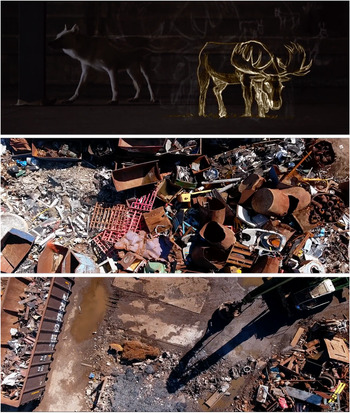
Undulating beneath Tagaq's spoken word poetics is another track of her voice, but here it is her personalised iteration of throat singing. This voice loops and pulses in time with the drum track, surfacing once Tagaq's spoken word track drops out for the duration of the song [1:58], and drives the visual and musical motion forward to support the message of urgency that infuses Tagaq's environmental activism woven throughout Retribution. Scored against this percussive vocal track are a series of disjointed images – an industrial dump of scrap metal and discarded machinery from the extractive resource industry, a white wolf trotting through the abandoned industrial building Tagaq and Williamson Bathory perform, effervescent illuminated line drawings of moose, caribou and bison, and tyre tracks from industrial machines imprinted into snow that has been soiled with soot and oil residue – and shots of Tagaq and Williamson Bathory performing together in a derelict industrial building and on urban streets as inattentive consumers and speeding traffic busily circulate around them (Figure 5). The final minutes of the video are aurally and visually frenetic, as though a limit (be it musical or environmental) has been reached and its bounds can be pushed no further. Tagaq releases a final extended scream [7:43] followed by a series of ascending cries until she abruptly stops, her vocals echoing through the empty building and the camera resting on the qulliq and its slow intense flames.
Video Stills of Animal Life and Discarded Industrial Materials from the Music Video ‘Retribution’.

Tagaq continues her aesthetic engagement with contemporary tar sands and pipeline politics elsewhere on Retribution. ‘Sulfur’ and its accompanying music video, like Retribution's title track and audiovisual treatment, highlights the abuse of Indigenous lands through the creation of oil fields, refineries, and processing plants, and pipelines to transport oil for internal processing and international export. ‘Sulfur’ is a reference to the by-product of the bitumen being extracted from the tar sands industry in Canada. Undulating silky illuminescent flows of oil move across the screen as blood red oil rigs fade in and are layered over the close-up shots of oil (Figure 6). Tagaq's voice begins to gurgle, foam, swell, intumesce, tumefy, and overflow against a shot of the violently gurgling ocean that surrounds the ground line and base of a mobile off-shore drilling oil rig [00:49]. The water pulses and ripples out as the extractive technology digs down and pumps out the crude oil. In contrast to ‘Retribution’, the music video that accompanies ‘Sulfur’ avoids physical human presence and instead focuses almost exclusively on the human technologies of oil extraction. When we encounter human beings in the video, they are in the forms of an exploratory miner discovering an oil reserve by accident and a group of activist Indigenous protesters. The miner inquisitively looks at his hands, questioning the sticky black substance that coats his skin. In contrast, the Indigenous protesters actively reject the extractive industry's exploitative relationship with the non-human environment that blatantly discounts an ethics of generosity and reciprocity that is at the core of Indigenous ways of being-in-the-world.
Video Stills of Visually Altered Oil Rigs and Oil from the Music Video ‘Sulfur’.

As the images of the rippling oil slick fade away, the colour of the oil rigs changes from red to black against what is now saturated red sky that screams alarm. Images connected to the Canadian oil industry move slowly across the screen: oil rigs, the oil refinery and its billowing opaque smokestack emissions, tar sands, congested highways, filling up suburban cars at the gas station, and footage of Indigenous anti-tar sands protesters carrying a banner with the text ‘If You Build It We Will Come’ (Figure 7). These are not fleeting images and they are meant to arrest our attention. ‘Sulfur’ is a chilling and evocative combination of visual imagery, audiovisual effects, and experiments with the human voice that interprets the material effects of environmental trauma inflicted upon traditional Indigenous lands by the energy industry. The video was released in 2016 shortly after the Canadian Prime Minister Justin Trudeau made the controversial announcement granting an initial ‘green-light’ to two oil pipeline projects, Kinder Morgan's TransMountain pipeline and Enbridge's Line 3. Regardless of the red tape and active protests that have slowed down the progress of these two pipeline projects, they will ultimately not only have degradative effects on the natural environment, but they will also impact the First Nations communities that live on the lands these pipelines slice through. The audiovisual narrative of ‘Sulfur’ draws on sounds and images that highlight the abuse inflicted upon unceded and ceded traditional Indigenous lands through the oil pipelines that circumvent and restrict Indigenous-informed ways of navigating the land, the oil sands tailings ponds, the oil rigs that sprout out from beneath the bedrock, and the congested highways that pattern the landscape.
Video Stills of the Impact of the Oil Industry from the Music Vide ‘Sulfur’.

In the aforementioned ‘Nacreous’ that opened this article, Tagaq juxtaposes beauty and toxicity in this song about the polar clouds contributing to the hole in the ozone layer. Some reviewers have likewise described Tagaq's voice as simultaneously beautiful yet grotesque, using affective descriptive terms like ‘petrifying howls’, ‘lulling murmurs’, ‘terror’, and ‘adoration’ in the same article (Borkowski Reference Borkowski2015; Presley Reference Presley2016). Distant and close-up shots of Circumpolar cloudscapes and NASA footage are visually processed with flashes of light, static, images that skip, accelerate or move in slow motion. The colour of each image is adjusted, flooded with saturated fields of pigment (e.g. lime green, bright cobalt blue, neon yellow) on the periphery of nature's palette (Figure 8). The gauzy ethereal clouds that hang at a high altitude in the atmosphere are scored against the glassy overtones of Tuvan throat singer Radik Tulush who contributes guest vocals on the track. Against these stunning, but discomforting visuals, Tagaq juxtaposes her voice. The grittiness of her vocal texture in this instance foreshadows the illusive and hidden toxicity of beautiful discard, similar to the glossy National Geographic photo essay centrefold of the visually stunning, but uninhabitable Alberta oil sands and tailings ponds (Remillard Reference Remillard2011; see also Rozelle Reference Rozelle2006).
Video Stills from the Music Video ‘Nacreous’.

Tagaq's introduction of segments of spoken word and declarative speech on a few tracks including ‘Retribution’ is a marked shift away from the linguistic content of her previous albums and cements the urgency of her environmental message in the album. There is no time to listen on repeat to develop a connection with the ecological message and decode meaning. Few of the songs have lyrics that the listener can latch onto and glean meaning from. Tagaq's listeners must rely on the timbre, texture and sensory manoeuvres of her voice to communicate her personal politics and aesthetic values. However, Tagaq is very clear in her interviews and press releases, outlining the politics of her music in frank terms so that there is no opportunity for the public to misunderstand her or unhear these important statements. In her press release for Retribution she aligns her work with ecofeminism and feminist materialism, stating candidly: ‘This album is about rape. Rape of women, rape of the land, rape of children, despoiling of traditional lands without consent’ (Tagaq quoted in Barclay Reference Barclay2016).Footnote 16
Retribution closes with a cover of Nirvana's ‘Rape me’, from their final studio album In Utero (1993), to ensure this is the last thing listeners hear. Tagaq has altered her cover version to sing the verse repeatedly in the first person, swapping the word ‘rape’ for ‘hate’, ‘kill’ and ‘beat’ each time in a whispered tone. This chilling cover references both the rape of the non-human environment, but also the systemic violence inflicted upon Indigenous bodies over the course of North American colonialisation and in the present in the form of police brutality and the social ruptures resonating from the Residential School System. As she sweetly sings ‘I'm not the only one’, she is invoking the destruction of Indigenous ancestral lands, the exploitation and depletion of what should be shared natural resources, and the systemic violence against Indigenous peoples – particularly the missing and murdered Indigenous women (#MMIW and #REDdress). This last allusion to rape culture on Retribution is even more poignant post-Ghomeshi, Cosby and Trump and the height of the #MeToo movement. ‘Rape me’ alludes to the actual and metaphorical violation of Indigenous lands and the underacknowledged non-human members of our global ecosystems.
Epilogue: Toothsayer and forward
In March 2019, Tagaq released Toothsayer (2019), which continues her creative activist making that joins landscape, culture and resistance. The music is excerpted from (and serves as a companion to) a commission she received to compose music for ‘Polar Worlds’, an exhibit at the National Maritime Museum in London, England. In Polar Worlds, patrons ‘discover the challenges of extreme environments. From Arctic and Antarctic exploration to the impact of climate change on human lives’ (Royal Maritime Museum, n.d.). The goal of this multisensory exhibit is to situate gallery visitors in place and history so that the issues that impact the communities and non-human environment of the polar region in the 21st century are kinetically experienced and present a diverse set of perspectives to represent the polyvocality of a multivalent Circumpolar North. Tagaq's music is central to creating that kinetic gallery experience. On Toothsayer, Tagaq continues to evoke her cultural experience and local surroundings as expressed sonically, and challenges listeners to recognise that their everyday world is not just a landscape in which they live, but a world that they shape through their experiences and actions. The tone of ‘Icebreaker’ is ominous, established by a low-pitched synthesiser drone, while the persistent rhythm of the drum track loops and drives forward alongside Tagaq's relentless shifting gasps and growls, inhales and exhales, suggesting that something (or someone) is steadily reducing the indispensable and irreplaceable polar glacier ice. Listening to Tagaq we are reminded that our environments are the product of our collective active engagements with our surroundings (see further Lefebvre Reference Lefebvre1991[1974], p. 5) and the ‘ecological relations’ forged among human and non-human beings (Ingold Reference Ingold2011, p. 5).
Tagaq's politics are unapologetically autobiographical, intensely connected to community and her lived experiences, and unavoidably intersectional. Her activism concerning the environment is bound up with what it means to be an Inuk woman in the 21st century, her role as a mother, her work as a maker, steward, and circulator of cultural knowledge. The intersectionality of her environmentalist art reappraises the ways in which we know, interact with, listen to, and exist in the world, while also decentring the human and normalised colonial settler perspectives in our understanding of placemaking and the agency of the non-human.
Retribution was recorded as a concept album focused on the slow toxic environmental violence inflicted upon the environment by the oil industry, and her preceding album, Animism, is a musical treatment of how ecological knowledge extends beyond personhood. These albums address the erasure of Indigenous consent and the resulting cultural and environmental violence, including the ‘rape of women, rape of the land, rape of children, despoiling of traditional lands without consent’ (Unreserved CBC Radio 2016; see further Brake Reference Brake2016). A vocal advocate for Inuit and Indigenous rights, Tagaq considers environmental justice to be a pan-Indigenous intersectional social justice issue, one that requires a polyvocal response from Indigenous and non-Indigenous activism. The current framing of the Anthropocene is Eurocentric and fails to account for uneven power relations or include marginalised perspectives and data, thus problematically implicating all humans as equally responsible for the ongoing ecocide and contemporary ecological crises. The Anthropocene ‘is already entwined with colonialism’, Davis and Todd argue, and ‘Indigenous knowledges should be productively engaged to disrupt and undo these universalizing and violent logics’ (Davis and Todd Reference Davis and Todd2017, p. 765). The confluence of ethics and aesthetics in Tagaq's creative activity is part of a broader operation in the arts to rethink the Anthropocene and include marginalised perspectives that are expressed through alternative performance structures and venues to raise awareness of urgent environmental issues and implement change.