One of the biggest stories of the 2008 election—which saw the first woman Republican vice-presidential candidate, the first woman with a serious chance to win a major party nomination, and the victory of the nation's first African American president—concerned an otherwise little-known community organization called ACORN.
Prior to 2008, few Americans had heard about ACORN (an acronym for Association of Community Organizations for Reform Now), although it was the nation's largest community organizing group. Then, during the presidential campaign, ACORN was thrust on center stage, the subject of many national stories in newspapers and magazines, on TV and radio news and talk shows, and on blogs and websites. The spotlight on ACORN reached a peak when Republican candidates John McCain and Sarah Palin charged ACORN with undermining the nation's economy and electoral process, focusing on alleged widespread “voter fraud” by the community group. In an effort to discredit candidate Barack Obama, they sought to link him to ACORN. After the election and Obama's inauguration, the attacks on ACORN continued and they continued to find their way into the mainstream media as well as the conservative echo chamber.Footnote 1
The political and media campaign against ACORN worked. A month before the election—in October 2008—a Pew survey that month discovered that 82 percent of the public had heard “a lot” or “a little” about candidate Obama's ties to ACORN. Republicans were more aware of the ACORN controversy than others. A solid majority of Republicans (60 percent) had heard “a lot” about ACORN, compared with fewer than half of Democrats (46 percent) and independents (43 percent).Footnote 2 That same month, a national Rasmussen poll found that 60 percent of likely voters had a slightly unfavorable or very unfavorable opinion of ACORN. The same poll reported that 45 percent believed that ACORN was consciously trying to register people to vote multiple times in violation of election laws.Footnote 3 By November 2009, another survey found 26 percent of Americans—and 52 percent of Republicans—believed that ACORN had stolen the election for Obama. Overall, 11 percent of Americans viewed ACORN favorably while 53 percent had a negative opinion of the group.Footnote 4
ACORN is now well known, but what most Americans know about it is wrong, based on controversies manufactured by the group's long-time enemies. Why and how did the ACORN controversy get so much attention? And why did most news media coverage of the controversy reflect an anti-ACORN perspective?
We examine a classic case of the agenda-setting effect of the news media: how a little-known community organization became the subject of a major news story in the 2008 U.S. presidential campaign and beyond. Secondly, we analyze how the ACORN controversy was “framed” in media reports by examining the activities of what we call “opinion entrepreneurs.” We examine how different Internet-based groups and individuals were able to inject their views in the media, and how they used the network of conservative media organizations (the so-called “echo chamber”) to test and promote their frames and channel the stories into mainstream media agenda. The seamlessness of the campaign against ACORN was startling: in the 2008 presidential contest, almost everything that the McCain-Palin campaign said about ACORN duplicated, sometimes almost word-for-word, what the conservative media and opinion entrepreneurs had already uttered.Footnote 5
Consequently, most of the mainstream news media coverage about ACORN during the 2008 presidential campaign and afterward utilized similar narrative frames. It repeated the conservative and Republican criticisms of the group without seeking to verify them or to provide ACORN or its supporters with a reasonable opportunity to respond to the allegations. Although we focus mainly on media coverage of ACORN during the 2007–2008 presidential campaign, conservative opinion entrepreneurs and the conservative media echo chamber remained fixated on ACORN, and managed to keep the controversy about ACORN's activities in the news in 2009 and early 2010. Media attention to ACORN reached a crescendo during the summer of 2009 after two young conservative activists released videotapes of their visits to at least 10 ACORN offices around the country, posing as a prostitute and her boyfriend, and asking for advice on taxes and, in a few instances, advice on a business venture that involved underage illegal immigrant girls from El Salvador. The videos were posted to the conservative web site biggovernment.com, and then quickly became the top story on the Glenn Beck Show, the rest of Fox News, conservative talk radio, CNN's Lou Dobbs Show, and finally proved irresistible for the mainstream news media.
The controversy surrounding the videos compounded ACORN's troubles. Congress—including some of ACORN's long-term allies—quickly voted to rescind ACORN's federal funding, primarily for homeownership counseling. Although ACORN received no funds from the IRS or the Census Bureau, both agencies also removed ACORN as a partner in efforts to help the working poor qualify for tax rebates and to encourage low-income households to fill out census forms. Many of ACORN's foundation funders withdrew their support. By the time a Congressional Research Service report exonerating ACORN of any wrongdoing was released in December 2009, ACORN was laying off staff, closing offices in many cities, and fighting for its survival.Footnote 6 In April 2010, ACORN closed its doors.
We found that the 2009 and 2010 stories about ACORN were merely the latest version of the same agenda-setting and framing patterns present during the 2007–2008 election period. Because of the news media's negligence in fact checking and quick acceptance of partisan frames about ACORN, the ACORN story was whipped into a “disingenuous controversy”—a controversy that emphasizes the appearance of controversy, but lacks the open debate and alternative perspectives of a genuine controversy.Footnote 7 In other words, news media coverage facilitated the making of ACORN into a ready symbol for controversy, a proxy for the poor, minorities, cities, radicals, and even Barack Obama, that could be deployed for partisan purposes in subsequent elections and political battles.
We also found that although ACORN was on the national agenda, local mass media were the least likely to jump onto the national news media's dominant “voter fraud” story-frame bandwagon. This points to some of the limitations of the conservative “echo chamber.”Footnote 8 The focus of the anti-ACORN disinformation campaign was largely a national battle, fueled by national political figures and designed to influence the national news media. At that level, conservative opinion entrepreneurs and the conservative media establishment were quite effective. But our analysis of three metropolitan newspapers that used local sources outside of the DC Beltway to verify stories found that they were much less likely to buy the disingenuous controversy about voter fraud than the national news media, which at best usually left its audience with unverified claims. Unfortunately for ACORN, although its work was largely at the local level, most of its foundation grants and government contracts originated at the national level and were thus affected by national politics.
Key Concepts: Agenda Setting, Framing, and Opinion Entrepreneurs
In recent decades, media scholars have identified two ways that the media influence public opinion and even policymaking—agenda setting and framing. Together, media agenda-setting and the way they frame stories and issues play an important role in shaping public opinion and influencing political debate. In fact, agenda-setting effects have been found to be even stronger when framed as part of a political campaign.Footnote 9
The concept of the “agenda-setting effect”Footnote 10 was initially documented by media researchers at the University of North Carolina in 1972. The effect suggests that the news media, by virtue of their ability to determine what will be in the news, create an agenda. According to a popular summary of the agenda-setting effect, the media don't tell people what to think, but what to think about. The collective effect of the news media's coverage of a certain issue increases the public salience of that issue. Thus, the media agenda “sets” the public agenda. For example, public concern about issues—war, crime, political scandal, homelessness, and others—is shaped in large measure by what the media covers.
A second way that social scientists examine media influence is by examining “frames.”Footnote 11 The frame of a news story gives meaning to the individual events reported. Todd Gitlin defines frames as “persistent patterns of cognition, interpretation, and presentation, of selection, emphasis, and exclusion, by which symbol-handlers routinely organize discourse, whether verbal or visual.”Footnote 12 In other words, the way in which a journalist tells the story is the story frame. If the agenda-setting function of the media shapes what readers and views think about, the way the media frames a story shapes what or how they think.Footnote 13 For example, Robert Entman explains that a dominant news frame, supported by the Bush administration, emerged after the September 11, 2001 terrorist attacks on the U.S. and endorsed invading Afghanistan and Iraq in a so-called “war on terror,” based in part on the alleged existence of weapons of mass destruction in Iraq.Footnote 14
Agenda setting and framing are related theories of mass communication and public opinion. Maxwell McCombs and Donald Shaw, authors of the seminal research article on agenda setting, view framing and agenda-setting as overlapping functions: “Both the selection of objects for attention and the selection of frames for thinking about these objects are powerful agenda-setting roles.”Footnote 15 Likewise, Entman sees agenda setting as part of framing: “Agenda setting can thus be seen as another name for successfully performing the first function of framing: defining problems worthy of public and government attention.”Footnote 16 McCombs notes that the accumulated evidence of nearly four decades of research on agenda setting and framing is “that journalists do significantly influence their audience's picture of the world.”Footnote 17
The media environment has changed dramatically since social scientists first began exploring agenda setting and framing. In their original agenda-setting study of media, for example, McCombs and Shaw needed to analyze only five local and national newspapers, two television networks, and two major news magazines to cover “nearly all of the sources used by Chapel Hill voters during the 1968 presidential election.”Footnote 18 Since then, the proliferation of channels and personal media with the advent of 24/7 cable and satellite television, cell phones, video games, and the Internet had some media theorists at the turn of this century wondering if mass communication and mass communication theory had ended.Footnote 19 But early experimental research on the Internet found mass media were still a dominant force in agenda setting. Researchers found that news on the Internet, like news in traditional news media, can make issues salient, but that the traditional news media set the news agenda of the Internet's electronic bulletin boards.Footnote 20 Several studies addressed the influence of blogs in campaigns. One study that analyzed blog posts and mainstream news media stories during the 2004 president election concluded that the blog agenda, regardless of the blogs' political leanings, were similar to the agenda of the mainstream news media, because “limited resources for gathering information make blogs heavily dependent on reports from more traditional media.”Footnote 21 Another study of the same election similarly found that the mainstream news media, particularly television networks, set the agenda for campaign blogs, as the campaigns reacted to what was in the news.Footnote 22
Our research on agenda setting and framing found a different dynamic of influence in the 2008 presidential campaign. The activities of certain groups and individuals, who we call “opinion entrepreneurs,” played an important role in creating the issue of ACORN and framing the story for the mainstream news media. We conceptualize opinion entrepreneurs as similar to Entman's notion of elites (politicians, ex-officials, and experts) who influence the mainstream news media, but different in that many of them are non-elite individuals, businesses, and quasi-political organizations who, often by virtue of a web page or blog, work outside the traditional definitions of those who influence the news and public agenda.Footnote 23 Moreover, their influence is magnified by the fact that they work collaboratively, as part of a network, echoing the same message; as a result, the whole echo chamber is larger in influence than the sum of its parts.
In the ACORN case, for example, the business-funded attack site, rottenacorn.com, and conservative provocateur Andrew Breitbart (whose biggovernment.com became a clearinghouse for communicating the Right's case against ACORN) represent significant opinion entrepreneurs. Breitbart in particular is a model for the new, potent agenda-setting influence of opinion entrepreneurs on the Internet. Wired magazine noted that Breitbart is a person who “rams [his talking] points into the popular consciousness.” In 2009, in anticipation of releasing the now-infamous videos targeting ACORN offices, Breitbart “deployed an army of 200 bloggers to write post after post about Acorn, giving the story momentum that once would have required a swarm of media outlets to achieve. Fox News ran several segments on the first day alone.”Footnote 24
ACORN had no comparable network of opinion entrepreneurs. Although ACORN was accused of being the main cog in a radical leftist network, it had little or no routine access to the mainstream media. Nor was there a left-oriented, progressive echo chamber counterpart with a comparable capacity to inject its message into the mainstream media. ACORN had no full-time media staff person and no full-time attorney in its national office. Put on the defensive, it was unable to mobilize its allies to serve as opinion entrepreneurs on its behalf. Most of the foundations that provided ACORN funding were cautious and gun shy about political controversy. Likewise, even some of ACORN's allies among Democratic elected officials were unwilling to come to ACORN's defense as the group became the object of controversy in the mainstream media (consistent with research that Democrats limit their rhetorical options in the face of campaign fundraising concerns).Footnote 25 The House vote on September 17, 2009 to ban all federal funding for ACORN was 345–75. All 173 Republicans and 172 of the 247 Democrats voted against ACORN.Footnote 26 At the time, the Tea Party protests against Obama and the Democrats (triggered by the health care reform debate) were generating considerable media coverage and making even liberal Democrats more cautious and defensive than usual. Thus ACORN was left to speak on its own behalf and lacked the capacity to do so effectively, as evidenced by the media's failure to give ACORN's perspective in the majority of stories.
In general, the news media (reporters and editors) seek out, respond to, and rely on some sources more than others, and those sources routinely become news.Footnote 27 Organizations with more resources or that have more credibility in the eyes of journalists are more likely to become regular news sources, and thus shape which issues (agenda setting) and which perspectives (frames) dominate the news. For example, business-backed organizations (such as the chamber of commerce, foundations, think tanks, or policy groups)Footnote 28 have the resources (staff, reports, blue-ribbon task forces, social connections) to get their concerns into the media's line of vision, whereas low-income groups often have to resort to protest. During a political campaign, candidates and their staffs become major sources of news, but some candidates receive more coverage (agenda setting) and more control over their narratives in coverage (frames) than others. The role of opinion entrepreneurs in influencing media coverage—agendas and frames—has not received the attention it deserves. We examine this phenomenon through the media coverage of ACORN.
When reporters can't immediately verify the facts of a statement from a legitimate source, they simply report the “truth claim,” as Gaye Tuchman explained in her book, Making News. A statement may or may not be true, but it is true that the source said it. Sometimes the reporter may report an opposing truth claim, enabling the reporter to “claim to have been fair by presenting ‘both sides of the story.’”Footnote 29 Journalists refer to this as the “he said/she said” approach to reporting.
But it isn't simply a neutral balancing act; the news media gives more or less credence to certain truth claims by way of narrative framing. Over time, some sources gain credibility by having their truth claims regularly repeated, but not evaluated for their validity. As Trudy Lieberman noted in her study of the conservative news media, repetition creates a truth of its own: “If the public hears the same message multiple times, soon people will believe its veracity.”Footnote 30
We investigate a series of questions: Have recent opinion entrepreneurs used new media outlets—such as web sites and blogs—to influence the agenda and framing of the mainstream news media, thus changing the direction of influence in media theories? Do the conservative media—broadcast, print, and new (Internet) media—repeat certain truth claims over and over? Do they frame stories with few or no opposing truth claims? Do these narratives influence the news agenda at mainstream media? Do these stories influence the public agenda?
By examining a recent political controversy, we explore a question of concern to political activists as well as political scientists. We consider the emergence of a new phenomenon on the political scene—the conservative echo chamber—to understand its role in American politics and its impact on the mainstream media, public opinion, and campaign dynamics. Our main purpose in this study is not to advance a new theory, but to take up Donald Kinder's recommendation to balance studies of experimental lab-based research of framing effects with “more studies of framing au naturel.”Footnote 31 Kinder's point reflects Bent Flyvbjerg's account of the limits of traditional “social scientific” social inquiry.Footnote 32 Flyvbjerg calls for analyzing power in everyday social practice and redeeming the legitimacy of the case study, rich with context. Similarly, Sanford Schram and Philip Neisser argue for the study of narratives as “an alternative to the dominant positivist understanding of the public policy-making process and public policy analysis.”Footnote 33 With the study of ACORN, we examine the narratives and power relations of a major political controversy, applying agenda-setting and framing theories as the narratives were still unfolding in a very complex media environment.
Methodology
Our methodology follows the steps identified by Dennis Chong and James Druckman: 1) identify the issue, 2) understand how frames in communication affect public opinion, 3) identify a set of frames for a coding scheme, and 4) select sources for a content analysis and test the coding procedure with a sample.Footnote 34
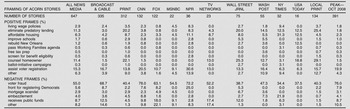
First, we first identified our study's issue as media coverage of ACORN during the 2008 presidential election. Second, our focus was how the network of opinion entrepreneurs and news media coverage put ACORN on the public agenda, and how the news media framed stories about ACORN during the campaign. Third, we identified a set of narrative frames for the coding scheme by examining the range of frames offered by opinion entrepreneurs and news media. We identified 11 potentially positive frames about ACORN, which derived from ACORN's own description of its activities, ranging from working to enact living wage policies and eliminating predatory lending practices, to doing mortgage counseling for first-time homeowners and assisting in voter registration.Footnote 35 Based on our analysis of long-running criticisms of ACORN in conservative websites, blogs, and conservative authors and broadcast pundits, we also identified five potentially negative frames that might appear in the mainstream news media. These criticisms included voter fraud (which typically meant, but was not called, voter registration fraud), ACORN as a front for registering Democrats, ACORN as the source of the national mortgage and foreclosure crisis, ACORN's admission of its own internal embezzlement scandal, and disapproval of ACORN receiving public funds (refer to Table 1.) Each of the stories we analyzed had at least one narrative frame about ACORN; stories could have more than one frame, and could have both positive and negative frames.
ACORN story frames in the news

Finally, we selected sources for content analysis. We examined the complete 2007–2008 coverage of ACORN by 15 major news media organizations. Four are among the nation's top five highest circulation newspapers: USA Today, New York Times, Washington Post, and the Wall Street Journal. (The Los Angeles Times, number four in US circulation, which is less of a nationally circulated newspaper, was not included in our study.)Footnote 36 In addition, we analyzed the transcripts of reports about ACORN from leading broadcast news organizations: ABC, CBS, NBC, Fox News Channel, CNN, MSNBC, National Public Radio (NPR), and NewsHour with Jim Lehrer (PBS). To get a different perspective, we also analyzed stories from three local newspapers representing cities in which ACORN has a long-time presence: Pittsburgh Post-Gazette, Minneapolis Star-Tribune, and the Cleveland Plain Dealer.
The combination of the four major dailies, the three local dailies, and the eight broadcast outlets netted a total of 647 stories.Footnote 37 All of these stories were accessed through the LexisNexis database, except for the Wall Street Journal stories, which were accessed through the ProQuest database. We developed a coding scheme to analyze story framesFootnote 38 and other story components and refined the scheme after a pilot test. Two independent coders were trained and tested in a pilot study. Both then coded all 647 stories. A 10 percent sample of all variables was evaluated, with coder interreliability on all variables ranging from 87.5 to 100 percent, generally accepted as a high rate of coder agreement.Footnote 39
Beyond the formal content analysis for 2007–2008, we monitored and analyzed media coverage of ACORN and ACORN's fate after Obama took office in January 2009 through April 2010, when ACORN was forced to dismantle its operation. Thus we were able to examine whether, and how, the conservative echo chamber's anti-ACORN frame persisted beyond the election to influence public opinion and, ultimately, ACORN's survival.
Community Organizing and ACORN
In recent years, a growing number of social scientists, historians, and journalists have documented the upsurge of grassroots organizing across the country and the role of community organizing groups in the nation's political culture. Traditional community organizing typically involves the mobilization of low-income and working class residents of local neighborhoods to improve social and economic conditions and to gain political influence. Unlike most “interest groups” and voluntary associations that rely primarily on conventional tactics such as lobbying and voter drives, community organizing groups rely on both conventional tactics and more unconventional tactics such as protests. Community organizing groups mobilize people to fight on their own behalf, compared with advocacy groups that typically hire professionals to advocate on behalf of others.Footnote 40 Participants in community organizing tend to be people who are marginalized by established political institutions and channels of influence—typically low-income and working class residents of cities—although the community organizing world has expanded to include new constituencies and approaches, as we shall see.Footnote 41
Historians trace modern community organizing to Jane Addams, who founded Hull House in Chicago in the late 1800s and inspired the settlement house movement. These activists—upper-class philanthropists, middle-class reformers, and working-class radicals—organized immigrants to clean up sweatshops and tenement slums, improve sanitation and public health, and battle against child labor and crime. In the 1930s, another Chicagoan, Saul Alinsky, took community organizing to the next level. He sought to create community-based “people's organizations” to organize residents the way unions organized workers. He drew on existing groups—particularly churches, block clubs, sports leagues, and unions—to form the Back of the Yards Neighborhood Council in an effort to get the city to improve services to a working-class neighborhood adjacent to meatpacking factories.Footnote 42
Activists in the 1960s adopted some of the strategy ideas outlined in Alinsky's books, Reveille for Radicals and Rules for Radicals, but it wasn't until the 1970s that nation experienced an upsurge of community organizing, what Harry Boyte called a “backyard revolution.”Footnote 43 That trend has continued, with groups organizing around the traditional bread-and-butter neighborhood issues (such as public safety, tenants rights, and gentrification) as well as newer issues like environmental justice, immigrant rights, and living wages. The number of groups engaged in community organizing has mushroomed. Almost every US city (and a few suburbs) now has at least one—and in many cases dozens of—community organizing groups.Footnote 44
Community organizations emerge out of churches and synagogues, social service agencies, neighborhood self-help groups, unions, and other institutions. Robert Putnam, Steven Rosenstone, John Hansen, and others have lamented the declining membership in voluntary associations and organizations that mobilize people for political power, but it is likely that these studies overlook many people who are involved in community organizing groups, especially low-income and working class Americans. No one really knows how many community organizations exist, the total size of their budgets, the number of staff people who work for them, how long they've been in business, how many are linked to larger networks, or how effective they are.Footnote 45 Many (perhaps most) of the community organizing groups that have emerged in the past four decades eventually fell apart or remained small and marginal, unable to sustain themselves financially, economically, and politically. What seems clear, however, is that most community organizations engage in relatively modest efforts. These include, for example, pressuring the police to close down a local crack house, getting city hall to fix potholes, or getting the parks department to clean up a local playground. Some groups are more ambitious. Their community organizing has included enacting living wage laws, forming tenant unions, building community development corporations, combating redlining, challenging police abuses, fighting against environmental and health problems, mobilizing against plant closings and layoffs, reforming public education, setting up housing trust funds, encouraging inclusionary zoning laws, expanding funding for health services and public schools, and even setting up charter schools.
Most community organizing groups are rooted in local neighborhoods, often drawing on religious congregations and block clubs. But changes in the nation's economic, social, and political conditions make neighborhood-based organizing less effective than was the case in the 1940s, when Saul Alinsky first formulated his ideas about community organizing, or even in the 1970s, when corporate consolidation accelerated. Moreover, local governments have less money and influence today than in the past, making it more difficult for city politicians to respond to community demands.
A major dilemma for contemporary community organizing groups is the reality that the sources of urban problems—poverty, unemployment, homelessness, violent crime, racial segregation, high infant mortality rates—have their roots in large-scale economic forces and federal government policy outside the boundaries of local neighborhoods. What influence, then, can neighborhood organizing groups be expected to have on policies made in city halls, state capitals, Washington, and corporate board rooms?
In Diminished Democracy: From Membership to Management in American Civil Life, Theda Skocpol laments that since the early 1900s mass membership grassroots and mixed-income organizations have declined and been replaced by advocacy/lobbying groups run by professional staff with little capacity to mobilize large numbers of people.Footnote 46
Some community organizing groups have responded to these trends by expanding in scope and scale. They grew and gained in strength, in part by becoming part of broader networks at the city, regional, or national levels. Although most local community groups are not linked to any regional or national organizing or training networks, those local groups that are so connected have been helped to improve their capacity to develop leaders, mobilize campaigns, and win local victories as well as participate in citywide, state, and national campaigns beyond their local bases.
Thus the notion of “community organizing” has evolved beyond its localist origins. While many groups continue to focus exclusively on local issues, there are now a number of national organizing networks with local affiliates, enabling groups to address problems at the local, state, and national levels, sometimes even simultaneously. These groups include ACORN, the Industrial Areas Foundation (IAF), People in Communities Organized (PICO), the Center for Community Change, National People's Action, Direct Action Research and Training (DART), the Partnership for Working Families, and the Gamaliel Foundation (the network affiliated with the Developing Communities Project that hired Obama in Chicago in 1983). These networks, as well as a growing number of training centers for community organizers—such as the Midwest Academy in Chicago, the Highlander Center in Tennessee, and a few dozen universities that offer courses in community and labor organizing—have helped recruit and train thousands of people into the organizing world and strengthened the community-organizing movement's political power.
Within the community organizing world, ACORN was (until its demise in early 2010) the largest and most effective group, in part because it was, in Skocpol's terms, a federated organization with local bases but with a national infrastructure and the capacity to wage campaigns simultaneously at the local, state, and national levels.Footnote 47 Its staff worked to build strong local organizations and leaders that could influence municipal and county governments as well as major corporations (such as banks) to address the needs of the poor and their neighborhoods. Local organizing defined ACORN's core issues, but when national leaders and staff recognized problems that were energizing members in several cities, they could consider whether changes in state or federal policy would more effectively address the issue. ACORN employed a staff of researchers and lobbyists in its national offices in Brooklyn, New York, and Washington, DC, to serve the needs of local chapters. Issues such as welfare reform, redlining, predatory lending, school reform, and low wages provided ACORN with organizing “handles” at the local, state, and national levels. Their efforts in mobilizing the residents of New Orleans forced to evacuate by Hurricane Katrina benefitted from ACORN's capacity to work simultaneously to put pressure on politicians and policymakers in several cities, in at least two states, and at the national level. By 2008, ACORN was the largest community organizing group in the United States. It had chapters in about 110 cities in 40 states, and ACORN and its affiliates had over 1,000 employees and nearly 500,000 dues-paying families.Footnote 48
ACORN emerged out of the anti-poverty activism of the 1960s. By the late 1960s, one of those groups, the National Welfare Rights Organization, had built an organization with affiliates in 60 cities across the country. But because it focused exclusively on welfare recipients, its narrow constituency base guaranteed that it would remain a marginal force in the nation's politics. George Wiley, NWRO's leader, believed that the time was ripe to build a broader multi-racial movement for economic justice, with a membership base of low-income people, including the working poor, but with support from middle-class allies. A one-time NWRO organizer, Wade Rathke, started ACORN in Little Rock, Arkansas in 1970, organizing welfare recipients and low-income working families around issues that could unite them, among them free school lunches, Vietnam veterans' rights, hospital emergency room care, and unemployment. ACORN initially stood for Arkansas Community Organizations for Reform Now.
ACORN soon expanded in Arkansas and started building chapters in other cities throughout the South and later throughout the country. By 1975, it was organizing in eight cities in three states. Five years later, ACORN had chapters in 35 cities in 24 states. By 2000, it had 46 affiliates in 29 states. After 2000, ACORN rapidly accelerated its expansion effort, growing to 92 cities in 35 states by 2005, then to 103 cities in 40 states three years later. As a result of its expansion outside Arkansas, the group kept its name but soon revised the acronym to stand for Association of Community Organizations for Reform Now. Most people, however, simply knew the group as ACORN.Footnote 49
The Beginnings of an Anti-ACORN News Frame
To understand how conservative groups used the media to manufacture a controversy about ACORN, it is useful to examine the chain of influence that involves several sectors: business-sponsored groups that opposed ACORN's organizing work on wages, lending and other issues; Republican Party officials and candidates; conservative websites and blogs, publications, columnists, and TV and radio talk shows; and mainstream media organizations.
During its more than three decades of community organizing, ACORN made enemies among some politicians, business groups, and conservatives. Many politicians, especially Republicans, opposed ACORN's efforts to register and mobilize low-income minority voters, who tend to vote for Democratic candidates. In the past few years, ACORN was among the most effective groups at registering low-income voters, and they were able to focus their efforts in key states.Footnote 50 The banking industry generally opposed ACORN's campaigns against redlining and predatory lending and its support for legislation, like the Community Reinvestment Act, to strengthen government regulation of the industry. Firms involved in predatory lending, pay-day lending, and credit card abuses created a front group, the Consumer Rights League (CRL), to attack ACORN, not only on lending issues but also on ACORN's other activities, including its voter registration work. Similarly, the restaurant, hotel, alcoholic beverage, and tobacco industries, who opposed ACORN's work to raise wages through campaigns to adopt local “living wage” laws and to increase minimum wages at the state and federal levels, created a front group, the Employment Policies Institute (EPI), that has issued reports and created a website to discredit ACORN and thwart ACORN-led efforts. Both CRL and EPI are “Astroturf” lobbying organizations, a term coined by the late US Sen. Lloyd Bentsen to refer to organizations that claim to be grassroots-based citizen groups but are actually conceived, created, and/or funded by corporations, industry trade associations, political interests, or public relations firms.
For years prior to 2008, these organizations had limited success in generating anti-ACORN stories. The stories usually appeared in the conservative echo chamber, but only occasionally in the mainstream media (refer to Figure 1). During the 2008 political season, however, the issues and frames promoted by ACORN's opponents received much more attention. A measure of their success was that the names of the business-backed groups that started the anti-ACORN crusade—the Consumers Rights League and the Employment Policies Institute—appeared only once each in the 647 stories analyzed. Their fingerprints were missing, but their influence was evident in news frames about ACORN.
ACORN stories from 15 news organizations by month, 2007–2008

The persistent attacks on ACORN gained more visibility in 2008, when a perfect storm of conditions emerged. These included the earlier rise of cable television and the 24/7 news cycle, the proliferation of conservative TV and radio talk shows, the creation of the Internet and blogosphere, the domination of the Republican Party by its conservative wing,Footnote 51 the emergence of the Tea Party movement, and a presidential election in which an African American—a former community organizer with tangential ties to ACORN—became a leading candidate and ultimately the Democratic nominee.
In a well-known essay in Harper's magazine in 1964, historian Richard Hofstader identified what he called the “paranoid style” in American politics. He examined the tendency for conservative movements throughout American history to craft conspiracy theories.Footnote 52 This tendency persists today, exemplified by the Tea Party movement and the upsurge of conservative bloggers, websites, and especially broadcasters like Rush Limbaugh, whom Jamieson and Cappella consider the dean of what they call the “conservative media establishment.”Footnote 53 In recent years, however, Glenn Beck has catapulted to the top of that establishment and, if anything, supplanted Limbaugh as the dominant modern-day practitioner of the “paranoid style” of politics.Footnote 54
The Right's framing of ACORN is part of a larger ultra-conservative narrative that pegs ACORN as a tool in a larger Obama socialist/Marxist strategy. The conservative narrative identifies an otherwise relatively obscure 1966 article in The Nation by sociologists Richard Cloward and Frances Fox Piven as the founding document of the alleged radical leftist conspiracy.Footnote 55 Tagged the “Cloward-Piven strategy” by the Right, the article called for the poor to demand an expansion of the social safety net. A politicized poor would create a political crisis, urging political leaders to act in response to group demands, like in the New Deal of the 1930s and the Civil Rights Movement of the 1950s and 1960s. In the estimation of ultra-conservatives, though, the Cloward-Piven article represents a leftist plan for destroying the government and imposing “Obama's socialist agenda.” For example, Glenn Beck first mentioned the so-called “Cloward-Piven Strategy” in March 2009, shortly after he began his nightly Fox News show, and mentioned it at least 32 times in the next twelve months, connecting it in his trademark hand-drawn marker board diagrams to ACORN, Che Guevara, Bill Ayers, the SEIU, the Apollo Alliance, the Tides Foundation, George Soros, Van Jones, Valerie Jarrett, and Obama—all villains in the alleged conspiracy.Footnote 56 Opinion entrepreneur WorldNetDaily editor Joseph Farah linked every major Obama policy to the “Cloward-Piven strategy” in a keynote address to the founding Tea Party convention in February 2010. “With Obama, everything is a crisis. Carbon dioxide levels. The banking industry. The automobile industry. The health care system. And especially the economy. He's going to fix all of them, he promises. How? By turning make-believe crises into real crises,” Farah said.Footnote 57
As Jamieson and Cappella document, on its own the conservative echo chamber speaks to a relatively narrow base of very conservative followers.Footnote 58 Its influence depends on injecting its idea into the mainstream media and thus helping to shape broader public opinion, especially the views of what pollsters and political scientists consider “moderate” or “swing” voters. Even if the ultra-conservative echo chamber doesn't change their minds about particular issues or change their worldview, their ability to plant seeds of doubt via mainstream media helps to undermine the credibility of liberal ideas, organizations, and institutions.
The Wall Street Journal is a mainstream media institution that serves as transmission belt for the ideas of conservative activists. Although its regular news stories are moderate in tone, the Journal's opinion and editorial pages are staunchly conservative, and were one of ACORN's most persistent critics. As the Journal noted in an October 14, 2008 editorial, “We've written about them for years, but Acorn is now getting more attention as John McCain's campaign makes an issue of the fraud reports and Acorn's ties to Mr. Obama. It's about time someone exposed this shady outfit that uses government dollars to lobby for larger government.”Footnote 59
The Journal's language reveals much about efforts to shroud ACORN with a disingenuous controversy. First, “make an issue” about ACORN. Facts were not presented, only allegations that there was something troublesome or controversial going on with ACORN. Second, repeat the notion that ACORN has “ties” to Obama. (The ultimate goal was to damage the Obama campaign and, later, the Obama presidency). Finally, stigmatize ACORN with negative language—such as “shady outfit”—and keep suggesting “it's about time someone exposed” ACORN, despite the fact that after years of politically motivated state and federal charges and investigations there was no serious criminal wrongdoing by ACORN to expose.
Starting in 2004, Karl Rove (President George W. Bush's top political advisor) personally orchestrated an attack on ACORN. He insisted that a number of U.S. attorneys prosecute ACORN for voter fraud, even if there was no evidence for it. When one of them, David Iglesias, the U.S. Attorney in New Mexico, investigated the situation and discovered ACORN had not engaged in any fraud, he refused to prosecute the group. Rove quickly got Attorney General Alberto Gonzales to fire him, part of a pattern that ultimately led to the resignation of Gonzales in 2007. The resulting scandal eventually forced Gonzales to resign, but he had already helped put the anti-ACORN campaign in motion.Footnote 60
In 2006, during Bush's second term, conservatives and Republicans renewed their efforts against ACORN. Although there was growing dissatisfaction in public opinion polls with Bush and the Republican Party, if they could make their political opponents look worse by linking them to a controversial, even “radical,” group, they still might win in 2008.
The seeds of conservative efforts against ACORN were planted first on the Web, an example of the process of opinion entrepreneurship. Hundreds of blog sites echoed the same unsubstantiated allegations and charges about ACORN. The sites, some well known, others not, included Townhall, NewsBusters, WorldNetDaily, The Foundry, Chicagoans Against Obama, Let Liberty Ring, Sharp Right Turn, LaRouchePAC, Wake Up America, Red Stater, Audacity of Truth, Audacity of Hypocrisy, Christian Coalition of America, Christian Action League, SarahPalin4VP, Judicial Watch, and Accuracy in Media.
Many of the initial allegations originated with industry-funded campaigns, or conservative commentators and operatives—opinion entrepreneurs. What follows is a review of some of the Internet-based campaigns against ACORN that began prior to it becoming a major presidential campaign issue in 2008.
One of the earliest Web efforts against ACORN was a website called rottenacorn.com, sponsored by the Employment Policies Institute. It represented a common business-funded attack on ACORN, with familiar charges on its Web site:
ACORN's practices have corrupted our political process as well. It has engaged in questionable election activities for years—stretching back even to the organization's founding years in Arkansas. In recent years, as its political power has increased, so have instances of fraud. In the past few years, it has been investigated for election fraud in at least a dozen states.Footnote 61
Like the approach noted earlier, the modus operandi was to taint ACORN with charges of systemic corruption (“questionable activities,” “investigated for election fraud”), yet the site and its 30-page report from July 2006, titled “Rotten ACORN: America's Bad Seed,” did not produce any evidence of convictions against ACORN.Footnote 62
The Employment Policies Institute (EPI) is actually a front group created by Washington, D.C.-based Berman & Co., which specializes in Astroturf lobbying. According to the reporting of SourceWatch.org, “EPI's mission is to keep the minimum wage low so Berman's clients can continue to pay their workers as little as possible.”Footnote 63 Thus, part of EPI's job was to churn an ever-present information campaign against ACORN for its clients in the chain restaurant and bar industry.
Berman & Co. continued its campaign against ACORN through LaborPains.org, a web site sponsored by two other Astroturf lobbying organizations—the Center for Union Facts, and the Employee Freedom Action Committee. Both groups are headquartered at the same Washington, D.C. address of Berman & Co., and oppose reforms that would make it easier for labor unions to organize. A March 19, 2007 posting titled “Prosecutors Eye Union-Backed ACORN (Again)” on LaborPains.org took a familiar swipe at ACORN:
We've discussed before the union-backed group ACORN, which has been tied to voter fraud in more than a dozen states in recent years…. News from this weekend suggests that systematic voter fraud is fact, not myth. The [New York] Times reports that one of the federal prosecutors mired in a political mess failed to investigate ACORN in an a (sic) meaningful way for its repeated (and galling) shenanigans in New Mexico.Footnote 64
Again, a conservative web site recycled allegations (“tied to voter fraud” and “shenanigans”). Yet the posting misinterpreted the New York Times story it referenced. In fact, the Times story was about the emerging scandal about the firing of a U.S. Attorney. David Iglesias, the federal prosecutor in New Mexico who did not find merit in charges of voter fraud against ACORN despite the urgings of his state's Republican Party officials, was one of the federal attorneys fired. “I thought I was insulated from politics,” Iglesias said. “But now I find out that main Justice was up to its eyeballs in partisan political maneuvering.”Footnote 65 Still, the effect of the LaborPains posting was to keep repeating misinformation about ACORN to make a controversy seem legitimate.
Later in 2007, Investor's Business Daily, a conservative business newspaper, rehashed more accusations and misrepresentations. “ACORN has been accused of voter fraud in 13 states since 2004 and was convicted of falsifying signatures in a voter registration drive last July, drawing a fine of $25,000 in Washington state,” the newspaper wrote in an editorial that was often repeated around the conservative blogosphere as evidence of evil at ACORN.Footnote 66
But accusations of voter fraud do not amount to wrongdoing (no matter how often they are repeated). As the Seattle Times more truthfully reported, it was rogue ACORN employees who falsified voter registrations, not an ACORN conspiracy. The defendants “concocted the scheme as an easy way to get paid, not as an attempt to influence the outcome of elections, King County Prosecuting Attorney Dan Satterberg said,” the newspaper stated. ACORN agreed to pay $25,000 to King County for investigative costs.Footnote 67
Conservative publicist and Republican strategist David Horowitz added to the efforts to stigmatize ACORN with his “DiscoverTheNetworks.org: A Guide to the Political Left” web site that he launched in early 2005. The profile for ACORN included this description:
• “Largest radical group in America, with more than 400,000 dues-paying member families, and more than 1,200 chapters in 110 U.S. cities”
• “Was implicated in numerous reports of fraudulent voter registration, vote-rigging, voter intimidation, and vote-for-pay scams during recent election cycles”Footnote 68
Again, the crimes and misdemeanors of a “radical” community organization are in fact just “implicated.” The evidence offered by DiscoverTheNetworks.org comes from the same swirl of allegations previously published in conservative and Republican Internet sites, plus conservative periodicals and news organizations like Fox News, the National Review, the American Spectator, and the op-ed pages of the Wall Street Journal. This is the modus operandi of a media “echo chamber.”
Included in the list of resources on DiscoverTheNetworks.org were anti-ACORN pieces by Michele Malkin, the self-described “blogger, conservative syndicated columnist, author, and Fox News Channel contributor.” In her July 26, 2007 post, Malkin also misrepresented the Washington state case:
Guess which left-wing group is at the center of the worst case of voter-registration fraud in Washington state history? Yep, you guessed it: ACORN. The same ACORN tied to massive voter fraud in Missouri. And Ohio. And 12 other states.Footnote 69
“At the center” and “tied to” are the same stigmatizing language used in the other conservative blog posts, adding to the resonating theme. In fact, this single Malkin post was quoted and hypertext linked to 58 other web sites.Footnote 70 Malkin's post also revealed the second step of the conservative strategy: link the sullied name of ACORN to the leading Democratic candidate. In mid-2007, the Democrat leading in the polls in Iowa (the first state in the nominating process) was featured in the title of Malkin's post: “John Edwards & ACORN, perfect together.”Footnote 71
By 2008, the conservatives and Republicans, as they attempted to bring the campaign against ACORN to a much wider audience, had laid a solid trail for the mainstream news media to follow. One important example of the intentions of conservatives/Republicans was the revision of John Fund's book, Stealing Elections: How Voter Fraud Threatens Our Democracy. Fund, an editorial writer for the Wall Street Journal and ghostwriter of Rush Limbaugh's 1993 book The Way Things Ought to Be, made absolutely no mention of ACORN in his first edition of the book in 2004.Footnote 72 But, by the release of the revised edition of Stealing Elections in July 2008,Footnote 73 the target had changed. Fund included two new chapters demonizing ACORN, including one whose title reflected Malkin's approach a year earlier and foreshadowed the Republican's new campaign strategy: “Barack Obama and ACORN: Perfect Together.”
Along with Fund, Stanley Kurtz was the conservative echo chamber's most persistent figure in circulating the charges against ACORN. Kurtz, who is affiliated with the conservative think tank Ethics and Public Policy Center, frequently wrote about ACORN for conservative publications such as National Review, Footnote 74 as well as conservative daily newspapers such as the New York Post Footnote 75 and Wall Street Journal. Footnote 76 He also frequently appeared on conservative TV and radio shows, and was cited as an expert on ACORN by other conservative columnists and by talk show hosts. His articles were frequently reprinted and cited by websites and blogs and other parts of the conservative echo chamber. (During the campaign, McCain's attacks on ACORN were drawn substantially from Kurtz's writings).
By October 2008, conservative talk radio host Rush Limbaugh, already deeply immersed in the accusations of the conservative echo chamber, came to this conclusion on his national radio program:
I actually think, after studying all this ACORN stuff, and reading what Stanley Kurtz [a contributor to National Review magazine] has written about this … you find that it has been part of an entire movement that has been going on for two, maybe three decades, right under our noses.
We thought that it was just liberal welfare policies and all that that kept blacks from progressing while other minorities grew and prospered. But no, it is these wackos from Bill Ayers to Jeremiah Wright to other anti-American, Afrocentric black liberation theologists, working with ACORN, and Barack Obama is smack dab in the middle of it. They have been training young black kids to hate, hate, hate this country. And they have trained their parents before that to hate, hate, hate this country. It was a movement! It was a Bill Ayers, anti-capitalist, anti-American educational movement. ACORN is how it was implemented, right under our noses. They're doing far more, folks, than just cheating when it comes to elections and registration. They're deep in this mortgage crisis. ACORN and Obama and Barney Frank and Chris Dodd—the Democrat (sic) Party—have their fingerprints all over the subprime mortgage crisis. It has been a movement. It has been a religion. And Obama and Jeremiah Wright and William Ayers were all up to their big ears in it.Footnote 77
Limbaugh's crescendo fit nicely into the conservative media's angle on ACORN, repeated so many times, hyped with so many allegations, and ramped up with great ferocity in October 2008 (refer to Figure 1 and Table 1) in an attempt to put ACORN on the national public agenda in the final month of the presidential election.
Putting ACORN on the Nation's Public Agenda
The ACORN case is an excellent example of the agenda-setting effect. Opinion entrepreneurs set the story in motion as early as 2006, the conservative echo chamber orchestrated its anti-ACORN campaign in 2008, the McCain campaign picked it up, and the mainstream media reported its allegations without investigating their truth or falsity.
The GOP strategy was on display at the Republican convention in St. Paul in September 2008. There, former New York City Mayor Rudy Giuliani, former New York Governor George Pataki, and newly minted vice presidential candidate Sarah Palin pointedly attacked Obama's experience as a community organizer.Footnote 78
On October 15, 2008, Republican candidate Senator John McCain said in a televised presidential debate with candidate Barack Obama at Hofstra University that ACORN “is now on the verge of maybe perpetrating one of the greatest frauds in voter history in this country, maybe destroying the fabric of democracy.”Footnote 79
Before October 2008, most news coverage about ACORN was generally limited to the metropolitan areas where the community organization conducted its activities. Although there were no national surveys documenting the public's familiarity with ACORN prior to October 2008, it is likely that most Americans didn't know much about ACORN before then. But, particularly with unprecedented numbers of news stories mentioning ACORN in the month before the presidential election, ACORN was vaulted onto the entire nation's public agenda.
There were 647 stories mentioning ACORN over 2007–08 in the 15 news organizations we analyzed. For most of the period, news coverage was relatively steady, but there was a spike of 391 stories in October 2008, that one month accounting for 60 percent of the ACORN stories over the 24-month period;Footnote 80 (refer to Figure 1).
By October 2008, ACORN was clearly on the public's agenda as well. The Pew Research Center for the People and the Press, in a survey conducted during October 17–20, asked a national sample of about 1,000 voters, “How much if anything have you heard about … Barack Obama's connection to the community organizing group ACORN, which has been accused of voter registration fraud?” Nearly half of the country (48 percent) heard “a lot,” 34 percent heard “a little,” and only 18 percent of respondents had heard nothing at all. It is a testament to the high level of attention given to ACORN at Fox News, the Wall Street Journal, and the rest of the conservative media echo chamber that the same survey found that “a solid majority of Republicans (60 percent) have heard a lot about ACORN, compared with fewer than half of Democrats (46 percent) and independents (43 percent).”Footnote 81
Of course, agenda-setting theory only explains why the public was thinking about a topic—in this case, ACORN. A second step in analysis looks at how the news media framed the story; that is, how in its stories the news media suggested what readers, viewers, and listeners should think about ACORN.Footnote 82
Framing ACORN for Voter Fraud
The data in Table 1 represent the percentage of the stories that had certain narrative frames. For example, of the 55 stories about ACORN in the Washington Post over 2007–2008, 47.3 percent had a “voter fraud” frame, 16.4 percent used an “assist voter registration” frame, and 14.5 percent carried an “eliminate predatory lending” frame.
As Table 1 indicates, voter fraud was the dominant story frame in news about ACORN for 2007–08, with 55 percent of the total 647 stories analyzed using it. In fact, given the comparatively low percentages for alternate frames about ACORN (the two next most frequent frames appeared in only 15.3 percent and 11.4 percent of the stories), allegations of voter fraud may have been the only story frame about ACORN that many news consumers experienced. Coverage of the voter fraud frame was even more intense in the broadcast and cable media, with 68.7 percent of those stories using the frame. Other than “assisting voter registration” (in 16.7 percent of broadcast stories)—a frame that got tainted by the much more common “voter fraud” frame—uses of any other frames were extremely low among all broadcast news media. Thus, among broadcast media, ACORN was plainly linked to voter fraud, with no major competing frames. This corresponds with what Donald Kinder identifies as the way in which news frames are presented “in everyday life.” Although frames may be operationalized as a condition and easily isolated in an experiment, in real life they are “characterized by repeated exposure through multiple venues over long periods of time—a whole curriculum of exposure.”Footnote 83 In the case of ACORN, the curriculum of exposure across 15 different news media venues still generated a consistently dominant frame.
The negative broadcast news coverage about ACORN—negative in the sense that competing claims about fraud were rarely included, as noted in Table 2 below—was compounded by the fact that TV news was the dominant news medium for Americans during the election season. The Pew Center's national survey in October 17–20, 2008 found that 73 percent of respondents said they got most of their news about the presidential campaign from TV, more than double the percentage who got their news from other media.Footnote 84
How the news responded to “voter fraud” claims

Across all news media, October 2008—the month prior to election day—was the most intense month for stories with the voter fraud frame, with more than three-quarters (76 percent) of all stories about ACORN in that month using the frame. The news media frames of that important month carried extra weight, given their proximity to the election. Thus, although the conservatives slowly built their assertions against ACORN over many years (we have documented the beginnings of opinion entrepreneurs as far back as 2006), when the full force of the Republican anti-ACORN campaign hit in October 2008, it came as a classic “October Surprise”—an element added in the final days of the campaign with little time for citizens to gain an accurate understanding of the issue.
Cable News
CNN (132 stories) and Fox News (122 stories) were the two news organizations with the greatest number of stories about ACORN in 2007 and 2008. Fox's alignment with the Republican Party (despite their marketing mottos “Fair and Balanced” and “We Report, You Decide”) is well documented, and Fox did not disappoint their fans.Footnote 85
For example, one of Fox's greatest partisan efforts in the October push was a special edition of Hannity's America, a one-hour show at 9:00 p.m. on Sunday, October 5, 2008. Host Sean Hannity introduced the program, which amounted to a primetime summary of the same misinformation, with the same unsubstantiated allegations, that had been circulated in the conservative media for years.
Echoing Rush Limbaugh's allegations of a radical left conspiracy, Hannity concluded the October 5 program with: “ACORN, Ayers, Jeremiah Wright—Obama's list of friends reads like a history of radicalism.” Two weeks later on Hannity's Sunday night program came “Obama and Friends: History of Radicalism, Volume II.” This October 19 program again featured the same allegations about ACORN, with Hannity concluding that “it's easier for [Obama] to sever ties with radicals like the Rev. Wright and Bill Ayers, but can he afford to cut off a group [ACORN] that is willing to do anything to help him win this presidential election?”
CNN didn't always march to the same conservative/Republican drumbeat as Fox News, but their coverage of ACORN was still not wholly accurate and proportionate. In fact, CNN had the highest percentage (78 percent) of stories with the voter fraud frame than any other news organization studied. The voice behind most of this coverage was CNN investigative correspondent Drew Griffin, who filed more than 30 reports for CNN on ACORN and fraudulent voter registrations during the month of October. (Often the news wasn't breaking: many times Griffin would go on live several times a day to introduce the same recorded news package report for different CNN news programs.)
Griffin's first stories aired on October 9, three days after the voter registration deadline in Indiana. The major point of concern were several thousand fraudulent registrations turned in by ACORN workers in Lake County, Indiana—registrations that ACORN delivered and flagged as potentially fraudulent for the county election board. State laws require ACORN to file all voter registration forms they collect, even those they know to be bogus. ACORN alerted officials when they suspected bogus signatures on voter registration forms. But ACORN's critics then used the notification information to demonstrate that ACORN was engaged in voter fraud.
The earliest reports excessively hyped the story, and frequently missed the distinction between fraudulent voter registrations and the actual voter fraud that can happen at the time of casting a ballot. In fact, casting fraudulent ballots is quite rare.Footnote 86
In his first report on the story, on the afternoon CNN Newsroom program, Griffin accurately described the situation: “They're calling it serious, serious voter registration fraud. That is from the bipartisan election board workers in Lake County, Indiana. Now, this is a heavily Democratic County—Gary, Indiana, shuttered steel mills. It has a heavy minority population in its northern end. And that's where ACORN, the community organization group, went in there with the intent of registering 45,000 brand new voters.” From that modest and accurate beginning, CNN's take on the story soon grew into something much further from the truth.
By the time Griffin appeared a few hours later on “The Situation Room,” he exaggerated the impact of the story, and conveniently left the subject out of his sentence structure so there was no one to which he had to attribute “concerns”: “Big concerns that this voter registration fraud could lead to actual voter fraud come November.” Of course, the likelihood of a “Jimmy Johns” (one of the phony names used in Indiana; Griffin in fact went to the local Jimmy John's sandwich shop to ask on camera “is there anybody here that's actually named Jimmy Johns?”) illegally voting in the Indiana election was slim; an award-winning investigative reporter like Griffin should have reported early and often that Indiana requires a photo identification from voters. Instead, Griffin said that the phony registrations “certainly sets up a potential” for fraudulent voting.
The same day (October 9), after “The Situation Room,” CNN anchor Lou Dobbs engaged in even greater sensationalism and hyperbole, teasing the story with: “Tonight, the left-wing activist group ACORN, charged with widespread election fraud.” Later in the show, his tease raised the ante: “A left-wing activist group linked to Senator Obama. Are they trying to steal the election outright? We'll have that special report on widening investigations into an outfit called ACORN.” After Griffin's report, Dobbs's conclusions parroted conservative conspiracy theory about ACORN: “Listen, you've been looking into this story for days and days now. We're seeing it from Vegas to Ohio to Pennsylvania to Indiana, all over the country, and these investigations are opening up. How can there be any doubt about what's at work here?”
CNN began giving major coverage to ACORN and voter registration fraud. Yet, to generate interest in the story required more exaggeration to broaden its presumed news value. Following Dobbs on October 9, anchor Campbell Brown (whose show is titled No Bias, No Bull) called the story “a developing scandal” and previewed Griffin's report as follows: “Up next, an important investigation into allegations of massive voter fraud by a group with ties to Barack Obama. Listen to what Drew Griffin found. It's pretty unbelievable.” Later in the program, though, Brown did get the fraud part straight by referring to it as “allegedly phony voter registration.”
Griffin's coverage continued for the next two weeks, but with little additional concrete information. Still, he was encouraged to keep telling the story. Anchor Wolf Blitzer told Griffin on air after his October 13 report to “stay on top of this story for us. I suspect it's growing.” The story was helped by the “truth claims” of Republican vice-presidential candidate Sarah Palin, who called in to Rush Limbaugh's radio show on October 14 to say, “Given the ties between Obama and ACORN and the money that his campaign has sent them and the job that he had with them in the past, Obama has a responsibility to rein in ACORN and prove that he's willing to fight voter fraud.”Footnote 87
Griffin didn't always disabuse his CNN colleagues of the unsubstantiated notion that ACORN was mounting a massive fraud to steal the election. On October 15, he told anchor Heidi Collins, “Heidi, ever since the registration closed for this election cycle, I feel like we've been on a national tour looking into voter registration fraud and today in Philadelphia officials are saying, look, it's the same here as it's everywhere else, and it's also the same group.”
On October 15, in the third and final presidential debate, Republican candidate John McCain—reflecting the years of groundwork by conservatives and Republicans in demonizing ACORN—charged that ACORN “is now on the verge of maybe perpetrating one of the greatest frauds in voter history in this country, maybe destroying the fabric of democracy.”
The next day, CNN—perhaps forced to fact-check someone else's allegations about ACORN—seemed to back off its own hype for the story. Moreover, despite McCain's comments, the voter registration fraud story, with no formal charges or investigations, was running out of steam. Griffin and CNN anchor Rick Sanchez appeared to be trying to convince themselves that this was a story worth talking about.
GRIFFIN:
Rick, I just don't know. Voter registration is a gateway to voter fraud. Now, some of it has happened in the past, not by huge margins, but what it does…
SANCHEZ:
Yes. But in a tight election, right, right.
GRIFFIN:
In a tight election, in an extremely partisan environment, where you have a very left-leaning group that has endorsed Barack Obama, that supporters wear Barack Obama T-shirts, it opens up the door for Republicans to speculate this is a much bigger deal. It's probably not, but…
(CROSSTALK)
SANCHEZ:
And that he represented once as a lawyer, right?
GRIFFIN:
I mean, it is fair to say what Barack Obama said last night, that the Obama campaign has nothing to do with this current registration drive with ACORN.
On October 17, CNN reported Republican vice presidential candidate Sarah Palin's comments on the campaign trail in Ohio:
PALIN:
As for ACORN and voter fraud, now they're under federal investigation, and John and I are calling on the Obama campaign to release communications it has had with this group and to do so immediately. And we are asking for this, not picking on someone or someone's campaign. We're asking this in fairness to all of you, the American voters.
CNN anchor Kyra Phillips then turned to Griffin for comment.
PHILLIPS:
Now as I mentioned, our Drew Griffin, who works with the special investigations unit, is the one that broke that story on ACORN and the concerns over voting.
Drew, appreciate you coming in at just the last minute here, but you heard what Sarah Palin had said at that rally. What do you make of her pointing the finger at ACORN, at the Obama camp? And how does this fold into what's happening right now less than two weeks away from voting?
Griffin “owned” this story for CNN, but his response to Kyra Phillips seemed to disavow the very same charges about the possibilities of voter fraud he had been leveling at ACORN since October 9:
GRIFFIN:
Yes, I think ACORN has done a very bad job registering voters. Sloppy registration, and that's opened the door on the campaign trail for this charge.
But let's be very clear, Kyra. Voter registration fraud has not led to voter fraud, at least as far as anybody could—can say at this time. We have a sloppy job going on of registering voters, but it's a big stretch to say that voter registration fraud is—or has—going to lead to voter fraud. Certainly in any kind of big numbers anywhere across the country.
So I think that this is a big stretch being said on the campaign trail. But, again, it is ACORN that has opened the door in this nasty campaign, if you will, to have statements like Sarah Palin made today.
Despite the fact that CNN hyped an ACORN voter fraud conspiracy persistently for days, it washed its hands of any connection to the “nasty” campaign charges of the Republicans. Griffin's reports on ACORN and alleged voter fraud tailed off after that day, and he filed his last live report on the matter on October 28. On October 31, CNN ran a corrective report by Carol Costello that explained the politics behind the charges of fraud and concluded “phony registration forms does not mean that phony voters will actually cast a ballot.” CNN had no follow-up on the allegations of voter fraud after the election through the end of the year.
Fox gave up on the ACORN voter fraud allegations by the end of October, too, as McCain-Palin's chances of winning slipped. But, as we note below, Fox News soon brought back ACORN as its bogeyman in the contested Coleman-Franken Senate recount in Minnesota, as a target of blame in the global financial meltdown, and with new untruthful allegations that ACORN was targeted to receive billions of dollars in the economic stimulus plan.
Compared to its cable news competitors CNN and Fox, MSNBC spent much less time covering ACORN (only 22 stories), but still more than half of those stories (54.5 percent) carried the “voter fraud” frame. Yet, MSNBC's approach to its stories differed, as its anchors directly disputed allegations of fraud themselves rather than using a traditional news source to respond with an opposing truth claim.
Network Television and NPR
On the broadcast TV networks (ABC, CBS, NBC, and PBS), the voter fraud frame was in more than half (52.2 percent)of their combined 23 stories about ACORN. Again, reporting competing truth claims—rather than investigating whether the truth claims were accurate or reliable—characterized many of the stories. For example, on NBC's broadcast on October 10, 2008 correspondent Kelly O'Donnell reported this back to anchor Brian Williams:
O'DONNELL:
Brian, usually when we're counting down to the election, we see allegations of voter registration fraud and voter suppression, and we are seeing that this year, too. And some of it, of course, is going between both parties, but a lot of attention's been focused on a group called ACORN that has some ties to Senator Obama, and there are investigations under way in quite a number of states.Footnote 88
O'Donnell's comments illustrate how the mainstream media picked up, perhaps unwittingly, on the anti-ACORN frames initiated by conservative opinion entrepreneurs. Her statement that allegations of wrongdoing was “going between both parties” appears even-handed, but is misleading, since in fact the vast number of allegations were made by Republicans. Her statement that “ACORN has some ties to Senator Obama” lacks any context, suggesting that the allegations of wrongdoing are somehow connected to the Democratic candidates. The statement that “there are investigations under way in quite a number of states” fails to include any contextual information, including the fact that almost all of the investigations were initiated by Republicans. On NPR, 72.2 percent of the stories had the voter fraud frame, a percentage higher than all news organizations except CNN. Ken Rudin, NPR's political editor, summarized the “voter fraud” story with competing truth claims on the October 15, 2008 edition of Talk of the Nation:
ACORN is a community organizing group that has worked to help raise—increase the minimum wage, to address voter fraud, voter registration, but Republicans claim that ACORN has made a lot of fictitious names of dead people, has them registering their vote, and they blame ACORN for this massive voter fraud. But Democrats say, look, they're having some problems but it's hardly the magnitude that Republicans say it is.Footnote 89
Although NPR gave a lot of coverage to the voter fraud frame, it also had a higher percentage of story frames on ACORN's voter registration work (30.6 percent) than any other new organization examined in this study. This provided valuable context for at least some of NPR's stories. NPR spent a lot of time on the voter fraud story, sometimes providing important background on the story's history. (NPR's “Fresh Air” host Terry Gross's October 9, 2008 interview with former federal prosecutor David Iglesias of New Mexico was notable for its length and detail on the subject.)Footnote 90
National Newspapers
The work of opinion entrepreneurs and the conservative echo chamber pushed the “voter fraud” frame to mainstream newspapers as well. During the 2007–2008 period, the New York Times had several stories on ACORN's work in the New York metropolitan area supporting living wage policies (9.4 percent of its ACORN stories), eliminating predatory lending (12.5 percent), and advocating affordable housing (31.3 percent). Affordable housing was an especially big story, due to ACORN's involvement with large redevelopment projects at Willets Point in Queens, Atlantic Yards in Brooklyn, and Hempstead Village in Long Island.Footnote 91 Yet, the “voter fraud” frame—originating with partisan opinion entrepreneurs and nurtured by the conservative echo chamber—prevailed over all other frames at the New York Times, accounting for 34.4 percent of its ACORN stories during the two-year period.
The same thing happened at other leading mainstream newspapers. The voter fraud frame (37.5 percent) dominated ACORN stories at USA Today, which didn't verify the facts of the story so much as carry competing truth claims. For example, an October 15, 2008 story began with this sentence: “Less than three weeks before the November election, the Democratic and Republican presidential campaigns are trading accusations of voter fraud and voter suppression and gearing up for possible court battles over the outcome.”Footnote 92 The rest of the story carried the competing accusations.
On October 22, USA Today offered competing opinion pieces on alleged voter registration fraud, one by the chairman of the Wisconsin Republican Party and one by the editorial board, leaving it up to the reader again to try to sort out the truth claims.Footnote 93
The voter fraud frame at the other mainstream news media was even more prevalent, perhaps due to their predilection to covering the “inside baseball” of national politics, which includes any and all political allegations.Footnote 94 (But, as Table 2 indicates, while they covered the so-called inside story, they did not always identify that Republicans were trying to discredit Obama with allegations of a voter fraud “scandal”.)
The voter fraud frame accounted for 47.3 percent of the Washington Post's 55 stories, with the “legs” of the story sustained by competing truth claims. An October 21 Post story offers a typical lead paragraph for the Post: “Ohio Democrats and Republicans traded accusations yesterday as they continue to battle over absentee ballots and other voting issues.”Footnote 95
The Wall Street Journal was very attentive to the work of ACORN, with 75 stories over two years. But, the Journal's location in the American journalism landscape differs from the other leading newspapers. Because the Journal is a business newspaper, many of those stories covered ACORN from a business perspective. For example 20 percent of the paper's stories about ACORN were framed around its work to eliminate predatory lending and 25.3 percent of its stories about ACORN were framed about the group's counseling of homeowners. Yet, because the Journal also has a strongly conservative editorial side, the greatest number of its stories (38.7 percent) covered the voter fraud frame, including commentary from conservative media figures like John Fund.
Local Newspapers
The three local newspapers representing cities in which ACORN has a long-time presence—the Pittsburgh Post-Gazette, Minneapolis Star-Tribune, and the Cleveland Plain Dealer—were the least likely to latch onto the “voter fraud” story bandwagon. This is because the focus of the disinformation campaign was largely a national battle, with the hopes of influencing those who knew little or nothing about ACORN. But, in these three metropolitan areas, alternative (and better verified) positive frames dominated the ACORN story, especially the organization's efforts to eliminate predatory lending (25.4 percent), counsel low-income homeowners (29.1 percent), and register voters (15.7 percent); refer to Table 1.)
Although 40 percent of the stories at the three metropolitan area newspapers contained the voter fraud frame, they had a different tone and approach to the story than the national news media. In fact, front-page stories at newspapers in Pittsburgh, Minneapolis, and Cleveland all suggest that the voter fraud fears being stirred at the national level didn't connect to local experiences. For example, in a story on November 3, 2008, the day before the election, the Pittsburgh Post-Gazette seemed unworried by the potential for voter fraud, as did its source Mark Wolosik, the Director of the Allegheny County Bureau of Elections: “Mr. Wolosik said concerns nationally about ACORN producing thousands of improper voter registration cards barely caused a blip here. The court ruled neither ACORN nor elections officials had to take any special steps to stop improperly registered people from voting.”Footnote 96
The Minneapolis Star Tribune took a similar tack, acknowledging the hype, but actually verifying the local voting situation:
More than 43,000 Minnesotans have registered to vote this year through ACORN, the group that has come under Republican attack over voter registration irregularities around the nation.
But despite calls by state and national GOP groups to investigate ACORN, election officials in Hennepin and Ramsey counties say there is scant evidence of fraud, other than a few hundred late registration filings.Footnote 97
In Ohio, one of the hardest-fought swing states, the Cleveland Plain Dealer distinguished between allegations and actual wrongdoing in its October 12 story:
Even as Cuyahoga County digs deeper into possible fraud by a voter-registration group, election board members from both political parties maintain that any problems uncovered will not compromise the presidential election.
Board members say proof of voter-registration fraud does not mean illegal ballots will be cast on Nov. 4.Footnote 98
Thus, instead of competing truth claims, the local newspapers went directly to county election officials and verified the most essential fact of the story.
As Bennett, Lawrence, and Livingston explain in their book When the Press Fails, “by its own self-defined rules, the mainstream press ordinarily does not foreground sources that fall outside of the scope of the Washington power calculus.”Footnote 99 However, the Pittsburgh, Cleveland, and Minneapolis newspapers, using sources outside of the D.C. Beltway and in their community to verify the story, were much less susceptible than the national news media to the “controversy” about voter fraud.
On October 18, 2008, FactCheck.org—a website sponsored by the Annenberg Public Policy Center at the University of Pennsylvania—issued its analysis media reports about the ACORN controversy, finding exaggerated claims in the news:
Neither ACORN nor its employees have been found guilty of, or even charged with, casting fraudulent votes. What a McCain-Palin Web ad calls “voter fraud” is actually voter registration fraud. Several ACORN canvassers have been found guilty of faking registration forms and others are being investigated. But the evidence that has surfaced so far shows they faked forms to get paid for work they didn't do, not to stuff ballot boxes.Footnote 100
FactCheck.Org's report apparently had little influence on journalists' coverage of ACORN.
Fact-Checking Claims of “Voter Fraud”
In general, the news media reported but failed to thoroughly fact-check claims of “voter fraud.” In total, in more than two-fifths (44.2 percent) of the 355 stories reporting allegations of voter fraud, the media failed to include at least one of five countervailing arguments listed in Table 2, even though these countervailing arguments were readily available at the time. Moreover, when stories did include fact-check statements in stories that alleged voter fraud, rarely did they include the full context of multiple fact-check statements:
• that ACORN was reporting registration irregularities to authorities, as required to do by law;
• that ACORN was acting to stop incidents of registration problems by its (mostly temporary) employees when it became aware of these problems;
• that actual voter fraud is very rare;
• that Republicans were trying to discredit Obama with an ACORN “scandal”;
• and that allegations of voter fraud in 2007 and 2008 related to the earlier case of the firing of U.S. Attorneys who refused to cooperate with Republican efforts to politicize voter fraud accusations.
Just 31 percent of “voter fraud” frame stories included one of the five fact-check statements; only 13.5 percent of the stories carried two of the fact-check statements; 9 percent contained three; 2 percent had four, and a mere 0.3 percent—exactly one story in the 355 that used the voter fraud frame (an October 14, 2008 report from NPR)—provided full context with all five fact-check statements;Footnote 101 refer to Figure 2.) The incomplete fact checking resulted in the voter fraud frame being sustained for much longer than it merited.
How the news responded to “voter fraud” claims

Cable News
CNN carried more voter fraud stories, but Fox News was much less likely to fact-check allegations of voter fraud with some kind of countervailing argument. Of particular note is how infrequently Fox News acknowledged that Republicans were trying to discredit Obama with the “scandal” of voter fraud. In 79.2 percent of its stories about ACORN's alleged voter fraud, Fox News failed to mention that these allegations were an aspect of the GOP's effort to discredit the Democratic candidate. It mentioned this political angle in only 20.8 percent of the stories—the lowest of any news organization. CNN failed to acknowledge Republican motives in 64.1 percent of its vote fraud stories. In other words, CNN mentioned Republican motives in only 35.9 percent of its voter fraud stories.
MSNBC fact checked allegations of voter fraud better than its cable news counterparts. In 63.6% of its voter fraud stories it acknowledged that Republicans were trying to discredit Obama with a voter fraud scandal. MSNBC tied its fact checking to a larger narrative. In 27.3 percent of its voter fraud stories, MSNBC linked the allegations against ACORN to the earlier U.S. attorney firings scandal that led to the resignation of U.S. Attorney General Alberto Gonzales. But in 80.9 percent of its stories, MSNBC failed to note that ACORN was already reporting registration irregularities. Not one of its stories noted that ACORN was already acting to stop such incidents. This is likely due to MSNBC's anchor-as-respondent approach, which resulted in the channel not having any ACORN representatives as sources in its newscasts. Only USA Today had a worse track record of acknowledging that ACORN was reporting registration irregularities to the authorities.
Network Television and NPR
In 50 percent of their stories, the television network (ABC, CBS, NBC, PBS) newscasts acknowledged that Republicans were attempting to discredit Obama with the allegations of voter fraud. NPR made the same acknowledgement in 38 percent of its voter fraud stories. But NPR and the television network news lacked persistent fact checking, noting that ACORN was already reporting registration irregularities, that ACORN was already acting to stop such incidents, and that actual voter fraud is minimal, in only about one-quarter or less of their voter fraud stories. One of the best verified reports was on October 19 from ABC, in which legal correspondent Jim Avila interviewed a former ACORN worker convicted of registration fraud and noted that “according to the Department of Justice, since 2002, only 150 people have been charged with actual voter fraud and 115 convicted.”Footnote 102
National Newspapers
The New York Times (63.6 percent) and Washington Post (69.2 percent) noted that partisan politics were involved in the voter fraud narrative in roughly two-thirds of their reports. But, even stories that acknowledged the partisan nature of the attacks on ACORN and allowed ACORN to rebut the allegations—such as the New York Times' October 10, 2008 story, “On Obama, ACORN, and Voter Registration,” and its October 27, 2008 story, “McCain's Warning About Voter Fraud Stokes a Fiery Campaign Even Further”—reflected the conservative frame. For example, the lead paragraph of the October 10 story read, “Senator John McCain's presidential campaign on Friday stepped up its efforts to tie Senator Barack Obama to a community organizing group that has been accused of involvement in problematic voter registrations in several hotly contested states, including Colorado, Indiana, Nevada and North Carolina.”Footnote 103
The rest of the article was a balancing act between truth claims from the McCain campaign, the Obama campaign, and ACORN, but the story was oriented around the accusation of voter fraud, thus putting ACORN and the Obama campaign on the defensive. Only a handful of the stories in the New York Times, Washington Post, and Wall Street Journal mentioned that actual cases of voter fraud were very rare.
USA Today published only 16 stories about ACORN over 2007–08. Of those stories, 37.5 percent—six stories—used the voter fraud frame. Although one-third of the stories noted that actual voter fraud is minimal and that Republicans were trying to tag Obama with a voter fraud scandal, fact-checking didn't otherwise figure heavily into the stories. As Table 2 indicates, none of those 6 USA Today stories noted that ACORN was already reporting registration irregularities, that ACORN was responding to registration problems by its workers, and that investigations of “voter fraud” may be linked to U.S. attorney firings.
After Fox News, the Wall Street Journal was the least likely (27.6 percent of their “voter fraud” stories) of any news organization to acknowledge that Republicans were trying to discredit Obama with the scandal of voter fraud. Only Fox News, the Journal's fellow conservative news organization, mentioned it at a lower rate. (Rupert Murdoch's News Corporation owns both Fox News and the Wall Street Journal.)
Local Newspapers
The three local newspapers—the Pittsburgh Post-Gazette, Minneapolis Star-Tribune, and Cleveland Plain Dealer—had some of the same fact-checking problems as the national mainstream news media. In fact, the local newspapers were at their worst (from a fact-checking point of view) when they carried syndicated material from national newspapers, wire services, or columnists, or when they covered the alleged voter fraud with the same official or opinion entrepreneur sources.Footnote 104 As noted earlier, the best fact-checking by the local newspapers was when they opted out of the national news narrative frame (and its competing truth claims) and talked to their own local election officials to verify the extent of any voting problems.
Other Frames in ACORN Stories
The voter fraud narrative frame dominated the two years of coverage (and particularly October 2008). But there were two other frames that emerged from the conservative echo chamber during the campaign that also got some traction in the mainstream news media.Footnote 105 As the U.S. and world economy began to worsen even further in 2008 due, in part to risky loans made by financial institutions, opinion entrepreneurs and the conservative echo chamber alleged that a) ACORN was the source of the entire mortgage scandal—and thus the world financial crisis—and, b) that ACORN was being rewarded for its election work by getting millions in government bail-out funds.
These frames tread on rather shaky ground, since in reality it was ACORN that sounded the alarm about predatory lending practices that led to mortgage meltdown and financial crisis. As early as 1999, ACORN members visited Citigroup offices in 20 cities to protest “discriminatory and predatory lending” and to demand a meeting with the corporation's top officials.Footnote 106 Indeed, in the time before the presidential campaign the Wall Street Journal covered ACORN's work in this area accurately, and led (20 percent of its ACORN stories) all but the local newspapers in frames about ACORN's work to stop exploitative lending practices.Footnote 107 By September 2008, though, the Wall Street Journal's editorials and columns were becoming the leading progenitor of untruthful frames blaming the economic crisis on ACORN and suggesting Democrats are funneling government money directly to ACORN: “Acorn has promoted laws like the Community Reinvestment Act, which laid the foundation for the house of cards built out of subprime loans. Thus, we'd be funneling more cash to the groups that helped create the lending mess in the first place.”Footnote 108
Contrary to the Journal's interpretation, the Community Reinvestment Act (CRA) was enacted in 1977 to stop discriminatory redlining in bank loans. The CRA regulates loans by depository institutions, like commercial and savings banks. Thanks to deregulation, private, nonbank mortgage companies sprang up, grabbed the majority of the mortgage business away from the regulated deposit institutions. Then, with more deregulation, Wall Street investment firms purchased the subprime mortgages from the lenders, bundled them into “mortgage-backed securities” and sold them to wealthy investors worldwide, typically without scrutiny.Footnote 109
Still, there was some persistence to sell this frame in the echo chamber. On Fox's October 5 “Obama and Friends: The History of Radicalism” program, Stanley Kurtz shifted from ACORN's support of the CRA to community-oriented bullying as the method for ACORN's destruction of the economy. “Sometimes ACORN will actually send people to a bank official's home,” Kurtz said. “They will scare him and they will scare his kids, again, all in an effort to get the banks to make these bad loans.” Fox and the Wall Street Journal led on these frames, and some of the other mainstream media followed. Lisa Sylvester reported for Lou Dobbs Tonight on CNN on September 29, 2008 reported that “critics say this community activist group shares the blame” on the financial meltdown with Wall Street.
Continuing the Controversy
The attacks on ACORN in the conservative echo chamber persisted into 2009 and 2010. These included false statements—made by Republican officials, repeated by the conservative echo chamber, and reported by the mainstream media—that the economic stimulus plan sponsored by Obama and the Democrats had billions of dollars set aside specifically targeted for ACORN, ACORN's involvement with the 2010 US Census count, and other manufactured controversies. For example, on January 23, 2009, House Republican Minority Leader John Boehner issued a press release repeating these claims: “ACORN Could Get Billions from Democrats' Trillion Dollar Spending Plan: ‘Job Creation’ Bill Offers Taxpayer-Funded Bonanza for Organization Reportedly Under Federal Investigation.” Several mainstream news organizations repeated this frame, despite its multiple inaccuracies.Footnote 110 FactCheck.org corrected the record by explaining in a February 6, 2009 post that “the bill does include funds for which ACORN would be eligible to compete—against hundreds of other groups. But most is for a housing rehabilitation program ACORN says it never applied for in the past and won't in the future.”Footnote 111 Still, the allegations persisted and made a dent in the mainstream news media, including a page-one Columbus (Ohio) Dispatch story on February 18, 2009 story that gave readers no information to question the allegations rehashed in this quote from a Boehner spokesperson: “Letting groups like ACORN, which is accused of voter fraud, compete for these federal dollars is an insult to taxpayers who are already paying for ACORN's role in the housing meltdown.”Footnote 112 Later in 2009, ACORN was again stigmatized in a bogus controversy over its role in the 2010 Census. Republican senators upheld the nomination of the Director of Census, again repeating complaints that a group “accused of voter fraud” should not take part in the national count.Footnote 113
As the attacks on ACORN mounted, ACORN's ongoing organizing successes barely registered in the media. For example, on November 17, 2009, the New York Times published a long front page story, “Philadelphia Gives Homeowners a Way to Stay Put,” about an innovative municipal program to help families facing foreclosure stay in their houses.Footnote 114 ACORN wasn't mentioned in the report, even though ACORN had the original idea for the program, mobilized residents on its behalf, and persuaded local elected officials to implement it. Christopher Hall, the homeowner featured in the article, was recruited by an ACORN canvasser.Footnote 115 Likewise, the Los Angeles Times published a 1,226-word article on December 22, 2009 about a plan to revitalize a low-income neighborhood, in part by relocating a polluting metal-finishing factory and replacing it with an affordable housing development. This effort was initiated and carried out by ACORN, but the article, “A Good Move for South L.A. Neighborhood,” didn't mention the organization until the twenty-second paragraph.Footnote 116 Meanwhile, despite the two reports that exonerated ACORN of any illegal activity, other news media used the end of the year to firmly lodge the symbol of ACORN-as-scandal in the nation's collective memory. Time magazine put ACORN at ninth in its Top 10 scandals of 2009, while U.S. News & World Report rated ACORN fourth in its Top 10 Political Scandals of 2009.Footnote 117 Fox News, with no sense of irony, listed the undercover ACORN videotapes as second on its “Nine Big Stories the Mainstream Media Missed in 2009” list.Footnote 118
The continued attacks against ACORN in the conservative media were led in the ongoing crusade by Glenn Beck, a radio and former CNN personality who joined Fox News in early 2009. Beck's emotional appeals mobilized many viewers and radio listeners, including encouraging them to participate in the Tea Party protests at Congressional town meetings during the summer of 2009. An enthusiastic practitioner of the “paranoid style” of politics, one of Beck's common persuasive devices was a hand-written chart showing the alleged left-wing conspiracy that includes ACORN, SEIU (Service Employees International Union) and its president Andy Stern, philanthropist George Soros, and Van Jones, the one-time Obama administration environmental policy advisor who was forced to resign after the conservative echo chamber, led by Beck, attacked him for being a radical with past communist and black nationalist ties. Beck and other conservatives often include Obama as part of the web of people and organizations that constitute a radical conspiracy.Footnote 119 At the conservative Tea Party movement's founding convention in Nashville in February 2010, keynote speaker Joseph Farah, publisher of the website WorldNetDaily, highlighted ACORN's connection to the web of radical activists.Footnote 120
On October 14, 2009, reporter Ben Smith of the Politico.com website used a LexisNexis search to examine the topics Beck had discussed since his program began on Fox News in January 2009. He found that Beck had mentioned ACORN 1,224 times, but mentioned the Taliban only 38 times, Al Qaeda only 50 times, and Iraq only 95 times. Among individuals, Van Jones was mentioned 267 times, while a number of international terrorists and enemies of the state were hardly mentioned.Footnote 121
For Beck and others, the hidden videos taken at ACORN offices by two young conservative activists generated the most media attention for their anti-ACORN campaign. James O'Keefe, who had previously developed hidden camera stories for a conservative magazine he founded at Rutgers University, and Hannah Giles, an undergraduate who previously interned with the conservative National Journalism Center in Washington, DC, visited at least ten ACORN offices, posing as a prostitute and her boyfriend. The hidden videos were gradually released beginning in September 2009 on biggovernment.com, a web site operated by Los Angeles-based opinion entrepreneur Andrew Breitbart. Breitbart worked for Matt Drudge, the most-read conservative blogger, before he started his own trio of conservative web sites, which have grown in traffic through generous links from drudgereport.com, where he still contributes.Footnote 122
In some offices, ACORN employees asked O'Keefe and Giles to leave; at least two offices called the police. In at least one office, a staffer, concerned that the couple was engaged in illegal child sex trafficking, used a cell phone to record video of them. But, from a video camera the pair had concealed, we also know several ACORN employees, in offices in Washington, DC; Baltimore; Brooklyn; and San Bernardino and San Diego, California took the bait and appeared willing to give the couple advice on how to get set up a business and do taxes for what sounded like an illegal enterprise. In no ACORN office did employees file any paperwork on the duo's behalf. (Because the complete original video footage has never been fully disclosed, the context and full truth of what happened is not clear.)
ACORN responded by firing the employees involved and initiating an internal review by former Massachusetts Attorney General Scott Harshbarger. The report, released December 7, 2009, concluded that although ACORN had grown so large it “failed to commit the organization to the basic, appropriate standards of governance and accountability,” leaving itself “vulnerable to public embarrassment,” there was “no evidence that action, illegal or otherwise, was taken by any ACORN employee on behalf of the videographers.” Harshbarger also noted that the O'Keefe/Giles videos were “in some cases substantially” edited, including the use of over-dubbing and voiceovers such that it was “difficult to determine the questions to which ACORN employees are responding.”Footnote 123 Only three of the 15 news organizations analyzed in this study—the Washington Post (in an AP wire story), CNN (in a 20-second mention), and Fox News (in which Glenn Beck disparaged and ridiculed the report for more than 10 minutes)—noted the release of the Harshbarger report.Footnote 124
Despite the fact that ACORN had not been charged with any violations related to the videos, the news media stories about the videos had huge repercussions. Even many Democrats in Congress voted to condemn ACORN and demand that the federal government pull its financial support. Some foundations also pulled the plug. The Catholic Campaign for Human Development, the United States Conference of Catholic Bishops' antipoverty charity, praised ACORN for its work “preventing home foreclosures, creating job opportunities, raising wages, addressing crime, and improving education.” But under pressure from conservatives, it, too, cut off ACORN's money. The Ford Foundation and Mott Foundation likewise withdrew their funding from ACORN. The National Journal published an article, “PR for Pariahs,” about ACORN's problems with what it called its “communications nightmare.”Footnote 125
On December 22, 2009, the nonpartisan Congressional Research Service (CRS) released a report on ACORN, finding no “instances of individuals who were improperly registered by ACORN attempting to vote at the polls” and “no instances in which ACORN violated the terms of federal funding in the last five years.” Moreover, the report found that the two conservative activists who secretly videotaped conversations with ACORN workers and distributed those recordings on the Web without their consent violated laws in Maryland and California.Footnote 126
Yet, the CRS report, a veritable treasure trove for fact-checking the allegations of the entire ACORN controversy, found little traction in the news media. The New York Times reported the story in a short article, and USA Today noted it in a seven-sentence news brief.Footnote 127 Fox News mentioned the report, but only to set up the replay of a months-old interview between Bill O'Reilly and ACORN officials. CNN took just a few seconds to mention the report, again playing a clip of the infamous undercover video.Footnote 128 None of the other 15 news organizations in this study mentioned the CRS report by the end of 2009.
ACORN was further vindicated in mid-December 2009 when federal District Court Judge Nina Gershon ruled that Congress had improperly singled out ACORN for defunding. She issued an injunction halting implementation of the congressional ban on federal funding. The 406-word story appeared on page 15 of the New York Times. Footnote 129
Then on January 26, 2010, O'Keefe was one of four men arrested by the FBI and accused of trying to tamper with Sen. Mary Landrieu's New Orleans office phones. His arrest made headlines in most major print and broadcast media. His conservative allies rallied to support him.
On March 1, 2010, the Brooklyn (New York) District Attorney's office announced that after a five-month investigation it had found no criminal wrongdoing by the three ACORN employees in the Brooklyn office who were captured on the video made by O'Keefe and Giles, which generated much of the controversy and public outrage, and which helped “frame” ACORN in the public's mind. The Brooklyn video appeared to catch ACORN workers advising the couple to bolster their housing application by lying about Giles' “profession” and laundering her earnings. Many print and broadcast news outlets used an Associated Press story to report the “not guilty” finding, but none of the nation's major newspapers gave the story much prominence. The AP story described Giles and O'Keefe as having “posed as a prostitute and her boyfriend,” but both the UPI and Reuters stories used the phrase “posing as a prostitute and a pimp.”
But in an interview with the Washington Independent, Hannah Giles admitted that the images of O'Keefe in an outlandish pimp outfit were edited in later.Footnote 130 In fact, three months earlier, the Harshbarger report noted that “although Mr. O'Keefe appeared in all videos dressed as a pimp, in fact, when he appeared at each and every office, he was dressed like a college student—in slacks and a button down shirt.”
Indeed, the “pimp and prostitute” image became a key part of the anti-ACORN iconography. This was compounded by O'Keefe's frequent public appearances dressed in a pimp costume. In interviews, he consistently remarked that he was wearing his pimp outfit when meeting with ACORN staff.Footnote 131 In reporting the story of O'Keefe's arrest in New Orleans, the New York Times, the New Orleans Times-Picayune, and other papers repeated that O'Keefe was dressed as a pimp when taping ACORN employees. In fact, the Times had consistently referred to O'Keefe as a “pimp.” When asked by Fairness and Accuracy in Reporting (FAIR) to issue a correction, the New York Times said it had no reason to do so.Footnote 132
Even Jon Stewart (who had joined in the anti-ACORN chorus after the O'Keefe videos were initially broadcast) devoted a segment on his January 27, 2010 “Daily Show” to making fun of O'Keefe's credibility and praising ACORN for doing “God's work.”
The Harshbarger report, the CRS report, Brooklyn DA's announcement, the O'Keefe arrest, the federal court ruling in ACORN's favor, and even Jon Stewart's about-face should, in combination, have exonerated ACORN and cleared its name, or at least led its former liberal political and foundation supporters to reconsider their abandonment of ACORN. But by the time these events took place, it was too late. The damage to ACORN had already been done. When its federal funding was cut, ACORN had to end its counseling work helping low-income people with tax preparation and obtaining the Earned Income Tax Credit. But when its major funders withdrew their support, ACORN had to lay off its much larger staff of organizers in cities around the country, closing its offices, and curtailing its work fighting foreclosures and investigating wage and hour exploitation of workers. In March 2010, ACORN CEO Bertha Lewis announced that ACORN was closing down the next month.Footnote 133
Conclusion
The role of community organizing in American politics typically gets little attention in the mainstream media and is thus not well understood by the general public. Reporters know how to cover rallies, demonstrations, and riots, when protesters disrupt business-as-usual and get into the media's line of vision. But effective grassroots organizing is rarely so dramatic. It typically involves lots of one-on-one meetings, strategy discussions, phone calls, and training sessions. When these efforts are effective, and ordinary people join together to channel their frustrations and anger into solid organizations, they can win improvements in workplaces, neighborhoods, and schools. The media, however, are generally more interested in political theater and confrontation—when workers strike, when community activists protest, or when hopeless people resort to rioting.Footnote 134 As a result, with a few exceptions, much of effective community organizing is almost invisible in the mainstream media.
After Sarah Palin attacked Obama's community organizing experience in her acceptance speech at the GOP convention in St. Paul in 2008, there was a short increase—for about a week—in articles describing the work of community organizers. But since that peak, the mainstream media returned to its previous ignorance of this vital aspect of American democracy. The only exception to that trend was the media's coverage of ACORN, but this coverage focused on accusations of scandal and abuse, not ACORN's day-to-day organizing work among America's poor.
In fact, the US news media has little capacity for covering the working class and poor. Only two national news organizations have even a single full-time labor reporter in their newsroom.Footnote 135 As news organizations increasingly target upscale audiences, the working class and poor are largely written out of the news.Footnote 136 Of the 15 news organizations in this study, only NPR had a reporter who regularly covered community organizing, and it made their coverage much less likely to repeat unverified narratives frames. But news organizations without reporters knowledgable about community organizing—that is, almost every other news organization—cover community organizing groups sporadically, typically in stories about controversial issues in which community groups are involved. When they are assigned to beats such as the environment, health care, banking, real estate, city hall, or the Pentagon, reporters need to develop sources and expertise to understand a subject. But since there is no “community organizing” beat, few reporters develop expertise in covering community organizing groups, or develop the kind of sources necessary to understand what they do on a day-to-day basis and how they wage organizing campaigns that target powerful corporations and politicians in the country. As a result, they are at a disadvantage when it comes to separating accusations from truth.Footnote 137
This was evident in the New York Times' review of its ACORN coverage. Clark Hoyt, the newpaper's public editor, acknowledged the Times' inability to find the right reporter for the ACORN story: “The report by Harshbarger and Crafts was not covered by The Times. It should have been, but the Acorn/O'Keefe story became something of an orphan at the paper. At least 14 reporters, reporting to different sets of editors, have touched it since last fall. Nobody owns it.”Footnote 138 Only in the three local newspapers analyzed did the news do a better job of verifying the ACORN story. Although the newspapers in Cleveland, Minneapolis, and Pittsburgh didn't have reporters on a specific community organizing beat, their reporters were attuned enough to local ACORN chapters and election officials to verify that charges of “voter fraud” were unfounded.
The same obstacles to covering community organizing were also evident during the year-long battle for health care reform in 2009 and early 2010. Most daily newspapers and broadcast outlets covered the political dance among politicians and inside-the-Beltway industry lobby groups, and the attacks on Obama and other Democrats by Tea Party activists, but, in comparison, they barely reported the grassroots efforts of activist reform groups, such as Health Care for America Now!, even when they participated in protest and civil disobedience at insurance company offices.Footnote 139
This case study of media coverage of ACORN reveals the agenda-setting effect of the news (the news tells us what to think about), and news framing (the news tells us how to think about it). The anti-ACORN efforts of the conservative echo chamber vaulted poorly-verified stories into the mainstream news agenda, and created narratives of a national voter fraud controversy from what were essentially localized problems of workers registering voters and of ACORN flagging examples of questionable applications to the appropriate officials, as required by law. Those kinds of stories and narrative framing didn't make it into the news media all by themselves. Conservative opinion entrepreneurs, along with Republican Party officials, maintained a steady barrage of words and images to inject their anti-ACORN ideas into the media and influence the agenda-setting and news-framing activities of the media.
Were this simply an isolated example of media complicity (witting or unwitting) with political and ideological organizations, the attack on ACORN would be of interest only to ACORN, its allies, and detractors. But this case has wider implications.
Our analysis of the narrative framing of the ACORN stories demonstrates, first, that opinion entrepreneurs can be powerful players in agenda setting and media framing. Some do so by going straight to the public via blogs and the web and defining media frames long before the mainstream media pick up the story. Others, especially those with closer elite ties, go straight to the mainstream media. Second, the news media's agenda can be easily permeated and their narrative frames distorted by a disingenuous controversy, particularly when news organizations have no clear expertise in the topic of coverage. (Community organizing clearly isn't the only area in which mainstream news media are poorly prepared to cover a story.) Finally, we found some limits to the reach of the conservative echo chamber. At the local news media level, where the national news frames can be put to the test of local experience, metropolitan newspapers were less likely to repeat only the dominant national frame, and more likely to introduce a greater variety of narrative frames. Thus, at the local level, conflicting frames may have resulted in a wider range of local views on ACORN.Footnote 140
Further research on how national issues are framed at the local news media level, and how agenda setting and framing work in a media environment now replete with powerful Internet-based opinion entrepreneurs, would be extremely useful. Also, as the media environment is now much more complicated than it was when the theories of agenda setting and framing emerged decades ago, more studies au natural, with a focus on narrative and power within the context of complex social systems, would complement the findings of traditional social science research.
Journalism is essentially a discipline of verification, and verification is what separates it from propaganda, as Tom Rosenstiel and Bill Kovach note in The Elements of Journalism. Footnote 141 In the case of ACORN, the story continued—and still continues—to serve as misinformation because it has largely been reported without transparency and accuracy.
When journalism organizations take a disinterested stance of “objectivity,” passing along the day's political talking points, and failing to verify allegations before they report—or, just passing along the political talking points because they have 24 hours of programming or news holes in their op-ed pages to fill—they do a great disservice to citizens, the electorate, and their own profession.
The most responsible journalism hews to a discipline of verification, independently investigating allegations instead of hosting a crossfire of repeated, unsubstantiated charges. A real “developing story” deserves some actual development for its next publication, airing, or posting, and shouldn't hype disingenuous controversy to fill a news hole or a program slot in a 24/7 broadcast schedule.
Unfortunately for ACORN, its fate was sealed by the national news media, where news frames were unverified but resolute; by national public opinion, which followed the dominant news frames; and—ultimately—by decision makers, who were nearly uniform in drawing their conclusions based on the news frames, before all of the facts were in.