Introduction
Family caregiving is a process that continues after care recipients enter long-term care (LTC; Davis and Buckwalter, Reference Davis and Buckwalter2001). Research emphasizes that the involvement of families in everyday care is “one of the best guarantees of a resident's well-being” (Haesler et al., Reference Haesler, Bauer and Nay2007, p. 385), by improving psychosocial outcomes and decreasing mortality, and plays a pivotal role in the provision of holistic client-centered care (Kiely et al., Reference Kiely, Simon, Jones and Morris2000; Gaugler, Reference Gaugler2005). Moreover, family involvement results in decreased family stress, reduced feelings of alienation, and may significantly contribute to caregiver well-being (Gaugler et al., Reference Gaugler, Anderson, Zarit and Pearlin2004).
Family caregivers believe that the quality of care that their relatives receive is compromised if their roles and actions as family caregivers are not supported and understood by staff, and that the quality of care provided to the resident is dependent on their participation in the LTC setting (Kellet, Reference Kellett1999; Bauer and Nay, Reference Bauer and Nay2003). They view optimal involvement as one that allows them to collaborate with staff, to have a perception of sharing a common goal in providing care, to be readily involved in decision-making processes, and to be recognized as a vital partner in care (Bauer and Nay, Reference Bauer and Nay2003; Kellett, Reference Kellett1999).
Although staff report that families can be a resource in providing care, often they are viewed as demanding, disruptive, and time-consuming (Hertzberg et al., Reference Hertzberg, Ekman and Axelsson2003). However, it has been suggested that family involvement can actually increase the time that staff has to provide care (Hertzberg et al., Reference Hertzberg, Ekman and Axelsson2003). Kemp and her colleagues (Reference Kemp, Ball, Perkins, Hollingsworth and Lepore2009) reported that there is a great need to create environments in LTC where both staff and family caregivers are empathetic of one another and view themselves as partners in caring. Moreover, not only do family members want to be involved in care, many want to do so in different ways, so care partnerships may take different forms (Bauer and Nay, Reference Bauer and Nay2003). In short, effective family–staff partnerships have the potential to create caring communities that are driven by a common sense of purpose and, ideally, the best possible care for residents.
Individuals’ involvement and their perceptions of belonging to a community are viewed as being essential to adaptive functioning in everyday life. Psychological sense of community, herein referred to as SOC, has been defined as “a feeling that members have of belonging, a feeling that members matter to one another and to the group, and a shared faith that members’ needs will be met through their commitment to be together” (McMillan and Chavis, Reference McMillan and Chavis1986, p. 25). The most influential theory of SOC, namely that of McMillan and Chavis (Reference McMillan and Chavis1986), identifies four elements that comprise SOC, namely membership, influence, integration and fulfillment of needs, and shared emotional connection. Membership refers to a feeling of belonging to or being part of a group. Influence is a bi-directional concept, whereby the individual has a sense of personal control and influence over the community and the community also has some influence over the individual. Integration and fulfillment of needs suggests that, in order for a community to maintain a harmonious sense of togetherness, the individual's association with the group must be perceived as rewarding. Status of membership, success of the community, and the perceived competence of the members in the community are vital. Furthermore, shared values among community members are essential for the fulfillment of needs. Shared emotional connection is based on a sense of shared history and identification with the community. According to McMillan and Chavis (Reference McMillan and Chavis1986), these components result from increased interactions between community members and sharing of events. The more positive the interactions and the more important the shared events are to the individuals involved, the stronger the connection that develops between them.
To date, the SOC construct has not been applied to LTC. However, factors that constitute SOC are the pillars of the new philosophies of care that are resident-centered, family-focused, and attempt to de-institutionalize LTC facilities through the development of caring communities (e.g. Eden Alternative). Furthermore, family caregiving research in LTC settings echoes the dimensions of SOC: Caregivers seek recognition of their involvement, enhanced collaboration and communication with LTC staff, and mutual support in providing care for their loved ones (Haesler et al., Reference Haesler, Bauer and Nay2007). Thus, conceptually, SOC is an ideal framework for understanding and promoting staff–family partnerships that foster healthy LTC communities.
For family caregivers of elderly veterans, SOC may be particularly important for optimal adaptation to LTC settings. The culture of veteran families is rich and many families are highly integrated into veteran communities, organizations, and specialty services (Settersten, Reference Settersten2006). These communal ties facilitate adaptation and enhance quality of life (Bowen et al., Reference Bowen, Mancini, Martin, Ware and Nelson2003). The formation of lifelong veterans’ communities has been noted to be especially important as an expressive outlet to many aging veterans and their families, and particularly those exposed to combat or imprisonment (Settersten, Reference Settersten2006). In addition, a sense of pride is prevalent among veteran families, leading them to keep their affairs private and to endure their stressors stoically (Settersten, Reference Settersten2006). This often results in feelings of isolation, which makes SOC, as a venue for sharing experiences and understandings, seminal for optimal functioning for these families (Settersten, Reference Settersten2006). In fact, elderly veterans are placed in LTC settings together with the belief that it will create a supportive environment (Veterans Affairs Canada, 1994).
However, to date, there is no research investigating the extent to which specialized LTC facilities for veterans preserve and support a SOC among residents and family members. Moos and Lemke (Reference Moos and Lemke1994) compared veterans’ nursing care facilities and community facilities (i.e. non-veteran, private, and non-profit) and concluded that veterans’ facilities provided high-quality care but were significantly more regimented and were characterized by higher levels of conflict. However, this study did not include family caregivers, who, particularly in military families, may have a strong influence on sustaining and promoting an SOC.
Thus, this is the first study that evaluates SOC among caregivers of military veterans in LTC. It is important for three reasons. First, assessing family caregivers’ perceptions of SOC is the first step toward attaining family-focused care. Do family caregivers endorse the elements of SOC – the feeling of membership, influence, integration, and a shared emotional connection? Do they feel like important and valued members of the LTC community? Second, there is increasing recognition that research should focus on subgroups of family caregivers in LTC (Gaugler, Reference Gaugler2005) and, clearly, veterans are a growing and understudied population with unique needs. Veterans Affairs Canada (VAC) has emphasized the vital role that family caregivers play in caring for aging military veterans (Struthers, Reference Struthers2007). Similarly, Veterans Affairs Canada has endorsed specialized LTC facilities for veterans as a way of supporting a SOC. However, there is an absence of research addressing this issue. Third, the SOC construct has a long history in community psychology and has played an influential role in understanding why communities do or do not thrive (Chavis and Pretty, Reference Chavis and Pretty1999). SOC has been studied in many contexts and may serve as a useful index for evaluating LTC settings and the perceptions of all partners in care.
The goals of this study were as follows. First, to provide descriptive data on SOC among family caregivers of military veterans in LTC, as well as other indices of family satisfaction and adjustment. Second, to evaluate the correlates of SOC. These include key resident (e.g. duration of residence) and caregiver (e.g. length of caregiving and burden) variables, as well as indices of satisfaction with care and staff–family relationships. Third, to examine the relationship between identification with the military community and SOC. Fourth, to examine predictors of SOC and conflict with staff. The latter was deemed to be important given the higher levels of conflict within veterans’ facilities reported by Moos and Lemke (Reference Moos and Lemke1994).
On the basis of the caregiving research literature and research on SOC, it was hypothesized that (1) SOC would be positively related to family adjustment, community connectedness, positive interactions with staff, communication and support from staff, satisfaction with care, duration of residence, and total hours of visitation, and (2) SOC would be negatively related to conflict with staff, duration of caregiving, negative interactions with staff, caregiver burden, and mental health. Furthermore, it was hypothesized that connectedness to the military community would be positively correlated with SOC.
Methods
Setting
The study was conducted in a non-profit LTC facility that provides specialized care for elderly veterans. The facility accommodates 175 residents, of whom 135 are veterans and 40 are community seniors. Funding from non-profit societies and Veterans Affairs Canada provides enhanced services and amenities, such as palliative care, pastoral care, health promotion, woodworking shop, and individual legacy cases. All resident rooms are private with en-suite bathrooms, and the facility contains an atrium, pub, chapel, and a library. The residents reside in 12 conceptual homes (i.e. based on a military theme), each with its own dining room and living area. The first floor primarily accommodates residents with dementia, whereas the second floor accommodates physically frail, cognitively intact residents.
Participants and procedure
The sample consisted of 46 family caregivers of veterans, recruited over a period of five months through mail-outs, an advertisement in the facility newsletter, recruitment posters throughout the facility, and an on-site recruitment booth. Fifty-five individuals were recruited; however, five did not participate due to lack of time and four were ineligible as they were residents of the facility. All spoke English as their first language.
The research was approved by the University Conjoint Health Research Ethics Board. The study was cross-sectional in research design and correlational in nature. Participants received a description of the study and informed consent was obtained. Family caregivers were interviewed individually for approximately 90 minutes. If the caregiver became fatigued or expressed a desire to continue at a later time, a second interview was offered, with one participant requiring two sessions. For elderly caregivers, laminated cards with enlarged text representing various Likert-type scale designations were used to facilitate understanding, clarity, and accuracy of responses. Interviews consisted of a semi-structured questionnaire assessing demographic information, caregiving experience, resident's military information, and nine self-report measures.
Measures
Family caregiver demographic information was collected (e.g. age, gender, marital status, duration of caregiving, and relationship to the resident). Family caregivers were also asked to provide resident information including age, presence/absence of dementia, duration of institutionalization and duration of stay at this LTC site. In addition, family caregivers provided information on the resident's military history (e.g. duration of service, rank, and experience of combat).
The following measures were included in the protocol:
1. Sense of Community: The Brief Sense of Community Scale (BSCS; Peterson et al., Reference Peterson, Speer and McMillan2008) is an eight-item measure of SOC that is derived from the Sense of Community Index (SCI) developed by McMillan and Chavis (Reference McMillan and Chavis1986) and is based on their four-factor model of SOC. Respondents endorse each item on a five-point Likert-type scale (1 = strongly disagree; 5 = strongly agree), with higher scores indicating greater SOC. Internal consistency estimates (Cronbach's α) were 0.92 for the total scales, 0.94 for membership, 0.77 for influence, 0.86 for needs fulfillment, and 0.87 for emotional connection (Peterson et al., Reference Peterson, Speer and McMillan2008). The overall scale and its subscales correlate with community participation, psychological empowerment, and mental health and depression in a community sample, including older adults (Peterson et al., Reference Peterson, Speer and McMillan2008). Although the BSCS has not been employed to date with family caregivers, the measure holds significant face validity and was deemed more applicable to family caregivers than the SCI due to its applicability in both geographic and relational communities, with the latter being more relevant to family caregivers in LTC.
2. Community Connectedness: The Inclusion of Community in the Self Scale (ICSS; Mashek et al., Reference Mashek, Cannaday and Tangney2007) is a single-item pictorial measure of community connectedness, with scores ranging from 1 to 7. Higher scores on the ICSS indicate greater community connectedness. The ICSS has been shown to correlate with psychological sense of community, and with community-relevant helping and hurting behaviors (Mashek et al., Reference Mashek, Cannaday and Tangney2007).
3. Connection to Military Community: Four five-point Likert ratings (1 = strongly disagree to 5 = strongly agree) were developed to assess whether participants felt that they were currently a part of the military community, whether they interacted with the military community either in the past or currently, and their identification with the military community.
4. Nursing Home Adjustment: The Nursing Home Adjustment measure (Whitlatch et al., Reference Whitlatch, Schur, Noelker, Ejaz and Looman2001) consists of two items inquiring about the family caregiver's adjustment to the nursing home (family adjustment) as well as the resident's (resident adjustment). Family caregivers rate the items on a five-point Likert scale (1 = very poor to 5 = excellent), with higher scores indicating better perceived adjustment.
5. Nursing Home Stressors: This questionnaire consists of three parts (Whitlatch et al., Reference Whitlatch, Schur, Noelker, Ejaz and Looman2001). The first two parts assess family caregivers’ perceptions of staff's attitudes toward them: (1) staff's communication with residents’ families (six items, α = 0.73), which assesses how well family members are treated when visiting the nursing home; and (2) staff's support for families (five items; α = 0.76), which assesses caregivers’ perceptions that staff provided support and reassurance to them. The family caregiver is asked to rate each item on a three-point scale (1 = hardly ever; 3 = most of the time). The third part of the measure evaluates personal interactions and experiences within the nursing home environment by assessing five positive and five negative interactions that the family caregiver has experienced with their relative, staff, other residents, and families of other residents throughout the duration of the resident's stay at this LTC facility.
6. Satisfaction with Care: The Family Perception of Care Tool (FPCT; Maas and Buckwalter, Reference Maas and Buckwalter1990) is a 51-item self-report questionnaire measuring family member satisfaction with the care of their relative. Satisfaction is measured in four areas: (1) staff consideration of family and resident; (2) management effectiveness; (3) physical care; and (4) activities. Family members rate the items on a seven-point Likert scale (1 = strongly disagree; 7 = strongly agree). Item scores are summed to form a total FPCT score and four subscale scores. Overall, FPCT is a reliable measure: Chronbach's α were 0.95 for the total, 0.97 for physical care, 0.87 for activities, 0.88 for management, and 0.85 for consideration. As the FPCT was originally developed for family members of residents with dementia, the items that contained the words Alzheimer's dementia were reworded to exclude the term.
7. Caregiver Burden: The Family Perceptions of Caregiving Role (FPCR; Maas and Buckwalter, Reference Maas and Buckwalter1990) is an 81-item self-report questionnaire developed to measure multiple dimensions of family members’ stress associated with an institutionalized relative. Family members rate the items on a seven-point Likert scale (1 = strongly disagree; 7 = strongly agree), with higher scores indicating greater caregiver burden. The FPCR contains four subscales: (1) conflict with staff related to caregiving; (2) captivity resulting from obligations of caregiving; (3) guilt from perceived failure in caregiving; and (4) loss of aspects of the relationship with the relative. In regard to reliability, reported Cronbach's α across studies were 0.94 for the total scale, 0.73–0.83 for the loss subscale, 0.70–0.74 for the guilt subscale, 0.80–0.81 for the captivity subscale, and 0.60–0.84 for the conflict subscale (Specht et al., Reference Specht, Park, Maas, Reed, Swanson and Buckwalter2005). As the FPCR was originally developed for family members of residents with dementia, the items that contained the words Alzheimer's dementia were reworded to exclude the term.
8. Physical Health: Participants were asked to rate their health at the present time as excellent, good, fair, or poor, with lower values indicating better health (Maddox and Douglas, Reference Maddox and Douglas1972). This single-item self-assessment of health has shown excellent agreement with physicians’ assessments of general health status, and is a well-established predictor of mortality (Maddox and Douglas, Reference Maddox and Douglas1972; Idler and Benyamini, Reference Idler and Benyamini1997).
9. Mental Health: The Brief Symptom Inventory (BSI-18; Derogatis, Reference Derogatis2000) is an 18-item measure of psychological distress experienced during the past seven days and consists of an overall distress scale (Global Severity Index; α = 0.89) and three symptom subscales: anxiety (α = 0.79), depression (α = 0.84), and somatization (α = 0.74). The BSI-18 has been extensively validated in medical and community populations and has been employed with female partners of military veterans and with older adults (Manguno-Mire et al., Reference Manguno-Mire2007; Petkus et al., Reference Petkus, Gum, Small, Malcarne, Stein and Wetherell2010).
Data analysis procedures
Given that there were no comparable studies to conduct a power analysis, a convenience sample was employed, as is common in this area of research. The Shapiro–Wilk test indicated that the major variables were normally distributed, including the BSCS, Connection to Military Community, FPCT, FPCR, and Nursing Home Stressors (NHS) Support. Frequencies, descriptive statistics, and internal consistencies were assessed for all measures. The main research questions of the study were analyzed with bivariate and point-biserial correlations. In addition, two multiple regression analyses were conducted. Adjustments for multiple testing were not conducted due to the overconservative nature of the techniques and their controversial use (see Perneger, Reference Perneger1998, for a review).
Results
Sample characteristics
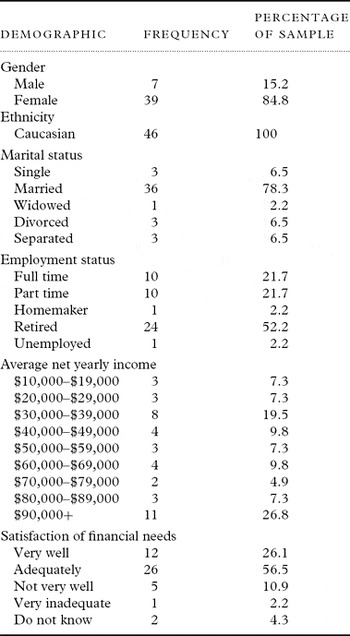
The sample consisted of 46 family caregivers with a mean age of 67.84 years (SD = 13.05; range = 20–88 years), with an average of 13.78 years (SD = 3.05; range = 8–19 years) of education. The majority were wives (43.5%) followed by daughters (34.8%), sons (10.9%), or other relatives (11.0%). Additional family caregiver demographics are presented in Table 1.
Demographic information for family caregivers (N = 46)

With respect to residents, 86.0% were men and 69.8% were diagnosed with dementia according to family caregiver reports. Their mean age was 88.70 years (SD = 3.86; range = 77–97 years).
Caregiving demographics, physical, and mental health
Family caregivers reported caregiving for the residents in the community and LTC, on average, for 84.62 weeks (SD = 68.14; range = 8.5–300 weeks). They reported currently caring for 1.48 (SD = 0.69; range = 1–3) individuals, and that an average of 2.76 (SD = 1.48; range = 1–6) family members were involved in caring for each resident. Fifty percent of family caregivers lived with the resident prior to institutionalization. Residents had a mean stay of 21.57 weeks (SD = 25.48; range = 1–120 weeks) in this facility, and had resided, on average, in two continuing care facilities (SD = 0.84; range = 1–4), including the present facility. Family caregivers reported visiting 3.86 times (SD = 3.79; range = 1–21 times) per week with an average duration of 2.60 hours (SD = 1.88; range = 5–10 hours), totaling to an average of 10.52 hours (SD = 13.44; range = 0.75–70 hours) per week. Participants’ responses indicated that 95.7% interacted with staff, 69.6% interacted with other residents, and 58.7% interacted with other family caregivers during a typical visit.
Furthermore, family caregivers reported being, on average, in good physical health (M = 2.04; SD = 0.84, range = 1–4). In regard to mental health, the Global Severity Index (M = 9.59; SD = 10.49; range = 0–42) of the BSI-18 and the somatization (M = 2.87; SD = 4.22; range = 0–20), depression (M = 3.59; SD = 4.71; range = 0–17), and anxiety (M = 3.13; SD = 3.45; range = 0–14) subscales were within the normal range.
Military demographics for residents and the utilization of resources
Of the residents, 90.7% served during World War II, 2.3% served in the Korean War, 2.3% served in both, and 4.7% were wives of veterans. Of those who served, 80.5% were deployed internationally, 50.0% were involved in combat, and 90.9% held a non-commissioned military rank. Only one resident was a prisoner of war. Residents served in the military an average of 5.81 years (SD = 5.78; range 1–33 years). The majority of family caregivers indicated that they used veterans’ resources in the past (80.4%) and in the present (93.5%), including those provided by Veterans Affairs Canada (e.g. disability pension) and social resources (e.g. Legions).
In regard to connectedness to the military community, 41.3% of family caregivers identified with the military community, 45.7% interacted with the military community in the past, 41.3% interact currently with the military community, 28.3% feel like a part of the military community, and 80.4% feel that it is important to maintain a military culture in nursing homes.
Internal consistency of measures
According to the Cicchetti (Reference Cicchetti1994) guidelines, Cronbach's α were good to excellent for the BSCS (0.85), FPCR (0.92), FPCT (0.92), Connection to Military Community (0.89), and BSI-18 (0.92) scales. The NHS-Communication scale had fair internal consistency (0.72), whereas the NHS-Support scale had unacceptable internal consistency (0.50). Furthermore, the subscales of the BSCS scale were variable: needs fulfillment (0.88), membership (0.86), and emotional connection (0.63), with the influence subscale showing particularly unacceptable internal consistency (0.17).
Descriptive statistics
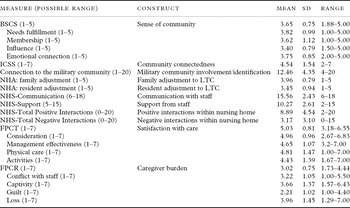
To address the first research question, descriptive statistics for the SOC and other satisfaction/adjustment scales are presented in Table 2. Total and factor scores for the BSCS suggest that caregivers endorsed moderate levels of SOC, with mean values ranging from a low of 3.40 for perceptions of influence to a high of 3.82 for needs fulfillment. However, as indicated by the range of scores, there was considerable variability in caregivers’ perceptions of SOC. A similar mid-range value was reported on the ICSS.
Means, standard deviations, and ranges of family caregiver measures (N = 46)

BSCS = Brief Sense of Community Scale; FPCR = Family Perception of Caregiving Role Total; FPCT = Family Perception of Care Tool Total; ICSS = Inclusion of Community in Self Scale; LTC = long-term care; NHA = Nursing Home Adjustment; NHS = Nursing Home Stressors.
Family caregivers generally felt that their relative's adjustment to the nursing home was positive. Specifically, more than half (54.3%) responded that the resident's adjustment had been very good to excellent, while the remaining rated the adjustment as fair (30.4%) and as poor to very poor (15.2%). Similarly, their perceptions of their own adjustment to the placement of the resident were found to be largely positive. Two-thirds (78.2%) felt that their adjustment was very good to excellent, while 19.6% felt their adjustment to be fair, and 2.2% felt they had adjusted very poorly. Thus, mean values in Table 2 and distributions suggest better family than resident adjustment (as reported by caregivers).
The NHS measure revealed generally good communication. Participants reported cordial interactions with staff but were less positive about staff members’ interest in learning about the resident, with one-quarter of the sample indicating that staff had not expressed an interest in doing so. Perceptions of support were less favorable. The majority of participants did not feel that they were encouraged to talk about their fears and concerns (60.9%), and one-third of the sample reported that staff failed to appreciate the stress associated with having a relative in LTC. Almost half of the sample (47.8%) felt that staff kept them informed about changes in the residents’ condition and 56.5% of the sample felt that staff informed them about whom to contact at the LTC facility regarding a problem. Positive interactions were reported more frequently than negative interactions.
In addition to the overall means presented in Table 2, additional information was collected pertaining to the type of interactions. Positive interactions were more likely to take place with staff (M = 3.27, SD = 1.34), followed by the family member in care (M = 2.67, SD = 1.54), other family caregivers (M = 1.73, SD = 1.89), and other residents (M = 1.20, SD = 1.52). Negative interactions were more common with the family member in care (M = 1.76, SD = 1.85), followed by staff (M = 0.80, SD = 1.34), other residents (M = 0.38, SD = 0.89), and other family caregivers (M = 0.18, SD = 0.78).
Satisfaction with care, as assessed by the FPCT, was rated most highly for staff consideration, with lower ratings of satisfaction with activities provided in the facility. The mean total score of the FPCT indicates that family caregivers endorsed moderate levels of satisfaction with care. Caregiver burden, as assessed by the FPCR, revealed that family caregivers were less likely to endorse feelings of guilt but more likely to report feelings of loss.
Sense of community and caregiver indices
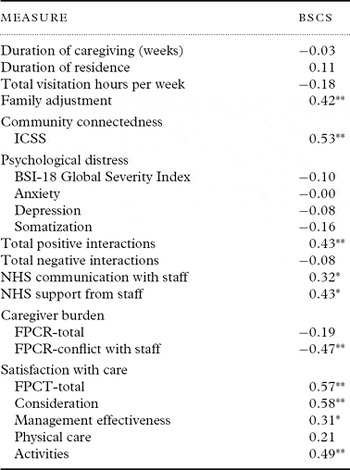
The second research question evaluated the relationship between the BSCS and key resident and caregiver characteristics, as indicated in Table 3. As predicted, positive and significant correlations were observed between SOC (BSCS) and family adjustment, community connectedness (ICSS), total positive interactions (NHS), communication with staff (NHS-Communication scale), support from staff (NHS-Support scale), and satisfaction with care (FPCT), specifically the consideration and activities subscales. A negative correlation was observed with the conflict with staff subscale of the FPCR. However, the negative correlations predicted for duration of caregiving, duration of residence, total visitation hours per week, psychological distress (BSI-18) or its subscales, total caregiver burden (FPCT), and total negative interactions were not evident in the data.
Correlations between sense of community and caregiver variables (N = 46)

BSI-18 = Brief Symptom Inventory-18; BSCS = Brief Sense of Community Scale; FPCR = Family Perception of Caregiving Role Total; FPCT = Family Perception of Care Tool Total; ICSS = Inclusion of Community in Self Scale; NHS = Nursing Home Stressors.
*p < 0.05.
**p < 0.01.
Military community and sense of community
The third research question evaluated the relationship between family caregivers’ connection to military community and SOC. A positive relationship was observed between the two variables (r(44) = 0.258, p < 0.042). Furthermore, additional correlations were conducted to evaluate whether connection to military community was related to residents’ military history and key caregiving variables. Connection to military community was positively related to the duration of service of the resident (r(39) = 0.420, p < 0.003), as well as with satisfaction with care (r(43) = 0.323, p < 0.015) and support from staff (r(43) = 0.289, p < 0.027).
Multiple regression analyses
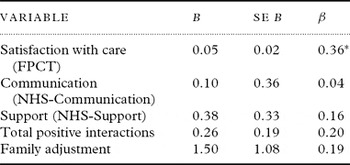
To address the fourth research question, two multiple regressions were conducted. To predict family caregivers’ SOC, a simultaneous multiple regression employing family adjustment, support from staff (NHS-Support), communication with staff (NHS-Communication), total positive interactions, and satisfaction with care (FPCT) as predictors was employed (Table 4). The five predictors collectively accounted for 46.0% of the variance in SOC, which was significant, F(5, 39) = 6.64, p < 0.001. Satisfaction with care accounted for significant variance in SOC (32.71%), β = 0.365, t(39) = 2.43, p < 0.02. Although family adjustment, total positive interactions with persons in LTC, support from staff, and communication with staff accounted for significant variance in SOC (18.2%, 18.2%, 18.8%, and 12.4%, respectively; p < 0.009), these predictors did not account for any unique variance as evidenced by non-significant β values.
Regression analysis summary for predicting sense of community

R 2 = R Square; B = The Standardized Beta Coefficient; SE B = Standard Error of the Estimate; R 2 = 0.46 (N = 45, p < 0.001); adjusted R 2 = 0.39. FPCT = Family Perception of Care Tool Total; NHS = Nursing Home Stressors.
*p < 0.05.
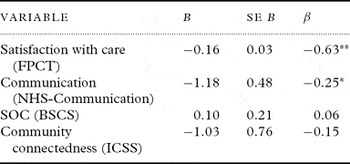
To evaluate which family caregiver variables predict conflict between family caregivers and staff, the data were analyzed using a simultaneous multiple regression and employing SOC (BSCS), community connectedness (ICSS), communication with staff (NHS-Communication), and satisfaction with care (FPCT) as predictors (Table 5). The four predictors collectively accounted for 66.3% of the variance in conflict with staff, which was significant (F(4, 40) = 19.68, p < 0.001). Satisfaction with care accounted for significant variance in conflict with staff (59.91%), β = –0.630, t(40) = –5.21, p < 0.001. Furthermore, communication with staff accounted for significant variance in conflict with staff (26.42%), β = –0.253, t(40) = –2.48, p < 0.018. Although sense of community and community connectedness accounted for significant variance in conflict with staff, 22.37% and 22.28%, respectively (p < 0.001), these predictors did not account for unique variance in the criterion. Overall, satisfaction with care and communication with staff were negatively related to conflict, indicating that lower scores on each predictor are related to higher levels of conflict, as well as higher scores on each predictor are related to lower levels of conflict.
Regression analysis summary for predicting conflict with staff

R 2 = R Square; B = The Standardized Beta Coefficient; SE B = Standard Error of the Estimate; R 2 = 0.66 (N = 45, p < 0.001); adjusted R 2 = 0.63. BSCS = Brief Sense of Community Scale; FPCT = Family Perception of Care Tool Total; ICSS = Inclusion of Community in Self Scale; NHS = Nursing Home Stressors; SOS = sense of community.
*p < 0.05. **p < 0.001.
Given that the independent variables employed in the aforementioned multiple regressions possess small to moderate correlations with other independent variables included in the analysis, multicollinearity was assessed. The variance inflation factor was examined, with all of the variance inflation factors in both regressions ranging from 1.30 to 1.74, which is less than the standard conservative cut-off of 5 for multicollinearity. However, given the small sample size in this study, the influence of multicollinearity cannot be discounted and limits the interpretation of the regression analyses.
Discussion
This is the first study that examines SOC among family caregivers of military veterans in LTC, a subgroup of family caregivers with unique histories and needs. Although there are measures designed to assess family members’ level of satisfaction with different facets of LTC, SOC provides unique information about whether family members feel part of the LTC community as valued partners in care. SOC is an important yet understudied construct that could contribute substantially to our understanding of family-focused care.
Sense of community and family caregivers
SOC reported in this sample is comparable with that reported in the literature (Blatt and Camden, Reference Blatt, Camden, Dutton and Ragins2007). The total and subscale BSCS means were slightly higher than those reported in a Navy sample (e.g. Wombacher et al., Reference Wombacher, Tagg, Burgi and MacBryde2010) and slightly lower than those of a community sample (e.g. 18+ years, including older adults; Peterson et al., Reference Peterson, Speer and McMillan2008).
The poor internal consistency of the influence subscale indicates that this subscale should be further evaluated in family caregiver samples. As SOC has not been investigated in LTC, the concept of influence may differ. LTC facilities are generally low influence environments in which caregivers often struggle for influence (Majerovitz et al., Reference Majerovitz, Mollot and Rudder2009). The two items included (Item 5: I have a say about what goes on in this nursing home and Item 6: People at this nursing home are good at influencing each other) may be tapping into different aspects of influence: item 5 may be referring to an internal perception of influence, whereas item 6 may be referring to external influence that may be more tied to organizational factors (e.g. the hierarchical nature of LTC facilities). Although the external and internal perceptions of influence are considered unitary in other communities (McMillan and Chavis, Reference McMillan and Chavis1986), families in LTC seek collaborative partnerships with staff, which would include the ability to influence others as well as to have others influence the individual, that may not have been fully realized in this sample (Haesler et al., Reference Haesler, Bauer and Nay2007). As this is the first time when the BSCS has been used in LTC, it may be that the content of the scale does not reflect the experiences of family caregivers, indicating the need for further content analysis.
Given that this is the first study that employed the BSCS with a family caregiver sample, several measures that are proximal in nature, such as connectedness to the military community, community connectedness, and SOC, were incorporated in the study. This was performed to examine whether BSCS was measuring the construct of SOC or mere affiliation that is assessed with the aforementioned constructs. SOC would be posited to be related to these similar constructs and this was observed through moderate positive correlations with connectedness to the military community and community connectedness. However, even though convergent validity was demonstrated, BSCS was not perfectly correlated with these related constructs and was differentially related to other study variables, indicating that it is assessing a different construct beyond feelings of affiliation.
In regard to correlates of SOC, positive interactions were related to SOC whereas negative interactions were not. Positive interactions have been shown to assist in building SOC by providing opportunities to share both positive and negative emotions, even in the absence of a shared history or a long-term relationship (Blatt and Camden, Reference Blatt, Camden, Dutton and Ragins2007). McMillan and Chavis (Reference McMillan and Chavis1986) have postulated that the more positive the interactions and the felt importance of the interaction, the greater is the bond that develops between the individuals involved. In addition, SOC was also related to better communication with staff and positive support from staff. Similar relationships have emerged in studies of other communities noting that SOC was positively correlated with depth of disclosure, reciprocity, and shared interests/experiences (Forster, Reference Forster2004). However, the absence of a relationship between SOC and negative interactions is surprising. Studies have reported that negative interactions possess greater salience in relationships between staff and families (Chen et al., Reference Chen, Sabir, Zimmerman, Suitor and Pillemer2007). Nevertheless, research also indicates that negative interactions have greater relation to negative feelings (i.e. depression; Whitlatch et al., Reference Whitlatch, Schur, Noelker, Ejaz and Looman2001), whereas positive interactions are more related to positive feelings in older adults (Ingersoll-Dayton et al., Reference Ingersoll-Dayton, Morgan and Antonucci1997). Therefore, positive interactions may have greater influence on positive caregiver outcomes such as SOC. In addition, information regarding the resolution of negative interactions was not obtained, which could have the potential to affect SOC, as caregivers have indicated the importance of positive resolutions in negative situations (Haesler et al., Reference Haesler, Bauer and Nay2007).
The results indicate that SOC is not related to psychological dysfunction or overall caregiver burden as initially hypothesized. Although SOC has been found to be related to well-being in the literature (Davidson and Cotter, Reference Davidson and Cotter1991), as well as to psychological distress (Royal and Rossi, Reference Royal and Rossi1996), the relationships that have been observed for psychological distress are usually low (i.e. consist of low negative correlations in large samples; Wombacher et al., Reference Wombacher, Tagg, Burgi and MacBryde2010). Therefore, the small sample size of this study may have been inadequate to reveal the relationship reported in the literature, and the present sample was largely psychologically healthy which could limit the range required to detect the relationship. Another plausible explanation may be that an individual does not possess a single SOC in their life. Other communities (e.g. neighborhood, church, and social group) and their respective SOCs may compensate for the lack of a SOC at the nursing home (Forster, Reference Forster2004).
Surprisingly, duration of the residents’ stay at the nursing home was not related to family caregivers’ SOC. Traditionally, SOC has been perceived to develop over time within a community (Chavis et al., Reference Chavis, Hogge, McMillan and Wandersman1986). However, SOC can develop when individuals interact irregularly, rarely, or even never meet, and it is not circumscribed by time or space (Blatt and Camden, Reference Blatt, Camden, Dutton and Ragins2007). Individuals may have the ability to quickly develop a SOC, especially if they perceive that SOC could be advantageous to them (Blatt and Camden, Reference Blatt, Camden, Dutton and Ragins2007). For family caregivers, adapting to and learning the routines of the LTC facility, as well as establishing a relationship with others, have been shown to be of paramount importance (Haesler et al., Reference Haesler, Bauer and Nay2007). Moreover, participants in this study reported previous experience with the LTC facility either with other relatives who had resided there or as part of military volunteer organizations. Therefore, these pre-existing ties to the facility may have initiated a SOC at a point prior to the resident's institutionalization. In this manner, their SOC could be an extension of their military community participation. Similarly, SOC was not related to visitation frequency or duration in the current study. It is important to note that Gaugler (Reference Gaugler2005) has reported that it is not the frequency or duration of visitation that is important but the quality of visitation. It is plausible that the diversity of experiences during visits may be more relevant to perceived SOC; however, a measure of visitation quality was not included in this study.
Importantly, SOC was found to be inversely related to conflict with staff. This finding is consistent with other SOC literature, whereby low SOC was related to disharmony in the workplace, increased employee grievances, and antisocial and aggressive actions (Catano et al., Reference Catano, Pretty, Southwell and Cole1993; Roussi et al., Reference Roussi, Rapti and Kiosseoglou2006). Research has shown that SOC is related to or predictive of several factors that counter conflict such as sustaining harmonious relations in a community, collaborative behavior, and greater participation in community affairs (Chavis and Pretty, Reference Chavis and Pretty1999). However, SOC and community connectedness did not emerge as significant predictors of conflict with staff, although satisfaction with care and communication with staff did. Austin et al. (Reference Austin2009) reported that chasms observed around communication between staff and families are the most significant source of conflict in LTC. Family members can easily misunderstand staff's actions if they are not completely explained by expressing the reasons behind the actions and decisions. Participants in this study frequently cited difficulty communicating with staff due to limited English proficiency, which reportedly resulted in difficulties in comprehension and communication. Understaffing may contribute further to problems with communication. Importantly, Austin and colleagues’ recommendations for improving the social climate and for decreasing conflict in LTC are to invite families to be a part of the community, encourage communication, and recognize facilities as communities to nurture a culture of respect.
In regard to the prediction of SOC, satisfaction with care emerged as the only statistically significant predictor. This is unsurprising considering that satisfaction with care as a construct is composed of several interpersonal factors such as consideration for family and residents, as well as activities provided, which could provide the basis for interaction and relationship building reported to be the basis of SOC (McMillan and Chavis, Reference McMillan and Chavis1986). Notably, SOC was solely related to the interpersonal components of satisfaction with care, such as consideration for families, activities, and management effectiveness, but not physical care. Similarly, the moderate positive relationship observed between SOC and satisfaction with care is consistent with a report in a community sample that SOC is positively related to satisfaction with health care (Ahern et al., Reference Ahern, Hendryx and Siddhartan1996). Furthermore, when families are satisfied with the care that is provided, they become more trusting of staff (Gladstone and Wexler, Reference Gladstone and Wexler2002), which may contribute to the establishment of SOC.
Although the universal nature of SOC has been noted across communities (Halamova, Reference Halamova2001), it is plausible that individuals may differ in their propensity to develop a SOC. There are large individual differences in family members’ desires for involvement (Gaugler, Reference Gaugler2005). Therefore, it may not be wise to expect all individuals to maintain similar levels of involvement or to develop a SOC in LTC. For example, although it has been noted that increased involvement has positive benefits for the family, it also has been related to adverse consequences (Grabowski and Mitchell, Reference Grabowski and Mitchell2009). An individual difference variable that could potentially account for this is need for affiliation, which has been related to SOC and its development (Davidson and Cotter, Reference Davidson, Cotter and Stovall1991). For family caregivers who experience extensive caregiver burden and have terminated many activities, enhancing SOC could potentially have deleterious consequences. Brodsky (Reference Brodsky1996) has operationalized SOC as either positive or negative and has found that negative SOC can be adaptive and lead to positive outcomes for persons who perceive their community to be a burden rather than a resource. This finding is consistent with information collected in this study as some participants indicated that they limit their involvement and thereby do not possess a SOC, due to self-preservation.
Connectedness to the military community and sense of community
SOC was positively related to connection to the military community. Research has shown that connection to different communities and the respective perceived SOC could contribute to an overall SOC (Forster, Reference Forster2004). In the current sample, some participants viewed this Veterans’ LTC facility as an extension of the military community and would frequently emphasize the involvement that veterans have with the facility and the involvement of Veterans Affairs Canada. Therefore, it is plausible that the SOC perceived in LTC is an extension of a SOC felt within the greater military community. Similarly, individuals who have a long-standing history of being involved in communities may have a stronger need for affiliation and, therefore, may be more likely to develop a SOC.
Moreover, connectedness to the military community was positively related to satisfaction with care. This finding relates to the value of specialized facilities for veterans in military families. Veterans facilities provide multiple activities and services targeted toward veterans, and it is plausible that individuals who feel more connected have a greater appreciation for the veteran-specific services offered. It has been shown that if staff and the facility honor residents’ preferences, including interests, families are less critical of care (Chapman et al., Reference Chapman, Keating and Eales2003).
Practice implications
SOC has the potential to figure prominently in the new community approach to LTC. As individuals with a felt sense of belonging and SOC are more likely to take actions that are aligned with organizational goals, values, and norms (McMillan and Chavis, Reference McMillan and Chavis1986), building a SOC could assist not only with adjustment but also with improved involvement of family members, limiting the interference and conflict that have been reported in the literature (Gaugler, Reference Gaugler2005). Notably, SOC was uniquely related to conflict with staff without being related to other indices of caregiver burden, which could make it a practical and unobtrusive indicator of potential for conflict with staff. Furthermore, application of interventions designed to build and enhance SOC could assist in ameliorating problems such as conflict and dissatisfaction with care, and increase positive participation for families. Utilizing SOC as a starting point for building a community-model of LTC may prove fruitful, by educating families about their possible roles and the value of care partnerships, while enhancing the potential for positive interactions between families, residents, and staff, through common activities, care conferences, family councils, and the like.
Study limitations
First, this study has likely been affected by sampling bias, as it is plausible that family caregivers with greater involvement were more likely to participate in the study. Also, this sample included an affluent subgroup, with a quarter of the sample reporting an income of more than $90,000 and, on the whole, was physically and psychologically healthier than some of the family caregiver samples reported in the literature. Second, the small sample size limited the types of analyses that could be conducted and potentially reduced the power for some of the analyses conducted. Also, the small sample size limits the generalizability of the statistically significant results. However, the sample size in this study does not greatly differ from that of comparable family caregiving studies, as caregiving samples are typically difficult to recruit (Farran, Reference Farran2001). Third, the results of the multiple regression analyses need to be interpreted with caution. Satisfaction with care is a multicomponent construct that is related to multiple caregiver outcomes in LTC. Although the inclusion of this variable in predicting both SOC and conflict with staff is warranted, the significant contribution of this variable to the predicting model and the moderate to high correlations with other independent variables makes it difficult for other variables to contribute significantly to the model. Similarly, the low to moderate intercorrelations among the independent variables employed in the multiple regressions complicate the interpretation of the results and, therefore, we cannot clearly understand how the various independent variables impact SOC and conflict, as their contributions may have been obscured. To reduce the impact of collinearity, this study could benefit from an increased sample size. Furthermore, collecting samples over a wider range of predictor variables could greatly assist in reducing the impact by increasing the variation between variables. Lastly, given the sensitive nature of the constructs measured, such as family adjustment, conflict with staff, and satisfaction with care, social desirability may have influenced participants’ responses, and this study could have benefited from the inclusion of a social desirability measure in the study protocol. Of note, participants in this study did show a wide range of responses on each of the constructs measured.
Conclusion
Family caregivers in LTC are pivotal partners in providing client-centered care. This is the first study that assesses SOC in LTC, a construct that has significant potential for understanding the contribution of social climates to the well-being of residents, caregivers, and staff and minimizing conflict. Moreover, this is also the first study that investigates the SOC of veterans in LTC, a unique and understudied population for which SOC may be particularly important.
Future studies should evaluate how SOC develops or fails to develop over time, as well as the organizational and individual factors that affect the development and promotion of SOC across continuing care settings (e.g. LTC and assisted daily living). Evaluation of whether there are optimal levels of SOC for families should be considered, as well as positive and negative SOC within a family caregiving sample. Also, studies should evaluate how residents’ perceived SOC is related to family caregivers’ SOC. Moreover, SOC has the potential for addressing conflict in LTC environments, an area where there is significant dearth of research. Finally, future studies should evaluate the potential unique characteristics of military family caregivers compared with family caregivers in non-veteran LTC sites.
Conflict of interest
None.
Description of authors’ roles
A. Petrovic-Poljak formulated the basic premise of the paper, designed the study, collected the data, and was responsible for the statistical design of the study, for carrying out the statistical analyses, and for writing of the paper. C. Konnert supervised the project and assisted with writing of the paper, including making major revisions to it.
Acknowledgments
We sincerely thank the participants of the study, the families, residents, and staff of Carewest's Colonel Belcher Care Centre.