Introduction
Smoking is one of the top public health problems around the world, despite tough anti-smoking legislation and widespread public awareness of negative health consequences, including cardiovascular diseases and lung cancer. It has been estimated that smoking causes more than 5 million deaths annually worldwide, and this figure is expected to increase to 8 million deaths per year by 2030 (Centers for Disease Control and Prevention, 2013). According to a 2013 report by the World Health Organization (WHO), tobacco-related illnesses and deaths are highest in smokers from low- and middle-income countries, where 80% of all deaths resulting from smoking are projected to occur within the next decade (World Health Organization, 2013). In recent years, the internet has become an effective avenue for promotion of smoking cessation, due to the wide availability of literature online about the health risks associated with smoking, and information on how to quit and maintain smoke-free behaviours. Approximately 10.2 million adult American internet users search for information about quitting smoking online each year (Cobb, Graham, & Abrams, Reference Cobb, Graham and Abrams2010). In addition to finding timely information to help them quit smoking, smokers can also join online health support groups, the majority of which now incorporate forums, message boards and social networking features (Stretcher, Shiffman, & West, Reference Stretcher, Shiffman and West2005; Stoddard et al., Reference Stoddard, Delucchi, Munoz, Collins, Perez-Stable and Augustson2005). Health issue-specific social networking sites (SNSs) are increasingly popular for people with chronic health conditions because the social features of the sites can help increase their connections to others with similar problems. This study examines the relationship between participation in health issue-specific SNSs for smoking cessation, and smoking cessation self-efficacy, focusing on factors influencing members to participate, through a Social Identity Theory (SIT) (Tajfel & Turner, Reference Tajfel, Turner, Stapel and H1986) perspective. Through doing this, the study aims to highlight the importance of health issue-specific SNSs on smoking cessation.
Social networking sites (SNSs) are web-based services where people create a public or semi-public profile, connect with a list of other users, and view and traverse these connections and those made by others within the site (Boyd & Ellison, Reference boyd and Ellison2008). The online profile acts as one's home page, where he or she articulates his or her identity, providing personal information, hobbies, interests and posts pictures. Web 2.0, or the Social Web, has enabled more widespread collaboration and interactivity, such that users can simultaneously act as readers and writers, providing quicker access to relevant information and knowledge. By incorporating social networking features, health support sites can enable members to better manage their own health issues and also gather information, learn from and give support to others (Boulos & Wheeler, Reference Boulos and Wheeler2007). SNSs are fundamentally transforming relationships between health care consumers, providers and caregivers, because members are able to talk about illness experiences with others who have the same health conditions, compare treatment options, provide and receive social support, and aggregate their illness's community experience (Hughes, Joshi, & Wareham, Reference Hughes, Joshi and Wareham2008). Compared to traditional online communities, health issue-specific SNSs are also characterised as being more supportive, with less flaming, negative attitudes and behaviour (Kontos et al., Reference Kontos, Emmons, Puleo and Viswanath2010). Since they are not anonymous, SNSs allow more meaningful and deeper friendships, as members can browse others’ profiles and know exactly to whom they are talking.
Lurkers in Health Issue-Specific SNSs
One of the most significant challenges in online health groups is that the majority of members, as high as 90% on some sites, are lurkers who only read messages without posting or participating in any discussions, and who do not actively give support to other members (Han et al., Reference Han, Kim, Yoon, Shim, McTavish and Gustafson2012; Kollock & Smith, Reference Kollock, Smith and Herring1996; White & Dorman, Reference White and Dorman2001). The lack of participation on these sites presents a major problem because they are not able to provide members with much-needed services, such as discussion of treatments and problems (Bishop, Reference Bishop2007). As a result, most SNSs cannot be sustained over a long period of time (Butler et al., Reference Butler, Sproull, Kiesler, Kraut, Weisband and Atwater2002; Ramirez et al., Reference Ramirez, Zhang, McGrew and Lin2007). Encouraging lurkers to actively participate is a major challenge for administrators of online groups due to the difficulty of reaching them. Even if an online group has the latest interactive technology available, the community will not flourish without participation. Research has indicated that lurking is a post-joining adaptive strategy, with many lurkers being ‘shy’ and ‘introverted’ individuals (Preece, Andrews, & Nonnecke, Reference Preece, Nonnecke and Andrews2004). Even though lurkers felt like they were part of the community, active participants have a significantly greater feeling of solidarity with other members (Ramirez et al., Reference Ramirez, Zhang, McGrew and Lin2007). Lurking allows people to have the best of both worlds because they can access information and other people's insights and experiences while bypassing flaming, insults and abuse (Schlosser, Reference Schlosser2005) To encourage lurkers to participate, researchers suggest strategies including organizing small group activities, stronger moderation of forums, heightened privacy protection, and implementing trustworthiness ratings to increase members’ credibility on the sites (Bishop, Reference Bishop2007; Preece et al., Reference Preece, Nonnecke and Andrews2004).
However, online health groups may also benefit from lurking, because lurking allows new members to learn group norms, see if issues addressed are relevant to them, and find out more about other members before posting any messages (Schlosser, Reference Schlosser2005). In groups with heavy traffic, lurking can also be positive because it reduces the ‘noise-to-signal’ ratio. By participating only when necessary, lurkers help online groups maintain the quality of information shared and received. A study by Christofides, Muise and Desmarais (Reference Christofides, Muise and Desmarais2009) found that even though lurkers receive fewer benefits from online support groups, they still derive a sense of community within the groups. Lurking can also be advantageous since indiscriminate posting, including spamming, flaming and trolling, can cause groups to be less efficient, taking more time for members to sift through unwanted material (Kollock & Smith, Reference Kollock, Smith and Herring1996). Spamming is the posting of unsolicited, and often unwanted, information on message boards; flaming involves hostile and insulting interaction between online forum users, while trolling occurs when someone posts inflammatory, controversial and off-topic messages on forums, so as to provoke others and disrupt online conversations (Mclaughlin, Osborne, & Smith, Reference McLaughlin, Osborne, Smith and Jones1995). For many lurkers, merely reading others’ posts and identifying with their experiences can lead to positive health outcomes (Mo & Coulson, Reference Mo and Coulson2010; Van Uden-Kraan et al., Reference Van Uden-Kraan, Drossaert, Taal, Seydel and Van de Laar2008).
Social Identity Theory
Social Identity Theory (SIT) (Tajfel & Turner, Reference Tajfel, Turner, Stapel and H1986) defines one's social identity as the part of one's self-concept deriving from the knowledge of his or her membership in a social group, together with the emotional and value significance attached to the membership. In an interpersonal interaction, people relate to others as individuals, with no concept of social categories, while in an intergroup interaction, people relate to others as representatives of the group, with no individualising characteristics (Hogg, Reference Hogg, Leary and Tangney2003). When one's social identity is salient, the psychological separation between the self and the group as a whole disappears, resulting in individuals seeing themselves as interchangeable exemplars of their social group. The main principle of SIT is that people strive to achieve and maintain a positive social identity, which can be achieved by favourable comparisons with, and positive differentiation from, a relevant out-group. The central motivation for intergroup behaviour is one's desire for a positive and secure self-concept, and this is formed and maintained through positive evaluations of one's own in-group with reference to relevant out-groups (Hogg & Reid, Reference Hogg and Reid2006). Individuals are motivated to act and think in ways that achieve positive distinctiveness for the in-group, leading to high levels of positive evaluations of members of the in-group, and negative evaluations of members of out-groups (Hogg, Reference Hogg, Leary and Tangney2003).
Many factors influence participation in health issue-specific SNSs. Parks and Floyd (Reference Parks and Floyd1996) examined relationship development in internet newsgroups, conceptualising online relationships along seven dimensions: interdependence, breadth and depth of interaction, interpersonal predictability and understanding, code change towards more personalised communication, convergence of social networks, and commitment. In their examination of lurking on SNSs, Rau, Gao, and Ding (Reference Rau, Gao and Ding2008) incorporated the seven relational dimensions in their measures of verbal and affective intimacy, referring to verbal intimacy as self-disclosure, measured through breadth and depth of online interactions, and affective intimacy as emotional closeness, affective feelings and reciprocal support, measured through interdependence, interpersonal predictability and understanding and commitment. When a SNS user feels a high level of verbal intimacy from the site, he or she is more likely to disclose various aspects of him or herself, including uploading photos, links, blog messages and profile updates. Users who perceive higher affective intimacy will post more because they are more likely to seek emotional support from their SNS connections, and the expectation that they will receive reciprocal support is also high. Parks and Floyd (Reference Parks and Floyd1996) found that personal relationships on the internet developed through a series of interactions among participants, which become increasingly complex and intertwined. Rau et al. (Reference Rau, Gao and Ding2008) also found significant differences between posters and lurkers on perceived verbal and affective intimacy in SNSs. Following on Rau et al. (Reference Rau, Gao and Ding2008), this study added two dimensions of intimacy: cognitive and physical, corresponding to Parks and Floyd's (Reference Parks and Floyd1996) ‘code change’ and ‘network convergence’ subscales respectively. It was hypothesised that each dimension of intimacy would influence participation on the site (H1).
Previous studies of computer-mediated communication via SNSs have found a strong link between SNS usage and social identification (Barker, Reference Barker2009; Ellison, Steinfield & Lampe, Reference Ellison, Steinfield and Lampe2007; Papacharissi & Rubin, Reference Papacharissi and Rubin2000; Valkenburg, Peter, & Schouten, Reference Valkenburg, Peter and Schouten2006). As SIT states, individuals are motivated to seek a positive social identity through positive associations with in-groups. It is possible that the more one participates in SNSs, the higher his or her social identification with other members of the sites will be. Additionally, active participation in online health communities can result in positive health benefits for members (Han et al., Reference Han, Kim, Yoon, Shim, McTavish and Gustafson2012). In previous online smoking cessation interventions, smoking cessation self-efficacy (Etter et al., Reference Etter, Bergman, Humair and Perneger2000), or one's ability to resist the temptation to smoke in various situations, has been found to be a major predictor of actual smoking cessation and subsequent abstinence from cigarettes (Balmford, Borland & Benda, Reference Balmford, Borland and Benda2008; Cobb et al., Reference Cobb, Graham and Abrams2010; Norman et al., Reference Norman, McIntosh, Selby and Eysenbach2008; Stretcher et al., Reference Stretcher, Shiffman and West2005; Stoddard et al., Reference Stoddard, Delucchi, Munoz, Collins, Perez-Stable and Augustson2005). In other words, people with higher smoking cessation self-efficacy are more likely to quit smoking because they are better able to control their urge to light up when faced with temptation. As such, participation in health issue-specific SNSs was expected to significantly impact smoking cessation self-efficacy, a form of behavioural intention (H2).
Further, according to SIT, when one's social identity is salient, he or she is more likely to see him or herself as interchangeable exemplars of the social group, incorporating the values and beliefs of the group as his or her own (Hogg, Reference Hogg, Leary and Tangney2003). Previous research in health interventions has found that social identity can play an important role in changing attitudes and intention, particularly for addictive behaviours like binge drinking and smoking (Cullum et al., Reference Cullum, O'Grady, Sandoval, Armeli and Tennen2013; Kobus, Reference Kobus2003; Reed et al., Reference Reed, Lange, Ketchie and Clapp2007). Hence, it was hypothesised that social identification would significantly impact smoking cessation self-efficacy (H3).
In traditional online communities, members may read messages to find the information they need, and only post when they have specific questions, knowing that a stranger with more expertise would be able to respond (Preece et al., Reference Preece, Nonnecke and Andrews2004). In SNSs however, posting messages is more akin to a conversation with friends and acquaintances (Ellison et al., Reference Ellison, Steinfield and Lampe2007). In online health support communities, when one identifies strongly with an in-group, they are more likely to conform to in-group norms related to the health issue (Han et al., Reference Han, Kim, Yoon, Shim, McTavish and Gustafson2012; Mo & Coulson, Reference Mo and Coulson2010; Norma et al., Reference Norman, McIntosh, Selby and Eysenbach2008). As such, in health issue-specific SNSs, it is possible that social identification with other members would mediate the relationship between participation and behavioural intention, operationalised in this study by smoking cessation self-efficacy (H4).
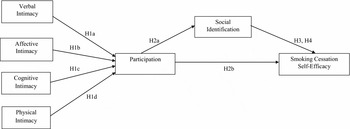
H1: Perceived (a) verbal, (b) affective, (c) cognitive), and (d) physical intimacy with other members on the site would significantly predict participation.
H2: Participation on the site would significantly predict: (a) social identification with other members on the site, and (b) smoking cessation self-efficacy.
H3: Social identification on the site would significantly predict smoking cessation self-efficacy.
H4: Social identification on the site would mediate the relationship between participation and smoking cessation self-efficacy.
Based on these hypotheses, a structural model (Figure 1) linking the four types of intimacy with participation, social identification, and smoking cessation self-efficacy, was proposed and tested.
Theoretical model for the effect of perceived intimacy on participation, social identification and smoking cessation self-efficacy (N = 252)

Additionally, as previously discussed, lurkers comprise a large percentage of membership in online health groups (Bishop, Reference Bishop2007; Preece et al., Reference Preece, Nonnecke and Andrews2004; Ramirez et al., Reference Ramirez, Zhang, McGrew and Lin2007; Rau et al., Reference Rau, Gao and Ding2008). The potential impact of health issue-specific SNSs on lurkers, versus active participants, is therefore important to understand. This study sought to address whether active participants and lurkers in health issue-specific SNSs derived significantly different levels of verbal, affective, cognitive and physical intimacy on the site, as well as identification with other members, and smoking cessation self-efficacy. The following research question was proposed.
RQ1: Is there a significant difference in: (a) verbal, (b) affective, (c) cognitive, and (d) physical intimacy, (e) social identification, and (f) smoking cessation self-efficacy between active participants and lurkers on the site?
Method
Data was collected using an online questionnaire, which was posted on the home pages of several health issue-specific SNSs. A comprehensive web search on major search engines like Google, Yahoo and Bing, was conducted to select possible study sites. Keywords used included ‘Smoking Cessation’, ‘Social Networking’, ‘Quit Smoking’, ‘Moderator’, ‘Membership’, ‘Post Profile’ and ‘Friend Connections’. Other sources, such as newspaper and magazine reports, were used to generate a list of possible sites. The sites on the list fulfilled the following criteria: (1) focus on, or include a section for, smoking cessation, (2) not sponsored by pharmaceutical companies, (3) moderated, and (4) include social media components (e.g. news feeds, friend connections, personal profiles etc.). Sites without social media features, those that only provided information about quitting, or which catered specifically to health professionals, or provided social support for smokers to continue smoking, were excluded. The initial screening yielded a list of 25 sites that fulfilled the definition of ‘health issue-specific SNSs’. This number was then further reduced through a secondary screening process for site activity. Sites that had discussion forums with at least one posting during the most recent week were considered to be active. Several sites hosted on Google, Yahoo and Ning (a website for creating SNSs) were deemed inactive, and excluded from the sample. Eighteen active sites were selected, and moderators were contacted for permission to post a link to the questionnaire. Among those contacted, three moderators granted permission to post the survey links on their site. Four others requested additional information, while the other moderators did not reply. An Institutional Review Board (IRB) approval letter was sent to the four moderators who requested additional information. Three of them granted permission, while the fourth denied permission, stating that they wanted to maintain privacy for group members. Moderators of the six approved sites posted the questionnaire on their sites with a recruitment message, URL link and endorsement message. The study period lasted from December 2009 to June 2010, with the questionnaire posted on each site for one month. A total of 318 subjects completed the questionnaire. After subtracting incomplete questionnaires, 252 respondents were included in the final sample for data analysis.
Measures
Participation Level: Participation was measured using Brandtzaeg and Heim's (Reference Brandtzaeg and Heim2011) user-generated content (UGC) participation scale, on seven-point Likert-type scales, ranging from ‘strongly disagree’ to ‘strongly agree’. Eighteen items assessed SNS members’ participation in various activities on the site. Examples include ‘I regularly contribute information to the site’, ‘I regularly answer questions on the site’, ‘I regularly correspond with others’ and ‘I regularly update my profile status’. Cronbach's α for the scale was .87. Additionally, six open-ended questions asked respondents the number of hours per week they spent: (1) on the site, and (2) surfing the internet, as well as: (3) number of messages posted per week, (4) number of friend connections, (5) number of offline friends who are also members of the site, and (6) number of offline friendships developed from those initially met online.
Social Identification: Four questions, from Reed et al. (Reference Reed, Lange, Ketchie and Clapp2007), measured respondents’ social identification on the site, using seven-point Likert scales, ranging from ‘Strongly disagree’ to ‘Strongly agree’. Questions included ‘I identify with other members on the site’, ‘I am similar with other members on the site in our attitudes and beliefs’, and ‘Other members on the site are important to my sense of self’ (Cronbach's α = .91).
Smoking Cessation Self-Efficacy: Smoking cessation self-efficacy was measured using Etter et al.'s (Reference Etter, Bergman, Humair and Perneger2000) Smoking Self-Efficacy Questionnaire (SEQ-12), which included 12 items assessing current and former smokers’ ability to abstain from smoking in situations where they might be tempted to smoke. Questions included ‘I can refrain from smoking when depressed’, ‘I can refrain from smoking when drinking with friends’, and ‘I can refrain from smoking after a meal’ (Cronbach's α = .87).
Verbal Intimacy: Verbal intimacy consisted of 11 items, from Parks and Floyd (Reference Parks and Floyd1996) and Rau et al. (Reference Rau, Gao and Ding2008). Four questions measured breadth, and seven questions measured depth of interaction, and were summed to create a scale. Questions included ‘I can confide in other members on the site’, ‘My communication with other members on the site covers a wide range of topics’, and ‘I can tell other members on the site exactly how I feel’ (Cronbach's α = .87).
Affective Intimacy: Affective intimacy included 22 questions from Parks and Floyd (Reference Parks and Floyd1996) and Rau et al. (Reference Rau, Gao and Ding2008). Six items measured interdependence, five items measured interpersonal predictability, five items measured commitment, plus six items from Miller and Lefcourt's (Reference Miller and Lefcourt1982) Social Intimacy Scale (MSIS), which measured frequency of affective intimacy. Questions included ‘I feel like being encouraging to other members on the site’, ‘I wait to consult other members on the site regarding important matters’, and ‘It is important for me to listen to the disclosures of other members on the site’ (Cronbach's α = .88).
Cognitive Intimacy: The six-item cognitive intimacy scale was taken from the code change subscale (Parks & Floyd, Reference Parks and Floyd1996), which assessed the degree to which online communication partners develop specialised ways of communicating. Questions included ‘I am able to read between the lines of my communication with others on the site’, ‘I share special language jargon with other members on the site’, and ‘I use special nicknames to address other members on the site’ (Cronbach's α = .83).
Physical Intimacy: The six-item physical intimacy scale was taken from the network convergence subscale (Parks & Floyd, Reference Parks and Floyd1996). Questions included ‘I have overlapping social circles offline with other members on the site’, ‘I have introduced other members on the site to my friends and family’ and ‘I am involved in the same social groups and activities as other members on the site’ (Cronbach's α = .82).
Demographics: This included questions asking about respondents’ gender, age, ethnicity, marital status, educational level, nationality and annual household income.
All measures used in the questionnaire are presented in Appendix 1.
Data Analysis
During data analysis, structural equation modelling (SEM) was used to build and test the proposed structural model, which specified relationships between perceived verbal, affective, cognitive, and physical intimacy, participation, social identification, and smoking cessation self-efficacy. Mediation analysis (Preacher & Hayes, Reference Preacher and Hayes2008) was then conducted to test the relationships between social identification, participation and smoking cessation self-efficacy. Additionally, MANOVA and ANOVA tests were conducted to test for significant differences between active participants and lurkers on perceived verbal, affective, cognitive, and physical intimacy levels, social identification, and smoking cessation self-efficacy.
Results
Descriptive Statistics
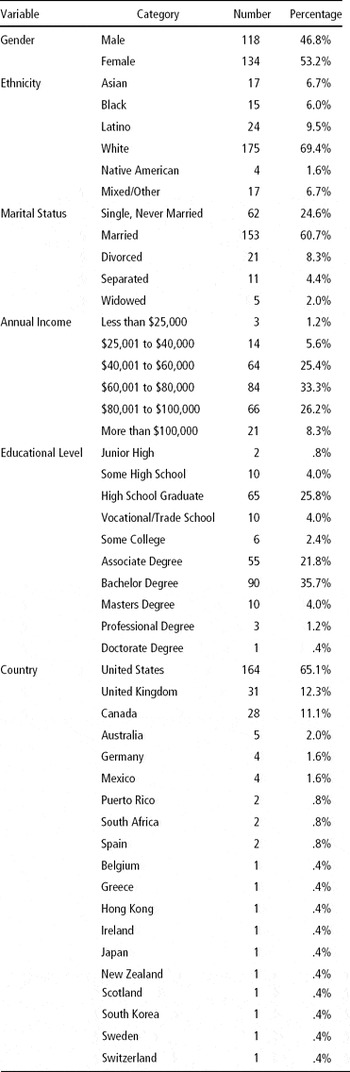
Among the respondents (N = 252), mean number of hours spent on the site per week was 3.9 (SD = 2.7), while mean number of hours spent surfing the internet per week was 10.1 (SD = 8.5). The mean number of messages posted on the site per week by each respondent was 6 (SD = 3). The mean number of friend connections on the site was 43 (SD = 12), while the mean number of offline friends who were also members of the site was 8 (SD = 5), and the mean number of offline friendships developed from those initially met online was 4 (SD = 3). Demographic characteristics of the 252 respondents are summarised in Table 1.
Demographic characteristics of questionnaire respondents (N = 252)

Confirmatory Factor Analysis
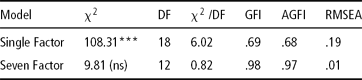
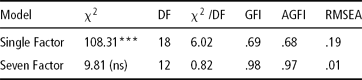
Two separate models were run in confirmatory factor analysis (CFA), in order to test for common method variance (CMV). In the first model, all seven variables were loaded as one single factor in the CFA, while in the second model, the full seven-factor measurement model was tested. According to Harman's (Reference Harman1976) one-factor test, if common method variance (CMV) was present, the one-factor model would fit the data well. Results obtained showed that the one-factor model did not fit the data well [χ2 (18) = 108.31, p < .001, GFI = .69, AGFI = .68, RMSEA = .19], compared to the seven-factor model [χ2 (12) = 9.81, p = .71, GFI = .98, AGFI = .97, RMSEA < .01]. Hence, CMV was not considered a threat, and unlikely to confound interpretation of the results. As such, the full seven-factor model was used in structural equation modeling (SEM) analysis. (Table 2)
Goodness-of-fit indicators of measurement models in confirmatory factor analysis (N = 252)
p<.05*, p<.01**, p<.001***
Structural Equation Modelling
Following CFA, structural equation modelling (SEM) analysis was used to test the structural model. A sample size of ten for each free parameter estimated, and a critical sample size of 200, was needed to provide sufficient statistical power for SEM analysis (Hoe, Reference Hoe2008). Sample size for this study was 252, and seven free parameters were estimated, fulfilling SEM requirements. The model addressed four dimensions of intimacy (verbal, affective, cognitive and physical) influencing participation on the site, which in turn influenced social identification, and smoking cessation self-efficacy. The model was tested in LISREL using the maximum likelihood estimation procedure. The error term for each endogenous variable was set at a mean of 0, and a variance of 1. Model fit was assessed through a non-significant χ2 statistic, goodness-of-fit index (GFI), and adjusted goodness-of-fit index (AGFI) of .90 and above, and root mean square error of approximation (RMSEA) equal or less than .06 (Byrne, Reference Byrne1998).
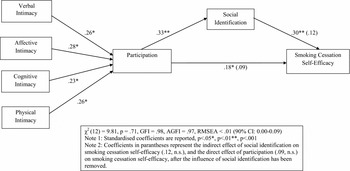
Results indicated the model was a good fit to the data. The chi-square goodness-of-fit test was not significant [χ2 (12) = 9.81, p = .71], RMSEA was < 0.01, goodness-of-fit index (GFI) = .98, and adjusted goodness-of-fit index (AGFI) = .97, showing support for the predicted mechanisms put forth in the study. The complete model is shown in Figure 2.
Structural model for the effect of perceived intimacy on participation, social identification and smoking cessation self-efficacy (standardised solution, N = 252)

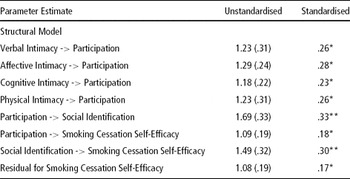
Perceived verbal (β = .26, p < .05), affective (β = .28, p < .05), cognitive (β = .23, p < .05), and physical intimacy (β = .26, p < .05), significantly predicted participation on the site, thereby supporting H1. Participation also significantly predicted social identification (β = .33, p < .01) and smoking cessation self-efficacy (β = .18, p < .05), supporting H2. Social identification also significantly predicted smoking cessation self-efficacy (β = .30, p < .01), thus supporting H3. The direct effect of participation on smoking cessation self-efficacy, after accounting for social identification, was non-significant (β = .09, p = .23), and the indirect effect of social identification on smoking cessation self-efficacy was also non-significant (β = 0.12, p = .19). (Table 3)
Parameter estimates and significance levels for structural model (standard errors in parentheses) (N = 252)

Note: χ2 (12) = 9.81, p = .71, GFI = .98, AGFI = .97, RMSEA < .01 (90% CI: 0.00-0.09)
Mediation Analysis
Mediation analysis was conducted using Preacher and Hayes’ (Reference Preacher and Hayes2008) bootstrapping method with 1000 resamples. The model found was significant [F (2,249) = 18.83, p < .001], accounting for 28% of variance in smoking cessation self-efficacy. Across the samples, the mean estimated indirect effect for the mediation path was computed, along with the 95% confidence intervals and standard errors for each estimate. The bootstrapping at the 95% confidence interval of the indirect effect did not indicate 0; therefore social identification significantly mediates the relationship between participation and smoking cessation self-efficacy (SE = .193, CI = .485 [lower], 1.331 [upper]), thus supporting H4. Those who more strongly identified with other members on the site were more likely to have greater smoking cessation self-efficacy, rather than those who participated more.
MANOVA and ANOVA Tests
One-way MANOVA and ANOVA tests were used to test for significant differences between active participants and lurkers for perceived verbal, affective, cognitive, and physical intimacy, social identification, and smoking cessation self-efficacy. Participation was re-coded with four categories: lurker, low, medium, and high participation. ‘Lurker’ included scores from 18‒45, ‘Low participation’ included scores from 46‒72, ‘Medium participation’ included scores from 73‒99, and ‘High participation’ included scores from 100‒126. The Lurking index was entered in the tests as the ‘Factor’ variable.
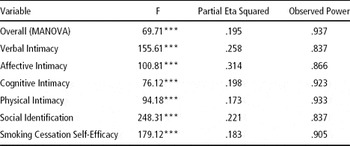
A MANOVA test was first done to reduce experiment-wise Type I error. The one-way MANOVA test revealed a significant multivariate main effect for participation level, F (10, 126) = 69.71, p < .001, Wilks’ λ = .579, partial-eta-square = .195. Significant differences in perceived verbal, affective, cognitive, and physical intimacy, social identification, and smoking cessation self-efficacy, were found across participation categories. Univariate main effects were then examined. To protect against inflated alpha error in the six univariate ANOVA tests, a confidence interval of .008 was set. The ANOVA tests revealed significant main effects for participation on verbal intimacy [F (3, 248) = 155.61, p < .001], affective intimacy [F (3, 248) = 100.81, p < .001], cognitive intimacy [F (3, 248) = 76.12, p < .001], physical intimacy [F (3, 248) = 94.18, p < .001], social identification [F (3, 248) = 248.31, p < .001], and smoking cessation self-efficacy [F (3, 248) = 179.12, p < .001], thereby answering RQ1. (Table 4)
Tests of significance difference between active participants and lurkers on intimacy levels, social identification and smoking cessation self-efficacy (N = 252)

p<.05*, p<.01**, p<.001***
Discussion
The findings of this study suggest that perceived intimacy with other members of health issue-specific SNSs can have a strong influence on participation, with social identification acting as a mediator impacting the relationship between participation and smoking cessation self-efficacy. As previously discussed, SNS features such as the ability to upload pictures, create personal profiles, connect to other members through friend requests, write on others’ walls, and post links, videos and other media, naturally lend them the ability for people to engage in more social, interactive activities with others online (Bishop, Reference Bishop2007; Boulos & Wheeler, Reference Boulos and Wheeler2007). Perceived verbal, affective, cognitive and physical intimacy all had significant impacts on participation level on the sites. Hence, the depth and breadth of one's interactions with others online, feelings of interdependence, predictability of interpersonal interactions, commitment to the online relationships, communication code change and network convergence, all positively influenced participation on health issue-specific SNSs. The practical implication of this finding is that it would be in site owners’ best interests to build infrastructure on the SNSs which would help to best encourage and facilitate group activities that are interactive so as to foster community among members. Even though lurkers may choose not to post messages, they can still derive a sense of community from reading (Kollock & Smith, Reference Kollock, Smith and Herring1996; White & Dorman, Reference White and Dorman2001). Over a period of time, their perceived intimacy with other members through reading messages may increase, influencing them to become active participants.
Another finding of this study is that participation on the site significantly predicted social identification. As stated in SIT, when individuals experience a negative social identity, they will employ self-enhancement strategies to restore their positive self-concept in relation to an in-group (Tajfel & Turner, Reference Tajfel, Turner, Stapel and H1986). In SNSs, intensity of usage can help those with lower self-esteem and satisfaction with life, to feel more connected to their communities (Barker, Reference Barker2009; Ellison et al., Reference Ellison, Steinfield and Lampe2007; Papacharissi & Rubin, Reference Papacharissi and Rubin2000). Results of this study suggest that participation in health issue-specific SNSs can help members to raise their social identification with others on the site, thereby helping them to feel more socially-connected through discussion of common health topics. Social identification also significantly impacted smoking cessation self-efficacy. When members of health issue-specific SNSs relate to others as representatives of the group, seeing themselves as interchangeable exemplars of their social group (Hogg, Reference Hogg, Leary and Tangney2003), the salience of their social identity can influence cognitive factors like smoking cessation self-efficacy, which lead to positive health outcomes. Further, the relationship between participation and smoking cessation self-efficacy was mediated by social identification. As such, the more one related to other members as part of the in-group, and incorporated the group's characteristics as their own, the more likely he or she is to conform to the group's norms related to the health issue, e.g. smoking cessation self-efficacy, rather than how much he or she participates within the group.
Additionally, this study also found that active participants and lurkers in health issue-specific SNSs for smoking cessation differed significantly on perceived verbal, affective, cognitive and physical intimacy, as well as social identification with other members, and smoking cessation self-efficacy. Existing literature has found that lurkers can feel as if they are a part of the online community, and receive positive health benefits without any direct participation (Preece et al., Reference Preece, Nonnecke and Andrews2004; Schlosser, Reference Schlosser2005; Mo & Coulson, Reference Mo and Coulson2010). However, as this study found, active participants on the sites reported significantly greater relationship breadth and depth, including discussing a wider variety of topics, more in-depth and honest discussions, and greater self-disclosure of personal matters. Through their communication, their relationship with others on the site became more interdependent, they were able to better understand each other and accurately predict each other's reactions to various situations, and also became more committed to maintaining the relationship. Further, active participants also saw their online relationships develop such that they were able to read between the lines of each other's communication, use their own jargon, signals, private language and nicknames. Active participants also developed these online relationships offline, as they introduced close friends, colleagues and family members to each other, and had overlapping social circles. Consequently, greater participation significantly predicted social identification with others on the site, and smoking cessation self-efficacy.
There were some limitations to the present study. First, the study sites included both general health SNSs with a smoking cessation community, and SNSs specifically for smoking cessation. There was little control over the type and number of sites examined, as permission was needed from moderators to post the questionnaire. The six study sites thus had differences in structure (e.g. site design, forums, message boards, profiles, wall posts, news feed) and site activity (e.g. number of active members). Future studies should standardise the structural and social elements of study sites, and also examine SNSs for other health issues, so as to establish generalisability of results to help build more effective SNSs. Second, measures were self-reported, so data may be subjected to self-reporting biases. Future studies should include system-recorded data of SNS usage. Third, the cross-sectional nature of the study meant that causal relationships could not be verified. Future studies should include longitudinal data, measuring participants’ SNS site usage over a period of time, so as to more effectively establish causality. Fourth, the study examined smoking cessation self-efficacy as a dependent variable. Future studies should link SNS usage and social identification to actual health outcomes.
Conclusion
Collectively, the findings of the present research suggest that health issue-specific SNSs can have a positive effect on members’ health outcomes. Perceived intimacy with other members on the site prompts lurkers on these SNSs to participate, particularly after they learn group norms, and relate to other, active members, on the sites (Bishop, Reference Bishop2007; Preece et al., Reference Preece, Nonnecke and Andrews2004). When members actively participate on the sites, members of health issue-specific SNSs can increase their social identification with other members on the sites, which, in turn, result in greater smoking cessation self-efficacy. Furthermore, active participants and lurkers differed significantly on perceived verbal, affective, cognitive and physical intimacy on the site, as well as social identification with other members, and smoking cessation self-efficacy. By regularly posting messages, corresponding with other members, and updating information, active members of the SNSs not only derive more satisfying and fulfilling relationships with others on the sites, but also see themselves as a more integral part of the in-group, have a more salient social identity with regards to the group, and have greater cognitive control over negative health issues. By applying a social identity lens (Tajfel & Turner, Reference Tajfel, Turner, Stapel and H1986) to the study of participation in health issue-specific SNSs for smoking cessation, this study extended current research on lurkers in online health communities through a socio-psychological perspective. Health issue-specific SNSs combine the utility of the internet with the affordances wrought by social connections. As such, they are a promising venue for health promotion. With greater public interest in potential health benefits derived from social groups (Christakis & Fowler, 2008; Kontos et al., Reference Kontos, Emmons, Puleo and Viswanath2010), the importance of health issue-specific SNSs in the future is not to be underestimated. Future studies, if conducted, should continue to investigate the use of new media technologies for harnessing one's social networks in health promotion.
Financial Support
This research received no specific grant from any funding agency, commercial or not-for-profit sectors.
Conflict of Interest
None.
Ethical Standards
The authors assert that all procedures contributing to this work comply with the ethical standards of the relevant national and institutional committees on human experimentation and with the Helsinki Declaration of 1975, as revised in 2008. The authors assert that all procedures contributing to this work comply with the ethical standards of the relevant national and institutional guides on the care and use of laboratory animals.
Acknowledgements
None
Appendix 1: Measures for Online Questionnaire
Note: All questions were assessed on 7-point Likert-type scales, ranging from ‘Strongly disagree’ to ‘Strongly agree’, unless otherwise stated.
*Questions reversed during data analysis.
Participation Level:
1) How many hours do you spend on the site per week? ___
2) How many hours do you spend surfing the internet per week? ___
3) How many messages do you post on the site per week? ___
4) How many friend connections do you have on the site? ___
5) How many of your offline friends are also members of the site? ___
6) How many offline friendships have you developed with people you initially met on this site? ___
7) I regularly contribute information on the site.
8) I regularly find announcements for events on the site.
9) I regularly publish or share pictures on the site.
10) I regularly publish or share audio or music on the site.
11) I regularly publish or share film or video clips on the site.
12) I regularly check to see if other members have tried to contact me.
13) I regularly look for new friends on the site.
14) I regularly read new contributions on the site.
15) I regularly view other members’ videos and pictures on the site.
16) I regularly make appointments with other members on the site.
17) I regularly look for new information on the site.
18) I regularly correspond with other members on the site.
19) I regularly engaged in discussion with other members on the site.
20) I regularly run community groups on the site.
21) I regularly surf other members’ profiles on the site.
22) I regularly update my profile status on the site.
23) I regularly contact other members on the site.
24) I regularly answer questions on the site.
Social Identification:
1) I identify with other members on the site.
2) Other members on the site are important to my sense of who I am – my self-identity.
3) I am similar with other members on the site in our attitudes and beliefs.
4) I feel strong bonds to other members on the site.
Smoking Cessation Self-Efficacy (SEQ-12)
1) I can refrain from smoking when I feel depressed.
2) I can refrain from smoking when having a drink with friends.
3) I can refrain from smoking after a meal.
4) I can refrain from smoking when I feel nervous.
5) I can refrain from smoking when I feel angry.
6) I can refrain from smoking when I feel very anxious.
7) I can refrain from smoking when I think about a difficult problem.
8) I can refrain from smoking when I feel the urge to smoke.
9) I can refrain from smoking when celebrating something.
10) I can refrain from smoking when drinking beer, wine, or other spirits.
11) I can refrain from smoking when I am with smokers.
12) I can refrain from smoking when having coffee or tea.
Verbal Intimacy
1) My communication with other members ranges over a wide variety of topics.
2) Once we get started, we move easily from one topic to another.
3) We contact each other in a variety of ways other than on this site.
4) I can usually tell other members exactly how I feel.
5) I have told other members what I like about him or her.
6) I feel I can confide in other members about almost anything.
7) I have told other members things about myself that he or she could not get from any other source.
8) Our communication stays on the surface of most topics.*
9) I would never tell other members anything intimate nor personal about myself.*
10) My communication with other members is limited to just a few specific topics.*
11) I try to keep my personal judgments to myself when other members say or do something with which I disagree.*
Affective Intimacy
1) I feel like being encouraging to other members when they are unhappy.
2) I wait to consult other members on important matters.
3) It is important for me to listen to other members’ disclosures.
4) Other members and I depend on each other.
5) Other members and I have a great deal of effect on each other.
6) Other members and I influence each others’ feelings.
7) I can accurately predict other members’ responses on the site.
8) I can tell what other members feel inside.
9) I can accurately predict other members’ attitude.
10) I am committed to maintaining relationships with other members.
11) My relationship with other members is a big part of who I am.
12) I make a great effort to maintain relationships with other members.
13) I feel close to other members most of the time.
14) It is important to me that other members understand my feelings.
15) I am satisfied with my relationships with other members.
16) It is important to me that other members are encouraging to me when I am unhappy.
17) I am very uncertain about what other members are like.*
18) Other members and I have very little influence on each others’ thoughts.*
19) I do not know other members on the site very well.*
20) I do not expect my relationship with other members to last.*
21) Other members and I do not set aside any time to communicate on the site.*
22) My relationships with other members are not very important.*
Cognitive Intimacy:
1) I am able to read between the lines of my communication with others on the site.
2) I share special language jargon with other members on the site.
3) I use special nicknames to address other members on the site.
4) I use private signals for other members on the site.
5) I can get ideas across to other members using much simpler messages than I would use with other people.
6) There is not much difference between the way I communicate with other members on the site, and the way I generally communicate on the internet.*
Physical Intimacy:
1) I have overlapping social circles online with other members on the site.
2) I have overlapping social circles offline with other members on the site.
3) I have introduced other members on the site to my friends and family.
4) I am involved with many of the same sites and groups as other members on the site.
5) Other members and I contact a lot of the same people on the internet.
6) Other members and I do not know any of the same people.*
Demographics
1) What is your gender? Male/Female
2) What is your age? ____
3) What is your ethnicity? Asian / Black / Hispanic / White / Native-American /Mixed or Other
4) What is your marital status? Single / Married / Divorced / Separated / Widowed
5) What is your highest education level? None / Elementary / Junior high (middle school) / Some high school / High school graduate / Vocational or trade school / Some college / Associate degree (2 year degree) / Bachelor's degree (4 year degree) / Master's degree/ Professional degree / Doctorate degree
6) What is your annual household income? $25,000 or less / $25,001 to $40000 / $40001 to $60000 / $60001 to $80000 / $80001 to $100000 / More than $100,000
7) What is your country of residence? ____