Introduction
The genus Camellia L. is a member of the eastern and southeastern Asian branch of the family Theaceae, which consists of some 9 to 15 genera, this number being subject to interpretation of the known facts by various authors (Sealy, Reference Sealy1958; Chang & Bartholomew, Reference Chang and Bartholomew1984; Ho, Reference Ho1991; Gao et al., Reference Gao, Parks and Du2005; Ming & Bartholomew, Reference Ming, Bartholomew, Wu and Raven2007). The major centres of Camellia diversity appear to be the southern provinces of China, where most Camellia species are distributed throughout the mountainous areas of the country, and also the mountains of Burma, Thailand, Cambodia, Laos and Vietnam (Sealy, Reference Sealy1958; Chang & Bartholomew, Reference Chang and Bartholomew1984; Ho, Reference Ho1991; Gao et al., Reference Gao, Parks and Du2005; Ming & Bartholomew, Reference Ming, Bartholomew, Wu and Raven2007).
The new species was discovered in an extremely rugged region of the southern Annamite Mountains and it seems to be confined to a specific mountainous area of rainforest situated within the Bidoup-Nui Ba National Park, Lam Dong Province, Vietnam. The new species is highly unusual as it exhibits an upright, almost branchless habit, distichous leaves, and laterally compressed branchlets and upper two-thirds of the trunk. This combination of morphological characters gave the new species such a unique appearance that we considered the possibility it might represent a new genus. However, subsequent morphological examination of the new species’ reproductive characters clearly indicated placement in genus Camellia. Further molecular work, using SSR protocols and methods, furnished data that confirmed this conclusion (G. Orel, unpublished data). Because of the unique features of this taxon, we recognise it not only as a new species, Camellia inusitata, but also as a new section, Bidoupia. We also compare both the species and the section with existing taxa and discuss the species’ conservation status.
Camellia sect. Bidoupia Description
Camellia sect. Bidoupia Orel, Curry & Luu, sect. nov.
Sectio propria ab aliis sectionibus combinatione characterum sequentium distinguitur: truncus unicus fere exclusive non ramosus; ramuli complanati; folia disticha; ovarium tricarpellatum carpellis plerumque bilocularibus; fructus magni oblati. – Type: Camellia inusitata Orel, Curry & Luu.
Trunk strictly single, initially laterally compressed, later rounded, branchless, or with few rudimentary branchlets when vertical, at acute angle with few vertical shoots; branchlets laterally compressed towards the apex. Leaves distichous, leaf bases cordate to shallowly amplexicaul. Flowers pedunculate, solitary or geminate. Sepals 5. Petals 5 (6). Stamens not numerous. Styles, proximally fused, finely pubescent proximally; ovary densely tomentose, 3-carpellate. Mature fruit unevenly round, distinctly oblate, dehiscing into three parts, columella stout. Seed glabrous and laterally compressed.
Species Description
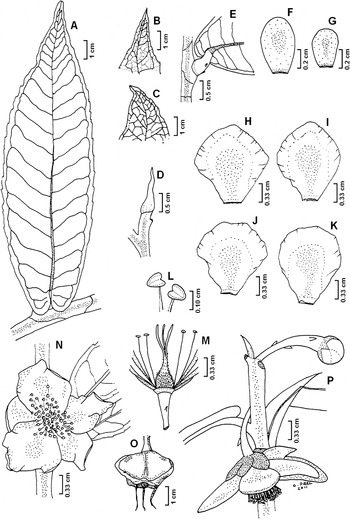
Camellia inusitata Orel, Curry & Luu, sp. nov.Fig. 1.
Fig. 1.Camellia inusitata Orel, Curry & Luu. A, mature leaf; B, apex of mature leaf showing leaf apex variation, adaxial view; C, apex of mature leaf showing leaf apex variation, abaxial view; D, terminal leaf bud; E, adult leaf petiole and its attachment to mid vein, abaxial view; F, sepal; G, sepal; H–I, petals from the outer whorl; J–K, petals from the inner whorl; L, anthers; M, adult flower, lateral section showing all flower parts; N, senescing flower with fully reflexed and folded petals; O, adult fruit with persisting styles; P, branchlet with flower and leaves. Drawn by G. Orel from the holotype, Luu 464.

Ab aliis speciebus Camelliae characteribus sectionis et petalis senescentibus valde recurvatis differt. – Type: Vietnam, Lam Dong Prov., Bidoup-Nui Ba National Park, 19 xii 2010, Luu Hong Truong, Pham Huu Nhan & Vo Duan Luu 464 (holo VNM; iso NSW, VNM).

Woody perennial, small to medium evergreen treelet to 3 m high; trunk single, slender, flexible, distally and laterally compressed for about two-thirds of its length, sometimes broadly arching; trunk mostly branchless or sparsely branched towards the apex but a few vertical shoots may occur on the trunk’s upper surface when it is out of vertical alignment; first year’s branches thin, laterally compressed, longitudinally thinner in their mid section, thicker on the edges, light to mid green, later darker green, glabrous, shiny, with occasional leaf scars; in their second year branches distally and laterally compressed for about two-thirds of their length, longitudinally thinner in their mid section, thicker on the edges, proximal sections of the branch unevenly rounded, mid to dark green, glabrous, shiny; in their third year branches partially compressed towards the apex, otherwise unevenly rounded, initially dark green, then turning dark cinnamon-brown, glabrous, shiny; in their fourth year, branches unevenly round, grey to light brown, patchy, slightly furrowed; adult bark light grey, slightly flaky, covered by lichens. Axillary leaf buds rudimentary, roughly triangular, flat, with rounded apex, glabrous, green to brown, bud scales small but prominent, 1–2 mm long; terminal leaf buds laterally compressed, thin, slightly falcate, slightly sinuous, roughly triangular, with a sharp apex, glabrous, 10–14 mm long, 3–4 mm wide; juvenile leaves soft, slightly pendulous, variable in size, orange to reddish in colour; mature leaves alternate, distichous; leaf petiole of variable length, linear to slightly falcate, rather stout, slightly narrower proximally, wider distally, attached at 45° to 60° to the branch, obscured by the cordate leaf base so that the leaf appears to be sessile from above, mid green adaxially, darker green and reddish-brown abaxially, glabrous, shiny, finely textured, 6–8(–10) mm long, c.4 mm wide; lamina coriaceous, glabrous, slightly undulate, narrowly lanceolate to lanceolate, up to 18 cm long, 3–4(–5) cm wide, margins distinctly and regularly serrate in the mid section, but entire towards the base and the apex; leaf apex sometimes slightly falcate, acuminate, leaf base cordate to shallowly amplexicaul; adaxial leaf surface glabrous, dark green and shiny, lighter green and slightly duller below; adaxial primary vein indistinct, 1–2 mm wide, abaxial midrib 2–2.5 mm wide proximally, less than 1 mm distally, yellowish-green and shiny on both sides, adaxially slightly prominent, abaxially distinctly prominent; secondary venation pinnate, thin, brochidodromous, with 20–23 pairs of veins, adaxially slightly raised but indistinct, abaxially prominent; tertiary venation adaxially indistinct, distinct and finely reticulate abaxially, more prominent at the leaf margins. Flowers pedunculate, axillary on older stems or the trunk, or sometimes terminal, mostly solitary, seldom geminate, unevenly circular in shape, lacking scent; senescing flowers with extremely reflexed and abaxially folded petal apices; peduncle slender, glabrous, relatively thin proximally, wider distally, proximally pink to reddish for about two-thirds of its length, otherwise yellowish-green, 11–18 mm long, distally 2–3 mm wide, 1 or sometimes 2 (3) small, 1–2 mm deciduous bracteoles present; flower buds numerous, unevenly globose, distally rounded, initially green and tomentose, then light yellow and glabrous; bud scales prominent; senescing flowers 20–26 mm diameter with extremely reflexed soft, shiny, partially translucent petals that are light yellow with darker yellow pigmentation in the centre and the proximal area, midrib or any type of striations lacking. Sepals 5, in two whorls of 3-2 or 2-3, basally overlapping, tightly adpressed to the outer petal whorl, concave, variable in size and shape, generally roughly orbicular to elliptic, 3–6 mm wide, 4–7 mm long, lacking emargination, glabrous, shiny, reddish-brown, margins yellow, partially translucent on margins, persistent after anthesis. Petals 5 (rarely 6), in two whorls, proximally overlapping, slightly concave, without emarginations, glabrous, thin, crinkly, easily damaged, with translucent and slightly undulate margins; the outer whorl 3 (2) petals of variable size but similar in shape, 12–15 mm long, 9–17 mm wide, slightly concave, broadly orbicular to obovate, proximally overlapping within the whorl and with the petals of the inner whorl, basally joined to outer stamens for 1–1.8 mm; the inner whorl 2 (3) petals of variable size but similar in shape, 11–15 mm long, 9–17 mm wide, concave, slightly asymmetric, broadly orbicular to obovate, proximally overlapping within the whorl and with the petals of the outer whorl, basally attached to outer stamens and to the inner petal whorl. Stamens not numerous (50–70), 7–10 mm long, initially intensely yellow, later dark yellow to light brown, in a circular formation 10–13 mm diameter, outer stamens connate proximally for 1–2 mm, otherwise free, outer stamens also joined to the inner petal whorl proximally for 1–1.8 mm; filaments intensely yellow, later dark yellow, 1 mm or less wide, proximally slightly thickened, distally thin; anthers bright yellow, later slightly brownish on margins, distinctly abaxially concave, striations of adaxial surface shallow but prominent, variable in length and width, c.1 mm long, 0.7–0.9 mm wide, obtuse to very broadly ovate at the distal end, cordate at proximal end. Styles three, 7–9 mm long, less than 1 mm wide proximally, irregular in shape, proximally fused for 2–3 mm, finely pubescent proximally, but to a lesser degree than the ovary, glabrous distally, yellowish-green; stigma indistinct, slightly darker than the rest of the style; ovary superior, unevenly rotund, yellowish-green, without longitudinal striations, densely tomentose, 3-carpellate, carpels mostly but not always bilocular, 2–3 mm long, 3–4 mm wide proximally. Young capsule mid green, shiny, finely tomentose, unevenly round, distinctly oblate, remnants of the three persistent styles distally prominent, divided into three uneven lobes, sutures prominent; mature fruit dark brown, shiny, glabrous, finely textured, unevenly round, distinctly oblate, 3–3.5 cm diameter, 1.5–2 cm deep, style remnants persistent, but lacking on fully dehisced fruit, dehiscing distally into three parts, with three internal chambers that are not always bilocular, columella stout, distinct, 2–2.5 cm long; seed mid to dark brown, shiny, glabrous, laterally compressed, variable in shape and size, each capsule with (4–5–)6 seeds.
Distribution. Camellia inusitata is known only from the type location which is situated in the mid section and at the top of a spur of an unnamed mountain adjacent to Hon Giao Forest Protection Station. The area of discovery is estimated to measure less than 1 km2 and is covered in evergreen, semi-open, mountain forest that persists on always wet and nutritionally relatively rich soils.
Phenology. Camellia inusitata was found by Dr Luu Hong Truong, the Vice-Director of the VNM Herbarium in Saigon, during one of his numerous field trips. Since then the site of the discovery has been visited on several occasions. Recently, vegetative material collected by the staff of the VNM Herbarium was grafted onto suitable root stocks. The results of this experiment are not yet available. The new species was collected in flower in December with some juvenile fruiting capsules present. This was followed by fruit maturation in May–July, with fruit capsules dehiscing in late July.
Proposed IUCN Red List category. Critically Endangered CR B1ab(iii)+ B2ab(iii). A thorough search of the area around the type locality revealed fewer than 100 adult plants which occupy an area of less than 1 km2. The known population of Camellia inusitata faces a potentially high risk of extinction in the immediate and mid-term future. The building of a main road has already divided the only known population of Camellia inusitata, resulting in disturbance and habitat fragmentation. Traffic volumes are increasing with ever expanding local traffic and tourist activities. Future road widening would directly threaten the population since trees occur within 15 m of the present road. Given this situation, we consider the IUCN category of Critically Endangered (CR) to be appropriate (IUCN, 2011).
Etymology. The specific epithet is from the Latin ‘inusitatus’, meaning ‘unusual’, ‘uncommon’ or ‘strange’, and refers to the anomalous morphology.
Taxonomic Notes
Morphological evidence shows that the newly described species, Camellia inusitata, possesses a number of unique vegetative characteristics which are not common to any of the currently described species within the genus Camellia. Most of the plants of Camellia inusitata observed in the field appear to be completely branchless. A detailed survey of the wild population, which numbers fewer than 100 individuals, indicates that this is one of the salient morphological characteristics that define the species. Evidence shows that sparse branching may occur on senescing plants, or on broadly arching specimens (the lean of the trunk being caused by foraging animals, falling debris or wind), in the form of a few vertical shoots that grow on the trunk’s convex surface. These may be the result of the reassertion of apical dominance.
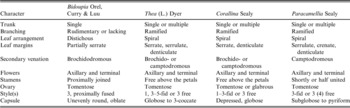
Another important morphological trait of Camellia inusitata is its trunk and branch development and structure. The apex of the trunk and the rudimentary branchlets that sometimes occur are laterally compressed and become completely round in their lateral section only in their third (partially) and fourth year of development. The distichously arranged mature leaves and the small, yellow flowers may appear on the laterally compressed parts, as well as on the older, rounded parts of the trunk and branchlets, covering the distal two-thirds of these parts. Analysis of vegetative morphological characteristics of the newly proposed species does not in itself confirm placement within the genus Camellia (Table 1). However, despite the atypical vegetative attributes, Camellia inusitata possesses basic reproductive morphological characteristics that firmly place it in the genus Camellia (Table 1). These include pedunculate flowers, loculicidally and distally dehiscing capsules, and large wingless seeds (Sealy, Reference Sealy1958; Chang & Bartholomew, Reference Chang and Bartholomew1984; Ho, Reference Ho1991; Gao et al., Reference Gao, Parks and Du2005; Ming & Bartholomew, Reference Ming, Bartholomew, Wu and Raven2007).
Comparison of selected morphological characters of the newly established Camellia sect. Bidoupia Orel, Curry & Luu with Camellia sects. Thea (L.) Dyer, Corallina Sealy and Paracamellia Sealy

References: Gagnepain (Reference Gagnepain1941), Keng (Reference Keng, Smitinand, Larsen and Hansen1972), Krussmann (Reference Krussmann1985), Ho (Reference Ho1991), Ming & Bartholomew (Reference Ming, Bartholomew, Wu and Raven2007); pers. obs. G. Orel & A. S. Curry, 1999–2011.
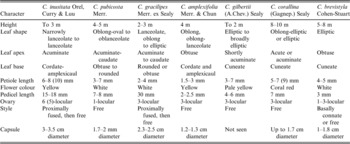
The new species exhibits broad affinities with the members of Camellia sects. Thea (L.) Dyer, Corallina Sealy and Paracamellia Sealy in subgen. Thea (L.) Hung T.Chang (sensu Ming & Bartholomew, Reference Ming, Bartholomew, Wu and Raven2007). As shown in Table 1, these are of importance, but numerically few (Gagnepain, Reference Gagnepain1941; Keng, Reference Keng, Smitinand, Larsen and Hansen1972; Krussmann, Reference Krussmann1985; Ho, Reference Ho1991; Ming & Bartholomew, Reference Ming, Bartholomew, Wu and Raven2007). The morphological evidence presented supports taxonomic placement in a new section of the genus Camellia, described here as Camellia sect. Bidoupia (Table 1). In Table 2 we compare the new species with selected members of the other sections of Camellia.
Comparison of selected morphological characters of Camellia inusitata Orel, Curry & Luu with species in Camellia sect. Thea (L.) Dyer, Corallina Sealy and Paracamellia Sealy

References: Gagnepain (Reference Gagnepain1941), Sealy (Reference Sealy1958), Keng (Reference Keng, Smitinand, Larsen and Hansen1972), Chang & Bartholomew (Reference Chang and Bartholomew1984), Ho (Reference Ho1991), Gao et al. (Reference Gao, Parks and Du2005), Ming & Bartholomew (Reference Ming, Bartholomew, Wu and Raven2007); pers. obs. G. Orel & A. S. Curry, 1999–2011.
To test the conclusions based on morphological characters, a molecular evaluation of the newly proposed species was also undertaken using SSR protocols and techniques (Kaundum & Matsumoto, Reference Kaundum and Matsumoto2002). Comparisons were made with data from selected representatives of nine genera of Theaceae and a further six Camellia species. The results (G. Orel, unpublished data) have confirmed placement in the genus Camellia to be correct. These molecular studies are an integral part of continuing broader research into the placement of a range of unpublished Camellia species within the infrageneric framework of the genus. Because this is on-going work, no detailed analyses are presented in this paper.