


Introduction
Among the glaciers flowing down the sides of the DryValleys ofVictoria Land, Antarctica, those which are not confined to the valley sides but reach the valley floor show thick sequences of debris layers incorporated at their base. Although these glaciers are cold-based (temperature lower than —17°C), those with ice-marginal lakes show well-preserved stratified sedimentary structures obviously entrained within their basal part (Fig. 1). Observations made in a 25 m long tunnel dug at the bed of one of these glaciers (Fitzsimons and others, in press) confirm that many basal ice structures visible at the ice margin represent extensions of subglacial structures observable 100 m up-glacier of the margin.
Well-preserved stratified sedimentary structures in upper part of ice and debris apron atfoot of ice cliff along right margin of Suess Glacier.

Recently, one of us (Reference FitzsimonsFitzsimons, 1996) proposed a model that explained the formation of thrust-block moraines at the margin of glaciers which flow into lakes with an unfrozen bed (Fig. 2). Such lakes are common in the Dry Valleys (Reference Wilson, Holdsworth and HendyWilson and others, 1974 ; Reference Cartwright and HarrisCartwright and Harris, 1978 ; Reference Chinn, Green and FriedmannChinn, 1993). This model takes into account the change in position of the 0°C isotherm when a glacier is flowing into a lake. Transient wet-based conditions occur as ice flows onto unfrozen sediments of the lake bottom. Water can be confined near the glacier sole, at the lake margin, and basal freezing can occur since glacier ice acts as a cold source. Ice accretion and basal incorporation of sediment layers take place in such conditions. Rising flow vectors, characteristic of the ablation zone of the glacier, result in the upward movement of the accreted ice and debris.
Depositional model for formation of thrust-block moraines at margin of cold-based glaciers flowing into lakes.

However, the processes at the glacier—lake interface, by which debris incorporation is occurring, have not been identified precisely. In this paper, we study a situation where this model is evaluated by an ice-composition study.
Site Description
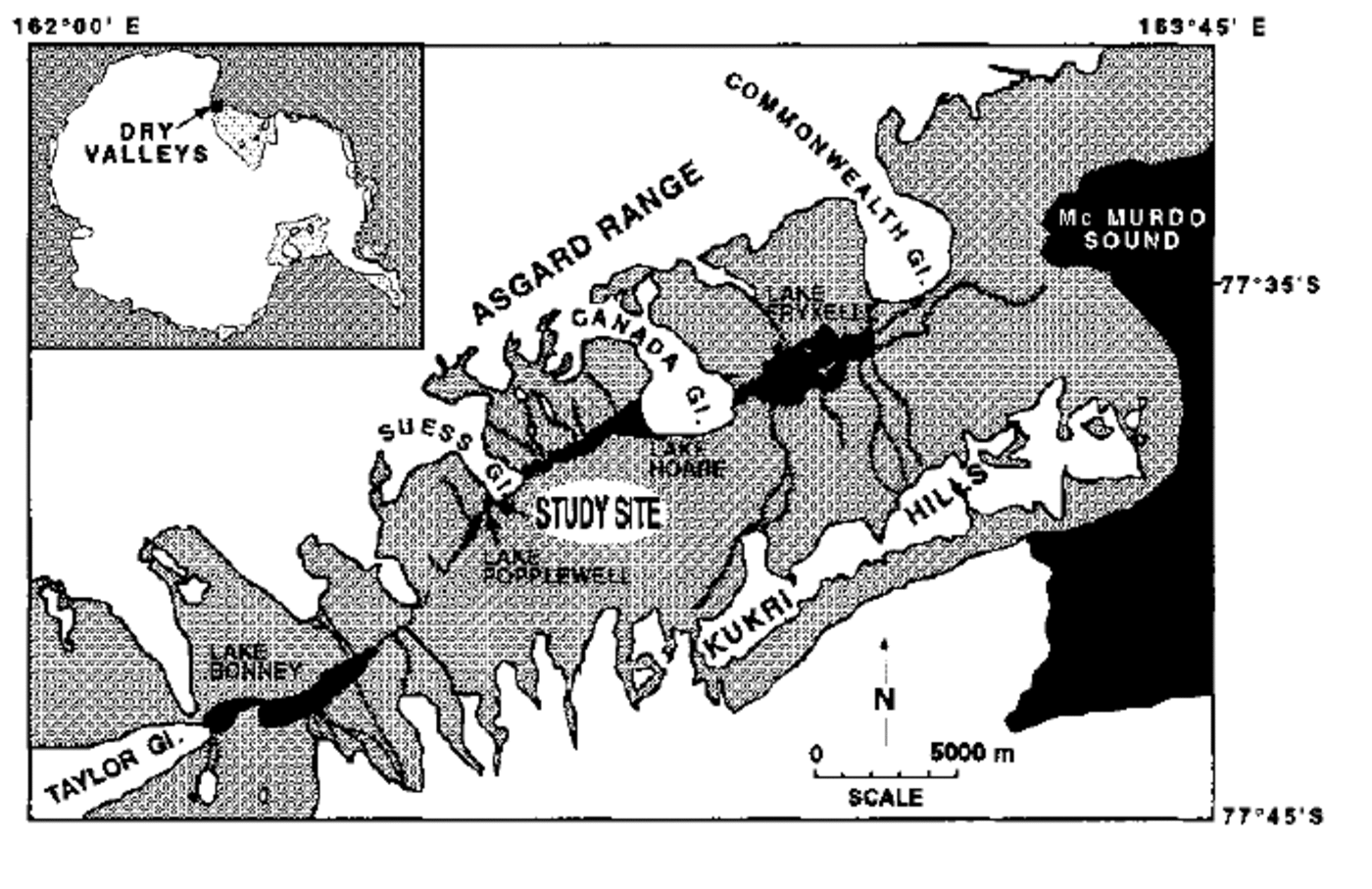
Suess Glacier is a 5 km long alpine glacier that descends from 1750 m on the Asgard Range and flows across the floor of the Taylor Valley (Fig. 3). At the terminus, the right side of the glacier flows up the Taylor Valley and forms a 18-20 m high cliff overlooking an ice and debris apron adjacent to Lake Popple- well (Fig. 4). As with all the other alpine glaciers of the Dry Valleys, the whole glacier is below the pressure-melting point (Reference ChinnChinn, 1991) and a basal temperature of —17°C has been measured. The surface of the glacier is debris-free, apart from a few boulders coming from the valley sides. The substrate of the glacier, revealed by excavation below the basal ice, consists of frozen planar bedded or crossed-bedded sand and also massive unstratified sand containing layers of fine gravels.
Study site located where Lake Popplewell and Suess Glacier are closest.
Right margin of Suess Glacier showing ice and debris apron at foot of 18-20 m ice cliff; ice-covered Lake Popplewell in foreground.

Direct observation and excavation of the ice and debris apron, from its base to its contact with the vertical part of the ice cliff, reveals a 3–5 m thick series of ice layers of variable thickness (1cm to a few dm), interbedded with sand and fine gravel beds (Fig. 5). Occasionally, a thin organic mud layer or an algae layer (a few mm thick) is associated with a sand layer. The whole stacked sequence is dipping from 12–22 deg in an up-glacier direction. The particle-size characteristics of the sediment are similar to those of the adjacent lacustrine environment (Reference FitzsimonsFitzsimons, 1996).
Sampling site showing most of 3–5m thick series of ice layers of variable thickness, interbedded with sand and gravel beds.

The ice layers show different facies which fit the classification scheme developed by Reference Sharp, Jouzel, Hubbard and LawsonSharp and others (1994). The main components of the basal ice zone are basal-dispersed, basal- laminated, basal-clear and basal-solid facies that are overlain by the amber-ice facies, the latter being the only one previously reported in the Dry Valleys; at the base of Meserve Glacier (Reference HoldsworthHoldsworth, 1974). Some blocks of undisturbed lacustrine sediments are included within the sequence, especially in the upper part of the apron. The well-preserved primary sedimentary structures of these blocks suggest the sediments were frozen during entrainment (Fig. 1). This apron is thus very different from the ice cliff above, which consists of bubbly glacier ice devoid of visible particles.
Sample Description and Treatment
The excavation made in the apron permitted sampling of many of the ice beds present in the sequence. All samples were taken with the aid of a chain saw equipped with tungsten carbide teeth. Blocks about 10 cm wide and 30–40 cm high were taken along the vertical sequence, wrapped in polyethylene bags and immediately stored in a freezer installed in the nearby field camp.
Additionally, seven shallow ice cores (1.6 m long) were retrieved with a SIPRE-type ice auger along a longitudinal profile from the upper surface of Suess Glacier. Finally, a 1m long ice core was also taken from the ice cover of adjacent Lake Popplewell.
All ice samples were kept at — 18°C and transferred to the cold laboratory in Brussels. Temperature loggers were used to monitor the samples from their initial storage in the field to their laboratory storage; the temperature of the samples did not rise above —18°C. The laboratory analyses consisted of measurements of stable isotopes (δD and δ18O), total gas content and gas composition (O2, N2, GO2).
All the samples taken with the chain saw were re-sawed in the cold laboratory with a diamond-wire saw without any melting: a slice, 2 cm thick, was cut parallel to each side and discarded to avoid contamination. Then, 85 subsamples of 5 g were cut from the different layers present in the basal ice blocks for isotopic analyses. For gas analyses, a lower number of subsamples (70–80 g each) were cut at the same level as some of the samples taken for the isotopic analyses. The same type of “subsampling” was carried out on the seven ice cores retrieved from the glacier surface: 25 samples were cut for isotopic composition and one for gas analysis.
The isotopic analyses were performed at the Saclay Nuclear Research Center in France. Results are expressed in S units normalized to Standard Mean Ocean Water. Precision of the measurements is ±0.5%o on δD and ±0.1 %o on δ18O.
The gas analyses were performed in Brussels. Total gas content was determined by a melting—refreezing method, using a Toepler pump. This method has been fully described by Reference Raynaud, Chappellaz, Barnola, Ye, Korotkevich and LoriusRaynaud and others (1988) and Reference BlunierBlunier and others (1993). The relative precision is better than 5% (Reference Martinerie, Lipenkov, Raynaud, Chappellaz, Barkov and LoriusMartinerie and others, 1994). Gas composition was measured using a dry extraction technique at —55°C in a cold room and a Varian 3300 gas chromatograph; using a procedure fully described by Reference Raynaud, Delmas, Ascencio and LegrandRaynaud and others (1982) and Barnola and others (1983). The precision of the measurements is 2.5% for CO2 and 0.4% for O2 and N2.
Results and Comments
Basal ice clearly differs from glacier ice as far as its isotopic composition is concerned. Placed on a graph in which δ18O is plotted against δD (Fig. 6), the 25 glacier ice samples from the glacier surface show a linear relationship with a slope S = 8.1. The line has the equation:

and can be considered as the local Meteoric Water Line as defined by Reference CraigCraig (1961). The world Meteoric Water Line has been recently redefined by Reference Rozanski, Araguás-Araguás, Gonfiantini, Swart, Lohmann, McKenzie and SavinRozanski and others (1991) as having the equation:

δD—δ18O diagram of all samples analysed from: the glacier surface (?) from the basal ice (?) of Suess Glacier; and from the lake water of Lake Popplewell (?). S is the value of the slope of the nearby regression line.

Such a relationship derived from fresh precipitation is generally true for glacier ice that has not undergone isotopic change since its formation in the accumulation area.
By contrast, the 85 ice samples taken from the apron section show a linear relationship with a slope
S = 5.4. The regression line has the equation:

This slope is typical for ice due to water freezing as explained by Reference Jouzel and SouchezJouzel and Souchez (1982) and Reference Souchez and JouzelSouchez and Jouzel (1984). These authors have shown theoretically and experimentally that progressive freezing of a water reservoir induces changes in the isotopic composition of successively formed ice increments. The more negative values correspond to the ice formed when the freezing front draws near to the end of the reservoir. The evolution in δD and δ18O during freezing defines a so-called “freezing slope” in a δD—δ18O diagram which constitutes a specific isotopic signature of ice produced by water freezing. This slope can be calculated by the following equation

where δi is the δD composition of the parent water, ϕ i its δ18O composition, a and β, the values of the ice—water equilibrium fractionation coefficients for deuterium (taken as 1.0208) and for 18O (taken as 1.003), respectively.
If, as suggested by Reference Souchez and JouzelSouchez and Jouzel (1984), the S values at the intersection of the two regression lines are taken as the isotopic composition of the parent water (δ18O = —32.74% and δD = —255.8%) the slope calculated from Equation (4) for a freezing process is 5.4. If water sampled in Lake Popplewell, adjacent to the glacier, is taken as parent water (δ18O = —29.56% and δD = —237.5%), the calculated slope is 5.5. These two calculated slopes are in close agreement with the slope of 5.4 obtained from the basal ice samples of the apron of Suess Glacier. Go-isotopic analyses of this ice thus indicate that water freezing plays a major role in the build-up of the basal ice sequence of Suess Glacier.
Results from gas analyses give further arguments. Basal ice clearly differs from surface glacier ice in both gas content and gas composition (Table 1)
Results of gas analyses of ice samples from Suess Glacier and from Lake Popplewell.
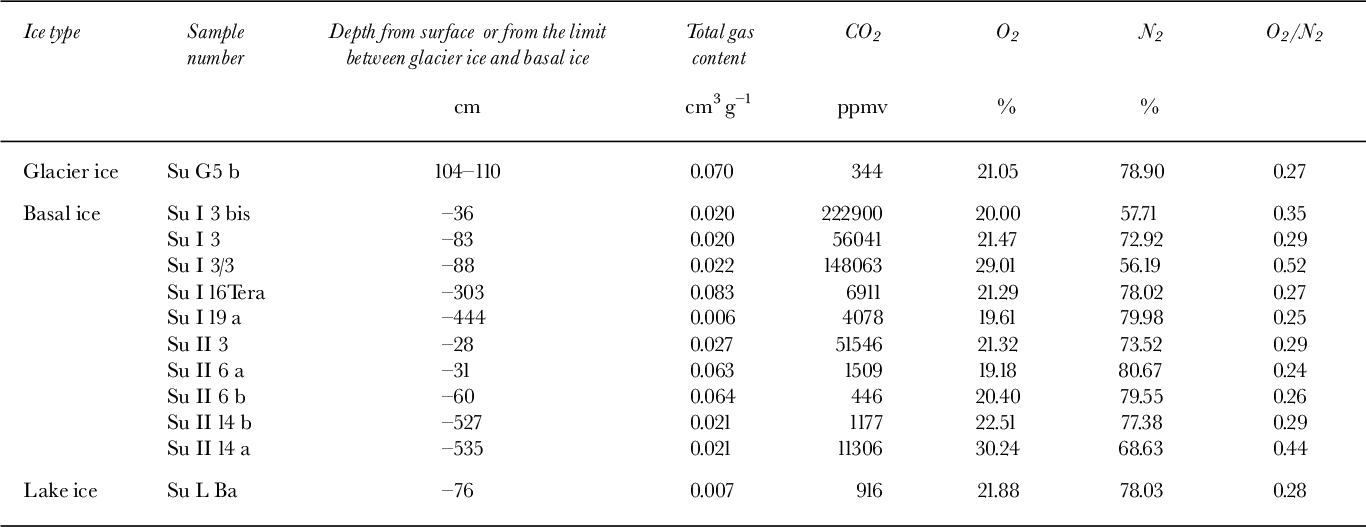
Surface glacier ice has a total gas content close to that typical for polar meteoric ice. This value is about 0.100 cm3 g—1 of ice at standard temperature and pressure conditions. Values between 0.075 and 0.140 cm3 g—1 1 have been reported in glacier ice from polar ice cores (Reference Martinerie, Raynaud, Etheridge, Barnola and Mazau-dierMartinerie and others, 1992). Surface ice has a CO2 concentration slightly higher than the atmospheric one from the pre-industrial period (≈280ppmv) and its O2/N2 ratio is nearly the atmospheric one (0.268). These characteristics point to the possibility that small quantities of superficial meltwater have penetrated into the firn and have refrozen as a thin layer of ice covering cold snow grains (Reference Stauffer, Neftel, Oeschger, Schwander, Langway, Oeschger and DansgaardStauffer and others, 1985).
By contrast, the basal ice has a strikingly lower total gas content, a very much higher CO2 concentration and a O2/N2 ratio generally higher than atmospheric values. These characteristics indicate that this ice formed, at least partly, from the freezing of liquid water, a process that causes gas rejection and preferential incorporation of CO2. As compared to the situation in the atmosphere, air dissolved in water at 0°G and atmospheric pressure has a different composition (19300 ppmv CO2 and O2/N2 — 0.56) because of the higher solubility of CO2 and O2 compared to N2 (Reference Stauffer, Neftel, Oeschger, Schwander, Langway, Oeschger and DansgaardStauffer and others, 1985).
In the present case, the CO2 content reaches much higher values (222900 ppmv). To our knowledge, the highest value of CO2 content in glaciers ever published was 135000 ppmv which was reported by Reference Souchez, Lemmens and ChappellazSouchez and others (1995a, Reference Souchez, Janssens, Lemmens and Staufferb) for basal silty ice from the Greenland Icecore Project (GRIP) core in central Greenland.
Results of this study show that the O2/N2 ratios reach values as high as 0.516 and are associated with high CO2 concentrations. This situation is completely different from that described at the base of the GRIP core where high CO2 concentrations are related to low O2/N2 ratios. The latter relationship implies that oxidation of organic matter has produced carbon dioxide since this process is responsible for a lowering of the oxygen content. Our case, on the contrary, precludes this process. Progressive freezing of a water reservoir must be considered.
Results of gas analyses from natural ice formed by water freezing are very scarce in the literature and deal with one or two gases only. However the O2/N2 ratio has been studied by Reference Craig, Wharton and McKayCraig and others (1992) in the water and in the bubbles of lake ice from Lake Hoare, situated in Taylor Valley not far from Suess Glacier (Fig. 3). These authors explain that gases become supersaturated in the region immediately below the nearby forming ice during freezing of lake water until bubbles nucleate and form a gas phase. As freezing proceeds, gas is transferred from solution to the bubbles until finally the bubbles are encapsulated in the ice. In the case of Lake Hoare, the O2/N2 ratios measured in such ice bubbles range from 0.48— 0.51. In the case of the ice cover of Lake Popplewell, sampled in the present study (Table 1), this ratio is even lower (0.28). As stated above, the equilibrium value of the O2/N2 ratio for air dissolved in water at 0°C and an atmospheric pressure is 0.56, but this is not the case in ice formed by water freezing since O2 and N2 do not diffuse at the same rate away from the advancing freezing front: at 0°C the O2 diffusion coefficient in water is 2.08 x 10 –9m2s—1 instead of 1.61 x10 –9m2s —1 for N2). The higher values reached in the Lake Hoare ice could be explained by the local production of oxygen by photosynthesis which, following Reference Craig, Wharton and McKayCraig and others (1992), is responsible for 11% of the O2 input of the lake. Different freezing rates could also play a role since they affect the O2/N2 ratio in the boundary layer situated at the ice—water interface. More work is clearly needed to understand all aspects of the gas composition of the basal ice from Suess Glacier, but the data cannot be explained without considering freezing of liquid water.
Conclusion
The stable isotope composition, the total gas content and the gas composition of the basal ice from Suess Glacier indicate that water (most probably lake water) plays a major role in the formation of the stacked sequence of ice and sediment layers accreted at the base. This is consistent with the previously proposed model of debris entrainment by cold-based glaciers that flow into lakes. This model states that transient wet-based conditions occur as ice flows into the unfrozen sediments of the lake bottom, creating conditions favorable for the entrainment of sediments and for ice accretion by water freezing.
Several aspects require further study. For instance, occasionally organic muds or algae layers are present in the basal ice sequence as well as in the shallow lacustrine environment of the adjacent Lake Popplewell. The potential role of these living organisms in the gas budget of the associated water and ice is of interest for better understanding of the gas composition reported here. Sampling of basal ice from the tunnel recently dug at the glacier sole, 100 m upstream of the sequence studied here, will certainly allow a more complete and detailed view of the build-up mechanisms of the basal sequence of the glacier.
Acknowledgements
We would like to thank Antarctica New Zealand for providing the logistical support for this study and the University of Otago for financial support. Thanks are also due to B. Hooker and S. Mager for assistance with the field work and to L. Janssens and O. Lambert for their effective help in sample treatment and analyses. R. Souchez is warmly acknowledged for his constructive comments on an early draft of this paper.
The authors are also indebted to P. Jansson and J. Kohler for their helpful critical comments. J. Fitzpatrick and G. Hargreaves from the U.S. Geological Survey National Ice Core Laboratory, Denver, Colorado, are thanked for their help in transferring the ice samples from Antarctica to Brussels.
This paper is a contribution to the Belgian Scientific Program on Antarctica (Science Policy Office).



