BACKGROUND
Palliative care considers the physical, psychosocial, and emotional needs of patients, offering a unique concept of care for terminally ill and dying persons (Wanzer et al., Reference Wanzer, Federman and Adelstein1989). Importantly, palliative support is not supposed to focus on patients as isolated individuals but to include their families and informal caregivers in the caring process (Borasio, Reference Borasio2011). There is growing evidence that informal caregivers are at high risk of suffering emotional and physical distress due to the substantial demands associated with caregiving (Scott et al., Reference Scott, Whyler and Grant2001; Sanderson et al., Reference Sanderson, Lobb and Mowll2013). They are at risk for developing disabling mental health problems—such as depression, anxiety, and posttraumatic stress disorder—during both the times of caring for their loved one and in the subsequent phase of bereavement (Williams & McCorkle, Reference Williams and McCorkle2011; Robinson et al., Reference Robinson, Gott and Ingleton2013).
Today, both the significant role of family caregivers as well as their potential vulnerability is widely accepted by palliative care professionals (Borasio, Reference Borasio2011), and increasing research activity is focusing on caregivers' experiences (Kogan et al., Reference Kogan, Dumas and Cohen2013), needs (Hannon et al., Reference Hannon, O'Reilly and Bennett2012), and preferences (Lee et al., Reference Lee, Woo and Goh2013), and on caregiving outcomes such as physical, social, or emotional problems (Stenberg et al., Reference Stenberg, Ruland and Miaskowski2010). In practice, caregivers' needs, such as information, support, and communication, are acknowledged but often not adequately met (Hwang et al., Reference Hwang, Chang and Alejandro2003). This has considerable clinical consequences. For caregivers, unmet needs are associated with impaired work performance (Park et al., Reference Park, Kim and Kim2010) and higher levels of burden and anxiety (Sharpe et al., Reference Sharpe, Butow and Smith2005), as well as distress (Hirdes et al., Reference Hirdes, Freeman and Smith2012). It has also been shown that caregivers' unmet needs predict poor mental health during the time of diagnosis and treatment and for years after (Kim et al., Reference Kim, Kashy and Spillers2010).
In order to adequately address caregivers' needs, they must first be reliably identified (Henriksson et al., Reference Henriksson, Benzein and Ternestedt2011; Hudson, Reference Hudson2013). Numerous assessment tools have been developed to systematically measure caregiver variables, including support needs (Hudson et al., Reference Hudson, Trauer and Graham2010), but often they are not properly validated or sufficiently tested for clinical use and may need further refinement (Wen & Gustafson, Reference Wen and Gustafson2004). No thoroughly validated assessment tool for caregiver needs exists in German. The Family Inventory of Needs (FIN) (Kristjanson et al., Reference Kristjanson, Atwood and Degner1995) has been considered a promising instrument for clinical practice since it encompasses a wide range of needs, measuring both their perceived importance and whether they have been met (Deeken et al., Reference Deeken, Taylor and Mangan2003). However, in research the scale has been applied using variable scoring rules, which makes it difficult to appraise its practical applicability and psychometric properties (Friethriksdottir et al., Reference Friethriksdottir, Saevarsdottir and Halfdanardottir2011; Hannon et al., Reference Hannon, O'Reilly and Bennett2012).
This study has two aims: (1) to add to the establishment of the psychometric properties of the FIN, and (2) to provide a validated German version of the instrument.
METHODS
Translation and Content Validation
The FIN was translated from English into German according to the World Health Organization's recommendations for developing equivalent versions of assessment tools in different languages (WHO, 2013). This involved professional translation of the original scale into German followed by having the translation checked by three bilingual German-/English-speaking researchers. Additionally, 30 unilingual German speakers from different sociodemographic backgrounds, including relatives of palliative care patients and nurses and doctors, reviewed the translated scale. The translation was amended according to their comments and back-translated to English by a different professional translator. The back-translation was then sent to the author of the original scale for approval.
Setting and Participants
This validation study was part of a larger research program. It employs data from the baseline assessments of an ongoing prospective study that screens for a range of psychiatric diagnoses (including prolonged bereavement) and their predictors in caregivers before and after the death of the patient. Informal caregivers of terminally ill cancer patients were recruited from the Medical University of Vienna and two major Viennese city hospitals. Participants were self-identified primary caregivers of terminally ill cancer patients, defined by the presence of advanced metastasis or an estimated life expectancy of less than six months, aged at least 18, fluent in German, and capable of giving written informed consent. After an initial information letter, eligible family members were contacted via telephone and informed about the study. Following their assent to participate, they received the questionnaires, information, and consent form, together with a prepaid return envelope. Some 50 participants were randomly chosen to receive the FIN again after a target interval of one week to establish retest reliability. The study was approved by the ethics committee of the Medical University of Vienna (905/2010).
Measurement Tools
The Family Inventory of Needs (FIN) measures the support needs of family caregivers of advanced cancer patients and the extent to which these are met (Kristjanson et al., Reference Kristjanson, Atwood and Degner1995). It contains 20 items, each of which is rated on two subscales. In its original version, the first subscale (FIN–Importance) measures the importance of each care need on a scale between 0 (not at all important) and 10 (very important). The second subscale (FIN–Fulfillment) asks respondents to indicate whether each need scoring above 0 on FIN–Importance is met by healthcare professionals, allowing ratings of 0 (not met) and 1 (met). The original scale-development study reported a Cronbach's alpha of 0.83 for the FIN–Importance subscale. For the FIN–Fulfillment subscale, a percentage of met and unmet needs was calculated. Other authors scored the scale differently. The Icelandic version rates FIN–Importance between 1 (not important) and 5 (very important), and FIN–Fulfillment as “not met,” “partly met,” or “met” whenever a score of at least 4 is chosen on the FIN–Importance subscale. This approach resulted in an alpha of 0.92 for FIN–Importance and 0.96 for FIN–Fulfillment (Fridriksdottir et al., Reference Fridriksdottir, Sigurdardottir and Gunnarsdottir2006). For the present study, we combined the two approaches using ratings between 1 (not important) and 5 (very important) for FIN–Importance and 0 (not met), 0.5 (partly met), and 1 (met) for the FIN–Fulfillment subscale, including all items with a score of at least 2 (somewhat important) on FIN–Importance.
The Integrative Hope Scale (IHS) contains 23 items rated on a 6-point Likert-type scale from “strongly agree” to “strongly disagree.” The six negatively anchored items are reverse scored. The overall score is the sum of all items, ranging from 23 (low hope) to 138 (high hope). The scale's internal consistency has a Cronbach's alpha of 0.92 and a retest reliability of r = 0.84 (Schrank et al., Reference Schrank, Woppmann and Sibitz2011).
The Impact of Event Scale–Revised (IES–R) contains 22 items estimating subjective distress caused by traumatic events. Items are rated on a 4-point Likert-type scale from “not at all” to “frequently” and assess the domains of intrusion, avoidance, and hyperarousal. Cronbach's alpha for the scale is between 0.78 and 0.82, and retest reliability is r = 0.87 (Horowitz et al., Reference Horowitz, Wilner and Alvarez1979; Creamer et al., Reference Creamer, Bell and Failla2003).
The Hospital Anxiety and Depression Scale (HADS) is the most commonly used method for assessing depression and anxiety in palliative care, both for patients and their relatives. The scale's 14 items assess the levels of depressive and anxiety symptoms on a scale ranging from 0 to 3. Cronbach's alpha lies between 0.80 and 0.93 and retest reliability between r = 0.70 and 0.85 (Herrmann, Reference Herrmann1997).
DATA ANALYSIS
Questionnaire acceptability and comprehensibility were estimated by analyzing missing responses, including the percentage of missing responses per item, the frequency of missing responses per subscale, and the frequency of the questionnaire being unusable for analysis due to missing responses. We used a conservative rule for classifying questionnaires as unusable, that is, more than two missing responses per subscale. After analyzing missing data, we replaced missing responses on the FIN–Fulfillment subscale with the item-specific population mean whenever there was a maximum of two missing values per person. For analyzing FIN–Fulfillment only, those items are used that received a corresponding value of at least 2 on the FIN–Importance subscale. Items with a missing value or a value of 1 on the FIN–Importance subscale are not included in the analysis of FIN–Fulfillment. Hence, missing items on the FIN–Importance subscale cannot be replaced. The discriminative power was calculated for each item using the Item Discrimination Index (Schwierigkeitsindex) (Kubinger, Reference Kubinger2009). Internal consistency was calculated for each subscale using Cronbach's alpha. Concurrent and discriminant validity for FIN–Fulfillment were established using Pearson's correlation coefficient. It is not possible to adequately test or interpret concurrent or discriminant validity for FIN–Importance since, to the best of our knowledge, no validated measurement tool in the German language exists that could be applied for this purpose. Nevertheless, to approach this task, we tested the correlations between FIN–Importance and hope, distress, depression, and anxiety, hypothesizing a lack of relationship. Retest reliability was assessed using Pearson's correlation coefficient between the first and second assessment times for both subscales. All statistical analyses were computed using IBM® Statistical Product and Service Solutions (SPSS, version 17.0), and p values of 0.05 were considered statistically significant.
RESULTS
Participants
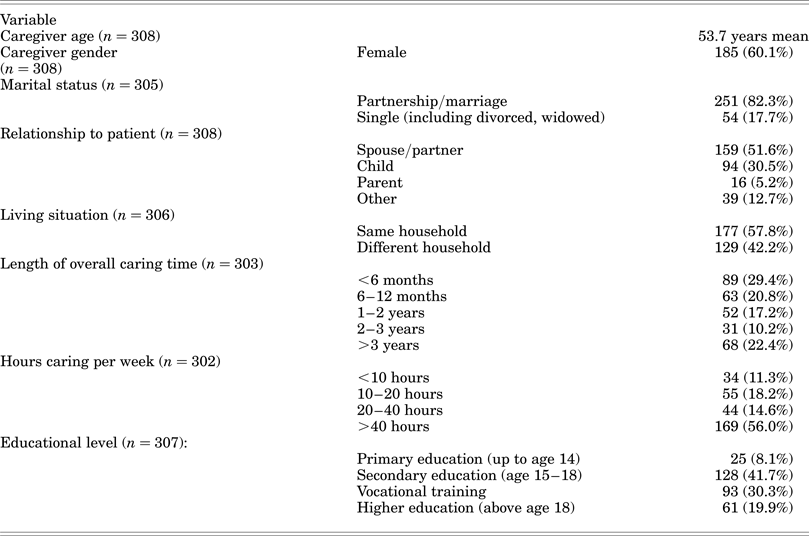
A total of 308 caregivers supplied written informed consent and participated in the assessment. Their characteristics are shown in Table 1.
Sociodemographic characteristics of participants [n (%)]

Questionnaire Acceptability
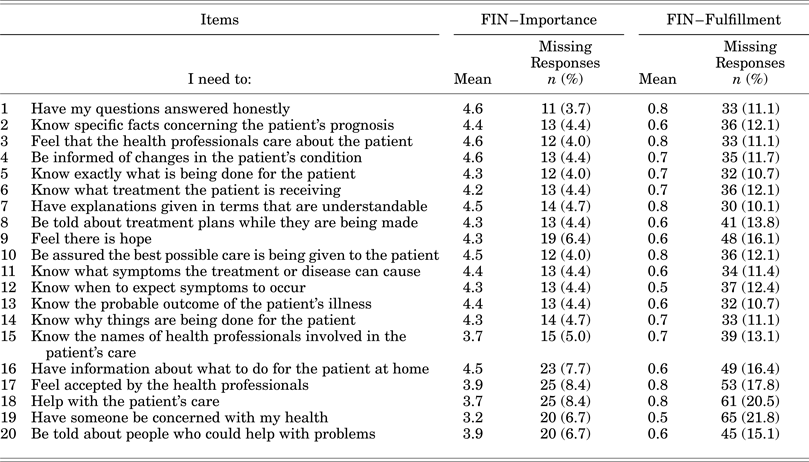
On the FIN–Importance subscale, 45 questionnaires (15.1%) had at least one missing response, 31 (10.4%) more than one, and 22 (7.4%) more than two. On the FIN–Fulfillment subscale, 124 questionnaires (41.6%) had at least one missing response, 96 (32.2%) more than one, and 75 (25.2%) more than two. This means that on the FIN–Importance subscale 14 of the 20 items remained below the 5% threshold for missing responses, while on FIN–Fulfillment all items showed missing response rates above 10%. Overall, the number of missing responses increased toward the end of the questionnaire. Table 2 shows the raw item means and missing responses per item.
Item means and missing responses per item for both subscales (n = 298)

Participants often did not adhere to the instructions when completing questionnaires. The most frequent deviation was that only one of the subscales (FIN–Importance or FIN–Fulfillment) was answered throughout. Other questionnaires showed erratic response patterns, with individual questions often rated on only one of the subscales. Consequently, 70 questionnaires (23.5%) had more than 2 missing responses per subscale and were hence classified as unusable. Mean values were 4.0 (SD = 0.7, n = 254) for FIN–Importance and 0.6 (SD = 0.2, n = 223) for FIN–Fulfillment. Given the flawed response styles (e.g., FIN–Fulfillment ratings also provided for items with low or missing FIN–Importance scores), existing responses needed to be excluded from the analysis when using only items with a FIN–Importance rating above 1. This increased the percentage of excluded responses (i.e., together with missing responses) per item to between 15.1 and 31.2% on the FIN–Fulfillment subscale.
We subsequently decided to include all questionnaires in further analyses irrespective not only of the overall number of missing responses per questionnaire but also the corresponding FIN–Importance rating for analysis of the FIN–Fulfillment subscale. This was considered appropriate because of the high number of missing responses overall, their unequal distribution among the two subscales, and the fact that no overall score covering both subscales could be calculated. Most importantly, excluding a high number of questionnaires due to complex rating methods would have constituted a loss of available clinically relevant information. For comparison, using all available data, mean values were 4.2 (SD = 0.7, n = 288) for FIN–Importance and 0.7 (SD = 0.2, n = 275) for FIN–Fulfillment.
Discriminative Power of Items
In order for a test to be equally discriminative across all possible scores, item discrimination indices (Schwierigkeitsindizes) should be equally distributed between 0.2 and 0.8 (possible values ranging between 0 and 1). An index of 1 indicates that all respondents answered the question on the extreme positive end of the scale, while an index of 0 indicates that all respondents answered the question on the extreme negative end of the scale. In both cases, the item provides no statistically relevant information and should be removed from the item pool (Kubinger, Reference Kubinger2009). Our results show that, for all items in both subscales, item discrimination indices were equally spread between 0.4 and 0.7. There were no items with very low or very high indices.
Internal Consistency and Subscale Correlation
The internal consistency of FIN–Importance had a Cronbach's alpha of 0.94 and that of FIN–Fulfillment 0.96. The two subscales showed a significant but small linear relationship (r = 0.27, p = 0.000, n = 203).
Validity
For FIN–Importance, a lacking relationship was confirmed for hope, distress, and depression, all showing nonsignificant correlations between r = 0.07 and 0.09 with FIN–Importance. However, anxiety scores did show a low but significant correlation with FIN–Importance (r = 0.14). As expected, a significant positive correlation was found between FIN–Fulfillment and hope (r = 0.40) and a significant negative correlation with distress (r = –0.30), as well as with anxiety and depression (both r = –0.25).
Test–Retest Reliability
Overall, 46 participants returned their retest questionnaires after a mean of 5 days. None of the participants had completed sufficient responses on the FIN–Fulfillment subscale, making it impossible to calculate its retest reliability. The data quality for FIN–Importance was adequate, with a retest reliability of r = 0.97.
DISCUSSION
Our study provides a German translation and validation of the FIN. In terms of acceptability, the FIN–Importance subscale showed satisfactory results, with missing responses for 14 of the 20 items below the 5% threshold. By contrast, for FIN–Fulfillment, all items showed missing response rates above 10%. There were no missing data in the original scale-development paper (Kristjanson et al., Reference Kristjanson, Atwood and Degner1995). Other applications of the scale do not mention missing responses. However, the Icelandic version, for which no formal validation study has been published, uses the FIN–Fulfillment subscale only for items that receive the two highest possible ratings on FIN–Importance (Friethriksdottir et al., Reference Friethriksdottir, Saevarsdottir and Halfdanardottir2011). This suggests there may have been issues with missing responses that could be adequately dealt with by reducing the overall number of included items.
In our study, missing responses increased toward the end of the questionnaire. Hence, the reasons for missing responses may not necessarily be due to a lack of comprehensibility but to the overall length of the questionnaire and similarities between questions. This may make the scale appear overly repetitive to participants and lead to noncompliance. One solution may be to shorten the scale. Six questions (item 9 and 16–20) showed particularly high rates of missing responses on both subscales. The same items also received rather low importance scores when rated. Together, this suggests their exclusion may improve the scale's acceptability without losing potentially clinically relevant information.
The internal consistency of both subscales was very high: α = 0.94 (FIN–Importance) and 0.96 (FIN–Fulfillment). This means that the items within each subscale had a high degree of concordance, measuring the same latent construct. The very high value of alpha is also consistent with an assumption that the questionnaire may be repetitive and that it may be possible to shorten it without any major loss of information.
Retest reliability for FIN–Importance was excellent. The fact that it was not possible to calculate retest reliability for FIN–Fulfillment reinforces conclusions about a potential lack of acceptability due to the scale's lengthiness or repetitiveness. Caregivers may simply not find it meaningful to rate the fulfillment of a large number of similar and partly overlapping or interdependent needs.
The discriminative power of items showed an equal spread of values between 0.4 and 0.7. However, there were no items with very low or very high indices, suggesting that the scale is not highly discriminative at the extreme ends of the spectrum. This may simply be due to the nature of the scale, which assesses a range of needs in a population that may consider most or all needs to be at least somewhat important.
Concurrent and discriminant validity of the FIN–Fulfillment subscale were confirmed by the moderate but significant correlations with hope, distress, depression, and anxiety in the expected directions. For FIN–Importance, a lack of correlation was confirmed with hope, distress, and depression, but we found a small but significant positive correlation with anxiety. So far, a relationship has been described between anxiety and need fulfillment (Sharpe et al., Reference Sharpe, Butow and Smith2005; Molassiotis et al., Reference Molassiotis, Wilson and Blair2011) but not between anxiety and the perceived importance of support needs. One possible interpretation of this finding is that caregivers with higher levels of anxiety may assume more support needs to be important due to increased safety seeking.
Research Implications
Our results suggest that the FIN cannot be recommended for use in research in its current version. Given the high number of missing responses and participants' erratic answering style, including items in the FIN–Fulfillment analysis only if the corresponding FIN–Importance rating is above a certain value effectively results in the loss of a significant amount of data.
We can identify four suggestions to increase the scale's acceptability and usefulness. First, when using the scale in its current version, supported assessment may be used to reduce the number of missing items. Second, it may be advisable to calculate FIN–Fulfillment means irrespective of the ratings on the FIN–Importance subscale to avoid loss of available data. Third, the FIN–Fulfillment subscale may be replaced by a single question, rated in VAS or Likert-type style, that assesses the overall fulfillment of all important support needs. This strategy would be justified by the hypothesis that people automatically take into account everything that is important to them personally when answering broad questions (Cummins, Reference Cummins2003). Hence, completion of each fulfillment item may not be necessary. Fourth, our results suggest that excluding questions 9 and 16–20 may increase the scale's overall acceptability. However, qualitative research with the client group may help to further inform adaptations of the questionnaire, including response options and the choice of questions to retain, and also support in rephrasing of items to make them more meaningful and potentially also more discriminative.
CLINICAL IMPLICATIONS
As opposed to its application in research, the FIN appears valuable for clinical practice. It is important for support planning to know exactly which of many needs are most important to caregivers and to what degree they are perceived to be met (Hannon et al., Reference Hannon, O'Reilly and Bennett2012). The usefulness of the scale may be further increased if completed collaboratively with clinical staff, helping to identify the most pressing needs while at the same time attenuating the emotional burden of answering difficult questions that many caregivers come across in practice.
Need fulfillment showed both a statistically and clinically relevant relationship with hope, as did (to a lesser degree) distress, anxiety, and depression. Our results also suggest that there may be a link between anxiety and needs considered important for caregivers of terminally ill cancer patients. While these associations and their power to predict potential mental health problems in caregivers will need to be confirmed in future research, it appears prudent for health professionals to be mindful of caregivers' psychological state when assessing their support needs, including their hopes, distress, and anxiety, as well as their depressive symptoms.