Abbreviations
ARE- antioxidant response element; BW- body weight; GSH-Px- glutathione peroxidase; HSP- heat shock protein; MDA- malondialdehyde; Nrf2- Nuclear factor-erythroid-2-related factor 2; ROS- reactive oxygen species; SD- stocking density; SOD- superoxide dismutase; Trx- thioredoxin; TrxR- thioredoxin reductase.
Introduction
Commercial and intensive poultry production is associated with various stresses leading to decrease of productive and reproductive performance of growing chickens, parent birds and layers. A growing body of evidence indicates that most of the stresses in poultry production at the cellular level are associated with oxidative stress due to excess of free radical production or inadequate antioxidant protection. Recently, a concept of the cellular antioxidant defence has been revised with a special attention paid to cell signalling. Indeed, in animals, redox signalling pathways use reactive oxygen species (ROS) to transfer signals from different sources to the nucleus to regulate a number of various functions including growth, differentiation, proliferation and apoptosis.
The vitagene concept of fighting stresses emerged as a new direction in a nutritional research. In accordance with Calabrese et al. (Reference CALABRESE, GUAGLIANO, SAPIENZA, PANEBIANCO, CALAFATO, PULEO, PENNISI, MANCUSO, BUTTERFIELD and STELLA2007) the term vitagenes refers to a group of genes that are strictly involved in preserving cellular homeostasis during stress conditions and playing an essential regulatory role in cell and whole organism adaptation to various stresses. The vitagene family includes heat shock proteins (HSPs; Heme oxygenase-1 and HSP70), the thioredoxins (Trx)/thioredoxin reductase (TrxR) system, sirtuins (Calabrese et al., Reference CALABRESE, GUAGLIANO, SAPIENZA, PANEBIANCO, CALAFATO, PULEO, PENNISI, MANCUSO, BUTTERFIELD and STELLA2007) and superoxide dismutases (SOD; Surai, Reference SURAI2015). The vitagene concept has found acceptance in medical sciences, involving neurodegenerative disorders (Calabrese et al., Reference CALABRESE, BOYD-KIMBALL, SCAPAGNINI and BUTTERFIELD2004), neuroprotection (Calabrese et al., Reference CALABRESE, CORNELIUS, MANCUSO, BARONE, CALAFATO, BATES, RIZZARELLI and KOSTOVA2009), aging and longevity (Calabrese et al., Reference CALABRESE, GUAGLIANO, SAPIENZA, PANEBIANCO, CALAFATO, PULEO, PENNISI, MANCUSO, BUTTERFIELD and STELLA2007; Reference CALABRESE, CORNELIUS, CUZZOCREA, IAVICOLI, RIZZARELLI and CALABRESE2011; Reference CALABRESE, CORNELIUS, DINKOVA-KOSTOVA, IAVICOLI, DI PAOLA, KOVERECH, CUZZOCREA, RIZZARELLI and CALABRESE2012; Reference CALABRESE, SCAPAGNINI, DAVINELLI, KOVERECH, KOVERECH, DE PASQUALE, SALINARO, SCUTO, CALABRESE and GENAZZANI2014), dermatology (Calabrese et al., Reference CALABRESE, CALAFATO, PULEO, CORNELIUS, SAPIENZA, MORGANTI and MANCUSO2008), free radical-related diseases (Calabrese et al., Reference CALABRESE, CORNELIUS, TROVATO, CAVALLARO, MANCUSO, DI RIENZO, CONDORELLI, DE LORENZO and CALABRESE2010), osteoporosis and Alzheimer pathology (Cornelius et al., Reference CORNELIUS, KOVERECH, CRUPI, DI PAOLA, KOVERECH, LODATO, SCUTO, SALINARO, CUZZOCREA, CALABRESE and CALABRESE2014).
It has been suggested that the vitagene concept can be useful in poultry production (Fisinin and Surai, Reference FISININ and SURAI2011; Reference FISININ and SURAI2011a; Surai and Fisinin, Reference SURAI and FISININ2012; Reference SURAI and FISININ2012a). Upregulating vitagenes, for-example, via the Nrf2/ARE system, and improving adaptive ability of animals to stress it is possible to decrease negative consequences of various stresses in poultry and farm animal production. Therefore, the aim of the first part of this review is to analyse technological and environmental stresses in poultry production with a special emphasis to the possible roles of oxidative stress. In the second part of the review nutritional and internal stresses will be considered and the third part of the review will be devoted to the vitagene concept and its applications in poultry production.
Stresses in poultry production
From a physiological point of view, stress is related to a deviation from optimal internal and external conditions. Under stressful conditions, the hypothalamic-pituitary-adrenal axis, the autonomic nervous system and the immune system are responsible for re-establishing homeostastis. Therefore, a cascade of regulatory mechanisms are involved, resulting in a mobilisation of energy and a shift in metabolism, with detrimental effects on growth performance and feed efficiency (Bureau et al., Reference BUREAU, HENNEQUET-ANTIER, COUTY and GUÉMENÉ2009). In modern commercial poultry production, oxidative stress-related nutritional metabolic diseases (e.g. encephalomalacia, exudative diathesis, muscular dystrophy, etc.) has practically disappeared (Surai, Reference SURAI2002; Reference SURAI2006), however, various disorders in the antioxidant defence system still cause substantial problems. For example, the amount of a particular nutrient in the diet may be insufficient to meet requirements, the diet may contain substances that inactivate the nutrient or inhibit its absorption/utilisation, or metabolism may be upset by the interaction of dietary and environmental factors causing oxidative stress (Mezes et al., Reference MEZES, SURAI, SALYI, SPEAKE, GAAL and MALDJIAN1997).
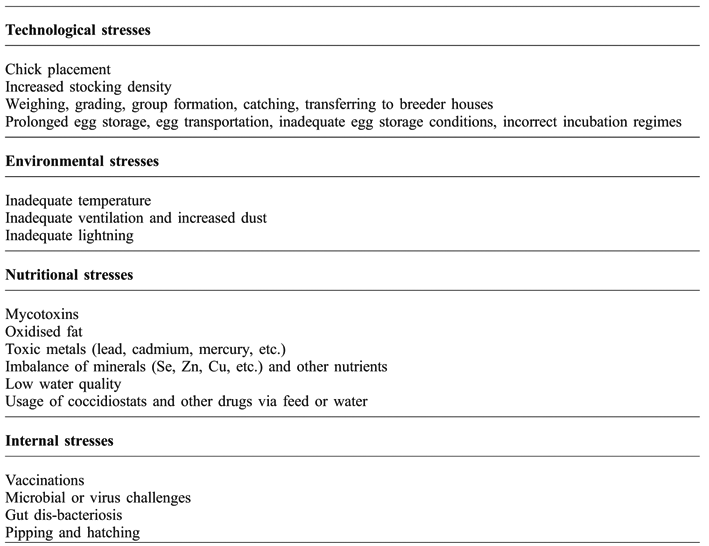
Domestication and genetic selection based on rapid growth rates, better feed conversion, and heavier body weight (BW) of broilers has made domestic birds, including broilers and turkeys, particularly susceptible to oxidative stress (Soleimani et al., Reference SOLEIMANI, ZULKIFLI, OMAR and RAHA2011). In general, there are four major types of stress in poultry industry: technological, environmental, nutritional and internal stresses (Surai, Reference SURAI2002; Reference SURAI2006; Fisinin et al., Reference FISININ, PAPAZYAN and SURAI2009; Reference FISININ, PAPAZYAN and SURAI2009a; Surai and Borodai, Reference SURAI and BORODAI2010; Surai and Fotina, Reference SURAI and FOTINA2010; Surai and Fisinin, Reference SURAI and FISININ2012; Reference SURAI and FISININ2012a; Table 1 ). According to recent literature, heat and diet are among the main means causing oxidative stress in domestic birds that may lead to biological damage, serious health disorders, lower growth rates, and, hence, economic losses (Estévez, Reference ESTÉVEZ2015). Dietary antioxidants are considered to be the main protective means to deal with various stresses in poultry production (Surai, Reference SURAI2002; Reference SURAI2006; Fellenberg and Speisky, Reference FELLENBERG and SPEISKY2006; Estévez, Reference ESTÉVEZ2015) and vitagene regulation by nutritional means (Fisinin and Surai, Reference FISININ and SURAI2011; Reference FISININ and SURAI2011a; Surai and Fisinin, Reference SURAI and FISININ2012; Reference SURAI and FISININ2012a; Surai, Reference SURAI2015; Reference SURAI2015a; Reference SURAI2015b; Reference SURAI2015c) appeared as a new approach to realise a full potential of the body for adaptation to stress conditions in poultry/animal production.
Stresses in poultry production (Adapted from Fisinin et al., Reference FISININ, PAPAZYAN and SURAI2009; Reference FISININ, PAPAZYAN and SURAI2009a).

Technological stresses
chick placement
Chick viability is an important factor in determining profitability and, from fertilisation to placement at the broiler farm, factors such as egg quality, egg storage conditions, incubation conditions and post-hatch environment all affect chick quality (Decuypere et al., Reference DECUYPERE, TONA, BRUGGEMAN and BAMELIS2001). It has been proven that the first 24 hours of the chick's life are the most important (Noy and Uni, Reference NOY and UNI2010; Fisinin and Surai, Reference FISININ and SURAI2012; Reference FISININ and SURAI2012a). It is believed that a chick should have an access to feed and water as soon as possible after hatching to stimulate the development of the digestive and immune systems. It is well appreciated that time between chick hatch and placement is stressful due to dehydration and yolk sac reserve depletion. Indeed, when putting together hatching time inside the brooder, time of chick processing and transportation, and placement at the farm, it can take up to 36-48 h before a newly hatched chick has access to feed and water and during this time body weight decreases quickly (Noy and Sklan, Reference NOY and SKLAN1999).
It has been shown that, in the hatching chick, the most dramatic changes in the small intestine occur within the first 24 h post-hatch (Geyra et al., Reference GEYRA, UNI and SKLAN2001). In fact, there is an inverse relationship between duration of post-hatching holding time and subsequent chick performance (Hager and Beane, 1983; Pinchasov and Noy, Reference PINCHASOV and NOY1993; Fisinin and Surai, Reference FISININ and SURAI2012; Reference FISININ and SURAI2012a). Therefore, immediate access to feed and water helps to achieve increased body weight of the growing chick at three weeks (Sklan et al., Reference SKLAN, NOY, HOYZMAN and ROZENBOIM2000) or at market age of broilers (Vieira and Moran, Reference VIEIRA and MORAN1999). It should be mentioned that there is the hatch ‘window’ (24-36 hours) between late and early hatchers which depends on the homogeneity/heterogeneity of the incubating eggs which is dependent on breeder age (Fisinin and Surai, Reference FISININ and SURAI2012; Reference FISININ and SURAI2012a). A spread in the hatching period will increase the numbers of chicks sitting extra hours in stressful conditions of the hatcher without food or water. Furthermore, any delay in accessing food (Noy et al., Reference NOY, GYRA and SKLAN2001; Bigot et al., Reference BIGOT, MIGNON-GRASTEAU, PICARD and TESSERAUD2003) and/or water intake after hatching as well as hatchery treatments such as vaccination, sexing and transport to the farm can result in additional stress (Geyra et al., Reference GEYRA, UNI and SKLAN2001a). Indeed, extended time in the hatcher (36 h) was associated with decreasing antioxidant defences indicated by decreased vitamin E and coenzyme Q concentrations in chicken tissues (Karadas et al., Reference KARADAS, SURAI and SPARKS2011). Given the relatively high temperature and humidity in the hatcher, it is possible to make the argument that the chick may be under chronic oxidative stress during this holding time (Fisinin and Surai, Reference FISININ and SURAI2012; Reference FISININ and SURAI2012a; Surai and Fisinin, Reference SURAI and FISININ2012; Reference SURAI and FISININ2012a). Therefore, antioxidant protection at hatching time is considered to be an important determinant of chick viability during first post-hatch days (Surai et al., Reference SURAI, IONOV, KUCHMISTOVA, NOBLE and SPEAKE1998; Reference SURAI, NOBLE and SPEAKE1999; Reference SURAI, SPEAKE, NOBLE and SPARKS1999a; Surai, Reference SURAI2002; Surai et al., Reference SURAI, FISININ and KARADAS2016).
During chick embryo development there is an antioxidant/prooxidant balance in the tissues which supports normal embryonic development and post-hatch chick viability (Surai et al., Reference SURAI, NOBLE and SPEAKE1996; Surai and Fisinin, Reference SURAI and FISININ2015). It has been suggested that an accumulation of natural antioxidants like vitamins A, E and carotenoids as well as an increase in GSH-Px activity in the embryonic liver, may have an adaptive significance, evolving to protect unsaturated lipids against peroxidation during the stress imposed by hatching (Surai, Reference SURAI2002; Surai et al., Reference SURAI, FISININ and KARADAS2016).
Post-natal nutritional exposures are considered to be critical for the developmental maturation of many organ systems and optimal physiological functions. There is a growing body of evidence indicating that environmental exposure, including nutritional factors, during these critical and sensitive periods of life can cause permanent changes in many physiological processes, which is known as ‘programming’ (Amarasekera et al., Reference AMARASEKERA, PRESCOTT and PALMER2013).
Previous investigations indicate that low quality neonatal nutrition resulted in long-term impairment in the capacity to assimilate dietary antioxidants (Blount et al., Reference BLOUNT, METCALFE, ARNOLD, SURAI, DEVEVEY and MONAGHAN2003). It seems likely that early programming associated with epigenetic mechanisms plays a key role in chicken growth and development and at time of chicken placement. Furthermore, scientific evidence has accumulated that the programming effects of conditions during early development can be transmitted to the offspring (Champagne and Rissman, Reference CHAMPAGNE and RISSMAN2011). Therefore, transgenerational effects of stress are potentially mediated via modulation of the hypothalamic-pituitary-adrenal axis as well as epigenetic mechanisms causing heritable changes in gene expression and it was suggested that early experiences may shape phenotypes of chickens in a long-term way (Goerlich et al., Reference GOERLICH, NÄTT, ELFWING, MACDONALD and JENSEN2012). In addition to the aforementioned issues, chicks are exposed to such stresses as hatching without maternal contact, transportation and social isolation. Indeed, early life isolation stress resulted in a dampened corticosterone response to restraint stress in affected birds and in their male offspring. Furthermore, stress-specific genes, such as early growth response 1 and corticotropin releasing hormone receptor were upregulated immediately after restraint stress (Goerlich et al., Reference GOERLICH, NÄTT, ELFWING, MACDONALD and JENSEN2012).
Research data support the hypothesis that the vitamin E status of turkey poults and chickens may be inadequate during the first weeks after hatching (Sell, Reference SELL1996). A variety of approaches aimed at improving the vitamin E status of turkey poults have, in fact been investigated including dietary supplementation of the poults with high levels of α-tocopherol (Applegate and Sell, Reference APPLEGATE and SELL1996; Surai, Reference SURAI2002), bile salts (Marusich et al., Reference MARUSICH, DERITTER, OGRINZ, KEATING, MITROVIC and BUNNELL1975) and fat (Soto-Salanova and Sell, Reference SOTO-SALANOVA and SELL1995), as well as vitamin E injection (Soto-Salanova and Sell, Reference SOTO-SALANOVA and SELL1996) and alterations in provision of n-6 and n-3 polyunsaturated fatty acids (Applegate and Sell, Reference APPLEGATE and SELL1996). When d-α-tocopherol was added in the drinking water, there was an increase of α-tocopherol in tissues and a decreased susceptibility of red blood cells to haemolysis (Soto-Salanova, Reference SOTO-SALANOVA1998). Moreover, day-old chickens were treated with 3.25 mg vitamin E/bird/day per os, via the drinking water, for two weeks. The vitamin E content of both the liver and the blood plasma was significantly higher in the treated chickens than in the untreated controls (Mezes, Reference MEZES1994). It seems likely, that provision of vitamin E and other fat-soluble vitamins (A, E and D3) with water at time of chicken placement can solve the problem of their low availability for newly hatched chicks (Surai and Borodai, Reference SURAI and BORODAI2010; Surai and Fotina, Reference SURAI and FOTINA2010; Surai and Fisinin, Reference SURAI and FISININ2012; Reference SURAI and FISININ2012a). Such a supplementation helps chickens overcome stress of placement and has positive effects on chicken growth and development.
When chicks are placed in winter and outside temperatures are quite low there is always a temptation to decrease ventilation to keep energy usage to the minimum. However, it is very important to provide good quality, warm, fresh air that is rich in oxygen for recently hatched chicks. Indeed, the chick's trachea is often irritated from being boxed and shipped in chick trays, often for many hours. Furthermore, chicks can be exposed to formaldehyde gas and contaminated air during hatch (Fisinin et al., Reference FISININ, PAPAZYAN and SURAI2009; Reference FISININ, PAPAZYAN and SURAI2009a; Fisinin and Surai, Reference FISININ and SURAI2012; Reference FISININ and SURAI2012a). Excessive amounts of irritants such as carbon dioxide and ammonia can cause depression, dehydration and emaciation as well as problems with the respiratory system of the chick (Surai and Fotina, Reference SURAI and FOTINA2010; Surai and Fisinin, Reference SURAI and FISININ2012; Reference SURAI and FISININ2012a). Increased lipid peroxidation and reduced activities of antioxidant enzymes in healthy chickens reared under unfavourable microclimatic conditions, such as higher air temperature and humidity, higher ammonia concentrations and lower light intensity, were indicative of an induced oxidative stress (Georgieva et al., Reference GEORGIEVA, STOYANCHEV, BOZAKOVA and JOTOVA2011). It should also be mentioned that poor ventilation is often associated with toxic carbon monoxide accumulation. Toxicity causes an irreversible physiological and biochemical change that cannot be corrected with successive additional ventilation (Fisinin et al., Reference FISININ, PAPAZYAN and SURAI2009; Reference FISININ, PAPAZYAN and SURAI2009a).
Therefore, to deal with oxidative stress at chicken placements there are several important options. They include: a) electrolyte supplementation via drinking system to increase water consumption by chicks and keep optimal electrolyte balance in the body (Balnave and Gorman, Reference BALNAVE and GORMAN1993; Fisinin et al., Reference FISININ, PAPAZYAN and SURAI2009; Surai and Fisinin, Reference SURAI and FISININ2012); b) fat-soluble vitamin supplementation via drinking water to overcome low efficacy of vitamin assimilation from the diet (Surai, Reference SURAI2002; Surai and Fisinin, Reference SURAI and FISININ2012; Reference SURAI and FISININ2012a); c) other protective nutrients (e.g. ascorbic acid, Se, carnitine, betaine, lysine, methionine) supplementation with water to decrease oxidative stress related to chick placement and gut adaptation to a new type of feed (Fisinin et al., Reference FISININ, PAPAZYAN and SURAI2009; Surai and Fisinin, Reference SURAI and FISININ2012; Reference SURAI and FISININ2012a). Improved antioxidant defences during first days of postnatal life are suggested to help immune system development in this critical period of time (Fisinin and Surai, Reference FISININ and SURAI2013; Reference FISININ and SURAI2013a).
other technological stresses
Stocking density (SD) is a management factor which has critical implications for the poultry industry. Current recommended SD is rather variable and depends on breed, countries, and husbandry systems (Estevez, Reference ESTEVEZ2007). In fact, high stocking density has been reported to be a stressful condition (Puron et al., Reference PURON, SANTAMARIA, SEGURA and ALAMILLA1995), unfavourably affecting the welfare and gut health of broiler chicks, predisposing them to various gut disorders including necrotic enteritis (Tsiouris et al., Reference TSIOURIS, GEORGOPOULOU, BATZIOS, PAPPAIOANNOU, DUCATELLE and FORTOMARIS2015). Furthermore, high stocking density is associated with decreased locomotor activity and increased physiological (H:L ratio and bursa weight) and oxidative (GSH concentrations and GSH/GSSG ratios) stress indicators (Simitzis et al., Reference SIMITZIS, KALOGERAKI, GOLIOMYTIS, CHARISMIADOU, TRIANTAPHYLLOPOULOS, AYOUTANTI. A., HAGER-THEODORIDES and DELIGEORGIS2012) causing decreased performance, increased mortality and prevalence of leg weakness (Sørensen et al., Reference SØRENSEN, SU and KESTIN2000) and had a negative effect on some aspects of bone quality (tibia curvature and shear strength; Buijs et al., Reference BUIJS, VAN POUCKE, VAN DONGEN, LENS, BAERT and TUYTTENS2012). Furthermore, high SD is associated with decreased relative weights of lymphoid organs (spleen and bursa; Ravindran et al., Reference RAVINDRAN, THOMAS, THOMAS and MOREL2006), reduced feed intake and weight gain with poor feed conversion ratio (Cengiz et al., 2015), decreased breast muscle yield, tibial development, increasing gait scores, footpad and hock burns, and abdominal plumage damage (Sun et al., Reference SUN, YAN, G, ZHAO, LIN and GUO2013) and decreasing the final body weight (Tong et al., Reference TONG, LU, ZOU, WANG and SHI2012), and decreasing the carcass quality (Feddes et al., Reference FEDDES, EMMANUEL and ZUIDHOF2002) of broiler chickens.
In addition to less efficient growth, birds in more crowded conditions had depressed immune responses (Casteel et al., Reference CASTEEL, WILSON, BUHR and SANDER1994). Similarly, hens in cages with higher SD had lower hen-day egg production, egg mass, and feed intake compared with those in lower density cages (Mirfendereski and Jahanian, Reference MIRFENDERESKI and JAHANIAN2015). High stocking density is physiologically stressful to broiler chickens, as indicated by serum corticosterone, ovotransferrin, ceruloplasmin and brain heat shock protein (HSP 70) expression (Najafi et al., Reference NAJAFI, ZULKIFLI, SOLEIMANI and KASHIANI2015) or by increased serum MDA level and reduced GSH-Px activity (Simsek et al., Reference SIMSEK, DALKILIC, CIFTCI and YUCE2009). Natural antioxidants, including vitamin E and capsaicin, have been shown to have beneficial effects on growth performance and lipid peroxidation in broilers reared under high-stocking-density condition (Thiamhirunsopit et al., Reference THIAMHIRUNSOPIT, PHISALAPHONG, BOONKIRD and KIJPARKORN2014). However, effects of stocking density on bird productive and reproductive indices depend on many factors, including breed, sex, age and results are not always consistent. For example, Buijs et al. (Reference BUIJS, KEELING, RETTENBACHER, VAN POUCKE and TUYTTENS2009) reported that SD did not affect bursa weight, mortality, or concentrations of corticosterone metabolites in droppings. Similarly, SD did not affect weights of the liver, spleen, bursa, and thymus, and there were no significant differences in organ:BW ratios as density increased (Tong et al., Reference TONG, LU, ZOU, WANG and SHI2012) and feed conversion ratio was not affected (Cravener et al., Reference CRAVENER, ROUSH and MASHALY1992; Feddes et al., Reference FEDDES, EMMANUEL and ZUIDHOF2002).
Chicken weighing, grading and group formation in rearing houses, as well as catching are stressful to birds (Fisinin et al., Reference FISININ, PAPAZYAN and SURAI2009; Reference FISININ, PAPAZYAN and SURAI2009a; Surai and Fisinin, Reference SURAI and FISININ2012; Reference SURAI and FISININ2012a) and the transfer of chickens to breeder houses is always associated with increased stress, sometimes causing feather picking and cannibalism (Gunnarsson et al., Reference GUNNARSSON, KEELING and SVEDBERG1999). Therefore, antioxidant dietary supplementation could be considered as a technological measure to deal with oxidative stress in chickens caused by increased SD (Fisinin and Surai, Reference FISININ and SURAI2012; Reference FISININ and SURAI2012a).
Environmental stresses
Environmental stresses start from the moment when the egg is laid, since temperature variation can cause the embryo to start developing (high environmental temperature) or die (low temperature or fast temperature change; Fisinin et al., Reference FISININ, PAPAZYAN and SURAI2009). It is well known that temperature and other conditions of egg storage between egg laying and its placement into the hatchery negatively affect embryonic development. In fact, the hatchability of fertile eggs declines with the length of storage and there is an increase in percentages of early and late embryonic mortality with length of storage period (Elibol et al., Reference ELIBOL, PEAK and BRAKE2002; Fasenko, Reference FASENKO2007) and could affect chickens in later life.
heat stress
Heat stress is one of the most common environmental stressors in the poultry industry worldwide (Altan et al., Reference ALTAN, PABUÇCUOĞLU, ALTAN, KONYALIOĞLU and BAYRAKTAR2003). It seems likely that increased metabolic activity of modern poultry genotypes is responsible for the reduction in heat resistance (Soleimani et al., Reference SOLEIMANI, ZULKIFLI, OMAR and RAHA2011). Today's chickens are shown to suffer from immune dysregulation and gut barrier dysfunction due to heat stress, leading to decreased productive and reproductive performance, immunosuppression and increased susceptibility to infectious diseases and mortality (Quinteiro-Filho et al., Reference QUINTEIRO-FILHO, RIBEIRO, FERRAZ-DE-PAULA, PINHEIRO, SAKAI, SÁ, FERREIRA and PALERMO-NETO2010; Fisinin and Surai, Reference FISININ and SURAI2013; Reference FISININ and SURAI2013a; Lara and Rostagno, Reference LARA and ROSTAGNO2013). Indeed, the gastrointestinal tract is particularly sensitive to stressors (Surai and Fisinin, Reference SURAI and FISININ2015), which can cause a variety of changes, including alteration of the normal, protective microbiota (Burkholder et al., Reference BURKHOLDER, THOMPSON, EINSTEIN, APPLEGATE and PATTERSON2008) and decreased integrity of the intestinal epithelium (Quinteiro-Filho et al., Reference QUINTEIRO-FILHO, RIBEIRO, FERRAZ-DE-PAULA, PINHEIRO, SAKAI, SÁ, FERREIRA and PALERMO-NETO2010). Furthermore, detrimental consequences of heat stress on gut immunity (Fisinin and Surai, Reference FISININ and SURAI2013; Reference FISININ and SURAI2013a; Surai and Fotina, Reference SURAI and FOTINA2013) warrants further investigation. Heat stress alters the jejunal glucose and lipid transport in chickens (Sun et al., Reference SUN, ZHANG, SHEIKHAHMADI, WANG, JIAO, LIN and SONG2015) and can inhibit the activity of digestive enzymes and reduce absorption and immune functions of intestinal mucosa (Chen et al., Reference CHEN, XIE, WANG and TANG2014). Broilers subjected to heat stress are characterised by reduced daily gain and feed intake; lower viable counts of Lactobacillus and Bifidobacterium and increased viable counts of coliforms and Clostridium spp. in the small intestinal; shorter jejunal villus height, deeper crypt depth, and lower ratio of villus height to crypt depth (Song et al., Reference SONG, XIAO, KE, JIAO, HU, DIAO, SHI and ZOU2014).
The negative effects of high temperature on hatching eggs can be substantial during summer heat stress. Indeed, high environmental temperature is one of the most serious factors adversely affecting the laying performance in poultry. Egg production (De Andrade et al., Reference DE ANDRADE, ROGLER, FEATHERSON and ALLISON1977; Mack et al., Reference MACK, FELVER-GANT, DENNIS and CHENG2013 ), egg weight (Mashaly et al., Reference MASHALY, HENDRICKS, KALAMA, GEHAD, ABBAS and PATTERSON2004; Sahin et al., Reference SAHIN, ONDERCI, BALCI, CIKIM, SAHIN and KUCUK2007; Ebeid et al., Reference EBEID, SUZUKI and SUGIYAMA2012; Mack et al., Reference MACK, FELVER-GANT, DENNIS and CHENG2013), eggshell thickness (De Andrade et al., Reference DE ANDRADE, ROGLER, FEATHERSON and ALLISON1977; Lin et al., Reference LIN, MERTENS, KEMPS, GOVAERTS, DE KETELAERE, DE BAERDEMAEKER, DECUYPERE and BUYSE2004; Franco-Jimenez et al., Reference FRANCO-JIMENEZ, SCHEIDELER, KITTOK, BROWN-BRANDL, ROBESON, TAIRA and BECK2007; Ebeid et al., Reference EBEID, SUZUKI and SUGIYAMA2012), eggshell percentage (Ebeid et al., Reference EBEID, SUZUKI and SUGIYAMA2012), eggshell density (De Andrade et al., Reference DE ANDRADE, ROGLER, FEATHERSON and ALLISON1977) and eggshell breakage (Lin et al., Reference LIN, MERTENS, KEMPS, GOVAERTS, DE KETELAERE, DE BAERDEMAEKER, DECUYPERE and BUYSE2004) were negatively affected by high ambient temperature. The calbindin concentration was majorly decreased in ileum, cecum, colon, and eggshell gland under heat stress conditions, which could be related to the deterioration of eggshell quality characteristics under heat stress conditions (Ebeid et al., Reference EBEID, SUZUKI and SUGIYAMA2012). Elevated temperatures increase mortality in both layers (Mashaly et al., Reference MASHALY, HENDRICKS, KALAMA, GEHAD, ABBAS and PATTERSON2004) and broilers (Quinteiro-Filho et al., Reference QUINTEIRO-FILHO, RIBEIRO, FERRAZ-DE-PAULA, PINHEIRO, SAKAI, SÁ, FERREIRA and PALERMO-NETO2010). In fact, at the molecular level, oxidative stress is considered to be a driving force of the negative consequences of heat stress (Lambert et al., Reference LAMBERT, GISOLFI, BERG, MOSELEY, OBERLEY and KREGEL2002; Lin et al., Reference LIN, DECUYPERE and BUYSE2006; Surai and Fotina, Reference SURAI and FOTINA2013). Therefore, natural antioxidants, including vitamin E (Niu et al., Reference NIU, LIU, YAN and and LI2009), selenium (Habibian et al., Reference HABIBIAN, SADEGHI, GHAZI and MOEINI2015), ascorbic acid (Pardue et al., Reference PARDUE, THAXTON and BRAKE1985) carnitine (Celik et al., Reference CELIK, TEKELI and OZTÜRKCAN2004), betaine (Sayed and Downing, Reference SAYED and DOWNING2011) as well as electrolytes (Ahmad and Sarwar, Reference AHMAD and SARWAR2006) are shown to be protective in heat stressed birds. It is interesting to note that cold stress in chickens is associated with oxidative stress and triggers a response via the Nrf2/ARE signalling pathway (Chen et al., Reference CHEN, LI and GENG2015). Furthermore, the differentially expressed genes due to cold stress in partridge hypothalamus included 334 down-regulated genes and 543 up-regulated genes (Chen et al., Reference CHEN, LI, WANG and GENG2014a). Protective and regulatory roles of heat shock proteins in poultry exposed to heat stress has been described in detail in a recent review (Surai, Reference SURAI2015a).
other environmental stresses
Chronical exposure to high levels of dust and ammonia within a broiler rearing house was shown to cause oxidative stress (Bottje and Wideman, Reference BOTTJE and WIDEMAN1995; Bottje et al., Reference BOTTJE, WANG, KELLY, DUNSTER, WILLIAMS and MUDWAY1998). This could be the case during periods of cool weather, when poultry producers often decrease ventilation to increase efficiency of heating, thereby allowing dust and gaseous pollutants to accumulate in the air. Changing lightning programs and light sources could also be a stress for poultry (Fisinin et al., Reference FISININ, PAPAZYAN and SURAI2009; Reference FISININ, PAPAZYAN and SURAI2009a; Huth and Archer, Reference HUTH and ARCHER2015). For example, in growing chickens, dimming was shown to be lower environmental stress than the abrupt light-dark transition (van der Pol et al., Reference VAN DER POL, MOLENAAR, BUITINK, VAN ROOVERT-REIJRINK, MAATJENS, VAN DEN BRAND and KEMP2015).
Conclusions
In modern commercial poultry production, oxidative stress-related metabolic diseases (e.g. encephalomalacia, exudative diathesis and muscular dystrophy) have practically disappeared however, various disorders of the biological antioxidant defence system are still causing substantial problems. In general, there are four major types of stress in the poultry industry: technological, environmental, nutritional and internal stresses. In fact, a list of commercially-relevant stresses in poultry production would be quite long, but the main point is the most of them suppress reproductive performance of parent birds including reduced fertility and hatchability. Furthermore, stresses are associated with impaired feed conversion, reduced average daily weight gain, immunosuppression and increased mortality in growing birds. It seems likely that oxidative stress is a driving force of the detrimental consequences of the major aforementioned stresses. There is a need for the development of an effective strategy to deal with stresses in poultry production and vitagene concept could be an important element of such a strategy, which will be considered in the following associated review.