Introduction
Vegetative growth is an important fitness component in perennials, especially for plants that also reproduce clonally (Stevens et al. Reference Stevens, Kruger and Lindroth2008). Following apical meristem injury, vegetative regrowth from the undamaged lateral meristems is made possible by the metameric architecture of plants (Marquis Reference Marquis1996). Metamers can be defined as functional units of plants, each consisting of a meristem, node, internode, and one or more leaves (Watson Reference Watson1986; Marquis Reference Marquis1996). Production of new lateral shoots by the activation of dormant buds is a common tolerance mechanism against apical meristem herbivory (Whitham and Mopper Reference Whitham and Mopper1985; Tolvanen et al. Reference Tolvanen, Laine, Pakonen, Saari and Havas1994; Marquis Reference Marquis1996; Lehtila Reference Lehtila2000; Wilson Reference Wilson2000; Nakamura and Ohgushi Reference Nakamura and Ohgushi2007). However, regrowth after injury may be constrained by factors such as availability of meristems (Richards and Cladwell Reference Richards and Cladwell1985), and the allocation of sufficient resources to the dormant buds (Bilbrough and Richards Reference Bilbrough and Richards1993).
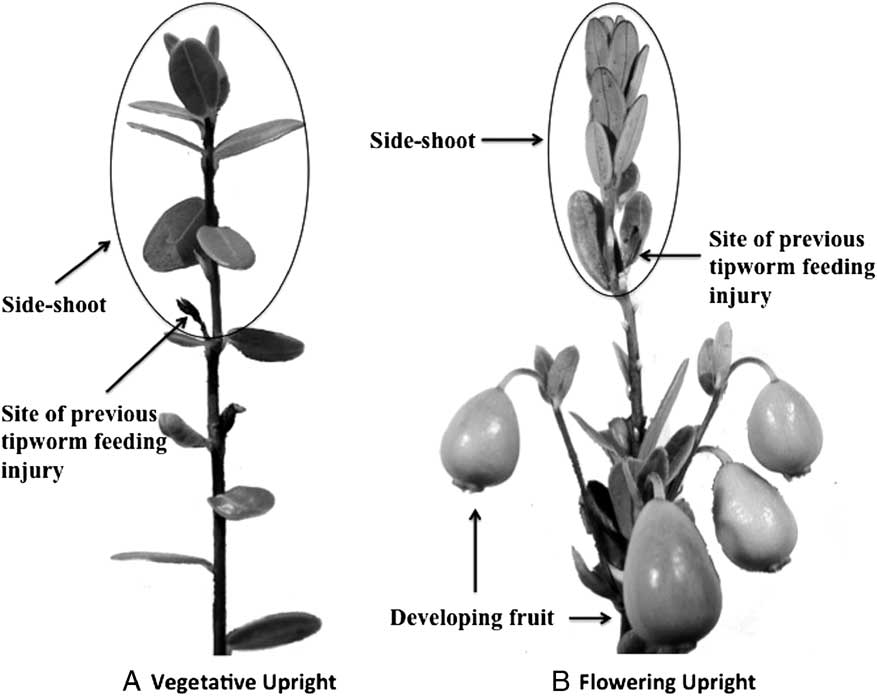
The cultivated cranberry, Vaccinium macrocarpon Aiton (Ericaceae), is a low-growing woody perennial native to North America (Vander Kloet Reference Vander Kloet1988). Horizontal stolons, also known as runners, trail on the soil surface and produce vertical shoots called uprights. Each year the uprights may either produce vegetative growth only (vegetative upright; refer to Fig. 1A), or vegetative growth combined with flowers/fruits in basipetal positions (flowering upright; refer to Fig. 1B). Cultivars of cranberry are either selections from wild native stands (e.g., Ben Lear and Howes), or those developed through traditional breeding programs (e.g., Stevens). Howes is planted in ~30% of Massachusetts’s commercial cranberry bogs whereas majority of cranberry acreage in North America consists of Stevens (Roper Reference Roper2001). In the United States of America, cranberry is commercially cultivated in Massachusetts, New Jersey, Oregon, Washington, Wisconsin, and Maine. In Canada, the major cranberry production regions are British Columbia and Québec (Agriculture and Agri-Food Canada 2009). Dasineara oxycoccana (Johnson) (Diptera: Cecidomyiidae) is a gall making fly whose larvae feed on the developing buds of cranberry and several species of blueberry (Fitzpatrick et al. Reference Fitzpatrick, Gries, Khaskin, Peach, Iwanski and Gries2013). Recent work has suggested that the populations of tipworm on cranberry and blueberry may be cryptic species (Cook et al. Reference Cook, Ozeroff, Fitzpatrick and Roitberg2011; Mathur et al. Reference Mathur, Cook, Sinclair and Fitzpatrick2012; Fitzpatrick et al. Reference Fitzpatrick, Gries, Khaskin, Peach, Iwanski and Gries2013). Tipworm overwinters as late instar larvae (Gagne Reference Gagne1989) and adults emerge around mid-May in the cranberry growing regions of Massachusetts. Tipworm females lay one or more eggs on the actively growing uprights/shoots of cranberry and the larvae kill the tip by piercing through the meristematic tissue (Cook et al. Reference Cook, Ozeroff, Fitzpatrick and Roitberg2011; Fig. 1). The life cycle from eggs to adults takes 10–15 days (Mahr Reference Mahr1996) and there can be multiple overlapping generations of tipworm in a single growing season (Gagne Reference Gagne1989). It has been hypothesised that feeding injury can have a negative impact on cranberry production in the northern latitudes of the United States of America (Maine and northern Wisconsin) and tipworm has reached pest status in the growing regions of British Columbia, Canada (C. Armstrong, personal communication; Mahr Reference Mahr2005; Mahr and Perry Reference Mahr and Perry2006; Cook et al. Reference Cook, Ozeroff, Fitzpatrick and Roitberg2011).
Vegetative and flowering cranberry uprights with tipworm feeding injury and a side-shoot produced from lateral axillary bud. Flowering upright also shows developing fruit in basipetal positions.
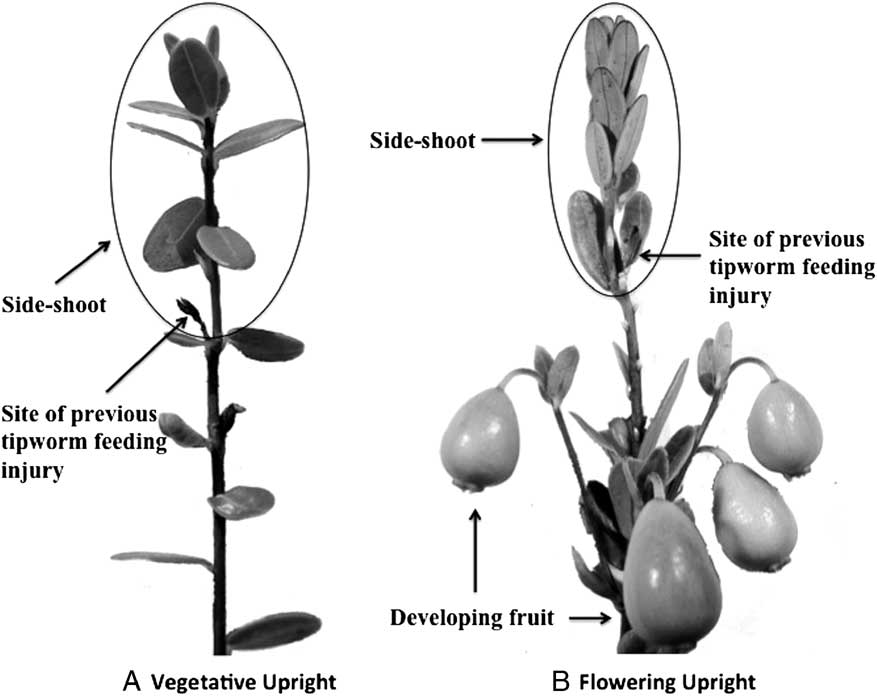
Feeding by tipworm larvae results in the death of apical meristem and the vegetative growth of uprights is disrupted. Tipworm-injured uprights may resume vegetative growth by the activation of lateral meristems and form a side-shoot (Fig. 1; Tewari et al. Reference Tewari, Buonaccorsi and Averill2013). However, the majority of tipworm-injured flowering uprights do not produce a side-shoot before the onset of dormancy and growth (vegetative and reproductive) in the following year may be adversely affected, as compared with injury-free uprights (Tewari et al. Reference Tewari, Buonaccorsi and Averill2012, Reference Tewari, Buonaccorsi and Averill2013). Furthermore, intact cranberry uprights free of tipworm injury do not produce a side-shoot (Tewari et al. Reference Tewari, Buonaccorsi and Averill2013).
The absence of regrowth in tipworm-injured flowering uprights may be a result of competition between the two sinks, developing fruit and lateral buds, for the available resources (Ho Reference Ho1988), or the lack of active meristems in injured flowering uprights (Whitham et al. Reference Whitham, Maschinski, Larson and Paige1991). The goal of this study was to investigate the factors affecting vegetative regrowth in tipworm-injured uprights and addresses the following questions: (1) does the presence of developing fruit suppresses regrowth after tipworm feeding injury, and (2) is there difference between tipworm-injured vegetative and flowering uprights in regrowth via the production of side-shoots?
Materials and Methods
General methods (field studies 1 and 2)
The fieldwork was carried out at a commercial cranberry farm with established beds of Howes and Stevens (41°56'59.31" N, 70°47'15.98" W), planted in 1985 and 1995, respectively. For each cultivar, two 0.2 ha plots were established and four 10 m equidistant transects separated by 20 m were marked in each plot. The transects were laid down perpendicular to the direction in which the majority of cranberry runners was oriented to eliminate measuring more than one upright on a single runner.
Determining impact of flower removal on the production of side-shoots in tipworm-injured flowering uprights (field study 1)
One plot in each of the cultivar beds was used (Howes and Stevens). For each transect in both the cultivar plots, 45 flowering uprights with visible tipworm feeding injury signs (cupping of terminal leaves with dead apical meristem and characteristic scar tissue) were identified and tagged in the first week of June 2011 using plastic slip-on tags (Texpak Inc., Franklin Square, New York, United States of America) printed with unique identification numbers. The tagged uprights were approximately evenly spaced along the entire length of each transect. A total of 180 individual flowering uprights was tagged for each cultivar (45 per transect×4 transects). None of the developing flowers were open at the time of tagging in any of the uprights. For each transect in both of the cultivar plots, the tagged uprights were assigned randomly to one of the following three treatments (15 per treatment): (i) all the developing flowers removed from the upright, (ii) all the developing flowers removed from the upright except one (at the base of 2011 season growth – the earliest formed flower of an upright), and (iii) all the developing flowers left intact. A razor blade was used to excise the flowers. Both flower removal treatments were applied in the first week of June 2011. Data on presence or absence of side-shoots were collected from all the tagged uprights in September 2011.
Determining impact of flower removal on the production of side-shoots in tipworm-injured flowering uprights (greenhouse study)
The greenhouse studies were carried out with Ben Lear, Howes, and Stevens. Uprights of Ben Lear with visible signs of tipworm feeding injury were collected from an established variety plot at the University of Massachusetts Cranberry Station (East Wareham, Massachusetts, United States of America; 41°46'00.58" N, 70°40'07.90" W) in the first week of June 2011. Similarly, tipworm-injured uprights of Howes and Stevens were collected from the commercial farm used in field study 1. In addition to current season growth, each harvested upright had ≈3 cm of previous season growth. For each cultivar, 40 uprights were planted individually in 10.2 cm2 growing pots (Griffin Greenhouse and Nursery Supplies, Tewksbury, Massachusetts, United States of America) filled with a 3:1 (sand:peat) mixture. On the following day, 20 uprights were selected randomly and all the flowers were excised using a razor blade. The remaining 20 uprights with intact flowers served as controls. Cranberry vines are routinely propagated from field-harvested uprights and form roots readily upon planting. The plants were maintained under greenhouse conditions and once stigmas became exposed, all flowers were hand-pollinated (Sarracino and Vorsa Reference Sarracino and Vorsa1991) using pollen collected from the same plots as the uprights. Data on the presence or absence of side-shoots were collected from all the plants in September 2011.
Comparing flowering and vegetative uprights for the production of side-shoots after tipworm injury (field study 2)
One plot (separate from field study 1) in each of the cultivar beds was used (Howes and Stevens). For each transect in both the cultivar plots, 15 flowering uprights and an equal number of vegetative uprights, all with visible tipworm feeding injury signs, were identified and tagged in the first week of June 2011. Plastic slip-on tags printed with unique identification numbers were used for tagging the individual uprights. The two types of tagged tipworm-injured uprights were approximately evenly spaced along the entire length of each transect. A total of 60 flowering and 60 vegetative tipworm-injured uprights were tagged for each cultivar (15 per transect×4 transects). Data on the presence or absence of side-shoots were collected from all the tagged uprights in September 2011.
Data analysis
We used SAS v. 9.3 for all the analyses (SAS Institute 2011) and separate analyses were carried out for the different cultivars.
Determining impact of flower removal on the production of side-shoots in tipworm-injured flowering uprights (field study 1)
For each of the four transects, the proportions (and standard errors) of the uprights with side-shoots in the three treatments were estimated. These estimates were averaged over the four transects to determine the proportion and variance for each of the three treatments and used to construct an overall Wald χ² test of no difference among the three treatments (PROC IML) that accounts for the variance structure. This test allowed transects to be a random factor and also for the treatments being blocked on transects. Pairwise comparisons among the three treatments were carried out using PROC IML.
Determining impact of flower removal on the production of side-shoots in tipworm-injured flowering uprights (greenhouse study)
A χ² based categorical data analysis test (PROC FREQ), with treatment as the explanatory variable, was used to determine if removal of flowers had an impact on production of side-shoots in the greenhouse planted uprights.
Comparing flowering and vegetative uprights for the production of side-shoots after tipworm injury (field study 2)
For each of the four transects, the proportions (and standard errors) of flowering and vegetative uprights with side-shoots were estimated. These estimates were averaged over the four transects to determine the proportion and variance of tipworm-injured uprights with side-shoots (flowering and vegetative). The averaged estimates were used to compare production of side-shoots between tipworm-injured flowering and vegetative uprights by constructing an overall Wald χ² test of no difference (PROC IML) that accounts for the variance structure. This test allowed transects to be a random factor and also for the treatments being blocked on transects.
Results
Determining impact of flower removal on the production of side-shoots in tipworm-injured flowering uprights (field study 1)
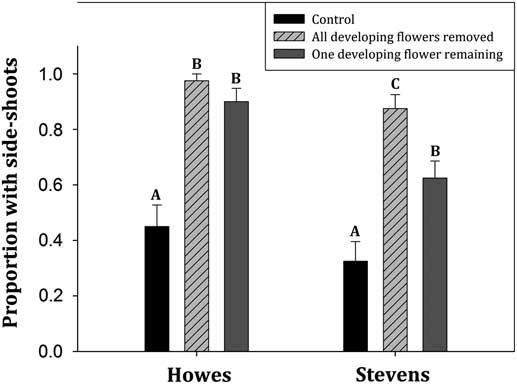
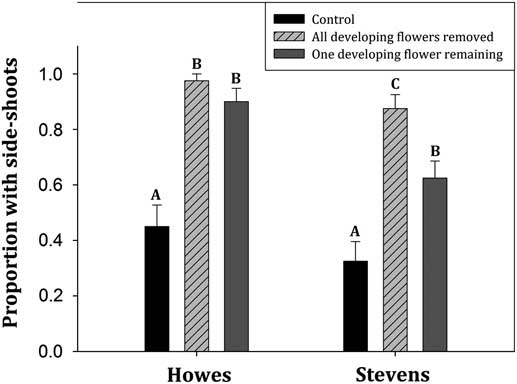
Both the flower removal treatments increased production of side-shoots in Howes and Stevens (χ²=40.57; df=2; P<0.001 and χ²=38.83; df=2; P<0.001; Fig. 2), as compared with the uprights with intact flowers. In Stevens, a greater number of uprights from which all the flowers were removed produced side-shoots, as compared with uprights in which one flower remained (P=0.002). There was no difference in side-shoot production between the two flower removal treatments for Howes (P>0.05).
Estimated proportions of tipworm-injured flowering uprights with side-shoots for Howes and Stevens. The uprights either had all the flowers intact (control), or subject to the two deblossoming treatments. For each cultivar, bars with the same letters above them are not significantly different (α=0.05).
Determining impact of flower removal on the production of side-shoots in tipworm-injured flowering uprights (greenhouse study)
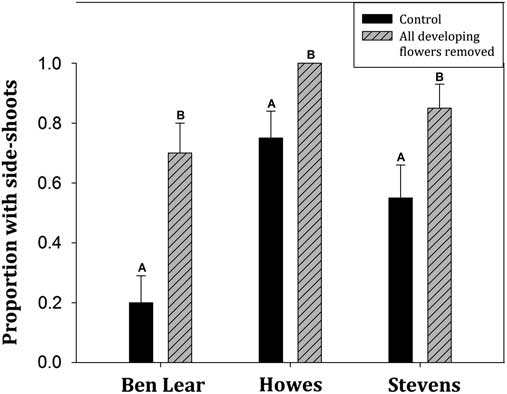
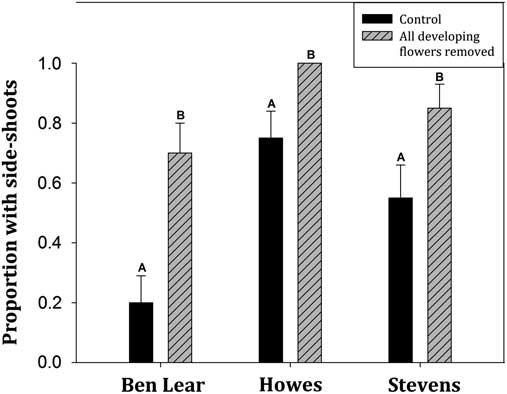
Removal of flowers from greenhouse planted tipworm-injured uprights increased the production of side-shoots, as compared with the uprights with intact flowers in Ben Lear, Howes, and Stevens (χ²=10.10, df=1, P=0.001; χ²=5.71, df=1, P=0.01; χ²=4.28, df=1, P=0.038; Fig. 3).
Estimated proportion of tipworm-injured flowering uprights with side-shoots for Ben Lear, Howes, and Stevens. The uprights either had all the flowers intact (control), or subject to the deblossoming treatment. For each cultivar, a greater number of deblossomed uprights produced side-shoots as compared with the uprights with flowers (α=0.05).
Comparing flowering and vegetative uprights for the production of side-shoots after tipworm injury (field study 2)
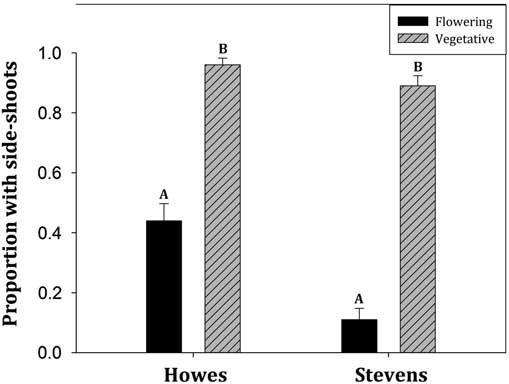
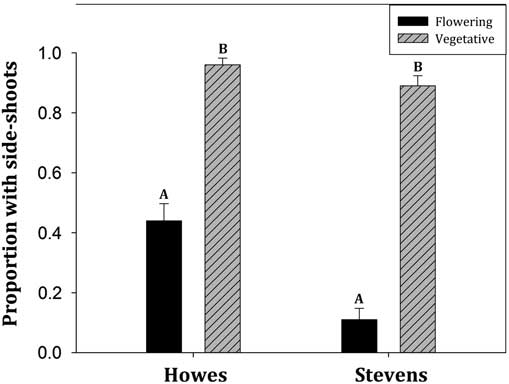
A greater number of tipworm-injured vegetative uprights produced side-shoots, as compared with the injured flowering uprights with developing fruit for both the cultivars (Howes: χ²=69.67, df=1, P<0.001; Stevens: χ²=235.87, df=1, P<0.001; Fig. 4).
Estimated proportions of tipworm-injured flowering and vegetative uprights with side-shoots for Howes and Stevens. For each cultivar, significantly greater number of tipworm-injured vegetative uprights produced side-shoots as compared with the tipworm-injured flowering uprights (α=0.05).
Discussion
The key finding of our study is that presence of developing fruit inhibited the regrowth of tipworm-injured flowering uprights, and removal of flowers increased the production of side-shoots in all three cultivars (Ben Lear, Howes, and Stevens). Furthermore, more vegetative uprights produced side-shoots as compared with flowering uprights after tipworm feeding injury. For Howes and Stevens, ≈40% and 20% of tipworm-injured flowering uprights resumed vegetative growth before the end of the growing season, respectively (Figs. 2, 4). However, majority of tipworm-injured vegetative uprights (≈90%) of both the cultivars produced side-shoots before the onset of dormancy (Fig. 4). These results suggest that the partitioning of limited available resources between the potential sinks (developing fruit and lateral axillary buds) plays a key role in determining regrowth response of tipworm-injured cranberry uprights.
In field study 1, removing either all the flowers or all but one flower increased the number of uprights that produced side-shoots after tipworm feeding injury (Howes and Stevens). Similar results were obtained in the greenhouse study wherein fewer tipworm-injured uprights with intact flowers produced side-shoots, as compared with deblossomed uprights (Ben Lear, Howes, and Stevens). In cranberry, competition between vegetative and reproductive growth and limited availability of total nonstructural carbohydrates during fruit development has been reported (Birrenkott et al. Reference Birrenkott, Henson and Stang1991; Hagidimitriou and Roper Reference Hagidimitriou and Roper1994; Brown and McNeil Reference Brown and McNeil2006; Vanden Heuvel and DeMoranville Reference Vanden Heuvel and DeMoranville2009). Further evidence of resource limitation is provided by studies investigating low fruit set in cranberry (Birrenkott and Stang Reference Birrenkott and Stang1990; Brown and McNeil Reference Brown and McNeil2006). In cranberry uprights the flowers are borne along a vertical axis with sequential phenology; the earlier formed ones being closer to the base of current season growth (Birrenkott and Stang Reference Birrenkott and Stang1989; Brown and McNeil Reference Brown and McNeil2006). The number of flowers on an upright can range from 2 to 7 with only 1–3 fruits reaching maturity by the end of growing season (Brown and McNeil Reference Brown and McNeil2006). Furthermore, the lower earlier formed flowers have a higher probability of setting fruit than the distal later formed ones (Baumann and Eaton Reference Baumann and Eaton1986). However, removal of the either one or both of the lowest flowers increased the fruit set for the remaining flowers suggesting resource limitation during fruit development in cranberry (Birrenkott and Stang Reference Birrenkott and Stang1990).
Insufficient carbohydrate supply may result in competition between the different vegetative and reproductive sinks in plants and a number of studies have documented a negative relationship between fruit production and vegetative growth (Murneek Reference Murneek1926; Eaton Reference Eaton1931; Schaffer et al. Reference Schaffer, Barden and Williams1986; Pakonen et al. Reference Pakonen, Laine, Havas and Saari1988; Kappel Reference Kappel1991; Karlsson Reference Karlsson1994; Maust et al. Reference Maust, Williamson and Darnell1999; Vaast et al. Reference Vaast, Angrand, Franck, Dauzat and Génard2005). For example, deblossoming increased the shoot growth and leaf area of sweet cherry trees, Prunus avium (Linnaeus) Linnaeus (Rosaceae) (Kappel Reference Kappel1991). Similarly, Karlsson (Reference Karlsson1994) reported that the removal of flowers from the reproductive branches of Rhododendron lapponicum (Linnaeus) Wahlenberg (Ericaceae), an evergreen ericaceous clonal shrub, resulted in increased vegetative growth and hypothesised that resource competition was the underlying cause. Thus, competition for the limited available resources and a disproportionate partitioning of assimilates to the developing fruit over lateral axillary buds, may be responsible for the absence of regrowth in the majority of tipworm-injured flowering uprights. The partitioning of assimilates between two competing sinks depends on the intrinsic ability of each sink to receive assimilates relative to the other (Ho Reference Ho1988). Results from our studies (field study 1 and greenhouse) suggest that following apical meristem injury, developing fruit has a higher priority to receive the available assimilates as compared with the lateral axillary buds. Furthermore, priority of assimilate distribution can be altered through manipulation of a sinks’ ability to draw in resources (Ho Reference Ho1988), and may explain the higher rate of side-shoot production in the uprights that received the two deblossoming treatments.
In field study 1, fewer uprights with one developing fruit produced side-shoots as compared with the uprights from which all the flowers were removed in Stevens. However, there was no difference in side-shoot production between the two deblossoming treatments for Howes. Stevens produces relatively large sized fruit, as compared with the small-fruited Howes. For example, Stevens plantings on average produce ≈50% more fruit by weight than Howes in Massachusetts (DeMoranville Reference DeMoranville2011). It is therefore possible that the single developing fruit in Stevens sequestered a greater proportion of the available assimilates, as compared with the Howes uprights with one fruit. Consequently, fewer uprights with one fruit may have initiated the growth of side-shoots in Stevens, as compared with the uprights from which all the flowers were removed. However, phenological differences between Howes (late maturing) and Stevens (early maturing) may have also contributed to the different trends in production of side-shoots between the two flower removal treatments.
In field studies 1 and 2, the majority of tipworm-injured flowering uprights with developing fruit failed to resume growth before the onset of dormancy (Howes and Stevens). Although injury to apical meristem (tipworm and artificial) does not impact the current season fruit production in cranberry (Tewari et al. Reference Tewari, Buonaccorsi and Averill2013), uprights that fail to produce new growth (side-shoots) do not flower in the following year (Tewari et al. Reference Tewari, Buonaccorsi and Averill2012, Reference Tewari, Buonaccorsi and Averill2013). Tipworm-injured flowering uprights without side-shoots are also less likely to resume vegetative growth in the next growing season, as compared with intact uprights (Tewari et al. Reference Tewari, Buonaccorsi and Averill2013). The potential negative effects of upright-level lack of regrowth and flowering on farm-level commercial fruit production, from one growing season to next, have not been investigated in Massachusetts and the other growing regions. The trend in data from the greenhouse study suggests a higher rate of side-shoot production for tipworm-injured uprights with intact flowers (Howes and Stevens), as compared with the field tagged uprights of the same cultivars. Seventy-five and 55% of the greenhouse planted flowering uprights produced side-shoots as compared with 45 and 32% of the field tagged uprights for Howes and Stevens, respectively (field study 1). The change in growing habit of the upright, from clonal ramet (field study) to physiologically independent and rooted plant (greenhouse), may be responsible for the observed trend. Differences in irrigation and fertilization between the field and greenhouse may have also contributed to the above-mentioned trend.
In field study 2, a greater number of tipworm-injured vegetative uprights produced side-shoots, as compared with the flowering uprights with developing fruit. The absence of additional sinks (developing fruit) in vegetative uprights may have resulted in activation of a greater number of dormant lateral buds, as compared with the flowering uprights. In the cranberry production region of Massachusetts, approximately two-thirds of all the uprights in any growing season are vegetative and results from our study demonstrate that a majority (≈90%) of the tipworm-injured vegetative uprights resume growth and produce side-shoots before the onset of dormancy. Tipworm injury is thus unlikely to have a significant impact on the growth and fruit production of vegetative uprights, from one growing season to next. However, the ability of a plant to compensate for herbivory may be affected by environmental factors such as length of the growing season (Huhta et al. Reference Huhta, Lennartsson, Tuomi, Rautio and Laine2000). Tipworm injury has been reported from the cranberry production regions in the northern latitudes with a shorter growing season (Canada, Maine, and northern Wisconsin) (Mahr and Perry Reference Mahr and Perry2006; Cook et al. Reference Cook, Ozeroff, Fitzpatrick and Roitberg2011; C. Armstrong personal communication), and the regrowth responses of vegetative and flowering uprights are yet to be investigated in these regions.
In summary, our field and greenhouse studies demonstrate that developing fruit inhibit the regrowth of uprights after tipworm feeding injury. Furthermore, a greater number of vegetative uprights resumed growth as compared with the flowering uprights before the onset of dormancy. We now have a better understanding of the factors that affect the regrowth of cranberry uprights after tipworm feeding injury to the apical meristem. We suggest that competition among the different sinks and preferential allocation of the available assimilates to developing fruit inhibits the regrowth of tipworm-injured flowering uprights.
Acknowledgements
Marty Sylvia, UMass Cranberry Station (East Wareham, Massachusetts, United States of America), provided logistical help in site selection, coordination with property owners, and fieldwork. The authors thank cranberry grower cooperators in Massachusetts for allowing them to carry out this work on their properties. They are also grateful to the two anonymous reviewers for comments on earlier versions of this manuscript.