Introduction
End-of-life (EOL) discussions and preparations have been a behavioral health challenge for African American (AA) patients and their doctors. Religious and cultural beliefs of the AA patient are often at odds with the physician's recommendations of EOL care (Kwak and Haley, Reference Kwak and Haley2005; Johnson et al., Reference Johnson, Elbert-Avila and Kuchibhatla2006; Cohen, Reference Cohen2008; Eneanya et al., Reference Eneanya, Wenger and Waite2016; National Institute on Aging, 2017). Poorly timed discussions during moments of critical care and lack of knowledge about EOL options result in barriers and/or conflicts within the AA community (Kwak and Haley, Reference Kwak and Haley2005; Johnson et al., Reference Johnson, Elbert-Avila and Kuchibhatla2006; Cohen, Reference Cohen2008; Eneanya et al., Reference Eneanya, Wenger and Waite2016; National Institute on Aging, 2017). This lack of knowledge and poor timing affects the whole family, including the dying individual and his/her children. Discussion of EOL during crisis makes it difficult to treat AA patients and decreases the wellness of the senior at the EOL. We argue that EOL education must be initiated and completed when the patient is stable and with the involvement of available family. This strategy will help to ensure that the senior understands their options, and their wishes are heard and documented.
Multiple studies have confirmed distinct ethnic differences when addressing EOL (Johnson et al., Reference Johnson, Elbert-Avila and Kuchibhatla2006). However, more studies are necessary to define and address these differences. Other studies have shown that Non-White racial or ethnic groups generally lacked knowledge of advance directives and were less likely than Whites to support advance directives. AAs were consistently found to prefer the use of life support than palliative and/or hospice care. Variations within groups existed and were related to cultural values, demographic characteristics, level of acculturation, and knowledge of EOL treatment options (Kwak and Haley, Reference Kwak and Haley2005). Other studies show that there are racial variations in hospice use and that minorities use EOL services disproportionately less than white patients (Cohen, Reference Cohen2008).
Lack of knowledge plays a critical role in EOL decisions. In a study looking at white and black patients with advanced Chronic Kidney Disease (CKD), there were differences in areas of EOL communication, preferences, and hospice knowledge that caused disparity of service. The recommendation of this study was that future efforts should aim to improve patient understanding and promote informed decision-making (Eneanya et al., Reference Eneanya, Wenger and Waite2016).
AA patients are more likely to choose life-sustaining measures at the end of their lives compared to other ethnic groups despite terminal illness. This decision is partly based on lack of knowledge of the available options of care at the EOL. Due to multiple life-sustaining measures, the AA patients are not receiving the care to help them peacefully die. Minorities use hospice services disproportionately less than white patients do. This leads to higher cost in health care to the patient and health system (Johnson et al., Reference Johnson, Elbert-Avila and Kuchibhatla2006).
To address the challenges that AA experience at the EOL, we developed and piloted the effectiveness of an EOL education program for AAs. Our pilot study aimed to develop an effective, targeted educational intervention that can serve as a teaching tool to educate AA population, especially the elderly, on options of EOL prior to critical care. We first assessed the level of preparation for EOL in the AA community through a survey instrument. The survey was used to determine the deficits in knowledge in AA population in Mid-Michigan regarding EOL choices before and after the educational intervention. Our educational intervention seeks to empower individuals and communities to take an active role in creating a culture of wellness at the EOL and decreasing morbidity. We hypothesize that an educational tool, like our educational video, will increase the participants understanding of the available EOL options.
Methods
Participants
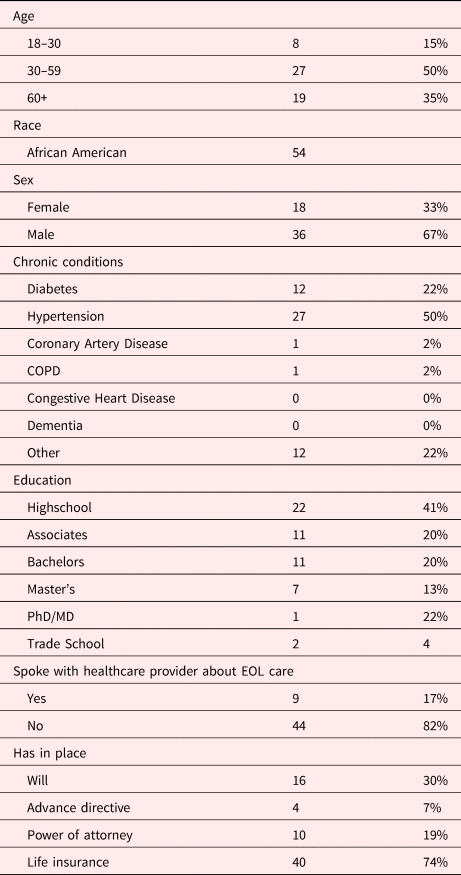
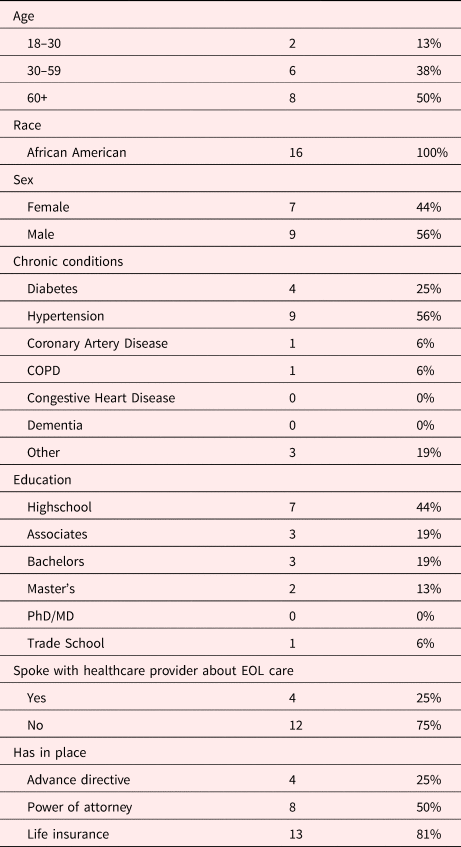
This pilot study consisted of 54 participants from Saginaw, MI. The demographic information of the participants is described in Table 1. All our participants were AAs. Almost half of them experienced a chronic condition with 22% being diabetic and 50% hypertensive. Fifty percent of our subjects were between 30–59 years of age and 35% were 60 years of age or over. Almost half of the subjects indicated that high school was the highest educational degree achieved. Only nine of the subjects spoke to their healthcare provider regarding making EOL choices. Sixteen (30%) of our participants had a will, 4 (7%) had advance directives, 10 (19%) had power of attorney, and almost all the participants (74%) had life insurance. To better understand the sample, we examined the demographic of the participants who had a will in place (Table 2). Half of the participants who had a will in place were over 60 years of age, over 75% had diabetes or hypertension, just under 50% only had a high school degree, and 81% of them had life insurance in place as well. Of significance, only 25% previously discussed possible EOL choices with their healthcare provider.
Demographic information

Demographic information for participants with a will in place

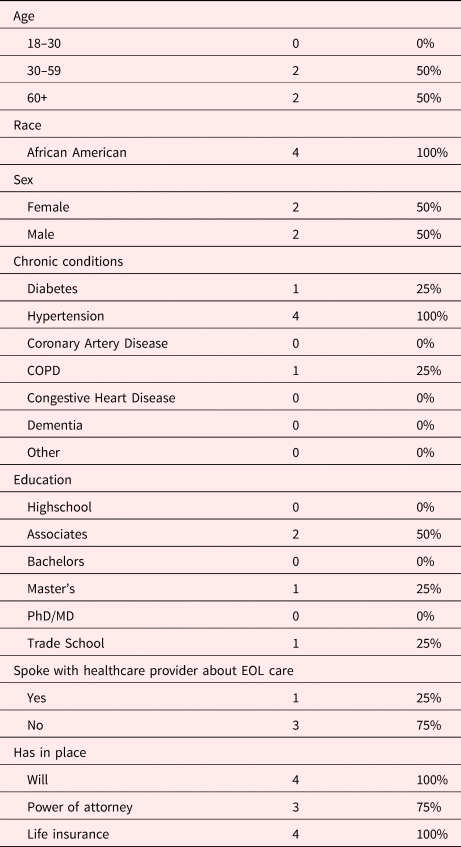
Table 3 outlines the demographic information for the four participants who indicated they have advanced directives in place. This group had higher educational attainment. In addition to specifying advanced directives, they also had a will, power of attorney and life insurance in place. However, only one of them spoke to a healthcare provider regarding EOL choices.
Demographic information for participants who have advanced directives in place

Survey design
Pre- and post-intervention surveys were designed to assess participants’ knowledge and perception regarding the following: (a) knowledge regarding documents that can be put in place to assist during EOL decision-making such as a will, advanced directives, life insurance; (b) awareness of power of attorney and if they are already in process of designating one; (c) confidence in their understanding regarding wills, advanced directives, power of attorney, life insurance, hospice care, and palliative care; and (d) consideration of palliative care use if one is given a terminal diagnosis (told that he/she is going to die) and if no or not decided what the underlying reason for this is (it costs too much, faith in God, there will be less money for others in my family, mistrust such as hospice care will give permission to the doctors to hasten my death or others).
The pre-intervention survey also included demographic questions (see Tables 1–3). Additional questions solicited information regarding the current status of the participants EOL preparation, such as “I am in the process of having a will written up” and “I have told a family member and/or a doctor about my wishes regarding a will, but they are not documented.”
The post-intervention survey was the same as the pre-intervention survey with the demographic questions removed.
Questions on both survey's measuring changes in understanding utilized a 6-point Likert scale varied from 1 = Strongly Disagree to 6 = Strongly Agree. Change in attitude toward using palliative or hospice care utilized 1 = “No” or 2 = “Yes” answer options.
To link the pre- and post-intervention surveys, both surveys asked participants to provide the first two letters of the name of the street on which they grew up, the first two numbers of the earliest phone number they can remember, and the first two letters of mother's maiden name.
The Central Michigan University Institutional Review Board Committee approved the study.
Teaching tool design (Educational intervention)
The teaching tool was designed with the guidance of a counselor who has had counseling experience with AA patients and understands the belief system of the AA population. After two sessions, the counselor and Primary Investigator developed the steps of preparing for the EOL. Information on hospice and palliative care was obtained from the NIH website. The average expenses for funerals in Michigan, information about wills and assets were obtained by a google search. A video lasting 10 min was designed to present this information. Pre-surveys were collected before the educational intervention and post-surveys were collected after the educational intervention.
Statistics analysis
Our sample size consisted of 54 participants. Two sets of analyses were conducted. Specifically, paired-sample t-test was utilized to assess changes in understanding about EOL planning options. Regression analysis was then used to asses these changes while including several demographic covariates. Significance levels at the 0.10, 0.05, and 0.01 levels are flagged throughout the reporting of the t-test and regression analysis.
Results
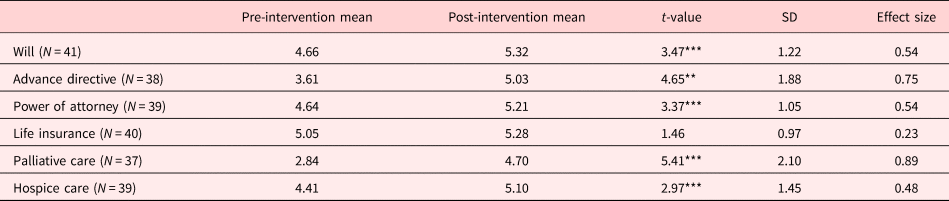
Paired-sample t-tests revealed the educational intervention was effective in improving knowledge (Table 4). Participants reported their understanding of wills significantly improved from pre-intervention to the post-intervention assessment, P < 0.001. Similarly, understanding of advance directives significantly improved from the pre-intervention to the post-intervention, P < 0.001. Understanding of power of attorney also significantly improved from the pre-intervention to the post-intervention, P < 0.001. Additionally, understanding of palliative care significantly improved from the pre-intervention to the post-intervention, P < 0.001. Likewise, understanding of hospice care significantly improved from the pre-intervention to the post-intervention, P < 0.001. By contrast, knowledge about life insurance did not significantly improved from the pre-intervention to the post-intervention. Pre-intervention mean scores for understanding life insurance were high to begin with (M = 5.05); therefore, this lack of significance maybe due to the presence of a ceiling effect.
Means, t-values, standard deviations (SDs), and effect sizes for pre- and post-intervention understanding

** P < 0.05.
*** P < 0.001.
The educational intervention also helped to ease concerns about palliative care and hospice care (Table 5). Concerns about palliative care decreased from the pre-intervention to the post-intervention, P < 0.001. Likewise, concerns about hospice care decreased from the pre-intervention to the post-intervention, P < 0.001.
Means, t-values, standard deviations (SDs), and effect sizes for pre- and post-intervention concerns about palliative care and hospice care

*** P < 0.001.
In addition to improved knowledge and ease of concerns, the intervention resulted in intended behavioral change (Table 5). Considering use of palliative care significantly increased from the pre-intervention to the post-intervention assessment, P < 0.001. Similarly, considering use of hospice care increased from the pre-intervention to the post-intervention, P < 0.001 (Tables 6 and 7).
Means, t-values, standard deviations (SD), and effect sizes for pre- and post-intervention intention to use palliative care and hospice care

*** P < 0.001.
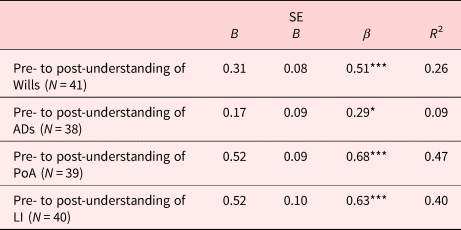
Regression analyses predicting post-intervention understanding from pre-intervention understanding

ADs, advanced directives; PoA, power of attorney; LI, life insurance.
* P < 0.10.
*** P < 0.01.
In a second set of analyses, we performed linear regressions to further evaluate changes from pre- to post-intervention. Our data demonstrated that there was a statistically significant increase in the understanding of wills, power of attorney, and life insurance from before the educational intervention to post-educational intervention (Table 2).
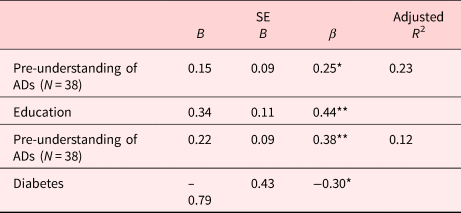
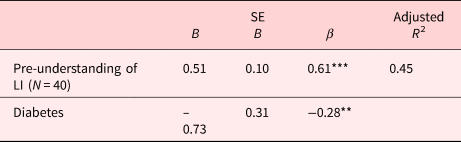
Following, we performed linear regressions to determine if covariates (age, education, sex, presence of diabetes, presence of other co-morbidities, and if the participants talked to their primary care provider about EOL options) had a significant effect on the findings previously reported. There were no statistically significant covariates (age, education, sex, and if the participants talked to their primary care provider about EOL) for the understanding of wills or power of attorney (data available upon request). However, educational attainment was a significant predictor of post-intervention understanding of advanced directives (AD) such that educational attainment beyond high school resulted in greater the understanding of AD post-educational intervention (Table 8). Understanding of life insurance was significantly different in people with diabetes when comparing a increase in knowledge pre-test to post-test. No other co-variates were statistically significant predictors of post-intervention understanding of life insurance (Table 9).
Regression analyses predicting post-intervention understanding of advanced directives (ADs) from pre-intervention understanding of advanced directives and significant demographic covariates

Age, sex, talked with doctor, and chronic conditions other than diabetes were ns.
* P < 0.10.
** P < 0.05.
Regression analyses predicting post-intervention understanding of life insurance (LI) from pre-intervention understanding of LI and significant demographic covariates

Age, education, sex, talked with doctor, and chronic conditions other than diabetes were ns.
** P <0.05.
*** P <0.01.
Discussion
Our pilot study indicated that the educational intervention could be used as an effective teaching tool in educating AA population on EOL choices. In particular, the educational intervention statistically significantly improved the knowledge and understanding regarding wills, advanced directives, power of attorney, palliative case, and hospice care as measured by changes in responses from pre- to post-survey. The intervention was also effective in easing participants’ concerns about palliative care and hospice care. In addition to improved knowledge and ease of concerns, the intervention resulted in intended behavioral change. Considering use of palliative care increased from the pre- to the post-intervention assessment with P < 0.05. Similarly, considering use of hospice care increased from the pre-intervention to the post-intervention with P < 0.05.
Regression analysis revealed that besides the education and diabetes that are co-founders in the understanding of AD and LI, respectively, all of the observed changes in the knowledge pre- versus post-educational intervention are independent of age, education, sex, talk to primary care provider, diabetes and other chronic conditions.
This study provides evidence that AA patients had a lack of knowledge about EOL topics like palliative care, hospice care, and advanced directives. No specific demographic information made one participant more prepared for the EOL than another, including income, education, or gender. One in four participants stated that their doctor never discussed palliative and/or hospice care with them. This provides evidence that physicians will need to increase their educational efforts with the AA population to help them better understand EOL options. Physicians are knowledgeable about this subject and can easily educate their patients. An educational tool like the one developed in this study may be helpful and lessen the time of education so that the physician can answer any questions at the end of the session.
Educating AA about palliative care will also have an impact on healthcare cost. Morrison et al. (Reference Morrison, Penrod and Cassel2008) reported that palliative care patients who were discharged alive had an adjusted net savings of $1,696 in direct costs per admission (P = 0.004) and $279 in direct costs per day (P < 0.001) including significant reductions in laboratory and intensive care unit costs compared with usual care patients. The palliative care patients who died had an adjusted net savings of $4,908 in direct costs per admission (P = 0.003) and $374 in direct costs per day (P < 0.001) including significant reductions in pharmacy, laboratory, and intensive care unit costs compared with usual care patients 6, 7, and 8. Therefore, education about EOL to AA patients can have a tremendous impact on their preparedness to make the most appropriate for them and their family’s EOL choices as well as decrease the healthcare cost.
Study limitations
The study was limited in that we did not follow the participants' long-term to determine if the educational intervention resulted in participants actually making EOL choices, such as living wills, advanced directives, power of attorney, establishing life insurance, or planned for hospice or palliative care. However, research does show that intention to change behavior is predictive of actual behavioral change (Dillard et al., Reference Dillard, Weber and Vail2007). Another limitation of the study was that we had a small sample size. We are currently expanding the study to more locations in the Saginaw in order to get more representative sample of the AA population in the Saginaw area. Because our study focused on the Saginaw county residents, the study results may not translatable to AAs in other counties in Michigan. Future work will focus on expanding the study and educational intervention beyond the boundaries of Saginaw County. In addition to the above limitations, there were 54 pre-surveys and 40 post-surveys. This equates to a 25.9% loss to follow up. This was unexpected because the pre- and post-survey were done during the same 45-min session. More assistance with the participants during the post-survey maybe necessary to decrease loss to follow up. Finally, in this study, 35.2% of the participants were college educated with a bachelor's or higher degree. In Saginaw in 2017, 9.9% of AAs had a bachelor or higher degree. The participants, therefore, may not be a cross-sectional representation of the Saginaw community. Future studies that incorporate different churches and will done at public venues to get a more representative cross-sectional sample of Saginaw, Michigan's AA population.
Acknowledgments
We acknowledge Felicia Seals-Buchanan for her assistance with the project and the leadership of the CMU College of Medicine for the financial support of this study.
Conflict of interest
The authors declare no conflict of interest.