Introduction
In a large variety of studies it has been observed that the experience of stressful life events constitutes a major risk for the development and persistence of psychiatric disorders (Kendler et al. Reference Kendler, Karkowski and Prescott1999; Brilman & Ormel, Reference Brilman and Ormel2001; Comijs et al. Reference Comijs, Beekman, Smit, Bremmer, van Tilburg and Deeg2007). Stressful life events and psychiatric disorders such as depression may be associated with changes in glucocorticoid levels (Nemeroff, Reference Nemeroff1996; Holsboer, Reference Holsboer2000; Meewisse et al. Reference Meewisse, Reitsma, de Vries, Gersons and Olff2007). It has been hypothesized that stress leads to long-term changes in hypothalamic–pituitary–adrenal (HPA) axis regulation (Brilman & Ormel, Reference Brilman and Ormel2001; Boyce & Ellis, Reference Boyce and Ellis2005), which, in turn, makes an individual more prone to psychiatric disorders (Checkley, Reference Checkley1996). Furthermore, it has been hypothesized that particularly severe stress during childhood leads to chronic alterations in HPA axis regulation (McEwen, Reference McEwen1998; Heim et al. Reference Heim, Ehlert and Hellhammer2000a).
Studies on the relationship between adverse events during childhood and HPA axis regulation resulted in inconsistent findings: some studies reported elevated levels of basal cortisol (Essex et al. Reference Essex, Klein, Cho and Kalin2002; Halligan et al. Reference Halligan, Herbert, Goodyer and Murray2004) and hyper-reactivity to new stressors (Heim et al. Reference Heim, Newport, Bonsall, Miller and Nemeroff2001), while others reported lower basal cortisol levels (Heim et al. Reference Heim, Newport, Heit, Graham, Wilcox, Bonsall, Miller and Nemeroff2000b; Bremner et al. Reference Bremner, Vermetten and Kelley2007) and hypo-reactivity to new stressors (Elzinga et al. Reference Elzinga, Roelofs, Tollenaar, Bakvis, van Pelt and Spinhoven2008) after early adverse events.
With respect to life events later in life, conflicting results have been observed as well. Several studies found that adverse events later in life were associated with lower levels of salivary morning cortisol and 24 h plasma cortisol, particularly in persons with post-traumatic stress disorder (PTSD) (Lauc et al. Reference Lauc, Zvonar, Vuksic-Mihaljevic and Flögel2004; Yehuda et al. Reference Yehuda, Morris, Labinsky, Zemelman and Schmeidler2007), but elevated levels of salivary and 24 h urine cortisol have been reported following adverse events later in life as well in persons with (Pitman & Orr, Reference Pitman and Orr1990; Rasmusson et al. Reference Rasmusson, Lipschitz, Wang, Hu, Vojvoda, Bremner, Southwick and Charney2001) and without PTSD (Pico-Alfonso et al. Reference Pico-Alfonso, Garcia-Linares, Celda-Navarro, Herbert and Martinez2004).
Methodological differences, including variation in study population (children, adolescents or adults), participants with or without psychopathology (e.g. depression or PTSD), nature of adverse event (neglect, abuse, maltreatment), cortisol measurements (e.g. basal cortisol versus cortisol reactivity tests) and type and onset of stressful events may explain these conflicting results (Gunnar & Quevedo, Reference Gunnar and Quevedo2007; Meewisse et al. Reference Meewisse, Reitsma, de Vries, Gersons and Olff2007; Miller et al. Reference Miller, Chen and Zhou2007).
Since HPA axis regulation is also affected by ageing, it has been suggested that older people show a different stress-reactivity than younger adults (Otte et al. Reference Otte, Hart, Neylan, Marmar, Yaffe and Mohr2005). Older persons experience many life events, predominantly of negative valence, and are thus exposed to many stressors (Hardy et al. Reference Hardy, Concato and Hill2002). However, most of the previous studies were conducted in relatively small samples of children or younger adults (age <65 years), and less is known about the association between life events and cortisol in older adults.
The present study assessed the association between early and late life events and HPA axis regulation, using basal salivary cortisol levels, collected within 30 min after awakening and in the evening, in an older community-based population.
Method
Sample
Data were derived from the Longitudinal Aging Study Amsterdam (LASA). LASA is a population-based prospective cohort study among persons initially aged 55–85 years. Details of this cohort study have been described previously (Deeg et al. Reference Deeg, van Tilburg, Smit and de Leeuw2002). For the present study, data from the baseline interview of LASA (T1) were used for data on early life events, whereas all other variables were assessed at the third follow-up of 2001–2002 (T4), when 1691 subjects participated. Of the 1416 persons who were lost to follow-up, 1050 (33.8% of the T1 sample) had died, 112 (3.6%) indicated by self-report or proxy that they were too ill or cognitively impaired to be interviewed, 222 (7.1%) indicated that they were no longer interested in participating in the study, and 32 (1.0%) could not be contacted.
During the third follow-up (T4), from the 1619 available respondents, 1474 underwent a face-to-face interview and 1307 respondents underwent a medical interview, during which additional information was gathered, including collection of saliva samples. Interviews were conducted at the homes of the respondents by well-trained and intensively supervised interviewers. All interviews were tape-recorded to control the quality of the data.
Measures
Cortisol measurement
Saliva samples were collected with the ‘Salivette’ device (Sarstedt, Germany). Material for collection of saliva and detailed instructions were sent home to the respondents, and the samples were kept in the refrigerator until collected by the interviewer the next day. Respondents were instructed to collect saliva in the morning within 30 min after waking and in the evening just before going to bed. In order to prevent contamination with blood, respondents were instructed to rinse their mouth and wait 10 min before starting to chew the cotton ball and not to eat or brush their teeth before.
Cortisol levels (nmol/l) were determined using radioimmunoassay coated tubes (Spectria Orion Diagnostics, Finland). The detection limit was 1.5 nmol/l. The intra-assay coefficient of variation was 7% for cortisol levels around 30 nmol/l and 19% for cortisol levels around 1.3 nmol/l, whereas corresponding inter-assay coefficients of variation were 5% and 19% (Peeters et al. Reference Peeters, van Schoor, van Rossum, Visser and Lips2008). Morning and evening cortisol levels had a skewed distribution. To obtain normal distribution of cortisol levels, natural log transformation was performed. Diurnal variability of cortisol was calculated by subtracting the evening levels from the morning levels.
Life events
Late life events were measured with a structured questionnaire during the face-to-face interview and were assessed retrospectively during T4. Respondents were asked whether the following events had occurred in the 3-year time interval prior to the interview: widowhood, divorce, severe illness of partner, death of a relative, death of a child, relocation, severe conflicts, victim of a crime, or financial problems. The events were adapted from the life event inventory developed by Tennant & Andrews (Reference Tennant and Andrews1976), with the aim of assessing the stress of life events. The significance of life events is scaled in two conceptually different ways. The first is based on the magnitude of the change produced by the event. The second is based on the undesirable or distressing quality of the events. The items used in the LASA data collection were selected on the following criteria: the event is likely to occur relatively frequently in the population (e.g. having a baby is unlikely), and the event scores relatively high on the distress and life changes scalings (de Beurs et al. Reference de Beurs, Beekman, Geerlings, Deeg, van Dyck and van Tilburg2001). In the analyses, the number of late life events was categorized into three more or less equally sized categories: no late life events, one late life event and two or more (with a maximum of five) late life events.
Early life events were assessed by means of an open-ended question whether the participant had experienced any significant life events before the age of 18 years. The reported life events were categorized into war experiences; death of a parent or important other; divorce of parents; sexual abuse; severe problems at home; poverty or unemployment; and physical illness. In the analyses, respondents were categorized in having or not having experienced a significant life event during childhood.
Additionally, based on the life-event measures a new variable was created which combined early and late life events, with the following four categories: (1) no early or late life events; (2) only early life events; (3) only late life events; and (4) both early and late life events.
Other variables
Age, sex and level of education were recorded during the first wave of LASA (T1). Educational level was recorded in seven categories ranging from not more than 6 years of education to university education. Other covariates were assessed at T4. In addition, the presence of diabetes, history of cardiovascular diseases (atherosclerosis, heart disease and cerebrovascular accidents) and medication use were assessed based on self-report (Kriegsman et al. Reference Kriegsman, Penninx, van Eijk, Boeke and Deeg1996). Blood pressure was measured twice, and the average of two measurements was calculated. Hypertension was defined as a diastolic tension >90 mmHg or a systolic tension above 140 mmHg or usage of anti-hypertensive medication. Body mass index (BMI) was calculated from measured weight and height and expressed as kg/m2. Furthermore, alcohol consumption, smoking status and amount of sleep (number of hours) were assessed. Alcohol consumption was expressed as number of drinks per week and was categorized in three groups (no alcohol use; on average <14 drinks weekly; ⩾14 drinks weekly). Smoking habits were categorized into current and non-current smoker. Respondents were asked to determine the average amount of sleep (number of hours) per night. Depression was measured using a Dutch version of the Center for Epidemiologic Studies Depression (CES-D) questionnaire (Radloff, Reference Radloff1977; Beekman et al. Reference Beekman, Deeg, van Limbeek, Braam, de Vries and van Tilburg1997).
Study sample
Of the 1307 respondents participating in the medical interview at T4, 1184 (90.6%) respondents collected saliva for cortisol measurements, and thirty-four respondents (2.7%) used corticosteroids and were excluded from the study sample. Of the samples of morning levels, four were below the detection limit (1.5 nmol/l); 92 samples of evening values were below the detection limit. We imputed these missing values with random values between 0 and 1.5. Furthermore, morning and evening cortisol levels above 100 nmol/l were excluded, because these extreme levels were considered to be due to measurement error (10 morning samples and five evening samples; 1.3% of all cortisol samples) and also if the evening level was more than 5 nmol/l higher than the wakening level (22 samples). The cut-off of 100 nmol/l corresponds to a cut-off score of 4 s.d. above the mean morning cortisol level (Peeters et al. Reference Peeters, van Schoor, van Rossum, Visser and Lips2008). We recoded these values to missing values. Missing values were also present on covariates in 48 respondents, leaving 1049 participants for morning cortisol levels, 1055 participants for evening cortisol levels and 1041 participants for diurnal variability of cortisol for the data analysis.
Compared with the respondents of whom no complete data were available (n=636), the study sample was 4 years younger, was more often male, had fewer chronic illnesses and had a higher score on the Mini Mental State Examination (p<0.05). They did not differ with respect to level of education, alcohol consumption, smoking habits or average amount of sleep (number of hours) per night.
Data analysis
Linear regression analyses and analysis of covariance (ANCOVA) were used to estimate the cross-sectional associations of childhood adversity and number of life events with morning and evening levels of cortisol and diurnal variability of cortisol. In separate models the diurnal variability of cortisol and the natural log-transformed levels of morning cortisol and evening cortisol were entered as the dependent variable. We first examined the single effects of early life events (yes v. no) and number of late life events (0, 1, ⩾2) by entering them in separate linear regression models as independent variables and then created an ANCOVA model for the combined life events variable (no reported life events; only early life events; only late life events; early and late life events). First, models were adjusted for age and sex. Second, models were also adjusted for educational level, smoking, alcohol consumption, BMI, hypertension, diabetes, cardiovascular diseases and average number of hours of sleep. And third, additional adjustments were made for depressive symptoms. We selected these covariates a priori, based on the literature (Wust et al. Reference Wust, Wolf, Hellhammer, Federenko, Schommer and Kirschbaum2000; Kudielka & Kirschbaum, Reference Kudielka and Kirschbaum2003; Badrick et al. Reference Badrick, Bobak, Britton, Kirschbaum, Marmot and Kumari2008; Vreeburg et al. Reference Vreeburg, Kruijtzer, van Pelt, van Dyck, Derijk, Hoogendijk, Smit, Zitman and Penninx2009) and tested whether they also fulfilled the criteria for confounding within our data by adding each confounder to the linear regression models between life events and cortisol measures. If the coefficient changed by 10% or more we added the confounder to the model.
Finally, because some studies suggest different cortisol levels after psychosocial stress in men and women (Otte et al. Reference Otte, Hart, Neylan, Marmar, Yaffe and Mohr2005; Elzinga et al. Reference Elzinga, Roelofs, Tollenaar, Bakvis, van Pelt and Spinhoven2008), interaction terms between sex and life event variables were added to the fully adjusted model.
Results
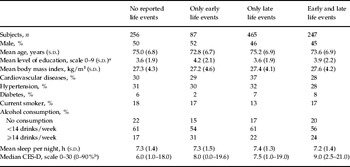
In the total study sample the median morning cortisol level was 15.0 nmol/l [interdecile range (IDR) 10–90%: 7.4–27.0 nmol/l], the median evening cortisol level was 2.8 nmol/l (IDR 10–90%: 1.5–6.3 nmol/l) and mean diurnal variability of cortisol was 12.4 (s.d.=7.4) nmol/l. Table 1 presents the baseline characteristics of the study sample (n=1055) per life event category. As can be seen, persons who reported only early life events were slightly younger, had a higher educational level and had less often diabetes than the other categories. Persons who reported only late life events more often had a history of cardiovascular diseases.
Baseline characteristics per life event category

s.d., Standard deviation; CES-D, Dutch version of the Center for Epidemiologic Studies Depression questionnaire.
a Level of education ranges from elementary education or less, ⩽6 years of education to college education and higher vocational education.
b Interdecile range.
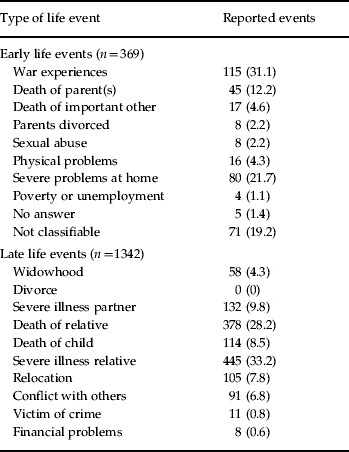
Table 2 presents the frequency distributions of the early and late life events. War experiences, severe problems at home and death of parents were the most often reported early life events. The most often reported late life events were death of a relative, severe illness of a relative and severe illness of partner.
Frequency distribution of type of childhood adversity and recent life events

Values are given as n (%).
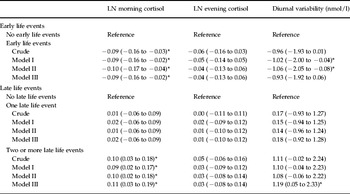
The results from the linear regression analyses are shown in Table 3. Persons who reported early life events had significantly lower morning cortisol and flattened diurnal variability of cortisol, compared with persons who reported no early life events (model 2). No significant associations were found for evening cortisol. After additional adjustment for depressive symptoms (model 3), the associations with morning and evening cortisol did not materially change. However the association with diurnal variability of cortisol slightly attenuated (p=0.07).
Results of the regression analyses of the associations between childhood adversity, life events and natural log-transformed morning and evening cortisol levels and diurnal variability of cortisol

LN, Natural log-transformed; Model I, adjusted for age and sex; Model II, additional adjustments for educational level, BMI, alcohol use, mean hours of sleep, diabetes, cardiovascular disease, hypertension and current smoking; Model III, Model II+adjustments for depressive symptoms.
Values are given as B (95% confidence interval).
* Significant association (p<0.05).
Persons who reported two or more late life events in the past 3 years had significantly higher morning cortisol compared with persons who reported one late life event or no late life events. Reporting two or more late life events was borderline significantly associated with a higher diurnal variability of cortisol (p=0.06) (model 2). No significant associations were found for evening cortisol. Additionally, the associations with morning and evening cortisol did not materially change after adjustment for depressive symptoms in the third model, but the association with diurnal variability of cortisol changed from borderline significant to significant.
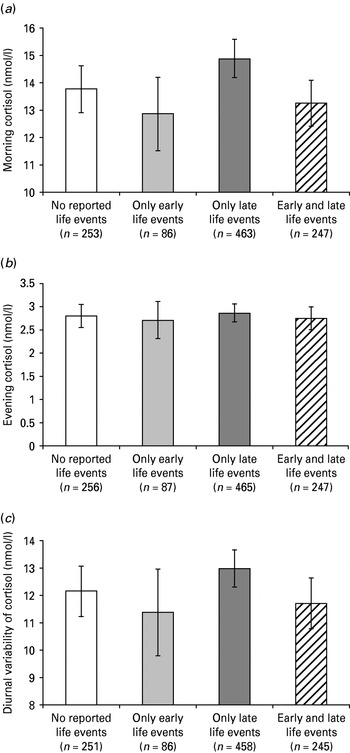
Fig. 1 shows the adjusted mean cortisol levels for the combined life event categories (no reported life events; only early life events; only late life events; both early and late life events). Mean cortisol levels were transformed back to linear scale. Overall, there was a significant relationship between life event categories and morning cortisol [F(3, 1046)=3.82, p=0.01] (Fig. 1a). There was no significant relationship between life event categories and evening cortisol [F(3, 1052)=0.24, p=0.87] (Fig. 1b). A borderline significant relationship was found between life event categories and diurnal variability of cortisol [F(3, 1042)=2.17, p=0.09] (Fig. 1c). After additional adjustment for depressive symptoms the relationships between life events and morning and evening cortisol did not materially change, but the relationship with diurnal variability was no longer significant [F(3, 1042)=1.89, p=0.13].
Morning (a) and evening (b) cortisol levels and diurnal variability of cortisol (c) according to life-event category. Values are adjusted means, with 95% confidence intervals represented by vertical bars. Mean cortisol levels were adjusted for age, sex, educational level, body mass index, alcohol use, mean hours of sleep, diabetes, cardiovascular disease, hypertension and current smoking.

No significant interaction was found between early and late life events for morning or evening cortisol levels or diurnal variability of cortisol. Also, no significant interactions were found between sex and early or late life events for morning or evening cortisol levels or diurnal variability of cortisol (p>0.05, data not shown).
Discussion
In this large community-based sample of older persons we observed that life events experienced later in life were associated with higher morning levels of cortisol, whereas life events experienced early in life were associated with lower morning levels of cortisol. Also, early life events were associated with flattened diurnal variability of cortisol, whereas late life events were associated with higher diurnal variability of cortisol.
To our knowledge, this is the first study to investigate the association of early and late life events with HPA axis regulation in older persons. A major strength of our study is the large population-based sample and the extensive measurements of a large number of covariates, for which analyses could be adjusted. Furthermore, the response rate for saliva collection was very high in our study sample, which led to limited selection bias.
A limitation of the study is the cross-sectional design. As a result, we cannot discern cause from consequence. We therefore do not know if cortisol levels changed after the experience of life events or that changes in cortisol levels already existed prior to the experience of life events. Since we assessed life events retrospectively we assume that life events were experienced prior to the observed cortisol levels.
Another limitation of our study is that we do not know exactly at which time the saliva samples were taken, as the participants were asked to collect saliva within 30 min after awakening instead of directly at awakening or 15 or 30 min after awakening. Cortisol follows a specific circadian rhythm, with peak levels 30 min after awakening when cortisol levels increase by 50–60% (Fries et al. Reference Fries, Dettenborn and Kirschbaum2009) and a nadir at night. Consequently, it is unclear whether the morning samples in our study reflect the awakening level, the peak at 30 min after awakening, or any time within this 30 min interval. Although this will have led to measurement errors, we do not think that this error was systematic, as it seems unlikely that persons who reported late life events collected their morning samples systematically later than persons who reported early life events. More likely, this sampling method resulted in non-differential misclassification and may have diluted our estimates; it is therefore recommended that studies sample cortisol with greater attention to its circadian rhythm. Additionally, it is recommended to collect cortisol samples on 2 consecutive days (Kraemer et al. Reference Kraemer, Giese-Davis, Yutsis, O'Hara, Nevi, Gallagher-Thompson, Taylor and Spiegel2006), because cortisol levels are rather variable within individuals. However, our large sample size may have largely compensated for the possible variability in cortisol measures.
It has been proposed that life events experienced in childhood (aged <12 years) have a stronger association with HPA axis regulation than life events experienced during adolescence (12–18 years of age), as it has been suggested that particularly life events during early childhood affect the development of the HPA axis (McEwen, Reference McEwen2000). In our study, we asked respondents about life events before the age of 18 years and thus it is possible that we underestimated the association between early life events and HPA axis regulation. On the other hand, this age cut-off has been used in many other studies (Harkness & Monroe, Reference Harkness and Monroe2002; Schilling et al. Reference Schilling, Aseltine and Gore2008) and has been shown to be a reliable and valid cut-off for measuring childhood adversity (Fink et al. Reference Fink, Bernstein, Handelsman, Foote and Lovejoy1995; Bremner et al. Reference Bremner, Vermetten and Mazure2000).
Additionally, the early life events were assessed using an open-ended question. Therefore it is possible that we missed certain important childhood events. It is possible that some under-reporting has occurred due to unwillingness to report embarrassing events or painful memories. Under-reporting may also have occurred because of some memory failures. However, in our study sample, the level of global cognitive functioning, as measured with the Mini-Mental State Examination (Folstein et al. Reference Folstein, Folstein and McHugh1975), was well within normal ranges, therefore recall failure due to cognitive impairment will probably be limited.
In spite of the shortcomings, our results suggest a differential association of early and late life events with HPA axis functioning. As first noted by Selye (Reference Selye1937), stressors cause an initial hyper-activation of the HPA axis. However, there is increasing evidence that exposure to severe stressors or chronic stress can also lead to relative hypo-activation of the HPA axis (Heim et al. Reference Heim, Ehlert and Hellhammer2000a; Gunnar & Vazquez, Reference Gunnar and Vazquez2001; Miller et al. Reference Miller, Chen and Zhou2007). For instance, in two recent reviews it has been suggested that hyper-secretion of cortisol could be a marker for acute stress, while hypo-secretion is more likely to be a consequence of chronic stress, but could also be related to a longer passing of time since the onset of a stressor (Gunnar & Quevedo, Reference Gunnar and Quevedo2007; Miller et al. Reference Miller, Chen and Zhou2007). The exact mechanism by which this occurs is still unclear. A possible mechanism may be that long-lasting excessive secretion of cortisol leads to negative feedback inhibition of the pituitary to the adrenal cortex (McEwen, Reference McEwen1998; Heim et al. Reference Heim, Ehlert and Hellhammer2000a).
Additionally, it is believed that severe stressors early in life can set the responsiveness of the HPA axis. For instance, in rodents it has been found that after neonatal handling, the HPA axis under-reacts to stressors later in life (McEwen, Reference McEwen1998). In humans it has also been found that people who experienced adverse childhood events showed blunted cortisol levels after a psychosocial stress task or a corticotrophin-releasing factor stimulation test (Heim et al. Reference Heim, Newport, Bonsall, Miller and Nemeroff2001; Elzinga et al. Reference Elzinga, Roelofs, Tollenaar, Bakvis, van Pelt and Spinhoven2008). However, in our study, persons who reported both early and late life events showed no significant alterations on basal salivary cortisol levels compared with persons who reported no life events or only early life events. Probably, the differential associations of late life events with higher levels of morning cortisol and diurnal variability and early life events with lower morning cortisol levels and flattened diurnal variability cancelled out an interactive effect between early and late life events on HPA axis regulation.
We did not observe any significant associations between life events and evening cortisol levels; as a result the differences in diurnal variability are largely due to the differences in morning cortisol levels. Previous studies on HPA axis regulation and adverse life events (Bremner et al. Reference Bremner, Vermetten and Kelley2007; Smeets et al. Reference Smeets, Geraerts, Jelicic and Merckelbach2007) also reported that differences in diurnal variability could be largely explained by differences in morning cortisol and less by evening cortisol levels, although one study reported that physical and psychological abuse in women was associated with higher levels of evening cortisol and not with differences in morning cortisol (Pico-Alfonso et al. Reference Pico-Alfonso, Garcia-Linares, Celda-Navarro, Herbert and Martinez2004). In our study, the intra- and inter-assay coefficients of variation of the laboratory measurements of cortisol were relatively high for low levels of cortisol. This may have affected the reliability of the evening levels and may have reduced the possibility of finding significant associations with evening cortisol.
Besides stress, HPA axis regulation can be affected by numerous other factors, one of which is ageing (Kudielka et al. Reference Kudielka, Buske-Kirschbaum, Hellhammer and Kirschbaum2004; Otte et al. Reference Otte, Hart, Neylan, Marmar, Yaffe and Mohr2005). Since we are among the first to study the relationship between life events and HPA axis regulation in older persons, more research is necessary in order to investigate to what extent the reactivity of the HPA axis is altered by life events in old age. However, our results in older persons are comparable with several previous studies in younger adults, which observed similar differential associations of early and late life stress with cortisol levels (Meewisse et al. Reference Meewisse, Reitsma, de Vries, Gersons and Olff2007; Weems & Carrion, Reference Weems and Carrion2007).
Several lines of evidence suggest that life events and HPA axis regulation are both associated with depression (Brilman & Ormel, Reference Brilman and Ormel2001; Boyce & Ellis, Reference Boyce and Ellis2005). Possibly, the experience of life events leads to chronic changes in HPA axis regulation, which could increase the risk for psychiatric disorders, like depression (Checkley, Reference Checkley1996). To study the effect of depression on the association between life events and HPA axis regulation we adjusted for depressive symptoms in a separate model. Adjustments for depressive symptoms hardly altered the associations between life events and salivary cortisol levels, which suggests that life events are associated with HPA axis regulation independently of depression. Two previous studies have already shown that life events and cortisol levels are independently related to the onset of depression during follow-up (Goodyer et al. Reference Goodyer, Herbert, Tamplin and Altham2000; Harris et al. Reference Harris, Borsanyi, Messari, Stanford, Cleary, Shiers, Brown and Herbert2000), whereas one cross-sectional study observed that in depressed women psychosocial stressors were related to elevated evening cortisol, but not in non-depressed women (Strickland et al. Reference Strickland, Deakin, Percival, Dixon, Gater and Goldberg2002).
It has also frequently been reported that HPA axis regulation is affected by sex (Otte et al. Reference Otte, Hart, Neylan, Marmar, Yaffe and Mohr2005; Elzinga et al. Reference Elzinga, Roelofs, Tollenaar, Bakvis, van Pelt and Spinhoven2008). In these stress-induction studies it has been observed that the cortisol response to challenge is higher in older women than in older men. In our study we did not find that the association of life events with cortisol levels was different in men and women. However, we investigated basal cortisol levels in relation to life events and not the stress-reactivity of the HPA axis. Therefore our data may not be comparable with studies in which stress-reactivity was examined.
In conclusion, the results of this large population-based study of older persons suggest a differential association of early and late life events with HPA axis regulation; early life events were associated with a relative hypo-secretion of morning cortisol and flattened diurnal variability, while late life events were associated with elevated secretion of morning cortisol and high diurnal variability of cortisol.
Acknowledgements
The research was supported by the Dutch Ministry of Welfare and Health (VWS), a VIDI grant from the Netherlands Organization for Scientific Research (NWO, project no. 917-66-311) and a grant from the Internationale Stichting Alzheimer Onderzoek (ISAO).
Declaration of Interest
None.