Poison centers (PCs) assist poisoned individuals by providing the best available management by phone or even delivering emergency treatment in some cases. These centers have provided their services to public and healthcare professionals for more than 50 years (Reference Litovitz, Benson, Youniss and Metz20). Although PCs most commonly respond to inquiries regarding patients under the age of 5 that have typically been exposed to the poisonous agent at home (Reference Bronstein, Spyker and Cantilena7), they also help to identify public health outbreaks, respond to terrorism, and provide public awareness during chemical catastrophes (Reference Sutter, Bronstein and Heard29).
Despite the benefits of PCs, they have historically lacked stable financing and have been highly sensitive to healthcare expenditure reductions. Some PCs in the United States (U.S.) have been closed because of budget cuts, since the 2008 financial crisis (Reference Bronstein, Spyker and Cantilena7;Reference Giffin and Heard11;Reference Thompson30;Reference Woolf, Karnes and Kirrane35).
Economic evaluations are important tools to help allocate health resources efficiently in the context of resource competition and can identify the benefits and costs with comparative analyses of the intervention options (Reference Drummond, Sculpher, Torrance, O'Brien and Stoddart9;Reference Gold, Siegel, Russel and Weinstein12;Reference Kolbelt19;22). Systematic reviews of economic evaluations summarize high-quality studies and provide support to decision makers in an efficient allocation of healthcare resources.
Systematic reviews of economic evaluations of PCs are not available to our knowledge. Therefore, our objective was to summarize and assess the economic evaluation of PCs from the perspectives of society, the payer and the healthcare system to consequently inform decision makers of the economic viability of PCs.
METHODS
Study Eligibility Criteria
Economic evaluation studies that compared PCs with an alternative intervention from the perspectives of society, the payer, and the healthcare system were eligible for this review. The outcomes of interest were economic evaluations results (cost–benefit ratios, incremental cost-effectiveness ratios, incremental cost–utility ratios, and incremental costs).
Search Strategy and Study Data Sources
A literature search was conducted in June 2010 with no language or publication date restrictions, and the search was updated monthly until November 2011. We searched MEDLINE, Embase, Scopus, Centre for Reviews and Dissemination databases (CRD, including the NHS EED, HTA, and DARE databases), the Cochrane Library, the Cochrane Central Register of Controlled Trials (CENTRAL), mCRT (metaRegister of Current Controlled Trials), Latin American and Caribbean Center on Health Sciences Information (LILACS), and Scientific Electronic Library Online (SciELO) databases. We also screened peer-reviewed, published abstracts from the proceedings of the North American Congress of Clinical Toxicology (NACCT), the International Congress of the European Association of Poisons Centers and Clinical Toxicologists Congress (EAPCCT), and ProQuest Dissertations & Theses. This gray literature search was performed to minimize the risk of publication bias and to identify relevant studies that were not published in indexed periodicals.
The search strategy used for MEDLINE (via PubMed) was: (“poison control centers”[mesh] or “poison control centers”[tw] or “poison control center”[tw] or “poison control centre”[tw] or “poison information centre”[tw] or “toxicology center”[tw] or “toxicology centre”[tw] or “poison center”[tw] or “poison centre”[tw] or “poison information centre”[tw] or “poison information services”[tw] or “poisons information services”[tw]) and (cost and (cost or effectiveness or utility or benefit or minimization or consequence) or economic evaluation or health economics or health technology assessment). For the other databases we adapted this search strategy.
Study Selection and Data Extraction
Two reviewers, a pharmacist with clinical toxicology expertise (TFG) and a PhD economist experienced in health economic evaluation (ENS), selected the articles independently after reading their titles and abstracts.
One reviewer assembled the study data of interest from each publication in an online spreadsheet, and the other reviewer checked the information. We collected from studies the country and year in which the cost data were collected, type of economic evaluation, time horizon, perspective, population, intervention, alternative intervention, discount rate, sensitivity analysis, scenarios adopted, costs measured, effectiveness considered, and economic results. For papers that any of these data were missing, we attempted to contact the corresponding author to obtain the needed information.
Quality and Risk of Bias Assessment
We used the Drummond ten-item checklist (Reference Kolbelt9) to determine whether the method used in each study was adequate for the proposed objectives and whether the results were valid. These parameters were considered when interpreting the evidence retrieved.
Data Analysis
The quantitative data were extracted as it was presented in the articles. We did not adjust or summarize the original data to avoid a potential introduction of bias. However, when the cost-benefit ratio was not available, we calculated the ratio of the benefits (extra charge to the health system) to the operational cost of the PC, based on the information available in the articles.
RESULTS
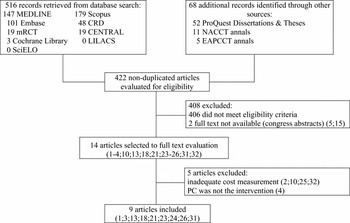
In total, 422 non-duplicated publications were found, and nine met the inclusion criteria (Figure 1). We excluded two eligible studies published in congress abstracts because additional information needed for inclusion could not obtained after contacting the authors (Reference Bottei and Kalin5;Reference Hilton and Wahl15). The results of these studies were favorable to PCs, and thus risk of publication bias is not denoted.
Flowchart depicting the search, selection, and inclusion of studies.

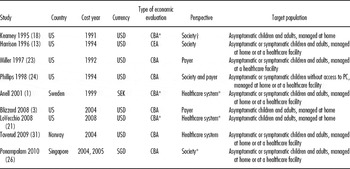
Three economic evaluations did not meet at least seven of the ten quality evaluation items (1;Reference LoVecchio, Curry and Waszolek21;Reference Ponampalam26) (Supplementary Table, which can be viewed online at www.journals.cambridge.org/thc2012012). Five studies failed in their allowance for uncertainty, as sensitivity analysis was not reported (Reference Higgins and Green1;18;Reference Song, Parekh and Hooper21;26;Reference Toverud, Pike and Walloe31). Four did not adequately describe the PC operating costs and consequences (Reference Anell and Persson1;Reference Harrison, Draugalis, Slack and Langley13;Reference LoVecchio, Curry and Waszolek21;Reference Ponampalam26). Six studies did not report the time horizon, which made it impossible to determine whether the discount rate used was appropriate (Reference Anell and Persson1;Reference Blizzard, Michels and Richardson3;Reference LoVecchio, Curry and Waszolek21;Reference Phillips, Homan and Hiatt24;Reference Ponampalam26;Reference Toverud, Pike and Walloe31). One fundamental piece of information missing in three studies (Reference Anell and Persson1;Reference Kearney, Olson, Bero, Heard and Blanc18;Reference LoVecchio, Curry and Waszolek21) was the type of economic evaluation, which the reviewers had to assume from the available information (Table 1).
Characteristics of the Studies Included

Note. *Information inferred by the reviewers; †Information obtained by contacting the study corresponding author.
US, United States; USD, United States dollar; SEK, Swedish krona; SGD, Singapore dollar; CBA, cost–benefit analysis; CEA, cost-effectiveness analysis.
The studies similarly described the infrastructure and operation of the poison centers. PCs were characterized as offering only telephonic 24-hour assistance by healthcare professionals, including physicians, nurses or pharmacists with specialized training in toxicology, and access to computerized resources to support the calls. No included studies assessed PCs with emergency poison treatment facilities.
The residents of the centers’ geographical service area were the target population of each center and included individuals of all ages who had used the service previously or were likely to use it. Three studies surveyed healthcare personnel to obtain economic evaluation data (Reference Anell and Persson1;Reference Ponampalam26;Reference Toverud, Pike and Walloe31).
All economic evaluations were undertaken in developed countries, mainly the United States (n = 6, four in the 1990s and two in the 2000s). The other studies were from Sweden (Reference Anell and Persson1), Singapore (Reference Ponampalam26), and Norway (Reference Toverud, Pike and Walloe31), all in the 2000s. Eight studies used cost–benefit analyses, and one used a cost-effectiveness evaluation (Reference Harrison, Draugalis, Slack and Langley13). The perspectives adopted in the studies were from the society (Reference Harrison, Draugalis, Slack and Langley13;Reference Kearney, Olson, Bero, Heard and Blanc18;Reference Phillips, Homan and Hiatt24;Reference Ponampalam26), the healthcare system (Reference Anell and Persson1;Reference LoVecchio, Curry and Waszolek21;Reference Toverud, Pike and Walloe31), and the payer (Reference Blizzard, Michels and Richardson3;Reference Miller and Lestina23;Reference Phillips, Homan and Hiatt24). All included studies examined a time horizon of less than 1 year. If the time horizon was not available in the reports, we obtained this information by contacting the authors (Reference Kearney, Olson, Bero, Heard and Blanc18;Reference Miller and Lestina23;Reference Toverud, Pike and Walloe31) or conservatively assumed that the time horizon was less than 1 year (8;14–16;Reference Song, Parekh and Hooper28;33), if the authors could not be contacted.
Two studies restricted their direct costs to medical care, including hospitalizations and medical consultations (Reference Harrison, Draugalis, Slack and Langley13;Reference Ponampalam26). The majority of studies considered non-medical direct costs, such as ambulance/emergency medical services, other healthcare provider services and the hours spent by healthcare professionals researching the information to manage the poisoning (Reference Anell and Persson1;Reference Blizzard, Michels and Richardson3;Reference Kearney, Olson, Bero, Heard and Blanc18;Reference Miller and Lestina23;Reference Phillips, Homan and Hiatt24;Reference Toverud, Pike and Walloe31). Only two studies included indirect costs related to the target population's time away from gainful employment and earnings lost due to death (Reference Miller and Lestina23;Reference Ponampalam26).
Costs were calculated based on the average treatment charges from hospitals or health departments. The cost savings were assessed by considering a scenario in which the PC was absent. The treatment cost of a poison exposure was estimated via telephone surveys of individuals who used PC services (Reference Anell and Persson1;Reference Blizzard, Michels and Richardson3;Reference Kearney, Olson, Bero, Heard and Blanc18;Reference LoVecchio, Curry and Waszolek21;Reference Toverud, Pike and Walloe31), expert panel (Reference Harrison, Draugalis, Slack and Langley13), literature review (Reference Miller and Lestina23), or author inferences (Reference Ponampalam26). One research used data from a real situation in which calls to the PC were rerouted to 911 emergency operators (Reference Phillips, Homan and Hiatt24).
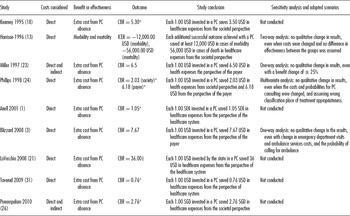
Outcomes from cost–benefit analysis were measured in monetary terms, by quantifying the extra cost that would be incurred without PCs. This extra cost represented the unnecessary costs of medical consultations, emergency department visits, and inpatient hospitalizations that would most likely not have occurred if a PC were available. The results of each study are presented in Table 2.
Economic Results of Included Studies: Comparison of Presence Versus Absence of Poison Centers

Note. *Cost–benefit relationships calculated by reviewers based on study data. †Only the expenditure of the state government was considered, not the total annual budget.
USD, United States dollar; SEK, Swedish krona; SGD, Singapore dollar; ICER, incremental cost-effectiveness ratio; CBR, cost–benefit ratio.
Studies from the United States showed the greatest savings, with cost–benefit ratios ranging from 2.03 to 7.67 (Reference Blizzard, Michels and Richardson3;Reference Phillips, Homan and Hiatt24); that is, for each United States dollar (USD) spent on the PC, up to 7.67 (USD) in healthcare costs were saved. In other countries, this ratio ranged from 0.76 to 2.76 (Reference Ponampalam26;Reference Toverud, Pike and Walloe31). One study found that the overall satisfaction with the service approached 100 percent, but this finding was not incorporated into the cost–benefit analysis (Reference Toverud, Pike and Walloe31).
In one study, the cost–benefit ratio only considered state funding, which showed a saving of 36.00 USD for each dollar invested in the PC by the state (Reference LoVecchio, Curry and Waszolek21). Because U.S. centers have complex financing that includes federal, state, and local funding along with grants and donations (16), this result probably overestimates the potential benefits of the PC. As our attempt to contact the study's authors failed, we decided to classify this study as an outlier and considered the results unclear.
The cost-effectiveness study assessed exposures to four different poisons in adults and children: acetaminophen, tricyclic antidepressants, household cleaning substances, and cough and cold medications (Reference Harrison, Draugalis, Slack and Langley13). In all cases, morbidity and mortality were the outcome. The results showed minimum incremental cost-effectiveness ratios of −12,000 USD for morbidity and −56,000 USD for mortality, which shows that the PCs saved a minimum of 12,000 USD to 56,000 USD for each case of poisoning successfully handed.
Qualitatively, the results were supported by studies that performed sensitivity analyses, which showed robust PC resource savings (Reference Blizzard, Michels and Richardson3;Reference Harrison, Draugalis, Slack and Langley13;Reference Miller and Lestina23;Reference Phillips, Homan and Hiatt24).
DISCUSSION
The evidence from the included economic evaluations favor PCs regardless of the perspective adopted. In the cost–benefit analyses, the savings from the PCs clearly offset the operating expenses from the perspectives of society, payer, and healthcare system. From the societal perspective, the cost-effectiveness evaluation found negative incremental cost-effectiveness ratios (i.e., an increase in effectiveness led to a reduction in costs). Incremental cost-effectiveness ratios that result in savings are seldom obtained in cost-effectiveness studies. Considering the thresholds for cost-effectiveness currently in use, PCs appear to be highly cost-effective (33). Although PCs indicate promising economic results, experience has shown that this is an extremely difficult concept for health insurance providers and governmental funding agencies to understand, and they often choose not to invest in such health technologies despite the cost advantages.
Strengths and Limitations of the Present Review
The review was conducted according to the current systematic review quality standards, including the sensible search in the main literature databases, the selection process that was conducted independently by specialists and the cross-checked data abstraction (8;Reference Higgins and Green14). We attempted to provide a detailed description of our method to enable its reproducibility.
We sought to minimize the effect of publication bias by not restricting our search to any particular language or any publication date range and by including gray literature search. These procedures are important because of the negative impact of publication bias on systematic review results (Reference Song, Parekh and Hooper28). The two congress abstracts that were excluded due to lack of important information would probably not alter our findings nor suggest in a risk of publication bias, as their results showed benefits from PCs (Reference Bottei and Kalin5;Reference Hilton and Wahl15).
The quantitative results from the included studies were not adjusted for inflation or converted into an unique reference currency because there is no consensus on international economic evaluation guidelines (8;17). Moreover, because of the heterogeneity of the healthcare systems involved, especially regarding their financing and costs, comparative analyses of absolute monetary values are not recommended. The same cannot be said of the studies’ qualitative results, which may indicate the most cost-effective strategy for a specific context. For an intervention that generates resource savings, it is relatively more important to understand the ratio of savings to costs than the absolute value of the savings.
Limitations of the Included Economic Evaluations
Economic evaluation tools for health technologies were developed in the 1960s, and these methods have been used mostly to compare medicines rather than programs (Reference Drummond, Sculpher, Torrance, O'Brien and Stoddart9). The scarcity of studies addressing programs may be reflected in the methodological limitations observed in several of the included articles.
Included studies analyses lacked specific definitions of the type of economic evaluation used, which can lead to challenges in interpretation. Additionally, the time horizon was often undefined, which can hinder the discount rate assessment and the determination of whether the timing of the study was adequate (Reference Drummond, Sculpher, Torrance, O'Brien and Stoddart9). The description of the study perspective was often insufficient, which makes it impossible to verify whether the cost quantification was appropriate (Reference Drummond, Sculpher, Torrance, O'Brien and Stoddart9). Few studies included sensitivity analyses, which are an important feature of economic evaluations because they determine the impact of the changes in the model parameters on the study results (Reference Briggs6;Reference Rascati27).
All of the included economic evaluations assessed PCs that provided only telephonic information for the public or healthcare professionals and were conducted in four different high-income economies (36), which may limit the applicability of these results to PCs of distinct structure and to countries with lower economic levels. The highest PC cost–benefit ratios in this review were from the United States, which has one of the greater proportions of healthcare spending relative to its gross domestic product (15.7 percent) (34). Another limitation of the generalization of these results is that most of these studies were conducted in the 1990s. This concern may be assuaged by the similar or better results of more recent studies. For example, an update of one study included in our review (Reference Miller and Lestina23) found that the cost–benefit ratio had risen from 6.5 to 13, which was a twofold increase from the ratio measured 10 years before (Reference Hilton and Wahl15).
The quality of our review depends on the quality of the primary studies. These studies obtained data from sources that were not particularly robust, including inferences, expert panels, and non-random telephone surveys, which may have weakened the results.
Despite these limitations, all of the included studies appear to support PCs as a rational strategy to increase healthcare efficiency by providing health benefits and saving money. PCs provide positive and cost-saving effects to the health sector in all available perspectives, including the societal, that comprises a broader range of benefits.
Our results could be considered conservative as the included studies did not incorporate important intangible costs, such as patient and family anxiety or lost wages from poisoning treatment. Additionally, some studies only comprised unintentional exposures that were not life-threatening. Including more severely poisoned patients in the analytical model might further prove the ability of PCs to mitigate greater costs.
CONCLUSIONS
Poison centers are economically viable and have highly favorable incremental cost-effectiveness and cost–benefit ratios from the perspective of the society, the healthcare system, and the payer. The savings offered by PCs offset their operational costs. Investing in existing PCs and opening new PCs to assist neglected populations is a rational strategy, in direct contrast to the current trend of resource reduction for PCs. Future research should analyze the intangible costs of poisoning, evaluate the impact of PCs on more severely poisoned patients and assess this health technology in less developed countries.
SUPPLEMENTARY MATERIAL
Supplementary Table 1 www.journals.cambridge.org/thc2012012
CONTACT INFORMATION
Tais F. Galvo, MSc, Doctorate student, Faculty of Health Sciences, University of Brasilia, Brasilia, Brazil; Pharmacist, Amazonas Poison Control Center, Getulio Vargas University Hospital, Federal University of Amazonas, Manaus, Amazonas, Brazil
Everton N. de Silva, MSc, PhD, Professor, Faculty of Ceilandia, University of Brasilia, Brasilia, Brazil
Marcus T. Silva, MSc, Specialized Technician, Department of Science and Technology, Ministry of Health of Brazil; doctorate student, Faculty of Health Sciences, University of Brasilia, Brasilia, Brazil
Alvin C. Bronstein, MD, FACEP, Medical Director, Rocky Montain Poison Center, Denver Health and Hospital Authority; Associate Professor, Department of Emergency Medicine, University of Colorado Health Sciences Center, Denver, Colorado
Mauricio G. Pereira, MD, MPH, PhD, Professor, Faculty of Medicine, University of Brasilia, Brasilia, Brazil
CONFLICTS OF INTEREST
The authors report they have no potencial conflicts of interest. This research was funded by Brazilian Nacional Research Council (CNPq), grant no. 558655/2009-2.