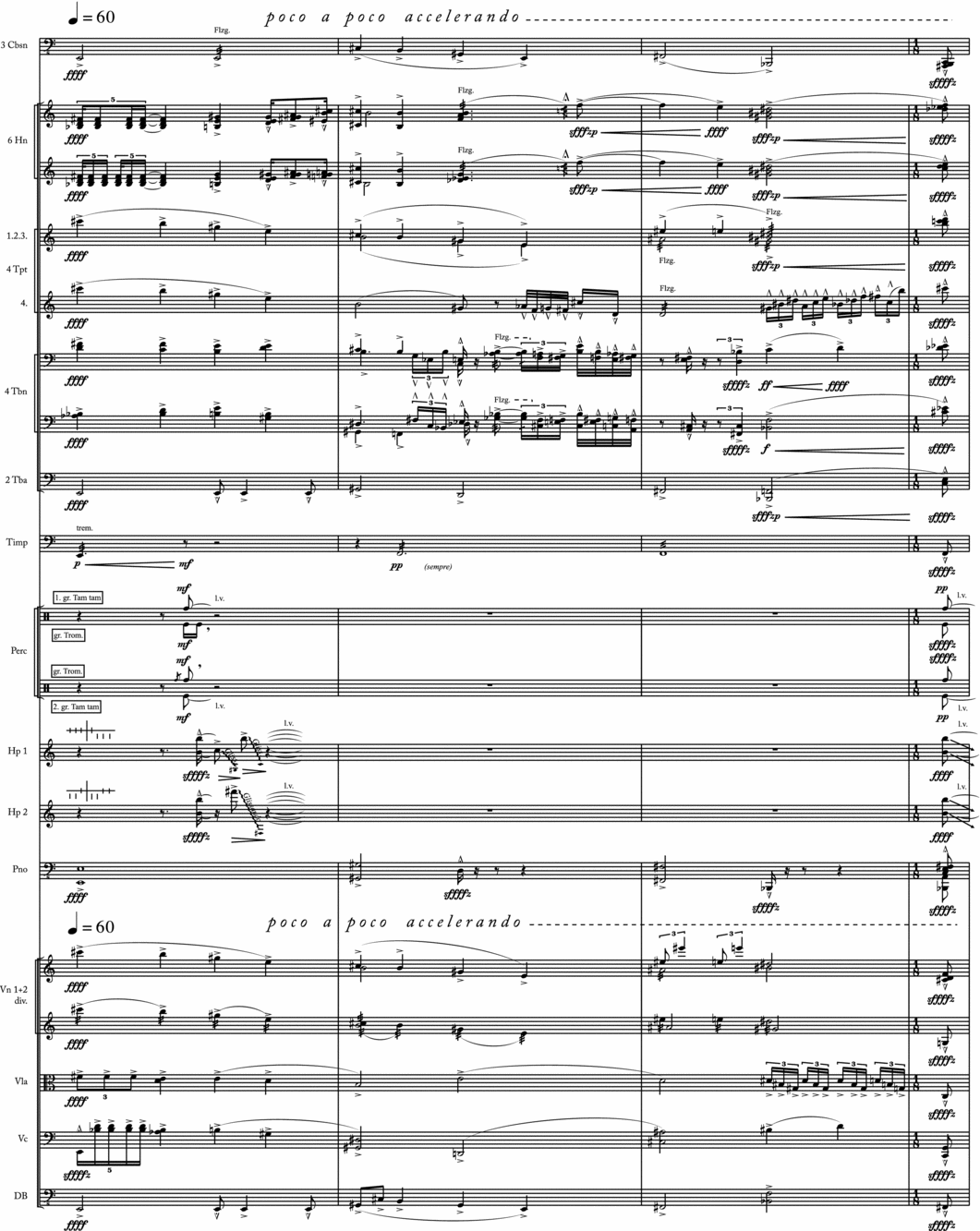
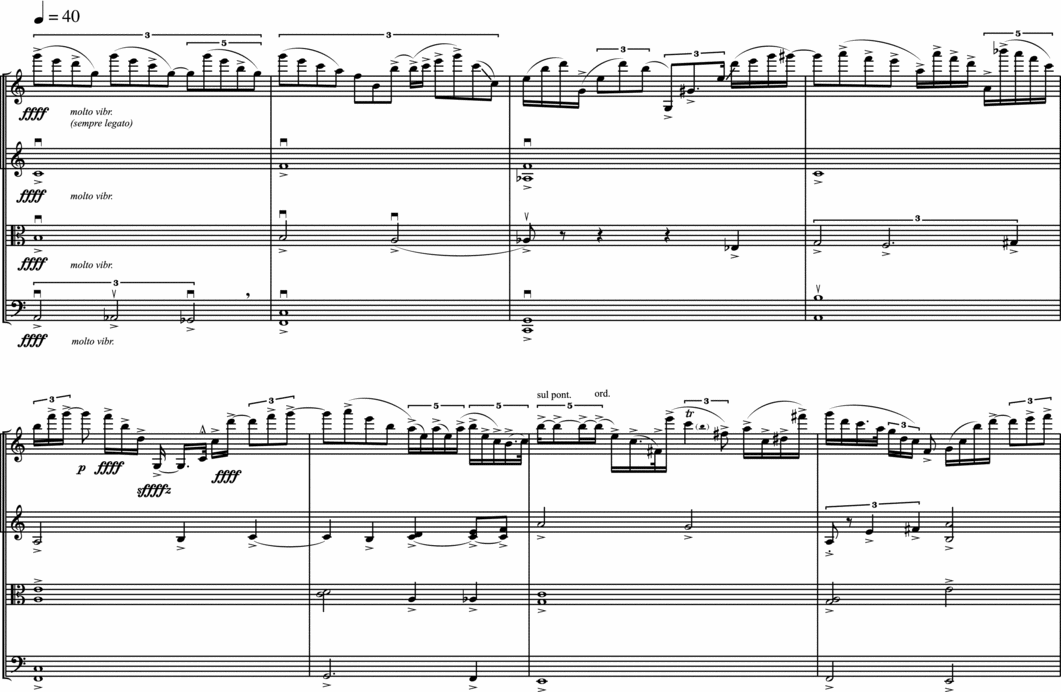
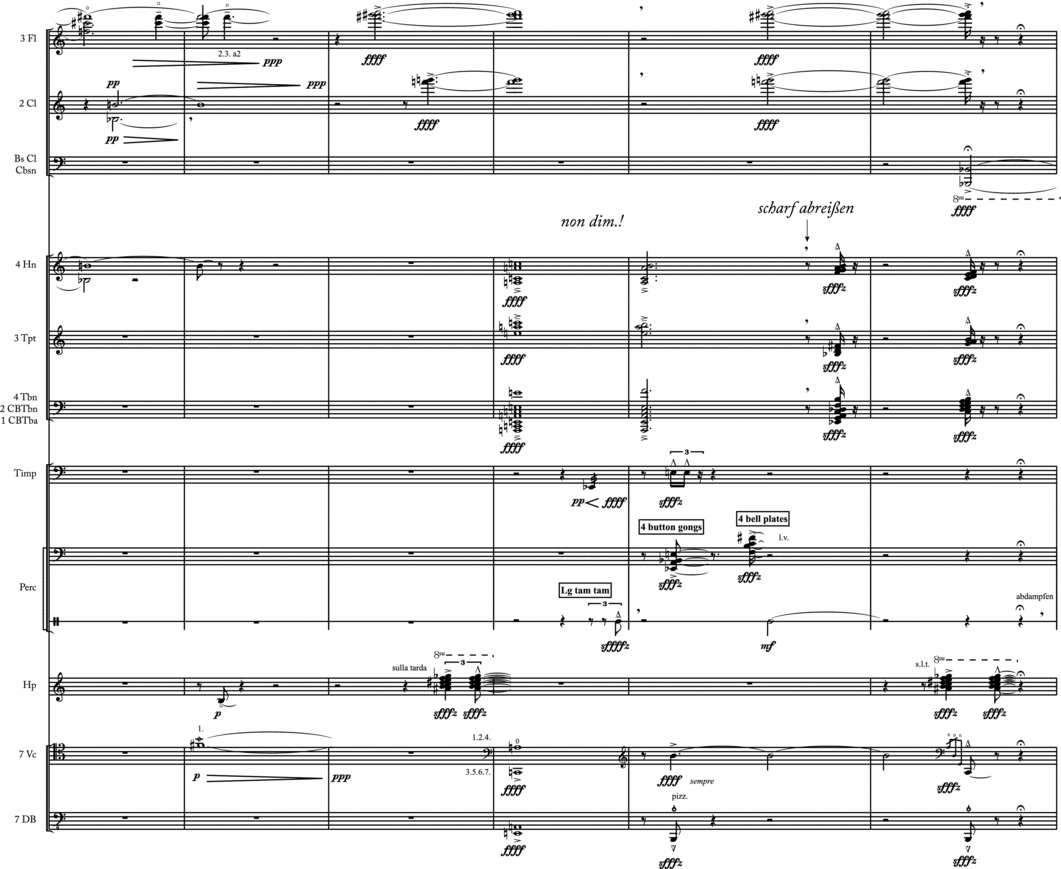
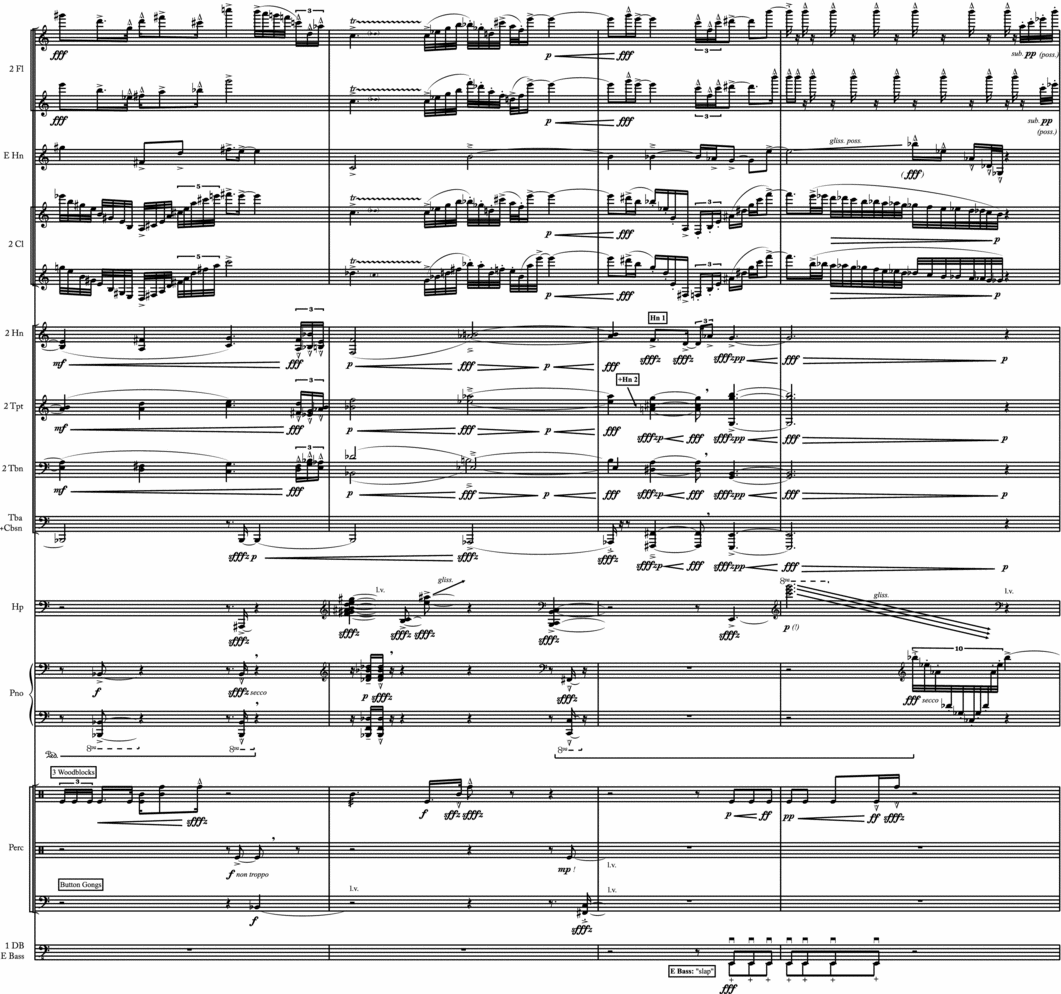
I
Today we shall examine tonality in its last throes. I want to prove to you that it's really dead. Once that's proved, there's no point in going on dealing with something dead.
(Webern, The Path to the New Music, 1933)
Tonality! Psychosis! Modernity! Why not start with a joke? ‘Two Jews met in a railway carriage at a station in Galicia. “Where are you going?” asked the one. “To Cracow”, was the answer. “What a liar you are!”, broke out the other. “If you say you're going to Cracow, you want me to believe you're going to Lemberg. But I know that in fact you're going to Cracow. So why are you lying to me?”’Footnote 1
Next, a caveat: Wolfgang Rihm's is one of the more radical attitudes towards tonality among post-war composers, and I take the word ‘radical’ to the letter here – not ‘new’ but ‘deep’, rooted, in this case at the beginning of something. But any attempt to address it ought to begin with a claim Rihm made in a talk for the 32nd Darmstadt Summer Courses in 1984.Footnote 2 The theme was Tonalität, and he captures that year's fractiousness with his opening line: ‘Actually, there is no tonality. Only harmony' (‘Eigentlich gibt es Tonalität nicht. Nur Harmonik’).Footnote 3
There is a remarkable project to be undertaken on harmony in Rihm's music – on the seemingly asystematic world opened up by Rihm's dealings with tones and their dealings with him. Despite his confessed wish to write an ‘unanalyzable’ music,Footnote 4 scholars have made admirable headway.Footnote 5 But still, they make it in a twofold dark: first, a dark as a lack of light given off by pre-compositional sketches, pitch-matrices, chord-derivation charts, long-range harmonic or structural schemata – all of which largely do not exist. Second, a ‘positive’ dark: the blithe, almost tautological evidence of the ink itself, mocking the very idea of background or substrate. Instead, these scripts expand into an expanding mycelium network of (mostly European) performers serving both the signifiers and their institutions: conservatories, juries, competitions, publishers, funders, discoursers.Footnote 6
On its own, this is no great point. Rihm is now Germany's most established but also establishment living composer. With considerable influence over policy and programming, he is the emblem of a Neue Musik firmly embraced by the state and its bodies – down to the party: Rihm voted for Angela Merkel and her Christian Democratic Union in the 2013 elections, and was not shy about it.Footnote 7 While he considers T. W. Adorno's famous 1961 essay ‘Vers une musique informelle’ a ‘Holy Bible’,Footnote 8 Rihm would also seem to embody what Adorno previously called an ‘aged New Music’, willing to renounce its own ‘renunciation of consensus’ to become a ‘stabilized music, [harmonizing] itself with the world’.Footnote 9 Judgements aside, a striking irony emerges: while centring – tonicizing? – itself institutionally and politically, Rihm's ‘music itself’ has, over the last four decades, performed an exorbitant spectacle of instability. And here ‘unanalyzability’ plays a role, since no composer so integrated into the last century's establishment produces music so analytically resistant or, on the other hand, so uninspiring of analysis. Analysis has, after all, been a powerful legitimizing servant of musical institutionalization. Might there be a positive relation between unanalyzability – a ‘madness without method’ – and institution? And how might one analyze it?
On the one hand, there is the prospect of an analysis at odds with academic protocols, renouncing a faithful parsing of signs to speculate about body, weight, energy, drive. Sigmund Freud's dictum about the drives – that they are silent – provides a lifeline here for a speculative music analysis beyond sound and yet utterly un-Pythagorean and anti-metaphysical in ethos.Footnote 10 On the contrary: something rooted in the body, a soma-analysis.Footnote 11
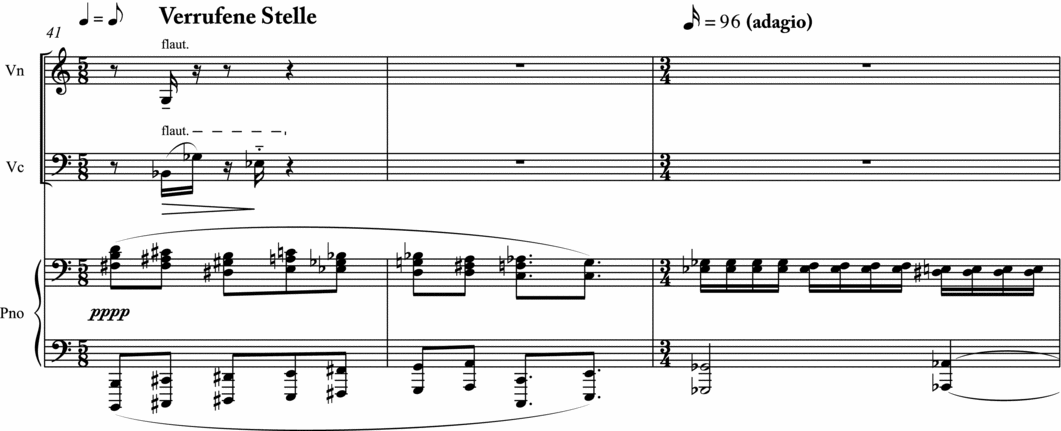
On the other hand, there is what I intend: not a soma-analysis but a psycho-analysis, or at least a series of constructions informed by psychoanalysis which I think gets more precisely at the paradox of a music stabilized in its instability. I take up a specifically Lacanian perspective, and take on a more vulgar interpretation of ‘tonality’ – what Rihm, punning on a movement from Schumann's Waldszenen, might call his own verrufene Stellen, those ‘notorious’ or ‘disreputable passages’ in which a historical image of tonality appears, leers, and vanishes (Example 1).Footnote 12 In these passages (sometimes quite extensive), no encompassing tonal system presents itself as the generator of the material. Rather, Tonalität moves from a symbolic register into an imaginary one; it becomes material. There it oscillates between two kinds of pre- or post-functionality: the body without organs – which notion Deleuze took from Rihm's muse, Antonin Artaud; and the historical objet trouvé warped by time – an era, an author, a work, a bar, a beat. In both cases, a composite sign, ‘stability-destabilized’.Footnote 13
Rihm, Fremde Szene III (1984) for piano trio, bb. 41–3.

These verrufene Stellen do not constitute the majority of Rihm's gigantic output, but they give its parade of peripeties an anchor, or what Jacques Lacan called a quilting point: a signifier from which ‘everything radiates out and is organized around, similar to this little line of force that an upholstery button forms on the surface of material. It's the point of convergence that enables everything that happens in [a] discourse to be situated retroactively and prospectively.’Footnote 14 This does not render tonality the meaning of everything in Rihm's music. A quilting point demarcates an absence or senselessness, whose permanent being-not-there allows everything around it to mean. It is the very act of giving form – the null-point, the minimal mark or notch – in all its contingency. As Michel de Certeau puts it, the quilting point is ‘not authorized by any meaning; on the contrary, it authorizes signification, like a poem that is preceded by nothing and creates unlimited possibilities for meaning’.Footnote 15 Were someone suddenly to run into the room in which you are reading this text and shout, ‘It's OK! There's no fire!’, this might quilt your remaining day, changing everything while changing nothing. Lacan understands a certain kind of quilting point as the foundation of the neurotic – read: neurotypical – subject, in whom it remains repressed. The neurotic structure is coined through a decompletion, an introduction of permanent, structural lack. Every neurotic is unconsciously convinced that something absolutely essential is missing – that fire is the key to life, and that indeed there is no fire. But one of Lacan's most original and controversial theories is that psychosis emerges from the lack of such a quilting point, not its repression but its foreclosure. The psychotic forecloses the very possibility of a quilting point. This is paradoxical: psychosis emerges out of a lack of a lack, a failure of structural decompletion.Footnote 16
This is one of the more compelling reasons to read Rihm with Lacan. For Rihm, on the one hand, tonality – of which there is none – can serve as a quilting point, a signifier of decompletion that orients him as a subject of music composition. But in a twist, tonality also functions for Rihm as the discourse of the psychotic, one in whom the quilting point is foreclosed. To the long list of Rihm's psychotic muses – Artaud, Hölderlin, Lenz (via Büchner), von Günderrode, Schumann, late Nietzsche, Wölfli, Herbeck – I would add Tonalität. Given how many of these figures precipitate Rihm's most extended verrufene Stellen, tonality could be called Rihm's psychotic master-muse. It is a semblance of foreclosure which displaces an actual foreclosure, heading off psychosis. Instead, it produces a ‘normal’, neurotic, art-making subject, readable to a bourgeois public who can fantasize its own aspirational self-in-process therein: full of doubt, confusion, desire; struggling to figure out what it wants.
Which brings me back to the joke. It is an old psychoanalytic favourite, beginning with the place Freud gave it in his 1905 book Jokes and Their Relation to the Unconscious as ‘the fourth and rarest’ class of ‘tendentious joke . . . attacking not a person or an institution but the certainty of our knowledge itself’.Footnote 17 It also enters a peculiarly sonic territory, a scene of split audition, the heard as lie and truth at once.
Through elaborate signifying networks and their choreographed failure, many of Rihm's works announce that they are psychotic – that they are going to Cracow, as it were. But we know they are lying. They are works of art, wily dissimulations crafted with calculation if not the ‘traditional’ pre-compositional labour characteristic of classic works of musical modernism. They are, rather, making a show of psychosis, employing and enjoying it as an object of desire, a veil of fantasy. And desire and fantasy are the libidinal gear of the neurotic. So Rihm's works are actually going to Lemberg, where all neurotic artists go.
But this is not the joke. The joke is that a traveller says he is going to Cracow, and he is lying, and he is actually going to Cracow. He ‘is lying when he tells the truth and is telling the truth by means of a lie’, as Freud puts it. Slavoj Žižek, receiving the joke as a favourite of Lacan's, makes a finer point: for the travellers, ‘telling the truth represented a breach of the implicit code of deception which ruled their relationship: when one of them was going to Cracow, he was supposed to tell the lie that his destination was Lemberg, and vice versa’.Footnote 18 What if the psychoses staged in Rihm's work are ‘second order’, an ego-discourse keeping up appearances to convince us – and perhaps Rihm himself – that this music is neurotic, a music of desire, fantasy, a Wordsworthian ‘evermore about to be’? And what if these forms of appearance, embroiled in the logic and imaginary of psychosis, are defences against a greater, first-order psychosis? The second-order psychosis we might call modernism. The first-order psychosis, this ‘actually going to Cracow’, we might call modernity.
II
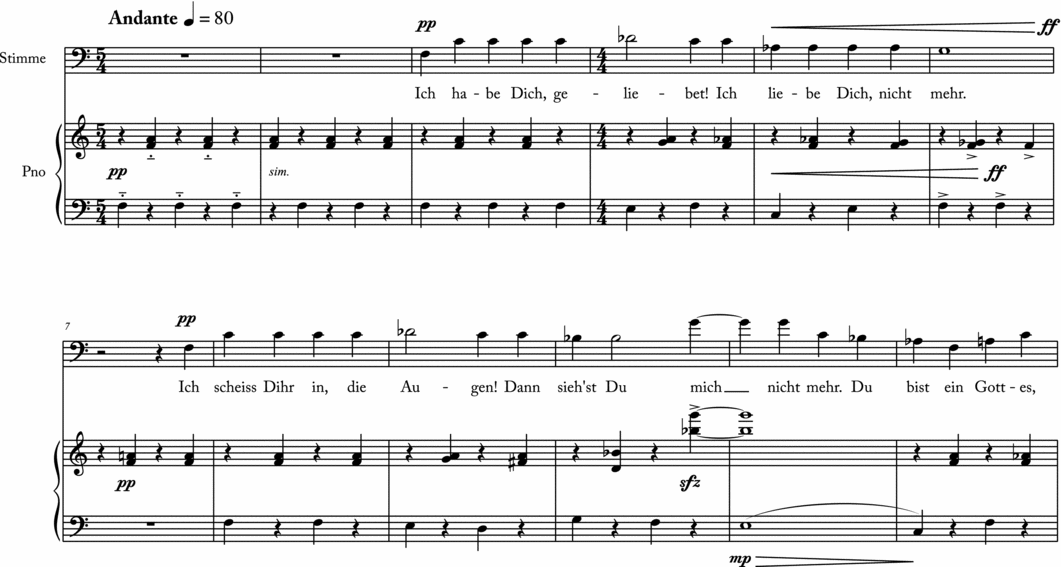
The opening of the first song from Rihm's Wölfli-Liederbuch (Example 2) counts as one of his most verrufene Stellen, tonally speaking: only the most naive listener could hear its opening bars and, noting their 1981 date, not expect bad news.Footnote 19 With its gap-toothed, glassy-eyed, fifth-less F major plonking, this opening Lied is all too readable, rehearsing one of New Music's more tired topics by the early 1980s – something fresh and traumatic in, say, Peter Maxwell Davies's Eight Songs for a Mad King from thirteen years earlier, but now fodder for any second-rate film score semaphoring psychic cracks. Wölfli, admitted to a psychiatric hospital at twenty-nine with a diagnosis of schizophrenia and remaining there until his death thirty-five years later, makes a fine ersatz ‘mad king’: he is one of the most famous and creatively productive psychotics in Western history, author of a forty-five-volume, 25,000-page autobiographical epic with 16,000 illustrations and hundreds of idiosyncratically notated scores.Footnote 20
Rihm, Wölfli-Liederbuch (1981), I. “Ich habe Dich, geliebet!” (opening).

By 1981, Adolf Wölfli was a cultural node in Europe, the most illustrious member of a collection of artists whose mental unsoundness was inseparable from their fame, an equal partner in their exhibitions, catalogues, and essay collections. The title of one influential exhibition from 1979 captures the moment's aura: ‘Outsiders: An Art without Precedent or Tradition’.Footnote 21 Madness becomes a storefront; the contemporary trained artist, pressed against its glass, burdened by a century-long ‘tradition of the new’, sees a gleaming new vision of autonomy and originality. Rihm would have likely seen some shows, and as an avid book collector might have known contemporaneous collections on ‘the psychopathology of creativity’ by psychiatrists such as Alfred Bader and Leo Navratil.Footnote 22 He also likely knew the 1978 LP Adolf Woelfli: Gelesen und Vertont, which attempted to realize some of Wölfli's scores.Footnote 23 But Rihm's decision to engage Wölfli ultimately came from a cultural Big Other riding the art-world wave: the Liederbuch was one of four commissions by the Austrian festival ‘Steirischer Herbst’ as part of an evening-length series of Wölfli-Szenen.Footnote 24
The Liederbuch’s opening song does not sound much like those contemporaneous attempts to transcribe Wölfli's own more völkisch music. Here one hears Lied. With its major–minor oscillations and lowered sixths/raised fifths, the song is coded ‘Schubert’ – echoes of ‘Auf dem Flusse’ and Lied-im-Volkston. But if it wants to play the Biedermeier Viennese outsider, it arguably resides in the Ansbach Germany of early nineteenth-century foundling Kaspar Hauser, another cultural touchpoint in mid-1970s Germany.Footnote 25 Thomas Gartmann has done thorough work on the entire cycle,Footnote 26 and I would supplement his analysis of this song only by spotlighting the meticulous estrangement devices which disrupt the stylistic idiom, and suggesting they operate on three interdependent registers.
On the first, most obvious register, the song is a catalogue of errata, in which Rihm practices his art of ‘free displacement’ and ‘un-binding’ with characteristic zeal.Footnote 27 The song opens with two inaudible 5/4 bars, the baritone entering on the wrong beat; things are evened out by bar 4, but in the third beat of bar 6 the baritone fails to descend from A♭ to G and then F; he gets stuck, as does the piano, and the ensuing three-semitone dissonance is hamfisted into a fortissimo crescendo, a silence, and a restart. An unexpected sforzando, too high, on the bar's last beat; a subsequent disappearance of two beats; an inexplicable pause; a bone-crunching fortissimo E minor chord, and so on. On a second register, text and music become decoupled; they exist near each other, but their mimetic pact dissolves. ‘Nicht mehr’ gets an appropriate intensification, but the line ‘Ich scheiss dihr in die Augen!’ (‘I shit in your eyes!’) floats by without comment, as does the insult ‘Und hast du Keine, Eutter!’ (‘And you have No, udders!’); and yet the following ‘Drumm öffne mihr, das Graab’ (‘Then, that's when the grave opened for me’) suddenly reawakens the piano's agency, echoing the opening grave at the end of Schumann's Dichterliebe. Such moments suggest a third register of estrangement: there is, after all, a sense of key here, as something that can actually modulate however ungracefully. The words ‘das Graab’ effect a downturn from F major to E minor, and, after the thwacking E minor chord, insinuate an impending turn to A minor.
But this turn, and the song's entire structure, are arrested by the first appearance, in the voice, of a B natural. The piano answers with a cavernous B♭ octave, gently breaking the song completely open. An extended two-note cadenza ensues on high B–B♭, uncomfortably absorbed, unfolding over an intermittent, hobby-horsey F♯–D, staccato in the bass. Text, singer, lied all depart, leaving only fingers attached to a nystagmic gaze; völkisch Schubert cedes to postluding Schumann, voided of the Schumannian piano's hard-won wisdom. But the postlude is pre-emptive, the song is not done. Without a whit of cause, it drags its threadbare persona back on stage, picking up where it left off, in A minor, but soon erupting into a thundering, monstrous fortissimo, A, G♯, G♮, and F♯ grinding together in the piano as the baritone belts out Es and As. The baritone's last iteration of the refrain – ‘Ich liebe Dich, nicht mehr - !’ – tears up to a high F, shadowed by the piano's F♯–G, and is cut off by another gut-punching chord, this time in B♭ minor, triple sforzando.
It is tempting, and easy, to read this music as impoverished. The epithet ‘gimmicky’ comes to mind, but the evaluative move is a broader one, getting at the heart of the old sand-line between modernism and postmodernism drawn by Michael Fried in his distinction between arts of absorption and of theatricality – of a sublimely self-sufficient ‘presentness’ vs a manipulative, scene-chewing ‘presence’.Footnote 28 The lied – a consummately ‘high’ genre of absorption, a theatre of inwardness where one might say, with Fried, that ‘presentness is grace’ – is made here merely ‘present’, theatrical, literal.Footnote 29 It lurches into the audience, haranguing listeners, putting red pens in their hands and rendering them little Beckmessers, forced to mark up a Hopplamusik: wrong notes, wrong harmonies, wrong meters, wrong dynamics and accents, wrong phrasings, wrong rests and lacks-of-rest (Example 3). This is perhaps the subtext of Carl Dahlhaus's faintly damning assessment of certain post-serial musics as (overly) dependent on secondary parameters, treating as central what was systemically peripheral in the tonal tradition, or even ‘dislodging’ the very distinction between the two.Footnote 30 There are two fields of sonic activity in Rihm's lied, unfolding on two registers, both seemingly degraded: on the one hand, a weak field of ‘language’, idiom, Tonsprache, replete with at least the signs of syntax and grammar, of intentions to be made good on; and, on the other hand, a field of noise, of faltering signal and its excess, a too-little-and-too-much brought about by language's failure. Tonality becomes, quite literally, noisy – making noise, leaking noise, its circuits under-insulated. In this context, theatricality betrays a certain bad faith: whatever mess the music makes in auditory and semiotic fields is instantly mopped up by the vulgar assignation of character – the singing madman.
Hopplamusik (Rihm, Wölfli-Liederbuch, I & II. ‘Ich habe Dich, geliebet!’).

Rihm's own conception of the Liederbuch contradicts this reading in two important ways. While he admits the genre's theatricality, its ‘subcutaneous plot’, he rejects any overt staging and, crucially, any identification between singer and poet: ‘It can be staged, but “poorly” [arm]. Rich in space. No singing madmen, and definitely no crazy artists. Perhaps Wölfli just sits there and listens on as the songs are sung to him.’Footnote 31 Simultaneously, Rihm prioritizes the ‘musical plot’. The notes on the page may look ‘so simple that they seem to exempt themselves from the score’, but the singer and pianist must always be compelled ‘to dynamic extremes! When there is a fff-ppp-fff, this is a physical spasm . . . Certainly the whole thing should be staged with great restraint, without any apparent insanity. [But] this doesn't mean the singer and pianist should be musically restrained . . . I imagine the whole thing thus: sparse and glowing, icy-hot, wintery without any nature scenes.’Footnote 32
These requests suggest Rihm is after something here other than persona – or that ‘music itself’ is the persona. Wölfli's primary function is more algorithmic than illustrative; he is not the ground being read by the old expressionist seismograph (‘physical spasm’), but is the seismograph, and is being used to read a mad ground, a topography of language rather than flesh and blood. There is no less fantasy in this. But it transposes the work from a register of realism (‘Here is a madman’) and allegory (‘Here is an emblem of a mad society’) to one of medium: Here – look, listen – is the condition of Music.
III
Lacan's classic formulation of psychosis comes in his third seminar of 1955–56.Footnote 33 It revisits Freud's revolution in understanding madness – namely that ‘the discourse of the psychotic and other bizarre and apparently meaningless phenomena of psychosis could be deciphered and understood, just as dreams can’.Footnote 34 At the same time, Lacan criticizes Freud's etiology; while Freud continued to ascribe the mechanism of repression to psychosis – Justice Daniel Paul Schreber, for instance, suffers from a repressed homosexual desire for his father, and its transference onto his doctor, Paul Flechsig, leads to his psychotic break – this fails the radicality of psychosis for Lacan. He finds a way out through the notion of foreclosure, which is not a matter of the disavowal of something once known to the subject, but rather the absence of the very capacity to conceive something's absence. To put it simply, there is no ‘as if’ in foreclosure. Something is actually missing from the subject's conception of the ‘existable’ – a first signifier, the introduction of an original ‘as if’ which brings with it the whole structure of language.
Language and letter are for the Lacan of the 1950s and 1960s the locus of the Other, and the ‘normal’ subject – which is to say the neurotic, desiring, constitutionally decentred subject – comes into being as a subject of this Other. His or her subject position is determined by the experience, never without problems, of entering the Other as language.Footnote 35 More than ‘language acquisition’, this process involves ‘installation’ in a symbolic order, a sudden ‘universe of symbols’Footnote 36 whose infinite mesh of internal differentiations and combinatorial protocols ‘carves up [the individual's] body’ according to a structure ‘which has nothing to do with anatomy’.Footnote 37 This ‘shearing’ is ambivalent: it produces in the subject a register of dead letters, inert forms which fragment and dis-integrate the subject; but these letters’ dis-integrating power produces the spaces in which subjective desire emerges, in which the prohibitive enjoyment Lacan calls jouissance can coil.
If the stuff of the symbolic is suddenly one day there, still it is not quite an order. It exists piecemeal; Lacan calls this the imaginary order: the domain of dyad, the mirror, the lure, the deception, inherently unstable.Footnote 38 ‘Wholeness, synthesis, autonomy, duality, and above all similarity’ are the central luring images, toggling the subject between brittle narcissism and countering aggressivity.Footnote 39 The imaginary subject has no security; his or her position is always about to be usurped, dissolved into agon. ‘In the beginning was rivalry’, maintains Lacan in the third seminar. ‘It is in a fundamental rivalry . . . that the constitution of the human world as such takes place.’Footnote 40
The symbolic plays a constitutive role in this imaginary world: the stuff of the imaginary is made in large part of signifiers, signs, symbols. But something is missing: a quilting point, something that distinguishes the Other of language from the real or concrete others by introducing a permanent, structural lack into the subject. Lacan calls this quilting point the ‘name-of-the-father’, the nom-du-père, where nom is a triple-entendre: ‘name’, ‘noun’, and ‘no!’ The name-of-the-father is emphatically not an actual man with children. It is a symbolic function, the nothing preceding de Certeau's poem, and though it might be any signifier, it attains the material power of a proper name, serving as an absolute cause, what Lacan calls a master signifier.
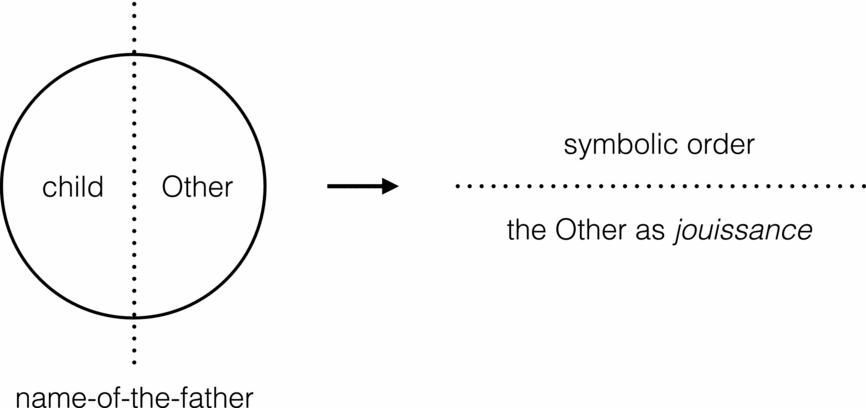
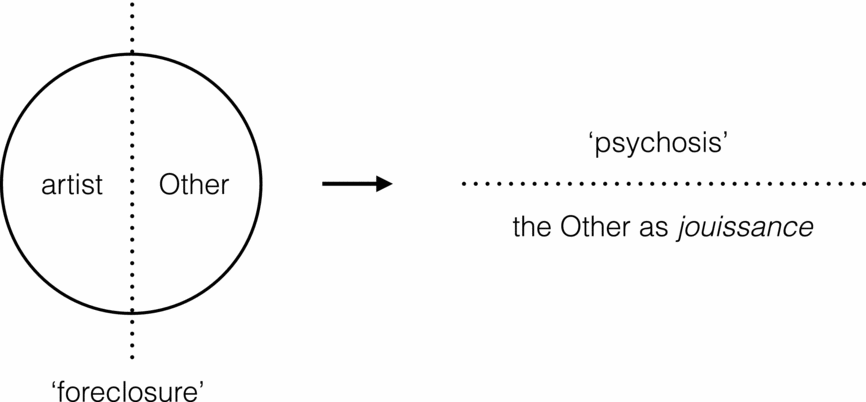
At the same time it also performs a prohibition. In terms of child development, it cancels out and stands in for the otherwise imaginary, dyadic relation the child has with the Other as primary caregiver, whether mother or (actual) father, grandparent, aunt, uncle, or older sibling. In the process, the name-of-the-father forces the child to sacrifice a certain jouissance, a dangerous or overwhelming enjoyment, and to undergo a ‘primal’ or ‘first repression’. This repression carries tremendous ramifications for the child: it founds the unconscious; it introduces a permanent lack, negation and the structure of negation, and hence the capacity to create language, to coin and think in metaphors; it replaces dyad with triad, ‘fundamental rivalry’ with the wiles and imbroglios of triangulation; it brings the death of hallucinatory certainty, and the birth of doubt, enigma, the great existential questions of childhood. Finally, this name-of-the-father, with its quilting lines of force, comes to organize the child's drives, and to give a prohibited jouissance an inverted meaning in the form of the wish. The whole process, complex in outcomes, is diagrammatically simple (Figure 1).Footnote 41
The name-of-the-father as quilting point and primary repression.

The psychotic forecloses this name-of-the-father – again, not in the legal sense, by striking a proposition ‘from the field of possibilities as seen by the speaker’, but by preventing a signifier designating the very presence or absence of a proposition, the structural possibility of ‘as if’. In the absence of this quilting point, the symbolic fails to overwrite the imaginary, and the Other of language remains indistinct from the world's sundry others; words and things overlap each other and the subject, who is sometimes obliterated therein. Primary repression does not occur; the unconscious is not founded, but remains à ciel ouvert, open for all the world to see, ‘present but not functioning.’Footnote 42 The father stays a volatile image, not a symbolic function, and the anarchy of mimetic agon stands. An impulsive hallucinatory certainty forecloses neurotic doubt, desire, wish, fantasy. Jouissance, otherwise prohibited or domesticated into the erogenous zones, invades the subject and overtakes the body anywhere and everywhere; relative control over the drives is lost.
In his writings and letters, Artaud himself provides witness to these phenomena, describing himself as having ‘forgotten how to think’, as suffering
a forgetting of oneself, of the forms of one's intellectual or moral sensibility, one's sensibility in the presence of ideas. In these states, it is a question of nothing less than forgetting the intellectual content of the mind, of losing contact with all those first assumptions which are at the foundation of thought.Footnote 43
‘If the neurotic inhabits language’, Lacan says in the third seminar, ‘the psychotic is inhabited, possessed, by language.’Footnote 44 Devoid of a name-of-the-father, a permanent perch from which to speak the world as something other, language remains a disastrously sundry invasion of the piecemeal, sweeping up a subject no more integrated than it. In Artaud's case, language does not simply fill him with overcharged intensities, nor does it empty him out into a ‘walking robot’, a ‘private intellectual vacuum’.Footnote 45 It does both at once: it enforces a radical inconsistency, what Louis A. Sass calls a ‘chronic ontological nausea’.Footnote 46
I do not want to make claims about the clinical validity of Lacan's account here. But it is worth holding up to Rihm's Liederbuch, which seems to be enacting its diagnostic criteria almost pedantically. In ‘Ich habe dich’, there are certainly what Lacan calls ‘language disturbances’: this is not music whose ‘wrong notes’ point to a subterranean system where glitches are smoothed out via a Stravinskian or Bergian post-tonal punning, a ‘doubled flooring’ as Rihm has called it.Footnote 47 Rather, these disturbances sound out a structural unsoundness, the lack of any proper depth at all. Lacan claims that the unconscious exists in psychotics, but that it is inoperative: there is no tonal-unconscious working behind the cracks in this edifice. Similarly, this music does not use what language it has to ‘create new metaphors’: the tones gather themselves into resemblances of the tonal, but seem incapable of acknowledging their parallel conceptual existence on a plane where new rule-bound coinages could materialize. This music plays with tonality, but cannot play in tonality as a system of playfulness. Instead, tonality functions as an alien materiality, entering the song's flow as pure iteration, quasi-divine in its violence: a single bare F, a high major sixth, a low E minor chord, a low B♭ minor chord – imaginary objects rather than chords proper. Such sounds are never struggled with or against, but simply force the song in a different direction, analogous to the interrupted sentences the psychotic hears, always broken off, forcing the subject to complete them. The same logic of alien cause governs hallucinations – which anyone can experience, but which the psychotic experiences with an absolute certainty, not the neurotic's characteristic doubt (‘I think I just heard a voice!’ ‘I swear I just saw someone there!’). The obvious moment of hallucinatory certainty here is the song's B–B♭ cadenza: coming from nowhere, whence it also goes, it is its own cause, heeded with mad calm, oblivious of the audience at the other end of its non-communicative act.
All of which is to say that ‘Ich habe dich’ is a remarkably faithful rendition of the Lacanian psychotic scenario. We could stop here, proclaiming this a case of high mimesis. Rihm is setting the words of a psychotic, and practices a textual fidelity worthy of the Lied-genre. But I think there is more to song and cycle, especially if we change its object. What if we hear – not Wölfli as object of mimesis, but rather ‘tonality’? What if Rihm uses the text in order to ‘set’ Music?
We might then hear this song as an attempt to depict music ‘proper’ as psychotic, as a failed symbolic having foreclosed the name-of-the-father and existing only in the imaginary. Availing itself of any and all signifiers of the tonal, it would nonetheless be incapable, in Brian Hyer's words, of ‘[managing] expectation and [structuring] desire’ in any traditional sense. Nor would it be capable of ‘[determining] the coordination of harmony with melody, meter with phrasing, and texture with register, thus encompassing – within its historical domain – the whole of music’.Footnote 48 It would instead be governed by mimetic rivalries, consumed by encounters – never with Music as a Big Other, but with little-other musics – authors, works, bars, beats. It would be compelled – not governed – by impulsive anarchic certainty. It would be invaded by jouissance, its drive-economy radically deregulated. It would not be that every tone or gesture becomes equally invested with greatest affect. Rather, any tone, chord, or form might at any moment be inexplicably flooded with intensity.
This is not only an account of an isolated act of liederly mimesis in the Wölfli-Liederbuch. It is also a rehearsal of many characteristics fundamental to Rihm's musical practices as a whole. Pull the Liederbuch’s psychotic thread and the Neue Alexander Lieder from only two years earlier, setting Ernst Herbeck, comes with it; continue pulling and along comes the vastly subtler Das Rot, setting poems of Karoline von Günderrode; or unhinged late Nietzsche set in the opera Dionysos, premiered in 2010; or 1977’s mammoth 3. Symphonie, also setting Nietzsche. Each of these works shares in common extended passages in which historical tonality plays itself out in a strictly imaginary register; it becomes a ‘weak’ consolidating force, a dysfunctional relative of a Baroque ‘unity of affect’ stretching a tight, thin, ill-fitting membrane over a demonic energy which tears it asunder at any moment to reveal an ‘other music’. And this mode extends to many more works: the Abgesangszenen (1979–81) and Fremde Szenen (1982–84, ‘setting’ Schumann); the cycles Vers une symphonie fleuve (1992–2000), Über die Linie (1999–2004), and Verwandlung (2002–14); the Deus Passus of 2000 (especially its chorales), and the subsequent quasi-liturgical works Vigilia (2006) and ET LUX (2009); and the profusion of Brahms-inspired scores beginning with the 1996 Ernster Gesang, through the Vier Studien zu einem Klarinettenquintett (2004) and Das Lesen der Schrift (2002), and up to the recent Nähe-Fern cycle (2011–12), each of its four pieces paired with one of the four Brahms symphonies. Brahms, Strauss, Bach, Sibelius, Mahler, Mozart, Schumann, Schubert, Elgar, Gesualdo (of course): in none of these works is there a ‘tonality’ without the presence of a little, extremely volatile imaginary other – an unreliable partner, body, spectre, text or tissue. I do not think it is a coincidence that so many of these works are lyrical, fixated with line, thread, melos; their convulsive breaks, their frayed or snapped threads, reinforce dialectically their seeming indestructibility, their ‘mad certainty’.
One conspicuous exception involves Artaud, whose Tutuguri: Pour en finir avec le jugement de dieu inspired Rihm's remarkable work-cycle Tutuguri (1980–82).Footnote 49 With few exceptions, the Tutuguri pieces have little truck with historical tonality, appearing to foreclose it altogether and operate in a space where tonality's absence is not even a possibility – nowhere more so than in the ballet's last closing Tutuguri VI (Kreuze), a 40-minute gauntlet for unpitched percussion. Tone is not repressed here but foreclosed.
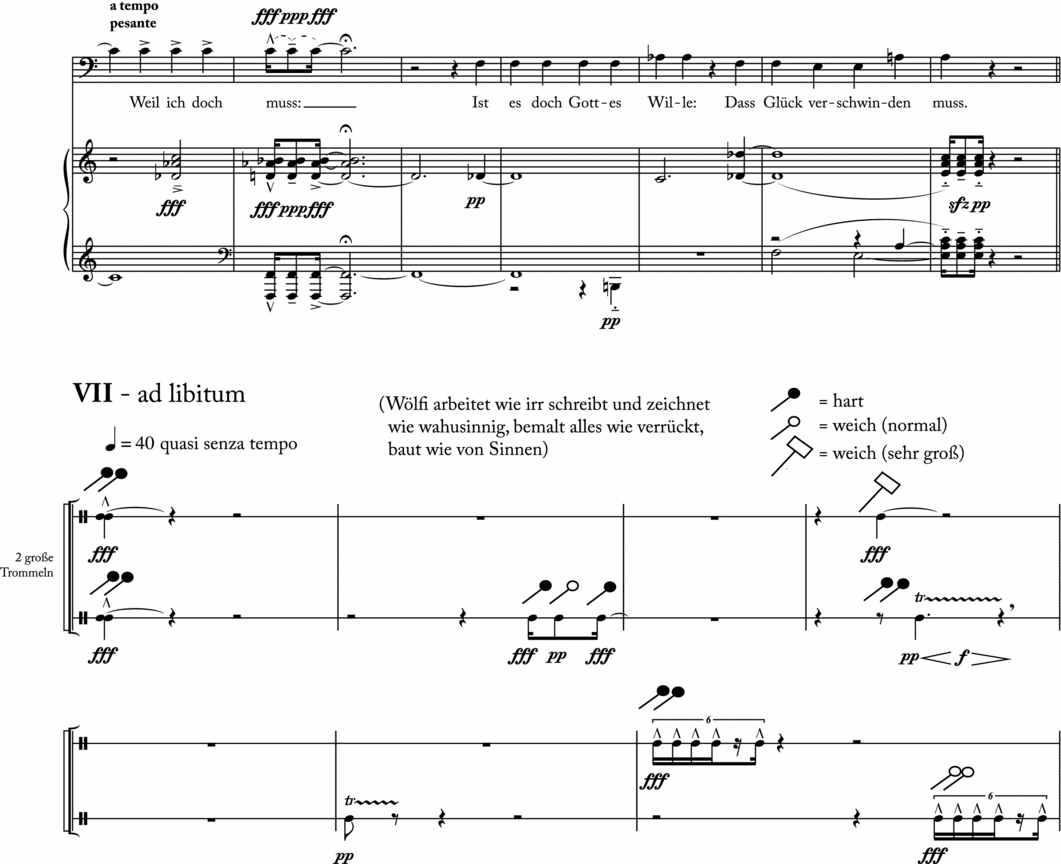
But Tutuguri ought to remain in the frame of Rihm's engagement with the historical-tonal, and he forges the link himself – at the very end of the Wölfli-Liederbuch, composed concurrently. The cycle's last actual song, ‘Graab – Innschrift. 1,868’, is its most paroxysmal, unified by recurring three-chord piano convulsions (fff–ppp–fff). A last peroration is dead certain to the very end: ‘Because I really must: It really is God's will: that luk [sic] must disappear.’) But then the tables turn: two bass drums usurp the stage (Example 4). Voice, piano, tone, ‘tonality’ – also ‘Schubert’, the lied genre, the historical Big Other – fall silent. Now only the thunder of stick and skin, the muscular violence of swinging limbs, an air of something absolutely other. Perhaps other than ‘music itself’, other than Music as a proper name.
Transition from VI. “Graab—Innschrift. 1,868” to VII. “Coda ad libitum”.

IV
The attempt to suture aesthetic modernism to psychotic states is almost synonymous with modernism's history. Many actors keep it going: artists mandating self-derangement; bourgeois publics, alternately scandalized and fascinated, crying crazy; avant-gardists unhinging aesthetic institutions; aestheticians, historians, and psychologists chronicling it all.Footnote 50 Sass's 600-page tome Madness and Modernism represents a historical culmination, a tireless, unprecedentedly synthetic unfolding of theories of mental illness and aesthetic practice.Footnote 51
This extraordinary book nonetheless tends towards an equally long-standing interpretive move I might call the transubstantial hypothesis. Reduced to its mythemes, it narrates how, with modernism, art became mad.Footnote 52 Society suffered first, buckled by modernity's ceaseless traumatic contingencies, its blindness and deafness; art, unable to serve a mad society under the constraints of its old mimetic pact, underwent its own crisis of representation, falling into a madness whose diagnostic criteria are now the stuff of textbooks – fragmentation, alienation, cold abstraction, delusional system-building, and so on.Footnote 53 In a paradoxical turn, art's reflective incapacity, the collapse of its imaginary regimes, actually reflected society's own collapsed imaginaries. If aesthetic modernisms came to ‘look like’ schizophrenia, it was as schizophrenics did: because they were.
This circular hypothesis poses obvious problems, as does its pathologizing of modernism, but what bothers me most is the plausibility of an opposite hypothesis: that ‘madness’, as an evolving discursive matrix laid over modernity, strengthened the representational drive – that it provided aesthetic practices with a means of preserving the mimetic contract under the sign of its impossibility. Here is at least one counter-history of aesthetic modernism: ‘fragmentation’, ‘alienation’, ‘cold abstraction’, ‘delusional system-building’ all become components of an instrumental redemption of the old work of representation while simultaneously assuming a psychic identity – an ego – predicated on representation's failure, on the disintegration of ego itself. A picturing of modernity's blindness or a sounding of its deafness; a faithful and technically prodigious portraiture of the facelessness of modernity, or of what T. J. Clark memorably called ‘the hiddenness of the “hidden hand”; or rather, the visibility of that hiddenness’.Footnote 54
In this sense, I side more with Hal Foster's argument, an antipode to Sass's, that aesthetic modernism generally had all-too-sane designs on mental illness, designs which often worked to re-inscribe the former's position as aesthetic, as the structurally secured other to the world it heard, beheld, took hold of. For Foster, psychosis was yet another site for the practice of an ‘absolutely modern’ instrumental reason. Modernists ‘saw the art of the mentally ill according to their own ends only – as expressive of an aesthetic essence, revelatory of an innocent vision, or defiant of all convention – and for the most part it was none of these things. Rather, [these] readings . . . bespeak modernist fantasies either of a pure origin of art or an absolute alterity to culture.’Footnote 55
I am struck by Foster's phrase ‘bespeak modernist fantasies’: if the fantasy of madness in Rihm's Liederbuch remains in a performative gray zone for the first six numbers, that fantasy is bespoken in the ‘ad libitum’ coda. It comes as a silent parabasis, a direction atop that page of convulsive große-Trommel-ing. There Rihm writes ‘Wölfli works as if [wie] mad, writes and draws as if [wie] insane, paints as if [wie] crazy, builds as if [wie] out of his mind.’ Wie here testifies that Rihm, his method-acting aside, is operating snugly in the symbolic. He is, literally, as-if-ing the incapacity to as-if that is psychotic foreclosure. Wölfli himself remains on the other side, wie-los.
Anyone familiar with Rihm's productive powers could read his direction as an expression of deep sympathy for Wölfli as a worker. ‘I am a work-ethicist’, Rihm told an interviewer in 2009; ‘I define myself through bringing things out, through work. I am a worker. I belong to those individuals who come into being through work.’Footnote 56 But Rihm's impulsive work-ethic is the flip-side of Wölfli's: the former works from an overwhelming desire for an object constitutionally out of reach, the latter as a means of maintaining minimal distance from an object catastrophically close. In Lacanian terms, the Other is not structurally distinct from Wölfli; the foreclosure of the name-of-the-father obviates any permanent partitioning of the psyche. Rather, Wölfli has his object of desire ‘in his pocket’, and its terrifying proximity, the possibility it will swallow him whole, is constant.Footnote 57 He is one of Lacan's ‘truly free men’, who have ‘no demand for the [object of desire] . . . He does not cling to the locus of the Other, the big Other, through the [object of desire], he has it as his disposal . . . Let's say that he has his cause in his pocket, and that is why he is mad.’Footnote 58
This scenario's impossibility is Rihm's constant. In Lacan's words, he is someone who ‘maintains as a subject’ only insofar as ‘language allows him to regard himself as the stagehand, or even the director, of the entire imaginary capture’. Wölfli is for Rihm ‘an image set to work within a signifying structure’ – Lacan's swiftest definition of fantasy – and it is the impossibility of this fantasy being realized that props up such desire.Footnote 59 The fantasy of psychosis becomes for Rihm a ‘window on the real’, a way of framing and enjoying a structural lack not there in the psychotic. Desire circulates therein only by being perpetually dissatisfied, its object always kept at a distance. So the wie atop the last movement of the Liederbuch becomes a sibling of the citation above bar 81 in Rihm's Musik für drei Streicher from 1977, where Flaubert – a consummate non-psychotic – confesses in a letter that ‘the further I go, the more I find myself unable to reproduce [wiedergeben] the idea’. Or Rihm's line about his much later Gejagte Form [‘Hunted Form’] (1995–96), tracking the ‘moment [Augenblick] where the hunt for (a) form suddenly turns into (its) form’.Footnote 60 In a 2001 interview about Jagden und Formen, the larger work built around the score, Rihm maintained that ‘form and self can never coincide. And why should they? That would be boring.’Footnote 61 It would, in Lacanian terms, also be psychotic: the disastrous boredom of having one's object of desire in one's own pocket. But what is disastrously possible for the psychotic is boringly impossible for the neurotic, and many of Rihm's works, formal enemies of apotheosis that they are, seem dead-set to prove this point. Rihm's staging of the inability to ‘reproduce the idea’ – arguably the most consistent trope of his un-summarizable output – becomes a grand testament to neurotic desire, as canalizing of his oeuvre's libidinal economy as the Tristan-chord was in Wagner's eponymous music drama. Behind a lurid psychotic imaginary lurks the neurotic realism of the bourgeois modernist.
We are back at the joke. It would seem, contra Sass, pro Foster, that a strain of Rihm's works are crazy like a fox. They tell us they are going to Cracow when they are really going to Lemberg, a place where artists can fantasize madness from a distance, through a window, in the subjunctive of the aesthetic and the comfort of neurotic sanity. But the joke itself prompts a third hypothesis, pushing past both Sass and Foster, to Freud's reflexive formula of the speaker ‘lying when he tells the truth and telling the truth by means of a lie’. It would be this: imitating madness aesthetically staved off aesthetic madness; the aestheticization of psychosis gave modernism a quilting point through which to defend against a certain kind of psychosis; fantasies of psychotic break produced consistency in a symbolic order that was, or was perceived as, falling to pieces.
V
‘In brief, this is my case: I have completely lost the ability to think or speak coherently [zusammenhängend] about anything at all.’ The line comes from a fictional missive by one Lord Chandos to Francis Bacon in 1603; but was written by Hugo von Hofmannsthal in 1902 Vienna, and published simply as ‘A Letter’.Footnote 62 The text is an essential document of the European fin-de-siècle Sprachkrise (‘crisis of speech’), and more broadly a ‘founding text of literary high modernism’.Footnote 63 It is riven with contradictions, above all between its exquisite prose and the scene of disintegration and incapacity it describes:
First I gradually lost the ability, when discussing relatively elevated or general topics, to utter words normally used by everyone with unhesitating fluency. I felt an inexplicable uneasiness in even pronouncing the words ‘spirit,’ ‘soul,’ or ‘body’ . . . Rather, the abstract words which the tongue must enlist as a matter of course in order to bring out an opinion disintegrated in my mouth like rotten mushrooms . . . Everything came to pieces, the pieces broke into more pieces, and nothing could be encompassed by one idea. Isolated words swam about me; they turned into eyes that stared at me and into which I had to stare back, dizzying whirlpools which spun around and around and led into the void.Footnote 64
The scene is suffused with the Lacanian operations of psychosis: after the foreclosure of an elusive formal element, subject and Other lose their consistency; nothing being structurally held apart, nothing can now hang together, zusammenhängen. Speaker and language become painfully alienated from each other, descending into mutual materialities devoid of life, alternately ghastly and torpid; yet they also revivify, terrorizing each other.
As Patrick Greaney has observed, Hofmannsthal's formidable powers of characterization seduce the reader into interpreting the letter as if it ‘recorded a real crisis’. The task of reading becomes one of diagnosis.Footnote 65 Three intertwining possibilities suggest themselves – Chandos is going mad; or Hofmannsthal is; or The Age is – and the letter becomes a record of this descent into a ‘profound state of speechlessness’ at once individual and cultural.Footnote 66 For Greaney, this is the text's dominant exegetical tradition, haunted by the transubstantial hypothesis. But what happens when the reader leaves ‘the level of the character and his narcissistic self-deceptions’, no longer repeating ‘his misjudgments with more or less empathy and emphasis’?Footnote 67 What would it mean, here of all places, to remain stubbornly aesthetic, ‘to pay attention to the literary aspect of “A Letter”? What would literary knowledge look like here?’Footnote 68
One form it might take is what Lacan, after Freud, conceives as unconscious or ‘fundamental’ fantasy. It is adamantly not a conscious imaginary scenario: neither a moment of wakeful hallucination to which the subject more or less knowingly gives over; nor the calculated, mimetic imagination at work in Rihm's Liederbuch, which knows itself as artifice. It is, rather, an irrefutable force always already framing and organizing the scenes it encounters in an axiomatic way – ‘not [as] something to be proven or demonstrated per se, but [as] something which generates all of the allowable statements within a certain field’.Footnote 69 Fundamental fantasies are world-making, ‘absolute significations’ that designate and partition the reality that language then fills in and fills out.Footnote 70 Fantasies also stage an impossible relationship, between the neurotic subject, constitutionally lacking, and his or her desire, embodied in an impossible or ‘real’ object. This relationship is what Žižek, after Kant, calls unconscious fantasy's ‘transcendental schematism’: ‘it literally “teaches us how to desire”’, and gives both the subject and the Other – big and little – a sense of consistency they lack in actuality.Footnote 71 The fundamental fantasy veils this lack with the ever-deferred promise of its shoring, simultaneously exploiting it as an obscene ‘enjoyment of what we do not have’ in Todd McGowan's words; ‘[f]antasy is how subjects and societies organize their enjoyment’.Footnote 72
Žižek's virtuosic Lacanification of fantasy ought not mask its role in Freud, especially his political metapsychology.Footnote 73 Freud eventually came to the same conclusion with which Lacan began: one cannot interpret unconscious fantasies, but only offer ‘constructions’, assemblages, ‘fragment[s] of historical truth’, or new knowledge meant to resonate with and unsettle what was never quite there in the first place, but nonetheless exerted powerful effects.Footnote 74 Freud's late essay ‘Constructions in Analysis’ postulates that ‘[i]f we consider mankind as a whole and substitute it for the single human individual, we discover that it too has developed delusions which are inaccessible to logical criticism and which contradict reality’.Footnote 75 The word ‘delusion’ is striking: there is something delusional about unconscious fantasies. While they anchor neurotic desire and organize collective enjoyment, they do it through a little piece of psychotic certainty, a vestige of the madness they defend against.
My reader has perhaps guessed I would arrive at the matter of aesthetic modernism's fundamental fantasy. But if I come to it now, it is as a conundrum. I would like to issue a Freudian ‘construction’ of aesthetic modernism's originary fantasy as a fantasy of foreclosure: the fantasy not simply that one has lost one's language, but that one has lost that essential element, that quilting point or name-of-the-father, that made language cohere, ‘hold together’ and actually become a language – a proper symbolic order, a registry of dead letters and living laws capable of allocating the common and the proper through their very distinction. Devoid of this name-of-the-father, language exists in the imaginary, as for Lord Chandos: one can still use words such as ‘spirit’ or ‘body’, but they have lost their place on the grid. They do not help one ‘think or speak coherently about anything at all’. Moreover, the distinction between common and proper dissolves; the Other may be aggressive or invasive, but is no longer symbolic, impersonal, Big.
The conundrum initially appears at the level of theory: foreclosure also means the foreclosure of the fantasy function itself. The psychotic, technically, cannot fantasize; he or she does not enjoy the veiled impossibility of jouissance, but suffers its invasive, ‘real’ possibility. Psychosis is not the domain of frustrated desire, but of radically unregulated drive. What then does it really mean to fantasize foreclosure? Does not this mean fantasizing the loss of the faculty of fantasizing?
In a sense, it does. And there is a larger argument to be made, outside this article's scope, that the history of so many aesthetic modernisms involves the dissolution and traversal of pre-existing cultural fantasies as embodied in the aesthetic objects and practices of the past.Footnote 76 This is one way of accounting for the recursive nature of aesthetic modernism's negativity: as an auto-immune disease of the aesthetic – a fantasy-fuelled attack on the fantasy function by the body whose charge it was to nurture and develop it.
But modernism rarely remains in the space of Chandos, eloquently slack-jawed as the rotten mushrooms of language fall from its mouth. It moves on, or tries to. When Andreas Huyssen calls Hofmannsthal's text one of modernism's founding documents, he is not just thinking of what it records but what, in its closing lines, it augurs: a future putting-back-together, a ‘dream of finding that radically “other” language’.Footnote 77 It is a language of which Chandos confesses ‘I know not one word, a language in which mute things speak to me’, but he nonetheless holds out that in this language ‘I will perhaps have something to say for myself someday when I am dead and standing before an unknown judge.’Footnote 78 Fredric Jameson has written of modernism's ‘two moments’, the way in which its constant proliferating breaks seem to cohere into pairs: symbolisme, with its ‘organic forms and vegetal decorations’, find its antithesis in the ‘machine-age violences and celebrations of futurism’, and this differential dynamic is ‘replicated in architecture (Jugendstil versus the Bauhaus), in music (the early neurotic Schoenberg, whose melodies Brecht famously thought were ‘too sweet’, versus the later theoretician of the twelve-tone system); in painting (Impressionism versus Cubism); and so on down the line’.Footnote 79
The pairings are striking, but I am most interested in Jameson's mention of Schoenberg, the only example among his four explicitly pairing moments from a single career. It suggests a logic autonomous of style, of imaginary matters. I would argue it is a logic determined by the fantasy, axiomatic and ‘inaccessible to logical criticism’; namely, that if the language has lost its consistency, if the name-of-the-father has been foreclosed and the symbolic has collapsed, then a new name-of-the-father is not only possible but necessary. In this way modernism coins the new object of its desire as the New: new speech, language, the symbolic Other. Having not only lost it, but foreclosed its possibility, it paradoxically founds the space where a new symbolic, a symbolic of the New, can come into being. Aesthetic modernism becomes the history of this fantasy and its vicissitudes.
Schoenberg's own career is probably the most anthologized example. First there is the loss, or rather, its staging: the subject maintains by becoming ‘the stagehand, or even the director, of the entire imaginary capture’. Think of the Schoenberg of Erwartung, writing to Busoni in summer 1909: ‘I strive for: complete liberation from all forms / from all symbols / of cohesion and / of logic. / Thus: / away with “motivic working out.” / Away with harmony as / cement or bricks of a building. / Harmony is expression / and nothing else.’Footnote 80
And then there is the response to the loss, its restaging as desire: bringing one's own language into being, and one's own being into language. Undergoing again the tormenting–exhilarating adventure of language installation, from imaginary into symbolic, from paternal prohibition to self-subjection. Here Chandos's last words are important: the new language becomes properly symbolic only when spoken before by ‘an unknown judge’, a Big Other who hears and authorizes it as such. Schoenberg to Josef Rufer in 1922, in a statement whose disputed veracity ought not neutralize its fantasmatic historical power: ‘I have discovered something [the twelve-tone method] which will guarantee the supremacy of German music for the next hundred years.’Footnote 81
Unlike Jameson's two moments, these instances of loss and reconstruction are not simply contingent antagonists. Rather, they obtain a structural autonomy and temporal sequence, two distinct scenes inextricably linked within the same fantasy. Schoenberg's example suggests they follow an irreversible teleology, but I think they trace a loop, not a line: each implies the inevitable arrival of the other in an unending rotational intensity.Footnote 82 As such, they may each appear at any point, each being retold or restaged in relation to the other. Here, for instance, is Rihm in 1985 on his Chiffre VI, painting a hyperreal portrait of the seismographic composer – and doing a double impression of epistolary Schoenberg and Chandos:
And here is Rihm eight years earlier, in his youthful 1978 polemic ‘Ins eigene Fleisch . . .’, staging the logical consequence of the scene above:
My musical language [Sprache] formed itself like a dialect, with concrete objects which had to be addressed and for which, in conversation, I simply had to find a name. The encounter with the unnamed, and the grasping of this situation, are prerequisites for learning how to be an artist. Year by year the vocabulary grew richer, but the unnamed unknowns I encountered also grew in number . . . Nothing, absolutely nothing, relieves us of the burden of having to find our own language [eine eigene Sprache]. The whole nostalgic fuss in all its mawkish pathos has shown us how quickly the attempt to secure history fails, when one continues it with a thread that has already been used.Footnote 84
This is a true fremde Szene: a reminiscence of what will continue, throughout Rihm's career, to not-yet-happen, or only-just-happen, a constant re-responding to a crisis needed or not.Footnote 85 And this strange scene has its own verrufene Stelle, especially if verrufene admits richer, more Schumannian connotations – not simply ‘notorious’ or ‘condemnable’, but zwielichtig, ‘shady’, obscured or opaque and therefore suspect.Footnote 86 This, to me, is the ‘shady passage’: ‘Nothing, absolutely nothing, relieves us of the burden of having to find our own language.’ It is a statement whose authority cannot be tied back to its speaker without losing virtually all its power. Instead, it comes – like a letter – from an offsite authority, performatively produced by the utterance itself. Offsite but also impersonal, a purely formal notch, the ‘very act of giving form’ which is the function of the name-of-the-father. In this shady passage, this underside of the utterance, the paradox of foreclosure as the name-of-the-father is exposed: the authority that demands the new language must be formulated in the old one.
VI
I return to tonality, or rather, ‘tonality’, my original verrufene Stelle, that body without organs or objet trouvé haunting so many of Rihm's works. This tonality-of-which-there-is-none is the Doppelgänger of Rihm's outsourced mandate to find ‘our own language’. And it too finds its offsite authorization, its form-giving power, only by being performed.
When I first researched this topic, I had in mind not the lyrical works I catalogued above, which all gather under the signifier ‘thread’ or ‘line’ – Rihm's Fadenmodus, so to speak – but another mode, his demiurgic works or Hammermusik: those scores collected under metaphors of sculpture, script, cipher, the haptic and plastic. Tutuguri counts among them, and like Tutuguri, they operate in the realm of free – non-‘systematic’ and only minimally ‘pre-composed’ – atonality. Also like Tutuguri, they follow an anamnestic course backwards, a ‘path from style into sound, into pre-tone’ that sheds all ‘figural concatenations’ and ‘historically reflected models’ to achieve ‘a raw state, as itself, naked, as the state of music’.Footnote 87 If a ‘schizoid’ Schubert possesses the Wölfli songs, the ‘paranoid’ Schoenberg of Die glückliche Hand is a distant partner of these eked and chiselled works. They often make a neo-primitivist spectacle of pre-linguistic tone, tone as manual rather than vocal art, mouth and breath as percussion.Footnote 88
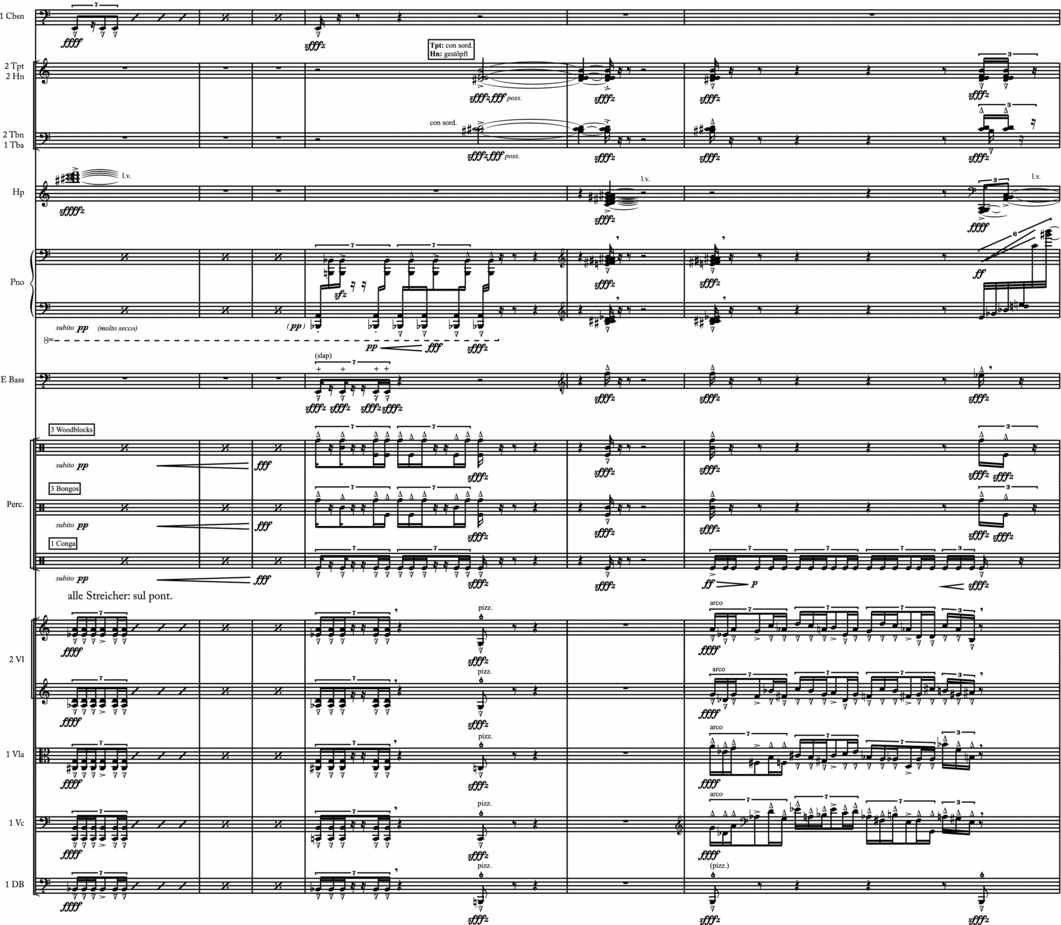
But an essential feature of these works is that the anamnestic path, shortly before reaching its final bar, eventually encounters a verrufene Stelle. And when it does, it triggers a catastrophic Durchbruch, a breaking-in from outside or breaking-out from inside. Sub-Kontur (1975) explodes into leeringly sub-par Brucknerian adagiana before being crushed by a riotous, chromatically saturated can-can (Example 5a). The third string quartet, ‘Im Innersten’ (1976), bursts into ecstatic late Romantic song, spasming between sped-up Strauss Lied and manic scat-singing (Example 5b), only to freeze into scratch-tones and perforated silences. Out of the unisons, long rests, and punch-and-pop clusters of the 1995 orchestral IN-SCHRIFT eventually erupts a gargantuan ffff A minor triad, moving (‘non-diminuendo!’) to a half-diminished chord on B before being brutally cut short by another chromatic cluster (Example 5c). From below the plosive winds and harsh harp clusters of Gejagte Form (also from 1995) surfaces a final peroration straight out of John William's space battles in Star Wars, dragging his models with it (Wagner, Strauss, Holst, Korngold, et al.) (Example 5d); a yawning unstoppable crescendo ends (again) in a chromatic sffffz rictus, paralyzed by cavernous grand pauses and dissolving into a feral thicket, its conga-heartbeat trailing off (Example 5e).
Sub-Kontur (1975), Brucknerian eruption.

‘Im Innersten’, 3. Streichquartett (1976), song eruption.

IN-SCHRIFT (1995), A minor eruption.

Jagden und Formen, 10. Zuständ (2001), climactic ‘peroration’.

Jagden und Formen, 10. Zuständ (2001), climactic ‘collapse’.

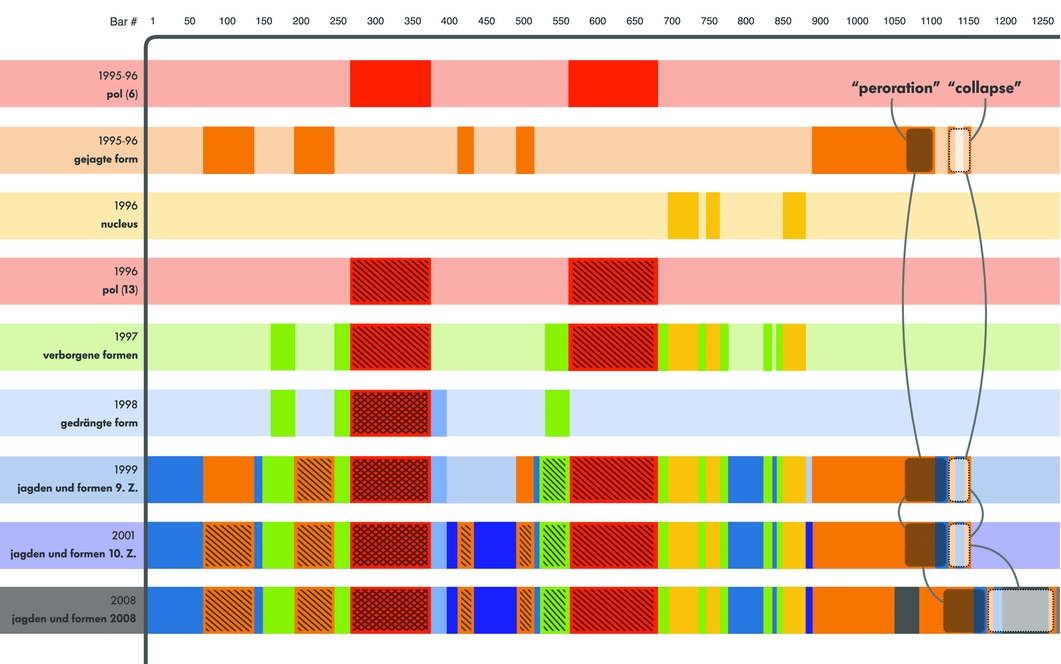
This last example is especially interesting. Between 1996 and 2002 Rihm continued integrating the score into a highly contingent, proliferating network of related pieces. The emergent hour-long Jagden und Formen was, according to Rihm, less a fixed work than an ongoing series of mutating ‘conditions’ (Zustände); while Arnulf Rainer's ‘overpainting’ provides a processual model, Gilles Deleuze hovers over the score, patron saint of its rhizomatic ostentations.Footnote 89 But curiously, the ending of Jagden remains more or less the same in every ‘condition’: it always concludes with Gejagte Form’s doomed space-battle and subsequent implosion (Figure 2). The sequence belies the score's Deleuzian swagger, suggesting that the elusive ‘moment where the hunt for (a) form suddenly turns into (its) form’ is not so elusive after all. It is a fait accompli, the ‘very act of giving form’ in all its arbitrary violence – less a hunt than a kill.
‘Foreclosure’ as quilting point and ‘psychosis’ as primary repression.

In Jagden and the anamnestic works chronicled above, ‘tonality’ functions dramaturgically as a return of the repressed: it insinuates and explodes, signals not the end of the work, but that the end is near. But it does this by signalling itself as ending, as unable to do what tonality was ‘made to do’ – to close the work and produce the sound of closure. And the production of this signal of non-production – this audible axiom that ‘Actually there is no tonality’ – becomes what the work requires in order to end. The syntactic power of the tonal emerges as a spectre: trapped in a lurid imaginary register, it becomes a functional dominant. Catastrophic un-closure, a sequence of collapse-and-dissolution, takes on the role of tonic.
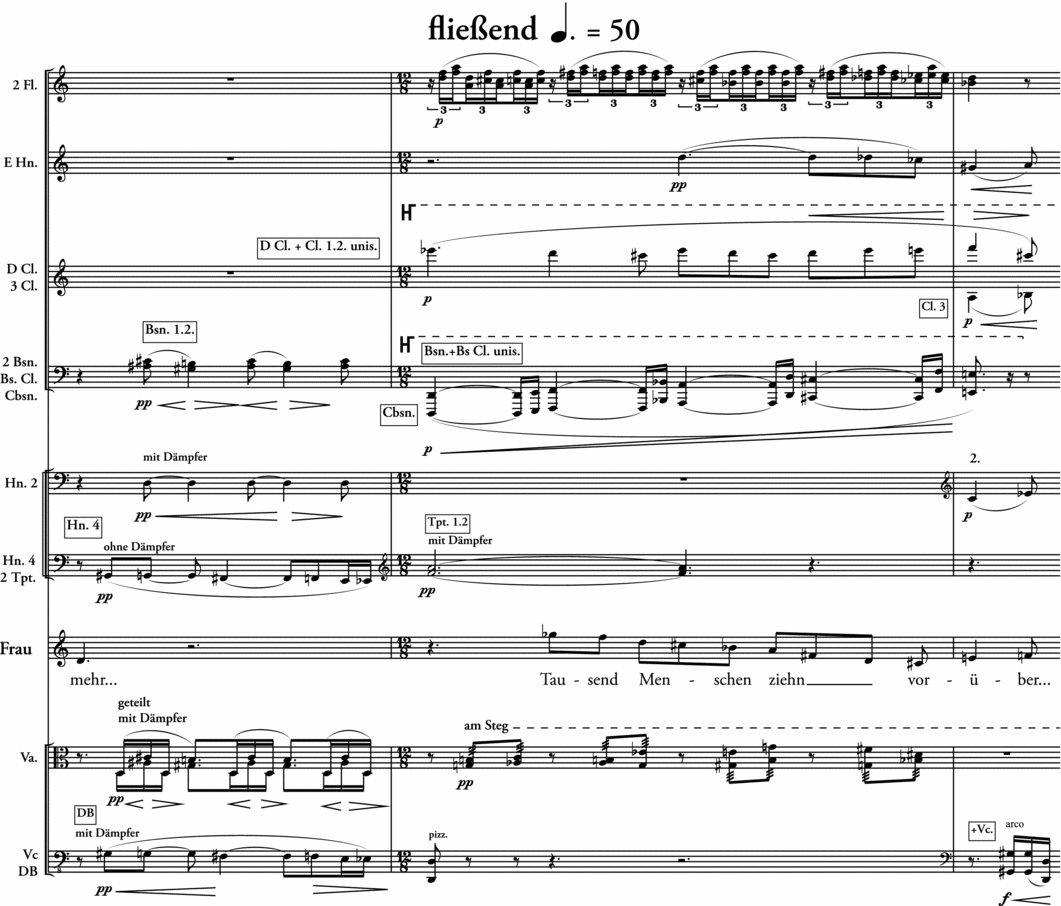
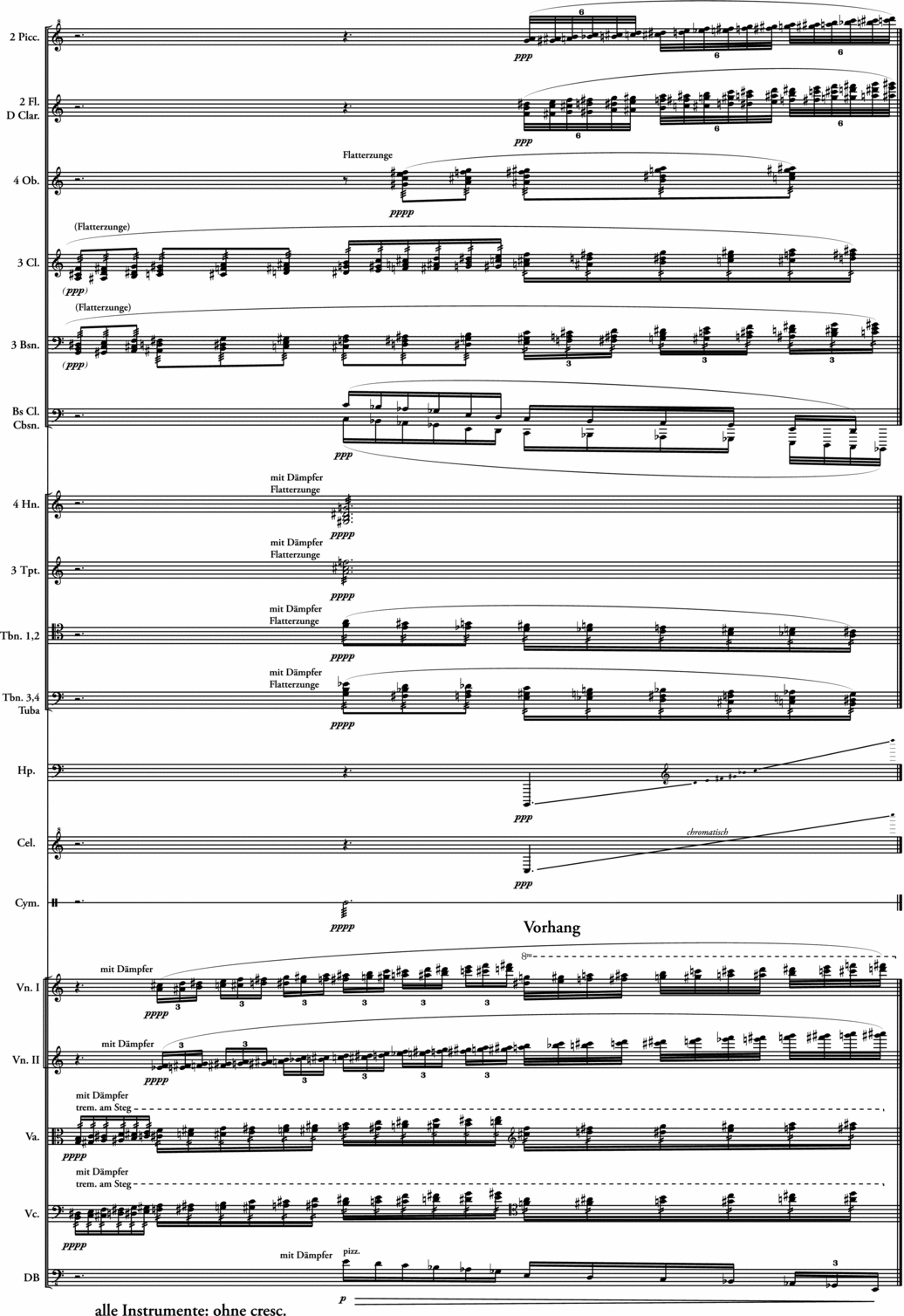
It is no surprise that this conceptualizing of form comes from a composer who considers the instant of Schoenberg's Erwartung ‘one of the most astonishing moments in the history of our times’.Footnote 90 And certainly Rihm's seismographic keenness, his arts of ‘free displacement’ and composing-with-nerve-ends, testify to the continuing nearness of Schoenberg's expressionistic summa. But the identification goes beyond stylistic and expressive affinities, to a shared fantasy and its playing out in the work itself. Near the end of Erwartung, the ceaseless stream of saturated tonic-less harmony encounters its own anamnestic object, two conflated passages from the D minor song ‘Am Wegrand’ (‘By the Roadside’) from 1905 (Example 6a). The song's appearance – is it a memory? or an exorcism? – is one of Erwartung’s most discoursed aspects.Footnote 91 I would only suggest that ‘tonality’ – and not just any, but the portentous key of D minor – appears here too as a signal of what has been lost, or rather what must be shown to have been lost, such that the work can end. In order for Erwartung to bring itself to a close – one of the most iconic anti-closures in Western music history – it must stage the inoperativity of the pre-existing symbolic order's ‘language of closure’ (Example 6b). Historical tonality cannot end the work; the work must end historical tonality, end its capacity to end. It must override the useless insistence of the tonic by remaining faithful to the ‘searching I’ who enters the dark forest of the aggregate.
Schoenberg, Erwartung, op. 17, appearance of ‘Am Wegrand’.

Schoenberg, Erwartung, op. 17, last bar.

On one register, Erwartung is chewy Aristotelian theatre, attending with fanatical precision to its suffering protagonist's affective collapse. On this register, the work exemplifies how ‘madness’ might strengthen the representational drive under the sign of its impossibility. But on another register, die Frau’s madness becomes the algorithm with which Schoenberg generates his own Chandos-letter, another artist's fantasy about losing the very language in which he could operate mimetically at all. ‘Am Wegrand’, when it appears, completes this decompletion. A damaged fragment of a dis-integrated symbolic authorizes the score's famous last bars; it provides the dominant of a foreclosed Old, such that the new tonic, or tonic of the New, can take its place – here, the aggregate, simultaneously the sound of total self-dissolution and depersonalized new symbolic. Another paradox: die Frau’s completed fall into madness authorizes Schoenberg's new ‘aesthetic sanity’, his installation in an incipient language. The historiography of musical modernism will work hand in hand with Schoenberg – and so many others – to strengthen this fantasy's world-making powers.Footnote 92 On its authority, countless composers will become subjects of desire by undergoing a ‘first moment’ of psychotic break, the loss of paternal prohibition, and a ‘second moment’ of entrance into a new symbolic, anchored by a new name-of-the-father. Music and discourse will both play essential roles in the constitution, enactment, and enjoyment of this fantasy, ceaselessly saying, along with Webern in 1933, ‘Today we shall examine tonality in its last throes. I want to prove to you that it's really dead. Once that's proved, there's no point in going on dealing with something dead.’Footnote 93 A last paradox: the ‘madness’ of modernism becomes its Oedipus, its patricidal passage to neurotic maturity.
VII
Modernity, famously, makes a poor father. It is always too close or too distant; deadly bureaucratic or aggressively inconsistent; hideously overcharged or hidden, faceless, in the speculative mire. Schreber's father, an almost literal breaker of his son's back, is one embodiment; Hölderlin's fathers, constantly disappearing before they could make their mark, are another. Better to foreclose the ill-named lot of them, and choose another.Footnote 94
This is not how the Oedipus complex is supposed to go! One is not supposed to win but lose, and learn one's lesson: the Mother, or Other, is off-limits; the paternal prohibition stands; the place of the father-as-law remains occupied by this cipher, this name-noun-no. In the language of psychoanalysis, the subject is castrated, and accepts this castration. Harold Bloom's paradigmatic ‘anxiety of influence’ reads as a rejoinder to this process: strong poets – the ‘good’ ones – defeat their fathers. But parsed carefully it becomes clear strong poets are the ones who learn their lesson all too well, which is to say consciously. The cunning creativity of their ‘revisionary ratios’ are not triumphs over the father, but melancholy admissions of castration, poetic confessions of second place.Footnote 95 The prototypical (Bloomian) Romantic transposes the Oedipal imbroglio onto ‘tradition’, as a family romance in an expanded field. But Bloom's vision upholds – arguably relishes – the scene of castration. The subject loses out, and in a strange re-gifting, receives that loss as a consolation prize.
The prototypical modernist sublates this transposition. The logic of the Oedipal battle is preserved, but the family ceases to ground it, and so too, for all the modernist's endless talk of it, does ‘tradition’. The ground is instead further transposed to language itself. Language, or the fantasy of language, becomes the site from which tradition can be ‘propered’, transformed from an increasingly motley crew of squabbling family members into radical new consistencies, most prominently that of ‘medium’, a consistency which allows infinite historical transformations and abuses while still remaining nominally ‘itself’. Aesthetic modernism was enacting this transposition long before Lacan came on the scene; but Lacan can be understood as one of its most robust and imaginative theorists. For him, the analysand is a kind medium, is the consistency of language and the inconsistency of its effects. But it is a troublesome transposition, categorically different from its precedent, and it introduces a bug. The modernist subject ‘loses out’ to the Other by losing the Other's language, which is to say: losing the Other tout court, as a properly symbolic order, as the locus of the very authority to issue the castrating ‘no!’ which forces the subject to lose. So there is a truth to modernism's mock-madness. It says it is going to Cracow (madness) in order to convince us – and itself – that it is going to Lemberg (neurotic desire). But its fantasies of language-loss have world-making consequences. Language does get lost, the Other's authority is dissolved. Modernism is endlessly worried it may have boarded the wrong train, and is actually going to Cracow.
The Oedipus myth arises indirectly in Martin Iddon's searching think-piece on the ‘spectres of Darmstadt’.Footnote 96 Iddon argues that ‘Darmstadt’ is itself a name-of-the-father for the European musical avant-garde, and that
when Darmstadt is spoken of, whether in affirmation or negation, it seems more often than not to refer to something other than, sensu stricto, the events of the new music courses held there, but rather to a broader set of discursive tropes, suggesting a certain avant-garde trajectory. In short, ‘Darmstadt’ is often a convenient shorthand for organizing ways of thinking about music in the post-war era.Footnote 97
Recalling the deaths of more concrete patriarchs – ‘Maderna, Feldman, Cage, Nono, Goeyvaerts, in very recent years Brown, Ligeti, Kagel, Stockhausen, and Pousseur’ – Iddon wonders about the impending death of the name ‘Darmstadt’ and its consequences: ‘the death of that symbolic father, however it becomes extended and perpetuated, surely presages rupture and collapse within the symbolic order’.Footnote 98 Without contradicting Iddon, who eventually emphasizes a different point than mine, I think he gets something wrong about the name-of-the-father, something Freud stressed already in 1913 with his great alibi of parricidal origins: ‘The dead father became stronger than the living one had been.’Footnote 99 The deader the father, the deader the letter, the better the totem.
Perhaps Iddon imagines a true cultural foreclosure, in which the name ‘Darmstadt’ is actually scotomized from even the registry of forgotten names. But if ‘Darmstadt’ no longer signifies a cultural hegemon, it continues to effect a community, less a name-of-the-father than a place where that name – which remains unconscious, and can hence take infinite shapes – is intoned along with the fantasies it authorizes. It is the temple not the scripture: the site where a certain open-ended social group, organized by a common enjoyment, can come together and enjoy what it does not have. It is a modernist Montsalvat, where all the knights are Amfortas – nursing and relishing in their wounds at once – and Parsifal is constantly being re-barred from entry. In the Darmstadt of 1984, this enjoyment appears, rebus-like, when the course-theme ‘Tonality’ encounters Wolfgang Rihm's assertion that ‘Actually, there is no tonality.’
Iddon cites a 1987 lecture by Helmut Lachenmann, ‘Composing in the Shadow of Darmstadt’: ‘We are all – more or less consciously – parricidal children of Darmstadt.’Footnote 100 I am less struck by the proper name here than its opening construction – ‘We are all’. This construction belies the alleged parricide: it is the survival of the patriarchal authority, as a dead letter, that gives the ‘We’ its consistency and, through this, its power. Darmstadt designates a place where this dead-lettered prohibition continues to structure fantasies of a music which must constantly re-perform the grounds of its groundlessness, which must continually stage the chasmic lack which a symbolic-to-come will eventually fill.
These days, one could argue this fantasy informs ‘Darmstadt's New Wave Modernism’, as Celeste Oram calls it.Footnote 101 Among its practitioners – Oram cites Johannes Kreidler, Stefan Prins, Jagoda Szmytka, and Jennifer Walshe – one finds no discursive mention of ‘tonality’. The very idea seems quaint, ‘pitch logic’ long having ceded its hegemonic position to technology, virtuality, mediation, liveness. But as Oram points out, these composers’ engagement is not ‘optimistic’: in often aggressively visionary ways, technology is ‘misused’; mediation obstructs; virtuality deludes; liveness takes form as the saboteur's wile. Rihm – a composer who prefers fax over email and counts among his 400+ works none for live electronics and only a few with tape – seems distant from this world. When I ask Kreidler why he dislikes Rihm's music, he answers without hesitation: ‘Rihm writes classical music. I prefer New Music.’Footnote 102
But this is a dispute in the imaginary, about what a fantasy ought to look and sound like, and what kind of language might fill the phantasmatic frame. It is not, I think, a dispute about the fantasy itself. In historical terms, Rihm's early career is associated with its own ‘Darmstadt New Wave’, the Neue Einfachheit (‘New Simplicity’) movement. In some ways the movement was – far more than the current wave – pure ruse; the music was not ‘simple’, and the label would not stay put, morphing here into ‘New Romanticism’, there into ‘New Sensuality’ or even ‘New Tonality’.Footnote 103 Rihm was among the movement's vocal critics,Footnote 104 and his own mandate – that nothing ‘relieves us of the burden of having to find our own language’ – seems to contradict one of the most quoted ‘mission statements’ of the Neue Einfachheit, from Rihm's colleague Hans-Jürgen von Bose: ‘we must build on what we find, but above all else we must see to it that music recovers its language [ihre Sprache wiederfindet] – it has lost precisely this in the last thirty to fifty years’.Footnote 105 If such statements suggest Sprache was essential to this precarious new community, they also suggest it was an antagonism, a ‘real object’ producing deadlocks around how and where it could be gotten, and whether it would be found, re-found, or founded.
The example of Rihm suggests this antagonism was not to be resolved at all, but staged in all its irresolution: a new musical language would be founded out of the failed attempt to find or re-find music's language. In Lacanian terms, a musical subject would prevent foreclosure – would stave off an aesthetic madness – through a symbolic quilted in place by the signifier ‘foreclosure’ (see Figure 3). ‘Madness’ would found a language, or something language-like, a ‘stabilized instability’ with its own consistency, ‘formed like a dialect, with concrete objects which had to be addressed and for which, in conversation, I simply had to find a name’. This language would stage repeatedly music's inability to secure the grounds of its own language. It would not be, as Rihm puts it, an ‘attempt to secure history . . . with a thread that has already been used’, but instead the creation of a new thread precisely by spinning the failed attempt to secure history into a Sprache.
‘Foreclosure’ as quilting point and ‘psychosis’ as primary repression.

There are a number of larger speculative moves which might emerge from my ‘construction’, especially those involving the ramifying formalism of unconscious or fundamental fantasies – the way in which their dumb but autonomous logic produces formal categories of their own over time, independent of the fantasist's conscious designs. The thread that might connect the third movement of Mahler's First Symphony to John Zorn's Naked City, or Boulez's Structures 1a to the Velvet Underground's ‘Sister Ray’, is spun through a certain kind of formalism. It is not a musical formalism that turns the history of the medium into a Hegelian parody, marching its way towards freedom; nor is it a formalist historicism tying together only what conscious signification within a circumscribed moment has already licensed. It is instead the axiomatic formalism of unconscious fantasy: at once a matter of ‘the actual statements and actions of human agents (“real people”)’,Footnote 106 and simultaneously something unavailable to them as anything other than a depersonalizing construction – an ‘aggregate’ of ‘fragments of historical truth’ that point to an antagonism which keeps appearing on the historical scene as its excess.
But I want to close with another matter, that of ‘motive’. For psychoanalysis, fantasy serves many functions, but the most consistent is defence. In his essay ‘Science and Truth’, Lacan puts this a bit counter-intuitively: fantasy is ‘the institution of a real that covers (over) the truth’.Footnote 107 That is, fantasy does not merely protect the subject against the real, the impossible or un-signifiable; it protects the subject against his or her own interpretation of that real – an unbearable truth of the subject's own coining.Footnote 108 A subjective registration of the real yields a traumatic interpretation, and this precipitates the ‘absolute signification’ of the covering fantasy.
What traumatic truth might the modernist fantasy of foreclosure protect the modernist from? What does this fantasy render unthinkable? One answer emerges in the fantasy's logical precondition. To fantasize a language as lost – obsolete, disintegrated, dead, impermissible – is simultaneously to fantasize that it actually once existed: that it exerted a normative, community-creating power, bound its subjects to an impersonal law, possessed a consistency transcending the merely imaginary and piecemeal. And could exist again: as an utterly new symbolic to match or exceed the consistency of the old, as its reinvention or revivification, as its melancholy or parodic ghosting.Footnote 109 Stravinsky's neoclassicism is from this perspective an attempt to prove that a classicism really existed, that it once had a great and noble consistency, such that he can now play pallbearer, or taxidermist, or re-animator. Such a fantasy cunningly veils what – even in today's second or hypermodernity – remains one of modernity's most unrelenting insinuations: that there never was a properly symbolic order. To assert, with T. J. Clark, that ‘modernity is contingency’ does not capture the fullness of its disenchanting power: it is not simply that the gods have gone away, that the law has turned rotten, that everything solid has finally melted into air. Modernity carries – for the modernist more than most – the constant presentiment that the past was wrong: there were never any gods, the law was always already rotten, solidities and certainties were always illusions. Bruce Fink writes of fantasy as a means of ‘trying to prove something to oneself’; perhaps aesthetic modernism was trying to prove to itself that, contrary to a ‘modern truth’ that inspires and torments it ceaselessly, a proper language had once existed, and could again.Footnote 110
Though I hope to have formulated and engaged them critically, I do not wish to judge such fantasies, least of all as deluded by false consciousness. If they are wrong answers to larger historical conditions, still there are no right ones. I would even venture that, so long as the (modern?) experience of radical contingency continues to inflict itself on the present, the fantasy of foreclosure and reconstruction, and its corollary logic of psychotic break and recovery, will present themselves as a formal inevitability, if not the only one. Rihm's example is especially interesting in this regard: a ‘radically disorganized body’ of works nonetheless formally quilted in place by an indestructible belief that there was language, and language there will be – ‘where it was, I will become’, the very formula of Oedipus. If modernism seems untimely today, it is perhaps because Oedipus is as well. ‘Late Modernism’ is a cultural outpost for a – very idiosyncratic – patriarchal thinking, a thinking about patriarchy and its ambivalent power. Like Don Quixote and Sancho Panza in the second book of Cervantes's adventures, it finds itself in a world where everyone now knows it as a fiction. But this is possible only because another psychoanalytic story – what Lacan called its ‘big secret’ – occupies the place of non-fiction: that there is no Other of the Other, no grand guarantor of the Other's consistency.Footnote 111 We do not know if the Other is going to Cracow, or to Lemberg. We do not know if the Other is lying. Modernism is a form of forcing an answer.