INTRODUCTION
Historians of continental Southeast Asia tend to shy away from the inflammable issue of Burmese impact on Tay (Shan)Footnote 1 language and culture. The situation in Myanmar since 1962 has coloured the way that we interpret their history: political oppression has generated a sort of Tay nationalism which emphasizes the quintessential qualities of Tay culture, thereby deflecting attention away from any consideration of inter-cultural borrowing over history. Scholars assume that Burmese influence on Tay language and culture emerged after the mid-sixteenth century Toungoo dynasty conquest of most of the Tay World, including polities in Northern Thailand and Southern Yunnan. It stands prominent in contemporary Tay language and culture west of the Salween River; it is evident in the writing system, the large numbers of Burmese loan words and the practice of Burmese-style Theravada Buddhism. Did this all come with the conquest, or did some of it originate from earlier contact with Burman culture? After all, the dry, central plains of Burma have fostered large, powerful and wealthy agrarian states since the Pagan era (mid-tenth to late thirteenth centuries), not to mention the Pyu walled cities in the pre-900 AD period. Is it possible that Burman script and culture influenced the Tay earlier than has hitherto been suggested?
Mäng2 Maaw2 Footnote 2 (Moeng Mao thirteenth to mid-fifteenth centuries) seems to have been the earliest large Tay polity west of the Salween, and its capital lay in the Ruili 瑞麗 (Mäng2 Maaw2) basin straddling the international border between the Dehong 徳宏 Autonomous Region in Yunnan, China and the Shan State, Myanmar. The polity name Mäng2 Maaw2 first appears in the Baiyi Guan laiwen 百夷館來文 (“Incoming Correspondence of the Baiyi College”) of the fifteenth century, which gives Luchuan 麓川 as the Chinese equivalent.Footnote 3 Generally known in Yuan and Ming sources by this name, it seems to have suddenly sprung up during the period from 1253 to 1382 when the Duan Family Route Commanders 段氏總管 administered western Yunnan after the fall of the Dali kingdom 大理國 to the Mongols.Footnote 4 Taking advantage of the internal weakening of Pagan, Mäng2 Maaw2, accompanied by other Tay polities, plundered upper Burma from 1359 to 1368; their incursions also contributed to the collapse of Pagan.Footnote 5 Michael Aung-Thwin demonstrated the wealth of the Kingdom in his 1985 book, and has recently reiterated his argument for the attractions that Pagan offered to neighbouring ethnic groups.Footnote 6 It is possible that the Tay, who as Victor Lieberman remarked were undoubtedly exposed to Pagan administrative culture,Footnote 7 may have adopted some aspects of its language and culture to strengthen their polities in order to extricate themselves from control by Dali Kings and their successors.
Broadly speaking, two old Tay scripts are still in use today. The first, known as lik 6tho 3ngök 6 (‘bean sprout’) script, is employed by the Tay in the Dehong 徳宏 Autonomous Region and in parts of the Lincang 臨滄 region in south-western Yunnan. The second, called lik 6to 4mon 2
 (‘round’ or ‘circular’) script, is prevalent among the Tay in the Shan state (also known as lik 6tay 2taü 5
 in Dehong). Popular tradition reveres lik 6tho 3ngök 6 as the earliest form of Tay writing west of the Salween River, but we possess no firm data concerning when, where and how it first emerged; a situation radically different to that of the major east Salween Tay script, the Tham (Dharma or Lanna letters), which can be traced to the fifteenth century.Footnote 8 Despite its murky ancestry, the eminent Tay scholar Sai Kam Mong has proposed that lik 6tho 3ngök 6 was the progenitor of the lik 6to 4mon 2 script and the Khamti script of Assam. According to his research, the round to 4mon 2 script evolved sometime in the nineteenth century from the lik 6to 4yen 4
 (kam yein) script which, in turn, originated from lik 6tho 3ngök 6 during the eighteenth century. Sai Kam Mong has described its three-stage evolutionary path as progressing “by stages [in which] the writing system was transformed into the Burmese system by incorporating its features, and the letters became very similar to the Burmese alphabet”.Footnote 9 He envisages early Tay script as a largely independent entity, which only later adopted certain features of the Burmese script, particularly its characteristic round form. In short, he assumes that early Tay script originated with uniquely Tay features, and that Burmanization only took place after the eighteenth century.
A Tay text dated to the early fifteenth century has become available which furnishes us with fresh data about early Tay script. It is written on a scroll dated 1407 (Yongle 永樂 5), which depicts the miracle-working Tibetan Lama, De-bzin-gsegs-pa (1384–1415), performing benedictory services for the deceased parents of the Yongle emperor (reigned 1402–1424) at the contemporary capital, Nanjing. The fabulous supernatural feats of the Lama are recorded on the scroll in five scripts, including Tay, as well as being elaborately depicted in painting.Footnote 10 Presumably it was translators from Mäng2 Maaw2, or neighbouring polities, who penned this earliest known specimen of Tay characters. The writing system incorporates an assortment of consonants and vowels resembling those of the post-eighteenth-century lik 6tho 3ngök 6 and the lik 6to 4mon 2 scripts, but also contains some features not found in either. When H. E. Richardson examined the scroll in 1949, it was in the possession of the mTshur-phu monastery some fifty miles west of Lhasa, the principal monastery of the Karma-pa sect. It is apparently now held by the Museum of Tibet (Xizang Bowuguan 西藏博物館). I have used the facsimile edition of the scroll included in a collection of historical materials on Tibetan Buddhism published in Beijing in 2000. Though I have not been able to consult the original scroll, the reproduction is extremely valuable and important because of the firm evidence it furnishes about the early usage and the historical evolution of the Tay script.Footnote 11
This article analyses the Tay script on the 1407 scroll in order to establish the extent of Burmese influence on the writing system of Mäng2 Maaw2 and its adjoining polities in the early fifteenth century. Scholars regard Buddhism as the main vehicle for the spread of Tay scripts, so this article cites vocabulary found in the scroll text to demonstrate the role of writing and Buddhism among the Tay west of the Salween. On the basis of empirical evidence, this article maintains that Tay script exhibited a strong Burmese influence from the outset. But readers should not construe the argument for the borrowing of Burmese script as an attempt to demean the status or historical importance of the Tay writing system itself. I take the view that the Tay writing system has its own individual history, and that it has functioned as a refrigerator, “freezing” so to speak, some old Burmese terms and preserving them for posterity.
INTRODUCTION OF BUDDHISM TO THE MÄNG2 MAAW2 POLITY
The caw5faa6 and nobles of Mäng2 Maaw2 and adjoining polities hailed from families steeped in the values and traditions of the warrior. Burmese sources record their raiding of the political and cultural heartland of Burma after the ascension of Sä1 Khaan3 Pha5 (the Si Kefa 思可法 of Chinese sources) to the throne in circa 1340. Victor Lieberman and Jon Fernquest have stressed the critical role that Tay incursions played during the Ava period (1365–1555). Fernquest stresses how the magnitude of the devastation wrought by Mäng2 Maaw2 and other Tay polities created a crisis in the Burmese heartland between 1359 and 1368, which in turn precipitated the foundation of Ava in 1364, the peak year of their attacks.Footnote 12 The Tay valued military prowess, and Buddhism had not yet reached these parts during the late thirteenth and early fourteenth centuries. Buddhism was put at the service of state administration in Pagan; the heads of the clergy also acted as the leaders of religious affairs, and the concern of the ruler was to engender religious values that maintained and preserved the social system of the state. This constituted the ideal of the Mahāsangharāja.Footnote 13
But Buddhism made a slow and fitful entry into the area west of the Salween River. As elsewhere in Southeast Asia it was not necessarily on congenial soil, for the people, whether living in the basins, or on hilltops, were adamant animists. They had no tradition of commitment to a single belief, or to ecclesiastical life; they were not inclined to religious inquiry, or to learning for its own sake. Indeed, the Tay polities did not embrace Buddhism until after the mid-sixteenth century, and then only after swearing fealty to the Burmese throne.
Buddhism did play a vital role in cultural integration, but that followed the Toungoo conquest. Victor Lieberman argues that Theravada orthodoxy stimulated the spread of more standard Burman ethnicity throughout the realm after 1555. From this time onwards, and especially during the Kon-baung dynasty (1752–1885), the Burmese empire expanded by incorporating territory in an east–west direction, as well as by integrating the Mon lands in the south. At its height Kon-baung power extended from Arakan, Manipur and Assam in the west to the Tay world of Kengtung in the East. The diffusion of a more standard Burman ethnicity that was linked to Theravada orthodoxy is said to have contributed to this success. Lieberman contends that this new ethnicity enhanced cultural integration among Burmans, and that it even made minority leaders more acquiescent to regulation by the Burmese monarch. While emphasizing how the solidification of imperial alliances forged stronger links “at all social levels between Burman ethnicity and loyalty to the northern throne”, he is quick to point out that it also defined the boundaries between Burman/non-Burman which rendered ethnic standardization “outside the basin physically impossible”.Footnote 14 But, as mentioned above, the situation prevailing during the late fourteenth and early fifteenth centuries was totally different.
One would suppose that the sheer necessity of survival transcended any need for a system of writing among the Tay. After all, scholars generally regard the spread of writing in Southeast Asia as progressing in unison with the adoption of Theravada Buddhism, but that religion had not arrived yet. Two envoys despatched by the Ming court in the account of their visit to this polity in 1396 known as the Baiyi zhuan 百夷傳 (“An Account of the Baiyi [Hundred Barbarians]”) bluntly stated that the people of Mäng2 Maaw2, “do not worship the ancestors, do not believe in the Buddha, and nor do they have any Buddhist monks or Daoist priests 不祀先,不奉佛,亦無僧道”.Footnote 15 The envoys reported that they were not conversant with sciences and technologies usually associated with Buddhism:Footnote 16
[They] possess no books on medicine, divination and other [such subjects]. [They] do not know how to keep time, and simply mark it by gazing at the waxing and waning of the moon. In deciding matters they merely use chicken-bone divination. 無醫卜等書。不知時節,惟望月之盈虧爲候。有事惟鷄卜是決。
Rulers lacked a calendrical method and their reliance on chicken-bone divination strongly suggests that court astrologers and horoscopes for fortune-telling had not been called into play yet either. Nevertheless, the Ming envoys testified that the polity actually did possess a writing system:Footnote 17
[They] do not employ Chinese characters. [They] engrave minor matters on bamboo and wood, and use Mian [Myanmar] script for major matters. In both cases [they] make the record in horizontal lines. 無中國文字,小事刻竹木,大事作緬書,皆旁行爲記。
It is evident that people put official affairs (“major matters”) down in writing. Mäng2 Maaw2 maintained an efficient postal service for the speedy delivery of written documents. The envoys commented:Footnote 18
For postal transmission, a small tower is set up every li, and several persons watch over it. Matters of official business are reported swiftly even to [places] as distant as one thousand li away. 郵傳一里設一小樓,數人守之,公事雖千里遠,報在頃刻。
Here the adoption of script did not go hand in hand with conversion to Buddhism. This in itself is not a novel finding, for I made this point over ten years ago in 2000.Footnote 19 At that time I was not exactly sure how to interpret the expression “Mian script” in the Baiyi zhuan. Did it refer to writing in the Burmese language and script, or the use of Burmese script to write the Tay language? The 1407 Tay text indicates beyond doubt that it denoted early Tay script. Perhaps the Chinese named it Mian script because, to their eyes, it seemed surprisingly similar to the one used in Pagan and Ava.
THE TEXTS ON THE 1407 SCROLL
The year 1407 was of great significance for the Tay script. It was the year in which the Yongle emperor ordered the foundation of the Siyiguan 四夷館 (“College of Translators for the Barbarians of the Four Quarters”), a government office attached to the Hanlin Academy 翰林院 at the capital that handled the translation of documents submitted to the emperor by foreign tribute missions. That institution had a total of eight colleges (guan 館), and two of them translated Southeast Asian scripts.Footnote 20 They were the Baiyi 百夷館 (Tay, literally ‘hundred barbarians’) and the Miandian 緬甸 (Myanma [Burman]) colleges. The establishment of the Babai 八百館 (for the Fak Khām [‘tamarind pod letters’] script)Footnote 21 and the Xuanluo 暹羅館 (for Ayudhya script) colleges came much later in 1511 (Zhengde 正徳 6) and 1579 (Wanli 萬暦 7) respectively.Footnote 22 Of all the contemporary Tay/Thai scripts, the Ming court chose the writing system of Tay polities west of the Salween for diplomatic communication from the early fifteenth century, roughly a hundred years before they set up a translation college for Fak Khām script and 170 years before they created one for Ayudhya script. This undoubtedly reflected the contemporary importance of the area west of the Salween to the Ming court, and bespeaks the political power and military might of Mäng2 Maaw2 and adjoining Tay polities.
The oldest specimens of Tay writing date from sometime after the late sixteenth century. They appear in the Baiyi Guan zazi 百夷館雜字 (“The Miscellaneous Characters of the Baiyi College”) and the Baiyi Guan laiwen.Footnote 23 Two Japanese linguists, Izui Hisanosuke 泉井久之助 and Nishida Tatsuo 西田龍雄, have published linguistic studies of these documents, but they have found no evidence to confirm exactly when the Tay script was put down on paper.Footnote 24 Nishida regards them as late Ming texts valid for reconstructing sixteenth-century Baiyi language. Viewed in this context, the 1407 scroll is significant because it provides us with samples of Tay script from the early fifteenth century, over a hundred years earlier than the previously known texts.
The facsimile edition of the long scroll painting containing the Tay text bears the title, “Gemaba wei Ming Taizu jianfu tu” 噶瑪巴爲明太祖薦福圖長巻 (“A Painting of Prayers for the Blessing of the First Ming Emperor by Gemaba [De-bzin-gsegs-pa]”). The first Ming emperor established contact with the Lamas of the Karma-pa sect who controlled the Kham region and south-east Tibet, and the third emperor, Yongle, despatched an emissary to invite De-bzin-gsegs-pa (recorded as Halimaba 哈立麻巴 in the Chinese text on the scroll, but mostly as Halima in Chinese sources), the fifth hierarch of the Karma-pa order, to his capital at Nanjing 南京 in early 1407. Yongle lavishly bestowed him with a title of extraordinarily munificent length on 10 April 1407 (Yongle 5/03/03); it ran to a total of thirty-three Chinese characters!Footnote 25 The Chinese text on the 1407 scroll shortened it to fifteen characters: Rulai Dabao Fawang Dashan Zizaifo Halimaba 如來大寶法王大善自在佛哈立麻巴 (“Halimaba, the Tathagata, the exceptionally precious Dharmaraja, a Buddha who has great compassion”). The translators made no attempt to render it into Tay, merely transliterating it as “ni nay tay paw faa wang tay san sä (sü) say fo”. The Ming court hoped to establish control over the country by recognizing the hierarch as the Lama who exercised temporal rule over Tibet. This was not a novel strategy, for it merely continued the policy of the Yuan dynasty. However, it soon became abundantly clear to the Yongle emperor that the miracle-working De-bzin-gsegs-pa was unwilling to collaborate, and that the Ming court could not rely on currying favour with a single hierarch, so he invested eight Lamas as theocrats (jiaowang 教王) in an attempt to exert dominion over Tibet through a divide-and-rule policy.Footnote 26
The scroll was commissioned at a time when the Yongle emperor still bore high hopes for obtaining assistance, so he lavished his time, money and energy on the entertainment of De-bzin-gsegs-pa. The emperor summoned him for an audience on 1 February 1407 (Yongle 4/12/24), three days after his arrival in Nanjing on 29 January (Yongle 4/12/21).Footnote 27 De-bzin-gsegs-pa began to perform the rites for the benefit of the emperor's deceased parents, Zhu Yuanzhang 朱元璋, the first emperor of the Ming, and his principal wife, the empress née Ma 馬, on 14 March 1407 (Yongle 5/2/5). The Chinese text on the scroll stated that on imperial command the hierarchFootnote 28
… led the multitude of monks under heaven to erect a large edifice for the salvation ceremony at the Linggu Temple to pray and exalt the emperor's father, the founding Emperor Gao, and his mother Xiaoci, the founding Empress Gao for the repose of all disembodied spirits of the dead under heaven. 領天下僧衆於靈谷寺修建普度大齋薦揚皇考太祖高皇帝皇妣孝慈高皇后普度天下一切幽靈
The scroll measures 4,968 cm in length and 66 cm in width, and is divided into forty-nine frames. It represents in image and text the events, including the numerous miraculous deeds that De-bzin-gsegs-pa conjured up; it portrays deities riding on clouds and multi-coloured lights radiating from auroras. The paintings depict the precious storied building (baolou 寶樓), the residence of De-bzin-gsegs-pa, the altar hall (tandian 壇殿) as well as a stupa (talou 塔樓). Various types of auspicious clouds (xiangyun 祥雲) and other propitious phenomena embellish the background. The Chinese text on the scroll noted that the Lama left the Linggu temple “to travel to Wutai Mountain 五台山 [in Shanxi 山西], the place where Maňjusri manifested himself as a Bodhisattva”, on 20 April 1407 (Yongle 5/3/13), and the Taizong shilu (“Veritable Records of Emperor Taizong [Yongle]”) recorded that he performed memorial services at that mountain on 24 August 1407 (Yongle 5/7/22).Footnote 29
It has taken over fifty years to accurately determine the five languages of the text. We now know the correct identification to be Chinese, Chaghatai Mongolian, Tay, Tibetan and Uyghur Mongolian. The captions beside the buildings in the paintings are written in two languages only: Chinese and Tibetan. Richardson, who examined the scroll in 1949, identified the scripts in the text as Chinese, Tibetan, Arabic, Mongol, and Uighur, and published an English translation of the entire Tibetan text in his 1958 article.Footnote 30 In their preface to the 2000 facsimile, the Chinese editors did not cite Richardson's article or cite the English version of the Tibetan text, which he rendered, not from the original text on the scroll, but from a copy presented to him in 1949. The Chinese editors only mentioned three scripts, Chinese, Tibetan and Mongolian, but remained silent about the fourth and fifth. An article posted on the web in 2004 provided more detailed information. It reported the Mongolian as Uyghur script Mongolian, and recognized the fourth as Chaghatai, a highly Persianised literary Turkic language employed in Xinjiang and Central Asia from circa AD 1000.Footnote 31 This study is the first to identity the fifth script as Tay, which has most probably evaded recognition until now due to unfamiliarity with Southeast Asian scripts among Chinese scholars.
THE TAY SCRIPT OF THE 1407 TEXT
The 1407 Tay text, a translation of the Chinese version, contains roughly 1,970 words, about 1,949 of which are fairly readable with a magnifying glass, while the rest remain undecipherable due to the minute size of the characters. The constant repetition of similar vocabulary, division of sentences with the conjunction le4 , which serves to mark the punctuation in the Chinese text, as well as the prose style (most major post-eighteenth-century Tay literary works were written in rhymed verse), makes the Tay relatively easy to follow. The text contains some Burmese words, along with transliterated Chinese words for Buddhist terminology that would be difficult to interpret without the aid of the Chinese text.
At first glance the Tay text does appear to be written in what looks like an early form of lik 6tho 3ngök 6 which, as mentioned earlier, is regarded as the progenitor of Tay script. It is also known by other names such as lik 6Tay 2lä 1 (nä 1)  (
 ) (Northern Tay Script), lik 6to 4yaaw 2
 (the long script) and so forth. Extant lik 6tho 3ngök 6 manuscripts can only be dated to the post-eighteenth-century period. Constant hand-copying over the years makes it difficult to trace texts back any earlier. A close examination of the 1407 text reveals that the letters stand upright or slightly slant to the left, and shows that, in fact, they resemble the Ahom Tay script (discussed below) rather than lik 6tho 3ngök 6. Also, viewed overall they lack the roundness so characteristic of the Burman script and the lik 6to 4mon 2, or the round letter script.
Due to the minuteness of the text in the facsimile edition it is not possible to reproduce the original letters, so I will confine my account to an outline of the consonants and some common vocabulary, leaving aside a discussion of the vowels. This does not affect the main purpose of the article, which is to substantiate Burmese influence from the viewpoint of a historian.
The 1407 text contains a total of nineteen consonant letters and eight vowels as laid out below:
Consonants (a is a placeholder for syllables with an initial vowel as in Burmese)Footnote 32
k kh ng
c s ny
t th n
p ph m f
y l r w
h a
Vowels (short and long vowels not given)
a, i, e, ë, ü, ä o, ö
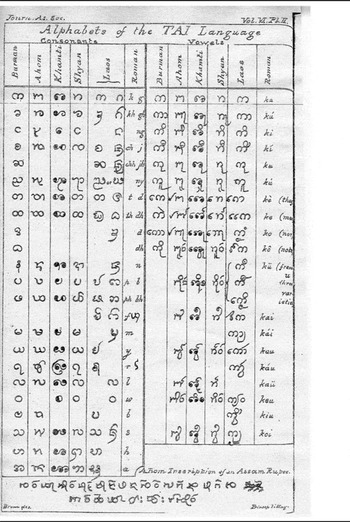
Since it is not possible to reproduce the originals, I will refer to the table of Tay consonants and vowels published by the Reverend N. Brown in Reference Brown1837 (Table 1) to give the reader visual examples of the shape and form of the letters. Fourteen of the consonants (k, kh, c, s, ny, t, th, n, p, ph, m, y, l, h) are basically identical to those in the Ahom column, while two (w and ng) are the same as those in the Shyan (Shan) column in Table 1. The placeholder for syllables with initial vowels, a, is identical with that in the Burmese column. Of the remaining two, one (r) is not similar to any Burmese or other Tay script in Table 1, while f is not listed for Burmese, Ahom, Khamti or Shan at all. I have handwritten r and f into the Roman column in Table 1, but readers should be warned that the r is of extremely tentative shape and may have to be revised when the original becomes accessible.
Consonants and vowels of Burmese, Ahom, Khamti, Shan and Lao. (Brown Reference Brown1837, Plate between p. 18 and p. 19.)

As indicated above, fourteen consonants are almost identical to, or appear to originate from Burmese. They include; k, kh, c, ng, ny, t, th, p, ph, m, y, l, w, a. The five non-Burmese consonant letters are s, n, f, r, h. Apart from f, which is a simple innovation on ph, the origin of the other four remains shrouded in mystery. Nevertheless, it is noteworthy that s, n and h are the same in Ahom script. The s of the 1407 text differs from the s found in post-eighteenth-century lik 6tho 3ngök 6, lik 6to 4yen 4 and lik 6to 4mon 2scripts, though it somewhat resembles the s in the Baiyi Guan laiwen.Footnote 33 Post-eighteenth-century lik 6tho 3ngök 6 texts have two s's: the first has a different shape from, but is equivalent to, that given in the Burman and Shyan columns of Table 1; the second, not in the 1407 text, is employed for writing specific words such as süng 3 (‘country’ or ‘state’), söm 2 (‘food offering’). The second s is not the same as, though it does slightly resemble, the letter in the Baiyi Guan zazi which Izui Hisanosuke romanized as c‘.Footnote 34 The c‘ letter, which was probably pronounced ch, may have evolved into the second s of lik 6tho 3ngök 6, but I have not come across any examples of it in the 1407 text.
Both lik 6tho 3ngök 6 and lik 6to 4mon 2 have the same number of consonants and vowels as the 1407 text, except for the consonant f which is absent from the list for lik 6tho 3ngök 6 in Sai Kam Mong's book.Footnote 35 The 1407 text clearly distinguishes between ph and f, which shows that the Tay of the Mäng2 Maaw2 area in the north employed the initial consonant f from the early fifteenth century, if not earlier.
One prominent feature of initial consonants in the 1407 text is the substitution of ny for y. For instance, yang 4 (‘to have’) is written as nyang 4
 , yaü 3
 (‘big’) as nyaü 3
 and ya 5
 (‘flower’) as nya 5
 . Such usage also occurs in some post-eighteenth-century lik 6tho 3ngök 6 texts.Footnote 36
Vocabulary and pronunciation of the Tay language varies from place to place. As W. R. Hillier explained in Reference Hillier1891, the Tay in the Shan States can be divided into Tay2 Nä1 or Northern Tay (Shans), a category which encompasses the Tay2 Nam6 Kham2
 (Nam Kham Tay or Chinese Tay also known as Tay2 Khe3
 ) and the Tay2 Taü5
 or Southern Tay (Shans).Footnote 37 Standard Tay (Shan) in Myanmar today is largely based on southern usage, particularly that from around Lay2 Kha4 (Laihka) and Mäng2 Naay2 (Möngnai). In his preface to the first edition of A Shan and English Dictionary in 1881, Cushing clearly stated: “The pronunciation common in the principalities of Laihka and Möngnai has been taken as a standard.”Footnote 38 Most of the dictionaries compiled subsequently have followed Cushing, though they do list dialect variations. One well-known difference is the shift in the initial consonant of the word for ‘village’: waan 4
 in the south becomes maan 2
 in the north (the most northern part of the Shan state and the Dehong Autonomous Region of Yunnan). Differences in vocabulary distinguish the language of the north from that of the south.
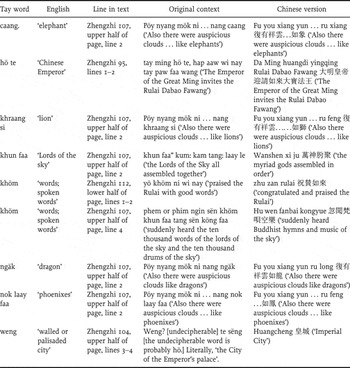
Evidence demonstrating the presence of northern usage in the 1407 text appears in the term khöm 2 (now khwaam 4 in Tay [Shan] of Myanmar) which means ‘words’ or ‘spoken words’. As shown in Table 2, it occurs twice in the text. At present it is used widely throughout the Dehong Autonomous Region and in the adjoining parts of the northern Shan State in place of the term kwaam 4, the common expression in standard Tay (Shan) of Myanmar. Khöm 2 is now read khaam 2 in Dehong and adjacent areas, and Northern speakers always refer to the Tay language as khaam 2Tay 2
 , but never as kwaam 4Tay 4 as in the south. The orthography khöm 2 indicates its long history among the Tay in the north, and reminds us of the fact that kwaam 4(kwöm 4 in some lik 6to 4yen 4 texts) is a southern term.
Some Tay words from the 1407 text.

Source: Baozang, pp. 94–115.
Most of the Tay vocabulary of the 1407 text is basic to the north and south. It abounds in familiar nouns such as ‘water’ (nam 6), ‘clouds’ (mök 3), ‘flowers’ (mök 3ya 5, but mostly written mök 3nya 5), ‘wind’ (lom 2) and so forth. In order to give the reader an idea of the general characteristics of the vocabulary, I have assembled some examples in Table 2. Burmese loan words and transliterations from Chinese have been largely omitted as they are discussed separately later.
Apart from khöm 2, other terms of interest to the historian that have an extended record of usage include hö 1te 3 , and weng 2
 . Table 2 confirms that the Tay designated the Chinese Emperor (huangdi 皇帝) as hö 1te 3 in the early fifteenth century, and undoubtedly much earlier, and that weng 2 referred to the Imperial capital, which was located in Nanjing 南京 in 1407 (Beijing was not officially proclaimed the principal capital until 1420). Tay chroniclers denoted the Chinese capital as weng 2hö 1te 3sëng 1 (literally, ‘the City of the Gem Emperor’). They frequently used different expressions for the Chinese Emperor and the Burman monarch. The term hö 1sëng 1
 (literally, ‘the palace of gems’) appears in the Jatakas, and chroniclers seem to have adopted it for the son of heaven, and reserved hö 1kham 2
 (literally, ‘the golden palace’) for the Burman monarch. Maang 2taa 2laa 2
 (meaning ‘prince’ from the Burmese) often occurs in Tay chronicles as a generic term for Burman monarchs or male members of the royal family. The 1407 text gives Tay names for animals such as elephants (caang 6
 ), dragons (ngäk 6
 ) and phoenixes (nok laay faa), but translates the Chinese term shizi 獅子 (‘lion’) as khaang 3si 5

 , a Burmese loan word.
THE EXTENT OF BURMESE FEATURES IN THE TAY SCRIPT
In the scenario which postulates that lik 6to 4yen 4 and lik 6to 4mon 2 increasingly acquired Burmese features during the eighteenth and nineteenth centuries, Sai Kam Mong claims that post-eighteenth-century lik 6tho 3ngök 6 was characterized by a lack of de-vowelizing (vowel shortening) symbols or tone marks. He identifies the following as the Burmese features apparent in lik 6to 4yen 4:
(1) The rounding of the letters. In the words of Sai Kam Mong, “the shape of the letters became a bit circular”.Footnote 39
(2) The adoption of tone markers like the superscripted dot and the heavy tone marker -:Footnote 40
(3) The use of the de-vowelizing symbol. In early lik 6to 4yen 4 the de-vowelizing symbol was only indicated by a superscripted dot, but at its later stages it becomes “like the superscripted circle”.Footnote 41
Sai Kam Mong concludes that the adoption of these Burmese features resulted in the birth of the round shaped lik 6to 4mon 2 letters by the mid-nineteenth century.Footnote 42
The facsimile edition of the 1407 text provides data that compels us to reconsider this scenario, and to reassess the role of Burmese script in the history of Tay orthography. In the first place, heavy borrowing from Burmese is salient from the fact that fourteen out of nineteen consonant letters originate from that script. The Tay had undoubtedly adopted Burmese consonants for their own writing system. If so, was Burmese influence restricted to the alphabet alone, or were features that Sai Kam Mong attributes to lik 6to 4yen 4 already present in the 1407 text? If stimulus from Burmese was patently strong, what role did that script play in the creation of early Tay?
By way of answer let us clarify exactly what Burmese features occur in the orthography of the 1407 text. First, though the writer did not round out all of the letters, he did use Burmese medial diacritics for modifying initial consonants. The diacritics that can be identified include:
(1) Ya pin (indicating –y–). For instance, syang (‘precious’, probably sëng 1
 ), syan (‘pure’, probably sën 5) and myan (‘to fly’).Footnote 43
(2) Ya yit indicating –r– For instance, khröng (‘temple’), pram (‘the Buddha’)Footnote 44 and khrang (the khaang 3 of khaang 3si 5 (‘lion’).Footnote 45 Interestingly, phi 1
(‘spirit’)Footnote 46 is written with this diacritic, which would theoretically make it phri.(3) Wa hswe indicating –w– For instance, khwa (‘right’).Footnote 47 In addition, the wa hswe, has been deformed into a subscript shaped c, as in the case of kwa (‘to go’).Footnote 48
 ), syan (‘pure’, probably sën 5
 ) and myan (‘to fly’).
 (‘spirit’)
Second, the high tone marker -: is used with five initial consonants (kh, t, p, m, and w). They are listed below together with the number of incidences:
kha 2 (‘to seek’) occurs once, but is written with the medial diacritic Ya yit, which would theoretically make it khra.Footnote 49
ta 2 (‘eye’) occurs once.Footnote 50
pa 2 (meaning unclear) occurs once.Footnote 51
ma 2 (‘to come’) occurs eighteen times.Footnote 52
wa 2 (a unit of measurement) occurs three times.Footnote 53
The application of tone markers to five different initial consonants, particularly the consistency and frequency of their usage with the verb ma 2 (‘to come’), demonstrates that writers had already employed them with ordinary Tay vocabulary by the early fifteenth century. This is much earlier than the dates proposed by Sai Kam Mong, who asserts that the heavy tone marker was applied to Burmese words from the lik 6to 4yen 4 stage.
Third, the text employs Burmese numerals for numbers from zero to nine and writes ten and eleven in Tay as sip 1 and sip 1et 3
 . But with classifiers it usually spells out Tay words for numerals. For instance, the five in the phrase “five coloured rays of light” (söng 3ha 5ton 5
 Chinese: wuse haoguang 五色毫光), which occurs repeatedly throughout the text, is always fully spelled out as ha 5, and Burmese numerals are never used. Special numbers such as❘:❘ for one and so forth are also employed.
From the above we may conclude that the Tay did not simply borrow consonants and methods of indicating consonant clusters, they created their writing system on the basis of the Burmese one from the beginning.
TAY TERMS OR BUDDHIST BUILDINGS AND THE BUDDHIST CLERGY
The Chinese text on the 1407 scroll abounds in an assortment of Buddhist terminology, which must have presented problems for the Tay translators who had not yet converted to the Sāsanā. Their renditions reveal their understanding of Buddhism as well as the origins of the terms that they chose.
In Table 3, I have assembled the Tay translations of the Chinese terms for buildings, pagodas and other edifices within the precincts of the Linggu Temple. This data, tortuous as it may seem, provides all the terms, the contexts, and the total number of occurrences. It picks up the Chinese names of the eight structures mentioned and provides the Tay translations. I outline the main Chinese and Tay terms, and the total number of incidences, below:
(1) fodian 佛殿 (‘Buddhist sanctum’). Tay translation: khröng (‘monastery’). One occurrence.
(2) tandian 壇殿 (‘Altar Hall’). Tay translation khröng (‘monastery’) and rän khröng (‘monastery house’). Nine occurrences. It breaks down to seven instances of tandian 壇殿 and two of Rulai tandian 如來壇殿(‘The Altar Hall of Rulai Dabao Fawang’ 如來大寶法王 [the Tathagata, the exceptionally precious Dharmaraja = De-bzin-gsegs-pa]).
(3) ta 塔 (‘Pagoda/tower’). Tay translation: khröng (‘monastery’). Six occurrences.
(4) tadian 塔殿 (‘pagoda hall’). Tay translation: rän khröng (‘monastery house’). Six occurrences.
(5) baota 寶塔 (‘precious pagoda’). Tay translation: khröng and syang khröng (literally ‘the precious gem palace room’). Two occurrences.
(6) baoping 寶缾 (literally ‘precious vase’). Tay translation: rän song (literally ‘tall house’). One occurrence.
(7) bao lou 寶樓 (‘precious storied building’). There are two Tay translations. The first is hö syang (literally ‘the gem palace’). It mostly appears in the compound Rulai baolou 如來寶樓 (‘the precious storied building of the Tathagata’ = the residence of De-bzin-gsegs-pa), which is rendered as hö syang wi nay (‘the gem palace of the Tathagata’). The second is hö syan. (literally ‘the pure palace’). It mostly appears in the compound Rulai baolou 如來寶樓 which is translated as hö syan. wi nay (‘the pure palace of the Tathagata’). Eleven occurrences. It breaks down to seven instances for hö syang and four for hö syan..
(8) tian wang dian 天王殿 (‘the palace of the Maharāja-devas’). No Tay translation. Simply transliterated as tën wang, omitting the final dian 殿 (‘palace’). One occurrence.
Terms used to translate Chinese words for buildings, pagodas and other edifices within the precincts of the Linggu Temple.

Source: Baozang, pp. 94–115.
A brief perusal of Table 3 and the outline reveals an acute lack of specific Burmese or Pali terms for temple buildings. Terms such as ce 3ti 3,  , cetiya (‘reliquary monument’) or thaat 6
 are not employed to translate the Chinese word for pagoda, ta 塔. The word khröng 2, denoting a monastery, is applied to a wide variety of structures from wihaan (‘prayer halls’) to pagodas. In both Burmese and Tay today the word for monastery is kyaung and kyöng 2 respectively, so it is curious that the initial consonant is kh rather than k, and equally odd that the medial diacritic is ya yit (indicating –r–) rather than ya pin (indicating –y–). Furthermore, the term rän khröng literally meaning ‘monastery house’ is extensively used to denote what, from the painting on the scroll, appears to be a wihaan. The equation of a wihaan with a secular house (hän 2
 in present-day Tay) is curious terminology for a Buddhist monastery.
The text has a total of thirty-seven references to buildings within the precincts of the Linggu Temple, but Tay word compounds are not in the majority. Among the purely Tay terms, hö syang (present-day sëng 1 ) and hö syan (present day sën 5
 ), the translation of bao lou 寶樓, come top with a total of eleven incidences, while the word for house, rän, appears only once by itself with the adjective song (‘tall’) as a translation for baoping 寶缾. The word rän appears in the Tay/Burmese hybrid compound rän khröng (‘monastery house’) which occurs eleven times. The only other Tay/Burmese hybrid compound is syang khröng (‘the precious gem monastery’) which is the translation for baota 寶塔, but it only occurs once. Here, interestingly, the word order seems to have being influenced by Chinese, for in syang khröng the adjective has been placed before the noun following the Chinese original baota; in Tay it should have been khröng. syang.
The Tay west of the Salween now use the Burmese loan word kyöng 2 (pronounced as cöng 2 ) to refer to Buddhist monasteries or temples, while the Tay and Siamese living east of the Salween employ the word wat. The 1407 Tay text translates the Chinese word for temple (si 寺) with khröng for the Linggu Temple, and this term is the earliest known Tay orthography for kyöng 2. In the 1407 text, khröng 2 assumes an array of meanings, some of which are no longer current today. In addition to denoting temple, it also appears in the translation of three Chinese terms: fodian 佛殿, tandian 壇殿 and ta 塔 or ‘pagoda’.
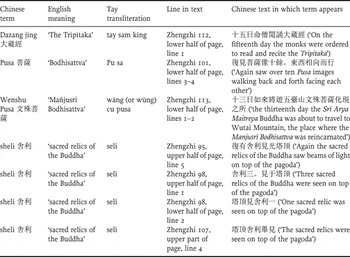
The evidence assembled in Table 3 suggests that the northern Tay had a vague acquaintance with Burmese terminology for structures within Buddhist temple compounds. The first emperor of the Ming Zhu Yuanzhang bequeathed on the Linggu temple the title Diyi Chanlin 第一禪林 (‘The First Forest of Chan [Zen]’), which the Tay translator rendered as pat tu khröng, the same term that he used to translate the Chinese term for the temple gate (shanmen 山門).Footnote 54 Also, further evidence revealing a lack of concern with Buddhism can be found in the choice to transliterate some key Chinese Buddhist terms, rather than translate them. Table 4 shows that the text provides no Tay (Pali or Burmese loan word) equivalents for the three terms Dazang jing 大藏經 (The Tripitaka), Pusa 菩薩 (‘Bodhisattva’) and sheli 舎利 (‘sacred relics of the Buddha’). The first two terms only occur once and twice respectively, but sheli appears four times. The absence of a Tay/Burmese translation for Pusa should come as no surprise because Theravada Buddhism does not embrace the concept of a Bodhisattva deity, who once having achieved enlightenment remains in this world to aid others to salvation. One may assume that the word phra or Buddha could have been invoked, but intriguingly, this word, a standard term for the Buddha, does not appear anywhere in the text. The text refers to the Buddha as pram, but only on one occasion.Footnote 55 The Tay word for sheli is thaat 6tö 3 , from the Burmese word dhaat’ to’ (‘relic of the Buddha or of an arhat’), and its non-use may indicate that the Tay were still unfamiliar with this term in the early fifteenth century. The etymology of the word dhaat in Burmese is from Pāli dhātu, via Old Mon, where the final syllable was dropped and the Burmese affix to’ denoting power, sacredness, reverence and royalty appended. The presence of to’ in thaat” tö, indicates that it came to the Tay through Burmese rather than directly from Mon.
Chinese Buddhist terms transliterated in the 1407 Tay text.

Source: Baozang, pp. 94–115.
Such want of acquaintance, however, did not apply to the word for ‘monk’, for it was translated, not transliterated. As can be gauged from the examples assembled in Table 5, the translations included both Burmese/Pali and Tay terminology. The standard terms saang (from the old Mon and Old Burman san; three incidences), saang kaa (from the Pali sangha; one incidence) and phung (an Old Burmese word for monk; one incidence) are employed. But failure to come up with a specialist term for a monk's robes is surprising. The Tay translation of the Chinese, shen pi baina 身披百衲 (‘draped the robes of a monk over his body’) is literal, nung sä phung (‘wearing the clothes of a monk’). The Tay now use the Burmese loan word saang 3kaan 2 for the robes of a monk. What is truly fascinating is the purely Tay term mö taü faa (two incidences). It seems to be a literal translation of tianxia sengzhong 天下僧衆 (‘the multitude of monks under heaven’) and tianxia seng 天下僧 (‘the monks under heaven’), and signifies the assemblage of monks from all over the Ming to participate in the ceremonies at the Linggu Temple by order of the Yongle emperor. Mö taü faa literally means “all the masters (teachers/astrologers) under the sky”, which shows that contemporary Tay understood monks as belonging to the category of mö 1 or masters with special knowledge. This may indicate that they considered monks as experts like astrologers (mö 1faa 6
 ) and other learned people. This is another corroborant attesting to the non-adoption of Buddhism by the Tay in the north at the time.
Tay terms for the Buddhist clergy.

Source: Baozang, pp. 94–115.
As demonstrated earlier, the 1407 Tay script resembles the Ahom script more than any other Tay script known to us. In view of this similarity it is interesting that a report of the 1830s commented that “no trace of Buddhism is to be found in the religion of the Ahom”, the Tay ethnic group inhabiting Assam.Footnote 56 Though the Ahoms are reputed to have migrated to Assam during the thirteenth century we have no contemporary source that can elucidate their early history. Nevertheless, the fact that both the Ahom and the Mäng2 Maaw2 groups of Tay were non-Buddhists may be more than a curious coincidence, and may suggest that these two groups originally used the same script.
CONCLUSION
This article substantiates for the first time that Tay was one of the five scripts written on the 1407 scroll. The choice of Tay script bespeaks the affability that the Ming court displayed towards Tay polities in the early years of the fifteenth century. Detailed research by Jon Fernquest has revealed how Ava sent raiding expeditions into the Tay world between 1401 and 1416 “to augment man, horse, and elephant power in the long war against Rajadhirat's Pegu in the south (1383–1425)”, and that large numbers of Tay war captives, especially Tay cavalry, fought for Ava against Pegu. In 1406, the very year that the Yongle emperor invited De-bzin-gsegs-pa to visit Nanjing, Ava plundered Mäng2 Yaang2, Bhamo and Kale, carrying off large numbers of people. The Tay polities appealed to the Ming to intervene and stop aggression by Ava.Footnote 57 In such a situation it is only natural that the Ming Court in their role as conciliator would favour the Tay script over that of the recalcitrant Burmans. The Tay may even have regarded it as a diplomatic victory to have their script chosen instead of that of their Burman adversaries, but this is mere speculation.
The data assembled here demonstrates beyond doubt that the Tay script on the 1407 scroll exhibited many features of the Burmese writing system. Fourteen of the nineteen consonants as well as three medial diacritics and the high tone marker derived from it. Many of the vowels, which I have not been able to treat due to the inability to reproduce them for inclusion, may also be Burmese in origin. The evidence shows clearly that the Tay borrowed from Burmese script to create their own writing system from the outset, and proves the invalidity of the scenario which postulates gradual Burmanization from the eighteenth century onward. In fact, the presence of medial diacritics and the high tone marker from the early fifteenth century calls into question the validity of the very criteria on which Sai Kam Mong based his claim for the evolutionary path lik 6tho 3ngök 6 → lik 6to 4yen 4 → lik 6to 4mon 2. From the similarity between the 1407 Tay script and the Ahom script we can conclude that lik 6tho 3ngök 6 was not the progenitor of Tay scripts as previously thought. The Ahom script clearly has priority; it appeared on the historical stage much earlier than lik 6tho 3ngök 6.
Heavy reliance on Burmese script for the conception of their writing system illustrates the eclecticism of pre-fifteenth century Tay culture. The Tay borrowed selectively from outside cultures, choosing only what they required to solidify their own polities, but rejected superfluous trappings. They turned to Pagan, or early Ava, culture for a written script, but shunned Theravada Buddhism, the religious apparatus that we assume always accompanied the spread of writing. Pagan embraced an assortment of religions including Theravada and animism. Tantric, Saivite and Vaishnava practices enjoyed some measure of popularity among the elite, while royalty persisted in conducting official spirit (nat) propitiation ceremonies.Footnote 58 It was the advantages for administration that motivated the Tay to create their own script. At that time religion was syncretic, so the political milieu did not require the Tay elite to become Buddhists. Since Mäng2 Maaw2 and surrounding polities did not adopt Buddhism as a state religion before the mid-sixteenth century, we may count their use of a writing system, along with that of the Ahom of Assam and the Tay Dam (Tãy Đăm or Black Tay) of Northwestern Vietnam, as rare cases of script without Buddhism in northern continental Southeast Asia.Footnote 59
The impact of Burmese script on the Tay writing system from the outset raises the broader issue of borrowing from Pagan and early Ava culture. To the Tay, Pagan stood out as a dominant political power worthy of emulation, and the adoption of Mian script demonstrates the magnitude of its influence. The original motivation for borrowing Burmese script could be attributed to the aspirations of some Tay to raise their position and status within the Pagan world. Their close involvement in early Ava politics may have inspired the Tay to create their own script, but this cannot be verified by contemporary sources. Nevertheless we may contend that without embracing Burman language and script Tay elites would not have been able to communicate easily with the Pagan elite, or participate in the political world of Ava. Hence the desire to succeed in the Pagan and Avan polities would have prompted them to master Burmese script. The incentive to modify it for recording Tay probably came later. The only substantive evidence available to support such a hypothesis is the fact that the Tay writing system derived from the Burmese one; Tay script could only have been created by someone proficient in Burmese. Such borrowing did not signal subservience to the Burman yoke. Rather it arose out of the Tay desire to self-strengthen their own polities, perhaps in an endeavour to rival the Burmans. For the Tay script to have been ready for use in 1407, some degree of cultural interaction must have taken place between the Tay and the bearers of Burman culture during the fourteenth century, if not earlier.
Tay script emerged in an age when the Burman language had just attained predominance among the elites of Pagan and Ava. The Burman language was first written in the eleventh century, but only gained ascendancy at court during the twelfth century.Footnote 60 Mon language had been prestigious for Burmese rulers who employed it for inscriptions during the early Pagan era, but by the thirteenth century Burman had become the main language of northern inscriptions, while Mon remained foremost in the south.Footnote 61 Even in the fourteenth century, when we postulate its adoption for writing Tay, literacy in Burmese was still largely confined to the aristocracy and their monastic peers. Lieberman asserts that such monopoly by the elite ensured that “most commoners retained non-textual, essentially local religious identities tied to the worship of particular nat spirits.”Footnote 62 Two features of Tay adoption of Burmese script are worthy of note. First, they borrowed at a time when it was relatively novel and still the preserve of the Pagan elite, a fact which reinforces the notion of borrowing for prestige value as well as practical utility. Second, the Tay gravitated towards the northern parts of Pagan and Ava, rather than the southern areas where Mon language retained predominance in inscriptions. Lieberman characterizes the fourteenth and fifteenth centuries as marked by the spread of Burman ethnicity and cultural influence over the Mon communities in the north, despite the great ethnic diversity; the Mon were in the Irrawaddy delta and Kadus, Tay (Shans), Karens, Chins and other peoples on the fringes of the dry zone.Footnote 63 Viewed in this context, the borrowing of Burmese script by the Tay exemplifies the extension of Burmese cultural influence after the weakening of Pagan and the rise of Ava.
APPENDIX
Throughout this article, the Shintani system as outlined in Shintani Reference Shintani2000 is used to romanize Tay words. It possesses the following advantages:
(1) It is applicable for transcribing and/or transliterating all the languages in the Tay Cultural Area (Tay languages, Tibeto-Burman languages including Burmese, and Mon-Khmer languages etc).
(2) It is designed to avoid digraph of vowels. It distinguishes diphthongs and records long and short vowels in a terse form.
(3) It can be inputted with conventional fonts.
(4) The use of –y and –w as a syllable final is designed to avoid triptongue.
Transcription of Vowels

Transcription of Consonant Clusters
Note that the consonant clusters -w- (pw-, tw-, thw–, sw–, lw–), –y– (py–,phy–, my–) and –r– (mr–, sr–, cr–) are not included in the Thai system.
Consonant Clusters are romanized as follows:

Tones
The tones of Dehong Tay and their relationship to Proto-Tay are given in the following table.

Key:
1. The upper line in the high and low class divisions (e.g. 1, 2 etc.) indicates tone categories of present-day Dehong Tay tones.
2. The lower line in the high and low class divisions (e.g. 35, 55) indicates the levels of the tones.
3. A, B, C correspond to the ping 平, qu 去 and shang 上 tones of ancient Chinese.
4. D1 (for short vowels) and D2 (for long vowels ) refer to syllables with –p, -t, -k finals.
The tones of present-day Dehong Tay are indicated in the article by numbers given in superscript, e.g mäng2, sä1 etc.
For reference, the tones of Tay (Shan) in Burma and their relationship to Proto-Tay are given in the following table.

N.B. The numbers indicating the tones of Dehong Tay do not correspond to the tone numbers for Tay (Shan) in Burma. The Shintani System allocates odd numbers for voiceless initial consonants and even numbers for voiced initial consonants in representing the tones of Dehong Tay, but retains the traditional tone numbers for Tay (Shan) because the latter has undergone tone fusion. To avoid confusion regarding the relationship of the two languages to proto-Tay, the Shintani system does not use the same tone numbers for Dehong Tay and Tay (Shan).
 but romanizes it as ya
 .