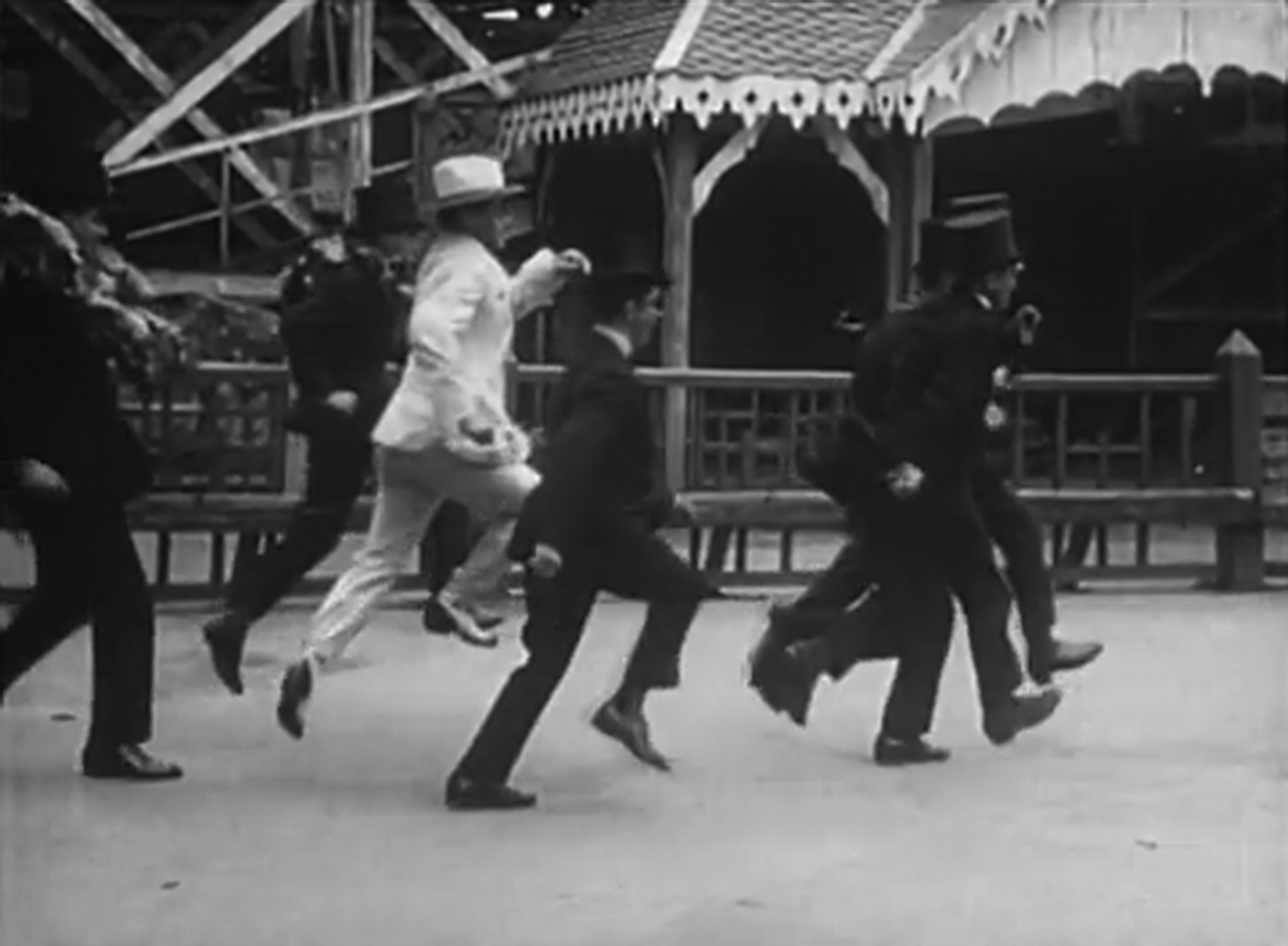
“Repetition is a necessary and justified conduct only in relation to that which cannot be replaced.” —Gilles Deleuze, Difference and Repetition
How does one create a dance legacy? Or, in the case of Merce Cunningham, how does one create an avant-garde dance legacy? Can a corpus of controversial works and ideas be preserved for posterity without betraying the fundamental impulse of an intentionally self-exceeding experimental art? What can be preserved, archived, and bequeathed of a choreographer's work if that choreographer's project was precisely to generate what he had not done before?
These are some of the questions that the Merce Cunningham Trust is confronting as it orchestrates the closure of the Merce Cunningham Dance Company and plans for the reconstruction (and thus afterlife) of his choreographies. A few years before Cunningham died on July 26, 2009, members of the Cunningham Dance Foundation decided to set in place the “Legacy Plan,” which is a set of initiatives intended to preserve while making available to other companies over fifty years of choreographic production as well as a unique method of training dancers.Footnote 1 Whereas the Martha Graham Company, composed of dancers she had trained (or those her dancers had trained), continues to teach and perform her repertory in reconstructed form, the Cunningham Dance Foundation, with the help of Executive Director Trevor Carlson, determined that Cunningham's company should not exist in his absence, and thus it was decided that the Merce Cunningham Dance Company would cease to exist on January 1, 2012. In order to ensure that Cunningham's dances would be properly memorialized and performed by other companies, the officers of the Foundation, under the guidance of the choreographer, devised an unprecedented Plan including the following: (1) the creation of “Dance Capsules,” employing state-of-the-art technologies to produce digital versions of Cunningham's prolific choreographic notes, the costumes and sets he used, video and film registrations, photographs, and reviews for eighty-six out of approximately two hundred dances in the repertory;Footnote 2 (2) a severance package for each of the remaining core dancers; and (3) the Legacy Tour, a two-year performance marathon showcasing eighteen works from throughout his entire career staged in fifty cities throughout the globe. Cunningham stipulated that the last performance of his company should be in New York; that it should be an “Event”; and that it should cost $10. The Legacy Tour—composed of the last company of dancers Cunningham had personally trained—began in February 2010 and ended on December 31, 2011 (a year and a half after his death). Taking over the reins from the Foundation, the Merce Cunningham Trust, with a staff and board of trustees, now manages the licensing of choreographies, oversees the technique classes taught at City Center, and offers fellowships for the reconstruction of Cunningham's works.Footnote 3
The major thrust of this massive effort, and the problem it seeks to resolve, is how to keep alive—on stage and in the bodies of students in the classroom—Cunningham's works as well as his unique way of moving and thinking about dance. The members of the Trust face a difficult and perhaps intractable contradiction, for they seek to marry the notion of legacy—and thus of tradition—with the ideals of a fundamentally unconventional approach to aesthetic production. To preserve a legacy is implicitly an attempt to perpetuate a certain look and a certain praxis from one generation to the next (and the next and the next and the next …). A “legacy” is not quite the same thing as an “influence,” for the word “legacy” implies something material that is left behind, something tangible deliberately bequeathed and deliberately assumed. The notion of “legacy” presupposes the perseverance of an essential core, and preserving this core requires technologies of storage, reproduction, and transmission as well as institutional support. The impulse to preserve, however, comes into conflict with the structure and ideology of the avant-garde itself, which demands the rejection of the recent in favor of the new, a fundamentally self-sacrificial and open attitude toward the future as a blank unknown. “The new is a blind spot,” writes Theodor Adorno in reference to the avant-garde: “the new is akin to death” (Reference Adorno and Hullot-Kentor1997, 21). Conversely, a legacy “plan” constitutes a concerted effort to keep something alive in the face of death; as an attempt to control how the intervention will be kept alive in the future, a plan necessarily involves defining for good what that intervention is, congealing it into a “legacy” to be preserved, archived, and handed down. It is conceivable, then, that precisely that which is new and radical about the avant-garde intervention will be arrested, captured as a museum-piece—a no-longer-evolving (“timeless”) replica of itself. How, then, can a well-intentioned Legacy Plan engineer the perpetuation of an avant-garde aesthetic while embracing the ethos of ephemerality, the embrace of self-annihilation in the face of the new, that is constitutive of avant-garde generativity?
Pondering the efforts of the Merce Cunningham Foundation's Legacy Plan, one is tempted to conclude that Cunningham's choreography is, quite simply, no longer avant-garde, that it has become “established”—a status that Carolyn Brown carefully distinguishes from being “part of the establishment” (1975, 31). Following Brown's distinction between “established” and “establishment,” one could advance the hypothesis that something in Cunningham's work remains critical and unassimilable (and thus, he is not “part of the establishment”), but that the very effort to preserve Cunningham's choreography hastens its congealment, its recuperation by the very institutions he was always challenging in various ways. According to this line of thinking, the Legacy Plan would miss—if not downright betray—the most significant aspect of Cunningham's legacy—his legacy as a member of the American avant-garde.Footnote 4 Further, the Legacy Plan might well overlook something crucial about his performance legacy. The insistence on preservation suggests that both aspects of his intervention—as a performer and as an avant-garde performer—require greater theorization than they have yet received. Avant-garde movements and performance genres share an interest in the temporality of appearance, and they both link their identity to forms that resist the congealment of that appearance. As the controversy around Marina Abramović's recent reconstructions reveals, an attempt to preserve performance (and especially avant-garde performance) opens up a Pandora's box of problems, a kind of crisis of identity, for the avant-garde and performance alike. To cite Rebecca Schneider's trenchant analysis, “The tangle in Abramović's thinking in advance of herself as dead underscores that the battle of much reenactment … is a battle concerning the future of the past” (Reference Schneider2011, 4; original emphasis).
Let us begin, then, with this hypothesis, that the most avant-garde aspects of Cunningham's work—his investment in the ephemeral, the Event, the newest technology, and the next frontier—are obscured rather than advanced by the Trust's investment in preserving him in the form of a “legacy.” By entertaining this hypothesis, I do not mean to criticize the Legacy Plan or the brilliant dancers and administrators who have devoted themselves to realizing it. On the contrary, I am extremely grateful to them for the opportunities they have provided (and continue to provide) for Cunningham's work to be seen and studied in depth. The members of the various institutions dedicated to continuing his legacy—the Foundation, the Company, and now the Trust—have offered scholars a very special opportunity: the opportunity to reflect on the tension between innovation and preservation implicitly encoded in avant-garde performance works. As a scholar of the avant-garde, I am particularly interested in exploring what it means for one of the foremost innovators in dance, a figure who developed what are arguably the most game-changing practices in the history of modern dance composition and performance techniques, to be confronted with the dilemma of his own consecration, memorialization, and transformation into an archive.
The alternative hypothesis is that Cunningham's work is no longer avant-garde, or that it never really was—at least no more than works like Nijinsky's Rite of Spring (1913) or Picasso's Still Life with Chair Caning (1912), which have been integrated into the patrimoine, the cultural archive of the library and the museum. But what would this mean—to no longer be avant-garde? If, as Carolyn Brown has stated, Cunningham's choreography is now “established,” the suggestion is still that at some point in time it was not.Footnote 5 Brown herself describes the hostile reaction to his work in her recent memoir, Chance and Circumstance; pieces such as Winterbranch (1964), she writes, were received as “notoriously controversial” and “branded” with an avant-garde label that was not always intended as praise (Reference Brown2007, 158). The trajectory Brown traces—shocking the public, inciting curiosity, attracting the esteem of other artists, and finally receiving mainstream recognition—is one that should be familiar to any student of the historical avant-garde. Here, as usual, radical innovation loses its critical force as soon as newer innovations arrive on the scene. This narrative has been around for a long time, and scholarly works following the evolution from Cunningham to Judson Church Dance tend to follow it, arguing that Cunningham's innovations may now be treated as exhausted and surpassed, no more than a point on a line or a step in a progression, whose legacy can be discerned in the trends he helped to generate but that have now left him behind.Footnote 6
However, the linear nature of this account should give us pause. It does not, I believe, help us to understand what “legacy” means in the case of the Legacy Plan, nor does it properly account for the provocative edge to the gift Cunningham leaves (ahead for) us, namely, a rich corpus of ideas and experiences urging us to reflect on the co-implication of performing and archiving, producing the unique and repeating it. As is well known, the primary compositional technique that Cunningham developed so as to short-circuit his own movement habits involved the use of chance operations—from coin tossing to digital algorithms—to generate dance sequences from a predetermined “gamut” of movements. He then preserved—inscribed—these results as a choreo-graphy so that they might be repeated again and again. What has not received equal attention is the relation of the choreographic practice to his performance practice, also a crucial element of the aesthetic. After generating, notating, and physically assimilating (through a brutal process of repetition) the chance-derived sequences—that is, after “canning chance,” to evoke Marcel Duchamp's concise phrase—Cunningham then added variables to the actual performance situation intended to challenge the dancers’ ability to repeat with precision what they had already done—variables, in other words, meant to revive through repetition what was in the “can” (Duchamp Reference Duchamp, Sanouillet and Peterson1973, 31).Footnote 7 The non-collaborative collaborative process that Cunningham, Cage, and Rauschenberg perfected in the 1960s expanded the scope of this performance practice, weaving together chance and archival preservation, the emergence of the new and the repetition of the habitual, the creation of the singular and the manufacture of the multiple. Repeatedly performing works that could not be replaced, Cunningham juxtaposed a set of “paradoxical principles,” revealing the insufficiency of a logic that opposes repetition and difference, the unique and the readymade, and, ultimately, life and death (Bonk Reference Bonk and Britt1989, 9).Footnote 8
If these pairs strike us as familiar, this should come as no surprise. Ever since Marcel Duchamp sought to counteract his own congealed habits (his training and “taste”) by employing elements of chance, then congealing the aleatory results in “works” that he preserved and multiplied, he inaugurated what is arguably the most productive line of questioning to animate the twentieth-century avant-garde, including the entire Cage generation to which Cunningham belonged. Duchamp is the thinker par excellence of the archive, an artist who made the question of his own legacy into the thematic and formal engine of his life's work. Indeed, it seems impossible to address the issue of avant-garde legacy, and thus of the Cunningham Foundation's Legacy Plan, without returning to the example of Duchamp. Duchamp's interest in “incompatible” but inextricable pairs informs Cunningham's choreography at almost every point in his career, and thus, as might be expected, the figure of Duchamp also leaves a clear imprint on the Legacy Plan, and, as I will argue, on the set of performances that concluded the nearly sixty-year lifespan of the Merce Cunningham Dance Company (The company was formed in 1953.) In this essay, I will take these final performances, known as the Park Avenue Armory Event, as my primary object of study, analyzing how they illustrate the Plan's understanding of what constitutes Cunningham's aesthetic legacy and how it should be encapsulated and handed down. Through a description of one performance in Part I, I identify two contradictory archival logics driving the Legacy Plan: the will to fix, preserve, monumentalize, and compile (traditional archival logics); and, alternatively, the will to reject the archive (as already-behaved behavior) itself. Then I turn in Part II to theories of the archive in order to reflect on what constitutes the singularity of Cunningham's legacy and how it might be preserved and passed on. Finally in Part III, via a close reading of Walkaround Time (1968), Cunningham's hymn to Duchamp, I examine the third archival logic at play in Cunningham's work, which is the will to enter into the archive that which has never been there before—or, put differently, to include as a part of the self's archive that which does not originate with the self. By contrasting the Legacy Plan with what I will delineate as the more complex, self-contradictory archival logics advanced by the Duchamp–Cunningham approach, I hope to suggest an alternative understanding of what might constitute the archival project of an avant-garde form.
Part I: The Event as Archive
The last performances of the Merce Cunningham Dance Company (known as MCDC) took place on three consecutive nights, December 29, 30, and 31, 2011, at the Park Avenue Armory between 66th and 67th Streets in Manhattan.Footnote 9 I attended the first of the two 48-minute Events on the evening of December 30. To my eyes, the final performance of the Company appeared to be a negotiated compromise between contrary notions of the archive and its function. It reflected the influence of two strong and outspoken members of MCDC's inner circle, Robert Swinston and Laura Kuhn, whose notions of “legacy” are not exactly identical. Swinston, who has served as Director of Choreography since Cunningham's death, believes that accuracy in reconstruction is essential; accordingly, he has sought throughout the company's two-year swan-song, “The Legacy Tour,” to reincarnate Cunningham's earlier roles and to perpetuate his choreographic vision. Even before Cunningham died—in fact, fourteen years before he died—Swinston began reconstructing earlier dances, although he was never sure whether Cunningham approved of his projects or not (Swinston Reference Swinston2011; see also Brown Reference Brown2002). In any case, although absorbed in creating a new piece (rather than reconstructing an old one), the choreographer allowed Swinston to pursue his various projects. Perhaps Cunningham acquiesced, as Swinston has suggested, because grant funding was attached to reconstructing one choreography per year, but it is also possible that he found the process intriguing—but from afar—as is evident in the short video produced on the reconstruction of Roaratorio while the choreographer was still alive.Footnote 10
Swinston's own reasons for wanting to revive older repertory are complicated. He mentions in an interview conducted in July 2011 that mounting dances from earlier periods gives “the dancers a different movement experience,” implying that at different points of his career, Cunningham's vocabularies and sequences demanded distinct skills from his dancers (Swinston Reference Swinston2011).Footnote 11 Even though Cunningham choreography retains a similar dynamic it is remarkable how many different types of movement he integrated over the course of his career. Ostensibly, then, by mounting older works on young dancers, Swinston could enlarge their capacities while also inspiring them to perform and teach a wider spectrum of the repertoire in the future. What Swinston does not articulate is a fear of the loss, or disturbance, involved in reconstructing an earlier piece on a new set of young dancers. As is well known, Cunningham tended to choreograph for specific members of his company (especially during the first decades), taking advantage of their unique qualities and strengths.Footnote 12 If we study his own effort to reconstruct a role he himself had danced thirty-two years earlier, we can see to what a great extent a dancer's personal style counted in his calculations—with respect to both the original and the reconstruction. On July 20, 2000, Cunningham bequeathed part of his role in Walkaround Time (1968) to Mikhail Baryshnikov in the one-time only, eight-minute performance of Occasion Piece (accompanied by John Cage's Music for Marcel Duchamp).Footnote 13 In fact, the explicit doubling of dancers on the stage (rather than the imitation by one dancer of an earlier dancer no longer present) brought to the fore the impossibility of exact repetition while subtly suggesting the ghostliness of performance itself, the way the presence of the performer is haunted by the execution of those movements in a recent past or, proleptically, in a remote future. Occasion Piece threatened to undermine the very thesis of reconstruction—that one dancer can be replaced by another, or that a past experience can be wrested back from time—suggesting instead that something quite different can be the aim of reconstruction, namely, to produce a meditation on what it means to happen only once (on only one “occasion”), and then to disappear completely from view.
Swinston has proved to be a far more classical reconstructionist than Cunningham. In order to reconstruct works such as Roaratorio and Rain Forest, for instance, Swinston pored over Cunningham's idiosyncratic notes as well as video recordings and photographic images of rehearsals and performances. He also made sure to include the testimony of the dancers who had originated the roles and thus were able to provide nuances of execution that no notes or images could capture.Footnote 14 Swinston's approach should be contrasted with that advocated by Laura Kuhn, the director of the John Cage Archive at Bard College and a faithful companion of Cunningham in his last years. Musing on the Legacy Plan, Kuhn has suggested that perhaps exact replication should not be the goal; indeed, the work could “live otherwise,” in a new form. In an interview with Kuhn conducted in 2011, she advanced the need for what she calls a “living archive”; rather than “replicate and reconstruct,” she proposes, one should “make something else of the material” (Kuhn Reference Kuhn2011).
Yet while Kuhn's view differs in some crucial ways from Swinston's, both seemed to have influenced the production of the Park Avenue Armory Event that ended the nearly sixty-year lifespan of the Merce Cunningham Dance Company. The Event clearly contained elements of a typical “modernist reconstruction,” the “return to in a nostalgic sense,” as Mark Franko has put it, but it also gestured toward the more innovative and iconoclastic aesthetics of the avant-garde reenactment, or, to quote Franko again, “the return of in an inventively original sense” (Reference Franko1989, 57, original emphasis). The final December performances of the Legacy Tour took place in the Drill Hall of the Park Avenue Armory, formerly a space for military exercises measuring 55,000 square feet (see Photo 1). Set up in the “Drill Hall” were three stages, the largest one in the middle and two smaller stages on each side. Around these stages a few benches were arranged, but most of the audience had to stand, either at floor level or on one of the platforms near the edges of the hall. The Event began promptly at 6:30 p.m. Two oversized stop-watches, mounted at each end of the Hall, appeared at first to serve a purely practical function: they allowed the dancers to check periodically whether they were respecting the time limits that had been imposed. But the exaggerated dimensions of the stop-watches also served a symbolic function: they recalled and monumentalized Cunningham's famous technique for teaching phrases to his dancers, both in the classroom and during the rehearsal period.Footnote 15 This scenic exaggeration of a typical Cunningham gesture (measuring time) seemed to be at odds with Cunningham's actual practice as a collaborator: he never had any control over the stage design or the sets, and thus could not render their elements either symbolic or commemorative (as they were here).
Park Avenue Armory Event: Andrea Weber and Rashaun Mitchell on the near stage; Krista Nelson and John Hinrichs on the far stage. Photograph by Anna Finke (2011).

With respect to the dance material for the Event itself, the archival logic was that of collecting and summarizing: it included excerpts from over 25 different choreographies from all parts of Cunningham's career. Apparently, Swinston, who was responsible for the Event's organization, had asked the company dancers themselves to choose the segments they would like to dance, then faced the ambitious task of ordering and timing them in such a way that the fourteen dancers scattered across three separate stages could move from stage to stage over the course of the overarching forty-eight-minute time bracket and all end exactly at the same moment. The dancers knew when they had to finish each excerpt, when they had move to another stage, and when they had to start a new excerpt, but they could pace the movements within each time bracket as they preferred. The Event highlighted the fact that the time bracket method allows dancers to add their own rhythmic flavor and dynamics to the execution of the phrase. Interestingly, Swinston chose to stage two versions of the same choreographic excerpt simultaneously, thereby exposing to view the inflections, or deviations in pacing, introduced by the individual dancers concerned.Footnote 16 Reconstruction (as the repetition of entire sequences by different dancers) was thus integrated into the Event itself, as a kind of mise en abyme. Showcasing members of a company who were all approximately the same age, the Event collapsed reconstruction into the smallest time frame imaginable (as opposed to extending it from one generation to another). The temporal and spatial juxtaposition of the young, vigorous bodies engaged in replicating one another's moves had the effect of muffling the audience's awareness of the passage of time, making it seem as if reconstruction—as a genre of revival—could take place in a perpetual present, with no loss or distortion: difference without death. The various inflections and movement styles of the distinct performers became indexical of a pure present-ness, with no single performance the original one and all multiples equally the first. Appropriately for a commemoration, a celebration of Cunningham's life, Swinston underscored the intense liveliness of performance—even as that liveliness was achieved through the duplication of identical phrases.
It was of course not accidental that the “Event” format was chosen to conclude the Tour and thus to perpetuate an aesthetic predicated on repetition as a way of producing the new. The Event genre, according to Cunningham, is composed of “excerpts of dances from the repertory and new sequences arranged for the particular performance and place, with the possibility of several separate activities happening at the same time.”Footnote 17 The imperative for creating Events was originally pragmatic: Cunningham began making them during tours in order to accommodate difficult or unusual performance conditions.Footnote 18 A new space, a new (or absent) music, and a new order of dance phrases would produce a parallel, sometimes dramatically different experience of the original choreography.
Swinston and the other organizers were clearly sensitive to the Event's memorializing and archival function, and thus made sure that it would provide not only a compendium of Cunningham's repertoire but also an encapsulation of the formal innovations associated with his partner, John Cage.Footnote 19 For that reason, the Event on the cusp of 2012 was multiply and densely allusive: the huge stop watches, the three stages (or circus design), and the musicians elevated on platforms near the ceiling all recalled Cage. There were even allusions to the material conditions out of which the Cage/Cunningham aesthetic emerged. For instance, the very sites where Cunningham lived and worked were recalled and memorialized in the costumes designed by Anna Finke. Each dancer wore a unitard (some gray or sky-blue, others brown) that had been photo-scanned with images of the West Village landscapes viewed from the windows of the Westbeth studio, where the Company's studio had been located since 1970. Even the $10 entrance fee could be considered at once practical (allowing a broader spectrum of spectators to attend) and symbolic, evoking the relative poverty of the Company during its early years as well as its countercultural ethos of the “happening” and open access.
Yet, although highly commemorative (including winks intended for the initiated, such as the photo-scanned unitards), the Event also possessed a surprisingly immediate quality, as though it were concerned just as much with being in the present as it was with recalling the past (and shaping the future). The overwhelming sensation reported by many who attended the Event was that of witnessing an intensely focused dance concert performed in real time and, frequently, at close range.Footnote 20 To refer to my own experience: the dance phrases and stage devices evoking past events competed for attention with the exceedingly dynamic gestures taking place before my eyes. As a spectator seated on one of the benches near center stage, I could see the sweat beading on a dancer's forehead and sternum; I could hear the sound of her panting breath and the soft padding of her feet as she moved from one venue to the next. The present-ness of the individual moving body was superimposed on and clearly visible through the images of past dances that were preserved in the dancers’ movements. Framed by a discursive context—the highly publicized end of The End (the two-year-long Legacy Tour)—the Park Avenue Armory Event magnified our consciousness of the moment, even though we knew we were witnessing “twice-behaved behavior” that would be enacted, precisely, twice each night (Schechner Reference Schechner2002).
Acutely conscious of the archive he was creating under the rubric of the Legacy Tour's concluding event, Swinston thought carefully about the “end”—that is, about specifically what dance material that “end” should contain and how it should be presented.Footnote 21 He knew that the final dance excerpts featured in the Event would inevitably be burdened with heavy symbolism; therefore, as might be expected, he chose to mount on the stage nearest to the exit onto Park Avenue an excerpt from Nearly Ninety, Cunningham's last choreographic work. Meanwhile, three dancers on the stage furthest from the exit performed Cross Currents, and seven dancers on the center stage performed the finale from Points in Space. Although Swinston has not explained all his choices, it is clear that the very titles of the dances chosen suggest the themes privileged by the Armory Event. The first two titles, Points in Space and Nearly Ninety, reference, respectively, space and time, the matière première, according to Cunningham, of dance. The third title, Cross Currents, references the intersection of differing aesthetics, or the collaborative process. Although the choice of final material was probably dictated more than anything by durational constraints, there were other compelling reasons for leaving the spectator with these three works in mind. Nearly Ninety was composed in 2009, Points in Space in 1986, and Cross Currents in 1964; their juxtaposition thus encapsulates three distinct periods and nearly fifty years of choreographic productivity. Further, the last piece, Cross Currents, makes a statement that reflects the nature of Cunningham's career—as well as the Park Avenue Armory Event—in a significant way. Originally choreographed for Viola Farber and Carolyn Brown, indisputably the two most important dancers to perform Cunningham's choreography, Cross Currents contains the elements of the Cunningham “look” that we appreciate today. The idea for the dance, Cunningham wrote, “was that there were these three people [Cunningham joined Farber and Brown] who often had quite different rhythms and then they would come together at the end of the phrase” (Vaughan Reference Vaughan and Harris1997, 140). The description of the piece (which was often used in Events) could be applied to the structure of the Park Avenue Armory Event itself, for here, three groups on three different stages maintained distinct rhythms while coming “together at the end.” But more importantly, Cross Currents alludes to a principle of aesthetic creation—the decision to combine within a single length of time the work of numerous artists (musicians, set designers, and so on) while respecting the uniqueness of each contribution produced in isolation and therefore impelled by its own “current.”
The fresh quality of Cunningham's Events has been much celebrated by critics—and rightly so—but this quality does not prevent them from simultaneously resembling archives, collections of things, “album[s] of approximately all the things I produced,” as Duchamp would say (Bonk Reference Bonk and Britt1989, 147). Events are not just responses to contingency, they are also replicas of the repertoire en miniature. In this sense, the multiple Events that Cunningham produced during his lifetime offered a foretaste of the final Park Avenue Armory Event, suggesting proleptically an approach to performance as archive, performance as a way of placing one's oeuvre en boîte de conserve (or “dance capsules”) (Duchamp Reference Duchamp and Sanouillet1994, 50). Conversely, however, the replica-like nature of the Event's contents (similar to the replica-like nature of Duchamp's encyclopedic Boîtes) does not prevent them from legitimately claiming the status of the singular; the Events were indeed “happenings” with details of execution that could not be repeated again. Just as each and every replica included in Duchamp's Boîte verte, for instance, differs in slight (“inframince”) ways from every other replica (the vagaries of reproductive methods producing unforeseeable variations in facture), so too Cunningham's dance phrases mutate slightly in response to new conditions (variations in sequencing, a different venue, a different dancer, a different music or set) that each performance brings into view.Footnote 22 Further, while Events, like Boîtes, are collections (encapsulations) of past works, they also—as is the case for all archival ventures—project the promise of future use. A work such as the Boîte verte (see Photo 2) serves both as a tiny coffin, or cemetery, and as a toolbox full of resources for future generations. That a cemetery could contain a Pandora's box of ideas, and that something so alive as a moving body could be a mausoleum (an archive of the past), is the paradox that Cunningham's work throws into relief in a variety of ways.
Marcel Duchamp, Boîte verte (1934). © Succession Marcel Duchamp / ADAGP, Paris / Arists Rights Society (ARS), New York 2013
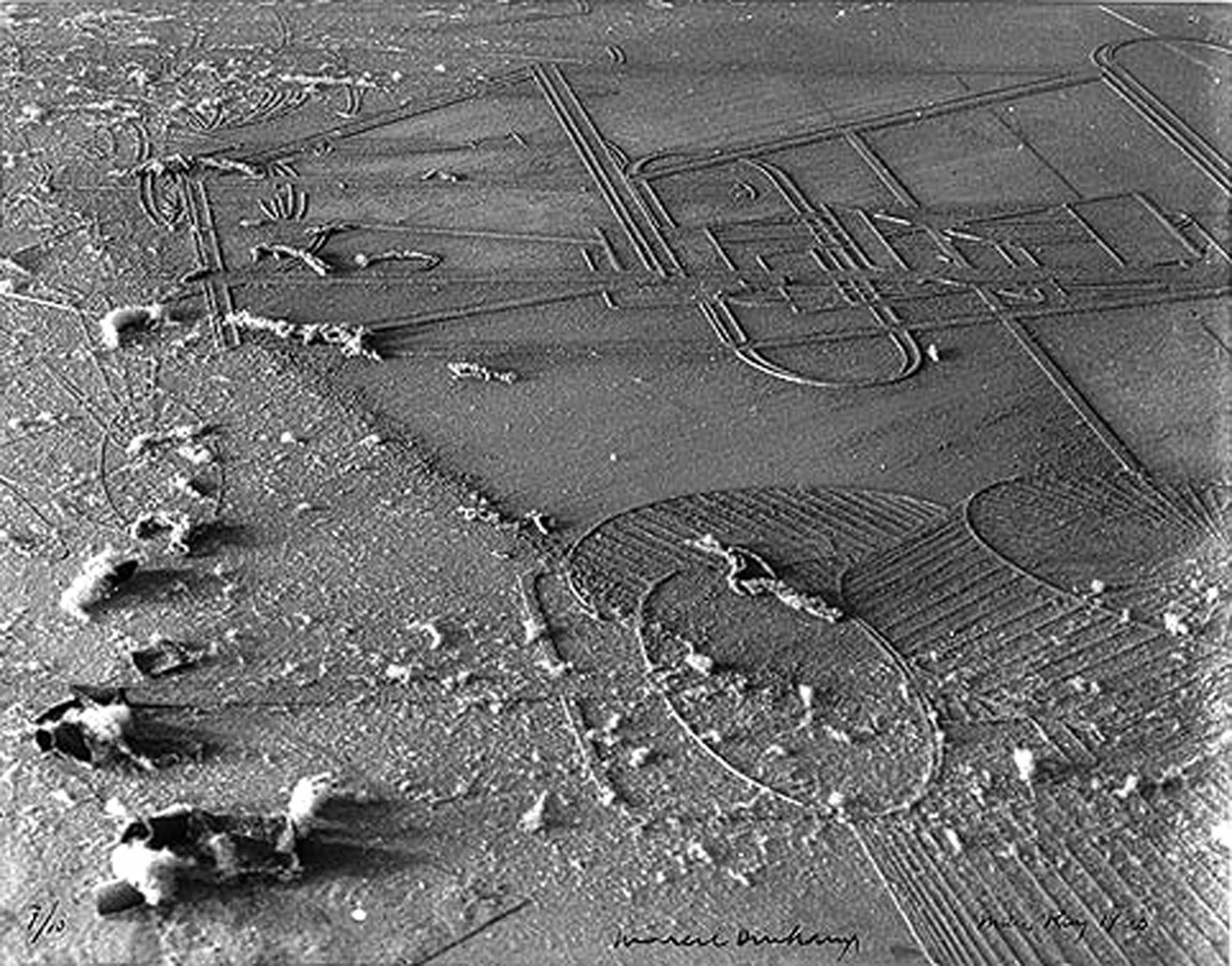
Duchamp employed the method of conserving the products of a chance operation (or “canning chance”) in 1913 when he “composed” the score for Erratum musical by drawing notes from a bag. He followed the same principle with his Élévage de poussière of 1920, in which a photograph shot by Man Ray captured for posterity the arrangement of dust particles as they had accumulated on the back side of Duchamp's La Mariée mise à nu par ses célibataires, même of 1915–1923 (otherwise known as Le Grand Verre, or Large Glass). (See Photo 3)
Marcel Duchamp and Man Ray, Élévage de poussière (1934). © Succession Marcel Duchamp / ADAGP, Paris / Arists Rights Society (ARS), New York 2013. © 2013 Man Ray Trust /Artists Rights Society (ARS), New York / ADAGP, Paris
However, the evocative expression “canned chance,” or “le hasard en conserve,” emerged from Duchamp's pen in 1914 when he was describing a work he had been laboring on since 1913 entitled 3 Stoppages étalon (3 Standard Stoppages) (Duchamp Reference Duchamp, Sanouillet and Peterson1973, 33). To make 3 Standard Stoppages, Duchamp dropped three lengths of string, each approximately a meter long, from the height of one meter from the floor. Using varnish, he then glued the dropped strings down onto pieces of canvas, thereby preserving their aleatory shapes for posterity. In The Green Box (1934)—a work with which Cage and Cunningham were familiar—Duchamp underscored that his objective was to allow each string to fall “as it pleases” (Duchamp Reference Duchamp, Sanouillet and Peterson1973, 33). 3 Standard Stoppages thus perfected a procedure Duchamp would use many times—in Unhappy Readymade (1919).Footnote 23Élévage de poussière, and elsewhere—which consisted in preserving a “condition prevailing at a given moment” as a sculptural memento.Footnote 24 Just as 3 Standard Stoppages froze the results of gravity first on canvas, then on wooden slats placed in a coffin-like box, so too works like Élévage de poussière turn accident into monument in a way that anticipates the chance-generated results of Cage and Cunningham's signature works. The procedures they developed during the 1950s—using I Ching hexagrams or imperfections on a sheet of paper to determine sequences (or what Cunningham called “continuities”)—hark back to Duchamp's early dadaist gestures. In particular, the Duchampian archival logic of producing the aleatory—then freezing it or placing it in a “boîte”—governs the primary archival logic not only of Cunningham's choreographic practice but also the scenic decisions made by his collaborators while planning the Park Avenue Armory Event. Even the nature of the Event's set design shows a clear debt to Duchamp. Daniel Arsham, the artist responsible for the set, chose to imitate Duchamp's archival logic with his polyethylene sculptures. Composed of what look like tennis balls (dyed various shades of gray), the hanging fixtures were actually modeled after photographs of cloud formations Arsham had taken while following the company during the previous months of the Legacy Tour. That is, the eight ball clusters Arsham hung from the ceiling of the Drill Hall document the contingent weather conditions that had accompanied the dancers, musicians, and technicians as they made their way through the two-year-long performance marathon. In effect, the ball clusters archive visually what company members saw each day, providing a register of the passage of time. As sculptural snapshots of unrepeatable and aleatory events, they keep a record of the accidental, the contingent, and the unintentional, that is, a record of precisely that which cannot be considered to be authored, or the product of human intention.
Park Avenue Armory Event: excerpt from Ocean. On the floor, near to far: Silas Riener, Andrea Weber, Marcie Munnerlyn, Rashaun Mitchell. Back stage, right: Jennifer Goggins. Back stage, left: Robert Swinston. Photograph by Anna Finke, 2011.
It is typical of the Park Avenue Armory Event that it juxtaposed this archival, almost Pompeian logic (to seize the everyday as if in stone—or polyurethane) with an emphasis on the utter freshness of the here and now. In keeping with the nature of performance as a live event, the results of the chance operation, once “canned,” had to be made to emerge from the coffin (or “boite”) onto the stage. In order to achieve this emphatic present-ness, the archive had to be re-animated, set into a new context or frame. With respect to the dancing, which involved, of course, the execution of steps archived in the muscle memory of the dancers, such a re-animation was achieved by means of a technique that Cage and Cunningham had developed early on in their professional lives. The Event organizers commissioned four works by the composers David Behrman, John King, Takehisa Kosugi, and Christian Wolff to accompany the forty-eight minutes of the Armory performance; then they decided to rotate the sequence of four musical compositions at every performance so that the dancers would encounter an entirely new score not only once, but twice each night.Footnote 25 This technique of rotating the musical accompaniment was consistent with the method Cunningham and Cage had devised some sixty years earlier, a technique that makes it impossible for dancers to identify rhythmic or dynamic touchstones as movement cues. To that extent, the final Event managed to retain more than just the choreography—as a set of movement patterns and rhythms; it also managed to capture the Cunningham “look.” The heightened alertness in the bodies and on the faces of the dancers, the sense that every gesture takes on a meaning in relation to that musical phrase, at that precise moment in time (and no other), successfully made the repetition of a “canned” sequence into the never done before. As Cédric Andrieux, a former Cunningham dancer, has noted, the separation of the dance from the music has profound effects on the dancer's experience (and thus on the spectator's experience as well). The release from musical accompaniment liberates dancers from an “imposed” emotion, freeing the movement from a predetermined dynamic or momentum. When dancing Cunningham “I am totally in the moment,” he states; although repeating learned sequences as accurately as possible, Andrieux remembers feeling authorized to “dance the movement according to how I am feeling, what I am thinking, on a particular day.”Footnote 26
Clearly, all participants in the Event—from Arsham to Swinton, from the costume designer to the musicians—were trying to aggregate and evoke as many of the practices associated with the Duchamp/Cage/Cunningham aesthetic as possible. There was one choreographic decision that Swinston made, however, that could be considered at odds with Cunningham's own preferences: the end of the Event was carefully orchestrated, rather than governed by chance or contingency, and thus differed significantly from the kind of closure—or lack thereof—often associated with his choreography.Footnote 27 In a 2011 interview, Swinston explained that it was crucial for him that all dancers exit the Hall together, so that the Merce Cunningham Dance Company could, as he put it, just “disappear. Nothing left. Gone” (Swinston Reference Swinston2011). He insisted, that is, that all three groups of dancers on all three stages should complete their respective sequences at the exact same moment and thus exit the Hall in unison. It is likely that Cunningham would have been content to let each group finish at a different moment and exit the stage on its own. He would not have needed—or even wanted—the dancers to make a symbolic gesture out of their exit, to “disappear,” as Swinston puts it, “Nothing left. Gone.” As Cunningham quips in “Space, Time and Dance” (1952), “Climax is for those who are swept [away] by New Year's Eve” (Cunningham Reference Cunningham and Kostelanetz1992, 39).
Still, there was something inspired in Swinston's choice, for it underscored an important aspect of the event. Whereas it might be possible to approach life as a series of equally pregnant, nonhierarchical presents, each one following another without climax or dénouement, the advent of death causes a definitive rupture in the sequence, and its difference cannot be ignored. As much as the Event aspired to leave its audience with a sense of continuing aliveness (an impression one certainly took away from the vigorous virtuoso performances), and as much as it projected itself into the future as a “legacy,” a series of potentially endless presents, it also marked a real conclusion, a point of no return: the dispersal of the Company Merce Cunningham had built, nurtured, and—no less rigorously—chosen to kill off. It is clear that for Swinston, at least, the unison exit symbolized the Company's closure and the inexorably definitive nature of Cunningham's death. The sudden and simultaneous evacuation of all three stage spaces did indeed convey a truth of corporeal disappearance (even if we, the audience members, knew that the Company would perform the same exact disappearing act six times over the next three days). Paradoxically, then, we were left with a visceral understanding of Merce Cunningham's disappearance, a disappearance that nevertheless could be repeated two times each night.
Achieving the repeatability of that which has ended has been one of the fundamental objectives of the Legacy Plan, which aims to overcome the definitive nature of death (and the closure of the company) by leasing out Cunningham's choreographies to other companies for reconstruction. These companies will extend the virtual lifetime of an aesthetic into the foreseeable and unforeseeable future, but the costs of such an extension are not entirely clear. When Swinston was asked why he was so troubled by the closing of the Cunningham Company—given that much of the repertoire will continue to be performed—he exclaimed, “but those dancers won't have been trained by Merce! These fourteen dancers are the collective memory of Merce's choreography!” He might just as well have said “these dancers are the collective memory of Merce Cunningham's body”; for Swinston, the Legacy to be preserved intact lies in Cunningham's body, that fragile archive of a particular way of moving and thinking about movement. To preserve this fragile archive, the dancers he trained would also have to remain active, both on the stage and in the technique classroom. Swinston's fear, which is shared by others, is a reasonable one, namely, that once Cunningham's dancers move on, the legacy will be diluted, perhaps beyond recognition (Swinston Reference Swinston2012). Essential to Swinston's concept of legacy, then, is not simply that the choreographies be archived through documents and recordings, but that the choreographies remain connected to Cunningham, performed and transmitted to other dancers by living bodies touched by his own.Footnote 28
All the dancers who took part in the Park Avenue Armory Event had been trained by Cunningham, and therefore their idiosyncratic inflections remained (at least for Swinston) within an acceptable range. But in reality, each step that was danced by his company at the Event constituted a step away from Merce, for the act of reviving always brings us closer to his end, closer, that is, to the forgetting of a specific body's way of moving. It could not escape the mind of the spectator that inevitably, one day, the choreography will be performed by dancers not trained by Merce Cunningham—or even by Robert Swinston, for that matter. Anyone familiar with the “dance capsules” project knows that that eventuality is, in fact, anticipated and even encouraged by the initial impetus of the Foundation: to preserve the work for future revivals. After all, the digital archiving of all existing documents pertaining to a dance expressly makes Cunningham's movement material available in the far-off future. Embedded within the self-understanding of the Legacy Plan—and registered in the futuristic name, “capsule”—is the knowledge that Cunningham's choreography will change, that new dancers will come to accent the movement differently, making it into something it was not before. Swinston's devotion to the Cunningham technique—more, to the Cunningham body—thus enters into tension with the “capsule” as a kind of embryonic body, a “can or Pandora's box,” a set of DNA to be grafted onto a new dancer who will develop the movement's “dispositions”—its preprogrammed possibilities—in an unforeseeable way. To what extent, then, does Cunningham's aesthetic die with his body, or with the bodies he himself trained? (The image of an avant-garde aesthetic that is also a body, that is contained in that body, and that dies with it takes on greater significance when we turn to the legacy of Marcel Duchamp.) Alternatively, to what extent is Swinston's concern misguided, given that Cunningham sought throughout his career to be more than a body; in fact, he sought to transcend his body, to short-circuit and foil the automatisms of his training, his anatomical limits and tendencies, and even the human-ness of his way of moving? Where precisely, should we locate Cunningham's legacy? In his unique way of moving as a dancer, in his Duchampian methods of choreographing, in his performance and collaboration techniques, or somewhere else?
Part II: The Body as Archive
The question of the legacy necessarily involves the question of the archive, for this is presumably where a legacy is stored and preserved. A legacy can be passed on verbally or visually, but that does not mean that there is not some surface, some matter, upon which it is retained or inscribed. As we have seen, the archival logic developed by Duchamp suggested a way of preserving the ephemerality of the living present that could inform both the act of creation and the act of reproduction; however, Duchamp was concerned primarily with the reproduction of static artefacts, not the reenactment of movement phrases. To capture precisely what is at stake in the passing on of a movement legacy, we need to turn to other notions of how legacies may be archived and reanimated, inscribed on a support and transformed by the contingencies of the re-embodiment.
Jacques Derrida has meditated in fruitful ways on the nature of the archive and the many forms it can take—from the most disembodied (an archive of objects, written documents, and recordings of live events, for instance) to the most embodied (what he calls “living memory”). In Archive Fever: A Freudian Impression, Derrida begins by exploring the distinction between the arkhe (durable remains) and mneme (personal recollections associated with an “alive and internal experience” of the phenomenon concerned). “The archive,” he proposes,
… if this word or this figure can be stabilized so as to take on a signification, will never be either memory or anamnesis as spontaneous, alive and internal experience. On the contrary: the archive takes place at the place of originary and structural breakdown of the said memory. There is no archive without a place of consignation, without a technique of repetition, and without a certain exteriority. (Derrida Reference Derrida and Prenowitz1996, 11)
Here, Derrida seems to be drawing a firm line between a “technique of repetition” and “consignation” peculiar to the archive proper on the one hand, and, on the other, the ostensibly non-technical, organic recollection by means of “alive and internal experience,” which requires no external support (or “place of consignation”). However, Derrida's ultimate purpose in Archive Fever is to interrogate this strict opposition. As Archive Fever proceeds, he begins to nuance his argument, indicating that in fact an archive of disembodied signs (written documents, photographs, video and audiotapes, and so on) is “alive” insofar as it requires acts of interpretation to be deciphered, and through these acts of interpretation, the archive constantly mutates and grows. In other words, an archive also requires life, the supplement of a reading and interpreting scholar who reanimates the materials before his or her gaze. Conversely, “living memory” (mneme or anamnesis ) is also a matter of deferral and reflexivity, and so can be considered, at least figuratively, to imply a technē. “Living memory” does not simply recall in precise and accurate detail the original event, but requires an organic support that reenacts and revises it in the process of retrieval. Indeed, as neuroscientists now argue, “to remember” is to retrace a neuronal pathway and thus, at the same time, to alter the former pathway that constructed percepts in the mind. The archive is thus exemplary of the fate of all returns—organic (neuronal) and otherwise. It presents a heightened case of the trace or deferral structure of experience in which the technē of consciousness, like the technē of the document (or mode of “consignment”), introduces self-difference into the unique event intended to be preserved.
Thus it might be said that Derrida and Duchamp are both interested in the fundamental paradox of the archive, which consists in the fact that by creating it one ends up altering that which one is attempting to preserve. In a sense—and here we return to our original concern—the Park Avenue Armory Event could be seen as structured by this very principle: an Event reiterates but also recreates, renews (brings back to life), and alters the movements of a former dance. The Park Avenue Armory Event—the Event to end all Events—was a presentation of this structural paradox au deuxième degré: the problem of replication as alteration was increased exponentially, such that, as I suggested earlier, “each step is a step away from Merce”; each recall was also a presencing of the past that would transform what that past would be.
Without referencing Derrida directly, performance theorist Diana Taylor has subtly reworked Derrida's categories, elaborating on his distinction between arkhe and mneme in ways that are useful for our present line of questioning. In The Archive and the Repertoire: Performing Cultural Memory in the Americas, Taylor (Reference Taylor2003, 19) opposes “the archive of supposedly enduring materials (i.e., texts, documents, buildings, bones)” to “the so-called ephemeral repertoire of embodied practice/knowledge (i.e., spoken language, dance, sports, ritual).” By opposing documents to dances, written language to spoken language, Taylor seems to return to the binaries Derrida sets in play in Archive Fever. In her study of Andean theatre collectives in Peru, for instance, she argues that the “cultural memory” of a traumatic event may be transmitted to future generations not through written and photographic documentation (and not even through oral testimony), but rather through “embodied acts” (Taylor Reference Taylor2003, 193)—“gestures” that the community recognizes and knows how to interpret as part of a generational response to traumatic violence. Considering a performance of Teresa Ralli's Antigona (2000), for instance, Taylor recounts how the actress “included the gestures she associated with the women [of the contemporary village] as a way of signaling the continuity of cultural gestures and behaviors. The women might not identify with Sophocles’ Antigone, yet they would recognize this as their story” (2003, 207–8). The “continuity” linking a figure from the past to the experience of the present is sealed by the performance of “cultural gestures and behaviors.” That is, Ralli engages her audience (and evokes their kinesthetic empathy) by imagining the movement vocabulary of the present to be identical to the movement vocabulary of the past. Imaginatively, at least, an experience of grief may be transmitted intact, not as recollection but as “gesture,” as actual sensory percept. These “embodied acts” (“cultural gestures”), writes Taylor, “cannot be contained or recuperated through the [written] archive,” but they can remain as elements of a “repertoire” to be reenacted again and again (2003, 193). Taylor argues that, alongside the official written archive, these “multiple forms of embodied acts are always present” in the communities she studies, “reconstituting themselves—transmitting communal memories, histories, and values from one group/generation to the next” (2003, 193).
It is important to underscore that the members of the audience Taylor describes are not invoking the past in some pure, unadulterated form. Taylor sees the repertoire as a site of “reconstitution,” not a site of pure “reliving.” On her reading, to transmit cultural knowledge is not to bequeath this knowledge utterly unchanged—and here we return to the problems discussed earlier in reference to the Legacy Plan. The “gestures” of which she speaks (and for which she provides photographic evidence) are actually highly stylized gestures adapted to the requirements of a theatrical mise en scène. This process of aestheticization has arguably rendered the gesture more rather than less effective as a mnemonic device for recalling and preserving experience, even though it adds to the archive by offering new images, experiences, and understandings (and, potentially, distortions) in its wake. Taylor is working with an understanding of cultural memory similar to that developed by Joseph Roach in Cities of the Dead, where “transmission is understood to be a “translation” (in Derrida's sense), a transposition, a repetition breeding difference as it moves from the body of one subject to another, and from one time period to another (Roach 1996). For Taylor and Roach, neither performance nor spectatorship involves exact transmission; it is not a matter of ghosting (and therefore rendering the present null) while re-living a past experience.Footnote 29 In fact, what Derrida says of the archive (the interpretation of the document alters what is documented) could just as easily be said of the embodied gesture (the repertoire): there is no pure inhabiting of the past, no thoroughly faithful repetition, for the very reason that the subject re-experiencing (or re-behaving) is also existing in a present alive with its own contingencies and demands. Although Taylor states that when “traditions are stored in the body … forms handed down from the past are experienced as present,” it is clear that this “present” is a complex and multilayered one. It is a “present” that is imbued with the past even as it prepares (through heightened dramatization) for recall and repetition in the future. Ultimately, then, there is less distance between the archive and the repertoire than there might at first appear.Footnote 30
However, even if we assume with Taylor that the “repertoire” is itself a mediated mode, we still have to ask how an archive imprinted on the muscles, ligaments, and sometimes even bones of the performers differs from an archive stored on paper or other nonhuman surfaces. What might be the difference between a legacy handed down as documents to be interpreted and a legacy handed down as movements to be performed?
Two distinguished scholars of dance, Mark Franko and Sally Ann Ness, have recently offered insightful meditations on legacies consisting of movement, thereby helping us to develop ways to theorize the preservation of choreographies as specific “repertoires,” or gestural routines. Their work addresses precisely the concerns expressed by Robert Swinston when he warns of the dangers of extending a choreographic repertoire after the death of the choreographer. In “Given Time: Dance and the Event” (2004), Franko reflects on a transmission scene that, while involving a classical dance form rather than a modern or avant-garde one, sheds some light on the question of the embodied archive. He describes an impromptu dance lesson filmed on a street in Bali by Gregory Bateson in Learning to Dance in Bali (1936–39) in which a renowned dancer named Mario teaches Murda, a young novice, elements of a dance routine through a haptic and kinesthetic procedure. For Franko, the scene illustrates the transfer of the present, or what he felicitously refers to as a “gratuitous gift” (2004, 119). Murda does not watch Mario perform, then copy his movements; rather, Mario places the limbs of the student in the proper position and thus “circulates” his own “self as mark” (Franko Reference Franko and Lepecki2004, 120). Franko writes:
Mario positions himself behind his pupil whose arms and torso he manipulates into the positions and through the trajectories of the choreography he imparts. … Mario offers no image to mimic. … Mario's movements are presenced in Murda's body at the very moment Murda “learns” them, or is given them to learn. … Teaching a movement is giving something of oneself, and this gift of movement indexes the force inhabiting the gift as described by Mauss. … This force—the motor of posteconomic circulation—involves the “circulation” of self as mark. (Franko Reference Franko and Lepecki2004, 120)
Following Franko, we could think of this “gift” as a type of legacy, one that is contained in a self (Mario's bodily memory and understanding of the tradition). This legacy can only be transferred—and preserved—by marking the other with the self, that is, by imprinting on the other's body an experience that can in turn become part of that second self in the form of muscular/skeletal structure and the memories the embodied self can pass on.
Although touching was not the primary way in which Cunningham taught his choreography, he is known to have placed his dancers in the postures he had in mind. In his later years, however, Cunningham was unable to demonstrate phrases or interact physically with his dancers, as he had before. He was forced to describe the movements and phrases to the dancers who stood expectantly before his desk. Cunningham dancer Andrieux describes the process whereby Cunningham indicated first the leg movements, then the position of the torso, then finally the position of the arms. These positions and phrases were based not on those he had himself executed, but rather on those executed by a computer avatar (nicknamed “Biped”). (Some revealing scenes of choreographic instruction are to be found in films such as CRWDSPCR, or short vignettes available on the Web site Mondays with Merce.Footnote 31) It is not clear, then, that the “self” being “circulated” from teacher to student has anything to do with Cunningham's “self,” understood as a singular body, or even as a plural, acculturated human body (a subject of the habitus). On the contrary, it seems that the “self” to be circulated during the process of choreographic transmission is a composite of human input (the “gamut” of movements entered into the computer “memory”) and an inhuman output (the computer's recombination of these movements). If Franko is concerned with a “dance form's fragile cultural identity” (2004, 121; added emphasis) in his account of the Bali dance transmission scene, we might want to say that Swinston is concerned with a dance form's a-cultural identity, its existence as technique-of-construction only tangentially related to a singular body's privileged “gamut” of movement possibilities. It is important, then, to underscore that Cunningham and his dancers are not preserving through transmission a “cultural” dance tradition per se, and yet the same combination of present and past, the self as mark and the self as marking, are still involved. The “presencing” of a Cunningham dance phrase in the body of the dancer he is training produces not only a complex present but also a complex body: the habitus that is transmitted to the dancer, the “self” that is circulated, is one that exceeds any previously given cultural habitus, any previously given singular body. The “self” is circulated as this excess; it is precisely that which is beyond any particular individual aesthetic (singular way of moving) or particular cultural tradition that leaves the mark.
Sally Ann Ness has approached the question of movement transmission from a slightly different angle, asking whether the mark of dance is reducible to a bodily inscription (muscle memory) or whether it represents something more. She is interested in what, precisely, is contained in a dance archive, and whether it might convey meanings relevant beyond the relatively limited semiotics of dance. In “The Inscription of Gesture: Inward Migrations in Dance” (2008), Ness builds on Franko's argument, suggesting not only that the “gift” of movement involves acts of inscription, but also that this inscription, in the form of a circulating gesture, might also be thought of as bearing meaning. Similar to verbal inscriptions, she proposes, gestures belonging to a dance form might communicate an ethos or an approach to life. This would mean that along with the movement “gift” that Mario bequeaths to Murda there comes another kind of lesson—a perspective on how to behave, on what constitutes proper comportment, beauty, grace, and even strength. In the dance traditions she references—Balinese classical dance and Western ballet—a particular “form of life” is enacted, circulated, handed down. In the case of Balinese classical dance, she notes, postural balance, maintained by “extraordinary limb control, endurance, and meticulous precision,” entails “basic assumptions” that reach “far beyond dance in their cultural significance” (Ness Reference Ness, Noland and Ann Ness2008, 13–4). Following Bateson (and echoing Wittgenstein), Ness suggests that the dance demonstrates “a particular way of thinking”; it is “truly integral to the ongoing practice of balance in a specifically Balinese form of life” (2008, 14; added emphasis). For Ness, this “thinking” engenders “principles of conduct” and can be considered comparable to an argument (2008, 25).Footnote 32 Accordingly, in receiving instruction in a dance tradition, a student would become “something very much like a living monument to a given technical ‘discourse.’ … [The body] appears as a durable host, an organism whose ‘final form’ preserves in its very bones the understanding of a certain tradition of intelligent, methodical practice” (Ness Reference Ness, Noland and Ann Ness2008, 22; added emphasis).
Ness's phrasing here is significant: “the very bones” of the living body preserve an “understanding”—not simply a habit but an “understanding”—associated with “a certain tradition of intelligent, methodical practice” (2008, 22).Footnote 33 Against a tradition of scholarship that emphasizes the ephemeral and purely physical nature of bodily experience, Ness argues that the body's “understanding” participates in producing culture, duplicating itself through what Franko calls “events,” or scenes of transmission, in which two separate bodies act in concert to preserve and perform both a set of movement phrases and an approach to life. Ness's observations are especially pertinent to Cunningham's choreographic method since it is inspired by—and circulates—an understanding consistent with a Zen “form of life.” In a sense, then, we could say that Cunningham makes a culture out of the practice of exceeding what any one given culture has to give. That is, he creates a habitus—techniques of the body inscribing an understanding—out of that which no single habitus can contain; he creates bodies by circulating what no body ever executed; and finally, he creates a present out of what never existed in the past.
It could be objected that Cage, too—and even before Cunningham—employed Zen principles to un-ground cultural prescriptions, and this would of course be true. But what is different, unique, and potentially more radical in Cunningham's practice is that he extended a “form of life,” a Zen approach to the experience of time and an anti-foundationist approach to the circulation of culture, to the production of human movement in space. To be sure, Cage was responsible for creating a new soundscape, but this soundscape left marks only on our aural memory (and arguably altered perception), whereas the choreographer left marks on actual bodies. A way of moving is indelibly imprinted in/on the dancers of the Merce Cunningham Dance Company. But that does not mean that that way of moving, allied to and conditioned by a “form of life,” resides in their bodies alone or will die out when they are gone if the “form of life” can be preserved, archived, and circulated as time goes on.
And herein lies the crux of the issue for the Legacy Plan and its heirs. What must be bequeathed to subsequent generations is not simply the way Cunningham choreographies look, for that is something that could be preserved fairly well by digital means. What needs to be preserved (and what informs the Cunningham “look”) is the “form of life” or “understanding” that Cunningham's practice entails. That is, it is not enough to preserve Cunningham's dances (or even his dancers) as if they could be entirely separated from what was for Cunningham and Cage a mode of conduct, an ethos, and even a way of being in the world, a kind of anti-ontological ontology demanding defiance of whatever one was before. Ultimately, the object of the Cunningham archive, that which must be transmitted from one generation to the next, is a collection of movement phrases (an archive) and—equally importantly—an “understanding,” a mental stance contained in the very flesh of those formed by his technique. This understanding is a “form of life” similar to the ones Ness identifies as social (not simply physical), such as the ethics of balance manifested by the Balinese dancer or the ethos of precision manifested by the ballerina.
Paradoxically, however—and this point is crucial—the “form of life” consistent with the Cunningham technique involves a radical openness to what no technique can foresee. In the case of Cunningham, we are not talking about “cultural memory” (as in Taylor's discussion of Ralli and the “repertoire”), but rather about the critical un-grounding of culture, the adventure of the extracultural, the “blindspot” of the new. It is the “whatever happens next,” the radically unknown, that is the center of Cunningham's interest.Footnote 34 Cunningham himself stated that the purpose of the technique he developed during the late 1940s and early 1950s was to facilitate the execution of rapid and unexpected changes of direction and unusual combinations of isolated movements, focusing on the spine as the flexible core.Footnote 35 Although during his lifetime Cunningham developed a rigorous and coherent mode for training his dancers, a “Cunningham technique” proper to him, this training was predicated on an ideal: that the technique should prepare dancers for all contingencies not covered by already executed movement phrases. In other words—ideally at least—the technique should allow for a certain form of self-abandonment, that is, an abandonment of past routines archived in the self.Footnote 36 It is for this reason that we need to consider the technique not simply as a set of classroom exercises that hammer into the body of a set of inscriptions, or habits, to be reiterated by rote; the technique also serves as a way of preparing dancers psychologically and kinetically to confront the unknown.Footnote 37 Cunningham wanted his dancers to be alert to the present dangers of performing, intensely aware of their place in space, their position vis-à-vis other dancers, and the constraints of an allotted time frame. From the start, Cunningham worked to form dancers who would engage at every moment in thinking, kinesthetically and proprioceptively, rather than emoting, picturing internally a story line or a rehearsed, predetermined emotion. Why else would Cunningham have deprived his dancers of musical accompaniment during rehearsals unless he wanted them to develop a more acute awareness of where they were, at any given moment, on the stage? Why else would he have pressed them to perform the same phrases in different orders and scenic situations unless he wanted to short-circuit mindless reiteration and thus force them into the present—even while repeating steps they had executed before?
Arguably, the task of archiving how a Cunningham dance looks depends entirely on archiving the Cunningham “form of life.” That is, a Cunningham dance will not look like a Cunningham dance unless the Plan finds a way to preserve the full range of stage and performance techniques—from last-minute chance-determined sequencing changes to collaborative non-collaboration—that challenge a dancer's capacity to repeat. What a spectator of the Merce Cunningham Dance Company sees—or, more accurately, saw—is a performed understanding, that is, a company of dancers exhibiting an understanding of how to repeat the past in the present as they have never done before. This understanding is what makes a Cunningham dance a Cunningham dance, and it is precisely the element that challenges the Legacy Plan as it prepares to transport his legacy into the future.
Cunningham technique is thus not traditional (or not “establishment”) in two senses: it is not a national or “cultural” dance tradition shared by an entire community, intended to recall or represent a shared history; nor does it offer the dancer a routine of phrases to be recombined in fairly predictable ways (as does, for instance, classical ballet). To some extent, Cunningham's avant-gardism inheres in his rejection of tradition as it has been embodied in modern and classical forms of dance training. More importantly—and this is the key to his profound difference vis-à-vis other modernist choreographers of his generation—his avant-gardism inheres in his rejection of tradition as it exists in his own body, that is, in his own bodily programmation.Footnote 38 If all habitual movements, all gestural routines, possess their own liveliness, their own intelligence trained to cope with an unanticipated change, the Cunningham technique aims to make that intelligence primary, to dilate it to such an extent that any new vocabulary element might be accommodated—whether generated from a computer or found on the street. The goal is to make a habit out of not reiterating the habitual, to outwit tradition (both cultural and personal) by making the search for the nontraditional itself an “established” practice (to evoke Carolyn Brown's distinction once again). It is this established practice, this countertraditional tradition, that is the object of the legacy to be bequeathed.
The word “tradition,” then, should be understood in the broadest possible sense: as whatever movement tradition or cultural habitus Cunningham, the social subject, originally acquired (the social past); as whatever movement vocabulary Cunningham, the dancer, learned from his predecessors (the aesthetic past); as whatever dance phrases Cunningham, the choreographer, had last created (the personal past); as whatever biologically determined tendencies and unique motor capacities resided in his own body (the genetic past). Cunningham's ultimate rebellion, I would argue, is against this embodied “tradition,” or past, the accumulation of knowledges and understandings the body receives as a host and stores as an archive. He strains against the archive that is constituted by the self, the archive the self necessarily is.
The questions for the Legacy Plan are thus the following: How does one preserve an avant-garde technique of composition and performance that undermines learned techniques of composing and performing in principle? How does one carry on the imperative not to reiterate, not to carry on? For it is clear that Cunningham generated not simply a set of choreographies or a set of classroom exercises but also a “form of life.” The “understanding” embodied in his practice informs a way of approaching dance, to be sure, but also a way of going on tour, a way of confronting new technologies, and even a way of accepting the aging body on stage. This is not to say that everything about Cunningham's work was revolutionary; on the contrary, he could not help but be a product of his own time and thus, perhaps unconsciously, set limits on which traditions, which habits, he could aim to break. For instance, he never lost the habit of thinking in terms of the heterosexual duet, he never relinquished his preference for slim (and almost always white) dancing bodies, and he never abandoned the standard program length for concert dance, that of an hour and a half.Footnote 39 My point, finally, is not that Cunningham is the most anticonventional, self-interrogating choreographer ever to exist, but that he was the first to choose as an explicit objective of his work the task of refusing the movement legacy he understood to be contained within his own, acquired ways of moving. Paradoxically, he was also the first to recognize that the products of such a refusal could themselves become the object of repetition, that one could congeal the results of nonhabitual, chance-derived movement phrases into repeatable choreographies, thereby creating new archives both within and beyond the self. He was the first, in other words, to translate into dance an exploration of the “incompatibles” associated with Marcel Duchamp, and, as I will argue in the concluding section, to go beyond Duchamp toward a vanishing point where only dance can go.
Part III: Movement and Chance
Although Cage and Cunningham developed chance procedures largely on their own,Footnote 40 the aesthetic they were developing in the 1940s and 50s was one that had been introduced by Marcel Duchamp fifty years earlier.Footnote 41 Cage first met Duchamp in 1942 at the home of Peggy Guggenheim, but the entire Cage milieu—Cunningham as well as Rauschenberg and Johns—developed a deeper acquaintance with him during the 1960s. Cage, especially, recognized a close affinity; as early as 1913, in Erratum musical Duchamp had experimented with chance operations in a manner that anticipated Cage's own. This exercise, as I have shown, taught Duchamp that a refusal of intention could go hand and hand with a heightened desire to document intentionally, just as a refusal of tradition (in the form of a previously acquired skill set) could be reconciled with an obsessive interest in self-archiving, in repeating oneself.Footnote 42
Critics have long recognized that Duchamp's influence on the post-war American neo-avant-garde was profound and long lasting. However, whereas Cage tended to emphasize Duchamp's probing of authorial control through the invention of non-intentional methods, Jasper Johns became intrigued with Duchampian seriality, and the generation of artists around Daniel Buren and Michael Asher focused on Duchamp's institutional critique,Footnote 43 Cunningham, as might be expected, took up Duchamp's challenge to explore the relationship between movement and the stasis, advancing and congealing, which the artist had earlier investigated in works such as Nude Descending a Staircase, no. 2 (1912).
The organizers of the Park Avenue Armory Event were obviously aware of Duchamp's influence on Cunningham, although I believe the Event was even more thickly allusive than they would have acknowledged. For instance, when asked why the Park Avenue Armory had been chosen as the venue for the last performance of the Merce Cunningham Dance Company, Swinston replied: “Because that's where the Memorial for Merce was held” (on October 28, 2009); a large, commanding space, he explained, was needed to accommodate both occasions (Swinston Reference Swinston2012). When pressed further, however, Swinston admitted that the choice of venue might have contained a reference to John Cage's 9 Evenings: Theatre and Engineering, a 1966 performance that took place in the same space. But Swinston was not clear: in fact, Cage's collaborative musical extravaganza, which featured contributions from Billy Klüver, Robert Moog, and Robert Rauschenberg, was not held at the Park Avenue Armory. It was held at the Lexington Avenue Armory of the 69th Regiment—that is, in the same building that housed the 1913 International Exhibition of Modern Art in which Duchamp's Nude Descending a Staircase, No. 2 was first displayed.
Marcel Duchamp, Nude Descending a Staircase, no. 2, 1912. © Succession Marcel Duchamp/ADAGP, Paris/Arists Rights Society (ARS), New York 2013.
The use of an Armory, loft, warehouse, or hangar space as an exhibition or performance venue is now a staple of the American avant-garde's history. The Armory venue may be considered a "lieu de mémoire" of the avant-garde, conjuring forth immediately a lineage that extends back to Duchamp and to what many have taken to be the inaugural moment of neo-dada and the American avant-garde.Footnote 44 To a scholar of modernism, the last performance of the Merce Cunningham Dance Company could not but recall the first performance by Duchamp, his entrée sur scène, so to speak, as the ringleader of twentieth-century experimentalism. Clearly, as Swinston has underlined, the Cunningham Event was connected to the Duchamp Event by a thread running directly through Cage and Rauschenberg's 9 Evenings: Theatre and Engineering. Footnote 45 Yet the 1913 Armory Show and the 2011 Park Avenue Armory Event were linked in an even stronger, yet more subtle way. During two performances of 9 Evenings, Robert Rauschenberg staged a faux tennis match with real tennis balls as part of a performance piece entitled Open Score. The rackets were attached to amplifiers that emitted a clanging sound every time a tennis ball was hit. When the game ended (each hit dimmed the lights more until the Hall was shrouded in complete darkness), three screens projected real time images of a large group of men and women completing gestures, one of which was the removal—the stripping, if you will—of the jackets they had been wearing. It is possible, then, that Daniel Arsham's ball clusters, hung from the ceiling during the Park Avenue Armory Event, referenced not only the aleatory and ephemeral cloud formations seen during The Legacy Tour but also, as a gesture of memorialization, the tennis match in Rauschenberg's Open Score.Footnote 46 If that is the case, then the Park Avenue Armory Event actively archived a whole host of previous performances—not only by Cunningham but also by his former collaborators, including Duchamp.
The works by Cunningham that refer directly to Duchamp indicate that he was well aware of the legacy he was inheriting. Consider, for instance, the choreography entitled Walkaround Time of 1968. The term, “walkaround time,” refers to an interval, a technologically determined period of time, in which one waits for the computer to complete its task. During this period one is free to leave the desk and thus to “walk around.” The interval is an aleatory measure of duration, a “time bracket,” in Cage's terms, into which one might put anything, at any pace. And pace is clearly the theme of Walkaround Time, as well as its fundamental material; the dance explores how fast one can move, how slowly one can move, and how the same thing can look quite different when performed at various speeds. Critics have focused largely on the iconography of Walkaround Time, which is to be expected, given that it is explicitly a work of homage to Duchamp and even contains replicas of The Large Glass. To be sure, The Large Glass and Nude Descending a Staircase, No. 2 provide much of the visual and ideational material for the choreography. However, a previously unremarked source also determines some of the movement phrases: René Clair and Francis Picabia's Entr'acte, a film of 1924 in which Duchamp appears in a cameo role. As I hope to demonstrate, Cunningham drew heavily from the visual meditation on human locomotion and seriality found in this film. The type of movement material that he chose to integrate into his choreography indicates something significant about how Cunningham approached his own body as an archive while also helping us to address the problem of how that archive might live on in the form of a legacy (not a body) after the choreographer's death.
The origin story of Walkaround Time has achieved almost mythic status, perhaps because it illustrates the spontaneous and informal quality of the collaborations that Cunningham engaged in during the 1960s. In an interview with David Vaughan (1992), Cunningham described the genesis of Walkaround Time as a kind of fortunate accident. Apparently, Cunningham, Cage, and Jasper Johns were eating dinner at the New York apartment of Duchamp and his wife, Alexis (Teeny), when Johns suggested that the choreographer “do something” with The Large Glass (La mariée mise à nu par ses célibataires, même [1915–1923]).Footnote 47 When Cunningham responded enthusiastically, Duchamp replied that he would give his permission; however, he did not want to have to replicate the images himself. Johns, therefore, took on the task of transferring seven discrete sections of The Large Glass onto transparent plastic cubes of varying dimensions that could be moved about the stage during the dance.Footnote 48 Meanwhile, Cunningham began to reflect on Duchamp; “Then I thought about Marcel,” he explains in an interview with Vaughan, and this process led to a meditation on what Duchamp's legacy might mean specifically for him.
Out of this period of questioning, Cunningham developed a multilayered, forty-eight-minute-long piece, which premiered at the University of Buffalo on March 20, 1968, and which was danced by Merce Cunningham, Carolyn Brown, Barbara Lloyd, Sandra Neels, Valda Setterfield, Albert Reid, Meg Harper, Gus Solomons Jr., and Jeff Slayton. The music, composed by David Behrman (in residence at Buffalo at the time), was entitled “… for nearly an hour …” after a piece Duchamp made in glass in 1918, To Be Looked At (From the Other Side of the Glass) with One Eye, Close to, for Almost an Hour. Unbeknownst to the Company, Walkaround Time would end up playing the role of summation and homage, for Duchamp died later that year, on October 2. Thus, Walkaround Time also became a kind of archive in retrospect—a compendium or “boîte” of famous Duchampian iconographies and conceptual gestures.
The following analysis focuses on the dance as it appears in the film version created in 1973 by Charles Atlas. In this incarnation of Walkaround Time, the cast is slightly different: the dancers filmed include several from the original cast—Brown, Setterfield, Neels, Harper, and Cunningham—but they are joined by Ulysses Dove, Douglas Dunn, Susana Hayman-Chaffey, Chris Komar, and Chase Robinson.Footnote 49 While critics have compiled exhaustive lists of the iconographic details Cunningham lifted from The Large Glass and Nude,Footnote 50 I will focus on a “readymade” that the choreographer located in Entr'acte, the film in which Duchamp played a cameo role. (Entr'acte was first projected during the intermission of a ballet entitled Relâche performed by the Ballet Suédois in 1924.Footnote 51) Similar to many films of the pre-sound era, Entr'acte explores the ways in which movement can be captured on film, inventorying turn-of-the-century cinematic “trucs,” such as those pioneered by Georges Mélies: slow motion and accelerated motion, but also the rewind, or action in reverse, and the montage technique that makes it seem as though something seen (e.g., a body) suddenly vanishes without a trace. It seems appropriate that Cunningham would be attracted to Entr'acte as a source for movement inspiration, given that it experiments so freely and encyclopedically with what were then the capacities of the medium to capture the moving body on film. There is one scene in particular that must have caught Cunningham's eye, for we see clear traces of it in the movement vocabulary he used for several sequences of the dance. This scene occurs in the latter half of Entr'acte, after a hunter—the erstwhile protagonist of the film—has been shot and his funeral has ended. The hunter, now inside a coffin conveyed by a hearse, traverses the city, followed by a crowd of mourners. After being led by a camel (!), the driver-less hearse then begins to speed up and the mourners are obliged to run at breakneck pace to keep up with it. The hearse enters the countryside, at which point the coffin finally falls off and lands in an open field. The coffin then opens to reveal a living man, the hunter miraculously returned to life, who rises up holding a magic wand. This revenant points the wand toward each mourner in turn, causing him to vanish into thin air. The resuscitated hunter then points the wand toward himself and promptly disappears to end the film.
Dalia Judovitz (Reference Judovitz2010) has argued that in the burial scene of Entr'acte, the filmmakers are explicitly alluding to the battles that were taking place at the time between two wings of the interwar avant-garde. Apparently in 1921 a group of Beaux Arts students orchestrated a “happening” in which a coffin labeled “Dada” was tossed into the Seine.Footnote 52 This symbolic gesture dramatized André Breton's pronouncement that same year that “Dada is dead!”—his characteristic way of striking down an opponent in order to assume the position at the head of the pack. By figuring Dada as a body that could be buried, Breton and the Beaux Arts students reinforced the rhetorical habit of personifying an aesthetic as a living being that can die—or, more to the point, a living being that can be killed off in the agonistic battle for avant-garde predominance. In Entr'acte, not only does the corpse (or avant-garde movement) turn out to be a live man—Picabia's riposte to Breton (a filmic equivalent of “Dada lives!”), but the funeral also ends up turning into a race. Interestingly, as the pace of the procession accelerates, the camera speed slows down, so that what the film's spectators see is a slow-motion capture of bodies in the act of accelerating as they run laterally across the screen. This remarkable sequence offers a breakdown of the postures involved in walking, running, then full-out sprinting, and thus recalls the movement dissections effected by Jules-Etienne Marey in his serial chronophotographs that so fascinated Duchamp (See Photo 6).
Jules-Étienne Marey, chronophotograph from Le Mouvement (1894). [Rights are in the public domain.]
Although Duchamp may have had little to do with the choreography of the funeral sequence, the relevance of dissected locomotion to his own interests in Nude Descending a Staircase, No. 2 is clear. One can easily discern a continuity linking René Clair's sequences of running to Duchamp's own concern with chronophotographic, snapshot seriality, as is evidenced in his attempt to capture the various stages of locomotion in Nude Descending a Staircase, No. 2.Footnote 53 In the scene of the funeral procession, each stage of the mourners' gait appears clearly, almost discretely, because of the distorting speed of the film in the camera. For instance, in Photos 7, 8 and 9, we see members of the procession caught at various moments of a lunge, their knees held high with one leg stretched out behind them and a shod foot cocked up.
René Clair and Francis Picabia, Entr'acte (1924); men in black suits. Permission to reproduce granted by Jean-François Clair.
René Clair and Francis Picabia, Entr'acte (1924); men in black suits and single mourner in white, hopping. Permission to reproduce granted by Jean-François Clair.
Credit line: René Clair and Francis Picabia, Entr'acte (1924); single mourner in white midair. Permission to reproduce granted by Jean-François Clair
Consider now the duet between Douglas Dunn and Susan Hayman-Chaffey, which occurs near the end of the first half of Walkaround Time. Here (Photos 10–13) we witness a curious scene in which Dunn lunges forward at a drawn-out pace while Hayman-Chaffey makes sudden little hops at his side. Their combined movements recreate the jerky effect of early filmed movement, while at the same time recalling the overlapping leg positions we see in the screenshots from Entr'acte (Photos 7, 8 and 9). In effect, Cunningham has excerpted and isolated positions from the running sequence found in Entr'acte, positions that belong to the continuum of movement linking one stride to the next, one point of balance to another. He has tried to imitate, that is, what only decelerated film (or chronophotography) can show us, the part of the stride that cannot be held in real time because it takes place in the air. Thus, Cunningham has incorporated into his dance vocabulary a posture he could not have seen with his naked eye; without the camera's optical unconscious, we would be blind to this in-between movement. The lunge is a mechanically seized element copied by a human being, and thus the dance (like the camera) becomes a register of the ephemeral—a preserver of postures unintentionally produced. (Cunningham foreshadows here his use of the DanceForms software avatar to generate inhuman sequences of movement for Biped [1999].) Paradoxically, although Walkaround Time is clearly dedicated to Duchamp, it is one of Cunningham's least chance-generated works. (Much of the movement material is lifted intentionally from the French artist's iconography.) However, at least in Dunn's sequences, what is being copied intentionally is something that can only be isolated unintentionally (and by technological means). Dunn's posture approximates a posture that no human could hold, an in-between linking movement registered by slow motion cinematography and then isolated by the choreographer's eye, imitated, and transformed into a vocabulary element of a dance.
Walkaround Time, dir. Charles Atlas (1973); choreography by Merce Cunningham (1968). Permission granted by Charles Atlas and Lynn Wichern (Merce Cunningham Trust). Dancers: Douglas Dunn and Susana Hayman-Chaffey. Leap and lunge.
Walkaround Time, dir. Charles Atlas (1973); choreography by Merce Cunningham (1968). Permission granted by Charles Atlas and Lynn Wichern (Merce Cunningham Trust). Dancers: Douglas Dunn and Susana Hayman-Chaffey. Landed leap and stride.
Walkaround Time, dir. Charles Atlas (1973); choreography by Merce Cunningham (1968). Permission granted by Charles Atlas and Lynn Wichern (Merce Cunningham Trust). Dancers: Douglas Dunn and Susana Hayman-Chaffey. Preparing for the next step.
Walkaround Time, dir. Charles Atlas (1973); choreography by Merce Cunningham (1968). Permission granted by Charles Atlas and Lynn Wichern (Merce Cunningham Trust). Dancers: Douglas Dunn and Susana Hayman-Chaffey. Landing and taking off again.
The practice of manipulating variables in order to produce the unintentional (dropping a length of string, floating fabric before a window) is, as I indicated earlier, associated with the chance procedures of Duchamp. Just as he worked to integrate into his paintings the results of a chance operation that he could not have produced willfully, so too Cunningham incorporates into dance a gesture derived from human movement, yes, but from human movement as it has been mechanically captured. In other words, he incorporates into his own movement vocabulary an element that has never before belonged to either the classical or modern repertoire. The camera provides Cunningham with a revelatory glimpse of the in-between movements intrinsic to learned gestural routines—such as running or hopping—in-between movements that I have theorized elsewhere as potential material for the innovation of our corporeal possibilities (see Noland Reference Noland2009). These un-tapped corporeal possibilities—such as the awkward lunge performed by Dunn and Hayman-Chaffey—have not yet been weighted down by semantic content. They do not have to be ripped out of a pre-established dance vocabulary and de-semanticized. They are captured naked of symbolic meaning and emotional intensity, although they certainly contain a kinetic intensity that can be mobilized for other choreographic ventures. Here, Cunningham mobilizes a kinetic element, seized by the aleatorics of slow motion capture, to forge an entire dance sequence. The “walkaround time” to which the title alludes could be seen, then, to name not simply the interval during which the computer programmer waits for the data entered to produce a result, but also the interval just after a gesture has been performed, denuded of its customary meaning and function, before it has yielded meaning or “information” in a cybernetic sense. Cunningham's explicit goal in training his dancers in the way he did was to make it possible for them to execute and permute vocabulary elements lifted out of their place in a conventional syntax or learned routine. He looked everywhere for these unremarked kinetic elements, focusing first on street life, then on animals, then on images in film, on TV, and finally, the computer screen. (This is why he never could be satisfied with the Judson Church critique of dance through the integration of everyday task movement; he sought a much wider vocabulary than task movement could offer.) We may observe in a later sequence of Walkaround Time a similar attention paid to the in-between movements of a repeated stride: this time, the stride is performed by Sandra Neels in an exquisitely stylized fashion and at an achingly prolonged pace.
Walkaround Time, dir. Charles Atlas (1973); choreography by Merce Cunningham (1968). Permission granted by Charles Atlas and Lynn Wichern (Merce Cunningham Trust). Dancer: Sandra Neels.
Walkaround Time, dir. Charles Atlas (1973); choreography by Merce Cunningham (1968). Permission granted by Charles Atlas and Lynn Wichern (Merce Cunningham Trust). Dancer: Sandra Neels.
Walkaround Time, dir. Charles Atlas (1973); choreography by Merce Cunningham (1968). Permission granted by Charles Atlas and Lynn Wichern (Merce Cunningham Trust). Dancer: Sandra Neels.
Walkaround Time, dir. Charles Atlas (1973); choreography by Merce Cunningham (1968). Permission granted by Charles Atlas and Lynn Wichern (Merce Cunningham Trust). Dancer: Sandra Neels.
Neels's lateral movement across the stage is emphasized by Atlas's static camera, which never adjusts the frame to follow Neels as she enters and exits on either side of the screen. Whereas the camera appears in the rest of the film to be relatively free, able to adapt its “gaze” to whatever is happening on the stage, here the optic is fixed and immobilized. At the beginning of the solo, we see Neels's hand reaching forward into the screen, whereas at the end we see only the tip of her foot as she disappears to stage left. During a live performance, Neels's solo would have been framed somewhat differently (according to the dimensions of the stage, not the lens), but the general effect would be the same. Either way, we watch Neels cross from one side to another and become acutely aware of the stage as a square, almost two-dimensional space. Cunningham has managed to realize the stage as canvas, accomplishing what Duchamp dreamed of doing—rendering the impact of movement in a static medium, only he does so in reverse: he renders the impact of stasis in the medium of dance. The step forward becomes the center of attention; as in Entr'acte and Nude, the step, the shift of balance from one foot to the other, is the fundamental building block out of which more complex visual sequences are made. Simply by manipulating the pace of a single step, or, put differently, simply by controlling the rhythm of the repetition of that step, Clair, Duchamp, and Cunningham produce complex works of art.
Neels's sequence in particular presents itself as a meditation on the unique as at once self-identical and ever-changing, for as much as she attempts to reproduce, with exactitude, her own past movement, she must—like Duchamp and his “boîtes”—register with each and every step forward the slightest increment of difference. (Duchamp called this slight, infinitesimal difference the “inframince.”Footnote 54) Cunningham's experiments with pacing draw our attention to this infinitesimal difference, and thus to the multiple micromovements, the deep complexities of articulation and balance, the limitless possibilities for erring (in the sense of swerving from the original path).
We could rest here, noting how Cunningham inherits Duchamp's legacy and then makes it his own. That is, we could locate Cunningham's legacy in his way of generating dance phrases through aleatory procedures, then congealing these phrases so that they could be archived and repeated again. Or we could locate his legacy in a particular manner of training dancers, a technique and a “form of life” that prepares them to confront the challenge of the never-heard-before score (or the never-seen-before set design or venue). All these aspects of the legacy are gifts Cunningham leaves behind. But I believe there is something more. It is perhaps Cédric Andrieux who, in his testimony as a Cunningham dancer, provides the ultimate summary of Cunningham's legacy. When speaking of his experience in Jérôme Bel's eighty-minute study of a dancer's life, entitled eponymously Cédric Andrieux (2009), Andrieux cites Cunningham's famous phrase, “It is where movement starts to be awkward that it becomes interesting.” The choreography is “never comfortable,” Andrieux goes on: “As soon as you start to feel good about what you are doing, you know you are mistaken because there's always something else that you can push further and I think that particular moment interests him, when you push movement beyond what you can do.” Andrieux, here, casts his experience with Cunningham in human, affective terms—indeed, that is the conceit of the piece: to tell the story of dance from the dancer's perspective, with phrases like “it's exhausting”; “I found it totally depressing”; “I was always in pain”; “I had a feeling of humiliation”; or, alternatively, “[the choreography] fulfills me and liberates me.” But, as opposed to Bel, Cunningham was rarely interested in the phenomenology of what he was making (and that is why Bel's strategic reversal of emphasis is so compelling). Cunningham's own focus, his own goal, was, as Andrieux seizes, to “push movement beyond”—not for the sake of what one could feel but for the sake of what one might learn. Like Duchamp, Cunningham was able to fish out of chance combinations, or out of the optical unconscious of film, movements he could not have invented on his own. However, whereas Duchamp became stuck within a stock repertoire of iconographic elements—the nude, the gaslight, the chocolate grinder, the butterfly pump, the malic mold, the shapes of the three lengths of string from 3 Standard Stoppages, and so onFootnote 55—Cunningham did everything he could to augment and revise his vocabulary, to challenge the limits by which the human body is constrained. As opposed to Duchamp, Cunningham was not obsessed with libidinal narratives; he did not seek to frame, parody, and foreground the desiring body, nor was he concerned with illustrating that the “cerebral cortex is … of the body,” as Rosalind Krauss (Reference Krauss1993) has written with respect to Duchamp. As a dancer, Cunningham wanted to crawl out of the body itself.Footnote 56 The body was his medium; there was no canvas out there to jettison, no painting to abandon, only the movement to make awkward and the body to defy.Footnote 57 Cunningham's aging body, crippled by arthritis, is the ultimate art object to emerge out of that process. In the filmed version of Occasion Piece, we watch that body confess to the phenomenological sacrifices it has had to make in order to produce the present as a repetition of what cannot be replaced.
Part IV. Coda
At the end of his life, Cunningham began to approach every performance as if it were an Event. As if he were running after his own disappearance, he created works that would be lost—works that had to be lost—as often as they were viewed. For CRWDSPCR of 1993, for instance, Cunningham stipulated that iPods should be handed out to all members of the audience so that each could tune in to one of (I believe) 20 channels of music and switch whenever he or she fancied. Thus, the score to the dance was a collaborative creation, always different for each person and each time the dance was viewed. For Split Sides of 2003, Cunningham commissioned two bands, Sigur Ros and Radiohead, to compose one half each of the musical score; he then tossed coins before the performance to determine which music would go with which half of the dance and which costumes each half of the company would wear. In Biped of 1999, a computer-generated sequence of animated images of filmed dancers was projected onto a scrim placed in front of the live dancers performing on the stage. Since the sequences of animation were generated algorithmically, they changed every time the dance was performed. Critics have viewed this increased use of chance during the performance process as continuous with his earlier efforts to use coin tossing, I Ching hexagrams, and DanceForms software during the composition process. It strikes me, in contrast, that Cunningham's desire to make each performance a unique original might have been motivated by the fear he had of being mummified by his own Trustees, “reconstructed” by his own choreographic director, and filed into a capsule as if into a coffin or grave. The Legacy Plan indeed threatens to make of him an object to be preserved and reproduced even as he sought the means to outwit preservation—even the preservation of his own physical body—in his active choreographic life.
One of the major problems with the discourses on the avant-garde is that they tend to insist upon figuring avant-garde movements as bodies that can die. In “Night of the Living Dead,” Paul Mann (Reference Mann1991) observes that “A number of obituaries ground themselves in organic metaphors, in a romantic allegory of the life-cycle of the avant-garde.”Footnote 58 But the avant-garde is not an organic matter, and an aesthetic is not a body that can die. The avant-garde legacy of Cunningham eludes Merce Cunningham's body, although clearly a significant portion of his movement legacy will be lost when he—through others—can no longer move. Nor can the legacy be passed on only as a set of exercises, methods of collaboration, or even a Zen understanding of how to be in the present even when doing something one has done before—although again, these are all important elements. What constitutes his legacy is, ultimately, his self-exceeding instinct, his demand not for “the new” per se, but for the “blind spot,” which is not quite the same thing as “the new.” The “blind spot” is what we cannot (yet) see, what we cannot (yet) be—until a new technology, or chance operation, or as-yet-unexploited procedure, brings that blind spot into view. If Adorno is right, and this “blind spot” is akin to death, then with Cunningham we reach the point where art is a process in which we risk who we were as well as what we will be. The notion of legacy flounders when confronted by this avant-garde death wish, this non-embodied demand.Footnote 59 Future reconstructors of Cunningham choreography would do well to walk on that tightrope between respectful accuracy and abandonment to what is not yet; for the first, accuracy, or the Same, “is inanimate,” as Gilles Deleuze writes, while “the other carries the secret of our deaths and our lives” (24).