Introduction
‘The heifer of today will be the cow of tomorrow.’ This obvious statement implies that the success of feeding and management cannot be measured solely in terms of daily gain or body weight (BW) at calving, but must also be measured in terms of lifetime milk production capacity. Several studies indicate that even if a modern dairy heifer has sufficient body reserves and development to produce a normal first lactation, this may not be sufficient to ensure optimal performance and longevity. Indeed, the annual replacement rate is high in most countries and the average number of lactations at culling is generally low (around three in France, e.g. Seegers et al., 1990). Hadley et al. (Reference Hadley, Wolf and Harsh2006) observed an average culling rate varying between 30% and 40% in US dairy herds, when optimal herd-level culling rate should vary from 19% to 29%. According to Mourits et al. (Reference Mourits, Huirne, Dijkhuizen, Kristensen and Galligan1999), a 5% increase in the annual removal rate corresponded to a 20% increase in the replacement cost, expressed per litre of milk produced. Finally, Tozer and Heinrichs (Reference Tozer and Heinrichs2001) estimated the net cost of rearing dairy replacements for a 100-cow herd to be more than US$32 000 per year.
The considerable lag between birth and first calving makes it difficult for most dairy farmers to recognize the impact of their rearing and/or replacement strategies on both cow and farm levels (Mourits et al., Reference Mourits, Dijkhuizen, Huirne and Galligan1997). Thus, according to Troccon (Reference Troccon1996), the importance of dairy heifer husbandry is probably not sufficiently well recognized and is mishandled by most farmers. The present review aims to give an actual overview of rearing procedures in dairy heifers and possible ways to achieve optimal goals.
Choosing the optimal age at first calving
Age at first calving usually varied between 24 and 36 months and it has continually decreased during the last decades (Mourits et al., Reference Mourits, Galligan, Dijkhuizen and Huirne2000). As first calving at 24 months of age is becoming a common and general goal, one can safely assume that first-calving age will continue to decrease in the short term. In addition, seasonal calving is used in many countries and results in a decreased variability of age at first calving. When year-round calving is used on a farm, heifers are generally bred when reaching BW and/or frame targets, and consequently, age is not so crucial. By contrast, seasonal calving procedures require heifers to be served at a fixed age (24, 30 or 36 months).
Genetic considerations
Comparison of performances of 1970s and 1990s heifers from the same genotype in New Zealand showed that modern heifers reached puberty at an earlier age than their predecessors, with a higher BW than 20 years ago, meaning that mature size is different (Macdonald et al., Reference Macdonald, McNaughton, Verberk, Penno, Burton, Berry, Gore, Lancaster and Holmes2007). Selection for milk production resulted in leaner dairy cattle, with larger mature size (Murphy et al., Reference Murphy, Johnson, Appleman and Otterby1991; Waldo et al., Reference Waldo, Tyrrel, Capuco and Rexroad1997). Sexual maturity varied according to breed and generally occurred between 9 and 12 months of age and at no less than 40% mature BW in Normande heifers (Loisel and Chavreul (1981), cited by Troccon, Reference Troccon1996) or from 15 to 16 months, at about 50% mature BW in heifers of breeds such as Montbeliarde (D’hour et al., Reference D’hour, Coulon, Petit and Garel1995). Van Amburgh et al. (Reference Van Amburgh, Galton, Bauman, Everett, Fox, Chase and Erb1998b) indicated that Holstein heifers reached puberty at approximately 43% mature BW, i.e. 275 kg live weight. Garcia-Peniche et al. (Reference Garcia-Peniche, Cassell, Pearson and Misztal2005) observed that Brown Swiss heifers were older than Holsteins (833 v. 806 days) and Jerseys were younger than Holsteins (760 v. 800 days) at first calving. These results clearly indicate that age at puberty, and to a certain extent, age at first calving, depends on breed and varies according to selection.
Frame and associated factors (age, body weight, height)
The relationship between age at first calving and milk yield has been widely documented. Results from both epidemiological and experimental studies showed similar effects of age at first calving on subsequent performances. However, age, BW and frame size are closely interrelated, i.e. the negative effect of early calving can be explained by high BW gain prior to puberty or a too low BW at first calving (Robelin, Reference Robelin1986; Sejrsen and Purup, Reference Sejrsen and Purup1997). From 3 months of age until puberty, mammary gland growth is related to BW, mainly due to an increased deposition of adipose tissue (Troccon, Reference Troccon1996). Increasing feeding intensity before maturity affects hormone secretion in the lactogenic complex, and reduces growth of the mammary gland parenchyma (Sejrsen, Reference Sejrsen1994). Indeed, studies reported in the review of Sejrsen (Reference Sejrsen1994) indicated a possible role of growth hormone (GH), i.e. increasing feeding level resulted in a decreased GH secretion and consequently a reduced mammary growth. On the contrary, regular injections of GH showed a positive impact on such mammary growth. Inadequate mammary development around puberty alters milk yield potential (Sejrsen and Purup, Reference Sejrsen and Purup1997). Although BW gain before puberty through high-energy diets decreases mammary development when evaluated independently of dietary treatment, heifers that grow faster do not have an impaired mammary development (Silva et al., Reference Silva, Van de Haar, Whitlock, Radcliff and Tucker2002). Accordingly, body fatness could be a better predictor of impaired mammary development than BW gain (Capuco et al., Reference Capuco, Smith, Waldo and Rexroad1995; Silva et al., Reference Silva, Van de Haar, Whitlock, Radcliff and Tucker2002).
The effect of age
First-lactation milk yield is reduced when heifers calve before two years of age (Heinrichs and Vazques-Anon, Reference Heinrichs and Vazques-Anon1993; Peri et al., Reference Peri, Gertler, Bruckental and Barash1993; Ptak et al., Reference Ptak, Horst and Schaeffer1993; Troccon, Reference Troccon1996). Milk components are also reduced when age at first calving is decreased, especially fat concentration in the milk (Pirlo et al., Reference Pirlo, Capelleti and Marchetto1997; Abeni et al., Reference Abeni, Calamari, Stefanini and Pirlo2000; Ettema and Santos, Reference Ettema and Santos2004), but protein percentage is higher (Pirlo et al., Reference Pirlo, Capelleti and Marchetto1997). In herds where the average calving age of heifers is ⩽27 months, milk quality (somatic cell counts) is altered in comparison to herds with an average age at first calving of >27 months (De Vliegher et al., Reference De Vliegher, Laevens, Barkema, Dohoo, Stryhn, Opsomer and de Kruif2004). Lin et al. (Reference Lin, McAllister, Batra, Lee, Roy, Vesely, Wauthy and Winter1988) showed that early-calving heifers had more days of productive life (730 v. 623 days) and higher lifetime milk yields than late-calving heifers (23 v. 26 months of age). Amir and Halevi (1984; cited by Troccon, Reference Troccon1996) reported that first-lactation milk production was reduced when heifers first calved at 20 to 24 months of age compared to 30 to 36 months of age, but milk yield per day of life was increased. Stillbirth might also be affected. Indeed, based on the results from 1905 heifers originating from three commercial dairy farms, Ettema and Santos (Reference Ettema and Santos2004) noted stillbirth rates of 19.8%, 16.1% and 13.5%, when age at first calving was less than 700 days, between 701 and 750 days, and higher than 751 days, respectively. They concluded that extending age at first calving beyond 750 days did not improve the performance of primiparous cows and that the highest economic return was observed when cows first calved between 700 and 740 days of age. Similarly, in pigs, Le Cozler et al. (Reference Le Cozler, Dagorn, Lindberg, Aumaître and Dourmad1998) showed that early-conceiving sows had better results during their lifespan than sows first conceiving at an older age, even if performances during first and second parity were reduced.
According to Pirlo et al. (Reference Pirlo, Capelleti and Marchetto1997), reluctance to decrease age at first calving is attributable to the belief that early calving is detrimental to milk yield and longevity. They concluded that reducing age at first calving to 23–24 months was the most profitable procedure, but not less than 22 months (except in cases of low milk prices and high rearing costs). In such a case, this might be an efficient strategy for the dairy farmer to reduce costs and remain competitive. However, one has to consider that rearing procedures might be adapted for calving at 21 months of age or less.
The effect of body weight
Many experiments showed a positive relationship between BW at first calving and first-lactation milk yield. However, Macdonald et al. (Reference Macdonald, Penno, Bryant and Roche2005) reported that BW at first calving and post-pubertal growth rate are important for first-lactation milk production, but had no effect on subsequent milk production. Grummer et al. (Reference Grummer, Hoffman, Luck and Bertics1995) concluded that a BW at first calving >660 kg did not enhance lactation performance. In practice, because of limited facilities or management procedures, recording BW is not always possible. Other methods based on body composition (Body Condition Score (BCS), wither height (WH) or fat depth measurements) are also used (Hoffman, Reference Hoffman1997). Heinrichs et al. (Reference Heinrichs, Rogers and Cooper1992) developed relationships between BW, WH and other traits, such as heart girth, body length and hip width. WH measurements appear to be an interesting method for monitoring heifer development (Heinrichs et al., Reference Heinrichs, Rogers and Cooper1992; Kertz et al., Reference Kertz, Barton and Reutzel1998; Jégou et al., 2006). Fatness measurements and BCS are used mainly for dairy cows (Rastani et al., Reference Rastani, Andrew, Zinn and Sniffen2001), but BCS at first calving is related to 90-days milk production (Waltner et al., Reference Waltner, McNamara and Hillers1993). BW has been widely used to define optimum body size of replacement heifers. However, body composition is not related only to BW. According to Hoffman (Reference Hoffman1997), optimum body size has also to take into account skeletal development and body condition. Parameters such as height, length and pelvic area have also been reported to influence not only subsequent first-lactation performance but also conception rate, duration of parturition and peri partum health problems (Colburn et al., Reference Colburn, Deutscher, Nielsen and Adams1997; Hoffman, Reference Hoffman1997). Age, BW and frame size are clearly not independent, and from a practical point of view, when defining targets at different levels of development, one should considered all of them together, with regard to herd strategy.
Optimizing milk yield potential at first calving
Nutritional factors
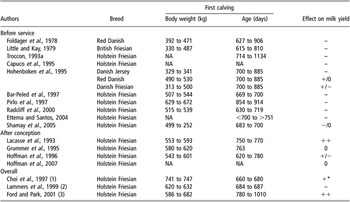
Since early in the 20th century, it has been common knowledge that late-maturing parts of the body are the most affected by the plane of nutrition. Animal composition and development is closely related to breed, daily gain and age (Robelin, Reference Robelin1986). Therefore, the relation between milk production and plane of nutrition has been the subject of research for more than 90 years. The effect of feeding intensity during rearing has traditionally been divided into effects before sexual maturity, i.e. puberty, and effects after (Mourits et al., Reference Mourits, Dijkhuizen, Huirne and Galligan1997) (Table 1). But several studies demonstrated that manipulating the feeding regimen as early as from birth until weaning also greatly influences further performance.
Some selected references on the impact of increased daily gain during rearing on first lactation yield in dairy heifers

NA = not available.
(1) Normal v. compensatory growth from 180 to 565 kg.
(2) Daily gain were increased before service, reduce after to have a similar daily gain between treatment from birth to first calving.
(3) From 160 kg to first calving.
*Positive effect of compensatory growth.
Before weaning
Nutrition in the early stage of life may have long-term effects on milk production. A prospective study by Heinrichs et al. (Reference Heinrichs, Heinrichs, Harel, Rogers and Place2005) demonstrated that age at first calving was affected by events around birth, as well as nutritional, health and environmental factors imposed during the first 4 months of life. In addition, BW and WH growth rate seem to be the fastest during the first 6 months of life and changing the raising rate during this period is the most efficient way to improve heifer growth performance (Kertz et al., Reference Kertz, Barton and Reutzel1998).
Akayezu et al. (Reference Akayezu, Linn, Otterby, Hansen and Johnson1994) noted that increasing crude protein (CP) content in the diets from 4 to 56 days of age had a positive effect on growth. Optimal results were observed for a starter diet containing 19.8% CP dry matter (DM), in agreement with Luchini et al. (Reference Luchini, Lane and Combs1991). When fed non-saleable pasteurized milk, dairy calves had a higher growth rate, and lower morbidity and mortality rates than calves fed conventional milk replacer (Godden et al., Reference Godden, Fetrow, Feirtag, Green and Wells2005). Calves with free access to milk twice a day (30 min per meal) from birth until weaning reached puberty earlier than those given 450 g/day DM of milk replacer (Shamay et al., Reference Shamay, Wermer, Moallem, Barassh and Bruckental2005). At first calving, these animals were heavier, had an improved skeletal development and gave more fat-corrected milk. Bar-Peled et al. (Reference Bar-Peled, Robinzon, Maltz, Tagari, Folman, Bruckental, Voet, Gacitua and Lehrer1997) observed similar effects and noted a trend for greater milk production in females that suckled milk, in comparison to those fed with a milk replacer during the first 42 days after birth. Therefore, when a cheap source of milk is available, feeding the replacement heifers with it might be an economically viable strategy.
Pre-pubertal heifers
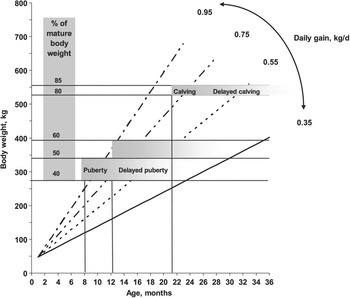
The effects of feeding intensity before puberty have been widely studied and published, as summarized in Figure 1, adapted from Wattiaux (Reference Wattiaux1997).
Schematic representation of the effects of various daily gains prior to puberty on puberty onset, service and calving ages (adapted from Wattiaux, Reference Wattiaux1997).

A curvilinear relationship between pre-pubertal growth rate and subsequent milk production has often been observed. Low (<400 g/day) or high (>800 g/day) daily gains before puberty reduced milk production during subsequent lactations, from 10% to 40% (Troccon and Petit, Reference Troccon and Petit1989; Hohenboken et al., Reference Hohenboken, Foldager, Jensen, Madsen and Andersen1995; Van Amburgh et al., Reference Van Amburgh, Galton, Bauman, Everett, Fox, Chase and Erb1998b). A negative interaction with age at first calving (i.e. worst results with high daily gain and early calving) was also noted. Results from Hohenboken et al. (Reference Hohenboken, Foldager, Jensen, Madsen and Andersen1995) suggested that a similar relationship between daily gain and milk yield is present in different breeds (Danish Friesian, Jersey and Danish Red), but smaller breeds tend to be more sensitive to the deleterious effects of accelerated rearing on milk production during first lactation. High growth rate during rearing in order to achieve sufficient body size for breeding heifers at a young age is the result of high energy consumption. This modifies the hormonal environment, which seems to impair mammary gland growth and consequently milk yield capacity during further lactations (Sejrsen et al., Reference Sejrsen, Purup, Vestergaard and Foldager2000). Zanton and Heinrichs (Reference Zanton and Heinrichs2005) published a meta-analysis based on eight experiments performed on the effect of pre-pubertal growth on first-lactation performance. Based on this analysis, the authors concluded that growth prior to puberty (150 to 320 kg) should be limited to around 800 g/day for maximum first-lactation milk production.
However, such a negative effect was not noticed in all studies and some authors reported that heifers with a high potential of milk production seem to be less sensitive to a high plane of nutrition (Daccarett et al., Reference Daccarett, Bortone, Isbell, Morrill and Feyerherm1993; Troccon, Reference Troccon1996; Mourits et al., Reference Mourits, Dijkhuizen, Huirne and Galligan1997). Modern Holstein heifers could then achieve growth rate before conception higher than in the past, without major significant deleterious effects. Hohenboken et al. (Reference Hohenboken, Foldager, Jensen, Madsen and Andersen1995) calculated the rate of daily gain that could be expected to result in deleterious effects on future milk yield from the 1980s to the mid-1990s with estimates ranging to year 2000. They estimated that the relationship between feeding level and milk yield would be unchanged, but optimal daily gain would be higher.
The relation between mammary development and milk production has not been observed in all studies. Results from Capuco et al. (Reference Capuco, Smith, Waldo and Rexroad1995), Radcliff et al. (Reference Radcliff, Vandehaar, Skidmore, Chapin, Radke, Lloyd, Stanisiewski and Tucker1997 and Reference Radcliff, Vandehaar, Chapin, Pilbeam, Beede, Stanisiewski and Tucker2000) and Waldo et al. (Reference Waldo, Capuco and Rexroad1998) indicated that mammary development could be either reduced or increased when feeding in excess or injecting bovine somatotropin before puberty. In both studies, no effect was noted on subsequent milk yield. According to puberty attainment, the length of time the pre-pubertal mammary gland has to develop can be affected (Van Amburgh et al., Reference Van Amburgh, Galton, Bauman, Everett, Fox, Chase and Erb1998b). Similarly, Capuco et al. (Reference Capuco, Smith, Waldo and Rexroad1995) fed Holstein heifers diets differing in energy and CP content (alfalfa silage or corn silage) to gain 725 or 950 g/day, in order to study the influence of pre-pubertal diet and rate of gain on mammary growth and milk production. The group of heifers fed the corn silage diet had higher mammary lipid content, particularly when reared at the higher rate of gain. Data showed a deleterious effect of pre-pubertal rapid weight gain on mammogenesis when accompanied by excess body fat deposition. However, this effect did not cause a decline in subsequent milk production. These results are consistent with previous data, i.e. heifers fed at a high energy level had reduced mammary parenchymal growth. But according to the authors, decreased mammary parenchymal growth was also associated with the marked carcass fattening of heifers in the group of animals receiving corn silage. No difference was noted between treatments in the parenchymal mass, but the reduction in mammary parenchymal DNA in this group of heifers is a consequence of decreased DNA concentration because of a higher content of adipocytes. However, recent data from Meyer et al. (Reference Meyer, Capuco, Ross, Lintault and Van Amburgh2006a and Reference Meyer, Capuco, Ross, Lintault and Van Amburgh2006b) concluded that if mammary fat pad is directly influenced by elevated nutrient intake, this is not the case for parenchymal mass. They suggested that the level of nutrient intake had a limited influence on mammary epithelial cell proliferation, the rate of DNA accretion in the parenchyma or the total parenchyma mass. Therefore, it is possible that some apparent deleterious effects on mammary growth at puberty might not be determinant for milk production or hidden by a faster growth later on.
As for energy, the level of protein in a heifer’s diet has been the subject of several studies. From 100 to 300 kg BW, increasing the amount of CP in the diet increased average daily gain, and the amount of CP in the diets of pre-pubertal heifers (90% to 110% of NRC (1989) recommendations) did not affect subsequent milk production (Pirlo et al., Reference Pirlo, Capelleti and Marchetto1997). Levels of undegraded intake protein (UIP) in the diets showed no major effect on body composition (Tomlinson et al., Reference Tomlinson, James and Mc Gillard1990; Steen et al., Reference Steen, Quigley, Heitmann and Gesham1992) but increasing UIP concentrations in the diets improved the growth rates of heifers according to some authors (Amos, Reference Amos1986; Casper et al., Reference Casper, Scingoethe, Brouk and Maiga1994), whereas others found no effect (Mäntysaari et al., Reference Mäntysaari, Sniffen, Muscato and Thonney1989; Van Amburgh et al., Reference Van Amburgh, Fox, Galton, Bauman and Chase1998a). To summarize, diets containing 16.0%, 14.5% and 13.0% CP for heifers averaging 90 to 220 kg, 220 to 360 kg and more than 360 kg BW, respectively, should be recommended (Hoffman, Reference Hoffman1997; Pirlo et al., Reference Pirlo, Capelleti and Marchetto1997; Waldo et al., Reference Waldo, Tyrrel, Capuco and Rexroad1997; Hoffman et al., Reference Hoffman, Esser, Bauman, Denzine, Engstrom and Chester-Jones2001).
Feeding pre-pubertal lambs with a supplement containing sunflower seeds protected from rumen biohydrogenation by a formaldehyde treatment resulted in an increase in the mammary parenchyma weight, but effects on lactating performances were not analysed since all animals were slaughtered at the end of the experiment (McFadden et al., Reference McFadden, Daniel and Akers1990). In mice, a diet deficient in essential fatty acids (linoleic and linolenic) resulted in a reduction of mammary development (Miyamoto-Tiaven et al., Reference Miyamoto-Tiaven, Hillyard and Abraham1981). Nevertheless, very few studies have investigated the effect of a diet’s lipid composition on mammary development and subsequent milk production. Thibault et al. (Reference Thibault, Petitclerc, Spratt, Léonard, Sejrsen and Lacasse2003) fed heifers with a high-soya-bean-oil diet from birth to 6 months of age. Results showed that the high-oil diet slightly improved mammary development but the effects were too small to be translated into better lactating performances. This does not eliminate the possibility of a positive effect of diet, but a minimum requirement is that unsaturated fatty acids be efficiently protected from ruminal alteration.
Negative effects of high growth rate through levels of energy intake before puberty are well known. However, results from recent studies suggest optimal values for growth changed over the last decades. Reference values considered previously as ‘too high’ and having a negative effect, especially on mammary development, might now be considered as close to values to be recommended. Further research on these aspects is needed.
Post-pubertal growth rate
Studies on the effects of feeding level after puberty are scarcer than those about feeding management before puberty. According to Vargas et al. (Reference Vargas, Van der Lende, Baaijen and Van Arendonk1998), the probability of a heifer reaching first calving could be significantly increased through an increased BW at 390 days of age, even if some difficulty might appear at first parturition. No deleterious effect was noted thereafter. Higher BW at calving is often associated with less body reserves mobilization at the beginning of lactation, an increased feed intake capacity and a higher milk production (Mourits et al., Reference Mourits, Dijkhuizen, Huirne and Galligan1997). However, possible negative effects, especially health problems, are to be expected if heifers are too fat at calving (see For a successful first calving section). Accelerating growth rate after puberty increases body protein content, frame growth and fat composition (Hoffman et al., Reference Hoffman, Brehm, Price and Prille-Adams1996). Accelerating post-pubertal growth (933 v. 778 g/day) and reducing age at first calving (650 v. 740 days) in order to reach a similar BW at calving reduced performance during first lactation (Hoffman et al., Reference Hoffman, Brehm, Price and Prille-Adams1996). According to Macdonald et al. (Reference Macdonald, Penno, Bryant and Roche2005), BW at first calving, as well as post-pubertal growth rate, are important for first-lactation milk production, but their effect diminishes in subsequent milk production Lacasse et al. (Reference Lacasse, Block, Guilbault and Petitclerc1993). manipulated the plane of nutrition before (from 12 months of age to 3rd month of gestation) and during gestation (4th month of gestation to calving). Plane of nutrition did not affect milk production. Accordingly, Grummer et al. (Reference Grummer, Hoffman, Luck and Bertics1995) reported that BW greater than 660 kg at first calving did not enhance lactation performance. Therefore, it seems important to maintain a good growth rate from puberty to first calving. However, there is little interest in having a very strong growth rate because there is no increase in milk production to compensate the increase in feeding cost.
Negative effect of inadequate temporary nutrition before puberty could therefore be counterbalanced by subsequent compensatory feeding (see below), but overfeeding in order to compensate insufficient rearing performances might also have negative effects.
Compensatory growth
Compensatory growth might be observed in heifers receiving inadequate feeding for a period of time. It could correct the negative effects of pre-pubertal feeding management and heifers might have better results during first lactation than those fed according to recommendations (Park et al., Reference Park, Baik, Keller, Berg and Erikson1989; Lammers and Heinrichs, Reference Lammers and Heinrichs2000). Experiments showed that compensatory growth might have a direct effect on the mammary development of dairy heifers and consequently on milk production (Choi et al., Reference Choi, Han, Woo, Lee, Jang, Myung and Kim1997; Ford and Park, Reference Ford and Park2001). In the experiment performed by Ford and Park (Reference Ford and Park2001), heifers received either a control-feeding regimen or followed a stair-step compensatory nutrition regimen, according to an alternating schedule. Positive effects on first- and second-lactation milk yields were noted (+21% and +15%, respectively). These results suggest that stair-step nutrition programme improves growth efficiency and lifetime performance. Nevertheless, these results were obtained from a limited number of observations and more research is needed to confirm these effects and to estimate the economical benefits of such practices.
Developing gut capacity
Cows generally reach mature size at parity three when fed normally during lactation and this attainment does not depend on rearing intensity. Size and structure of ruminant stomachs have been shown to change according to types of diet given, but with no permanent effect on the ability of calves to digest diets of concentrates or hay (Stobo et al., Reference Stobo, Roy and Gaston1966a and Reference Stobo, Roy and Gaston1966b). Feeding intensity and pattern after puberty have an important influence on the ingestion capacity of dairy cows. Faverdin et al. (Reference Faverdin, Leclerc, Rousselot and Troccon1995) noted that DM intake in primiparous cows is related to feed intake at the end of gestation and thus, to a certain extent, to BW at calving. Nevertheless, differences noted in feed consumption according to BW at first calving tend to disappear as lactation increases (Holden et al., Reference Holden, Coulon and Faverdin1988). Thus, strategies and managements that aim to improve feed intake in adults through development of gut capacity in heifers have very limited interest.
Environmental factors
Seasonal effects on animal performances, including growth, reproduction and lactation, have been widely reported in many species, including dairy cattle.
Photoperiod
Light regimen has a positive effect on puberty attainment in heifers (Hansen, Reference Hansen1985; Petitclerc et al., Reference Petitclerc, Kineman, Zinn and Tucker1985; Schillo et al., Reference Schillo, Hall and Hilemen1992; Rius and Dahl, Reference Rius and Dahl2006), as in most of farm species (Adam and Robinson, Reference Adam and Robinson1994). Enright et al. (Reference Enright, Zinn, Reynolds and Roche1995) showed that a 16-h daylight regimen reduced the age of puberty in comparison with an 8-h daylight treatment and Petitclerc et al. (Reference Petitclerc, Chapin, Emery and Tucker1983) noted that heifers exposed to long-day photoperiods had higher growth rates than those exposed to short photoperiods. Little et al. (Reference Little, Mallison, Gibbons and Rowlands1981) reported that heifers born in spring (when daylight was increasing) were lighter and younger at puberty than those born during autumn (decreasing daylight length). A long-day photoperiod (16 v. 8 h of daylight) increased mammary parenchymal weight by 40% in peri-pubertal heifer and by 30% in post-pubertal heifer (Petitclerc et al., Reference Petitclerc, Kineman, Zinn and Tucker1985). Such an exposure also increased lean growth (Petitclerc et al., Reference Petitclerc, Kineman, Zinn and Tucker1985; Ringuet et al., Reference Ringuet, Petitclerc, Sorenson, Gaudreau, Pelletier, Morisset, Couture and Brazeau1989). Only one study reported the effect of pre-pubertal photoperiod on milk production. Rius and Dahl (Reference Rius and Dahl2006) reported that heifers raised on long-day photoperiod were heavier and taller at parturition, and tended to produce more milk during their first lactation. Nevertheless, this study was conducted on a limited number of animals, which had very high growth rate from weaning to puberty (around 1100 g/day or more), and these results would need to be confirmed in larger studies. If so, long-day photoperiod management before puberty would be a potential tool to accelerate growth and puberty.
Air temperature
Season might affect both technical and economical performances (Jalvingh et al., Reference Jalvingh, Van Arendonk and Dijkhuizen1993). Indeed, it not only influenced puberty (Hansen, Reference Hansen1985) but also impacted feedstuff availability and price, as well as regimen composition. As a result, reducing the length of the rearing period during winter had a greater impact on rearing costs than the same reduction during autumn (Mourits et al., Reference Mourits, Dijkhuizen, Huirne and Galligan1997). Taking into account all these parameters, De Vries (Reference De Vries2004) demonstrated that delaying heifer replacement might be economically advantageous when cow performance is seasonal, as in Florida.
Both heat and cold stresses can reduce animal performances. Dairy heifers can resist very cold temperatures; however, the energy requirement for maintenance is increased. In the 7th edition of NRC recommendations (2001), surface area, external insulation value, wind speed and hair depth are considered in adjusting the energy requirement for maintenance equation in cold-stress situations. The increased energy requirement in cold weather has to be taken into account to avoid decreased growth rate. Similarly, high temperatures decrease DM intake and result in lower performance (NRC, 1989). Mitlöhner et al. (Reference Mitlöhner, Galyean and Mc Glone2002) demonstrated that shading pens improved the growing performance of beef heifers in hot summer conditions in West Texas, in comparison to animals housed in non-protected pens. Similarly, Fox and Tylutki (Reference Fox and Tylutki1998) predicted different average daily gain, calving BW and age according to environmental conditions in different parts of the USA. In addition, Collier et al. (Reference Collier, Dahl and Van Baale2006) reported that heat stress also negatively influences oestrus behaviour and embryo mortality. Therefore, housing facilities must be well adapted to the climate to maintain heifer performance.
Environmental factors can greatly influence heifer performances during rearing and thereafter through direct effects on animals and also on feedstuffs and forage. As a result, management and/or procedures that limit or enhance such environmental effects should also be considered.
For a successful first calving
Milk yield and reproductive performances are genetically negatively correlated (Lee, Reference Lee1997; Boichard et al., Reference Boichard, Barbat and Briend1998; Pryce et al., Reference Pryce, Royal, Garnsworthy and Mao2004). Moreover, fertility of both dairy heifers and cows has declined over the last 10 years (Barbat et al., Reference Barbat, Druet, Bonaiti, Guillaume, Colleau and Boichard2005). For some authors they are correlated and for others they are independent (Raheja et al., Reference Raheja, Burnside and Schaeffer1989). Even though fertility is generally higher in heifers than in cows, rearing management can highly influence heifers’ fertility.
Puberty and conception
Several studies showed that very early nutrition and management practices have important long-term effects (see Gardner et al. (Reference Gardner, Smith and Park1988) for example). Puberty is the culmination of a gradual maturation (Sejrsen and Purup, Reference Sejrsen and Purup1997) that started even before birth. Experiment by Martin et al. (Reference Martin, Vonnahme, Adams, Lardy and Funston2007) on beef heifers showed that dam nutrition during late gestation affected heifer post-weaning BW and fertility. In this experiment, gestating cows received a 0.45 kg/day of a 42% CP supplement while grazing, while another set of gestating cows did not receive any supplement. A greater proportion of heifers from supplemented cows were pregnant and calved in the first 21 days of calving season, despite similar ages at puberty and similar proportions of heifers cycling prior to the breeding season. These results suggest a possible foetal programming effect of late-gestation dam nutrition on subsequent fertility. Indeed, reproductive performances of animals are influenced, in part, by a large variety of factors acting at different stages of development, from before birth until birth (Rhind et al., Reference Rhind, Rae and Brooks2001).
It is well known that in most species, the effects of nutrition on puberty are more pronounced when applied in the early post-natal phase than immediate pre-pubertal phase (Robinson, Reference Robinson1990). Increasing dietary energy intake from 126 to 196 days of age in early-weaned heifers decreased age at puberty, regardless of the diet given after 196 days of age (Gasser et al., Reference Gasser, Behlke, Grum and Day2006). Sejrsen (Reference Sejrsen1994) reported that although huge variations in both age and BW at puberty were noted in several experiments in Denmark, the percentage of heifers reaching puberty before 200 kg or after 300 kg BW was low. The author concluded that reproductive development in cattle is more closely related to body development than to chronological age, thus echoing the findings of Frisch (Reference Frisch1984) with regard to humans.
Growth rate has a positive effect on puberty attainment (Little and Kay, Reference Little and Kay1979). When growth is slow, fertility is improved when animals are bred on the 3rd or 4th detected oestrus rather than at puberty in many species (Lin et al., Reference Lin, McAllister, Batra, Lee, Roy, Vesely, Wauthy and Winter1986; Byerley et al., Reference Byerley, Staigmiller, Berardinelli and Short1987; Robinson, Reference Robinson1990; Le Cozler et al., Reference Le Cozler, Ringmar-Cederberg, Johansen, Dourmad, Neil and Stern1999). In Holstein heifers where puberty occurs at an early age, first service around 15 months of age is then favourable. Indeed, Kuhn et al. (Reference Kuhn, Hutchinson and Wiggans2006) noted that the conception rate is maximal between 15 and 16 months of age and decreases by 10% for heifers older than 26 months. In late-maturing breeds, heifers may not be old enough for optimal performance at this age. As a result, they may not be appropriate for dairy farms based on first calving at 2 years of age. In addition, breeding season might affect conception rate, but results remain unclear (Donovan et al., Reference Donovan, Bennet and Springer2003; Kuhn et al., Reference Kuhn, Hutchinson and Wiggans2006; Chebel et al., Reference Chebel, Braga and Dalton2007).
Although lowering age at puberty and consequently age at first service may be an efficient way to reduce the length of the non-productive period before calving, it may also reduce pre-pubertal mammary gland development by reducing the length of the allometric phase of mammary gland growth (Meyer et al., Reference Meyer, Capuco, Ross, Lintault and Van Amburgh2006b), which may, in some cases, impair further milk production. Further investigation is needed on this aspect.
Optimizing fertility
Relationships between rearing management and fertility are not well documented, since most studies have focused on dairy cows rather than on heifers. Feeding regimen procedures between 12 and 18 months of age either reduced or increased the fertility rate, which showed there is no consistency in the published results (Robinson, Reference Robinson1990; Troccon, Reference Troccon1996). Inadequate feeding (energy and/or protein) might alter fertility and increased embryo mortality (Roche, Reference Roche2006). Too low or too high daily gains altered heifer fertility, but flushing procedures (i.e. increasing feed allowance during a brief period prior to ovulation) or, in some cases, feed restriction might restore a normal fertility rate (Troccon, Reference Troccon1993a). Indeed, feeding-level effects may be different according to age at first calving and breed. For example, in a 3-year first-calving experiment, Holstein heifers with a moderate energetic regimen from birth to 14 months of age had a higher fertility rate than those with a high energetic treatment during the same period (+24% after two inseminations, P < 0.02) (Troccon et al., Reference Troccon, Muller, Peccatte and Fergetton1997). Conversely, no difference was noted in Normande heifers. In another 3-year first-calving experiment, accelerating the growth rate before puberty resulted in decreased age at parturition and milk production, but did not affect reproductive performance (Radcliff et al., Reference Radcliff, Vandehaar, Chapin, Pilbeam, Beede, Stanisiewski and Tucker2000). Puberty attainment and fertility in heifers are greatly influenced by rearing management and consequently this may also be an effective way to control age at first calving, especially in seasonal calving.
Managing peri partum and later fertility
According to Troccon (Reference Troccon1993b), heifers receiving both adequate amount and quality of feed during rearing had better growth and reduced mortality during further lactations. Rearing strategies not only aim to assure good milk production as a cow but also to preserve further breeding efficiency. Because of its deleterious effect on placental retention, metritis, breeding efficiency and culling rates (Erb et al., Reference Erb, Smith, Oltenacu, Guard, Hillman, Powers, Smith and White1985; Augeard et al., 1986), incidence of dystocia has to be minimized. Its incidence is higher in too lean or too fat heifers compared with medium ones (Philipson, Reference Philipson1976a; Disenhaus et al., 1986). Similarly, dystocia in Holstein cows has also been related to excessive BW at calving (Erb et al., Reference Erb, Smith, Oltenacu, Guard, Hillman, Powers, Smith and White1985) and old age at first calving (2 v. 3 years old, Cutullic et al., 2008). In this latest case, frequency of dystocia was related to excessive body condition score at calving, which might be impaired with growth potential and sexual maturity precocity in Holstein cows. According to Philipson (Reference Philipson1976b) and Cutullic et al. (2008), calving difficulties related to excess fat condition were not as important in others breeds as for Holstein heifers. A 36-months first calving is probably too late for enhanced longevity in Holsteins, but it is also known that stillbirth rate decreases when first calving is over 26 months, especially for bull calves (Steinbock et al., Reference Steinbock, Näsholm, Berglund, Johansson and Philipsson2003; Heins et al., Reference Heins, Hansen and Seykora2006). As a result, it appears that optimal age of first calving cannot be determined without a precise definition of the main objective of the herd.
Delayed first ovulation occurs more often in primiparous cows than in multiparous adults, especially in lean animals (Grimard and Disenhaus, Reference Grimard and Disenhaus2005). By contrast, first service conception rate is more affected by loss of body fat in the first weeks post partum for primiparous than for multiparous cows (Lopez-Gatius et al., Reference Lopez-Gatius, Yániz and Madriles-Helm2003; Disenhaus et al., Reference Disenhaus, Grimard, Trou and Delaby2005). Rearing to achieve an adequate body condition score at first calving is a main objective, along with obtaining milk yield potential expression and maintaining first-lactation breeding efficiency. First-lactation cows have to be fed a high energetic density regime in early lactation to avoid excessive body condition lost.
Some consequences of feeding practices during rearing on post partum health remain unclear and have to be explored. Underfeeding during the last 2 months of gestation has significantly increased placental retention in first-lactation cows (Disenhaus et al., 1986). Surprisingly, Lacasse et al. (Reference Lacasse, Block, Guilbault and Petitclerc1993) observed a very high rate of displaced abomasums post partum for heifers fed a high plane of nutrition from 12 months of age to 3 months of gestation. If we accept that a compromise between body condition score and age at first calving is the prime objective in order to preserve post partum health and breeding efficiency, more investigation is needed to achieve efficient recommendations.
Nevertheless, it appears from all previous papers that avoiding too fat and too lean animals at first calving is a good way to preserve both production and reproduction and thus longevity of dairy cows.
Conclusion
Optimal performance and reproduction in large modern primiparous cows are compromised by the fact that animals are required to reach mature body size, to produce large amounts of milk and to successfully re-breed. Both genetics and environmental considerations are essentials in heifer reproduction, milking performances, longevity, etc. As many experiments showed a positive relationship between BW at first calving and milk yield in first lactation, BW has been widely used to define optimum body size of replacement heifers. Indeed, most models used to determine heifer requirements through daily protein and lipid retentions took into account the type, live weight and daily live weight gain. However, BW is not the only factor to consider body composition. Optimum body size has also to take into account skeletal development and body condition. Other parameters such as height, length, pelvic area, calf birth weight and shape, sire birth weight and climate have also been reported to influence not only subsequent first-lactation performance – particularly conception rates – but also the duration of parturition and health problems, which greatly influence further performances.
Considering modern approaches and management strategies in dairy milking farms, we may conclude, with regard to both genetic merit and optimal age at first calving, that:
• Breeds with high growth-rate potential (i.e. Holstein heifers for example) are:
○ Well adapted for young age at first calving (around 24 months) when fed adequately at a high level, without any deleterious subsequent performances. As a result, they should be recommended in seasonal-calving systems where cows first calved at 2 years of age;
○ Adapted when feed is not always sufficient to reach first calving at 24 months of age, resulting in a 3 to 4 months delayed first lactation. This is interesting when year-round calving is used on a farm;
○ Not very well adapted for old age at first calving (30 months or more), meaning that too high restrictions were previously applied or animals have inadequate body conditions at calving (too fat).
• Breeds with moderate growth-rate potential (i.e. Normande, Montbeliarde, etc., for example) are:
○ Not very well adapted in young age at first-calving systems (24 months);
○ Hard to handle in late age at first-calving systems (36 months), because of growth rate requirement before puberty (high), from puberty to service (rather high) and after service (low) to reach first calving in time;
○ Well adapted in year-round-calving systems or in a two-calving-seasons system, spring and autumn for example (first calving at 30 months of age).
• Breeds with low growth-rate potential (i.e. traditional breeds not selected on milk production, Abondance, for example) are well adapted in year-round-calving systems and probably in seasonal-calving systems where cows first calved at 3 years of age, but no information is available on this aspect.
Finally, in seasonal-calving systems where calving period is increasing due to reproductive failures, first calving at 21 to 22 months of age or less, thanks to rearing management, might be an efficient way to avoid too long reproductive period. Interest of delaying service in such primiparous cows has also to be considered, from reproductive, economic and longevity points of view. Further research on this aspect is needed.
Moreover, with an average stillbirth rate varying between 10% and 13% in many countries (Gustafsson et al., Reference Gustafsson, Kindahl and Berglund2007) and with a calf mortality around 8% in the US (Silva del Rio et al., Reference Silva del Rio, Stewart, Rapnicki, Chang and Fricke2007), more attention should be paid to heifers rearing, from birth to calving. Results from different studies indicated that practical recommendations might have to be re-considered and adapted to modern heifers, especially in breeds intensively selected for milk production such as Holsteins and Jerseys. Interests of new feeding strategies (using fermented milk during the nursing period) or older practices recently re-highlighted such as more grazing have also to be re-considered, in order to decrease rearing costs and both animal survival and performances. Research should also focus on the consequences of such practices on reproductive physiology, mammary development and subsequent consequences (milk yield, milk fat, protein content, etc.).