


3.1 Introduction
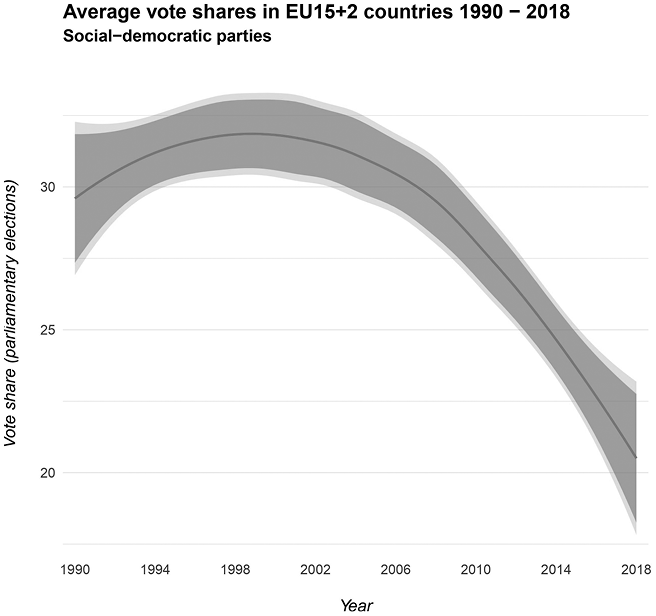
The starting point of this volume is that social democratic parties, which for much of the post-war period were a major force in West European politics, are currently facing a fundamental crisis. There can be little doubt that social democratic parties face an existential threat to their electoral and political relevance. Electorally, Figure 3.1 demonstrates clearly that social democratic parties have witnessed a steep decline in the past fifteen years. For example, the parliamentary elections in France and the Netherlands in 2017 saw the Parti Socialiste (Socialist Party, PS) and Partij van de Arbeid (Labour Party, PvdA) scoring below 10 per cent, some of the worst results for Western European social democratic parties in the post-war era. This electoral decline has obvious consequences for the broader political influence of Social Democrats, whose presence in European governments is much reduced, especially compared to the late 1990s.
Vote shares of social democratic parties in Western Europe
Notes: Vote shares computed for country−years of EU15 + 2 countries for years 1990−2018 based on data obtained from parlgov.org. Country−year data aggregated across countries and years using LOESS smoothing. Shaded areas around fitted curve depict 90 per cent and light-shaded areas 95 per cent confidence intervals, respectively.
In this chapter, we aim to address two widespread narratives about the decreasing vote shares of social democratic parties in the last fifteen years. The first account, the economic narrative, regards the electoral decline of social democratic parties largely as a backlash against their centrist and supposedly neo-liberal turn during the 1990s. Associated with labels such as New Labour, ‘die Neue Mitte’, or more generally the Third Way, social democratic parties embraced market principles as guiding themes for policy decisions. In government, social democratic parties indeed enacted far-reaching policy recalibration, especially of systems of social security (Häusermann Reference Häusermann2010; Gingrich Reference Gingrich2011; Schwander and Manow Reference Schwander and Manow2017). Initially, this arguably led to a certain level of electoral success. But – so the narrative goes – this was obtained by weakening these parties’ claim to represent the working class (Evans and Tilley Reference Evans and Tilley2017) – a dilemma that was already pointed out by Przeworski and Sprague (Reference Przeworski and Sprague1986). Over time, this is said to have led voters to abandon these parties (see also Karreth et al. Reference Karreth, Polk and Allen2013; Schwander and Manow Reference Schwander and Manow2017; Spoon and Klüver Reference Spoon and Klüver2019), not just to the Radical Left but also to the Radical Right (Kitschelt and McGann Reference Kitschelt and McGann1995; Spoon and Klüver Reference Spoon and Klüver2019). One story of social democratic party decline therefore places economic ideology and policy at the centre of a working-class backlash against the political decisions of the New Labour era.
The second account, the cultural narrative, focuses on the emergence of new issues in party competition, specifically cultural issues such as immigration, gender equality and European integration. The emergence and solidification of this two-dimensional space has arguably been a core development in political competition over the past decades. As argued by Inglehart (Reference Inglehart1977), Kitschelt (Reference Kitschelt1994) and others, from the late 1960s the ideological content of politics shifted towards more complex constellations of preferences. The simplest accounts of this rising complexity posit that a second dimension has been added to the first, economic dimension (though some argue that the second dimension has merely been transformed and reinterpreted; see Kriesi et al. (Reference Kriesi, Grande, Lachat, Dolezal, Bornschier and Frey2006)). This second dimension contains topics related to the basic principles of organizing societies and to cultural and moral issues and thus encompasses issue areas such as immigration, law and order, gender equality or LGBT rights. The dimension has been variously termed cultural, ‘new politics’, libertarian-authoritarian and Green/alternative/libertarian versus traditional/authoritarian/nationalist, but despite the varied nomenclature, these terms refer to the same phenomenon.
Within this transformed political space, the electoral decline of social democratic parties is then explained by the rise of the cultural dimension. Originally, it was suggested that Social Democrats have been challenged by parties taking liberal positions on this dimension, such as green and other left-libertarian parties (Kitschelt Reference Kitschelt1994). As a result, many voters deserted the centre-left Social Democrats in favour of these parties, which offered a credible left-libertarian alternative. However, the more recent version of the cultural narrative focuses on the defection of voters to right-authoritarian alternatives. This version of the narrative sees Social Democrats as taking up positions on second dimensions issues that are too progressive, and this is portrayed as having led to an exodus of their more authoritarian voters. In this account, these voters now support the Radical Right. This narrative is particularly prevalent in many recent popular science accounts of the decline of social democratic parties, such as Goodhart (Reference Goodhart2017), Eatwell and Goodwin (Reference Eatwell and Goodwin2018) or Lilla (Reference Lilla2018). However, there is also academic evidence that accommodating tough positions on migration may help the mainstream left maintain its electoral standing (van Spanje and de Graaf Reference Van Spanje and de Graaf2018; Spoon and Klüver Reference Spoon and Klüver2020).
At the core of these narratives lies the idea that social democratic parties, due to their policy positions, have alienated the working class, the electoral group that has historically been the main basis of their support. Moreover, this alienation has occurred due to Social Democrats’ own policy positions, which are either too economically centrist or too culturally liberal. These working-class voters are said to have found a new home with radical left and especially radical right parties. Both of these narratives are widespread among commentators, policy advisers and social democratic politicians themselves. For example, Sigmar Gabriel, the former head of the German Social Democrats, writes in an essay for Der Spiegel:
Us as social democrats and progressives too have felt too much at home within a post-modern liberal discourse. The environment and climate change were more important to us than industry jobs, data protection more important than security issues, and we celebrated the introduction of same-sex marriage as the basically biggest achievement of our party during the last administration […] Is the wish for a ‘Leitkultur’ really a conservative propaganda tool or does it represent – for our electorate too – the wish for orientation in a post-modern world? […] Winning over the hipsters in California cannot make up for losing the workers of the Rust Belt.Footnote 1
Implicitly or explicitly these diagnoses of the current state of Social Democracy are often accompanied by the advice to adjust policy positions towards an embrace of traditional welfare schemes, towards less emphasis on gender equality and LGBT rights and especially towards tougher immigration policies. Parties all over Europe are discussing if the ‘Danish Model’ could be the solution for the current crisis of social democratic parties.
In this chapter, we empirically investigate the decline in electoral support for social democratic parties in the past twenty years. We focus on eight countries with multiparty system in Western and Northern Europe (Austria, Denmark, Finland, Germany, Netherlands, Norway, Sweden and Switzerland). This means that our geographical focus is on advanced industrial democracies where social democratic parties were once major players and where several competitors with different ideological orientations exist within a multiparty setting. We explicitly excluded Southern and Central European countries due to the different crisis-driven economic context in the former and the post-communist historical context in the latter. Both Southern and Central Europe also have different socio-economic social structures than the countries we study. We also exclude the UK, whose majoritarian electoral system creates distinct dynamics for political parties. To study electoral choice in our eight countries, we use data from national election studies as well as the European Social Survey (ESS). Using this data, we analyse which voters left social democratic parties during this period, where they went and how we can explain vote choice between social democratic parties and their main competitors.
Our findings provide important empirical evidence on both the economic and the cultural narrative. First, we find that although social democratic parties have seen losses among all electoral groups, the voters who left social democratic parties were disproportionately centrist and educated. Second, we find that only a small share of former social democratic voters defected directly to parties of the Radical Right. Instead, social democratic parties lost their by far largest share of voters to parties of the Moderate Right and to green and left-libertarian parties.
These findings strongly indicate that the empirical reality of social democratic decline paints a different picture than that implied by both narratives presented earlier. If social democratic decline was caused by an exodus of voters alienated by the more centrist New Labour policies, then why did so many voters leave for parties of the Moderate Right? If this decline was caused by cultural positions that are too progressive, then why did so many voters leave for green and left-libertarian parties, also compared to those leaving for the Radical Right? Overall, the findings strongly contradict predominant narratives of social democratic party decline.
We additionally empirically demonstrate that the vote choice between social democratic and moderate right parties is largely determined by economic and not by cultural attitudes. We can also demonstrate that second-dimension attitudes such as preferences about LGBT rights and immigration are the defining factor that makes people chose green and left-libertarian parties over social democratic ones. Hence, in line with earlier formulations of the social democratic dilemma (Kitschelt Reference Kitschelt1994), but against many of the current narratives, we find evidence that losses in the left-libertarian quadrant of the political space are a main driver of the current crisis of social democratic parties.
In sum, we provide an account of the decline of social democratic parties that stands in stark contrast to the existing dominant narratives. Our evidence specifically contradicts a ‘backlash against liberal multiculturalism’ account and also does not provide much evidence for a ‘backlash against New Labour’. By contrast, our findings can be seen as an indication that losing the battle over economics to the Moderate Right and the battle over culture to more progressive parties are a more plausible way of explaining the current crisis of Social Democracy.
3.2 Data and Methods
Our first data source are national election studies. The great advantage of these surveys is that they generally ask for voting behaviour at the last and at the current election. Vote recall is not a completely valid measure of past voting behaviour: people might forget who they voted for, they might misremember their behaviour or they may feel uncomfortable saying that they changed their vote choice. Hence, vote recall probably leads to higher estimates of stability than there should be (Dassonneville and Hooghe Reference Dassonneville and Hooghe2017). Up to a quarter of respondents may recall their past vote choice incorrectly (Dassonneville and Hooghe Reference Dassonneville and Hooghe2017). However, other findings indicate that vote recall may not be that problematic. For instance, an analysis of panel data in the Netherlands shows broad overlap of around 90 per cent between vote reports directly after the election and recall three years later (van Elsas et al. Reference Van Elsas, Lubbe, van der Meer and van der Brug2014). Overall, it has been found that ‘the measurement error in recall data has a rather limited impact on the validity of research findings’ (Dassonneville and Hooghe Reference Dassonneville and Hooghe2017).
We collected surveys from the following countries (elections in parentheses): Austria (13, 17, 19), Denmark (01, 05, 07, 11, 15), Finland (03, 07, 11, 15), Germany (02, 05, 09, 13, 17), the Netherlands (02, 03, 06, 10, 12, 17), Norway (01, 05, 09, 13, 17), Sweden (02, 06, 14) and Switzerland (03, 07, 11, 15, 19).Footnote 2
To simplify comparisons across countries, we create five sets of competitors of social democratic parties: Moderate Right,Footnote 3 Liberals,Footnote 4 Greens and Left-liberals,Footnote 5 Radical LeftFootnote 6 and Radical Right.Footnote 7 All remaining parties are classed as ‘other’, including for instance parties such as the Christian Union or 50plus in the Netherlands.
Two points regarding this classification are worth noting. First, we treat the VVD in the Netherlands, Venstre in Denmark and the FDP in Switzerland as Moderate Right rather than Liberal given that they are key competitors in those party systems (and thus different from smaller liberal parties such as the FDP in Germany). Second, we group left-libertarian and green parties together, since both parties should attract a similar type of defector from social democratic parties (see also Kitschelt Reference Kitschelt1994).
In this chapter, we have decided to leave voters switching to abstention to one side. The question of mobilization is distinct to that of vote switching, and the mechanisms at work might be quite different. Social democratic parties in our data have not lost more voters to non-voting than other parties. Turnout patterns can thus not explain the dramatic shifts in vote shares that we have witnessed in the past twenty years. None of the general patterns that we demonstrate change if we include non-voters.
In each survey, we also coded key available demographics and focus on education, left-right (LR) self-placement and union membership. Other key variables are either not available in many datasets (such as class or occupation) or are plagued by missing values (such as income).
Our second data source is the European Social Survey (2020). We do not use this for our main analysis since this survey only ever asks for voting behaviour at the most recent election, so we are not able to assess voter transitions. However, the advantage of this survey programme is that it contains a stable set of attitudinal questions, which we can use to examine what attitudes are associated with the choice between social democratic and other parties, particularly the Moderate Right on the one hand and the green and left-libertarian parties on the other. In particular, we use survey questions on LR positioning, redistribution, homosexuality and immigration to see what kinds of preferences are associated with vote choice for each type of party.Footnote 8
3.3 Results
3.3.1 Who Left?
First, we show which groups have left social democratic parties since the 2000s. Specifically, we examine how LR self-placement, education and union membership are associated with voting for a social democratic party, conditional on whether respondents voted social democratic in the previous election. We thus separate voters into three categories: stay (social democratic vote at this and the last election), attract (social democratic vote at this but not the last election) and leave (social democratic vote at the last but not this election). All graphs convey two sets of information: How relevant a group is for the pool of social democratic voters, taking into account the group size within the whole electorate (Figure 3.2(a)) and how stay/attract/leave are distributed within that group of voters (Figure 3.2(b)).
Vote switching from social democratic parties conditional on LR ideology
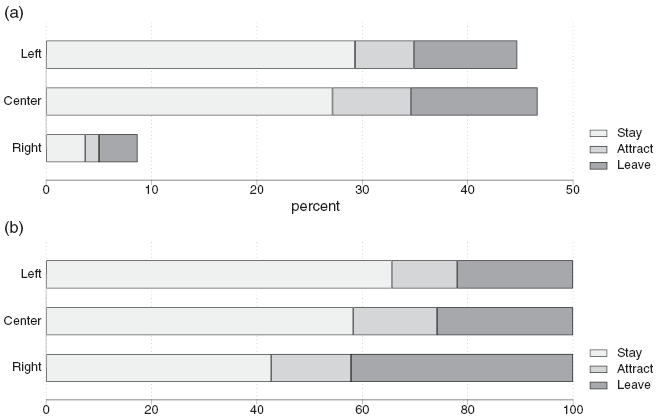
Figure 3.2 shows which voters decided to turn their back on social democratic parties conditional on their LR ideology. Figure 3.2(a) shows the proportion of all voters in the stay/attract/leave pool. We can see that centrist and left voters make up about the same share of the overall pool of social democratic supporters in the eight countries under investigation. Voters who identify as right-wing constitute a barely relevant group for social democratic parties. Overall, social democratic parties lost most voters among people who identify as centrist.
In Figure 3.2(b), we condition on LR ideology, so this panel presents the proportion for stay/attract/leave within each group. This panel shows that the more right-wing a person is the more likely they left social democratic parties. Since right-wing voters constitute a small support group for social democratic parties overall, the consequences of their departure were arguably small. However, the large share of centrist voters that left social democratic parties plays a crucial role in their decline. This provides initial empirical evidence against the economic narrative. If backlash against centrist policies was the main driving factor behind the electoral decline of social democratic parties, why would we see that it is mostly centrist voters who leave these parties?
Figure 3.3 shows patterns of support for social democratic parties based on education. We can see (in (a)) that social democratic parties have significantly lost voters at all levels of education, with people in the middle category making up the most important group for social democratic support. The dilemma of Social Democracy that Kitschelt already outlined in 1994 is strongly visible in this graph. Social democratic parties’ electoral decline cannot be reduced to one of the three groups. The restructuring of the political space has made them less attractive to those with lower as well as those with higher education.
Vote switching from social democratic parties conditional on education
Note: Below UpSec = below upper secondary; UpSec/Voc = upper secondary and vocational.

Interestingly, Figure 3.3(b) shows for the highly educated group that both attract and leave are higher, indicating high levels of competition over educated voters. At the same time, Social Democrats have proportionally seen somewhat stronger losses among the higher educated, so their support has been in slightly higher decline among this group. This indicates that narratives that focus on the decline of Social Democracy purely through a lens of eroding working-class support fail to identify a main driver of their declining vote shares. It also means that social democratic parties face dwindling support in a group that has grown in post-industrial societies and will continue to do so.
In Figure 3.4, we can see the different patterns of changing social democratic support for people who are union members versus those who are not. As Figure 3.4 shows, union members remain a crucial source of support for social democratic parties. We can also see that union members showed a smaller tendency to leave social democratic parties than other voters. While losses are pronounced among both groups, unions thus seem to continue to act as a stabilizing factor in the social democratic electorate.
Vote switching from social democratic parties conditional on union membership

3.3.2 Where Did They Go?
In order to understand the electoral decline of social democratic parties, a crucial factor is not only which voters left, but even more importantly which parties they chose to support instead. Knowing which competitors former social democratic supporters left the party for gives us important insights into these voters’ reasons for leaving the Social Democrats. Both narratives discussed in this chapter provide us with some expectations about which parties former social democratic voters should support. The economic narrative is based on the idea that supporters of social democratic parties turn their back on them because these parties have become too neoliberal. Based on this narrative, we should thus expect voters to choose parties that are economically more left-wing than social democratic parties. A classic example of this would be former supporters of the German SPD who, as a response to the Hartz IV labour market reforms, defect from the party in favour of the left-wing populist Die Linke. The narrative that social democratic parties have lost electoral support because their cultural positions are too progressive is strongly linked to the idea that voters, especially in the working class, have switched to the Radical Right. Empirically investigating where social democratic voters went thus provides us with important evidence about the empirical plausibility of these narratives.
Figure 3.5 presents the distribution of party family support for voters who left social democratic parties during the last two decades. The percentages can thus be interpreted as shares of all voters who left social democratic parties for another party in this decade. We exclude those voters switching to abstention.
Vote switching from social democratic to other parties
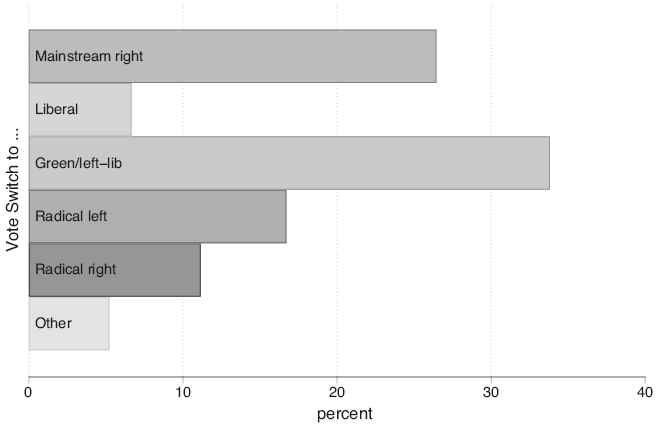
The findings in Figure 3.5 provide important evidence about the dynamics of social democratic electoral decline. First, only a small share of voters – just above 10 per cent – went to parties that belong to the radical right party family. This finding stands in stark contrast to much public debate about the decline of Social Democracy that largely focuses on this group. Second, we find that many voters who left social democratic parties since 2000 switched towards moderate right parties, overall almost 30 per cent of defectors. Competition with the Moderate Right seems to be a decisive factor for the decreasing vote shares of social democratic parties. Third, social democratic parties lost most of their voters by far to progressive green and left-libertarian parties. A closer look at the data reveals that this is even more pronounced in the last ten years that include the watershed elections in France and the Netherlands in 2017. In sum, what stands out in this figure is that nearly 60 per cent of former social democratic voters either switched to a moderate right or a green and left-libertarian party.
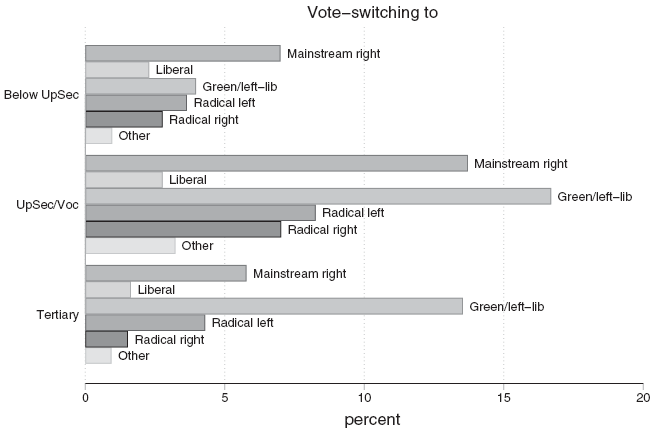
Figure 3.6 shows the same vote switching analysis, but now conditional on voters’ level of education. Among voters with low levels of education, the highest share left for a moderate right party. The higher the education of a voter, the more likely it is that they left for a green and left-libertarian party. For voters with tertiary education, we can see that about as many people decided to switch to a green and left-libertarian party as to all other parties combined. Even among people with low levels of education, we only find very small shares of vote switching to the Radical Right.
Vote switching from social democratic to other parties, conditional on education
Note: Below UpSec = below upper secondary; UpSec/Voc = upper secondary and vocational.
These findings speak against the empirical expectations that follow from the economic narrative. The fact that in the aftermath of the Third Way period and during a time that saw a large-scale economic crisis, social democratic parties lost many more of their voters to the Moderate Right than to the Radical Left is strongly at odds with an idea of a direct backlash against Third Way policies. About a fifth of former social democratic voters opt for the Radical Left, who oppose social democratic parties mainly on economic issues.
The predominant cultural narrative that claims that social democratic parties are too progressive on second dimension issues finds even less support. First, only a small share of people who previously supported social democratic parties decided to vote for a radical right party. Second, during a period that saw increased attention to second dimension issues and particularly to immigration, social democratic parties lost most of their voters to parties that are more and not less progressive than they are. Losses come disproportionally from educated voters. None of these findings support the dominant narratives of the decline of social democratic parties.
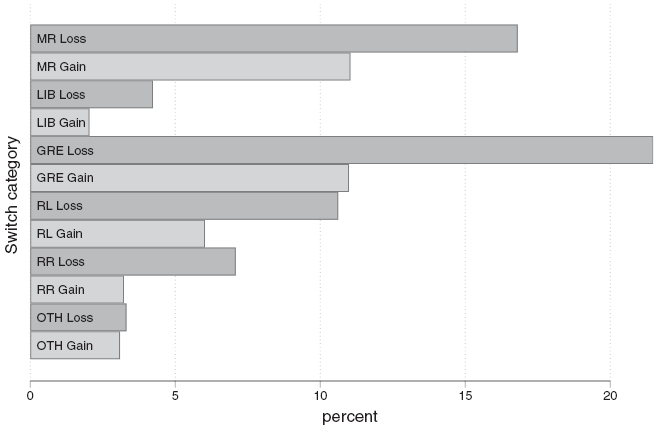
In multi-party competition, social democratic parties of course do not unidirectionally lose voters to another party family but can also win voters back. Just focusing on losses might thus provide an incomplete picture of social democratic decline. In Figure 3.7, we thus show both social democratic gains and losses to other party families. Overall, we can see that social democratic parties have a negative balance with all other party families – there is no party family that social democratic parties gain more voters from than they lose to. The gains and losses patterns support our previous findings. The net losses to green and left-libertarian parties strongly outweigh all other net losses. For moderate right parties, we find a more balanced picture of gains and losses, but in absolute terms the net difference shows a strongly negative effect for social democratic parties. These findings also contradict the idea that party competition largely happens within and not between ideological blocks.
Vote switching between social democratic and other parties
Overall, our findings demonstrate that it is necessary to move away from a narrow focus on working-class and low-education voters and to incorporate the educated middle class into approaches studying the electoral fate of social democratic parties. We argue that a focus on this group at the centre of tripolar competition between moderate left, moderate right and green and left-libertarian parties is necessary to understand the electoral trajectory of social democratic parties and leads to an account of their decline that strongly differs from the economic and cultural narrative presented in this chapter.
These findings are based on data from countries with proportional representation electoral systems. One might indeed wonder how these dynamics play out in single-member district systems that provide stronger incentives against defecting to smaller green and left-libertarian parties. Additional analyses for the United Kingdom, however, show a pattern that is remarkably similar to the one presented in this chapter. Labour has only lost very few voters to United Kingdom Independence Party (UKIP). Losses to the Liberal Democrats play an important role and, in the UK, outweigh losses to the Greens. Losses to abstention are especially high in the UK. This indicates that in SMD systems, voters that are dissatisfied with the mainstream left might be more likely to abstain than to switch to a more progressive party. It is noteworthy that in SMD systems, smaller changes in votes might be more harmful to the mainstream left than in PR systems. Even small shifts in votes can translate into larger shifts in seats and vote losses to the Liberal Democrats or the Greens may even cause seat losses to the Conservative party.
3.4 What Determines Social Democratic Vote Choice?
Further evidence to support our explanation against the economic and cultural narrative of course needs to be based on analyses of voter preferences. After all, it might just be that, for example, social democratic parties lost voters to the Moderate Right due to cultural reasons and to the Green Left due to economic ones, and such findings would much more be in line with the economic and cultural narrative than with the one proposed by us. National election studies unfortunately do not provide attitudinal variables in a way that would allow us to systematically test their effect on vote switching away from social democratic parties. Instead, we turn to the ESS, which provides data for the period between 2002 and 2018 with a rich set of attitudinal variables for our eight West European countries. As the ESS does not allow us to measure vote switching (there is no question on previous but only on the most recent vote choice) we analyse decision pairs, that is voting decision between social democratic and moderate right parties on the one hand and between social democratic and green and left-libertarian parties on the other.
For nine waves of the European Social Survey (2020), we run logit regressions with two-way fixed effects for country and year and cluster our standard errors by country wave. We show how attitudes towards redistribution, homosexuality and immigration as well as LR ideology affect the predicted probability to vote for a moderate left instead of a moderate right or green and left-libertarian party. These preferences reflect the three potential dimensions of the political space in post-industrial societies (Kitschelt Reference Kitschelt and Rydgren2012). One could argue that we thus should not include LR self-placement, but it allows us to also tap into a deeper-seated ideological attachment that potentially goes beyond policy preferences; our findings remain unchanged if we exclude LR ideology. The same is true if we additionally control for socio-economic variables such as education, occupation, gender, age and religious attendance.
Figure 3.8 shows the average marginal effect of our four attitudinal variables on the predicted probability to vote for a social democratic over a moderate right party. We find that LR ideology is by far the strongest predictor of choosing between social democratic and moderate right parties. As all variables are standardized the coefficient shows us that a one standard deviation change in LR ideology to the right decreases the predicted probability of voting for a social democratic over a moderate right party by nearly 0.3. We can also see that attitudes towards redistribution significantly affect choosing between these two party families, while attitudes on immigration and homosexuality barely have any impact at all. In sum, we can show that economic attitudes by far outweigh cultural attitudes in determining the vote choice between social democratic and moderate right parties. This strongly speaks against the idea that questions of immigration or other second dimension issues were the driver behind the loss of former social democratic voters to the Moderate Right. By contrast, they support our argument that this dynamic was largely driven by economic concerns.
Determinants of vote choice between SD and MR

In contrast to the effects for the Moderate Right as shown in Figure 3.9, we find that cultural preferences are far more important in predicting the choice between social democratic and green and left-libertarian parties. A one standard deviation shift towards more pro-immigration and more positive attitudes towards homosexuality decreases the predicted probability of voting for a social democratic instead of a green and left-libertarian party by 0.1. By contrast, LR ideology and redistributive preferences only have a small effect on choosing between social democratic and green and left-libertarian parties.Footnote 9 In sum, our findings show that attitudes on second-dimension issues play a crucial role for the vote choice between social democratic and green and left-libertarian parties. Combined with our earlier findings – that losing former supporters to green and left-libertarian parties was a main driver behind social democratic losses especially in the 2010 years – this supports our account of the electoral decline of social democratic parties.
Determinants of vote choice between SD and Green

3.5 Conclusion
In this chapter, we set out to examine two accounts for social democratic party decline since the turn of the millennium: the economic narrative and the cultural narrative. However, we found that neither narrative can explain the patterns of voter transition we find in our data. It is inconsistent with the economic narrative that centrist voters and non-union members were more likely to leave social democratic parties. It is inconsistent with the predominant cultural narrative that voters did not leave social democratic parties for radical right parties. It is also not the case that authoritarian/nationalist Social Democrats went to moderate right parties instead, since attitudes on immigration and homosexuality do not explain the choice between moderate right and social democratic parties. Education levels are not strongly associated with defecting from the Social Democrats, but both the cultural and economic narrative focus on working-class disaffection.
Instead, a different account seems more plausible. On the one hand, Social Democrats lost voters to the Moderate Right over questions of economic and social policy. On the other hand, Social Democrats lost voters to green and left-libertarian parties that take stronger and more credible stances on cultural questions. This second finding is in fact in line with original discussion of the impact of the rise of the second dimension on social democratic party fortunes (Kitschelt Reference Kitschelt1994).
These results cast doubt on much of the recent public narratives that have surrounded the decline of electoral support for social democratic parties in the past years – narratives that have also found much support within these parties themselves. It is not our aim to postulate that decline in educated middle class support is the only driver of the electoral crisis of social democratic parties. After all, our findings show that Social Democrats have lost out among virtually all electoral groups. However, it is our aim to emphasize that explanations that only focus on the working class – or worse that equate the working class with national/authoritarian whites – provide an incomplete and deeply misleading image of how social democratic strategies have affected their fortunes. Only after abandoning these oversimplified narratives will social democratic parties be able to formulate successful strategies against their current crisis.


 Open access