When trees form annual growth rings, the ring patterns can be used to gain information on growth rates, stand history, and to better understand past climate variability (Fritts Reference FRITTS1976, Speer Reference SPEER2010). Annual rings develop as a consequence of intra-annual variability in suitable growing conditions, such as those related to monthly temperature or precipitation (Fritts Reference FRITTS1976, Stokes & Smiley Reference STOKES and SMILEY1968).
The existence of annual tree-rings is well-established in temperate and semi-arid forests with strong temperature seasonality. Recent studies have demonstrated that some tree species growing in tropical areas with a predictable dry season or seasonal flooding also produce annual growth rings (Baker et al. Reference BAKER, BUNYAVEJCHEWIN, OLIVER and ASHTON2005, Fichtler et al. Reference FICHTLER, CLARK and WORBES2003, Reference FICHTLER, TROUET, BEECKMAN, COPPIN and WORBES2004, Schöngart et al. Reference SCHÖNGART, JUNK, PIEDADE, AYRESS, HÜTTERMANN and WORBES2004, Worbes Reference WORBES1999, Worbes et al. Reference WORBES, STASCHEL, ROLOFF and JUNK2003). Tree-ring records do not yet exist for islands within the eastern tropical Pacific region, however they are of considerable potential significance for two reasons. First, forests in this region support a globally unique and highly threatened endemic flora and fauna. Second, the eastern tropical Pacific region is important to regional and global climate dynamics because it is where much of the variability in the El Niño-Southern Oscillation (ENSO) phenomenon originates. Long tree-ring records from the western Pacific have provided important insights into ENSO and ENSO-induced drought variability at decadal and centennial time-scales, but no such records exist for the eastern dipole of ENSO (D'Arrigo et al. Reference D'ARRIGO, BAKER, PALMER, ANCHUKAITIS and COOK2008, Fowler Reference FOWLER2008).
In January 2010, we began exploring the slopes of Maunaloa and Maunakea on the island of Hawaiʻi searching for possible candidate tree species that could be studied using tree-ring dating methods. The most promising of the tree species examined was Sophora chrysophylla, commonly called māmane, a native tree that is dominant in these subalpine ecosystems and has long been known to produce rings. The primary goal of this study was to determine if these rings are produced annually, and if so, to develop a tree-ring chronology for S. chrysophylla on the slopes of Maunakea. A second goal was to use the tree-ring chronology to explore the relationship between ring-width patterns and rainfall variability of this ecologically important species.
The climate of the subalpine woodlands on the slopes of Maunakea is seasonally variable, with frost occurring regularly from January to April (Juvik et al. Reference JUVIK, NULLET, BANKO and HUGHES1993, Scowcroft Reference SCOWCROFT1983). Temperatures range from night-time lows a few degrees below 0°C to daytime highs above 20°C with mean annual rainfall of 350–750 mm (Scott et al. Reference SCOTT, MOUNTAINSPRING, VAN RIPER III, KEPLER, JACOBI, BURR and GIFFIN1984, Scowcroft & Conrad Reference SCOWCROFT, CONRAD, Stone, Smith and Tunison1992, van Riper Reference VAN RIPER1980). The wet season generally occurs from November to April and the dry season from May to October (Scowcroft Reference SCOWCROFT1983, van Riper Reference VAN RIPER1980). The soils in the area are very fine, sandy loams formed from volcanic ash, sand and cinders, resulting in low water-retention capacity (Scowcroft Reference SCOWCROFT1983, Scowcroft & Conrad Reference SCOWCROFT, CONRAD, Stone, Smith and Tunison1992).
Increment cores from live trees are best used for tree-ring analysis when trees have distinct annual rings and concentric radial growth (Worbes Reference WORBES1995). Hawaiian trees at high elevations often grow asymmetrically, and the oldest portion of the trunk (first ring) is rarely located at the centre (Hart Reference HART2010). During the preliminary phase of this study, several increment cores of S. chrysophylla were inspected, and the rings were not clearly defined under the microscope. Given this and the asymmetric growth habit of S. chrysophylla, it was necessary to inspect entire cross-sections to visually identify complete rings around the circuit of the stem.
We located and sampled 22 S. chrysophylla trees from an area known as Pōhakuloa, which is located on the southern slope of Maunakea (19°44′4″N, 155°30′1″W) with an altitudinal range of 2045–2100 m asl. Seven samples were collected live in 2002, and 15 samples were collected in 2011 from dead trees in an area that was burned in a forest fire in August 2009. A 3–6-cm-thick cross-sectional disc was collected with a chainsaw from between 1–3 m above the base of each tree. Samples were transported to the laboratory where the surfaces of the cross-sections were prepared for cross-dating.
With no known mortality dates of most of our trees (it is possible that some of those that burned at the Pōhakuloa study area were already dead) we explored the possibility of assigning calendar years to S. chrysophylla rings by cross-dating the ring-width series to those of nearby populations of exotic conifers, which included Pinus radiata, Pinus jeffreyi and Cedrus deodara. An increment borer was used to extract a continuous core of wood from the bark to the pith of these living conifer trees (Speer Reference SPEER2010, Stokes & Smiley Reference STOKES and SMILEY1968). One P. jeffreyi, three C. deodara and two P. radiata were sampled at approximately 2275 m asl on the western slope and 2470 m asl on the north-eastern slope of Maunakea in 2012. Two cores were collected from each tree. Samples were transported to the laboratory where the surfaces of the cores were prepared for cross-dating.
The ring boundaries of the S. chrysophylla cross-sections were visually identified, checked, and marked across three different radii that were drawn through the least disturbed sectors of the wood starting from the same innermost growth ring to the outermost distinguishable and visually cross-dated ring. The ring boundaries of the conifer cores were also visually identified, checked and marked across the two subsamples from each sampled tree. Ring-widths were then digitally measured at a precision of 0.001 mm using a Velmex Measuring System (Velmex, Inc.) and the MeasureJ2X computer software program (Speer Reference SPEER2010). Since the death dates of the 2011 collection of the S. chrysophylla samples were unknown, ring-widths were measured with no connection to calendar dates, and the resulting tree-ring series were considered undated. Ring-widths from the 2002 S. chrysophylla collection, and the 2012 conifer cores were measured as dated rings since they were collected from live trees, and the growth ring closest to the bark was used as a reference date for the most recent growing season.
The raw data were then imported into Cofecha, a statistical software program that numerically verifies the accuracy of the cross-dating (Grissino-Mayer Reference GRISSINO-MAYER2001). Cross-dating was first conducted within individual conifer cores and S. chrysophylla cross-sections. After cross-dating within individual trees was verified, Cofecha was then used to check the cross-dating between the combined S. chrysophylla collections with the conifer samples. Based on results from the Cofecha output on within-site cross-dating, the necessary adjustments were made in assigning calendar dates to the undated S. chrysophylla samples using the editing software program Edrm (Grissino-Mayer Reference GRISSINO-MAYER2001). Updated raw ring-width data were then compiled for each site and re-checked in Cofecha for dating accuracy.
Raw ring-width data were analysed and a site chronology was developed for the Pōhakuloa site using ARSTAN, a software program that removes age-dependent and non-climatic trends in the data through standardization (Cook Reference COOK1985). A Friedman variable span smoother with a variable-span sensitivity level set to nine (least flexible) was used to detrend the tree-ring series; this data-adaptive option is useful in modelling the growth curves of disturbed tree-ring series that do not evolve through time in a homogeneous way, and leaves intact tree-ring variability at inter-annual to decadal time scales (Friedman Reference FRIEDMAN1984). A robust (biweight) mean with bootstrap confidence limits was then used to calculate the mean chronology. The running RBar, the average correlation between series (a measure of chronology signal strength), was set with a 20-y window and a 19-y overlap (Wigley et al. Reference WIGLEY, BRIFFA and JONES1984). All other options were set to default.
The resulting tree-ring index chronology was used to investigate the relationship between local climate and annual growth patterns of the S. chrysophylla from the Pōhakuloa site using the software program PCReg (http://www.ldeo.columbia.edu/tree-ring-laboratory/resources/software). Local precipitation data were gathered from a nearby rain gauge station at 1986 m asl operated by the Hawaiʻi State Division of Forestry and Wildlife (SKN #107, 19°44′55″ N, 155°31′32″ W), and spans from 1938–1976 (http://rainfall.geography.hawaii.edu). To help determine the month most critical for tree growth a Pearson correlation analysis was conducted to examine the relationship between the current year's tree-ring index and the monthly precipitation within the present year, as well as the previous year (1-y lag) (Fritts Reference FRITTS1976).
An 86-y chronology spanning 1927–2012 was established using 12 radii from six conifer trees. This chronology included 591 rings with a median series length of 45 y, 0.631 mean series intercorrelation, 0.308 chronology standard deviation, 0.203 chronology lag-1 autocorrelation and 0.331 mean sensitivity. This provides the first evidence that conifers with temperate origins may produce annual growth rings when introduced to tropical areas, such as Hawaiʻi.
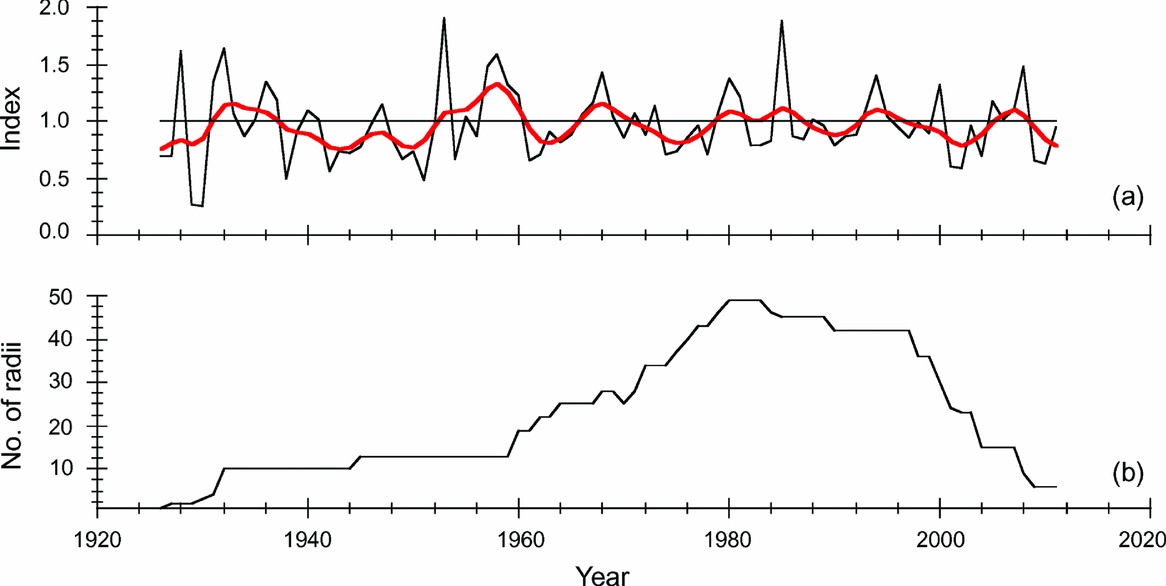
An 86-y chronology spanning from 1926–2011 was established using 52 radii from 22 S. chrysophylla trees from the Pōhakuloa site. This chronology included 2003 rings with a median series length of 32 y, 0.255 mean series intercorrelation, 0.314 chronology standard deviation, 0.096 chronology lag-1 autocorrelation and 0.303 mean sensitivity. The mean of the detrended ring-width series (standardized site chronology) is presented in Figure 1.
Raw tree-ring series mean and detrended curve (red curve) of an 86-y chronology (1926–2011) of Sophora chrysophylla from Pōhakuloa, Hawaiʻi based on 52 radii from 22 trees (a). Number of radii used to produce the chronology (b).

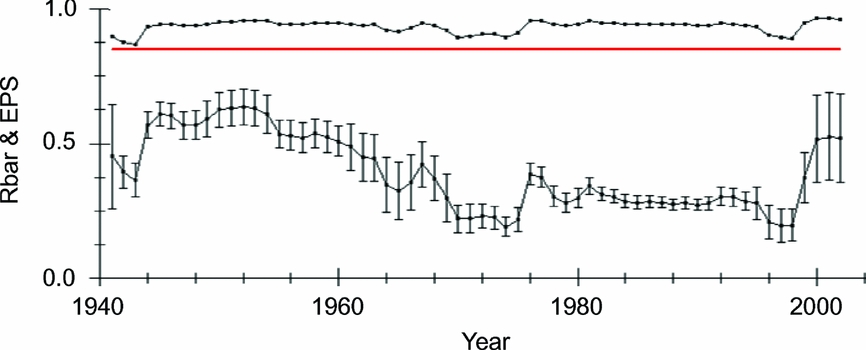
The S. chrysophylla chronology was characterized by a high RBar value and Expressed Population Signal (EPS) values (a measure of the common variability within a chronology in relation to sample depth) greater than 0.85, indicating high inter-annual variability and a strong common signal (Figure 2). The correlations between local monthly rainfall and the standardized chronology index for S. chrysophylla indicate that precipitation in August of the previous year is the best predictor of growth, with stem radial growth greatest in years following an August with heavier rainfall (r = 0.377, P = 0.019). These measures provide evidence for the chronology's reliability as a proxy for climate-change studies, as well as its usefulness in studying the ecology of S. chrysophylla.
High detrended RBar values (a measure of the strength of the common growth signal within a standardized site chronology), based on a 20-y window and a 19-y overlap, and Expressed Population Signal (EPS) values (a measure of the common variability within a chronology in relation to sample depth) greater than 0.85 (red line) from an 86-y chronology (1926–2011) of 22 Sophora chrysophylla trees from Pōhakuloa, Hawaiʻi indicate high inter-annual variability, a strong common signal, and reliability of this chronology as a proxy for climate change and ecological studies.
Cross-dating is based on the presence of a common interannual variation in the periodic growth patterns of trees from a similar area due to a common set of growth-limiting factors most often related to climate. Trees that do not show any synchronization in the variation of growth patterns will not cross-date (Stahle Reference STAHLE1999). The ability to cross-date multiple time-series within and among individual samples of S. chrysophylla and among the non-native conifers provides strong evidence that the growth rings in S. chrysophylla are indeed annual.
Since the successfully cross-dated trees at Pōhakuloa were smaller relative to those from other sites on Maunakea, the growth rings in the cross-sections were fairly clear. To strengthen the Pōhakuloa chronology it is imperative to find larger, older or longer dead S. chrysophylla samples that would provide longer time-series for cross-dating and would also extend the chronology further back in time. However, our results revealed that samples from even our largest trees (up to 55.7 cm diameter) may be relatively young (<150 y). While this may diminish their usefulness as records for how climate has varied over the past centuries in this region of the Pacific, it does provide hope for the success of ongoing restoration efforts of these forests.
ACKNOWLEDGEMENTS
We thank the many technicians, student assistants and interns for all their hard work in the collection, preparation and processing of samples – Tishanna Ben, Joshua Pang-Ching, Iwikauikaua Joaquin, Rhea Thompson and Leinaʻala Hall. We also thank Susan Cordell (U.S. Forest Service, Institute of Pacific Islands Forestry) for helping with access to the Pōhakuloa site, and Samuel Brooks (U.S. Forest Service, Institute of Pacific Islands Forestry) for escorting us and helping to collect samples at the Pōhakuloa site. We also thank the Climate Center of Lamont-Doherty Earth Observatory for funds to cover the field travel expenses of E. Cook and J. Li for conducting this research (Lamont-Doherty Earth Observatory Contribution No. 7293). P. Baker was supported by a Future Fellowship (FT120100715) from the Australian Research Council. Māmane samples were collected with the collaboration of the Hawaiʻi State Division of Forestry and Wildlife (Permit – DOFAWHA2010-01). This project was funded by the National Science Foundation's Centers for Research Excellence in Science and Technology (CREST) (Award No. 0833211).