Introduction
Attention-deficit/hyperactivity disorder (ADHD) typically has its onset in early childhood, with preschool children manifesting symptoms of this disorder similar to those reported in school-age children (Egger et al., Reference Egger, Kondo and Angold2006; Gadow et al., Reference Gadow, Sprafkin and Nolan2001; Wilens et al., Reference Wilens, Biederman, Brown, Tanguay, Monuteaux, Blake and Spencer2002). Although there is a strong genetic component to ADHD, with heritability estimates approximating .76 (Faraone et al., Reference Faraone, Perlis, Doyle, Smoller, Goralnick, Holmgren and Sklar2005), concordance rates do not approach 100%. Other biological factors, including exposure to neurotoxins in utero and to chemical pollutants in the environment, also may contribute to the development of ADHD (Braun et al., Reference Braun, Kahn, Froehlich, Auinger and Lanphear2006; Garrison-Desany et al., Reference Garrison-Desany, Hong, Maher, Beaty, Wang, Pearson, Liang, Wang and Ladd-Acosta2022; Nilsen & Tulve, Reference Nilsen and Tulve2020). The substantial contribution of biological factors to ADHD symptoms, however, does not preclude the possibility that social and psychological factors may also contribute to the development of ADHD symptoms and their consequences. Indeed, there is evidence that psychosocial factors play an important role in the onset, course, and sequelae of ADHD in children (Claussen et al., Reference Claussen, Holbrook, Hutchins, Robinson, Bloomfield, Meng, Bitsko, O’Masta, Cerles, Maher, Rush and Kaminski2022; Huhdanpaa et al., Reference Huhdanpaa, Morales-Munoz, Aronen, Polkki and Saarenpaa-Heikkila2021; Johnston & Chronis-Tuscano, Reference Johnston, Chronis-Tuscano and Barkley2015; Johnston & Mash, Reference Johnston and Mash2001; Tourjman et al., Reference Tourjman, Louis-Nascan, Ahmed, DuBow, Cote, Daly, Daoud, Sespinet, Flood, Gagnier-Marandola, Gignac, Graziosi, Mansuri and Sadek2022).
Johnston and Chronis-Tuscano (Chronis-Tuscano et al., Reference Chronis-Tuscano, Wang, Woods, Strickland and Stein2017; Johnston & Chronis-Tuscano, Reference Johnston, Chronis-Tuscano and Barkley2015) argued that a developmental-transactional model can best describe the complex interplay between parental and family factors and the development, maintenance, and exacerbation of ADHD symptoms. Such a model recognizes that parenting may influence the development of ADHD symptoms while the presence of ADHD may affect parenting, with complex reciprocal interactions between parenting and symptoms occurring as the child develops. In addition to pathways by which parent and family factors affect ADHD symptoms and ADHD symptoms affect parenting and family functioning, Breaux and Harvey (Reference Breaux and Harvey2019) note that the association between family functioning and child ADHD symptoms can be affected by comorbidities associated with ADHD.
Over the last 20 years, several authors raised concerns about the relative lack of longitudinal studies examining the relation between parenting and ADHD symptoms (Deault, Reference Deault2010; Hawes et al., Reference Hawes, Dadds, Frost and Russell2013; Johnston & Chronis-Tuscano, Reference Johnston, Chronis-Tuscano and Barkley2015; Johnston & Mash, Reference Johnston and Mash2001; Keown, Reference Keown2012). Longitudinal studies are important because cross-sectional research cannot inform us about the direction of effects, the pathways through which psychosocial factors influence the development of ADHD symptoms, and the transactional processes through which they exert their influence on one another (Keown, Reference Keown2012; Sonuga-Barke et al., Reference Sonuga-Barke, Auerbach, Campbell, Daley and Thompson2005).
Effects of parent or parenting factors on changes in ADHD symptom levels over time
To date, a small number of longitudinal studies have provided support for the effects of parenting on ADHD symptoms. Negative parenting practices found to be directly related to later ADHD symptoms in children include inconsistent discipline and parental involvement (Hawes et al., Reference Hawes, Dadds, Frost and Russell2013), timid discipline and poor communication (Burke et al., Reference Burke, Pardini and Loeber2008), parental overcontrol (Gadeyne et al., Reference Gadeyne, Ghesquiere and Onghena2004), and parental hostility (Harold et al., Reference Harold, Leve, Barrett, Elam, Neiderhiser, Natsuaki, Shaw, Reiss and Thapar2013). Positive parenting practices are associated with lower levels of ADHD symptoms over time; for example, Keown (Reference Keown2012) found that maternal positive regard and paternal sensitivity at age 4 were significantly, inversely associated with age 7 ADHD symptoms after controlling for age 4 conduct and ADHD symptoms, while Choenni et al. (Reference Choenni, Lambregtse-van den Berg, Verhulst, Tiemeier and Kok2019) found an inverse relation between maternal sensitivity at age 3 and ADHD symptoms at age 8, as well as a direct relation between maternal negative discipline at age 3 and ADHD symptoms at age 8.
Parental scaffolding skills refer to the parent’s ability to engage the child at their developmental level to support the child’s efforts to master a task, while not providing either too much or too little support as the child’s mastery of the task improves (Mazursky-Horowitz et al., Reference Mazursky-Horowitz, Thomas, Woods, Chrabaszcz, Deater-Deckard and Chronis-Tuscano2018). Parental scaffolding skills are associated with a variety of child development outcomes such as executive functioning (Duval et al., Reference Duval, Montminy, Brault Foisy, Arapi and Vezina2023), emotion regulation (Sun & Tang, Reference Sun and Tang2019), and behavior problems (Hoffman et al., Reference Hoffman, Crnic and Baker2006). Although scaffolding seems likely to be an important factor in helping a child cope with ADHD and disruptive behaviors, Mazursky et al. note that few studies have examined the relation of scaffolding to ADHD symptoms or skill mastery among children displaying those symptoms. Among those few studies, Winsler (Reference Winsler1998) found that the parents of boys with ADHD exhibited poorer scaffolding skills than parents of children not exhibiting ADHD symptoms. In a sample of children meeting criteria for either ADHD or disruptive behavior disorder (DBD), however, Mazursky et al. found that neither ADHD nor DBD symptoms were associated with maternal scaffolding skills after controlling for maternal age, education, and executive functioning skills. These studies sought to determine if there is an association between ADHD, disruptive behavior, and parental scaffolding skills in studies using cross-sectional designs, but did not examine their relations longitudinally. Thus, greater attention to the association of scaffolding, ADHD, and oppositional or disruptive symptoms in a longitudinal model is needed.
Other studies failed to find that parenting was associated with changes in ADHD symptoms. For instance, Burke et al. (Reference Burke, Pardini and Loeber2008) found that positive parental involvement, supervision quality, and harsh punishment were not associated with changes in ADHD, and Lifford et al. (Reference Lifford, Harold and Thapar2008) found that maternal rejection did not lead to increases in ADHD symptoms over 12 months. A report by Thorell et al. (Reference Thorell, Rydell and Bohlin2012) indicated that parenting at Time 1 (T1) was associated with ADHD at Time 2 (T2) 1 year later, but was unable to link parenting to changes in ADHD symptoms because it did not control for initial ADHD level.
A few recent studies examined whether specific parenting attitudes or practices mediate the effects of parental ADHD on child ADHD; a critical component of determining if mediation is occurring involves demonstrating that such parenting practices are significantly associated with child ADHD symptoms. In a longitudinal study of children ages 5–10 years, Moroney et al. (Reference Moroney, Tung, Brammer and Peris2017) found that higher levels of negative parenting (harsh discipline, inconsistent discipline, poor monitoring) and criticism were associated with higher levels of ADHD symptoms, while positive parenting (higher involvement, more positive reinforcement) were not.
Effects of ADHD symptom levels on changes in parent or parenting factors
Fewer studies have examined the impact of ADHD symptom levels on changes in parenting over time or the bidirectional effects of ADHD symptoms and parenting. In school-age samples, Lifford et al. (Reference Lifford, Harold and Thapar2008) found that ADHD symptoms led to increases in maternal rejection over 12 months, but that maternal rejection was not associated with increases in ADHD symptoms. For fathers, the direction of effect was the opposite—that is, paternal rejection was related to increased ADHD symptoms 1 year later, but ADHD symptoms at T1 were unrelated to increased paternal rejection at T2. In a second study of 11- to 17-year-old twins, Lifford et al. (Reference Lifford, Harold and Thapar2009) found that ADHD at T1 was associated with increases in maternal-child hostility, but maternal-child hostility was not associated with increases in ADHD symptoms. Gadeyne et al. (Reference Gadeyne, Ghesquiere and Onghena2004) found that ADHD affected parenting, with attentional symptoms at kindergarten associated with increased parental control at grade 1, but similar associations were not found between grades 1 and 2.
Other studies found that ADHD at T1 is associated with T2 parental control and positivity (Barkley et al., Reference Barkley, Fischer, Edelbrock and Smallish1991) as well as with maternal nurturance and hostility (Miranda et al., Reference Miranda, Colomer, Fernandez and Presentacion2015). Because these studies did not assess the parenting behaviors at both T1 and T2, however, they could not assess changes in parenting associated with ADHD.
Effects of comorbidity on parenting/ADHD relations
An understanding of the relations between ADHD and parenting must also account for the effects of conditions that are frequently comorbid with ADHD. Burke et al. (Reference Burke, Pardini and Loeber2008) and Johnston and Chronis-Tuscano (Reference Johnston, Chronis-Tuscano and Barkley2015) argue that existing studies show a stronger relationship between parenting and child disruptive disorders that might be comorbid with ADHD, such as oppositional defiant disorder (ODD) and conduct disorder, than with ADHD per se. As a result, any statistically significant relations between parenting and ADHD might no longer be significant when controlling for comorbid forms of psychopathology (Breaux & Harvey, Reference Breaux and Harvey2019). To understand fully the reciprocal interactions between parenting and symptoms of ADHD, it is important to determine the degree to which parenting is specifically associated with ADHD apart from comorbidities (Ellis & Nigg, Reference Ellis and Nigg2009), and to determine how parenting is associated with the comorbidities as distinct from their association with symptoms of ADHD.
Some studies show that parenting is associated with changes in ADHD symptoms independent of associated conduct problems. Hawes et al. (Reference Hawes, Dadds, Frost and Russell2013) found that inconsistent discipline measured at T1 was associated with T2 hyperactivity/inattention independent of conduct problems (although they did not examine the effects of ADHD on parenting independent of all conduct problems). Keown (Reference Keown2012) found that, after controlling for T1 levels of conduct problems, T1 lower levels of paternal sensitivity and lower levels of maternal positive regard were associated with higher levels of ADHD approximately 2 years later. In contrast, Burke et al. (Reference Burke, Pardini and Loeber2008) found no association between parenting and change in ADHD symptoms after controlling for initial ADHD level. Breaux et al. (Reference Breaux, Brown and Harvey2017) found that maternal and paternal over-reactivity were both associated with ADHD symptoms independent of comorbid ODD symptoms, while maternal and paternal laxness and maternal warmth were not.
Only two studies examined the effects of ADHD at T1 on parenting at T2 while controlling for initial levels of comorbidities. Burke et al. (Reference Burke, Pardini and Loeber2008) found no relation between ADHD and subsequent parenting (poor communication, harsh punishment involvement, poor supervision) when controlling for the effects of ODD. Using cross-lagged models and controlling for levels of comorbid ODD, Breaux and Harvey (Reference Breaux and Harvey2019) found support for the bidirectional effects of parenting and ADHD symptoms on one another throughout the preschool years. Specifically, with ODD comorbidity controlled, they found that more over-reactive parenting led to increased ADHD symptomatology over time, and higher levels of child ADHD led to decreases in parental warmth over time.
The present study contributes to the very limited literature on the relation of parenting and ADHD symptoms by examining bidirectional effects of parenting on ADHD symptoms and ADHD symptoms on parenting, while considering how a common comorbidity of ADHD, symptoms associated with ODD (Breaux & Harvey, Reference Breaux and Harvey2019), might affect the parenting/ADHD relation. In addition, it is possible that the relations between ADHD and parent factors vary by developmental level. Along with the report by Breaux and Harvey (Reference Breaux and Harvey2019), this is one of two studies to examine parenting/ADHD bidirectional effects in preschoolers as they transition into early grammar school. Although Breaux and Harvey (Reference Breaux and Harvey2019) included parent over-reactivity, lax parenting, and maternal warmth, they did not describe the results for the relation of lax parenting and maternal warmth with ADHD symptoms while including ODD symptoms in their model. Also, while reporting that they controlled for ODD symptoms in the model including maternal over-reactivity, they did not include paths from over-reactivity to ODD symptoms in their structural model, making it difficult to determine the effects on both ADHD and ODD of that particular parenting factor.
Two other characteristics of the present study should be noted. First, studies of ADHD in preschoolers suggest that the inattentive and hyperactive-impulsive types of ADHD are best considered to be independent constructs in that age group (Sterba et al., Reference Sterba, Egger and Angold2007; Strickland et al., Reference Strickland, Keller, Lavigne, Gouze, Hopkins and LeBailly2011). For that reason, the relations of parenting to both types of symptoms were examined. Second, while the developmental-transactional model provides a useful framework for considering the interplay between parenting and ADHD and comorbidities, neither that model nor any other we found suggests which specific types of parenting behavior may be important in its development. For that reason, we chose to examine three parenting factors—parental support, hostility, and scaffolding skills—that have been shown to be related to the development of ODD (Lavigne et al., Reference Lavigne, Gouze, Hopkins, Bryant and LeBailly2012, Reference Lavigne, Gouze, Hopkins and Bryant2016) and have been examined in several ADHD-parenting studies described above without attending to their effects on specific and general components of ADHD.
Method
Participants
A diverse sample of 796 children was recruited from 13 Chicago Public School preschool programs and 23 primary care pediatric clinics located throughout Cook County, Illinois, between 2005 and 2009 as part of a longitudinal study of the development of young children’s behavior and emotional problems. Parent and child data were first collected when the children were 4 years old, and then again when they were ages 5 and 6–7 years. Study-eligible children were as follows: (a) 4 years of age at initial recruitment, (b) spoke English or Spanish, (c) lived with the participating parent for at least the prior 6 months, and (d) attained a standard score on the Peabody Picture Vocabulary Test ≥ 70 (Dunn & Dunn, Reference Dunn and Dunn1997). Potential participants were excluded if they were enrolled in a special education class for children with developmental delays or intellectual disabilities, had a school IQ test score below 70, or met criteria for an autism spectrum disorder. There were 78 children (9.7%) for whom at least some Spanish was spoken at home.
There were 796 4-year-olds (mean age = 4.44, SD = .32), including 405 (50.9%) girls and 391 (49.1%) boys. Based on parent reports, the racial/ethnic composition of the sample was as follows: 433 (54.4%) White, non-Hispanic; 133 (16.7%) African American; 162 (20.4%) Hispanic; 19 (2.4%) Asian; and 35 (4.4%) multi-racial or “Other.” Race/ethnicity was not reported by 14 (1.8%) parents. Compared to Cook County, Illinois, where the study was conducted, the study sample (Census U. S., 2007) had slightly more White non-Hispanic children (Cook County, 45.4% White), slightly fewer African American children (Cook County, 26.4%), and was similar to that of the county for Hispanic children (Cook County, 22.2%) and Asian children (Cook County 5.5%).
All social classes (Hollingshead, Reference Hollingshead1975) were represented: there were 303 (38.1%) children in the highest class (Class I), 290 (36.4%) in Class II, 79 (9.9%) in Class III, 63 (7.9%) in Class IV, and 61 (7.7%) in Class V. At the second wave of data collection, the mean participant age was 5.11 years (SD = .35); at the third wave, the mean age was 6.20 years (SD = .46). For 31 families (3.9%), a primary caretaker father was the participating parent and this parent completed study measures.
At age 4, 13.4% of the children met criteria for ODD with mild impairment on a structured interview, and 12.8% met criteria for any type of ADHD (inattentive, hyperactive-impulsive, or combined type) with mild impairment. For a severe level of impairment, there were 8.3% of the 4-year-olds who met criteria for ODD and 8.8% of the 4-year-olds who met criteria for ADHD (Lavigne et al., Reference Lavigne, LeBailly, Hopkins, Gouze and Binns2009).
There were 627 children and parents (78.8%) who participated in all three waves of data collection. Families participating at all three waves differed from those who did not on three demographic variables: (a) race, with a greater proportion of minority participants dropping out, χ 2 (5, N = 796) = 77.7, p = .001, φ 2 = .10; (b) socioeconomic status (SES), with a greater proportion of participants in lower SES groups dropping out, χ 2 (4, N = 796) = 69.61, p = .001, φ 2 = .09; and (c) age, with those who dropped out being on average 25 days older at study entry, t(794) = 2.41, p = .02, d = .21. In preliminary analyses, missing data and item frequencies were examined. Because data were not missing completely at random (MCAR; Little’s test, χ 2 (137, N = 796) = 246.53, p < .001, φ 2 = .31), imputing missing data was more appropriate than listwise deletion (Graham, Reference Graham2009). Missing data were multiply imputed using SPSS V15.0 Expectation Maximization methodology using maximum-likelihood procedures utilizing all study variables (child age, sex, race/ethnicity, SES, all ADHD symptom measures for all three age groups) to estimate missing values. With the imputation, the final sample N was 796.
Measures
All measures were available for parents to complete in either Spanish or English. If published, copyrighted versions were available, they were used. For other measures, a bilingual, bicultural pediatrician with experience in pediatric mental health research produced Spanish-language versions.
Demographics
Parents completed a demographic questionnaire, providing the child’s age, race/ethnicity, and parental occupation and education. SES was coded using the Hollingshead Four-Factor Index of Social Status (Hollingshead, Reference Hollingshead1975).
ADHD symptoms
Three manifest indicators were used to estimate each of two latent variables representing inattentive and hyperactive ADHD symptoms. These measured indicators were the inattentive and hyperactive ADHD items from the following: the Diagnostic Interview Schedule-Young Child Version (DISC-YC) (Fisher & Lucas, Reference Fisher and Lucas2006), the Child Symptom Inventory (CSI) (Reference Gadow and Sprafkin2000b, Gadow & Sprafkin, Reference Gadow and Sprafkin1997a), and the ADHD Rating Scale (DuPaul et al., Reference DuPaul, Anastopoulos, Power, Reid, Ikeda and McGoey1998). Alphas for the inattentive (ADHD-I) and hyperactive-impulsive (ADHD-HI) scale in this sample were .77–.87 for ADHD-I and .85–.91 for ADHD-HI. Supporting the validity of this two-factor model, recent studies reaffirmed the two-factor structure of ADHD, with both inattention (ADHD-I) and hyperactive-impulsive (ADHD-HI) factors, and other studies demonstrate that this two-factor structure is present in young children (Sterba et al., Reference Sterba, Egger and Angold2007; Strickland et al., Reference Strickland, Keller, Lavigne, Gouze, Hopkins and LeBailly2011).
ODD symptoms
Three parent-rated, continuous measures of symptoms of oppositional behavior (composite alpha = .93 at ages 4, 5, and 6) were used: (a) the parent-report ODD symptom scale from the CSI for young children (Reference Gadow and Sprafkin2000a, Gadow & Sprafkin, Reference Gadow and Sprafkin1997b), (b) the parent-report Eyberg Child Behavior Inventory (ECBI) (Eyberg & Pincus, Reference Eyberg and Pincus1999), and (c) the symptom count measure for ODD from the DISC-YC (Fisher & Lucas, Reference Fisher and Lucas2006), a developmentally appropriate adaptation of the parent form of the DISC. The three manifest indicators of oppositional behavior were used to estimate the latent ODD factor at each age.
Parent support and hostility
Measures of parental hostility/coercion (referred to hereafter as hostility; in this study α = .73) and support/engagement (referred to hereafter as support; α = .73) were derived from the Parent Behavior Inventory (PBI) (Lovejoy et al., Reference Lovejoy, Weis, O’Hare and Rubin1999), a 20-item parent-report measure of parenting behavior for use with preschool and school-age children. Test-retest reliabilities in the standardization sample were .69 and .74, respectively. Internal consistency indices for the support/engagement and hostility/coercion scales are .90 and .87, respectively, in the standardization sample; in the present sample, they were .73 for both support and hostility. The support scale measures parental behavior reflecting acceptance of the child, shared activities, and emotional and instrumental support. The hostility factor includes behavior expressing negative affect or indifference to the child, and the use of coercion, threat, or physical punishment to influence the child’s behavior. Following commonly used procedures (Brown, 2006), items were combined into three parcels of parental support and hostility, providing three indicators of each latent factor.
Parent scaffolding skills
The scaffolding skills variable was derived from an observational measure, the NICHD Three Boxes Paradigm (NICHD Early Childhood Research Network, 1999). Parents and children were videotaped interacting during two structured tasks and one unstructured task. The first task requires the child to copy a design on an Etch-A-SketchTM, and the second is a block-building task; each task is designed to be too difficult for the child to complete without parental assistance. The third task involves free play with puppets. Using a 7-point Likert scale, trained research assistants rated parents on supportive presence, respect for autonomy, cognitive stimulation, quality of assistance, confidence, and hostility. A factor analysis indicated these dimensions constituted a single factor, which we labeled scaffolding (inter-rater reliability with a 20% random sample, .69–.80, M = .73, α = .81). Items were divided into parcels, creating three indicators of the latent scaffolding factor.
The validity of a measure is based, in part, on findings showing the measure is related to other variables in a manner that is expected and psychologically meaningful (American Education Research Association et al., 2014). Studies show that the parenting measures for support, hostility, and scaffolding are related to social class, family stress and conflict, child temperament, and symptoms of child psychopathology in a statistically significant and theoretically consistent manner (Bradley & Corwyn, Reference Bradley and Corwyn2002; Goodman et al., Reference Goodman, Simon, Shamblaw and Kim2020).
Procedure
Research assistants approached parents in pediatric offices and preschools and informed them about the study. Interested parents were then mailed questionnaires, which they completed either before or during a home visit. During the home visit (T1 - age 4), the Three Boxes Task was administered (along with other study measures not included in this report). Parents were re-contacted 1 year and 2 years after the initial visit to collect T2 (age 5) and Time 3 (age 6–7) data. Parents again completed all questionnaires at each of these visits, and parent-child interaction was video recorded in a developmentally modified version of the Three Boxes Paradigm.
This study was approved by the appropriate Institutional Review Boards; written consent to participate was obtained each year from the participating parent.
Data analysis
Structural equation modeling via LISREL 8.8 (Joreskog & Sorbom, Reference Joreskog and Sorbom2006) was used to conduct data analyses. In each latent-variable model, measurement errors associated with each of the indicators were allowed to correlate for the same measure across the three assessment periods (e.g., the CSI inattentive ADHD symptom scale at ages 4, 5, and 6). All path coefficients were freely estimated, allowing the magnitude of similar path coefficients to vary across time periods. In the first model, the bidirectional effects of the parenting factor and either ADHD-H or ADHD-I were included but the comorbidity factor was not. These models included the following: (a) autoregressive effects for a parent and an ADHD variable, (b) a path from the parenting variable at one age to ADHD symptoms at the next age, and (c) a path from ADHD symptoms at one age to the parenting variable at the next age.
In the second model, ODD was included along with the parent and ADHD factors. Each of these models included additional paths: (a) autoregressive effects for the ODD variable, (b) a path from the parenting variable at one age to ODD symptoms at the next age, and (c) a path from ODD symptoms at one age to the parenting variable at the next age. Because this report focused on the relations between parenting, ADHD, and ODD, the models did not include paths between ADHD and ODD.
In presenting these models, the important elements being studied were the specific, reciprocal paths themselves, that is, the statistical significance and magnitudes of individual paths and their reciprocal relations. We anticipated that model fit for models including just a parenting variable and ADHD would be good but, because ADHD and ODD symptoms tend to be correlated and might share a large amount of variance, that the model fit would not be as good for the models including parenting, ADHD, and ODD. Further, because we were not hypothesizing that these were strong models of the development of ADHD and ODD, the significance of model fit was of secondary importance. Nonetheless, we do report the goodness of fit of each model. To assess overall goodness of fit, we report a χ 2 value, but we did not interpret its statistical significance because it is inflated by large sample size (Brown, 2006). Robust maximum-likelihood estimation was used to correct for distortion in fit indices and standard errors due to multivariate nonnormality. We computed the Satorra-Bentler scaled maximum-likelihood chi-square (SB-ML χ2) (Bryant & Satorra, Reference Bryant and Satorra2012; Satorra & Bentler, Reference Satorra, Bentler, von Eye and Clogg1994) to obtain a more accurate assessment of model fit. Multiple fit indices were used, including an index that adjusts for model parsimony (root mean square error of approximation; RMSEA), a measure of absolute fit (standardized root mean square residual; SRMR), and comparative fit indices (non-normed fit index, NNFI, and comparative fit index, CFI). Criteria for acceptable-fitting models were as follows: RMSEA approximately .06 or lower for a good fit and approximately .08 for a moderately good fit, NNFI ≥ .95, CFI > .95, and SRMR < .08. Completely standardized path coefficients are reported in the figures and text; values of such path coefficients can exceed one in magnitude, especially when predictors are strongly intercorrelated (Deegan, Reference Deegan1978; Joreskog, 1999). Following Kline (1998), we describe path coefficients as small (< .10), medium (around .30), or large (>.50).
Results
Correlations between measured indicators and latent indicators
Tables reporting the correlations among measured indicators of ADHD-I, ADHD-HI, and parenting both within and across time-points are available as online supplemental material. To detect possible suppression effects, the directions and magnitudes of these correlations were compared to those of the paths in each of the structural equation models; no indications of suppression effects were found. The latent correlations between measures at each age level (represented by curved, dotted lines) are presented in each of Figures 1–6.
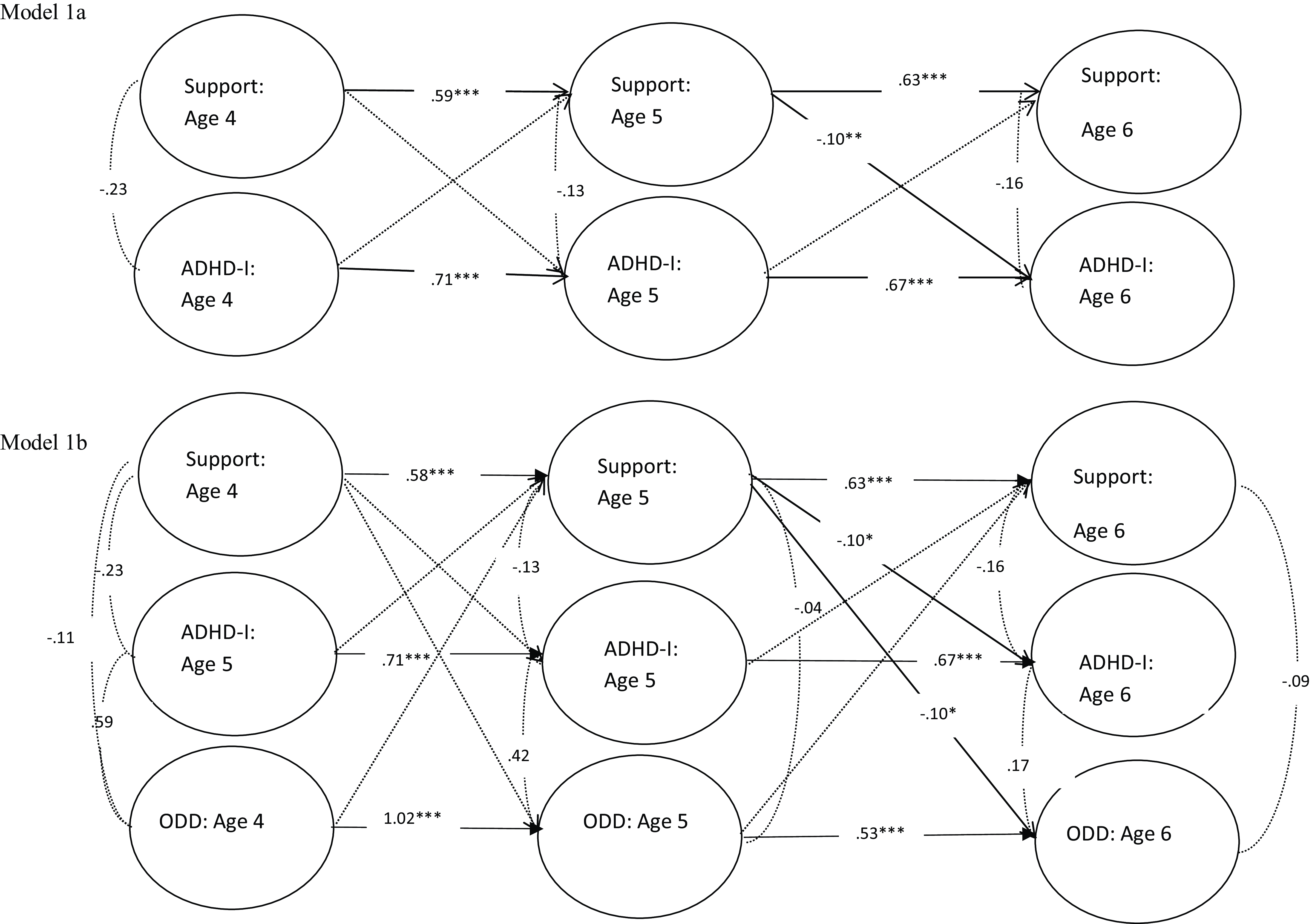
Independent influence of parental support, with child ADHD-I. Structural model for autoregressions and cross-lagged paths, showing the relationships between latent factors included in each model. Each latent factor included three measured indicators not indicated. Correlations between latent factors are represented by italicized curved lines. *p < .05, ** p < .01, *** p < .001.

Testing longitudinal metric invariance of parenting and ADHD measures
An important statistical issue in examining relations across time and interpreting differences between Time 1-Time 2 effects versus Time 2-Time 3 effects is whether the latent variables being analyzed have the same meaning across all three time-points. That is, does each parenting factor mean the same thing at each of the three ages, and does each ADHD factor mean the same thing across all three ages? It is critical to be able to rule out the possibility that changes in the meaning of parenting or in the meaning of ADHD across time are responsible for observed differences in effects across age periods. To address this concern, testing the metric invariance of factor loadings for each parenting factor and each ADHD factor across the three measurement points is required. Thus, we conducted these tests before assessing the bidirectional effects of parenting and ADHD symptoms.
To assess longitudinal invariance in factor loadings (Brown, 2006), we used LISREL 8 (Joreskog & Sorbom, Reference Joreskog and Sorbom2006). Longitudinal measurement models that included autocorrelated measurement errors for each item across adjacent time-points (i.e., T1–T2, T2–T3, and T1–T3) were used to impose longitudinal metric invariance (in factor loadings) on the data of each of the three parenting factors (hostility, support, and scaffolding) and each of the two ADHD factors separately. Strongly supporting longitudinal measurement invariance, in all five cases the temporal metric-invariant measurement models provided acceptable goodness of fit to the data, RMSEAs < .08, SRMRs < .07, CFIs > .994, and NNFIs > .989 (Willoughby et al., Reference Willoughby, Wirth and Blair2012).
Further supporting longitudinal measurement invariance, observed differences in goodness-of-fit indices for temporal-invariance constrained versus unconstrained measurement models were very small—that is, Hostility (ΔCFI < .0001), Support (ΔCFI < .0001), Scaffolding (ΔCFI = .0035), Inattention (ΔCFI = .0004), and Hyperactivity (ΔCFI = .0001)—were all well below the recommended cutoff value of ΔCFI <.01 for inferring measurement invariance (Cheung & Rensvold, Reference Cheung and Rensvold2002). Thus, all three parenting factors and both ADHD factors demonstrated longitudinal metric invariance, thereby enabling meaningful comparisons of relations across the three time-points. Invariance for the ODD symptoms was reported previously (Lavigne et al., Reference Lavigne, Bryant, Hopkins and Gouze2015).
Bidirectional relationships
Bidirectional effects of parental support and ADHD-I symptoms
The model fit for ADHD-I with parental support (Figure 1, model 1a) was good overall, SB-ML χ 2 (111, N = 796) = 245.98, p < .001, RMSEA = .04, SRMR = .06, NNFI = .99, CFI = .99. As expected, the inclusion of ODD reduced overall model (model 1b) fit to poor/moderate, SB-ML χ 2 (283, N = 796) = 1600.01, p < .001, RMSEA = .08, SRMR = .17, NNFI = .95, CFI = .96.
Model 1a (Figure 1) illustrates the relation between parental support and ADHD. Parenting factors and ADHD-I symptoms were highly stable over time. Between ages 4 and 5, both the paths from parental support to ADHD-I and ADHD-I to parental support were not significant. From age 5 to 6, a higher level of age 5 parental support significantly predicted a lower level of age 6 ADHD-I. The path from ADHD-I at age 5 to parental support at age 6 was not significant.
When ODD 2 was included in the model (model 1b, Figure 1), the relation between parental support and subsequent ADHD-I symptom levels was not affected. There were no indications of an association between ADHD-I and parenting in either direction between ages 4 and 5. Between ages 5 and 6, higher levels of age 5 support were associated with lower levels of ADHD-I at age 6 even when age 5 and age 6 ODD were included in the model. In addition, higher levels of age 5 support were associated with lower levels of ADHD-I symptoms at age 6 at a magnitude similar to that for the age 5 support-age 6 ADHD-I relation. Thus, for parental support, parenting effects on subsequent levels of ADHD-I symptoms were greater than ADHD effects on parenting.
Bidirectional effects of parental support and ADHD-H symptoms
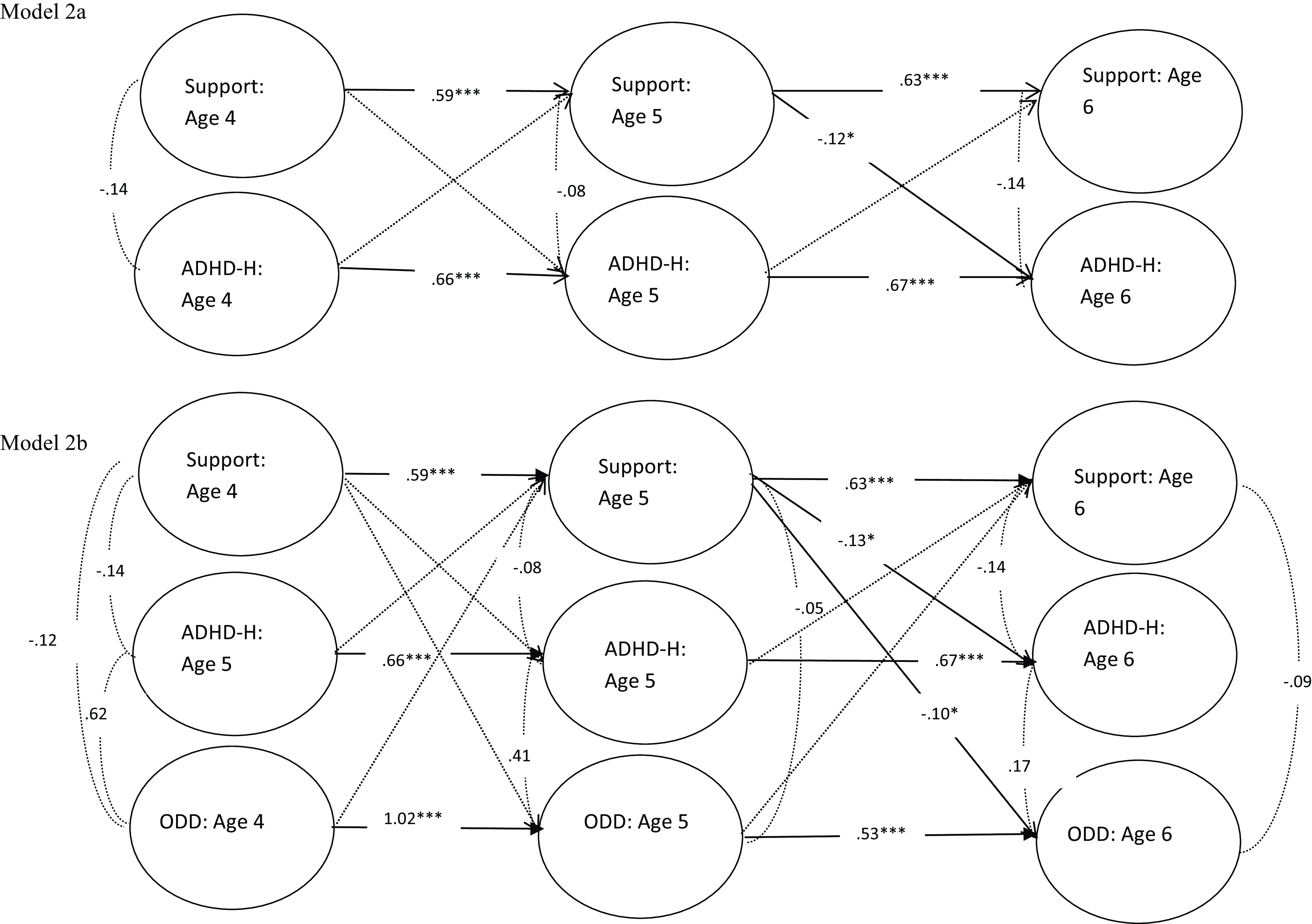
The model fit for ADHD-H with parental support (Figure 2, model 2a) was good overall, SB-ML χ 2 (111, N = 796) = 271.80, p < .001, RMSEA = .04, SRMR = .06, NNFI = .99, CFI = .99. Inclusion of ODD reduced overall model (model 2b) fit to poor/moderate, SB-ML χ 2 (283, N = 796) = 1762.58, p < .001, RMSEA = .08, SRMR = .17, NNFI = .95, CFI = .96. Except for minor variations in the magnitudes of path coefficients, for both models, the pattern of significance of results for ADHD-H and support was the same as that for ADHD-I and support. Specifically, age 4 parental support was unrelated to age 5 ADHD-H, but higher levels of support at age 5 were associated with a decrease in ADHD-H symptoms at age 6. Inclusion of ODD symptoms did not alter the relation of age 5 parental support to age 6 ADHD-H symptoms. As with ADHD-I, there was no association between ADHD-H and subsequent parental support.
Independent influences of parental support, with child ADHD-H. Structural model for autoregressions and cross-lagged paths, showing the relationships between latent factors included in each model. Each latent factor included three measured indicators not indicated. Correlations between latent factors are represented by italicized curved lines. *p < .05, ** p < .01, *** p < .001.

For both ADHD-I and ADHD-H, the path from parental support at one age to subsequent ADHD-I or ADHD-H was significant from age 5 to 6 but not from age 4 to 5. To determine whether the magnitude of that difference was significant, we compared a model in which the magnitude of the support to ADHD paths from age 4 to 5 and from age 5 to 6 were allowed to differ across age groups with a model in which the paths were set to be equal. The goodness of fit for the two models did not differ for ADHD-I or ADHD-H; thus, the possible developmental trend was not significant.
Bidirectional effects of hostility and ADHD-I symptoms
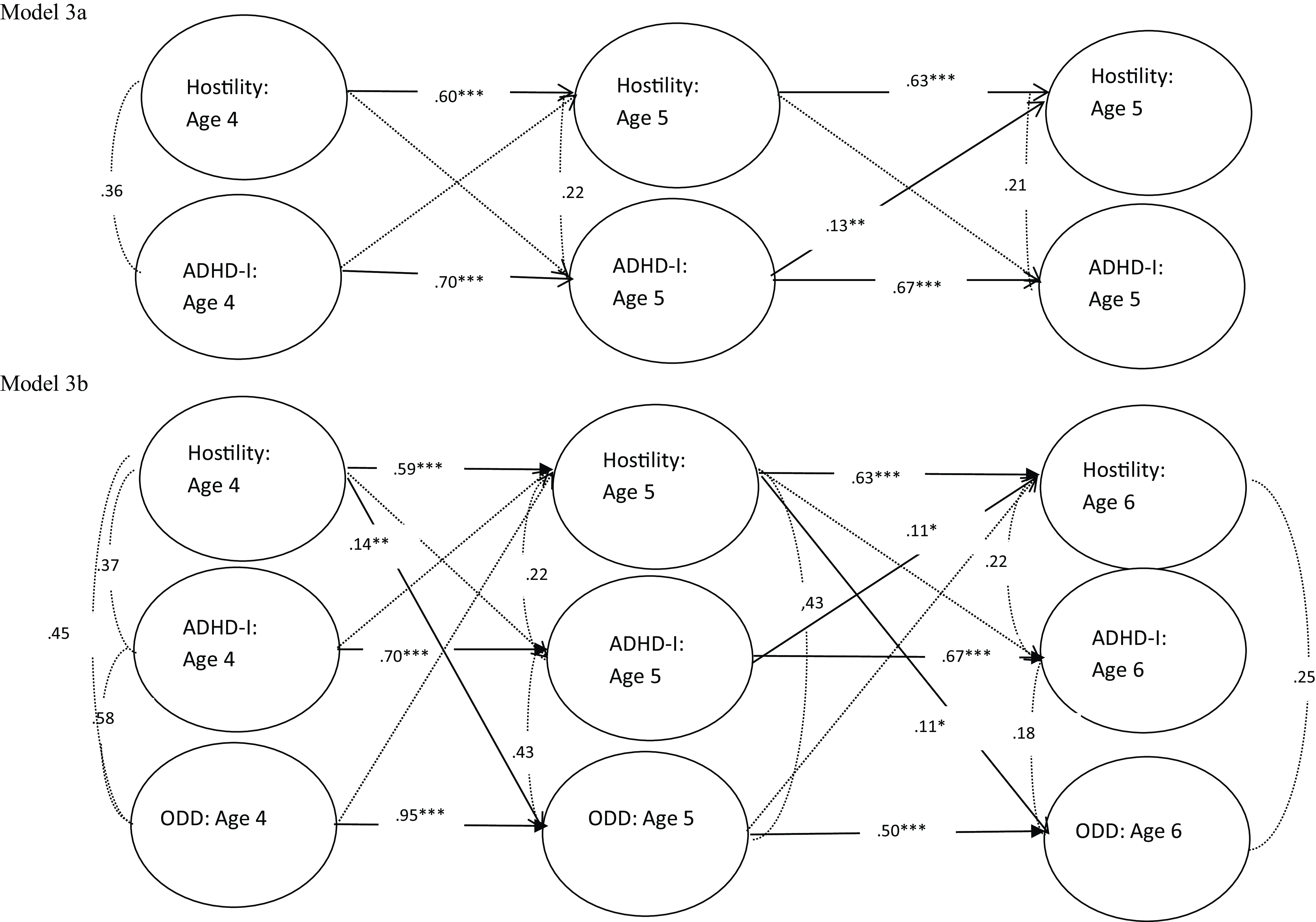
The model fit for ADHD-I with parental hostility (Figure 3, model 3a) was good overall, SB-ML χ 2 (111, N = 796) = 262.62, p < .001, RMSEA = .04, SRMR = .07, NNFI = .98, CFI = .99. Inclusion of ODD reduced overall model (model 3b) fit to only fair, SB-ML χ 2 (283, N = 796) = 1665.63, p < .001, RMSEA = .08, SRMR = .17, NNFI = .94, CFI = .96.
Independent influences of and hostility with child ADHD-I. Structural model for autoregressions and cross-lagged paths, showing the relationships between latent factors included in each model. Each latent factor included three measured indicators not indicated. Correlations between latent factor are represented by italicized curved lines. *p < .05, ** p < .01, *** p < .001.

Model 3a (Figure 3) illustrates the relationship between parental hostility and ADHD. Both parental hostility and ADHD-I symptoms were highly stable over time. Between ages 4 and 5, the paths from parental hostility to ADHD-I and from ADHD-I to parental hostility were not significant. From age 5 to 6, higher levels of age 5 ADHD-I were associated with an increase in parental hostility at age 6, while age 5 parental hostility was not associated with changes in age 6 ADHD-I symptom levels.
When ODD was included in the model (model 3b, Figure 3), there were no changes in the hostility/ADHD-I relation between ages 4 and 5; neither the pathway from age 4 hostility to age 5 ADHD-I nor the pathway from age 4 ADHD-I to age 5 parental hostility was significant. There was, however, a significant association of age 4 parental hostility and an increase in ODD symptoms from ages 4 to 5. Similarly, the inclusion of ODD symptoms did not affect the relation of ADHD-I and hostility between ages 5 and 6; the pathway from age 5 ADHD-I to age 6 parent hostility was significant while the pathway from age 5 parental hostility to age 6 ADHD-I was not. In contrast to the relation for age 5 hostility and age 6 ADHD-I, age 5 hostility was associated with an increase in ODD symptoms ages 5 to 6.
Bidirectional effects of hostility and ADHD-H symptoms
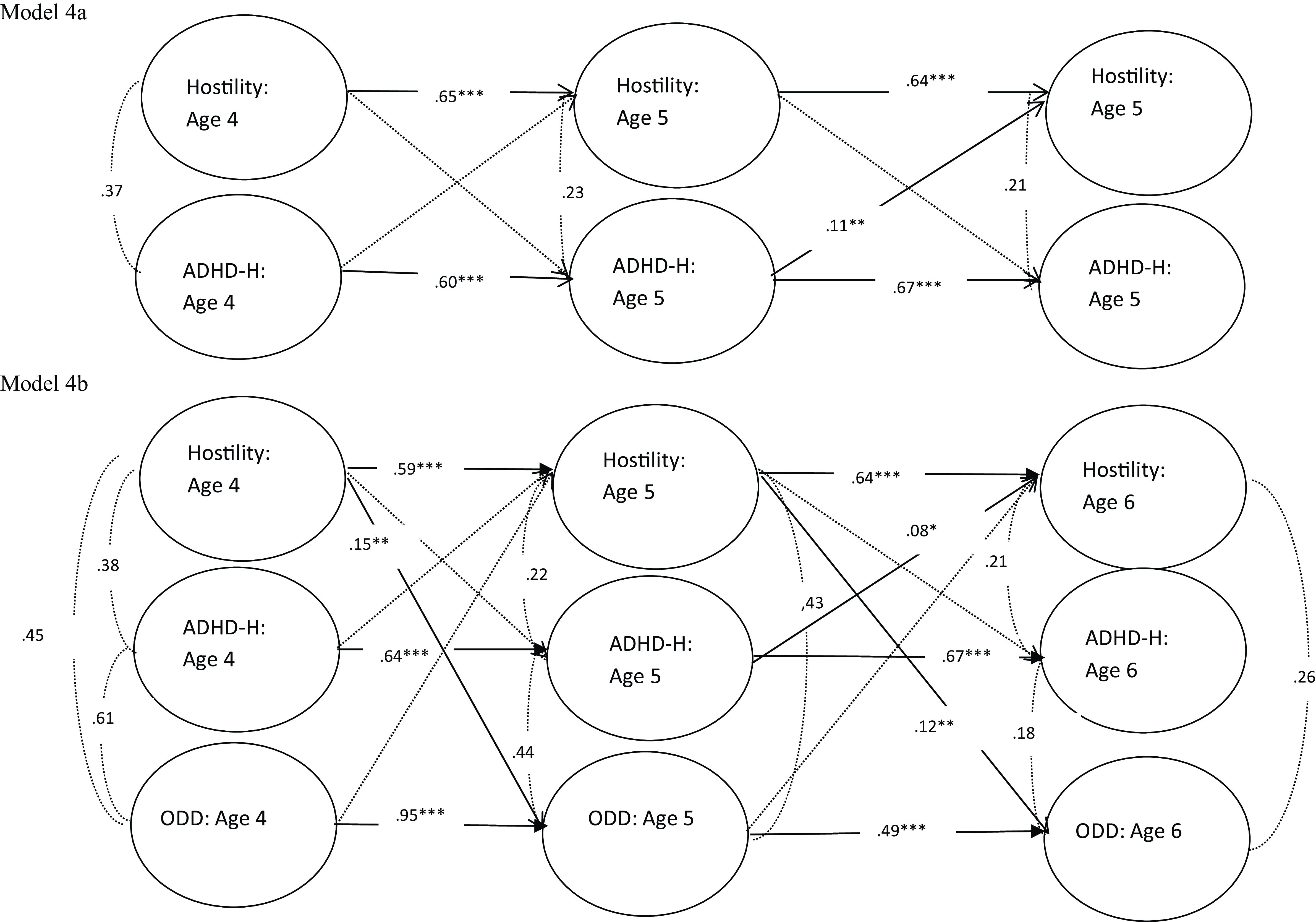
The model fit for ADHD-H with parental hostility (model 4a, Figure 4) was good overall, SB-ML χ 2 (111, N = 796) = 271.80, p < .001, RMSEA = .04, SRMR = .06, NNFI = .99, CFI = .99. Inclusion of ODD reduced overall model (model 4b) fit to poor/moderate, SB-ML χ 2 (283, N = 796) = 1762.58, p < .001, RMSEA = .08, SRMR = .17, NNFI = .95, CFI = .96. With the exception of minor variations in the magnitudes of path coefficients, the pattern of significant results for ADHD-H and hostility was the same as that for ADHD-I and hostility: there were no associations in either direction between ages 4 and 5, but age 5 ADHD-H symptoms were associated with increases in parental hostility from ages 5 to 6. While parental hostility was not significantly associated with changes in ADHD-H at ages 5 or 6, parental hostility was associated with subsequent increases in ODD symptoms at ages 5 and 6.
Independent influences of hostility with child ADHD-H. Structural model for autoregressions and cross-lagged paths, showing the relationships between latent factors included in each model. Each latent factor included three measured indicators not indicated. Correlations between latent factors are represented by italicized curved lines. *p < .05, ** p < .01, *** p < .001.

Bidirectional effects of scaffolding and ADHD-I symptoms
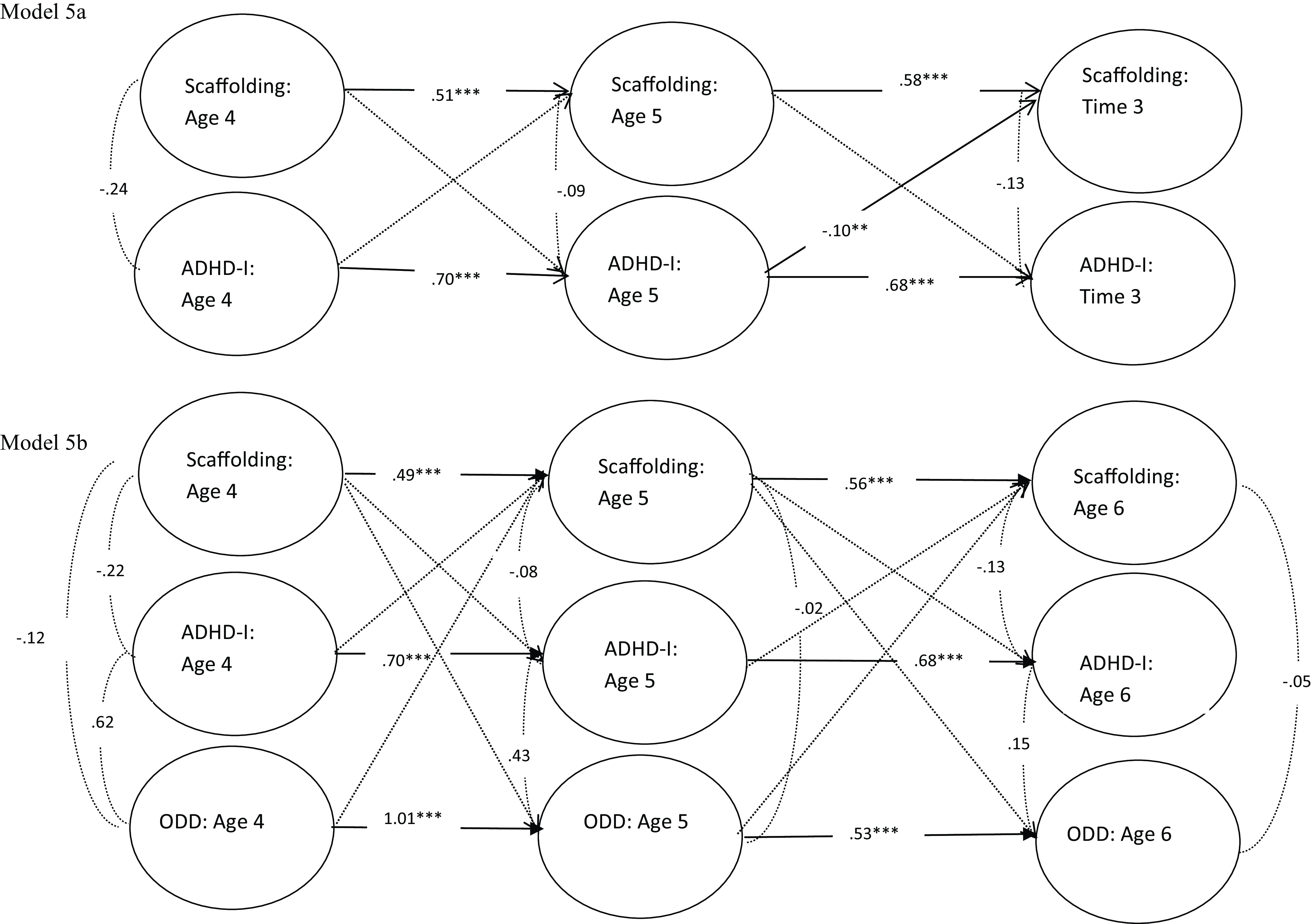
The model fit for ADHD-I with parental scaffolding skills (model 5a, Figure 5) was good overall, SB-ML χ 2 (111, N = 796) = 302.44, p < .001, RMSEA = .05, SRMR = .07, NNFI = .98, CFI = .99. Inclusion of ODD reduced overall model (model 3b) fit to poor/moderate, SB-ML χ 2 (283, N = 796) = 1982.43, p < .001, RMSEA = .08, SRMR = .16, NNFI = .94, CFI = .95.
Independent influences, scaffolding, with child ADHD-I. Structural model for autoregressions and cross-lagged paths, showing the relationships between latent factors included in each model. Each latent factor included three measured indicators not indicated. Correlations between latent factor are represented by italicized curved lines. *p < .05, ** p < .01, *** p < .001.

Model 5a (Figure 5) illustrates the relationship between parental scaffolding and ADHD. From both age 4 to 5 and age 5 to 6, the paths from parental scaffolding to ADHD-I were nonsignificant. Also, the path from age 4 ADHD-I to scaffolding at age 5 was nonsignificant. ADHD-I at age 5 was associated with a significant decrease in parental scaffolding at age 6. Unlike the findings for parental support and hostility, when ODD was included in the model (Model 5b, Figure 5), there were no significant associations between either scaffolding to ADHD-I or ADHD-I to scaffolding. Scaffolding and specific ODD were also not related in either direction at both ages.
Bidirectional effects of scaffolding and ADHD-H symptoms
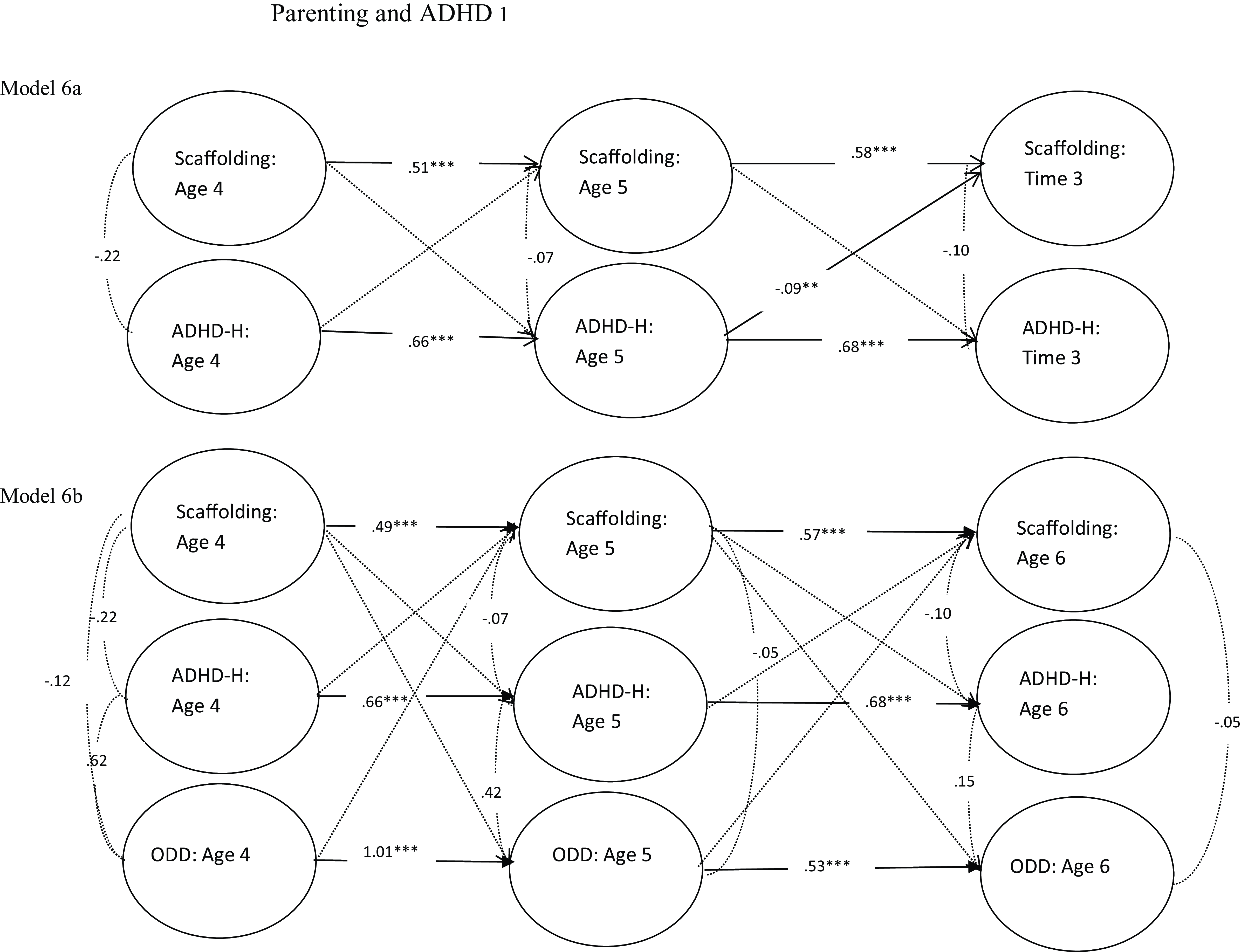
The model fit for ADHD-H with parental scaffolding skills (model 6a, Figure 6) was good overall, SB-ML χ 2 (111, N = 796) = 320.44, p < .001, RMSEA = .05, SRMR = .07, NNFI = .98, CFI = .99. Inclusion of ODD reduced overall model (model 6b) fit to poor/moderate, SB-ML χ 2 (367, N = 796) = 2532.90, p < .001, RMSEA = .08, SRMR = .17, NNFI = .94, CFI = .95. With the exception of minor variations in the magnitudes of path coefficients (models 6a and 6b, Figure 6), for both models, the pattern of significance of results for ADHD-H and scaffolding was the same as that for ADHD-I and scaffolding.
Independent influences of scaffolding, with child ADHD-H. Structural model for autoregressions and cross-lagged paths, showing the relationships between latent factors included in each model. Each latent factor included three measured indicators not indicated. Correlations between latent factors are represented by italicized curved lines. *p < .05, ** p < .01, *** p < .001.

Discussion
This study adopted a developmental-transactional approach to examine the relations between parenting variables, inattention and hyperactive-impulsive symptoms of ADHD, and a common comorbidity of ADHD in young children, symptoms of ODD. We sought to examine the reciprocal effects of parenting with both symptoms of “non-specific” ADHD (i.e., symptoms of ADHD that may share variance with symptoms of ODD), as well as with those components of the symptoms of ADHD and ODD that are “specific,” that is, do not share variance with one another.
Parenting effects on changes in ADHD and ODD symptoms levels
The relation between parenting and subsequent levels of ADHD-I and ADHD-H symptoms differed somewhat by age. For ADHD-I, the levels of parent support, hostility, and scaffolding skills at age 4 were unrelated to changes in ADHD-I symptoms between ages 4 and 5. Similarly, neither age 5 parental hostility nor scaffolding skills were associated with changes in levels of non-specific ADHD-I symptoms between ages 5 and 6. In contrast, there was a small but significant association between lower levels of age 5 parental support and both increased ADHD-I and increased ADHD-H symptoms between ages 5 and 6.
Prior studies raised the possibility that inclusion of an ADHD comorbidity might reduce the relation of parenting to changes in ADHD over time. For the one parenting variable in which there was an association of parenting with subsequent changes in ADHD symptoms, parental support, the inclusion of ODD symptoms in the model did not change the age 5 support/ADHD relation for ADHD-I or ADHD-H.
How does this finding compare to prior studies? First, studies of the relation of parenting at T1 and child ADHD symptoms at T2 that did not control for the initial level of ADHD symptoms or the presence of comorbidity yield quite different results from those that controlled for either initial child ADHD levels or initial ODD comorbidity. When those two factors were not controlled, both T1 negative parenting practices (e.g., parental hostility, poor communication, ineffective or inconsistent discipline, overcontrol, poor communication) and positive parenting practices (higher levels of positive regard and sensitivity) were associated with T2 ADHD (Burke et al., Reference Burke, Pardini and Loeber2008; Choenni et al., Reference Choenni, Lambregtse-van den Berg, Verhulst, Tiemeier and Kok2019; Gadeyne et al., Reference Gadeyne, Ghesquiere and Onghena2004; Harold et al., Reference Harold, Leve, Barrett, Elam, Neiderhiser, Natsuaki, Shaw, Reiss and Thapar2013; Hawes et al., Reference Hawes, Dadds, Frost and Russell2013; Keown, Reference Keown2012; Moroney et al., Reference Moroney, Tung, Brammer and Peris2017). In contrast, when T1 child ADHD levels were controlled for but comorbidities were not, harsh punishment, maternal rejection, and positive parental involvement were not associated with changes in ADHD (Burke et al., Reference Burke, Pardini and Loeber2008).
When considering the association of T1 parenting on T2 child ADHD while controlling for both T1 ADHD and comorbidity with symptoms of ODD at both T1 and T2, there continues to be support for an association of age 5 parent support on changes in ADHD-H and ADHD-I from ages 5 to 6, but not for parent scaffolding skills and hostility for ages 5-6. There are no significant associations between age 4 parenting and age 5 child ADHD-I or ADHD-H symptoms.
Overall, these results suggest that the relation of T1 parenting and changes in ADHD-I and ADHD-H symptoms to T2 is quite limited, with findings either being nonsignificant or, when significant, of rather small effect size. This is consistent with the conclusions of Deater-Deckard (Reference Deater-Deckard2017), who has noted that the correlations of parenting and child ADHD tend to be modest.
Effects of ADHD and ODD on changes in parenting
There were no indications of an effect of age 4 ADHD-I or ADHD-H on subsequent parental support, hostility, or scaffolding skills. Similarly, age 5 ADHD-I and ADHD-H were unrelated to change in levels of parental support at age 6. However, higher levels of age 5 ADHD-I and ADHD-H symptoms were associated with increases in parental hostility from age 5 to 6. It is noteworthy that age 5 ODD symptoms were not associated with increases in parental hostility from ages 5 to 6. As a result, the increases in parental hostility from age 5 to 6 were associated with age 5 ADHD-H and ADHD-I rather than with the comorbid ODD symptoms.
The association of both age 5 ADHD-I symptoms with age 6 parent scaffolding and age 5 ADHD-H symptoms with age 6 parent scaffolding was significant when the ODD comorbidity was not included in the model. When the ODD comorbidity was included, the association of both ADHD-I and ADHD-H with age 6 parental scaffolding skills was no longer significant. Thus, the changes in parental scaffolding skills cannot be attributable solely to symptoms of ADHD.
Overall comments
When compared to prior studies, these results are consistent with Burke’s findings that disruptive symptoms may influence subsequent parenting, and the Breaux and Harvey (Reference Breaux and Harvey2019) finding that, after controlling for ODD, ADHD symptoms were associated with subsequent maternal warmth and parental stress.
The findings of this report provide some, albeit slight, support for developmental transaction processes for parenting and ADHD, at least for young children. The very limited support for parenting effects on core ADHD symptoms is consistent with the literature. Johnston and Chronis-Tuscano (Reference Johnston, Chronis-Tuscano and Barkley2015) note there are just a few studies indicating parenting effects on ADHD, and our review found that the present study, along with the study of Breaux and Harvey which found that maternal over-reactive parenting was associated with subsequent ADHD symptoms while controlling for ODD, was designed to examine parenting effects specifically on ADHD rather than on comorbidities with which ADHD shares variance.
With regard to ADHD effects on parenting, Johnston and Chronis-Tuscano (Reference Johnston, Chronis-Tuscano and Barkley2015) report that there is more support for the direction of that effect, but only one such study (Burke et al., Reference Burke, Pardini and Loeber2008) examined the specific effects of ADHD on subsequent parenting. The results of that study were consistent in finding small effects of ADHD on changes in parenting behavior for some parent effects (i.e., parental communication), but not others (i.e., discipline, supervision, harsh punishment). Thus, in this study and that of Burke et al., developmental-transactional effects were small.
It is important to keep in mind that this study was done with young children and further studies will be needed to determine if developmental-transactional effects related specifically to ADHD after accounting for comorbidity effects need to be examined at different developmental levels. The present study also examined three specific aspects of parenting, and other aspects of parenting attitudes and behavior not measured in this study could be associated in different ways with symptoms in preschool children or with symptoms in older children.
The limited evidence for parenting effects on ADHD has both theoretical and clinical implications. Theoretically, heritability coefficients, along with other research indicating that biological factors such as neurotoxin exposure, indicate that ADHD symptoms have a strong biological base and that psychosocial contributions are likely to be small in comparison. The fact that parenting has a small influence on core ADHD symptoms raises the possibility that numerous psychosocial factors, rather than a single, highly important psychosocial factor (i.e., parenting), influence the development and expression of ADHD symptoms over time. There remains the possibility of a cumulative effect for certain kinds of parenting on ADHD. That is, parental support was associated with a decrease in ADHD symptoms in the subsequent year. Additional research is needed to see if this effect continues throughout the school years. If it does, then the cumulative effect of support leading to decreased symptoms could be greater than is apparent in the present study. It is also possible that improvements in parenting might have a greater impact on some children with ADHD symptoms than others or might have a greater effect on impairment resulting from ADHD symptoms than on the symptoms themselves.
The results of this study, along with others showing limited effects of parenting on ADHD symptom levels, have clinical implications. Chronis-Tuscano et al. (Reference Chronis-Tuscano, Wang, Woods, Strickland and Stein2017) note that most studies of parenting and ADHD have focused on negative and positive parenting. The few significant findings and small effect sizes found in this study on parental support, hostility, and scaffolding skills, as well as in others (Deater-Deckard, Reference Deater-Deckard2017), suggest that a focus on altering those aspects of parenting may have limited benefits. That does not mean, however, that a focus on altering other aspects of parenting might not be beneficial. Chronis-Tuscano et al. note that as many as 50% of the parents of a child with ADHD will have ADHD themselves. As a result, they argue that parent ADHD has an impact on treatment outcomes for evidence-based behavioral and psychopharmacological treatment of ADHD. Further, their developmental-transactional model suggests that parenting will have an influence on the child’s core ADHD symptoms as well as other comorbidities, such as executive functioning (EF). Chronis-Tuscano et al. also suggest that a focus on parental EF skills involving planning, organization, and flexibility may be more useful in improving the effectiveness of parent training. The results of the present study in which there was no association between parental scaffolding skills and change in ADHD-I or ADHD-H symptoms, however, raise some concerns about how successful that approach will be given that both parental EF and scaffolding skills both involve a process of structuring the tasks the child must perform to reduce frustration. There may well be developmental differences in the usefulness of focusing on parental EF to improve the functioning of the child with ADHD. That approach may be more useful with older children, for example, because parents may be able to model more complex verbalizations that the child can then use to engage in self-control, than it is with younger children, where scaffolding might need to rely on parental demonstrations than verbalizations.
The reader familiar with the treatment literature pertaining to behavioral interventions, particularly parent management training (PMT), may note that suggesting there may be limits to the effectiveness of parent-based treatment to reduce core ADHD symptom levels (i.e., those symptoms specific to ADHD) seems incompatible with the concept that behavioral treatment for ADHD is considered to be an empirically supported treatment (Pfiffner, Reference Pfiffner2014) and that the American Academy of Pediatrics (Wolraich et al., Reference Wolraich, Hagan, Allan, Chan, Davison, Earls, Evans, Flinn, Froehlich, Frost, Holbrook, Lehmann, Lessin, Okechukwu, Pierce, Winner, Zurhellen and Disorder2019) recommends that only preschoolers failing to respond to behavioral treatment be considered for treatment with a stimulant medication. Overall, opinion about the efficacy of parent training to improve the behavior of young children with ADHD appears to be mixed. Some reviews (Coates et al., Reference Coates, Taylor and Sayal2015; Daley et al., Reference Daley, van der Oord, Ferrin, Danckaerts, Doepfner, Cortese and Sonuga-Barke2014; Groenman et al., Reference Groenman, Hornstra, Hoekstra, Steenhius, Aghebati, Boyer, Buitelaar, Chronis-Tuscano, Daley, Dehkordian, Dvorsky, Franke, DuPaul, Gershy, Harvey, Hennig, Herbert, Langberg, Mautone and van der Oord2022; Mulqueen et al., Reference Mulqueen, Bartley and Bloch2015; Murray et al., Reference Murray, Lawrence and LaForett2018) report small to medium effect sizes for parent training with young children with ADHD and thus support the use of behavioral training, including PMT for treating ADHD symptoms. Other reviews, however, are less sanguine; a review by the CADDRA Guidelines Work Group (Tourjman et al., Reference Tourjman, Louis-Nascan, Ahmed, DuBow, Cote, Daly, Daoud, Sespinet, Flood, Gagnier-Marandola, Gignac, Graziosi, Mansuri and Sadek2022) found that caregiver interventions (i.e., PMT) showed a nonsignificant treatment effect for preschoolers and that, across all age groups, the treatment effects were significant for parent ratings (all of whom were not blind to whether or not their child was treated), but not significant for teacher ratings. That group’s recommendation for both psychosocial interventions of any type and for caregiver-based interventions, based on what they described as a weak quality of evidence, was “probably do it” for children and “probably don’t do it” for preschoolers. There are also concerns that critics have raised concerns about the efficacy of such interventions for improving core ADHD symptoms (i.e., inattention, activity level) rather than the oppositional or conduct-related symptoms associated with ADHD comorbidities. Thus, Sonuga-Barke et al. (Reference Sonuga-Barke, Brandeis, Cortese, Daley, Ferrin, Holtmann, Stevenson, Danckaerts, van der Oord, Dopfner, Dittman, Simonoff, Zuddas, Banaschewski, Buitelaar, Coghill, Hollis, Konofal and Lecendreux2013) note that behavioral interventions for children ages 3–18 are significant when raters are aware of the allocation of the child to a treated or not treated condition in randomized controlled trials, but the effects were not significant for probably blinded raters. Most important, while some meta-analyses of the effects of parent interventions on preschool ADHD symptoms (Coates et al., Reference Coates, Taylor and Sayal2015; Daley et al., Reference Daley, van der Oord, Ferrin, Danckaerts, Doepfner, Cortese and Sonuga-Barke2014; Mulqueen et al., Reference Mulqueen, Bartley and Bloch2015) do show that ADHD symptoms of preschoolers and older children are reduced by parent training, they typically do not account for the comorbidity between ADHD symptom measures and conduct measures. That is, they do not attempt to “control for” the effects of the conduct-related comorbidities in examining PMT effects on ADHD symptoms in the manner that Breaux and Harvey (Reference Breaux and Harvey2019) and the present study did. Thus, it remains an open question whether parenting interventions do produce improvements in core ADHD symptoms. The results of our study, showing that parenting may have a more significant impact on a comorbidity of ADHD in preschoolers rather than the “core” or “specific” ADHD symptoms, may help explain why behavioral training for preschoolers with ADHD symptoms may improve their overall behavior even though it may not improve core ADHD symptoms.
There are several noteworthy limitations to this study. First, while the children were age 4 at enrollment, it is possible that parenting effects may have been greater in younger children, so that additional research is needed with even younger children. Second, the study’s results are limited to this particular developmental period and may be different in other age groups. Again, additional research is needed to determine how generalizable results are to different developmental periods. Third, these results are specific to ADHD symptoms rated by parents. Studies noted earlier indicate that symptom ratings of parents and teachers show little agreement, and effects of parenting on ADHD symptoms may differ if teachers rate child symptoms. Fourth, this study was conducted with a community sample; results may differ in community samples with a different racial/ethnic composition and in clinic samples. Finally, this study focused on the bidirectional effects of parenting, ADHD, and a commonly occurring comorbidity of ADHD, ODD. One additional study limitation is that we did not look at the bidirectional effects of ADHD and ODD as well as their relations to parent. This could be an interesting topic for future research.
Despite these limitations, the present findings contribute to knowledge about the complex, bidirectional relations among different aspects of parenting and symptoms of a disorder that has a strong genetic component. The developmental psychopathology framework used in this study reveals how parenting factors and ADHD symptoms influence each other over time. Additionally, these findings suggest that parenting variables interact with a child’s biological vulnerabilities to influence child development in other areas of functioning, both behavioral/emotional and academic as the child confronts new developmental challenges.
Acknowledgments
This research was supported by National Institute of Mental Health grant MH 063665.
Competing interests
None.
Supplementary material
The supplementary material for this article can be found at https://doi.org/10.1017/S0954579424001640.