





Crossref Citations

This article has been cited by the following publications. This list is generated based on data provided by Crossref.
Schwarz, Jonathan
Habel, Jan Christian
and
Eberle, Jonas
2024.
Effects of habitat biotic features on hymenopteran diversity in East Africa.
Journal of Insect Conservation,
Vol. 28,
Issue. 4,
p.
821.
Marlon, Wichmann
Schröder, Winfried
Alexandra, Reith
Marco, Rieckmann
and
Halimu, Shauri
2025.
Handbuch der Umweltwissenschaften.
p.
1.
Akhmad Kurnia
Muhammad Yasir Arafat
Muhammad Wajdi
Usman, Usman
and
Fadhil Surur
2025.
The Study of Ammatoa Customary Forest Management by the Kajang Tribe for the Development of a Conservation-Based Learning (CBL) Model Integrated with Local Wisdom.
Jurnal Iqra' : Kajian Ilmu Pendidikan,
Vol. 10,
Issue. 3,
p.
79.
Habel, Jan Christian
Eberle, Jonas
Rainer, Markus
Schröcker, Maximilian
and
Ulrich, Werner
2025.
Ecosystem Functions in East African Forest and Agro‐Environments Depend on Site‐Specific Microhabitat Conditions.
Biotropica,
Vol. 57,
Issue. 4,
Habel, Jan Christian
Githitho, Anthony
Fungomeli, Maria
Teucher, Mike
Shauri, Halimu S.
Mwakumanya, Maarifa A.
and
Schmitt, Christine B.
2025.
Limits of cultural and traditional mechanisms in tropical forest conservation.
Biodiversity and Conservation,
Vol. 34,
Issue. 10,
p.
3675.
Ngumbau, Veronicah Mutele
Jiang, Hui
Nyange, Mwadime
Tian, Jing
Jia, Nan
Hu, Guang-Wan
and
Wang, Qing-Feng
2026.
Dichapetalum pseudoedule (Dichapetalaceae), a new species from the sacred Kaya forests of coastal Kenya.
Kew Bulletin,
Vol. 81,
Issue. 3,
p.
693.
Fungomeli, Maria Mashirma
Ulrich, Werner
Schmitt, Thomas
Wiemers, Martin
Teucher, Mike
Eberle, Jonas
and
Habel, Jan Christian
2026.
Habitat configuration and habitat quality shape butterfly diversity in tropical dry coastal forests of southern Kenya.
Biodiversity and Conservation,
Vol. 35,
Issue. 11,
Mkuzi, Hamisi Tsama
Fuchs, Márta
Ocansey, Caleb Melenya
Gulyás, Miklós
Sebők, András
Takács, Anita
Erika, Döbröntey Réka
Dálnoki, Boglárka Anna
Chiro, Lawrence Tunje
and
Boros, Norbert
2026.
Regeneration dynamics and diversity patterns across disturbance gradients in kaya Kauma Forest, coastal Kenya.
Trees, Forests and People,
Vol. 25,
Issue. ,
p.
101262.
Kimaro, Oforo Didas
Ojwang, Dennis
Rotich, Brian
Desie, Ellen
Verbist, Bruno
Kimaro, Didas Nahum
Feger, Karl-Heinz
and
Vancampenhout, Karen
2026.
Four decades of land-use/cover change reshape ecosystem service values in indigenous agroforestry landscapes of North-Eastern mountains, Tanzania.
Trees, Forests and People,
Vol. 26,
Issue. ,
p.
101278.
Duguma, Lalisa
Minang, Peter
Muthee, Kennedy
Alemagi, Dieudonne
Piabuo, Serge
and
Ayana, Alemayehu
2026.
Ecological restoration legitimacy and scaling: socio-cultural microcosms as structural determinants.
Frontiers in Environmental Science,
Vol. 14,
Issue. ,
Mkuzi, Hamisi Tsama
Boros, Norbert
Ocansey, Caleb Melenya
Gulyás, Miklós
Sebők, András
Takács, Anita
and
Fuchs, Márta
2026.
Aboveground Carbon Stocks and Soil Carbon–Nutrient Characteristics Across Edge, Intermediate, and Core Spatial Zones in Kaya Kauma Sacred Forest, Kenya.
Biomass,
Vol. 6,
Issue. 5,
p.
83.
Introduction
The East African (EA) Coastal Forest stretched once from Somalia in the northeast to Zimbabwe in the southwest (Burgess & Clarke Reference Burgess and Clarke2000). This ecosystem is habitat for various (endemic) animal and plant species (Robertson & Luke Reference Robertson and Luke1993, Wass Reference Wass1995, Burgess et al. Reference Burgess, Clarke and Rodgers1998, Matiku Reference Matiku2005) and provides numerous ecosystem services to people, such as wood, fruits and medical plants, carbon storage, and climate regulation, among others (Glenday Reference Glenday2008, Habel & Ulrich Reference Habel and Ulrich2020). With increasing demographic pressure changes in land ownerships (e.g. privatization), major parts of the East African Coastal Forest have been destroyed. Today, the remaining forest is highly fragmented but still of high relevance to biodiversity and functions (Mittermeier et al. Reference Mittermeier, Turner, Larsen, Zachos and Habel2011). Some of these forest remnants are protected as forest reserves or National Parks (Wass Reference Wass1995), such as the Arabuko Sokoke Forest and the Shimba Hills in southeastern Kenya (Fungomeli et al. Reference Fungomeli, Cianciaruso, Zannini, Githitho, Frascaroli, Fulanda, Kibet, Wiemers, Mbuvi, Matiku and Chiarucci2020a). In addition, some small and geographically isolated forest patches are protected across southern Kenya, as they host old settlement sites, old burials from former chiefs, and they are also rainmaking sites (Metcalfe et al. Reference Metcalfe, Ffrench-Constant and Gordon2010).
Forest Kayas or Mijikenda sacred forest sites are spread along the Indian Ocean coastline of southern Kenya (Robertson & Luke Reference Robertson and Luke1993, Githitho Reference Githitho, Lee and Schaaf2003, Matiku Reference Matiku2005, Shepheard-Walwyn Reference Shepheard-Walwyn2014, Fungomeli et al. Reference Fungomeli, Githitho, Frascaroli, Chidzinga, Cianciaruso and Chiarucci2020b). Most of these ca. 145 forest islands are very small (mean size of 120.4ha, with two larger forest islands – the Arabuko Sokoke Forest with 42000 ha and the Shimba Shills with 25300 ha, 75% smaller than 150 ha) (Nyamweru et al. Reference Nyamweru, Kibet, Pakia, Cooke, Sheridan and Nyamweru2008, Shepheard-Walwyn Reference Shepheard-Walwyn2014, Fungomeli et al. Reference Fungomeli, Githitho, Frascaroli, Chidzinga, Cianciaruso and Chiarucci2020b), and geographically isolated from each other. Since ancient times, they have been managed and controlled by elders and have remained largely intact (Fungomeli et al. Reference Fungomeli, Githitho, Frascaroli, Chidzinga, Cianciaruso and Chiarucci2020b). Ecologically, they are of high relevance as they still harbour considerably high biodiversity, including rare forest plant and animal species (Luke & Githitho Reference Luke, Githitho, Hoorweg and Muthiga2003, Wijtten et al. Reference Wijtten, Hankinson, Nuttall, Gomes, Lemarkat, Silva, Serrano and Chaves2011). In addition to local protection, many Kayas are protected as National Monuments or forest reserves; several Kayas are also included in the Mijikenda Kaya World Heritage site (Githitho Reference Githitho2016, Fungomeli et al. Reference Fungomeli, Cianciaruso, Zannini, Githitho, Frascaroli, Fulanda, Kibet, Wiemers, Mbuvi, Matiku and Chiarucci2020a).
Despite the cultural and ecological relevance of these forest islands, there exists a lot of pressure on them. Thus, the fast-growing and increasingly ethnically mixed local population collects firewood for cooking (deadwood and tree-cutting) and the construction of houses (stems from young re-growing trees), or for sale (alternative sources for firewood and timber are not easily at hand). In addition, cattle grazing takes place inside these forests, as well as illegal hunting (including with traps). These activities lead to the situation that vegetation regeneration can hardly take place for various forest tree species (Kibet Reference Kibet2011). Furthermore, it remains questionable whether wild animal and plant species can persist in such small habitat sites and populations which the Kayas typically consist of in the long run (see Melbourne & Hastings Reference Melbourne and Hastings2008). The protection of these forest islands builds on cross-generational respect for traditions and customary practices – which is increasingly challenged by the mobility and fragmentation of rural life. In addition, the protection status of the Kayas has not been harmonized and clarified in national legislation until today, and there are only limited financial resources available for conservation management. To enhance sustainable conservation, an effective and intensive cross-generational discussion is essential, including representatives of the local community (especially young people and elders), and from various stakeholders and from governmental organizations.
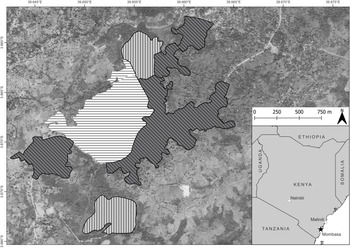
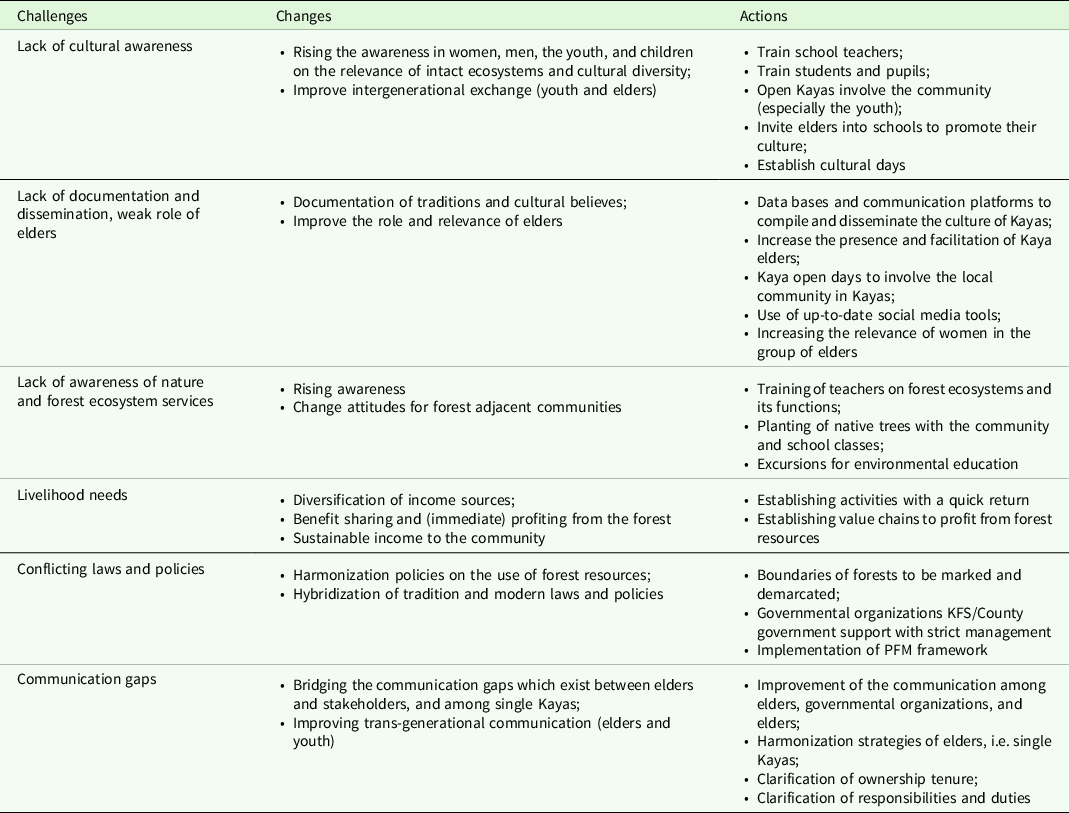
During a workshop with members of GOs, NGOs, representatives of the local community (elders), as well as people from the field of research, we discussed and analysed the current status and elaborated improvements for better protection of the resources of the Kaya Kambe (Figure 1). Out of the 24 participants, there were six from GOs (e.g. Kenya Wildlife Service – KWS, Wildlife Research Training Institute – WRTI, National Museums of Kenya – Coastal Forest Conservation Unit – KWS-CFCU), three of NGOs (Nature Kenya, WWF Kenya, Human Rights Agenda Kenya - HURIA), three representatives of the local community (elders, community forest association), four members from local university, and two teachers. During this workshop, we first defined our general aim (long-term conservation of Kaya forests). We subsequently elaborated potential measures and actions, which can be taken in smaller working groups – for the fields of ‘culture and tradition’, ‘education’, ‘governance’ and ‘economic independence’. We visualized all aspects as synergy map, following the leitmotif ‘what and who needs to change to create a positive impact for a positive future state’. The outcome of this working process is compiled in Table 1. In the following, we will critically reflect current shortcomings and potential strategies which might be suitable to better preserve nature and ecosystem services in and around Kaya forests.
Location of Kaya Kambe forest (star in small inlet map). Forest patch (white-black shaded) embedded in agricultural land and surrounded by settlement area (dark shaded) and quarries (white shaded).
Overview of identified challenges, desired changes, and specific actions to improve the current situation in and around the Kayas. The overarching goal aims for the long-term preservation of an intact forest ecosystem for nature and people.
Cross-generational forest conservation
Kayas represent old settlements with burial places linked to the traditional chiefs of the Mijikenda people. As such, they are tetemonies and heritage of not just the chiefs, but also the people who recognize his authority and rather than spiritual rituals suggest you write out rainmaking and other rituals (Githitho Reference Githitho, Lee and Schaaf2003, Shepheard-Walwyn Reference Shepheard-Walwyn2014). The Kayas are key in negotiating social identity and belonging and in creating a sense of ‘community’ (Matiku Reference Matiku2005). Traditionally, the elders have acted as the guardians of the Kayas. They have played a central role in performing rituals, and they have restricted and managed access to the forests. However, the breakdown in traditional beliefs and the increased influence of Christianity and Islam along with the increasing demand for forest products made forest protection less and less efficient (Goldammer Reference Goldammer1992, Sayer et al. Reference Sayer, Harcourt and Collins1992). Today, the elders represent a rather marginal group than the centre of cultural and social cohesion, and in parallel, the pressure on the resources of Kaya forests increased – for private use and for selling on the local market (Peltorinne Reference Peltorinne, Pellikka, Ylhäisi and Clark2004). The majority of the community does not participate in cultural life and is not allowed to enter the Kayas. However, with this exclusion of people and the entire community from the Kayas, the acceptance and interest to conserve the forest might be rather little. This was shown in a study on the effectiveness of Participatory Forest Management in the Coastal Forest block Arabuko Sokoke; only those residents and groups with a longer-term emotional attachment to the forest campaigned for its protection (Nzau et al. Reference Nzau, Ulrich, Rieckmann and Habel2022). Thus, a cross-generational dialogue is crucial to ensure a common goal and policy for the long-term conservation of these forest remnants and to rise acceptance of forest conservation. To start a lively dialogue between the elders and the (young) local population local meetings (barazas), excursions into the forest, and visits of elders in schools and school visits to Kayas (what partly happened when some Kayas were included in the world heritage site). With this cross-generational exchanges, it will be possible for the younger generation to learn about their heritage and customs, and at the same time the elders to adjust and adapt their teachings.
Strengthen a common policy
The role of elders and the access and use rights of Kayas vary strongly among the single Kayas. Most elders from different Kaya forests do not coordinate with each other. However, common policy formulation through the elders might help to act on par with representatives of governmental organizations (such as the governmental representatives, Chief, County government) or representatives of relevant government organizations (Kenyan Forest Service, Kenya Forest Research Institute, Kenyan Wildlife Training Institute, National Museums Kenya, UNESCO). A harmonization would help to gain more influence and acceptance again and reclaim a stronger role in society and the community.
Today, the management of Kaya forests officially relies on the National Museums of Kenya, through the Coastal forest conservation unit with the help of Kenya Forest Service, and the County government. Control and implementation of forest management should be conducted by a single and central organization in both, the legislative and executive capacity. Utilization should be ecologically sound and sustainable (regeneration capacity of forests, regeneration of vegetation must be guaranteed), such as wood harvest adapted to the ecosystem carrying capacity, leaving dead wood in the ecosystem. In order to protect the forest remnants efficiently, it would be desirable to develop a joint management strategy together with the local community, including elders and the youth. Decentralized, but coordinated action from the community could be most effective in this regard, as numerous studies from Southern Kenya show (Himberg et al. Reference Himberg, Omoro, Pellikka and Luukkanen2009). Thus, for effective protection of these forest islands, the rural people living around the Kayas should fully participate both in decision-making and in the implementation of any protective measures.
Profiting from ecosystem services
With the monetary valuation of nature’s services, a new acceptance of conservation and resource use (Christie et al. Reference Christie, Fazey, Cooper, Hyde and Kenter2012) emerged in many areas of human life. Kayas are not only places with exceptionally high biological and cultural diversity but also provide numerous services to humans that lead to an improved quality of life. For example, natural primary forests store a large amount of carbon (Pregitzer & Euskirchen Reference Pregitzer and Euskirchen2004), regulate the water balance (Traore et al. Reference Traore, Ciais, Vuichard, MacBean, Dardel, Poulter, Piao, Fisher, Viovy, Jung and Myneni2014) and the mesoclimate (Luyssaert et al. Reference Luyssaert, Schulze, Börner, Knohl, Hessenmöller, Law, Ciais and Grace2008). But also on a local level, such small forest fragments have a supportive effect on the surrounding landscape. Studies along the Arabuko Sokoke coastal forest and on forest fragments of the Taita Hills showed that pest infestations in agricultural areas are reduced by increased predation rates from the adjacent forest (Habel & Ulrich Reference Habel and Ulrich2020, Seifert et al. Reference Seifert, Teucher, Ulrich, Mwania, Gona and Habel2022). It is very important to communicate the relevance of kayas as a source of ecosystem services, for example, in schools. This could also lead to increased protection of the forest and a more careful use of nature and resources.
Kayas: Nucleus of diversity
The conservation of Kayas is of utmost ecological and cultural importance, for the entire landscape and population. These forest islands are important habitats for rare animal and plant species and represent valuable stepping stones in a densely populated, highly anthropogenic landscape. Kayas can also provide valuable habitats in the future with positive spill-over effects of services. Furthermore, even culturally, traditions are also a valuable asset to the society in the immediate vicinity of a Kaya. The basis for long-term conservation of these forest islands is much improved communication across generations, as well as alignment of management strategies and objectives between stakeholders. It will be a challenge to reconcile state management with traditional and cultural motivations.
Acknowledgements
We thank all participants of the Biocult workshop (September 18–20), Stephen Katana Kazungu (Kambe Secondary school), Wycliffe Shahati Luvuka (Maereni Primary School), Martin Mjape Tange (Chief Kambe), Francis Wathigu Kagema (Nature Kenya), Asma Awach (WWF Kenya), Mwabim Ilassim Ntindi (Kenyan Wildlife Service), Lynn Njuguna (WRTI – Watamu), Betty Mohamed Sidi (HURIA), Anthony Githitho, Lawrence Tunje Chiro (NMK CFCU), Dubi Dzua, Erastus Kubo (Elder Kaya Kambe), Rose N. Kigathi (Pwani University), and Isaac K. Opilo (Kenyan Forest Service). We thank the German Academic Exchange Service for funding this workshop. We thank xx anonymous referees for fruitful comments on a draft version of this manuscript.
Declarations
Availability of data and materials
Not applicable.
Authors’ contributions
JCH and MT have written a first draft version of this manuscript. All contributed afterwards while writing and finishing this manuscript.
Funding
This study and activity were funded by the German Academic Exchange Service, DAAD.
Competing interest
There are no competing interests.
Ethical approval
Not applicable.