


1. Introduction
The derivational relationship between adjectives and verbs is influenced by both conceptual and formal factors. One important conceptual factor is the distinction made in Dixon (Reference Dixon1982) between property concept states and states that arise from a previous action, or ‘result states’ (Koontz-Garboden Reference Koontz-Garboden, Booij and Marle2005). In some languages, this conceptual distinction is correlated with the morphological form taken by corresponding adjectives, which is suggestive of their derivational status. In English, for instance, a property concept state adjective such as loose in (1a) below can be considered the derivational base of the change of state (COS) and caused COS verbs of the form loosen in (1b, c) (respectively intransitive and transitive). A result state adjective such as broken in (2a), however, bears the past participial form of the verb break in (2b, c), and can reasonably be assumed to be deverbal (Haspelmath Reference Haspelmath, Comrie and Polinsky1993, Koontz-Garboden Reference Koontz-Garboden, Booij and Marle2005).
- (1)
(a) The knot is loose.
(b) The knot loosened.
(c) Sandy loosened the knot.
- (2)
(a) The window is broken.
(b) The window broke.
(c) Pat broke the window.
In this paper, I explore the derivational relationship between adjectives and verbs in Mandarin Chinese, a question complicated by an erstwhile controversy over whether an independent class of adjectives needs to be posited in the language. I argue that only one kind of regular derivational relation between these predicates is attested in Mandarin: COS verbs may be systematically derived from adjectives, but there is no correspondingly systematic derivation of result state adjectives from COS verbs. The key contrast is in the regularity of the derivation: I argue that Mandarin has both deadjectival COS verbs and deverbal result state adjectives, but only the former are systematically available, while the availability of the latter is determined by conceptual-pragmatic rather than grammatical factors.
Koontz-Garboden (Reference Koontz-Garboden, Booij and Marle2005) argues that the distinction between property concept and result states underlies the different shapes of morphological paradigms consisting of state, COS, and causative COS predicates that share the same state description. He argues that if the state description is a property concept state, the paradigm is based on the word describing the state. Alternatively, the causative verb may appear to be the basic member of the paradigm, with the intransitive and stative members derived from it. In such cases, the stative word in the paradigm would describe a result state. Relevant examples from Cuzco Quechua are given below. The state of being big, a property of one's size, is plausibly a property concept state. Example (3) below shows that state, COS, and causative meanings with the state of being big as their stative core are based on the stative word hatun ‘big’, with the COS meaning arising via the transformative affix shown in (3b) and the causative meaning arising via causative affixation to the COS form in (3c)Footnote 2.
(3) Cuzco Quechua (Koontz-Garboden Reference Koontz-Garboden, Booij and Marle2005: 90, ex. (15))
(a) wasi-qa hatun-mi (ka-sha-n)
house-top big-evid be-prog-3
‘The house is big.’
(b) hatun-ya-y
big-trans-inf
‘become big’ (Cusihuaman Reference Cusihuaman1976: 195)
(c) wasi-ta hatun-ya-chi-rqa-n
house-acc big-trans-caus-past-3
‘(S)he made the house big.’
Patterns analogous to (3) are also noted for O'odham and Warlpiri in Hale & Keyser (Reference Hale and Keyser1998). Such relationships between words have long been recognized in theories of event structure where they have been captured by means of lexical operators such as become, which indicates COS, or cause, which is found in the representation of causative predicates (Dowty Reference Dowty1979, Van Valin Reference Van Valin1993, Rappaport Hovav & Levin Reference Rappaport Hovav, Levin, Butt and Geuder1998, among others). Rappaport Hovav & Levin (Reference Rappaport Hovav, Levin, Butt and Geuder1998) model these event structure generalizations with event structure templates such as those in (4), where the above-mentioned operators apply to structures made up of primitive constants that represent activities, as in (4a), and states, as in (4b).
- (4)
(a) [x ACT<MANNER>] (activity)
(b) [x <STATE>] (state)
(c) [BECOME [x <STATE>]] (non-causative COS)
(d) [x CAUSE [BECOME [<y STATE>]]] (caused COS)
In such a system, then, the event structure of the words in (3) can be represented as in (5), where -ya would be understood as realizing the become operator, and -chi as realizing the cause operator (see also Koontz-Garboden Reference Koontz-Garboden2007a: 119–120, 125).
- (5)
(a) hatun ‘big’: λy λs big′(y)(s)
(b) hatun-ya ‘become big’: λy λs λe [become(s)(e) ∧ big′(y)(s)]
(c) hatun-ya-chi ‘cause to become big’:
λy λx λs λe′ λe [cause(x, e′)(e) ∧ become(s)(e′) ∧ big′(y)(s)]
In these and later representations, I assume an extensional semantics with a domain of ordinary individuals (type e), represented with variables such as x, y; a type of events (type v, variables e, e′); states (type s, variables s, s′) and times (type i, variables t, t′). (5a) gives the semantic representation for stative hatun ‘big’. The COS hatun-ya ‘become big’ in (5b) combines with an individual x and a state s, to yield the set of events in which x comes to be in the state s of being big(ger).Footnote 3 The causative hatun-ya-chi ‘cause to become big’ in (5c) would be used to describe those events where some participant causes a COS event in which another participant comes into a state of being big(ger).
With other predicates, however, derivational relations may go in the other direction. As (6) shows, the causative verb qhasu ‘tear’ (6a) is morphologically simple, and the related COS and stative words seem to be derived from it. The COS meaning is expressed via reflexive affixation (6b), and the stative predicate shows the past participle form of the transitive verb (6c).
(6) Cuzco Quechua (Koontz-Garboden Reference Koontz-Garboden, Booij and Marle2005: 91, ex. (16))
(a) Tela-ta qhasu-sha-n
cloth-acc tear-prog-3
‘(S)he tore the shirt./(S)he is tearing the cloth.’
(b) Tela qhasu-ku-n
cloth tear-refl-3
‘The cloth got/became torn.’
(c) Tela qhasu-sqa ka-sha-n
cloth tear-past.part be-prog-3
‘The cloth is torn.’
If the causative verb is indeed the basic member of the paradigm, this might suggest that the semantic representations of the intransitive COS and stative members are built on its representation. Such an assumption underlies the principle of monotonicity in the construction of word meaning postulated in Rappaport Hovav & Levin (Reference Rappaport Hovav, Levin, Butt and Geuder1998) and Koontz-Garboden (Reference Koontz-Garboden, Booij and Marle2005,Reference Koontz-Garboden2007a,b). The formulation in Koontz-Garboden (Reference Koontz-Garboden2007a 121, ex. (11)) is as follows:
(7) The Principle of Monotonic Composition (PMC)
Word meaning is constructed monotonically on the basis of event structure constants and operators.
The PMC constrains word meanings to be built up by adding pieces of meaning – event structure constants and operators – to some event structure representation, but not by deleting pieces of meaning. Under the PMC, then, it would be legitimate to derive say, (5b) from (5a) by adding the become operator, but not vice versa, by removing become from (5b) to derive (5a). Adopting the PMC, this would mean for the paradigm in (6) that the event structure representations of the COS and stative members include the meaning of the causative member. This is indeed what Koontz-Garboden (Reference Koontz-Garboden2007b) argues for intransitive COS verbs that appear to be derived from the causative version, such as anticausativized verbs in Spanish. He proposes that the COS verb arises from binding the agent argument of the causative verb. Following this proposal, the meaning of the COS verb in (6b) would be built on the meaning representation of the causative verb in (8a), resulting roughly in (8b): a relation between individuals, states, and COS events, where the individual undergoes a change of state caused by an implicit agent. Similarly, the meaning of the stative member would be built on that of the causative verb, and would be more or less as in (8c): a set of individuals related to a set of states arising from an implicit COS event (Kratzer Reference Kratzer2000, Koontz-Garboden Reference Koontz-Garboden2012) caused by an agent, also implicit.
- (8)
(a) qhasu ‘tear’: λy λx λs λe′ λe [torn′(y)(s) ∧become(s)(e′)∧cause(x, e′)(e)]
(b) qhasu-ku ‘become torn’: λy λs λe′ ∃e ∃x [torn′(y)(s) ∧ become(s)(e′)∧ cause(x, e′)(e)]
(c) qhasu-sqa ‘torn’: λy λs ∃e ∃e′ ∃x [torn′(y)(s) ∧ become(s)(e′)∧ cause(x, e′)(e)]
It is not the goal of this paper to argue specifically for these representations, but they are intended to make explicit the meanings I have in mind for the deadjectival verbs and deverbal adjectives in the following discussion. The crucial point here is that it is possible to identify two kinds of paradigms with related state/COS/caused COS words. Besides English and Cuzco Quechua, Koontz-Garboden (Reference Koontz-Garboden, Booij and Marle2005) illustrates this point with data from Tongan and Eastern Armenian (Megerdoomian Reference Megerdoomian2002),Footnote 4 and notes that this generalization also applies in other languages, such as Central Alaskan Yup'ik (Jacobson Reference Jacobson1984, Reference Jacobson1985), Cora (Vázquez Soto Reference Vázquez Soto and Shibatani2001), Maori (Bauer 1993) and Spanish.
Koontz-Garboden's (Reference Koontz-Garboden, Booij and Marle2005) discussion is framed around the stative word of the paradigm, in terms of whether it is basic or derived. At the heart of the distinction between basic and derived stative words, however, is really which member of these paradigms is basic. In one case, it is the stative word, describing a property concept. Categorially, this word could be an adjective (e.g. English, also Eastern Armenian (Megerdoomian Reference Megerdoomian2002)), a verb (e.g. Tongan (Koontz-Garboden Reference Koontz-Garboden, Booij and Marle2005, Reference Koontz-Garboden2007a)), or a noun (e.g. Warlpiri (Hale & Keyser Reference Hale and Keyser1998) ), in keeping with the controversial status of adjectives as a universal category (Dixon Reference Dixon1982, Wetzer Reference Wetzer, Kefer and Auwera1992, Reference Wetzer1996). In the other case, it is a COS verb, apparently the causative member. This would be the case where the stative member of the paradigm constitutes a result state predicate. The respective derivational relations would thus be as schematically represented in (9).
(9) Words expressing related state, COS, caused COS: Two kinds of morphological paradigms (in English, Cuzco Quechua, etc.) ǐ

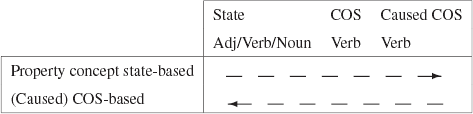
The picture in (9) is of course an abstraction, and there is variation in how individual languages reflect the relevant derivational relationships, hence the use of dashed arrow lines. The Cuzco Quechua data show a good fit with (9), while for English COS verbs such as break, which may be either intransitive or transitive, it is not clear which form should be considered basic, suggesting that result state words could be formed on the basis of intransitive COS verbs. Koontz Garboden (Reference Koontz-Garboden, Booij and Marle2005: 93) shows that in Tongan, the same form expresses state and intransitive COS meanings. Where a property concept state is involved, this form may take a prefix faka-, expressing the associated caused COS. Where a result state is involved, the causative member is morphologically basic, with the prefix ma- occurring on the intransitive COS and stative forms.
These observations raise certain questions. First, what is the role of intransitive COS verbs in such paradigms? The Cuzco Quechua data seem to suggest that intransitive COS verbs are either derived from a stative or a causative predicate, as analogous paradigms in Eastern Armenian (Megerdoomian Reference Megerdoomian2002: 187) suggest. In English, the situation is not clear. Are there, then, cases where the intransitive COS verb is clearly basic to such a paradigm? Second, the generalizations in (9) are based on languages with at least some kind of overt morphological marking that hints at the direction of derivation. Could the same paradigms be identified in a language where no such cues are available? Below, I show that these are precisely the issues brought into focus when we consider analogous sets of words expressing related state and COS meanings in Mandarin.
The Mandarin examples in (10), where the predicates can be assumed to share a property concept state meaning, show no overt morphology distinguishing related stative words, as in (10a),Footnote 5 and intransitive COS words, as in (10b): The same form seems to express both kinds of meanings.Footnote 6 On the other hand, this form is unable to express the related caused COS meaning such as in (10c).Footnote 7 Rather, a caused COS predicate related to a stative predicate is encoded by resultative verb compounds (RVCs) such as (10d).Footnote 8
- (10)
(a) mǎlù hěn kuān
road very wide
‘The road is (very) wide.’ (State)
(b) mǎlu kuān-le
road wide-perf
‘The road widened.’ (COS)
(c) *shì zhèngfŭ kuān-le mǎlù
city government wide-perf road
Intended: ‘The city government widened the road.’ (Caused COS)
(d) shì zhèngfŭ jiā-kuān-le mǎlù
city government add-wide-perf road
‘The city government widened the road.’ (Caused COS)
An overlapping but distinct set of behaviours is shown by predicates such as liè ‘crack’ in (11a), which I propose in Section 4.1.1 below to be a COS verb. Just as with kuān ‘wide/widen’ above, liè ‘crack’ cannot be causative, as is seen in (11b). The causative meaning is again expressed by an RVC, see (11c).Footnote 9 Unlike kuān ‘wide/widen’, however, liè ‘crack’ simply does not allow a stative interpretation, see (11d).
- (11)
(a) jìngzi liè-le
mirror crack-perf
‘The mirror cracked.’ (COS)
(b) *Sānmáo liè-le jìngzi
Sanmao crack-perf mirror
Intended: ‘Sanmao cracked the mirror.’ (Caused COS)
(c) Sānmáo pèng-liè-le jìngzi
Sanmao collide-crack-perf mirror
‘Sanmao cracked the mirror by knocking into it.’(Caused COS)
(d) *jìngzi (hěn) liè
mirror very cracked
Intended: ‘The mirror is (badly) cracked.’ (State)
The examples in (11) suggest that verbs such as liè ‘crack’ are not derived from stative predicates, but the forms of the intransitive predicates in (10) above do not indicate how the homophonous state and COS words are related. This last issue is in turn related to the question of whether a class of adjectives should be recognized in Mandarin (Tai Reference Tai1982, McCawley Reference McCawley1992), i.e. whether predicates such as kuān ‘wide’, which show both stative and COS interpretations, should be considered adjectives or verbs. That is, the picture presented by Mandarin thus far in terms of how related state, COS, and caused COS meanings are encoded appears like that in (12).
(12) The encoding of state, COS, and caused COS predicates in Mandarin
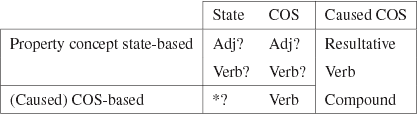
How is the picture in (12) related to that in (9)? In this paper, I argue that the distinction found in other languages between related state and COS morphological paradigms based on a property concept state word, or on a COS verb, also applies in Mandarin, showing how the surface manifestation of the distinction is influenced by language-particular properties. First, the overall picture differs from the languages discussed above in that the causative member of the paradigm is expressed by an RVC. I take this point for granted and will not discuss it in what follows. I show, however, that the two paradigms may be distinguished on the basis of their intransitive members.
Specifically, I argue that property concept states in Mandarin are expressed by adjectives, and Mandarin allows a systematic derivation of intransitive COS verbs from property concept adjectives. In addition, Mandarin also has a set of basic intransitive COS verbs. Unlike the languages discussed above, however, I argue that there is no way to systematically derive result state adjectives from COS verbs, including RVCs. This is not to say that Mandarin has no result state adjectives. I show that these do exist, but rather than being systematically derived, their availability depends on conceptual-pragmatic factors. My proposal is schematized in (13).
(13) No systematically derived result state adjectives (Mandarin)
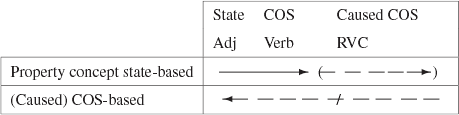
The dashed arrow line in the last row represents a potential regular derivation of result state adjectives from COS and caused COS verbs. The forward slash signifies the lack of such a regular derivation. To the extent that compounding can be considered a derivation, RVCs may be said to be formed on the basis of either stative or COS verbs. Since this issue is not discussed below, I represent the possible relationship with a parenthesized dashed arrow line in the second row of the table.
I begin the inquiry in the next section by addressing the verb/adjective controversy in Mandarin, where I provide preliminary evidence for distinguishing adjectives from stative verbs. In Section 3, I show that gradable adjectives have systematic verbal COS counterparts, and this distinguishes adjectives both from stative verbs, which do not consistently allow COS interpretations, and from basic COS verbs, which have no immediately observable stative counterparts. In Section 4, I reinforce this last point further, showing that COS verbs do not have regular result state adjective counterparts. This is not due to a categorical prohibition against deverbal adjectives in Mandarin, however. I demonstrate that deverbal result state adjectives are available, just not systematically so. I propose that conceptual-pragmatic factors are at work in determining the kinds of deverbal adjectives available. Section 5 concludes the paper.
2. Diagnosing adjectives in Mandarin
Whether an independent category ‘adjective’ in Mandarin should be recognized as distinct from verbs – that is, whether there are morphosyntactic criteria (apart from valence) to distinguish a class of intransitive, stative predicates of which property concept words are presumably the core members – has been an issue of some controversy, with some arguing against this position (Tai Reference Tai1982, McCawley Reference McCawley1992), and some for (Paul Reference Paul2005, Reference Paul, Hofherr and Matushansky2010; Huang, Li & Li Reference Huang, Li and Li2009: 21–26). In the Chinese linguistics tradition, xíngróngcí ‘descriptive words’ are treated as a subclass of verbs (Chao Reference Chao1968; Zhu 1956/Reference Zhu1980, Reference Zhu1982; Li & Thompson Reference Li and Thompson1981: 142). In works not directly dealing with the topic, decisions about lexical category have often been made without empirical motivation. In this section, I provide some background to the verb/adjective controversy in Mandarin, showing how the morphosyntactic properties of verbs and putative adjectives overlap. I then discuss recent research that provides initial evidence for distinguishing adjectives from verbs.
2.1 Similarities between verbs and adjectives
Three major points, well-documented in the literature, obscure the verb/adjective distinction. The first concerns the similarity between adjectives and stative verbs: Both purported adjectives and stative verbs allow modification by intensifying adverbials. For putative adjectives such as gāo ‘tall/high’ in (14a), being able to combine with intensifiers such as hěn ‘very’ is unsurprising. But this property cannot distinguish these predicates from stative verbs such as xǐhuān ‘like’ in (14b), which can also be modified with these adverbials (McCawley Reference McCawley1992). (Since xǐhuān ‘like’ can take an object, it may safely be assumed to be a verb (Zhu Reference Zhu1982: 55, 58).)
- (14)
(a) Sānmáo hěn gāo
Sanmao very tall
‘Sanmao is (very) tall.’
(b) Sānmáo hěn xǐhuān māo
Sanmao very like cat
‘Sanmao likes cats (very much).’
Second, Mandarin adjectives often show some degree of unpredictability in nominal modification contexts when the associative marker de is absent.Footnote 10 For instance, the putative adjective bái ‘white’ may felicitously modify the noun zhǐ ‘paper’ with or without the particle de, as in (15a), but with a different noun, such as shǒu ‘hand’, de seems to be required, as is seen in (15b):
- (15)
(a) bái (de) zhǐ
white assoc paper
‘white paper’ (Zhu Reference Zhu1980: 7)
(b) bái #(de) shǒu
white assoc hand
‘white hand’ (Zhu Reference Zhu1980: 10)
This has led some to conclude that putative Adj–Noun sequences are instances of word formation (potentially with verbs), rather than phrasal modification (McCawley Reference McCawley1992: 233–235; Duanmu Reference Duanmu and Packard1998: 157), with the presence of de being treated, for instance, as indicating a relative clause (Sproat & Shih Reference Sproat, Shih, Georgopoulos and Ishihara1991).
Third, as familiar from above, many putative adjectives, e.g. gāo ‘tall/high’ in (16a), also show verb-like behaviour. In particular, they allow a COS interpretation, most notably in the presence of the perfective marker -le, as in (16b).
- (16)
(a) bìng-ren xuè-yā hěn gāo
sick-person blood-pressure very high
‘The patient's blood pressure is (very) high.’
(b) bìng-ren xuè-yā gāo-le
sick-person blood-pressure high-perf
‘The patient's blood pressure has risen.’
These are the reasons why adjectives have been considered a subclass of verbs in Mandarin. Below, I review recent work highlighting the differences between adjectives and verbs.
2.2 The presence of degree modification
The examples in (14) above show that both putative adjectives and stative verbs may occur with degree modifiers such as hěn ‘very’. They contrast, however, in the absence of degree modification.
As is well known, the presence of hěn ‘very’ in (14a) above need not have an intensifying effect, but may simply provide a positive interpretation for the adjective (Li & Thompson Reference Li and Thompson1981: 143–144; Huang Reference Huang2006; Gu Reference Gu, Feng and Shen2008; Liu Reference Liu2010; Grano Reference Grano2012). In the absence of degree modification, putative adjectives take on a comparative interpretation, as in (17a) (Zhu Reference Zhu1956/1980, Sybesma Reference Sybesma1997), but stative verbs do not, see (17b), as is also the case in Cantonese (Francis & Matthews Reference Francis and Matthews2005).
- (17)
(a) Sānmáo gāo
Sanmao tall
‘Sanmao is taller.’ Not: ‘Sanmao is tall.’
(b) Sānmáo xǐhuān māo
Sanmao like cat
‘Sanmao likes cats.’ Not: ‘Sanmao likes cats more.’
This points to some kind of contrast between the two classes (although Francis & Matthews Reference Francis and Matthews2005 do not argue for a class of adjectives in Cantonese distinct from verbs).
Researchers have been careful to note that the comparative reading for putative adjectives without degree modification, as in (17a) above, does not arise in all contexts. In certain contexts, such as embedding, negation, or where two adjectival predication sentences are juxtaposed, the ‘positive’ reading is available without degree modification (Zhu 1956/Reference Zhu1980: 26). Several recent works have dealt in detail with identifying the kinds of contexts that license the positive interpretation of an unmodified degree adjective (Huang Reference Huang2006, Gu Reference Gu, Feng and Shen2008, Liu Reference Liu2010, Grano Reference Grano2012). Nonetheless, it remains true that stative verbs such as xǐhuān ‘like’ do not show this restriction, and the observation is still relevant to distinguishing adjectives and verbs as separate word classes.
2.3 Non-predicative adjectives
Turning to nominal modification, Paul (Reference Paul2005, Reference Paul, Hofherr and Matushansky2010) argues that not all putative Adj–Noun sequences unmediated by de are compounds, and also, not all putative Adj–de–Noun sequences should be considered relative clause modification. Citing work by Lü & Rao (Reference Lü and Rao1981), Paul (Reference Paul2005: 759) notes first that there is in Mandarin ‘a large class of so-called “nonpredicative” adjectives which cannot function as predicates on their own but only as modifiers’, as shown in (18a). In predicate position, these adjectives require the copula shì and the particle de, as shown in (18b), but shì … de cannot occur in a modification structure, see (18c).Footnote 11 (For further discussion of shì … de, see Section 4.2 below.)
- (18)
(a) yí gè fāng (de) pánzi
one cl square assoc plate
‘a square plate’ (Paul Reference Paul2005: 760, ex. (6))
(b) zhèi gè pánzi *(shì) fāng *(de)
this cl plate be square DE
‘This plate is square.’
(c) wǒ mǎi-le yí gè (*shì) fāng (de) pánzi
1 sg buy-perf one cl be square assoc plate
‘I bought a square plate.’ (Paul Reference Paul2005: 760, ex. (4a, b))
If all prenominal modifiers with de constitute relative clauses, we would expect shì fāng-de ‘square’ (lit. ‘be square-DE’) to occur prenominally, rather than simply fāng or fāng-de, as in (18a). Yet the facts are opposite to this prediction. Since words such as fāng ‘square’ cannot be predicative in isolation, it is hard to conclude that they constitute relative clauses in modifier position, with or without de. It is possible to assume that fāng pánzi ‘square plate’, without de, is a V–N compound, but this assumption again seems suspect since fāng pánzi ‘square plate’ is semantically transparent, and de may be added with no change in meaning, as (18a) shows (as opposed to bìng ‘sick’+N, see Section 4.1.3 below). The most appropriate conclusion seems to be that not all prenominal modification with de is indicative of a relative clause.Footnote 12
Paul (Reference Paul2005) then demonstrates a contrast between lexical and phrasal instances of prenominal adjectives. In phrasal modification structures, the head noun is accessible to phrase structure operations, whereas in cases of lexical compounding, it is not, in accordance with the lexical integrity hypothesis (Huang Reference Huang1984). Paul argues that in sentences like (19a), the head noun méigui ‘rose’ modified by huáng ‘yellow’ is visible to rules at the phrasal level.
- (19)
(a) Āměi bù xǐhuān huāng méigui, hóng de hái kěyǐ.
Amei neg like yellow rose red assoc still acceptable
‘Amei doesn't like yellow roses, red ones are still OK.’ (Paul Reference Paul2005: 763, ex. (19))
(b) *Āměi bù xiǎng chī hóng-huā, huáng (de) hái kěyi.
Amei neg want eat red-flower [=safflower] yellow assoc still acceptable
Intended: ‘Amei doesn't want to take safflower, yellow ones are still OK.’ (Paul Reference Paul2005: 762, ex. (21))
This allows an identity relation to be construable with the head noun in a following NP, licensing that empty head. In (19b), hóng-huā ‘safflower’ (lit. ‘red flower’) is a compound.Footnote 13 Its head noun is not visible to phrasal operations, thus it cannot participate in an identity relation with the head of a following NP, which in turn cannot be empty.
These arguments show that it is possible, and indeed useful, to distinguish a class of adjectives in Mandarin. I will take the ability of a word to productively modify a nominal in a semantically transparent way with the optional presence of de as indicative of adjective status. That is, I assume that an Adj–Noun sequence could be a compound, but may also be a phrasal configuration, as Paul suggests. This means that at least the following phrase structure configurations are available in Mandarin noun phrases:
- (20)
(a) N′ → (A) {N|N′}
(b) NP → (AssocP) N′
(c) AssocP → XP de
The rule in (20a) allows structures such as those in (21), and rules out those in (22).
- (21)
(a) yì zhī [N′ dà [N′ hēi gǒu]]
one cl big black dog
‘a big black dog’
(b) yì zhī [NP [AssocP dà de] [N′ hēi gǒu]]
one cl big assoc black dog
‘a big black dog’
- (22)
(a) *yì zhī dà [NP [AssocP hēi de] gǒu]
one cl big black assoc dog
‘a big black dog’
(b) *yì zhī [AdjP hěn dà] [N′ (hēi) gǒu]
one cl very big black dog
‘a very big (black) dog’
According to (20b), the presence of de between modifier and head noun in (21b) indicates a maximal NP. In the same way, hēi-de gǒu ‘black-assoc dog’ in (22a) also constitutes a maximal NP. The adjective dà ‘big’ is thus disallowed because adjectives cannot directly modify a maximal NP. The rule in (20a) also means that only lexical adjectives can directly modify nominals, but modifier phrases, including adjective phrases, must be mediated by de, as according to (20b, c), hence (22b), where the prenominal modifier is an AdjP, is ungrammatical, and requires de to occur between hěn dà and (hēi) góu.
Accordingly, gāo ‘tall/high’, discussed above, may occur prenominally without de, as in (23), but stative verbs such as xǐhuān ‘like’ may not, see (24) (see also Hopper & Thompson 1984: 729).
(23) gāo (de) jiàgé
high assoc price
‘a high price’
- (24)
(a) (qīngshàonián) xǐhuan *(de) diànyǐng
youth like assoc movie
‘a movie liked (by young people)’
(b) xǐhuan (diànyǐng) *(de) qīngshàonián
like movie assoc youth
‘young people who like (movies)’
Without de, (24a) could only be interpreted as a clause, meaning ‘young people like movies’, and (24b) would be disallowed altogether.
To recapitulate briefly, adjectives in Mandarin can be diagnosed preliminarily in the following ways. First, if a word that describes a gradable property must occur with some kind of degree modifier in a declarative main clause for a positive degree interpretation, and without the degree modifier, the clause takes on a comparative interpretation, the word is an adjective. Secondly, adjectives but not verbs can productively modify nouns at a phrasal level with the particle de optionally present, with a transparent, compositional interpretation. That is, whether or not de is present should not affect the interpretation of the noun phrase.
The ability of putative adjectives such as gāo ‘tall/high’ to take on COS interpretations (as in (16b) above) remains unresolved, however. It is possible, for instance, that Paul's arguments are correct in that non-predicative words such as fāng ‘square’ are adjectives, but that words such as gāo ‘tall/high’, which show both predicative and modifier uses, are verbs. In the next section, I address this issue, showing how the adjectival status of gāo ‘tall/high’ can be reconciled with its COS interpretation, and how the verb/adjective distinction finds correlating distinctions in the event structural properties of predicates.
3. Deadjectival verbs: COS interpretations of gradable adjectives
This section distinguishes adjectives from verbs by probing their alternative stative and COS interpretations. I argue that the COS interpretations of putative adjectives arise from COS verbs that are systematically derived from the adjectives.
3.1 The problem of COS interpretations
Across languages, the class of adjectives encodes states. If the word gāo ‘tall/high’ in (16a) is an adjective, then how does the COS meaning in (16b) arise?
- (16)
(a) bìng-ren xuè-yā hěn gāo
sick-person blood-pressure very high
‘The patient's blood pressure is (very) high.’
(b) bìng-ren xuè-yā gāo-le
sick-person blood-pressure high-perf
‘The patient's blood pressure has risen.’
The obvious response would be to attribute the COS meaning to the perfective marker -le. In this section, however, I argue that the change of state meaning arises from the predicate itself: In (16b) gāo ‘tall/high’ is a COS verb. That is, the form gāo ‘tall/high’ could correspond either to (i) a gradable adjective, or (ii) a COS verb, which I assume is derived from the adjective. I argue for this position by comparing these alternating predicates with a group of verbs that I show to be basically COS, a class whose categorization has so far not received consensus, and whose significance has yet to be sufficiently recognized.
In the debate over whether or not to recognize a class of adjectives in Mandarin, another related distinction in the language has been obscured, namely the contrast between basically stative and basically COS predicates. The difficulty of distinguishing verbs and adjectives means that assumptions about the lexical category of predicates relevant to the issue are often made without argument. These assumptions might not have strong consequences for a certain work, and indeed, are often correct (based on the criteria I argue for below), but this lack of empirical criteria has given rise to conflicting assumptions about various predicates among researchers.
This is reflected in some classification inconsistencies present in the literature. For instance, while both sentences in (25) show an intransitive predicate occurring with -le (as does (16b) above), Li & Thompson (Reference Li and Thompson1981) treat each predicate differently. They assume huà ‘melt’ in (25a) to be ‘an adjective with an end point as part of its meaning’ (page 251), but take sǐ ‘die’ to be a change of state verb (page 195).
- (25)
(a) bīng dōu huà-le
ice all melt-perf
‘The ice has all melted.’ (Li & Thompson Reference Li and Thompson1981: 251, ex. (44))
(b) tā qù-nián sǐ-le
3sg last-year die-perf
‘(S)he died last year.’ (Li & Thompson Reference Li and Thompson1981: 195, ex. (37))
It does not seem controversial that dying, which involves a change of state, should be described by a COS verb. Yet as much as dying, melting also involves a change of state (hence an endpoint). If huà ‘melt’ is assumed to be an adjective, this would imply that it is stative at some level. Its COS interpretation in (25a) would then be a derived one. It is not clear, however, what empirical criteria enter into this distinction. Similar questions arise with the position in Ross (Reference Ross2002: 348–351) that bìng ‘sick’ (see (26a)) corresponds to a state, whereas sǐ ‘die’ (see (25b) above) describes a change of state.Footnote 14
Deadjectival COS verbs and basic COS verbs are similarly indistinguishable. The example in (16b) above shares the same predicate–le form as the examples in (25) above and (26) below. However, I argue below that the predicates in (25) and (26) are basically COS verbs, whereas the predicate in (16b) is a deadjectival verb.
- (26)
(a) tā bìng-le
3sg sick-perf
‘(S)he got sick.’
(b) huǒ miè-le
fire extinguish-perf
‘The fire went out.’
The predicates in (16), (25) and (26) may all occur in sentences that encode a change of state. The sentences in (27)–(28) contain an in X amount of time adverbial, suggesting that they contain telic predicates.
(27) (dǎ-le zhēn hòu,) bìng-ren xuè-yā liǎng xiǎoshí (nèi) jiù gāo-le
hit-perf needle after sick-person blood-pressure two hours within JIU high-perf
‘(After getting the injection,) the patient's blood pressure rose in two hours.’
(28) (lín yŭ hòu,) tā liǎng tiān (nèi) jiù bìng-le
wetted rain after 3sg two day within JIU sick-perf
‘(After getting wet in the rain,) (s)he got sick in two days.’
Attributing the telicity of such examples to the presence of -le, Smith (Reference Smith1997) notes that sentences such as (26a) encode COS, but treats the verb itself as stative, taking the COS interpretation to be a ‘shifted’ one (page 265). It is not clear from the discussion whether it is the event structure category of the verb or the entire sentence that has shifted. I argue below that in all of the cases in (16b), (25), and (26) the COS interpretation should be attributed to the predicate rather than to -le. The difference between them is that (16b) contains a deadjectival COS verb, while (25) and (26) contain verbs that are basically COS.
3.2 Distinguishing adjectives and basic COS verbs
This section argues that putative adjectives systematically have COS verb counterparts. That is, the COS interpretations shown by adjectives arise from a COS verb that has the same form as the adjective. I show that deadjectival COS verbs behave just like underived COS verbs in certain degree modification and negation contexts.
3.2.1 Degree modification contexts
Two kinds of degree modification contexts distinguish between adjectives and COS verbs. The classic kind of degree modification with intensifiers such as hěn ‘very’ (see (14) above), fēicháng ‘extremely’ (see (29a)), and post-predicate jí-le ‘to the utmost’ illustrated in (29b), is possible for gradable adjectives, as noted earlier.
- (29)
(a) shù-yè fēicháng hóng
tree-leaf extremely red
‘The leaves are extremely red.’
(b) shù-yè hóng jí-le
tree-leaf red utmost-prt
‘The leaves are extremely red.’
They cannot, however, modify a predicate such as zuì ‘intoxicated’, and bìng' ‘sick', see (30a, b).
- (30)
(a) *Sānmáo hěn/fēicháng zuì/bìng
Sanmao very/extremely intoxicated/sick
Intended: ‘Sanmao is very/extremely drunk/sick.’
(b) *Sānmáo zuì/bìng jí-le
Sanmao intoxicated/sick utmost-prt
Intended: ‘Sanmao is extremely drunk/sick.’
This is not because zuì ‘intoxicated’ or bìng ‘sick’ are non-gradable. Rather, degree modification for these predicates must be expressed in another way. To encode the attainment of excessive intoxication/illness, a -de complement structure is employed, with the modifying phrase hěn lìhai ‘seriously’, as shown in (31).Footnote 15
(31) Sānmáo zuì-de/bìng-de hěn lìhai
Sanmao intoxicated-vprt/sick-vprt very serious
‘Sanmao is intoxicated/sick to a serious extent.’
Now putative adjectives such as gāo ‘tall/high’, hóng ‘red’, bái ‘white’, etc., may also combine with -de hěn lìhai ‘to a serious extent’, as is shown in (32a). Importantly, though, in this case they can only take on a COS interpretation. When modified by hěn ‘very’ (32b), the predicate bái ‘white’ can describe a congenitally high degree of whiteness in hair. When bái ‘white’ occurs with -de hěn lìhai, it must encode a change to a high degree of whiteness, and (32c) is infelicitous because the context indicates the improbable situation of a baby's hair somehow either turning white or having turned white at birth.
- (32)
(a) Sānmáo de tóufa bái-de hěn lìhai
Sanmao assoc hair white-vprt very serious
‘Sanmao's hair turned drastically white.’
(b) Sānmáo yì shēng-xià-lai tóufa jiù hěn bái
Sanmao one born-down-come hair JIU very white
‘Sanmao's hair was (very) white since birth.’
(c) #Sánmáo yì shēng-xià-lai tóufa jiù bái-de hěn lìhai
Sanmao one born-come-down hair JIU white-vprt very serious
‘Sanmao's hair turned drastically white the moment he was born.’
What does this pattern of interpretation indicate? Only on the stative interpretation can putative adjectives such as hóng ‘red’, bái ‘white’, gāo ‘tall/high’ combine with degree modifiers such as hěn ‘very’. Predicates such as zuì ‘intoxicated’ and bìng ‘sick’ cannot occur with these modifiers, but rather, must be modified with de hěn lìhai ‘to a serious extent’. The same holds of the COS interpretation of hóng ‘red’, bái ‘white’, etc. This indicates that zuì ‘intoxicated’ and the COS interpretation of bái ‘white’ must share some property. Furthermore, this property cannot be shared between zuì ‘intoxicated’ and the stative interpretation of bái ‘white’, since the former cannot occur with hěn ‘very’. I propose that this property is simply that of being a COS verb. Predicates such as bái ‘white’ may correspond either to an adjective or a COS verb. In contrast, zuì ‘intoxicated’ can only be a COS verb.
3.2.2 Negation
The preceding conclusion receives support from how adjectives and COS verbs interact with negation marking. Researchers have noted that the two negation morphemes in Mandarin, bù and méi, combine with predicates of different event structure categories. Different explanations have been proposed for these distinctions (Li & Thompson Reference Li and Thompson1981: 421–440; Huang Reference Huang1988; Ernst Reference Ernst1995; Lin Reference Lin2003), but one clear contrast is that bù is associated with negating the presence of some state, whereas méi is associated with negating the occurrence of an event (Lin Reference Lin2003). This point is demonstrated by Lin with the examples in (33), with lǎo ‘old’. With bù, lǎo ‘old’ has a stative meaning, see (33a), and with méi, it indicates COS, see (33b) (see also Liu Reference Liu2010: 1036).
- (33)
(a) tā kàn-shàngqu yì diǎn dōu bù lǎo
3sg look-appear one little all neg old
‘He is not old at all in appearance.’ (Lin Reference Lin2003: 437, ex. (23))
(b) tā kàn-shàngqu yì diǎn dōu méi lǎo
3sg look-appear one little all neg old
‘He hasn't become old at all in appearance.’ (Lin Reference Lin2003: 437, ex. (24))
Turning to basically COS predicates, we find that they cannot be negated using bù in a declarative sentence, as shown in (34a).Footnote 16 Rather, to claim that someone is not drunk, méi must be used (34b).
- (34)
(a) *Sānmao bú zuì
Sanmao not intoxicated
Intended: ‘Sanmao isn't/didn't get drunk.’
(b) Sānmáo méi zuì
Sanmao not intoxicated
‘Sanmao isn't/didn't get drunk.’
Converging with this contrast, Lin (Reference Lin2003) notes that certain adjectives, such as cōngming ‘intelligent’ – essentially those that describe human propensities (Dixon Reference Dixon1982: 21) – cannot be negated by méi, as shown in (35b). This would mean that such adjectives have no COS counterparts.
- (35)
(a) tā bù cōngming
3sg neg intelligent
‘He is not clever.’
(b) *tā méi cōngming
3sg not intelligent
‘He has not turned clever.’ (Lin Reference Lin2003: 437, ex. (25))
The negation patterns support the hypothesis that verbs such as zuì ‘intoxicated’ are basically COS, and thus also eventive, since they allow negation by méi but not by bù. They also support the related hypothesis that predicates such as lǎo ‘old’ (also gāo ‘tall/high’ and hóng ‘red’, discussed above) have both state and COS meanings. Finally, human propensity adjectives such as cōngming ‘intelligent’ seem to be stative only, as also suggested by their incompatibility with -le (Liu Reference Liu2010: 1035):Footnote 17
(36) *Zhāngsān cōngming/bèn le
Zhangsan smart/stupid perf
‘Zhangsan got smart/stupid.’ (Liu Reference Liu2010: 1035, ex. (83a))
3.2.3 Interim summary
To sum up, predicates such as lǎo ‘old’, hóng ‘red’, guì ‘expensive’, zāng ‘dirty’, and pàng ‘plump, fat’ occur with degree modifiers such as hěn ‘very’ and fēichang ‘extremely’, and are negated with bù, on a stative interpretation. In such cases, the predicate may be assumed to be an adjective. These predicates may also occur with méi ‘not’ and be modified with -de hěn lìhai ‘to a serious extent’, but only on a COS interpretation. In such cases, we may consider them COS verbs. In contrast, verbs such as zuì ‘intoxicated’ and bìng ‘sick’ are basically COS. They cannot be modified with hen ‘very’ and fēichang ‘extremely’, but only with -de hěn lìhai ‘to a serious extent’. They can only be directly negated by méi, and not by bù. These patterns are set out in (37):
(37) Modification patterns of adjective/COS verb alternation pairs and basic COS verbs

Strictly speaking, these patterns allow us to conclude only that hóng ‘red’, gāo ‘tall/high’, etc. alternate between state and COS, whereas predicates such as zuì ‘drunk’, bìng ‘sick’, etc. are simply COS verbs. They do not immediately lead to the conclusion that the stative meanings of the alternating predicates are rendered by adjectives. That is, these diagnostics per se cannot yet rule out the possibility that hóng ‘red’, gāo ‘tall/high, etc. are simply verbs with both state and COS interpretations. Below, I show that these predicates can and should be distinguished from stative verbs.
3.3 Distinguishing adjectives from stative verbs
It should be clear from the preceding discussion that adjectives such as bái ‘white’ and gāo ‘tall/high’ exhibit both stative and COS interpretations. I have proposed specifically that the COS interpretation arises from a deadjectival COS verb. This implies an assumption that the COS interpretation is structurally encoded, rather than arising pragmatically through some kind of coercion (Koontz-Garboden Reference Koontz-Garboden2007a). In this subsection, I provide evidence for this proposal by contrasting the consistent nature of deadjectival COS readings with COS readings of stative verbs that are also available, but less consistently. This, then, gives us yet another distinction between adjectives and stative verbs, strengthening the position that adjectives form an independent class.
In the examples discussed above, e.g. (16b), repeated below, the hypothesized deadjectival COS verb occurs in the presence of the aspectual marker -le. It is thus tempting to ascribe the COS interpretation to -le. But if gāo ‘tall/high’ here is a COS verb, this predicts that the COS interpretation would be available even without -le.
- (16)
(b) bìng-ren xuè-yā gāo-le
sick-person blood-pressure high-perf
‘The patient's blood pressure has risen.’
This is indeed the case. Sybesma (Reference Sybesma1997) notes that the COS interpretation of such predicates is available even in the absence of -le, e.g. when a modal is present, as the following examples, from Sybesma (Reference Sybesma1997: 230, ex. (21)), show.Footnote 18
- (38)
(a) tā néng gāo
3sg can tall
‘He can become tall.’
(b) tā huì pàng
3sg can fat
‘He may become fat.’
(c) tā yào hǎo
3sg will good
‘He will get better.’
Moreover, as examples such as (25) and (26) above show, even basically COS verbs such as bìng ‘sick’ in simple predication sentences occur with -le. Thus, the assumption that gāo ‘tall/high’ in (16b) is also a COS verb is entirely compatible with the presence of -le.Footnote 19
More importantly, the COS interpretations of these hypothesized deadjectival verbs are consistently available in these modal and perfective contexts. They contrast with stative verbs such as xiāngxìn ‘believe’ and xǐhuān ‘like’, which also allow COS interpretations in the presence of -le, and modal verbs like huì ‘will’, but are less consistent in this respect. The examples in (39), from the Peking University Center for Chinese Linguistics Corpus (henceforth PKU; http://ccl.pku.edu.cn:8080/ccl_corpus/index.jsp?dir=xiandai), illustrate the stative verbs xǐhuān ‘like’ and xiāngxìn ‘believe’ taking on COS interpretations with perfective -le.
- (39)
(a) tā zhújiàn shìying-le, xǐhuān-le Měilán gěi tā ānpái de shūshì ér yòu hélǐ de shēnghuó
3sg eventually accustomed-perf like-perf Meilan give 3sg arrange vprt comfortable and additionally reasonable assoc life
‘He eventually became accustomed to, and began to like, the comfortable and reasonable life Meilan had arranged for him.’ (PKU)
(b) jiēchù-le sān cì zhīhòu, Fǎguóren xiāngxìn-le Wēituōfū de chéngyì
contact three times after French.people believe-perf Vitov assoc sincerity
‘After three meetings, the French started to believe in Vitov's sincerity.’ (PKU)
While a COS interpretation does arise and indeed is a natural interpretation for a stative verb with -le, it is possible to find instances of a stative verb with le that are not interpreted as COS. For instance, xiāngxìn-le ‘believe-perf’ in (40) below could – but need not – mean that people started to believe in the myth of Japanese institutions' invincibility. The sentence could also mean that people believed in the myth for a period before the reference time of the sentence. This is not possible for sentences such as (16b) above.
(40) jīnróng jiānguǎn dāngjú hé Rìběn zhèngfŭ guò duō bǎohù jīnróng jīgòu, rénmen xiāngxìn-le Rìběn jīgòu bú huì dǎobì de shénhuà
finance oversee authority and Japan government over many protect finance institution people believe-perf Japan institution will not collapse assoc myth
‘The financial oversight authority and the Japanese government overly protect financial institutions, people believed the myth that Japanese institutions will not collapse.’ (PKU)
Finally, in modal verb contexts, deadjectival COS verbs again consistently yield a COS interpretation, whereas stative verbs do not do so. For instance, huì gāo ‘will (be) tall’ in (41a) has only a COS interpretation. This is not because huì ‘will’ cannot combine with stative predicates, as the stative huì hěn gāo ‘will (be) very tall’ in (41b) shows.Footnote 20
- (41)
(a) Sānmáo xiànzài hěn gāo, yǐhòu hái huì gāo
Sanmao now very tall afterwards still will tall
‘Sanmao is (very) tall now, and will be taller in future.’
(b) Sānmáo xiànzài hěn gāo, yǐhòu hái huì hěn gāo
Sanmao now very tall afterwards still will very tall
‘Sanmao is (very) tall now, and will still be (very) tall in future.’
In contrast, stative verbs in the presence of huì ‘will’ do not necessarily take on a COS interpretation. For instance, (42a, b) are compatible with a COS interpretation for xǐhuān ‘like’ and xiāngxìn ‘believe’, but they could also be interpreted as claiming that the state of liking/believing will hold at a future time.
- (42)
(a) nǐ yídìng huì xǐhuān tāmen
2sg definitely will like 3pl
‘You will definitely like them.’
(b) nǐ yídìng huì xiāngxìn tāmen
2sg definitely will believe 3pl
‘You will definitely believe them.’
Strikingly, xǐhuān ‘like’ and xiāngxìn ‘believe’ with huì in (43) do not allow a COS interpretation. That is, whether or not hěn ‘very’ is present in the second clauses of (43a, b), neither verb can be interpreted as COS.
- (43)
(a) Sānmáo xiànzài hěn xǐhuān tāmen, yǐhòu hái huì (hěn) xǐhuān tāmen
Sanmao now very like 3pl afterwards still will very like 3pl
‘Sanmao likes them a lot now, and will still like them (a lot) in future.’
Not: ‘Sanmao will like them more in future.’
(b) Sānmáo xiànzài hěn xiāngxìn tāmen, yǐhòu hái huì (hěn) xiāngxìn tāmen
Sanmao now very believe 3pl afterwards still will very believe 3pl
‘Sanmao believes in them a lot now, and will still believe in them (a lot) in future.’
Not: ‘Sanmao will believe in them more in future.’
The examples above demonstrate that stative verbs such as xǐhuān ‘like’ and xiāngxìn ‘believe’ do not consistently show COS interpretations in -le and modal contexts, while they consistently allow stative interpretations. This contrasts with deverbal adjectives, for which COS interpretations with perfective -le and modal verbs such as huì ‘will’ arise consistently. This suggests that the COS interpretation of stative verbs with -le and modals may arise from pragmatic coercion, whereas that of deadjectival COS verbs is structurally encoded.
To capture this consistent alternation between adjectives and their COS verb counterparts, I assume that a regular derivation is available in Mandarin that converts gradable adjectives such as bái ‘white’ and gāo ‘tall’ into COS verbs. I assume that this operation has a semantic component corresponding to a version of Dowty's (Reference Dowty1979)become operator, as well as a morphological component that converts an adjective to a verb. This derivation would apply to an adjective representation such as (44a), to yield a COS verb representation such as (44b).
- (44)
(a) bái Adj ‘white’: λx λs white′(x)(s)
(b) bái V ‘become white’: λx λs λe [become(s)(e) ∧ white′(x)(s)]
This operation does not apply to stative verbs such as xǐhuān ‘like’, which only have a stative meaning. Finally predicates such as zuì ‘become intoxicated’ and bìng ‘become sick’ are uniformly COS verbs, as shown in the representation in (45).
- (45)
(a) zuì V ‘become intoxicated’: λx λs λe [become(s)(e) ∧ intoxicated′(x)(s)]
(b) bìng V ‘become sick’: λx λs λe [become(s)(e) ∧ sick′(x)(s)]
Such verbs are not derived from adjectives, nor may deverbal adjectives be productively derived from them, as I argue in the next section.
Before leaving this subsection, let me clarify that there are, of course, alternatives to the treatment of deadjectival COS verbs as rule-derived proposed here. It would not make a substantive difference to the analysis were the alternation to be represented as, say, a systematic set of COS verbs homophonous with, and related by the become operator to, gradable adjectives. The key point I wish to convey is the regular, productive nature of the relation, and the actual representation is not my main concern. I am inclined towards the derivational approach, however, because the listing of separate lexical entries would seem to suggest a less systematic alternation, one that is available only for specific lexical items. Indeed, this is what I assume for the deverbal adjectives discussed below.
Summarizing, the COS interpretations of adjectives observed in perfective and modal contexts are consistently available, and should be treated as formally represented. Although stative verbs such as xǐhuān ‘like’ and xiāngxìn ‘believe’ also allow COS interpretations in these contexts, they are not consistently available, and are better treated as arising pragmatically.
We saw earlier that an adjective in a positive declarative clause requires a degree modifier for a positive degree interpretation, while stative verbs do not need a modifier. I have now shown that adjectives can be further distinguished from stative verbs in terms of whether their COS interpretations are consistently available. I have also shown that deadjectival COS verbs behave just like basic, underived COS verbs, which do not have stative counterparts.
4. Deverbal adjectives: Attested but not productive
In this section, I examine the relationship between Mandarin verbs and adjectives in the other direction, exploring whether result state adjectives may be systematically derived from COS verbs and RVCs. As hinted above, I show that the answer is in the negative: Although deverbal result state adjectives do exist, I argue that they do not stem from a productive derivational process or systematic polysemy. Rather, I argue that deverbal result state adjectives are allowed when the modified NP in which they occur describes a culturally or contextually salient class of entities (Bolinger Reference Bolinger1967, Paul Reference Paul, Anderl and Eifring2006). I assume that these deverbal adjectives are either separately listed in the lexicon or are formed ‘on the fly’ in an appropriate context.Footnote 21
4.1 No regular derivation of adjectives from COS verbs
I first consider COS verbs. I show that, although COS verbs may be derived from gradable adjectives, the relationship does not hold equally in the other direction. That is, COS verbs, both intransitive and transitive (i.e. RVCs), do not lend themselves to the formation of derived adjectives. I first show that these verbs in predicative position are not stative. That is, COS verbs do not productively form result stative predicates. I then show that in general, COS verbs cannot modify nominals without the mediation of de, and these verbs have eventive interpretations in modifier position as well, suggesting that they occur in relative clauses. That is, not only do COS verbs have no regular derived result state counterparts, they also have no regular derived adjectival counterparts. There is, however, a slight asymmetry between intransitive COS verbs and RVCs. The former allow limited prenominal modification without de, suggesting that they occasionally form deverbal adjectives. The latter, however, do not seem to allow any deverbal adjective formation.
4.1.1 COS verbs in predicative position
The degree modification and negation contexts used to distinguish adjectives from intransitive COS verbs in the last section reflect the eventive nature of these verbs. Using these contexts as diagnostics, predicates such as liè ‘crack’ in (11) above and suì ‘shatter’, which may be modified by -de hěn lìhai ‘to a serious extent’ but not by hěn ‘very’, and are negated by méi but not by bù, may be classified as COS verbs.Footnote 22 At least prima facie, there is no reason to believe that such verbs have a (zero-)derived stative form.
Now, RVCs such as qiāo-suì ‘knock-shatter’ in (46a) below may not be modified by hěn ‘very’ (presumably because they are eventive), nor by -de hěn lìhai ‘to a serious extent’ (probably because they are not gradable). Still, like intransitive COS verbs such as liè ‘crack’ and suì ‘shatter’, they are also negated with méi rather than bù, as seen in (46b), indicating that they are non-stative.
- (46)
(a) Sānmáo qiāo-suì-le bēizi
Sanmao knock-shatter-perf cup
‘Sanmao knocked on the cup, causing it to shatter.’
(b) Sānmáo méi/*bù qiāo-suì bēizi
Sanmao neg knock-shatter cup
‘Sanmao didn't cause the cup to shatter by knocking on it.’
That is, causative RVCs differ from COS verbs in having a causer argument, but otherwise are equally consistently eventive with respect to the relevant diagnostics. I now show that detransitivized forms of causative RVCs are also eventive and not stative.
Causative RVCs in Mandarin show a transitivity alternation demonstrated in (47):
- (47)
(a) Sānmáo qiāo-suì-le bēizi
Sanmao knock-shatter-perf cup
‘Sanmao knocked on the cup, causing it to shatter.’
(b) bēizi qiāo-suì-le
cup knock-shatter-perf
‘The cup got knocked on and shattered.’
Tan (Reference Tan1991) argues that these are zero-derived passive verbs, with no agent phrase realized. A similar assumption is made in Ting (Reference Ting2006), where these verbs are called middles. For current purposes, the actual label is unimportant. The crucial point is that Mandarin RVCs show detransitive uses in which the patient nominal is realized as subject (see Tan Reference Tan1991 and Ting Reference Ting2006 for arguments to this effect).
These detransitive uses retain an agentive meaning, however, as illustrated by their compatibility with agent and instrument phrases (Keyser & Roeper Reference Keyser and Roeper1984), in (48a). In contrast, (48b) shows that the COS verb suì ‘shatter’ itself is non-agentive.
- (48)
(a) bēizi yóu tāmen/yòng chuí-zi qiāo-suì-le
cup by 3pl/use hammer knock-shatter-perf
‘The cup was shattered by them/with a hammer’.
(b) *bēizi yóu tāmen/yòng chuí-zi suì-le
cup by 3pl/use hammer shatter-perf
‘The cup shattered *by them/*with a hammer.’
Unsurprisingly, the agentive detransitive RVC is also eventive. Like suì ‘shatter’, discussed above, and transitive qiāo-suì ‘knock-shatter’ (see (46b)), the detransitived RVC qiāo-suì ‘knock-shatter’ in (49) is also negated by méi.
(49) bēizi méi/*bù qiāo-suì
cup neg knock-shatter
‘The cup didn't get shattered from being knocked on./The cup was not knocked on.’
Such examples suggest that detransitive RVCs in predicate position, like their transitive counterparts and like intransitive COS verbs, do not have stative readings. I assume that qiāo-suì ‘knock-shatter’ in (49) has a lexical representation corresponding to a passive verb, along the lines of (50), with its agent argument existentially bound.Footnote 23
(50) λy λs λe′ λe ∃x [become(s)(e) ∧ shattered′(y)(s) ∧ cause(e′, e) ∧ knock′(x, y)(e′)]
I show further below that such predicates in attributive position concomitantly do not show adjectival behaviour in general.
4.1.2 No RVC-derived adjectives
In this subsection, I turn to RVCs in attributive position, and show that these verbs do not lend themselves to deverbal adjective formation. Two points demonstrate this. First, RVCs can only modify nominals in the presence of de, and second, they may always retain their original agentive and eventive interpretations. The examples in (51) show that an RVC such as dǎ-pò ‘break’ (lit. ‘hit-break’) cannot modify a noun in the absence of de.Footnote 24
- (51)
(a) yì zhī dǎ-pò de bēizi
one cl hit-break assoc cup
‘a broken cup’
(b) *yì zhī dǎ-pò bēizi
one cl hit-break cup
‘a broken cup’
The following examples show that an RVC in prenominal position continues to be agentive (52a), and eventive (52b).
- (52)
(a) yì tái yóu xīn yuángōng nòng-huài de jīqì
one cl by new employee make-bad assoc machine
‘a machine that was broken by (a) new employee(s)’
(b) yì tái méi/*bú nòng-huài de jīqì
one cl NEG make-bad assoc machine
‘a machine that was not broken’
These converge with the obligatory presence of de. While any phrase may combine with de to modify a noun (20c), only adjectives may directly modify a noun without de. That RVCs cannot do so suggests they are verbs here. That they allow agentive and eventive interpretations indicates the same. That is, examples such as (51a) contain a relative clause modifier. Below, I show that COS verbs are somewhat more flexible than RVCs, but they also do not productively form the base for a derived adjective.
4.1.3 No COS-derived adjectives
I now show that basic intransitive COS verbs do not regularly give rise to adjectives. I argue that although some basic COS verbs appear to engage in adjectival behaviour, this pattern is not productive, and in some cases, must receive a V–N compounding analysis.
I demonstrate this generalization first with the verb miè ‘extinguish’ in (26b), repeated here.
- (26)
(b) huǒ miè-le
fire extinguish-perf
‘The fire went out.’
Unlike zuì ‘intoxicated’ and bìng ‘sick’ discussed in Section 3 above, the verb miè ‘extinguish’, is not gradable, as shown in (53a). It is, however, negated using méi rather than bù, as (53b) shows, consistent with its COS interpretation in (26b).Footnote 25
- (53)
(a) *huǒ miè-de hěn lìhai
fire extinguish-vprt very serious
(b) huǒ méi/*bú miè
fire neg extinguish
The fire isn't extinguished.
(53b) indicates that miè is a COS verb. The contrast in (54) below shows that miè ‘extinguish’ cannot directly modify a noun, see (54a). The verb miè ‘extinguish’ can only occur prenominally within a relative clause, as in (54b), which the preferred presence of -le further suggests.
- (54)
(a) *yì gēn miè làzhú
one cl extinguish candle
Intended: ‘an extinguished candle’
(b) yì gēn miè(-le) de làzhú
one cl extinguish-perf assoc candle
‘an extinguished candle’
Some COS verbs such as pò ‘break’ and huài ‘break down’ in (55) sometimes seem able to directly modify a noun, but I would argue that, to the extent that pò ‘break’ and huài ‘break down’ are adjectival, it is probably via some kind of pragmatic coercion, or due to analogy with homophonous adjectives, which I describe immediately below.
- (55)
(a) ?yì zhī pò bēizi
one cl break assoc cup
‘a broken cup/a shabby cup’
(b) ?yì tái huài jīqì
one cl break.down machine
‘a broken down machine’
(c) …tuī-zhe huài chē lái zhǎo nǐ
push-dur break.down car come seek 2sg
‘pushing a broken down car to come looking for you.’ (PKU)
Several intransitive predicates, including pò ‘shabby/break’ and huài ‘bad, wicked/break down’, actually each have two senses, one corresponding to an adjective and one to a COS verb. The form pò may be adjectival, meaning ‘shabby, of poor quality’, or it may be a COS verb, meaning ‘break’. Consistent with the current assumptions, the adjectival sense occurs felicitously in attributive position without the associative marker de when modifying a nominal, but the verbal sense is far less felicitous in this position.
A search on the PKU corpus for the two senses of pò provides support for this interpretation. A search for pò fángzi ‘shabby house’, which shows the adjectival sense of pò, yielded 84 examples in the relevant sense. A search for pò bēizi ‘broken cup’, which taps the COS sense, yielded only two relevant examples, and only one of these clearly involved a broken cup, while the other could be interpreted as describing a cup in poor condition. Modification contexts suggest the same division. The sixteen instances of hěn pò in the PKU corpus could all be interpreted as ‘very shabby’. The objects described included machines, vehicles, furniture, books, shoes and cloth items, but not brittle objects such as cups and vases that typically break or shatter. In cases involving items made from cloth or paper, pò could also have meant ‘torn’, but each example was equally compatible with a ‘shabby’ interpretation. To supplement the PKU data, I also conducted informal Google searches for certain strings. Tellingly, a Google search for huāpíng hěn pò ‘vase very shabby’ turned up only one example, and that single instance clearly meant that the vase in question was of poor quality. A Google search for bēizi hěn pò returned 10 usable results.Footnote 26 Of these, there were six unique examples, all with a ‘shabby cup’ interpretation. A PKU search for pò de hěn lìhai ‘badly broken’ returned no results, but a Google search returned numerous instances, many describing human skin being broken, a situation hardly conceivable as shabbiness. This result is compatible with the understanding that -de hěn lìhai ‘to a serious extent’ modifies a COS verb (see Section 3.2.1 above), which in the case of pò would correspond to the ‘break’ sense rather than the ‘shabby’ sense.
Similarly, the form huài may correspond to either a COS verb meaning ‘to break down’ (as of machines), or an adjective meaning ‘bad’ or ‘wicked’ (of people).Footnote 27 This distinction underlies the contrast in acceptability of the examples in (56)–(57).
- (56)
(a) *zhè gè nàozhōng hěn huài
this cl alarm.clock very bad
Intended: ‘This alarm clock is very faulty.’
(b) zhè gè nàozhōng huài-de hěn lìhai
this cl alarm.clock bad-vprt very serious
‘This alarm clock is badly broken.’
- (57)
(a) zhè gè rén hěn huài
this cl person very bad
‘This person is wicked.’
(b) *zhè gè rén huài-de hěn lìhai
this cl person bad-vprt very serious
Intended: ‘This person became seriously wicked.’
The sense of huài describing mechanical malfunction cannot be modified by hěn ‘very’, as is shown in (56a), but allows degree modification with -de hěn lìhai ‘to a serious extent’, as in (56b), both hallmarks of a COS verb. The sense of huài describing a character flaw behaves in exactly the opposite way, as seen in (57).
A PKU search for huài N also yielded results consistent with the assumption that its COS, ‘break down’ sense would be less available in prenominal position than the adjectival sense of ‘bad/wicked’. A search for the string huài chē ‘broken down car’ yielded six relevant examples, and huài jīqì ‘broken machine’ yielded no results. In contrast, the search string huài háizi ‘naughty child’ yielded 90 examples.Footnote 28
Some other COS verbs, such as bìng ‘sick’, also seem able to directly modify nouns, e.g. bìng-rén ‘patient, lit. sick person’, bìng-fáng ‘sick room’. But these sequences are best considered V–N compounds as their meanings are non-transparent. A bìng-rén ‘patient’ is not necessarily ill, while bìng de rén ‘sick person’, where de here can be treated as marking a relative clause, does describe someone who is ill. And a bìng-fáng ‘sick room’ clearly does not describe a room that is ill, but a room for sick people, and *bìng de fáng ‘sick assoc room’ is correspondingly unacceptable.
On the basis of these generalizations, I conclude that intransitive COS verbs also do not constitute a regular basis for deverbal adjective formation, although in Section 4.4.2 below I will discuss why they seem to allow limited adjective formation.
4.2 Characterization: the shì …de construction
The preceding conclusions notwithstanding, there actually is one way to encode stative interpretations of COS verbs and RVCs. This is by way of the shì … de construction illustrated in (58a, b), briefly mentioned in the discussion of (18) above, where shì ‘be’ is the copula found in nominal predication sentences.
- (58)
(a) zhè zhī wǎn shì liè(-le) de
this cl bowl be crack-perf DE
‘This bowl is cracked.’
(b) hézi shì dǎ-kāi(-le) de
box be hit-open-perf DE
‘The box is open(ed).’
(c) gōngren dǎ-kāi-le hézi
worker hit-open-perf box
‘The worker opened the box.’
The examples in (58a, b) are compatible with a result state interpretation. The COS verb and RVC allow the presence of perfective -le, which would indicate that the cracked/opened state has arisen from a preceding event. Example (58c) simply shows that dǎ-kāi ‘open’ is a causative RVC. A shì … de sentence itself is stative. As (59) shows, a shì … de sentence may be negated by bù, but not méi.Footnote 29
- (59)
(a) zhè zhī wǎn bú/*méi shì liè de
this cl bowl neg be crack DE
‘This bowl is not cracked.’
(b) hézi bú/*méi shì dǎ-kāi de
box neg be hit-open DE
‘The box is not open(ed).’
As I show below, shì … de sentences containing COS verbs also have a stative interpretation that is not necessarily interpreted as the result of an event, see (60).
- (60)
(a) zhè zhǒng zhìzào guòcheng bǎozhèng zào-chūlai de jìngzi shì liè de
this kind manufacture process guarantee create-out assoc mirror be crack DE
‘This kind of manufacturing process guarantees that the mirrors produced are cracked (ones).’
(b) zhè xiē hézi zŭzhuāng-hǎo shí shì dǎ-kāi de
this pl box assemble-good time be hit-open DE
‘These boxes are open when assembled.’
Despite the stativizing effect of shì … de, I argue that it should not be understood as a construction that is specialized to deriving result states from COS verbs. Rather, shì … de is best understood as providing a characterizing description of an object. This understanding will pave the way for the rest of the discussion, where I show that deverbal adjectives show precisely this quality.
First, consider that the predicates in (58a, b) above may be interpreted as describing original states of the relevant entity, not necessarily as states resulting from an event. This interpretation may be teased out via a ‘creation’ context present in the examples in (60) above. In these creation contexts, the states of being cracked or open cannot be understood as arising from a preceding cracking or opening event.Footnote 30 Therefore, the examples in (61a, b), where the perfective marking on these verbs indicates that a cracking or opening event occurred, are infelicitous. (Without the given creation context, e.g. as in (58), perfective -le would be felicitous.)
- (61)
(a) #zhè zhǒng zhìzào guòcheng bǎozhèng zào-chūlai de jìngzi shì liè-le de
this kind manufacture process guarantee create-out assoc mirror be crack-perf DE
Intended: ‘This kind of manufacturing process guarantees that the mirrors produced have cracked.’
(b) #zhè xiē hézi zŭzhuāng-hǎo shí shì dǎ-kāi-le de
this pl box assemble-good time be hit-open-perf DE
Intended: ‘These boxes are open(ed) when assembled.’
In (60), then, liè ‘crack’ and dǎ-kāi ‘open (causative)’ could be interpreted as zero-derived adjectival counterparts of a COS verb and RVC. However, this predicative use is not available outside the shì … de context, as indicated by the examples in (62), nor can these forms occur prenominally without de, as shown by (63), in agreement with the claims made earlier that COS verbs and RVCs have no derived stative and adjectival counterparts.
- (62)
(a) *zhè miàn jìngzi (shì) liè
this CL mirror be crack
Intended: ‘This mirror is cracked.’
(b) *zhè gè hézi (shì) dǎ-kāi
this cl box be hit-open
Intended: ‘This box is open(ed).’
- (63)
(a) *yì miàn liè jìngzi
one cl crack mirror
Intended: ‘a cracked mirror’
(b) *yì zhī dǎ-kāi hézi
one cl hit-open box
Intended: ‘an open(ed) box’
This means that, in keeping with my preceding conclusions, even if liè ‘crack’ and dǎ-kāi ‘open (causative)’ in (60) were derived adjectives, such adjectives are not systematically available.
What of the role of shì … de, then? Besides COS verbs and RVCs, other kinds of predicates also occur in the shì … de context, including adjectives, shown in (64a), and both simple and complex verb phrases, shown in (64b, c), none of which has a result state interpretation. This, then, means that shì … de, while it has a stativizing effect, should not be considered a morphological context specialized for deriving result state predicates from COS verbs and RVCs.
- (64)
(a) zhè gè pánzi shì fāng de
this cl plate be square DE
‘This plate is square.’
(b) zhè xiē dōngxi shì mài de
this pl thing be sell DE
‘These things are for sale.’ Not: ‘These things are sold.’
(c) zhè zhǒng niǎo shì wǎnshàng chàng gē de
this cl bird be night sing song DE
‘This kind of bird sings at night.’
What the shì … de context actually does, I suggest, is to indicate that the predicate it combines with provides a description that characterizes the referent of the subject nominal as a member of a class that is salient in some way (Bolinger Reference Bolinger1967). This is illustrated by the examples in (65), in which (65a) can be felicitously continued by (65b), but not by (65c).
- (65)
(a) wǒ bù néng lái jiē nǐ
1sg neg can come fetch 2sg
‘I can't come to pick you up.’
(b) wǒ de chē huài-le
1sg assoc car break.down-perf
‘My car broke down.’
(c) #wǒ de chē shì huài de
1sg assoc car be break.down DE
‘My car is (a) broken (one).’
In contrast, a mechanic who is starting work at an automobile repair shop would quite likely be informed that the cars parked on the west side of the parking lot are ‘broken down’ (i.e. shì huài de), rather than they ‘broke down’ (i.e. huài-le). This suggests that the shì … de context expresses a characterizing interpretation of the predicate it combines with. For an owner of a car, a breakdown is a temporary situation that could perhaps prevent the owner from using the car in certain ways, but it would not typically be described as a characteristic property of the car. For a mechanic, however, cars that have broken down would constitute a category of things in need of professional attention (see also Section 4.4.2 and Footnote footnote 35 below). This assumption is compatible with the proposal that the stative interpretations of of liè ‘crack’ and dǎ-kāi ‘open’ with shì … de in (60) arises pragmatically. Mirrors that are produced to be cracked are quite plausibly understood as a particular category of, say, specialty items for sale. Similarly, it might well interest a packaging company whether the boxes to be used for packaging are open or closed.
Furthermore, shì … de bears the form of a nominalization structure (Li & Thompson Reference Li and Thompson1981: 145), and nominal predication in general is more likely to describe an entity in categorizing terms (Wierzbicka 1986, Croft Reference Croft1991: 101). Indeed, shì … de is the canonical structure for certain kinds of adjectival predication, namely those that express relatively permanent, defining characteristics of an individual, such as gender and verity or genuineness. The (a) examples of (66) and (67) show that nán ‘male’ and zhēn ‘real/true’ are adjectives. The (b) examples show that they cannot occur in predicative position. Rather, these qualities must be expressed using shì … de, as in the (c) examples.Footnote 31
- (66)
(a) yí gè nán (de) lǎoshī
yne cl male assoc teacher
‘a male teacher’
(b) *tā (shì) nán
3sg be male
Intended: ‘He is male.’
(c) tā shì nán de
3sg be male DE
‘He is male.’
- (67)
(a) yì kē zhēn (de) zuànshí
one cl real assoc diamond
‘a real diamond’
(b) *zhè kē zuànshí (shì) zhēn
this cl diamond be real
Intended: ‘This diamond is real.’
(c) zhè kē zuànshí shì zhēn de
this cl diamond be real DE
‘This diamond is real.’
In conclusion, then, shì … de indicates a characterizing description of an object, and may occur with predicate phrases of varying category, and with varying interpretations. Although it may combine with COS verbs and RVCs, it does not seem right to treat shì … de as a grammatical device specialized towards deriving result stative verbs or adjectives. This conclusion does not mean that Mandarin does not have deverbal adjectives altogether, though. I show in the next subsection that deverbal result state adjectives do exist, but unlike deadjectival COS verbs, and like the limited adjectival uses we saw of basic COS verbs, they are not systematically available.
4.3 Deverbal adjectives
At least two kinds of examples suggest that Mandarin may indeed allow deverbal adjectives. One kind involves names of dishes based on verbs of cooking, while the other involves verbs with incorporated instruments or agents. I discuss each kind in turn.
4.3.1 Verbs of cooking
The examples in (68)–(69) provide names of dishes which incorporate the verbs describing how the dishes are cooked, a common naming strategy in Chinese cuisine. While the verb of cooking itself is sufficient in some cases, such as in (68), in other cases, such as in (69), it includes adverbial modification. As (70) shows, the verbs of cooking involved are transitive verbs.
- (68)
(a) chǎo (de) ròu-piàn
sauté assoc meat-slice
‘sautéed pork slices’
(b) zhá (de) dòufu
deep.fry assoc tofu
‘deep fried tofu’
- (69)
(a) (qīng-)zhēng (de) yú
clear-steam assoc fish
‘steamed fish’
(b) (bái-)zhŭ (de) dàn
white-cook assoc egg
‘boiled egg’
(70) chúshī chǎo-le bō-cài/zhēng-le yú
chef sauté-perf spinach/steam-perf fish
‘The chef sautéed spinach/steamed fish.’
Clearly distinct from the COS verbs and RVCs discussed above is the ability of these verbal elements to modify nouns even in the absence of the associative particle de. Many of the names of dishes formed in this fashion are highly conventionalized, and some may be compounds, but some are productive, with a compositional meaning, and show characteristics of phrasal syntax. For instance, as is shown in (71) they license ellipsis of the head noun in a parallel structure (Paul Reference Paul2005, as discussed in Section 2.3 above).
- (71)
(a) wǒ bù chī zhá dòufu, (qīng-)zhēng de hái kěyi
1sg neg eat deep.fry tofu clear-steam assoc still acceptable
‘I don't eat deep fried tofu, steamed (tofu) is OK.’
(b) jīntiān méi yǒu bái-zhŭ dàn, chǎo de nì yào ma?
today neg have white-cook egg sauté assoc 2sg want qprt
‘There are no boiled eggs today. Do you want fried ones?’
Some of these modifiers allow an eventive interpretation, as indicated by negation with méi in (72a), and can occur with an agent phrase in the presence of de, as indicated in (72b).Footnote 32 Others, however, do not allow an eventive or agentive interpretation even with de. This is the case for bái-zhŭ ‘white-cook’ in (73).Footnote 33
- (72)
(a) yì pán méi/#bu chǎo *(de) bōcài
one plate neg sauté assoc spinach
‘a plate of spinach that has not been sautéed’
(b) yì pán yóu mŭqīn chǎo *(de) bōcài
one plate by mother sauté assoc spinach
‘a plate of spinach sautéed by mother’
- (73)
(a) *yí gè méi bái-zhŭ de dàn
one cl neg white-cook assoc egg
Intended: ‘an egg that has not been boiled’
(b) *yí gè yóu mŭqīn bái-zhŭ de dàn
one cl by mother white-cook assoc egg
Intended: ‘an egg boiled by mother’
How should we interpret the contrast between (72) and (73)? Recall from Sections 4.1.2 and 4.1.3 above that RVCs such as dǎ-pò ‘hit-break’ in (51) and COS verbs such as mìe ‘extinguish’ in (54) may only modify a nominal with de present, suggesting that in modifier position, they occur in a relative clause. This assumption is compatible with the eventive (and agentive, in the case of the RVC) properties they retain. Their behaviour is also consistent with the assumption that a deverbal adjective cannot be modified by eventive and agentive modifiers, reasonable enough given that adjectives are stative. These assumptions now suggest a reason for the contrast between (72) and (73). First of all, note that in (71b), the behaviour of bái-zhŭ ‘white-cook’ indicates that it modifies dàn ‘egg’ at a phrasal level, suggesting bái-zhŭ dàn ‘white-cooked egg, i.e. boiled egg’ is not a lexical compound. We thus cannot account for the ungrammaticality of (73) by, say, assuming bái-zhŭ ‘white-cooked’ to be part of a compound.
We can, however, account for the contrast between (72) and (73) by assuming that in (72) chǎo ‘sauté’ occurs in a relative clause, just like dǎ-pò ‘hit-break’ or miè ‘extinguish’ in (51) and (54), while in (73) bái-zhŭ ‘white-cooked’ is an adjective. Thus, the former but not the latter allows eventive and agentive modifiers. This step allows us to capture a three-way distinction. First, RVCs and COS verbs such as dǎ-pò ‘hit-break’ in (51) and mìe ‘extinguish’ in (54) have eventive/agentive interpretations, but never modify a noun without de. This suggests that, as prenominal modifiers, they correspond only to relative clauses. Second, verbs of cooking such as chǎo ‘sauté’ in (72) show eventive/agentive properties in the presence of de, but they may also modify a noun without de. This suggests that as prenominal modifiers, they may constitute relative clauses (allowing eventive/agentive modifiers, but only with de), or they may be adjectives (allowing de to be absent). Third, prenominal modifiers such as bái-zhŭ ‘white-cooked’ in (73b) do not show eventive/agentive properties, but may modify a noun without de. This suggests that such modifiers are not relative clauses, but are only adjectival. Overall, these distinctions point to the prenominal modifiers in (68)–(69) as having an adjectival representation available.
4.3.2 Agentive and instrumental modifiers
Another set of potential deverbal adjectives consists of an eventive verb, with a preceding noun describing an instrument or agent of the event. Some examples are listed in (74)–(75). Like the modifiers based on verbs of cooking, these phrases may directly modify nouns without de, although de is always possible.
- (74)
(a) zì-zhì (de) gāodiǎn
self-make assoc pastry
‘homemade pastries’
(b) shǒu-huì (de) tú-àn
hand-draw assoc pattern
‘handpainted patterns’
(c) kǒu-shù (de) lìshǐ
oral-recount assoc history
‘history in the oral tradition’
- (75)
(a) mín-bàn (de) tuántǐ
civilian-run assoc group
‘civilian-run group’
(b) xiàn-zhuāng (de) shū
thread-assemble assoc book
stitch-bound book
As with verbs of cooking, these modifiers fall into two groups. The modifiers in (74) are similar to chǎo ‘sauté(ed)’, but distinct from both dǎ-pò ‘hit-break’ and bái-zhŭ ‘white-cooked’, in that they allow the presence of an agent-denoting phrase, as in (76).
- (76)
(a) yì xiē yóu běn diàn zì-zhì *(de) gāodiǎn
one some by this store self-make assoc pastry
‘some pastries homemade by our store’
(b) yì xiē yóu yìrén shǒu-huì *(de) tú-àn
one some by craftsperson hand-draw assoc pattern
‘some patterns handpainted by artisans’
(c) yí duàn yóu zhǎngzhě kǒu-shù *(de) lìshǐ
one section by elder oral-recount assoc history
‘a stretch of history orally recounted by the elders’
Going by the discussion of (73a, b) above, these modifiers would be of the chǎo ‘sauté’ category: They may occur in a relative clause, as in (76), retaining the agentivity of the verb, or they may constitute adjectives, as in (74), allowed to modify the nominal with de absent.
However, as (77) shows, the modifiers in (75) do not allow agent phrases.
- (77)
(a) *yí gè yóu jū-mín mín-bàn (de) tuántǐ
one cl by reside-people civilian-establish assoc group
Intended: ‘a civilian group established by residents’
(b) *yì běn yóu dà chūbǎnshè xiàn-zhuāng (de) shū
one cl by big publisher thread-assemble assoc book
Intended: ‘a book stitch-bound by a big publisher’
This behaviour corresponds to that of bái-zhŭ ‘white-cooked’, which also does not allow an agent phrase, seen in (73b) above. These modifiers – bái-zhŭ ‘white-cooked’, mín-bàn ‘civilian-established’, xiàn-zhuāng ‘thread-assembled’ – however, do modify nominals directly while also allowing an optional de.
These patterns suggest that the agent/instrument–verb sequences here can have adjective status. The examples in (76) suggest that those sequences in (74) may be ambiguous with a relative clause structure, while (77) suggests that those in (75) are only adjectival. The table in (78) sets out the different possibilities for interpreting the pre-nominal modifiers discussed above.
(78) Deverbal adjectives and relative clause pre-nominal modifiers in Mandarin

Most noteworthy in (78) is the irregular relationship it reflects between verbs encoding some COS and their related adjectives. First, the relationship between verb classes and deverbal adjectives is non-uniform. In particular, as noted in Section 4.1.3 above, some intransitive COS verbs may form deverbal adjectives, but only in a limited fashion. Verbs of cooking and verbs of creation have deverbal adjectival counterparts, among which some, e.g. bái-zhŭ ‘white-cooked’ seem to be only adjectival. I have labelled kǒu-shù ‘orally-recounted’ as a verb of information transmission. In modifier position, kǒu-shù ‘orally-recounted’ may be an adjective or a relative clause. Unlike for verbs of cooking and verbs of creation, I have not been able to find a verb of information transmission that is only adjectival in modifier position. Second, note also the three-way distinction discussed above between verbs that have no deverbal adjective counterparts (RVCs, some intransitive COS verbs), those that do (most others in the table), and those that, in prenominal position, only correspond to deverbal adjectives (those in the last two rows of the table in (78) above). The varied situation presented by eventive verbs and their deverbal adjectival counterparts contrasts with the relatively regular COS verb alternations shown by adjectives (see (37) above). This suggests that a rule-based derivation may not be the right way to approach deverbal adjective formation in Mandarin. If so, how do these deverbal adjectives come about? I turn to this question directly below.
4.4 Modification with derived adjectives describes culturally-salient natural classes
In this subsection, I discuss the factors that license deverbal adjectives in Mandarin. I show that deverbal adjectives are not productively available, and thus we should not assume them to be the result of a regular grammatical operation, or an indicator of systematic polysemy. Rather, I propose that deverbal adjectives may arise just in case the resulting class of entities described by the noun phrase with these adjectives as modifier can be understood as a culturally- or contextually-salient natural class.
4.4.1 Deverbal adjectives are not productive
Unlike deadjectival COS verbs, which are quite regular, the deverbal adjectives discussed above are relatively conventionalized and domain-specific. For instance, although any food item described with a particular verb of cooking has to have undergone the process named, simply undergoing that process does not necessarily qualify the food to be named with the relevant modifier. Many dishes require intermediate steps of processing some ingredient in some way before that ingredient is combined with the rest of the ingredients to form the dish. Thus, for a certain dish, pork slices may be first sautéed briefly, then taken off the heat while something else is being prepared. This intermediate step does not necessarily qualify the pre-sautéed pork slices as chǎo ròu-piàn ‘sautéed pork slices’.
The flexibility of verbs of cooking is also domain-specific: There seems to be no correspondingly varied choice of modifiers for nouns naming drinks. For instance, there is no obvious way to express James Bond's famous ‘shaken not stirred’ distinction via prenominal modification without de.
Similarly, adjectives such as mín-bàn ‘civilian-established’ are restricted to the contrast between government and civilian as agents of an event. Analogous adjectives include guān-bàn ‘official-established’ and mín-yíng ‘civilian-administered’. There are, however, no corresponding adjectives for other social groups in agentive capacity, for instance, there is no adjectival *(xué)shēng-bàn ‘student-established’ or *(jiā)zhǎng-bàn ‘parent-established’. That is, in nominal modifier position, these phrases must be followed by de.
These observations demonstrate the non-productive nature of the deverbal adjectives discussed, suggesting that they are not systematically available.
4.4.2 The conceptual-pragmatic basis of deverbal adjectives
If the deverbal adjectives discussed above are not derived by rule or systematic polysemies, how do they come about? I suggest that these deverbal adjectives have a conceptual-pragmatic basis, specifically, that the modified NP containing these adjectives describes a culturally- or contextually-salient class of entities. Several points support this interpretation.
First, as seen in (79), these deverbal adjectives are attributive and do not occur in predicative position, except in the shì … de construction, as in (80).Footnote 34
- (79)
(a) *zhè pán bōcài chǎo
this plate spinach sauté
Intended: ‘This plate of spinach is sautéed.’
(b) *zhè duàn lǐshǐ kǒu shù
this cl history oral recount
Intended: ‘This history is in the oral tradition.’
- (80)
(a) zhè pán bōcài shì chǎo de
this pl spinach be sauté DE
‘This spinach is sautéed.’
(b) zhè duàn lǐshǐ shì kǒu shù de
this cl history be oral recount DE
‘This history is in the oral tradition.’
As we saw in Section 4.2 above, these properties are manifested by other adjectives, such as nán ‘male’ and zhēn ‘real’, which may be understood to have a characterizing function. It seems plausible that words that are used to characterize at least certain kinds of objects, when combined with the relevant nominal, would describe a culturally-salient class of entities.
Second, the ability to occur prenominally in the absence of de – the reason these words were identified as adjectives – is itself indicative of a characterizing function. As noted in Section 2.1 above, even basic property concept adjectives such as bái ‘white’ and gāo ‘tall/high’ do not modify all nominals with equal felicity in the absence of de (Zhu 1956/Reference Zhu1980). The examples in (15) above, repeated here, illustrate one such case.
- (15)
(a) bái (de) zhǐ
white assoc paper
‘white paper’ (Zhu Reference Zhu1980: 7)
(b) bái #(de) shǒu
white assoc hand
‘white hand’ (Zhu Reference Zhu1980: 10)
Paul (Reference Paul, Anderl and Eifring2006: 306) suggests that a pre-nominal modifier in the absence of the associative particle de ‘is possible provided the resulting NP provides a natural, plausible classification, with the modifier presented as a defining property’ (see also Li & Thompson Reference Li and Thompson1981: 119). Paul draws an analogy between nominal modification without de in Mandarin with prenominal adjectival modification in English, which shows ‘similar semantico-pragmatically motivated gaps’, discussed at length in Bolinger (Reference Bolinger1967). Bolinger (Reference Bolinger1967) argues that in English, adjectives in attributive position tend to have a ‘characterizing’ function. For instance, the same adjective in attributive and predicative position may have different effects on meaning, as in the contrast between the English expressions the visible stars (stars that are inherently visible, being of high magnitude) and the stars visible (on a cloudy night). The characterizing function similarly distinguishes between the availability of present participle compounds: a home-loving girl as opposed to the lack of a mistake-erasing secretary or a husband-waking wife, which ‘must await the day when we have some interest in characterizing secretaries as mistake-erasing or wives as husband-waking’ (Bolinger Reference Bolinger1967: 7). The availability of prenominal adjectives without de in Mandarin appears to be subject to a similar condition.
The deverbal adjectives discussed in Section 4.3 above, based on verbs of cooking and verbs with agent and instrument modifiers, are easily compatible with the cultural salience rubric, given the importance of cuisine in Chinese culture. Many of the deverbal adjectives discussed above also describe methods of production or creation, one way artifacts may be classified (Hilpinen Reference Hilpinen and Zalta2011).
Cultural salience is not the only factor licensing deverbal adjectives. Contextual factors may allow a class of objects to at least temporarily take on salience. This is presumably what is at work in the felicity conditions of huài ‘break down’ in the shì … de environment in (65) discussed in Section 4.2 above. COS verbs often describe changes resulting in decay, disrepair, and malfunction, perhaps not usually the kinds of categories objects are classified by. This may be why it is more difficult to find them in descriptions with a characterizing function such as the shì … de construction and in prenominal modifier position without de. But they are found in contexts where these categories are salient, e.g. for an auto mechanic, broken cars are of occupational significance. Indeed, huài ‘break down’ would be felicitous in prenominal position without de, e.g. huài chē ‘broken down car’ in the same context as it would be felicitous with shì … de, namely when the category of objects being described is salient in some way, e.g. broken down cars being pointed out to or by an auto mechanic.Footnote 35
A further example in this vein is provided by the intransitive COS verb duàn ‘to break/snap apart’ in (81a).
- (81)
(a) diàn-xiàn duàn-le
electric-cable snap-perf
‘The electric cables snapped.’
(b) tā gěi yì tuán duàn (de) diàn-xiàn chán-zhù-le
3sg give one mass snapped assoc electric-cable tangle-stop-perf
‘She was tangled in a mess of severed electric cables.’ (PKU)
(c) duàn (de) xiàn shì yīn de fúhào
broken assoc line be yin assoc symbol
‘A broken line is the symbol for yīn.’ (PKU)
(d) huàn-zhě kěnéng shì xuè-guǎn duàn-le
sickened-one possible be blood-vessel snap-perf
‘It could be that the patient's blood vessel had snapped.’ (PKU)
(e) *yì gēn duàn xuè-guǎn
one cl snap blood-vessel
Intended: ‘a snapped blood vessel’
This word may occur prenominally with optional de, suggesting that it has an adjectival representation, as in (81b, c), but these uses are limited when compared with its verbal use.Footnote 36 For instance, (81b) is in the context of a wartime novel, describing what happens during a family's flight from a city in which an air raid had recently occurred. In such a context, snapped cables are likely to be a salient category. Another putative adjectival use is in a specialized context such as (81c), which describes the use of a broken line to represent the concept of yīn in Taoist cosmology.Footnote 37 As (81d, e) suggest, however, duàn ‘snap/break apart’ is less restricted as a COS verb than as a result state adjective. I could find no instances of duàn xuèguǎn ‘snapped blood vessel’, which would indicate adjectival duàn ‘snapped’, either in the PKU corpus or through a Google search. In contrast, in the PKU corpus, I found five instances of xuèguǎn duàn-le ‘blood vessel snapped’, where duàn ‘snap’ would be verbal, and numerous further such instances through a Google search.
The conventionalized and context-dependent qualities of deverbal adjectives form a clear contrast with the regularity of deadjectival COS verbs, suggesting that some of them, e.g. those based on verbs of cooking, are simply listed in the lexicon, while some are probably formed ‘on the fly’, e.g. duàn ‘to break/snap apart’, hence the apparently random discrimination between, say, blood vessels and electric wiring.
4.5 Remaining questions
Before concluding, I turn to two issues that I have not addressed so far. These are, first, the lack of RVC-derived adjectives, and second, the status of the suffix -zhe as stativizing morphology.
4.5.1 Why no RVC-derived adjectives?
I have argued above that the deverbal adjectives discussed in this paper are not systematically available, and those that are available are either separately listed in the lexicon, or derived ‘on the fly’. This provides a plausible explanation for the rarity of deverbal adjectives based on COS verbs, and the domain-specificity of those based on certain transitive verbs, which are somewhat more numerous. One puzzle remains, however. This is the seemingly categorical inability of RVCs to show adjectival behaviour, i.e. to occur in attributive position of a noun phrase with de. I have no account of this asymmetry, but in this subsection, I speculate on a possible reason for it. I believe the crux of the matter lies in the lack of overt morphology in Mandarin specialized to signaling the relevant grammatical operations that verbs (and adjectives) participate in.
Let us first consider the simpler case of intransitive COS verbs. Drawing on Kratzer (Reference Kratzer2000), I assume a stativizing function (82) – possibly associated with a zero morpheme – that may apply to intransitive COS verbs, as shown in (83).Footnote 38 I assume that the operation, being non-overt, is costly, and that it is either conventionalized for particular verbs or applied when the context allows the kind of interpretation discussed above.
(82) Stativizer: λR λx λs ∃e R(x)(s)(e)
- (83)
(a) pò ‘to break (intransitive)’: λx λs λe [become(s)(e) ∧ not-whole′(x)(s)]
(b) Stativized pò ‘broken’:
λR λx λs ∃e R(x)(s)(e)(λx λs λe [become(s)(e) ∧ not-whole′(x)(s)])
=λx λs ∃e [become(s)(e) ∧ not-whole′(x)(s)]
One way RVCs may be prevented from giving rise to a derived stative is simply to assume that they are of the wrong type. The stativizing function selects for a function of type <e,<s,<v,t>>>, but an RVC such as cā-gān ‘wipe dry’, when detransitivized, as in (84), is of the type <e,<s<v,<v,t>>>>.
(84) Passive/detransitivized cā-gān ‘be wiped-dry’:
λy λs λe′ λe ∃x [wipe′(x, y)(e′) ∧ dry′(y)(s) ∧ become(s)(e) ∧ cause(e′, e)]
The distinction may seem trivial, but a more intuitive way of understanding it is that a phonologically non-overt grammatical operation that involves existential binding over events (as opposed to existential closure at the clause level) may not affect more than one event argument.
What of deriving statives from verbs of cooking and the other verbs discussed above? There are different ways to approach these, but one important point is that these verbs do not specify change of state in the same way as RVCs do. Although verbs of cooking such as chǎo ‘sauté’ allow an inference that the theme of the event is cooked to some extent, I believe this inference is not specified in the event structure of the verb.Footnote 39 This distinction shows up in negation contexts with méi, such as in (85).
- (85)
(a) wǎn méi cā-gān
bowl neg wipe-dry
‘The bowl wasn't wiped dry.’
(i.e. ‘The bowl was wiped, but didn't get dry.’ Or: ‘The bowl wasn't wiped.’)
(b) cài méi chǎo
vegetable neg sauté
‘The vegetables were not sautéed.’
(i.e. ‘No sautéing of the vegetables took place.’ Not: ‘The vegetables were sautéed but not cooked.’)
RVCs under méi have two interpretations: (85a) may mean that there was wiping but the bowl did not become dry (the favoured interpretation), or that no wiping occurred. The example in (85b), with chǎo ‘sauté, can only mean that no sautéing event took place, not that there was sautéing but the vegetables did not get cooked.
A proper representation that captures these generalizations must await further work, but for current purposes, we may distinguish chǎo ‘sauté’ (and other verbs of cooking) from ‘true’ COS verbs by representing them as activity verbs, as in (86a).
- (86)
(a) chǎo ‘sauté’: λy λx λe sauté′(x, y)(e)
(b) stative chǎo ‘sautéed’: λy λt ∃e ∃x [sauté′(x, y)(e) ∧ τ(e) <t]
To accommodate the associated COS inference, we could further assume a meaning postulate stating that, for any event of sautéing, there is a corresponding change of the theme to some degree of being cooked. A stativized meaning for such a verb, then, could perhaps be better captured via some version of Kratzer's (Reference Kratzer2000) ‘resultant state’ meaning, as a function from an individual to the set of times that are preceded by (the runtime τ(e) of) an event e in which this individual undergoes sautéing, as in (86b).Footnote 40 Again, I would assume such an operation to be costly, given its non-overt nature, and to be conventionalized for particular verbs, or to apply only in particular contexts.
4.5.2 Stativizing morphology?
On a related but more general note: Why is there an asymmetry between deadjectival verbs and deverbal adjectives? I speculate again that the lack of deverbal result state adjectives is due to the lack of overt verbal morphology such as a participial morpheme that is specialized for forming result state predicates from verbs encoding change, since this could mean that there is no consistent source of stative predicates for adjective formation. Such a hypothesis would suggest that deadjectival verb formation, which is also not overtly indicated, is somehow less ‘costly’ than a stativizing operation, perhaps because it does not involve existential binding over an event.
The durative particle -zhe presents a further potential problem for the notion that deverbal adjective formation in Mandarin is somehow limited by the lack of overt morphology. Jaxontov (Reference Jaxontov and Nedjalkov1988) proposes, for instance, that -zhe shows stativizing properties. This observation is based on the ability of -zhe to combine with verbs of putting such as fàng ‘put’, bǎi ‘place’ and guà ‘hang’, illustrated in (87). Since V-zhe may describe situations such as that in (87b) in which no actual causing action has taken place to bring about a change of location of the theme, this suggests V-zhe is some kind of a derived stative verb.
- (87)
(a) qiáng-shàng guà-zhe yì fú huà
wall-upon hang-dur one cl painting
‘On the wall hung a painting.’
(b) tiān-shang guà-zhe jǐ kē xīng
sky-upon hang-dur few cl stars
‘In the sky hung a few stars.’
While this proposal may be correct for verbs of putting, the morpheme -zhe cannot be considered a particle for deriving result states in general. It may attach to a variety of verbs, including activity verbs, as in (88a), and stative verbs, as in (88b–d), where the interpretation it yields is clearly that the event or state described is ongoing at the reference time of the clause. With the latter it is often associated with locative inversion, as shown in (88c) (Pan Reference Pan1996), though this is not necessarily the case, see (88d). For further discussion of -zhe, see Yeh (Reference Yeh1993), Wu & Kuo (Reference Wu and Kuo2003), Wu (Reference Wu2007).
- (88)
(a) tā kàn-zhe wǒ …
3sg look-dur 1sg
‘(S)he looked at me …’
(b) Qīngzàng gāoyuán-shang yǒu-zhe bǎi- xuě-ǎiǎi de xuě fēng
Qinghai-Tibet plateau have-dur white-snow-snowy assoc snow peak
‘On the Qinghai-Tibetan plateau there are white snow-capped mountains.’ (PKU)
(c) zhè-lǐ zhù-zhe 2.8 wàn Zhèjiāng rén
here live-dur 28,000 Zhejiang people
‘Here live 28,000 people from Zhejiang province.’ (PKU)
(d) tā … zài gōng-lǐ zhù-zhe
3sg be.at palace-within live-dur
‘She lived in the palace.’ (PKU)
That -zhe can combine with originally stative predicates suggests that it should not simply be considered stativizing morphology. That it can combine with activity predicates that do not encode a change of state indicates also that -zhe has functions other than creating a result state predicate. In addition, while -zhe may combine with verbs of change of location such as guà ‘hang’ in (87) above, it may not combine with other COS verbs, regardless of their valence, as (89a) shows.
- (89)
(a) *bēizi (dǎ-)pò-zhe
cup hit-break-dur
Intended: ‘The cup is broken.’
(b) guà-zhe *(de) yīfu
hang-dur assoc clothes
‘hanging clothes’
This shows that whatever its stativizing properties, it does not apply to all COS predicates. Finally, V-zhe never shows adjective-like behaviour (89b). It cannot modify nominals without de, further suggesting that even if -zhe does derive result state predicates from verbs of caused change of location, they remain verbs and are not converted into adjectives. Therefore, at the very least, we can conclude that V-zhe is not a source for a regular derivation of deverbal adjectives. It might eventually turn out upon investigation that the -zhe with verbs of putting is distinct from the durative -zhe in (88), but this is a question for another paper, and I do not discuss it further here.
Summing up this section briefly, adjectives cannot be derived systematically from COS verbs. Deverbal adjectives based on COS verbs do exist, but they are better considered as listed separately or formed ‘on the fly’ rather than being systematically available. These deverbal adjectives are allowed if the modified NP they occur in describes a culturally- or contextually-salient category of objects.
5. Looking further: The fundamental nature of change of state predication
This work has shown that morphological paradigms of adjectives and verbs expressing related state and COS meanings in Mandarin, as in the other languages noted above in the Introduction, fall into two categories. In one, the adjective is basic to the paradigm; in the other, the COS verb is basic. In previous work these derivational relationships have been contrasted in terms of whether the stative word in the paradigm encodes a property concept or a result state, indicated by whether the stative word or a (typically causative) COS verb is the morphologically simplest member of the paradigm. Analogous paradigms in Mandarin are less directly observable because of the lack of relevant morphological cues. They are also manifested somewhat differently because of the lack of monomorphemic verbs describing caused COS, so that the paradigms seem to be missing a member.
But these ‘pared-down’ paradigms in Mandarin, limited to intransitive predicates, throw into relief the conceptual basis underlying the different derivational directions. Dixon (Reference Dixon1982, Reference Dixon1991) identifies the following conceptual categories expressed by adjectives in English:
(i) dimension (e.g. big, short)
(ii) physical property (e.g. hard, cold, sweet)
(iii) speed (e.g. fast, slow)
(iv) age (e.g. new, young)
(v) colour (e.g. black, white)
(vi) value (e.g. good, bad)
(vii) difficulty (e.g. easy, tough)
(viii) volition (e.g. deliberate, accidental)
(ix) qualification, spanning subtypes such as definite (e.g. obvious, true) and likely (e.g. likely, certain)
(x) human propensity (e.g. kind, wicked)
(xi) similarity (e.g. (un)like, different (from))
Of these, age, dimension, value, and colour are most likely to be expressed by adjectives (rather than nouns or verbs) across languages (Dixon Reference Dixon1982: 46, summarized in Schaefer & Egbokhare Reference Schaefer, Egbokhare, Mufwene and Moshi1993: 160. See also Wetzer Reference Wetzer, Kefer and Auwera1992: 242; Reference Wetzer1996: 7–12, albeit with a caveat regarding colour also noted by Croft Reference Croft1991: 136).Footnote 41
In Mandarin, the words that I have argued are adjectives – hóng ‘red’, bái ‘white’, kuān ‘wide’, gāo ‘tall/high’ and lǎo ‘old’ – fit easily into these categories. I have shown that these are basic adjectives from which COS verbs of the same form may be derived. In addition, the Mandarin facts highlight an equally basic group of intransitive COS verbs, on which deverbal adjectives may be based, though not arising from a systematic derivational process. These generalizations were schematized in (13), repeated here.
(13) No systematically derived result state adjectives (Mandarin)
Dixon (Reference Dixon1982) notes the greater likelihood of certain meanings, expressed adjectivally in English, to be lexicalized as verbs in other languages. He provides examples from Alamblak, attributed to Les Bruce, listed here in (90), where he observes an ‘opposition between an unmarked state (shown by an adjective) and a marked action (shown by a verb) which alters the original state’ (page 52).
- (90)
(a) Adjectives: nfri ‘unripe’, wafkha ‘healthy’, nfri ‘alive, new’, briöh ‘empty’
(b) Verbs: huk(kföt) ‘to ripen’, dböhna(kföt) ‘to be sick’, noh(kföt) or gu(kföt) ‘to die’, frkih(kföt) ‘to be full’
The words that I have argued are basic COS verbs in Mandarin include bìng ‘to fall sick’, sǐ ‘to die’, zuì ‘to get drunk’, huài ‘to break down’, liè ‘to crack’, pò ‘to break’, duàn ‘to snap’ and huà ‘to melt’. Taken together with the Alamblak examples, what these suggest is that, just as concepts pertaining to dimension, age, colour, and value are the natural province of adjectives, there are equally concepts such as malfunction, decay, deterioration, sickness and becoming non-sober, and also quite possibly growth, blooming, blossoming, ripening, melting, freezing, etc. – but crucially not the states of being new, fresh, or unripe – that are the natural province of COS verbs. Many of these notions correspond to what Levin & Rappaport Hovav (Reference Levin and Hovav1995: 97) propose are ‘internally caused changes of state’. In the case of verbs such as pò ‘to break’ and duàn ‘snap’, this notion of change is clearly difficult to separate from the notion of causativity, but languages such as Mandarin, where the element of causation is quite neatly filtered out from the expression of change, suggest that there is a fundamentality to change of state that cannot be reduced either to being built up from a state, or being extricated from a causative. This further suggests, then, that COS, independent of causatives and states, is worthy and perhaps needful of greater attention in future research.


