INTRODUCTION
Highly advective environments such as estuarine areas and upwelling zones in eastern boundary currents may pose constraints to planktonic early life stages of coastal marine organisms. These species interact with their environment by a variety of biophysical processes in order to reduce offshore advection and to increase self-recruitment (Castro et al., Reference Castro, Salinas and Hernández2000; Franks, Reference Franks2001; Sponaugle et al., Reference Sponaugle, Cowen, Shanks, Morgan, Leis, Pineda, Boehlert, Kingsford, Lindeman, Grimes and Munro2002; Landaeta & Castro, Reference Landaeta and Castro2006a; Palma et al., Reference Palma, Pardo, Veas, Cartes, Silva, Manriquez, Diaz, Muñoz and Ojeda2006; Leis et al., Reference Leis, Wright and Johnson2007). Vertical migration can be triggered by selection of water temperatures, predation avoidance, searching for preys and may increase the chances of onshore transport (Landaeta & Castro, Reference Landaeta and Castro2002; Landaeta et al., Reference Landaeta, Herrera, Pedraza, Bustos and Castro2006; Yannicelli et al., Reference Yannicelli, Castro, Valle-Levinson, Atkinson and Figueroa2006) or coastal retention (Brewer & Kleppel, Reference Brewer and Kleppel1986; Poulin et al., Reference Poulin, Palma, Leiva, Narvaez, Pacheco, Navarrete and Castilla2002) in upwelling systems. Recently, the foraging behaviour of larval stages and their vertical positioning in the water column have also been considered as a mechanism which may influence dispersal and connectivity between nearby populations (Landaeta & Castro, Reference Landaeta and Castro2006b; Woodson & McManus, Reference Woodson and McManus2007; Gerlach et al., Reference Gerlach, Atema, Kingsford, Black and Miller-Sims2007).
In order to inflate the gas bladder during early ontogeny, physostomous fish (fish with pneumatic duct, a connection between the gas bladder and the gut; Uotani et al., Reference Uotani, Fukui, Osaki and Ozawa2000) and physoclists fish with physostomous larvae (transient physostomes; Trotter et al., Reference Trotter, Battaglene and Pankhurst2003a, Reference Trotter, Pankhurst, Morehead and Battagleneb, Reference Trotter, Battaglene and Pankhurst2005) need to swim near the water surface, thrust their heads above the surface to inhale air through their widely opened mouth, which is passed to the gas bladder via the pneumatic duct. The gas bladder has various functions in different fish. It serves in respiration, in the provision of buoyancy, in the detection of pressure changes, including sounds, and in sound production (Alexander, Reference Alexander1966). Then, for physostomous and transient physostomes larval fish, the gas bladder inflation will influence their diel vertical distribution (DVM).
In clupeoid species a diel rhythm of inflation and deflation of the gas bladder has been observed as a response to changes in light intensity (Hoss & Phonlor, Reference Hoss and Phonlor1984; Hoss et al., Reference Hoss, Checkley and Settle1989; Forward et al., Reference Forward, McKelvey, Hettler and Hoss1993; North & Houde, Reference North and Houde2004). The diel periodicity of gas bladder inflation (at night) has implications for the horizontal transport of early life stages of clupeoids and recruitment in estuarine systems (up-estuary and down-estuary) (Forward et al., Reference Forward, de Vries, Tankersley, Rittshof, Hettler, Burke, Welch and Hoss1999; North & Houde, Reference North and Houde2004). However, in upwelling systems, contradictory results have emerged about the relationship among gas bladder inflation, vertical distribution of larval clupeoid and coastal retention. Larval sardine Sardina pilchardus >12.4 mm present swim bladder inflation and are located in the neuston layer (upper 5 m depth) during the night, supporting the hypothesis of a diel rhythm of inflation/deflation related to active vertical migration behaviour (Santos et al., Reference Santos, Ré, Dos Santos and Peliz2006). On the other hand, larvae of Cape anchovy Engraulis encrasicolus >8 mm in the nighttime had inflated swimbladders, but they were deeper and more dispersed, with <20% in the upper 20 m (Stenevik et al., Reference Stenevik, Sundby and Cloete2007). Physoclists and physostomes might not be neutrally buoyant during parts of their DVM; and variations in their swimbladder volumes cause their backscattering cross-section and resonance frequency (Godø et al., Reference Godø, Patel and Pedersen2009).
One of the most important marine fish resources of the Humboldt upwelling ecosystem is the anchoveta Engraulis ringens. In the last decade, a large amount of information has emerged related to its early life dynamics along the Chilean coast, such as winter and spring spawning locations in upwelling (Castro et al., Reference Castro, Salinas and Hernández2000; Cubillos et al., Reference Cubillos, Ruiz, Claramunt, Gacitúa, Núñez, Castro, Riquelme, Alarcón, Oyarzún and Sepúlveda2007) and fjord areas (Bustos et al., Reference Bustos, Landaeta and Balbontín2008), larval growth and mortality rates (0.40–0.57 mm d−1 and 9–52% daily, respectively; Castro & Hernández, Reference Castro and Hernández2000; Hernández & Castro, Reference Hernández and Castro2000), and latitudinal gradients in egg and larval traits (Llanos-Rivera & Castro, Reference Llanos-Rivera and Castro2004; Llanos-Rivera et al., Reference Llanos-Rivera, Herrera and Bernal2006; Castro et al., Reference Castro, Claramunt, Krautz, Llanos-Rivera and Moreno2009). More recently, the transition from larva to juvenile has been proved to be more related to age than body size (Moreno et al., Reference Moreno, Claramunt and Castro2011). However, there is scarce knowledge about behaviour of larval anchoveta, and the relationship between inflation/deflation of gas bladder and the vertical distribution of larval anchoveta off central Chile has not been studied yet. This is important considering the relevance of larval behaviour in modelling population connectivity and dispersion (Leis et al., Reference Leis, Wright and Johnson2007), particularly for a full exploited population live on a dynamic coastal upwelling area. Through measurements carried out in the field, we investigated the biological aspects associated with the vertical positioning of the larvae (gas bladder inflation) on the vertical distribution of larval anchoveta during austral spring in an upwelling area off central Chile. We were particularly interested in determining whether the typical pattern of diel vertical migration of larval anchoveta was associated with the diel periodicity of gas bladder inflation.
MATERIALS AND METHODS
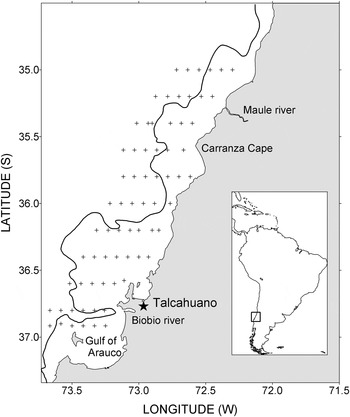
During 7–12 November 2001 (austral spring), an intensive oceanographic survey that sampled 69 stations, separated by 5 nautical miles each, was carried out on-board RV ‘Abate Molina’, over the continental shelf off central Chile, between 35° and 37°S (Figure 1). At each station, a hydrographic cast was carried out from surface to near bottom or to a maximum depth of 250 m, utilizing a Seabird SBE 19 CTD equipped with an YSI Beckman oxygen sensor. Sampling was conducted during day and night. At each station, oblique tows of stratified zooplankton samples were taken at 1–2 knots with a 1 m2 Tucker trawl (300 µm mesh size), equipped with a General Oceanic flowmeter mounted in the frame of the net to estimate filtered volume. Depth strata were variable, ranging from 0–10 and 10–25 m deep in nearshore waters (maximum depth ~55 m), 0–25 and 25–50 m deep over the shelf (maximum depth ~120 m), and 0–50, 50–100, 100–150 and 150–250 m deep at the shelf break area (maximum depth ~300 m). Samples from each stratum were preserved in 4% formaldehyde buffered with borax.
Map of the study area. Crosses indicate the location of the oceanographic stations carried out during November 2001; black star indicates the location of the meteorological station at Carriel Sur Airport. Line indicates the shelf-break (200 m depth isobath).

Larval anchoveta were identified, separated and counted from zooplankton samples. Undamaged individuals (N = 423) were measured to the nearest 0.1 mm with a calibrated ocular micrometer fitted to a Nikon stereomicroscope, from the tip of the snout to the end of the notochord in preflexion larvae (notochord length (NL) from 4.03 to 8.44 mm NL), and to the posterior margin of hypurals in flexion and postflexion larvae (standard length (SL) from 8.14 to 31.11 mm SL), and corrected for shrinkage following Theilacker (Reference Theilacker1980). To establish if net avoidance occurred, the frequency distribution of anchoveta larval length captured during day and night hours were compared by using the Kolmogorov–Smirnov test. Larval abundance per stratum was expressed in individuals per 1000 m3. Total larval abundance per station was standardized and expressed as individuals per 10 m2 (integrated, larvae all sampled depth summed), to observe the horizontal pattern of pre- and postflexion larvae in relation to oceanographic features. To show the vertical distribution of larval abundance (for pre- and postflexion larvae, expressed as ind./1000 m3) in relation to the water column structure, vertical sections of temperature and dissolved oxygen for selected transects were constructed with Surfer 8.0 and overimposed on the spatial distribution of larvae.
The volume of the larval gas bladder was estimated considering it as a prolate spheroid, according to Hunter & Sanchez (Reference Hunter and Sanchez1976). Gas bladders that showed evidence of inflation, i.e. with gas in it (N = 84), were measured (to the nearest 0.1 mm) in their length and height, with a calibrated ocular micrometer fitted to a Nikon stereomicroscope. The volume was estimated according to 4/3 π (a × b 2), where a is half of the length of the gas bladder and b is half of the height of the gas bladder.
To visualize whether a diel pattern of inflation of the gas bladder inflation occurred, a virtual day was constructed considering the different hours of the zooplankton sampling (dawn at ~06:00, dusk at ~21:00) and the percentage of larval anchoveta with inflated gas bladders. With this information we can evaluate time of inflation and deflation of gas bladders, and the vertical position of larval anchoveta in the water column. The centroid depth distribution (CDD) is expressed as:
 $$\hbox{CDD}={\Sigma \lpar P_{{\rm k}} \times Z_{{\rm k}}\rpar \over \Sigma P_{{\rm k}}}$$
where P k is the number of organisms at stratum k (abundance standardized to individuals per 1000 m3), and Z k is the mean depth of stratum k (i.e. if sampled stratum, k, was 50–0 m depth, Z k is 25 m), in order to estimate anchoveta larval vertical distribution at each oceanographic station. To determine if vertical migration occurred, the calculated centroid depths during day and night hours were compared using the Mann–Whitney U-test.
Wind data (intensity and direction) from November 2001 were obtained from the nearby Carriel Sur Airport (Figure 1). Wind-induced turbulence at 25 m depth (within the mixed layer), was estimated as the dissipation rate of kinetic energy (ɛ):
 $$\eqalign{\varepsilon &=\lsqb \lpar \rho_{{\rm a}}/\rho_{{\rm w}}\rpar C_{{\rm D}}\rsqb ^{3/2} \times \lsqb W ^{3}/\lpar 0.4z\rpar \rsqb \cr &\quad\times \lpar \hbox{1 Wm}^{-3}/0.001\, {\rm m}^{2}{\rm s}^{-3}\rpar =\lpar 5.82 \times 10^{-6}\rpar W ^{3}/z}$$
where W = wind speed (m s−1) at the surface (on-board), z is sampling depth (m), ρa = density of air (1.2 kg m−3), ρw = density of seawater (1026 kg m−3), C D = coefficient of drag between the water surface and the wind (0.0015), and 0.4 = Von Kármán's constant (Oakey & Elliott, Reference Oakey and Elliott1982; MacKenzie & Leggett, Reference MacKenzie and Leggett1993). In order to compare our results of ɛ (W m−3) with the literature (cm2 s−3), values were multiplied by a factor of 104 ρw −1 (Kiørboe & Saiz, Reference Kiørboe and Saiz1995; Fox et al., Reference Fox, Harrop and Wimpenny1999). Finally, maps of seawater temperature (°C) and dissolved oxygen (ml l−1) at 10 m depth (within the mixed layer) and at 40 m depth (~base of the pycnocline), were constructed utilizing krigging as the interpolating method.
RESULTS
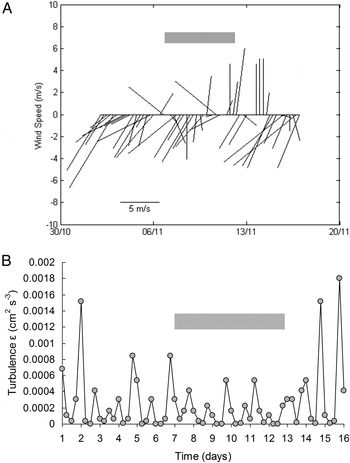
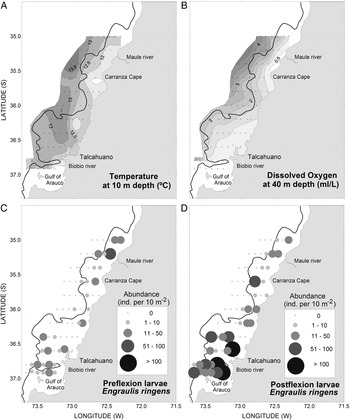
During early November 2001, there was a dominance of southerly winds with intensities of 2–6 m s−1 (upwelling favourable winds); then there was a reduction in the speed and finally a change to northerly winds at the end of the survey period (12 November; Figure 2A). The wind-induced turbulence (ɛ) at 25 m depth of the water column showed a decreasing trend during the first two weeks of November 2001, following the decrease of wind intensity (Figure 2B). A diel cycle of turbulence was also evident, showing the higher values of turbulence during the afternoon (18:00 h), and then a decrease of intensity during the night (24:00 h) and the next morning (06:00 h) (Figure 2B). During the sampling period (grey bars in Figure 2), the changes in wind direction and intensity triggered a reduction in the wind-induced turbulence, particularly in the difference between day and nighttime estimates. The high frequency of southerly winds forced the coastal upwelling of cold (<12°C; Figure 3A) and suboxic parcels of waters (<1 ml l−1; Figure 3B) in the vicinity of Carranza Cape and a thermal front near the shelf break (Figures 3A & 4). The horizontal distribution of water temperature in the mixed layer (at 10 m depth) showed an intrusion of warm waters (>13°C) over the wide continental shelf off Talcahuano. In this area, dissolved oxygen was low (1–2 ml l−1) and relatively homogeneous at the base of the mixed layer (40 m depth; Figure 3B).
(A) Stick plot of wind speed (m/s) during 1–16 November 2001 measured at Carriel Sur Airport (black star in Figure 1); (B) daily variability of wind-induced turbulence (cm2 s−3) at 25 m depth during November 2001 off central Chile. Grey bar indicates the sampling period.

(A) Horizontal distribution of temperature (°C) at 10 m depth along the study area; (B) horizontal distribution of dissolved oxygen (ml l−1) near the pycnocline, at 40 m depth; (C & D) horizontal distribution of pre- and postflexion larval abundance of anchoveta, Engraulis ringens, respectively (individuals per 10 m2). Crosses indicate the location of the oceanographic stations.

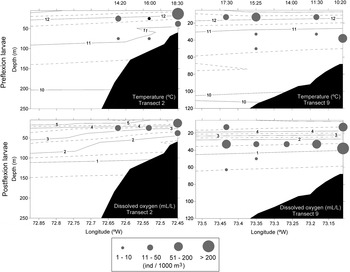
Vertical distribution of pre- and postflexion larvae of anchoveta Engraulis ringens, in relation to vertical sections of temperature (°C) and dissolved oxygen (ml l−1). In the upper panel is indicated the hour of the sampling.

Preflexion larvae (<9 mm SL) were located over the continental shelf, with the highest abundance (59.7 ind. per 10 m2) located in the cold and suboxic waters off Maule River (Figure 3C). In the southern zone, larvae were collected throughout the shelf, with abundances ranging between 2.8 and 30.8 ind. per 10 m2. Postflexion larvae of E. ringens were collected in highest abundance in protected areas such as the coastal waters off Talcahuano and over the Gulf of Arauco (between 103.8 and 136.9 ind. per 10 m2), although high abundance of postlarvae were also found in the shelf break zone off Carranza Cape (78.7 ind. per 10 m2) (Figure 3D).
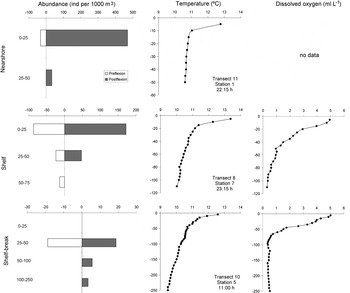
Vertical sections also showed the intrusion of colder and low oxygen waters over the continental shelf in the northern part of the studied area, indicated by the ascent of isotherm of 11°C (Figure 4). Pre- and postflexion larvae of E. ringens were collected over the shelf in the upper 100 m depth. In the southern area (transect 9), cold (11°C) and low oxygen waters (<1 ml/l) were found over the continental shelf and at shallower depths (~45 m depth) than in the northern area. Preflexion larvae were collected throughout the sampled water column, but postflexion larvae were collected at subsurface waters during daylight (Figure 4). Selected profiles of vertical distribution of temperature, dissolved oxygen, pre- and postflexion larval E. ringens collected nearshore, at shelf and shelf-break are shown in Figure 5. The vertical structure of the water column was similar at all locations, varying the width of the mixed layer; during night in nearshore stations, postflexion larvae were collected in higher abundance in the surface stratum (centroid depth ~14 m depth), but during daytime, larvae were found at subsurface (24–29 m depth) and near the base of the pycnocline (=thermocline) (Figure 5). At the shelf stations, preflexion larvae showed a similar depth distribution during day and night (25–43 m depth), but postflexion larvae showed differences in the centroid depth distribution (day: 25–75 m depth; night: 14–38 m depth). Finally, at the shelf-break, preflexion showed similar centroid depth distributions (28–38 m depth during daytime, 23 m depth during night) but postflexion larvae showed differences in the vertical distribution (44–53 m depth during day, 18 m depth during night) (Figure 5).
Vertical profiles of distribution of pre- (white bars) and postflexion (grey bars) larvae of Engraulis ringens, temperature (°C) and dissolved oxygen (ml l−1) obtained in stations located over nearshore (Station 1, transect 11), shelf (Station 7, transect 8) and shelf-break (Station 5, transect 10) off central Chile.

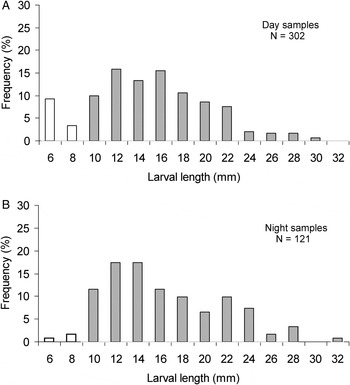
Measured larvae of E. ringens collected during November 2001 off central Chile and corrected for shrinkage (N = 423) showed an extended range of sizes, varying from 4.1 mm NL to 31.1 mm SL. Anchoveta larvae collected during daytime ranged from 4.1 mm NL to 29.5 mm SL (N = 302), and those collected during night catches ranged between 5.7 mm NL and 31.1 mm SL (N = 121) (Figure 6). The Kolmogorov–Smirnov test did not find significant differences (P > 0.1) in the mean values of anchoveta larvae captured during day (mean ± SD = 13.9 ± 5.3 mm SL) and night (15.4 ± 5.2 mm SL) (Figure 6).
Size distribution frequency of larval Engraulis ringens collected (A) during daytime, and (B) during nighttime. White bars correspond to preflexion larvae and grey bars correspond to postflexion larvae.

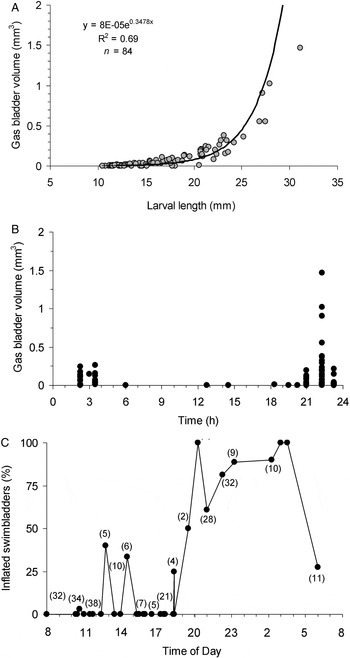
The smallest larva that showed an inflated gas bladder measured 10.4 mm SL (gas bladder volume = 9.6 × 10⁻⁴ mm3). From that size, larvae exhibited a positive (log) relationship between gas bladder volume and larval size, showing the highest volume (1.46 mm3) at 31 mm SL (Figure 7A). Although there was a wide larval size-range and a higher number of larvae collected during daytime, very few individuals (<9%) showed evidence of gas bladder inflation during daytime (Figure 7B, C). Larval anchoveta with larger gas bladder volumes were obtained during nighttime, between 21:00 and 03:30 h (Figure 7B). A diel rhythm of inflation/deflation of the gas bladder was evident for larval anchoveta larger than 10 mm SL (Figure 7C). After 20:00 h (near dusk) more than 50% of larval anchoveta showed evidence of an inflated gas bladder; the percentage was kept high up to 03:30 h and then it was reduced to 27% at 06:00 h during dawn (Figure 7C). The reduction of wind-induced turbulence during nighttime coincides with the beginning of the inflation process in larval >10 mm SL, and therefore may increase the chances of postflexion larvae to ascend in the water column to ingest a gas bubble, with lesser energetic costs.
(A) Relationship between gas bladder volume (mm3) and larval size (mm) of anchoveta larvae with inflated gas bladders (N = 84); (B) relationship between gas bladder volume (mm3) and sampling time (hours); (C) percentage of larval anchoveta with inflated gas bladders and sampling time (hours). Number in parentheses corresponds to sample size (number of larvae analysed).

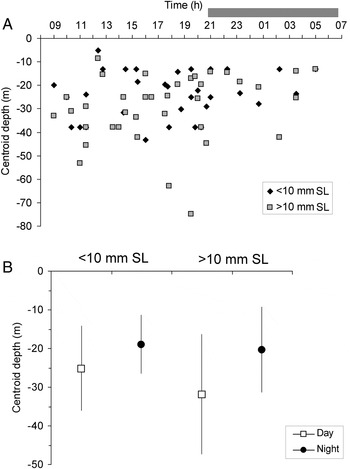
Considering the larval size at the beginning of the process of inflation of the gas bladder in postlarval E. ringens (~10 mm SL), two groups of size-ranges were examined to establish if vertical migrations occurred during November 2001. Larval anchoveta <10 mm SL showed CDD between 5 and 43.3 m depth during the day and between 13 and 27.9 m during the night (Figure 8A), occurring in the mixed layer and at the base of the pycnocline of the water column. However, no significant differences were found among CDD from day and night samples (U = 61, P = 0.12; Figure 8B). In larvae that showed evidence of inflation/deflation of their gas bladders (>10 mm SL), their centroids were deeper and widely distributed during the day (8.4–77 m depth-range, mean ± SD = 31.9 ± 14.7 m) compared with samples captured during night hours (13–42.2 m depth, mean ± SD = 20.3 ± 9.8 m; Figure 8A), showing significant differences between them (U = 52, P = 0.018) (Figure 8B).
(A) Centroid depth distribution of larval anchoveta without functional gas bladder (<10 mm standard length (SL)) and with gas bladder (both inflated and uninflated, >10 mm SL) during a virtual day. Grey bar indicates night hours; (B) average value (± one standard error) of centroid depth distribution of anchoveta larvae during day and nighttime.

DISCUSSION
The beginning of the mechanical inflation of the gas bladder coincides with the initiation of the vertical migration of larval anchoveta, after the formation of hypural structures of the tail (>9 mm SL), which also increases otolith growth and coincides with a change of prey selectivity (Somarakis & Nikolioudakis, Reference Somarakis and Nikolioudakis2010). Larval anchoveta larger than 10 mm SL showed a diel rhythm of inflation/deflation of their gas bladders and a relationship between the gas bladder volume and larval size similar to those described for larvae from several species of physostomous clupeiform fish, such as Engraulis mordax (Hunter & Sanchez, Reference Hunter and Sanchez1976), E. japonicus (Uotani et al., Reference Uotani, Fukui, Osaki and Ozawa2000), E. encrasicolus (Stenevik et al., Reference Stenevik, Sundby and Cloete2007), Sardina pilchardus (Santos et al., Reference Santos, Ré, Dos Santos and Peliz2006), Brevoortia patronus (Hoss & Phonlor, Reference Hoss and Phonlor1984), B. tyrannus (Hoss et al., Reference Hoss, Checkley and Settle1989; Forward et al., 1993, 1999) and Anchoa mitchilli (North & Houde, Reference North and Houde2004). In all these species vertical migration occurred when the large larvae (>10 mm SL) migrate to surface waters during the dusk, where they inhale air through their widely opened mouth. Exceptions were observed in larvae of E. encrasicolus which showed inflated gas bladder in individuals as small as 5.9 mm NL (Stenevik et al., Reference Stenevik, Sundby and Cloete2007) and A. mitchilli (North & Houde, Reference North and Houde2004).
Also, according to Stenevik et al. (Reference Stenevik, Sundby and Cloete2007), larvae sink during the night irrespective of the presence and/or the inflation of the swimbladder. A larva with an inflated gas bladder may reduce sink rate and reduce detection of gelatinous predators during night (Hunter & Sanchez, Reference Hunter and Sanchez1976), which were highly abundant during the cruise in offshore waters (Pavez et al., Reference Pavez, Landaeta, Castro and Schneider2010). Gelatinous predators use the movement or turbulence produced by prey for detection and attack; thus, the reduction of activity produced by slower sinking speeds could reduce predation (Hunter & Sanchez, Reference Hunter and Sanchez1976). Therefore, energy expenditure for swimming upwards to inhale gas bubbles may be compensated for with an increase of feeding rates in surface waters during dusk, reduction of predation and sinking during periods of reduced wind-induced turbulence. Recent results for individual-based models suggest that active behaviour like vertical migration may increase larval survival compared with larval and random behaviour (Kristiansen et al., Reference Kristiansen, Jørgensen, Lough, Vikebø and Fiksen2009).
Size differences in the beginning of the inflation of the gas bladder may arise from different sea temperatures experienced by larvae. For instance, larval E. encrasicolus are strongly influenced by the Angolan waters (16–22°C; Stenevik et al., Reference Stenevik, Sundby and Cloete2007), which may increase larval physiology, accelerate the inflation process and increase the larval swimming speed (Hunter, Reference Hunter1976), compared with larval anchoveta E. ringens (collected in colder waters, 10–13°C; Figure 4), and E. mordax from the California Current (14–17°C; Sánchez-Velaso et al., Reference Sánchez-Velaso, Shirasago, Cisneros-Mata and Avalos-García2000).
Results of our virtual day analysis showed an increase in the percentage of larvae with inflated gas bladders in the field near the dusk. In experiments carried out by Uotani et al. (Reference Uotani, Fukui, Osaki and Ozawa2000) on E. japonicus larvae they found that 13 minutes after sunset (with an illumination level of 0.56 Lx), the gas bladder inflation was observed in 23.5% of the larvae. Those facts suggest that the inflation of gas bladder with decrease of illumination is essential for the vertical migrating behaviour of the clupeiform fish larvae.
Potential consequences of larval gas bladder inflation during upwelling events off central Chile
During the upwelling season (October–March) southerly winds induce offshore advection of surface waters through the Ekman layer, a surface layer of ~20 m depth and 25–50% of the mixed layer (Sobarzo & Djurfeldt, Reference Sobarzo and Djurfeldt2004). Upwelling events may be detrimental for the nearshore retention of pelagic invertebrates and larval fish inhabiting the mixed layer (Bailey, Reference Bailey1981), and because of the ascent of suboxic waters, may also affect the deep limit of the vertical excursion of zooplankton (Pavez et al., Reference Pavez, Landaeta, Castro and Schneider2010). To reduce offshore advection, some zooplankters display diel vertical movements (Poulin et al., Reference Poulin, Palma, Leiva, Narvaez, Pacheco, Navarrete and Castilla2002; Castro et al., Reference Castro, Troncoso and Figueroa2007), others reside temporarily near the pycnocline (Castro et al., Reference Castro, Bernal and Troncoso1993) where horizontal velocities of currents are reduced, and others actively avoid the wind-driven transport by moving deeper in the water column (e.g. Pringle, Reference Pringle2007). However, not always vertical migration may be an efficient mechanism to improve coastal retention. In the Benguela region, larval (5–15 mm SL) and postlarval (>15 mm SL) Engraulis encrasicolus are transported from south to north by strong alongshore currents, and vertical migratory behaviour enhances the transport of larvae to the outer nursery area (Parada et al., Reference Parada, Mullon, Roy, Fréon, Hutchings and van der Lingen2008). In the present study, larval anchoveta with no evidence of gas bladder inflation (<10 mm SL) were located in the mixed layer irrespective of the time of the day, and probably they may be advected offshore in the Ekman layer during active upwelling events. With the beginning of the gas bladder inflation in larger larvae, the vertical movement of larvae increased. In the spring sampling, the ascent during dusk and night to inhale air bubbles coincided with periods of lower wind intensity, reducing the effect of wind-induced turbulence in the Ekman layer on zoo- and ichthyoplankton to flee the surface (Pringle, Reference Pringle2007). Therefore, and considering the usual cross-shelf two layer circulation during upwelling, the ascent during dusk and the descent to deeper waters during daytime following the deflation of the gas bladder may be part of a biophysical retention mechanism to increase the chances of postlarval E. ringens to be maintained near the coast, in a similar fashion described for the larval mollusc Concholepas concholepas (Poulin et al., Reference Poulin, Palma, Leiva, Narvaez, Pacheco, Navarrete and Castilla2002). Interestingly, maximum abundances of larval anchoveta in this zone do not occur in austral winter, when the peak spawning occurs and coastward water movement occurs due to northern winds (Castro et al., Reference Castro, Claramunt, Krautz, Llanos-Rivera and Moreno2009), but in spring when larvae have grown older, are capable of bladder inflation and, when it initiates the upwelling season in the southern Humboldt Current.
This diel variability in the vertical distribution of larval anchoveta is similar to those described for larval sardine off Portuguese waters during upwelling events (Santos et al., Reference Santos, Ré, Dos Santos and Peliz2006), but differs from the diel variability described for Engraulis encrasicolus in northern Benguela (Stenevik et al., Reference Stenevik, Sundby and Cloete2007). In the latter area, anchovy larvae appear to exhibit a Type II diel vertical migration pattern with daytime ascent and nighttime descent, although swimbladders are inflated during night (Stenevik et al., Reference Stenevik, Sundby and Cloete2007). Warmer (and therefore, lighter) waters occur on the surface, and probably anchovy postlarvae would be relatively heavier at surface waters. Also, avoiding the Ekman layer during nighttime would aid transport of larvae into the inshore nursery areas. Although vertical migration of anchovy larvae may be different in northern Benguela (Type II) and southern Humboldt (Type I), their consequences are similar—an increase of retention in coastal (over the shelf) areas. Nevertheless in this case, vertical migration is not successful in advection avoidance, but it increases the successful transport to nursery areas for early and late larvae (Parada et al., Reference Parada, Mullon, Roy, Fréon, Hutchings and van der Lingen2008). Therefore, differences in the vertical migration may occur for the same species at different areas.
Logarithmic models of ontogenetic change in volume of gas bladders differ between larvae of Engraulis ringens (this study) and E. encrasicolus (Stenevik et al., Reference Stenevik, Sundby and Cloete2007). The latter model exhibits a faster increase through development (estimated gas bladder volume for a larva 10 and 15 mm SL: 0.115 and 0.716 mm3, respectively) than our model (0.003 and 0.015 mm3, respectively). This suggests that larval E. ringens ingest fewer gas bubbles in order to inflate its bladders than larval E. encrasicolus at a same length. We do not know if it is a response to different water temperatures and/or oxygen concentrations, or differences at species-level.
Finally, behaviour of anchoveta larvae, including inflation and deflation of gas bladders, the complete formation of caudal fins and beginning of schooling behaviour, together with physical processes occurring at subinertial and tidal scale, will enhance the maintenance of fish larvae in a food-rich environment, such as the continental shelf of the southern Humboldt Current System. The capability of regulation of the vertical position of larval anchoveta through the inflation/deflation of gas bladder may be one of the biological mechanisms utilized for this species, coupled with upwelling events that may reduce offshore advection, and an increase of the coastal recruitment during austral spring and summer.
ACKNOWLEDGEMENTS
The authors thank all the crew of the RV ‘Abate Molina’, and particularly M.C. Krautz, B. Yannicelli, M. Pavéz and M. Gutierrez who actively participated in the fieldwork. Three anonymous referees improved an early version of the manuscript with their comments. The oceanographic cruises were funded by project FONDECYT 1010900 awarded to W. Schneider, R. Roa and L.R. Castro (Universidad de Concepción) and the Fondap Humboldt Program.