INTRODUCTION
It has been a central inquiry in organizational and management studies to understand complex organizational responses to institutional environments (Scott, Reference Scott2001). While early research has mainly focused on organizational conformity and institutional isomorphism following wide adoption of legitimate practices in an institutional field (DiMaggio & Powell, Reference DiMaggio and Powell1983; Meyer & Rowan, Reference Meyer and Rowan1977; Tolbert & Zucker, Reference Tolbert and Zucker1983), this lop-sided focus on isomorphism has received sharp criticism given the prevalence of practice variation in the field (Ansari, Fiss, & Zajac, Reference Ansari, Fiss and Zajac2010; Lounsbury, Reference Lounsbury2001; Oliver, Reference Oliver1991; Powell, Reference Powell, Powell and DiMaggio1991). In this light, scholars have called for institutional analyses of ‘finer-grained mechanisms’ that ‘spawn and are influenced by the heterogeneity of actors and activity that underlie apparent conformity’ (Lounsbury, Reference Lounsbury2007: 289–290).
Along with this growing research interest, two major theoretical approaches have emerged: one is to emphasize the institutional sources of practice variation, and the other is to highlight the strategic responses from the organizational perspective (Lounsbury, Reference Lounsbury2008). From the macro-level institutional perspective, the ‘institutional complexity’ approach emphasizes that there are often multiple legitimate models and even competing institutional logics in the organizational field. Instead of exerting a monolithic influence, complex constituency and diverse institutional pressures can generate different organizational responses (Greenwood, Diaz, Li, & Lorente, 2010; Hoffman, Reference Hoffman2001; Lounsbury, Reference Lounsbury2001; Reference Lounsbury2007; Reference Lounsbury2008). In contrast, from the organizational perspective at the micro-level, the strategic approach argues that organizations have a repertoire of responses to institutional pressures far beyond invariably passive conformity (Oliver, Reference Oliver1991). Thus, it emphasizes examination of ‘how the instrumental rationality of actors leads to divergences in motive and behavior’ (Lounsbury, Reference Lounsbury2008, 351; italics added). These two approaches shed important light on heterogeneous organizational responses from two distinct perspectives (e.g., Goodstein, Reference Goodstein1994; Greenwood et al., Reference Greenwood, Díaz, Li and Lorente2010; Lounsbury, Reference Lounsbury2001; Reference Lounsbury2007; Suchman, Reference Suchman1995). Nevertheless, as there has been limited dialogue between these two approaches, the macro-micro connection between institutional forces and organizational processes is widely missing. Consequently, it is often unclear how institutional pressures are passed on to and experienced differently by organizations, leading to heterogeneous responses (Greenwood, Hinings, & Whetten, Reference Greenwood, Hinings and Whetten2014; Thornton, Ocasio, & Lounsbury, Reference Thornton, Ocasio and Lounsbury2012).
The thriving relational perspective is promising to build the macro-micro connection, and scholars have long been interested in utilizing the relational perspective to study organizational behaviors under specific institutional environments (Owen-Smith & Powell, Reference Owen-Smith, Powell, Greenwood, Oliver, Sahlin and Suddaby2008). In particular, organizations’ institutional linkages, defined as organizational connections with the institutional authority in the environment (e.g., Baum & Oliver, Reference Baum and Oliver1991; Edelman, Reference Edelman1992; Lounsbury, Reference Lounsbury2001), function as a crucial nexus to bridge institutions and organizations. Therefore, institutional linkages should be the key research focus to understand the channels of different institutional pressures and organizations’ heterogeneous strategic responses.
Nevertheless, there are two interconnected limitations in the extant studies in this regard. On the one hand, while extant studies have examined the role of organizational connections with institutional authority, such as the state (e.g., Baum & Oliver, Reference Baum and Oliver1991; Edelman, Reference Edelman1992; Sutton & Dobbin, Reference Sutton and Dobbin1996) and professional associations (e.g., Ruef & Scott, Reference Ruef and Scott1998), they mainly highlight that the simple presence of such linkages imposes stronger institutional pressure, channels legitimate models, and facilitates organizational adoption and conformity. Although some studies have offered evidence that different types of relationships with state agents, industrial peers, or social organizations could influence organizational adoption patterns (Davis & Greve, Reference Davis and Greve1997; Lounsbury, Reference Lounsbury2001; Marquis & Qian, Reference Marquis and Qian2014), ‘how relational ties matter and how they may matter differently for different types of practices has received little attention’ in the extant literature (Raffaelli & Glynn, Reference Raffaelli and Glynn2014: 541; italics added).
On the other hand, while extant studies have mainly emphasized the role of institutional linkages in channeling institutional pressures from field-level authorities, they have devoted little attention to how these linkages can shape organizations’ strategic interpretations of these pressures and eventually result in heterogeneous responses. In this light, ‘the meaning of a strategic issue is not inherent in the environmental events or developments’ (Dutton & Jackson, Reference Dutton and Jackson1987: 77), and distinct organizational interpretations (e.g., threat or opportunity) of institutionally-demanded practices will lead to different responses (Ansari et al., Reference Ansari, Fiss and Zajac2010; Delmas & Toffel, Reference Delmas and Toffel2008; Kennedy & Fiss, Reference Kennedy and Fiss2009; Sharma, Pablo, & Vredenburg, Reference Sharma, Pablo and Vredenburg1999). Thus, from the organization's perspective, we also need to scrutinize firms’ linkages with the institutional authority to achieve a better understanding of the specific ‘nature and context’ of institutional pressures, which trigger divergent organizational strategies (Oliver, Reference Oliver1991).
To address these research gaps in the extant literatures, we develop a ‘relational complexity’ argument to highlight diverse institutional linkages as another important source of practice variation. Moving beyond extant studies of institutional linkages, we contend that organizations’ relations and connections with the same institutional authority (e.g., the state) can be diverse and complex (Powell, Reference Powell, Powell and DiMaggio1991; Scott, Reference Scott2014). Filtering different institutional pressures, diverse institutional linkages can trigger heterogeneous organizational responses and practices. As organizations are embedded in institutional and political environments and the state is the key institutional authority (Dacin, Ventresca, & Beal, Reference Dacin, Ventresca and Beal1999; Zukin & DiMaggio, Reference Zukin, DiMaggio, Zukin and DiMaggio1990), in this study we particularly scrutinize diverse institutional linkages with the state to shed further light on the relational dynamics that drive practice variation. These diverse political connections filter distinct institutional pressures and expectations, shape organizational interpretations of environmental demands, and eventually trigger heterogeneous organizational responses.
To examine our theoretical argument, we conduct a study of heterogeneous organizational practices in the emerging area of corporate social responsibility (CSR) in China's intriguing institutional environment. As the Chinese state is the dominant institutional authority and has entrenched influences on organizational life, we distinguish two distinct types of institutional linkages between firms and the state – bureaucratic linkage and associational linkage – and examine their differential impacts on shaping firms’ CSR practices. Drawing insights from studies of organizational framing of environmental demand (Ansari et al., Reference Ansari, Fiss and Zajac2010; Dutton & Jackson, Reference Dutton and Jackson1987; George, Chattopadhyay, Sitkin, & Barden, Reference George, Chattopadhyay, Sitkin and Barden2006; Kennedy & Fiss, Reference Kennedy and Fiss2009), firms with a strong bureaucratic linkage with the state are more likely to feel the coercive institutional pressure and perceive CSR demands as a threat. Empirical evidence in our study shows that they tend to take a restrictive adoption strategy and focus on more visible external-oriented CSR practices in philanthropy. In contrast, those firms forming a close partnership with the state through high-status political councils or semi-political industry associations are more likely to perceive the emerging CSR as opportunities. Our results show that they are more likely to undertake more extensive adoptions by not only performing a high level of external-oriented CSR practices, but also developing internal organizational structures on CSR.
As our study highlights diverse organizational linkages with institutional authority as an important source of practice variation, it advances the related literatures in several aspects. While the ‘institutional complexity’ perspective has highlighted field-level structures as the institutional source of practice variation (Greenwood, Raynard, Kodeih, Micelotta, & Lounsbury, Reference Greenwood, Raynard, Kodeih, Micelotta and Lounsbury2011), this ‘relational complexity’ perspective shifts our attention toward relational dynamics as another key source of practice variation. From this perspective, even in a consolidated field, diverse linkages between organizations and the same institutional authority can filter distinct institutional pressures and trigger different organizational responses. Meanwhile, extending institutional analyses of organizational ties, this study echoes the recent call to refine the analyses of different types of relations in shaping heterogeneous organizational practices (Raffaelli & Glynn, Reference Raffaelli and Glynn2014). While the extant literature has devoted little attention to various political connections and state-firm relations in the institutional field (Powell, Reference Powell, Powell and DiMaggio1991; for two very recent exceptions, see Sun, Mellahi, Wright, & Xu, Reference Sun, Mellahi, Wright and Xu2015; Zhu & Chung, Reference Zhu and Chung2014), our study enriches the literature by revealing the complex nature of political linkages and their different implications. All these extend the research scope of extant literatures and help achieve a better understanding of the intricate driving forces underlying heterogeneous organizational responses.
Moreover, by examining diverse linkages bridging organizations with field-level authorities, our study also joins the recent trend to connect institutional analyses of the environmental forces with research on the dynamic organizational processes (e.g., Ansari et al., Reference Ansari, Fiss and Zajac2010; Greenwood et al., Reference Greenwood, Raynard, Kodeih, Micelotta and Lounsbury2011; Hoffman, Reference Hoffman2001; Kennedy & Fiss, Reference Kennedy and Fiss2009; Lounsbury, Reference Lounsbury2001). As our study highlights organizational linkages with the powerful institutional authority as a key nexus to shape organizational perceptions and interpretations of the macro-level environmental pressures, it offers a new avenue to further integrate studies at these two levels. This will strengthen institutional inquires on organizational behaviors and enrich our understanding of strategic responses of organizations (Oliver, Reference Oliver1991).
Finally, this study contributes to the CSR literature. Our study is situated in China's dynamic institutional environment, where CSR is still in the early stage of development. In this intriguing research context, our study moves beyond the research focus on external-oriented philanthropic activities in China (e.g., Jia & Zhang, Reference Jia and Zhang2013; Lev, Petrovits, & Radhakrishnan, Reference Lev, Petrovits and Radhakrishnan2010; Ma & Parish, Reference Ma and Parish2006; Wang & Qian, Reference Wang and Qian2011; Zhang & Luo, Reference Zhang and Luo2013) to examine organizations’ external CSR practices and internal CSR structures simultaneously, which also enriches the recent research on extensiveness of adoption as a key feature in practice variation (Ansari et al., Reference Ansari, Fiss and Zajac2010; Fiss, Kennedy, & Davis, Reference Fiss, Kennedy and Davis2012; Kennedy & Fiss, Reference Kennedy and Fiss2009). Echoing the recent trend in connecting corporate political portfolio and social activities (den Hond, Rehbein, de Bakker, & Lankveld, Reference den Hond, Rehbein, de Bakker and Lankveld2014; Hadani & Coombes, Reference Hadani and Coombes2015; Rehbein & Schuler, Reference Rehbein and Schuler2015), this study further enhances our understanding on how diverse state-firm relations affect CSR in an emerging economy.
We organize the rest of this article into four sections. The following section discusses the characteristics of CSR development in China's institutional and political environment. We then elaborate on our theoretical framework and develop the hypotheses. We next describe the national survey data used in our empirical analysis, discuss analytical procedures, and present our results. In the final section we discuss broad implications of our findings and highlight our theoretical and practical contributions.
CSR IN CHINA'S INSTITUTIONAL AND POLITICAL ENVIRONMENT
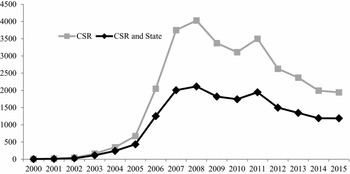
With the global diffusion of CSR (Lim & Tsutsui, Reference Lim and Tsutsui2012), CSR has become a hot topic in China, the largest emerging and transitional economy in the world. As shown in Figure 1, over the last decade CSR has gained popularity in the public discourse and received wide acceptance among Chinese firms. In 2006 when our data were collected, CSR had just taken off in this trend.
CSR Discourse in China (2000-2015)

Although the discourse of CSR in China is affected by the momentum of global CSR diffusion, local CSR development does not purely reflect the global trend and impact (Lim & Tsutsui, Reference Lim and Tsutsui2012). In China, CSR has exhibited different content and characteristics (Xu & Yang, Reference Xu and Yang2009), and the underlying logic and driving force of CSR diffusion are also fundamentally different from those in Western countries. Compared to ‘CSR as self-government’ in Western countries, the state has been the key driving force of CSR in China because ‘[t]he civil society remains closely bound to the state and is conspicuously absent as a driver of CSR’ (Moon, Kang, & Gond, Reference Moon, Kang, Gond, Coen, Grant and Wilson2010: 530). As shown in Figure 1, CSR discourses in China have always been closely associated with the state. As social problems (e.g., social inequality and poverty) emerged as a substantial issue and presented a serious challenge during China's market transition, the state calls on ‘building the harmonious society’ and promotes CSR as an important avenue to alleviate social tensions (Marquis & Qian, Reference Marquis and Qian2014; See, Reference See2008).
In China, based on strong regulative power and a distinct state-business relationship as a heritage of the socialist command economy, the state exerts a huge influence on firms’ behaviors, including their CSR orientation and practices (Francis, Reference Francis1996). Although China has made large strides in its market transition, the state continues to retain tremendous regulative power and holds substantial control over scarce resources (Fligstein & Zhang, Reference Fligstein and Zhang2011). State agencies thus can promote CSR through ‘an informal link between a company's performance in implementing its responsibilities and its chance of favorable treatment over government loans, contracts, the granting of licenses and access to other scarce resources controlled by local bureaucrats’ (Francis, Reference Francis1996: 858). Moreover, the state can directly impose CSR pressures through government subsidies or tax incentives, which provides a strong motivation for firms to conform (Moon et al., Reference Moon, Kang, Gond, Coen, Grant and Wilson2010). In such a highly politicized environment (Nee & Opper, Reference Nee, Opper, Nee and Swedberg2007), firms’ CSR adoption often follows a political logic (Zhao, Reference Zhao2012).
Since the Chinese state has high authoritarian power and exerts a substantial pressure on organizations, we would expect a high level of conformity in CSR adoption among Chinese firms. Yet, interestingly, facing the institutional demand on CSR, we observe different organizational responses in this emerging field. Some firms focus on external-oriented CSR practices, among which philanthropy is the most visible and popular in China. By comparison, others have undertaken more extensive adoptions by further developing internal organizational structures on CSR. Below, we elaborate on these two types of CSR strategies in this field.
In the early stage of CSR development, external-oriented CSR practices are more visible. Among them, the most widely recognized and embraced CSR practices are philanthropic activities, such as donation, which have attracted most attention in the extant literature on CSR in China (Jia & Zhang, Reference Jia and Zhang2013; Ma & Parish, Reference Ma and Parish2006; Wang & Qian, Reference Wang and Qian2011; Zhang & Luo, Reference Zhang and Luo2013). The popularity of philanthropy as the most visible CSR practice in China has historical roots and political driving forces. Philanthropic activities align directly with the popular state slogan of ‘building the harmonious society’ and are most visible to government agencies and public audience. Thus, they can easily attract public attention and satisfy the state's expectations and demands. Demands on philanthropic donations are particularly high when the nation suffers natural catastrophes, such as an earthquake, flood, typhoon, and drought. At those critical moments, the state is in urgent need of capital and other materials. For that purpose, state agencies and the public media often commend those firms making generous donations after each disaster, while criticizing those lacking of such actions (Zhang & Luo, Reference Zhang and Luo2013). As such information is often publicly available, engaging in these visible philanthropic activities can help a firm gain public recognition and social legitimacy, while lack of such engagement can result in public sanctions and tremendous social and economic losses (Wang & Qian, Reference Wang and Qian2011). In addition to highly visible donations, philanthropic activities also include sponsoring community welfare activities and participating in philanthropic projects, which are often endorsed by the state. In addition to being highly visible, another advantage of adopting these external-oriented CSR practices is that such adoptions do not require a firm's structural support and long-term commitment, and they generally do not interfere with its business operation and routine activities. Therefore, to directly respond to the state's CSR demand and avoid social and economic losses, some firms take a limited version of CSR adoption by focusing on philanthropic practices. As this kind of adoption focuses on activities that are not integrated into an organization's strategy, routines, and operations, it is essentially ‘peripheral CSR’ (Aguinis & Glavas, Reference Aguinis and Glavas2013).
Organizations can further respond to the institutional demand by developing formalized internal structures (Edelman, Reference Edelman1992; Greening & Gray, Reference Greening and Gray1994; Sutton & Dobbin, Reference Sutton and Dobbin1996). Differing from external-oriented CSR practices, internal-oriented CSR activities and management involve structural development, which has been largely ignored in the extant studies of CSR in China. Rather than acting in a provisional manner, development of internal organizational structures on CSR indicates a firm's high level of commitment and integration of CSR practices with its regular routines (Weaver, Treviño, & Cochran, Reference Weaver, Treviño and Cochran1999). Compared with external-oriented CSR practices of philanthropy, internal CSR structures (e.g., special staffing, implementation arrangement, and incorporation of CSR in strategic planning) are less visible to the external audience. In the early stage of CSR diffusion in China, this type of CSR structure is more subject to voluntary adoption and is not closely monitored or regulated by the Chinese state. Thus, moving beyond external-oriented CSR practices, development of formalized CSR structures indicates firms’ internalization process, long-term commitment, and a higher level of strategic CSR management. In a sense, in the early stage of CSR diffusion, this kind of extensive adoption is aligned with ‘embedded CSR’ based on a better integration of CSR within a firm's strategy, routines, and operations (Aguinis & Glavas, Reference Aguinis and Glavas2013).[ Footnote 1 ]
In short, in the emerging CSR field in China, firms make different strategic responses to the state's demand. While some firms focus on visible, external-oriented CSR practices, others have more extensive adoptions by not only engaging in external-oriented CSR practices, but also establishing internal structures to integrate CSR with organizational operation and routines. Why do firms respond to the institutional demand differently? To address this intriguing question, we develop a theoretical argument on how two distinct types of institutional linkages filter different institutional pressures and expectations, shape organizational interpretations of environmental demand, and eventually trigger heterogeneous organizational responses.
THEORETICAL BACKGROUND AND HYPOTHESES
Diverse Institutional Linkages and Heterogeneous Organizational Responses
Organizations are embedded in broad institutional and political environments (Dacin et al., Reference Dacin, Ventresca and Beal1999; Prechel & Morris, Reference Prechel and Morris2010; Zukin & DiMaggio, Reference Zukin, DiMaggio, Zukin and DiMaggio1990). Situated in the broad context, ‘the adoption and diffusion of new corporate practices often requires significant amounts of adaptive as well as interpretive effort, as organizations seek to integrate these practices into existing organizational technologies, cultural contexts, and political arenas’ (Ansari, Fiss, & Zajac, Reference Ansari, Fiss and Zajac2010: 85; italics added). In this light, institutional linkages matter in practice adoption because it connects organizations to those authorities who can offer a ‘guiding principle for matching the appropriate types of practices to specific problems and rhetoric accounting for why organizations should change to incorporate new practices’ (Shipilov, Greve, & Rowley, Reference Shipilov, Greve and Rowley2010: 846). As firms’ CSR adoption often follows a political logic in China's institutional environment, it is crucial to scrutinize firms’ specific institutional linkages with the state to achieve a better understanding of their heterogeneous CSR practices.
Organizations’ institutional linkages with the state are often complex (Powell, Reference Powell, Powell and DiMaggio1991; Scott, Reference Scott2014), including ‘bureaucratic, instrumental, or affective ties’ (Michelson, Reference Michelson2007: 352). Similar to other types of organizational connections, they can affect organizational behaviors by channeling resources and information into organizations and also by shaping organizational identity and status (Podolny, Reference Podolny2001). On the one hand, organizational linkages with the state can channel information and resources and filter regulative pressure into organizations (Edelman, Reference Edelman1992). This pressure is potent in China as the Chinese state holds strong regulative power and controls most scarce resources. For those firms under the state's tight bureaucratic control or scrutiny, they are particularly sensitive to the state's demand. On the other hand, institutional linkages can embody social norms and expectations and shape organizational identity and status (Ma & Parish, Reference Ma and Parish2006). An organization's linkages with key social and political institutions can signal its credibility, help gain legitimacy, and enhance its status (Baum & Oliver, Reference Baum and Oliver1991; Zott & Huy, Reference Zott and Huy2007). In China, as the state is the most powerful institutional authority, a close partnership with the state can manifest a firm's unique identity and higher status, which will filter distinct social norms and expectations.
Generally, there are two different types of state-firm relationships, which are associated with two major roles of the state in the economic and business arena. On the one hand, as a political-institutional structure, the bureaucratic state plays a key role as a regulator in monitoring, supervising, and coordinating firms and business activities; on the other hand, as an active actor itself, state may also form a type of partnership relationship with firms to achieve socioeconomic goals and effective political governance (Campbell & Lindberg, Reference Campbell and Lindberg1990; Lindberg & Campbell, Reference Lindberg, Campbell, Campbell, Hollingsworth and Lindberg1991). Consistent with this perspective, Edelman (Reference Edelman1992) uses ‘administrative linkages’ to conceptualize the firms’ connections to the federal government in the U context. She further distinguishes two different types of linkages between state and organizations as being either regulative in a hierarchical structure or cooperative in a more horizontal manner.
Under this general framework, the state-firm relationship can further display special characteristics under different institutional conditions (Hamilton & Biggart, Reference Hamilton and Biggart1988). In China, the state government monopolizes administrative, legislative, and judiciary systems, and thus has enormous power and capacities to exert social and political control of organizations. In this context, extant studies have highlighted two types of state-firm relations in contemporary China (Chen & Dickson, Reference Chen and Dickson2010; Dickson, Reference Dickson2003; Reference Dickson2008). On the one hand, China's powerful bureaucratic state imposes tremendous regulative pressure and influence on firms to maintain its economic control; on the other hand, to broaden the basis of sociopolitical support, the state strives to recruit business elites into the political system (such as via high-profile political councils) and also helps organize industry associations to achieve the state's strategic goals in political governance and socioeconomic development. Considering different natures of state-firm relationship and also drawing insights from categorizations in the extant literature (e.g., Edelman, Reference Edelman1992), we distinguish two main types of institutional linkages with the state in China's distinct institutional and political context. One is bureaucratic linkage, which denotes that an organization is subject to the powerful state's tight bureaucratic control, direct scrutiny, or strong regulative influence. The other is associational linkage, which denotes a firm's close affiliation and good partnership with the state through a political or semi-political association. This also echoes Oliver's (Reference Oliver1991) insight on that ‘[t]he opportunistic use of institutional links’ manifests in ‘coalition-building processes and the strategic use of institutional ties’ to pursue firms’ socioeconomic gains (157–158).
These two types of linkages define different state-firm relationships and filter distinct institutional pressures and social expectations. Accordingly, organizational adoptions can be subject to different mechanisms, such as coercive pressure versus normative emulation, in the diffusion process (Dobbin, Simmons, & Garrett, Reference Dobbin, Simmons and Garrett2007; Weber, Davis, & Lounsbury, Reference Weber, Davis and Lounsbury2009). Different pressures and mechanisms can further shape different organizations’ interpretations of environmental demand on CSR as threats or opportunities – based on loss or gain orientation, a sense of the issues as uncontrollable or controllable, and negative or positive emotional associations (Chattopadhyay, Glick, & Huber, Reference Chattopadhyay, Glick and Huber2001; Dutton & Jackson, Reference Dutton and Jackson1987; Kennedy & Fiss, Reference Kennedy and Fiss2009; Sharma, Reference Sharma2000; Sharma et al., Reference Sharma, Pablo and Vredenburg1999). Different organizational interpretations (i.e., threat vs. opportunity) will prompt organizations’ active agency in choosing strategic responses to institutional pressures and expectations (Oliver, Reference Oliver1991), thus affecting the extensiveness of practice implementation (Fiss et al., Reference Fiss, Kennedy and Davis2012; Kennedy & Fiss, Reference Kennedy and Fiss2009). Below we elaborate on how these diverse institutional linkages with the state can trigger various diffusion mechanisms and lead to different patterns in CSR adoption.
Bureaucratic Linkage and Limited CSR Adoption
As the powerful institutional authority, the state exercises regulative power and coercive control over organizations (Campbell & Lindberg, Reference Campbell and Lindberg1990). Bureaucratic linkage between firm and the state connotes the government's regulative power, bureaucratic control, and executive jurisdiction over firms, which channels the coercive pressure into firms (Edelman, Reference Edelman1990; Reference Edelman1992). In China, firms often face direct intervention from the state and are under close inspection by governmental agencies for numerous issues ranging from taxation to production safety (Estrin & Prevezer, Reference Estrin and Prevezer2011). Such regulative and bureaucratic control can trigger organizations’ coercive adoptions to gain the legitimacy (DiMaggio & Powell, Reference DiMaggio and Powell1983; Guillén & Capron, Reference Guillén and Capron2016; Weber et al., Reference Weber, Davis and Lounsbury2009).
Via more direct connections with the state bureaucracy, firms feel a stronger pressure to adopt CSR practices explicitly promoted by the Chinese government. Even if the government may not promulgate specific regulations on CSR, the central and local governments have established official ‘guidance’ toward CSR and have set up corresponding local standards to evaluate firms’ CSR performance. For example, in 2007, the State-Owned Assets Supervision and Administration Commission (SASAC) issued its ‘guidance’ to CSR practices of large state-owned enterprises (SASAC, 2007). Local governments have also issued similar ‘guidance’ and local standards on CSR since 2005 (Zhao, Reference Zhao2012). In this context, firms’ poor performance in CSR can be sanctioned by the bureaucratic state, which can easily impose extra fees on firms and intervene in their business by issuing administrative orders. Thus, failing to comply with the government's guidance can result in considerable social and economic losses. Under such situations, CSR demand would be perceived as threats since they likely cause tremendous losses over which firms have little power to control (Chattopadhyay et al., Reference Chattopadhyay, Glick and Huber2001; Dutton & Jackson, Reference Dutton and Jackson1987).
When firms perceive CSR issues as threats and strive to avoid social and economic losses under the coercive pressure, organizations have a lower-level commitment and tend to take superficial or ceremonial adoptions (Dobbin et al., Reference Dobbin, Simmons and Garrett2007; Weber et al., Reference Weber, Davis and Lounsbury2009). Lacking motivations and commitment, they tend to take a more passive response to the institutional demand, pursue a more provisional and limited adoption strategy, and focus more on visible practices to meet the government's basic requirements (Ansari et al., Reference Ansari, Fiss and Zajac2010; Fiss et al., Reference Fiss, Kennedy and Davis2012; Kennedy & Fiss, Reference Kennedy and Fiss2009). As philanthropic activities are most visible and directly align with the state's strategic goal of ‘building the harmonious society’, focusing on such external-oriented CSR practices is the optimal strategy to send the best signal of organizational compliance to the state's CSR demand. This kind of limited CSR adoption, resembling the ‘peripheral CSR’ strategy (Aguinis & Glavas, Reference Aguinis and Glavas2013), is also easy to learn and implement because philanthropic activities had historical tradition and examples in China. In contrast, it is not an appealing response strategy to take an extensive adoption approach by further establishing formalized internal CSR structures newly imported to China. After all, it is less visible to the state and public audience while requiring stronger organizational commitment, deeper organizational learning, and additional resources in the early stage of diffusion process.
As firms’ bureaucratic linkages with the state vary (Edelman, Reference Edelman1992), they may feel different levels of coercive pressure and threats, and they may have varied tendencies to focus on external-oriented CSR practices in a limited adoption approach. Those firms having a tighter connection with the bureaucratic state are under the state's direct monitoring, inspection, or scrutiny. As they feel a higher level of regulative and coercive pressure, they tend to perceive the CSR demand as an imminent threat. Consequently, they would be more likely to focus on more visible philanthropic activities. Meanwhile, firms with various property rights of ownership also establish different bureaucratic connections with the state (Greenwood et al., Reference Greenwood, Raynard, Kodeih, Micelotta and Lounsbury2011). Generally speaking, foreign firms have a weaker connection with China's bureaucratic state and face lower regulative pressure. Their foreign background and identity make them more tuned to the global CSR framework associated with a different logic, and they are less sensitive to the Chinese government's expectation and mandate (Zhang & Luo, Reference Zhang and Luo2013). In contrast, domestic firms, particularly state-owned enterprises and to a less extent private firms, are under more direct regulative control of China's bureaucratic state and are more dependent on government agencies for resources and support. Thus, they are more likely to perceive CSR demand as a threat and tend to focus more on visible philanthropic activities. As a testament, after the catastrophic Sichuan earthquake in 2008, domestic firms significantly out-donated many world-known foreign firms operating in China (McGinnis, Pellegrin, Shum, Teo, & Wu, Reference McGinnis, Pellegrin, Shum, Teo and Wu2009). Although the concept of CSR and sophisticated CSR structures within firms were still less developed in China, domestic firms felt stronger coercive pressure to engage in philanthropic activities to avoid state sanctions and socioeconomic losses.
In short, we expect that compared with firms with a weaker bureaucratic connection, those under more direct state bureaucratic control are more sensitive to the state's regulative and coercive pressure and perceive the state CSR demand as a threat. Under such conditions, external-oriented philanthropic activities have a great advantage of being more visible to the state and the public audience; such a limited CSR adoption is also easy to learn and implement. Thus, it is appealing for firms to focus on philanthropic activities in order to comply with the state's demand and avoid bureaucratic sanctions. Based on these considerations, we predict that:
Hypothesis 1 (H1): Firms having a stronger bureaucratic linkage with the state are more likely to focus on pursuing a higher level of philanthropic activities under limited CSR adoptions.
Associational Linkage and Extensive CSR Adoption
Different from the bureaucratic linkage, which connotes the state's bureaucratic control and regulative power on a firm, associational linkage through high-status political organization or semi-political industry association indicates a firm's closer affiliation and better partnership with the state. Active participation in political and industrial associations is an important avenue to engage in the collective form of corporate political activities (Hillman & Hitt, Reference Hillman and Hitt1999; Schuler, Rehbein, & Cramer, Reference Schuler, Rehbein and Cramer2002; Zhang, Zhao, & Ge, Reference Zhang, Zhao and Ge2016). In China's context, a firm's connections with the high-status state political council (e.g., the Chinese People's Congress (CPC) or the Chinese People's Political Consultative Conference (CPPCC)) or with the semi-political industry association form distinct and valuable ties with the state. The CPC and the CPPCC are two key political councils in the Chinese political structure that bring valuable political connections and status to their members (Ma & Parish, Reference Ma and Parish2006). Meanwhile, industry associations (e.g., the All-China Federation of Industry & Commerce (ACFIC)) are often sponsored by the Chinese state, and government officials often assume leadership positions in them. Such industry associations have important political functions and bridge firms with the state (Deng & Kennedy, Reference Deng and Kennedy2010; Dickson, Reference Dickson2003; Reference Dickson2008; Jia, Reference Jia2014). Different from the bureaucratic linkages, these associational linkages filter different institutional pressures, norms, and expectations, and also offer unique platforms for firms to cast their influence in China's institutional environment (Li, Meng, Wang, & Zhou, Reference Li, Meng, Wang and Zhou2008; Luo & Chen, Reference Luo and Chen1997; Peng & Luo, Reference Peng and Luo2000). Being close to the institutional authority prompts firms to meet high expectations and triggers normative emulation (Dobbin et al., Reference Dobbin, Simmons and Garrett2007; Weber et al., Reference Weber, Davis and Lounsbury2009). That is, adopters perceive the diffused practices as normatively appropriate, and they often ‘look to prestigious others and follow the advice of elite professional communities in order to maintain their own status’ (Weber et al., Reference Weber, Davis and Lounsbury2009: 1324). This strategic orientation leads to more active responses to the institutional demand and a more vibrant and extensive adoption strategy.
As such associational linkages embody social norms and expectations and reflect firms’ positive identity and high status (Ma & Parish, Reference Ma and Parish2006), it will influence their distinct CSR approach and strategic choice. In China, as these associational linkages symbolize firms’ high political and organizational status, those firms feel higher social expectations to set an exemplary model in the emerging field and to take the lead in further development of CSR, which fits their distinct organizational identity (Ansari et al., Reference Ansari, Fiss and Zajac2010). In the early stage of CSR diffusion, such development requires moving beyond external-oriented philanthropic activities and taking more extensive adoptions to further develop internal organizational structures on CSR. By taking this initiative, leading firms can gain recognition from the public audience and the state, which helps consolidate their status and further strengthen their relationship with the state. Moreover, they can distinguish themselves from peers and be perceived as the leaders in the business world (Kennedy & Fiss, Reference Kennedy and Fiss2009), which helps achieve their competitive advantage (Oliver, Reference Oliver1997). With more advanced CSR development, they can also define the standards of CSR practices and implementation in the emerging field to exert stronger influence and better control of the environment (Oliver, Reference Oliver1991).
Moreover, proximity to the institutional center and effective communication channels also facilitate organizational learning to take a more vibrant and extensive adoption approach (Dobbin et al., Reference Dobbin, Simmons and Garrett2007; Kennedy & Fiss, Reference Kennedy and Fiss2009; Weber et al., Reference Weber, Davis and Lounsbury2009). From this perspective, associational linkages help gain fine-grained knowledge (Uzzi, Reference Uzzi1997), which facilitates firms’ sense-making of state agendas and enhances organizational learning of CSR practices. Through interactions with other members in the high-status political councils and with associated government officials, a firm's manager will acquire more refined information about state CSR policies. Interactions with other members of an industry association also generate a better understanding of the state's CSR expectations and more advanced CSR structures. Acquiring such knowledge helps firms develop a higher-level commitment to CSR activities (Pache & Santos, Reference Pache and Santos2010). It also helps acquire requisite skills to go beyond the passive response and ‘peripheral CSR’ adoption and further develop internal organizational structures in a more extensive adoption strategy. Such an adoption strategy is aligned with the ‘embedded CSR’ (Aguinis & Glavas, Reference Aguinis and Glavas2013), featuring a better integration with organizational operations and strategies.
As Chinese state agencies have set up official CSR awards and included CSR as an important criterion for other business honors, the state sends a strong message of valuing and endorsing CSR activities and innovations. Therefore, those firms with a stronger associational connection are more likely to interpret the emerging CSR issue as new opportunities with potential gains instead of threats with possible losses (Ma & Parish, Reference Ma and Parish2006). When framing those issues emerging from the external environment as opportunities, firms are motivated to adopt a proactive strategy to explore those opportunities (Schneider & De Meyer, Reference Schneider and De Meyer1991; Sharma, Reference Sharma2000; Sharma et al., Reference Sharma, Pablo and Vredenburg1999). They will take the lead to implement more extensive versions of emerging practices (Ansari et al., Reference Ansari, Fiss and Zajac2010; Kennedy & Fiss, Reference Kennedy and Fiss2009) and often ‘engage in elaboration and extension of the practice to include more elements’ (Fiss et al., Reference Fiss, Kennedy and Davis2012: 1081). On the one hand, they will actively engage in external-oriented CSR, which has been widely embraced by firms and appreciated by the public to meet government expectations. On the other hand, as CSR has become an increasingly salient issue in China (see Figure 1), these firms will not be satisfied with merely engaging in CSR in a restrictive and provisional manner. Instead, they will be more active and take a further step to develop supporting internal structures to achieve a higher level of strategic CSR management. Such organizational CSR structures (e.g., staffing and strategic planning) not only enable a firm to better implement external CSR practices, but also help distinguish it from its peers and consolidate its organizational status to pursue socioeconomic gains (Kelly & Dobbin, Reference Kelly and Dobbin1999; Lounsbury, Reference Lounsbury2001).
Based on these considerations, we argue that compared with firms having a weaker associational connection with the state, those forming a closer partnership with the state via political or semi-political associations gain more refined CSR knowledge and understanding of state policies, acquire a distinct organizational identity, and bear higher social expectations. As those firms tend to perceive the emerging CSR as new opportunities for social and economic gains, they are motivated to take more extensive CSR adoptions (Kennedy & Fiss, Reference Kennedy and Fiss2009). Specifically, we predict that:
Hypothesis 2 (H2): Firms holding a stronger associational linkage with the state are more likely to not only perform a higher level of external-oriented philanthropy but also develop internal CSR structures under extensive CSR adoptions.
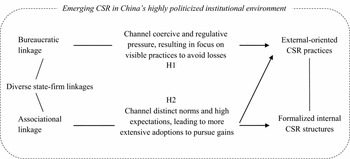
Summarizing our discussions above, Figure 2 presents our theoretical model to highlight these two types of institutional linkages and their differential impacts on firms’ CSR practices in China's institutional and political environment. In short, we argue that bureaucratic linkages and associational linkages capture two different types of state-firm relationships in China and filter distinct institutional pressures and social expectations. Thus, they shape firms’ interpretations of the state's demand on CSR as threats or opportunities and lead to different CSR practices. While those firms with stronger bureaucratic linkages tend to focus narrowly on external-oriented philanthropic activities, those with stronger associational linkages are likely to undertake more extensive adoptions by not only actively performing external CSR practices, but also developing internal CSR structures.
Diverse state-firm linkages and heterogeneous organizational practices

METHOD
Data
Our data were collected from a nationwide survey of industrial enterprises in China in 2006. The survey was conducted by the National Bureau of Statistics of China (NBS) in twelve medium-sized and large cities from different geographical areas (i.e., coastal, central, and western regions) in China. Within each city, NBS adopted a stratified sampling method based on firm ownership (state-owned enterprises, private firms, and foreign firms) to ensure sample representativeness. For sampled firms, NBS administered a questionnaire to inquire on firms’ CSR practices. Respondents of firms were top executives (i.e., owner or CEO, finance manager, production manager, sales manager, or human resources manager). Because NBS is the authoritative government agency in charge of data collection and official statistics, its survey received better cooperation from firms and generated more reliable data. Moreover, to complement the questionnaire data, additional and sensitive firm information (e.g., finance, tax, asset, and employment) were obtained from local government agencies. A rigorous sampling method, NBS's credential, and multiple sources in data collection all enhanced the data quality. The data set contained 1,268 firms. While some observations have missing values on our key variables, our checks for nonresponse bias (Armstrong & Overton, Reference Armstrong and Overton1977) indicated no statistically significant differences between respondents and non-respondents regarding major firm characteristics. We thus excluded these cases with missing values and got a valid sample of 1,051 firms for the final statistical analyses.
This data set is appropriate for testing our hypotheses for several reasons. First, the questionnaire contains solid information on both external-oriented CSR practices and internal CSR structures of firms, which have rarely been examined simultaneously in the CSR literature. Such information also offers a good opportunity to examine the scale of extensiveness in CSR adoption, which is an important feature in practice variation (Ansari et al., Reference Ansari, Fiss and Zajac2010; Fiss et al., Reference Fiss, Kennedy and Davis2012; Kennedy & Fiss, Reference Kennedy and Fiss2009). Second, the data contain important information on firms’ diverse connections with governmental agencies and political associations, which are crucial to test our hypotheses. Finally, compared with some previous studies that used samples of listed firms (e.g., Wang & Qian, Reference Wang and Qian2011), this data set provides a more representative sample (nearly 96% of the firms in the sample were not listed, as shown in Table 2 below). In China, most listed firms are large state-owned enterprises (SOEs) and private firms, which often have superior organizational performance. Compared to these previous studies, our sample based on a national survey enables us to investigate the general patterns of CSR practices in China.
Dependent Variables
External-oriented CSR practices
As discussed above, in the early stage of CSR development in China, philanthropic activities are the most visible and widely recognized CSR practices. As such, it is easier to obtain comprehensive, comparable, and less ambiguous information on philanthropy, which has been the research focus in the Chinese CSR literature (e.g., Jia & Zhang, Reference Jia and Zhang2013; Ma & Parish, Reference Ma and Parish2006; Wang & Qian, Reference Wang and Qian2011; Zhang & Luo, Reference Zhang and Luo2013). For these reasons, to examine the external-oriented CSR practices of each firm, we focused on three major indicators of philanthropic activities that have attracted particular attention in China (Xu & Yang, Reference Xu and Yang2009): (1) Donation: whether the firm has donated to philanthropic organizations, charities, or made other charitable contributions in the past three years; (2) Community welfare activity: whether the firm has sponsored or co-sponsored community welfare activities or public service activities in the past three years; and (3) Philanthropic project: whether the firm participated in philanthropic projects, such as programs supporting the education or helping the poor (e.g., ‘Guangcai Project’). We coded each dimension as a binary variable (yes=1).
Formalized internal CSR structures
To measure the formalized internal structures for CSR, we used three indicators that have been emphasized in prior research (e.g., Aguinis & Glavas, Reference Aguinis and Glavas2013; Greening & Gray, Reference Greening and Gray1994; Lounsbury, Reference Lounsbury2001): staffing for CSR, CSR implementation arrangement, and incorporation of CSR into strategic planning. In the survey, respondents indicated whether they completed these structural developments in their firms. We used a binary coding for each variable (yes=1). Staffing for CSR indicates a firm's commitment of resources and positional development to support CSR activities (Greening & Gray, Reference Greening and Gray1994; Lounsbury, Reference Lounsbury2001). Having an implementation arrangement shows that a firm has designed operation plans and procedures for CSR practices, and they are often integrated into the firm's daily operations and routines (Aguinis & Glavas, Reference Aguinis and Glavas2013). Incorporation of CSR into strategic planning suggests that the firm has taken CSR as an important part of a firm's overall strategy and long-term plan (Aguinis & Glavas, Reference Aguinis and Glavas2013; Carroll & Hoy, Reference Carroll and Hoy1984; Greening & Gray, Reference Greening and Gray1994).
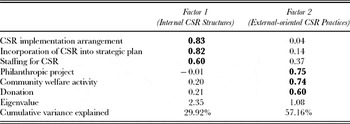
To further validate our categorization of these six CSR practices into external and internal dimensions, we performed a factor analysis. As shown in Table 1, the results indicated a clear two-factor structure of these six practices. Based on these results, we further constructed two composite measures of the overall adoption of external-oriented CSR practices and of internal CSR structures, respectively, as our main dependent variables. First, we aggregated the original values for three indicators of external-oriented CSR practices (ranging from 0 to 3) and those for three indicators of internal CSR structures (ranging from 0 to 3) to measure the overall adoption in these two dimensions. Second, we employed the corresponding factor scores (standardized score computed based on the Bartlett method) to aggregate the values in each dimension. This alternative construction of composite measures generated two continuous variables to indicate the overall adoption of external CSR practices and of internal CSR structures, respectively.
Rotated factor solution for CSR elements

Notes. N=1051
Extraction Method: Principal Component Analysis.
Rotation Method: Varimax with Kaiser Normalization.
Independent Variables
Bureaucratic linkages
Following our theoretical discussions, we used two variables to capture firm's bureaucratic linkages in China: the level of government inspection and scrutiny and a firm's property right of ownership. Intensity of government inspection and scrutiny indicates the extent to which a firm is under the government's direct bureaucratic control, monitor, and regulation. Following Estrin & Prevezer (Reference Estrin and Prevezer2011), the level of government's inspection and scrutiny is measured by how frequently government officials inspected a firm. This variable has an ordinal coding, ranging from 1 (‘very rarely’) to 5 (‘very frequently’). For a firm's property right of ownership, we classify firms into three major categories, SOEs, private firms, and foreign firms (including wholly-foreign owned firms and Sino-foreign joint ventures). Generally speaking, SOEs are closest to the state authority and bureaucratic government, while foreign firms are most remote from administrative fiats and regulatory influence (Zhou, Zhao, Li, & Cai, Reference Zhou, Zhao, Li and Cai2003). Foreign firms are used as the referent category in statistical analyses.
Associational linkages
We used firms’ institutional connections to two kinds of political or semi-political associations to measure their associational linkages. First, following the extant studies (e.g., Li et al., Reference Li, Meng, Wang and Zhou2008; Marquis & Qian, Reference Marquis and Qian2014; Wang & Qian, Reference Wang and Qian2011), we use the firm's top manager's affiliation with the state's political councils as an important indicator of associational linkage. The survey asked whether the firm's owner or CEO served as a representative in the CPC or CPPCC at the national, provincial, city or county/urban district levels. Both of these two political councils can bring political connections and status to their members (Ma & Parish, Reference Ma and Parish2006). This variable has a binary coding (yes=1). Our second measure of associational linkage is based on whether a firm was a member of an industry association (yes=1). In China, the industry association has important political functions and serves as an important communication channel to bridge firms and the state (Deng & Kennedy, Reference Deng and Kennedy2010; Dickson, Reference Dickson2003, Reference Dickson2008; Jia, Reference Jia2014).
Control Variables
To rigorously test our hypotheses regarding the effects of institutional linkages on CSR adoptions, we controlled for a set of organizational characteristics that may affect a firm's CSR orientations and/or practices (see Aguinis & Glavas, Reference Aguinis and Glavas2012 for a review). Prior research has demonstrated that a firm's financial performance and resources (e.g., profitability) and its visibility in the public sphere can positively affect its CSR activities (e.g., Chiu & Sharfman, Reference Chiu and Sharfman2011; Johnson & Greening, Reference Johnson and Greening1999). Accordingly, we controlled for firm profitability measured by return on assets (ROA), which was calculated as net income over total assets, a common measure of financial performance. We also included firm size (natural logged number of employees), firm age (natural logged number of years), listed firm (yes=1) and advertising intensity, which help to capture the visibility and identity of a firm. Among them, large firms are more visible and also have more resources, which can lead to better CSR performance (e.g., Brammer & Millington, Reference Brammer and Millington2006). Old firms founded in earlier periods may hold different attitudes toward emerging CSR because of their distinct identity and organizational inertia (Marquis & Lee, Reference Marquis and Lee2013). Listed firms have a higher market status and are more visible in the business world (Okhmatovskiy & David, Reference Okhmatovskiy and David2012). As they are under closer scrutiny of consumers, they should care more about their public reputation and thus be more sensitive to public pressure on CSR. In a similar vein, we also controlled for advertising intensity (calculated as the ratio of total expenses on advertising and marketing to sales in the past three years), which can affect a firm's visibility and their sensitivity to CSR demand (McWilliams & Siegel, Reference McWilliams and Siegel2001; Zhang, Zhu, Yue, & Zhu, Reference Zhang, Zhu, Yue and Zhu2010). Firms gaining public attention from advertising should also face a higher CSR pressure (Chiu & Sharfman, Reference Chiu and Sharfman2011). Meanwhile, since advertising-intensive firms likely come from consumer-oriented industries, they should have stronger economic incentives to invest in CSR to appeal to consumers (Tilcsik & Marquis, Reference Tilcsik and Marquis2013). Considering the industrial context, the external pressure on CSR can also be associated with the level of market competition, as intense competition can affect both firm profitability and its potential gains from CSR (Campbell, Reference Campbell2007), which provides greater incentives for a firm to engage in CSR practices in order to establish a good public image and earn consumer support. We measured the level of market competition for a firm's major products, which was rated by the respondent along an ordinal coding (1=‘low’, 2=‘moderate’, 3=‘fierce’).
We further controlled for several factors that may shape intra-organizational processes and organizational orientations toward CSR. Because CEO holds a central position in a firm's decision-making process, his/her stance toward CSR is a key factor to affect a firm's CSR engagement and strategy (Chin, Hambrick, & Treviño, Reference Chin, Hambrick and Treviño2013; Marquis & Lee, Reference Marquis and Lee2013; Waldman, Siegel, & Javidan, Reference Waldman, Siegel and Javidan2006). As the CEO's knowledge and view of CSR are influenced by education, we controlled for CEO's educational background, which was coded as an ordinal variable ranging from 1 to 5 (1=‘middle school and below’, 2=‘high school’, 3=‘college’, 4=‘a master's degree’, 5=‘a doctoral degree’). Similarly, employees’ educational background may also affect a firm's CSR orientation. Therefore, we controlled for employees’ education level, ranked by percentage of employees with a college-level education (1=‘0~20%’, 2=‘20~40%’, 3=‘40~60%’, 4=‘60% and above’). In addition, as labor unions are sensitive to the welfare of employees and the general public, they can play an active role in CSR adoption (McWilliams & Siegel, Reference McWilliams and Siegel2001). Thus, we also controlled for the presence of labor union in a firm (having a labor union=1).
Finally, we controlled for a firm's geographic location and the broad market environment, which can impose various external pressures on CSR and also influence firm behaviors. As the Chinese state has adopted different strategies to develop markets in various regions in accordance with its political agenda, governments’ influence on economic and corporate activities can differ across regions (Tian, Reference Tian1999; Tsui, Reference Tsui1996; Walder, Reference Walder1995). In our model, we created a set of dummy variables for regions (coastal, central, and western China), with the western region as the reference category. In addition, we controlled for the level of market development, which varies across provinces even within the same geographic region. Different levels of market development can affect the local government's administrative power and can also influence firm practices and political orientations (Wang & Qian, Reference Wang and Qian2011). We assessed market development using indices developed by the National Economic Research Institute (NERI). These indices capture the progress of institutional development in all 31 Chinese provinces, municipalities, and autonomous regions (Fan, Wang, & Zhu, Reference Fan, Wang and Zhu2007) and have been widely used in management studies (Li & Qian, Reference Li and Qian2013; Shi, Sun, & Peng, Reference Shi, Sun and Peng2012; Wang & Qian, Reference Wang and Qian2011).
Models
Our main dependent variables are the composite measures of the overall adoption of external CSR practices and of internal CSR structures, respectively. When the composite measures are two ordinal variables (ranging from 0 to 3) based on the aggregation of the original individual score in each dimension, we employed a bivariate ordered probit model to estimate these two dependent variables, which allows error terms to be correlated across equations. When the composite measures based on the factor scores are two continuous dependent variables, we use the seemingly unrelated regression to account for the cross-equation error correlations (Zellner, Reference Zellner1962). In these models, we used Huber-White's robust standard errors to correct for non-spherical disturbances.
RESULTS
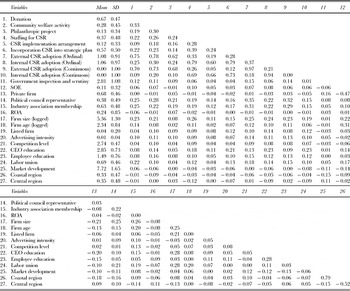
We report descriptive statistics and correlations of the dependent, independent, and control variables in Table 2. Among the three external-oriented CSR practices in philanthropy, most firms have made donations (67%). In contrast, engaging in community welfare activities (28%) and joining philanthropic projects (13%) are much less prevalent. Compared with more recent development of community welfare activities and philanthropic projects, donation remains the far more visible and popular CSR practice in China. Among the three indicators of CSR structural development, interestingly a large proportion of firms have incorporated CSR into their strategic plan (57%), which seems to be much easier than developing the other two internal structures requiring more resources and substantial actions. By comparison, about 37% of firms have established special staffing for CSR, while only 12% have made specific CSR implementation arrangements. There are also considerable variations in the overall adoption of external CSR practices and of internal CSR structures. All these provide a good opportunity to examine the underlying sources of heterogeneous organizational practices.
Descriptive statistics and correlations

Notes: N=1051. Correlations greater than or equal to 0.06 are significant at p < 0.05.
There is also a considerable variation for each of independent variables. For the measures of bureaucratic linkages, intensity of government inspection and scrutiny indicating the level of bureaucratic control has a mean of 2.81 and a noticeable variation of 1.08 (on a scale of 1 to 5). In terms of property rights of ownership, our sample consists of 11% of SOEs, 68% private firms, and 21% foreign firms. As for the indicators of associational linkages, 38% of firms’ owners or CEOs were representatives of political councils at different levels, and 63% of firms were members of industry association. Notably, government inspection and scrutiny have a significantly positive correlation with only external-oriented CSR practices in philanthropy (i.e., donation, community welfare activity, and philanthropic project), while the correlation patterns between those two types of domestic firms (SOEs and private firms) and CSR practices are not very clear. By comparison, political council representative and industry association membership have stronger positive correlations with not only external CSR practices but also internal CSR structures. Except for organizational ownership, the general patterns are consistent with our predictions in the two hypotheses.
Among control variables, firm size, firm age, listed firm, advertising intensity, competition level, CEO education, employee education, labor union, and market development all show significant correlations with CSR practices, which justify our incorporation of these variables for control purposes. To check multicollinearity between independent and control variables, we examined the Variance Inflation Factor (VIF) in the model. The maximum VIF is 4.59 and the mean VIF is 1.59, substantially below the rule-of-thumb cutoff of 10, which indicates no serious multicollinearity concern for the data (Greene, Reference Greene2011).
Analysis of the Overall Adoption of External CSR Practices and Internal CSR Structures
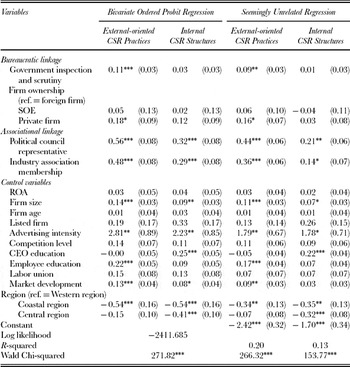
As we constructed the composite measures of the overall adoption of external CSR practices and of internal CSR structures in two alternative ways as our dependent variables, we used two different sets of models to conduct statistical analyses and report the results in Table 3.
Bivariate ordered Probit and SUR Model Estimates of overall CSR adoptions

Notes: N=1051. *p <0.05; **p <0.01; ***p <0.001. Standard errors are in parentheses.
When the composite measures of external-oriented CSR practices and of internal CSR structures are ordinal variables based on the aggregation of individual scores on three practices in each dimension, we used the bivariate ordered probit model for estimation, which allows these two models to correlate with each other. The results in the left panel of Table 3 show that among the measures of bureaucratic linkages, the level of government inspection and scrutiny exerts a highly significant effect on the overall adoption of external-oriented CSR practices in philanthropy (b=0.11, p < 0.001), yet they show no effect on the adoption of internal CSR structures. As for the firm ownership, compared with foreign firms (as the reference group), SOEs do not show any significant difference in CSR practices. In contrast, private firms are significantly more likely to adopt external-oriented CSR practices (b=0.18, p < 0.05), while they have no discernible significance in internal CSR structures. While SOEs stay closer with the state, they face higher pressure from the state; yet, at the same time, they also receive considerable support and have better communication channels with the bureaucratic state, which helps to provide some buffer to state pressure. By comparison, private firms feel a higher pressure from the state than foreign firms, yet receive less state support than SOEs. Therefore, private firms in particular are more likely to engage in the external-oriented CSR practices to gain legitimacy. Overall, these findings suggest that those firms having a stronger bureaucratic linkage tend to take a limited adoption strategy and only engage in the ‘peripheral CSR’ (Aguinis & Glavas, Reference Aguinis and Glavas2013). While they focus on more visible external-oriented philanthropic activities, they do not pay any particular attention to developing formalized internal CSR structure. These results render considerable support to Hypothesis 1.
In contrast, associational linkages show different patterns. They have more systematic effects on not only external-oriented philanthropic activities, but also internal CSR structures. As shown in Table 3, both political council representative and industry association membership, as two indicators of associational linkages, have a significant effect on the overall adoption of external-oriented CSR practices (b=0.56 and 0.48, p < 0.001). Compared with the effects of bureaucratic linkages, the positive effects of associational linkages on external-oriented CSR practices are stronger—they are more systematic, reach a higher significance level (both at p < 0.001 level), and also have larger coefficients (e.g., compared with the coefficient on private firm). These results suggest that firms with an associational linkage strive to achieve a higher level of performance in external-oriented CSR. The most striking difference between the effects of bureaucratic and associational linkages is in predicting internal CSR structures. While bureaucratic linkages have no discernible effects on internal CSR structures at all, two associational linkages have systematic and highly significant effects on internal CSR structures (b=0.32 and 0.29, p < 0.001). These results provide strong support to Hypothesis 2. That is, firms having an associational linkage with the state are more likely to take more extensive adoptions in the emerging CSR field. Specifically, they take the more extensive and ‘embedded CSR’ approach (Aguinis & Glavas, Reference Aguinis and Glavas2013) featuring not only a high-level performance of external-oriented CSR practices but also formalized internal CSR structures.
When we used the factor score as the alternative way to construct composite measures of the overall adoption of external CSR practices and of internal CSR structures, the two dependent variables are continuous variables. Accordingly, we used the seemingly unrelated regression models to conduct the analyses. As displayed in the right panel of Table 3, the results show a similar pattern to those based on the bivariate ordered probit model (the left panel). That is, bureaucratic linkages exert significant effects only on the overall adoption of external-oriented CSR practices, but have no effects on the overall adoption of internal CSR structures. In contrast, associational linkages exert strong and systematic effects on the overall adoption of both external CSR practices and internal CSR structures.
Overall, the two sets of analyses of the overall adoption of external CSR practices and of internal CSR structures in Table 3 yield highly consistent patterns, and these results provide strong support to our two hypotheses.
Robustness Check and Additional Analyses
To supplement our analysis of the overall adoption of external CSR practices and internal CSR structures, we also examined the adoption of six specific external and internal CSR elements. Results of the multivariate probit model predicting the adoption of each individual CSR element suggest a very similar pattern to the overall adoptions as shown in Table 3. That is, having a bureaucratic linkage largely enhances the chance to engage in three philanthropic activities (including donation, community welfare activity, and philanthropic project), but exerts no discernible effects on any of the three internal CSR structures. In contrast, an associational linkage exerts a systematic and significantly positive effect on adopting not only all three external CSR practices, but also all three structural elements, including staffing for CSR, setting up CSR implementation agenda, and incorporating CSR into strategic planning. This set of analysis further corroborates our main results as shown in Table 3.
We have also argued that different from bureaucratic linkages, associational linkages facilitate CSR adoptions partly by enhancing a firm's organizational learning and better understanding of CSR. We have further contended that firms with an associational linkage tend to perceive the emerging CSR as an opportunity and like to take the lead in CSR development to distinguish themselves from peers. We got auxiliary support to these arguments by testing a set of correlations. Additional analyses show the two forms of associational linkages are both positively related to firm's knowledge of CSR (i.e., whether senior managers have heard and known CSR and any international standard of CSR). In addition, firms with two types of associational linkages are also more likely to acquire certifications in the field of CSR (e.g., Social Accountability 8000, SA8000). In contrast, there is no significant correlation between bureaucratic inspection and either CSR knowledge or CSR certification. Interestingly, private firms actually know less about CSR and they are also less likely to obtain CSR certifications, which further suggests their higher level of philanthropic activities than foreign firms (see Table 3) are mainly driven by the coercive pressure. These findings supplement our main results and render additional support to our arguments and proposed mechanisms in CSR adoptions.
Prior research also suggested the positive effect of active corporate philanthropy on CEO's political status (e.g., Ma & Parish, Reference Ma and Parish2006), which raises the possibility of reverse causality in our argument. That is, active CSR adoptions and particularly engaging in visible philanthropic activities may help establish a firm's associational linkages, such as through acquiring the status of political council representative. But we believe this should not pose a serious concern in our study. While the election of political council representatives takes place every five years in China, the most relevant election recorded in our data occurred around 2003, which was far before the survey year (2006). Thus, the time when those CEOs obtained their political status should precede the firm's most recent philanthropic activities in the past three years as inquired in the survey, which helps to mitigate the concern about potential reverse causality.
DISCUSSION
In this study we develop a ‘relational complexity’ argument to shift our attention to the relational dynamics between organizations and institutional authority as another key source of practice variation, which has received insufficient attention in the literature (Raffaelli & Glynn, Reference Raffaelli and Glynn2014). We contend that organizational relations with even the same institutional authority (e.g., the state) can be complex and diverse (Edelman, Reference Edelman1992; Powell, Reference Powell, Powell and DiMaggio1991; Scott, Reference Scott2014), which filter distinct institutional pressures and channel various social expectations. They can shape organizational interpretations of environmental demands as threats or opportunities and trigger heterogeneous organizational responses.
We draw empirical evidence from the emerging CSR field in China. In China's highly politicized environment, we distinguish two distinct types of state-firm relations – bureaucratic linkage and associational linkage – and highlight their different implications in shaping organizations’ CSR practices (see Figure 2). Specifically, firms with a strong connection with the bureaucratic state and government agencies tend to perceive the CSR demand as threats, and they strive to avoid state sanctions and potential losses. In contrast, those firms forming a close partnership with the state through valuable associational connections tend to perceive the emerging CSR issue as opportunities for social and economic gains and thus take more extensive adoptions. They not only perform a higher level of external-oriented philanthropic activities, but also take the lead in developing sophisticated internal CSR structures, such as CSR staffing, implementation arrangements, and incorporation of CSR in the strategic plan.
Theoretical Contributions
The arguments and findings in this study make important theoretical contributions to the related literatures. First of all, this study expands the extant literature on practice variation by shifting our attention toward relational dynamics connecting organizations and institutional authority, which differs from the research focusing on field characteristics in the ‘institutional complexity’ approach. The ‘institutional complexity’ approach emphasizes the coexistence of multiple field-level authorities and competing logics in driving various organizational responses. Only recently did scholars start to pay attention to how institutional pressures pass through the field and are felt differently by organizations, and only ‘scattered and largely suggestive’ empirical work has focused on organizational attributes (e.g., organizational structure, governance, identity) in the filtering process (Greenwood et al., Reference Greenwood, Raynard, Kodeih, Micelotta and Lounsbury2011: 339). Our relational approach takes a further step to contend that institutional pressures are also filtered by diverse organizational linkages as the key nexus to bridge organizations and field-level authorities. From this perspective, diverse relations with the same institutional authority (e.g., the state) can trigger different organizational practices, as shown in our empirical study.
At the same time, this ‘relational complexity’ approach also advances our understanding of the role of organizational connections in institutional analyses of practice adoption and diffusion. While the extant literature has highlighted organizational connections with institutional authority as the key channel to facilitate organizational adoption and conformity (e.g., Baum & Oliver, Reference Baum and Oliver1991; Sutton & Dobbin, Reference Sutton and Dobbin1996), it has not systematically examined how various types of connections lead to heterogeneous organizational responses and practice variation (Raffaelli & Glynn, Reference Raffaelli and Glynn2014). In this study, we argue that diverse institutional linkages channel different institutional pressures and prompt different mechanisms in the diffusion process (Dobbin et al., Reference Dobbin, Simmons and Garrett2007; Weber et al., Reference Weber, Davis and Lounsbury2009), which shape organizational interpretations of the environmental demand and trigger heterogeneous organizational responses. This relational approach thus reveals the importance of scrutinizing relational complexity and diversity to understanding the variation in practice diffusion and adoption (Ansari et al., Reference Ansari, Fiss and Zajac2010; Fiss et al., Reference Fiss, Kennedy and Davis2012; Lounsbury, Reference Lounsbury2008; Raffaelli & Glynn, Reference Raffaelli and Glynn2014). In China's intriguing institutional context, our study distinguishes two types of political relations with the state and highlights their differential impacts on CSR adoptions. While the state-business relationships have received insufficient attention in the literature (Powell, Reference Powell, Powell and DiMaggio1991), our study sheds light on the key role of political relations in affecting organizational responses. It also reveals the specific and complex ways organizations are embedded in the political environment, which enriches the political embeddedness argument (Dacin et al., Reference Dacin, Ventresca and Beal1999; Zukin & DiMaggio, Reference Zukin, DiMaggio, Zukin and DiMaggio1990).
Future Research Directions
In addition to these specific theoretical contributions, our relational approach also points to new research directions and offers promising opportunities to integrate different theoretical perspectives, which can improve explanations of heterogeneous organizational practices. In particular, this relational approach complements and thus should be integrated with the ‘institutional complexity’ approach to explain practice variation. While our study has focused on political relations with the dominant institutional authority (i.e., the state) in China's context, it is important to further extend the research scope to examine complex organizational relations with other field-level actors. In this light, it is important to investigate an organization's ‘relational setting’ (Raffaelli & Glynn, Reference Raffaelli and Glynn2014) and scrutinize different types of organizational connections with multiple field-level actors simultaneously. This will help achieve a thorough understanding of how organizations respond to external pressures through a whole set of connections in a complex institutional environment.
Meanwhile, as this relational approach highlights the nexus linking institutional authority and organizations, it also offers new opportunities to bridge field-level analysis with research on organizational-level processes, which echoes important calls on integrating the macro-micro level analyses and also the institutional and strategic approaches (Kennedy & Fiss, Reference Kennedy and Fiss2009). In particular, recent research has drawn on insights from studies of organizational categorization of environmental demands as threats and opportunities (e.g., Dutton & Jackson, Reference Dutton and Jackson1987; George et al., Reference George, Chattopadhyay, Sitkin and Barden2006) to stress various organizational framing as a key factor to motivate different organizational responses (Kennedy & Fiss, Reference Kennedy and Fiss2009). Building on these recent studies, we further argue that institutional linkages can be one major source of organizations’ distinct interpretations of environmental demand and of different motivations in responding to institutional pressures. In this light, distinct linkages between organizations and field-level actors are the key nexus to channel institutional pressures and social expectations into firms, influence organizational processes (e.g., perception and interpretation, sense-making, and decision-making), and lead to diverse strategic responses (Oliver, Reference Oliver1991; Sharma, Reference Sharma2000). From this perspective, this relational approach will facilitate the dialogue and integration between macro- and micro-analyses of organizational behaviors. It can also help establish the micro foundation of institutional processes, which is badly needed in institutional analyses (George et al., Reference George, Chattopadhyay, Sitkin and Barden2006; Hoffman, Reference Hoffman2001; Thornton et al., Reference Thornton, Ocasio and Lounsbury2012).
This study also shows that different institutional linkages play a key role in determining firms’ strategic choices of focusing on external-oriented philanthropic activities or taking an extensive adoption approach to further develop internal CSR structures. This finding expands the extant literature on CSR in China focusing on philanthropic activities and also enriches recent inquiries on different CSR strategies (e.g., Aguinis & Glavas, Reference Aguinis and Glavas2013). Meanwhile, as there has been increasing interest in global diffusion of CSR (Lim & Tsutsui, Reference Lim and Tsutsui2012) and its broad implications (den Hond et al., Reference den Hond, Rehbein, de Bakker and Lankveld2014; Hadani & Coombes, Reference Hadani and Coombes2015; Rehbein & Schuler, Reference Rehbein and Schuler2015), our findings of different CSR strategies in China calls on examining specific institutional and political environments to appreciate the local development and characteristics of CSR practices in emerging economies as well as in developed countries.
We also acknowledge the limitations of our study and call on more refined research design and data collection in future studies. First, while our study contributes to the literature by simultaneously assessing both external and internal CSR activities, the measures of various CSR practices can be further expanded and refined in future studies. Second, measures that can better capture the complexity of institutional linkages in the real world should be further developed and enriched. Third, the absence of managerial-level perceptual data is a big limitation in our empirical inquiry. We call on incorporating such data and additional qualitative evidence in future studies, which will show how organizations actually interpret and frame institutional situations and environmental demands. Finally, we acknowledge the limitation of cross-sectional data used in our study, which makes it difficult to develop causal arguments. While we have made great effort to identify the causes and mechanisms in CSR adoptions in an emerging field in China, we call on collecting longitudinal data to establish more solid causal relationships in future studies.
Practical Implications
Our empirical findings on different CSR strategies also have practical implications. Because the relationship between CSR and a firm's financial performance is often ambiguous, there has been a debate on whether CSR is a cost or an investment and what is the firm's best strategic choice (Devinney, Reference Devinney2009; Lev et al., Reference Lev, Petrovits and Radhakrishnan2010; Porter & Kramer, 2006; Wang, Choi, & Li, Reference Wang, Choi and Li2008). Our findings suggest a contingent approach. That is, managers should examine an organization's particular position and specific needs, including its specific relationship and connection with the state and other institutional authorities, to choose an appropriate CSR strategy. If a firm aims to avoid potential losses under the state's coercive or regulative pressure, it can be a wise choice to take limited adoptions by engaging in more visible CSR practices to meet the basic institutional demand. Nevertheless, for those firms holding a high-status position, they can employ CSRs in a more extensive and sophisticated manner to pursue social, economic, and political gains. While our study focuses on CSR issues, such a contingent view based on a firm's position and its connections with the institutional authorities may also be applicable to other areas or issues, which can deepen our understanding of corporate strategic responses to meet the institutional demand (Oliver, Reference Oliver1991).
While this study is situated in China's institutional environment, its theoretical arguments as well as practical implications have great potentials to be generalized to other contexts. In various institutional contexts, organizational connections with institutional authorities should be critical to understanding firm heterogeneous responses to institutional pressures. As mentioned earlier, the categorization of bureaucratic (e.g., regulative) and cooperative (e.g., contractual) relations between the state and firms is also valid in the Western context (Campbell & Lindberg, Reference Campbell and Lindberg1990; Edelman, Reference Edelman1992). Therefore, in Western countries and other emerging economies, it would be important to adopt this ‘relational complexity’ approach to scrutinize various institutional links, including diverse state-firm relations, to better understand organizations’ heterogeneous responses to institutional demand.
CONCLUSION
To conclude, by developing a ‘relational complexity’ argument, our study sheds light on distinct natures of diverse relationships between organizations and institutional authority and also on their important implications in shaping heterogeneous organizational responses. This relational approach enriches our understanding of institutional and strategic analyses of practice variation across organizations. While our empirical study in China's emerging CSR field has provided strong support to our theoretical framework, we hope future studies on diverse linkages with other field-level authorities and in various institutional contexts will further demonstrate this approach as a fruitful avenue for academic endeavor.