In this study, an examination was made of the cognitive decision-making processes relating to the occupations or careers (hereafter ‘occupations’) of gifted and talented adolescents. Scholars have not traditionally examined the occupation or related decisions of adolescents in terms of the cognitive decision-making processes that lead to intentions or non-intentions to pursue particular occupations. Moreover, there has not been a strong or particular focus on gifted and talented adolescents. Gagné (Reference Gagné2004) defines giftedness as the possession of abilities that would place an individual within the top 10% of age peers, and talent as the demonstration of achievement at levels that would place an individual within the top 10% of age peers. A study of the cognitive decision-making processes relating to occupations is noteworthy as it goes beyond the study of individual predictors of the decision, by also investigating the relationships between these predictors and the ordering of these predictors in arriving at occupational intentions or non-intentions. Of all the adolescent groups, those who are gifted and talented may be a particularly important group for focus, as they may have the greatest potential to contribute to, and advance, the various occupational fields; and relatedly, have the greatest impact on the lives of others.
A clearer understanding of how specifically gifted and talented adolescents may go about making decisions related to their future occupations may mean that they may be better assisted to make decisions that fully utilise their potential. Some possible benefits of this outcome may include increases to their personal happiness and satisfaction, increases to workforce productivity, increases to national income, and a greater number of youth pursuing occupations in economically important areas that are experiencing difficulty in attracting talented candidates (Sikora & Saha, Reference Sikora and Saha2011).
The particular focus of this study was on the cognitive decision-making processes that lead to occupational indecision. Generally, occupational indecision, which may be defined as the inability to reach a decision about one's future occupation (Santos, Ferreira, & Gonçalves, Reference Santos, Ferreira and Gonçalves2014), appears to be a common experience that forms part of a developmental phase as adolescents consider their futures (Chen & Wong, Reference Chen and Wong2013; Creed, Patton, & Prideaux, Reference Creed, Patton and Prideaux2006). A distinction exists between occupational indecision and occupational indecisiveness, which refers to an enduring or chronic state of indecision about one's future occupation (Di Fabio, Palazzeschi, Asulin-Peretz, & Gati, Reference Di Fabio, Palazzeschi, Asulin-Peretz and Gati2013; Santos et al., Reference Santos, Ferreira and Gonçalves2014). Although substantial research exists on the predictors of occupational indecision (e.g., a lack of readiness, negative affect, choice/commitment anxiety, interpersonal conflicts, a lack of information, and uncertainty about outcomes), it has nevertheless been described as an ‘atheoretical’ construct that remains poorly understood (Di Fabio et al., Reference Di Fabio, Palazzeschi, Asulin-Peretz and Gati2013; Tinsley, Reference Tinsley1992). In recent times, any occupational decisions that are formed after the experience of occupational indecision appear unlikely to be time definite or lead to conclusive outcomes. Moreover, it may be unrealistic to expect an adolescent to spend, or be guaranteed, their entire working life in one occupation with only one employer (Reitzle, Körner, & Vondracek, Reference Reitzle, Körner and Vondracek2009).
The specific constructs that were investigated in the study include: (a) two constructs that have been repeatedly acknowledged in the gifted education literature as potentially leading to occupational indecision for gifted and talented adolescents (i.e., multipotentiality and perfectionism); (b) occupational amotivation, which is derived from a theory of motivation (i.e., self-determination theory) and has been shown to be strongly related to occupational indecision (Jung & McCormick, Reference Jung and McCormick2010, Reference Jung and McCormick2011b); and (c) cultural orientation constructs (i.e., idiocentrism-future and allocentrism-family) that may increase the relevance of the study to gifted and talented adolescents from diverse and multicultural backgrounds.
Review of the Literature
Multipotentiality
Multipotentiality is a phenomenon that has appeared over 100 times in the literature on gifted education since the early 20th century (Jung, Reference Jung2013; Rysiew, Shore, & Carson, Reference Rysiew, Shore and Carson1994; Sajjadi, Rejskind, & Shore, Reference Sajjadi, Rejskind and Shore2001). It has been defined inconsistently, with a number of scholars referring to it as a multitude of abilities, some describing it as a multitude of interests, and others incorporating a combination of abilities, interests, opportunities, and motivation. Arguably, the most frequently noted definition considers it to be a combination of multiple abilities and interests (Rysiew et al., Reference Rysiew, Shore and Carson1994; Rysiew, Shore, & Leeb, Reference Rysiew, Shore and Leeb1999). The reason why multipotentiality has been investigated so frequently may be related to the perception that it is a major characteristic of gifted and talented individuals (Gross, Reference Gross2006; Rysiew et al., Reference Rysiew, Shore and Leeb1999), and the competitive demands of the market economy, which assumes that people with multipotentiality may provide a better match to work demands (Reilly, Reference Reilly2001).
Multipotentialty has often been associated with the difficulties in making occupational decisions (Maxwell, Reference Maxwell2007; Rysiew et al., Reference Rysiew, Shore and Carson1994, Reference Rysiew, Shore and Leeb1999; Sajjadi et al., Reference Sajjadi, Rejskind and Shore2001). Indeed, a number of definitions of multipotentiality make reference to career decision-making difficulties. For example, Delisle and Squires (Reference Delisle and Squires1989, p. 98) defined it as ‘the interests and abilities to succeed in so many vocational areas that choosing one career path becomes problematic’. Some multipotential adolescents appear to be fearful of making the wrong choice from the wide range of options (Achter, Lubinski, & Benbow, Reference Achter, Lubinski and Benbow1996), while others experience problems in the identification of a single occupation that provides a satisfactory outlet for all of their areas of ability and interest (Rysiew et al., Reference Rysiew, Shore and Leeb1999). Consequently, multipotentiality may lead to delays in occupational decision making, frequent changes in the area of study, or the making of premature occupational decisions (Greene, Reference Greene2006).
In comparison to the field of gifted education, considerably less attention has been devoted to multipotentiality in vocational guidance and related fields. Nevertheless, some similarities appear to exist between the interest dimension of multipotentiality and having an undifferentiated profile in Holland's (Reference Holland1985) vocational themes (Rysiew et al., Reference Rysiew, Shore and Leeb1999). Indeed, Achter et al. (Reference Achter, Lubinski and Benbow1996) equated multipotentiality to having a ‘high flat’ ability-interest profile, whereby an individual was considered to be multipotential if he/she had comparable scores on the mathematics and verbal domains of the College Board Scholastic Aptitude Test (SAT) and the six Holland vocational interest themes. Although the identified frequency of multipotentiality among gifted and talented adolescents in Achter et al. (Reference Achter, Lubinski and Benbow1996) was below expectations, this may be attributed to the ‘extreme’ form of multipotentiality (or equipotentiality; Gross, Reference Gross2006) that was being targeted. Questions are therefore raised as to whether a gifted and talented adolescent will qualify as being multipotential only if he/she has an undifferentiated profile in all six of Holland's vocational interest themes and has comparable levels of mathematical and verbal abilities. If multipotentiality is considered using less stringent criteria (e.g., comparable profiles within only a few of Holland's vocational themes or high scores on a multipotentiality scale), it may be more useful in understanding the career decisions of gifted and talented adolescents.
Perfectionism
Like multipotentiality, perfectionism has traditionally been perceived to be a common characteristic of gifted and talented adolescents (Speirs Neumeister, Reference Speirs Neumeister2004). Historically, perfectionism was viewed largely in negative terms, with associations to the pursuit of unrealistically high goals, a destructive and compulsive mindset, a fear of failure, and procrastination (Chan, Reference Chan2011). However, today, most scholars appear to consider it to be a multidimensional construct that has positive and negative characteristics (Chan, Reference Chan2011; Flett & Hewitt, Reference Flett and Hewitt2014; Hawkins, Watt, & Sinclair, Reference Hawkins, Watt and Sinclair2006). Some of the factors that may lead to the development of perfectionism in adolescents may include high parental expectations, a physically or psychologically harsh upbringing, and a lack of early academic challenge (Speirs Neumeister, Williams, & Cross, Reference Speirs Neumeister, Williams and Cross2009).
Two of the most commonly used conceptualisations of perfectionism are those of Frost, Marten, Lahart, and Rosenblate (Reference Frost, Marten, Lahart and Rosenblate1990) and Hewitt and Flett (Reference Hewitt and Flett1991). Frost et al. (Reference Frost, Marten, Lahart and Rosenblate1990), who described perfectionism as arising when high standards are ‘accompanied by tendencies for overly critical evaluations of one's behavior’ (p. 450), proposed that perfectionism exists in six dimensions (concern about mistakes, doubts about actions, organisation, personal standards, parental expectations, and parental criticism) that appear to align with many of the frequently noted traits and behaviours of perfectionism (Hawkins et al., Reference Hawkins, Watt and Sinclair2006). Nevertheless, attempts at replication of the six factor structure have often been unsuccessful and have instead resulted in a factor structure that combines one or more of these dimensions (Cox, Enns, & Clara, Reference Cox, Enns and Clara2002; Flett & Hewitt, Reference Flett and Hewitt2014; Hawkins et al., Reference Hawkins, Watt and Sinclair2006). In contrast, Hewitt and Flett (Reference Hewitt and Flett1991) placed a focus on interpersonal relations by conceptualising perfectionism as existing in one of three forms: (a) self-oriented perfectionism (i.e., holding oneself to perfectionistic standards), (b) socially prescribed perfectionism (i.e., perceiving that others demand perfectionism), and (c) other-oriented perfectionism (i.e., holding others to perfectionistic standards). Confirmatory factor analysis has provided support for the three-factor structure (Cox et al., Reference Cox, Enns and Clara2002).
Motivation
In comparison to perfectionism, motivation appears to be a concept that is broader and with a greater range of conceptualisations. Of the various theories of motivation that exist in the literature, self-determination theory appears to be particularly relevant to the vocational decisions of individuals (Jung & McCormick, Reference Jung and McCormick2010, Reference Jung and McCormick2011a, Reference Jung and McCormick2011b; Jung, McCormick, Gregory, & Barnett, Reference Jung, McCormick, Gregory and Barnett2011; Schröder & Schmitt-Rodermund, Reference Schröder and Schmitt-Rodermund2013). One of the distinguishing features of the theory is that it recognises that motivation may exist in a number of different forms that differ from one another with respect to the reasons and goals that give rise to actions (Deci & Ryan, Reference Deci and Ryan1985; Ryan & Deci, Reference Ryan and Deci2000). Intrinsic motivation refers to motivation to engage in an activity for the inherently interesting, enjoyable, and satisfying aspects of the activity experience, while extrinsic motivation refers to the valuing of rewards that are separate to the activity experience, such as recognition from others and financial gain. Amotivation refers to non-motivation, or a state of lacking an intention to act. Amotivated individuals are unable to see any relationship between their behaviours and outcomes in specific contexts (Guay, Vallerand, & Blanchard, Reference Guay, Vallerand and Blanchard2000).
Generally, intrinsic motivation appears to be associated with a higher quality of experience and positive outcomes such as persistence and superior performance (Ryan & Deci, Reference Ryan and Deci2000), while amotivation appears to be associated with negative outcomes such as dropping-out behaviours, lower levels of performance, and states of depression (Cheon & Reeve, Reference Cheon and Reeve2015). It follows that in the context of the occupational decision, intrinsically motivated individuals are likely to persist in making an optimal decision, while those who are amotivated may show a reluctance to make the decision, delay the decision, or make a ‘low-quality’ decision. It is noteworthy that the various forms of motivation in self-determination theory appear to be generalisable across different cultural contexts (Hayamizu, Reference Hayamizu1997).
Culture
Culture appears to be a complex concept that has been defined in multiple ways in the literature. Fan's (Reference Fan2000) definition of culture as a ‘. . . collection of values, beliefs, behaviours, customs, and attitudes that distinguish a society’ (p. 3) nevertheless appears to capture the essence of many of the existing definitions. Hofstede (Reference Hofstede2001), whose classification system for culture is considered one of the most influential (Steenkamp & Geyskens, Reference Steenkamp and Geyskens2012), identified a number of dimensions of culture, including individualism/collectivism, power distance, masculinity/femininity, uncertainty avoidance, and long-term orientation/short-term orientation. Of these dimensions, individualism/collectivism may be particularly relevant to this study, due to its potential to acknowledge the degree to which the self and others may play a role in occupational decisions. Indeed, it appears to be one of the most extensively studied dimensions of culture today (Taras et al., Reference Taras, Sarala, Muchinsky, Kemmelmeier, Singelis, Avsec and Sinclair2014).
Essentially, individualism refers to the placement of importance on independence and autonomy, while collectivism refers to an emphasis on interdependence with others within their in-groups (Triandis, Reference Triandis1995). It follows that people in individualist cultures tend to display emotional detachment from in-groups, act according to their personal attitudes, and be willing to confront members of their in-groups with whom they disagree (Triandis, Reference Triandis1995; van Hoorn, Reference van Hoorn2015). In contrast, those from collectivist cultures tend to have strong emotional attachments to their in-groups, consider themselves to be a representative of their in-groups, and be concerned about the implications of their actions on others in their in-groups (Triandis, Reference Triandis1995; van Hoorn, Reference van Hoorn2015). It is noted that the terms individualism and collectivism refer to phenomena at the level of culture, and idiocentrism and allocentrism are the corresponding terms used at the level of the individual (Triandis, Reference Triandis1995). In this study, specific forms of idiocentrism and allocentrism were utilised that have been empirically identified as being relevant to the vocational decisions of adolescents (i.e., idiocentrism-future and allocentrism-family; Jung, Reference Jung2013; Jung & McCormick, Reference Jung and McCormick2011a; Jung et al., Reference Jung, McCormick, Gregory and Barnett2011).
Theoretical Framework
Two variations of one theoretical framework guided the study. Theoretical Framework 1 was, in essence, the theoretical framework that guided a preceding study on the cognitive processes associated with career indecision conducted with 687 gifted and talented adolescents, while Theoretical Framework 2 was the empirically modified and verified version of this theoretical framework (Jung, Reference Jung2013). The two variations of the theoretical framework were informed by the literature on the career decisions of gifted and talented adolescents, and cognitive process models that have been identified as being associated with the career indecision of adolescents in general (Jung & McCormick, Reference Jung and McCormick2010, Reference Jung and McCormick2011b). This study tested two variations of a model instead of one single model as part of a competing models strategy to avoid a possible confirmation bias that may exist when testing a single model in isolation, and to gain better insights into the comparative explanatory power of models (Diamantopoulos & Siguaw, Reference Diamantopoulos and Siguaw2000; Hair, Black, Babin, & Anderson, Reference Hair, Black, Babin and Anderson2010). Simultaneously, the study may be described as being confirmatory, as an attempt was made to assess the stability of models verified using an independent sample (Hair et al., Reference Hair, Black, Babin and Anderson2010).
Theoretical Framework 1
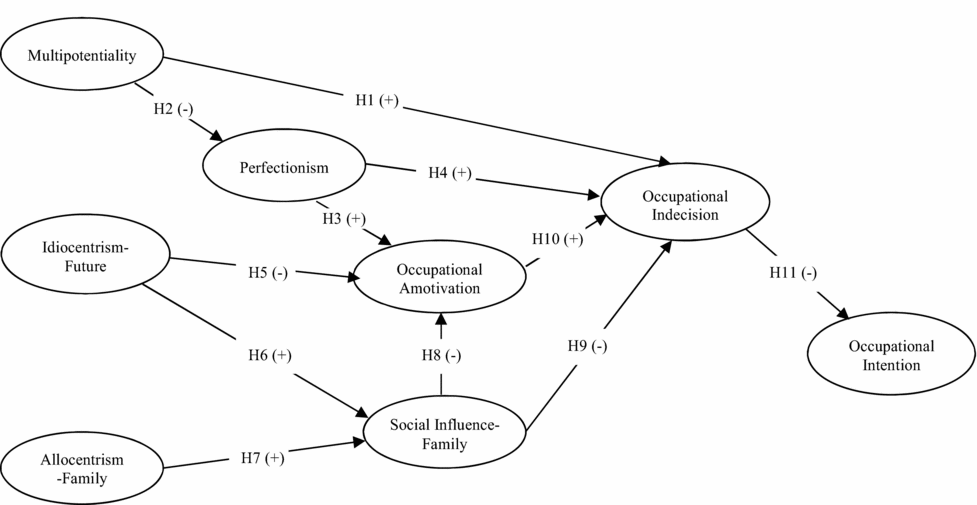
Theoretical Framework 1 (refer to Figure 1) was identical to the theoretical framework that guided Jung (Reference Jung2013), except for the positive or negative direction of three of the path relationships that were newly informed by the findings in Jung (Reference Jung2013). It proposes, first, that having abilities and interests in multiple areas will negatively predict tendencies toward perfectionism, which will itself be a positive predictor of amotivation about the occupational decision. Simultaneously, an individualistic orientation toward the future and social influences from the family (which may itself be positively predicted by an individualistic orientation toward the future and a collectivistic orientation toward the family) are proposed to direct gifted and talented adolescents away from occupational amotivation. Occupational amotivation, along with tendencies toward perfectionism and multipotentiality (and unlike social influences from the family), are in turn proposed to be positive predictors of indecision about one's future occupation. Finally, a state of occupational indecision is proposed to detract from a gifted and talented adolescent's intention to pursue particular occupations.
Theoretical Framework 1.

Theoretical Framework 2
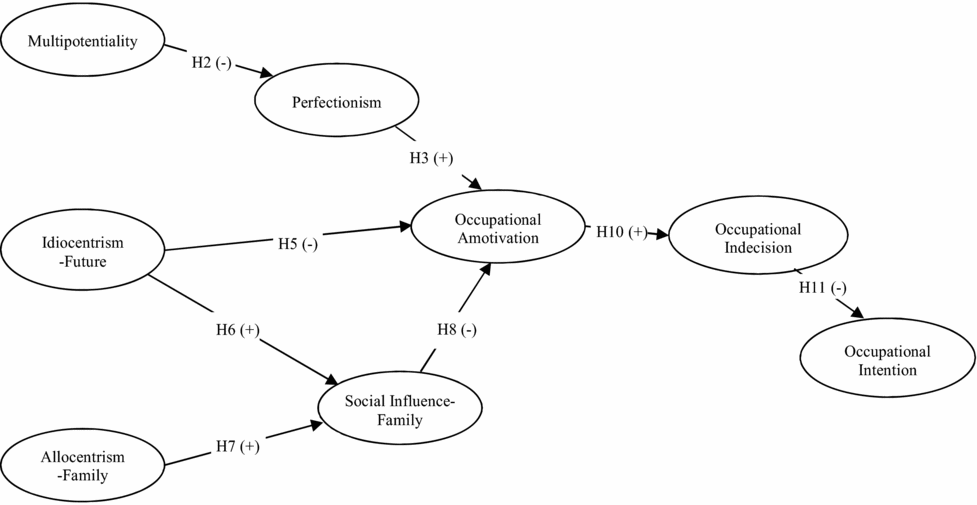
Theoretical Framework 2 (refer to Figure 2) may be considered to be a simplified version of Theoretical Framework 1. The only differences between Theoretical Framework 2 and Theoretical Framework 1 are that multipotentiality, perfectionism, and social influences from the family are not considered to be predictive of occupational indecision in Theoretical Framework 2.
Theoretical Framework 2.

Hypotheses
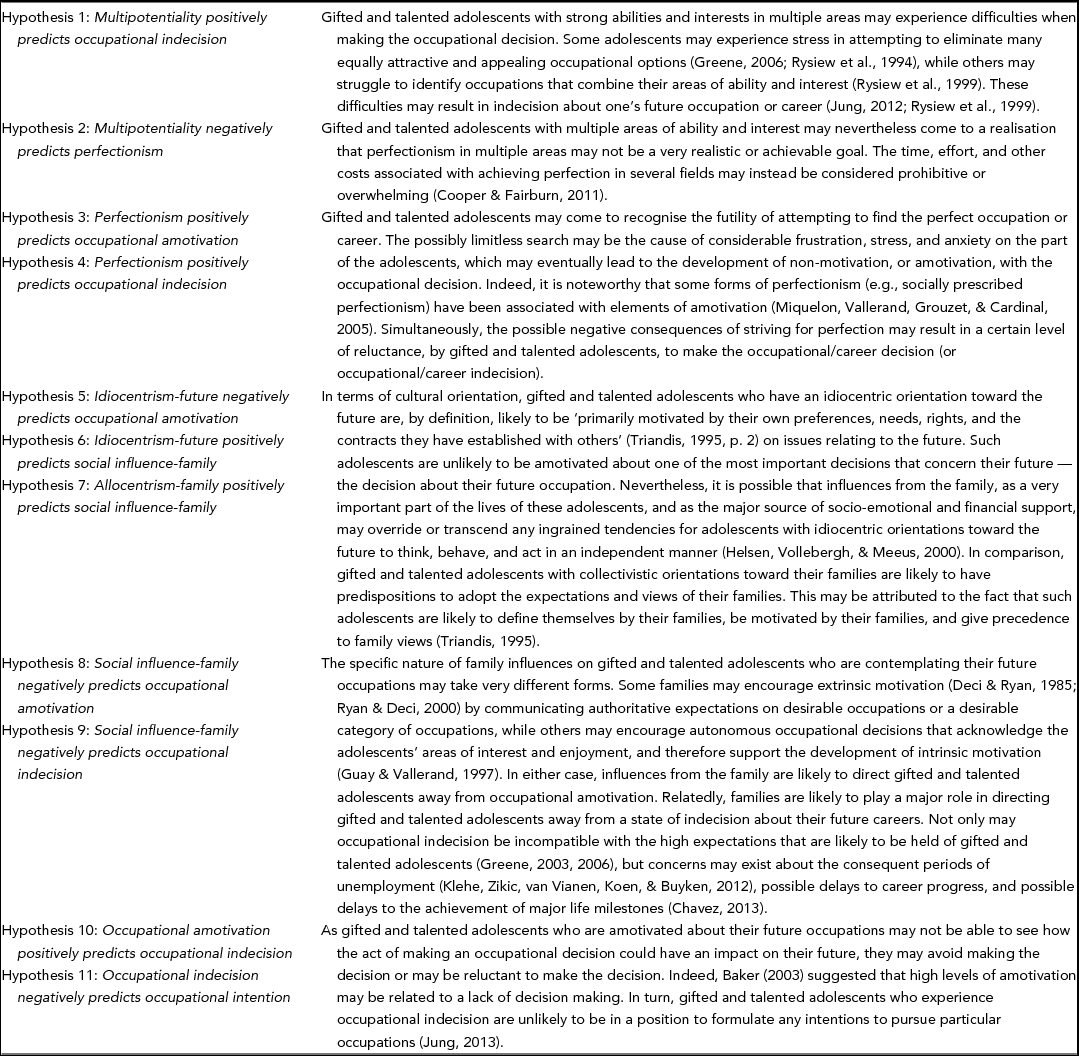
Separate predictions about the possible relationships between variables (i.e., hypotheses; Creswell, Reference Creswell2014) are proposed for each of the path relationships in the two variations of the theoretical framework that guided the study. Table 1 outlines each statement of a hypothesis and associated arguments.
Hypotheses

Method
The study formed part of a larger project on the cognitive occupational decision-making processes of gifted and talented adolescents that also examined how cultural orientations and motivation-related values may lead to attitudes and intentions to pursue particular occupations (Jung, Reference Jungin press).
Participants
The participants of the study comprised 664 students attending one of three academically selective high schools located in the greater Sydney metropolitan area in New South Wales (NSW), Australia. Entry into one of the approximately 50 academically selective high schools in the state of NSW is determined, mainly, by performance in tests of: (a) general ability, and (b) achievement in English and mathematics. Places in academically selective high schools represent approximately 5% of total places in high schools in NSW (Australian Bureau of Statistics, 2014; NSW Department of Education, 2016). The three participating schools were among the top 45 high schools (from 819 high schools) in NSW in 2014, as assessed by the academic performance of Grade 12 students at each school in in-school assessments and standardised external examinations (Australian Bureau of Statistics, 2014; McNeilage & Smith, Reference McNeilage and Smith2014).
The volunteering participants, who were enrolled in Grades 9 (n = 172), 10 (n = 232), and 11 (n = 260), had an average age of 15.67 (SD = 0.92), and comprised more males (n = 401) than females. The average socio-economic status of the participants, as assessed using the ANU4 framework (Jones & McMillan, Reference Jones and McMillan2001) that converts information on parental/guardian occupation into an index of socio-economic status, was at a level that is below that of most professionals, but above associate professionals in fields such as real estate. The mostly Australian-born participants (i.e., 79%) had multiple ancestries (47% East Asian, 32% Anglo-Saxon/Celtic, 8% South Asian, 3% other Western European, 2% Eastern European, 2% Southeast Asian, 1% Middle Eastern, and 6% mixed).
Instrument
A survey was used to collect data from the participants. The first section of the instrument comprised eight items on the socio-demographic characteristics of the participants (i.e., age, grade, gender, parental/guardian occupation, place of birth, local/international student status, ancestry, and school attended), which were presented using either an open-ended or a multiple choice response format. The second and main section of the instrument incorporated 47 items that were designed to assess the eight constructs of interest to the study (i.e., Idiocentrism-Future, Allocentrism-Family, Perfectionism, Occupational Amotivation, Social Influence-Family, Multipotentiality, Occupational Indecision, Occupational Intention). To complete this section, participants were requested to have in mind the job or occupation that they were most likely to pursue upon the completion of their studies, and respond using one of seven Likert scale options ranging from strongly disagree (1) to strongly agree (7).
The self-report instrument was previously administered to 687 gifted and talented adolescents in Jung (Reference Jung2013). Items relating to six of the constructs (i.e., Idiocentrism-Future, Allocentrism-Family, Occupational Amotivation, Social Influence-Family, Occupational Indecision, and Occupational Intention) were originally sourced from Jung and McCormick (Reference Jung and McCormick2010, Reference Jung and McCormick2011a, Reference Jung and McCormick2011b) and Jung et al. (Reference Jung, McCormick, Gregory and Barnett2011), while a number of scales were the original source of the items for Multipotentiality (i.e., Delisle, Reference Delisle1984; Emmett & Minor, Reference Emmett and Minor1993; Rothney, Reference Rothney, Frederickson and Rothney1972; Rysiew, Reference Rysiew1994) and Perfectionism (i.e., Hawkins et al., Reference Hawkins, Watt and Sinclair2006). The eight scales had at least fair levels of reliability, as evidenced by Cronbach alpha values (i.e., Idiocentrism-Future = .76, Allocentrism-Family = .86, Perfectionism = .64, Occupational Amotivation = .84, Social Influence-Family = .92, Multipotentiality = .78, Occupational Indecision = .87, Occupational Intention = .86) in Jung (Reference Jung2013). The convergent and discriminant validity of these scales were also demonstrated by an examination of the size of the factor loadings of each item (i.e., all were in excess of .50), and a comparison of the fit of the one- and equivalent two-factor models of the items that comprised each highly correlated factor pairing (i.e., a lower root mean square error of approximation [RMSEA], a higher normed fit index [NFI], a higher non-normed fit index [NNFI], a higher comparitive fit index [CFI], a lower standardised root mean square residual [SRMR], a higher goodness-of-fit index [GFI], and a higher adjusted goodness-of-fit index [AGFI] for the two-factor model in all cases; Jung, Reference Jung2013).
Results
Participant responses to the survey instrument (N = 664) were analysed in LISREL (version 8.80). The diagonally weighted least squares method of estimation was used for all analyses, in recognition of its appropriateness for the ordinal type data that were collected (Hair et al., Reference Hair, Black, Babin and Anderson2010). The expectation-maximisation algorithm was used to treat missing data, which accounted for less than 1% of total data.
Confirmatory Factor Analyses
First, a full measurement model, which comprised all of the items that were designed to assess the eight constructs of interest to the study, was estimated and assessed using the following criteria (Byrne, Reference Byrne1998; Weston & Gore, Reference Weston and Gore2006):
(a) the t statistic of each measurement equation is greater than 1.96;
(b) the R² value of each measurement equation is in between 0.30 and 1.00; and
(c) the goodness of fit of the model according to a number of fit indices (i.e., Satorra-Bentler χ², RMSEA, NFI, NNFI, CFI, SRMR, GFI, and AGFI) is ‘good’.
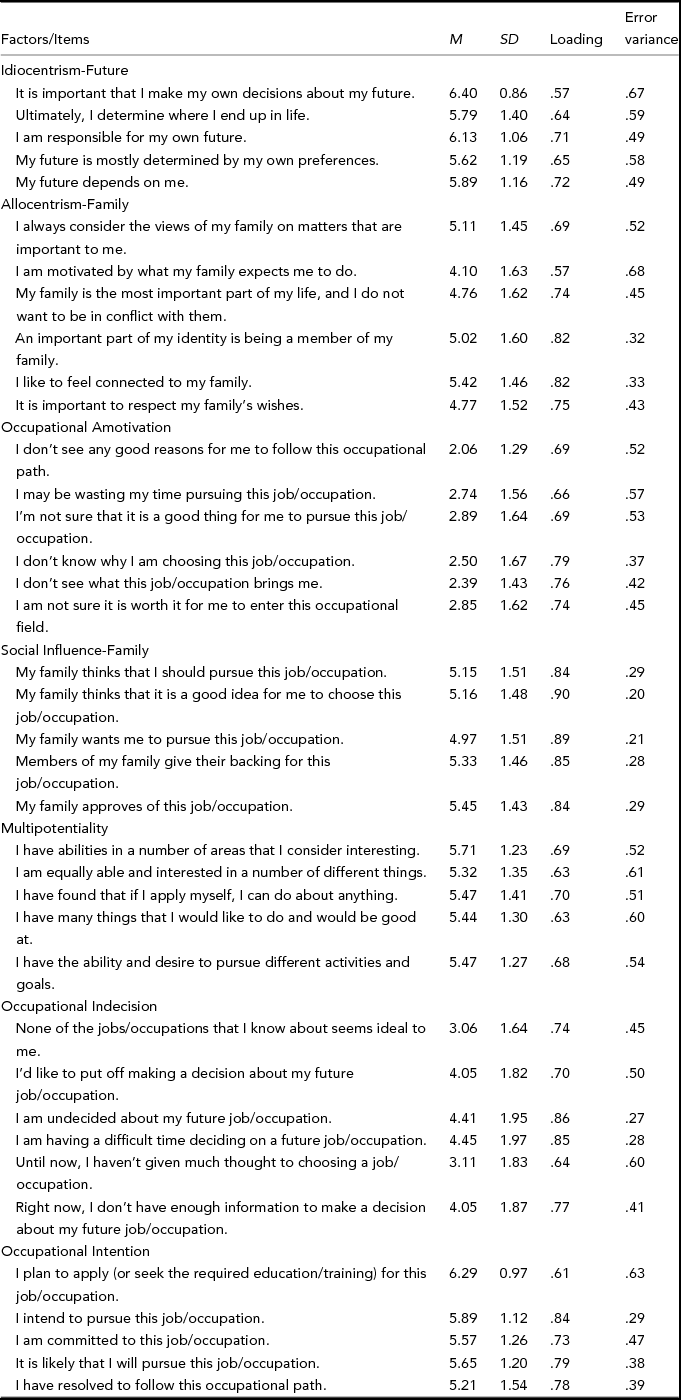
Due to violations of the second of the above criteria, seven of the items (i.e., four items designed to assess Perfectionism, one item designed to assess Multipotentiality, one item designed to assess Idiocentrism-Future, and one item designed to assess Social Influence-Family) needed to be progressively removed. Thereafter, it was necessary to remove the two remaining items that were designed to assess Perfectionism, as Perfectionism now comprised less than the minimum number of items recommended for factors (Hair et al., Reference Hair, Black, Babin and Anderson2010). The resulting full measurement model had no problematic issues and a good fit (χ² = 1,768.072, p = .000, dƒ = 644; χ²/dƒ = 2.745; RMSEA = .051; NFI = .949; NNFI = .964; CFI = .967; SRMR = .048; GFI = .984; AGFI = .982) to the data. Table 2 shows the means, standard deviations, factor loadings, and error variances of the items comprising the full measurement model.
Full Measurement Model: Means, Standard Deviations, Factor Loadings and Error Variances

Construct Validity and Reliability
The psychometric properties of the remaining seven factors of interest to the study were assessed prior to the conduct of further analysis.
Construct validity
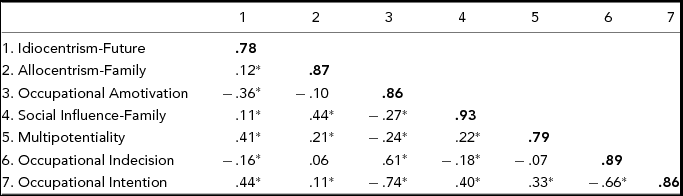
The requirements for convergent validity appeared to have been satisfied, as all the factor loadings in the full measurement model were in excess of .50 (Hair et al., Reference Hair, Black, Babin and Anderson2010). Thereafter, to assess whether discriminant validity may be an issue, any factors with substantially high correlations were further examined. For Occupational Amotivation and Occupational Intention, which was the only factor pairing with a correlation of greater than |.70| (refer to Table 3), the items that comprised both factors were combined to create a single-factor measurement model (after reverse coding the items loading onto Occupational Amotivation, as Occupational Amotivation was negatively correlated with Occupational Intention). Thereafter, the goodness of fit of this model was compared to its equivalent two-factor model. Discriminant validity was established, as the analysis indicated a significant Satorra Bentler chi-square difference statistic, and superior fit for the two-factor model across multiple fit indices (refer to Table 4).
Factor Correlations with Cronbach Alpha Values on the Diagonal

Note: *p < .01.
Goodness of Fit Indices of Measurement Models of the Observed Variables Loading onto Factors ‘Occupational Amotivation’ and ‘Occupational Intention’

Note: p < .05 for Δχ².
Reliability
The seven factors appeared to have reasonable levels of reliability, as indicated by Cronbach alpha values ranging from .78 to .93 (refer to Table 3).
Structural Equation Modelling
With the demonstration of sound psychometric properties for the factors, structural equation models could be estimated of the two variations of the theoretical framework that guided the study. It is noted that as Perfectionism could not be confirmed as a factor during the confirmatory factor analytical procedures, the paths in the two variations of the theoretical framework involving Perfectionism were not modelled.
Theoretical Framework 1
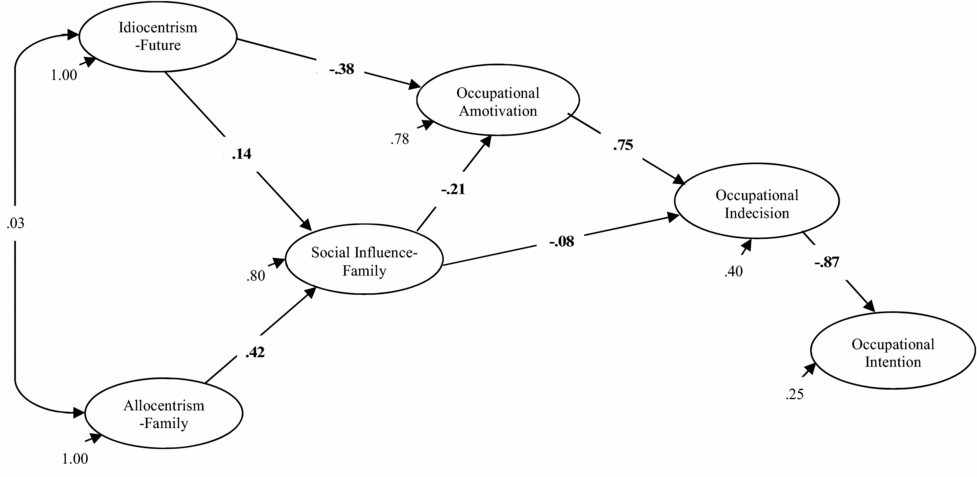
The initially estimated structural equation model of Theoretical Framework 1 satisfied the abovementioned criteria used to assess the full measurement model. Nevertheless, a statistically non-significant path in the model (i.e., Multipotentiality to Occupational Indecision) needed to be trimmed. Thereafter, it was necessary to remove Mulitpotentiality as it no longer contributed any paths to the model. The resulting model had no problematic issues and a good fit (χ² = 1,794.714, p = .000, dƒ = 487; χ²/dƒ = 3.685; RMSEA = .064; NFI = .942; NNFI = .953; CFI = .957; SRMR = .064; GFI = .975; AGFI = .972; AIC = 1,942.71; CAIC = 2,349.59; ECVI = 2.930) to the data (refer to Figure 3).
Final structural model of Theoretical Framework 1.

Theoretical Framework 2
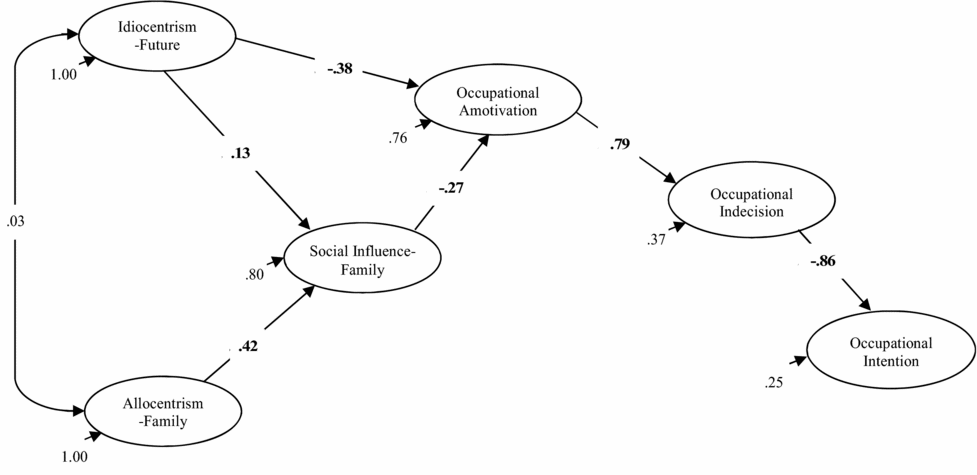
The initially estimated structural equation model of Theoretical Framework 2 satisfied all of the abovementioned criteria used to assess the full measurement model. Furthermore, it contained no non-significant path relationships and had a good fit (χ² = 1,785.968, p = .000, dƒ = 488; χ²/dƒ = 3.660; RMSEA = .063; NFI = .942; NNFI = .954; CFI = .957; SRMR = .064; GFI = .975; AGFI = .971; AIC = 1,931.97; CAIC = 2,333.34; ECVI = 2.914) to the data. The model could therefore be confirmed without any modifications (refer to Figure 4).
Final structural model of Theoretical Framework 2.

Comparison of models
The empirically refined versions of the structural equation models of the two variations of the theoretical framework that guided the study had very similar levels of fit to the data. The only difference between the models was that a statistically significant negative path relationship exists between Social Influence-Family and Occupational Indecision in the empirical model derived from Theoretical Framework 1, but not in the empirical model derived from Theoretical Framework 2. Of the two models, the model derived from Theoretical Framework 2 was determined to be the optimal model for the study, due to its superior fit according to more of the indices of model fit, and indices (i.e., AIC, CAIC, and ECVI) that have been specifically identified as being salient when making a selection among competing non-hierarchical models (Brown, Reference Brown2006; Diamantopoulos & Siguaw, Reference Diamantopoulos and Siguaw2000; Kline, Reference Kline2005).
The optimal model suggested that gifted and talented adolescents who are influenced by their families or have idiocentric orientations toward the future are likely to be directed away from a state of amotivation about their future occupations. In turn, the experience of amotivation by gifted and talented adolescents about their future occupations may be strongly linked to the experience of occupational indecision, which does not appear to be associated with the formation of intentions to pursue particular occupations. The model provided support for six of the study hypotheses (i.e., Hypotheses 5, 6, 7, 8, 10, and 11).
Discussion
The finally accepted model provided fresh insights into the cognitive decision-making processes associated with occupational indecision for gifted and talented adolescents. Generally, the main paths in the model suggested that gifted and talented adolescents without social influences from the family, or an individualistic orientation toward the future, may become amotivated about their future occupations or careers, and eventually experience occupational or career indecision. The model affirmed a significant portion of a model of cognitive decision-making processes that was empirically verified in a prior study of 687 gifted and talented adolescents (Jung, Reference Jung2013). A notable aspect of the model was its explicit acknowledgment of the role of constructs relating to culture.
The model showed that the cognitive decision-making processes associated with occupational indecision for gifted and talented adolescents are similar in some respects to those of adolescents in general. When a comparison was made with a model that was developed, tested, and refined with 1,058 general adolescents over two phases of data collection (Jung & McCormick, Reference Jung and McCormick2010, Reference Jung and McCormick2011b), identical relationships in terms of statistical significance and positive or negative direction were found between social influences from the family and occupational amotivation, and between occupational amotivation and occupational indecision. These findings suggested the possibly fundamental nature of these relationships in adolescent occupational decision-making processes, which may transcend levels of giftedness and talent among adolescents who are of at least average ability or demonstrate at least an average level of performance.
The major intermediary constructs in the finally accepted model were social influences from the family and occupational amotivation. Both constructs appear to play important roles in determining whether gifted and talented adolescents may become undecided about their future occupations or careers. Nevertheless, the strength of the relationship between occupational amotivation and occupational indecision, and the lack of any other direct predictors of occupational indecision, is suggestive of the greater, and possibly pivotal, function of occupational amotivation in the cognitive processes leading to occupational indecision among gifted and talented adolescents. Further investigations may be necessary to more fully evaluate the nature of the relationship between occupational amotivation and occupational indecision, including the possibility that occupational amotivation may be a precursor or a prototype of occupational indecision. It is noted that uncertainty, which may have some overlap with an inability to perceive a relationship between actions and outcomes (i.e., amotivation), has been suggested to be a precursor of occupational indecision (Jordaan, Smithard, & Burger, Reference Jordaan, Smithard and Burger2009).
Many of the relationships in the finally accepted model were consistent with expectations. Nevertheless, the relationships involving the two factors that were removed during the model refinement process (i.e., perfectionism and multipotentiality) were not supported. The fact that these factors did not form a part of the empirically verified models in the study suggested that any contribution of perfectionism or multipotentiality to the cognitive processes leading to occupational or career indecision for gifted and talented adolescents may not be consistently meaningful. The findings of the study instead suggested that perfectionism may not be pervasive enough as a characteristic of gifted and talented adolescents (i.e., fairly low mean scores of the participants on the items loading onto perfectionism), while the association between multipotentiality (on which the study participants had generally high scores) and the other elements of the empirical models may not be sufficiently direct. Further investigations may be necessary before greater clarity may be achieved on the nature of the role, if any, of perfectionism and/or multipotentiality on the occupational decisions of gifted and talented adolescents.
The lack of a statistically significant relationship between social influences of the family and occupational indecision, which is consistent with the positive relationship between parental influence and career decision-making self-efficacy identified in Keller and Whiston (Reference Keller and Whiston2008), was a noteworthy aspect of the finally accepted model. It also represented the only significant point of difference between the two empirical models derived from the two variations to the theoretical framework. A comparison of the two models suggests that amotivation with respect to the occupational decision may be considered slightly more malleable, open, and receptive to the influence of the family than the state of decidedness about one's occupation or career (reflecting the slightly better fit of the optimal model over the empirical model derived from Theoretical Framework 1). It follows that, unlike the initial and mid-stages of the occupational decision-making process leading to occupational indecision, the final stage may be viewed in comparatively individual terms by gifted and talented adolescents.
In terms of implications for practice, the model provides a basis and a framework for understanding, and providing assistance to, gifted and talented adolescents who may be experiencing some difficulty with the occupational decision. A particularly useful aspect of the model is that it provides some direction on the areas for potential focus (i.e., the degree to which the adolescent may be amotivated about the occupational decision, the existence or otherwise of family support, cultural orientations, and the degree to which the adolescent may be occupationally undecided) as well as areas that may require less attention (i.e., multipotentiality and perfectionism). As such, it may be advisable for psychologists, career counsellors, families, and other interested parties to make assessments of at least some of these constructs, possibly by utilising the scales that have been used in the present study. If found to be effective, such assessments may be regularly incorporated into the protocols and procedures used to support the occupational decisions of gifted and talented adolescents.
The finally accepted model additionally provides a number of strategies that may be useful to direct gifted and talented adolescents away from prolonged periods of indecision about their future occupations. If assessments of gifted and talented adolescents indicate abnormally high levels of occupational amotivation, which has been found to be strongly predictive of occupational indecision, it may be necessary to encourage the development of other forms of motivation, to direct these adolescents away from occupational indecision (Deci & Ryan, Reference Deci and Ryan1985; Ryan & Deci, Reference Ryan and Deci2000). For example, the interesting and enjoyable aspects of careers (i.e., intrinsic motivation), or the possible financial and social rewards of work (i.e., extrinsic motivation), may be highlighted. Reflecting the negative relationship between social influences from the family and occupational amotivation in the finally accepted model, the families of gifted and talented adolescents may have a particularly important role to play in this regard.
If the support of the family is not available, an alternative approach to direct gifted and talented adolescents away from occupational indecision may be to encourage an independent orientation with respect to the future (reflecting the negative relationship between an idiocentric orientation with respect to the future and amotivation about the occupational decision in the finally accepted model). Perhaps case studies may be shown of gifted and talented adolescents with individualistic future orientations moving onto successful careers. Alternatively, it may be useful to identify parties, such as mentors (Maxwell, Reference Maxwell2007), who may play a significant part of the lives of these adolescents, to communicate appropriate career-related messages in lieu of family members. Nevertheless, as social influence from the family appears to be such an important element of the finally accepted model, it is also possible that the absence of family support places gifted and talented adolescents at risk of prolonged occupational indecision. It is indeed noteworthy that scholars have suggested the substantial influence of the family in adolescent career decisions (Dietrich & Kracke, Reference Dietrich and Kracke2009).
In terms of future research, further scrutiny may be necessary of the relevance of multipotentiality and perfectionism, which appear to be inconsistent contributors to the occupation-related decision-making processes of gifted and talented adolescents. Furthermore, to gain a more complete understanding of the influence of culture on the occupation-related decision-making processes of gifted and talented adolescents, it may be useful to examine a broader range of cultural orientations, including power distance orientation and masculinity and femininity (Hofstede, Reference Hofstede2001). Moreover, interesting comparisons to the findings of this study may be found, if investigations are made of the occupational decision-making processes of gifted and talented adolescents of differing levels of ability and achievement.
Limitations
A number of limitations in the study require acknowledgment. First, only self-report survey data, which may have issues relating to a social desirability bias (Van de Mortel, Reference Van de Mortel2008) and a reliance on memory (Tourangeau, Reference Tourangeau, Stone, Bachrach, Jobe, Kurtzman and Cain2000), were collected from research participants. To gain additional confidence on its validity, it may have been useful to corroborate the data with data collected from the significant others in the lives of the participants (e.g., family members, teachers, and peers). Second, the standard bipolar agree-disagree Likert-type scale was used, which may comprise two dissociated scales, possibly leading to a central tendency bias (Popham, Reference Popham1988), the conflation of extreme positions (Start, Reference Start2002), and an acquiescence response bias (Burns, Reference Burns1990). The use of semantically differentiated, visual analogue scales may have overcome some of these issues (Geake & Gross, Reference Geake and Gross2008). Third, as all participants were enrolled in academically selective high schools (which enrol approximately 5% of all students in NSW) on the basis of performance in tests of ability and achievement, they may qualify as being ‘gifted and talented’ under Gagné’s definitions of giftedness (i.e., top 10% of age peers in terms of ability) and talent (i.e., top 10% of age peers in terms of achievement). Nevertheless, it is recognised that the sample may not in a strict sense be perfectly consistent with Gagné’s (Reference Gagné2004) definitions (e.g., achievement tests are only conducted in English and mathematics, rather than in all subject areas including the social sciences, philosophy, and art), and therefore, the findings of the study may not necessarily be generalisable to all gifted and talented adolescents. Fourth, as all the participants of the study came from a large urban area in Australia, they may not be reflective of gifted and talented adolescents from rural or remote areas. Fifth, the relationships between constructs in the finally accepted model were predictive rather than causal, as the conditions for establishing causality (Hair et al., Reference Hair, Black, Babin and Anderson2010) may not necessarily have been met. Lastly, it is acknowledged that the finally accepted model, while rigorously developed from the existing literature, may not incorporate every possible factor that may influence occupational indecision for gifted and talented adolescents (e.g., non-individual factors, including social, systemic, political, economic, media, technology, and cultural factors), and may not be the only possible model of the cognitive decision-making processes leading to occupational indecision for gifted and talented adolescents. Indeed, an investigation using an alternative epistemological approach may have resulted in a different final model.