1. INTRODUCTION
Cold cathodes for generating high-current electron beams are useful for many applications (Beilis et al., Reference Beilis, Boxman and Martin1995; Reference Beilis and Keidar2000; Reference Beilis2001; Reference Beilis2007; Chang et al., Reference Chang, Liu, Fang, Tang, Huang, Chen, Zhang, Liang, Zhu and Li2010; Dong et al., Reference Dong, Wu, Hao, Zou, Liu, Zhang, Zhang, Xu, Chen, Xu, Liu and Zhou2003; Mesyats, Reference Mesyats2000; Miller, Reference Miller1982; Roth et al., Reference Roth1995; Zhou et al., Reference Zhou, Yu and He2007). One example is in pumping high power microwave (HPM) devices (Benford et al., Reference Benford, Swegle and Schamiloglu2007; Fan et al., Reference Fan, Zhong, Yang, Li, Shu, Zhang, Wang and Luo2008; Reference Fan, Zhong, Li, Yuan, Shu, Yang, Wang and Luo2011; Miller, Reference Miller1998; Shiffler et al., Reference Shiffler, Haworth, Cartwright, Umstattd, Ruebush, Heidger, Lacour, Golby, Sullivan, Duselis and Luginsland2008; Wang et al., Reference Wang, Qian, Zhang, Zhang, Cao and Zhang2011; Xiao et al., Reference Xiao, Zhang, Zhang, Li, Zhang, Song, Hu, Sun, Huo, Chen, Zhang and Liu2010; Zhang et al., Reference Zhang, Jin, Yang, Zhong, Shu, Zhang, Qian, Yuan, Li, Fan, Zhou and Xu2011; Zhu et al., Reference Zhu, Shu, Zhang, Li and Zhang2010). In a typical HPM device, a high voltage (>100 kV) is applied to a cold cathode, resulting in what is termed “explosive emission plasma” or “surface flashover plasma,” whereby the cold cathode emits a high current electron beam (>1 kA) (Krasik et al., Reference Krasik, Dunaevsky and Felsteiner2001; Reference Krasik, Gleizer, Yarmolich, Vekselman, Hadas, Krokhmal, Chirko, Peleg and Felsteiner2007; Reference Krasik, Gleizer, Yarmolich, Vekselman, Hadas and Felsteiner2008; Reference Krasik, Yarmolich, Gleizer, Vekselman, Hadas, Gurovich and Felsteiner2009; Mesyats, Reference Mesyats2000). Electrons are extracted from the cathode plasma and accelerated in the electric field toward an anode (including beam-wave interaction structures and collector) some distance away. The energy in the electron beam thus generated is then extracted in the form of microwaves in the beam-wave interaction structures. Additionally, anode plasma could be generated due to intense electron bombardment of the collector surface. One of the problems frequently encountered in a HPM device is impedance collapse caused by the movement of the cathode and/or anode plasmas. This could lead to the mismatch between the diode and high voltage generator impedances which can be especially problematic when a constant power electron beam is required. The dynamic investigation of the expansion of the diode plasmas represents an interest not only for the study of diode physics but also for the researchers of high current electron applications.
One of the important dynamic issues of the diode plasmas is the expansion velocity that is of fundamental interest. Generally, the perveance model based on the classical Child-Langmuir law was used to study the time-resolved evolution of the expansion velocity of the cathode plasma (Pushkarev et al., Reference Pushkarev and Sazonov2009; Roy et al., Reference Roy, Menon, Mitra, Kumar, Sharma, Nagesh, Mittal and Chakravarthy2009; Saveliev et al., Reference Saveliev, Sibbett and Parkes2002). However, this was only reasonable when the total diode current was limited by the space charge in the anode-cathode (A-K) gap. Additionally, the spatial distribution difference of the cathode plasma was neglected in the perveance model. Furthermore, in terms of experimental studies, the temporal and spatial change of the cathode plasma can be shown vividly by using the imaging method (Krasik et al., Reference Krasik, Dunaevsky and Felsteiner2001; Reference Krasik, Gleizer, Yarmolich, Vekselman, Hadas, Krokhmal, Chirko, Peleg and Felsteiner2007; Reference Krasik, Gleizer, Yarmolich, Vekselman, Hadas and Felsteiner2008; Reference Krasik, Yarmolich, Gleizer, Vekselman, Hadas, Gurovich and Felsteiner2009; Saveliev et al., Reference Saveliev, Sibbett and Parkes2003; Yang et al., Reference Yang, Shu, Fan and Zhang2012a). Many experimental investigations have been carried out under a wide variety of physical conditions. However, in the previous studies, most documents provided only a qualitative and phenomenological pattern of the luminosity of the diode process. More accurate and valuable information about the dynamics of the cathode plasma could be acquired by utilizing the digital image processing methods.
The main purpose of the presented paper is to obtain reliable data on the temporal behavior of the two-dimensional expansion velocity distributions of the cathode plasma in pulsed high-power diodes. In Section 2, we discuss the details of the experimental setup and diagnostics. Analytical theory (Child, Reference Child1911; Langmuir, Reference Langmuir1913; Pushkarev et al., Reference Pushkarev and Sazonov2009) is used in Section 3 first to develop a simple physics understanding of the expansion velocity of the cathode plasma. Section 3 also compares the experimental measurements with the theoretical model. Conclusions that can be drawn from this work are summarized in Section 4.
2. EXPERIMENTAL SETUP AND DIAGNOSTICS
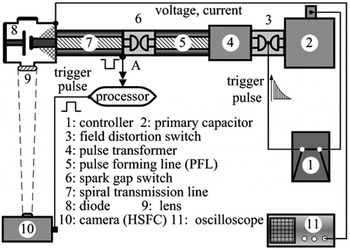
The high voltage generator and test chamber for the experiments have been described in detail in previous publications (Yang et al., Reference Yang, Shu, Zhang, Yang, Liu, Yin, Fan and Luo2012b). Figure 1 shows a detailed drawing of the complete system. A primary capacitor followed by a triggered field distortion switch was used to charge a spiral coaxial pulse forming line via a pulse transformer. The adjustable output voltage of the modulator ranged from 100 kV to 500 kV, with pulse rise-time (10% to 90% amplitude) of 25 ns and pulse duration (full width at half maximum) of 110 ns. To achieve accurate synchronization between the exposure time of the HSFC and the luminescence process of diode plasmas, the high voltage pulse was delivered to the cathode via a spiral transmission line placed after the spark gap switch.
Schematic of experiment setup.

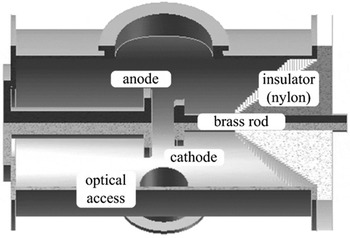
A simple planar diode without an external guiding magnetic field (as shown in Fig. 2) was chosen to study the basic phenomenology of the ignition and expansion of the plasmas. The stainless steel chamber was about 400 mm in diameter and 500 mm long. Optical access on the side of the chamber provided a view of the A-K gap. The central conductor to the vacuum vessel consisted of a brass rod mounted inside the nylon insulator. The brass rod was connected to a stainless steel holder upon which the cathodes were mounted.
Diode configuration.

The chamber was pumped down to a vacuum pressure of 2–5 × 10⁻⁵ Torr range with a turbo-molecular pump backed by an oil roughing pump. The diode consisted of a planar velvet cathode of 40 mm diameter and brass anode of 150 mm diameter. The distance between the anode and cathode d could be varied in the range 5–50 mm.
The diode voltage and current were measured using a resistive divider and a self-integrated Rogowski coil, respectively. To observe the temporal development of the diode plasmas optically, the HSFC with four micro channel plate (MCP) image intensifier modules was used. The gating time of the four channels could be varied from 3 ns up to several milliseconds. The gating pulses were applied to the MCP with various time delays, which allowed us to obtain plasma images at different times of the diode current.
3. RESULTS AND DISCUSSIONS
3.1. Theoretical Calculation
One of the most common and simple methods to investigate the temporal behavior of the plasma in planar diodes is to compare the diode perveance P with a one-dimensional model based on the Child–Langmuir law (Child, Reference Child1911; Langmuir, Reference Langmuir1913). Under the assumption that all electrons leave the planar cathode of infinite area (without considering edge effects) with zero velocity, the field and charge distribution in the gap is permanent, and the total current, I, flowing across the diode is given by the familiar equations
 $$I = P_{CL} \times U^{3/2} \comma \; P_{CL} = \displaystyle{{4{\rm \varepsilon} _0 } \over 9}\sqrt {\displaystyle{{2e} \over m}} \displaystyle{S \over {d^2 }} = 2.34 \times 10^{ - 6} \displaystyle{{{\rm \pi} R^2 } \over {d^2 }}\; \; \lpar {\rm A/V}^{{\rm 3/2}} \rpar \comma $$
where PCL is the diode perveance, U is the diode voltage, ɛ0 is the absolute dielectric penetrability, e and m are the charge and mass of electron, d is the A-K gap, S and R are the area and radius of the cathode emitting area, respectively.
It has been reported that the longitudinal velocity and transverse velocity could be taken as equal (Pushkarev et al., Reference Pushkarev and Sazonov2009). If the planar diode operates in the mode of space charge limitation, we will get that the cathode plasma expansion velocity v(t) is
 $$v\lpar t\rpar = \displaystyle{{Kd_0 - R_0 } \over {t\lpar K + 1\rpar }}\comma \; K = \sqrt {\displaystyle{I \over {2.34 \times 10^{ - 6} {\rm \pi} U^{3/2} }}}\comma $$
where d 0 and R 0 are the initial A-K gap and radius of the cathode emitting area, respectively.
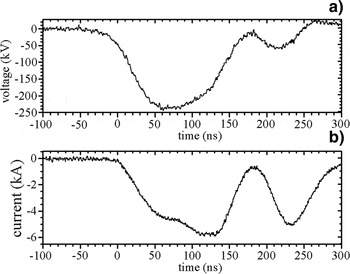
Typical experimental profiles of the diode voltage and current are shown in Figure 3. The A-K gap was 1.5 cm. The typical macroscopic field in the A-K gap, during the voltage flattop, was about 160 kV/cm. The average current density was nearly 440 A/cm2. Apparent increase of the diode current at td > 80 ns might be connected with two processes. They were increase of emissive surface on the velvet cathode and reduction of A-K gap through moving of cathode plasma toward grounded anode.
Experimental diode (a) voltage and (b) current pulse. The A-K gap was 1.5 cm.

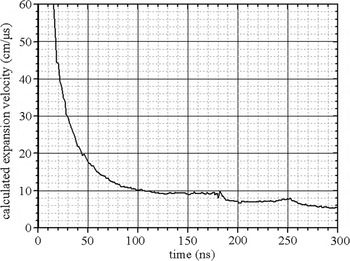
Figure 4 shows the calculated values of diode plasmas expansion velocity by correlation (Eq. (2)) using the measured voltage and current values (as shown in Fig. 3). The results showed that the plasma expansion velocity was very fast at first and fell down quickly with the time subsequently. The expansion velocity went downward from more than 60 cm/μs to nearly 18 cm/μs during the rising edge (td < 50 ns) of the current pulse. Additionally, it was found out that the range of the expansion velocity was 5–10 cm/μs during the flattop of the current. We can see that the expansion velocity values in the flattop of the current changed relatively slowly in contrast to the beginning of the current pulse where the expansion velocity values decreased dramatically. And this phenomenon was also observed under different experimental conditions (Pushkarev et al., Reference Pushkarev and Sazonov2009; Roy et al., Reference Roy, Menon, Mitra, Kumar, Sharma, Nagesh, Mittal and Chakravarthy2009; Saveliev et al., Reference Saveliev, Sibbett and Parkes2002).
Calculated expansion velocity vs. time. The A-K gap was 1.5 cm.

3.2. Optical Diagnostics
The electron emission from the velvet cathodes is of plasma origin. It was necessary to follow the cathode plasma expansion in time, to obtain new data and compare them with the information from the theoretical analysis. The adequate way of obtaining quantitative information is to study the light phenomena accompanying the pulsed operation of the diode. The most valuable information can be extracted from the plasma images.
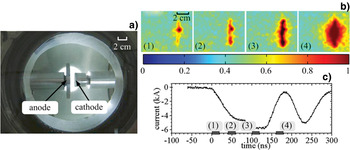
Typical photographs of the gap glow corresponding to various stages of the diode current are presented in Figure 5b. The view was from the side with the cathode right and the anode left (as shown in Fig. 5a). The A-K gap was 1.5 cm. All of these were registered with constant frame duration of 20 ns. Frame positions within the pulse are indicated by black rectangles on the diode current wave form (as shown in Fig. 5c). td = 0 corresponds to the start of the current pulse.
(a) Photograph of the diode. The cathode was the right electrode and the anode was the left one. (b) Evolution of the light emission (side view) seen by the HSFC at four different times of the current pulse. The light emission from the near-anode region was not seen. (c) Numbered black rectangles on the current waveform indicated positions of frames with corresponding numbers. td = 0 corresponds to the start of the current pulse.

One can see bright light emission (spots) associated with the plasma formation on the surface of the velvet cathodes at the beginning of the current pulse. The light emission from the near-anode region was not seen in the experiments. Further, an increase of td caused a gradual increase of the intensity and area of the light emission.
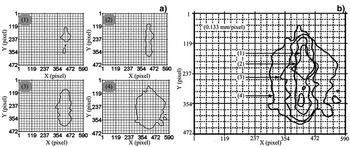
The split and merged profiles of the typical cathode plasma images are shown in Figures 6a and 6b, respectively. They were obtained by averaging the plasma intensities (as shown in Fig 5b) at adjacent 3 × 3 pixels to eliminate the ambiguity due to the spatial fluctuation, corresponding to a spatial resolution of 0.133 mm/pixel. The longitudinal positions of the cathode and anode surfaces are Xc = 424.8 pixel and Xa = 311.8 pixel, respectively. As a result, the average velocity in a certain period was simply calculated as v 1i = (di − di -1)/(ti − ti -1) and v 2i = (Ri − Ri -1)/(ti − ti -1), where v 1i is the average transverse expansion velocity, v 2i is the average longitudinal expansion velocity, Ri is the size of the profile in Y direction, di is the distance between the left margin position of the profile and the cathode surface, and ti is the time delays with respect to the beginning of the current pulse. Both the initial transverse and longitudinal size are aero, i.e., R 0 = d 0 = 0 at t 0 = 0. The velocity of motion of the luminous profile of the cathode plasma was given in Table 1.
(a) Split and (b) merged profiles of the typical side images of the light emission from the diode.

Profiles and expansion velocity of the cathode plasma

One can note several interesting trends from Figure 6 and Table 1. First, the transverse velocity was much faster than the longitudinal velocity at td < 60 ns. The transverse velocity was up to 90 cm/μs at first, and then dropped rapidly over time. Statistical processing of photographs of the cathode plasma luminosity revealed that in general separate spots appeared not simultaneously. Moreover, the results showed that cathode plasma distribution were clearly not uniform in the initial period of the current. There was little or even no plasma in some regions of the vicinity of the cathode surface (as shown in Fig. 6a1). Moreover, the effective emission area changed with time due to expansion of the cathode plasma in the radial direction. In this case, d 2 and R 2 in Table 1 are the longitudinal and transverse size of the new plasma region (as shown in Fig. 6a2) by comparison with d 1 and R 1 (as shown in Fig. 6a1), respectively. Since voltage application and till formation of solid plasma surface at the cathode (td = 0 ~ 60 ns) diode current was limited by emissive ability of cathode. It can be seen that the emission occurred over a fraction of the cathode area only. Moreover, the effective emission area changed with time due to expansion of the cathode plasma in the radial direction. As a result, the perveance model based on the Child-Langmuir should be modified taking in account the time dependent expanding plasma surface (i.e., not the whole cathode surface) for this period. Second, one can see that both the transverse and longitudinal expansion velocities kept at an almost constant level (5–8 cm/μs) at td > 60 ns. The plasma filled out all the surface of cathode during this period. It is reported that if the anode plasma was created under intense electron bombardment, it became a copious source of ions that modified the space charge distribution within the diode and increased the current (Saveliev et al., Reference Saveliev, Sibbett and Parkes2002). However, we did not observe distinct light emission from the near-anode region in the experiments. As a result, one can conclude that the effect of the plasma from the brass anode in our experiments was negligible, if it existed at all, and did not exceed the range of the experimental accuracy of the data. The expansion of the dense cathode plasma was the main reason of the dramatic increase of the diode current.
Finally, it was shown that the interaction of the electron beam with the brass anode did not lead to the distinct light emission from the near-anode region in the experiments. However, we observed the anode surface damage caused by melting and material transferred from anode to cathode surface. We hypothesize that the materials coming out from the anode might modify the performance of velvet cathode. This may be another reason for the velocity discrepancy between theory and experiments during the flattop of the current.
4. CONCLUSIONS
We have studied the time evolution of the two-dimensional expansion velocity distributions of the cathode plasma in pulsed high-power diodes at moderate voltages ~ 240 kV, electron current 5.5 kA (current density of ~ 440 A/cm2) and the pulse durations of ~ 110 ns. The performed research showed that the diode current was limited by the cathode ability in the current rising stage. The transverse velocity was much faster than the longitudinal velocity during this period. Furthermore, it was shown that the process of discrete emitting area increasing to the solid one at the beginning of electron beam generation went with a fast velocity in a relatively short time (< 60 ns). The satisfactory coincidence of experimental and calculated (both were in the range of 6–8 cm/μs) values of the cathode plasma expansion velocities was obtained during the current flattop stage. This corresponds to the limitation of electron current by the space charge in the A-K gap. Finally, the formation and expansion of the cathode plasma are relevant to the particular materials and structures of the diode. The corresponding experiments for different cathode materials (such as carbon fiber velvet) in a planar diode are being prepared in our laboratory.
ACKNOWLEDGMENTS
The authors gratefully acknowledge support from Prof. Lie Liu and Dr. Yi Yin. This work was supported by the Postdoctoral Science Foundation of China under Grant No. 201104761. It was also supported in part by the National Science Foundation of China under Grant No. 11075210, 11075211, and 61101028.