INTRODUCTION
Portraying people, animals, and supernatural beings, fired-clay figurines have long fascinated archaeologists because they seem to display “an intimate glimpse” (Triadan Reference Triadan2007:269) into the social conventions of how subjects depicted themselves, and the social processes of people who produced and used them (Faust and Halperin Reference Faust, Halperin, Halperin, Faust, Taube and Giguet2009). These small and portable ceramic objects are known across Mesoamerica. They have been recovered at sites along the Gulf Coast, in central Mexico, Oaxaca, and the Maya lowlands and appear in archaeological contexts dating from the Archaic-Formative transition (3000–2500 b.c.) through the Postclassic, although their frequency decreases significantly between 400 b.c. and a.d. 600 (Blomster Reference Blomster and Insoll2017; Clark and Colman Reference Clark and Colman2014; Coe and Diehl Reference Coe and Diehl1980; Cyphers Guillén Reference Cyphers Guillén1993; Derilo Tway Reference Derilo Tway2004; Drucker Reference Drucker1943; Follensbee Reference Follensbee, Orr and Looper2013; Grove and Gillespie Reference Grove, Gillespie, Chase and Chase1992; Halperin Reference Halperin2017; Hepp and Joyce Reference Hepp, Joyce and Joyce2013; Lesure Reference Lesure1999; Marcus Reference Marcus1998, Reference Marcus, Halperin, Faust, Taube and Giguet2009; Niederberger Reference Niederberger1976; Porter Reference Porter1953; Rands and Rands Reference Rands, Rands and Willey1965; Vaillant Reference Vaillant1930; Weiant Reference Weiant1943; Zweig Reference Zweig2010). The use of Preclassic figurines by Mesoamerican people has been a topic of research for quite some time. They have been interpreted as children's toys, decorative items, and ritual objects used as fertility fetishes. Because their primary recovery contexts are mostly domestic, they are also considered to be associated with household ritual (e.g., Cyphers Guillén Reference Cyphers Guillén1993; Hammond Reference Hammond1991; Hendon Reference Hendon2003; Hepp and Joyce Reference Hepp, Joyce and Joyce2013; Marcus Reference Marcus1998, Reference Marcus, Halperin, Faust, Taube and Giguet2009; Moholy-Nagy Reference Moholy-Nagy2003; Rands and Rands Reference Rands, Rands and Willey1965; Ruscheinsky Reference Ruscheinsky2003).
Based on contextual data from the Formative period in the Valley of Oaxaca, Marcus (Reference Marcus1996, Reference Marcus, Halperin, Faust, Taube and Giguet2009:27) has argued that figurines served as venues to which the spirits of ancestors could return during domestic ritual practices. Using ethnographic case studies from farming societies in China, Japan, and several West African communities, she suggested that figurines played a central role in household ancestor worship, especially by women who were likely the primary workers of the household (Marcus Reference Marcus1996, Reference Marcus1998, Reference Marcus, Halperin, Faust, Taube and Giguet2009). Other studies of Maya figurine use have similarly hypothesized a female fertility fetish for figurines (Gifford-Gonzalez Reference Gifford-Gonzalez2007; Grove and Gillespie Reference Grove and Gillespie1984; Willey et al. Reference Willey, Bullard, Glass and Gifford1965). Alternatively, focusing on the Middle Formative figurine collection recovered at Chalcatzingo (Morelos, Mexico), Cyphers Guillén (Reference Cyphers Guillén1993:209) stated that helmeted and cross-eyed figurines, similar to those used by Gulf Coast Olmec, were associated with domestic rituals focused on female life-crisis events. In Cyphers Guillén's assessment, these rituals were hosted by the women of important households as part of their political agenda. Hosting ritual performance with Olmec-like images helped create rights and obligations between community members, which were the means through which power and influence were acquired. We agree that there is no evidence to claim that the use of figurines was exclusive to women only because they are found primarily in domestic contexts. In addition, the contextual data across Mesoamerica indicate that these specialized objects were not exclusively used in domestic spaces, as they have been occasionally recovered from public structures and burials (Awe Reference Awe2013; Blomster Reference Blomster and Insoll2017; Garber and Awe Reference Garber and Awe2008; Rice Reference Rice2015), raising the possibility that they had different uses and meanings. We do accept, however, that figurines were used in domestic and public rituals that tied people together on a public scale of interaction (Hepp and Joyce Reference Hepp, Joyce and Joyce2013) and that these practices may have been tied to the political dynamics of ancient communities (Halperin Reference Halperin2017:535).
It is important to take into consideration that figurine forms and their methods of manufacture changed through time and differed over space (Rands and Rands Reference Rands, Rands and Willey1965; Triadan Reference Triadan2007:269). Accordingly, figurine use, function, and meaning also varied through time and, most importantly, between cultural groups (Halperin Reference Halperin2017:217; Hammond Reference Hammond1989; Triadan Reference Triadan2007). Grove and Gillespie (Reference Grove and Gillespie1984) provided an example of how the form, meaning, and function of figurines changed. They argued that Early Formative figurines usually portrayed females with large hips and stylized facial details. Based on these features, Grove and Gillespie stated that these figurines were probably used in fertility cults. In contrast, during the Middle Formative, figurines exhibited a greater variety of forms, with the Olmec-like figurines sometimes portraying male rulers. Like Cyphers Guillén (Reference Cyphers Guillén1993), Grove and Gillespie (Reference Grove and Gillespie1984) pointed out that these Middle Formative figurines were associated with ancestor cults, but the ancestors were all deceased male leaders.
Although biological sex and sociocultural gender constructions are not the same phenomenon, with respect to the ancient past, they are still highly intertwined (DeLance Reference DeLance2016). Based on primary and secondary sexual characteristics, Formative period figures are usually interpreted as portraying females and, because of this, most interpretations of their meaning give a central role to women (e.g., Follensbee Reference Follensbee, Orr and Looper2013; Hepp and Joyce Reference Hepp, Joyce and Joyce2013; Marcus Reference Marcus, Halperin, Faust, Taube and Giguet2009). In some instances, however, males are identified in the collections from the late Early Formative (Blomster Reference Blomster and Insoll2017:219). It is worth noting, however, that gender identification is not always easy to determine when dealing with Formative period collections recovered across Mesoamerica. Indeed, figurines can be characterized as having broad patterns of form and style (e.g., Blomster Reference Blomster and Insoll2017; Niederberger Reference Niederberger1976; Rice Reference Rice2015). This is particularly true for the Middle Formative. In some Mesoamerican regions, this period marked the introduction of a figurine form that is considered gender neutral, asexual, and androgynous and figurines are often depicted as nude people without garments (Flannery and Marcus Reference Flannery and Marcus1994:390; Hepp and Joyce Reference Hepp, Joyce and Joyce2013; Rands and Rands Reference Rands, Rands and Willey1965). A likely reason for this phenomenon may be because Formative figurines were handmade and lack the detailed elements of the later Classic mold-made samples, which usually signified gender though clothing (DeLance Reference DeLance2016).
The problem of gender assessment is compounded by the fragmentary state in which most figurines are uncovered. Few complete figurines haven been recovered from Formative contexts, and, instead, are usually found broken into heads, appendages, and torsos. This phenomenon of breakage and defacement could be related to termination rituals of animated objects that needed to be killed to release the spirit contained within the figurine (Grove and Gillespie Reference Grove and Gillespie1984; Stanton et al. Reference Stanton, Brown and Pagliaro2008:235). Once the soul was neutralized, the object could be deposited as ritual trash (Walker Reference Walker and Mock1998).
Aside from gender, establishing the specific social uses of these specialized artifacts also is problematic because figurines are often found in fill deposits or midden contexts. Analyses of this phenomenon has been sparse at best, due to the assertion by archaeologists that construction fill is not a primary artifact context. Few examples have been discovered in primary contexts, such as burials or caches, making it difficult to accurately evaluate their social use (Hammond Reference Hammond1989). The fact that most figurines are discovered in domestic fill across Mesoamerica suggests that they were primarily used in residential settings, although their occasional finding in fill under burials and public structures suggests that these objects were used in a variety of contexts (see Blomster Reference Blomster and Insoll2017). Based on contextual evidence, Halperin (Reference Halperin2014:202) claimed that figurines were similar to Hopi kachina dolls of American Southwest households. There, kachinas were treated as both everyday images displayed and used in residential spaces and sacred objects used in domestic rituals.
The site of Cahal Pech, located in the eastern periphery of the Maya lowlands, has yielded one of the largest samples of Preclassic figurines across the Maya lowlands. Most of these figurines have been recovered from contexts associated with Cunil and Kanluk ceramic material of the late Early Preclassic (1200–900 cal b.c.) and Middle Preclassic (900–350 cal b.c.), respectively. The main goal of this article is to provide insights into how these specialized objects were used by the social actors inhabiting the Preclassic community of Cahal Pech.
CAHAL PECH
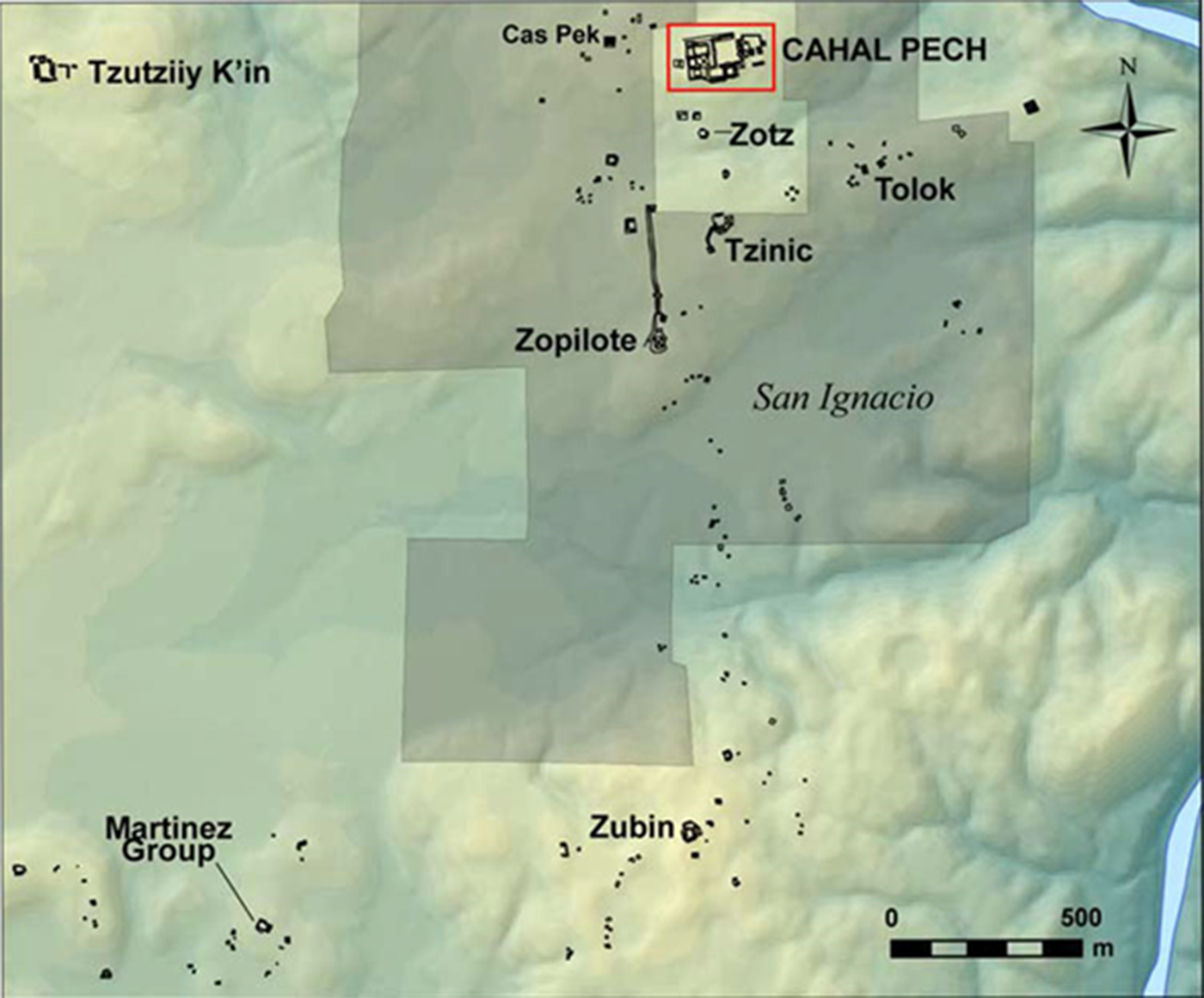
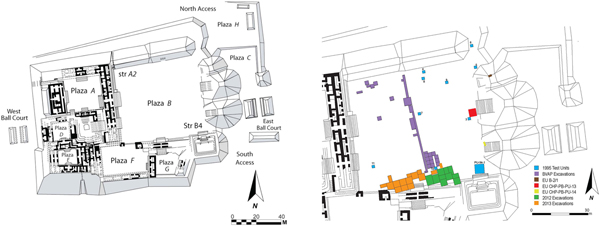
Cahal Pech is located in the outskirts of the modern town of San Ignacio and approximately two kilometers south of the convergence of the Macal and Mopan rivers. The central precinct was built on the crest of a steep hill. It consists of an acropolis composed of at least 34 structures, which are arranged around seven plazas (Awe Reference Awe1992). Plaza B constitutes the largest plaza and possesses the earliest and longest-lived locus of architecture first built around 1200 cal b.c. (Awe Reference Awe1992; Ebert et al. Reference Ebert, May, Culleton and Awe2017). In the sustaining area of the central precinct, there are a number of large settlement clusters, minor centers, plazuela groups, residential units, isolated house-mounds, and a sacbe termini complex (Figure 1; Awe Reference Awe1992; Healy et al. Reference Healy, Cheetham, Powis, Awe and Garber2004). Cahal Pech has a long history of archaeological investigation in both the acropolis and periphery and most of the excavations have yielded a rich dataset of Cunil and Kanluk material culture, which is described in detail elsewhere (Figure 2; Awe Reference Awe1992, Reference Awe2013; Ebert et al. Reference Ebert, May, Culleton and Awe2017; Garber and Awe Reference Garber and Awe2008; Healy et al. Reference Healy, Cheetham, Powis, Awe and Garber2004; Horn Reference Horn2015; Peniche May Reference Peniche May2016).
Map of Cahal Pech showing the relationships between the site core and known peripheral settlements (from Ebert et al. Reference Ebert, Culleton, Awe and J. Kennet2016:4).

Cahal Pech site core (map courtesy of BVAR project) and a detail of Plaza B with distribution of excavation units (after Peniche May Reference Peniche May2016).

Recent excavations conducted by the Belize Valley Archaeological (BVAR) Project in the southern section of Plaza B, immediately adjacent to Structure B-5, aimed to clarify the power strategies employed by leaders and elites of Cahal Pech to acquire, enhance, and legitimize their power over other members of the community during the Cunil and Kanluk phases (Peniche May Reference Peniche May2016). These investigations revealed a long architectural sequence spanning from the Cunil (1200–900 cal b.c.) to the Spanish Lookout phase (a.c. 900–1000; Figure 3). During the Cunil phase, the architectural remains consisted of floors that likely functioned as the surfaces of patios and buildings made of perishable materials (Plaza B/1st–Plaza B/4th). The buildings constructed during the early facet of the Kanluk phase were found in poor condition but it is likely that they were low foundations of circular and apsidal platforms that supported perishable structures (Plaza B/5th–Plaza B/8th). The late facet of the Kanluk phase witnessed increased architectural activity. Two rectangular structures were built consecutively (Plaza B/9th and Plaza B/10th), which were replaced by a key-shaped round structure that held a public function (Plaza B/11th-A). To the west, another domestic rectangular building (Plaza B/11th-B) was built, as well as a small oval feature (Plaza B/11th-C). This group would be gradually covered by a large cobbled platform (Plaza B/12th) with a public function. Comparison between the material culture recovered at Southwest Plaza B and other Cunil and Kanluk contexts elsewhere in the acropolis and periphery provide a foundation from which to examine the power strategies employed by Cahal Pech's social actors.
Plan view of the construction sequence exposed beneath Plaza B (from Peniche May Reference Peniche May2016:149, Figure 4.3).

CUNIL AND KANLUK FIGURINES FROM CAHAL PECH
The Cahal Pech figurine collection includes over 780 specimens recovered from contexts dating from the Cunil to the Spanish Lookout ceramic phases (DeLance Reference DeLance2016). Like in other Mesoamerican collections (Blomster Reference Blomster and Insoll2017:274), the concept of “figurines” at Cahal Pech refers to two different artifact types: figurines and musical instruments such as whistles and ocarinas. Of these figurines, 73.71 percent (n = 575) were recovered in Cunil and Kanluk (late Early and Middle Preclassic) contexts from the acropolis and the peripheral groups of Cas Pek, Tolok, and Zubin (Table 1; Awe Reference Awe1992; Iannone Reference Iannone, Iannone and Conlon1995; Lee Reference Lee, Healy and Awe1996; Lee and Awe Reference Lee, Awe, Healy and Awe1995; Peniche May Reference Peniche May, Hoggarth, Guerra and Awe2012; Powis Reference Powis1996; Powis and Hohman Reference Powis, Hohmann, Healy and Awe1995).
Temporal and spatial distribution of figurines recovered at Cahal Pech (Awe Reference Awe1992; Iannone Reference Iannone, Iannone and Conlon1995; Lee Reference Lee, Healy and Awe1996; Lee and Awe Reference Lee, Awe, Healy and Awe1995; Peniche May Reference Peniche May2016; Powis Reference Powis1996; Powis and Hohman Reference Powis, Hohmann, Healy and Awe1995; Zweig Reference Zweig2010).

a Specimens discovered during the 2011–2013 excavations.
b Corresponds to the Plaza B 10th construction phase.
c Corresponds to the Plaza B 11th-A construction phase.
Figurines Recovered in the Southwest Section of Plaza B
A total of 148 figurines were recovered from the Cunil and Kanluk contexts in SW Plaza B, comprising the 25.74 percent of the Middle Preclassic collection. The anthropomorphic figurines found in SW Plaza B were recovered from construction fill. Like others Preclassic specimens from other sites in the Maya lowlands and Mesoamerica (e.g., Lesure Reference Lesure, Claassen and Joyce1997, Reference Lesure1999; Marcus Reference Marcus1996; Rands and Rands Reference Rands, Rands and Willey1965), the anthropomorphic figurines from SW Plaza B were solid and hand-modeled out of clay, and were likely produced locally. While some figurines were made of an ashy cream paste, similar to Cocoyol Cream ceramics (Cunil phase), the majority of pastes and slips share very close affinity with Belize Valley pottery classified as Savana Orange: Rejolla variety (Kanluk phase). Like their container counterparts, the cream-paste figurines are highly eroded.
Fragments of anthropomorphic figurines include heads (n = 31), appendages (n = 44), and torsos (n = 18). The fact that most Middle Preclassic figurines have been recovered in fragmentary states has intrigued archaeologists. Some researchers state that figurines were subject to natural breakage because joints between heads, limbs, and torsos are the weakest points of these artifacts (e.g., Cyphers Guillén Reference Cyphers Guillén1993; Lesure Reference Lesure2002). Other archaeologists point out that figurine fragments often show a clean breaks and some even exhibited some defacement (e.g., Grove and Gillespie Reference Grove and Gillespie1984). Thus, figurines may have been intentionally broken or terminated after their use, perhaps as a method for killing them or releasing their animate spirit, or ch'ulel, in order to permeate and animate the area where they were left (Rice Reference Rice2015; Stanton et al. Reference Stanton, Brown and Pagliaro2008:235; Walker Reference Walker and Mock1998). The Cahal Pech figurines seem to support the intentional fracture hypothesis because figurines displayed clean breaks along the neckline, punctations around the neckline, and defacement (Zweig Reference Zweig2010:92). In addition, the figurine fragments appear to have been scattered across the site prior to deposition. DeLance (Reference DeLance2016) observed that figurine fragments from the same or nearby excavation units at Cahal Pech generally had small morphological differences in breakage patterns and/or different combinations of ceramic fabric inclusions and surface treatments.
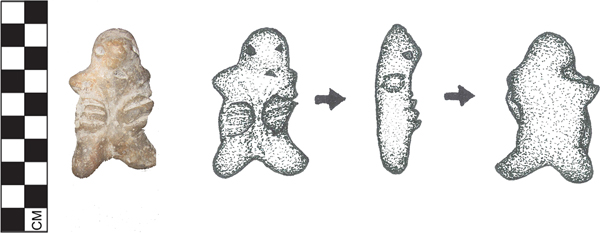
Only one ceramic figurine from SW Plaza B was found complete (Figure 4). It was also the only figurine recovered in a primary context, which consisted of a cache that included a concentration of freshwater shells. This figurine was solid and hand-modeled. Aside from this, it was completely different from all other described specimens. The figurine is relatively small, measuring 5.8 cm in height. It is made of dark brown clay and was finished with a brown slip. It seems to represent an anthropomorphic being, but its facial features and superior appendages are just schematic. The being is portrayed as naked, perhaps wearing a small helmet or headdress. It is standing with its hands across the chest and its feet pointing outward. Because of its schematic features, it was not possible to make an interpretation of its gender. It is similar to the “Charlie Chaplin” figurines reported elsewhere, although this artifact type is usually associated with caches dating to the Late Preclassic and Classic periods (see Lomitola Reference Lomitola2012).
Complete figurine discovered as part of a cache. Photograph by DeLance.

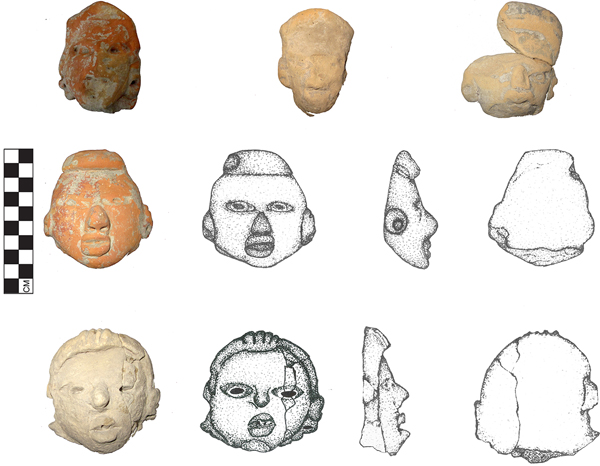
All figurine fragments discovered in SW Plaza B portray nude individuals either standing or seated (Figure 5). One of these specimens portrays an individual sitting cross legged, a position of authority in most of Mesoamerica (Rice Reference Rice2015:10). As Awe (Reference Awe1994) previously noted, figurine heads at Cahal Pech have very similar facial features. Nonetheless, there are slight differences between groups of figurines. Among figurine fragments from SW Plaza B, for instance, individuals wear turban-like headdresses, which display certain stylistic variability (Figure 6). According to Awe (Reference Awe1994), this phenomenon may indicate that these objects depicted different individuals, just like the Olmec colossal heads whose contrasting head gear indicated individuality in spite of their similar facial features.
Anthropomorphic torsos depicting gender-neutral and nude individuals in seated and standing position. Photograph by DeLance.

Anthropomorphic figurine heads. Each object portrays a different individual with a different headdress style. Photograph by DeLance.

The figurines from SW Plaza B are also characterized by exhibiting an absence or ambiguous nature of primary and secondary anatomical attributes. For instance, breasts and genitals are not depicted. Zweig's (Reference Zweig2010) analysis of Preclassic figures from elsewhere in the Cahal Pech site core reached a similar conclusion, and noted that body forms are often neutral. In the same vein, Awe (Reference Awe1992:263) and DeLance (Reference DeLance2016) noticed that, while some figurine fragments found at Cahal Pech clearly depict female or male bodies, by far the largest number of figurine fragments do not indicate the intended biological sex of the figurine. Consequently, this sexual neutrality in the figurines hinders the identification of gender. The same can be stated about secondary sexual characteristics and head ornamentation. It is possible that we do not fully understand the ways in which gender was indicated by the ancient social actors (DeLance Reference DeLance2016) or, as Marcus (Reference Marcus, Halperin, Faust, Taube and Giguet2009) has emphasized, gender could have been signaled through ornamentation, clothing, hair styles or other features that did not preserve. Another possibility is that figurines did not require explicit gender to fulfill their purpose. Marcus (Reference Marcus1998:19) has claimed that although ancestors needed a tangible venue to return to, they did not require a realistic depiction of any specific ancestor. Calling the figurine with the ancestor's name could have been enough to imbue the artifact with the ancestor's spirit and animate it to participate in rituals. It is also possible that figurines were purposefully gender-neutral because ancestors were dual gender (Joyce Reference Joyce2000) or because figurines were used as venues for others animate forces or tutelary deities from the supernatural realm with which the households tried to communicate during rituals for healing, pregnancy, or childbirth (Derilo Tway Reference Derilo Tway2004).
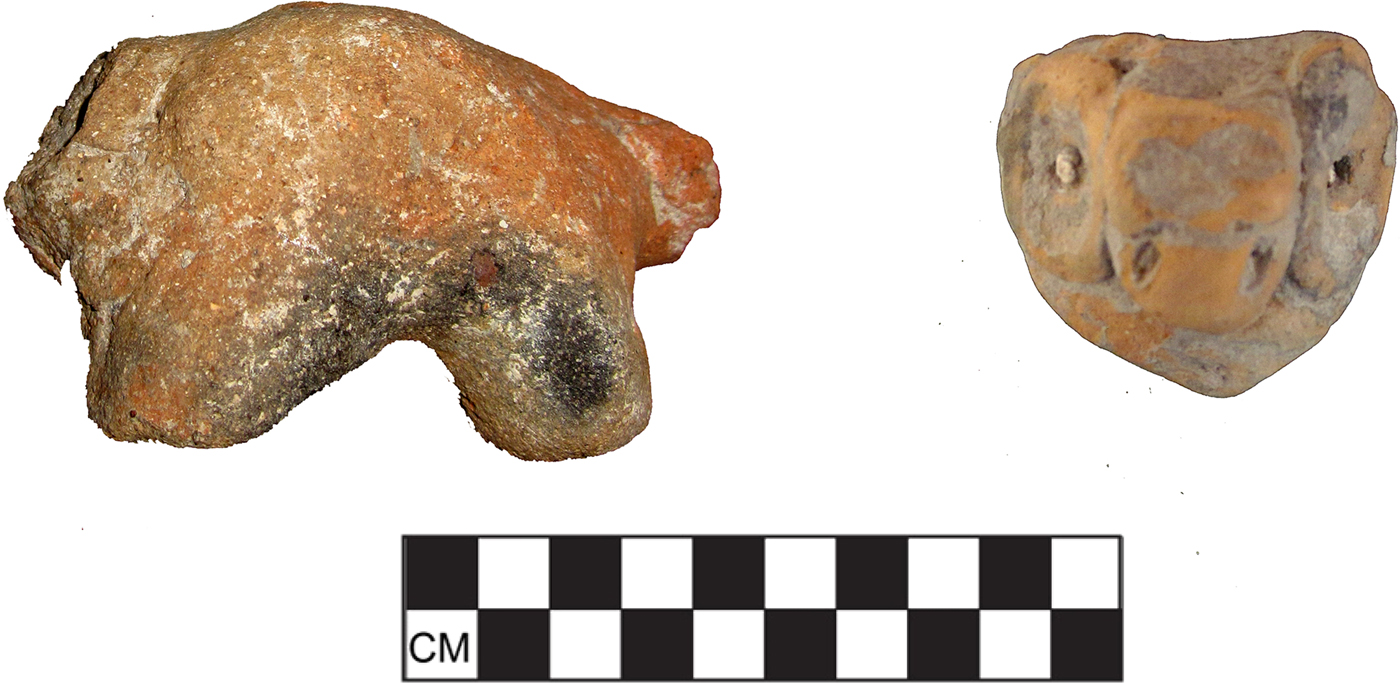
The figurines from SW Plaza B also portray supernatural beings and animals. The best example of a supernatural representation consists of a grotesque character's head whose facial features are not well defined. Like anthropomorphic objects, zoomorphic figurines are solid and hand-modeled using Jocote, Savana, or Cocoyol ceramic pastes (n = 8). With the exception of a complete specimen, most zoomorphic figurines were recovered as fragments (i.e., heads, bodies, and limbs; n = 7). Although Zweig (Reference Zweig2010) identified a variety of animals (feline, frog, howler monkey, dog, armadillo, and some unknown forms), the senior author only identified a bat (Figure 7) in the SW Plaza B assemblage.
Zoomorphic figurine depicting a bat. Photograph by DeLance.

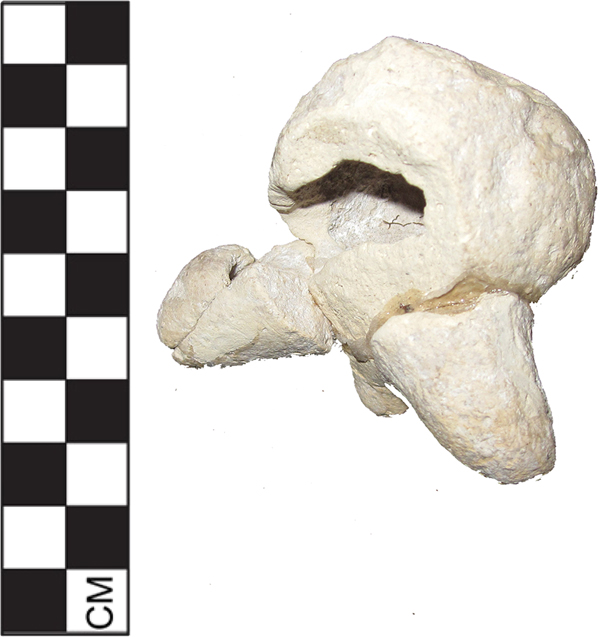
Figurines also took the form of hollow objects that functioned as musical instruments, which are typically made of ashy-cream, orange-brown, and orange pastes. With the exception of one specimen with an orange-red slip, all items are unslipped. The category of musical instrument includes ocarinas and whistles (Figure 8), including three mouthpieces, two resonating chambers, and three complete or almost complete whistles. Mouthpieces and resonating chambers were likely fragmented ocarinas or three-tone whistles. Some zoomorphic heads were probably part of these particular objects because most ocarinas at Cahal Pech are zoomorphic in form, as Zweig (Reference Zweig2010) previously concluded. There exists the possibility that wind instruments also were ritually terminated after their use, which would explain their fragmentary state.
Musical instruments discovered beneath Plaza B. The object at the right has one single stop, while the other two at the left exhibited several stops. Photograph by DeLance.

Because it has been argued that musical instruments fall into the figurine category (Blomster Reference Blomster and Insoll2017:274), one can argue that they held a similar function to anthropomorphic figurines. This notion, however, needs to be tested because the particular form and use of these objects differs from the solid anthropomorphic and zoomorphic figures. For instance, based on an examination of Late Classic musical instruments discovered at the site of Aguateca, located in the Pasión region of Guatemala, Triadan (Reference Triadan2007, Reference Triadan, Inomata and Triadan2014) has argued that musical instruments depicting animals, women, men, and supernatural beings were used during performances carried out in domestic spaces, based on the fact that they were recovered from domestic middens. Triadan (Reference Triadan2007, Reference Triadan, Inomata and Triadan2014) claimed, nonetheless, that these events were public but with a limited audience. Alternatively, Halperin (Reference Halperin2017:533) points out that the Late and Terminal Classic ocarinas recovered in domestic contexts in central Petén may have been used “in an unofficial capacity at large-scale ceremonial events as noisemakers by the crowd,” contributing in this manner to the overall success of public events. Unlike the Classic specimens, the musical instruments of SW Plaza B were recovered from fill below domestic and public structures, suggesting that they were used in both public and domestic events. Thus, these instruments could have been used to play a limited music repertoire during rituals and daily mundane activities. Wind instruments also could have served as toys for children. So far, the social use of these instruments remains poorly understood.
Temporal and Spatial Distribution of Cahal Pech Figurines
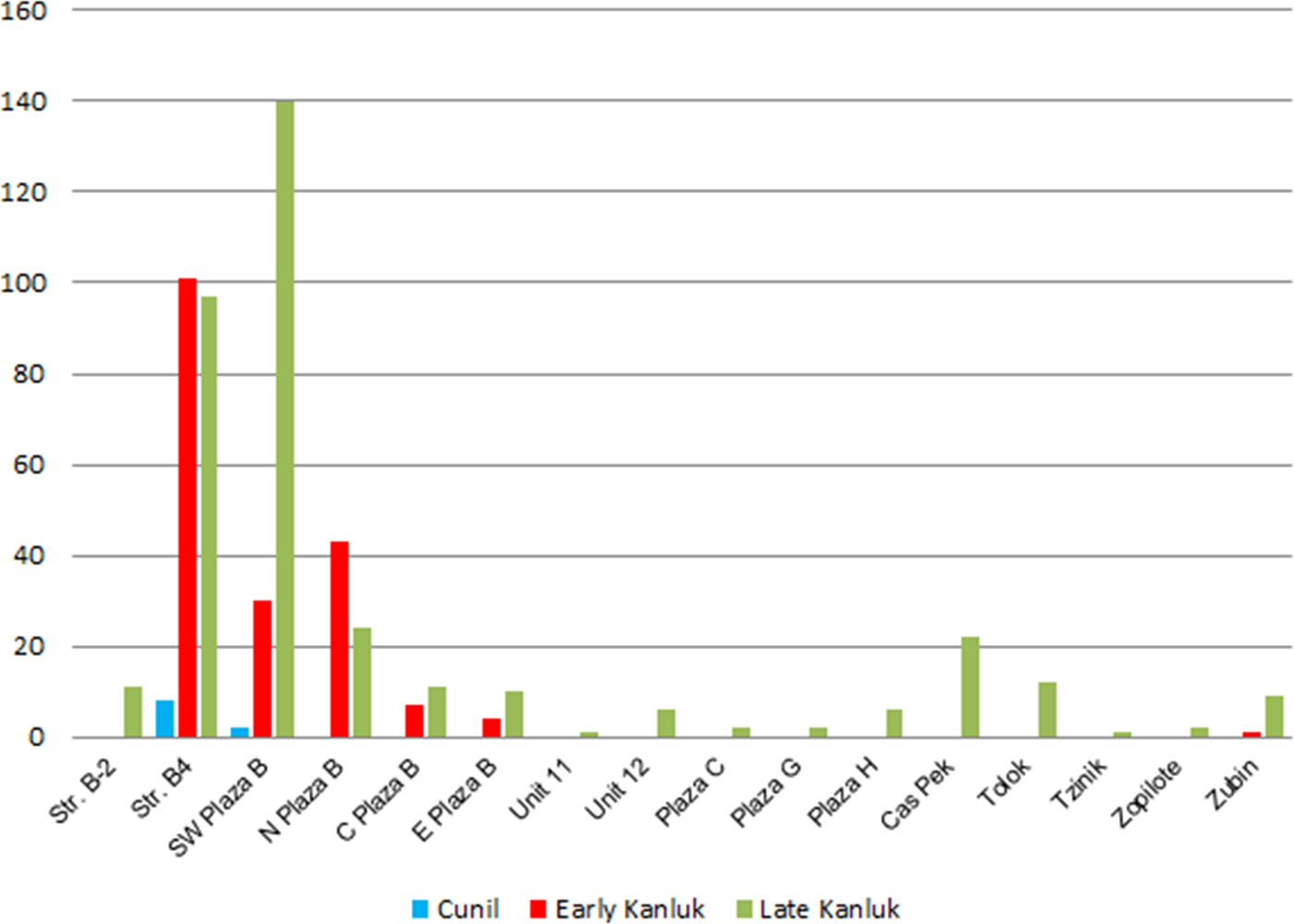
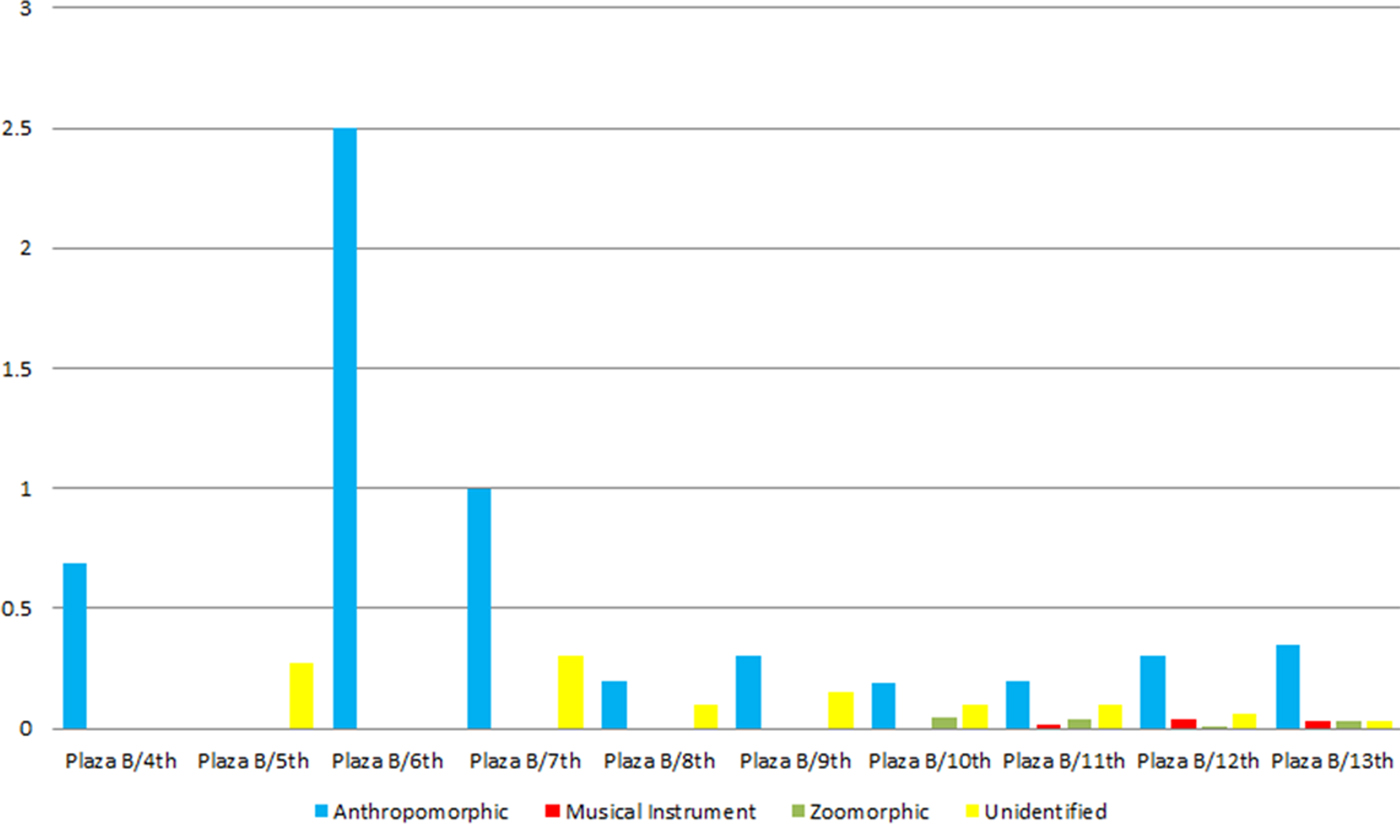
As it was mentioned in Table 1, 575 figurines have been found in Middle Preclassic contexts from the acropolis and peripheral house groups at Cahal Pech (DeLance Reference DeLance2016). Table 1 and Figure 9 present figurine data from Cahal Pech based on the information provided by excavation reports of Plaza B, Cas Pek, Tolok, and Zubin settlement groups and the analysis conducted by Awe (Reference Awe1992) and DeLance (Reference DeLance2016) for their dissertations, as well as the database of the artifacts recovered during the 2011–2013 excavations in SW Plaza B. The distribution of Middle Preclassic figurines recovered in SW Plaza B by construction phase is displayed in Table 2 and Figure 10.
Temporal and spatial distribution of figurines by area and ceramic phase. Compiled by Peniche May.

Percentages of ceramic figurines by construction phase relative to the number of ceramic fragments. Compiled by Peniche May.

Temporal distribution of figurines recovered in SW Plaza B.

During the Cunil phase, known figurines are exclusively associated with the space occupied by Structure B-4 (Awe Reference Awe1992; Peniche May Reference Peniche May2016), which has been interpreted as the oldest residence of the site and inhabited by the founder household (Awe Reference Awe1992; Cheetham Reference Cheetham1998). Even though the figurines were locally manufactured, neither the southwest group nor the northern group used figurines during this phase, although the possibility exists that this is a result of the excavation strategies used for these early contexts. The current contextual evidence suggests that the rituals in which figurines were used were performed exclusively by Structure B-4 household (Cheetham Reference Cheetham1998). Interestingly, this household also had the exclusive control of vessels with pan-Mesoamerican motifs (Awe Reference Awe1992; Garber and Awe Reference Garber and Awe2008), which were likely displayed during communal feasts performed in its residence with the twofold goal of enhancing community cohesion and demonstrating the privileged status of the sponsors (Guernsey Reference Guernsey2012:112). Figurines could have also been displayed during these or similar events hosted by the Structure B-4 household, who borrowed the idea of figurines through their non-local interactions but reinterpreting their meaning and social uses, which “might differ from their senses elsewhere” in Mesoamerica where figurines might be more “democratic” (Rice Reference Rice2015:26).
During the early facet of the Kanluk phase, except for one fragment reported in Structure C9-8th of Zubin, the occurrence of figurines seems to be limited to the core area of Cahal Pech. Structure B-4 continued yielding figurines, implying that figurine rituals continued to be performed in this location even when this building had become public at the beginning of the phase (Awe Reference Awe1992; Peniche May Reference Peniche May2016). After the newly created sacred space was likely built by and for the community, both the space and the communal rituals events held there were likely controlled by the founder's household, as their members could have proclaimed rights over the space as the place where their ancestors used to live (see McAnany Reference McAnany1995). Elsewhere, the senior author has claimed that the founder's household was deeply related to people living at SW Plaza B and it is likely that they formed a single social group (Peniche May Reference Peniche May2016:414). Therefore, the founder's household continued being spatially associated with the newly sacred space of the community. This could be the reason why, at the onset of the Kanluk phase, the performance of figurine rituals was important for the people occupying SW Plaza B. Figurines portraying humans started to be used by the social group inhabiting SW Plaza B during early Kanluk. The relative numbers of figurines based on the frequency of sherds suggests that people occupying the early Kanluk buildings used a larger number of figurines compared to the late Kanluk inhabitants of SW Plaza B, particularly during the Plaza B/5th and Plaza B/6th construction phases. Nevertheless, the relative numbers of figurines decreased during the second part of the early facet, a phenomenon that could be related to the changes in the ritual practices and, perhaps, the political economy of the community.
Unlike the previous phase, during early Kanluk, figurine rituals stop being celebrated only by the southern group. Smaller amounts of figurines portraying human beings recovered in the northern group suggest that ritual practices involving figurines were also performed in this location (Cheetham Reference Cheetham, Healy and Awe1996; Horn Reference Horn2015). Rituals involving figurine use increased at the end of the early facet at this northern architectural group, which is signaled by the finding of a larger amount of figurines in Platform B (Horn Reference Horn2015). The placement of a cache beneath the corners of Platform B also points to changes in ritual activity and ideology of both the domestic group and the community (Garber and Awe Reference Garber and Awe2008:187–189). For example, the deposits associated with Platform B included a variety of materials placed at each corner of the building, including polished greenstone, obsidian chips, and river pebbles in groups of three or thirteen, as well as a headless anthropomorphic figurine and two anthropomorphic heads. One corner of this Preclassic platform also had two stone slab-capped crypts containing a human skull placed in a bowl and a headless skeleton, respectively. Garber and Awe (Reference Garber and Awe2008:189) argue that this cache program was part of a ceremony aimed to venerate an ancestor who was buried beneath the southeast corner of this building. The material culture associated with this space indicates that it was domestic in nature (Horn Reference Horn2015; Horn et al. Reference Horn, Garber and Awe2017). Therefore, it is likely that this cache program was also part of a dedication ritual commemorating the construction of this domestic space (Stanton et al. Reference Stanton, Brown and Pagliaro2008), an event that likely occurred during the Kanluk phase (Horn Reference Horn2015; but see Horn et al. Reference Horn, Garber and Awe2017). The consumption of figurines by the northern group coincides with the site's increasing participation in regional and long-distance exchange networks (Horn Reference Horn2015). These non-local interactions enabled this social group to form a power base to compete with the southern group. Nevertheless, the current evidence suggests that the power strategies implemented by the northern household were not successful (Peniche May Reference Peniche May2016), which is mainly signaled by the absence of construction activity during the following late Kanluk phase (Horn Reference Horn2015).
During the late Kanluk phase, there were many changes in the economic, social, and political systems of the Cahal Pech community (Peniche May Reference Peniche May2016). Several domestic groups settled in the periphery, some of which have provided evidence of figurine use (Iannone Reference Iannone1996; Lee and Awe Reference Awe1994; Powis Reference Powis1996; Powis and Hohman Reference Powis, Hohmann, Healy and Awe1995). A late Kanluk residence at the Cas Pek Group south of the site core contained the largest sample of figurine fragments in the periphery, followed by Structure 1 at the Tolok Group. Interestingly, both residences were the oldest places of construction in their respective neighborhoods, perhaps serving as the residences of the founder's households and the place where a variety of communal events took place. Figurines also occurred in public buildings in the Tolok and Zubin peripheral groups (i.e., Tolok Structure 14 and Zubin Structures C9-7th and C9-6th), although their numbers in those contexts were very low. At the Zubin group south of the site core, two figurine fragments were discovered in an “apparent cache-like arrangement” in front of the retaining wall of Structure C9-7th, which served as a dedicatory deposit for the later Structure C9-6th (Iannone Reference Iannone, Iannone and Conlon1995:46). Thus, although most figurines were recovered as part of the construction fill of domestic buildings, these specialized objects also were used in caches and the fill of public structures, again, implying that they were both sacred and mundane objects (Halperin Reference Halperin2014).
Even though peripheral house groups yielded figurines, the majority of late Kanluk fragments have been discovered in Plaza B (n = 293, 83.95 percent). Other areas of the site core occupied during the late Kanluk have yielded only a few figurines or none at all. In Plaza B, these specialized objects were concentrated in the southern area, where the oldest constructions of the entire site were built (Awe Reference Awe1992; Cheetham Reference Cheetham, Healy and Awe1995, Reference Cheetham, Healy and Awe1996; Peniche May Reference Peniche May, Hoggarth, Ishara-Brito and Awe2013, Reference Peniche May, Hoggarth and Awe2014). It is quite interesting that Structure B-4, which continued serving public functions during the late Kanluk, yielded as many figurines as SW Plaza B, meaning that the rituals in which figurines were used were conducted as intensively as in SW Plaza B.
Rituals in which figurines were used may have increased throughout the late facet of the Kanluk phase. In SW Plaza B, for instance, at the beginning of late Kanluk, the locus of SW Plaza B yielded twelve figurine fragments or 9.84 percent of the late-Kanluk figurine collection considered in this research. When the Plaza B/11th group was occupied, the concentration increased to 53.3 percent. Nevertheless, when the relative percentages of all types of figurines are considered, the increasing importance of these specialized objects during the late facet is not corroborated (Figure 10). These percentages remained relatively constant from the second part of the early facet of the Kanluk phase to the end of the Kanluk phase, suggesting that the frequency in which figurine rituals were performed did not vary during most of the Kanluk phase. In contrast, the relative percentage of only anthropomorphic figurines increased through the late facet of the Kanluk phase. If this type of figurine is related to the frequency in which figurine rituals were conducted, then the performance of these events increased through the late facet of the Kanluk phase, particularly when the Plaza B/11th group and the cobbled platform Plaza B/12th were in use. As the senior author has argued, the Plaza B/11th group included a residence, a small oval feature, and a public keyhole-shaped platform, while the cobbled platform Plaza B/12th was a public space (Peniche May Reference Peniche May2016).
Significance and Uses
Because the sexual ambiguity of figurines hinders interpretation of their meanings and functions, the context of their recovery becomes crucial for understanding the role and significance these small and portable objects played in Preclassic Maya society (Rice Reference Rice2015). Their presence in residential and public spaces and their use in communal rituals suggest that the figurine social uses were diverse and likely included integrative rituals that may have involved divination, life-cycle events, fertility petitions, astro-calendric observations, subsistence-based celebrations, and ancestor veneration rituals (Awe Reference Awe1992:286; Rice Reference Rice2015:15). For example, based on his contextual analysis of figurines in the 1990s, Awe (Reference Awe1992, Reference Awe1994, Reference Awe2013) concluded that the forms, features, and contexts of these effigies indicated that earlier female specimens were likely used in fertility cults. Although figurines at Cahal Pech are gender neutral, our current assessments suggest that, during the Cunil phase, they were restricted to the location of Structure B-4 where they were part of communal rituals hosted by this household and, although these events took place in residential settings, they were likely public celebrations.
Following his analysis based on contextual evidence, Awe (Reference Awe1992:286) pointed out that, during the late Middle Preclassic, male effigies may have represented lineage heads or ruler portraits “in an incipient ancestor cult, and… whistles/ocarinas” served “as musical instruments which were used during funerary and other ritual ceremonies” (Awe Reference Awe1992:286, Reference Awe1994, Reference Awe2013).
The contextual analysis of figurines at Cahal Pech strongly supports the notion that figurines were associated with ancestor worship and invocation. Within the central precinct, for example, the largest number of figurines was found in Str. B-4. Outside of the site core they were recovered in the central platform of the Cas Pek Group, in Str. 1 at Tolok, Str. 2 at Zinic, and Str. 2 at Zotz. Interestingly, these mounds contain the earliest evidence of occupation within their respective patio groups, and they also contain the longest construction sequence within the site core and peripheral settlement clusters. If these mounds represent the initial residences of the founding families at the site, it is possible that the lineage heads and primary ancestors of Middle Formative families may have originally resided in these dwellings. Furthermore, if the heads of figurines were broken off at the termination of divination ceremonies, and if they were subsequently deposited within the residence of the primary ancestors that they represented, this could account for the marked frequency of figurines within these mounds and their relative absence in others (Awe Reference Awe1994:15).
The senior author agrees with the fact that the distribution of anthropomorphic figurines during the late fact of the Kanluk phase signals the loci of residence of the different households or lineages at the site. As Awe (Reference Awe1994; also Peniche May Reference Peniche May2016) previously stated, figurines have been recovered in different architectural groups across the settlement and they are mainly found in the oldest structures with the longest construction sequences. Although not all of these constructions were domestic (Structure B-4 in Plaza B during the Kanluk phase, Tolok Structure 14, and Zubin Structure C9), they were associated with residential spaces. Therefore, it is likely that those private and public locations were used by the founder households of their respective social groups.
Based on the contextual evidence, we also accept that figurines could have been used in rituals aimed to invoke and worship the ancestors of those social groups, analogous to those of Oaxaca. This is particularly true regarding Structure B-4 and SW Plaza B. The high frequency of figurines in this group, where the founders of Cahal Pech lived, may indicate the status of the household/lineage inhabiting this space and the high frequency in which the associated rituals were carried out during the late facet of the Kanluk phase. In contrast, the low numbers of figurine fragments outside Plaza B in the site core and in peripheral structures suggests that the events in which figurines were utilized were conducted sporadically mostly during the second part of the Kanluk phase. The placement of figurines beneath the corners of Platform B and its association to crypts containing a head and a headless torso reinforces the notion that anthropomorphic figurines were considered as representations of ancestors (Garber and Awe Reference Garber and Awe2008) and implies that this use started as early as the early facet of the Kanluk phase.
As we noted in the section Figures Recovered in the Southwest Section of Plaza B, however, lack of explicit primary and secondary sexual attributes do not allow gender to be accurately interpreted. This may seem to hinder the corroboration of the ancestor veneration function since ancestors are generally considered to be male. Were the figurines expressing gender through signs that did not preserve, as Marcus (Reference Marcus1998) suggested? Perhaps we are trying to impose a Western notion and gender representation was not necessary for the figurines to fulfill their purpose because ancestors could have been both male and female individuals or, perhaps, they became dual-gendered as the primordial beings mentioned in the Popol Vuh or the totilme'il (mothers/fathers) of the contemporary Zinacantec Tzotzil speakers (Joyce Reference Joyce2000). Thus, we think that the difficulty of identifying figurine gender should not be an obstacle to conclude that, at least during the late facet of the Kanluk phase, the figurines were used in ancestor veneration rituals. In addition, the discovery of figurines in special contexts suggests their social uses were diverse. For instance, figurines were essential elements in offerings recovered at Structure C-9 in the Zubin periphery group, where they were used as part of dedication rituals (Iannone Reference Iannone, Iannone and Conlon1995:46). Nevertheless, these findings are rare and, because of that, we think that figurines at Cahal Pech during the second part of the Kanluk phase were mainly used to invoke and worship ancestors.
In SW Plaza B, figurines also were recovered in construction fill associated with the late Kanluk public buildings of the area, the keyhole-shaped platform Plaza B/11th-A and the cobbled platform Plaza B-12th. It is likely that some of these rituals were performed on and around the round platform Plaza B/11th-A. If we take into consideration the large open space surrounding the round platform in use during the second part of late Kanluk, it is possible that ritual events carried out there were community-wide, witnessed by a larger audience than the hosting household. Neighboring households or people living in the periphery could have participated either directly or indirectly.
The involvement of other households in those public events is highly significant. On the one hand, the inclusion could have helped create a sense of solidarity among all participants, as well as construct and maintain group identity (Rice Reference Rice2015:16). On the other hand, differential participation in the rituals (people performing the rituals and the audience) may have contributed to social distinctions among households and individuals. Thus, the rituals may have served as a means for manipulating existing social norms and reinforcing new sociopolitical orders and ideologies. Figurines could have, therefore, been related to the emergence of political authority (Rice Reference Rice2015). Musical instruments would have been used as part of the ritual performances. The figurine collection recovered in SW Plaza B reveals that, during the second part of the Kanluk phase, solid zoomorphic figurines and musical instruments were used for the first time along with the anthropomorphic forms. In Halperin's (Reference Halperin2014:203) words, “[m]usical production as a performative act bridges the sacred and magical qualities of some rituals with entertainment and play.” Participants may have played the ocarinas during the rituals events, thus initializing the process of socialization and acquisition of the ideology.
CONCLUSION
Figurines provide valuable information about the social identities and rituals of the ancient communities who used them. As Blomster (Reference Blomster and Insoll2017:294) recently stated, their significance lies not so much in themselves but in the social contexts in which they were used. At Cahal Pech, the 30 years of excavations at the site has yielded a large collection of figurines whose spatial and temporal distribution has contributed to our understanding of the significance and meaning of these specialized objects.
During the Cunil ceramic phase, figurines were restricted to Structure B-4, a space that was probably inhabited by the founder's household of Cahal Pech (Awe Reference Awe1992; Cheetham Reference Cheetham1998). Based on material evidence, it has been suggested that Structure B-4 was also the location where communal feasts took place. Vessels with pan-Mesoamerican motifs, exclusively used by the Structure B-4 household, were likely displayed in these events. Figurines could have been used during these or similar events as venues to invoke supernatural beings, either ancestors or other animate forces. During the early facet of the Kanluk ceramic phase, the use of figurines and their associated rituals spread in the Cahal Pech community. People living in SW Plaza B and the northern architectural group also used figurines. Nevertheless, the largest number of figurines was concentrated in the southern area of Plaza B, including the public building Structure B-4 and the domestic structures in SW Plaza B. In fact, the relative percentage of figurines from SW Plaza B reveals that this social group used the largest amount of figurines during the onset of the Kanluk phase.
During the late facet of the Kanluk ceramic phase, figurines continued to be used by different social groups across Cahal Pech but, like the previous facet, figurines were mainly concentrated in the oldest constructed spaces of Plaza B: Structure B-4 (n = 97, 27.6 percent of the late Kanluk figurines) and the public and domestic buildings in SW Plaza B (n = 140, 39.9 percent of the late Kanluk figurines). This may suggest that social actors using these spaces performed rituals with figurines on a regular basis. Based on the information from SW Plaza B, we can state that the importance of these rituals increased through the second part of the late Kanluk phase, particularly when the Plaza B/11th architectural group and the cobbled platform Plaza B/12th were in use. The performance of these rituals may have been different from those practiced during the early facet of the Kanluk phase. The late Kanluk rituals included music and, perhaps, a more varied audience in terms of gender and age. The large open space around SW Plaza B public buildings and Structure B-4 suggests that neighboring households could have been involved indirectly in those rituals. Figurines were also present in other areas of Plaza B and the site core but their percentage in those contexts was quite low. For instance, in the northern architectural group in Plaza B, only 18 figurine fragments (representing 5.1 percent of the late Kanluk figurine fragments) were recovered from late Kanluk contexts. In peripheral settlements around the Cahal Pech site core, the figurine fragments were found in the oldest structures of Tolok, Zopilote, and Zubin groups, some of which were public spaces (Peniche May Reference Peniche May2016:Appendix 2). Although figurines were used in the periphery, however, the contextual evidence suggests that they were not always used in residential contexts.
The nature of the rituals in which figurines were used is an important point of discussion. Contextual data from Cahal Pech site core supports the hypothesis proposed by Marcus (Reference Marcus1998) for the figurines recovered in Oaxaca, which states the figurines were mainly used in ancestor veneration rituals, although the gender-neutral and asexual characteristics of the figurines hinders the interpretation that figurines represented males. Therefore, if these objects were venues for ancestors, they could have been male, female, or dual gender, as were some supernatural beings. The presence of figurines in public spaces in the site core and periphery suggests that the social uses of these small, portable objects were diverse and were not limited to ancestor worship, particularly during the late facet of the Kanluk phase.
The spatial distribution of figurines during late Kanluk would also seem to indicate that the production/acquisition of these goods was limited in the community. Not all social groups used figurines and those who used them did so in different frequency and, perhaps, for different purposes. The southern group of Plaza B used by far the highest percentage of figurines, indicating that these spaces were the main stage for the presentation of ritual events during the Cunil phase, perhaps suggesting the predominant role that the social group inhabiting this space had in the community. If these events included other social groups, then differential participation could have helped in the process of creating and enhancing asymmetrical power relations. In conclusion, the spatial and temporal distribution of figurines at Cahal Pech provide evidence supporting the ritual significance of these Preclassic effigies, they suggest that the function of figurines may have changed over time, and that the study of these small artifacts can yield important information on the rise of cultural complexity in Mesoamerica.
RESUMEN
Las figurillas de cerámica se encuentran de manera ubicua en el registro arqueológico de Mesoamérica. Estos pequeños objetos portátiles siguen fascinando a los arqueólogos, ya que su papel en la vida cotidiana de las personas que los manufacturaron y utilizaron sigue siendo un tema de debate en algunos círculos académicos. Las figurillas se han interpretado de diversas maneras, como juguetes para niños, amuletos de fertilidad y objetos rituales. En el sitio de Cahal Pech, Cayo, Belice se ha recuperado un gran corpus de figurillas principalmente en rellenos de construcción datando para las fases Cunil (1200–900 a.C.) y Kanluk (900–350 a.C.). En este artículo, analizamos la distribución temporal y espacial de las figurillas en el asentamiento y concluimos que estos objetos fueron usados en una variedad de eventos rituales. Aunque sirvieron principalmente como medios para invocar ancestros en rituales domésticos, su hallazgo en espacios públicos desde el inicio de la fase Kanluk sugiere que las figurillas tuvieron diversos usos sociales y que no se limitaron a rituales para conmemorar ancestros. De manera más importante, su presencia limitada en espacios públicos y privados afuera de la sección sur de Plaza B en el núcleo arquitectónico durante la faceta tardía de la fase Kanluk puede implicar que no todos los grupos sociales de la comunidad pudieron practicar ciertos rituales.
ACKNOWLEDGMENTS
Investigations of the SW Plaza B at Cahal Pech were made possibly by the support of the Tilden Family Foundation, the Belize Valley Archaeological Reconnaissance (BVAR) Project, the Department of Anthropology of University of California, San Diego, and the Consejo Nacional de Ciencia y Tecnología from Mexico (No. de Beca 305696). We thank the Institute of Archaeology, National Institute of Culture and History, Belize for their kind permission to conduct research at Cahal Pech. Excavations in the SW Plaza B were conducted by the 2011-2013 students of the BVAR field school, and by José A. Puc Sr., José A. Puc Jr., Alex Alvarez, Manuel E. Mendez, Dion Towers, Albert Bradley, John Waight, and Jaime Iglesias. This research would not have been possible without their hard work and contributions. We also extend our gratitude to Julie Hoggarth and Jorge Can for their professional assistance and support. Claire Ebert, Miriam J. Gallegos, and three anonymous reviewers provided valuable comments that enriched the final version of this paper.