Introduction
Cognitive impairment in schizophrenia is prominent, persistent and a good predictor of functional outcome (Reichenberg & Harvey, Reference Reichenberg and Harvey2007). Similar but milder cognitive impairments have been demonstrated in unaffected siblings of persons with schizophrenia (Sitskoorn et al. Reference Sitskoorn, Aleman, Ebisch, Appels and Kahn2004). The pathogenesis of cognitive impairments in schizophrenia is complex, being partly inherited and partly resulting from environmental adversities (Morgan et al. Reference Morgan, Croft, Valuri, Zubrick, Bower, McNeil and Jablensky2012).
Low birthweight has been associated with various neurodevelopmental disabilities in the general population, and with poorer cognitive performance in the general population and in persons with schizophrenia (Rifkin et al. Reference Rifkin, Lewis, Jones, Toone and Murray1994; Aarnoudse-Moens et al. Reference Aarnoudse-Moens, Weisglas-Kuperus, van Goudoever and Oosterlaa2009; Tanskanen et al. Reference Tanskanen, Valkama, Haapea, Barnes, Ridler, Miettunen, Murray, Veijola, Jones, Taanila and Isohanni2011). The possible effect of high birthweight has received less attention, although high birthweight is associated with many adversities, such as an elevated risk for obstetric complications (Jolly et al. Reference Jolly, Sebire, Harris, Regan and Robinson2003; Henriksen, Reference Henriksen2008), and associations between high birthweight and learning disabilities, depression and autism have been reported (Kirkegaard et al. Reference Kirkegaard, Obel, Hedegaard and Henriksen2006; Leonard et al. Reference Leonard, Nassar, Bourke, Blair, Mulroy, de Klerk and Bower2008; Van Lieshout & Boyle, Reference Van Lieshout and Boyle2011). Several studies in the general population depicted an association between high birthweight and increased cognitive impairment (Shenkin et al. Reference Shenkin, Starr and Deary2004; Silva et al. Reference Silva, Metha and O'Callaghan2006; Sorensen et al. Reference Sorensen, Mortensen, Reinisch and Mednick2006). Both low birthweight and high birthweight have been associated with increased susceptibility to schizophrenia (Gunnell et al. Reference Gunnell, Rasmussen, Fouskakis, Tynelius and Harrison2003; Abel et al. Reference Abel, Wicks, Susser, Dalman, Pedersen, Mortensen and Webb2010; Wegelius et al. Reference Wegelius, Tuulio-Henriksson, Pankakoski, Haukka, Lehto, Paunio, Lönnqvist and Suvisaari2011).
Some studies have suggested that people with a high genetic risk for schizophrenia are more susceptible to the effects of obstetric complications. Cannon et al. (Reference Cannon, van Erp, Rosso, Huttunen, Lönnqvist, Pirkola, Salonen, Valanne, Poutanen and Standertskjold-Nordenstam2002) observed that obstetric complications indicating fetal hypoxia are associated with greater structural brain abnormalities in people with schizophrenia and their unaffected siblings than in controls at low genetic risk for schizophrenia. Furthermore, the effects of hypoxia on brain structure were more widespread in people with schizophrenia than their siblings, suggesting that there was an additional vulnerability in people with schizophrenia compared to their unaffected siblings (Cannon et al. Reference Cannon, van Erp, Rosso, Huttunen, Lönnqvist, Pirkola, Salonen, Valanne, Poutanen and Standertskjold-Nordenstam2002). In addition, a study with a small sample size found that low birthweight had a stronger effect on cognitive functions in persons with schizophrenia than in controls (Freedman et al. Reference Freedman, Bao, Kremen, Vinogradov, McKeague and Brown2012).
In the present study, which represents the first study of its kind, we set out to investigate whether low or high birthweight is associated with increased cognitive impairment in patients with schizophrenia and their unaffected first-degree relatives and whether the effect of birthweight on cognition is different in these groups. Based on previous research in the general population, we hypothesized that both high and low birthweight would be associated with cognitive deficits and that the effect would be more pronounced in patients than in unaffected first-degree relatives.
Method
Participants
Persons with schizophrenia, schizo-affective disorder or schizophreniform disorder and born between 1940 and 1976 were identified from the Finnish Hospital Discharge Register, the Pension Register and the Medication Reimbursement Register, and their families from the Population Register Centre (Torniainen et al. Reference Torniainen, Suvisaari, Partonen, Castaneda, Kuha, Perälä, Saarni, Lönnqvist and Tuulio-Henriksson2011; Wegelius et al. Reference Wegelius, Tuulio-Henriksson, Pankakoski, Haukka, Lehto, Paunio, Lönnqvist and Suvisaari2011). From the identified families, we compiled two samples with assumed high genetic risk for schizophrenia. The all-Finland sample consisted of families with at least two siblings with schizophrenia, schizo-affective disorder or schizophreniform disorder (Hoti et al. Reference Hoti, Tuulio-Henriksson, Haukka, Partonen, Holmström and Lönnqvist2004). The isolate sample consisted of families with at least one sibling with schizophrenia and one parent born within a genetically isolated region in northeastern Finland, in which the prevalence of schizophrenia is known to be high (Hovatta et al. Reference Hovatta, Terwilliger, Lichtermann, Mäkikyrö, Suvisaari, Peltonen and Lönnqvist1997; Arajärvi et al. Reference Arajärvi, Haukka, Varilo, Suokas, Juvonen, Suvisaari, Muhonen, Suominen, Tuulio-Henriksson, Schreck, Hovatta, Partonen and Lönnqvist2004). The isolate region is rural with one primary care hospital. The nearest hospital with specialized services is 200 km away (Videman & Heikkilä, Reference Videman and Heikkilä1978).
Written informed consent was obtained from each participant. The lifetime diagnoses of the participants were made by two independent psychiatrists on the basis of the Structured Clinical Interview for DSM-IV Axis I Disorders, Clinician Version (SCID-CV; First et al. Reference First, Spitzer, Gibbon and Williams1996) and case records from hospitals and out-patient treatments.
A total of 280 patients with schizophrenia and 567 first-degree relatives without a lifetime diagnosis of psychotic disorder or bipolar disorder were interviewed and a neuropsychological test battery was administered. The exclusion criteria for the current study were: age >70 years, a severe neurological or general medical condition, mental retardation, current substance use disorder, untestable, for example due to severe disorganized symptoms and, in the relatives group, current psychiatric disorder. After applying the exclusion criteria, the schizophrenia group comprised 218 persons and the relatives group 438 persons. We had birthweight data for 142 (65%) persons in the schizophrenia group and 277 (63%) persons in the relatives group.
Assessment methods
Cognitive assessment
The cognitive variables used in the present study were: the Vocabulary subtest, the Similarities subtest, the Block Design subtest and the Digit Symbol subtest from the Wechsler Adult Intelligence Scale – Revised (WAIS-R; Wechsler, Reference Wechsler1981); parts A and B of the Trail Making Test (Reitan & Wolfson, Reference Reitan and Wolfson1985); the interference score from the Stroop test (Golden, Reference Golden1978; MacLeod, Reference MacLeod1991); the Digit Span Forward and Backward tasks and the Visual Span Forward and Backward tasks from the Wechsler Memory Scale – Revised (WMS-R; Wechsler, Reference Wechsler1987); and immediate recall (sum of trials 1–5), short delay recall and long delay recall in the California Verbal Learning Test (CVLT; Delis et al. Reference Delis, Kramer, Kaplan and Ober1987).
In a previous study we reported large, generalized cognitive impairments in the schizophrenia group and impaired processing speed and set-shifting in the relatives group (Torniainen et al. Reference Torniainen, Suvisaari, Partonen, Castaneda, Kuha, Perälä, Saarni, Lönnqvist and Tuulio-Henriksson2011). Persons in the relatives group outperformed persons with schizophrenia in all the variables used.
Birthweight
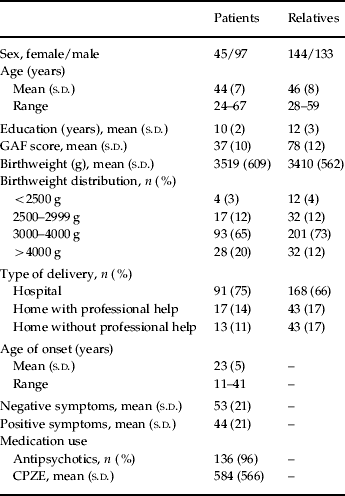
Birthweights were collected from obstetric and health-care records. Of the sample, 69% were born in hospitals, 16% at home with professional help and 15% at home without professional help (Table 1).
Demographic and clinical characteristics

GAF, Global Assessment of Functioning; CPZE, chlorpromazine equivalents; s.d., standard deviation.
Covariates
For covariates in the statistical analyses, we chose those characteristics that might have an impact on cognitive functioning. The type of delivery (hospital versus home with professional assistance versus home without professional assistance) was included as a covariate because possible complications, which are more probable in persons with low or high birthweight than in persons with intermediate birthweight, would be more difficult to treat at home than at hospital. The Global Assessment of Functioning (GAF; APA, 2000) reflects the level of functioning and symptom severity. The GAF score is related to cognitive functioning (Karilampi et al. Reference Karilampi, Helldin and Archer2011). Familial loading for the illness may have a small effect on cognitive functioning (Tuulio-Henriksson et al. Reference Tuulio-Henriksson, Arajärvi, Partonen, Haukka, Varilo, Schreck, Cannon and Lönnqvist2003) and therefore the number of affected siblings in each family was included as a covariate. The place of birth (isolate versus the rest of Finland) was included in the analyses to ensure that the sampling method did not confound the results. Age and sex were also used as covariates.
Statistical analyses
Statistical analyses were performed with Intercooled Stata v. 9.2 for Windows (StataCorp, USA). Because the assessed variables are correlated within families (Hoti et al. Reference Hoti, Tuulio-Henriksson, Haukka, Partonen, Holmström and Lönnqvist2004), the analyses were performed with the generalized estimating equation (GEE) approach. The method takes this correlation into account and estimates unbiased population-averaged regression coefficients (Zeger & Liang, Reference Zeger and Liang1986).
In the statistical models, birthweight (in kg) was entered as a continuous variable. A statistically significant squared birthweight indicates that the association between birthweight and cognitive functioning is not linear but instead follows a curvilinear trajectory. We analyzed whether the association between birthweight and cognitive performance was different in the schizophrenia and the relatives groups by group × birthweight and group × squared birthweight interactions. Non-significant interactions were removed from the analyses. The probability level p < 0.05 indicated statistical significance. The effect size of the mean differences between the schizophrenia and the relatives group was measured with Cohen's d (Cohen, Reference Cohen1988). Effect sizes of >0.20, >0.50 and >0.80 were considered as small, medium and large respectively.
Results
Demographic and clinical characteristics
In the schizophrenia group, men were over-represented (68%), whereas in the relatives group, the number of men (48%) and women (52%) was more equally balanced. In the schizophrenia group, 15% had a birthweight <3000 g and in the relatives group, 16%. Of the patients, 20% had a birthweight >4000 g and of the relatives, 12%. Demographic and clinical characteristics are presented in detail in Table 1.
Birthweight and cognitive functioning
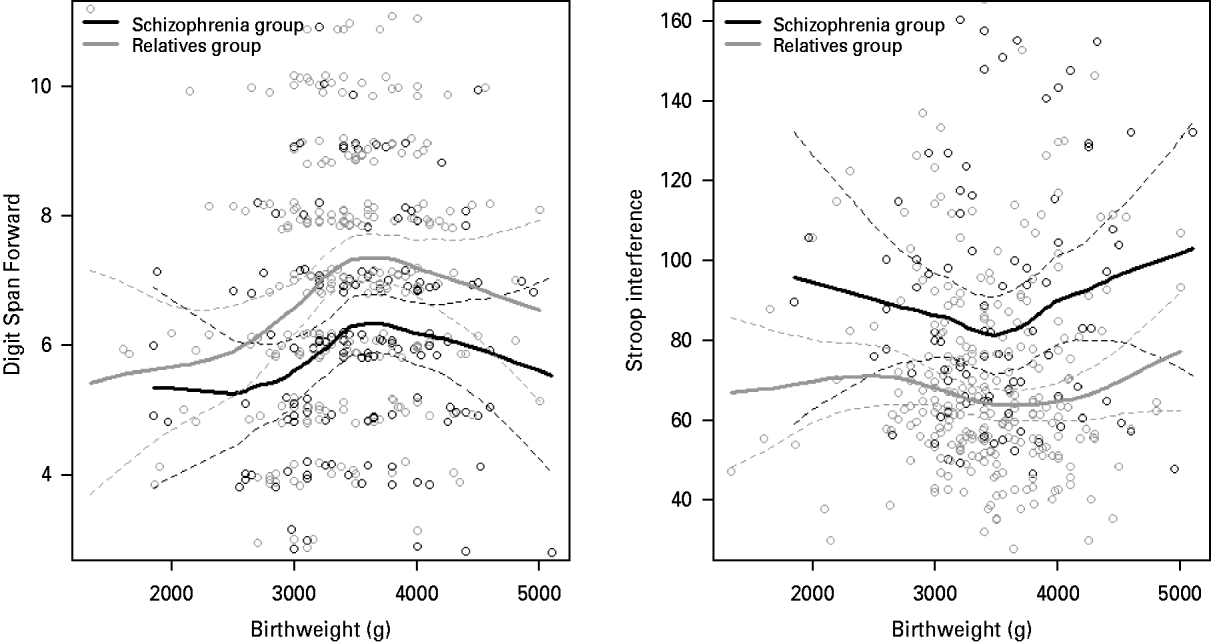
When examining scatter plots with LOWESS (locally weighted scatter plot smoothing) curves (see online Supplementary Material), the association between birthweight and several cognitive variables, including Digit Span Forward (Fig. 1), was seen to be non-linear, with both low and high birthweight being associated with poorer performance than average birthweight. The association between birthweight and most of the cognitive variables was similar in the schizophrenia and relatives groups.
Scatter plots with LOWESS curves and 95% confidence intervals of the association between birthweight and cognitive performance. High scores in the Digit Span Forward task and low scores in the Stroop interference reflect good performance.
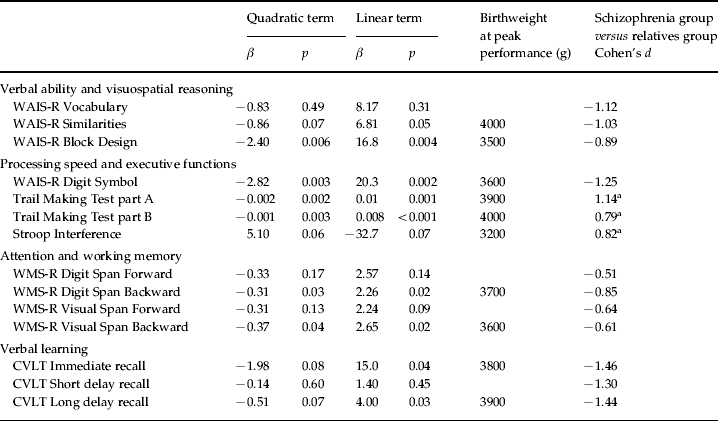
The association between birthweight and cognitive performance was statistically significant and followed a curvilinear trajectory in the Block Design subtest, the Digit Symbol subtest, the Trail Making Test parts A and B, and the Digit Span Backward and the Visual Span Backward tasks (Table 2), when controlling for the type of delivery (hospital versus home with professional assistance versus home without professional assistance), the GAF score, the number of affected siblings per family, place of birth (isolate versus the rest of Finland), age and sex. A curvilinear association of borderline statistical significance was observed between birthweight and performance in the Similarities subtest, the Stroop interference and immediate and long delay recall in the CVLT. In the tests where the association was non-linear, a birthweight of approximately 3500–4000 g was associated with the highest performance. The group × birthweight interactions were non-significant.
The association between birthweight and cognitive performance in GEE models and the birthweight where cognitive performance was the highest. The birthweight of the highest performance was reported if the association between a cognitive variable and birthweight was significant at least at trend level (p < 0.10). The effect size of the group difference between the schizophrenia group and the relatives group is also shown
GEE, Generalized estimating equation; WAIS-R, Wechsler Adult Intelligence Scale – Revised; WMS-R, Wechsler Memory Scale – Revised; CVLT, California Verbal Learning Test.
a High scores represent low performance.
Discussion
The association between birthweight and cognitive functioning was similar in persons with schizophrenia and their unaffected first-degree relatives, even though the impairments were larger in the schizophrenia group than in the relatives group (Torniainen et al. Reference Torniainen, Suvisaari, Partonen, Castaneda, Kuha, Perälä, Saarni, Lönnqvist and Tuulio-Henriksson2011). Persons in the intermediate birthweight range had the highest cognitive performance and both low birthweight and high birthweight were associated with small impairments in visuospatial reasoning, processing speed, set-shifting, and verbal and visual working memory.
Our results on persons with schizophrenia and their first-degree relatives are in line with studies in the general population. In previous studies, cognitive performance was reported to be lower in persons with low birthweight than in persons with birthweight in the intermediate range in the general population and also in persons with schizophrenia (Rifkin et al. Reference Rifkin, Lewis, Jones, Toone and Murray1994; Tanskanen et al. Reference Tanskanen, Valkama, Haapea, Barnes, Ridler, Miettunen, Murray, Veijola, Jones, Taanila and Isohanni2011). To date, research has focused predominantly on the association between low birthweight and cognitive functioning whereas few studies have investigated high birthweight. However, some studies in the general population have suggested that high birthweight may increase the risk for cognitive impairments (Shenkin et al. Reference Shenkin, Starr and Deary2004).
The association between low birthweight and cognitive impairments may stem from adverse effects during pregnancy, such as inadequate supply of nutrients and oxygen to the fetus altering brain growth and causing many adaptations in endocrine and metabolic processes (e.g. in glucocorticoids and insulin-like growth factors, IGFs), referred to as ‘fetal programming’ (Morgane et al. Reference Morgane, Austin-LaFrance, Bronzino, Tonkiss, Diaz-Cintra, Cintra, Kemper and Galler1993; Barker, Reference Barker1995; Fowden et al. Reference Fowden, Giussani and Forhead2006). In addition, low birthweight may result from pre-term birth, which has been shown to have negative effects on brain development and cognitive functioning (Volpe, Reference Volpe2009; Baron et al. Reference Baron, Litman, Ahronovich and Baker2012). Little is known about the mechanisms underlying the association between high birthweight and cognition. Similar mechanisms related to fetal adaptations to suboptimal intrauterine environment, caused for example by maternal diabetes, might be involved (Van Lieshout & Voruganti, Reference Van Lieshout and Voruganti2008). High birthweight is also associated with elevated risk for complications, which may affect cognition (Henriksen, Reference Henriksen2008). In particular, the risk of a prolonged second stage of labor is increased, and Caesarean section is more often required in deliveries of large babies compared to babies of average birthweight (Koskela, Reference Koskela1965). This might be a problem when the baby is born at home or in a local hospital where personnel lack the expertise for performing Caesarean sections. Both of these situations were relatively common in the rural areas of Finland at the time this study population was born.
The effects of a suboptimal intrauterine environment on brain development are diverse (Morgane et al. Reference Morgane, Austin-LaFrance, Bronzino, Tonkiss, Diaz-Cintra, Cintra, Kemper and Galler1993). The results of the present study are in agreement with diverse impairments in cognitive functions in persons with low or high birthweight. The results suggest that the widespread influence of a suboptimal intrauterine environment may be one of the factors contributing to broad cognitive impairments in schizophrenia. The strongest effect of birthweight was detected in tasks demanding processing speed, which has also shown pronounced impairments compared to other cognitive functions in schizophrenia (Dickinson et al. Reference Dickinson, Ramsey and Gold2007). Processing speed impairments have been detected before illness onset both in persons with subclinical psychotic experiences and in persons who later develop schizophrenia (Cannon et al. Reference Cannon, Moffitt, Caspi, Murray, Harrington and Poulton2006; Kelleher et al. Reference Kelleher, Clarke, Rawdon, Murphy and Cannon2012). Processing speed is dependent on distributed brain networks and the integrity of white matter tracks, which, in earlier studies, were found to be impaired in persons with low birthweight or pre-term birth (Skranes et al. Reference Skranes, Vangberg, Kulseng, Indredavik, Evensen, Martinussen, Dale, Haraldseth and Brubakk2007; Turken et al. Reference Turken, Whitfield-Gabrieli, Bammer, Baldo, Dronkers and Gabrieli2008; Allin et al. Reference Allin, Kontis, Walshe, Wyatt, Barker, Kanaan, McGuire, Rifkin, Murray and Nosarti2011).
The limitations of our study include the lack of a control group or a patient group without familial loading for schizophrenia, and therefore we do not know if the effects of birthweight differ in magnitude in patients with or without familial loading for schizophrenia or among the general population. The results of the present study only show that the pattern is the same as that found in studies on general populations. In addition, we did not have data on gestational age and therefore were not able to discern the effects of gestational age at birth and of fetal growth on the association between birthweight and cognitive functioning.
The strengths of the study include obtaining birthweights from obstetric records rather than relying on maternal recall. In addition, the sample was large and identified from health-care registers, which improves the representativeness of the sample because persons with schizophrenia without a current treatment contact were also included in the sample.
To conclude, both low birthweight and high birthweight were found to be associated with impairments in several cognitive functions among persons with schizophrenia and their unaffected first-degree relatives. The association between birthweight and cognitive functions was similar in both groups. The cognitive impairments in persons with low and high birthweight resemble results from previous studies of the general population. This suggests that our findings may reflect a general effect of birthweight on cognition that is not modified by the illness.
Supplementary material
For supplementary material accompanying this paper visit http://dx.doi.org/10.1017/S0033291713000032.
Acknowledgments
This study was funded by grants from the Sigrid Juselius Foundation to J. Lönnqvist and J. Suvisaari (129434).
Declaration of Interest
J. Suvisaari has served as a consultant for Janssen Cilag in a study that is not related to this manuscript. A. Wegelius has received an unrestricted research grant from Lundbeck Oy.