Introduction
On the afternoon of March 11, 2011, a major earthquake of 9.0 magnitude occurred 120 km off the northeastern coast of Japan, at a depth of 20 km below sea level. 1 The earthquake was followed within a short period of time by a 10-meter tsunami, causing widespread destruction. The majority of loss of life and property were caused by the tsunami. 2
Within the first hours after the tsunami hit Japan, the Japanese Government declared a state of atomic emergency due to the damage to the Fukushima Nuclear Power Plant (Futaba District, Okuma, Japan). Mandatory evacuation had been declared at a radius of 10 km from the nuclear plant, and it was later broadened to 30 km around the plant. The US military announced it would not allow its troops to be within 80 km of the Fukushima plant. 3 The radioactivity levels of environmental and water measurements in the inspected relevant areas, including Tokyo, were published for the public by the Japanese Government. The International Atomic Energy Agency (IAEA) raised the incident level at the nuclear site from four to five (on a 1-7 scale) during the first days following the tsunami, and subsequently, it raised it to the maximum level. 4 During the response phase, the Japanese Government received many official offers for assistance from more than 100 countries, but it accepted only a few international delegations. 5 The state of Israel was one of the countries offering assistance, and after two weeks, a medical support team was deployed once Japanese approval was received.
The willingness of personnel to be deployed to affected areas by a disaster with potentially unknown risk is a very interesting issue. The willingness of health care workers to report during catastrophic events, such as fire, terrorist attack, war time, or during a pandemic, has a major influence on the ability to respond. 6 - Reference Masterson, Steffen, Brin, Kordick and Christos 16 Many factors have been reported to influence personal willingness to report to work during catastrophic events, including concerns for childcare, eldercare, and pet care; fear and concern for the safety of families; personal health issues; gender of personnel; and available means of transportation. 6 - Reference Hope 13
Although extensive research has been published evaluating the willingness of health care workers to report to work during a catastrophic event in general, an absence of studies was found describing the willingness of international delegations to be deployed to areas with high risk of radiation. No article dealing with volunteers in international delegations that have to go to an unknown threat at the affected area (a radiology event) was found. The Israeli delegation to Japan for the 2011 earthquake was chosen as a case study.
The aim of this study was to assess personal willingness to respond to disaster, as a part of an international delegation, to an area with unknown and unclear risk of radioactive materials. The assumption was that there would be a difference personal willingness between those to be deployed overseas for the first time and those who have been deployed in the past.
Methods
Sample and Data Collection
The survey was conducted during the first two weeks after the tsunami disaster in Japan, March 11-25, 2011. The population was selected randomly from lists of 400 relevant disaster response personnel provided by governmental agencies, without any specific exclusion criteria. It included a variety of trained disaster-response professionals, such as medical doctors (MDs), nurses, paramedics, Urban Search and Rescue (USAR) team members, and logistic personnel. None of them had received specific radiological training; however, everyone had a chance of being deployed to the disaster scene in Japan, if such a mission were to be initiated. It included personnel who were deployed in the past as a part of the delegation to assist a foreign country during a disaster in the response phase, and relevant personnel who could have been deployed for the first time as part of an international delegation. A pretest was conducted with a similar population in order to validate the survey form by interviewing the participants about their understanding of the study questions. The survey itself was sent to random team members by email or printed surveys. It is important to note that as the target was to evaluate the willingness to be deployed before the actual deployment, very little time was available for study preparation. There was no need for an ethical board review or Helsinki approval, since the data does not have any personal identifying details.
The survey tool consisted of two main sections: a demographic section and an attitudes section. It included eight questions, of which all but one were closed ended. Three questions were demographic questions, and four questions were based on a Likert scale with answers between 1 and 5 (1 represented no concern and 5 represented very high concern). The responders could also indicate “don't know” or “irrelevant.”
The survey was conducted in Hebrew. The margin of error for the survey was calculated as a function of sample size and maximum sample proportion:
 $$--><$>{\rm{MOE}} = {\rm{z}}\alpha {\rm{/2\,\ast \,sqrt\{ p\ast(1 - p)/n\} }}$$$
where α = .05, zα/2 = 1.96, P = .5 and n = 94.
The sample was divided into two groups; the first group included people who were deployed in the past as a part of a delegation to assist a foreign country during a disaster in the response phase, and the second group included personnel who were to be deployed for the first time as a part of the delegation, and had not previously been deployed on an international delegation.
In order to assess the influence of a possible or actual radioactive leak, three main questions were included in the study, which differed by the assumed level of radioactive leak: “To what extent was the risk in Japan after the earthquake in a (nonleak situation, possible radioactive leak, and uncontrolled leak) a factor in your decision to participate as a member of the delegation to Japan?”
Statistical Analysis
Descriptive analyses were performed to characterize and evaluate the willingness to be deployed to Japan with unknown risk of radioactivity, and to evaluate differences among personnel with previous experience versus personnel without previous experience in an international support delegation to a disaster zone. A chi-square test was used in order to analyze the differences between the groups. Spearman correlations were made, and the Wilcoxon nonparametric test with Bonferroni correction for multiple comparisons was preformed to compare the level of concern in different levels of radioactive leak. The SPSS Statistical Application (Version 15, Armonk, New York USA) was employed for all data analysis in this paper.
Results
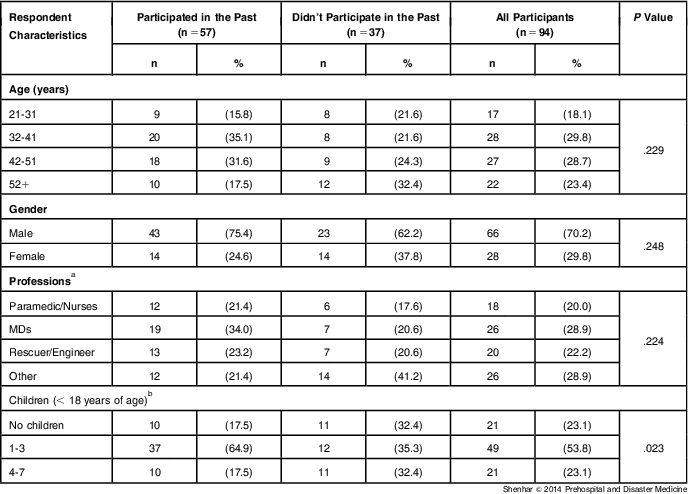
After distributing the survey form, 94 anonymous answers were received by email or fax (a 69% participation rate). The calculated margin of error was SD = 10. Table 1 presents the main sociodemographic characteristics of the sample (n = 94). Seventy percent were male, and the professions included: MDs, rescuers, paramedic, nurses, and others. Although a significant difference regarding family size was found (Table 1), it needed to be checked if being a parent had any influence on the willingness to be deployed. No significant difference was found regarding the number of children on the willingness to participate.
Sociodemographic Characteristics of the Participants

Abbreviation: MD, medical doctor.
a Data on professions missing n = 4 (4.3%).
b Data on children missing n = 3 (3.2%).
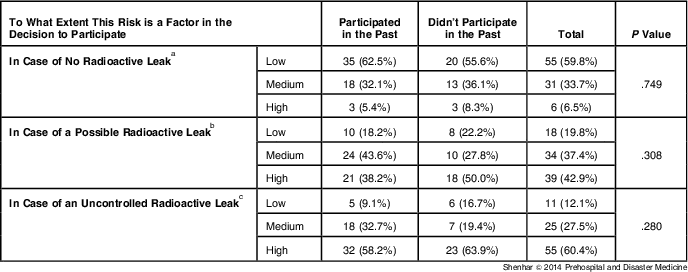
Table 2 presents a comparison between those with and without previous delegation experience regarding willingness to be deployed, in spite of concern in three assumed cases of risk: no radioactive leak, possible for radioactive leak, and uncontrolled leak. “Low” represents those who answered 1 or 2 [don't have any concerns (1) or low concern (2)]. “Medium” represents those who answered 3 [concern level is medium (3)]. “High” represents those who answered 4 or 5 [level of concern is high (4) or level of very high concern (5)].
To What Extent Does a Different Level of Risk Influence Either New Delegates or Returning Delegates?

a Data missing n = 2 (2.1%).
b Data missing n = 3 (3.2%).
c Data missing n = 3 (3.2%).
Table 2 demonstrates that as the situation on the ground becomes worse, the willingness to be deployed drops dramatically; no significant differences were found in willingness between the two study groups (participated or didn't participate in a delegation in the past). Yet, it is still important to note that, even during the worst situation on the ground, there were people who were willing to be deployed.
In Table 3, comparisons were made to evaluate willingness of the participants to be deployed, in spite of personal concern in the event of: no radioactive leak (A), compared to possible radioactive leak (B), and compared to uncontrolled leak (C). As the median number was higher, it represented a higher personal concern. In this case, significant differences were found in willingness to be deployed in a delegation among levels A, B, and C. As the situation on the ground was getting worse, personal willingness to be deployed was decreasing. These findings were similar to what was shown in Table 2. In the possible radioactive leak scenario, the willingness to be deployed was lower than in a no leak situation; and in an uncontrolled radioactive leak, the willingness to be deployed was the lowest.
Comparisons of Concern About Being Deployed in Possible Settings of Radioactivity Leak (Median (25%-75%)

a Wilcoxon test with Bonferroni correction for multiple comparisons.
Correlation calculations were made between the levels of personal concern in the three modes of radioactive leakage risk. A significant positive correlation was found in the levels of personal concern with the three possible levels of radioactive leak (Table 4).
Correlation Between the Levels of Personal Concern in Three Modes of Radioactive Leakage Risk

a Spearman's rho Correlations, P value < .01.
A high correlation was found between (A) and (B). When the concern in no leak (A) rose, the concern in possible leak (B) rose too (r = .6, P < .01). Additionally, a strong correlation was found between (B) and (C). When the concern in possible leak (B) rose, the concern in uncontrolled leak (C) rose too (r = .79, P < .01). Finally, a high correlation was found between (A) and (C). When the concern in no leak (A) rose, the concern in uncontrolled leak (C) rose too (r = 0.44, P < .01).
Discussion
Previous studies tried to evaluate the influence of situations, such as pandemics, fires, terror attack, and war time (including the possibility for unconventional warfare tactics), on willingness of health care providers and first responders to report to work in their own country. In this paper, an attempt was made to understand the influence of an unknown risk of radioactivity in a foreign country on willingness of international delegation to be deployed. The impact of different factors, such as previous experience and concern for one's family, on the readiness of Israeli responders in the context of a foreign emergency scene with unknown levels of radiological risks also were assessed. The Japan 2011 earthquake was chosen as a case study.
In both study groups, the willingness to respond varied by the event scale. As the leak situation became more serious, the willingness to participate decreased and personal concern rose. Personal concern in the case of no leak rose from 6.5% to 42.9% in the case of a possible leak, and further rose to 60.4% in the case of an uncontrolled leak. This is similar to previous studies that reported that willingness to report for duty varied by event type.
Balicer et al noted the decreased readiness (about 61%) of hospital personnel to respond to a radiological terror attack.Reference Balicer, Catlett and Barnett 14 Kob and LimReference Koh, Lim and Chia 15 evaluated the influence of the severe acute respiratory syndrome (SARS) outbreak on the willingness to respond to work in Singapore. About 70% were willing to report for duty in spite of the risk. MastersonReference Masterson, Steffen, Brin, Kordick and Christos 16 examined emergency department (ED) personnel's willingness to respond to various terror events, including radioactive bomb, biologic event, and airplane crash. Teams were more willing to work additional hours for victims of an airplane crash (98.0%), than for a radioactive bomb (85.3%), or a biologic agent (54.0%).
More specific to the context of this survey, an Israeli study found that during the First Gulf War (1991), 42% of the hospital personnel in Israel reported that they were willing to work despite the threat of an unconventional missile attack, thus, confirming the readiness of response personnel to risk their lives in order to assist in a major event.Reference Shapira, Marganitt, Roziner, Shochet, Bar and Shemer 7 Yet, the applicability of all these studies to this case is limited, as they dealt with the readiness of people to respond in their own countries under a threat, while this study dealt with the motivation to respond abroad.
Previous literatureReference Shapira, Marganitt, Roziner, Shochet, Bar and Shemer 7 , Reference Qureshi, Gershon and Sherman 8 , Reference Chaffee 10 noted the possible impact of having children on readiness of responders to report for duty. However, in this study focusing on the willingness of Israeli responders to be deployed to Japan, no such influence was found. Nevertheless, there is a possibility that the influence of having children on the responder's decisions may be much stronger when the disaster strikes in one's own country and may affect the responder's children and family directly.
No significant difference was found between the groups with different previous experience given the varying assumed risk of a radioactive leak. This might be due to the absence of specific prior experience of responding to an event with an uncontrolled radioactive leak.
In this study, it also was observed that even though willingness dropped with higher risk, there were still people who wished to deploy. This finding is very important for every decision maker who plans to send support delegations for missions abroad.
This study shows that the possibility of a radioactive leak may be a barrier for recruiting a support delegation for a mission abroad. Several recommendations could be given in order to overcome this barrier:
-
1. Provide teams with protective equipment, radioactive detectors, and medications. MacklerReference Mackler, Wilkerson and Linti 12 conducted a survey on first responders to evaluate if they would report for work during a H5N1 pandemic. They found that more than 80% wouldn't remain on duty if they were not vaccinated and did not receive protective gear. Therefore, it could be expected that having protective equipment might have a positive influence.
-
2. Provide teams with updated radioactivity level reports. Reynolds has found that information can reduce anxiety.Reference Renynolds and Seeger 17
-
3. Deploy the delegation into areas which are outside the dangerous radioactive zone and where their assistance is needed.
-
4. Add a radioactive expert to the delegation. Having such an expert will help the team to better protect the team personnel, to better understand the reports on the radiation, and to better handle rumors.
-
5. Choose a team member with personal readiness (at least basic knowledge and experience in radioactive scenario). Preparedness must be achieved before the disaster strikes by providing basic education on radioactive scenarios in advance.
-
6. A discussion of the ethical aspects of sending response teams to high-danger zones may be beneficial. Having clear guidelines in this regard could also benefit decision makers.Reference Iserson, Heine, Larkin, Moskop, Baruch and Aswegan 18
Limitations
The study was based exclusively on Israeli participants, which limited the external validity of its results. All participants were chosen from the lists provided by governmental organizations, thus, excluding independent responder agencies. The other limitation of the study was its survey methodology; even though the response rate was relatively high, possible bias in the participants’ choice to answer the survey could not be excluded. There was also a possibility of social desirability bias, as the participants were asked to confirm attitudes that could have marked them as being unprofessional.
Conclusions
The willingness of Israeli responders to serve on a delegation that responds to a scene with a potential radioactive leak will be dramatically influenced by the risk at the site. Authorities should consider implementing risk-reducing measures to reduce the barriers to the willingness of international delegations to deploy in such situations.