Advances in treatment have led to a continuous increase in the survival rates of patients with CHD. Around 90% of them reach adulthood, including survivors with complex lesions.Reference Marelli, Mackie and Ionescu-Ittu 1 – Reference Moons, Bovijn and Budts 5 As a consequence, quality of life in the long term has gained increasing importance in research.Reference Moons, Van Deyk and Marquet 6 – Reference Lesch, Specht and Lux 8 A high quality of life is directly connected to higher education and subsequent participation in working life.Reference Hemingway, Nicholson and Stafford 9 , Reference Helm, Sticker and Keuchen 10 Approximately 6000 children are born with CHD each year in Germany.Reference Schwedler, Lindinger and Lange 11
So far, little is known about the educational level and employment profile of adults with CHD in Germany. In order to investigate the current educational and work status of adults with CHD in Germany, we analysed data from the National Register for Congenital Heart Defects, which is the largest patient register for adults with CHD in Europe.
In Germany, medical data of patients with CHD are, with their permission, stored in the National Register for Congenital Heart Defects.Reference Helm, Koerten and Abdul-Khaliq 12 At regular intervals, these patients are asked to complete questionnaires or to participate in online surveys on a variety of topics such as progression of disease, life expectancy, quality of life, and treatment being received.Reference Lesch, Specht and Lux 8 , Reference Helm, Sticker and Keuchen 10 Vigl et al published data from an earlier survey of adults with CHD registered in the National Register for Congenital Heart Defects, focussing on the importance of socio-demographic factors for the quality of life. The authors showed that socio-demographic factors are significantly associated with the subjective well-being of adults with CHD.Reference Vigl, Niggemeyer and Hager 7 A French study evaluated the association of CHD with schooling and employment in adults with CHD, showing that the educational level tended to be lower in comparison with that of the general French population and that patients with complex CHD achieved their high-school diploma less often than did patients with simple CHD.Reference Karsenty, Maury and Blot-Souletie 13 Bygstad et alReference Bygstad, Pedersen and Pedersen 14 included adult male survivors of tetralogy of Fallot (n=53) in a survey with the SF-36 and showed that the educational level was similar to that of the general male population, whereas fewer were currently employed and more had retired early. Because of these few and differing results, we aimed to evaluate the educational level and employment status of a large group of adults with CHD in Germany.
Methods
Study design and setting
In 2015, the National Register for Congenital Heart Defects conducted an online survey of registered adults with CHD. The survey’s primary objective was to collect information on the general knowledge of endocarditis and the endocarditis prophylaxis of adults with CHD in Germany. In addition, data on educational background and employment status of the surveyed adults with CHD were collected. The information on educational background and employment is a central component of the following statistical analyses. In compiling the online questionnaire, the software EFS Survey was used. 15
National Register for Congenital Heart Defects
The National Register for Congenital Heart Defects is the national repository for medical data on patients with CHD in Germany. With 51,134 members (as of October, 2016), the National Register for Congenital Heart Defects is Europe’s largest register of CHD and can be viewed as a basis for representative studies.Reference Helm, Koerten and Abdul-Khaliq 12 Registration is voluntary, with self-enrolment of patients affected by CHD or enrolment by their parents, which is facilitated through collaboration between all treating institutions and self-help groups. At regular intervals these patients are asked to complete questionnaires on a variety of topics such as progression of disease, life expectancy, quality of life, and treatment being received. The National Register for Congenital Heart Defects has extensive experience in data collection via online surveys. The established data infrastructure of the National Register for Congenital Heart Defects allows data to be stored within the framework of a specific data-protection concept, which is registered with the Berlin Official for Data Protection and Freedom of Information (Nr. 531.390). General approval of the ethical review board of the Charité – Universitätsmedizin Berlin is given for all research conducted within the scope of the register.
Data assessment
To recruit patients, the register’s database was searched to identify patients who were at least 18 years old at the time of the survey and for whom an e-mail address was available (3874 patients).
The analyses covered the following questions:
-
∙ Does the educational level depend on the severity of the CHD?
-
∙ Does the employment status depend on the severity of the CHD?
-
∙ Are there any significant gender and/or age differences?
Following Warnes et al,Reference Warnes, Liberthson and Danielson 16 the CHD diagnoses were assigned to four groups: simple CHD, moderate CHD, complex CHD, and other/non-classified CHD.
The German school system
In Germany, school attendance is compulsory and free of charge. After finishing primary education for a duration of 4–6 years, depending on the federal state, there are four options for secondary schooling according to the students’ abilities: the highest is the Gymnasium, which comprises grammar school and graduation after 12–13 years with a high-school diploma, enabling study at a university; next is polytechnic college, involving graduation after 11–12 years with a vocational diploma enabling study at a university of applied sciences; this is followed by intermediate school from which graduation is after 10 years with an intermediate school-leaving certificate; and the lowest is secondary modern school, from which graduation is after 9 years with a secondary modern school-leaving certificate. After achieving the two lower-school degrees, an apprenticeship can be started.
Statistical analysis
For our analyses, educational level was categorised as follows: “low educational level”, for those without a school-leaving certificate or with a secondary modern school-leaving certificate; “medium educational level”, for those with an intermediate school-leaving certificate; “high educational level”, for those with a high-school diploma or a vocational diploma; and “other”, for those still in school or with any other kind of school-leaving certificate. Patients’ employment status was classified as follows: “in training”, if he or she was a pupil, trainee, or a student; “employed”, if he or she was part-time employed, full-time employed, or self-employed; “unemployed”, if he or she was seeking a job or was a pensioner; and “other”. The χ2 test was used for group comparisons including nominal data. α Error adjustment in multiple comparisons was not performed because of the study’s conception being explorative and descriptive and because we wanted to avoid overlooking potential influencing factors.Reference Bonferroni 17 SPSS (version 22) was used for statistical analyses. 18
Results
In total, 1458 patients (53.3% women) participated (response rate: 37.6%). Study participants for whom no adequate medical data were available (n=237) and participants who were older than 65 years (n=13) were excluded from the subsequent analyses, leading to a sample size of n=1198 (mean age 30±11 years, 54.5% women). For these 1198 participants, detailed medical information, such as main cardiac diagnosis and information from medical reports, was available.
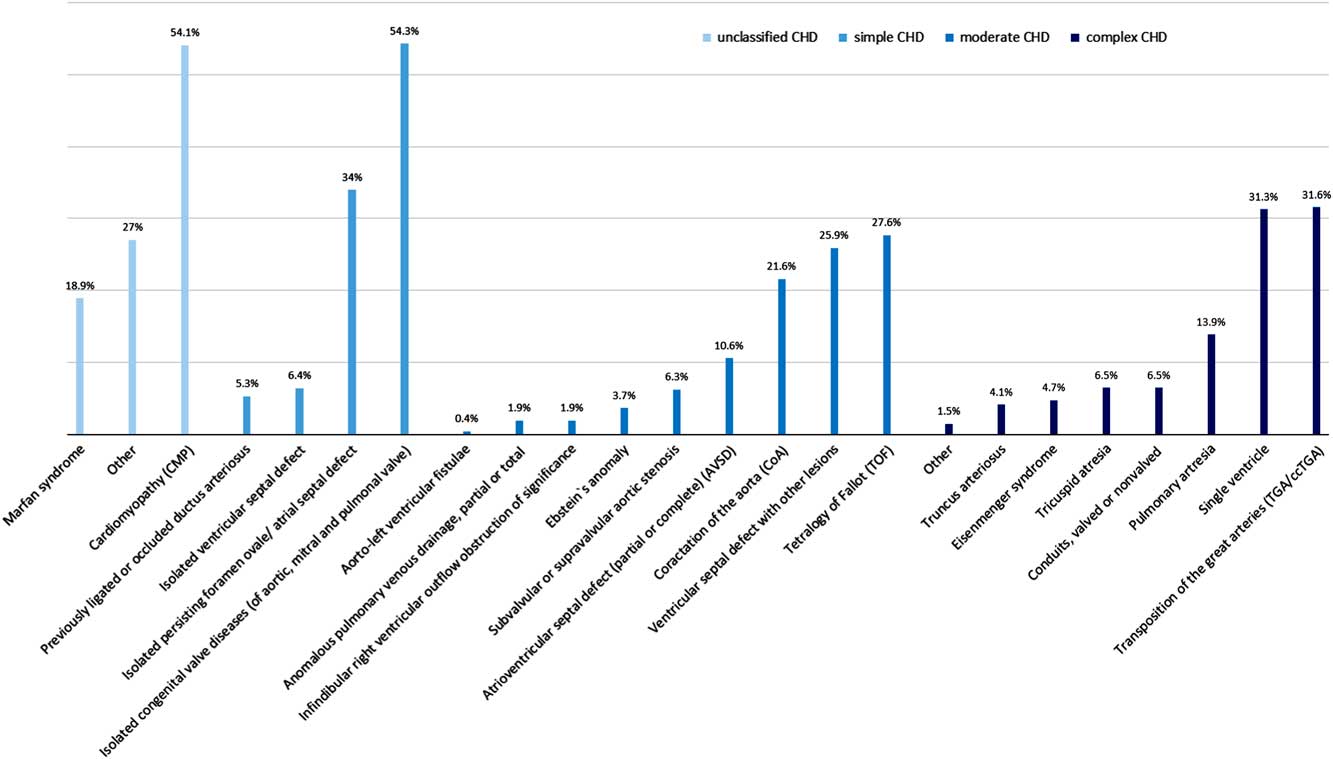
The distribution of diagnoses is shown in Figure 1.
Diagnosis distribution. The severity of CHD was defined as per Warnes et al.Reference Warnes, Liberthson and Danielson 16 Moderate CHD: in the group “Ventricular septal defect with other lesions” other lesions are defined as: absent valve(s), aortic regurgitation, coarctation of the aorta, mitral disease, right ventricular outflow tract obstruction, straddling tricuspid/mitral valve, subaortic stenosis.

Educational background and CHD severity
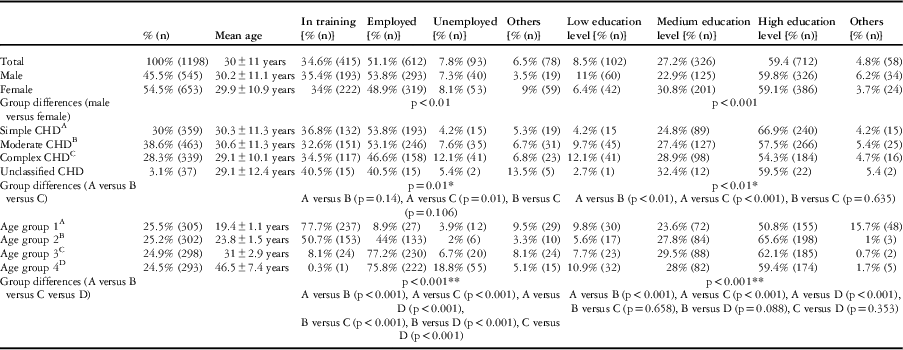
The majority of respondents (59.4%) stated that they had a high level of education (Table 1). Significant group differences were found between patients with simple CHD and those with moderate CHD (p<0.01) as well as between patients with simple CHD and those with complex CHD (p<0.001) (Table 1). In all, 66.9% of the patients with simple CHD, 57.5% of the patients with moderate CHD, and 54.3% of the patients with complex CHD reported having a high education level (Table 1). Significant sex differences were detected (p<0.001), with women tending to report a higher educational level than men (Table 1). Age group 1 (18–21 years) and age groups 2, 3, and 4 differed significantly (p<0.001) (Table 1) in educational level.
Sample composition (n=1198) and group difference

n=sample size
* χ2-Test of all groups – only simple, moderate, and complex CHD were included; reduced sample size: 1161
** χ2-Test of all age groups; age group 1=18–21 years; age group 2=22–26 years; age group 3=27–36 years; age group 4=37–65 years
Employment and CHD severity
A small majority of respondents (51.1%) stated that they were currently employed (Table 1). Significant sex differences were detected (p<0.01). Men tended to be more frequently employed than women (53.8 and 48.9%, respectively). Similar to our results on educational level, a significant difference (p=0.01) between patients with simple and those with complex CHD was found (Table 1). In all, 53.8% of patients with simple CHD were employed, whereas only 46.6% of patients with complex CHD were employed at the time of the survey (Table 1). Significant group differences (p<0.001) were found between all four age groups (Table 1).
Discussion
Because of the enormous technical progress and developments in the treatment of patients with a CHD, currently, almost all of the patients born with a CHD can reach adulthood. Therefore, it is of great interest to research the morbidity and quality of life of patients with CHD.
Main results
The majority of adults with CHD reached a high educational level and a small majority were currently employed. Patients with simple CHD had significantly higher levels of education (p<0.01) and were more likely to be employed (p<0.001) than were patients with complex CHD. Women had slightly higher levels of education, whereas, interestingly, men were more often employed. Adults with CHD at age 18–21 years had lower levels of education and were less often employed in comparison with other age groups of adults with CHD.
Comparison with other studies
Education and employment status in adults with CHD
There are only a limited number of studies evaluating the educational level in adults with CHD. Previous studies assessed the cognitive functions of adults with CHD – for instance, by administering intelligence tests. Results show that cognitive difficulties have a multifactorial aetiology.Reference Tyagi, Austin and Stygall 19 The limited number of studies assessing the educational level in adults with CHD and their differing results concerning education and employment status prompted us to carry out the present study. In line with our results, Bygstad et alReference Bygstad, Pedersen and Pedersen 14 showed that adults with CHD with repaired tetralogy of Fallot had similar educational attainment to the Danish general population. Also, in a study by Vigl et al,Reference Vigl, Niggemeyer and Hager 7 equal levels of higher education were found in adults with CHD compared with controls. In our study, we found that 59.4% of participating adults with CHD obtained the highest school-leaving certificate. Data in Census 2011 by the Federal Statistical Office Germany show that 36% of the general German population – ranging in age from 18 to 65 years, similar to that of our study population – achieved a high-school diploma.Reference Bundesamt 20 For the census, 1% of German private households are surveyed – approximately 390,000 private households with 830,000 citizens. Data are therefore representative of the German general population. In comparison, adults with CHD included in the present study performed even better regarding their educational career. In contrast to these positive findings, in a French study by Karsenty et alReference Karsenty, Maury and Blot-Souletie 13 adults with CHD had lower levels of education and were less often employed than the general population; however, it has to be considered that the study setting was different: in the French study, adults with CHD were included during consultations for the regular follow-up of CHD or hospitalisation, and the number of patients included was only 135. Studies in other paediatric disciplines showed that survivors of childhood cancer obtain high levels of education. In a German nationwide survey in 2008 among childhood cancer survivors, one-third of participating childhood brain-tumour survivors, at high risk for neurological complications, obtained a high-school diploma.Reference Pfitzer, Zynda and Hohmann 21 Further, former leukaemia patients reached high levels of education more often than did the German general population.Reference Zynda, Reinmuth and Pfitzer 22 These positive results of survivors of a severe illness in childhood might be due to a possible influence of patients’ strong motivation following a severe illness, combined with the effect of intensive psychosocial and/or paedagogical support on education.Reference Ternestedt, Wall and Oddsson 23
As expected, patients with complex CHD showed lower educational levels and were less often employed than patients with simple CHD. Survivors with complex CHD, being at a higher risk for a longer postoperative course and major complications, may be at a disadvantage with respect to their school career because of extended periods of absence due to illness, treatment or recovery, possible learning disabilities, or delayed neuropsychological development.Reference Matos, Sarmento and Moreira 24 – Reference Mahle, Clancy and Moss 27 Lower-school graduation may in the long term restrict vocational training and job opportunities.Reference Zomer, Vaartjes and Uiterwaal 28
In the present study, female adults with CHD tended to report higher levels of education. This reflects the actual situation in the German educational system, with girls obtaining better and higher educational qualifications than boys. 29 This gender differentiation will continue to be of great interest to our social structure. These days, women have higher levels of education, but because of pregnancy and childbirth they have to cope with a clearly more challenging situation than men.
Women seem to be more willing, in general, to take part in online surveys.Reference Curtin, Presser and Singer 30 This is consistent with our results, which show a slightly greater proportion of participating women.
Adults with CHD at age 18–21 years had lower levels of education and were less often employed than those in other age groups. This may be explained by the simple fact that, with higher age, more adults with CHD would have completed their schooling and vocational training. Also, it has to be considered that adults with CHD may obtain school-leaving certificates slightly later because of absence from school caused by illness, treatment, or rehabilitation.
Limitations
One might assume that particularly highly educated CHD patients have a greater interest in participating in scientific studies.Reference Helm, Korten and Abdul-Khaliq 31 It should also be taken into consideration that, in general, the survivors who are linked to the networks of adults with CHD are often well educated and active members of society. This sampling bias, together with a response rate of 37.6%, should be considered as an alternative explanation for our results. Further, the effect of a possible influence of patients’ strong motivation following severe illness, combined with the intensive psychosocial and/or paedagogical support for education, has to be reflected upon.Reference Pfitzer, Zynda and Hohmann 21 – Reference Ternestedt, Wall and Oddsson 23 Because of the study design, only registered patients with an e-mail address were included. We analysed the number of registered adults with CHD meeting age-based inclusion criteria but for whom no e-mail address was available (n=14,602). The mean age was 29.6±10.7 years, which is equal to that of our study population (mean age 30±11 years).
The present study is cross-sectional; relations of cause and effect cannot be concluded. The results cannot be generalised to patients beyond Germany, as both the educational system and aspects of working life may differ in small or large degrees between countries.
Conclusion
In our study, participating adults with CHD achieved high educational levels and a majority of them were employed. This underlines the goal of medical care of not only achieving long-term survival but also improving patients’ quality of life by providing the best possible physical and social conditions. The promising results of our study are of great importance to the patients affected, their family members and care physicians, and to all generations of children born with a CHD in the future.
In order to support and differentiate our results, it is necessary to carry out future, confirmatory studies with heterogeneous patient cohorts, including all CHD, for investigating the association between CHD and educational levels.
Acknowledgements
The authors thank all patients for participating in the survey. The authors also thank Anne Gale of the Deutsches Herzzentrum Berlin for editorial assistance.
Financial Support
C.P. is a participant in the BIH Charité Junior Clinician Scientist Program funded by the Charité – Universitätsmedizin Berlin and the Berlin Institute of Health.
Conflicts of Interest
None.
Ethical standards
All procedures performed in studies involving human participants were in accordance with the ethical standards of the institutional and/or national research committee and with the 1964 Helsinki declaration and its later amendments or comparable ethical standards.