Background
Anxiety disorders (ADs) are a leading cause of disability worldwide (Vigo, Thornicroft, & Atun, Reference Vigo, Thornicroft and Atun2016; Whiteford, Ferrari, Degenhardt, Feigin, & Vos, Reference Whiteford, Ferrari, Degenhardt, Feigin and Vos2015), and are associated with substantial losses in function and quality of life (Alonso et al., Reference Alonso, Angermeyer, Bernert, Bruffaerts, Brugha, Bryson and Vollebergh2004; Hendriks et al., Reference Hendriks, Spijker, Licht, Hardeveld, de Graaf, Batelaan and Beekman2016). The probability of an individual experiencing an AD in their lifetime may be as high as 46–53% in New Zealand according to one prospective study (Moffitt et al., Reference Moffitt, Caspi, Taylor, Kokaua, Milne, Polanczyk and Poulton2010). Longitudinal research has shown that adolescent and adult ADs can be predicted by behaviour in childhood (Côté et al., Reference Côté, Boivin, Liu, Nagin, Zoccolillo and Tremblay2009; Fergusson & Lynskey, Reference Fergusson and Lynskey1998; Pine & Fox, Reference Pine and Fox2015; Roza, Hofstra, Van Der Ende, & Verhulst, Reference Roza, Hofstra, Van Der Ende and Verhulst2003).
Several factor-analytic studies have identified a general anxiety/withdrawal dimension of child psychopathology, which is characterised by shy, anxious, fearful, withdrawn or sad behaviours (Achenbach, Conners, Quay, Verhulst, & Howell, Reference Achenbach, Conners, Quay, Verhulst and Howell1989; Achenbach & Edelbrock, Reference Achenbach and Edelbrock1978; Fergusson & Horwood, Reference Fergusson and Horwood1993; Sonuga-Barke, Thompson, Stevenson, & Viney, Reference Sonuga-Barke, Thompson, Stevenson and Viney1997). Like many mental disorders, ADs have homotypic continuity: children experiencing anxiety/withdrawal are more likely to experience anxiety as adults (Caspi, Moffitt, Newman, & Silva, Reference Caspi, Moffitt, Newman and Silva1996; Goodwin, Fergusson, & Horwood, Reference Goodwin, Fergusson and Horwood2004; Jakobsen, Horwood, & Fergusson, Reference Jakobsen, Horwood and Fergusson2012; Prior, Smart, Sanson, & Oberklaid, Reference Prior, Smart, Sanson and Oberklaid2000; Roza et al., Reference Roza, Hofstra, Van Der Ende and Verhulst2003).
However, not all children with anxiety/withdrawal problems will go on to develop an AD in later life. One explanation for this is other intervening factors, such as parental attachment, modifying the risk for later AD (Jakobsen et al., Reference Jakobsen, Horwood and Fergusson2012). It has also been found that more severe childhood anxiety/withdrawal carries greater risk for later AD than milder anxious/withdrawn behaviour (Goodwin et al., Reference Goodwin, Fergusson and Horwood2004; Prior et al., Reference Prior, Smart, Sanson and Oberklaid2000).
Another factor influencing outcomes may be the internal structure of the childhood anxiety/withdrawal dimension. Like adult mental disorders (Chmielewski & Watson, Reference Chmielewski and Watson2008; Clark, Watson, & Reynolds, Reference Clark, Watson and Reynolds1995; Fried, Epskamp, Nesse, Tuerlinckx, & Borsboom, Reference Fried, Epskamp, Nesse, Tuerlinckx and Borsboom2016; Hasler, Drevets, Manji, & Charney, Reference Hasler, Drevets, Manji and Charney2004; Zimmerman, Ellison, Young, Chelminski, & Dalrymple, Reference Zimmerman, Ellison, Young, Chelminski and Dalrymple2015), childhood emotional and behavioural problems often present with a heterogeneous mix of symptoms (Forslund, Brocki, Bohlin, Granqvist, & Eninger, Reference Forslund, Brocki, Bohlin, Granqvist and Eninger2016; Gazelle, Reference Gazelle2008; Waschbusch et al., Reference Waschbusch, Porter, Carrey, Kazmi, Roach and D'Amico2004). This suggests a limitation in measuring childhood anxiety/withdrawal along a single dimension. For example, if two children both score highly on an anxiety/withdrawal inventory, but one child scores very highly on fearful items, while the other scores very highly on emotional items, it is plausible they may have different prognoses. While summed measures along a single dimension capture quantitative heterogeneity (i.e. variation in disorder severity), they do not capture this qualitative heterogeneity (i.e. variation in disorder features). A better parsing of this qualitative heterogeneity may also help categorise children with a greater need for preventative treatment (Pine & Fox, Reference Pine and Fox2015; Weems, Reference Weems2008). Lastly, while previous research has found that controlling for sex does not significantly attenuate the overall relationship between childhood anxiety/withdrawal and later AD (Goodwin et al., Reference Goodwin, Fergusson and Horwood2004), there are observed differences in how male and female children experience anxiety (Anderson, Williams, McGee, & Silva, Reference Anderson, Williams, McGee and Silva1987; Bender, Reinholdt-Dunne, Esbjørn, & Pons, Reference Bender, Reinholdt-Dunne, Esbjørn and Pons2012; Lewinsohn, Gotlib, Lewinsohn, Seeley, & Allen, Reference Lewinsohn, Gotlib, Lewinsohn, Seeley and Allen1998). Research looking at AD outcomes from specific anxious/withdrawn childhood behaviours should account for possible differences between males and females.
Network approach to mental disorders
Traditional perspectives on mental disorders have assumed them to be either discrete or dimensional ‘disease’ entities. According to these perspectives, mental disorders arise from latent variables that cause symptoms: symptoms do not constitute mental disorder, but rather index its presence (Kendler, Reference Kendler2017). Over the past decade, the network perspective has emerged as an alternative conceptualisation of mental disorders (Borsboom, Reference Borsboom2017; Fried & Cramer, Reference Fried and Cramer2017; Robinaugh, Hoekstra, Toner, & Borsboom, Reference Robinaugh, Hoekstra, Toner and Borsboom2019). Under this explanatory model, mental disorders are conceptualised as causal systems of symptoms (Fried & Robinaugh, Reference Fried and Robinaugh2020). Instead of merely indexing mental disorders, symptoms (and the causal relationships between them) are theorised to constitute mental disorders. For example, in the case of depression, if one experiences insomnia, they may subsequently experience fatigue, then fatigue may lower their mood, which may reinforce insomnia, and so on. A symptom network in an active, self-maintaining state is theorised to constitute a mental disorder (Borsboom, Reference Borsboom2017).
Following the network perspective, a substantive empirical literature has emerged using a network psychometric approach (Epskamp & Fried, Reference Epskamp and Fried2018; Fried et al., Reference Fried, Van Borkulo, Cramer, Boschloo, Schoevers and Borsboom2017). Most empirical network studies to date have modelled cross-sectional data (Robinaugh et al., Reference Robinaugh, Hoekstra, Toner and Borsboom2019). In cross-sectional networks, the associations between symptoms typically represent a partial correlation between those two variables (i.e. a correlation after controlling for all other variables in the network). Network models are thus useful for discerning direct and indirect (mediated) associations between symptom variables while conditioning on all other symptoms (Epskamp & Fried, Reference Epskamp and Fried2018). The network approach to mental disorders is a relatively new and evolving branch of network science, so the identification of potential causal pathways via correlational networks is a theoretically appropriate method for exploratory research purposes (Fried, Reference Fried2020). Several studies have applied a correlational network approach to research aims involving child anxiety (Miers et al., Reference Miers, Weeda, Blöte, Cramer, Borsboom and Westenberg2020; Montazeri, De Bildt, Dekker, & Anderson, Reference Montazeri, De Bildt, Dekker and Anderson2019; Rouquette et al., Reference Rouquette, Pingault, Fried, Orri, Falissard, Kossakowski and Borsboom2018). However, only one study to date (Rouquette et al., Reference Rouquette, Pingault, Fried, Orri, Falissard, Kossakowski and Borsboom2018) has used network outcome analysis (NOA) to investigate the relationship between childhood behaviours and later anxiety outcomes.
Network outcome analysis
NOA is a recently developed extension of cross-sectional network analysis, in which an outcome variable is incorporated into a cross-sectional symptom network (Blanken, Borsboom, Penninx, & Van Someren, Reference Blanken, Borsboom, Penninx and Van Someren2019; Rouquette et al., Reference Rouquette, Pingault, Fried, Orri, Falissard, Kossakowski and Borsboom2018). Because cross-sectional symptom variables temporally precede the outcome variable, it can be inferred that associated symptoms predict the outcome, but not vice-versa (Pearl, Reference Pearl2000). Studies implementing NOA have identified specific candidates for preventative intervention for later AD (Rouquette et al., Reference Rouquette, Pingault, Fried, Orri, Falissard, Kossakowski and Borsboom2018) and depression (Blanken et al., Reference Blanken, Borsboom, Penninx and Van Someren2019). For instance, Rouquette et al. (Reference Rouquette, Pingault, Fried, Orri, Falissard, Kossakowski and Borsboom2018) demonstrated that only a few items explained the overall relationship between childhood emotional and behavioural problems and later AD in their female sample. With regard to the present research, although a childhood anxiety/withdrawal dimension has been shown to predict later AD, no research to date has investigated childhood anxiety/withdrawal networks as predictors of later AD. This is an important question from a network perspective, as individual scale items each carry their own implications for the prediction and prevention of mental disorders; they are not merely interchangeable indices of a latent dimension. A better understanding of specific behaviours that carry risk for later AD could more precisely inform prevention strategies in childhood.
Aims
Utilising a network theoretical framework, the present study uses longitudinal data from the Christchurch Health and Development Study (CHDS) to investigate childhood anxiety/withdrawal networks as predictors of later AD. Specific childhood item–outcome associations may more precisely explain the overall dimension–outcome association obtained in previous studies (Goodwin et al., Reference Goodwin, Fergusson and Horwood2004; Jakobsen et al., Reference Jakobsen, Horwood and Fergusson2012). The outcomes in the present study are measured in two periods: adolescence (14–21 years) and adulthood (21–40 years). The main aims of this study are to:
(1) Estimate a network structure of childhood anxiety/withdrawal items at 7–9 years for both males and females.
(2) Identify childhood anxious/withdrawn behaviours (7–9 years) which predict AD during adolescence (14–21 years) and adulthood (21–40 years) for both males and females.
(3) Assess sex similarities and differences in 1 and 2.
Method
Participants
The data used in this study were collected during the course of the CHDS. The CHDS is a longitudinal study of a representative population birth cohort of 1265 children born in the Christchurch urban region during a 4-month period in mid-1977. The cohort has been studied at birth, 4 months, 1 year, annually to age 16, and at ages 18, 21, 25, 30, 35 and 40. There has been good participant retention in the CHDS: 904 of the original 1265 cohort members completed the recent 40-year assessment (74% of surviving cohort members).
Childhood anxiety/withdrawal networks
The present study uses participants with complete childhood anxiety/withdrawal data for the baseline network models. The overall sample size available for childhood anxiety/withdrawal networks was N = 1044, which was divided into males (n = 524) and females (n = 520) for model estimation. Subsetting the sample did not significantly compromise the stability of the estimated models [see the Results section for correlation stability (CS) coefficients].
Outcome networks
For the NOA models, the present study uses participants that have childhood anxiety/withdrawal data and adolescent and/or adulthood AD data available. The overall sample size for the NOA with adolescent AD was n = 982, which was divided into males (n = 487) and females (n = 495) for modelling. For the NOA with adult AD, the overall sample size reduced to n = 944, which was divided into males (n = 459) and females (n = 485). A Welch two-sample t test was performed to determine if participants who completed the adolescent anxiety assessment (n = 982) differed on childhood anxiety/withdrawal severity from participants who did not complete the adolescent assessment (n = 62). A statistically significant group difference was found [t(67.08) = 2.72, p = 0.008], as participants who did not complete the adolescent assessment had a higher mean childhood anxiety/withdrawal item score (M = 4.11, s.d. = 0.59) than participants who did complete the adolescent assessment (M = 3.90, s.d. = 0.52).
Measures
Childhood anxiety/withdrawal
Childhood anxiety/withdrawal was measured using a scale developed by Fergusson and Horwood (Reference Fergusson and Horwood1993). The 15-item scale was completed at years 7, 8 and 9 from a combination of parent and teacher reports: five items were measured via parent report, five items via teacher report, and five items via both parent and teacher report. Parent-assessed items were based on a combination of the Rutter, Tizard, and Whitmore (Reference Rutter, Tizard and Whitmore1970) and Conners (Reference Conners1970) parental questionnaires. Teacher-assessed items were based on a combination of the Rutter et al. (Reference Rutter, Tizard and Whitmore1970) and Conners (Reference Conners1969) teacher questionnaires. Each item was rated on a three-point Likert scale, ranging from 1 (Doesn't apply) to 3 (Certainly applies). For the purposes of the present study, a sum score was created over the 7-, 8- and 9-year measure for each item. For items that were measured by both parent and teacher report, the average of the two scores was taken in each case. The resulting 15 childhood anxiety/withdrawal items each had a possible range of 3–9, with each item reflecting a tendency towards that anxious/withdrawn behaviour from 7 to 9 years. The scale had acceptable internal consistency for males (α = 0.76) and females (α = 0.78).
Anxiety disorder outcomes in adolescence and adulthood
Anxiety outcomes were measured with two binary variables. First, adolescent AD was defined as meeting the Diagnostic and Statistical Manual of Mental Disorders (DSM) criteria for at least one AD between 14 and 21 years. Adolescent assessments were at years 15, 16, 18 and 21. For all assessments, participants were asked to retrospectively report symptoms back to the previous assessment (e.g. the 21-year assessment queried symptomatology from 18 to 21 years). This assessment period coincided with the release of a new DSM edition, so the DSM-III-R (American Psychiatric Association, 1987) criteria were used for the assessments at years 15 and 16 only. The DSM-III-R criteria were assessed using items based on the Diagnostic Interview Schedule for Children (Costello, Edelbrock, Kalas, Kessler, & Klaric, Reference Costello, Edelbrock, Kalas, Kessler and Klaric1982). The ADs measured at years 15 and 16 with the DSM-III-R criteria were generalised AD, social phobia, specific phobia, agoraphobia and overanxious disorder. The DSM-IV (American Psychiatric Association, 1994) criteria were used for the 18-year assessment onwards, and were measured using items based on the Composite International Diagnostic Interview (CIDI; World Health Organization, 1993). The ADs measured at years 18, 21, 25, 30, 35 and 40 with the DSM-IV criteria were generalised AD, social phobia, specific phobia, agoraphobia and panic disorder (with and without agoraphobia). The second outcome, adult AD, was defined as meeting the DSM-IV diagnostic criteria for at least one measured AD between 21 and 40 years. Adult assessments were at years 25, 30, 35 and 40, and also queried symptomatology back to the previous assessment using items based on the CIDI (World Health Organization, 1993).
Statistical analyses
Network estimation
All analyses were performed in the R software environment (version 3.6.3; R Core Team, 2020). In network graphs, variables are represented as nodes and the relationships between nodes are represented as edges. Edges can be understood as partial correlations: pairwise associations after conditioning on all other nodes in the network (Epskamp & Fried, Reference Epskamp and Fried2018).
Childhood anxiety/withdrawal networks
Using the qgraph R package (Epskamp, Cramer, Waldorp, Schmittmann, & Borsboom, Reference Epskamp, Cramer, Waldorp, Schmittmann and Borsboom2012), separate baseline childhood networks were estimated for males (n = 524) and females (n = 520) from the 15 childhood anxiety/withdrawal items. Models were estimated using graphical LASSO (gLASSO; Epskamp & Fried, Reference Epskamp and Fried2018). The gLASSO algorithm penalises each model for its complexity, which shrinks all edges and removes many small edges, generating a sparse network. The strength of the penalty applied to the baseline network was selected using the Extended Bayesian Information Criterion (EBIC; Foygel & Drton, Reference Foygel and Drton2010). The EBIC tuning parameter (γ) was set at 0.5 for both baseline networks. These models are termed Gaussian graphical models (GGMs), as they assume multivariate normal distribution (Epskamp & Fried, Reference Epskamp and Fried2018). As all childhood anxiety/withdrawal variables in the present study were skewed, Spearman correlation matrices were used as input. Recent simulation work suggests rank-transformations, such as Spearman correlations, perform well as network model input when variables are skewed, relaxing the assumption of multivariate normality (Isvoranu & Epskamp, Reference Isvoranu and Epskamp2021). See online Supplementary materials for a more detailed description of the EBIC-gLASSO network estimation method, including an extended analytical rationale for choosing Spearman correlations over polychoric correlations as network input for the present research.
Community structures of the childhood anxiety/withdrawal networks were estimated via the spinglass algorithm with the igraph R package (Csardi & Nepusz, Reference Csardi and Nepusz2006). The spinglass algorithm groups nodes into a best-fit community structure akin to factor-analytic factors (Yang, Algesheimer, & Tessone, Reference Yang, Algesheimer and Tessone2016). As the spinglass algorithm is not deterministic (i.e. it can generate slightly different results if run multiple times), the algorithm ran 100 times and the median number of communities for each model was used, per previous work using the spinglass algorithm (Briganti, Kempenaers, Braun, Fried, & Linkowski, Reference Briganti, Kempenaers, Braun, Fried and Linkowski2018; De Beurs et al., Reference De Beurs, Fried, Wetherall, Cleare, O’ Connor, Ferguson and O’ Connor2019). Node centrality was quantified using the expected influence measure (Robinaugh, Millner, & McNally, Reference Robinaugh, Millner and McNally2016), which sums the edge weights connected to a node. The male and female childhood networks were tested for similarity by correlating the two graphs. They were also tested for statistically significant difference via the Network Comparison Test (NCT) implemented in the NetworkComparisonTest R package (Van Borkulo, Reference Van Borkulo2015).
Network outcome analyses
Network outcome analyses were performed to estimate the association between childhood anxiety/withdrawal networks and later AD. For both the male and female subsamples, an NOA was performed on each outcome: (a) adolescent AD (14–21 years), and (b) adult AD (21–40 years). Thus, a total of four NOA models were estimated. In each NOA model, an edge present between a childhood item and an outcome suggests a direct predictive association after controlling for all other items in the network.
The NOAs were estimated through two different procedures. Two estimation approaches were used to mitigate the possible effect of any assumption violations in the underlying data (see online Supplementary materials for full rationale). First, Mixed Graphical Models (MGMs) were estimated with the mgm R package (Haslbeck & Waldorp, Reference Haslbeck and Waldorp2020). Estimating MGMs allows the modelling of variables with different underlying distributions together in the same network graph. See online Supplementary materials for a detailed description of MGM estimation. Second, the four NOAs were estimated using the same procedure as the childhood anxiety/withdrawal networks: GGMs were estimated from Spearman correlations using gLASSO regularisation, with the best-fit models selected by minimising the EBIC (γ = 0.5).
Stability and accuracy
Stability and accuracy analyses were conducted using the bootnet R package (Epskamp, Borsboom, & Fried, Reference Epskamp, Borsboom and Fried2018). Each bootstrapping procedure was performed at n = 1000 iterations. The stability of the childhood networks was quantified with the CS-coefficient for node expected influence, estimated through the case-dropping bootstrap procedure given by Epskamp et al. (Reference Epskamp, Borsboom and Fried2018). For the NOA models, the accuracy of estimated item–outcome edges was assessed with 95% confidence intervals (95% CIs). The procedure for estimating edge weight 95% CIs via non-parametric bootstrapping is given in detail by Epskamp et al. (Reference Epskamp, Borsboom and Fried2018). Importantly, 95% CIs obtained on NOA edge weights should not be interpreted as significance tests (i.e. a 95% CI crossing zero does not necessarily indicate a null finding). As the edges have already had a statistical penalty (regularisation) applied to them within the estimation procedure, the 95% CIs should be interpreted only as indicators of the accuracy of these penalised associations: they show precision of weight estimates, not statistical significance. Last, from this same procedure, the proportion of bootstraps in which each parameter was estimated as non-zero (Pn −z) was obtained to assess robustness.
Results
Descriptives
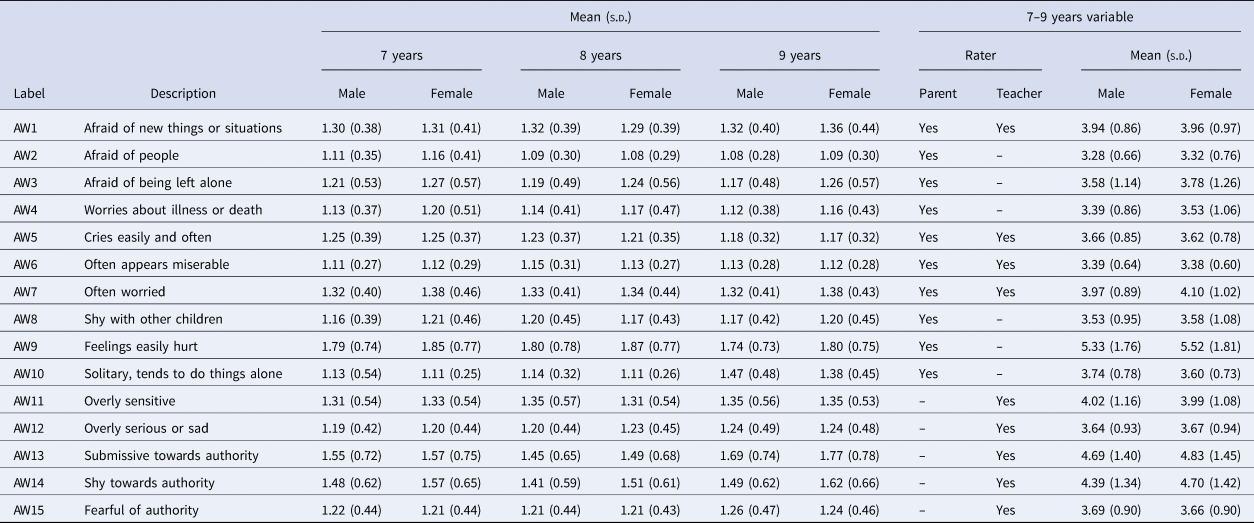
Descriptive statistics for the childhood anxiety/withdrawal items are shown in Table 1. Over 7–9 years, the same five items scored highest in both the male and female subsamples: feelings easily hurt (AW9), submissive towards authority (AW13), shy towards authority (AW14), often worried (AW7) and overly sensitive (AW11).
Descriptive statistics of childhood anxiety/withdrawal item responses (7–9 years) for male (n = 524) and female (n = 520) subsamples

Note: For items rated by both parent and teacher, the average of the two ratings was taken in each case.
Females met the diagnostic criteria for an AD more frequently than males during both adolescence (14–21 years) and adulthood (21–40 years). During adolescence, 244 females (49%) met the diagnostic criteria for an AD, compared to 132 males (27%). During adulthood, 233 females (48%) met the diagnostic criteria for an AD, compared to 141 males (31%). The proportion of male and female participants meeting the diagnostic criteria for an AD at each assessment is presented in online Supplementary Table S2. Raw Spearman correlations between all childhood items and AD as measured at each assessment are presented in online Supplementary Tables S3 and S4.
Childhood anxiety/withdrawal networks
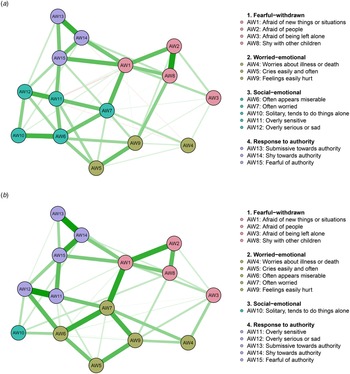
The childhood anxiety/withdrawal networks for male and female participants are presented in Fig. 1. Network edges that are thicker and more saturated represent stronger regularised partial correlations than thinner, lighter edges. Positive edges are plotted as green lines; negative edges are plotted as red lines. The layout for each graph is based on the Fruchterman–Reingold algorithm, which places nodes with stronger connection closer together, and more influential nodes towards the centre of the graph. Figures have been presented in averaged Fruchterman–Reingold layout to aid visual comparison between the male and female models.
Childhood anxiety/withdrawal (7–9 years) networks for the (a) male (n = 524) and (b) female (n = 520) subsamples. All edges represent positive associations.

The spinglass algorithm returned a four-community solution for both the male subsample and female subsample. In both subsamples, communities of items broadly reflecting (a) fearful-withdrawn, (b) worried-emotional, (c) social-emotional and (d) anxious/withdrawn response to authority were detected. Overall, 11/15 items were sorted into the same community in both the male and female subsamples, suggesting general consistency in node community structure between males and females. Node communities are shown in colour in all network figures.
The male and female childhood networks were overall very similar (rp = 0.87), and only small structural differences were observed. The NCT revealed the overall difference in structure was not statistically significant (M = 0.13, p = 0.43). Further, the male and female networks had no significant difference in global connectivity (S = 0.02, p = 0.98). Expected influence centrality measures for each graph also showed general agreement in which nodes were the most influential (see online Supplementary Fig. S1).
Network outcome analyses
Across the four NOA models, the GGM procedure estimated 17 of a possible 60 parameters between childhood items and later AD as non-zero. Of these 17 edges, 16 were also retrieved via the MGM procedure. The MGM procedure estimated an additional seven edges that were not retrieved with GGMs. Edge weight in the MGM procedure positively correlated with being retrieved in the corresponding GGM (rs = 0.43). As the MGM edges which were not retrieved in the GGM tended to be smaller, this suggests that the GGMs may offer increased specificity at the expense of some sensitivity. Indeed, the correlations between the equivalent GGM and MGM graphs were strong for all four NOAs (rp = 0.89–0.93), suggesting that they offer very similar estimations of the true outcome network, and differences may be explained by a sensitivity–specificity trade-off. As 16/17 GGM edges were also retrieved with the MGM procedure, the GGM results are presented to favour specificity. See online Supplementary Figs S2 and S3 for the MGM NOA models.
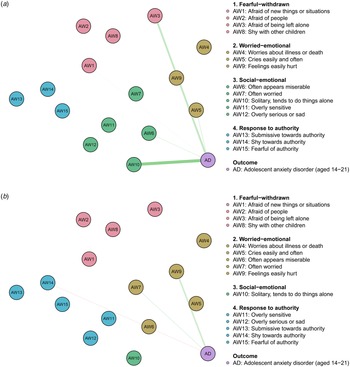
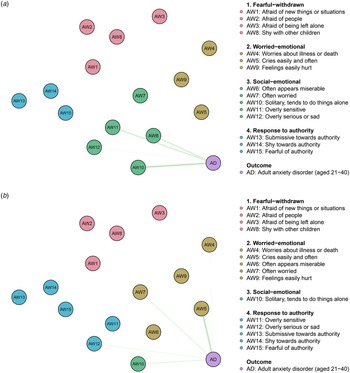
In the male subsample, five childhood items positively predicted adolescent AD. Four childhood items also positively predicted the adult AD outcome. Two items (AW6 and AW10) directly predicted both outcomes in the male subsample. In the female subsample, three childhood items positively predicted adolescent AD, while five childhood items positively predicted adult AD. One item (AW7) positively predicted both outcomes in the female subsample. One item was found to negatively predict adolescent AD (AW14) in the female subsample. The male and female NOAs for each AD outcome are presented in Figs 2 and 3 with only the item–outcome edges shown (see online Supplementary Figs S4 and S5 for NOA graphs with all edges visualised).
Adolescent anxiety disorder outcome (14–21 years) network for the (a) male (n = 487) and (b) female (n = 495) subsamples. Green edges represent positive associations; red edges represent negative associations. To aid interpretability, only the item–outcome edges are shown.

Adult anxiety disorder outcome (21–40 years) network for the (a) male (n = 459) and (b) female (n = 485) subsamples. Green edges represent positive associations. To aid interpretability, only the item–outcome edges are shown.

Stability and accuracy
Childhood anxiety/withdrawal networks
As per guidelines proposed by Epskamp et al. (Reference Epskamp, Borsboom and Fried2018), the expected influence CS-coefficients for both the male [CS(r = 0.70) = 0.59] and female [CS(r = 0.70) = 0.67] childhood networks indicated good stability [CS(r = 0.70) > 0.50].
Network outcome analyses for anxiety disorder
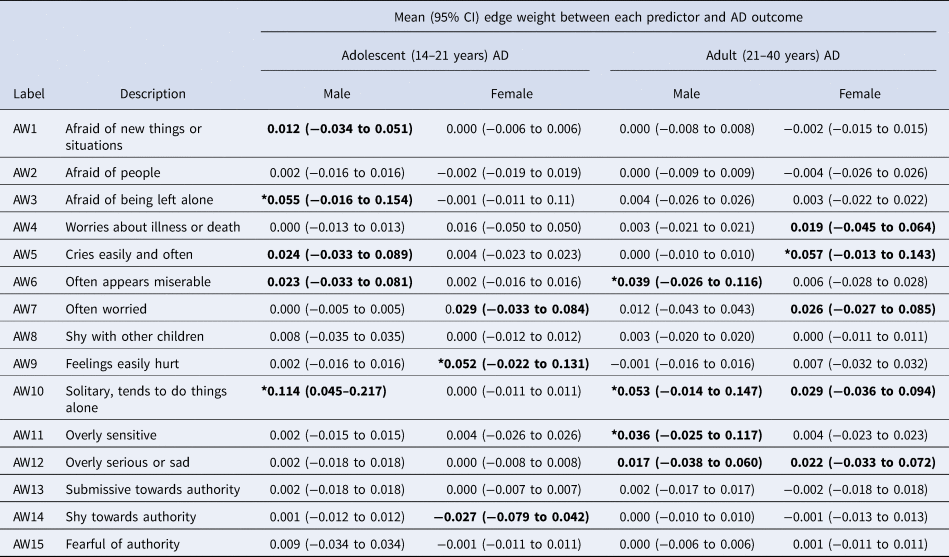
Table 2 shows mean GGM NOA edge weights across n = 1000 bootstrap iterations. In each model, all non-zero edges had overlapping 95% CIs, so no inferences can be made about the rank-order of these childhood items as predictors of AD. However, bootstrapping indices, in combination with cross-checking against the MGM estimation, provide means by which to interpret the accuracy and robustness of each edge. The 95% CIs around NOA edges are relatively wide, suggesting that the strength estimates of these associations are imprecise. In addition to 95% CIs, the Pn −z values for NOA parameters are reported in online Supplementary Table S5. Edges which were retrieved (estimated as non-zero) in >70% of bootstraps (Pn−z > 0.70) using both methodologies were considered robust. When interpreting specific edges, reference to these bootstrapping measures is advised.
Mean bootstrapped edge weights (n = 1000) between baseline childhood anxiety/withdrawal items (7–9 years) and anxiety disorder outcomes for males and females

Notes: (1) Edges estimated as non-zero in study sample are highlighted in bold; (2) edges which were estimated as non-zero in >70% of bootstrapped models (n = 1000 iterations) using both the GGM and MGM methodologies are denoted with an asterisk.
Discussion
The present study represents a novel application of network psychometrics to childhood anxiety/withdrawal. The recently developed NOA method (Blanken et al., Reference Blanken, Borsboom, Penninx and Van Someren2019; Rouquette et al., Reference Rouquette, Pingault, Fried, Orri, Falissard, Kossakowski and Borsboom2018) has been applied to investigate childhood anxiety/withdrawal items as predictors of AD outcomes in both adolescence and adulthood for the first time. The findings from this investigation are discussed below. High rates of AD were observed in the study cohort during adolescence and adulthood (during both outcome periods, about 40% of overall participants met the diagnostic criteria for an AD), highlighting the importance of identifying early risk factors.
Childhood anxiety/withdrawal
Similar rates of item endorsement were found across the male and female subsamples, and the NCT detected no statistically significant difference between the male and female childhood network models. It is noted that the NCT is conservative with regard to identifying significant group network differences, so this result should not be interpreted as firm evidence of no true sex difference (Van Borkulo, Reference Van Borkulo2015). However, the strong similarity (rp = 0.87) between the networks estimated from the male and female subsamples suggests a childhood anxiety/withdrawal causal system may function through similar pathways in both males and females. While some evidence suggests that there are sex differences in anxious childhood behaviour (Anderson et al., Reference Anderson, Williams, McGee and Silva1987; Bender et al., Reference Bender, Reinholdt-Dunne, Esbjørn and Pons2012; Lewinsohn et al., Reference Lewinsohn, Gotlib, Lewinsohn, Seeley and Allen1998), the present findings tend to fall in line with the view that notable sex differences in anxious behaviour emerge later, during puberty (Hayward & Sanborn, Reference Hayward and Sanborn2002; Pine & Fox, Reference Pine and Fox2015).
The spinglass community-detection algorithm retrieved a four-community solution for both the male and female subsamples. Four items changed community between subsamples. As the spinglass algorithm allows each node to inhabit only one community, the structure identified by the algorithm should be interpreted only as an aid. Much ‘bridging’ (Jones, Ma, & McNally, Reference Jones, Ma and McNally2019) was observed between communities, indicating that the groupings may be malleable. For instance, the items overly sensitive (AW11) and overly serious or sad (AW12) appeared to bridge two communities (social-emotional and response to authority); small changes in edge weights between the male and female subsamples thus resulted in them being grouped into the social-emotional community in the male subsample and the response to authority community for the female subsample. On face value, these two items may be better characterised as social-emotional, but the network structures indicate they may influence anxious/withdrawn responses towards authority figures.
Network outcome analyses
Previous research on the CHDS cohort has found that childhood anxiety/withdrawal, when modelled as a unidimensional variable, predicts later AD (Goodwin et al., Reference Goodwin, Fergusson and Horwood2004; Jakobsen et al., Reference Jakobsen, Horwood and Fergusson2012). The present findings add nuance to this established relationship by demonstrating that not all items measuring childhood anxiety/withdrawal procure the same type or degree of risk.
Childhood anxiety/withdrawal items formed a total of 16 positive edges and one negative edge with outcome AD variables across the four NOA models. Further, seven of these edges were considered robust, as they were retrieved in >70% of bootstrapped models using both the GGM and MGM estimation procedures. It is important to note that edges which did not meet the defined robustness criteria are not necessarily invalid. Although edges which were defined as robust can be interpreted with the highest degree of confidence, all regularised edges may still be interpreted with a high degree of confidence, as network models fitted with gLASSO regularisation have been shown under simulation to perform well in retrieving true networks (Epskamp et al., Reference Epskamp, Borsboom and Fried2018; Foygel & Drton, Reference Foygel and Drton2010; Van Borkulo et al., Reference Van Borkulo, Borsboom, Epskamp, Blanken, Boschloo, Schoevers and Waldorp2015). Further, the wide 95% CIs estimated around NOA edges do not affect interpretation of their validity. As edges have already been selected as non-zero by gLASSO, 95% CIs should be interpreted only as indicators of parameter strength estimate precision, and not significance tests. However, despite gLASSO generally performing well in retrieving true network structures, more recent work has suggested that estimating parameter stability and accuracy is an important safeguard against false-positive findings (Fried, Van Borkulo, & Epskamp, Reference Fried, Van Borkulo and Epskamp2020). This is particularly important for the present paper, as inferences are made based on the presence or absence of specific edges (rather than global network properties). When concerned with specific edges, false-positive edges lead directly to erroneous conclusions. To account for this, the extra step has been taken to define robust edges as those which were replicated in at least 70% of bootstraps using both the GGM and MGM estimation procedures. Thus, the full steps taken to ensure valid NOA results are: (a) regularised model selection; (b) two cross-checked estimation procedures, from which the higher specificity GGM models were presented; (c) bootstrapping all NOA models to estimate the accuracy and robustness of parameters, from which the most robust were identified.
All seven robust (Pn−z > 0.70) NOA edges were positive. Of these, four childhood items belonged to the social-emotional community, two belonged to the worried-emotional community, and one belonged to the fearful-withdrawn community. When looking at the individual items, this trend is also borne out. The item solitary, tends to do things alone (AW10) formed a robust edge with the AD outcome in both male NOA models. Five other childhood items each formed one robust edge with later AD: afraid of being left alone (AW3), cries easily and often (AW5), often appears miserable (AW6), feelings easily hurt (AW9) and overly sensitive (AW11). All of these items except AW3 describe behaviours relating to social problems and sadness. A preponderance of items related to social problems and sadness is also observed when looking at all regularised NOA edges estimated as non-zero (also including those where Pn −z < 0.70 across bootstraps). Of the 16 positive NOA edges, 13 belonged to either the social-emotional or worried-emotional communities. The item solitary, tends to do things alone (AW10) formed an edge with later AD in three NOA models. The items cries easily and often (AW5), often appears miserable (AW6), often worried (AW7) and overly serious or sad (AW12) each formed an edge with later AD in two NOA models. The items afraid of new things or situations (AW1), afraid of being left alone (AW3), worries about illness or death (AW4), feelings easily hurt (AW9) and overly sensitive (AW11) each formed an edge with later AD in one NOA model. Items describing fearful behaviours (AW1–AW3) and authority figure-specific behaviours (AW13–AW15) did not consistently predict later AD by any measure. This applied across both the male and female subsamples and both the adolescent and adult AD outcomes. Either by considering all regularised NOA edges, or only those which were considered robust, items describing sad and unsocial behaviours formed edges with later AD consistently when compared to items describing situational fears and responses towards authority figures.
These findings build substantially on the work of another NOA investigating AD outcomes from childhood items. In their study of childhood emotional and behavioural symptoms as predictors of later AD in a female sample, Rouquette et al. (Reference Rouquette, Pingault, Fried, Orri, Falissard, Kossakowski and Borsboom2018) found that the item tends to play alone, solitary at age 10 was associated with AD at age 15 or 22 follow-up. The results from the present NOAs provide further evidence that female children described as solitary are at increased risk of later AD. Moreover, the present research extends this finding to male children. The finding of Rouquette et al. (Reference Rouquette, Pingault, Fried, Orri, Falissard, Kossakowski and Borsboom2018) that fear was associated with later AD in female children was not replicated with the items in the present study. An earlier longitudinal study by Roza et al. (Reference Roza, Hofstra, Van Der Ende and Verhulst2003) found that a social problems scale administered at age 14, including items such as gets teased a lot and not liked by other kids, significantly predicted later AD. The present finding that solitary behaviour in middle childhood predicts later AD in males and females is also consistent with the findings of Roza et al. (Reference Roza, Hofstra, Van Der Ende and Verhulst2003).
The NOA results also indicate that the risk incurred by childhood anxiety/withdrawal items may not be constant over time. In our male subsample, two edges were formed between fearful childhood items and adolescent AD. The item afraid of being left alone (AW3) formed a robust edge, while afraid of new things or situations (AW1) formed an edge that did not meet the criteria for robustness. However, no edges were retrieved between fearful childhood items and adult AD. This may suggest that some fearful childhood behaviours, such as a fear of being left alone, predict anxious continuity into adolescence, but the risk associated with these behaviours diminishes in adulthood. Indeed, fears of specific objects and situations, such as being left alone, are common features of anxious behaviour in childhood, and typically reduce after puberty (Beesdo-Baum & Knappe, Reference Beesdo-Baum and Knappe2012; Pine & Fox, Reference Pine and Fox2015). Conversely, NOA models suggest that social and emotional aspects of childhood anxiety/withdrawal may have more persistent continuity into adulthood. Following developmental theories of anxiety, social and emotional symptoms are a typical feature of anxiety in adolescence and adulthood; they are less typical of childhood anxiety, where specific and situational fears are theorised to arise from challenges associated with that developmental period (Weems, Reference Weems2008; Westenberg, Siebelink, & Treffers, Reference Westenberg, Siebelink and Treffers2001). Considering this, it may be that children in mid-childhood exhibiting more developmentally advanced (i.e. social and emotional) anxious behaviours carry more risk for anxious continuity compared to children exhibiting situation-based fears more typical of their developmental stage.
Limitations
There are some limitations to the present study. First, the overall replicability of network analyses has recently garnered substantial discussion (Borsboom et al., Reference Borsboom, Fried, Epskamp, Waldorp, van Borkulo, van der Maas and Cramer2017; Forbes, Wright, Markon, & Krueger, Reference Forbes, Wright, Markon and Krueger2017a, Reference Forbes, Wright, Markon and Krueger2017b; Jones, Williams, & McNally, Reference Jones, Williams and McNally2019). Several steps were taken to mitigate the potential for false-positive findings. In particular, a thorough analysis of parameter accuracy and robustness has shown that important NOA findings are not likely to have been affected by false-positive edges. However, the relatively wide 95% CIs around NOA edges indicate that strength estimates of these parameters are not precise. Second, the scale used in the present study was developed to measure a latent dimension of childhood anxiety/withdrawal. As it was not created to be modelled at the level of its components, it may be missing important variables within the true causal system of childhood anxiety/withdrawal (Jones, Heeren, & McNally, Reference Jones, Heeren and McNally2017). Third, the present study did not control for covariates due to statistical power constraints. Previous research with the CHDS dataset found that the association between the summed childhood anxiety/withdrawal scale and later AD was only slightly attenuated after controlling for psychosocial covariates such as childhood sexual and physical abuse, adverse life events, and parental history of anxiety and depression (Goodwin et al., Reference Goodwin, Fergusson and Horwood2004; Jakobsen et al., Reference Jakobsen, Horwood and Fergusson2012). Last, there were several limitations related to the study cohort and data collection procedures worth mentioning. There was a significant difference in overall childhood anxiety/withdrawal between participants who completed the first outcome assessment, and those who did not. This suggests that participants who dropped out of the study tended to have slightly higher baseline anxiety/withdrawal, possibly introducing a selection bias. It has also previously been found that trait variation accounts for approximately a quarter to half of observed variance in childhood scale scores in the CHDS cohort, with the rest being accounted for by method effects and error. This may partially explain the relative lack of difference observed in male and female childhood networks. It should also be considered that the first two outcome assessments used a different diagnostic criteria (DSM-III-R) than subsequent assessments (DSM-IV). This may have contributed to some differences between the adolescent and adult NOAs (e.g. the robust edge between AW3 and adolescent AD in males). Finally, this study is based on data from one population birth cohort over a particular period of time. The degree to which these networks may generalise to different places and times is unclear.
Conclusions
Childhood anxious/withdrawn behaviours generally predict diagnosis of AD in adolescence and adulthood in both males and females. Individual behaviour items appear to carry different degrees of risk for later AD. In particular, childhood anxious/withdrawn items relating to social problems and sadness were found to consistently associate with later AD, indicating they may offer promising specific early intervention targets. Future research is needed to replicate these findings across samples.
Supplementary material
The supplementary material for this article can be found at https://doi.org/10.1017/S0033291721002889.
Acknowledgements
We thank all CHDS participants for their generous time and effort.
Funding statement
The CHDS is funded by the Health Research Council of New Zealand (Programme Grant 16/600).
Conflict of interest
None.
Ethical standards
The authors assert that all procedures contributing to this work comply with the ethical standards of the relevant national and institutional committees on human experimentation and with the Helsinki Declaration of 1975, as revised in 2008.