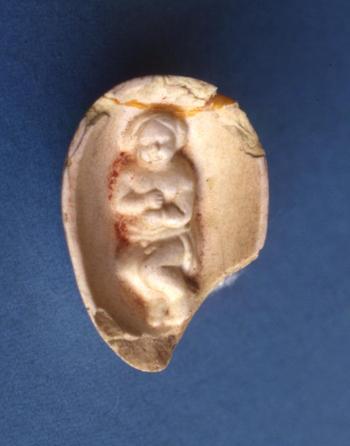
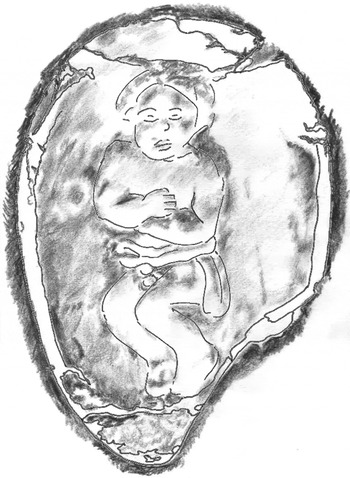
In 1969 on a riverside near the Lenyardi caves (about 5 kilometres from present-day Junnar, in the Indian state of Maharashtra), Dr Satish Deshmukh discovered an alabaster object in the form of half an egg (longitudinally cut) with a young male child lying inside it (with small traces of red paint on the right side of the object). This high-quality oval object (figures 1 and 2) measures about 5 cm × 3.4 cm and is usually interpreted as an item that was originally manufactured in the Mediterranean world before being brought to India, rather than a piece of artwork produced in India itself.Footnote 1 One possible, and largely accepted, interpretation is that this figure represents the birth of the god Eros.Footnote 2 However, identification of the figure within the egg-like structure is not easily made. While the figure does bear similarities to the putto-style representation of Eros in instances of Greek and Roman art,Footnote 3 it does not possess any clear identifying features (such as the wings with which Eros is often depicted). The figure's resemblance to Eros in some of his other iconographic depictions and the egg-like structure around him suggest a possible identification of this infant with Eros and the myth of his birth from an egg. However, without evidence from other iconography of a more clearly identifiable Eros in similar contexts, the figure cannot be said to be him with any certainty. As Dhavalikar notes, this object ‘is the only one of its kind among the classical antiquities so far found in the Indian subcontinent and perhaps has no parallel in the classical world’.Footnote 4 Thus the identification of this sculpture as a depiction of Eros in the egg is possible, but not certain.
The alabaster ‘Eros of Junnar’. Courtesy of Professor Rosa Maria Cimino.

Sketch image of the ‘Eros of Junnar’. Courtesy of G. Bissas.

Whether or not this object was originally carved by someone who intended the figure to be understood as a representation of Eros, we do in fact find representations of this god at a number of sites in the Indian subcontinent dating to the early centuries ce.Footnote 5 Among such Mediterranean craftsmanship found in India and Central Asia is an intaglio quartz with an image of Eros and a bird at Arikamedu (Tamilnadu); this item has strong parallels with a carved gem with an image of Eros and a bird found at Taxila (Pakistan). Other finds include a figure of Eros on a bronze handle found at Baroda/Vadodara (Gujarat) and bronze statues of a winged Eros at Begram (Afghanistan).Footnote 6 Perhaps one of the best parallels that can be drawn with our object is a plaster medallion found at Begram (alongside twelve other such objects which are of unmistakable Mediterranean origin). This plaster takes the form of a head and torso of a baby Eros, with wings and small fleshy arms holding a butterfly that represents Psyche, who is, in some narratives, the god's lover, and is the ancient Greek word used to mean both ‘butterfly’ and ‘soul’.Footnote 7
Besides the archaeological evidence which appears to show the wide-ranging appearance of the figure of Eros at a number of sites across the Indian subcontinent and Central Asia, the literary evidence also allows for the possibility that the Junnar object could be interpreted as representing this god. The story of Eros' birth from an egg appears in Aristophanes' Birds; in this text, Night produces an egg within Erebos (darkness) from which Eros hatches (this is discussed in more detail below). However, it should be noted that Eros is not the only deity associated with such a birth. In fact, narratives of deities born in this manner appear in ancient Greek, Indian, Egyptian, and Phoenician creation stories.
While most scholars who have recently discussed this object have assumed that it represents Eros, that it was produced in the Mediterranean world, and that it was brought to India in the early centuries of the first millennium ce, it is again worth stressing that this is not beyond doubt. There are some ambiguities in its dating resulting from the fact that it is a surface find (rather than coming from a specific archaeological context), and there are limited comparanda with which to try to stylistically date the item. Since the most intense phase of Roman participation in the Indian Ocean trade was during the first and second centuries ce, scholars who discussed this object have tended to assume that it arrived in the Deccan in this period. However, it is worth noting that it could conceivably have been exported in the preceding, Hellenistic, period. Indeed, examples of Hellenistic-era artwork and imitations have been discovered in India (see below). For our purposes, precise dating to the Roman (as opposed to the Hellenistic) period is not fundamental; rather, the object's significance lies in what it may represent with regard to cross-cultural exchange.
Dhavalikar sees this figure of Eros as representing the personal possession of a Roman (or western) merchant brought from Alexandria to the site of what is now modern Junnar (though he notes that it could also have been brought back by an Indian merchant as a souvenir).Footnote 8 This assumption fits into a wider, long-standing view that presumes finds of crafted wares (glassware, fine ware, pottery, bronze objects) must have been the possession of resident ‘Roman’ merchants in India,Footnote 9 a view likewise taken with regards to finds of amphorae sherds which formed parts of vessels containing olive oil or fish sauce.Footnote 10 This interpretation seems to be influenced by the fact that these objects are often found in small numbers at particular sites. Moreover, there is a long-standing (and in our opinion erroneous) assumption that many Indian cultures were less willing to accept crafted objects produced in the Mediterranean world, and instead mostly demanded gold and silver.Footnote 11
It is argued here, however, that this piece does not need to be interpreted as a mere souvenir or the personal possession of a ‘Roman’ merchant who came to this site in western India.Footnote 12 It is equally plausible that this object could have been owned by someone indigenous to the region, who appreciated crafted wares from the Mediterranean world in their own right.Footnote 13 Our intention is not to definitively prove that this object was owned by an Indian as opposed to a ‘westerner’ who (temporarily) resided in the Deccan. Rather we aim to show that this specific figure could have been appreciated for its symbolism within an Indian context, especially in light of parallel cosmological ideas about the births of deities from eggs which occur in Greek, Roman, and Indian sources.Footnote 14 Indeed, this type of transcultural adaptation, where the new geographical and cultural context informed how objects were understood and appreciated, is relevant to all imported items brought to India from the Mediterranean world and vice versa (in particular, it is worth considering how foreign objects could be re-contextualized by their integration into ‘local social practices and discourses’).Footnote 15 This object is, in fact, indicative of how issues of cross-cultural exchange, syncretism, and identity need to more fully inform our understanding of Indo-Mediterranean trade.
The site of Junnar and Mediterranean material in the Deccan
The site of Junnar is located near Naneghat, a mountain pass which provided an arterial route to the site of Kalyan close to the western coast of the Deccan. It was a significant seat of power for the Satavahanas and a centre for minting coins.Footnote 16 At certain points, control of Junnar was contested by neighbouring powers, notably by Nahapana (called Manabanos by Greek-speaking peoples), ruler of the Western Kshatrapas in the mid-first century ce. This conflict may be obliquely alluded to in the testimony of the Periplus Maris Erythraei (PME), a Greek merchant's guide to the major ports of the Indian Ocean.Footnote 17 The Satavahanas ruled much of the Deccan, including large tracts of the western littoral of India, as well as stretches of India's eastern coast.Footnote 18
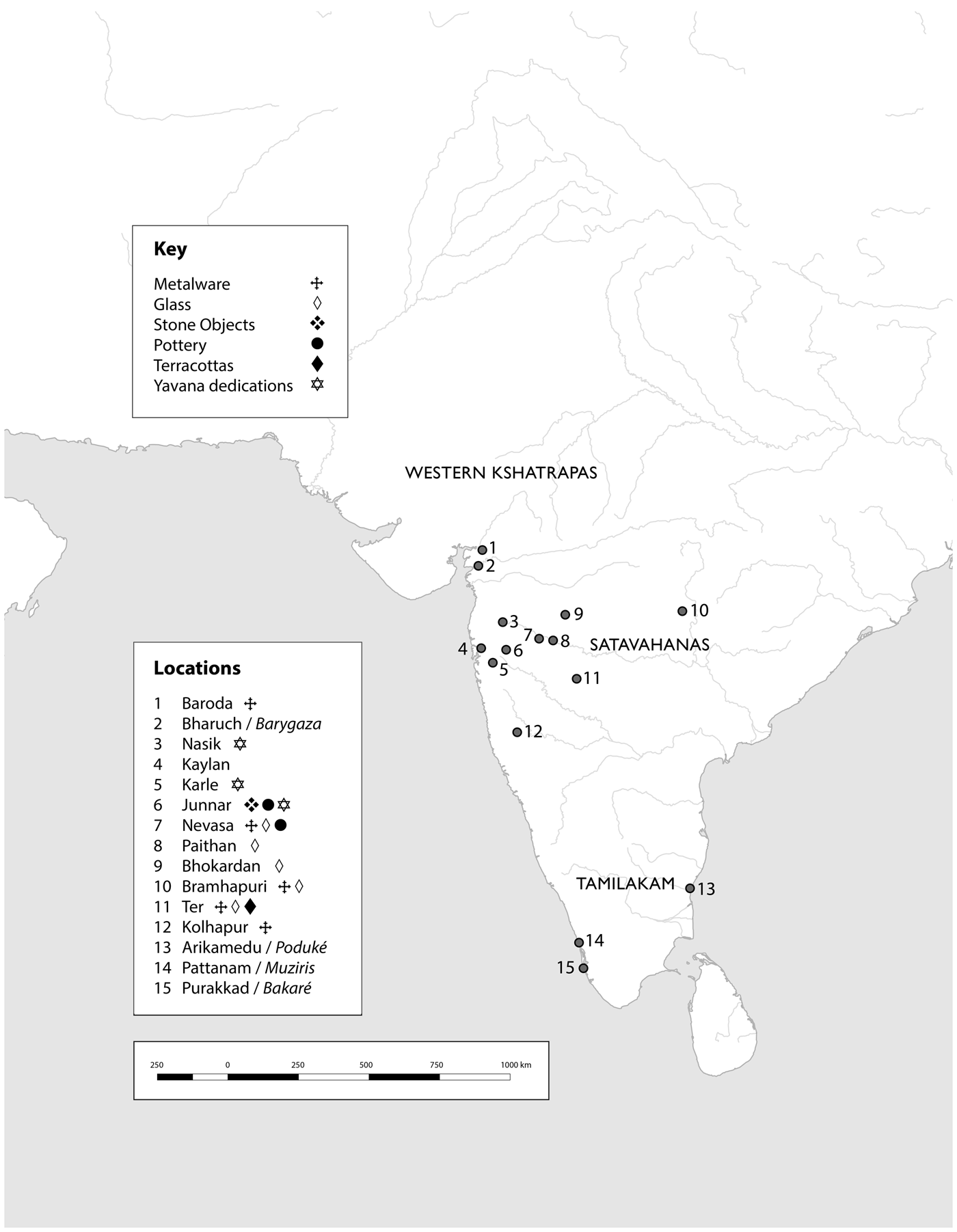
While the author of the PME emphasizes the importance of ports like Barygaza (Gujarat, north-west India), Muziris, and Bakare (Kerala, southern India) (see figure 3), he does mention a number of anchorages along the coast of the ‘Dachinabades’, including Akabaru, Suppara, and Kalliena.Footnote 19 Finds from a number of inland sites in the Deccan make it clear that Mediterranean goods were coming into the region via various trade links. At Junnar, some wine amphorae fragments have been found, in addition to the stone object identified as Eros.Footnote 20 Other sites in Satavahana territory (or territory at times contested by the Satavahanas and the Western Kshatrapas) have revealed bronze wares. At Brahmapuri, two large bronze pots were found in a house (first to third century ce). These contained a total of 102 smaller objects, 13 of which had clearly been produced in the Mediterranean world, including the partial remains of a bronze sieve used to strain wine.Footnote 21 This site has also revealed a crafted repoussé copper emblema depicting the legend of Perseus and Andromeda (popular in the Roman Empire during the first and second centuries ce).Footnote 22 At Kolhapur, an incomplete bronze handle has been identified as part of an oinochoe (wine jug), showing stylistic parallels with finds from Pompeii.Footnote 23 Two bronze mirrors, one with a lid cover, have been recovered from Ter (called Tagara in the PME); these are similar to finds from Kolhapur.Footnote 24 A possible Mediterranean bronze dish has been recorded at Nevasa, along with sixty-three fragments of Campanian Dressel 2 to 4 amphorae (probably pre-dating 79 ce).Footnote 25
Map of the distribution of objects deriving from the Mediterranean world in Satavahana and Western Kshatrapa territory. © Dr Matthew Adam Cobb.

Besides metal wares, glass objects produced in the Mediterranean world have also been found at sites in central western India. Among these items are blue glass beads and bangles of probable Mediterranean origin at Brahmapuri, Nevasa, and Bhokardan, as well as fragments of glass at Paithan (Paithana in the PME), Nevasa, and Ter.Footnote 26 The site of Ter has also revealed two rims of a glass cup and a bottle (early first century ce) similar to one discovered at Taxila-Sirkap (Pakistan).Footnote 27 In addition to crafted glass, Suresh believes that raw glass found at Nevasa, Brahmapuri, and Ter could derive from the Mediterranean world because of associated finds of pottery and coins.Footnote 28 This is a possibility, especially since the PME mentions the export of raw glass to certain India ports, but not something that can be asserted definitively.Footnote 29
The import of Roman coins also had a cultural impact on the Deccan region. Many of these gold (aurei) and silver (denarii) coins were no doubt appreciated in large part for their precious metal content. Nevertheless, these items had a significance beyond their mere bullion content. For example, images of the emperors featured on the observe sides of these coins offered inspiration (at least in terms of general features and detail) for Satavahana terracotta craftsmen who produced clay bullae (imitations of Mediterranean lamps were also made in terracotta).Footnote 30
Although the specific finds of terracottas, crafted metal objects, glassware, and beads might not be large in number, collectively they are significant in terms of the patterns they reveal about the movement of Roman goods into central western India. In fact, across the Indian subcontinent (and including Taxila and Begram) some twenty-odd sites have revealed metal ware, glassware, stone objects, terracottas, and jewellery/gold objects. About thirteen of these sites are 90 kilometres or more from the coast.Footnote 31 As outlined below, it would be a mistake to simply dismiss them as unrepresentative of a genuine demand for Roman goods in India.
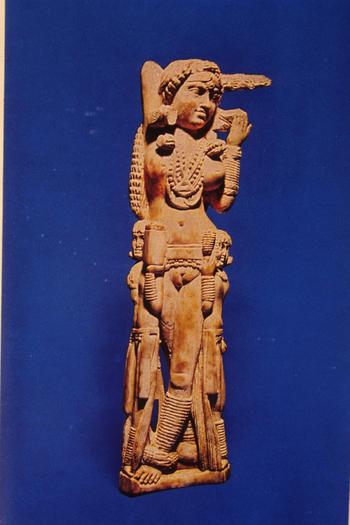
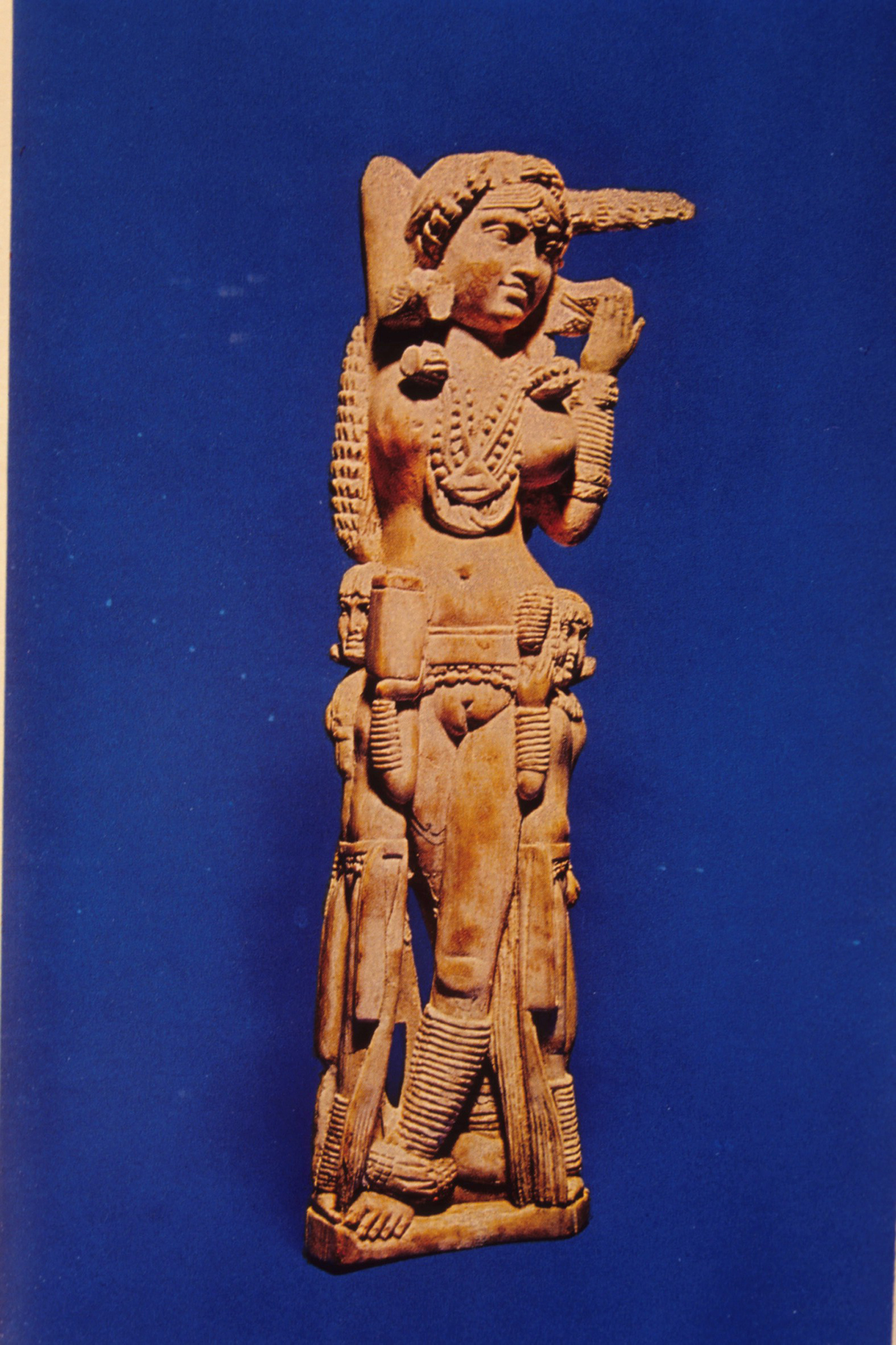
In the opposite direction, there seems to have been some desire in the Roman Empire for items deriving from the Deccan. Notably, an ivory statuette of a female figure discovered in Pompeii (figure 4) is often assumed to be of Satavahanan origin.Footnote 32 This crafted ivory object so far appears to be a relatively isolated find, although Evers has sought to argue that it may well have been representative of a large trade in crafted-Indian ivories, particularly connected to developments in the fashion for certain table styles in the Roman world.Footnote 33 The author of the PME also reveals that the Deccan region produced large quantities of ‘ordinary’ cloth, various cotton garments, and precious onyx.Footnote 34 Again, there seems little reason to doubt the existence of trade links between the Mediterranean world and the Deccan.
The Indian ivory figure found at Pompeii. Courtesy of Professor Rosa Maria Cimino.
Mediterranean items in India: personal property or objects of trade?
Finds in India of objects produced in the Mediterranean world need not, as a matter of course, be explained away as the personal property of ‘western’ merchants who were resident in India for periods of time. In fact, the distribution of metal wares, glassware, and stone objects at various inland sites should caution us against such a hypothesis.Footnote 35 First of all, most Roman merchants are likely to have restricted themselves to the coastal emporia when engaging in trading activity. Dio Chrysostom seems to confirm this point when he notes that merchants who went to India mostly met with the coastal populations.Footnote 36 In light of the tight sailing schedules (the need to observe the monsoon seasons for travelling back and forth across the western Indian Ocean), there may have been little benefit to wandering far inland, especially since a well-developed series of overland, riverine, and sea routes enabled indigenous merchants to move goods across the subcontinent and from eastern to western coasts.Footnote 37 Even for those merchants or agents who were resident in India for longer periods, it is not clear what economic benefit would have been derived from doing so (although adventure and curiosity may have encouraged some). The classical literary sources give the impression of familiarity with the port areas where goods could be purchased, but greater ignorance of areas of production and cultivation.Footnote 38 For example, Pliny mistakenly asserts that costus came from Patala, on the Indus, whereas it actually derived from the highlands of Kashmir.Footnote 39
A second reason for seeing these objects as imports and not the personal property of resident foreign merchants is the existence of Indian literary testimony that records an appreciation for Mediterranean crafted objects. Notably, a number of Sangam poems refer admiringly to finely crafted Yavana (‘Graeco-Roman’ or at least ‘western’) vases and lamps (the ambiguity of the term ‘Yavana’ is discussed in more detail below).Footnote 40 These vessels were probably metal, possibly some even made of gold and silver.Footnote 41 The use of aurei and denarii – as well as Indian imitations of these coins (both base and precious) – in jewellery also demonstrates that objects from the Mediterranean world could easily be appreciated for their artistic merit and adapted to suit a culturally specific purpose (whatever their original function may have been).Footnote 42 Additionally, a number of sites in the Deccan – Ter, Paithan, Kolhapur, Nevasa, Brahmapuri, and Bhokardan – have revealed imitations of Hellenistic terracottas (both stylistically and technically) and reproductions of Roman coins in terracotta by Indian craftsmen.Footnote 43 This evidence further emphasizes the point that Indian cultures were not only capable of appreciating artistic idioms from the Mediterranean world, but could also imitate or adapt them for their own uses.
Finally, the relative number of finds of a particular object are not an automatic indicator of the absolute quantities in which it was imported. Inconsistencies in the quality and nature of excavations within various areas of India, especially in earlier periods, makes comparisons of material between different sites problematic.Footnote 44 Moreover, the relative uniqueness of this alabaster object does not provide an a priori reason for assuming that it was either a personal souvenir or an item of import; neither possibility can be discounted by this fact alone. The presence of items in a particular area does, however, at least allow us to infer an appreciation for them – whether by someone ‘indigenous’ or not.
Yavanas in the Deccan
It has been argued above that there is no reason to assume that the ‘Eros’ at Junnar, or any other crafted Mediterranean object found in the Deccan, need be automatically interpreted as the personal possession of a ‘western’ merchant, when it is just as likely that it could have been an item of trade. Nevertheless, it is worthwhile briefly examining the contention that this stone object should be associated with the presence of Yavanas at Junnar and other sites in the region.Footnote 45 The term ‘Yavana’ appears to have originated as a transmutation of Persian ‘Yauna’, which referred to their Greek-speaking Ionian subjects. This became ‘Yona’ in Prakrit and ‘Yavana’ in Sanskrit. However, by the first half of the first millennium ce, Yavana appears to have become more expansive in meaning, not necessarily designating a Greek-speaker, but more broadly a foreigner from the west (including perhaps Arabs, Persians, and others).Footnote 46
Despite the increasing broadness of this term, references to Yavanas in some of the Tamil poems (Sangam or Cankam anthologies) of southern India (c.300 bce–600 ce) and on rock inscriptions at a number of sites in the Deccan (first century bce to early centuries ce) have been connected to people coming from the territory of the Roman Empire residing in India.Footnote 47 In some cases, such identifications seem quite plausible – for example, in the reference to Yavanas coming in finely constructed vessels to exchange gold for pepper – even if these associations cannot be placed beyond doubt.Footnote 48 But, as we shall see, in other cases a greater deal of circumspection is required.
With regard to the inscriptions mentioning Yavanas in the Deccan, these mostly relate to dedications made to the Buddhist sangha. Six such inscriptions have been found in Karle (c.50–60 kilometres from the west coast of India) and possibly date from the second century bce to the second century ce; five of the dedicators state that they originate from Dhenukātata (an uncertain location, though some have suggested that it can be identified with the Dounga of Ptolemy's Geography, which possibly equates to modern Junnar).Footnote 49 Three inscriptions were discovered at Junnar (c.100 kilometres from the coast) but these dedicators make no mention of their origin.Footnote 50 Ray has suggested that the Yavanas did not need to mention their profession, as they were exclusively traders, and that their donations represent participation in local Buddhist trade networks.Footnote 51
In addition, there are some Prakrit dedicatory inscriptions by Yavanas in a Buddhist cave near Nasik (c.120 kilometres east of the coast). It has even been speculated that an image of an owl, appearing in cave 24, might represent a ‘western’ iconographic element. Another inscription referring to ‘Raumakas’ has also been connected with Romans.Footnote 52 Given the insufficient clarity for the terms Yavana and Raumaka, it is not certain whether either one could refer to Roman merchants or whether they could be used interchangeably.
Previously Ray argued that the presence of Yavana inscriptions in the Deccan, and their absence in southern India (where Yavanas are referred to in the Sangam anthologies), reflects the fact that, in the latter region, Roman merchants were able to directly participate in commercial transactions, whereas in central western India they were dependent on local merchants.Footnote 53 While this idea is not implausible, and it is quite likely that many indigenous traders in the region had some connection with Buddhism (and made donations to the Buddhist sangha), it is less certain that merchants from the Roman Empire resided so far inland as (notional) Buddhist devotees.Footnote 54 As noted above, these merchants probably remained in the coastal emporia.
Moreover, it is important to acknowledge that not all references to Yavanas can be assumed to represent ‘Romans’. A number of examples demonstrate this point. Tieken has argued against Meile's previous assumption that the Yavana mercenary mentioned in the Malaippattu is a Greek. Meile had assumed that the Tamil mattikai was based on the Greek μάστιξ (mastix), a term for a whip.Footnote 55 However, Tieken, drawing upon other Tamil literature, demonstrates that this term is more likely to refer to a bridle or a band put around the head (an Arab kuffiya), with a further reference to meyppai alluding to a bag-like cloth covering the whole body (more akin to Arabic clothing). Furthermore, it may be the case that, in this context, the term Yavana simply denotes a mercenary soldier and not a specific ethnic group.Footnote 56
Additionally, a Brahmi inscription at the Hoq Cave on Socotra (near the Horn of Africa) records an individual called Candrabhūtimukha, who describes himself as a Yavana (approximately second to early fifth century ce).Footnote 57 It is not impossible that he was a Greek-speaking individual who had integrated himself into one of the polities of (north-)west India and continued his career as a merchant, subsequently visiting the island and leaving an inscription. However, it seems more plausible that the label ‘Yavana’ did not denote a Greek-speaker in this context, but rather something else – perhaps simply a broad association with the north-west Indian subcontinent (which historically had been the location of earlier Indo-Greek kingdoms during the second and first centuries bce).Footnote 58 Indeed, in the Mahābhārata (c.400 bce–400 ce), the Yavanas are regarded as among the tribes of the north, while Thapar notes that a later mythic tradition assigned the Yavanas an origin from Turvasu son of Yayâti (a Puranic king).Footnote 59
A further example that underlines the importance of being cautious about assigning a ‘Roman’ origin to the Yavanas mentioned in the Deccan dedications is a late first-century or second-century ce inscription set up on the orders of the Satavahana queen Bālasrī. This inscription eulogizes her son, Gautamiputra Satakarni, who is said to have driven out the Sakas, Yavanas, and Pahlans from the Deccan forever.Footnote 60 A key point to note in this context is that the Yavanas are associated with the north, conforming to an origin assigned them in the Mahābhārata. Moreover, the inscription indicates that they were an invading group to be driven out. Surely, in this instance it is easier to regard these Yavanas as a group of peoples inhabiting territory to the north of the Satavahanas (as is the case with the Sakas, i.e. Western Kshatrapas), rather than as a large body of mercenaries from the Roman Empire.Footnote 61
The points made above are not intended to reject out of hand the possibility that the dedications left by ‘Yavanas’ at Junnar, Karle, and Nasik may reflect ‘Roman’ merchant activity, or that the alabaster ‘Eros’ found in Junnar could in some way be connected to such activity. However, it is apparent that these hypotheses are far from certain. Moreover, at the site of Junnar we so far lack the finds which we tend to associate with the presence of a resident foreign community, such as cooking/domestic wares.Footnote 62 These types of wares, which are often seen as representative of culturally specific cooking and consumption practices, can potentially be interpreted as evidence for the presence of resident foreign merchants at a site (as opposed to vessels containing tradable goods).Footnote 63
Consequently, it is just as plausible that the Eros of Junnar represents an imported trade item owned and appreciated by an individual (or group) indigenous to the Deccan. If this is the case, it raises some interesting questions with regard to the manner in which such an object could be appreciated in Indian cultural terms, an issue to which we shall now turn.
The origins of the universe from an egg
As noted in the introduction, the narrative of a deity being born from an egg during the process of the creation of the world appears in several places in antiquity, including India. Eros is one of the mythological figures who is associated with this narrative, but in Greek, Roman, and Indian sources there are other deities and semi-divine figures who have such a birth. Thus, even if the figure can be identified as Eros, this does not mean that the owner of the alabaster had to come from a Greek or Roman background in order to appreciate the image or associate it with their own religious beliefs.
The depiction of a creator deity being born from an egg appears more than once in ancient Greek texts. As noted in the introduction, Eros is born in this manner in Aristophanes’ Birds (414 bce):
In the limitless depths of Erebos, black-winged Night produced the very first wind-egg,Footnote 64 from which, after the cycle of ages, Eros, full of longing, came forth, with a back of glittering, golden wings and the likenesses of a swift whirlwind.
(Aristophanes Birds 694–7)Footnote 65In addition to this, a deity is born from an egg in the Orphic theogonies, specifically the Rhapsodic Theogony and the Hieronyman and Hellanicus Theogony. These fragmentary texts have largely survived through the works of Christian apologists and Neoplatonic authors from the second to sixth centuries ce, although they probably incorporate mythological material dating back as far as 300 bce.Footnote 66 In both of these texts, Chronos, a deity representing time, produces an egg from which Phanes, the primary creator deity, emerges:
ὃ συμπληρούμενον ὑπὸ βίας τοῦ γεγεννηκότος ἐκ παρατριβῆς εἰς δύο ἐρράγη. τὸ μὲν οὖν κατὰ κορυφὴν αὐτοῦ Οὐρανὸς εἶναι ἐτελέσθη, τὸ δὲ κάτω ἐνεχθὲν Γῆ· προῆλθε δὲ καὶ θεὸς τρίτος δισώματος.
[The egg], when it had been fulfilled by the force of the begetter, broke in two through friction. The sky was completed from the upper part, and the earth was produced from the lower part. And third, the double-bodied god went forth.
(HHT Fr. 80.II)Footnote 67And then Phanes broke the cloud, the bright tunic, and was first to leap from the top part of the wide-yawning, split egg and jump up, Protogonos, man-woman and very honoured.
(RT Fr. 121)Thus, the image of a deity being born from an egg is not solely associated with the birth of Eros within the Greek literary tradition, and the image of a figure within an egg cannot be identified as that deity solely on this basis.
There are two other examples of divine figures being born from eggs in Roman iconography. The first is a second-century ce sculpture which depicts a male figure standing between two halves of an eggshell emitting flames.Footnote 68 This figure is probably Phanes, both because of the birth from the egg and because the figure has several animal heads attached to his sides, matching descriptions of Phanes in the Orphic theogonies (e.g. HHT Fr. 76.I). He is also surrounded by imagery associated with celestial bodies, such as the zodiac; in the Orphic theogonies, Phanes has strong associations with the movements of the celestial bodies.Footnote 69 The second is a similar sculpture of less certain date found at Housesteads on Hadrian's Wall, which depicts a variation of the scene of Mithras’ birth from a rock.Footnote 70 The rock births usually show an adult Mithras emerging from a rock, wearing a Phrygian cap and holding a torch in one hand and a dagger in the other.Footnote 71 The sculpture from Housesteads depicts a figure matching these characteristics; however, he is emerging not from a rock, but from between two halves of an egg. Both of these sculptures bear some similarity to the alabaster from Junnar in that they show a figure within an egg; however, they do not show the figure resting within it, but rather the breaking of the egg and the moment in which a deity emerges. Additionally, both Phanes and Mithras are depicted as adult figures, not infants.
Narratives of infants being born from eggs appear elsewhere in Greek and Roman iconography in connection with the births of Helen and her (half-)brothers, the Dioskouroi. There are two main traditions about the conception and birth of Helen in which the avian form of her parents during conception explain her emergence from an egg. In one, she is the daughter of Leda and Zeus, who fathered his child in the form of a swan. In the other, she is the daughter of Nemesis and Zeus; Nemesis is consistently portrayed as a goose during the conception, while Zeus is either a goose or a swan.Footnote 72 In both the versions of her birth, Helen is frequently (although not universally) described as being born from an egg. As noted by Blondell, the moment of Helen's birth often depicts her as more adolescent than infant, to the point of being adorned in jewellery or having her hair styled.Footnote 73 However, there are some examples in which she is shown as an infant during the egg birth; these often occur in instances where she is depicted being born from the same egg as the Dioskouroi.Footnote 74 As in the representations of Phanes and Mithras, these images show the infants between, or having emerged from, two halves of the shell; they vary somewhat from the previous examples as they show the egg splitting vertically rather than horizontally. Although they do not show Helen or the Dioskouroi reclining inside the eggs, they show a greater similarity to the figure found at Junnar than the previous examples in their depiction of infant rather than adult bodies.
The closest example, in terms of overall composition, appears in a fifth-century Attic lekythos depicting an egg sitting on an altar which contains a clothed infant reaching out towards an adult woman.Footnote 75 While the image does not label the child or the woman, Helen and Leda seem the most likely subject one the basis of the scene. In particular, the position of the egg on an altar is seen in many other vase-paintings representing Leda and her daughter, although Helen is not usually visible within it. The image on the lekythos thus indicates a possible precedent for the alabaster found at Junnar.
As noted earlier, creation narratives involving the primary creator deity being born from an egg appear not only in the ancient Mediterranean but also in the Near East and India. These different versions share some significant characteristics; in particular, the god born from the egg is one of the key creator deities and is often associated with the sun, and the moment of their birth is the one in which the physical world is brought into existence. These narratives differ in the nature of the creation narrative that follows: for example, in the presentation of a cyclical or linear chronology of the universe, or in the use of the eggshell to construct parts of the universe.
The earliest examples of this narrative come from the Coffin Texts and Pyramid texts in Egypt (twenty-first century bce). A particularly clear attestation occurs in Spell 714 from the Coffin Texts; however, this type of cosmogony appears several other time in texts associated with Hermopolis.Footnote 76 As noted by West and López-Ruiz, narratives with very similar characteristics also appear in stories that are attributed to Phoenician sources.Footnote 77 López-Ruiz argues that it is likely that Phoenicians trade networks were one of the primary means by which this narrative was transmitted to other ancient cultures (at least in the Mediterranean).Footnote 78
In contrast to the appearance of this narrative in a comedic cosmogony and some more obscure theogonies in Greek literature, the narrative of the egg and the creator deity appears in several ancient Indian texts which are significant in the Hindu literary tradition. For example, this version of the narrative of creation appears in the Laws of Manu (1.5–13), the Vishnu Purana (1.2.10–56), the Matsya Purana (2.28–36), the Śatapatha-Brāmaṇa (11.1.6.1), and the Mahābhārata (1.1.27). The precise details of the narrative in each of these versions vary somewhat (such as the length of time during which the deity dwells in the egg), but the key features are very similar: the deity within the egg is usually Brahmā; and the creation of the world occurs when the egg splits and he emerges. Although these texts are difficult to date, it is very likely that the presence of this narrative in literary form in India pre-dates the creation of the alabaster. For example, the Laws of Manu appears to date to approximately 200 bce to 200 ce and the Matsya Purana has been dated to approximately 500 bce to 300 ce.Footnote 79 Even if these texts were produced at the latter end of their date ranges, the narrative of the egg is almost certainly part of a mythological tradition long preceding the written works. The inclusion of this narrative in a greater number of ancient Indian texts, and in texts which have had a long period of transmission and influence (particularly the Mahābhārata and the Laws of Manu) may be indicative of a wider usage and knowledge of this myth within India than in the Mediterranean. The image of a figure within an egg, therefore, would be one that could easily be understood within, and adapted to, the cultural conceptions of an indigenous resident of the Deccan region.Footnote 80
Conclusion
Having examined this stone object in a wider commercial and cultural context, several points become clear. First, there is no need to assume, a priori, that this object must have been the personal possession of a ‘Roman’ merchant resident in the Deccan; it could equally plausibly have been owned by someone indigenous to the region. The archaeological and literary evidence seems to strongly indicate a wide appreciation for crafted wares from the Mediterranean world in western central India (among other regions). Secondly, a clear identification of the figure depicted in the alabaster cannot be made definitively. However, Eros is a likely option: the male infant figure matches him most closely in terms of traditional iconographic depictions. Thirdly, while the figure may be Eros or another figure in an egg, it is also possible that it could simply be the image of a child either sleeping or in the womb. In either case, the image of a figure within an egg-like shape could have provoked mythological associations for either a visitor to Junnar from the Mediterranean world or a local inhabitant on the basis of various Indian mythologies. Thus, as can be seen from just this one example, more detailed consideration of issues of cross-cultural exchange, cultural/religious syncretism, and transculturalism would enhance future studies of Graeco-Roman objects discovered in India.