Introduction
Up to 42% of patients with cancer experience significant psychological distress (Zabora et al., Reference Zabora, BrintzenhofeSzoc and Curbow2001; Strong et al., Reference Strong, Waters and Hibberd2007) that is associated with more severe physical symptoms (Brown and Kroenke, Reference Brown and Kroenke2009; Delgado-Guay et al., Reference Delgado-Guay, Parsons and Li2009; Reddy et al., Reference Reddy, Parsons and Elsayem2009), poor quality of life (Smith et al., Reference Smith, Gomm and Dickens2003; Horney et al., Reference Horney, Smith and McGurk2011), worse adherence and response to medical treatment (Fujii et al., Reference Fujii, Ohno and Tokumaru2001; Greer et al., Reference Greer, Pirl and Park2008; Pedersen et al., Reference Pedersen, Sawatzky and Hack2010), chemotherapy dose delays and reductions (Greer et al., Reference Greer, Pirl and Park2008); higher rates of healthcare utilization (Prieto et al., Reference Prieto, Blanch and Atala2002; Balentine et al., Reference Balentine, Hermosillo-Rodriguez and Robinson2011), increased risk of an emergency department visit, overnight hospitalization, and 30-day hospital readmission (Jayadevappa et al., Reference Jayadevappa, Malkowicz and Chhatre2012; Mausbach and Irwin, Reference Mausbach and Irwin2016), and shorter survival (Barrera and Spiegel, Reference Barrera and Spiegel2014). Therefore, providing distressed patients with mental health services is vital to improving patient care with the potential for impact across care outcomes.
Research on distress and mental health service utilization has largely focused on common types of solid tumor cancers (Epping-Jordan et al., Reference Epping-Jordan, Compas and Osowiecki1999; Norton et al., Reference Norton, Manne and Rubin2004; Graves et al., Reference Graves, Arnold and Love2007; Zenger et al., Reference Zenger, Lehmann-Laue and Stolzenburg2010). As a result, significant gaps exist in our understanding of distress in patients with hematologic cancers (Epping-Jordan et al., Reference Epping-Jordan, Compas and Osowiecki1999; Norton et al., Reference Norton, Manne and Rubin2004; Graves et al., Reference Graves, Arnold and Love2007; Zenger et al., Reference Zenger, Lehmann-Laue and Stolzenburg2010; Loquai et al., Reference Loquai, Scheurich and Syring2013). Addressing this gap is necessary as the experience of patients with solid tumor cancers may not be generalizable to hematologic cancers that have distinct courses of treatment and disease trajectories with unique implications for patients’ mental health and quality of life (Keat et al., Reference Keat, Law and Seymour2013).
Aggressive B-cell lymphomas are hematologic malignancies with unique disease trajectories that have implications for patient distress. For example, the most common type of lymphoma, Diffuse Large B-Cell Lymphoma (DLBCL) is considered a curable disease. However, among the 30–40% of patients not cured following first-line therapy (Coiffier et al., Reference Coiffier, Lepage and Briere2002, Reference Coiffier, Thieblemont and Van Den Neste2010; Sant et al., Reference Sant, Minicozzi and Mounier2014; Howlader et al., Reference Howlader, Noone and Krapcho2016), only 20% are alive 2 years later (Crump et al., Reference Crump, Neelapu and Farooq2017) with an overall survival (OS) of 4–6 months (Mack et al., Reference Mack, Block and Nilsson2009; Van Den Neste et al., Reference Van Den Neste, Schmitz and Mounier2015; Crump et al., Reference Crump, Neelapu and Farooq2017). Therefore, while the initial treatment goal for patients with DLBCL is cure, prognosis suddenly and dramatically worsens following disease progression (Crump et al., Reference Crump, Neelapu and Farooq2017).
The abrupt and drastic shift in prognosis from curable to largely terminal in patients with advanced B-cell lymphomas is a unique trajectory with implications for patient distress. Yet, little is known about rates of distress and mental health service utilization among these patients. The few existing studies conducted among patients with B-cell lymphomas examined only survivors (Smith et al., Reference Smith, Zimmerman and Williams2009; Jensen et al., Reference Jensen, Arora and Bellizzi2013; Van Der Poel et al., Reference Van Der Poel, Oerlemans and Schouten2014; Oberoi et al., Reference Oberoi, White and Seymour2017). Therefore, we have little understanding of distress and mental health treatment utilization among patients with B-cell lymphomas who are not in remission. To address this gap, this study examined psychological distress, quality of life, and mental health treatment utilization among patients with advanced, progressive B-cell lymphomas.
Methods
Participants and procedures
Participants were recruited from June 2016 to March 2018 from a single academic medical center in an urban setting. Patients were identified through oncology clinic schedules via electronic medical records. Once patients were deemed potentially eligible and after gaining approval from treating oncologists, patients were invited to participate via recruitment letters in the mail. Informed consent was conducted over the telephone by trained study staff and all participants provided oral informed consent. Participants received $20 for completing the interview. Eligible participants were English-speaking and 21 years of age or older with a diagnosis of diffuse large B-cell lymphoma (DLBCL), follicular lymphoma transformed to DLBCL, double/triple hit lymphoma, Burkitt Lymphoma (BL), or aggressive B-cell lymphoma intermediate between BL and DLBCL. Eligible patients also experienced disease progression following first- or second-line treatment. Patients were excluded if they had a diagnosis of dementia, delirium, and/or endorsed active suicidal ideation on study screening measures. Participants were administered study measures over the telephone by trained research staff. All study procedures were approved by the institutional review board.
Measures
Quality of life
The Short-Form Health Survey (SF-12 v2) (Ware et al., Reference Ware, Kosinski and Keller1996) is a 12-item survey that assesses mental and physical quality of life over the past month and has been validated in cancer patients (Kuenstner et al., Reference Kuenstner, Langelotz and Budach2002) and used in research with patients with lymphoma (Crespi et al., Reference Crespi, Smith and Petersen2010; Kelly et al., Reference Kelly, Pandya and Friedberg2012). Items are rated on a three- or five-point scale with higher scores indicating better quality of life. Sample questions include, “How much of the time during the past four weeks have you felt downhearted and blue?” (response options ranging from “None of the time” to “All of the time”) and “During the past 4 weeks, have you had any of the following problems with your work or other regular daily activities as a result of your physical health? (1) Accomplished less than you would like, (2) Were limited in the kind of work or other activities” (response options ranging from “None of the time” to “All of the time”). The Physical and Mental Quality of Life composite scores for the scale are derived using norm-based scoring (Ware, Reference Ware2002).
Psychological distress
Patients were administered the Hospital Anxiety and Depression Scale (HADS) to assess levels of anxiety and depression over the past week (Zigmond and Snaith, Reference Zigmond and Snaith1983). The HADS is a 14-item self-report measure commonly used with cancer patients that consists of seven-item anxiety and depression subscales (Hopwood et al., Reference Hopwood, Howell and Maguire1991; Moorey et al., Reference Moorey, Greer and Watson1991; Walker et al., Reference Walker, Postma and McHugh2007; Vodermaier et al., Reference Vodermaier, Linden and Siu2009; Hinz et al., Reference Hinz, Krauss and Hauss2010; Mitchell, Reference Mitchell2010). Sample items on the anxiety and depression subscales include, “Worrying thoughts go through my mind” and “I still enjoy the things I used to enjoy” (reverse scored). Each item is rated on a four-point Likert scale ranging from 0 to 3. Scores range from 0 to 21 per subscale (0 to 42 for the total scale), with higher scores indicating greater anxiety or depression. Per established cutoff criteria, a score of eight or greater on each subscale indicates elevated levels of depression or anxiety, and a total score of 11 or greater indicates elevated global distress (Zigmond and Snaith, Reference Zigmond and Snaith1983).
Mental health service utilization
To assess mental health service use since being diagnosed with cancer, patients were asked, “Have you accessed any type of mental health treatment to help yourself adjust to your cancer?” Response options included: “Yes,” “No,” and “I don't want mental health treatment.”
Statistical analyses
Frequency and descriptive statistics were used to examine sample characteristics and levels of distress and mental health service utilization. One-way between subjects Analysis of Variance (ANOVA) was conducted to examine the relationship between distress and quality of life. Distress was dichotomized using established cutoffs. Statistical tests were two-sided and p values of <0.05 indicated statistical significance.
Results
Sample characteristics
Out of the 99 patients who were approached to participate, 68 were excluded due to not meeting eligibility criteria, refusing to participate in the study, or being unavailable via telephone for the study staff to contact; the 31 patients who were eligible and agreed to participate provided oral informed consent via telephone. Five patients were subsequently lost to follow-up for various reasons (e.g., transferred to hospice care, patient death, inability to reach the patient). The final sample consisted of 26 patients with complete data on study measures. The average age of the sample was 64.15 years (SD = 16.33, Table 1), with the majority of patients self-identifying as Caucasian (n = 23, 88.5%) and non-Latino (n = 26, 100%). Approximately half of the sample was female (n = 14, 53.8%) and the majority had a diagnosis of DLBCL (n = 19, 73.1%).
Sample characteristics (n = 26)

Note: DLBCL, Diffuse Large B-Cell Lymphoma.
Rates of distress and mental health service use
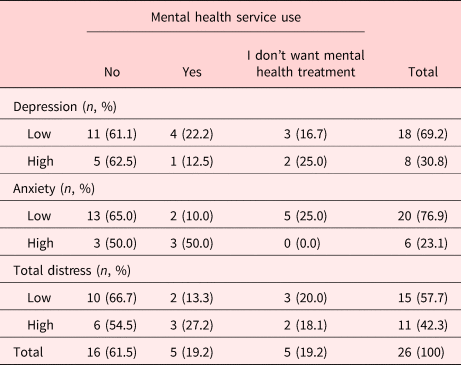
Almost half of the total sample (n = 11, 42.3%) reported elevated levels of global distress, with approximately one-third (n = 8, 30.8%) endorsing elevated depression and approximately one-quarter (n = 6, 23.1%) endorsing elevated anxiety. Approximately half of the patients who reported elevated overall distress did not receive mental health services (n = 6, 54.5%). Of the patients who reported elevated depression, more than half (n = 5, 62.5%) did not receive mental health treatment since their cancer diagnosis, and one-quarter (n = 2, 25.0%) did not want mental health treatment. Half of patients with elevated anxiety (n = 3, 50.0%) utilized mental health treatment, while the other half (n = 3, 50.0%) did not (Table 2).
Rates of distress and mental health service use

Note. Low depression: <8 on HADS depression subscale; Low anxiety: <8 on HADS anxiety subscale; Low total distress: <11 on complete HADS scale.
Distress and physical quality of life
The bivariate relationship between global distress and physical quality of life was not statistically significant [F (1, 24) = 3.05, p = 0.94]. Similarly, the relationship between physical quality of life and anxiety was not statistically significant [F (1, 24) = .10, p = 0.75]. However, the bivariate relationship between physical quality of life and depression approached statistical significance [F (1, 24) = 3.74, p = 0.065], such that patients with elevated depression had worse physical quality of life (M = 48.83, SD = 14.34) relative to patients without elevated depression (M = 59.83, SD = 12.97). This association remained unchanged after controlling for sex, age, and race [F (1, 24) = 3.74, p = 0.065].
Distress and mental quality of life
The bivariate relationship between total distress and mental quality of life was statistically significant [F (1, 24) = 15.32, p = 0.001]. Patients with elevated distress reported worse mental quality of life (M = 53.7, SD = 13.61) than patients without elevated distress (M = 72.5, SD = 10.90). This association remained significant after controlling for age, sex, and race [F (1, 24) = 28.29, p < 0.001]. The relationship between mental quality of life and depression was also statistically significant [F (1, 24) = 7.74, p = 0.010], such that patients with elevated depression had worse mental quality of life (M = 53.52, SD = 14.70) relative to patients without elevated depression (M = 69.44, SD = 12.93). This association remained significant after controlling for age, sex, and race [F (1, 24) = 15.16, p = 0.001]. Finally, the relationship between mental quality of life and anxiety was statistically significant in uncontrolled analyses [F (1, 24) = 11.76, p = 0.002]. Patients with elevated anxiety had worse mental quality of life (M = 48.96, SD = 11.30) than patients without elevated anxiety (M = 69.22, SD = 13.03). This association remained significant controlling for sex, age, and race [F (1, 24) = 8.48, p = 0.008].
Discussion
The present study examined psychological distress, quality of life, and mental health treatment utilization among patients with advanced, progressive B-cell lymphomas. Over one-third of patients endorsed significant distress which was associated with worse mental quality of life. Among patients endorsing significant distress, over half did not receive mental health services. Notably, approximately one-fifth of patients with elevated distress reported not wanting mental health services.
The prevalence of distress in this study is similar to findings from prior research of patients with common and rare malignancies (Zabora et al., Reference Zabora, BrintzenhofeSzoc and Curbow2001; Bergerot et al., Reference Bergerot, Bergerot and Philip2018). The rates of elevated depression and anxiety found here (approximately one quarter of patients) were also comparable, albeit slightly higher, to a previous study of patients with DLBCL and multiple myeloma (15 and 18% for anxiety and depression, respectively) (Oberoi et al., Reference Oberoi, White and Seymour2017). Thus, our findings suggest that among patients with progressive B-cell lymphomas, rates of distress are similar to rates in broader samples of DLBCL patients and patients with more common solid tumor cancers.
Our findings also indicate that distress is negatively associated with mental quality of life in patients with B-cell lymphomas. Additionally, the relationship between distress and physical quality of life approached significance. While causality cannot be determined from these cross-sectional data, distress may have negative implications for patients’ quality of life. In fact, prior longitudinal studies in survivors of hematologic cancers found that distress was associated with worse quality of life over time (Oberoi et al., Reference Oberoi, White and Seymour2017). Furthermore, the relationship between elevated depression and physical quality of life approached statistical significance in this small study. While a nonsignificant finding cannot be interpreted, future research on the relationship between distress and physical well-being may expand our understanding of the relationship between physical and mental health in patients with advanced B-cell lymphomas.
Given this relationship between distress and poor mental quality of life, the low rates mental health treatment of distressed patients in this study are concerning. Over half of distressed patients did not receive services to treat their distress with the potential to improve their quality of life. The current study was conducted at a single institution, thereby reflecting a specific treatment setting. However, similar rates of mental health treatment for distressed patients have been found in other studies (Carlson et al., Reference Carlson, Angen and Cullum2004; Mosher and DuHamel, Reference Mosher and DuHamel2012), suggesting that under-treatment of distress may be a widespread problem. The American College of Surgeons Commission on Cancer mandates distress screening and referral to psychosocial services in accredited cancer centers (Wagner et al., Reference Wagner, Spiegel and Pearman2013; American College of Surgeons Commission on Cancer, 2016). Research identifying barriers to provision of mental health services and examining implementation strategies that address these barriers is vital to the provision of cancer care focused on the whole person (Institute of Medicine (US) Committee on Psychosocial Services to Cancer Patients/Families in a Community Setting, 2008; Trevino et al., Reference Trevino, Healy and Martin2018, Reference Trevino, Canin and Healy2020). Innovations in mental health assessment and delivery, such as co-located oncologic and mental health services (Druss and Newcomer, Reference Druss and Newcomer2007) and remote delivery options (e.g., telephone, web-based) may improve patient access to mental health services (Shepherd et al., Reference Shepherd, Goldstein and Olver2008; Head et al., Reference Head, Studts and Bumpous2009; Krigel et al., Reference Krigel, Nelson and Spaulding2014).
These innovations in mental health delivery may also benefit patients who endorsed distress but indicated not wanting mental health services. Easier access to services may incline patients to accept treatment for their distress. However, future work should also consider other reasons for refusal of mental health services including cost, the stigma associated with seeking care, patient perceptions regarding seeking help, and a lack of awareness regarding effective and available mental health services (Weinberger et al., Reference Weinberger, Bruce and Roth2011; Mosher et al., Reference Mosher, Winger and Hanna2014). Strategies to address these barriers may further increase patients’ willingness and ability to utilize mental health services.
Limitations of the present study include the use of self-report measures and a small sample size. Mental health treatment utilization was assessed via self-report. Patient self-report has the benefit of capturing services received outside of the institution that would not be recorded in the medical record. However, this assessment strategy may result in inclusion of services not traditionally viewed as mental health treatment and heterogeneity across patients in the definition of mental health services. Collection of objective data on mental health treatment use, such as from the medical record, in combination with self-report may provide a more comprehensive assessment of mental health service use.
The present study is also limited by the small sample size, attributable to the rarity of progressive B-cell lymphomas and recruitment challenges related to patients being too sick, or busy with medical appointments to participate (Surveillance Research Program, 2000–2011; Joy et al., Reference Joy, Ndindjock and Coyle2013; Parikh et al., Reference Parikh, Rabe and Call2013). However, despite the small sample, the relationships between distress and quality of life were significant or approached significance, highlighting the magnitude of these relationships. Future research should explore these associations further, including examining factors that may account for these relationships. Additional research on the relationship between distress and constructs such as treatment decision-making and adherence, sleep quality, and relationship function will provide a more comprehensive understanding of the impact of distress on patients’ lives. Longitudinal research on the relationship between distress and these variables is particularly important in B-cell lymphomas due to the potential for a drastic change in prognosis. Longitudinal research would capture patients’ experience of this change and elucidate causal relationships that cannot be determined from these cross-sectional data.
Finally, this study is limited by sample selection as the sample consisted of patients from a single institution in an urban setting. As a result, the majority of the sample was white and highly educated, precluding generalization to other demographic groups such as racial and ethnic minority patients. Research on more diverse samples is vital to understanding cultural influences on patients’ experiences and informing interventions tailored to the needs of particular populations.
The present study is a preliminary step toward understanding distress, quality of life, and mental health treatment use in patients with advanced hematologic malignancies. Despite the limitations of this study, our results highlight potential gaps in the research and clinical care of these patients. The unique disease trajectory of advanced B-cell lymphomas likely has significant implications for patients’ psychological well-being that justifies additional research and clinical services that account for the unique needs of this population.
Funding/support
This work is funded by the Weill Cornell Medicine Lymphoma Program (J.P.L.), the National Institute on Aging and American Federation for Aging Research (K23 AG048632, K.M.T.), and the National Cancer Institute (P30 CA008748, T32 CA009461). This work is supported by a grant from Ben and Ayalet Blaustein in memory of Henry Blaustein.
Conflict of interest
P.M. serves as a consultant to AstraZeneca, Gilead, Janssen, Bayer, Seattle Genetics, and Kite; S.C.R. serves as a consultant for AstraZeneca, Celgene, Heron, Juno Therapeutics, Karyopharm, and Seattle Genetics; J.P.L. serves as a consultant to Sutro, Bayer, MEI Pharma, Gilead, AstraZeneca, Novartis, Celgene, Biotest, Merck, Morphosys, Beigene, Nordic Nanovector, Roche/Genentech, ADC Therapeutics; No other authors (K.M.T., C.M., L.S.G., D.J.O..) have conflicts to disclose.