Recent data from the Center for Disease Control and Prevention show that over 60% of adults have experienced at least one adverse childhood experience (ACE) with close to 25% of adults reporting exposure to three or more ACEs (Merrick et al., Reference Merrick, Ford, Ports and Guinn2018). On average, exposure to early adversity is associated with an increased risk for poor mental and physical health outcomes across the life span (Green et al., Reference Green, McLaughlin, Berglund, Gruber, Sampson, Zaslavsky and Kessler2010; Nusslock & Miller, Reference Nusslock and Miller2016). However, many children display resilience to early adversity and do not go on to develop poor outcomes (Masten et al., Reference Masten, Burt, Roisman, Obradović, Long and Tellegen2004). Multiple environmental factors, including those outside of the home, such as connectedness to school, have been posited to promote resilience (Barber & Olsen, Reference Barber and Olsen1997; Masten et al., Reference Masten, Lucke, Nelson and Stallworthy2021). The present study examined child and adolescent connectedness to school as protective against childhood exposure to early adversity. Consistent with prominent calls in the field (Masten & Cicchetti, Reference Masten and Cicchetti2016), this study is precise in its specification of two dimensions of adversity that index multiple levels of environmental exposure and examines resilience in terms of both the absence of negative outcomes and the presence of positive outcomes.
Protective effects of school connectedness
Youth spend a majority of their day at school and thus their experiences there can play a large role in both socioemotional development and resilience (Masten & Cicchetti, Reference Masten and Cicchetti2016; Roeser, Eccles, & Sameroff, Reference Roeser, Eccles and Sameroff2000). School connectedness, an index of youth’s sense of belonging and supportive relationships in the school environment, has been associated with positive adolescent outcomes including reduced emotional distress, suicidality, violence, and substance use (Bond et al., Reference Bond, Butler, Thomas, Carlin, Glover, Bowes and Patton2007; Brookmeyer et al., Reference Brookmeyer, Fanti and Henrich2006; Kalu et al., Reference Kalu, Menon and Quinn2020; Resnick et al., Reference Resnick, Bearman, Blum, Bauman, Harris, Jones, Tabor, Beuhring, Sieving, Shew, Ireland, Bearinger and Udry1997). Moreover, research has shown that school context factors, including connectedness, can buffer against the detrimental effects of cumulative risks, as well as specific exposures, such as neighborhood violence and negative family relations (Hardaway et al., Reference Hardaway, McLoyd and Wood2012; Lensch et al., Reference Lensch, Clements-Nolle, Oman, Evans, Lu and Yang2020; Loukas et al., Reference Loukas, Roalson and Herrera2010; Markowitz, Reference Markowitz2017). Additionally, research suggests that social support in the school environment may compensate for low social support from other sources, such as the home (Barber & Olsen, Reference Barber and Olsen1997; Foster & Brooks-Gunn, Reference Foster and Brooks-Gunn2009). In light of these findings and the fact that school connectedness is a potentially modifiable factor, it is an attractive target for interventions designed to promote positive outcomes in youth exposed to adversity (Foster & Brooks-Gunn, Reference Foster and Brooks-Gunn2009; McNeely et al., Reference McNeely, Nonnemaker and Blum2002).
Dimensional models of adversity
Though a wealth of literature has examined the effects of either specific adversities (e.g., abuse, harsh parenting) or the cumulative effects of adversity broadly (i.e., cumulative risk research), dimensional models of adversity propose that the complex experiences of early adversity can be broken down into core underlying dimensions that influence neural and behavioral development through both distinct and more global mechanisms (McLaughlin et al., Reference McLaughlin, Sheridan, Humphreys, Belsky and Ellis2021; McLaughlin & Sheridan, Reference McLaughlin and Sheridan2016). In the dimensional model of adversity and psychopathology (DMAP), one of the first and more prominent dimensional models, adversity is broken down into threat and deprivation (McLaughlin et al., Reference McLaughlin, Sheridan and Lambert2014). Guided by the DMAP, we have constructed very similar measures of violence exposure (“threat” in DMAP) and social deprivation (narrower than the broader “deprivation” in DMAP). Violence exposure, similar to the threat construct in DMAP, includes experiences of physical and emotional abuse, exposure to intimate partner violence (IPV) in the home, and community violence (Hein et al., Reference Hein, Goetschius, McLoyd, Brooks-Gunn, McLanahan, Mitchell, Lopez-Duran, Hyde and Monk2020). Social deprivation, which differs from the DMAP dimension of deprivation, includes experiences of physical and emotional neglect, a lack of support in the home, and a lack of a sense of cohesion and support in the neighborhood (Hein et al., Reference Hein, Goetschius, McLoyd, Brooks-Gunn, McLanahan, Mitchell, Lopez-Duran, Hyde and Monk2020). Both violence exposure and social deprivation exist on a continuum: violence exposure ranges from low (i.e., safety) to high and social deprivation from low (i.e., high levels of home/neighborhood support) to high (i.e., lack of support). These dimensions are conceptually and statistically distinct (Hein et al., Reference Hein, Goetschius, McLoyd, Brooks-Gunn, McLanahan, Mitchell, Lopez-Duran, Hyde and Monk2020; Lambert et al., Reference Lambert, King, Monahan and Mclaughlin2017; McLaughlin et al., Reference McLaughlin, Sheridan and Lambert2014; Miller et al., Reference Miller, Sheridan, Hanson, McLaughlin, Bates, Lansford, Pettit and Dodge2018). For example, research has shown that violence exposure is specifically linked to differences in areas of the brain involved in fear-learning and emotion processing, while social deprivation has been related to differences in areas involved in social reward processing (Hein et al., Reference Hein, Goetschius, McLoyd, Brooks-Gunn, McLanahan, Mitchell, Lopez-Duran, Hyde and Monk2020; McLaughlin et al., Reference McLaughlin, Weissman and Bitrán2019). However, these dimensions coexist, are likely correlated, and interact with each other to create a unique environment of adversity for each individual (Goetschius et al., Reference Goetschius, Hein, Mitchell, Lopez-Duran, McLoyd, Brooks-Gunn, McLanahan, Hyde and Monk2020; McLaughlin & Sheridan, Reference McLaughlin and Sheridan2016). Thus, it is important to assess exposure to both dimensions simultaneously.
Resilience can differ by risk process and outcome
Resilience is a multidimensional construct that encompasses processes that help youth do well even when exposed to adverse environments (Masten et al., Reference Masten, Lucke, Nelson and Stallworthy2021; Miller-Graff, Reference Miller-Graff2020). These processes involve reciprocal influences across a network of interconnected systems within and outside the individual (Kalisch et al., Reference Kalisch, Cramer, Binder, Fritz, Leertouwer, Lunansky, Meyer, Timmer, Veer and van Harmelen2019; Masten et al., Reference Masten, Lucke, Nelson and Stallworthy2021). Systems within an individual that work to promote resilience can be psychological (e.g., positive self-perception, adaptable temperament) or biological (e.g., the brain, genes), whereas external systems related to resilience can include networks of social support in home, neighborhood, and school environments (Ceballo & McLoyd, Reference Ceballo and McLoyd2002; Hyde et al., Reference Hyde, Gard, Tomlinson, Burt, Mitchell and Monk2020; Luthar et al., Reference Luthar, Crossman and Small2015; Masten et al., Reference Masten, Lucke, Nelson and Stallworthy2021). We examine the protective effects of school connectedness, an index of youth’s sense of belonging and supportive relationships in the school environment, in the context of violence exposure and social deprivation in the home and neighborhood (Loukas et al., Reference Loukas, Suzuki and Horton2006; Resnick et al., Reference Resnick, Bearman, Blum, Bauman, Harris, Jones, Tabor, Beuhring, Sieving, Shew, Ireland, Bearinger and Udry1997).
Protective processes underlying resilience can differ depending by risk process (Blum et al., Reference Blum, McNeely, Nonnemaker, Fischhoff, Nightingale and Iannotta2001), therefore it is advantageous to examine the potential buffering effects of school connectedness in the context of multiple dimensions of childhood adversity. Prior research suggests that dimensions of adversity shape development in ways that are at least partially distinct (Hein et al., Reference Hein, Goetschius, McLoyd, Brooks-Gunn, McLanahan, Mitchell, Lopez-Duran, Hyde and Monk2020; McLaughlin et al., Reference McLaughlin, Sheridan, Humphreys, Belsky and Ellis2021), but there is a lack of work empirically testing protective processes within a dimensional framework. Given that underlying core dimensions of risk may work through distinct neural and behavioral mechanisms (Lambert et al., Reference Lambert, King, Monahan and Mclaughlin2017; McLaughlin et al., Reference McLaughlin, Sheridan, Humphreys, Belsky and Ellis2021), it is tenable that protective factors may function differently in the context of violence exposure and social deprivation.
Of equal importance to modeling the complexity of adversity in the study of resilience is the selection of outcomes. Most studies examining the protective effects of school connectedness have focused solely on outcomes such as externalizing behaviors (e.g., conduct disorder) (Klika et al., Reference Klika, Herrenkohl and Lee2013; Loukas et al., Reference Loukas, Roalson and Herrera2010), or internalizing behaviors (Lensch et al., Reference Lensch, Clements-Nolle, Oman, Evans, Lu and Yang2020; Markowitz, Reference Markowitz2017). Given the high comorbidity of internalizing and externalizing disorders in children (Caron & Rutter, Reference Caron and Rutter1991; Smith et al., Reference Smith, Atkinson, Davis, Riley and Oltmanns2020), surprisingly little research has examined the protective effects of school connectedness against early adversity when predicting internalizing and externalizing simultaneously (Hardaway et al., Reference Hardaway, McLoyd and Wood2012). Additionally, protective factors can promote resilience in ways that enhance adaptive outcomes rather than mitigating negative outcomes, though fewer studies of resilience have examined both positive and negative outcomes (Luthar et al., Reference Luthar, Crossman and Small2015; Masten & Cicchetti, Reference Masten and Cicchetti2016). Positive function, as measured in the present study (Kern et al., Reference Kern, Benson, Steinberg and Steinberg2016), indexes qualities such as optimism and perseverance, which promote positive outcomes (Chen & Miller, Reference Chen and Miller2012). To gain a greater understanding of protective processes, it is important to evaluate them with respect to adaptive and the absence of maladaptive outcomes.
Types of resilience processes
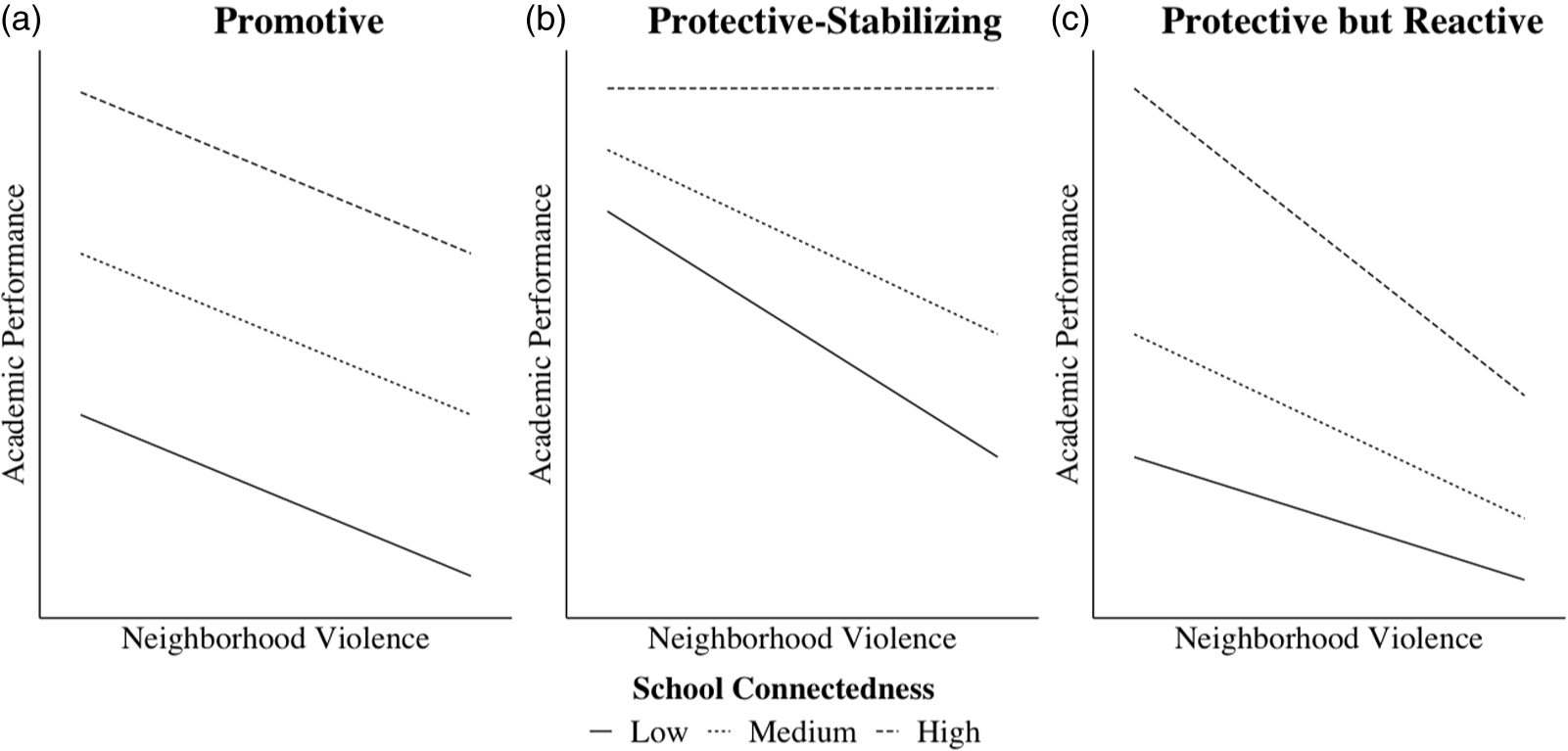
Protective factors, such as school connectedness, are defined by who they are protective for and how that protection differs across risk level. This can be best understood using a hypothetical example that displays three different types of protective effects of school connectedness against violence exposure when predicting academic performance (Figure 1). Protective factors can be promotive, meaning that they are associated with better outcomes for everyone regardless of risk level (Sameroff, Reference Sameroff2010). In our hypothetical example, school connectedness would be promotive if it was associated with better academic performance, regardless of the level of neighborhood violence (Figure 1a). Alternatively, protective processes can be more complex involving interactions between risk and protective factors. A protective variable can be protective-stabilizing, where, in the context of increasing risk, having a certain attribute results in no decrease in rates of the positive outcome (Foster & Brooks-Gunn, Reference Foster and Brooks-Gunn2009; Luthar et al., Reference Luthar, Cicchetti and Becker2000). For example, school connectedness would be considered protective-stabilizing if high levels of school connectedness were associated with similar levels of high academic performance, regardless of the level of neighborhood violence (Figure 1b). Conversely, a protective variable can be protective but reactive, where it promotes positive outcomes, but less so as environmental risk or stress increases (Luthar et al., Reference Luthar, Cicchetti and Becker2000; Proctor, Reference Proctor2006). Returning to our example, school connectedness could be considered protective but reactive if is associated with better academic performance, but as the level of neighborhood violence increases, the protective effect of school connectedness becomes less pronounced. Protective variables may also function in different ways depending on the risk factor and the outcome. The different ways that protective factors can promote resilience highlight the multidimensional nature of adversity.
Hypothetical plots representing the different definitions of protective processes. Adapted from Luthar et al., Reference Luthar, Cicchetti and Becker2000. All data and associations represented are for example purposes only and are not based on real data.

Resilience and developmental timing
The protective effects of school connectedness may differ with developmental stage. The school experience can vary dramatically at different developmental stages due to differences in school environment, as well as, developmental characteristic (e.g., importance of peer relationships), which may impact both the level of school connectedness and what contributes to it (Eccles, Reference Eccles1999; Monahan et al., Reference Monahan, Oesterle and Hawkins2010; Oelsner et al., Reference Oelsner, Lippold and Greenberg2011). Research has shown that, on average, positive relationships with teachers and teacher support declines from elementary school across middle and high school (Eccles et al., Reference Eccles, Midgley, Wigfield, Buchanan, Reuman, Flanagan and Iver1993; Reddy et al., Reference Reddy, Rhodes and Mulhall2003). Additionally, social relationships with peers, including those at school, become more salient in adolescence compared to middle childhood (Eccles, Reference Eccles1999). Most research on school connectedness has focused on adolescence. The small amount of research examining the positive effects of school connectedness earlier in development has found links with more life satisfaction and positive academic outcomes (In et al., Reference In, Kim and Carney2019; Klem & Connell, Reference Klem and Connell2004; Liu et al., Reference Liu, Kim, Carney, Chung and Hazler2020).
The present study
In the present study, we examined whether childhood exposure to two dimensions of early adversity (composite across ages 3, 5, 9), violence exposure and social deprivation, predicted latent variables indexing child (Age 9) and adolescent (Age 15) internalizing and externalizing symptoms (4 separate variables) and adolescent positive function in youth from the Fragile Families and Child Wellbeing Study (FFCWS), a longitudinal birth cohort study. We hypothesized that both violence exposure and social deprivation would predict increased internalizing and externalizing symptoms and decreased positive function. Additionally, we tested whether connectedness to school in both childhood (age 9) or adolescence (age 15) was protective against the sequelae of early adversity and whether this differed across dimensions of adversity or by the outcome examined (i.e., internalizing symptoms, externalizing symptoms, or positive functioning) using a latent variable moderation approach. We did not have specific hypotheses regarding whether protective effects of school connectedness would be stronger for one dimension of adversity than another; however, given the multidimensional nature of resilience, we did not assume it would be uniformly protective. Additionally, given developmental differences in school connectedness, we did not assume that protective or promotive effects would be the same across development.
Methods
Sample
We used data from the FFCWS, a population-based, longitudinal, birth cohort study of 4,898 children born between 1998 and 2000 and their parents across 20 U.S. cities. The FFCWS oversampled for non-marital births at an approximately 3:1 ratio (Reichman et al., Reference Reichman, Teitler, Garfinkel and McLanahan2001). FFCWS families were interviewed at the birth of the focal child, and again when the child was 1, 3, 5, 9, and 15 years of age through a combination of in-person interviews and phone surveys.
Analyses use data from 3,246 families primarily from the mother and primary caregiver interviews at ages 3, 5, 9, and 15 and the focal child interviews at ages 9 and 15. Over the 3 waves where we used data from the primary caregiver survey (ages 3, 5, 9), an average of 96% of respondents were mothers. Therefore, for parsimony, we refer to responses from mothers and primary caregivers as maternal reports. Families were excluded from the full FFCWS sample (N = 4898) if they were missing from the age 15 wave (N = 1633). Participants who had age 15 data were excluded if they were missing all possible datapoints from the age 3, 5, and 9 waves (N = 19). Full information maximum likelihood estimation was used to account for missing data in participants who were not missing all variables but were missing individual items (Kline, Reference Kline2015; Muthén & Muthén, Reference Muthén and Muthén1998). See Table 1 for sample demographic information. When demographic characteristics from the included and excluded samples are compared, the excluded families had a slightly lower average income-to-needs ratio, lower levels of maternal education at the child’s birth, and were more likely to be male (Supplemental Table 1). These sample differences were accounted for by adjusting for the average income-to-needs ratio and child sex at birth, in addition to other demographic characteristics in all models (details in Covariates section below). We did not include maternal education at birth due as a covariate to a high correlation with average income-to-needs ratio.
Demographic characteristics of the sample

1 Income-to-needs ratio variable is referred to as the poverty ratio in the FFCWS data set.
Measures
Childhood violence exposure and social deprivation composite scores
Violence exposure and social deprivation were assessed using composite scores calculated using data from the FFCWS at ages 3, 5, and 9 years. Both constructs included the maternal report of experiences that directly (i.e., child physical and emotional abuse, child physical and emotional neglect) and indirectly (i.e., intimate partner emotional, physical, or sexual violence, intimate partner support, community violence, community support) affect the child. Emotional abuse was included as part of the violence exposure dimension because it causes emotional harm, making a child feel unsafe (Berzenski & Yates, Reference Berzenski and Yates2010; Font & Berger, Reference Font and Berger2015). Exposure to IPV and support was calculated from maternal reports based on their current partner who could be the baby’s father or a different partner. Approximately 70% of mothers reported being in a relationship at each wave with 43% reporting being in a relationship all three study waves included in the composite scores. The dimensions of violence exposure and social deprivation exist on continua with violence exposure ranging from low (i.e., safety) to high and social deprivation from low (i.e., high levels of home/neighborhood support) to high (i.e., lack of support). Our approach of including experiences with varying levels of proximity to the child across multiple time points allowed us to comprehensively assess the child’s cumulative, dimensional exposure to violence and social deprivation across childhood as has been done in previous research (Hein et al., Reference Hein, Goetschius, McLoyd, Brooks-Gunn, McLanahan, Mitchell, Lopez-Duran, Hyde and Monk2020; McLaughlin & Sheridan, Reference McLaughlin and Sheridan2016). These composite scores were first utilized in previous work from our group (Hein et al., Reference Hein, Goetschius, McLoyd, Brooks-Gunn, McLanahan, Mitchell, Lopez-Duran, Hyde and Monk2020).
Childhood exposure to violence
Included in this composite was the maternal report of child physical and emotional abuse based on items from the Parent-Child Conflict Tactics Scale (CTS-PC) (Straus et al., Reference Straus, Hamby, Finkelhor, Moore and Runyan1998) that have been used in previous research (Font & Berger, Reference Font and Berger2015; Hunt et al., Reference Hunt, Slack and Berger2017). Five items were used to assess physical abuse including, “hit him/her on the bottom with a hard object” and “shook him/her” and five items were used to assess emotional abuse including whether the parent/caregiver has “sworn or cursed at,” or “called him/her dumb or lazy or some other name like that.” Each item was rated on a 7-point Likert scale ranging from “never happened” to “more than 20 times.” Maternal report of the child’s exposure to or victimization of violence in the neighborhood (Zhang & Anderson, Reference Zhang and Anderson2010) was also included in the composite. This was measured using the maternal report of the child witnessing or being the victim of beating, attacks with a weapon, shootings, and killings (witness only) on a 5-point Likert scale ranging from “never” to “more than 10 times.” At age 9, the mother was not asked about whether the child had witnessed killings or if they had been the victim of a shooting, so these items were only included for ages 3 and 5 years. Lastly, we included maternal report of IPV (physical-2 items, emotional-3 items, or sexual-1 item) in the home at each wave (Hunt et al., Reference Hunt, Slack and Berger2017). Each item was rated on a 3-point Likert scale ranging from “never” to “often.” Physical IPV items included “he slapped or kicked you” and “he hit you with his fist or a dangerous object.” Emotional IPV items included “he tried to isolate you from family and friends,” and “he tried to prevent you from going to work and/or school.” The sexual IPV was “he tried to make you have sex or do sexual things you didn’t want to do.” The child’s exposure to IPV against the mother was coded as missing for a given wave if the child did not live with their mother at least 50% of the time.
Childhood exposure to social deprivation
Included in this composite was maternal report of child physical and emotional neglect based on items from the CTS-PC (Straus et al., Reference Straus, Hamby, Finkelhor, Moore and Runyan1998) that have been used in previous research (Font & Berger, Reference Font and Berger2015; Hunt et al., Reference Hunt, Slack and Berger2017). Four items from the CTS-PC were used to assed physical neglect including whether the parent was ever “so drunk or high that you had a problem taking care of your child.” One item, whether the parent was “ever so caught up in your own problems that you were not able to show or tell your child that you loved him/her,” was used to assess emotional neglect. These items from the CTS-PC were reported on the same 7-point Likert scale as the items in the violence exposure composite. Maternal report of social cohesion in the neighborhood was also included in this composite (reverse coded such that higher scores corresponded to lower cohesion) (Donnelly et al., Reference Donnelly, McLanahan, Brooks-Gunn, Garfinkel, Wagner, Jacobsen, Gold and Gaydosh2016; Morenoff et al., Reference Morenoff, Sampson and Raudenbush2001). This included 4 items, such as “this is a close-knit neighborhood,” rated on a 5-point Likert scale ranging from “strongly agree” to “strongly disagree.” Lastly, we included maternal report of the level of intimate partner support for each wave using six items, such as “how frequently (the current romantic partner) expresses love and affection (for the mother),” that were rated on a 3-point Likert scale ranging from “never” to “often” (Manuel et al., Reference Manuel, Martinson, Bledsoe-Mansori and Bellamy2012). This was also reverse coded such that higher scores corresponded to less support. Child exposure to the mother’s intimate partner support was coded as missing for a given wave if the child did not live with their mother at least 50% of the time.
Composite score calculation
To calculate composite scores indexing violence exposure and social deprivation across ages 3, 5, and 9 years, the Z scores for each of the childhood experiences at each time point (child abuse, exposure to IPV, community violence, child neglect, lack of romantic partner support, lack of neighborhood social cohesion) were summed for each of the childhood experiences within a dimension (violence exposure and social deprivation) (Song et al., Reference Song, Lin, Ward and Fine2013). The summed z-scores were then divided by the number of childhood experiences within a dimension for each participant, thus maximizing the number of participants and the diversity of the sample by minimizing drop out due to missing data at any given wave (see Supplemental Table 2 for a breakdown of missing participants per wave). In our sample, violence exposure and social deprivation were correlated at r = .400 with a variance inflation factor (VIF) of 1.191. VIF reflects how much the estimated regression coefficients are increased due to collinear independent variables. Cutoffs are typically between 5 and 10, therefore, based on the VIF reported here, the multicollinearity of violence exposure and social deprivation was low (Craney & Surles, Reference Craney and Surles2002; Sheather, Reference Sheather2009).
Internalizing symptoms
Child internalizing symptoms
Child (age 9) internalizing symptoms were measured using maternal report on 28 items from the Child Behavior Checklist (CBCL) (Achenbach & Edelbrock, Reference Achenbach and Edelbrock1983). These items came from three subscales; “anxious/depressed” (i.e., “Child cries a lot”), “withdrawn/depressed” (i.e., Child enjoys very little), and “somatic complaints” (i.e., “Child has nightmares”). These items were rated on a three-point Likert scale ranging from 1- “not true” to 3- “very true or often true.” Four items from these subscales were not included due to very low endorsement (less than 20 responses for a category) which resulted in correlations with other items which exceeded +/−0.985 due to one or more zero cells.
Adolescent internalizing symptoms
Adolescent internalizing symptoms in the FFCWS were measured at age 15 using teen report on five items for depression and five items for anxiety. The items for depression were from the Center for Epidemiologic Studies Depression Scale (Radloff, Reference Radloff1977) and include statements such as, “I feel I cannot shake off the blues, even with help from my family and my friends.” Teens responded with their degree of agreement based on the last four weeks on a four-point Likert scale ranging from 1- “strongly agree” to 4- “strongly disagree.” The items for anxiety were adapted from the Brief Symptom Inventory 18 (Derogatis & Savitz, Reference Derogatis, Savitz and Maruish2000) and include statements such as, “I have spells of terror or panic.” Teens responded on a four-point Likert scale ranging from 1- “strongly agree” to 4- “strongly disagree.” Items corresponding to both depression and anxiety were reverse coded such that higher values represented more internalizing symptoms.
Externalizing symptoms
Child externalizing symptoms
Child (age 9) externalizing symptoms were measured using maternal report on 25 items from the CBCL (Achenbach & Edelbrock, Reference Achenbach and Edelbrock1983). These items came from two subscales; “rule-breaking behavior” (i.e., “Child lacks guilt”) and “aggressive behavior” (i.e., “Child argues a lot”). These items were rated on a three-point Likert scale ranging from 1- “not true” to 3- “very true or often true.” Ten items from these subscales were not included due to very low endorsement (less than 20 responses for a category) which resulted in correlations with other items which exceeded +/−0.985 due to one or more zero cells.
Adolescent externalizing symptoms
Adolescent externalizing symptoms were measured at age 15 using teen report of delinquency (6 items), impulsivity (6 items), and substance use (5 items). The items for delinquency were adapted from the National Longitudinal Study of Adolescent Health (Add Health - (Harris, Reference Harris2013) and included items such as “painted graffiti or signs on private property/public spaces.” Items were rated on a four-point Likert scale ranging from 1- “never” to 4- “5 or more times.” Seven items from the delinquency scale were not included due to very low endorsement (less than 20 responses for a category) which resulted in correlations with other items which exceeded +/−0.985 due to one or more zero cells. The items for impulsivity were adapted from the dysfunctional impulsivity items on Dickman’s Impulsivity scale (Dickman, Reference Dickman1990), and included items such as, “I will often say whatever comes into my head without thinking first.” Items were rated on a four-point Likert scale ranging from 1- “strongly agree” to 4- “strongly disagree.” Impulsivity items were reverse coded so that higher scores represented increased impulsivity to match the delinquency scale. The items for substance use were binary variables (yes/no) indexing cigarette use, alcohol use (more than 2 drinks without parents), marijuana, illegal drugs other than marijuana, and taking prescription drugs without a prescription.
Adolescent positive function
Adolescent positive function was measured at age 15 using teen report on 20-items adapted from the EPOCH Measure of Adolescent Wellbeing (Kern et al., Reference Kern, Benson, Steinberg and Steinberg2016). These items make up five subscales representing perseverance (i.e., “I finish whatever I begin”), optimism (i.e., “I am optimistic about my future”), connectedness (i.e., “When something good happens to me, I have people who I like to share the good news with”), happiness (i.e., “I feel happy”), and engagement (i.e., “when I do an activity, I enjoy it so much that I lose track of time”). Teens responded with their degree of agreement to the items based on the last 4 weeks on a four-point Likert scale ranging from 1- “strongly agree” to 4- “strongly disagree.” These items were recoded so that higher values represented more positive function.
School connectedness
School connectedness was measured in the FFCWS via self-report at ages 9 (elementary school) and 15 (high school) years based on questions developed for the Panel Study on Income Dynamics Child Development Supplement (The Panel Study of Income Dynamics Child Development Supplement: User Guide for CDS-III, 2010). The focal child was asked if they “feel close to people at school,” “feel like part of school,” are “happy to be at school,” and “feel safe at school.” At age 9, children responded on a five-point Likert scale with the frequency that they felt the above questions ranging from “0 - not once in the past month” to “4 - every day.” At age 15, teens responded on a five-point Likert scale with the degree of agreement with the same statements ranging from “0 - strongly agree” to “4 - strongly disagree.” The Age 15 school connectedness items were reverse coded so that higher scores represented more connectedness to be consistent with the Age 9 items.
Covariates
Focal child sex at birth, self-reported race/ethnicity at age 15 (dummy coded – African American, European American, Latinx, Other), and average income-to-needs ratio across the study waves were used as covariates. Self-reported race/ethnicity was coded using a set of 3 dummy coded variables to represent the following groups: African American, European American, Hispanic/Latinx, and Other. The average income-to-needs ratio (referred to as poverty ratio in the FFCWS data) is calculated by taking the average of (
 ${{household\;income} \over {poverty\;threshold}}$
) across the six study waves. The poverty threshold accounts for household size and composition as well as inflation; however, it does not differ geographically (U.S. Census Bureau, 2020). A value of less than 1 on this ratio means that the household income is less than the poverty threshold. For reference, the median Average income-to-needs ratio for the sample is 1.46%, or 146% of the poverty threshold, which is less than the 68% of the U.S. population living on more than 200% of the poverty threshold (Flood et al., Reference Flood, King, Rodgers, Ruggles and Warren2016). All structural equation models (SEMs) were clustered by city of birth to account for the multiple site design of FFCWS with the exception of the moderation models (more detail in Statistical Analysis section).
Statistical analysis
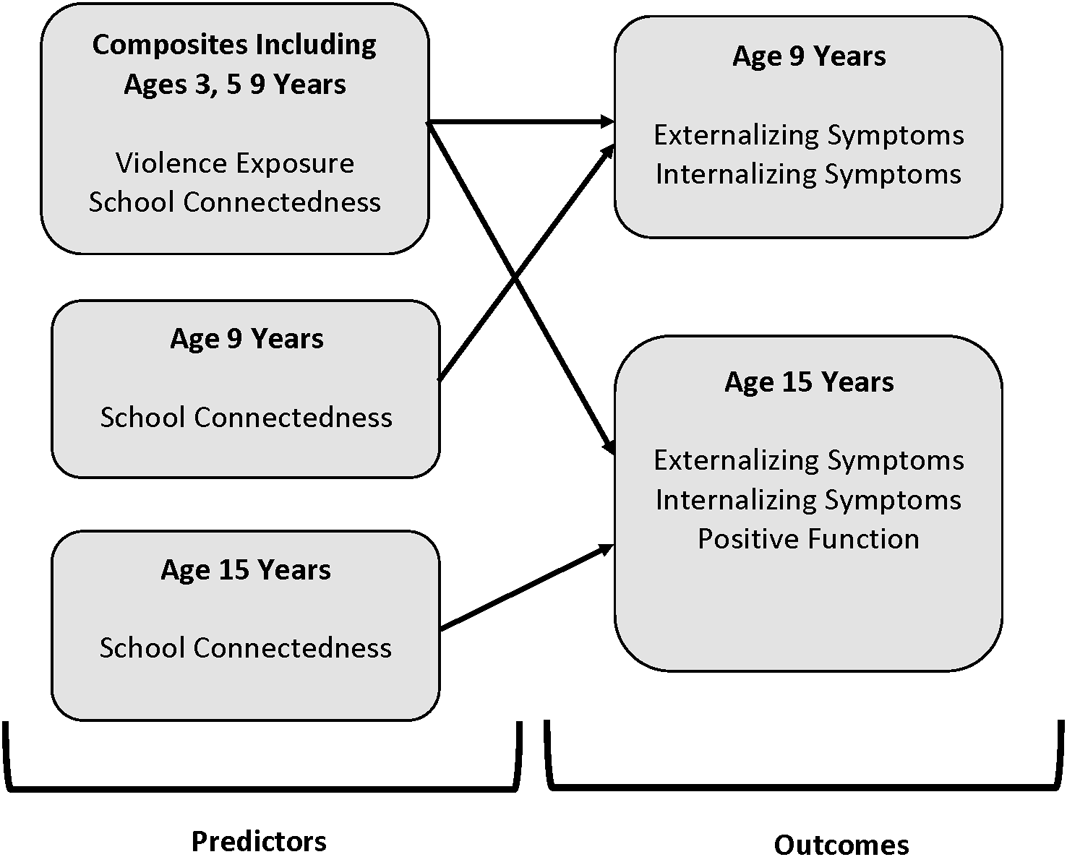
Analyses for the present study were primarily SEMs done in Mplus (v.8.4-Muthén & Muthén, Reference Muthén and Muthén1998–2017). Data were cleaned in R (v4.0.2) and were prepared for analysis in Mplus using the MplusAutomation package (v.0.7-3) (Hallquist & Wiley, Reference Hallquist and Wiley2018). R was also used to interpret significant moderation effects. See Figure 2 for a conceptual diagram of main effects and moderation models tested. The fit of the measurement and structural models were assessed using accepted fit indices: RMSEA, CFI, TLI, and SRMR (Hu & Bentler, Reference Hu and Bentler1999). The X 2 value of these model are reported but were not interpreted since X 2 is likely inflated by the large sample size and thus the significant value cannot be taken as an indicator of poor fit (Schermelleh-engel et al., Reference Schermelleh-engel, Moosbrugger and Müller2003). To account for the multisite design of the FFCWS, all measurement and structural models were clustered by city at baseline and estimated using Taylor-series linearization using Type = Complex in Mplus. Cluster effects could not be accounted for in the same way in the moderation models because they required a different analysis type that allows for random slopes and models heterogeneity in the residual variance (Muthén & Muthén, Reference Muthén and Muthén1998). When weighted, the FFCWS is representative of children born at the turn of the century in American cities of 200,000 or more. When not weighted (as here), the sample is not nationally representative, and the results cannot be generalized to the U.S. population in the same way. Given the oversample for non-marital births, the unweighted sample represents mostly low-income, urban families. We chose not to use the sample weights because the research question focuses on protective processes in families facing adversity.
Conceptual figure of the main effects and moderation models.

Measurement model
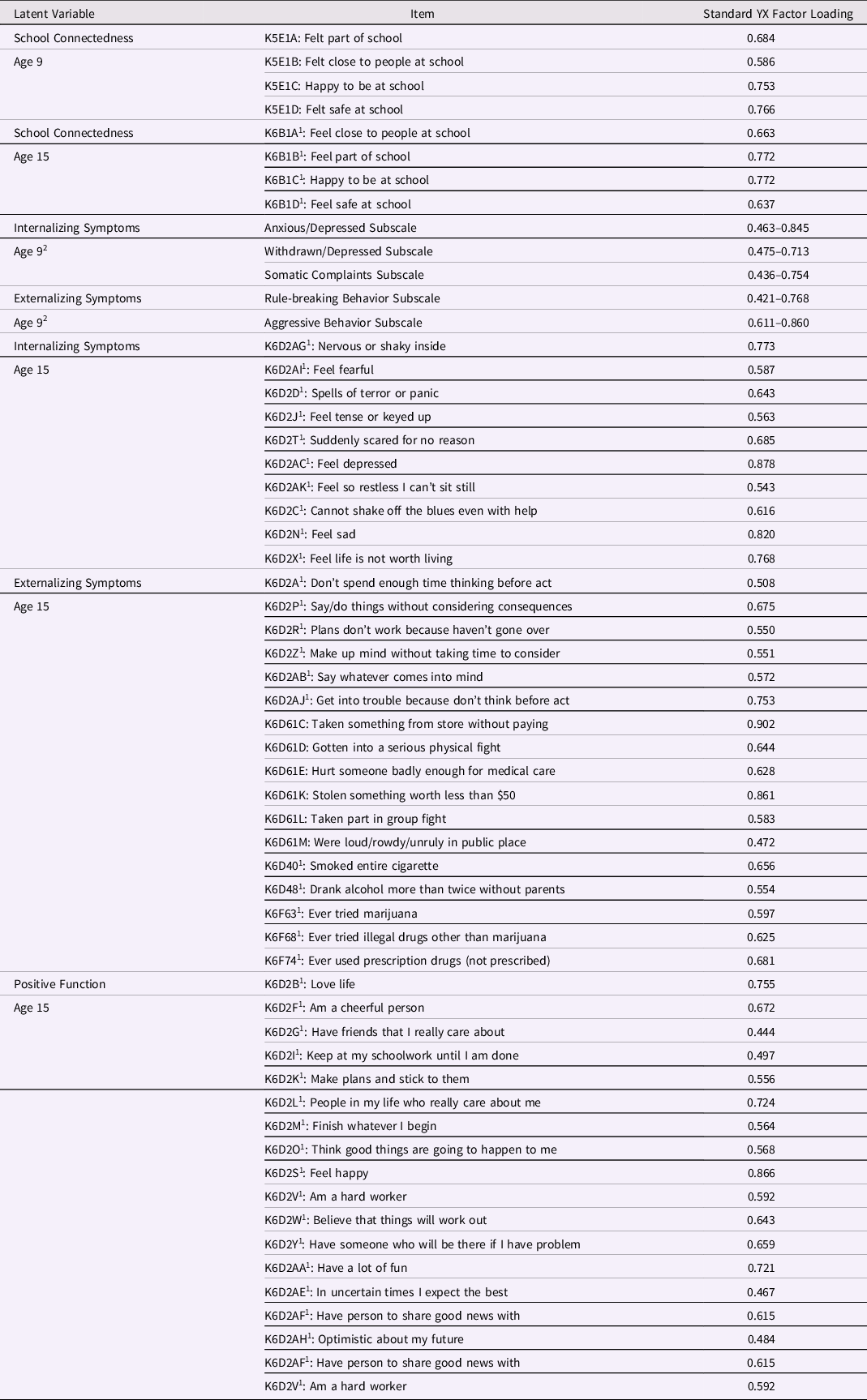
Latent variables were created using item level indicators to measure school connectedness at age 9, school connectedness at age 15, internalizing symptoms at 9, externalizing symptoms at 9, internalizing symptoms at age 15, externalizing symptoms at age 15, and positive function at age 15 (a single latent variable though there are subscales), in Mplus. We used the WLSMV estimator because we had categorical as indicators of the latent factors (Kline, Reference Kline2015). Items were excluded if they did not have a standard YX loading of at least 0.4 (Kline, Reference Kline2015). Standardized coefficients (β) are effect size estimates (Kline, Reference Kline2015) and all factor loadings reported in the present study are standardized.
Main effects models
We tested a model that estimated the main effects of childhood violence exposure (ages 3, 5, 9 years), childhood social deprivation (ages 3, 5, 9 years), and child (age 9) and adolescent (age 15) school connectedness on our predicted outcomes (internalizing symptoms, externalizing symptoms, positive function). It is tenable that internalizing symptoms, externalizing symptoms, or positive function could influence how connected teens feel to school rather than how it was specified in our hypothesized model. Therefore, we also ran a reverse effects model where the outcome variables predicted school connectedness at the same time point (e.g., age 9 internalizing symptoms predicting age 9 school connectedness) and compared model fit and path estimates. All path estimates reported in the present study are standard YX estimates. We used the WLSMV estimator because we had categorical variables included the latent variables (Kline, Reference Kline2015). Models controlled for the demographic covariates listed above.
Moderation models
Two moderation models were run. The first tested whether school connectedness at either age 9 or age 15 moderated the association between childhood violence exposure and internalizing and externalizing symptoms (age 9 and 15) or the association between childhood social deprivation and internalizing and externalizing symptoms. The second tested whether school connectedness at either age 9 or 15 moderated the association between childhood violence exposure and adolescent positive function or the association between childhood social deprivation and adolescent positive function. All moderation models were tested in Mplus using a latent variable moderation approach (Maslowsky et al., Reference Maslowsky, Jager and Hemken2015). In this approach, interaction terms are created from an observed (i.e., social deprivation composite score) and a latent variable (i.e., school connectedness at age 9) using the XWITH option along with ANALYSIS TYPE = RANDOM which allows for random slopes that model heterogeneity in the residual variance (Muthén & Muthén, Reference Muthén and Muthén1998). We used the MLR estimator, because the WLSMV estimator cannot be used with TYPE = RANDOM, and the Monte Carlo option for numerical integration with 10,000 randomly generated integration points (Muthén & Muthén, Reference Muthén and Muthén1998). The fit of these moderation models was assessed using a Satorra–Bentler Scaled Chi-Square Difference Test (TRd) using the log likelihood values for the main effects model verses the interaction model (Satorra & Bentler, Reference Satorra and Bentler2010). This was done because the traditional global fit indices are not produced in Mplus when the analysis TYPE = RANDOM. Models controlled for demographic covariates.
Simple slopes analysis
To interpret significant interactions, simple slope and regions of significance analyses were conducted to determine the nature of the interaction and ensure that the interaction was within our observable data using methods outlined by Preacher et al, (Reference Preacher, Curran and Bauer2006). This was done in R using factor scores extracted from Mplus. Factor scores were extracted from measurement models containing all of the latent variables in the model (e.g., school connectedness at age 9, school connectedness at age 15, and adolescent positive function). Interactions were plotted using the interactions (v1.1.1) toolbox in R (Long, Reference Long2019).
Results
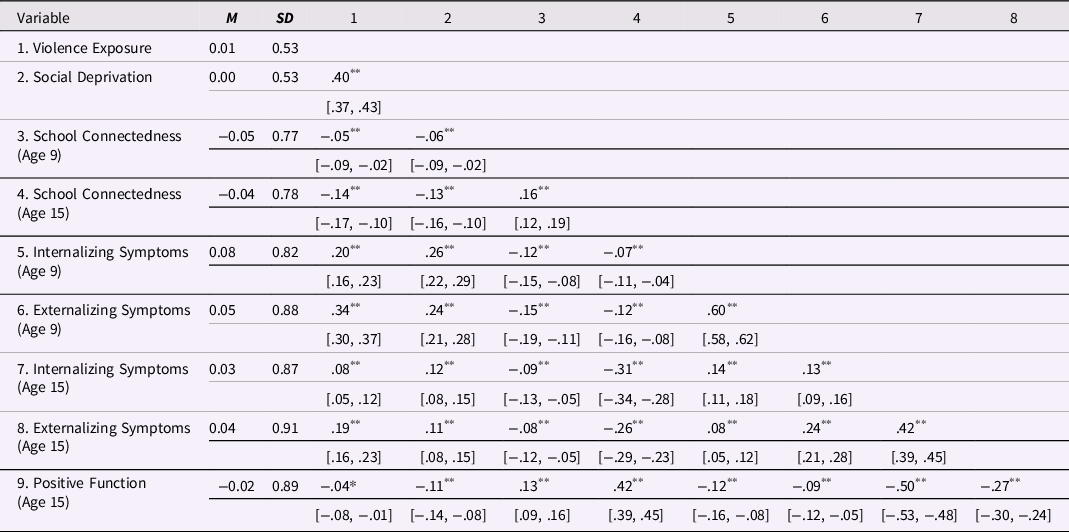
Descriptive statistics for and zero-order correlations between childhood exposure to violence and social deprivation as well as the factor scores representing child and adolescent school connectedness, internalizing and externalizing psychopathology, and adolescent positive function are in Table 2.
Means, standard deviations, and zero-order correlations with confidence intervals of the variables of the interest

Note. M and SD are used to represent mean and standard deviation, respectively. Values in square brackets indicate the 95% confidence interval for each correlation. The confidence interval is a plausible range of population correlations that could have caused the sample correlation (Cumming, Reference Cumming2013).
* indicates p < .05.
** indicates p < .01.
Measurement model
The final measurement (Cumming, Reference Cumming2013) model using CFA to fit the Age 9 School Connectedness, Age 15 School Connectedness, Age 9 Internalizing Symptoms, Age 15 Internalizing Symptoms, Age 9 Externalizing Symptoms, Age 15 Externalizing Symptoms and Age 15 Positive Function items to their respective factors fit the data well (Table 3 – RMSEA: 0.010, RMSEA 95% CI [0.009, 0.010], CFI = 0.935, TLI = 0.933, SRMR = 0.064, X 2(4928) = 6619.97). During the process of fitting the CFA model, we discovered that three items from the internalizing subscales of CBCL (1 from each of the Anxious/Depressed, Withdrawn/Depressed, and Somatic Complaints subscales) did not load well with the other items with standard factor loadings below the 0.4 threshold. These items were excluded in the final measurement model. Additionally, we discovered that the “Engagement” subscale of the positive function (EPOCH) scale (4 items – Kern et al., Reference Kern, Benson, Steinberg and Steinberg2016) did not load well with the rest of the items from the other four subscales with standard factor loadings well below 0.4. Therefore, we excluded the items from the engagement subscale from further analyses. All factor loadings in the final measurement model had standard YX estimates of greater than 0.4.
Standard factor loading values for the latent variable measurement model. All factor loadings were significant at p < .001. Items were excluded if loading <0.4 or if very low endorsement (less than 20 responses per category). Model was clustered by city at birth.

1 Item was reverse coded.
2 CBCL subscale with range of standardized factor loadings.
Main effects models
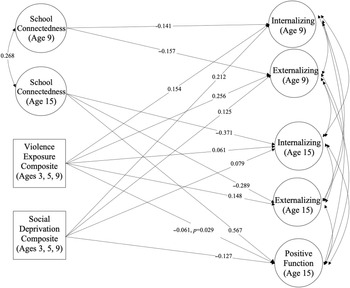
The main effects model testing the main effects of childhood violence exposure, childhood social deprivation, and child and adolescent school connectedness on our predicted outcomes fit the data well (RMSEA = 0.009, 95% CI [0.008, 0.010], CFI = 0.928, TLI = 0.926, SRMR = 0.065, X 2(5602) = 7094.661 – Figure 3).Footnote 1 In this model, childhood violence exposure predicted greater internalizing symptoms (age 9: β = 0.154, SE = 0.030, p < .001; age 15: β = 0.061, SE = 0.018, p = .001), greater externalizing symptoms (age 9: β = 0.256, SE = 0.021, p < .001; age 15: β = 0.148, SE = 0.012, p < .001), and lower positive function at age 15 (β = −0.031, SE = 0.041, p = .029). Childhood social deprivation also predicted greater internalizing symptoms (age 9: β = 0.212, SE = 0.023, p < .001; age 15: β = 0.079, SE = 0.025, p = .002) and externalizing symptoms at age 9 (β = 0.128, SE = 0.019, p < .001) but not age 15. Social deprivation also predicted lower positive function at age 15 (β = −0.127, SE = 0.022, p < .001). School connectedness at age 9 predicted lower age 9 internalizing (β = −0.141, SE = 0.021, p < .001) and externalizing (β = −0.157, SE = 0.029, p < .001) symptoms, but did not predict age 15 internalizing symptoms, externalizing symptoms, or positive function. School connectedness at age 15 predicted lower age 15 internalizing (β = −0.371, SE = 0.016, p < .001) and externalizing (β = −0.289, SE = 0.020, p < .001) symptoms as well as greater adolescent positive function (β = 0.567, SE = 0.020, p < .001).
Diagram of the main effects model including school connectedness. Model controlled for average income-to-needs ratio, race-ethnicity, and sex and was clustered by city at birth. Path estimates shown are standard YX estimates. To make this figure more readable, only paths significant at p < .05 are shown, but all were modeled. p-values of all paths are p < .01 except where reported otherwise. Correlations between all outcome latent variables are all significant at p < .01.

The reverse effects model where the outcomes at age 15 (internalizing symptoms, externalizing, symptoms, and positive adolescent function) predicted school connectedness at age 15 and the outcomes at age 9 (internalizing and externalizing symptoms) predicted school connectedness at age 9 fit the data worse than our hypothesized model (RMSEA = 0.017, 95% CI [0.016, 0.017], CFI = 0.751, TLI = 0.745, SRMR = 0.115, X 2(5611) = 10745.500) and the standardized path estimates were lower suggesting that our hypothesized model may be a better fit for the data. No statistical comparison of the two models could be made; however, because the model degrees of freedom are equivalent, therefore the comparison is descriptive.
Moderation models
A latent variable moderation model which included the interaction between school connectedness at 15 and early adversity (violence exposure and social deprivation) was initially tested for both for sets of outcomes; however, the moderation paths including school connectedness at age 15 were non-significant.Footnote 2 In order to retain a more parsimonious model, those paths were removed in the final model making school connectedness at age 9 the only moderator in the models.
Child and adolescent internalizing and externalizing symptoms as outcome
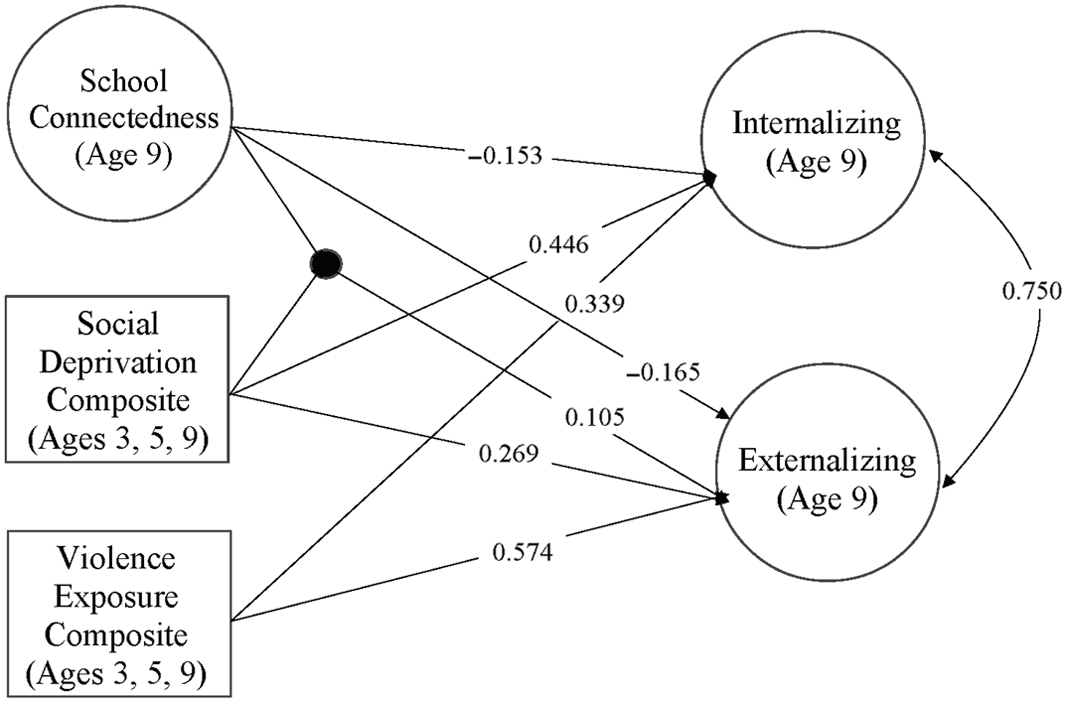
This latent variable moderation model showed a significant interaction between social deprivation and child school connectedness (age 9) when predicting child externalizing symptoms (age 9) (β = 0.073, SE = 0.036, p = .043 – Figure 4). This moderation model fit the data better than the main effects model without interactions based on a Satorra–Bentler Scaled Chi-Square Difference Test (TRd = 18.765, df = 8, p = .016) and better than the moderation model with the school connectedness at age 9 and social deprivation interaction path predicting child externalizing symptoms set to 0 (TRd = 6.515, df = 1, p = .011).
Diagram of the latent variable moderation model showing that school connectedness at age 9 moderates the association between social deprivation (ages 3, 5, 9) and externalizing symptoms (ages 9). Model controlled for average income-to-needs ratio, race-ethnicity, and sex. Note: Path estimates shown are standard YX estimates. To make this figure more readable, only paths significant at p < .05 are shown. All paths, including all 4 interaction paths, are retained in the model even though they are not shown. Including age 15 school connectedness and symptoms of psychopathology does not change the results of this model.

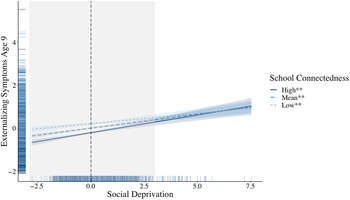
A simple slopes analysis revealed that at all conditional levels of age 9 school connectedness that were tested (+1 standard deviation (SD), mean, −1 SD), social deprivation was positively correlated with externalizing symptoms at age 9 (Figure 5). However, when school connectedness was high (+1 SD), the slope of this association was steeper (b = 0.162, p < .001) and the intercept was lower (intercept = −0.193) than when school connectedness was at mean (b = 0.123, p < .001, intercept = −0.001) or low (b = 0.0784, p = .005, intercept = 0.196) levels. For ease of interpretation of these intervals, all variables were scaled such that the mean was 0 and SD was 1. An evaluation of Johnson-Neyman intervals showed that the interaction was significant until social deprivation was 3.02 SD above the mean and when school connectedness was greater than −1.80 SD below the mean. This suggests that school connectedness at age 9 was protective against social deprivation, but that the protective effects diminished when social deprivation was moderately high (+3.02 SD −1% of sample). Additionally, when school connectedness at age 9 was low (−1.80 SD – 5% of sample), it was not protective against social deprivation. Therefore, the protective effect of school connectedness against social deprivation was present, to some degree, for 94% of the sample.
Plot illustrating the interaction between childhood social deprivation (ages 3, 5, 9) and school connectedness at age 9 in predicting childhood externalizing symptoms (age 9). For ease of interpretation, all variables have been centered and z-scored so that the mean is 0 and the standard deviation (SD) is 1. The dashed line represents mean levels of social deprivation. School connectedness has been plotted at mean and +/− 1 SD. For each level of school connectedness, the 95% confidence interval is shown. Rug plots depict individual data points for social deprivation and externalizing symptoms on the x and y axis, respectively. An evaluation of Johnson-Neyman intervals shows that, in this sample, the interaction was significant until social deprivation was very high (+3.02 SD) and when school connectedness was greater than −1.80 SD. This suggests that school connectedness at age 9 also had a protective but reactive association with social deprivation when predicting externalizing symptoms at age 9, meaning that school connectedness was protective against social deprivation but that the protective effects diminished when social deprivation was extreme. Additionally, when school connectedness at age 9 was low (−1.80 SD), it was not protective against social deprivation. The range of school connectedness at age 9 in this sample was [−3.31, 1.59] and the range of social deprivation values was [−2.77, 7.54].

Adolescent positive function as outcome
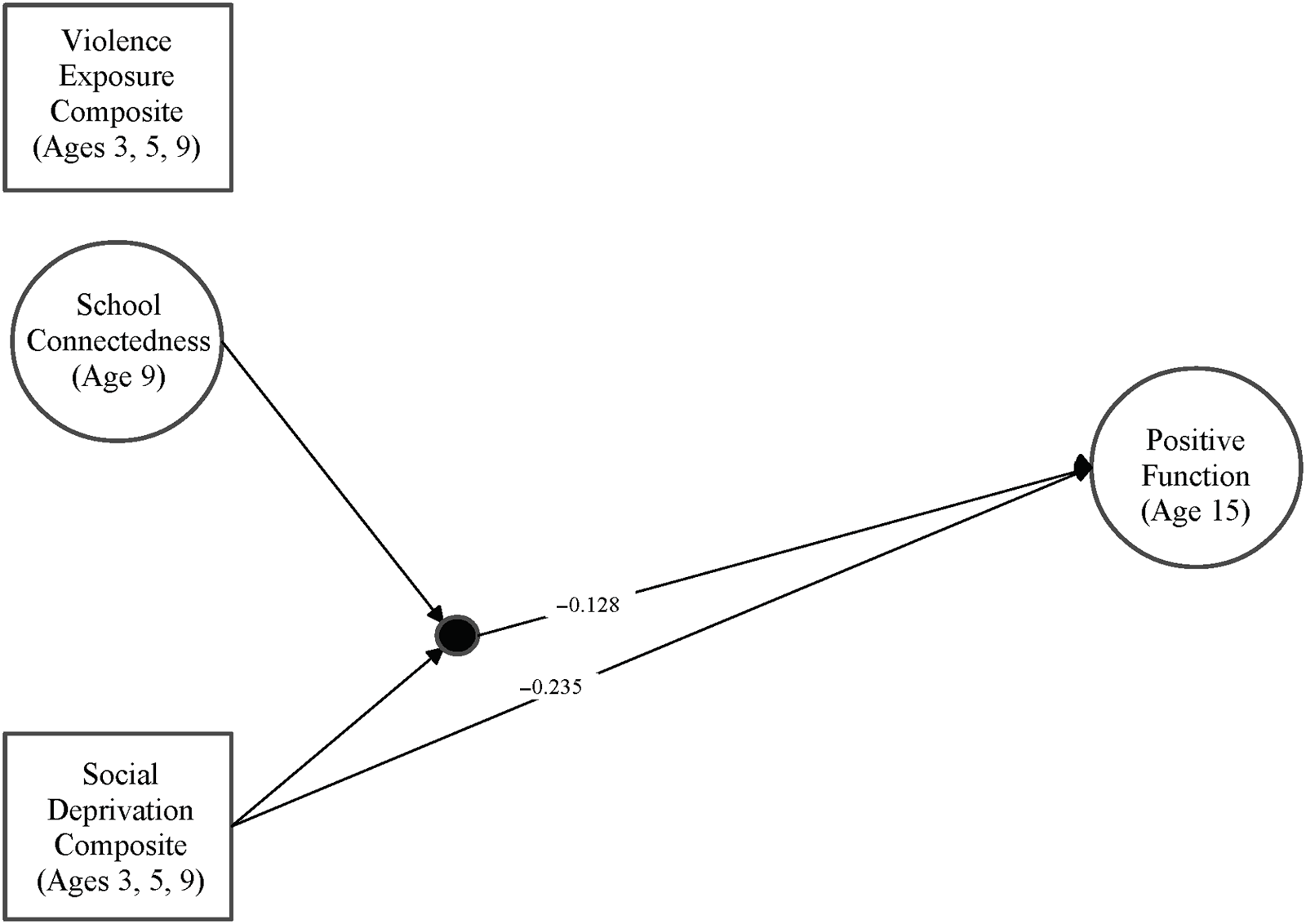
This latent variable moderation model showed a significant interaction between social deprivation and school connectedness at age 9 when predicting adolescent positive function (β = −0.051, SE = 0.026, p = .045), even when accounting for the main effects of school connectedness at age 9, school connectedness at age 15, social deprivation, violence exposure, and the interaction between violence exposure and school connectedness at age 9 (Figure 6). This moderation model fit the data better than the main effects model based on a Satorra–Bentler Scaled Chi-Square Difference Test (TRd = 7.088, df = 2, p = .029) and better than the moderation model with the school connectedness at age 9 and social deprivation interaction set to 0 (TRd = 6.603, df = 1, p = .010).
Diagram of the latent variable moderation model showing that school connectedness at age 9 moderates the association between social deprivation (ages 3, 5, 9) and positive adolescent function (age 15). Model controlled for average income-to-needs ratio, race-ethnicity, and sex. Note: Path estimates shown are standard YX estimates. To make this figure more readable, only paths significant at p < .05 are shown. All paths, including all both interaction paths, are retained in the model even though they are not shown. Including age 15 school connectedness does not change the results of this model.

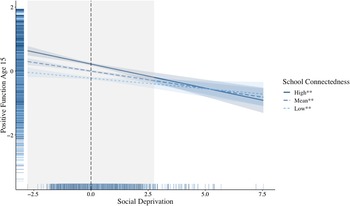
A simple slopes analysis revealed that at all conditional levels of age 9 school connectedness that were tested (+1 SD, mean, −1 SD), social deprivation was negatively correlated with positive adolescent function (Figure 7). However, when school connectedness was high (+1 SD), the slope of this association was steeper (b = −0.150, p < .001) and the intercept was higher (intercept = 0.209) than when school connectedness was at mean (b = −0.112, p < .001, intercept = −0.001) or low (b = −0.075, p = .002, intercept = −0.210) levels. An evaluation of Johnson-Neyman intervals showed that the interaction was significant until social deprivation was 2.76 SD above the mean and when school connectedness was greater than −1.27 SD below the mean. For ease of interpretation of these intervals, all variables were scaled such that the mean was 0 and SD was 1. Similar to the interaction predicting externalizing symptoms at age 9, school connectedness at age 9 was protective against social deprivation when predicting positive adolescent function; however, it became less protective as social deprivation becomes more extreme (+2.76 SD – 1% of sample). Additionally, when school connectedness at age 9 was low (−1.27 SD – 11% of sample), it was not protective against social deprivation. Therefore, the protective effect of school connectedness against social deprivation was present, to some degree, for 88% of the sample.
Plot illustrating the interaction between childhood social deprivation (ages 3, 5, 9) and school connectedness at age 9 in predicting adolescent positive function (age 15). For ease of interpretation, all variables have been centered and z-scored so that the mean is 0 and the standard deviation (SD) is 1. The dashed line represents mean levels of social deprivation. School connectedness has been plotted at mean and +/− 1 SD. For each level of school connectedness, the 95% confidence interval is shown. Rug plots depict individual data points for social deprivation and positive function on the x and y axis, respectively. An evaluation of Johnson-Neyman intervals shows that, in this sample, the interaction was significant until social deprivation was very high (+2.77) and when school connectedness was greater than −1.27. This suggests that school connectedness at age 9 had a protective but reactive association with social deprivation when predicting positive adolescent function, meaning that school connectedness was protective against social deprivation but that the protective effects diminished when social deprivation was extreme. Additionally, when school connectedness at age 9 was low (−1.27 SD), it was not protective against social deprivation. The range of school connectedness at age 9 in this sample was [−3.26, 1.46] and the range of social deprivation values was [−2.77, 7.54].

Discussion
We examined whether school connectedness was protective against childhood exposure to violence and social deprivation based on multiple indices of child and adolescent function in a longitudinal sample of greater than 3,000 youth from the FFCWS. We found that both child and adolescent school connectedness were associated with better concurrent outcomes (i.e., higher positive outcomes, lower negative outcomes), even when accounting for the detrimental effects of violence exposure and social deprivation. Additionally, we found that child school connectedness (age 9) specifically interacted with childhood social deprivation, but not violence exposure, to moderate the association with child externalizing symptoms and adolescent positive function. An analysis of simple slopes for both interactions suggested that child school connectedness was protective against social deprivation, but that it became less protective when social deprivation was very high. Compared to the types of resilience processes, this is most similar to a protective but reactive factor, because it conferred benefit for most of the sample; however, as social deprivation became more extreme, the protective effects diminished (Luthar et al., Reference Luthar, Cicchetti and Becker2000; Proctor, Reference Proctor2006).
Protective effects of school connectedness
Our results are consistent with the literature highlighting the protective effects of school connectedness (Brookmeyer et al., Reference Brookmeyer, Fanti and Henrich2006; Hardaway et al., Reference Hardaway, McLoyd and Wood2012; Kalu et al., Reference Kalu, Menon and Quinn2020; Markowitz, Reference Markowitz2017), but expand on it in four key ways. First, we utilized two multi-context measures of adversity that prospectively indexed a child’s exposure to both violence and social deprivation at varying levels of proximity to the child (i.e., self, home, neighborhood) and at multiple time points (ages 3, 5, 9 years). Second, we operationalized resilience in terms of enhanced positive function in addition to reduced negative function (i.e., internalizing and externalizing symptoms) which supports examining protective processes in terms of multiple domains of function (Blum et al., Reference Blum, McNeely, Nonnemaker, Fischhoff, Nightingale and Iannotta2001). Third, we examined the protective effects of school connectedness at an earlier developmental stage (childhood) than previous research studies. Last, we included measures of school connectedness and outcomes at two time points (age 9 and 15 years). This allowed us to gain insight into the longitudinal effects of school connectedness because we were able to assess how school connectedness can be correlated with better outcomes at the same timepoint, but also in the future, while controlling for the effects of contemporaneous school connectedness.
The specific interaction effect between social deprivation and school connectedness at age 9, but not age 15, suggests that there may be a developmental difference in the protective processes underlying school connectedness. Research shows that, on average, the level of emotional support from teachers decreases as youth transition from elementary to middle and high school (Eccles et al., Reference Eccles, Midgley, Wigfield, Buchanan, Reuman, Flanagan and Iver1993; Oelsner et al., Reference Oelsner, Lippold and Greenberg2011). Many schools also change formats across these stages (from mostly a single classroom with a single teacher to multiple classes and teachers across the day) (Eccles et al., Reference Eccles, Midgley, Wigfield, Buchanan, Reuman, Flanagan and Iver1993). This may explain why school connectedness in elementary school, but not high school, seemed to confer additional benefit specifically against a lack of expected social input in the home and neighborhood. An alternative explanation for the specific interaction between social deprivation and school connectedness at age 9 is that low school connectedness is a compounding risk factor for elementary school students who also experience social deprivation in the home and neighborhood. Previous work on the impact of teacher support found that low levels of teacher support in elementary school was a greater risk factor for negative academic outcomes (i.e., low school engagement, achievement scores, attendance) compared to middle school (Klem & Connell, Reference Klem and Connell2004). A third potential explanation is that school connectedness at age 15 would interact with social deprivation if the deprivation measure included information from when the focal child was 15 years old. However, the measures used in the social deprivation composite score were not collected in the Age 15 wave of the FFCWS. Future research should collect data that can probe this potential developmental effect in more detail.
Both child and adolescent school connectedness were promotive of contemporaneous outcomes in all youth, regardless of their childhood exposure to violence or social deprivation. Additionally, school connectedness at age 9 was a protective but reactive buffer against social deprivation when predicting age 9 externalizing symptoms and even six years later when predicting positive function. Protective but reactive effects confer protection against a risk factor, but the buffering effect diminishes with increasing stress (Luthar et al., Reference Luthar, Cicchetti and Becker2000). Of note, the interactions observed in present study are not a perfect example of protective but reactive effects because school connectedness seemed to confer some advantage, even at low levels (i.e., when kids felt comparatively less connected to school). However, it is the type of resilience process that best describes our findings. This pattern of results suggests that the protective effect of age 9 school connectedness is reduced over time and with increasing stress, which is consistent with previous work showing a decreasing promotive effect size over time for late adolescent school connectedness (Markowitz, Reference Markowitz2017). The residual protective effect of age 9 school connectedness on positive function six years later supports previous work positing that social connections and support at school can compensate for other areas of social deprivation (Foster & Brooks-Gunn, Reference Foster and Brooks-Gunn2009) and it extends that work by showing that those connections seem to enhance adolescent self-reports of perseverance, optimism, connectedness, and happiness. An important consideration for interpreting the interactions in the present study, however, is that the protective effects became smaller as social deprivation became more extreme. This underlines the continued need for efforts aimed at reducing social deprivation in the home and neighborhood in addition to promoting connectedness to school.
Results from the present study underscore the important role that the school environment can play for youth who have been exposed to adversity in other areas of their lives. They also underscore the enduring effect of positive social connections. School-aged children and adolescents spend a majority of their day at school (Roeser et al., Reference Roeser, Eccles and Sameroff2000), and thus, it is critical to help them develop strong social connections at school, especially those who are exposed to violence and social deprivation in their homes and neighborhoods. Previous research has shown that school connectedness is improved through social support and encouragement in school involvement from teachers, school counselors, peers, and parents, as well as through involvement in school-sponsored extracurricular activities (Daly et al., Reference Daly, Buchanan, Dasch, Eichen and Lenhart2010). However, more research is needed to determine effective interventions to promote school connectedness because there are systematic disparities in school connectedness and climate based on race ethnicity, gender, and socioeconomic status (Liu et al., Reference Liu, Kim, Carney, Chung and Hazler2020; Voight et al., Reference Voight, Hanson, O’Malley and Adekanye2015). Promoting school connectedness may be particularly salient for African American boys who experience disparate treatment at school, including disproportionately high levels of suspensions and expulsions (Thomas & Stevenson, Reference Thomas and Stevenson2009) and systematically lower expectations for academic attainment (Wood et al., Reference Wood, Kaplan and McLoyd2007). Additionally, Latinx youth are the largest ethnic minority in the U.S.; however, the rate of degree attainment in Latinx high school students is systematically lower and has been linked to academic discrimination (Alfaro et al., Reference Alfaro, Umaña-Taylor, Gonzales-Backen, Bámaca and Zeiders2009). These troubling trends highlight the importance of identifying processes that promote factors, such as school connectedness, that improve academic and socioemotional outcomes in at-risk youth (Liu et al., Reference Liu, Kim, Carney, Chung and Hazler2020).
Resilience in the context of dimensional models
Results from the present study support modeling adversity in terms of their core underlying dimensions which relate to development in both distinct and overlapping ways (McLaughlin & Sheridan, Reference McLaughlin and Sheridan2016). We found that both violence exposure and social deprivation predicted childhood symptoms of psychopathology. However, violence exposure distinctly predicted adolescent externalizing symptoms and social deprivation, more strongly predicted reduced adolescent positive function. These findings are largely consistent with previous research modeling the effects of adversity using the DMAP framework, including work done with the FFCWS sample, which found that threat (similar to our violence exposure) was associated with both internalizing and externalizing symptoms (Miller et al., Reference Miller, Sheridan, Hanson, McLaughlin, Bates, Lansford, Pettit and Dodge2018, Reference Miller, Machlin, McLaughlin and Sheridan2020). We are unaware of any prior research examining links between dimensions of adversity and positive function. The predictive effect of social deprivation suggests that there may be a specific mechanism linking the lack of expected social input in the home and neighborhood environment with teen self-reports of low perseverance, optimism, connectedness, and happiness.
Findings related to social deprivation in the present study are complementary, but not identical, to those found in previous research using the DMAP framework. This may be due to varying definitions of deprivation. Deprivation constructs have largely encompassed two areas: cognitive, which indexes information about a lack of cognitive enrichment of the child’s environment (e.g., age-appropriate toys, books, measures of SES – Lambert et al., Reference Lambert, King, Monahan and Mclaughlin2017; Miller et al., Reference Miller, Sheridan, Hanson, McLaughlin, Bates, Lansford, Pettit and Dodge2018); and social, which indexes information about a lack of expected social input in the child’s environment as was done in the present study. Previous work has explicitly or implicitly operationalized deprivation as either cognitive deprivation, social deprivation, or both. Behavioral correlates of these differing definitions suggest that deprivation may be two dimensions rather than one. Deprivation, when indexed by both cognitive and social deprivation, has been linked to increased internalizing and externalizing symptoms (Miller et al., Reference Miller, Machlin, McLaughlin and Sheridan2020). However, when deprivation is indexed strictly as cognitive deprivation, it is associated selectively with increased externalizing symptoms (Miller et al., Reference Miller, Sheridan, Hanson, McLaughlin, Bates, Lansford, Pettit and Dodge2018), suggesting that perhaps cognitive deprivation is related to a higher risk for externalizing psychopathology and, consistent with our findings, social deprivation may be a greater risk factor for internalizing psychopathology. Future work using dimensional models of adversity should more directly test whether social and cognitive deprivation form two separate dimensions in addition to violence exposure/threat. Additionally, future work comparing the neural correlates of differing definitions of deprivation may provide insight into if there are diverging neural mechanisms underlying cognitive and social deprivation.
We found that social connections at school can promote resilience broadly, but that protective effects also manifest in more specific ways through interaction with social deprivation, highlighting that resilience is the result of reciprocal influences across a network of interconnected systems within and outside the individual (Kalisch et al., Reference Kalisch, Cramer, Binder, Fritz, Leertouwer, Lunansky, Meyer, Timmer, Veer and van Harmelen2019; Masten et al., Reference Masten, Lucke, Nelson and Stallworthy2021). A benefit of employing dimensional models of adversity is that it is possible to test specific hypotheses regarding how variation in core aspects of childhood adversity relate to outcomes with the idea that particular dimensions are likely to impact development through specific mechanisms (e.g., threat exposure impacts the development of fear-learning and emotion processing systems – McLaughlin et al., Reference McLaughlin, Sheridan and Lambert2014). By examining protective processes within a dimensional model of adversity, we were able to demonstrate that social connections at school protected against, and may compensate for, a lack of expected social input elsewhere (Foster & Brooks-Gunn, Reference Foster and Brooks-Gunn2009), while also promoting outcomes overall. Future research should test whether the compensatory effects of school connectedness operate through distinct mechanisms compared to the general promotive effects. Additionally, future research should examine if school connectedness is protective against other dimensions of adversity, such as cognitive deprivation or environmental instability (Ellis et al., Reference Ellis, Figueredo, Brumbach and Schlomer2009; Miller et al., Reference Miller, Sheridan, Hanson, McLaughlin, Bates, Lansford, Pettit and Dodge2018), which would provide additional insight into the mechanisms through which school connectedness promotes resilience.
Limitations
The present study had limitations. First, there was a six-year gap between FFCWS data collection waves at ages 9 and 15. We would be able to better understand these protective associations and how the strength of school connectedness at age 9 changes over time if we had information about the children and their families during this gap. Second, because the adversity indexed by the composite scores temporally overlapped with the age 9 school connectedness and the age 9 outcomes, it is not possible to determine the temporal precedence or statistical causality of effects; however, this is a direction for future research. Third, we did not have a comparable index of positive function at age 9 to test whether school connectedness at age 9 is also correlated with positive function. Fourth, the violence exposure and social deprivation composites were derived from maternal reports. Data regarding childhood adversity from sources outside the home, such as social workers and teachers, would make our composites more comprehensive. Last, the environment of adversity is complex; thus, there are likely unmeasured variables that may influence these associations or contribute to cascades of risk.
Conclusion
The present findings suggest that school connectedness is a robust protective factor against exposure to early adversity in youth from the FFCWS in terms of both positive and negative metrics of child and adolescent function. Additionally, social connections at school in childhood may compensate for a lack of expected social support and input in the home and neighborhood to help reduce externalizing symptoms and promote positive adaptive function. Consistent with previous research, our results highlight the important role that the school environment can play for youth who have been exposed to adversity in other areas of their lives. Additionally, the interactive effect of school connectedness with social deprivation, but not violence exposure, supports modeling risk and resilience processes using dimensional frameworks to better identify specific groups of youth that may benefit from interventions that boost social connectedness at school.
Acknowledgments
This research would not have been possible without the participation of the families in the Fragile Families and Child Wellbeing Study.
Funding statement
The research reported in this paper was supported by grants from the National Institutes of Health, R01MH103761 (Monk), R01MH121079-01 (Monk, Hyde, Mitchell), T32HD007109 (McLoyd & Monk), and a Doris Duke Fellowship for the Promotion of Child Well-Being (Hein). Funding for FFCWS was provided by the NICHD (R01-HD36916, R01-HD39135, R01-HD40421) and a consortium of private foundations.
Conflicts of interest
The authors declare no competing financial interests.
Supplementary material
For supplementary material accompanying this paper visit https://doi.org/10.1017/S0954579421001140