Evidence from atypical populations has been of particular interest to theories of language acquisition (Curtiss, Reference Curtiss1977; Yamada, Reference Yamada1990). In this respect, cross-linguistic studies of atypical populations have proved informative in highlighting different patterns of language breakdown in different atypical populations, and as a way of supporting or refuting different theoretical explanations of language acquisition (e.g., Leonard, Reference Leonard1998). Within this context, individuals with Williams syndrome (WS) as an atypical population have attracted a lot of interest in the field of cognitive science. WS is a neurodevelopmental disorder caused by a microdeletion on chromosome 7 (band 7q11.23; Ewart et al., Reference Ewart, Morris, Atkinson, Jin, Sternes and Spallone1993; Francke, Reference Francke1999). It has an incidence rate of 1 in 20,000 live births (Greenberg, Reference Greenberg1990), although a recent study by Strømme, Bjørnstad, and Ramstad (Reference Strømme, Bjørnstad and Ramstad2002) reported a much higher incidence rate of 1 in 7,500 live births.
WS has attracted wide interest during the past three decades because of the “uneven” neurocognitive profile of these individuals, characterized by cognitive strengths and weaknesses (Bellugi, Lichtenberger, Jones, Lai, & George, Reference Bellugi, Lichtenberger, Jones, Lai and George2000). Cognitive weaknesses that have been identified in this population are general learning difficulties (Arnold, Yule, & Martin, Reference Arnold, Yule and Martin1985), poor visuospatial ability (Bellugi, Bihrle, Neville, Jernigan, & Doherty, Reference Bellugi, Bihrle, Neville, Jernigan, Doherty, Gunnar and Nelson1992; Wang & Bellugi, Reference Wang and Bellugi1993), and severe deficits in conceptual reasoning, arithmetic, and motor control (Bellugi, Marks, Bihrle, & Sabo, Reference Bellugi, Marks, Bihrle, Sabo, Bishop and Mogford1988; Bihrle, Bellugi, Delis, & Markis, Reference Bihrle, Bellugi, Delis and Markis1989; Udwin, Yule, & Martin, Reference Udwin, Yule and Martin1987). However, studies have shown that individuals with WS have relative cognitive strengths with regard to their phonological memory (Grant et al., Reference Grant, Karmiloff-Smith, Gathercole, Paterson, Howlin and Davies1997; Grant, Karmiloff-Smith, Berthoud, & Christophe, Reference Karmiloff-Smith, Klima, Bellugi, Grant and Baron-Cohen1996; Vicari, Brizzolara, Carlesimo, Pezzini, & Volterra, Reference Vicari, Brizzolara, Carlesimo, Pezzini and Volterra1996; Vicari, Carlesimo, Brizzolara, & Pezzini, Reference Vicari, Brizzolara, Carlesimo, Pezzini and Volterra1996; Wang & Bellugi, Reference Wang and Bellugi1994), face processing (Bellugi et al., Reference Bellugi, Bihrle, Neville, Jernigan, Doherty, Gunnar and Nelson1992; Udwin & Yule, Reference Udwin and Yule1991), and aspects of theory of mind (Karmiloff-Smith, Klima, Bellugi, Grant, & Baron-Cohen, Reference Karmiloff-Smith, Klima, Bellugi, Grant and Baron-Cohen1995; Tager-Flusberg & Sullivan, Reference Tager-Flusberg and Sullivan2000).
Early studies of English-speaking individuals with WS described their linguistic abilities as relatively strong (e.g., Arnold et al., Reference Arnold, Yule and Martin1985; Bellugi et al., Reference Bellugi, Marks, Bihrle, Sabo, Bishop and Mogford1988). These studies claimed that certain cognitive aspects, such as morphosyntax, are “preserved” in WS. This was taken as evidence that there must be a dedicated neural mechanism or “module” for computational aspects of language, such as morphosyntax, which is innately specified and unaffected by other cognitive abilities (such as low IQ, poor visuospatial awareness, etc.). Thus, it was suggested that individuals with WS offer evidence for innate modularity, that is, that the brain is specialized for different cognitive functions from birth (Pinker, Reference Pinker1999).
Not only were claims made about the preservation of morphosyntactic abilities in WS, but also claims were made that the subdomain of lexical semantics is characterized by word knowledge above mental age level, though anomalies are evident (Bellugi et al., Reference Bellugi, Lichtenberger, Jones, Lai and George2000). In addition, good social communication skills have been reported to be a “hallmark” of the syndrome (Jones et al., Reference Jones, Bellugi, Lai, Chiles, Reilly and Lincoln2000) and claimed to be a relative strength (Reilly, Klima, & Bellugi, Reference Reilly, Klima and Bellugi1990; Sparrow, Balla, & Cicchetti, Reference Sparrow, Balla and Cicchetti1984). It has also been claimed that prosody is preserved, albeit over-rich in the case of affect intonation (Jones et al., Reference Jones, Bellugi, Lai, Chiles, Reilly and Lincoln2000; Losh, Bellugi, Reilly, & Anderson, Reference Losh, Bellugi, Reilly and Anderson2000; Trevarthen, Aitken, Papoudi, & Robarts, Reference Trevarthen, Aitken, Papoudi and Robarts1998). Therefore, when research on language in WS initially only focused on English, the generally accepted view was that individuals with WS, despite profound deficits in many cognitive domains, had superior language abilities, especially in the domain of morphosyntax and prosody. This was taken as evidence that language (and in particular syntax) is acquired independently of other cognitive abilities (Bellugi et al., Reference Bellugi, Marks, Bihrle, Sabo, Bishop and Mogford1988).
RELEVANCE OF STUDIES IN ROMANCE LANGUAGES AND CROSS-LINGUISTIC RESEARCH IN WS
Research involving rich and complex morphosyntactic systems, such as those found in the Romance languages, has allowed us to detect specific grammatical patterns of impairments that would have been difficult to identify in a language such as English, which does not have a rich morphological system. For example, Italian and French people with WS make errors with grammatical gender agreement (Karmiloff-Smith et al., Reference Karmiloff-Smith, Grant, Berthoud, Davies, Howlin and Udwin1997; Volterra, Capirci, Pezzini, Sabbadini, & Vicari, Reference Volterra, Capirci, Pezzini, Sabbadini and Vicari1996), which would have been impossible to detect in a language such as English, which does not mark gender grammatically apart from in personal pronouns. Preposition errors and ungrammatical substitutions of function words or inflected forms in Spanish- or Italian-speaking children with WS have also been reported (Díez-Itza, Antón, Fernández-Toral, & García-Pérez, Reference Díez-Itza, Antón, Fernández-Toral, García-Pérez, Aksu, Erguvanli Taylan, Özsoy and Küntay1998; Volterra et al., Reference Volterra, Capirci, Pezzini, Sabbadini and Vicari1996). These results suggest that morphosyntax may not be a preserved component of language in individuals with WS, which in turn means WS may not provide strong evidence for innate modularity of language. Therefore, studies of the way WS manifests in different languages may have an important role to play, not only in the description of the cognitive profile of individuals with WS, but also in the theoretical debate of innate modularity.
Similarly, cross-linguistic studies that have investigated the same language phenomena in different languages have also contributed toward our increased understanding of the type of language problems associated with WS and how language specific these problems may be. For example, Reilly, Lacroix, et al.'s (Reference Reilly, Lacroix, Poirier, Bernicot, Bellugi and Klima2005) cross-linguistic study of English and French individuals with WS found that French-speaking children with WS made fewer morphological errors in a story-telling task compared to English-speaking children with WS. The authors explain this by referring to the greater amount of homophony found in French than in English. Thus, narratives of French-speaking individuals with WS included predominantly pronouns and verbs that are homophonous in French (e.g., third person pronouns in singular and plural are homophonous such as “il/elle” vs. “ils/elles”). This would account for French-speaking individuals with WS producing fewer morphological errors than their English counterparts.
PROSODY IN ENGLISH-SPEAKING INDIVIDUALS WITH WS
In contrast to the abundance of research into the morphosyntactic abilities in WS, there has been limited interest in the phonological abilities in this population, including suprasegmental features such as prosody. Yet prosody has an important role to play in a range of communicative functions of language, such as establishing and regulating conversational turns (referred to as turn-end function in the paper), conveying emotions and emotional states (affective function), providing cues for segmenting the speech chain into smaller units (chunking function), and expressing the focus of an utterance or the word that is most important (focus function; Barry, Reference Barry1981; Belinchón, Igoa & Riviére, Reference Belinchón, Igoa and Rivière1998; Couper-Kuhlen, Reference Couper-Kuhlen1986; Prieto, Reference Prieto and Prieto2003; Roach, Reference Roach2009). Thus, being able to successfully use and interpret prosodic features of an utterance is crucial if communication is to be successful (see, e.g., McCann & Peppé, Reference McCann and Peppé2003; Wells & Peppé, Reference Wells, Peppé, Stackhouse and Wells2001; Wells, Peppé, & Vance, Reference Wells, Peppé, Vance and Grundy1995).
As already mentioned, it was originally thought that prosody, like other aspects of language, is a preserved skill in WS (e.g., Jones et al., Reference Jones, Bellugi, Lai, Chiles, Reilly and Lincoln2000; Losh et al., Reference Losh, Bellugi, Reilly and Anderson2000; Trevarthen et al., Reference Trevarthen, Aitken, Papoudi and Robarts1998). However, limitations in this domain have been reported. In this respect, deficits in segmenting words by using prosodic cues have been found in infants with WS (Nazzi, Paterson, & Karmiloff-Smith, Reference Nazzi, Paterson and Karmiloff-Smith2003). Severe difficulties in different prosodic components were also reported in two adolescents with WS (Catterall, Howard, Stojanovik, Szczerbinski, & Wells, Reference Catterall, Howard, Stojanovik, Szczerbinski and Wells2006). Using the English computerized version of the Profiling Elements of Prosody in Speech–Communication Battery (PEPS-C; Peppé & McCann, Reference Peppé and McCann2003), Stojanovik, Setter, and van Ewijk (Reference Stojanovik, Setter and van Ewijk2007) showed that children with WS have prosodic deficits, compared to children of the same chronological age in four prosodic domains, including affect, chunking, focus, and turn-end. The children with WS also had difficulty with the imitation and discrimination of different prosodic patterns. However, with the exception of the ability to repeat intonation patterns over longer prosodic domains, the children with WS did not significantly differ from their language age-matched peers. Therefore, prosodic abilities seemed to be a weakness in the linguistic profile of children with WS relative to their chronological age but not relative to their level of language comprehension.
Reilly et al. (Reference Reilly, Klima and Bellugi1990) reported higher use of affective prosody in narratives of individuals with WS compared to individuals with Down's syndrome so that the prosody used by individuals with WS was often inappropriate for the context, and in many cases considered exaggerated. Using acoustic measurements (pitch range in semitones), Setter, Stojanovik, van Ewijk, and Moreland (Reference Setter, Stojanovik, van Ewijk and Moreland2007) reported significantly wider pitch range in a group of children with WS compared to younger and older typically developing peers. Furthermore, the children with WS were perceived by phonetically naïve listeners as being twice as emotionally involved as the control groups when telling a story. Nevertheless, such results have not been found in teenagers and adults with WS (Crawford, Edelson, Plesa-Skwerer, & Tager-Flusberg, Reference Crawford, Edelson, Plesa-Skwerer and Tager-Flusberg2008).
Plesa-Skwerer, Faja, Schofield, Verbalis, and Tager-Flusberg (Reference Plesa-Skwerer, Faja, Schofield, Verbalis and Tager-Flusberg2006) found significant difficulties with emotion recognition, assessed by facial expressions and affective prosody, in a group of teenagers and adults with WS (aged 12–32) compared to a control group of chronological age and IQ-matched participants with learning disabilities of mixed etiologies and a control group of typically developing participants matched on chronological age. In a second study, Plesa-Skwerer, Schofield, Verbalis, Faja, and Tager-Flusberg (Reference Plesa-Skwerer, Schofield, Verbalis, Faja and Tager-Flusberg2007) reported deficits in the perception of prosodic cues in people with WS when judging the meaning of ambiguous lexical constructs (i.e., word pairs with identical segmental content but different meaning depending on the lexical stress, e.g., MAKE up vs. make UP). The WS group performed worse than a typically developing control group matched for chronological age, but was no different from a group of individuals with learning disabilities. The same pattern was found in a task assessing sensitivity to affective prosody (happy, sad, or neutral emotions) of sentences with congruent or incongruent semantic content. Moreover, the two clinical groups had particular difficulties when processing affective prosody together with conflicting content information (e.g., sad tone of voice–happy sentence content). However, when segmental information was filtered out and only prosodic information was presented, the WS group performed as well as the typically developing group. These results were interpreted to mean that individuals with WS have a relative sensitivity to affective prosody, while the ability to use prosodic cues for semantic interpretation is more severely impaired and constrained by the cognitive limitations present in WS. This was taken to suggest that there may be dissociations within the prosodic profile of individuals with WS: affective prosody is relatively preserved while lexical prosody is impaired (Plesa-Skwerer et al., Reference Plesa-Skwerer, Schofield, Verbalis, Faja and Tager-Flusberg2007).
PROSODY IN INDIVIDUALS WITH WS WHO ARE SPEAKING ROMANCE LANGUAGES
The above-mentioned studies focus on prosody in English-speaking individuals with WS. Studies of prosody in individuals with WS who are speaking in languages other than English are sparse. The data so far have mainly come from studies that have relied on spontaneous speech output as elicited by narratives. In this context, the high use of affective prosody in narratives reported for English-speaking individuals with WS (Reilly et al., Reference Reilly, Klima and Bellugi1990) has also been found in the narratives of individuals with WS whose mother tongue was French, Italian, or Portuguese (Gonçalves, Reference Gonçalves2004; Reilly, Bernicot, Vicari, Lacroix, & Bellugi, Reference Reilly, Lacroix, Poirier, Bernicot, Bellugi and Klima2005). However, differences between languages were also reported (Reilly, Bernicot, et al., Reference Reilly, Bernicot, Vicari, Lacroix, Bellugi, Ravid and Bat-Zeev Shyldkrot2005). In this study, the number of evaluative devices (i.e., social engagement devices such as affective prosody or audience hookers) used by American English, Italian, and French individuals with WS in a story narration task was different. Italian-speaking individuals with WS used more affective prosody than their American English counterparts, who in turn used more prosodic devices than their French peers. These differences were interpreted to reflect the nature of the culture conventions for demonstrating sociability and conveying emotion typical of each language.
Interesting cross-linguistic differences were found when prosodic tasks assessing the comprehension and production of specific prosodic functions were administered. Martínez-Castilla, Campos, and Sotillo (Reference Martínez-Castilla, Campos and Sotillo2005) assessed production and reception of affective prosody in a group of teenagers and adults with WS (aged 11–31) in comparison with a group of typically developing participants matched on chronological age. Participants had to identify the affective prosody (happiness, sadness, anger, and fear) expressed in single words with neutral semantic content. They also had to produce such words while expressing the basic emotions by prosodic means. The emotions were evaluated afterward by a group of listeners. No significant differences were found between the WS group and the typically developing group on any of these tasks. Therefore, in contrast to what had been concluded from studies of prosody of English-speaking individuals by Plesa-Skwerer et al. (Reference Plesa-Skwerer, Faja, Schofield, Verbalis and Tager-Flusberg2006), the results found by Martínez-Castilla et al. (Reference Martínez-Castilla, Campos and Sotillo2005) suggest that the understanding (and also the expression) of the affective function of prosody in Spanish-speaking individuals with WS (teenagers and adults), is in line with their chronological age. These cross-linguistic comparisons indicate that the understanding of the affective function of prosody may not be universally “spared” in individuals with WS. Further investigation is needed in order to address the issue of why this may be the case and how the characteristics of the specific language of the individual may impact on the acquisition of this prosodic skill.
CROSS-LINGUISTIC STUDIES OF PROSODY IN TYPICALLY DEVELOPING ENGLISH- AND SPANISH-SPEAKING CHILDREN
As seen above, research on prosodic abilities in WS in different languages allows us to ascertain whether results obtained in English have a universal character for the WS population, or whether they depend on the specific characteristics of the particular language (Bernicot, Lacroix, & Reilly, Reference Bernicot, Lacroix and Reilly2003). Following from this and considering the differences already found between English- and Spanish-speaking individuals with WS, it is timely that the prosodic profiles of English- and Spanish-speaking individuals with WS are investigated. In this respect, it is of particular advantage that a study comparing the acquisition of prosody in typically developing children acquiring English and Spanish has already been conducted (Martínez-Castilla & Peppé, Reference Martínez-Castilla and Peppé2008a). The study compared the performance of two groups of typically developing children (English and Spanish) aged 7 years, 6 months (7;6)–9;5 and 9;6–11;5 on a number of expressive and receptive tasks that are part of the PEPS-C battery (Peppé & McCann, Reference Peppé and McCann2003). Different developmental patterns between the two languages were found. In tasks that assessed the expression and comprehension of the prosodic function of turn end (questioning vs. declarative intonation), the younger Spanish children performed as well as the older group, whereas there was an effect of age for the English-speaking children (the younger children did not performed as well as the older children). In addition, the younger Spanish-speaking children performed better than their younger English-speaking peers on these tasks. Results in favor of the Spanish-speaking children in both age groups were also found in the expression and comprehension of affect by prosodic means. However, contrary to what is observed among typically developing English-speaking children, who are able to use nucleus placement to manipulate narrow focus in prefinal position as early as 3;0 to 5;11 years (Hornby, Reference Hornby1971; Macwhinney & Bates, Reference Macwhinney and Bates1978), the Spanish children were limited in the use of this prosodic function. This cross-linguistic difference was the most noticeable one in the study.
AIMS AND HYPOTHESES
The current paper aims to compare the prosodic profiles of a group of English-speaking and a group of Spanish-speaking children with WS, examining cross-linguistic differences. The lack of cross-linguistic differences between English- and Spanish-speaking children with WS would suggest that the results already reported for English also hold for Spanish, and that the prosodic deficits previously found in English-speaking children with WS are not specific to this particular language but may have a more universal character. It would also suggest that prosody is not “preserved” in WS, which would add new evidence that the WS profile may not support theories of innate modularity. However, different patterns of language acquisition in WS could also be found as a consequence of the specificities of each language. In fact, based on the results that have already been reported with regard to cross-linguistic differences in prosodic skills between typically developing English- and Spanish-speaking children and the differences in prosodic skills reported for teenagers and adults with WS, we would expect to find some cross-linguistic differences between English- and Spanish-speaking children with WS.
The hypotheses of this paper are (a) English-speaking children with WS will outperform their Spanish counterparts in their ability to mark the most salient word in an utterance using intonation (the focus function of prosody). This is because strong cross-linguistic differences have been found between English and Spanish typically developing children for this prosodic function. (b) English-speaking children with WS will be worse than Spanish-speaking children with WS on the ability to understand affect through prosodic means, because typically developing Spanish-speaking children outperform their English peers, and because Spanish-speaking teenagers and adults with WS have been found to be better than their English counterparts with regard to this prosodic ability. (c) the English-speaking children with WS will be poorer than their Spanish counterparts in their ability to use prosody for expressing questioning versus declarative intonation. This is because typically developing English-speaking children seem to acquire this prosodic function later than their Spanish-speaking peers. (d) no cross-linguistic differences will be found for the ability to use prosody for phrase delimitation (i.e., the chunking function of prosody) or for the abilities to imitate and discriminate prosodic forms.
METHOD
Participants
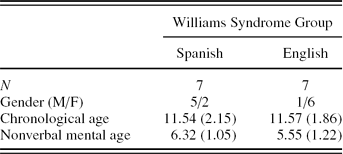
The sample used in the present paper was composed of two sets of data from two different research projects on prosodic abilities in children with WS carried out almost simultaneously in the United Kingdom and in Spain. Fourteen children with WS, 7 native speakers of English and 7 native speakers of Spanish, were included in this study. The English children with WS, aged between 9.17 and 13.02 (mean age = 11.57), were recruited through the Williams Syndrome Foundation in the United Kingdom. The Spanish participants with WS, aged between 8.42 and 13.75 (mean age = 11.54), were recruited through the Asociación Síndrome de Williams de España (The Williams Syndrome Association of Spain). In order to obtain a measurement of general cognitive abilities, the English children with WS were administered the Raven's Coloured Progressive Matrices test (Raven, Reference Raven1982), and the Spanish children with WS were administered the Wechsler Intelligence Scale for Children, Fourth Edition (Wechsler, Reference Wechsler, Corral, Arribas, Santamaría, Sueiro and Trans2005). The mean nonverbal mental age was 5.55 for the English WS group and 6.32 for the Spanish one, and no significant differences in nonverbal mental ages were found between groups (U = 16, p = .28, r 2 = .08). All the children had a positive fluorescent in situ hybridization test to confirm gene deletion and diagnosis of WS. No participants had diagnosis of autism or hearing impairment. Sample characteristics of the Spanish and English WS groups are shown in Table 1.
Sample characteristics of the Spanish and English Williams syndrome groups
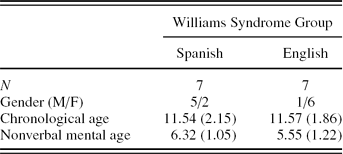
Note: The values in parentheses are standard deviations.
Materials
The computerized version of the English PEPS-C battery (Peppé & McCann, Reference Peppé and McCann2003) and its Spanish version (Martínez-Castilla & Peppé, Reference Martínez-Castilla and Peppé2008a) were used to assess prosodic abilities in English- and Spanish-speaking children, respectively. Several reasons led us to choose this test. First, it is the only prosody assessment procedure available for the Spanish language. Second, it has been proved useful for assessing prosodic abilities in atypical populations (Peppé, McCann, Gibbon, O'Hare, & Rutherford, Reference Peppé, McCann, Gibbon, O'Hare and Rutherford2007), including individuals with WS (Martínez-Castilla, Reference Martínez-Castilla2009; Stojanovik et al., Reference Stojanovik, Setter and van Ewijk2007). Third, cross-linguistic data in typically developing children has already been collected by using the PEPS-C battery (Martínez-Castilla & Peppé, Reference Martínez-Castilla and Peppé2008a), which, as previously mentioned, could be especially useful as a source of comparison for this study.
The PEPS-C test considers prosodic abilities within a psycholinguistic framework, assessing the ability to understand and to express prosody both in terms of auditory discrimination and voice skills required (form tasks) and in terms of how communication is affected by prosody (function tasks; Peppé & McCann, Reference Peppé and McCann2003; Wells & Peppé, Reference Wells, Peppé, Stackhouse and Wells2001). The test therefore seeks to evaluate both receptive (input) and expressive (output) skills at the levels of form (perceptual and motor ability) as well as function (cognitive understanding and expression).
The Spanish version of PEPS-C (Martínez-Castilla & Peppé, Reference Martínez-Castilla and Peppé2008a) preserves the structural similarities of the original English test, thus allowing for direct cross-linguistic comparisons. Cross-linguistic similarities between English- and Spanish-speaking adults and evidence of prosodic development within and between these two languages allow us to consider the Spanish version of PEPS-C as truly parallel to the English version (Martínez-Castilla & Peppé, Reference Martínez-Castilla and Peppé2008a). Both the English- and Spanish PEPS-C batteries consist of 12 tasks (subtests). Each subtest consists of 2 practice items and 16 subtest items, the practice items included ensure that the participant understands what is required in each task. The function tasks include turn-end (distinction between questioning and declarative intonation), affect (intonation distinction between liking and disliking), chunking (phrase delimitation by prosodic means), and focus (contrastive accent), both in the input and output domains.
In the input tasks, the participants are presented with two pictures and are required to select the one which best corresponds to the way a word or utterance is being said. The output tasks, which are also supported with pictures, require the participants to use intonation in order to convey different meanings. The form tasks assess discrimination and imitation (input and output domains, respectively) of the intonation and prosody patterns involved in the previous function tasks over both short and long items. In the input tasks, participants hear pairs of prosodic patterns without lexical information and are asked to say whether they were the same or different (discrimination). In the output tasks, participants are required to imitate the speaker.
Because there are only two possible responses to each item in the input tasks (which means that the load on memory is brought to a minimum), the PEPS-C test treats scoring below 75% correct as performance at chance level (Peppé & McCann, Reference Peppé and McCann2003). This criterion arises from using the binomial distribution with the number of dichotomic items (n) and the probability of succeeding in each item (π) parameters with a confidence level of 99%. For comparison purposes, and because there is also a possibility of producing the right answer by chance, the same criterion is adopted in the output tasks (Peppé & McCann, Reference Peppé and McCann2003). Appendix A contains a description and examples of each subtest, explaining the differences between the English and Spanish versions where required.
Procedure
The Spanish-speaking children with WS were tested in a quiet room in their homes, and their English counterparts were tested in a quiet room either at their schools, homes, or at the University of Reading. All participants were individually assessed and PEPS-C administration lasted approximately 45 min. Administration of both the Spanish and English PEPS-C was preceded by a vocabulary check in order to ensure that the children were familiar with the vocabulary items. As designed in the computerized version of PEPS-C, items in the output tasks were randomly presented to participants and hidden from the tester to elicit a rating blind as to target. The output tasks were recorded with the PEPS-C software using a Sony lapel microphone connected to a laptop (Toshiba Intel Pentium Core Duo CPUT7250 at 2.00 GHz and 778 MHz with a Realtech High Definition Audio sound card for the English study; and HP, Intel Pentium M Processor 1.60 GHz, 800 MHz, SoundMAX Integrated Digital Audio sound card, for the Spanish study). As established in the PEPS-C software, such tasks were recorded at a sampling frequency of 22.05 kHz.
RESULTS
Interrater reliability
In each set of data (Spanish and English), items in the output tasks were independently scored by two raters who were native speakers of each language. Cohen kappa indexes were obtained as a measure of interrater reliability. A high level of agreement was found between each pair of raters, both for the Spanish items (κ = 0.75, p < .001) and the English ones (κ = 0.85, p < .001).
Prosodic tasks
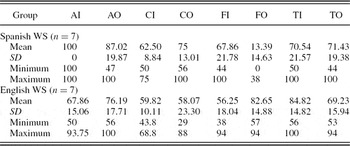
Table 2 presents the mean percentage of correct answers in function tasks for Spanish and English WS groups as well as other descriptive statistics. The Spanish WS group scored at chance level in turn-end input, focus output, focus input, chunking input, and turn-end output. In these three last tasks, the English WS group also failed to achieve a score above chance level. This group scored no better than chance on the affect input and on the chunking output tasks.
Raw scores in percentages (number correct/number scorable) on the function PEPS-C tasks

Note: PEPS-C, Profiling Elements of Prosody in Speech–Communication; AI, affect input; AO, affect output; CI, chunking input; CO, chunking output; FI, focus input; FO, focus output; TI, turn end input; TO, turn end output; WS, Williams syndrome.
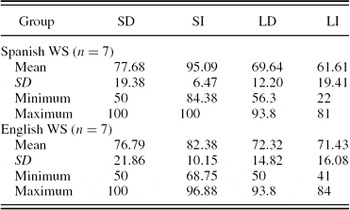
Descriptive statistics for the form tasks for each group are presented in Table 3. Both groups of children with WS performed at chance level in the two long-item discrimination and imitation tasks.
Raw scores in percentages (number correct/number scorable) on the form PEPS-C tasks

Note: PEPS-C, Profiling Elements of Prosody in Speech–Communication; SD, short-item discrimination; SI, short-item imitation; LD, long-item discrimination; LI, long-item imitation; WS, Williams syndrome.
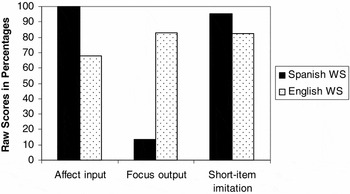
Scores on PEPS-C tasks tended to be nonnormally distributed. Therefore, in order to compare prosodic performance of the Spanish and English WS groups, Mann–Whitney U comparisons were conducted on each PEPS-C task. Analyses showed significantly higher scores for the Spanish-speaking children with WS in comparison to the English-speaking children with WS in the affect input task (U = 0, p = .001, r 2 = .80). Both in the English and Spanish versions of the PEPS-C battery, like is expressed using the same intonation patterns (rise–fall), whereas dislike is expressed differently (fall–rise in English vs. narrow melodic contour with a slight fall in Spanish), and so it is possible that the differences between the Spanish and the English speakers are due to differences in only one of the categories. Therefore, Mann–Whitney U comparisons were conducted separately on items expressing like and dislike in the Affect input task. Significant differences between WS groups in favor of the Spanish-speaking children were only found for items expressing dislike (U = 0, p = .001, r 2 = .82).
The same pattern was found for the short-item imitation task, where the Spanish-speaking children with WS performed significantly better than their English peers (U = 5.5, p = .014, r 2 = .73). However, in the focus output task the English-speaking children with WS achieved significantly higher scores compared to their Spanish-speaking counterparts (U = 0, p = .001, r 2 = .43). No other significant differences were found (p > .05). Significant cross-linguistic differences are shown in Figure 1.
Significant cross-linguistic differences for Profiling Elements of Prosody in Speech–Communication tasks.

In the light of the descriptive statistics presented in Tables 2 and 3, possible different patterns of relationships between input and output tasks for the Spanish- and English-speaking children with WS may be inferred. For example, it looks as though the Spanish children with WS have better comprehension of the affective function of prosody than expression, whereas the English-speaking children with WS seem to show the opposite pattern (i.e., better expression of the affective function of prosody than comprehension). Therefore, in order to investigate these possible different patterns of relationships between understanding and production of prosody, Wilcoxon comparisons were conducted separately for the Spanish and English WS groups on each pair of PEPS-C tasks (e.g., affect input vs. affect output, chunking input vs. chunking output). For the Spanish-speaking children with WS, scores on the focus input task were significantly higher than on the focus output task (Z = −2.37, p = .018, r 2 = .40). Likewise, they performed significantly higher on the short-item imitation task than on the short-item discrimination task (Z = −2.20, p = .028, r 2 = .34). For the English-speaking children with WS significant differences were also found between the tasks assessing the focus function of prosody. However, in this case, participants performed better on the focus output task than on the focus input task (Z = −2.21, p = .027, r 2 = .35). Finally, the English WS group scored significantly higher on the turn-end input task than on the turn-end output task (Z = −2.21, p = .027, r 2 = .35). No other significant differences between the input and output tasks were found either for the Spanish or the English WS groups (p > .05).
DISCUSSION
Cross-linguistic comparisons between English- and Spanish-speaking children with WS
The aim of the study was to investigate whether there were cross-linguistic differences between Spanish- and English-speaking individuals with WS with regard to different prosodic abilities. We found three main differences: the understanding of affect, the production of prefinal narrow focus, and the imitation of short prosodic patterns. The first two are related to the way prosody is used for communication (function) and the last one is a form task, that is, assesses the ability to repeat different intonation patterns.
Understanding of affect. As hypothesized, English-speaking children with WS performed significantly lower than the Spanish children with WS on the ability to understand affect through prosodic means. This would suggest that in individuals with WS the acquisition of this prosodic function in English occurs at a later stage than in Spanish. As previously mentioned, the same pattern has already been reported in other studies that have compared prosodic abilities of typically developing English- and Spanish-speaking children (Martínez-Castilla & Peppé, Reference Martínez-Castilla and Peppé2008a). Moreover, the same cross-linguistic pattern was evident with teenagers and adults with WS (Martínez-Castilla et al., Reference Martínez-Castilla, Campos and Sotillo2005; Plesa-Skwerer et al., Reference Plesa-Skwerer, Schofield, Verbalis, Faja and Tager-Flusberg2007). The question is why this should be the case.
Both in the English and Spanish versions of the PEPS-C task, affect is assessed through a distinction between preference (i.e., like) versus reservation (i.e., dislike) and these emotions are expressed with the same strength (i.e., like is expressed as assertively as dislike). As mentioned above, in the English version of the PEPS-C battery, this distinction is expressed by using rise–fall versus fall–rise pitch movement, respectively. In Spanish, athough preference is expressed through the same intonation features as in English, a fall–rise contour is not considered to be a major indication of reservation. Instead, dislike is mainly expressed by a narrow melodic contour with a slight fall (Martínez-Castilla & Peppé, Reference Martínez-Castilla and Peppé2008b). Considering the cross-linguistic differences found in this study with regard to the understanding of affect through prosodic means where the Spanish-speaking participants outperformed their English peers only when perceiving dislike, we suggest that, during childhood, the intonation pattern for expressing dislike in Spanish seems more expressive and it is more easily perceived than the pattern used in English. This explains why the acquisition of this function seems to occur later in English than in Spanish.
It is also important to note that there is paucity of research on prosodic expression of emotion and therefore acquisition data are sparse (Scherer, Reference Scherer1986). Developmental data from a single case of a young English-speaking child showed that the child used a fall–rise tone in smiling-face contexts and never to express doubt or opposition (Halliday, Reference Halliday1975). This suggests that the pragmatic contrast expressed by a fall–rise as opposed to a rise–fall is acquired later in English. As far as we know, no research has focused on the development of the intonational distinction of like versus dislike in Spanish-speaking children, and we therefore do not know at what age this distinction is acquired. However, what has emerged is that, by investigating understanding and expression of intonation in children with WS, we have added a new finding with regard to cross-linguistic differences in the acquisition of one specific aspect of intonation in Spanish and English.
Production of prefinal narrow focus. As hypothesized, the Spanish children with WS performed significantly lower than their English counterparts on the ability to mark the most salient word in an utterance using intonation. As it was the case with the understanding of affect, this cross-linguistic difference has already been found for English- and Spanish-speaking typically developing children (Martínez-Castilla & Peppé, Reference Martínez-Castilla and Peppé2008a). This developmental difference seems to be related to the linguistic specificities in the expression of focus in English and Spanish. Although English mainly uses intonation to express focus, Spanish tends to mark focus with word order. Therefore, expressing contrastive focus exclusively through intonation (producing prefinal narrow focus), despite being a well-attested function in Spanish (e.g., Face, Reference Face2001, Reference Face2002, Reference Face2006; Zubizarreta, Reference Zubizarreta1998), is a more cognitively demanding strategy. This would explain why, both in typical development and in WS, this prosodic ability is acquired earlier in English than in Spanish.
Imitation of short prosodic patterns. The third task that distinguished between the Spanish and English children with WS was the Short-item imitation task; there was a significant difference between the English and Spanish WS groups in favor of the Spanish one. This task assesses the ability to produce intonation form patterns and includes items which feature in the turn-end and affect input function tasks. Therefore, we hypothesize that the Spanish children did better on this form task because it included items from the affect input task for which we already found a difference in favor of the Spanish WS group. This could explain this unexpected cross-linguistic difference. Further research is needed to address the issue of whether a more advanced ability in understanding affective prosody facilitates the imitation of the intonation form patterns, or whether it is the other way around, that is, whether more advanced intonation abilities facilitate the understanding of affect intonation.
Ability to use questioning versus declarative intonation. Our prediction that the English-speaking children with WS may be worse than their Spanish counterparts with regard to their ability to use questioning versus declarative intonation was not borne out in that the groups were not significantly different on this task. Thus, even though younger typically developing English-speaking children acquire this task later than Spanish children of the same age, this pattern does not affect the children with WS. Stojanovik (Reference Stojanovik2010) found that children with WS in fact outperform typically developing children of the same nonverbal mental age on this task. Therefore, it seems that the acquisition of this prosodic skill is not delayed in WS and is unaffected by their nonverbal ability. This is not surprising given that children with WS are known to have relatively good social communication skills (Jones et al., Reference Jones, Bellugi, Lai, Chiles, Reilly and Lincoln2000), and this task taps these skills in particular.
Relationships between comprehension and production of prosody. Apart from the cross-linguistic differences found for comprehension of the affective function of prosody, the expression of contrastive stress and the ability to imitate short intonation patterns, we also found cross-linguistic differences regarding the relationships between the comprehension and expression counterparts of certain other prosodic tasks. Although the Spanish-speaking children with WS performed better on the focus input task than on the focus output task, the English-speaking children scored higher on the focus output task than on the focus input task. Therefore, perception seems to precede production of the prosodic function of focus in Spanish-speaking children with WS, whereas production seems to precede perception of the same function in the English group. This cross-linguistic difference in the developmental pattern of the focus function of prosody has already been reported for typically developing English- and Spanish-speaking children (Cutler & Swinney, Reference Cutler and Swinney1987; Martínez-Castilla & Peppé, Reference Martínez-Castilla and Peppé2008a). In addition, the English-speaking children with WS performed better on the comprehension than on the expression counterpart of the turn-end task (i.e., using prosody to distinguish between questioning vs. declarative intonation). This difference mirrors the developmental pattern found in other linguistic components where perception is mastered before production. However, this pattern was not found for the Spanish WS group. To our knowledge, no previous study has compared the ability to understand and express the turn-end function of prosody in typically developing Spanish-speaking children. Therefore, we do not know to what extent the difference found between the English and Spanish WS groups for the turn-end tasks resembles typical development. This makes it difficult to obtain any solid conclusions regarding the cross-linguistic difference found in our study between perception and production of questioning versus declarative intonation. Finally, significant differences between the short-item discrimination and short-item imitation tasks were also found for the Spanish-speaking children with WS in that their performance was better when they had to repeat short intonation forms than when they had to discriminate between two different forms. This was not the pattern seen in the English-speaking WS group. As already discussed, cross-linguistic differences between the Spanish and English WS groups in favor of the former were found for the short-item imitation task. This could explain why significant differences between the imitation and discrimination of short intonation forms were only found for the Spanish group.
Implications of the study
Following from the above discussion, the first conclusion we can draw is that some aspects of prosodic function, such as understanding affect and the use of prefinal narrow focus in order to mark the most important words in an utterance, are dependent on the characteristics of the particular language being acquired. With regard to this, we conclude that the cross-linguistic differences found between the English- and Spanish-speaking children with WS seem to be reflective of developmental prosodic patterns that have also been observed in typically developing English- and Spanish-speaking children. As previously mentioned, this is supported by a study by Martínez-Castilla and Peppé (Reference Martínez-Castilla and Peppé2008a), which showed that understanding of affect is acquired later in English, whereas marking prefinal narrow focus is acquired later in Spanish. Furthermore, Stojanovik and Setter (Reference Stojanovik and Setter2008) also showed that the developmental trajectories of different prosodic abilities in WS are similar to those of typically developing children matched for verbal or nonverbal mental age. The children with WS in Stojanovik and Setter's study showed a delayed onset, but an otherwise typical rate of development with regard to the production of affect and production of contrastive stress, whereas there was no delayed onset but a slower rate of development with regard to the production and comprehension of questioning versus declarative intonation (turn-end), production and comprehension of grammatically ambiguous noun phrases using prosody (chunking) and the comprehension of contrastive stress.
What emerges clearly from this study is that the profiles of the children with WS speaking two different languages seem to mirror to a great extent the patterns observed in typically developing children. Those aspects of prosody that seem to be acquired later in typically developing children are also more difficult for children with WS. We do not exclude the possibility that the route to acquiring different cognitive abilities in WS may be atypical, and therefore that they achieve similar scores to typically developing children does not automatically imply that the children with WS use the same strategies on different cognitive tasks, including prosody. Nazzi et al. (Reference Nazzi, Paterson and Karmiloff-Smith2003) showed that the acquisition of prosodic patterns in infants with WS may be atypical. However, this issue needs to be investigated in studies that focus on infants with WS and investigate the acquisition of prosody longitudinally.
Apart from the aforementioned cross-linguistic differences, as expected, no other significant differences were found for prosodic abilities between the Spanish- and English-speaking children with WS. Stojanovik et al. (Reference Stojanovik, Setter and van Ewijk2007) found that prosodic abilities among English-speaking children with WS are a weakness in their linguistic profile relative to their chronological age but not relative to their level of language comprehension. Based on this, the fact that English- and Spanish-speaking children with WS did not significantly differ in most of the prosodic abilities assessed in this study could lead us to conclude that the prosodic abilities of Spanish children with WS are also impaired. Consequently, it appears that certain prosodic deficits are associated with the WS profile, being therefore universal rather than specific to English-speaking children with WS. It also follows that children with WS speaking English or Spanish do not have “preserved” prosodic skills, which means that prosody is unlikely to be unaffected by general cognitive development, and therefore no direct evidence for innate modularity. However, this will certainly need to be further investigated. In this respect, future research should clarify whether Spanish-speaking children with WS present deficits in the prosodic abilities where they outperformed their English-speaking counterparts (understanding of affect and the imitation of short prosodic patterns that do not carry any meaning). It is most important that future research should compare prosodic abilities in Spanish-speaking children with WS with those of typically developing controls as well as consider individuals with WS who speak different languages.
Limitations and future research
The relatively small sample size of this study, a frequent problem with investigations of rare disorder such as WS, is a limitation and hinders the generalization of the results, which should be viewed with a degree of caution. Therefore, replication with larger samples is needed. The lack of information regarding verbal mental age of participants also limits the study, and future research should focus on the relationships between receptive or general language abilities and prosodic skills in WS. Further cross-linguistic studies on prosodic abilities in WS should include control groups that allow for comparisons with typically developing participants of the same chronological age or same verbal or nonverbal mental age. More research on the development of prosody in Spanish- and English-speaking typically developing children is also needed in order to have a more comprehensive view of the cross-linguistic differences reported in the current paper. Furthermore, we do not exclude the possibility of the existence of other cross-linguistic differences apart from the ones found in this study. Thus, that both Spanish- and English-speaking children with WS performed at chance on several tasks (i.e., chunking input, focus input, turn-end output) could be masking other potential cross-linguistic differences. In addition, future longitudinal studies of the prosodic profile of infants with WS are needed in order to investigate whether prosodic abilities follow atypical developmental trajectories during early infancy and the impact this may have on language acquisition in infants with WS.
Final remarks
In summary, this study yields new data about the prosodic profile of Spanish- and English-speaking children with WS and has implications for universal versus language-specific phenomena with regard to prosody acquisition. This means that although typically developing children master the prosody of their mother tongue by age 12, some aspects of prosody, such as the understanding of affect and using prosody to make certain words in an utterance more prominent, are acquired earlier or later depending on the specific language being acquired (Martínez-Castilla & Peppé, Reference Martínez-Castilla and Peppé2008a; Wells, Peppé, & Goulandris, Reference Wells, Peppé and Goulandris2004). These language-specific phenomena seem to hold for children who have WS because the results from this cross-linguistic study showed that the children with WS have prosodic abilities that resemble those of typically developing children in the respective languages.
CONCLUSIONS
In this study, different patterns of prosody acquisition have been observed for English- and Spanish-speaking children with WS. This indicates that several aspects of prosodic function are dependent on the specificities of the language being acquired. The cross-linguistic differences found in this study between the English- and Spanish-speaking children with WS have already been reported for typically developing English- and Spanish-speaking children. Therefore, the prosodic profiles of English- and Spanish-speaking children with WS seem to mirror to a great extent the patterns observed in typical development.
However, English- and Spanish-speaking children with WS did not significantly differ in most of the prosodic abilities tested in this study. This would lead us to suggest that the prosodic impairments previously found for English-speaking children with WS are also present in Spanish-speaking children with WS. Furthermore, we would conclude that certain prosodic deficits are associated with the WS profile and have a universal character. Nevertheless, this needs to be further investigated.
APPENDIX A: DESCRIPTION OF THE PEPS-C TASKS
Function tasks
Turn-end. Assesses the ability to understand and produce the distinction between questioning and declarative intonation, evaluating the function of intonation in interaction by looking at single words constituted as conversational turns. In the input task, words of food items (e.g., milk) are presented with rising or falling intonation. Participants have to decide if the food item has been “read” (falling intonation) or “offered” (rising intonation). For the production task they have to produce the words by using the appropriate intonation according to a picture that shows one of the two possibilities (reading or offering).
Affect. Assesses the ability to identify and express the affect function involved in the intonation distinction of “liking” versus “disliking.” In the English version, “liking” is conveyed by a rise–fall pitch contour, whereas “disliking: is conveyed by a fall–rise pitch contour. The Spanish version also uses a rise–fall pitch contour for “liking” but a flat melodic contour with a slight fall for expressing “disliking.” In the input task, children have to identify, by the way the person in the computer talks, if she likes or dislikes each food item. Conversely, in the output task, they have to express by the same means their “liking” or “disliking” of each food item.
Chunking. Assesses the comprehension of syntactically ambiguous sentences, which are disambiguated by prosody, and then the production of this distinction. It assesses the grammatical function of phrase delimitation. The stimuli include pictures of food items and different-colored socks for the English version and the same type of colored socks and several other compound nouns for the Spanish one. In the input task, participants are presented with two pictures that show two possible interpretations of the same lexical items. The difference in the interpretation will be based on the place of the prosodic boundary markers of a presented phrase. For example, the utterance chocolate cake and buns needs to be interpreted as a cake made of chocolate if the boundary is placed after the second item (/chocolate-cake/ and buns/) but as three different food items (/chocolate/ cake/ and buns/) if the boundary is placed after the first one. Participants have to click on the appropriate picture depending on what they hear. Another example for the sock items is: /red/ and pink and black socks/ versus /red and pink/ and black socks/ interpreted as pink and black bicolored socks in the first case and red and pink bicolored socks in the second one. Similar items are included in the Spanish version: /pez/ espada/ y limón/ (/fish/ sword/ and lemon/) versus /pez-espada/ y limón/ (/sword-fish/ and lemon/) or /calcetines negros y rosas/ y rojos/ (/black and pink/ and red socks/) versus /calcetines negros/ y rosas y rojos/ (/black/ and pink and red socks/). In the output task, participants are presented with only one picture and are asked to say what they see.
Focus. Assesses the ability to identify and produce prefinal contrastive stress. As a result of Spanish linguistic specificities related to this function, the English and the Spanish version of focus tasks involve different stimuli, although the Spanish version preserves the structure of the original English one. In the English input task, a computer-recorded voice stresses one of two colored socks to express that only one of the socks (the stressed one) was forgotten. Participants have to decide which one has been the forgotten one, for example, “I wanted BLUE and white socks” versus “I wanted blue and WHITE socks,” where the forgotten socks were the blue and the white, respectively. In the English output task, participants are presented with a football match between different colored cows and sheep. Each time one of the animals has the ball they hear a voice (commentator) giving an erroneous description of the situation; for example, for a picture of a blue cow, the commentator says “the red cow has the ball.” Participants have to correct the commentator using prefinal contrastive focus by saying: No, the BLUE cow has it! For each situation either the color or the animal has to be changed depending on which of these the commentator got wrong. In the Spanish version, input task presents a child that has been given just one food item to eat but that wanted another one. Participants are shown two pictures of food and a recorded sentence; they have to decide which of the two foods the child is asking for, for example, “Quería paella y YOGUR para comer” versus “quería PAELLA y yogur para comer” (I wanted paella and YOGURT to eat/I wanted PAELLA and yogurt to eat). Stimuli also consist of food items in the Spanish output task. Participants are presented with a picture of a child with a callout with his two desired foods. Participants hear what the child's mother has understood he wanted to eat, but she is always making a mistake over one of the two food items. Therefore, participants have to correct the mother by saying exactly what the child wanted to eat and respecting the order of the items (in order to keep the prefinal position of the contrastive focus), for example, “ha dicho que quería leche y GALLETAS para comer” versus “ha dicho que quería LECHE y galletas para comer” (“he said he wanted milk and BISCUITS to eat” versus “he said he wanted MILK and biscuits to eat”).
Form tasks
Short-item and long-item discrimination tasks. These tasks assess participants' ability to perceive the acoustic prosodic differences involved in the previous functions (the term short-item refers to intonation parameters involved in turn-end and affect tasks, whereas the long-item to the prosodic parameters deployed in chunking and focus functions). Both tasks involve laryngograph recordings of the items from the function tasks, which preserve pitch, loudness, and length variations but eliminate lexical information. Participants are presented with pairs of these sounds and they have to decide if the sounds are the same or different.
Short-item and long-item imitation tasks. These tasks assess the ability to imitate different intonation or prosodic forms. Participants have to repeat words/phrases exactly as they hear them. As in the discrimination form tasks, the short-item task contains items from the turn-end and affect function tasks and the long-item one from the chunking and focus function tasks.
ACKNOWLEDGMENTS
This research was funded by Grant AP2003–5098 from the Ministry of Education and Science of the Spanish Government (to P.M.-C.) and Award RES-000-22-1302 from the Economic and Social Sciences Research Council, United Kingdom (to V.S. and J.S.). We thank the Asociación Síndrome de Williams de España in Spain, the Williams Syndrome Foundation in the United Kingdom, and all of the children who participated in the study and all of the parents and teachers who helped us access the children.