Introduction
Difficulties faced by some viable small- and medium-sized firms in obtaining finance have long been central to debates on the United Kingdom’s economic problems.Footnote 1 In 1930 Keynes described these companies as an “unsatisfied fringe of borrowers.”Footnote 2 The problems this “fringe” faced in obtaining capital became known as the “Macmillan Gap” in 1931 after the government’s Macmillan Review of Finance and Industry.Footnote 3 Government reports returned to the topic over subsequent decades, recommending interventions to increase the flow of capital to small- and medium-sized businesses.Footnote 4
The Macmillan Gap thesis proposes that capital markets are prejudiced against smaller companies for two reasons: the structural characteristics of equity; and information asymmetry leading to overly conservative perceptions of risk by financial institutions.Footnote 5 In relation to the first explanation, Coase’s analysis of transaction costs implies that the cost of raising equity creates a threshold level below which it becomes uneconomic.Footnote 6 Debt is often more attractive for smaller businesses, as it is cheaper than equity and does not usually involve loss of ownership or control.Footnote 7 However, the second explanation applies to both debt and equity, as the cost to investors of obtaining information on small companies is high compared with the potential rewards. Not only must much data be collected on many prospective investments, but more crucially, businesses seeking finance are often start-ups without a track record to reassure investors. Stiglitz and Weiss argued that such asymmetry creates markets featuring imperfect information in which companies with viable projects are either unable to obtain financing or must accept debt at high levels of interest. Footnote 8
Information asymmetry also has regional dimensions. The decision-making functions of regional banks are closer to local business when compared with large national banks. This proximity enables regional banks to gather data on local applicants at a lower cost than that faced by national banks. Carnevali argued that the postwar lack of such banks in the UK’s regions ensured that London clearing banks were the most important source of finance for smaller regional firms, but the scale and centralized structures of clearing banks hampered efficient risk assessment.Footnote 9 Moreover, Berger and colleagues argued that regional banks are locally embedded with greater access to “soft” information such as the character of managers within applicant companies.Footnote 10 Carnevali tested this hypothesis by examining banks in the commercially successful region of northern Italy, finding that they used local knowledge to construct a mutually beneficial credit relationship with regional firms,Footnote 11 although such approaches required a preexisting local stock of successful firms and individual entrepreneurs.
Government intervention that attempts to fill the Macmillan Gap has two justifications. The first is that the gap is caused by market failure. Governments can fill this gap with their own venture capital,Footnote 12 but Lerner noted how such programs “far more often than not, have been failures.”Footnote 13 The second is the spillover hypothesis. This accepts that returns from rejected projects could be less than the opportunity cost of funding, but that government financing generates positive externalities.Footnote 14 Spillover returns can include broader economic impacts, including salaries, rates, rents, and taxes, as well as expenditure on goods and services. Mazzucato placed spillover arguments in a broader context, proposing that intervention beyond that justified by market failure is crucial for the market-shaping role of an “entrepreneurial state,” if the short-termism of private finance is to be overcome for the public good.Footnote 15
Despite the topic’s continued salience, it has been little studied in relation to UK regions.Footnote 16 In particular, the business history literature lacks such studies as part of a broader trend of what Wren called the “remarkable” lack of evaluation of financial support to UK industry.Footnote 17 This article addresses this gap by examining the loan and equity investment activities of the government’s Welsh Development Agency (WDA) between 1976 and 1994. Our research question is: Can the WDA’s activities be justified in terms of the market failure and/or spillover hypotheses?
This examination has two merits. One is that the agency was an example of government attempts to fill the Macmillan Gap in a peripheral and poorly performing economy. The other is that the market failure argument remains prominent within ongoing debates on venture capital and development finance. Internationally, the United Nations has argued that development banks can be “instrumental not only in addressing market failures […] but as a critical tool in supporting a proactive development strategy.”Footnote 18 Nationally, Wales’ percentage share of the UK’s venture capital funding remains low.Footnote 19 Following the cessation of the WDA’s activities, the Welsh Government created Finance Wales in 2001 to increase the provision of business finance, subsequently folding it into a new Development Bank in 2016 to “support the economy […] by making it easier for businesses to get the finance needed to start up, strengthen and grow.”Footnote 20
The article uses three primary data sources to assemble its account. The first, and most important, are the WDA’s board papers held by the UK’s National Archives. The second is official documentation produced by the WDA and other bodies such as the Welsh Office, a territorial government department. Finally, the article draws on interviews with politicians and former managers at the agency. The article uses these data to assess the agency’s activities against market failure and spillover hypotheses. In relation to the former, the Welsh Office instructed the agency in 1978 to measure the rate of return on capital employed by its investment portfolio, to be compared against targets. Although definitions of the rate of return changed over time, time-series data based on financial year-end reports are available. No data exist, however, on the proportion of investments that succeeded or failed, although board papers and the WDA’s annual reports contain data on the performance of some individual investments.
Few data exist by which to test the spillover hypothesis. While annual “forecast additional employment” expected to be created by the portfolio data are available, those on employment achieved or data that eliminate double counting over time are not.Footnote 21 Data on other spillover impacts such as salaries, rates, rents, taxes, and expenditure on goods and services are also absent. The National Audit Office noted in 1985 that the Welsh Office (and its Scottish equivalent) “did not seek information [from their agencies] on jobs created, maintained or safeguarded by the investment function or other economic and social benefits arising.”Footnote 22 The only data on spillovers are contained within a 1993 evaluation of a sample of investments made by the agency between 1987–88 and 1990–91.Footnote 23
The article finds that although some of the WDA’s investments were viable, based on commercial criteria, its portfolio performed poorly and an “unsatisfied fringe” of viable projects did not exist except at the margins. However, spillover returns, magnified by the depressed economic conditions of the time, did exist, making some noncommercially viable investments worthwhile in terms of their social rate of return. However, such returns are difficult, if not impossible to quantify due to the lack of appropriate data. The central problem faced by the agency was the incompatibility of its two investment objectives: to assemble a profitable portfolio (reflecting purely commercial considerations); and to grow employment levels through boosting commercial activity (reflecting a concern with social, rather than commercial, rates of return). The findings suggest that while scope exists for state-backed venture capital, obtaining a successful return requires an ecosystem across knowledge, technical skills, and financial support to facilitate demand for capital.Footnote 24 Crucially, creation of such ecosystem attributes, where some or all do not exist, is beyond the sole institutional capacity of most regional government bodies; they can only form part of a broader approach led by national governments that can deploy a full range of governance powers.
The remainder of this article is structured as follows. The next sections discuss state provision of venture capital in Wales between the 1930s and the establishment of the WDA. The subsequent parts examine the agency’s activities and achievements across four periods between 1976 and 1994. The final section assesses the extent to which these activities justified the market failure and spillover arguments, before concluding.
Targeting the Macmillan Gap in Wales, 1936–1976
The industrial economy of Wales in the eighteenth and nineteenth centuries depended on coal mining and metal manufacturing. Large financial institutions did not emerge as entrepreneurs sourced funding from plowed-back profits or imported capital from England.Footnote 25 However, demand for primary products collapsed in the 1920s, and Wales became mired in a depression. Pressure mounted on the government, and in 1934 it designated south Wales as a “Special Area.”Footnote 26 The Bank of England’s Special Areas Reconstruction Association offered loans from 1936, joined from 1937 by HM Treasury’s Special Areas Loans Advisory Committee, but total lending from both sources was small in volume.Footnote 27
Wartime necessity compelled the state to reconstruct Wales’ industrial economy between 1939 and 1945, and its newly dominant role continued after the war’s end. Postwar governments channeled intervention through the nationalized industries of coal and steel, as well as regional policy instruments that controlled industrial location, constructed factories, and provided finance.Footnote 28 Finance played a small role initially, and two funding mechanisms existed from 1945.Footnote 29 The first was HM Treasury’s Development Areas Advisory Committee, but it financed only ninety-nine companies in Wales between 1960 and 1966. Its loan criteria excluded start-up and high-risk projects,Footnote 30 and demand was low. Officers visited 174 companies in Wales in 1959, but only 13 would consider applying for loans.Footnote 31 The other mechanism was the Industrial and Commercial Finance Corporation (ICFC), formed by clearing banks and the Bank of England. Although Wales had a 4.1 percent share of the UK’s employees in 1970,Footnote 32 only 1.6 percent of the ICFC’s debt was held there, having fallen from 2 percent in 1960 and 2.7 percent in 1951. The ICFC noted that although its Cardiff office did as “much [business] as we could expect,” it was less profitable than other branch offices.Footnote 33 The corporation attributed low demand to an industrial structure in Wales that featured concentrations of heavy industry, implying that other activity had been crowded out.
In 1968 the Welsh Council, an advisory body to government, appointed a Finance Panel to explore problems faced by businesses seeking capital. The panel’s majority report argued that “gaps in the financial structure” created market failure, as clearing banks with “marginal” interests in Wales based lending policies on UK-wide conditions, creating a shortage of local risk capital. It proposed the creation of an investment bank with policies dictated by local conditions to address market failure, although a dissenting minority report was also published that argued the problem was demand, not supply.Footnote 34 A Cardiff financier, Julian Hodge, responded that Wales had no indigenous financial institutions except for his own small merchant bank, in contrast to Scotland. He proposed a new bank to give “help and advice, and finance, to indigenous Welsh industry, to promote [its] development,” while “building up Cardiff as a financial centre.”Footnote 35 Hodge established the Commercial Bank of Wales in 1971, and although it was profitable, the extent to which it fulfilled a developmental mission is unclear. The bank only approved 0.5 percent of loan requests, and a lack of “viable” Welsh projects (possibly reflecting the high interest rates charged) meant that its business was mostly outside Wales.Footnote 36
The continuation of government intervention in Wales in the 1970s and beyond was facilitated by an administratively devolved government department created in 1964, the Welsh Office. It was controlled by a secretary of state for Wales, a cabinet minister with broad responsibilities.Footnote 37 From 1974 the secretary of state was Labour’s John Morris, who noted that he was part of “an interventionist government.”Footnote 38 In 1975, the Labour government established the National Enterprise Board (NEB) to invest in industry in England, and the Scottish Development Agency (SDA). Echoing the latter’s inauguration, on January 1, 1976, the WDA was established as the most powerful agency in Wales, holding many of the powers exercised in England by the NEB and in Scotland by the SDA.Footnote 39 The WDA’s investment remit was set out in the Welsh Development Agency Act 1975 as including: acquiring, holding, and disposing of securities; forming companies and partnerships; and making loans and issuing guarantees.Footnote 40 The agency also constructed and let factories, cleared derelict land, and provided business advice to companies as part of its broad mission to regenerate the Welsh economy.Footnote 41
The WDA and Venture Capital
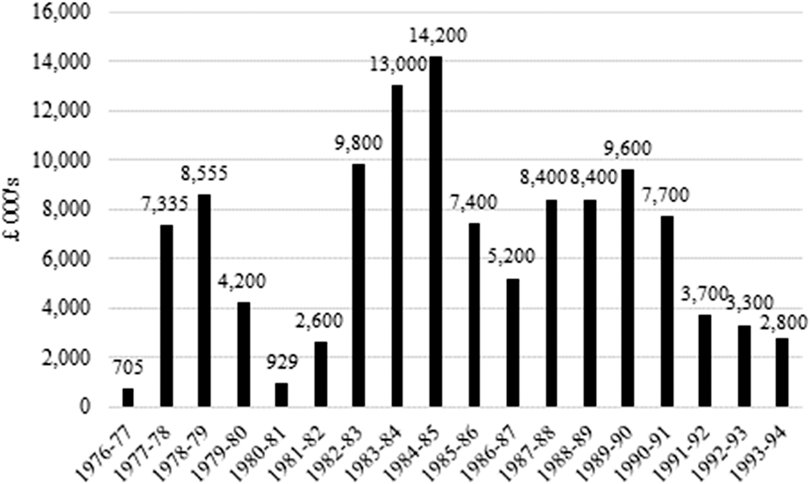
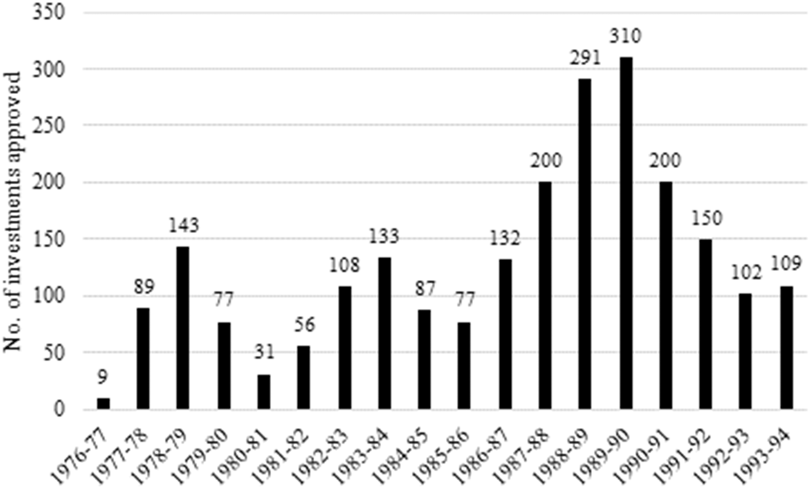
Between 1976–77 and 1993–94 the WDA made 2,304 loan or equity investments totaling £117.8 million.Footnote 42 Annual expenditure fluctuated but peaked at £14.2 million in 1984–85 (see Figure 1). The number of companies receiving new support in each year reached 310 in 1989–90 (see Figure 2), and the number of firms in the portfolio peaked at 1,021 in 1990–91. The portfolio’s value peaked at £35 million in 1988–89.
Total annual approval of new investment funds, 1976–77 to 1993–94.
Source: WDA Annual Reports and Board Papers.

Number of investments approved, 1976–77 to 1993–94.
Source: WDA Annual Reports and Board Papers.

Between 1976–77 and 1993–94, the activities of the Welsh Office and the WDA were overseen by five different secretaries of state: John Morris (1974–79), Nicholas Edwards (1979–1987), Peter Walker (1987–1990), David Hunt (1990–93), and John Redwood (1993–95). While the last four were Conservative politicians, they did not all have the same approach to addressing Wales’ real and perceived problems.
Four periods are discernible when time in office of the secretaries of state is linked with the data presented in Figures 1 and 2. The first was 1976–77 to 1978–79, when the agency aimed to facilitate economic momentum by investing in large and small firms, including mounting rescue operations, an approach endorsed strongly by John Morris. The second period was 1979–80 to 1986–87 under Nicholas Edwards. Margaret Thatcher’s Conservative government initially curtailed activity, but the WDA became an active venture capital investor to small firms and start-ups, although profitability concerns led to investment being reduced after 1984–85. The third and shortest period was 1987–88 to 1989–90, when Peter Walker spurred a short-lived expansion focused on high-risk start-ups. Activity began to decline in the final period from 1990–91, initially under David Hunt, and equity investments had almost ceased even before John Redwood instructed the agency to minimize its lending in 1994. We now examine agency activities across each period.
I. 1976–77 to 1978–1979
The WDA’s ambitions were clear from the outset. Its chairman, Sir David Davies, informed the inaugural board meeting that the agency had an “important role to play in providing new industry and new employment opportunities.”Footnote 43 Ambition was, however, tempered by the chairman’s comments that “we have not been set up to bail out non-viable projects” and “we cannot achieve our objectives merely by pumping a great deal of money into industrial investment. Sound investment decisions need to be taken.” This duality between creating employment and minimizing risk was reflected in the guidelines for industrial investment issued by the Welsh Office. The WDA was authorized to take a shareholding of up to £2 million in or loan up to £1 million to any business, but was also to be subject to financial targets that would define and measure an “adequate return on capital employed.”Footnote 44
The WDA scaled up investment rapidly from £705,000 in 9 companies in 1976–77 to £8.6 million in 143 companies by 1978–79.Footnote 45 It focused on manufacturing, and the service sector accounted for only 2 percent of its portfolio in 1979–80.Footnote 46 The agency, like its Scottish counterpart, the SDA,Footnote 47 was initially expected to play a catalytic role as an industrial investment agency supporting large and small businesses,Footnote 48 as part of the secretary of state’s policy to “provide financial packages [to] help both the lame ducks and those who could waddle.”Footnote 49 The WDA’s portfolio reflected this broad approach. Small companies dominated investments by number, 64 percent of which were less than £50,000,Footnote 50 and 34 percent were start-ups.Footnote 51 However, larger investments, generally in established firms, accounted for greater than 75 percent of investment expenditure.
Investment policy focused on generating additional economic activity,Footnote 52 spurring the WDA to take decisions “involving a degree of risk that the banks would not contemplate.”Footnote 53 This was typified by board decisions taken in October 1978. Having provided two tranches of equity and loans totaling £125,000 over the previous twelve months to Callbuoy Marine Electronics, the WDA appointed receivers just four months after the company received the latter. This decision was taken after new company managers revealed a worsening financial outlook and efforts by the agency to attract commercial partners failed. At the same time, the WDA board also approved £200,000 for Newport Precision Engineering despite the company’s “somewhat uncertain proposal in a very difficult and high-risk market.”Footnote 54 This risk, however, proved to be justified, as the company survived until the mid-1990s.
In December 1978 the agency approved its biggest investment to date: £2 million in the gelatin manufacturer, Leiner. This family-run company had performed well but internal disputes had left it in need of external management and financial support. It employed 530 people at Treforest on the largest industrial estate owned by the agency, where it was a major customer of the WDA’s steam-generating plant powered by cheap gas from coking works linked to adjacent collieries. The agency was concerned that without a capital injection, the company would be taken over by a competitor that might close the factory. Closure would have imperiled the steam plant’s viability, and although Leiner operated in an oligopolistic market featuring volatile price movements, the WDA’s investment in early 1979 aimed to enable the company to commercialize a new photographic gelatin technology in a market considered to have great potential.
Despite the intensity of the agency’s early investment activity, performance data are limited. In December 1977 central government set the NEB in England a target of achieving a 15–20 percent return by 1981 on investment other than British Leyland and Rolls-Royce. The Welsh Office proposed a similar target for the WDA in 1978, but the agency instead suggested targets that measured the agency’s success in promoting industrial efficiencies rather than “simply as a measure of the effectiveness of the agency as an investor.”Footnote 55
However, the Welsh Office was determined to measure the agency’s overall financial effectiveness and subsequently instructed it to secure a portfolio rate of return of between 15 and 20 percent by 1981–82.Footnote 56 The WDA did not report formally against this target until after 1978–79, but it calculated a rate of return of 6 percent at the end of that year and claimed that its investments would create some three thousand jobs.Footnote 57 Despite setting a high target rate of return, the secretary of state, John Morris, was keen to see the agency take risks to achieve higher levels of commercial activity, stating that “we wouldn’t need the WDA” if it “operated as a sort of a trustee savings bank.”Footnote 58 However, while investments appeared promising, changing circumstances were to place these activities in jeopardy.
II. 1979–80 to 1986–87
After Margaret Thatcher’s Conservative Government assumed office in 1979, agency investment fell from £8.6 million in 1978–79 to £900,000 in 1980–81.Footnote 59 Although the new secretary of state, Nicholas Edwards, was determined to use the WDA as an “instrument [...] to address inherited [economic] problems,”Footnote 60 two factors combined to create this decline. The first was his decision to divert funds to a large-scale program of factory construction to create jobs quickly during the deep recession of 1980–81. The other was the agency’s poor financial performance as it reported negative rates of return for 1979–80 (−15.25 percent) and 1980–81 (−4.65 percent).Footnote 61
Much of this poor performance was caused by the failure of Leiner’s operations in Wales. The firm built up rent and utility debts to the agency of £1.2 millionFootnote 62 before failing in 1980, forcing the agency to write off its investment. The scale of the failure was damaging, as was the fact that the agency’s director of industry and investment, Jack Loveland, had joined Leiner as their chief executive after the WDA had approved its investment.Footnote 63 While the agency noted that Leiner’s aging leadership and history of internal conflict meant that new management was required, Loveland made his decision independently. Nevertheless the agency’s reputation was tarnished by this action, and WDA board member Garel Rhys argued later that the Welsh Office “just didn’t trust the WDA after Leiner.”Footnote 64
Tensions between the Welsh Office and the agency often flared, generally caused by differences between the former’s more cautious approach to the use of public funds, reflecting HM Treasury’s guidance, and the latter’s greater readiness to take risks. Senior civil servants within the Welsh Office’s Industry Division put such concerns to their permanent secretary in 1980: although the WDA “seemed to fancy themselves as merchant bankers,” in their opinion there was “no great funding gap, except of course for difficult projects, which [it] should not be involved in.”Footnote 65 The Welsh Office subsequently insisted on signing off on investments over £1 million and instructed the agency to invest only where sufficient finance was not available from the private sector on “appropriate terms.”Footnote 66
However, economic problems meant that investment soon reemerged as a priority. Employment in manufacturing, coal, and steel throughout Wales fell by 35.3 percent between 1979 and 1985,Footnote 67 while unemployment remained at postwar peaks until 1985.Footnote 68 In response, David Waterstone, WDA chief executive between 1981 and 1990, was determined to “re-commercialise” and “empower” the Welsh people through taking risks and accepting losses.Footnote 69 In 1985 the secretary of state set out an agenda for investment that characterized his period in office between 1979 and 1987. He drew on declinist concepts then present within historical scholarship to attack the “prejudice, ignorance, and striking lack of awareness” displayed by those in the City toward areas “outside their own experience,” before stating that his “central aim [was] to use the funds at our disposal to act as a lead and catalyst for the growing investment and participation of the private sector.”Footnote 70
Two perceived market imperfections drove strategy throughout the decade. The first was how the absence of local financial institutions created a finance gap, particularly for small and high-risk projects. Although the WDA was “dogged by a lack of projects” in the early 1980s as “the stratum of indigenous business [was] pretty thin,”Footnote 71 it claimed to be an “established and successful merchant banker” and expanded its investment activities.Footnote 72 New annual investment grew from £2.6 million in fifty-six companies in 1981–82 to £14.2 million in eighty-seven companies by 1984–85, the largest sum invested in any one year (see Figure 1), although concerns as to profitability led to subsequent reductions.
Some investments produced high returns, with successful exits including W. Williams & Sons Holdings, an engineering specialist. The WDA had acquired a 28.4 percent stake in 1979 for £307,000 and sold it in 1983 for £574,000.Footnote 73 However, thirteen companies failed in that year and the agency lost most of the £800,000 it had invested.Footnote 74 The agency’s ambition was symbolized by its 1984 investment in a “very ambitious but strategically important” start-up manufacturer of computer disks, Parrot PLC.Footnote 75 The WDA invested £1.5 million (followed by a £750,000 loan guarantee), while commercial sources provided £5.5 million. The agency proudly promoted the deal as one of the largest start-up venture capital deals of that year in either Europe or the United States,Footnote 76 although its eventual failure in the late 1980s was to equal Leiner in scale and impact (see section III. 1987–88 to 1989–90).
The second perceived imperfection was investors’ poor awareness of profitable opportunities in Wales.Footnote 77 The WDA noted later that it was influenced strongly by estimates that 78 percent of venture capital investments were made within a two-hour drive of a fund’s office, but 73 percent of the UK’s funds were based in London,Footnote 78 more than two-hour drive from any part of Wales. While the agency had tackled this from 1976 by investing itself, it now sought to create new funds to produce a “distinct, local” financial services sector.Footnote 79 In 1982 it launched Hafren Investment Finance to invest in new technology and high-risk projects. A marketing campaign attracted one thousand enquiries and one hundred fifty applications, and loans totaling £791,000 in seventeen companies were approved. Another initiative, the Welsh Venture Capital Fund was launched in 1984–85, half of whose funds were raised in the City with the balance from local sources, including the church in Wales, local authorities, and the WDA. However, difficulties were symbolized by the Cardiff Consortium project, launched in 1986 to market commercial funds. It received 844 enquiries, 144 of which became proposals, but none were funded, as their quality was “too low.”Footnote 80
Finally, between 1983 and 1987 the WDA supported some Welsh companies by underwriting their share issues and was similarly involved in underwriting UK-wide privatizations. The agency committed £2.3 million in total, and while the underwriting of companies including Laura Ashley and the Trustee Savings Bank was profitable, gains were outweighed by losses. Notably, the agency lost money underwriting British Petroleum during the “Black Monday” stock market crash of 1987. The WDA stopped underwriting in the same year, having lost £150,000 across all such activity.Footnote 81
In 1986, in the absence of official data, the WDA commissioned research that demonstrated its dominance of venture capital, it being the agency providing all such investments in Wales below £99,000 and a majority of larger investments. Overall, the agency claimed to have financed 90 percent of venture capital investments in Wales by number and 65 percent by value.Footnote 82 Although the WDA was able to take risks and invest in volume, financial success was elusive. In 1981 the Welsh Office instructed the agency to achieve returns equivalent to the cost of government borrowing over a rolling five-year period, to ensure that the cost to the government of supplying funds was covered.Footnote 83 Agency investment managers briefed their board in 1982 that they intended to take “more risks,” meaning that targets would be “elusive”; they were “putting the government on notice about this and asking for understanding when the time comes.”Footnote 84 The WDA hoped that short-term losses would be offset by later surpluses, but this did not happen.Footnote 85
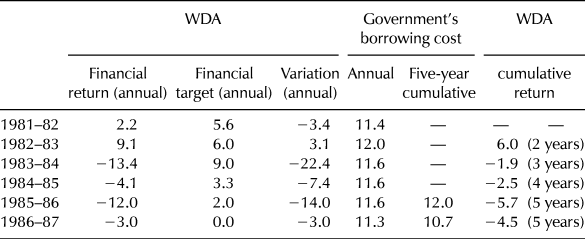
While some investments were successful, the portfolio performed poorly (see Table 1) and missed targets in all but one year between 1981–82 and 1986–87. Annual and cumulative returns were negative each year from 1983–84 to 1986–87, and its 1983–84 return was 22.4 percentage points below its target of 9 percent.
Financial targets and returns for industrial investment activities, 1981–82 to 1986–87.*

Note: *All figures as percentages. —, data not available.
Source: WDA Annual Reports.
By mid-1984 the agency had to write to the secretary of state to justify its investment activities, and the WDA identified most of its portfolio in the following year as unsecured or low value, as its operating area was “one where other institutions would probably not enter.”Footnote 86 By 1986–87 the target was downgraded to breaking even, but even this proved impossible to achieve. While commercial success continued to elude the WDA, there is some evidence of the existence of spillover effects, despite the absence of specific data. In 1984, for example, the agency board was informed that poor financial performance was caused by the need to create employment “even at the cost of a bad investment.”Footnote 87
III. 1987–88 to 1989–90
The WDA’s focus on investment was temporarily revitalized in 1987 by the appointment of Peter Walker, a firm supporter of government intervention, as secretary of state.Footnote 88 Investment increased immediately from £5.2 million in 1987–88 to £8.4 million in the following year, and the annual number of investments made peaked at 310 in 1989–90 (see Figure 2). Activity was “intense” by mid-1988, and in the following year, average investment size was £40,000 in line with the agency’s new goal of 75 percent of investments being under £100,000.Footnote 89 The WDA planned a second tranche of the Wales Venture Capital Fund and launched a financial services initiative to attract employers. The initiative addressed the perennial issue of what the agency described as “strong prejudice” in the City toward Wales, where the “most arrogant view [was] taken by merchant banks,” which saw relocations and investment in the principality as “a one way-ticket” to a “wilderness [of] slag heaps.”Footnote 90
However, greater activity was short-lived due to two circumstances. First, the Welsh Office was steering the agency toward a self-financing status, meaning that poorly performing activities would be a future burden on its activities. Second, poor financial performance was leading to waning political support. Problems were illustrated by later write-offs linked to £242,249 loaned to forty-seven small or start-up businesses in the late 1980s, £193,143 of which was unrecoverable.Footnote 91 Details were available on thirty-six loan signatories, of whom thirteen had moved abroad or disappeared, while the remainder had insufficient assets to enable recovery. Failures forced the agency in 1988–89 to raise provision against investments at imminent risk of failure to 100 percent, doubling such provisions from £3.032 million to £7.082 million.Footnote 92
Poor performance caused the agency in June 1988 to ask for a less onerous target of a compound rate of return of 2 to 3 percent over ten years, warning that without this, “consideration will need to be given to policy changes.”Footnote 93 Such policy changes became more likely in December 1988 when WDA executives met Peter Walker. A strong supporter of investment on his appointment as secretary of state a year previously, he now queried the “agency’s minus 12 percent return on investments [in 1985–86] and the zero percent target [from 1986–87],” before emphasizing that “it should always be difficult to borrow money.”Footnote 94 Concerned officials within the WDA noted that the Welsh Office had “little sympathy” for “what they see as the provision of loans by the agency which are, or ought to be, available from the private sector.”Footnote 95 While loss-making investment activity was once justified by the argument that it raised levels of commercial activity and employment, economic recovery in the late 1980s and the absence of spillover data lessened this argument’s force, and equity support became reserved for very low-risk companies.Footnote 96
Welsh Office patience finally expired after the failure of one of the agency’s largest investments to date: Parrot. The company was an ambitious attempt to produce computer disks, but it mistakenly manufactured disks of a specification quickly made obsolete by advancing miniaturization. In 1988 the WDA planned to purchase additional shares as part of a rights issue to enable Parrot to develop more advanced disks. However, the Welsh Office unsurprisingly prevented this investment given the agency’s admission that “Parrot has never met any of its forecasts, losses continue to be made and accumulated losses exceed £4 million.”Footnote 97 The company entered receivership in 1989, and the agency lost much of its £1.5 million investment and £750,000 loan guarantee. The WDA was heavily criticized in the House of Commons over many occasions after 1987: its monitoring of the company was considered deficient; Neil Taylor, an agency employee instrumental in funding Parrot, had subsequently worked for the company, echoing events at Leiner; and Frank E. Peters, recruited by the agency to lead Parrot, was charged with financial offenses linked to misappropriation of public money, although he was later acquitted.Footnote 98 In response, the agency tightened its procedures to prevent a recurrence of the overly close relationship with Parrot and never again undertook an investment of the same scale and ambition.
The Parrot debacle presaged a final attempt by the Welsh Office to stem the WDA’s losses. In 1989 it set new annual targets for the agency of a real rate of return of 6 percent over ten years for new equity investments, and a separate target for those made before March 31, 1989.Footnote 99 Although the WDA did achieve a small overall profit “for the first time ever” in 1989–90,Footnote 100 it failed again to meet its targets. Importantly, the WDA’s flagship attempt to offset information asymmetry, the Welsh Venture Capital Fund, was closed in 1990, as it had “not done well commercially” with losses of £700,000 linked to investments of £5.6 million.Footnote 101
By 1990 the WDA accepted that it was “difficult, if not impossible” to invest in start-up or early-stage businesses and “make a positive return.”Footnote 102 Its broader remit was moving away from investment and factory construction toward assisting business through advisory services, and the agency accepted that its previous status as a “lender of last resort” would no longer apply.Footnote 103
IV. 1990–91 to 1994–95
The agency’s commitment to investment declined steadily throughout the early 1990s, as the Welsh Office, under Secretary of State David Hunt, questioned the rationale for such activity. Expenditure fell from £7.7 million on 200 projects in 1990–91 to £3.3 million on 102 projects in 1992–93 (see Figures 1 and 2). While the WDA still sought to attract venture capital funds and supported a new Welsh Enterprise Fund, it was only prepared to invest the relatively small sum of £500,000 in total.Footnote 104 The Welsh Office enforced a £100,000 limit per single business on equity and tightened monitoring to avoid the losses of the 1980s.Footnote 105 Organizational downgrading began in 1990 when investment lost its departmental status and was subsumed into a business services division.Footnote 106 By 1992 the “whole rationale” of the function was under review,Footnote 107 and investment was no longer a mainstream activity. While the Welsh Office had long been skeptical, the difficulty of building a large-scale portfolio had discredited investment within the agency itself. Disillusionment was symbolized by Brian Morgan, its chief economist from 1991, who stated later that the WDA was once keen to “invest more in winners […] putting a lot of money in new areas” but companies receiving investment were often “completely hopeless and couldn’t make it in the market. And the agency lost lots of money.”Footnote 108
Pressure intensified in 1993 following John Redwood’s appointment as secretary of state for Wales. He opposed intervention,Footnote 109 remarking that “development agencies have been necessary bandages […] but the healing comes from within from the talents, energies and ideas of people and the businesses they set up or attract.”Footnote 110 He drew support from unemployment in Wales dropping below UK averages in 1993 for the first time since records were available. This success was due in part to the efforts of the WDA’s activities within property, finance, and marketing, which attracted large volumes of manufacturing inward investment to Wales, a leading UK region for such investment in the late 1980s and early 1990s.Footnote 111
Political pressure translated into three administrative actions. First, the Welsh Office instructed the WDA to concentrate on assisting companies to obtain finance from other sources.Footnote 112 Second, the agency’s delegated ability to make equity investments of less than £100,000 was removed,Footnote 113 and board member Garel Rhys noted that “taking equity in companies, it just wasn’t on the agenda by the mid-1990s.”Footnote 114 Finally, and despite twenty years of activity, in 1994 the Welsh Office began to question the legality, under the 1975 Welsh Development Agency Act, of the use of government grant-in-aid for investment purposes and instructed the agency to pause all new investments.Footnote 115 While the WDA was eventually allowed to retain two schemes, a technology growth fund and a Wales development loan, individual loans were not to exceed £150,000, and total expenditure was capped at low levels,Footnote 116 meaning that the agency largely withdrew from investment and ran down its portfolio.
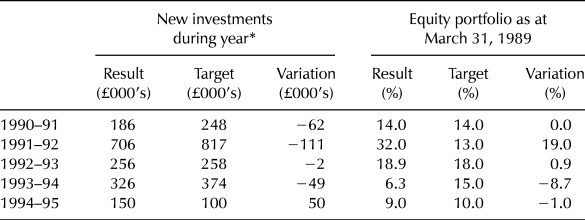
Ironically, the agency’s financial performance finally showed some improvement in the first half of the 1990s. From 1990–91 to 1994–95, performance was largely in line with, or better than, targets (see Table 2), albeit achieved on a rapidly falling turnover of low-risk projects and attributable to occasional successes such as selling two stakes in 1992 for a profit of £705,000.Footnote 117 However, performance disappointed as the portfolio was further run down with, for example, losses of £808,397 written off in 1997.Footnote 118 Monetary cash receipts for 1995–96 and 1996–97 proved to be less than half of the annual targets set before such monitoring was discontinued in 1997.Footnote 119
Financial targets and results for industrial investment activities, 1990–91 to 1994–95.*

Note: *Data relate to the investments made in the year to which the accounts apply.
Source: WDA Annual Reports.
While the WDA had long neglected to gather spillover data, it finally commissioned an evaluation in 1993. The study focused on investments made between 1987–88 and 1990–91, and the researchers interviewed representatives of eighty-five companies (some 8.5 percent of investments). They identified 37 percent of projects as “fully additional,” as they would not have proceeded without agency support, while 44 percent were classified as “partially additional,” because they would either have gone ahead but on a smaller scale or been delayed. It was estimated that the eighty-five companies had created employment of 6,367 “net additional job years” and value added of £123.3 million. Sampled firms also agreed that agency support had contributed to new technology (36 percent), increased exports (28 percent), enhanced skills (28 percent), and better management (27 percent).Footnote 120 These results demonstrated the effectiveness of at least some of the agency’s investments in creating spillover impacts, although they covered but a fragment of such activity and could do little at this late stage to offset the long-gestating disillusionment as to financial performance.
Conclusion
The market failure hypothesis argues that deficiencies in the provision of regional capital can be explained by the existence of high transaction costs and information asymmetry. The WDA sought to offset both by delivering investment and, from the 1980s, attracting venture capital. However, it struggled to achieve positive returns and meet Welsh Office targets. While the targets set for the agency in the late 1970s were harsher than for the NEB, which could exclude two of its largest and poorest performing investments, targets thereafter were more lenient. They were linked to the cost of government borrowing, falling to zero percent in 1986–87 before low, long-term, targets were set. Despite the relative leniency of these targets, the agency failed to perform at or near them, apart from during the 1990s, when activity was winding down and investments were few in number and low risk.
Crucially, the agency spared no effort to improve returns and constantly changed its approaches across debt and equity. It targeted: start-ups, growth, and large companies in the late 1970s; high-risk start-ups and smaller companies in the 1980s; high-risk companies in the late 1980s; and low-risk established companies in the early 1990s. The agency’s efforts to attract greater levels of private sector venture capital through joint ventures also met with little success, as funds were unable to build profitable portfolios. Although some investments were successful, these were overwhelmed by failures. Overall, if a substantial “unsatisfied fringe” of viable investment projects existed that had been overlooked by commercial providers such as the Commercial Bank of Wales or the clearing banks, the scope and scale of WDA activity was such that it seems highly likely they would have been identified to form an eventually profitable portfolio for the agency.
However, the WDA saw its role as far more than building a profitable portfolio, given its broader mission of boosting employment and prosperity. Wales suffered economic upheaval in the 1970s and 1980s as manufacturing declined and the coal and steel industries shed tens of thousands of jobs. Public discourse on economic issues was notably negative and demoralized. In 1990 the WDA discussed how it had combated the “total collapse of business and personal morale in the face of the rundown of the coal and steel industries” through activities such as investment to persuade people that “there was hope and it was worth making an effort to try to pull Wales together.”Footnote 121 Similar justifications were also made of attempts to create venture capital funds. The agency’s chief executive, David Waterstone, claimed in 1990 that although the Wales Venture Capital initiative “failed commercially,” it “succeeded in bringing home to our supporters that venture funding activities are a vital element in the regeneration of the economy.”Footnote 122
The central problem was that the agency’s objectives of assembling a profitable portfolio and raising commercial activity were incompatible. Moretti notes the importance of a supportive ecosystem of specialized local expertise in locations where venture capital funds are successful.Footnote 123 However, Wales had low levels of entrepreneurship and lacked an ecosystem to facilitate demand for capital;Footnote 124 it was a difficult environment for venture capital. Lerner notes that failure in such circumstances is common; “serving the main course before setting the table [is] unlikely to lead to a successful dinner party.”Footnote 125 While the agency attempted to create an ecosystem through providing business advisory services and supporting access to technology, the scale of the challenges faced by a deindustrializing economy meant that, according to board member Garel Rhys, it “never found the silver bullet […] to engage the SMEs [small- and medium-sized enterprises] in what was happening or to really increase the numbers.”Footnote 126 Crucially, the Welsh Office had no responsibility over broader policies such as taxation, regulation, monetary, or trade. This lack of power meant that investment could not form part of Mazzucato’s all-encompassing “entrepreneurial state” or the “developmental state” described by Wade as having created “tiger” economies in East Asia.Footnote 127
Within the WDA, it was recognized that a narrow focus on commercial rates of returns was inappropriate in the context of Wales in the final quarter of the twentieth century, but the agency failed to persuade its political masters of this. More specifically, the WDA attempted, without success, to persuade the Welsh Office that if investment activities focused on raising levels of employment and commercial activity, this approach would carry disproportionate overheads that should be excluded from agency balance sheets.Footnote 128 It also claimed that equity was a form of repayable grant and thus a cost-effective way of providing grant support even when losses were incurred.Footnote 129 However, the agency mistakenly neglected to collect evidence as to the additional impacts of its activity over time with which to persuade the Welsh Office as to the merits of venture capital, and Brian Morgan, WDA chief economist in the 1990s, remarked that monitoring and evaluation were “haphazard.”Footnote 130 This lack of evaluation was far from unique, as econometric techniques were barely used by economic development organizations in the United Kingdom until the mid-1990s.Footnote 131 Despite this reluctance, the belated 1993 econometric evaluation of the agency’s venture capital activities identified a high level of additional outputs between 1987–88 and 1990–91,Footnote 132 and it is likely that comparable outputs were generated in previous years. While spillover impacts are often estimated within contemporary projects, including those funded by the European Union to assess performance,Footnote 133 the data sets necessary to estimate such impacts of the WDA’s activities do not exist and cannot be assembled retrospectively.Footnote 134
In the absence of comprehensive spillover data, the Welsh Office focused on the market failure justification and refused to accept a loss-making portfolio, despite the difficulty of profitably operating venture capital schemes within a poorly performing, peripheral economy. Once the economy began to recover from the turbulence of the late 1970s to the mid-1980s, the unquantified spillover rationale lost force, and the agency was unable to continue to justify its engagement with unprofitable activities, regardless of occasional successes.
The article’s overall finding is that market failure, in terms of the availability of investment funds for viable (commercially profitable) business opportunities, was not widespread and did not by itself justify intervention. However, the WDA created much-needed spillover benefits in a deindustrializing economy that lacked many of the attributes necessary for self-sustaining regeneration. While spillover benefits can justify public venture capital in underperforming regional economies, this article’s findings on market failure stress the need for a realistic assessment of the financial risks compared with the social benefits linked to such investments. A methodology that simply highlights opportunities presented by market failure does not necessarily distinguish those investments that could yield a positive social rate of return from those that will not. Hence, only a robust approach to gathering, evaluating, and publicizing spillover data can properly justify the provision of public venture capital.
Despite much activity since, many of the problems identified in Wales in the late 1960s by the Welsh Council and Julian Hodge remain, and the extent to which lessons have been learned from the WDA’s difficulties in creating a profitable portfolio is debatable. Moreover, despite the Welsh Government’s provision of public venture capital through Finance Wales being loss making,Footnote 135 such activities have now been subsumed into a much larger government-owned Development Bank for Wales. The mixed record of public venture capital in Wales implies that successful provision requires an ecosystem supportive of entrepreneurship across knowledge, technical skills, and financial support to facilitate demand for capital,Footnote 136 but developing such an ecosystem is often beyond the institutional capability of regional government bodies.