We have frequently printed the word Democracy. Yet I cannot too often repeat that it is a word the real gist of which still sleeps, quite unawaken'd, notwithstanding the resonance and the many angry tempests out of which its syllables have come, from pen or tongue. It is a great word, whose history, I suppose, remains unwritten, because that history has yet to be enacted. (Walt Whitman, ‘Democratic Vistas’)
Introduction
Why and how do the natures and values of democracy, transformation and music education intersect in music classrooms? Being amongst others democratically tends to involve complications, power struggles and tensions as individuals and social collectives endeavour to create or resist hierarchical entanglements. Yet, if teachers are willing to consider and move toward interacting with students and their various musics dialogically and democratically, through mutual respect, care, negotiation and educative teaching strategies, we may find ourselves engaged in something larger: ‘becoming critically aware of one's own tacit assumptions and expectations’ and ‘assessing [a] relevance for making an interpretation’, or transformative music education, which will be discussed in detail below (Mezirow, Reference MEZIROW and Mezirow2000, p. 4). In this study I discuss the processes and results of a critical ethnography I carried out to investigate my secondary school teaching practices in relation to teaching and learning music listening. As detailed in the methodology section, below, critical ethnographies have several distinctive characteristics. Critical ethnographers gather qualitative data with a social–ethical sense of responsibility to critique and, if necessary, to ameliorate unjust circumstances that may exist in the contexts they investigate (Thomas, Reference THOMAS1993; Kinchloe & McLaren, Reference KINCHLOE, MCLAREN, Denzin and Lincoln2000; Denzin, Reference DENZIN2001; Noblit et al., Reference NOBLIT, FLORES and MURILLO2004; Madison, Reference MADISON2005). Also, critical ethnographies are grounded in ‘a self-referential form of reflexivity that aims to criticise the ethnographer's own production of an account’ (Schwandt, Reference SCHWANDT2007, p. 51). Specifically, the purpose of this study was to investigate, illustrate and explain how music educators can approach the development of students’ music listening abilities democratically in order to (a) deepen students’ musical understandings about music and – by teaching through music – to (b) create pathways for student–teacher interactions that are inclusive, educative, ethical and transformative.
The philosophical foundations of both my teaching practices and critical ethnography (explained fully below) are rooted in contemporary concepts of ‘praxis’ that integrate the works of numerous thinkers past and present (e.g. Aristotle, Reference Irwin1985; Freire, Reference FREIRE1970; Habermas, Reference HABERMAS1974).Footnote 1 Stated briefly, praxis involves (1) active reflection and critically reflective action, (2) human flourishing and wellbeing, (3) an ‘ethic of care’ (e.g. Noddings, Reference NODDINGS2002, Reference NODDINGS2005), and (4) the positive transformation of people's everyday lives (e.g. Elliott, Reference ELLIOTT1995, Reference DARDAR2012; Bowman, Reference BOWMAN2000; Regelski, Reference REGELSKI2005).
To foreshadow one of my findings for both theoretical and pragmatic purposes, I propose that facilitating a democratic teaching–learning environment of mutual care, reflection and respect allows students and teachers to create multiple ways of experiencing, negotiating, and working continuously toward deeper musical understandings and an appreciation of each other's personal-musical identities, perspectives and desires. Additionally, my study suggests that a democratic, dialogical and informal classroom-as-community approach to music listening instruction opens possibilities for reflecting on and accepting multiple perspectives that affect the musical, personal and ethical growth of students’ and teachers’ self-expression, empowerment, belonging and ‘transformation’. As I explain later (see the section titled, ‘Key Concepts’) ‘transformation’ occurs when people undergo a positive, paradigmatic shift in the ways they ‘frame’ their personal–social situations, ideas, and experiences of everyday life. When democratic engagements are encouraged in an informal and nurturing environment, students gain multiple opportunities to construct their personal-musical values and the means to achieve lifelong musical enjoyment (e.g. DeLorenzo, Reference DELORENZO2003; Green, Reference GREEN2008; Elliott, Reference ELLIOTT2012).
Background and context
From 2004 to 2009, I taught in a large, urban, public secondary school in New York City. My teaching responsibilities included instrumental music instruction, English literature classes and music listening courses. In the United States, music listening instruction is usually conceived and taught as ‘music appreciation’. For reasons I explain below, I rejected the concept and teaching methods of teaching music listening as ‘music appreciation’.
The school, which was originally intended to hold 2500 students, had a population of over 4000. Students’ ethnicities and races were diverse: Puerto Rican, Afro-American, Jamaican, Haitian, Indian, Tibetan, Greek, Mexican, Korean, Japanese, Chinese, Ecuadorian, Brazilian and so on. Not surprisingly, English was not the native language for a large number of my students. Indeed, the school's students spoke a total of 58 languages.
Three other background factors deserve mention. First, a large number of students needed instructional support services due to various learning disabilities, psychological problems and physical and cognitive challenges. (The administrators labelled these students ‘at risk or reluctant learners’.) Second, 70% of the student population were from families whose annual incomes fell below the official poverty line. Thus, most students lived in government subsidised housing projects with some of the highest crime rates in New York City. Third, New York State curriculum regulations mandated one semester of music as a graduation requirement for all secondary students. ‘Music appreciation’ classes were used to fulfil this requirement. Hence, my class was never smaller than 55 students, ranging in age from 14 to 20.
The setting I have just described presented me with a wide range of pedagogical, ethical, musical and social challenges that motivated me to investigate how I could approach the development of students’ music listening abilities democratically in order to: (a) deepen students’ musical understandings and (b) teach through music in order to create pathways for student–teacher transactions that were inclusive, educative, ethical, mutually respectful and transformative.
Methodology
This study is a critical ethnography. Although there are overlaps among descriptive, interpretive and critical approaches to ethnographic research, ‘critical’ ethnographies are conventional ethnographies that include sociopolitical and ethical aims (Thomas, Reference THOMAS1993). That is, critical ethnographers, like descriptive and interpretive ethnographers, gather qualitative data that provide ‘thick descriptions’ (Geertz, Reference GEERTZ1973) and analyses of how knowledge develops from the discourses, actions, interactions and gestures in a specific social context. However, critical ethnographers ground their research in a social–ethical sense of responsibility to contribute to changing the status quo of (for example) the specific school or classroom situation they are investigating to help achieve greater freedom and equity with/for students and teachers in that situation.
From a philosophical perspective, critical ethnography combines praxial themes with the priorities of critical theory and critical pedagogy (e.g. McLaren, Marx, Freire). Madison (Reference MADISON2005) explains that critical ethnography is ‘the ‘doing’ or the ‘performance’ of critical theory’ (p. 15). Kinchloe & McLaren (Reference KINCHLOE, MCLAREN, Denzin and Lincoln2000) describe critical ethnography as critical theory in action. According to Madison (Reference MADISON2005) and others (e.g. Thomas, Reference THOMAS1993; Denzin, Reference DENZIN2001; Noblit et al., Reference NOBLIT, FLORES and MURILLO2004), the critical ethnographer ‘disrupts the status quo, and unsettles both neutrality and taken-for-granted assumptions by bringing to light underlying and obscure operations of power and control. Therefore, the critical ethnographer . . . moves from ‘what is’ to ‘what could be” (Madison, Reference MADISON2005, p. 5). S/he aims to break through unjust social barriers ‘in defense of . . . the voices and experiences of subjects whose stories are otherwise restrained and out of reach’ (p. 5) and to contribute to emancipatory knowledge and social justice.
In summary, critical ethnography integrates theory and practice; it rejects the notion of ethnographers as ‘detached, neutral participant observers’ (Schwandt, Reference SCHWANDT2007, p. 51); it combines description and interpretation with sociopolitical and ethical aims; it focuses on highly specific contexts; and it is ‘critical’ in the sense that it insists on ‘a self-referential form of reflexivity that aims to criticise the ethnographer's own production of an account’ (Schwandt, Reference SCHWANDT2007, p. 51). That is, the researcher must be aware of her ‘positionality’ – aware of her own sociopolitical power, intentions and biases, and her moral responsibilities to her participants (Madison, Reference MADISON2005, p. 14). Clearly, then, critical ethnography is appropriate for investigating specific sites and collectives, such as music classrooms, that are inherently fluid and variegated in terms of participants’ individual and collective abilities, aims, beliefs, preferences, cultures, ethnicities, languages, power positions and needs for democratisation and social justice.
Data collection
During each semester of my one-semester listening course, individual classes took various forms. Out of necessity, a few classes required me to orient my class to new pieces and projects by providing students with contextual information about the music I introduced. However, I deliberately planned most classes around large and small-group discussions of pieces selected mutually in dialogues between my students and myself. In other words, I created a welcoming and hospitable place for ‘their music’ (as I describe in detail below in ‘Democratic Listening: A Representative Interactive Sequence’), which won their trust and led them to grant me their permission to select examples of ‘my music’, if/when I suggested doing so.
In some classes, small groups took responsibility for teaching the class what to listen for in specific pieces that they selected (while I deliberately ‘faded’ into the background). At other times, students led discussions and presented on aspects of a piece of music we were listening to and making during class projects (e.g. African and Brazilian drumming; contemporary 20th/21st century soundscape vocalisations; hip-hop; electro-acoustic music). Sometimes, one student took full responsibility for teaching an entire class the music (and dances) of his or her culture. Other classes consisted of ten or more small groups (which I monitored and contributed to as needed) engaged in dialogues about the same piece of music. During all class discussions, I was especially attentive to the ways students ‘exercised’ their powers, preferences, emotions and care for the dignity of the ‘others’.
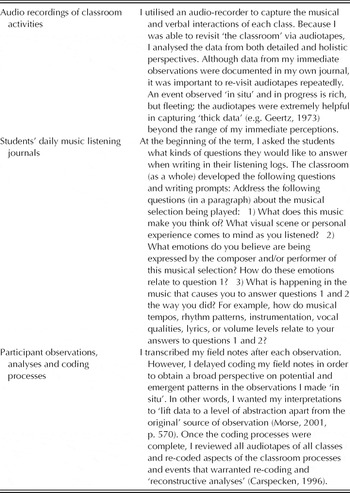
Like other forms of ethnographic research, my data collection procedures included transcriptions of audio recordings I made in many of my classes and my analyses and codings of many students’ daily music listening journals, student-led discussions (discussed in detail in Table 1), peer-teaching episodes, and my personal journal of reflections before, during and after each class episode:

The main body of this article describes, synthesises and interprets data gathered during one week at the mid-point of one music listening course I taught in the spring of 2009, with specific attention to the events of one day that focused on a specific unit of study.
Key concepts
Three concepts – music appreciation, transformation and empowerment – are central to this study. I explain these next and expand on their meanings during the detailed narrative of my music-listening class, which follows this section.
As conceived and practiced in North America, teaching and learning music-listening education as ‘music appreciation’ assumes that student listeners should be prepared as passive consumers of Western art music. Students in music appreciation classrooms are most often expected to ‘sit and listen’ to classical masterpieces and learn to identify the formal elements (i.e. melody, harmony, rhythm, timbre, texture and form) of musical sound structures. Standard music appreciation textbooks provide students with ‘maps’ or ‘perception charts’ of selected works to follow as they listen, as well as bits of historical and theoretical information about each piece. Equally important in our current ‘age of testing’, music appreciation textbooks often include summative ‘evaluation charts’ that test students’ listening abilities in relation to pieces they have not studied during their courses. A latent assumption of this approach is that musical-structural acuity and verbal information about music prepares students for deep ‘aesthetic experiences’ and greater respect for masterpieces.
Regelski (Reference REGELSKI2006) articulates some of the reasons I reject this concept of music listening instruction:
music appreciation, as a paradigm, assigns . . . reverent, informed, disciplined seriousness of connoisseurship established in connection with the aesthetic paradigm of ‘appreciating’ classical music – namely, studying history and theory and other information ‘about’ the music that . . . teachers have come to believe is the prerequisite ‘training’ for ‘understanding’ and thereby properly ‘appreciating’ any music. (p. 285)
Aside from the passive, ‘data-banking’ concept of education (which Freire, Reference FREIRE1970, deplores) that underpins music appreciation, it is highly arguable that the more one accumulates verbal information and aural acuity about musical elements alone, the more deeply one will respond emotionally to music. For one thing, copious contemporary scholarship on the complex relationships between music and emotions (e.g. Juslin & Sloboda, Reference JUSLIN and SLOBODA2001; Elliott & Silverman, Reference ELLIOTT, SILVERMAN, Bowman and Frega2012) does not support this claim. For another thing, billions of people worldwide respond deeply to music without any formal knowledge of musical form. This does not mean that music-listening instruction is unimportant; it means that there is a great deal more to understanding, valuing, responding to and engaging joyfully in music than verbal information about musical form can ever provide. Also, music appreciation methods usually seek students’ consensus about the ‘the truth’ or ‘true meaning’ of musical examples, which music appreciation teachers attribute to musical elements.
I reject this narrow view of music and music listening, as I demonstrate in the next section of this paper. Suffice it to suggest now that ‘music’ cannot be reduced to pieces alone. Rather, music is a multidimensional social practice that is simultaneously formal, social, symbolic, cultural, emotional, gendered, political, ethical (and more) – all of which is absent from the concept of music appreciation. Moreover, and from an educational perspective, music appreciation is a teacher-centred, top-down, undemocratic approach to music listening instruction that is unlikely to activate students’ lifelong love of music listening and making, let alone transform and empower students individually and socially.
What does ‘transformation’ mean? Brookfield (Reference BROOKFIELD, Mezirow and Associates2000) explains that transformation occurs when people undergo a positive, paradigmatic shift in the ways they ‘frame’ their personal-social situations, ideas and experiences of everyday life. A transformative experience is one that deepens and optimises ‘a habit of mind together with its resulting point points of view’, accompanied by the awareness that life is always in flux and, therefore, that there is no single ‘truth’ about life (or music, or anything else) that holds for everyone (p. 139). Indeed, teaching for transformative experiences means rejecting any sense of finality that might prevent students from asking inconvenient questions.
Brookfield continues: ‘an act of learning can be called transformative only if it involves a fundamental questioning and reordering of how one thinks or acts. If something is transformed, it is different from what it was before at a very basic level’ (p. 139). Importantly, personal and social transformation only arises from active reflection and critically reflective action in a social context. Indeed, ‘without consequent social action, critical reflection is . . . a self-indulgent form of speculation that makes no real difference to anything’ (p. 143).
What does ‘empowerment’ involve? Dardar (Reference DARDAR2002) explains:
Empowerment is a process that we as individuals must willingly and freely undertake for ourselves. Within the classroom, this entails participation in pedagogical relationships in which students experience the freedom to break through the imposed myths and illusions that stifle their empowerment as subjects of history and the space to take individual and collective actions that can empower and transform their lives. This dialogical process . . . is not just an individual phenomenon, but takes place within the solidarity of relationships with others. (p. 110)
As Freire (Reference FREIRE1970) reminds us: ‘while no one liberates himself [or herself] by his [or her] own efforts alone, neither is he liberated by others’ (p. 53). Teachers cannot empower students by means of authoritarian, top-down instruction; instead, teachers must deploy their educational expertise and power judiciously, with ‘an ethic of care’, to organise and guide classroom interactions that support students’ reframing of and critical reflection on received wisdom. Teachers create ‘the dialogical conditions, activities, and opportunities that nourish this developing process within students, as both individuals and social beings’ (Dardar, Reference DARDAR2002, p. 110).
In summary, this section conceptualised three key terms: music appreciation, transformation and empowerment. In North America, teaching and learning music-listening as ‘music appreciation’ most often aims at the development of students as passive musical consumers and connoisseurs of musical form, structure and details of music history as related to Western art music. Transformation was explained as a positive, paradigmatic experience and shift in the way people envision their personal-social situations, ideas and experiences of everyday life. A transformative experience deepens a positive disposition and its related viewpoints and actions. Following Dardar and Freire, empowerment was conceptualised as a dialogical teaching-learning process aimed at enabling students to experience the freedom to question imposed myths and illusions that stifle their individuality, collective actions and their ability to transform their lives.
Democratic listening: a representative interactive sequence
(a) Prelude
This section provides excerpts of experiences from my music-listening classes. These excerpts were chosen randomly from the data I collected from my interactions with students in one class (which I described at the outset of this article: see ‘Background and Context’) during one week at the mid-point of the one music-listening course I taught in the spring of 2009, with specific attention to the events of one day that focused on one specific unit of study. These excerpts capture key characteristics, patterns, rhythms and themes of teaching-learning sequences and transactions between myself and my students and among the students themselves. At some points in the following narrative, I interject observations, impressions and reflections I recorded during these excerpts.
During the early weeks of the class, I engaged the students in listening to, performing and discussing several musical styles, and, with their direct involvement in choosing the music we would listen to, I organised the content of the course thematically. Together, the students and I planned units that revolved around ‘life themes,’ rather than musical elements, form, or music history. (However, I did insert information about these issues parenthetically in response to students’ questions and/or to help contextualise specific pieces, composers, or performers.) For example, the students and I decided to examine musics that were related to and expressive of themes that focused on aspects of love, war, poverty, violence and family life, all of which were major concerns in the daily lives of my students.
Although my education is rooted mainly in Western art music, I did not force my preferences on my students. This is not to say that we avoided examples of classical music. From time to time we did, because I believed it was part of my ethical responsibility as an educator to ‘open worlds of music’ they had never explored. But my approach was eclectic; the sequence of our musical experiences and discussions flowed back-and-forth and to-and-from students’ evolving musical interests and personal inquiries. To use a geographical analogy, the students and I travelled the following routes: from the music of the Black and Puerto Rican ghettos of my students’ neighbourhoods; to the musics of different periods in the musical history of Salzburg, Venice and Berlin; to some of the students’ native homes in Argentina, Mexico, Tibet, Peru, North and South India, South Korea, China and Malaysia; and then back to the jazz, pop and rural musics of America, as these pertained to the themes we chose throughout the course.
Additionally, the last part of every class was left open for students who were eager to teach the class their own personal-cultural musical selections. The only requirements I requested were that students who led these discussions had to include explanations of why they chose a specific piece, the meanings it held for them, and the ways in which the musical and cultural features of the music related to our curricular themes. In these ways, and again, issues of musical elements and concepts often emerged organically from our music listening and making, along with many other dimensions of musical meaning; ‘elements’ did not dictate the design or direction of the classes or discussions. Let me provide some details of the democratic classroom-as-community approach that I have sketched so far.
(b) Details
At one point in the semester, the students and I decided to focus on ‘Revolutionary and Evolutionary Musicians’. The choice and organisation of this unit came about because several students’ conversations coalesced around the issue of why and how musicians renew or advance a specific style of music or create new styles. During this unit, students remarked that they were particularly moved by ‘Für Elise’, which was sampled and embedded in a rap song they all knew, called ‘I Can’, from the album, God's Son, by rapper Nasir Bin Olu Dara Jones, or Nas. When I identified the composer of ‘Für Elise’, the students were not only astonished (most had heard of Beethoven, but none knew much about him), a discussion of Beethoven's life and cultural circumstances evolved organically. This led to deeper questions and discussions about Beethoven's life and how his music was simultaneously revolutionary and evolutionary, which the students and I explored by listening to and discussing several short excerpts from recordings. This circled back to further discussions of other pieces by Nas and their revolutionary and evolutionary features.
It's important to note that the students were highly motivated to discuss Nas not only because they loved what Nas was expressing in his rap songs but, also, because Nas was raised in the same ‘housing projects’ where many of them were living. Thus, consciously and unconsciously, ‘I Can’ resonated with the students on several levels – personal, emotional, cognitive, social, cultural and political. Some realised quickly that Nas's use of ‘Für Elise’ was an example of how an innovative musician found ways of combining new musical means and materials (means and materials that several students were already sampling at home as they created their own raps with computer software) and his/their social-political messages.
To give the students more opportunities to penetrate the music by Nas, Beethoven and others, I separated the class into groups of five.Footnote 2 I posed the following questions as launching pads for discussion: Why do you think Nas sampled ‘Für Elise’? How does this sample add to the musical and social meaningfulness of ‘I Can’? What do you need to know about Beethoven to help you answer these questions? How do the lyrics of ‘I Can’ relate to Nas's decision to sample ‘Für Elise’? Can you map the form of ‘I Can’? Is it similar to or different from ‘Für Elise’? Does understanding the form of both songs help us understand the intent of both pieces? If so, how?
Students gathered in their groups to talk about Nas's verse. At several points, they asked me to play ‘I Can’ again, even though all of them ‘knew it’ by memory and were rapping along with Nas. What became very obvious, however, was that their listening became increasingly intense during repeated listenings as they began to detect and understand social, cultural, formal and political dimensions of ‘I Can’ that they had never noticed or understood before. This motivated more dialogues, which, according to students’ remarks, added to their enjoyment of and admiration for Nas's skills and gave them ideas about Nas's motivations for creating such a track.
Some students argued that Nas created his rap text from a desire to pass old values to their generation. Others countered with the idea that Nas was strictly an expert in mixing and matching ‘sonic structures’, which, for all of them, was a new way of thinking about and describing music that they ‘picked up’ in the processes of our dialogues. Some argued strongly that structural elements alone do not make a good rap song, however, had difficulty deciding what specific qualities were necessary for an effective rap song. Some students who knew a great deal about rap music offered ideas to their classmates, including further interpretations of Nas's verse.
(While respecting their peers’ views, many students became increasingly comfortable with and thoughtful in defending their ideas reasonably, albeit passionately. However, many others found it difficult to articulate their ideas and/or overcome their shyness, due to the embarrassment they felt about their lack of English proficiency. Nevertheless, all of them were so excited about sharing their ideas about ‘their musics’ that they persisted and succeeded admirably over the course of the semester.)
One student suggested that Nas's verse and his sampling of Beethoven's ‘Für Elise’ was a deliberate effort to revolutionise traditional rap structures. Some students noticed that some of the lyrics in ‘I Can’ discuss issues of personal growth. According to these students, Nas is trying to affirm young people who say ‘yes’ to possibilities, which, to them, was a form of revolution. Aligned with this, other students believed that Beethoven's ‘Für Elise’ was ‘a perfect choice’ for sampling because Beethoven pushed composition beyond the traditions of his time.
In the following section I highlight one group's dialogues: Richard, Elfido, Luisa, Justin and CarmenFootnote 3 gathered together to talk about Nas's verse. After listening to it, and following along with the lyrics, Richard offered a response: ‘I like how Nas begins the song with a scratchy old-record feel, and then adds in the Beethoven. I think he did this cuz Beethoven is old and he's bringing the old to the new.’
Elfido exclaimed impatiently: ‘Come on. That's ridiculous. Nas wasn't thinking deeply about this. He just did it cuz it sounds good. I mean, that's what it's about. You forcing all these meanings on things! Can't it just be cuz it sounds good?’
Luisa jumped in: ‘Elfido, rappers don't just do things cuz it sounds good. There's gotta be a reason. I think Richard is right. I never thought about this before, but there's gotta be something to this. No? If you listen to the beat that Nas is using, it's kind'a old-school, too. Like, he's saying that being on a fast track can ruin things for us. Maybe we gotta slow down and think, then we get somewhere.’
Richard continued: ‘I don't know about all that. I'm just sayin’ that I think Nas is, like, hey . . . we don't have to ignore the past in order to move onto the future. We need the past to make the future.’
Justin, who had been shy about entering the discussion, added his ideas: ‘Something bothers me. I agree with Richard. Like, there's gotta be reasons for things. Sorry, Elfido, but I think Nas is just way too smart to do things just cuz it sounds good. But why ‘Fur Elise’, with the voices of little kids? I don't get that. I don't think they go together.’
Richard, ready to burst, said: ‘That's what I'm sayin’. Why doesn't anyone listen to me! It's the old and the new. Beethoven's old. Little kids are new – you know, like, a new generation. Hello?!’ Richard slumped back in his chair, as if exhausted.
A shy Carmen said: ‘Maybe it's not about old versus new. Or about old and new coming together. Maybe it's because Beethoven was a revolutionary. He was always pushing. And if we look at Nas's lyrics, isn't he trying to create a revolution?’
Justin asked: ‘What revolution? What are you talkin’ about?’
Luisa: ‘Carmen's right. I don't think we've looked at Nas's lyrics. He's saying all kinds of stuff, like we shouldn't just sit back and let people tell us what we should do, what we should be. We can be whatever we want. No one can keep us down. Look at this line: ‘If the truth is told, the youth can grow/Then learn to survive until they gain control’. Nas is talking about us! We can be whoever we want to be, no matter what other people think.’
Elfido looked disapprovingly at Luisa and said: ‘Where you getting all this? Are you some kind'a psychic? How you know?’
Carmen, again quietly, but without losing her resolve, said: ‘Beethoven is the most obvious choice. He totally matches Nas's lyrics.’
Luisa said: ‘I don't like the lines that talk about the young girls in the clubs. Why does Nas have to bring HIV into his song? Is this really necessary? Come on. Right?’
With a smirk, a defiant Elfido said: ‘What kind of music you usually listen to?’
Luisa: ‘R&B.’
Elfido: ‘Well, there's your problem. If you don't listen to Rap, you're not part of the Rap world. R&B is cool, especially when you're with your girl, or in your case, your guy, but it's so sugary. Rap is real. And in the real world, HIV exists. That's why. Nas has to talk about these things or else he'd be a fake.’
Luisa sat back and thought for a moment: ‘OK. Fine. But why does he talk about HIV and Oprah Winfrey? I don't get it.’
Richard, who had remained calm throughout most of this back-and- forth, said: ‘This is the greatness of Nas. You see what he's done? He's turned a negative into a positive. He's saying as long as you keep your head on right, you can be an Oprah Winfrey, if you want. Just don't act stupid – know what's out there. Know there are people who can take advantage of you. Keep your guard up, and always keep your eye on your goals. Look, Nas says: ‘If you believe you can achieve.’ Girls don't have to try to hook up with a guy to be somebody.’
Luisa didn't buy it: ‘That's not true. So many times, people – good people – get cheated out ‘a what they want, what they need. And they believed. Yet, look where they are now? Don't you think this kind of message is a bit ridiculous? You said R&B was sugary. I think ‘I Can’ is sugary. At least R&B doesn't pretend. Nas is pretending here. I don't believe him one bit. If we're just listening to a song – fine. Right, Elfido? But as a message to us, to get us out of our world (cause that's what he's trying to do), he's not keepin’ it real.’
Other groups of students grappled with these same issues throughout their transactionalFootnote 4 dialogues and musical interpretations. During and within these processes, the students articulated their emotions, perspectives and arguments; they negotiated and re-negotiated personal positions and sub-group alliances; they rapped and re-rapped lines and sections of Nas's song; and they refined their frames of reference. For example, Elfido disagreed with his group about the ‘causes’ behind artistic choices in rap music. In the process of resisting his peer's ‘frames,’ he critically refined his position and offered further reasons.
As Elfido put it: ‘Sometimes rappers do things cuz of the way it sounds, the way it grooves. I don't care what you all say. That's what I do when I'm hangin’ out. I mean I fit in words and rhymes cuz I can. They don't need to mean anything. But, I do it. Look at what Naz does at the end of his. He says: ‘Save the music, y'all.’ What does that have to do with anything? It's just something to say. And I like it.’
Notably, students emphasised their assertions by accompanying their words with very active movements and gestures that often included full-bodied, personalised, hip-hop performances of other pieces by Nas and similar rappers. Such movements and gestures were an example of their communicated habitus, which is ‘an embodied pattern of action and reaction’, in which people are not fully aware of their actions, or the reasons why they ‘perform’ them. Habitus is ‘a tendency to behave in a certain way’ (Becker, Reference BECKER2004, p. 71) – ‘tacit, unexamined, seemingly completely ‘natural” (p. 71).
Toward the end of this unit, I gave the students the option of adding a verse of their own to Nas's ‘I Can.’ Those who did were invited to perform it for the class. I recorded their performances and loaded them into Garage Band. These new variations on ‘I Can,’ all of which included new samples from many pieces we listened to and discussed during the unit, motivated new questions and dialogues.
It should be noted that it was never my intention to lead my students to any consensus or ‘truth’ about anything we listened to or discussed, nor did any of our student-teacher dialogues end with total agreement. However, and due to the continuous ‘conditioning’ they underwent in other subject areas that insisted on ‘right answers,’ some students would ask me to provide ‘correct’ interpretations of specific pieces and/or conclude dialogues with my views. I answered by providing more questions to them about their ideas. Indeed, it took some time for the students to understand that our discussions were not about determining ‘the truth’ about a given piece of music. Rather, a key aim of the course was to empower them to risk speaking their minds to support their critically reflective thoughts and actions.
Reflections
Given the above, I suggest that the research methodology of critical ethnography enabled me to study and contribute to the personal/group empowerment and positive transformation (see precise definitions of these terms, above) of my music students, whose voices, needs and dignity had been largely marginalised and/or suppressed throughout their schooling by (a) the large school bureaucracies that characterise contemporary American public education and (b) the exclusionary, ‘top-down’ teaching methods driven by the priorities of American ‘marketplace education’ and its corollaries, namely high-stakes testing and business-accounting procedures. These characteristics of American education and their deleterious effects on students and teachers have been thoroughly studied and confirmed by leading American educational scholars (e.g. Anyon, Reference ANYON1997; Apple, Reference APPLE2001; Cochran-Smith; Reference COCHRAN-SMITH2004; Darling-Hammond, Reference DARLING-HAMMOND, Meier and Wood2004). Additionally, it is important to note that critical ethnographies carried out in other domains of education provide persuasive documentation of positive social-educational results of critical ethnographies in the context of contemporary American education and elsewhere (e.g. McLaren, Reference MCLAREN1999; Hansen, Reference HANSEN, Carspecken and Walford2001; Van Horn, Reference VAN HORN, Carspecken and Walford2001; Radigan, Reference RADIGAN, Zou and Trueba2002; Mills, Reference MILLS2007).
Altogether, students’ listening, discussing and performing music were intense, enjoyable and individually transformative for many students and myself. But this is not altogether surprising, because most had never been given opportunities to listen intensely to the voices (and musics) of others in conversation, or express themselves freely, or be listened to respectfully, or to take various positions of power in the classroom, especially the powerful role of teaching the teacher and their class. To echo Mezirow (Reference MEZIROW and Mezirow2000):
Transformative learning refers to the process by which we transform our taken-for-granted frames of reference (meaning perspectives, habits of mind, mind-sets) to make them more inclusive, discriminating, open, emotionally capable of change, and reflective so that they may generate beliefs and opinions that will prove more true or justified to guide action. (pp. 7–8)
In the democratic class community my students and I were able to construct together, some individuals’ music-listening interpretations collided with others who were making efforts to listen openly, by which I mean listening to both the music and the thoughts and feelings of their peers’ ‘otherness’. Through daily experience of democratic listening, however, students began to cross everyday, taken-for-granted norms and boundaries of self, other and power. Brookfield (Reference BROOKFIELD, Mezirow and Associates2000) discusses such collaborative-critical reflection.
Any critically reflective effort we undertake can only be accomplished with the help of critical friends. We need others to serve as critical mirrors that highlight our assumptions for us and reflect them back to us in unfamiliar, surprising, and disturbing ways. (pp. 146–147)
I venture to suggest that when students and teachers listen to music democratically, which includes teaching each other how and what to listen for, students have more opportunities to grow in their individual, interpersonal and musical empathy than if they listened to music by themselves and/or for musical elements and concepts alone. A music-listening community functions as communitas – students and teachers marshal their individual and collective powers of sharing, each gaining a greater sense of individual and other's personhood in a context of social equality, solidarity and togetherness.
Of course, conceptualising and enacting music listening as a social act of becoming involves committing to the processes of negotiating the unique paradoxes of working in a continuous ‘democratic experiment’.Footnote 5 This fluid, unpredictable ‘freedom experiment’ opens pathways towards greater communication and acceptance. It contributes to the resolution of inter-personal and intra-personal tensions that characterise flexible communities of distinctiveness, belonging and openness. This kind of freedom is what Appiah (Reference APPIAH2005) calls ‘a politics that regards persons as ends, as possessing dignity and inherent worth. It proposes a social order conducive to some version of individuality’ (p. 61).
Teaching democratically is difficult in so-called educational contexts where the combined forces of undemocratic administrators, top-down curriculum development and testing operate to ignore the importance of students’ emotions, individuality and social relationships.
Rosenblatt (Reference ROSENBLATT1940) wrote extensively about the delicate cognitive-emotional-social dynamics involved in teaching and learning in artistic contexts. She was particularly concerned about how authoritarian teaching methods contributed ‘to the persistent hold of habits of thought and images of behaviour no longer appropriate to our present-day knowledge and our aspirations for a more democratic way of life’ (p. 106). Indeed, among the numerous challenges facing democratic teachers is how to work openly and respectfully with school leaders and colleagues who believe in, or are forced to accept, tightly held, one-dimensional perspectives. As Rosenblatt (Reference ROSENBLATT1968) says:
The fact that the success of the individual must so often be at the expense of others places a premium on this kind of blindness . . . Teachers need to take this cultural pressure into account, since it is so directly opposed to the attitude of mind they are attempting to foster. (pp. 92–93)
In contrast to undemocratic music classrooms, students who are able to learn music in a critically reflective and empathetic environment, where listening is approached as an open-ended process, students are more likely to replace the traditional framing of ‘music’ as a collection of static ‘art objects’ with a frame that empowers them to understand, receive and create music as a living, fluid, social practice that is applicable to their daily lives because it is simultaneously personal, emotional, expressive, ethical, historical and cultural. And with such realisations, students are less likely to remain silent in deference to teachers’ expertise or musical preferences.
If we are interested in implementing democratic listening to gain its many benefits, then professors of music must adopt a new paradigm of music teacher education that will prepare pre-service teachers to use pedagogies that empower them to move past classroom monologues toward dialogues, collaborations, democratic engagements and social justice through music listening. Doing so will, in turn, position students and teachers as critical partners and critical mirrors. If we are able to revision our aims and pedagogies in these terms, music students will be much more likely to enjoy, learn from and co-create transformational learning experiences in the processes and contexts of music-listening classes.
In a transactional music classroom, where the teacher is never the dominating force behind musical study and interpretation, students who are moved emotionally by a piece of music ‘will be led to ponder questions of right and wrong, of admirable or antisocial qualities, of justifiable or unjustifiable actions’ (Rosenblatt, Reference ROSENBLATT1968/1976, p. 17). This is so because musical practices and pieces embody, exemplify and allow numerous stances that students can take to consider and reconsider human motives and actions.
Collective music listening has enormous potential to activate deeply participative musical-social experiences with others. Ideally, future democratic citizens should have daily learning experiences that will assist them to develop a commitment to and an enthusiasm for sharing their critically reflective beliefs and interpretations. If music education can be reconceived in this sense of ‘artistic citizenship education’ (Elliott, Reference ELLIOTT2012), students will be more likely to achieve a sense of social responsibility to develop and maintain a welcoming stance toward alternate beliefs and a willingness to engage respectfully with diverse individuals and communities. This aligns with Rosenblatt's belief that we must deliberately construct classroom communities that revolve around spiralling democratic dialogues and active democratic engagements among listeners, performers and musics in an ever-expanding circle of experiences with other people's musics. Such are the prerequisites and constituents of individual–social student–teacher transformations as has been evidenced in this study (see the ‘Prelude’ and ‘Details’ sections above).
Conclusions
To conclude, I suggest that the kinds of musical, dialogical, empathetic and democratic transactions that I reported under ‘Democratic Listening: A Representative Interactive Sequence’ exemplified key characteristics of what Karolides (Reference KAROLIDES and Karolides2000) calls the ‘transactional dynamics’ of a democratic classroom. To Karolides, transactional dynamics stimulate the expression and recognition of multiple viewpoints: ‘They must be considered and reconsidered, measured, and tested . . . This pattern of weighing and questioning contains a democratic aspect, for it discourages adherence to a presented idea’ (p. 23).
In doing so, music educators must guard against their own and/or others’ inclinations to exaggerate intellectualisation, thereby separating life and music in the classroom from everyday life and musical experiences. When this happens, it leads to situations that are unacceptably unbalanced. Classroom contexts dominated by purely theoretical dialogues, devoid of emotions and the kinds of ‘harmonious obsessions’ that ground and drive the love of music listening and making, must be central to each and every music teaching–learning episode. As Rosenblatt (Reference ROSENBLATT1968/1974) observes:
It is comparatively easy for the students to think rationally about difficult human problems when impersonal academic treatments make them abstract subjects of thought. Unfortunately, that kind of thinking is probably not very useful; it lacks the conflicting impulses or emotional perplexities out of which thinking usually grows in real life. (p. 268)
Pradl (Reference PRADL1996) concurs: ‘reason only flows as the issue of feeling’ (p. 91). He points out that whenever students or teachers settle into unemotional and non-reflective routines, they are not required to expend the energy needed to be open and accepting of change. In such emotionally bloodless situations, students and teachers become locked inside abstract rationalisations that prevent full-blooded democratic engagements with others. Further to this point, Dewey (Reference DEWEY1922) offers the following:
The conclusion is not that the emotional, passionate phase of action can be or should be eliminated in behalf of a bloodless reason. More ‘passions,’ not fewer, is the answer. (p. 71)
During my engagements with the students in my urban secondary school, positive and transformative emotional tensions emerged continuously due largely to our various social/cultural origins and backgrounds. Thus, and in line with Rosenblatt, I constantly encouraged my students to ask themselves, ‘What will I do when faced with new relationships in a new situation?’ Through the transactional dynamics of my classroom, which included my continuous observations of students’ shifting emotions, the students and I agreed that our past experiences and dispositions must be supplemented with deeper considerations of ethical and moral issues toward further revisions and/or rejections of our original assessments of each other, our musics and our musical beliefs. Indeed, as Karolides (Reference KAROLIDES and Karolides2000) reminds us, essential to students’ democratic empowerment are the differences in culture, socioeconomic status, politics, ethnicity and gender that students and teachers bring to the classroom (p. 23). ‘The various perspectives within an open, equalizing forum promote acceptance of and insights about the speaker, in addition to enriching and enhancing . . . understanding’ (p. 23).
In my discussion of critical ethnography, I noted that I was ethically bound to remain cognisant of my ‘postionality’, to be continuously and critically aware of my power, intentions, biases and moral responsibilities during this study. I believe I did so, but I acknowledge freely that I may not have succeeded completely. Put another way, this study is not free of subjectivity; on the other hand, and in my defence, pure objectivity is not and cannot be the telos of critical ethnography. Suffice it to say that, based on the data presented in this study, I believe my students and I were individually and mutually empowered and transformed on many occasions during our teaching–learning interactions. Very often we re-thought, refined and broadened our prior mindsets; we grew in emotional maturity and empathy; we became more adept at generating critically informed arguments for our views; we matured in our tolerance for and acceptance of constructive criticism; and we increased the frequency of voicing our passions for social justice, all of this through experiences of critical music listening carried out in a collaborative-democratic environment.
When conceived and implemented as illustrated in this study, the music classroom can accommodate and encourage a positive instability in students’ thoughts, actions and passions. Then again, teachers must be caring and ‘care-full’, because music and identity are tightly aligned (e.g. Frith, Reference FRITH, Hall and Du Gay1996; Tarrant et al., Reference TARRANT, NORTH and HARGREAVES2001; McPherson et al., Reference MCPHERSON, DAVIDSON and FAULKNER2012). An ethic of care (e.g. Noddings Reference NODDINGS2002, Reference NODDINGS2005) is especially important when students are discussing ‘their music’ (indeed, students would often yell out, ‘That's my song!’), because individuals can easily be hurt when others’ comments on their music conflict with an individual's personal beliefs. But as democratically inclined teachers gain experience dealing with issues of care, sensitivity and instability, a classroom of multiple and tolerant voices will develop in which each student will share ‘the emotions and aspirations of other human beings, she can gain heightened sensitivity to the needs and problems of others remote from her in temperament, in space, or in social environments’ (Rosenblatt, Reference ROSENBLATT1978, p. 261). Rosenblatt (1983) adds ‘such sensitivity and imagination are part of the indispensable equipment of the citizen of a democracy’ (p. 274).
Music has the power to move, empower and unsettle performers and listeners. In democratic music classrooms, musical participations invite varied interpretations, changes and innovations. Listeners and music makers converse actively with/through music. An empowering and transformative music classroom, one that aims for the growth of democratic citizenship, begins with the individual and acknowledges the other. It creates a community of diverse meanings, each equally important, each open to critical-emotional considerations. Such music teaching–learning contexts offer students and teachers opportunities to create and renew their relationships with music, with themselves and with each other.