INTRODUCTION
Heritage speakers of Arabic, like heritage speakers of other languages, constitute a significant segment of the population of learners of Arabic as a second/foreign language. Most of these heritage students have been exposed to the colloquial varieties of their parents in the home. However, many of them stop using their heritage/first language (L1) or use it in very limited contexts due to their shift to English, the paucity of literacy resources available in these spoken varieties, and the limited opportunities to use it outside the home (Albirini, Reference Albirini2014). Hence, their ability to use their L1 effectively in everyday interactions is reduced, even though they still have a good grasp of various aspects of its linguistic system (Albirini, Benmamoun, & Saadah, Reference Albirini, Benmamoun and Saadah2011; Benmamoun, Albirini, Montrul, & Saadah, Reference Benmamoun, Albirini, Montrul and Saadah2014a).
One of the main challenges that heritage Arabic speakers commonly face in the Arabic language classroom is that the language variety taught in most American colleges and universities, namely Standard Arabic (SA), is, in many respects, different from the colloquial dialects that they may have acquired at home.Footnote 2 A further complication stems from the fact that little is known about the role of Colloquial Arabic (QA) in facilitating, slowing, or inhibiting the acquisition of the standard variety or the possibility of developing proficiency in both varieties simultaneously. This is the case of a number of languages, such as (Mandarin) Chinese, Spanish, and German (Gutiérrez, Reference Gutiérrez1997; Pauwels, Reference Pauwels1986; Potowski, Jegerski, & Morgan-Short, Reference Potowski, Jegerski and Morgan-Short2009; Valdés, Reference Valdés, Peyton, Ranard and McGinnis2001).
SA and QA differ in form, distribution, and function. SA is mostly uniform across the Arab region, whereas QA varies across and within countries. SA is the official language, or one of the official languages, of more than 20 countries of the Arab League. It is the language of education, official business transactions, administration, “high” arts and culture, and the media (especially documentaries and news). Unlike SA, QA does not have a standardized script and is, therefore, mainly used in the home and informal interactions. SA and QA also differ in structure and acquisition. The two varieties share various linguistic features, but they also diverge in several aspects of phonology, lexicon, morphology, and syntax.Footnote 3 For example, SA and QA have different sentential negation systems, question particles, agreement paradigms, and aspectual and modality markers. Similarly, some of the words and sounds found in SA do not exist in some Arabic dialects and vice versa. In terms of acquisition, QA is acquired natively by children from birth, whereas SA is typically acquired in school.
Although their colloquial dialects vary in several respects from the variety they learn in the classroom, heritage speakers are often assumed to have an advantage over Arabic L2 learners because they enter the Arabic classroom with some knowledge of the “Arabic language” and its cultural settings. In addition, some heritage speakers may have had previous exposure to SA through Sunday school, religious practice, and media. Thus, SA may not be entirely new to them. However, it is an empirical question as to whether heritage speakers do in fact have an advantage over L2 learners based on their familiarity with a variety that is related to the target variety they are learning, especially in areas where there is little overlap between them. Another important question is how much and in what way knowledge of QA helps in easing the path to a higher degree of proficiency in SA.
The present study aims to pursue these questions by examining heritage students’ acquisition of sentential negation in SA. In particular, the study investigates the knowledge that heritage speakers bring to the Arabic classroom and whether and how their previous knowledge contributes positively or negatively to their learning of sentential negation in a classroom setting. To this end, the study will compare heritage Arabic speakers with English-L1, Arabic-L2 learners—those who have no formal exposure to Arabic prior to college. This comparative approach may inform our understanding of the similarities and differences between the linguistic systems of heritage speakers and L2 learners. Several studies have shown that students learning an L2 that is similar to their L1 may be positively or negatively affected by their L1 (De Angelis, Reference De Angelis2005; Odlin, Reference Odlin1989; Ringbom, Reference Ringbom, Cenoz, Hufeisen and Jessner2001; Ringbom & Jarvis, Reference Ringbom, Jarvis, Long and Doughty2011). The question, then, is whether the same applies to transfer effects among closely related language varieties.
The study of the learning of the standard variety by speakers of colloquial varieties may provide important insights into whether the acquisition of a standard dialect for heritage speakers is similar to learning a new language. While neurolinguistic studies have pointed to the “independence” of the QA and SA linguistic systems (e.g., Khamis-Dakwar & Froud, Reference Khamis-Dakwar, Froud and Mughazy2007), little is known about the acquisition of SA by heritage speakers and the role of QA in learning SA. The study may also shed important lights on the issue of transfer, both positive and negative, from QA to SA as well as the similarities or differences between transfer effects among dialects and transfer among typologically distinct languages. From a pedagogical perspective, the study of this area can potentially help language instructors identify and then build on the strengths that heritage speakers bring to the classroom and anticipate difficulties that heritage speakers may face in learning the standard variety (for a review, see Valdés, Reference Valdés, Peyton, Ranard and McGinnis2001). It may also help professionals develop instructional materials targeted to the abilities and needs of these speakers.
If, while acquiring the standard variety of their language, heritage speakers exhibit patterns of acquisition that are similar to those of their L2 counterparts, then the question is whether we can consider learning the standard variety as a form of learning a new language (L3), as has been previously suggested (Albirini & Benmamoun, Reference Albirini and Benmamoun2014; Iverson, Reference Iverson, Pires and Rothman2009; Polinsky, Reference Polinsky2015). Even if SA proves to be an L3, there is still the question of whether L1 (colloquial variety) plays a role in the acquisition of L3 (standard variety) and, if it does, whether this role is positive or negative. The last two questions have inspired competing hypotheses about the role of L1 and L2 in the acquisition of L3, three of which will be investigated in the present study: the Cumulative Enhancement Model (CEM), the Typological Primacy Model (TPM), and the L2 Status Factor. Considering the goals of the present article, we focus mainly on the main predictions of these models concerning transfer from L1 to L3 (i.e., transfer from the heritage colloquial varieties to the standard variety).
According to the CEM (Flynn, Foley, & Vinnitskaya, Reference Flynn, Foley and Vinnitskaya2004), all previously acquired languages, including L1, may positively influence the acquisition of L3 or remain neutral, but they may not affect the learning of L3 negatively. The reasoning behind the exclusively facilitative role of previously acquired languages is that transfer is a cumulative and selective process that utilizes previously learned forms to facilitate the acquisition of subsequent languages. The L2 Status Factor (Bardel & Falk, Reference Bardel and Falk2007; Falk & Bardel, Reference Falk and Bardel2011) negates the possibility of L1 transfer as it is obstructed by L2, which is the likely source of transfer whose learning is cognitively and sociolinguistically similar to L3 learning (e.g., with respect to typical age of acquisition, learning milieu, or ultimate attainment). This model also negates the possibility of negative transfer. The TPM model (Rothman, Reference Rothman2011; Rothman & Cabrelli Amaro, Reference Rothman and Cabrelli Amaro2010) proposes that L1 as well as L2 may impact L3 acquisition depending on their actual or perceived structural proximity to L3. Thus, transfer has less to do with order of acquisition and more with psycho-typological closeness.
The predictions of these theoretical analyses have been assessed in studies focusing on typologically different languages and in varieties of the same language. The results indicate that L1 may be the sole contributor, one of the contributors, or not a main contributor to L3 acquisition (e.g., Berkes & Flynn, Reference Berkes, Flynn, Cabrelli Amaro, Lynn and Rothman2012; Hermas, Reference Hermas2014; Jaensch, Reference Jaensch, Cabrelli Amaro, Lynn and Rothman2012; Kulundary & Gabriele, Reference Kulundary, Gabriele, Cabrelli Amaro, Flynn and Rothman2012; Montrul, Dias, & Santos, Reference Montrul, Dias and Santos2011; Polinsky, Reference Polinsky2015). As far as we know, the literature lacks any studies on the role of QA in the acquisition of SA by heritage Arabic speakers. The present study examines this topic by focusing on the acquisition of sentential negation in SA by heritage speakers of the Palestinian and Egyptian dialects. We focus on heritage speakers of the Palestinian and Egyptian dialects because they are highly represented in the population of Arab descent in the United States (Arab American Institute, 2009). The negation system found in the Palestinian and Egyptian dialects is considerably different from that of SA, presenting, thus, a suitable and valuable testing ground.
SENTENTIAL NEGATION IN ARABIC
In this section, due to space limitations, we focus only on the properties of sentential negation that are relevant to the present study. However, before we introduce the topic of negation, it is necessary to provide a brief background about the main sentence types in Arabic (both SA and QA).
Arabic Clause Types
Main Arabic sentences are usually divided into “verbal” and “verbless” sentences depending on whether they contain a verbal head. Verbless sentences can have nominal (1), adjectival, or prepositional predicates, and they usually have a present-tense interpretation:
(1) huwa muhandis-u-n
he engineer-nom-indef
“He is an engineer.”
Another type of verbless sentences is existential constructions, which are marked by the use of the locative proform hunaaka “there” followed by an indefinite subject (Aoun, Benmamoun, & Choueiri, Reference Aoun, Benmamoun and Choueiri2010). Like other verbless sentences, verbless existential constructions have a present-tense interpretation, as in (2).
(2) hunaaka kalb-u-n xalfa-naa
there dog-nom-indef behind-us
“There is a dog behind us.”
Verbal sentences (in the SVO order, which is the focus of this article) are marked by the presence of a verbal head that may have past, present, or future interpretations based on the types of affixes attached to it. In the present tense, the verb carries imperfective morphology, which encodes person, number, and sometimes gender agreement through different prefixes and suffixes but does not represent tense morphologically (Aoun et al., Reference Aoun, Benmamoun and Choueiri2010; Benmamoun, Reference Benmamoun2000).Footnote 4
(3) al-ʔaṭfaal-u ya-ḍħak-uuna
the-children-nom 3-laugh-m.pl
“The children laugh/are laughing.”
In the future tense, the same imperfective form is used but the verb is introduced by the future particle sa/sawfa:
(4) al-ʔaṭfaal-u sawfa ya-ḍħak-uuna
the-children-nom will 3-laugh-m.pl
“The children will laugh.”
In the past tense, the verb is in the perfective form where agreement is realized exclusively through suffixes and tense is not encoded by overt morphology.
(5) al-ʔaṭfaal-u ḍaħik-uu
the-children-nom laughed-3m.pl
“The children laughed.”
A fourth type of verbal sentences is imperatives, which, like present and future-tense sentences, involve the use of the imperfective form and incorporate suffixes denoting number and sometimes gender:
(6) a. ʔiḍħak-uu
laugh-m.pl
“Laugh (you all).”
Sentential Negation in SA
Sentential negation in SA is realized by five main negative particles: laa, maa, lam, lan, and laysa. Verbless sentences are typically negated by the particle laysa,Footnote 5 which can carry full agreement inflections, except when it precedes the indefinite subject in the context of hunaaka:
(7) a. al-ʔaṭfaal-u lays-uu fii l-bayt-i
the-children neg-m.pl in the-house-gen
“The children are not in the house.”
b. laysa (*laysuu) hunnaaka ʔaṭfaal-u-n fii l-bayt-i
neg there children-nom-indef in the-house-gen
“There are no children in the house.”
Present-tense sentences and imperatives are negated by the negative marker laa,Footnote 6 which, according to Benmamoun (Reference Benmamoun2000) and Aoun et al. (Reference Aoun, Benmamoun and Choueiri2010), does not encode tense information and is the default form of negation that is used with the default imperfective form of the verb.Footnote 7 Unlike in positive imperatives, in negative imperatives the presence of the person agreement prefix is obligatory (9).
(8) al-ʔaṭfaal-u laa ya-ḍħak-uuna
the-children-nom neg 3-laugh-m.pl
“The children do not laugh/are not laughing.”
(9) laa ta-ḍħak-uu
neg 2-laugh-m.pl
“Do not laugh (you all).”
Negation in future-tense sentences is realized by the particle lan, which also hosts tense and precedes the imperfective verb.
(10) al-ʔaṭfaal-u lan ya-ḍħak-uu
the-children-nom neg.future 3-laugh-m.pl
“The children will not laugh.”
Past-tense sentences are negated by two particles: lam and maa. The particle lam, which is the most frequent form of past-tense negation according to corpus studies (Benmamoun et al., Reference Benmamoun, Abunasser, Al-Sabbagh, Bidaoui and Shalash2014b), behaves like the particle lan in the sense that it carries tense and is followed by the imperfective verb. The particle maa, which is less common, is followed by the perfective verb and does not host tense.
(11) al-ʔaṭfaal lam ya-ḍħak-uu
the-children-nom neg.past 3-laugh-m.pl
“The children did not laugh.”
(12) al-ʔaṭfaal maa ḍaħik-uu
the-children-nom neg laughed-3m.pl
“The children did not laugh.”
The location of the negative projection in the clause structure has been the subject of intense debate. In this study, we will adopt the account advanced by Benmamoun et al. (Reference Benmamoun, Abunasser, Al-Sabbagh, Bidaoui and Shalash2014b), Shlonsky (Reference Shlonsky1997), and Soltan (Reference Soltan2007), which postulates a configuration that locates the negative projection in a higher position relative to the tense projection.

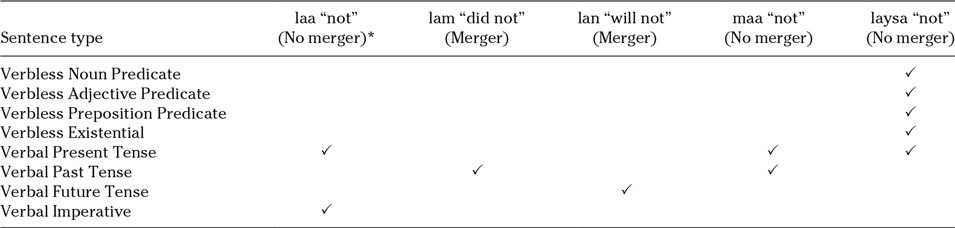
Under this analysis, the least complex negation forms appear in verbless and verbal present-tense constructions (laysa and laa), where no head movement seems to be involved, as in (13a). The negation of past and future constructions is relatively complex because tense must move to negation and merge with it yielding the tensed negatives lam and lan (13b). When maa is used in past-tense constructions, the verbal predicate merges only with tense and the negative projection is realized independently (13c). Thus, one would expect heritage and L2 speakers to encounter more difficulties with past-tense and future-tense constructions and less with verbless and present-tense structures. Table 1 summarizes the patterns of negation along with their movement options.
Patterns of sentential negation in SA

* “No merger” = Tense does not merge with negation; “Merger” = Tense merges with negation.
Sentential Negation in Egyptian Arabic and Palestinian Arabic
The Egyptian and Palestinian dialects deploy similar negation strategies (Benmamoun et al., Reference Benmamoun, Abunasser, Al-Sabbagh, Bidaoui and Shalash2014b; Soltan, Reference Soltan2007). Sentential negation in Egyptian Arabic (EA) and Palestinian Arabic (PA) is typically realized by two negative particles: miš and maa—š. miš is the nondiscontinuous particle because it realizes negation as a morphologically independent marker.Footnote 8 It is used in verbless sentences with nominal, adjectival, or prepositional predicates (as in 14) and in future-tense sentences (as in 15). maa—š is the discontinuous particle because its two parts are realized, respectively, as a proclitic and enclitic on the opposite edges of the host. It is used in verbless existential constructionsFootnote 9 (as in 16) as well as in past-tense sentences and imperatives, as in (17) and (18), respectively. Like SA imperatives, negative imperatives in EA and PA require the prefixation of the second-person morpheme t- to the imperfective verb.Footnote 10
(14) a. xaalid miš ṭaalib
Khalid neg student
“Khalid is not a student.”
(15) xaalid miš ħa-y-saafir
Khalid neg future-3-travel
“‘Khalid will not travel.”
(16) maa-fii-š karaasi fi-l-beit
neg-there-neg chairs in-the-house
“There are not chairs in the house.”
(17) xaalid maa-saafir-š
Khalid neg-travel-neg
“Khalid did not travel.”
(18) maa-t-saafir- š
neg-2-travel-neg
“‘Do not travel.”
In present-tense sentences, both the discontinuous and the nondiscontinuous markers are possible, but the latter is less frequent and marked (Benmamoun et al., Reference Benmamoun, Abunasser, Al-Sabbagh, Bidaoui and Shalash2014b).
(19) a. xaalid maa-b-yi-ktib-š
Khalid neg-asp-3m-write-neg
“Khalid is not writing.”
b. xaalid miš b-yi-ktib
Khalid neg asp-3m-write
“Khalid is not writing.”
Although the surface realization of sentential negation is notably different in SA and EA/PA, the underlying syntax, especially with regard to clause structure and the mechanisms governing the relationship between tense, negation, and the predicate, is similar (Benmamoun et al., Reference Benmamoun, Abunasser, Al-Sabbagh, Bidaoui and Shalash2014b; Soltan, Reference Soltan2007). For example, the position of the negative projection in SA and EA/PA is higher than tense (see (13) above). Likewise, though not aligned with the same sentence types, the movement and nonmovement options are available in EA/PA negation. Moreover, in both SA and EA/PA, the syntax of negation and its realization are sensitive to clause type (verbless vs. verbal) and tense.
THE STUDY
In this article, we compare heritage and L2 learners of SA with respect to their performance on sentential negation in SA. The different forms of sentential negation are covered in the first year of formal language instruction, with the exception of the negative imperatives, which are taught in the second year. The rules of sentential negation are explained explicitly in the textbook used in the three universities followed by form-focused exercises. There are also exercises focusing on the use of the different negation forms in context. The teachers reported that they use both form-focused and communication-based instruction when teaching negation. The purpose of the study is threefold. First, the article investigates heritage Arabic speakers’ knowledge of SA and whether they have an advantage over L2 learners in elementary SA classes. Second, the study investigates whether and how their acquisition patterns are (dis)similar to those of learners of SA as L2. Third, the study explores whether transfer effects, if any, are comparable in the case of heritage speakers and L2 learners. The last two questions may shed light on whether learning SA for heritage speakers is similar to learning a new language. Given the exploratory nature of this study and the lack of much empirical work in this area, no attempt was made to formulate hypotheses. The research questions are examined through the experiment outlined in the following text.
Participants
The study involved 79 participants, 28 of whom were Arabic-L2 learners,Footnote 11 35 were heritage speakers, and 16 were controls who were native speakers of QA and were formally educated in SA since early childhood.Footnote 12 The participants were recruited from three universities in the United States. The L2 group consisted of 28 English-L1 speakers, 18 of whom were male and 10 were female (average age = 21; 2). The L2 learners were a mixture of undergraduate (#19) and graduate (#9) students at the time of the experiment. Eighteen of the advanced L2 learners were in their third year of college-level Arabic language instruction, and the remaining 10 were in their fourth year.Footnote 13 All of them were born in the United States to at least one American parent (but no Arab parent). All of them identified English as their first and dominant language in terms of acquisition and use. All of them were exposed to Arabic at or after the age of 18 (at college). Nineteen L2 learners made visits to the Arab region that ranged in length from one month to a whole year. For 17 of them, the purpose of the visit was to learn Arabic and the other two made tourist trips.
The heritage group consisted of 16 males and 19 females, only six of whom were graduate students, and the remaining 29 were undergraduate students. The heritage participants were speakers of the Palestinian (18) and Egyptian (17) dialects of Arabic. Thirty of the heritage speakers were born in the United States and five were born in Arab countries but moved to the United States at the ages of 1 (1 subject), 2 (1 subject), 3 (2 subjects), and 5 (1 subject). The parents of 31 heritage speakers were of Arab descent and four had Arab fathers and non-Arab mothers. According to self-report, 21 of the heritage speakers were exposed to their Arabic dialects and English from birth, and 14 remained monolingual in their dialects until the ages of three (3 subjects), four (4 subjects), five (6 subjects), and six (1 subject). The heritage speakers ranged in age between 18 and 33 (average age = 20; 7). Twenty-seven of the heritage participants still spoke Arabic at home and eight spoke English predominantly.
The heritage speakers were divided into two groups based on their degree of exposure to SA. The first group included 16 students who were in their third year (#8) or fourth year (#1) of college-level Arabic language instruction or who completed at least four semesters of SA language learning within a maximum of six months before the time of the experiment (7).Footnote 14 The second group consisted of 19 students who were in their first year, first semester of SA study.Footnote 15 All of them had been exposed to SA at an earlier stage of their lives, but not in a formal educational setting.Footnote 16 For descriptive purposes, we will identify the elementary-level heritage speakers and the advanced heritage speakers as the EH and AH groups, respectively.
The control group consisted of 10 males and 6 females who lived in the Arab region for at least 23 years before coming to the United States to complete their graduate studies. They all had exposure to SA since childhood through formal education in their home countries. They were also raised in contexts where SA has significant presence on a daily basis.Footnote 17 Educated Arabic speakers are generally able to comprehend SA in its written and spoken forms.
Tasks
The participants completed five oral tasks that focused on the negation of different sentence types. For the first task, the subjects were shown 10 drawings of a hypothetical Arab American student named Khalid who was involved in 10 different daily activities. After listening to an orally provided statement about each of Khalid’s activities, the subjects had to confirm or negate the statement depending on whether it matched the action displayed in the drawings. Five of the statements required negative responses and five required affirmative responses (fillers). The following instructions were given orally to the subjects before eliciting the data: “The following set of pictures depicts some of the daily activities of Khalid, who is an Arab American student living in Chicago. As you view the pictures, you will hear sentences that are supposed to reflect what is happening in the pictures. However, some of the sentences that you will hear report false information about the pictures and the activities themselves. You need to negate the ones that do not reflect the events in the corresponding pictures.”
The second task involved 10 drawings of Khalid and 10 statements (including five fillers) about a previous trip that he made to Cairo (past tense). The subjects were provided with the following instructions: “The following set of pictures depicts some of the activities that Khalid did during his visit to Cairo (Egypt) last year. As you view the pictures, you will hear sentences that are supposed to reflect what is happening in the pictures. However, some of the sentences that you will hear report false information about the pictures and the activities themselves. You need to negate the ones that do not reflect the events in the corresponding pictures.” Similarly, the third task included 10 drawings of Khalid and 10 statements about his plans after graduation. The directions given to the subjects were as follows: “The following set of pictures depicts what Khalid is planning to do after graduation. Omar, who is Khalid’s friend, is trying to guess what Khalid will be doing after graduation. As you will notice, Omar’s guesses are not always accurate. You need to negate the ones that do not reflect what Khalid will actually be doing, as shown in the pictures.”
The fourth task was similar to the previous tasks in the sense that it included 10 statements, five of which were fillers. However, no pictures were used because the task focused on negative imperatives. The participants were given the following instructions: “Khalid is not doing well at school this semester. Khalid has been given different pieces of advice by a number of friends to improve his performance. Some of them are useful and some are misleading. Correct the misleading ones by negating them.” For the fifth/last task, the subjects were shown a picture of a room with several objects. They were orally provided with 40 sentences about the objects and were asked to indicate whether these statements correctly reflect what is in the picture. If not, they had to negate the sentences, based on these instructions: “The sentences you will hear describe whether an object exists in the picture below, how it is, or its locations. If you hear a wrong sentence about an object, you need to correct the sentence by negating it.” The stimuli in this task were verbless constructions representing four sentence types: 10 sentences with noun predicates, 10 with adjective predicates, 10 with prepositional predicates, and 10 with existential constructions starting with hunaaka “there.” Twenty of the 40 sentences in this task were fillers (five in each category). The subjects of all of the nonfiller sentences were singular.
The data was collected in the first month of the academic year when elementary students where still acquiring the Arabic alphabet and basic introductory phrases. Before eliciting their responses to the first three tasks, we provided the subjects with two examples in the present tense demonstrating the expected responses. Two examples were also provided before the imperative-negation task, and two others before the verbless-sentence tasks. All of the examples were in English. None of these examples occurred (in translation) in the test items. Only the negative responses were analyzed (i.e., the fillers were discarded).
Data Analysis and Results
The participants’ responses to the verbal negation tasks were transcribed separately in Excel sheets. Their responses to the fifth task were divided into four categories representing the four forms of negation in verbless sentences under study. Each sentence was assigned “1” point when the correct form of SA negation is used in the correct sentence position and with the correct morphemes and verb; otherwise “0” point was given to the response. In addition to counting the correct and incorrect instances, we also analyzed the patterns of errors across token and negation types.
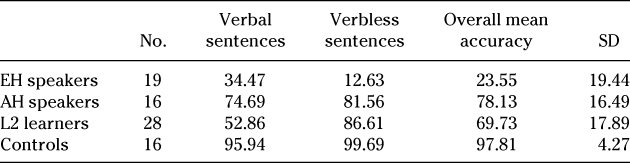
Tables 2 and 3 summarize the mean accuracy percentages of the four groups on negation in general, on verbal versus verbless negation types, and on each of the eight negation categories.
Mean accuracy percentages on verbal and verbless sentences and overall negation

Mean accuracy percentages on the eight sentence types

As Table 2 shows, the AH and L2 groups had relatively comparable accuracy rates of 78.13% and 69.73%, respectively. The AH and L2 learners were more accurate than the EH speakers, who were able to deploy negation correctly in only 23.55% of the cases. The control group performed notably better than the other three groups (97.81%). The AH, L2, and control groups displayed greater accuracy in negating verbless sentences than verbal sentences. While their accuracy percentages on negative verbless sentences were 81.56%, 86.61%, and 99.69%, respectively, their correct-response rates on negative verbal sentences were 74.69%, 52.86%, and 95.94%. The EH speakers diverged from the other groups in this respect, thus producing an accuracy rate of 34.47% on verbal sentential negation and only 12.63% on verbless sentential negation.
The performance of the four groups was not consistent across the eight categories of sentential negation under study (Table 3). The AH speakers encountered the greatest difficulty with past (63.75%) and future (60.00%) tense sentences as well as with existentials (43.75%). The EH speakers performed poorly on all eight categories, but particularly on future sentences (8.42%) and the four categories of verbless sentences. As for the L2 group, imperative sentences (31.43%) and, to a lesser degree, past-tense and future-tense sentences (44.29% and 43.57, respectively) were the most problematic sentence categories. The controls showed a relatively consistent performance across all sentence categories, with future-tense sentences (86.25%) being the least accurate form.
Before we ran the statistical analysis, we checked the reliability estimates of the data. The Cronbach’s alpha reliability coefficient for the whole data (40 items) was .977, indicating very high internal consistency. The Cronbach’s alpha coefficients for the verbal and verbless types of negation (20 items, each) were .967 and .925, respectively. Using the GLIMMIX procedure in SAS statistical software, a Generalized Estimating Equation (GEE) model for repeated measures was used to examine the effects of sentence type (verbal vs. verbless) and sentence category (present, past, future, etc.) as the two within-subjects factors on the accuracy scores of the four groups (between-subjects factor).Footnote 18 Sentence category was nested within the verbal-verbless sentence types, and subjects was included as a random factor in the model. Residual plots did not show violations of normality and homogeneity assumptions of the model. Effect size as measured by the proportion of variance explained by this GEE model was 0.61; there was a strong association between the participants’ scores and the variables included in this model.
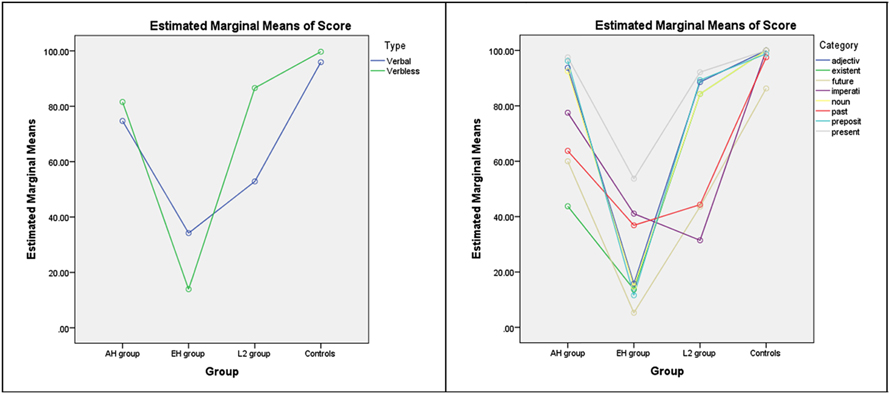
The results showed a marginally significant effect of sentence type, F(1, 75) = 3.29, p = .07; the participants generally performed better on verbless sentences than verbal sentences. There was also a main effect of sentence category, F(6, 450) = 13.10, p < .0001; the participants’ accuracy rates on some sentence types (e.g., present tense) were consistently higher than others (e.g., future tense). A significant main effect of group was also detected, F(3, 75) = 84.15, p < .0001; the controls performed better on both forms of negation than the AH and L2 groups, who in turn performed better than the EH group. An interaction was found between sentence type and group, F(3, 75) = 13.64, p < .0001; the performance disparity between verbal and verbless sentences was more pronounced in the case of the L2 and EH learners than the AH and control speakers (Figure 1). Multiple comparisons showed that each of the four groups differed from the others in verbal negation (p < .05), whereas significant differences existed only between the EH group and the remaining three groups in verbless negation (p < .0001). Another significant interaction was found between sentence category and group, F(18, 450) = 7.18, p < .0001; the disparity in the participants’ performance on the eight sentence types was more visible in the case of the EH group and, to a lesser degree, the AH and L2 group than in the control group (Figure 1).
Interaction of groups’ mean scores on different sentence types and categories.

Error Analysis and Particle Choice.
An analysis of the incorrect responses of the EH, AH, and L2 participants revealed seven main types of errors, illustrated in examples (20) through (26). The first type of errors is transfer errors, which materialize when QA forms of negation are used instead of SA ones. In (20), for example, negation is based on a form, namely miš, that is exclusively used in QA.Footnote 19 The second type is particle errors, which involve the inaccurate selection of a negation particle. In (21), the speaker infelicitously uses the SA negative particle laysa instead of laa. Third are verb/tense errors, that is, the wrong form of the verb (and sometimes its associated negative marker) is used. Example (22) involves the erroneous substitution of the perfective verb darasa “studied” for the imperfective verb yadrusu “studies.” The fourth type are morphological errors, which refer particularly to the omission of the person morpheme ta- in negative imperatives, as in example in (23). Fifth are merger errors, which occur when speakers fail to merge tense and negation in the process of forming negative future sentences. In (24), for instance, the negative and tense particles (laa “neg” and sa “fut”) are kept separate, instead of being merged and realized as lan “neg.fut.” The sixth type is word order errors, as in (25) where the negative particle laysa is placed after the existential hunaaka “there.” The last type of errors are miscellaneous errors, which do not conform to any of the preceding. Example (26) involves a unique error, namely, the dropping of hunaaka “there” and the use of the negative particle before the indefinite subject kombyuuter “computer,” which is not possible in SA.

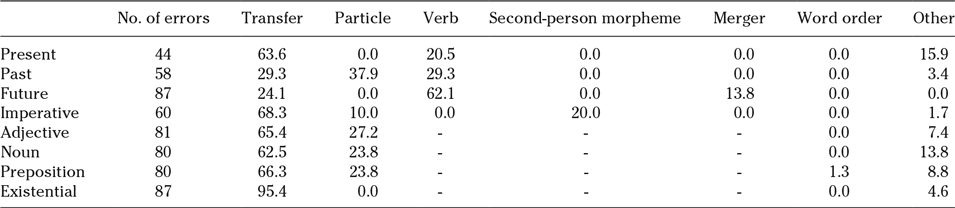
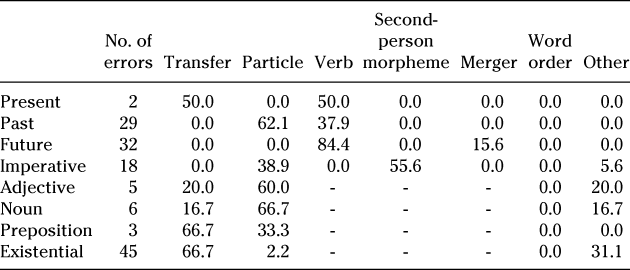
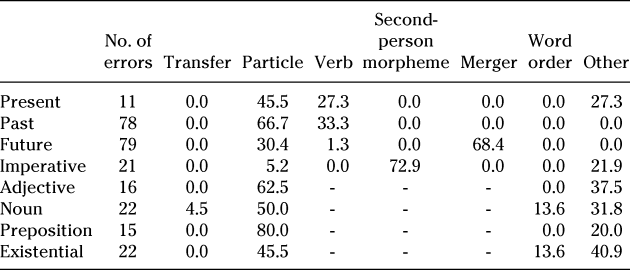
An examination of the participants’ errors reveals a number of similarities and differences among the EH, AH, and L2 groups (Tables 4, 5, and 6). First, with regard to verbal negation, most of the AH speakers’ errors are due to the inaccurate selection of the verb/tense or negative particles. Similar patterns appear in L2 learners, whose errors mainly involved the incorrect use of particles or verbs. For both groups, morphological errors were prevalent in imperative sentences (55.6% for the AH group and 72.9% for the L2 group). Unlike the AH and L2 groups, the EH speakers display errors that appear to be mainly due to the influence of QA; QA-based errors represent 63.6% of the total errors in the present tense, 29.3% in the past tense, 24.1% in the future, and 68.3% in imperative sentences.
Types and distribution of the EH speakers’ errors

Types and distribution of the AH speakers’ errors

Types and distribution of the L2 learners’ errors

In the context of negation in verbless clauses, the predominant error pattern for the L2 group consists of particle selection. Particle-selection errors also figured predominantly in the responses of the AH speakers, who also produced a sizable number of errors involving QA forms, especially in existential constructions (66.7%). The AH and L2 groups diverged considerably from the EH group whose most pervasive error pattern involves the use of QA forms across the four types of verbless sentences (65.4%, 62.5%, 66.3%, and 95.4%). The L2 group has a single QA error using maa-fii “there is not” that was produced by a fourth-year student with a study-abroad experience.
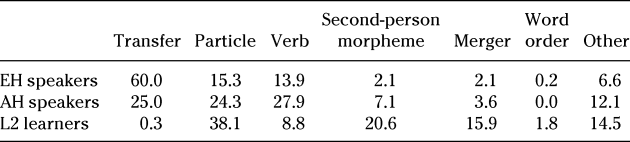
The overall distribution of the errors (Table 7) indicates that the AH speakers and L2 learners display similar patterns of errors; most of the errors of the AH and L2 group involve the inaccurate selection of the verb or negation particle. However, the AH speakers diverge from the L2 learners and pattern with the EH speakers with regard to the notable presence of QA negation forms, even though the latter group (60%) was more influenced by QA than the former (25%). Thus, the AH speakers’ developing proficiencies in SA help reduce the volume of transfer errors, but do not eliminate them completely.
Overall distribution of errors in the responses of EH, AH, and L2 learners

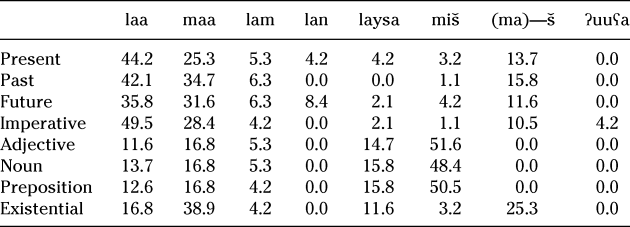
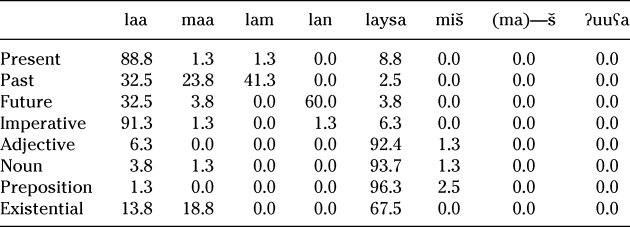
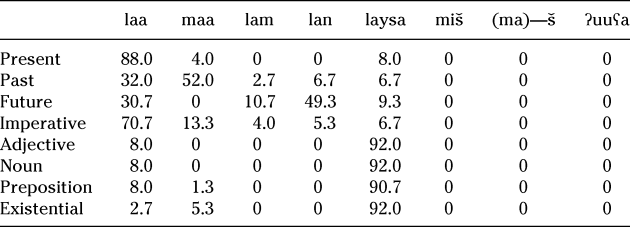
The differences among the three groups also surface when we consider the distribution of negative particles (Tables 8, 9, and 10). In verbal sentences, the distribution of the negative particles by AH and L2 speakers is marked by the predominant (and accurate) use of laa in the present tense (88.8% and 88.0%, respectively) and imperative (91.3% and 70.7%), maa and lam in the past tense (65.1% and 54.7%), and lan in the future tense (60.0% and 49.3%). Unlike the AH and L2 groups, the EH speakers deploy the default negative particle laa primarily across the four verbal sentence types (44.2% in the present, 42.1% in the past, 35.8% in the future, and 49.5% in imperatives). Moreover, a significant proportion of the negative particles used by this group comes exclusively from QA, which is not the case for the AH and L2 speakers. Similar patterns emerge in the domain of verbless negation. The AH and L2 groups mainly use the correct negation particle laysa across the four types of verbless sentences, whereas the EH learners deploy the QA forms miš, (ma)—š, and maa more frequently. The QA forms also figure on a much lesser scale in the responses of the AH group. One of the striking features of the use of the QA forms is that the discontinuous and nondiscontinuous forms are used felicitously with the target sentence types.
Distribution of negation particles in EH speakers’ responses

Distribution of negation particles in AH speakers’ responses

Distribution of negation particles in L2 learners’ responses

Overall, the results of the negation tasks show that the AH speakers display patterns that are comparable to those of the L2 learners in terms of their overall accuracy on sentential negation, on verbal versus verbless negation types, and on the eight negative sentence types. The two groups were also similar with respect to their error patterns and negative particle choice. However, the AH speakers were influenced by QA, which was evident in their error patterns. In this respect, they pattern with the EH speakers, even though the effects of QA seem less pervasive.
DISCUSSION
The present study has investigated heritage Arabic speakers’ knowledge of SA. In addition, it compared the acquisition patterns displayed by advanced heritage speakers and L2 learners of SA in an attempt to uncover any similarities and differences. Furthermore, the study examined the role of transfer from previously acquired language varieties in the acquisition of SA in a formal setting. These questions may help identify the factors that contribute to their SA attainment over time, whether learning a standard variety for heritage speakers is comparable to learning a new language, and the role of their previous linguistic knowledge in acquiring SA.
The findings indicate that the EH speakers come to elementary SA classrooms with prior background knowledge in SA, which they may have acquired mostly in informal contexts (e.g., TV and media) or community programs such as Sunday schools. This knowledge gives them an advantage over nonheritage L2 learners even in an area where no significant overlap exists between SA and QA, such as sentential negation. However, heritage speakers lose part of this advantage as they advance in their SA study. The findings in this study reveal minimal significant difference between the AH and advanced L2 groups with regard to their acquisition of SA sentential negation.Footnote 20 The convergence between the AH and advanced L2 learners is manifest not only in their comparable performance on SA sentential negation but also in the similar type of challenges they seem to face. For example, morphosyntactic complexity seems to underlie a substantial portion of the errors made by both the AH and L2 speakers. Both groups perform poorly on negative past-tense and future-tense sentences, which are syntactically and morphologically complex. Syntactically, they involve movement of a head to another projection, which entails establishing a dependency between the two positions according to the constraints that govern movement and its residue in the syntactic representation (Benmamoun et al., Reference Benmamoun, Abunasser, Al-Sabbagh, Bidaoui and Shalash2014b; Soltan, Reference Soltan2007). Morphologically, they involve the realization of tense and negation in a single morpheme (lam or lan), which may require changes in the form of the verb (perfective vs. imperfective) and/or accompanying affixes such as those marking mood (Aoun et al., Reference Aoun, Benmamoun and Choueiri2010; Benmamoun, Reference Benmamoun2000).
The AH speakers perform worse on negative existentials than on any other form of negation. Moreover, it is the form in which the heritage speakers most frequently shifted to QA. Studies on L1 acquisition of the negation system in a number of Arabic varieties suggest that, although the negative existential construction ma-fii-š “there isn’t/aren’t” deploys the complex discontinuous marker ma—š, this form of negation seems easier to acquire by Arab children due to its high frequency in child directed input (Omar, Reference Omar1973; Smadi, Reference Smadi1979). Likewise, Albirini and Benmamoun (Reference Albirini and Benmamoun2015) found that, among all sentences that use the discontinuous form of negation, negative existentials are the least problematic for Egyptian heritage speakers, which they again attribute to the frequency of existential constructions. If we accept the frequency explanation, the use of QA negative existentials may then be explained by the fact that they are more accessible to and more easily activated by heritage speakers. L2 and heritage language research suggests that the accessibility and activation threshold of different linguistic components is often determined by their frequently in input and use (Green, Reference Green, van Hout, Hulk, Huiken and Towell2003; Hulsen, de Bot, & Weltens, Reference Hulsen, de Bot and Weltens2002; Paradis, Reference Paradis, Köpke, Schmid, Keijzer and Dostert2007).
Similarly, the L2 learners face problems with negative imperatives, which are relatively complex. The difficulty of negative imperatives is most likely due to its complex morphology: the requirement to insert the second-person prefix morpheme, which is obligatorily absent in positive imperatives (Benmamoun, Reference Benmamoun2000). Thus, L2 learners have to perform an additional morphological step to realize negative imperatives. Generally speaking, morphosyntactic complexity seems to underlie a substantial portion of the errors of both the AH and advanced L2 learners, which is consistent with previous studies showing that heritage speakers and L2 learners of Arabic find consistent problems with the morphosyntactically complex aspects of the language (Albirini et al., Reference Albirini, Benmamoun and Saadah2011; Alhawary, Reference Alhawary2009; Bos, Reference Bos1997; Boumans, Reference Boumans2006; El Aissati, Reference El Aissati1996). The two heritage groups and the L2 learners resort frequently to the default laa particle to express negation (Benmamoun, Reference Benmamoun2000). This may be a form of structural simplification, which has been widely reported in previous studies on heritage Arabic speakers (Albirini & Benmamoun, Reference Albirini and Benmamoun2014, Reference Albirini and Benmamoun2015; Benmamoun et al., Reference Benmamoun, Albirini, Montrul and Saadah2014a).
However, the AH speakers and L2 learners differ in an important respect. Unlike L2 learners, who display no clear effects of transfer from English, the AH speakers produce a substantial number of errors through borrowings from (or switches to) QA. Research in language contact situations and in SLA suggests that transfer effects are more likely to occur when the two languages in question are perceived to be close (Albirini & Benmamoun, Reference Albirini and Benmamoun2014; De Angelis, Reference De Angelis2005; Ringbom, Reference Ringbom, Cenoz, Hufeisen and Jessner2001). This may be extended to closely related varieties of the same language family, which is the case of SA and QA. L2 learners’ realization of negation follows the rules and constraints of Arabic. This suggests that they are not influenced by their L1 (English), where it is generally assumed, particularly within the principles and parameters framework, that negation is located between the projections of tense and the predicate (Pollock, Reference Pollock1989). The absence of transfer effects from English may be due to the structural distance between Arabic and English relative to the syntactic position of sentential negation in the syntactic configuration and interplay between negation, tense, and the verb in English that lacks movement and merger of tense and negation and verb movement to tense (Chomsky, Reference Chomsky1995; Pollock, Reference Pollock1989). This may account for the difference between the current findings and previous results that showed transfer effects from English to heritage Arabic (Albirini & Benmamoun, Reference Albirini and Benmamoun2014; Alhawary, Reference Alhawary2009).
If we accept the assumption that SA is L3 for heritage speakers, then the results are consistent with the predictions of the CEM and TPM models (Flynn, Foley, & Vinnitskaya, Reference Flynn, Foley and Vinnitskaya2004; Rothman, Reference Rothman2011; Rothman & Cabrelli Amaro, Reference Rothman and Cabrelli Amaro2010), both of which warrant L1 transfer to L3. We believe that QA plays a positive role in the slight, though insignificant, lead (based on accuracy percentages only) that the AH speakers in this study have over their L2 counterparts in sentential negation. The facilitative role of QA may be attributed to its positive bootstrapping effects due to the phonological, lexical, and structural similarities between the two diglossic varieties, SA and QA. However, the fact that QA is the source of many “errors” suggests that L1 may also have a negative effect on the acquisition of L3. This is consistent with the predictions of the TPM model, which recognizes the possibility of negative transfer from L1 if the latter is typologically close to L3. L2 effects do not seem to play a role here possibly because of the morphosyntactic distance between English and SA, particularly with regard to sentential negation and its syntactic and morphological properties.
When we compare the transfer-based errors made by heritage speakers in this study and in previous work on transfer between typological distinct languages, it becomes clear that the nature of cross-dialectal transfer diverges from cross-linguistic transfer in an important aspect. Although heritage speakers resort to QA to realize sentential negation, their sentences are, for the most part, syntactically well-formed according to the syntax of both SA and QA. Again, this is not surprising if we consider the structural similarities between SA and QA. In contrast, previous studies on transfer from a typologically distinct language (e.g., English) suggest that transfer sometimes results in erroneous sentences that are acceptable neither in the target language nor in the interfering language (Albirini & Benmamoun, Reference Albirini and Benmamoun2014; Bos, Reference Bos1997; Boumans, Reference Boumans2006; El Aissati, Reference El Aissati1996). Thus, the question of whether the learning of the standard variety may be viewed as a form of L3 regardless of the linguistic distance between the two varieties is not without problems. Heritage speakers resort to their spoken dialects in their acquisition of SA, leveraging the overlap between the two and treating them as if they were on a continuum. Their dialects may, therefore, enable them to fill in some of the gaps in their knowledge of the standard variety. There are certainly heritage speakers to whom the description of the standard variety as an L3 applies, but this question merits further investigation.
Apart from cross-dialectal interference, a number of pedagogical issues may have influenced the AH speakers’ attainment in SA. In all three universities where this research was conducted, there were no independent sections for heritage speakers at the time of study, which is common across U.S. colleges and universities. This is because the number of heritage Arabic speakers fluctuates considerably from one semester or year to another, which complicates the possibility of planning and creating independent courses for them. Moreover, most U.S. colleges and universities lack instructional material specifically designed for heritage speakers possibly because no instructional material can fully accommodate the different language experiences and needs of this group. In addition, there are no well-established guidelines for teaching heritage speakers and building on the language skills that they bring into the SA classroom.Footnote 21 In a study focusing on the factors responsible for the variability in the language proficiencies of Egyptian and Palestinian speakers, Albirini (Reference Albirini2014) found that formal classroom instruction was not related to proficiency in heritage Arabic or to language input and use. Albirini calls into question the quality of Arabic language education that heritage Arabic speakers receive and whether it really addresses their linguistic and pedagogical needs. This assessment is supported in this study by the comparable performance of the AH and L2 groups.
One of the main challenges for heritage speakers in SA classrooms is that, although their precollege proficiencies in SA range from advanced to mere rudimentary (as is evident in the standard deviations), they are often placed in the same classes with L2 learners. Most elementary SA classes focus on the sounds, alphabet, and basic functional uses of SA (greetings, self-introduction, etc.). If we take into account their familiarity with SA and the phonological, lexical, and structural similarities between SA and QA, one would expect little added benefits to some heritage speakers from elementary SA courses, which may be mainly restricted to some areas of grammar and reading. Thus, whereas the L2 learners have the opportunity to acquire new skills in the language, the L2-learner-directed instruction gives some heritage speakers reduced opportunities to develop their SA skills beyond what they already possess. It is not surprising then the SA skills of L2 learners become comparable to those of heritage speakers in advanced SA courses.
The heritage speakers are also different from the control group in their use of sentential negation. While the control group does not switch to QA in realizing sentential negation, heritage speakers do. One possible explanation for this disparity is that, because of their extensive exposure to both varieties in a wide range of contexts, the control group is more aware of the distinction between the two varieties and their functional distribution in everyday speech. Previous studies have shown that native Arab speakers deploy these varieties (typically at the sentence or discourse level) strategically to attain certain communicative and socio-pragmatic goals (Albirini, Reference Albirini2011; Bassiouney, Reference Bassiouney2006). By contrast, its use by heritage speakers seems to be related to cross-dialectal influence and possibly processing difficulty. It has been reported that heritage speakers may resort to their stronger, more frequently used, or first language either to deal with processing delays resulting from complex structures or simply because certain forms are more accessible to them in one language/variety than in another (Albirini & Benmamoun, Reference Albirini and Benmamoun2014; Hawkins, Reference Hawkins1999; Jiménez, Reference Jiménez, Schmid, Köpke, Keijzer and Weilemar2004).
Needless to say, the results of this study underscore the need for more research that explores the aspects of convergence/divergence between heritage and L2 speakers and the effective methods that could potentially allow heritage speakers to advance their proficiency in the standard variety of their languages based on the linguistic skills that they bring to the classroom. Apart from the factors discussed in this article, we believe that the converging proficiencies of the heritage and L2 learners in advanced SA courses may also implicate several social and affective factors. Future studies would hopefully explore these factors and their impact on the language learning experience of heritage speakers.Footnote 22