Introduction
There is an area of popular musicology that is a rich seam which has yet to be truly mined: the role certain instruments and the playing of those instruments have undertaken in defining, redefining and developing genres and styles of Anglo-American popular music. This is particularly true when it comes to the consideration of the role of the drum kit and the influence of the drummers themselves. Over the last 40 years there has been a peppering of contributions to this field, but the seasoning is occasional and not always easy to detect. The academic texts in this area can be roughly split into three strata where the focus continues to narrow as we move through them. The first group is exemplified by work such as Theodore Denis Brown's (Reference Brown1976) ‘A history and analysis of jazz drumming’ and Geoff Nichols' (Reference Nichols1997) The Drum Book: The History of the Rock Drum Kit, both of which consider the history of the kit in relation to a particular style or genre. The second group contains texts that either consider a particular drummer's approach and consequently influence to a style, such as ‘Ringo round Revolver: rhythm, timbre and tempo in rock drumming’ (Baur Reference Baur2002), or those which consider the collective energies of drummers within a particular scene and who in turn helped shape the scene itself. These include Jon Fitzgerald's (Reference Fitzgerald1995) ‘Motown crossover hits 1963–1966 and the creative process’, Jim Payne's (Reference Payne1996) Give the Drummer Some!: The Great Drummers of R&B, Funk and Soul, and Alexander Stewart's (Reference Stewart2000) ‘“Funky drummer”: New Orleans, James Brown and the rhythmic transformation of American popular music’. The value of this particular layer is best described by Fitzgerald when he comments that it was often the drummers who ‘following minimal directions, create[d] grooves that became the building blocks for often undefined songs’ (Fitzgerald Reference Fitzgerald1995, p. 3).
The third group zooms in even further and looks at the role of particular instruments within the drum kit – not just within the kit itself but also as markers within the creation and exploration of groove and styles. There are very few offerings to be found in this stratum and it is this seam that the authors of this article believe is particularly rich for academic mining. Two items that are worthy of mention are Walter Everett's first chapter in The Foundations of Rock (Reference Everett2008), which is a useful survey of each of the different parts of the drum kit in relation specific grooves that explore their character within the genre, and Garry Tamlyn's (Reference Tamlyn1998) PhD thesis on ‘The big beat – origins and development of snare backbeat’. Tamlyn neatly sets out his stall for this type of investigation by stating that the ‘average inhabitants of the industrialised world … will probably hear around 3000 snare backbeats per day’ and as such ‘one of the main aims of [his] thesis is to explain the origins and development of this highly common musical structure’ (Tamlyn Reference Tamlyn1998, p. 1). In essence, the thesis places the snare at the centre of the investigation and considers all other elements in reference to this part of the kit. So, for example, when Tamlyn investigates the origins of the backbeat he looks at its earlier incarnations in jazz but always keeps the focus on the snare as the instrument that drives the investigation. If we continue to follow Tamlyn's logic that a snare will probably be heard by an average listener 3,000 times a day, then the hi-hat could potentially be heard 12,000 times a day.Footnote 1 This is not to top-trump Tamlyn's rightful placement of the snare as an integral component and driving factor within Anglo-American popular musics, but to join forces with him, and show similar prominence for the hi-hat.
The hi-hat is an integral and basic component of the modern-day drum kit. It consists of two cymbals, usually between 13 and 15 inches in diameter. It is mounted on a stand that can raise and lower the upper cymbal thereby altering whether it is in contact with the lower cymbal or suspended higher. The stand is operated with a foot pedal and is most conventionally controlled with the drummer's subordinate foot, the dominant foot being occupied with the bass drum pedal. Hi-hats were initially manufactured as cymbals that could only be played with the foot pedal, as the cymbals were not raised from the ground and were simply attached to the pedal. The era where these ‘low-boys’ became elevated to a position where they could also be played with sticks was the late 1920s, with Walberg and Auge being the drum manufacturing company credited with this innovation (Nichols Reference Nichols1997, pp. 8–12). Once able to be played by hand, techniques began to develop regarding how the drummer approached the instrument. To use a generalised historical timeline, through the 1920s to the 1950s various hi-hat techniques emerged and the foot chick became a standard measure of tempo that other musicians in an ensemble listened forFootnote 2; with the advent of rock and roll, from the 1950s onwards, the hi-hat technique began to develop again as the genre grew more popular. Today, the hi-hat is arguably one of the most important parts of a drum groove and numerous techniques are employed during playing. To evaluate the development of the hi-hat's role and to ultimately affirm its importance, the development of standard rock techniques must be traced through music history. Three basic techniques which rely on the sound of the hi-hat are the ‘16 beat’ (the drummer using the hi-hat to purvey a semiquaver feel), the ‘open hi-hat sound’ and where in a bar to place that sound and – further developing the previous idea – the ‘disco groove’ (the hi-hat opening on every off-beat to achieve a back-and-forth feel).
The ‘16 beat’
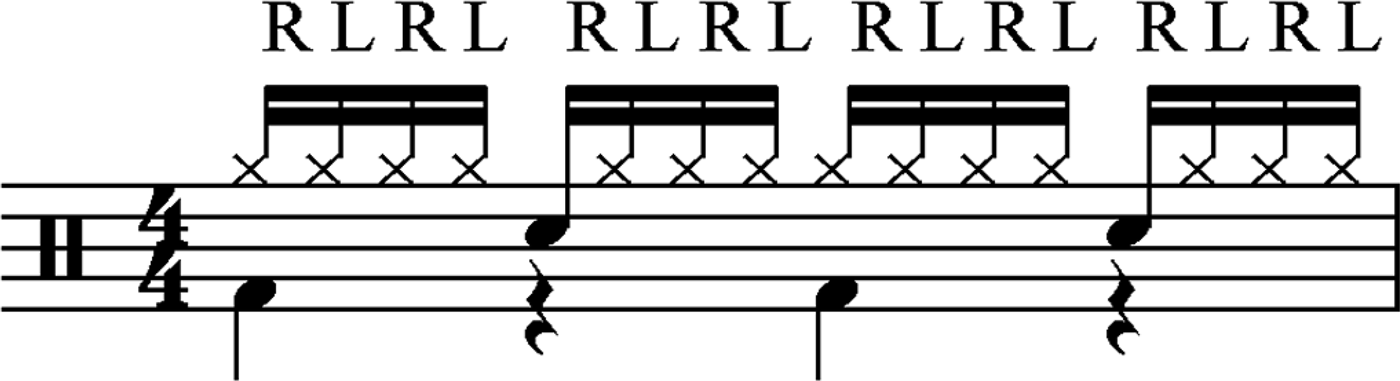
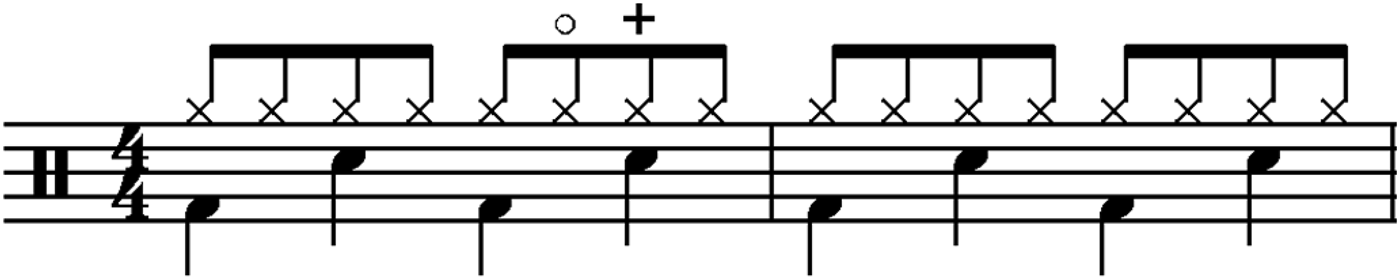
The inclusion of semiquavers, or ‘sixteenth’ notes, in a standard groove adds an increased sense of movement. This semiquaver feel can be employed anywhere on the drum kit but in a standard groove the hi-hat is the component which the player uses to present this rhythmic drive. To achieve this movement at quicker tempi, and to retain a sense of the backbeat, the standard practice is to play the hi-hat with both sticks (alternating right and left for each semiquaver) and to play the snare notes on beats ‘2’ and ‘4’ with the right-hand stick, as shown in Example 1:
Providing the snare backbeat with the right-hand stick when playing dual-handed hi-hat semiquavers.

The development of this technique is readily traceable in the music of the last 50 years and the largest step to achieving this beat was the decision to use the right-hand stick to play the snare backbeat. Although pioneering drummers initially employed the techniques a long time beforehand it was by the mid- to late 1970s that this groove appears to have established itself in the mainstream. This phenomenon has had very little attention on the academic stage, although the basics of rock and roll rhythms themselves have already been covered. In Tamlyn's thesis, the definition of ‘backbeat’ itself is discussed, as well as various notated figurations, and cymbal rhythms (including a discussion of shuffle rhythms and straight rhythms) are also considered. The relationship between the cymbal rhythms themselves and the snare backbeat, however, is not covered, and straight hi-hat semiquavers are not featured in the ‘Cymbal rhythms’ section. The following research (including this section and the following two) aims to expand upon the initial parameters of rock and roll rhythms set out by Tamlyn.
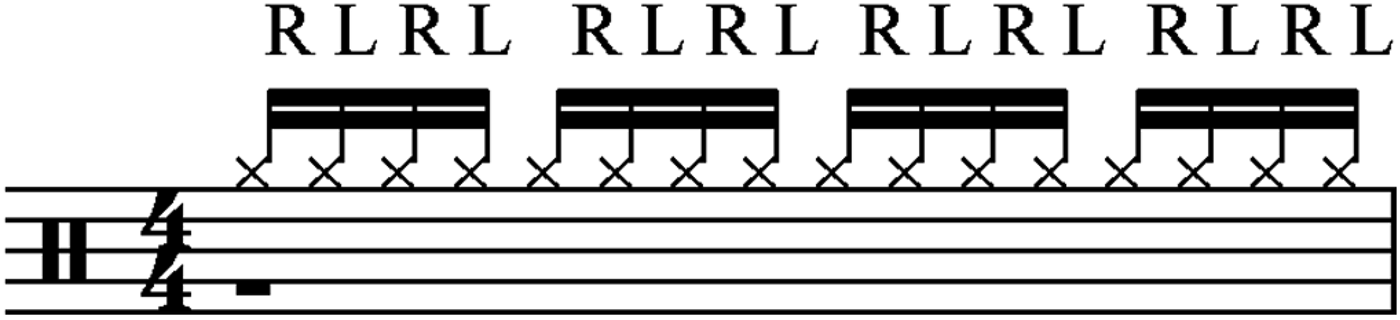
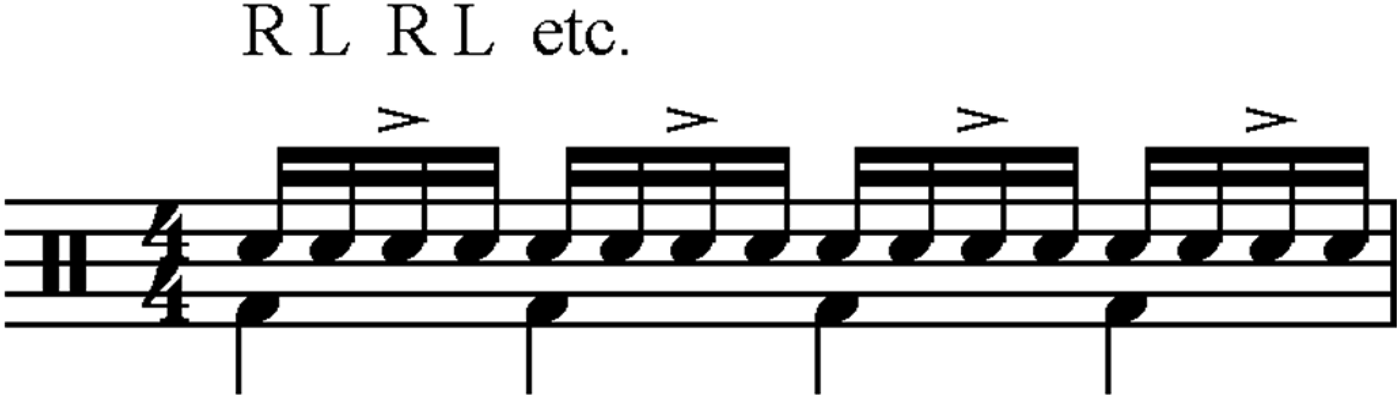
The development of this groove has two main stages. The first stage is the initiative to play semiquavers on the hi-hat with both sticks, in a single-stroke-roll fashion as shown in Example 2:
Hi-hat semiquavers played in a single stroke roll fashion.
The second stage is the decision to place beats ‘2’ and ‘4’ on the snare drum with the right-hand stick. The innovation in this context exists due to the fact that the backbeat is usually played with the left stick. Or, we might even suggest, just the stick that isn't held in the player's dominant hand (this would therefore apply to left-handed drummers with their equivalent being the right hand). The first stage, although still rare, is more common than the inclusion of the second stage in the years prior to the mid-1970s.
An early (but not the earliest) example of this first stage of the 16 beat groove is featured in Isaac Hayes' ‘Theme from Shaft’, recorded and released in mid-1971. Played by Willie ‘Too Big’ Hall, this is the clearest example of this technique as it is given centre stage in the arrangement and the mix of the record, and is used in the opening title sequence of the film of the same name (Shaft, 1971). While this is still an early period for the development of this beat, the first stage was not completely alien to drummers at this point. What is interesting about it is Isaac Hayes' inspiration for the beat, which came from five years earlier. Otis Redding recorded ‘Try a Little Tenderness’ in 1966 with the band The Bar-Kays (who, incidentally, acted as rhythm section on the ‘Shaft’ soundtrack) and in the outro to the track, after the second iteration of a chromatic horn phrase, the entire band dropped out leaving only Carl Cunningham's hi-hat semiquavers for two bars. Willie Hall replaced Cunningham in the Bar-Kays after his death in a 1967 plane crash and the use of this beat could be seen as homage to Cunningham.
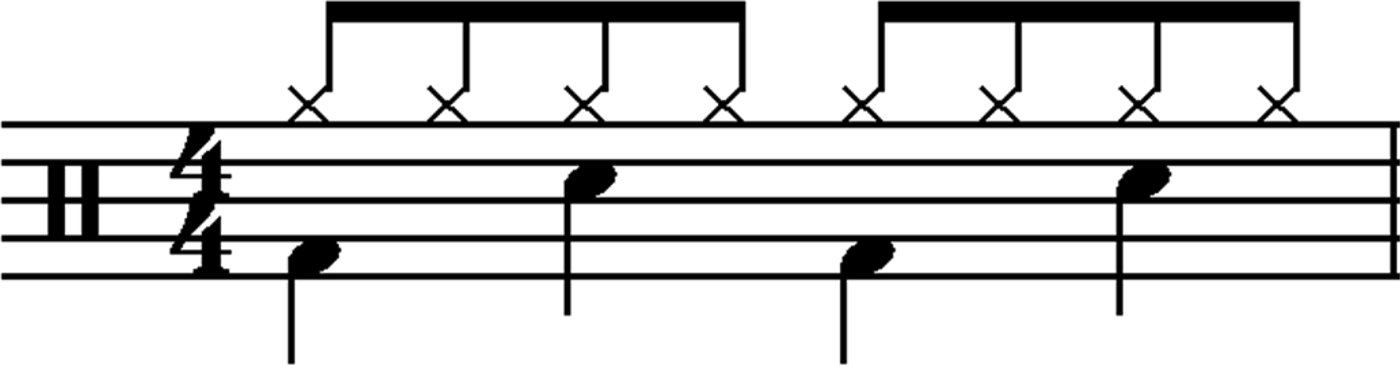
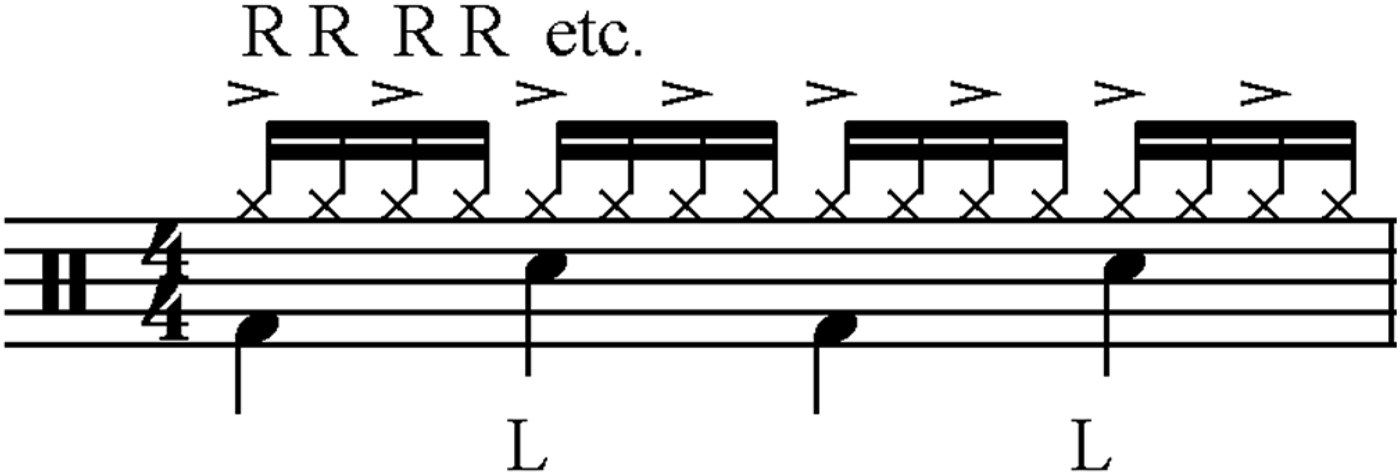
The earliest example known to us of this first stage comes from Ringo Starr. In the Beatles' ‘This Boy’, Starr plays hi-hat semiquavers during each verse, in a time signature of 12/8. The example was recorded in late 1963 and pre-dates any other known examples of extended first stage hi-hat semiquavers. This technique became almost commonplace in late-period Motown with the clearest and most notable example being present on The Temptations' ‘Cloud Nine’ of late 1968. The drummer here was Richard ‘Pistol’ Allen (playing alongside fellow drummer Uriel Jones). This beat became an integral part of Motown's ‘psychedelic soul’ craze in the late 1960s and early 1970s. The heavy, syncopated accents of this first stage hi-hat 16 beat are, like ‘Shaft’, given priority in the mix and are the main drive behind the music. Allen's hi-hat is still at the forefront even when Uriel Jones' full 4/4 rock beat, including the snare drum on the second drum kit, enters during the second verse. Although originally native to the ‘psychedelic soul’ movement in the context of Motown, the first stage became almost standard in Motown recordings featuring two drum kits from 1968 onwards, with one set playing a standard cross-stick 4/4 beat, shown below in Example 3, and the other accompanying it with hi-hat semiquavers.
Standard 4/4 rock pattern featuring right-hand stick on hi-hat and left-hand stick on snare.
This was also true in recordings featuring only one drum kit where the first stage was used during the verses.Footnote 3
In different musical contexts that do not include two drummers, the hi-hat semiquavers were often overdubbed after the basic drum track was recorded. This is apparent in the 1969 Jeff Beck Group recording ‘Plynth (Water Down the Drain)’ as played by Tony Newman. Throughout the verses the hi-hat semiquavers have been double tracked, even though they are difficult to detect in the early portion of the recording due to the similar positioning in the mix. When the instrumental section begins, snare drums notes are heard and the overdubbed second hi-hat becomes apparent as both the snare and the hi-hat are continuously audible (which would be a physical impossibility for one drummer/drum track). The leading drum track has moved to a conventional cross-stick position while the overdubbed track maintains the semiquaver feel in the hi-hat for longer, ultimately joining the first track in a conventional sticking position. Recordings of this nature are evidence that a need for a backbeat but a desire to maintain the hi-hat semiquaver feel, without the advent of right-hand stick snare notes in second stage, were solved by having to record the drums twice, but this was a time-consuming and inefficient practice.Footnote 4
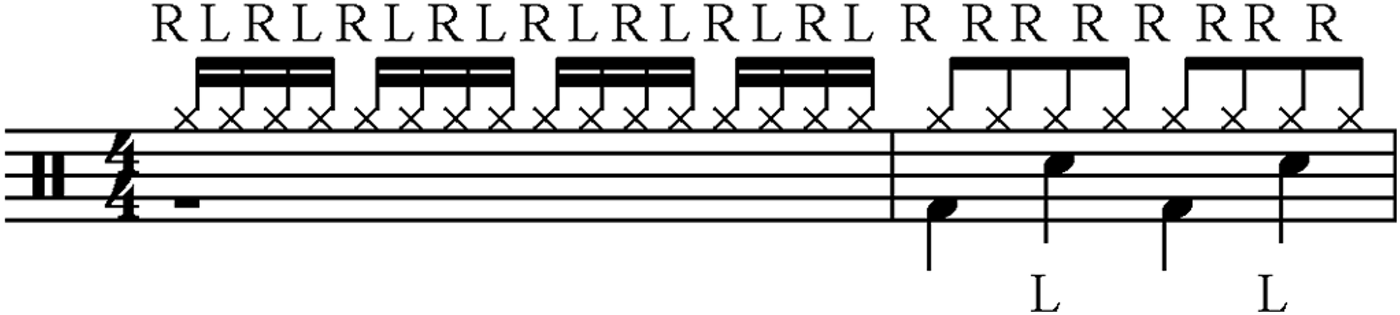
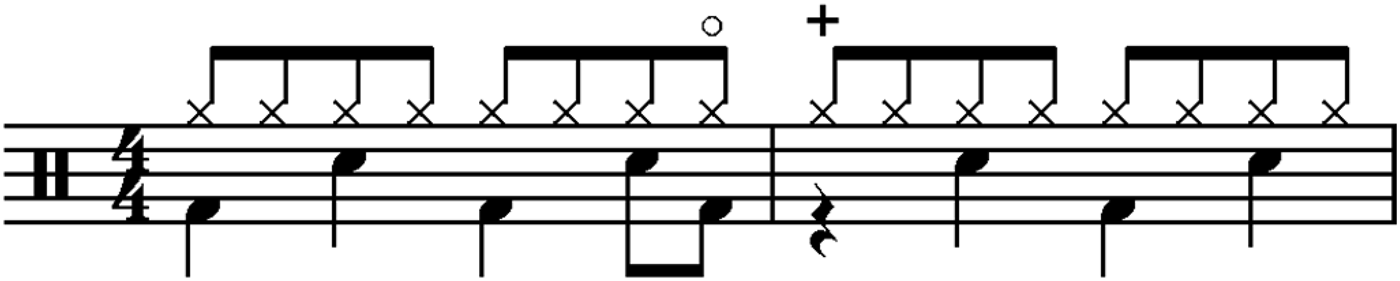
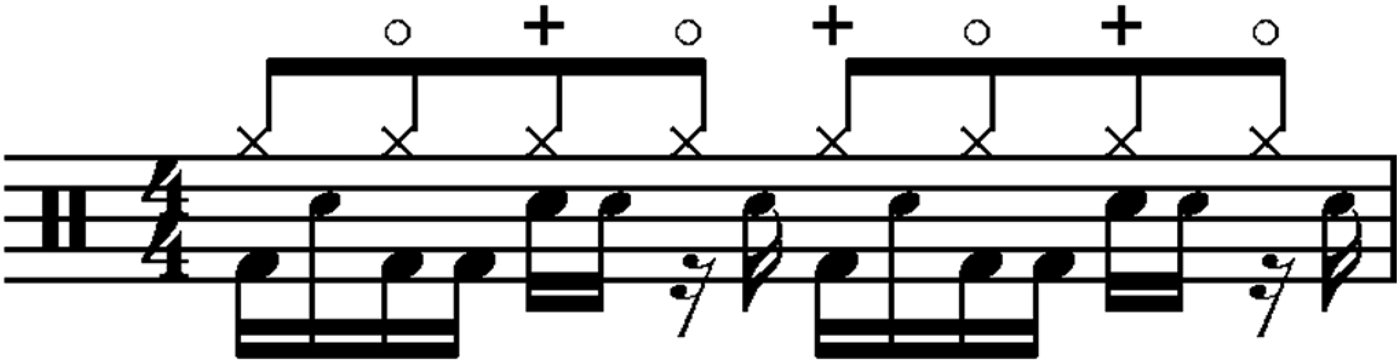
The second stage (see Example 1) to the 16 beat has its roots in the same period as the first. The evidence of the lack of this leading stick snare-playing in standard drumming is the apparent avoidance of it in a first stage context. The previously mentioned ‘Too Busy Thinking About My Baby’ and ‘This Boy’ both include a migration from plain hi-hat semiquavers to a full beat with snare inclusion, seen in Example 4:
Moving from hi-hat semiquavers to standard 4/4 rock beat.
This is reached by retaining quavers in the right-hand stick on the hi-hat but moving the left-hand stick down to the snare drum. This interrupts the semiquaver feeling of the rhythm. At slower tempi, a semiquaver feel can be achieved with the right-stick only on the hi-hat (using the ‘push-pull’ method with alternating accented and unaccented notes) while keeping the left stick in the conventional snare position, shown in Example 5:
Semiquaver pattern played on hi-hat with only the right-hand stick, achieved by using the ‘push-pull’ method, alternating accented and unaccented notes.
Before the second stage was standard on a drummer's palette, drummers often achieved a semiquaver feel with backbeat by applying greater physical exertion with only the right-hand stick on the hi-hat. Uriel Jones can be heard employing this method on Edwin Starr's ‘Running Back and Forth’, Stevie Wonder's ‘Heaven Help Us All’ and The Jackson 5's ‘Darling Dear’, all recorded in 1970, as well as Clyde Stubblefield on James Brown's ‘Funky Drummer’, recorded in 1969. This does of course allow for snare ‘ghost notes’ due to the freedom of the left hand, which was a possible consequence of the technique. Therefore, a lot of early examples of retaining both sticks on the hi-hat and moving the right stick to the snare appear to grow out of the wish for a backbeat in a first stage context.
A clear example of this hails from Elvis Presley's filmed shows at the International Hotel in Las Vegas in 1970. These were released by Metro-Goldwyn-Mayer and were entitled That's the Way it Is. The studio original of the composition ‘Suspicious Minds’ was recorded in 1969 and featured Ronnie Tutt playing first stage hi-hat semiquavers in the verses, which then moved to the standard snare position for the left-hand stick for the latter part of the verses into the choruses. The transition between first stage and a standard pattern was marked with miscellaneous drum breaks. An obvious discrepancy can be heard in performances from different evenings, when the song was performed live and at a quicker tempo for That's the Way it Is. One well-known performance of this is featured in the 2001 special edition release of the film, in which Tutt plays the first section of the verses in first stage, plays a drum pick-up, then continues with snare backbeat in a standard quaver cross-stick technique. However, in the performance featured on the soundtrack released alongside the film (and included as an outtake on the DVD) Tutt begins the piece in first stage, does not include a pick-up, and proceeds to retain the hi-hat semiquavers while adding the snare backbeat with the right-hand stick. This is clearly visible in the footage from the outtake where he then reverts to the original pattern for the remaining verses. There are two possible explanations for this: (1) Tutt's lack of inclusion of a pick-up may be the key element, as without it the sticks don't reach the conventional cross formation. The pick-up could have been an accidental oversight and the right-hand snare notes could have acted as the prevention of an error; thereby providing a recovery backbeat where the song structure called for it. (2) Another explanation could lie in Tutt's country music roots. A standard country drum beat features both sticks playing the snare drum with a semiquaver groove, and an accent with the right-hand stick provides the backbeat, as in Example 6:
Country beat, featuring snare-only sticking with accents on the backbeat (or off-beat depending on notation choice, used here), showing how the backbeat in this context is only acquirable with the right-hand stick.
Tutt's decision to use the right-hand stick in the second stage context could have stemmed from this generic pattern. Whatever the reason, the resulting feel was one Tutt evidently became partial to as future performances of this song featured this pattern in nearly every verse.Footnote 5
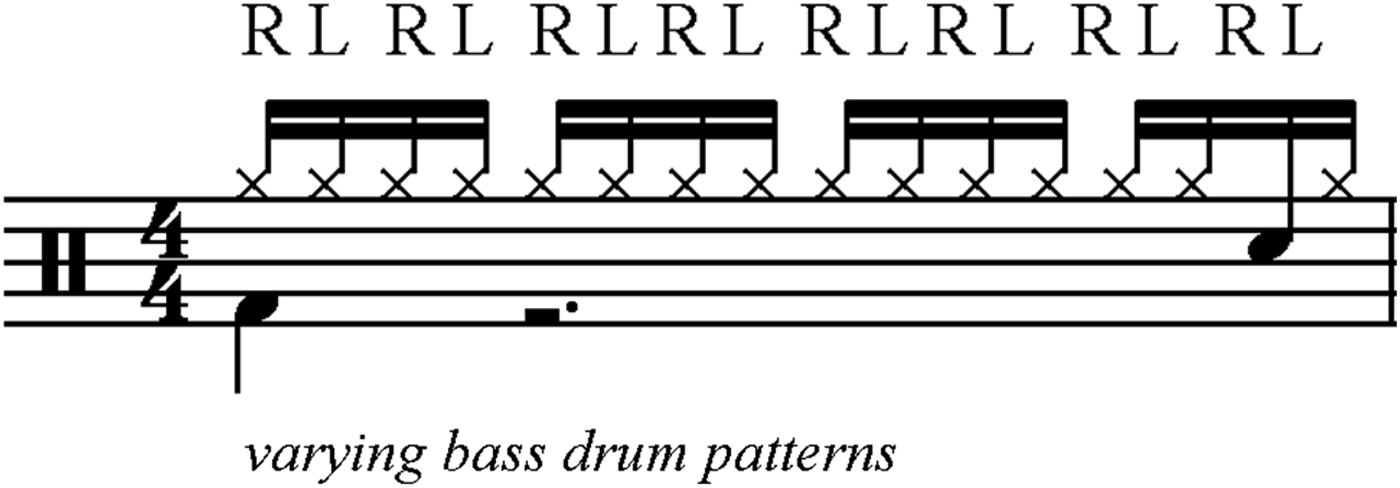
Other early examples of right-hand snare drum notes emerging from a first stage context do not necessarily come from the wish for a backbeat. On the Jackson 5's ‘The Love You Save’, recorded in 1970, drummer Gene Pello maintains first stage hi-hat semiquavers in the verses and moves to a standard cross-stick 4/4 pattern for the choruses. In the bridges, however, he initially returns to first stage but plays a right-stick snare note on the ‘4 + ’ of the bar to provide an upbeat to the new bar, seen in Example 7:
‘Preparation’ right-stick snare note in otherwise first stage context, featuring various bass drum patterns that differ from bar to bar.
In this rhythmic pattern the snare note cannot be considered a backbeat as it only exists to prepare an accent; the accent in this case being the bass drum note that signifies the start of the succeeding bar.Footnote 6 In a jazz setting, a right-stick snare note travelling from the hi-hat again is not part of a groove or ostinato. Rather it is a way to add accents and could instead be considered an auxiliary movement, with the right-stick snare playing existing only as a means of transport around the rest of the drum kit. A clear example of this resultant second stage positioning of the stick is visible in 1968 footage of Mel Lewis playing with the Thad Jones/Mel Lewis Orchestra on the number ‘Once Around’. Footnote 7 Mel Lewis' solo begins with various rudiments played between the hi-hat and left side cymbal: the effect created is a concentrated, quiet anticipation movement around and towards the drums and other cymbals, thus creating an instrument-specific crescendo. As Lewis moves from playing the hi-hat to the rest of the set, starting with snare drum and rack tom, he appears to delay the transition by adding randomised snare notes with the right stick, almost creating a ‘prediction’ of the sonorities to follow the hi-hat solo. In this situation, Lewis would have had no choice but to employ the second stage growing out of the first stage.
These examples document the iteration of this beat after a period of first stage before the iteration of second stage.Footnote 8 However, we must also note that there are recordings that employ second stage without this initial stimulus. John Densmore of The Doors plays second stage 16 beats on ‘The Soft Parade’ from 1968 and ‘Peace Frog’ from 1969, without any traceable origins. Footage of Densmore playing this can be seen in the PBS Critique soundstage performance of ‘The Soft Parade’ from 1969. Hal Blaine, although slightly later, employs an ‘unforced’ second stage 16 beat during the vocalised sections of America's 1972 composition ‘Ventura Highway’. But most notable of all are a collection of second stage examples hailing from before even the first stage had established itself. Al Jackson, drummer for the Stax record company, played a second stage 16 beat in 12/8 on ‘Pain in my Heart’ and ‘That's What my Heart Needs’, both from 1963, and ‘I'm Sick Y'All’, recorded in 1966. The earliest of all comes from Clayton Fillyau on James Brown's live album ‘Live at the Apollo’ during ‘I Found Someone’ (which was part of a medley including ‘Please, Please, Please’ and ‘You've Got The Power’), again played in 12/8. This was recorded in October 1962 and pre-dates even the earliest examples of first stage.
Innovation in the field of the 16 beat can often be achieved as the result of a desire to purvey a certain feel. A clear example of the drummer arriving at second stage can be heard from Zigaboo Modeliste in The Meters' ‘Cissy Strut’, recorded in 1969. The piece belongs to the New Orleans Funk genre and therefore requires a swung, laid-back feel. Modeliste's hi-hat semiquavers (notably not on every semiquaver of the bar) are played at a slow enough tempo for only the right stick to be used. On listening to the recording, it is possible to think that it is indeed one stick on the hi-hat, partly because of the tempo and partly because of the inclusion of a hi-hat note with each snare backbeat.Footnote 9 This, however, would compromise the feel of the genre, as the resultant groove would be one that sounded tense. Modeliste's decision to use both sticks on the hi-hat and to play the snare backbeat with the right stick means he could physically relax and allow the groove to sound laid back. As Alexander Stewart suggests:
this shift [from swung to straight] supported further subdivision to sixteenth-note [semiquaver] rhythms that were exploited in New Orleans R&B and Funk … New Orleans drummers excelled in the creation of catchy beats (usually one- or two-bar repetitive patterns) that were innovative while being rooted in their city's percussive traditions. (Stewart Reference Stewart2000, p. 293)
African American music is the most salient genre in this innovation. The decision to use the right-hand stick to play the snare drum during a semiquaver passage is born of an obvious want for a backbeat emphasis, and this is traceable in the history of African American music. Jon Fitzgerald describes it thus:
The so called ‘Motown sound’ incorporates … the use of handclaps, fingerclicks and tambourine to emphasise the ‘backbeat’, which is common to many African-American musical styles and clearly consistent with gospel practice. (Fitzgerald Reference Fitzgerald1995, p. 5)
This natural instinct in African American music is a potential catalyst for innovation in the field of the ‘16 beat’; the desire to maintain a backbeat on ‘2’ and ‘4’ led to the entry of snare notes played with the free stick at that moment, from the position of hi-hat double-sticking. Therefore, genre did indeed play a part in the progression of this particular technique.
The development of the open hi-hat in popular music and the placement of a single open hi-hat note
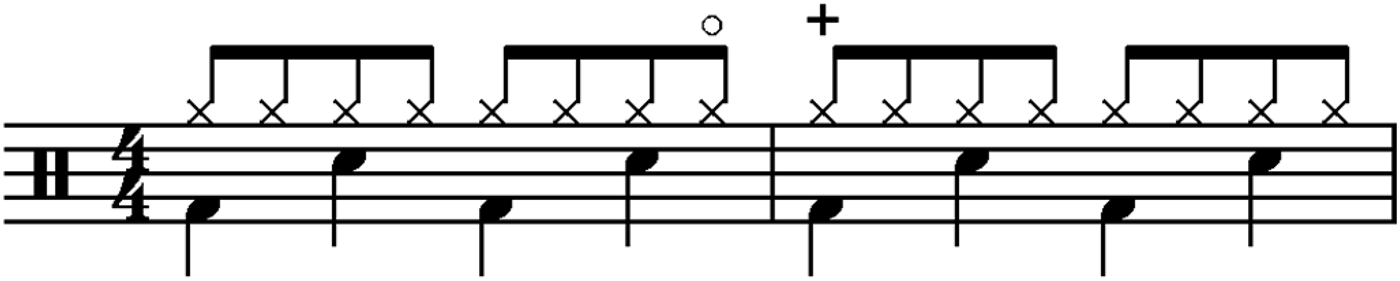
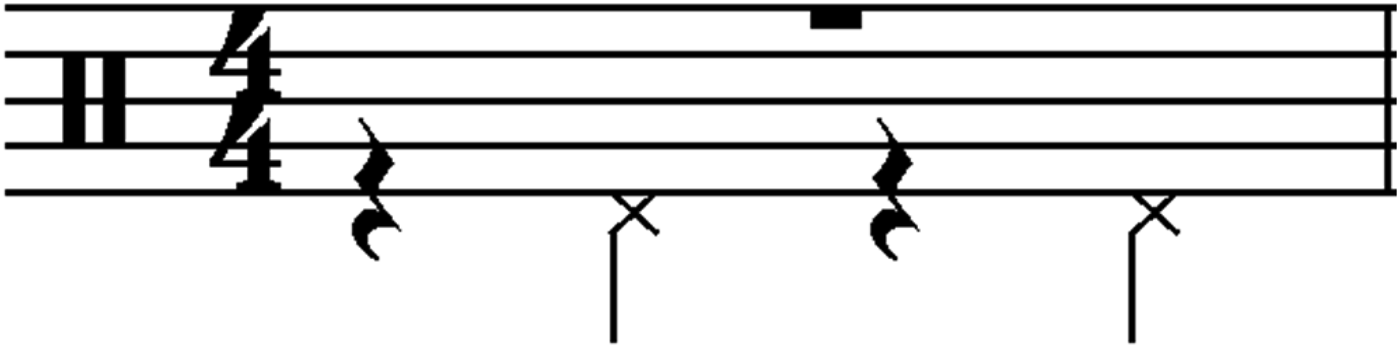
A common device used in modern drumming is the inclusion of an open hi-hat note on the ‘4 + ’ of a standard 4/4 groove thereby providing a sense of ‘leading on’ to the next bar, as in Example 8:
Open hi-hat note on 4 + , leading to ‘fall’ onto the succeeding bass drum note.
This standard practice was still developing during the 1960s and early 1970s and its evolution can be traced in the popular music of the period.
The first step to this device becoming standard practice is the decision to include an open hi-hat note in a bar of straight playing. During the early 1960s, the standard practice was to use the hi-hat simply to keep time by playing quavers on the closed (or slightly open) cymbals to accompany the bass drum and snare drum notes (and it is worth saying that we must be careful not confuse the trajectory of the specific examples used in the previous section with those that chart the trajectory of this technique in the present section). This simplistic reading of hi-hat technique may be a product of the infancy of straight drumming, as rock drumming as a concept had not been addressed and drummers of the period would have been trained in jazz techniques, an area which requires further research. Alexander Stewart writes on this on this metamorphosis that:
many jazz historians have shown interest in the process whereby jazz musicians learned to swing … but there has been little analysis of the reverse development. … By the 1960s, division of the beat into equal halves had become common practice. (Stewart Reference Stewart2000, p. 293)
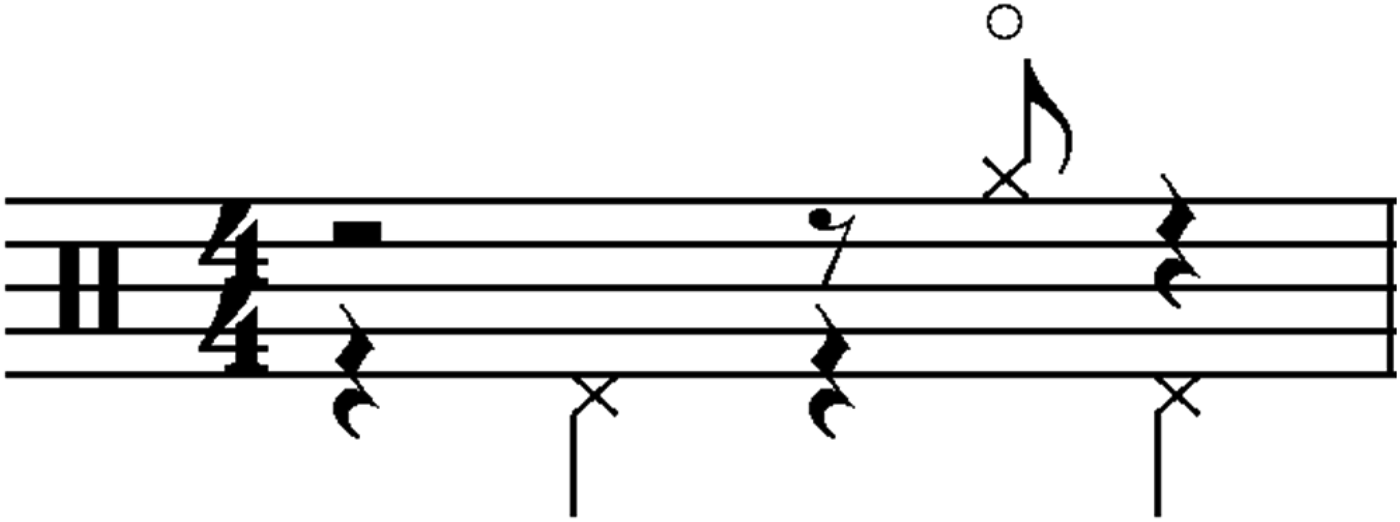
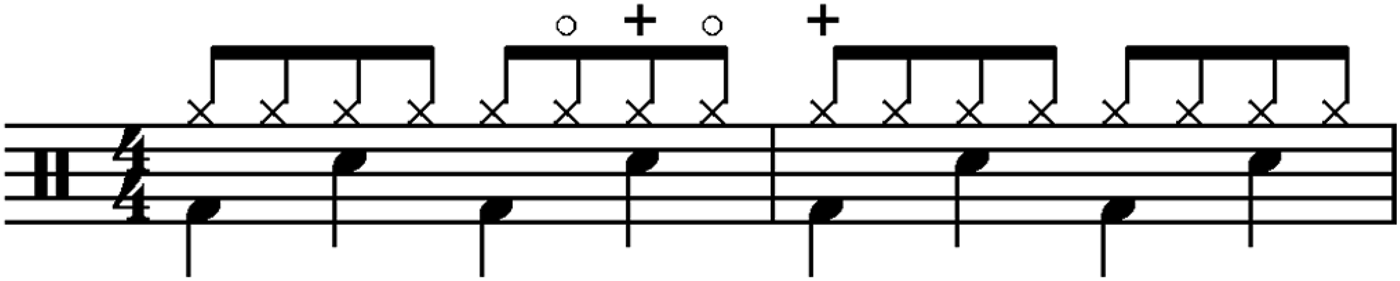
The earliest examples of an open hi-hat in straight time are often placed in a different position in the bar to the fully evolved ‘4 + ’ position. A common early position is to place the open hi-hat on ‘3 + ’, leading to the succeeding upbeat (seen in the following Example 9), instead of the ‘4 + ’ leading to the next bass drum note in the succeeding bar.
Open hi-hat note on 3 + , before the backbeat.
A clear early example of this technique features in Wilson Pickett's 1966 recording of ‘Mustang Sally’, played by Muscle Shoals Rhythm Section drummer Roger Hawkins. This way of opening the hi-hat serves to round off the bar, as opposed to linking it to the next. It could be argued that the placement of the open hi-hat on ‘4 + ’ is the most logical because of the feel it projects and, with hindsight from the point of view of today's techniques, the 1960s and early 1970s approach of the ‘3 + ’ position may seem strange. The explanation of this position's popularity could be explained by referring to the jazz roots that most drummers at the time had. A standard jazz groove requires the drummer to provide a sense of the upbeat by closing the hi-hat with the foot on beats ‘2’ and ‘4’ of the bar, as seen in Example 10:
Jazz backbeat, closing the hi-hat with the foot on beats 2 and 4.
Physically, when playing this, the foot has to lift on beats ‘1 + ’ and ‘3 + ’, and if the hi-hat is played with the stick during this technique then the resultant open sound naturally falls before the backbeat. It is possible that early rock drummers, with jazz training, felt that the closing of the hi-hat should still fall on the backbeat, with the open sound occurring before this rather than afterwards. It is easier to examine this notion when an open hi-hat note is played without being incorporated into the full groove. In The Hollies' ‘On a Carousel’ from 1967, drummer Bobby Elliott keeps time in the introduction by closing the hi-hat on beats ‘2’ and ‘4’. Halfway through this passage, Elliott strikes the hi-hat cymbals on ‘3 + ’ as they are preparing to close on ‘4’, thereby producing an open sound that is then muted by the foot chick, as seen in Example 11Footnote 10:
Hi-hat struck directly before jazz foot chick, resulting in a swiftly muted accent.
The jazz foot chick is a possible explanation for this early open hi-hat placement. As well as the open hi-hat note on ‘3 + ’, because of the above reasons, the sound also appears on ‘1 + ’, as in Example 12:
Open hi-hat notes on 1+ and 3+.
An early example of open hi-hats on ‘1 + ’ as well as ‘3 + ’ can be heard on the Archie Bell and the Drells' 1967 track, ‘Tighten Up’, played by Bernard Purdie. Throughout the playing time of the recording, Purdie opens the hi-hat on ‘1 + ’ and ‘3 + ’ before each snare note. This is a technique that Purdie continued to use on recordings after ‘Tighten Up’, on several Aretha Franklin tracks recorded between 1971 and 1972, and on Steely Dan's ‘Kid Charlemagne’, recorded for the 1976 album, The Royal Scam.Footnote 11
The emergence of an open hi-hat note on ‘4 + ’ rather than the ‘3 + ’ could be attributed to a musical accent. In early examples of this device, a bass drum note is often included underneath the open hi-hat note, while the first beat of the succeeding bar lacks a bass drum note, shown in Example 13:
Involuntary open hi-hat note falling on 4 + , resultant of an accented ‘push’ on the 1 of the succeeding bar.
This situation can be heard in BB King's 1969 track, ‘Why I Sing the Blues’, from the album Live and Well. Herbie Lovelle includes an open hi-hat on ‘4 + ’ that is covered with a bass drum note. The reason for this device is to move the ‘1’ of the next bar to a quaver beat in anticipation, thereby creating a ‘push’. It seems that the open hi-hat only serves to further accent the bass drum note and therefore is not used to lead on to the next bar in its own right.Footnote 12 Therefore, a ‘4 + ’ open hi-hat without a bass drum note supporting it would achieve a leading feeling.Footnote 13 The clearest early examples of open hi-hat on ‘4 + ’ without the purpose of accent but to link the bars can be heard in recordings that session drummer Hal Blaine played on in the mid- to late 1960s. On two tracks by Johnny Rivers, ‘Poor Side of Town’ recorded in 1966 and a cover of The Four Tops' ‘Baby I Need Your Lovin'’ from 1967, Blaine plays open hi-hats on ‘4 + ’ of each bar, without a supporting bass drum note, which thereby leads on to the first bass drum note of the succeeding bar.Footnote 14
As mentioned earlier, the development of hi-hat technique in straight drumming was still evolving but there is a possibility that the technique could have progressed over a shorter period of years when considering other factors which affected drummers' performance. In an interview conducted with Hal Blaine on the open hi-hat sound during the 1960s, he described his experiences:
I call [the open hi-hat sound] ‘squeeze box’. I was fascinated by the sound, I tried it a few times and each time the producer(s) said, ‘Hal, don't do that hissing sound, it sounds like white noise’. I always said ‘Sure’, but kept on trying different producers' sessions. I finally did ‘Poor Side of Town’ for Johnny Rivers and he loved the sound. After that, practically every time I did a session, producers would ask for that hit sound! So once it's a hit, everyone wants it.
This evidence could suggest that this technique, as far as the awareness of the performers is concerned, could actually have been ahead of known recorded examples. If ‘Poor Side of Town’ was the first example of the ‘4 + ’ open hi-hat that was accepted among studio technicians, and although Blaine discusses it as his first usage of this device, it is possible Blaine may have been defiant previously. This is the case in his performance on ‘Monday, Monday’ by The Mamas and the Papas which dates from 1965 where the ‘4 + ’ open hi-hat is clearly present, thereby making this piece a contender for the earliest recorded example of this technique, as well as a landmark in the development of Blaine's signature style.
The ‘disco groove’
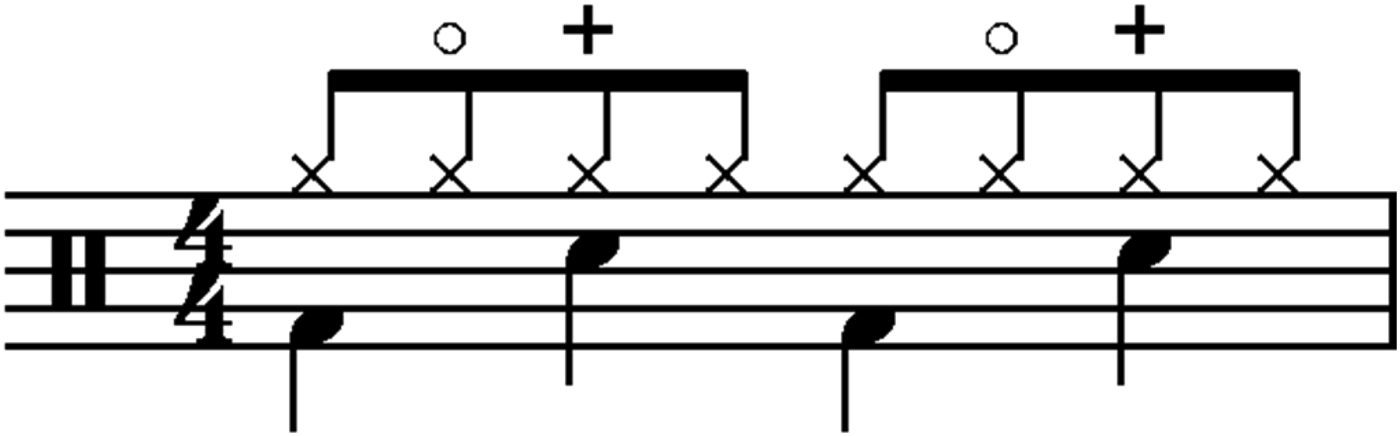
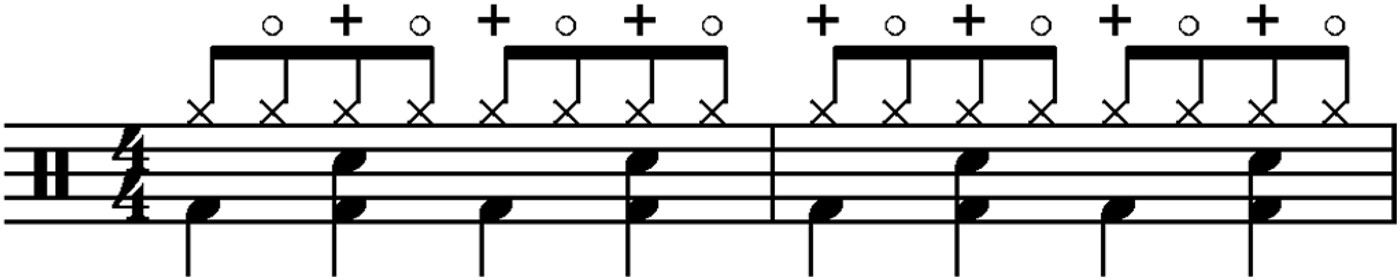
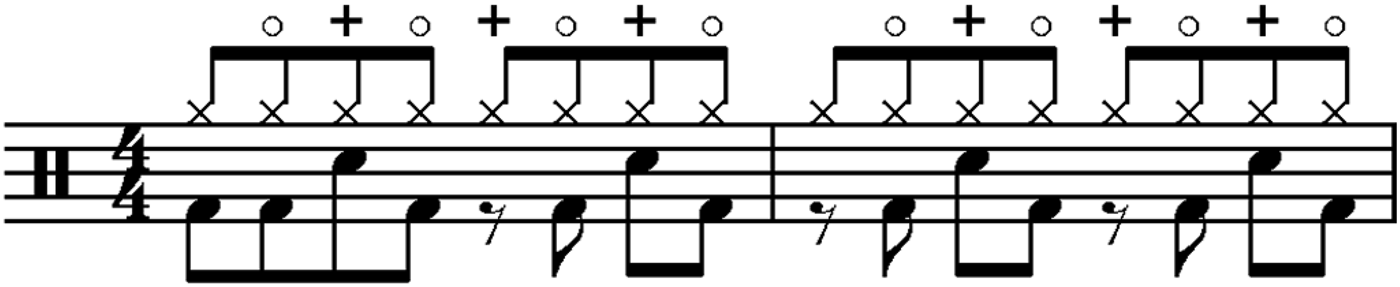
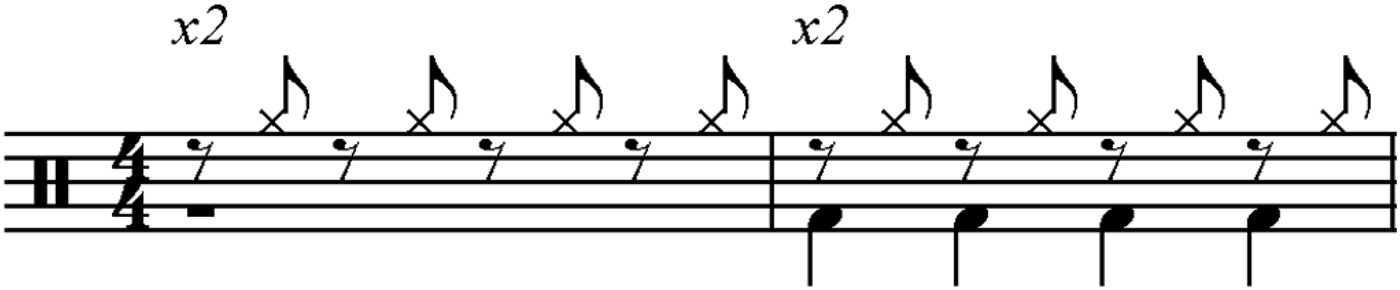
One of the first grooves a beginner drummer learns is what is commonly referred to as the ‘disco beat’. This comprises an open hi-hat on every off-beat in a 4/4 groove, with a ‘four-on-the-floor’ pattern played on the bass drum, seen in Example 14:
Fully evolved ‘disco beat’, featuring four-on-the-floor and open hi-hat notes on every off-beat.
Essentially, this beat incorporates two grooves at two different tempi; the snare provides one tempo by playing on ‘2’ and ‘4’ as in a standard rock groove, while the off-beat open hi-hat and the bass drum provide the second tempo in what could be considered double-time with the off-beat acting as a secondary upbeat. The key to this feel firmly lies in the hi-hat technique. This groove reached its popularity in the late 1970s in the disco scene and has continued to have relevance in other genres since then, with more recent trends being indie rock, dance and EDM (electronic dance music).
Disco as a genre grew out of the Philadelphia Soul scene in the late 1960s and early 1970s. The drummer most associated with this genre is Earl Young, who played drums and sang with the vocal group The Trammps, and played drums with the MFSB Orchestra on the SalSoul label. He lays claim to ‘inventing’ the disco groove (see Example 14); in an interview recorded in 2010 he states that ‘the sock cymbal [hi-hat] is the main thing when I'm playing, because that's your whole timing, your whole feel’.Footnote 15 Young cites the first recorded example of his using the continuous open hi-hat and four-on-the-floor bass drum as ‘The Love I Lost’, which was a Harold Melvin and the Blue Notes track from 1973.Footnote 16 However, the germination of this idea exists earlier than this statement. Although without a true four-on-the-floor, a continuous open hi-hat is heard in the introduction and instrumental bridge of The Trammps' ‘Zing! Went the Strings of my Heart’, which was released as a single in 1972 but recorded in 1971. Despite not including the bass drum with the snare drum on ‘2’ and ‘4’, the lack of other syncopated bass notes still makes for a back and forth feel between the drums and the hi-hat. Young indeed pioneered the exact feel and method of the beat in an up-tempo Soul groove, but it is important to note that essential elements of the groove exist in examples that date from before this period.
These essential elements of the groove are traceable in music from the years predating the late 1970s and understanding the origins of these individual components is key to the eventual arrival at the groove. The first step to consider as the germination of this groove is the use of consecutive open hi-hat playing – in other words, more than one open hi-hat note, one following the other. A clear, early example of this can be heard in Tyrone Davis' recording, ‘Turn Back the Hands of Time’, played by drummer Quinton Joseph in 1970. Joseph makes extensive use of the open hi-hat sound throughout the track and often plays two consecutive off-beat open hi-hats on beats ‘3 + ’ and ‘4 + ’, illustrated in Example 15Footnote 17:
Two consecutive open hi-hat off-beat notes, the first step to continuous off-beat open hi-hat.
Because the most important component of the disco groove is arguably the continuous off-beat open hi-hat, namely on beats ‘1 + , 2 + , 3+ and 4 + ’, the decision to place the open hi-hat notes close together is an obvious springboard. One theory explaining the abundance of the open hi-hat in this recording can be presented by examining the lack of other drum kit components that can be heard. As well as the consecutive open hi-hat previously discussed, the open hi-hat sound is generally used throughout the track to provide accents where there are no other audible cymbals at all. We would suggest that Joseph was performing on a drum kit that was void of any cymbals other than the hi-hat, and therefore was inclined to use the open hi-hat sound as a substitution for ‘crash’ accents. Furthermore, the performance does not feature any playing of toms, which also could be physically missing from the drum kit, meaning that the kit featured only a bass drum, hi-hat and snare drum.Footnote 18 The progression of technique may, in this case, be attributed to a performer attempting to cultivate the most from limited resources.
Another possible origin of the disco groove is quite simply that it evolved from live playing – for example, the spontaneous opening of the hi-hat on every off-beat. An example of this comes from Deep Purple drummer Ian Paice during a live performance of ‘Mandrake Root’ at Granada Television Studios in 1970, shown in Example 16Footnote 19:
Ian Paice's open hi-hat on every off-beat during ‘Mandrake Root’.
During a section of the piece when guitarist Ritchie Blackmore is playing rhythmic semiquaver figures and descending scalic patterns with organist Jon Lord, Paice is playing a standard quick tempo rock beat with ghost notes on the snare drum and bass drum at around 130 bpm. Once this section of the music is established, Paice gradually begins to open the hi-hat on every off-beat. The resultant sound is not one of a definite established off-beat open hi-hat, it is one of uncertainty. Paice's open hi-hat may be attributed to a foot stomp helping him keep time at such a quick tempo and it is perhaps accidental that his drum stick strikes the open hi-hat while it is in preparation to be closed, as opposed to a conscious accented open sound. This can be heard and seen in the earlier parts of the piece, when Paice is opening the hi-hat with the foot but never actually striking it while the cymbals are apart. This action is not enough to achieve an ‘open’ sound, but as the music crescendos Paice becomes heavier with the sticks, apparently notices the resultant sound of the open hi-hat and begins to accent it; the foot and the stick become acquainted.
This linking of the stick with the foot to achieve this sound consciously is important in the evolution of the groove. Early examples of continuous off-beat open hi-hats were used as a signpost of the structure of a song. This can be noticeably heard in the Five Stairsteps track ‘Ooh Child’ from 1970, which features drummer Bernard Purdie employing this hi-hat ostinato in the choruses, notated in Example 17:
Purdie's open hi-hat notes in the choruses of ‘Ooh Child’.
Because this use of the hi-hat gives more movement to the choruses, it is apparently intentional, a conscious decision from Purdie to add more to the beat at this point in the track.Footnote 20
A further reason for which the hi-hat is played in this fashion is if there is the need for an accent on every off-beat. This situation occurs in ‘Higher’, a Sly and the Family Stone track released on the 1968 album Dance to the Music and recorded in late 1967. In the choruses of this track, bassist Larry Graham places his notes between the crotchet beats which creates a pushing feel in the music. Drummer Greg Errico responds to this by opening the hi-hat on these pushes, but covering the open hi-hat with a bass drum note, as in Example 18:
Greg Errico's continuous open hi-hat notes played with bass drum notes, creating ‘pushes’.
Therefore, the hi-hat is used to further emphasise the bass drum placement, instead of working against the bass drum; in a sense the off-beat almost becomes the true beat. This is an important part of the development of the technique as it should be noted that it cannot be linked to the development of the technique within disco because the characteristic effect of the ‘back-and-forth’ between the bass drum and hi-hat is not present.
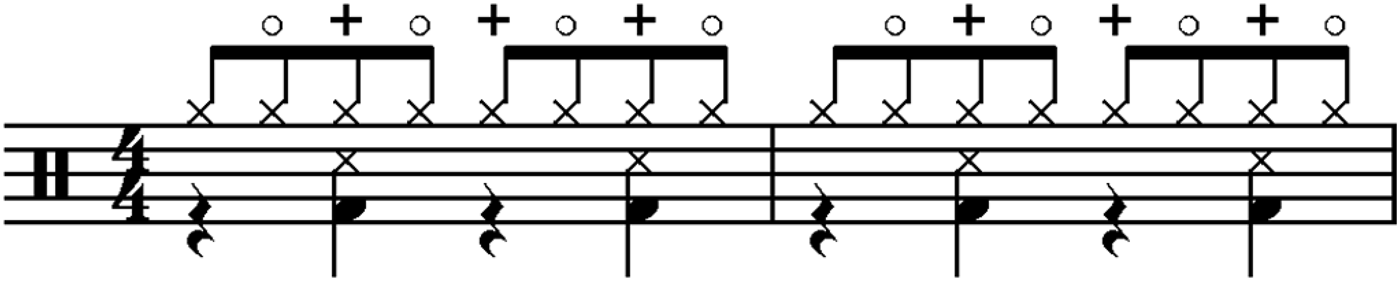
Another genre which predates disco and which first used a continuous off-beat open hi-hat to create a ‘back and forth’ (as opposed to covering the open hi-hat with a bass drum note) is ska and early reggae. A common beat in Jamaican ska is to play the off-beat hi-hat with the bass drum landing on ‘2’ and ‘4’, where the snare drum would be in a rock groove but with the snare drum note replaced by a stick-across, shown in Example 19:
Common reggae groove, featuring continuous off-beat open hi-hat and stick-across with bass drum on the backbeat.
This beat is only one bass drum note away from achieving the disco groove. One of the earliest examples of this beat can be heard in the Toots and the Maytals recording, ‘Broadway Jungle’, dating from 1963.Footnote 21
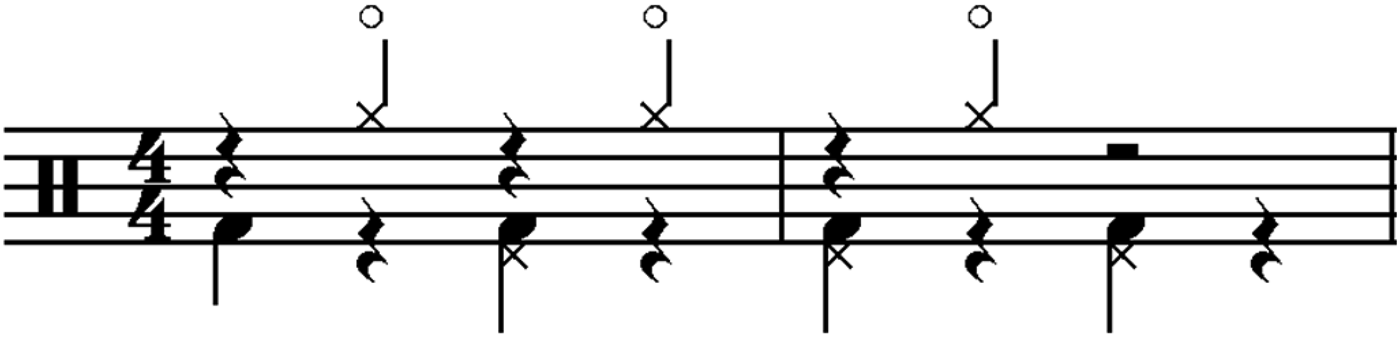
Despite the use of the hi-hat in this manner in all of the above examples, none actually purveys the feel of disco. As we have stated, the relationship between the open hi-hat and the bass drum is the key to arriving at the beat. The previously discussed double-time beat within disco is played out on these two components. An early example of the open hi-hat used as the upbeat comes once again from Ringo Starr on the Beatles track ‘Being for the Benefit of Mr Kite’ from the 1967 album Sergeant Pepper's Lonely Hearts Club Band. The bass drum is conventionally played on ‘1’ and ‘3’ and the open hi-hat replaces the snare drum beat, giving more of an ‘up and down’ feel, almost deliberately dragging the feel of the time signature, shown in Example 20:
Starr's early disco allusion, as yet without diminution.
If the counts of the bass drum were renamed ‘1, 2, 3 and 4’ instead of the implied ‘1, 3, 1, 3’, Starr would have achieved the integral part of the disco sound. An early version of the bass drum on ‘1, 2, 3 and 4’ along with the opening hi-hat, without a snare note, can be heard on the vamp sections of King Curtis and the Kingpins' ‘Memphis Soul Stew’ from live shows in 1971,Footnote 22 and in the introduction and instrumental sections of Gil Scott-Heron's ‘Home is where the Hatred is’, also from 1971. Both of these drum tracks were played by Bernard Purdie, where during these passages he plays the hi-hat with both sticks in semiquavers in the ‘first stage’ of the 16 beat.Footnote 23
From the evidence outlined here, we can observe that the individual elements of the disco groove existed in different areas of music from before Young consolidated them. The fully evolved beat incorporating the bass drum on every crotchet of the bar and the open hi-hat on every off-beat (see Example 14) is traceable long before Earl Young's claims of innovation. To hopefully seal this point, Stax drummer Al Jackson plays this particular groove in the bridges and outro of the Sam & Dave track ‘You Got Me Hummin'’ which was recorded in 1966 and released in 1967, thereby predating some examples of the isolated components of the groove that have already been mentioned.
To conclude this section it is worth discussing an extension of this groove where the hi-hat is solely played on the off-beat, only striking the cymbals between the crotchet beats and either keeping the cymbals together to give a staccato sound or opening the hi-hat as previously discussed. This development marks the confirmation of the arrival of the groove as it is a recognition of its existence; in other words, the off-beat sound is no longer an accident but a goal within the groove. An early example of this technique can be heard on the original concept album of Jesus Christ Superstar in ‘The Arrest’, recorded in 1969 and released in 1970. In the early part of the piece, Bruce Rowland only plays the hi-hat on the off-beats of ‘1’ and ‘2’, with ‘3’ and ‘4’ being implied with various notes on the toms, notated in Example 21:
Bruce Rowland's closed, off-beat hi-hat strikes.
Although it is possible that this is the earliest iteration of this technique, it cannot be considered as the groove in question as the hi-hat notes are not on all four off-beats and are not grounded by bass drum notes on each crotchet. In fact, the bass drum covers the second off-beat hi-hat note, making it possible that the off-beat on ‘2 + ’ is actually an anticipated ‘3’. An early recording comprising the four-on-the-floor bass drum and ‘off-beat-only’ hi-hat is to be heard on Junior Walker and the Allstars' ‘Walk in the Night’ from 1972, and this is another Motown recording featuring Richard Allen and Uriel Jones. During the introduction, Allen can be heard sticking a closed hi-hat on all off-beats of the bar and, two bars later, he begins playing bass drum notes on all four crotchets, thereby creating the back and forth feel, as seen in Example 22:
Developing off-beat hi-hat notes and four-on-the-floor pattern, similar to Starr's in Example 20 but without open hi-hat and featuring correct diminution.
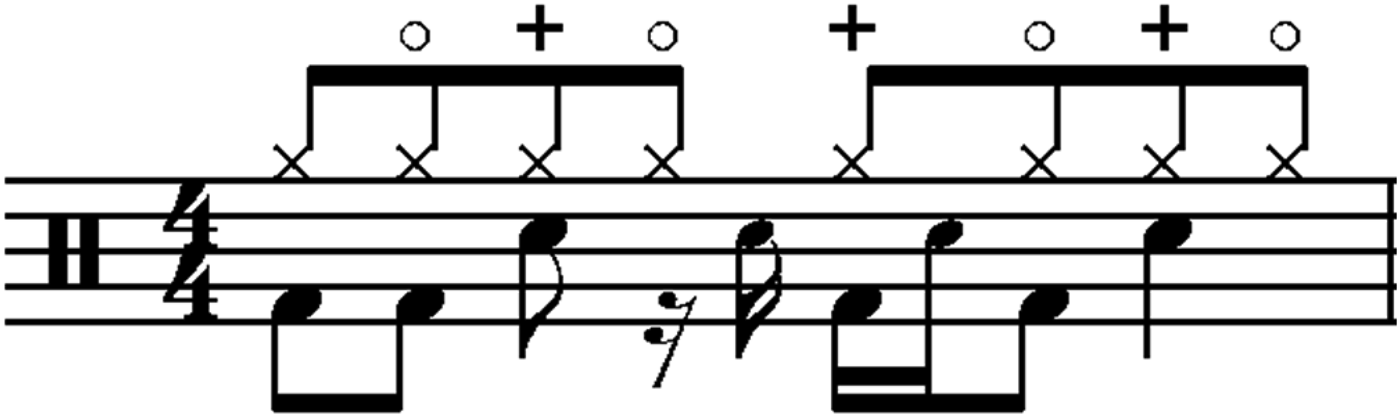
Allen never includes any notes to signify beats ‘2’ and ‘4’. However, after the introduction, Jones's stick-across rim-clicks and Jack Ashford's tambourine provide the backbeat as Allen's bass drum and hi-hat continue. Once the piece reaches the chorus, Allen maintains the hi-hat notes but discards the bass drum crotchets as Jones plays snare notes on all beats. The significance of this example of technique is difficult to measure as Allen's intention is not entirely clear. It could be that he was indeed attempting to bring a back and forth feel to the groove, aligning itself with the disco beat, or it could be a case of cross-rhythm. As discussed with Ringo Starr's performance on ‘Being for the Benefit of Mr Kite’, Allen could be purveying a double-time feel with the hi-hat off-beats being secondary upbeats. The result could have been an unconscious decision by Allen where he was unaware of the resultant off-beat sound and instead conscious of the cross-rhythm between drum kits. Because of this possibility, as well as the lack of a backbeat and the tendency to discard the bass drum crotchets, this performance still falls short of the groove previously outlined. It is possible that Allen's performance may have actually reached full maturity had he been the only drummer on the session, as he would have had to play all the rhythmic parts instead of the delegations that exist between percussionists. Therefore, because Allen's feel is unclear, we would need an example where there would be no question as to the drummer's motive. The contender for this also happens to be the earliest example of all previously discussed components in existence. It is by Ollie E. Brown on Stevie Wonder's 1973 performance of ‘Superstition’, from the television show Sesame Street. Footnote 24 Throughout the seven-minute-long performance Brown maintains a four-on-the-floor bass drum and, in different sections of the piece (initially to accompany the entry of the horn riff), plays continuous off-beat open hi-hat resulting in the fully evolved ‘disco groove’. During the encore of the piece, after Wonder induces a false ending, Brown can be seen playing the evolved beat and migrating from sticking the hi-hat on every quaver to only when the hi-hat is open, on every off-beat, as shown in Example 23:
Migration from sticking continuous open hi-hat off-beats on every quaver to only striking when open, matching the off-beat.
Innovation and the importance of basics
Examining the development of these three commonplace grooves (16 beat, open hi-hat and disco groove) demonstrates that the hi-hat has become an essential part of drum performance in Anglo-American popular music. It could also be argued that it has become an important element in drum programming, drum tuition and even in practices such as beat boxing. It has become a dominant force in the development of grooves. It has redefined the importance of the downbeat and the upbeat, and provided the drummer with a palette of techniques that can influence the entire feel of any groove. Further, it has also affected how other instruments in an ensemble respond to its sonic properties and beat placements. The aforementioned pioneering drummers may not have been aware of their influence on popular music at the time, but the effects their techniques have had across genres is truly remarkable and worthy of further investigation.
Acknowledgements
Many thanks to Hal Blaine for his participation in an interview on 15 November 2011.