Introduction
Administration of fluids remains an important intervention in prehospital and disaster situations.Reference Sever, Vanholder and Lameire 1 - 3 Even when there are sufficient personnel trained and qualified to start intravenous (IV) lines, the out-of-hospital setting can pose challenges to catheter placement.
Problems are compounded in multi-patient situations such as mass-casualty incidents (MCIs). In such a situation, there may be insufficient numbers of emergency providers, such as Emergency Medical Technician-Paramedics (EMT-Ps), who are trained to insert intravenous lines to meet the demand. In systems with both EMT-Ps and EMT-Bs, during a disaster, the paramedics may be employed as supervisors, critical treatment providers, or triage officers. In these events, which can overwhelm resources rapidly, their advanced skills may be better used for triage and the treatment of victims with traumatic injuries.
The concept of providing an alternative to obtaining IV access has been investigated previously. A preliminary trial, conducted using EMT-Ps and volunteers, demonstrated that access for enzyme-assisted subcutaneous infusion (EASI) was reliable, and that infusion of tracer-labeled glucose resulted in detectable intravascular glucose as early as 15 minutes after the infusion was initiated.Reference Soremekun, Shear and Patel 4
Enzyme-assisted subcutaneous infusion entails subcutaneous (SC) infusion, also called “hypodermoclysis,” facilitated by pre-infusion administration of human recombinant hyaluronidase (rHuPH20, or HRH). The HRH hydrolyzes hyaluronan, the major barrier to SC diffusion (and fluid movement).Reference Craig, Eikenberry and Parry 5 Pretreatment with HRH, approved in 2005 by the US Federal Drug Administration (FDA), increases local dispersion and absorption of EASI-administered drugs and fluids due to a short-lived (<24 hours) decrease in viscosity.Reference Bookbinder, Hofer and Haller 6 - Reference Frost 8
So-called “spreading agents,” historically derived from animal extracts, have been used clinically to facilitate dispersion and absorption of other drugs for more than 50 years.Reference Bookbinder, Hofer and Haller 6 The FDA approval for HRH states the drug is “indicated as an adjuvant to increase the absorption and dispersion of other injected drugs, for hypodermoclysis, and as an adjunct in subcutaneous urography for improving resorption of radiopaque agents.” 9 According to Baxter pharmaceuticals staff (personal communications), human recombinant hyaluronidase costs approximately US $90 per 150-unit vial. Previous studies have demonstrated that various solutions can be infused with little or no discomfort, at rates up to (and occasionally exceeding) 500 mL/hour.Reference Soremekun, Shear and Patel 4 , Reference Bookbinder, Hofer and Haller 6 , Reference Thomas, Yocum, Haller and von Gunten 10 - 12
One potential role for EASI access is utilization in cases in which IV access is not obtainable. A previous study (EASI Access I) focused on the capability of EMT-Ps to place and use EASI access.Reference Soremekun, Shear and Patel 4
The current study, EASI Access II, focuses on another potential role for EASI access: its use for cases in which there is a need for access to the intravascular compartment, but no ALS-level provider available. The potential use of EMT-Bs for the provision of emergency hydration (and glucose-administration) lines is noteworthy for MCIs, in which large numbers of patients easily can outstrip the available ALS resources.
The main goals of EASI Access II were twofold: (1) to assess the ability of EMT-Bs, who are not trained or qualified to place intravenous lines, to place EASI lines; and (2) to build upon the glucose uptake methodology validated in the EASI Access I study.Reference Soremekun, Shear and Patel 4 An additional goal was to administer a large amount of tracer-labeled glucose, and perform early and frequent phlebotomies to obtain a picture of the uptake of EASI-administered glucose.
Methods
Setting
The study was conducted in the Emergency Department at Massachusetts General Hospital, where Institutional Review Board approval was obtained.
Participants
Trial participants were recruited using an IRB-approved approach that required circulating the study's protocol and consent form to basic life support (BLS) providers for review. Due to the nature of the need for study subjects to understand the differences between BLS and ALS levels of care, and the need to understand the risks and potential benefits of the study, the participants were BLS providers with minimal experience (<5 years), who had just enrolled in a paramedic class. None of the participants had any experience with either IV or EASI access.
All of the subjects were healthy, and had none of the following conditions: pregnancy, diabetes, or infection at the site of IV or EASI placement. Subjects could not be anticoagulated, or be taking steroids or other immunosuppressants. Because of the potential for reduced hyaluronidase effectiveness, 9 the study excluded subjects taking more than 80 mg/day of aspirin. Subjects were not restricted as to diet during the time frame of the trial.
Interventions
The EMT-Bs who placed the 20-gauge EASI access lines each had received three to five minutes of training from a Baxter-employed nurse the morning of the trial. For subject safety reasons, this nurse remained on-scene during the entire trial. She assured safe and appropriate utilization of the recombinant hyaluronidase; no consultation with this nurse was required, and she did not have medical care contact with any of the participants.
Subjects were entered into the study in staggered fashion. This entailed initiation of EASI access in a group of four subjects, with completion of the initial group of frequent (i.e., every five minutes) phlebotomies on those four subjects, before institution of EASI access in the next group (by which time the first group of subjects were having blood draws at a longer spacing of 15 minutes). As part of establishment of EASI access, 150u HRH (Hylenex, Baxter International Inc., Deerfield, Illinois USA) was injected (1 mL).
Upon study commencement, an initial group of subjects had IV access placed by a nurse. These lines were used for subsequent blood draws. After the IV line was placed, a baseline (t = 0) blood sample was drawn.
Once the t = 0 blood sample was taken, the subjects were paired. Each member of a pair instituted EASI access in the other member of the pair. The EASI access lines were placed in the upper back in all subjects, and the EASI infusion with D5W was begun.
The infusate volume of 250 mL contained 12.5 g of glucose, all of which was stable tracer D-glucose-6,6-d2 (Cambridge Isotopes, Cambridge, Massachusetts USA). In this deuterated tracer, two C6 hydrogens had atomic mass of 2 (instead of 1), thus adding 2 units to the standard glucose formula weight of roughly 180. This enabled gas chromatography/mass spectrometry (GC/MS) methods to detect and differentiate the EASI-infused glucose with a formula weight of approximately 182, from glucose from another source detected in the phlebotomy samples.
Subjects indicated on a placement difficulty scale (0 to 10) their perception of how hard it was to establish EASI access. A 0 to 10 scale also was used to rate discomfort associated with infusion, both in the early (initial five minutes) and later stages of infusion. For both early and later infusion discomfort, subjects were asked to indicate the maximum level of pain associated with the EASI infusion during the time period in question (even if this pain maximum was reached only briefly). This separation of subject pain rating time periods into initial and later stages was made a priori based upon perception that the first few minutes of EASI infusion tend to be the most uncomfortable.
Study personnel were available to execute timing and subject tracking, so that study data were reliably collected on each subject. The goal was to record time information and perform timed phlebotomies, with precision to the nearest minute. Blood sampling occurred after EASI access and infusion institution, at times t = 5, 10, 15, 20, 25, 30, 45, 60, 90, and 120 minutes after EASI access infusion commencement. In every subject, all phlebotomies were obtained on schedule.
Once the EASI infusions were running, the subjects were maintained in a seated position. Subjects were allowed to ambulate during the infusion, and they also participated in helping keep blood draws on schedule.
Upon completion of a given subject's EASI infusion, the EASI access line was removed. Even if the infusion was completed within two hours, subjects stayed on-site for the t = 120 blood draw.
Once a subject's EASI access infusion was finished, and the final (120-minute) phlebotomy was executed, study procedures were complete. In order to track for possible infusion-site or other side effects, telephone contact was made with all subjects at 24 hours post-study. Any subjects experiencing problems at the 24-hour telephone call also were contacted at 48 hours post-study.
The blood samples were stored on ice on the day of the study, before transport to an adjacent hospital laboratory. In the laboratory, the samples were centrifuged and the plasma frozen, in preparation for GC/MS. The GC/MS methodology specifics in use at the laboratory executing these analyses have been reported in detail.Reference Yu, Wagner, Walesreswski, Burke and Young 13 In brief, the isotopic enrichment of glucose was determined by analysis of the plasma samples with a Hewlett-Packard 5985B quadruple mass spectrometer (Hewlett-Packard, Palo Alto, California USA), using positive chemical ionization with methane as the reagent gas. A 12 m × 0.20 mm ID, OV-1 capillary column, using helium as a carrier gas, was used in the gas chromatograph. Enrichments of glucose were calculated as atom percent excess, relative to the natural background (i.e., baseline) level of the isotope.Reference Yu, Wagner, Walesreswski, Burke and Young 13
Analysis
Descriptive statistics were used to assess data such as subject characteristics. For continuous variables and ordinal data (ease-of-placement and pain scales), descriptive techniques included calculation of medians with interquartile range (IQR). Proportional data are reported using binomial-exact confidence intervals (CIs); for those instances in which the point estimate was 0%, a one-sided 97.5% CI was calculated.
The initial study plan called for timing of need for EASI access placement, but all EASI access lines were placed within 15 seconds (on the first attempt). Additionally, the initial plan was to assess factors associated with failure of EASI access placement requirement for multiple attempts or the occurrence of “moderate” or “severe” pain. These a priori plans were nullified by the first-pass success in all cases, and by the absence of any pain of >3 on a 10-point scale. Therefore, the relevant analysis was limited to reporting of point estimates and CIs.
The plan for processing GC/MS results entailed multiple approaches. The first planned endpoint was the proportion of subjects in whom tracer-labeled glucose was detected at the initial (t = 5) blood draw. The second endpoint to be displayed graphically was the speed of absorption of the tracer-labeled glucose. The third endpoint was the calculation using the principle of “enrichment” (i.e., percentage of total blood glucose that was tracer-labeled).Reference Yu, Wagner, Walesreswski, Burke and Young 13 The method of using the trapezoid area-under-curve summation for calculating tracer-glucose absorption and enrichment using isotope-ratio mass spectrometry has been validated by another group of investigators.Reference Duro, Duggan and Valim 14
One aspect of the GC/MS data processing, absorption efficiency, was calculated with an understanding that the study protocol resulted in substantial underestimation. Due to the prolonged duration of the study, the fact that subjects were not fasted, and other logistical issues (e.g., need for multiple tracer infusions), the methodology of this study was virtually certain to underestimate the percentage of infused glucose that was absorbed.Reference Yu, Wagner, Walesreswski, Burke and Young 13 , Reference Duro, Duggan and Valim 14 These results are provided for purposes of interest and hypothesis generation.
Data processing was performed using STATA 10/MP (StataCorp, College Station, Texas USA). Statistical significance was set at the P = .05 level.
Results
Demographics of the 18 participants included a median age of 23 years with a range of 21-48 (interquartile range 21-26). There were 15 males (83%) and three females. With two exceptions, all subjects were white. The exceptions were a female who identified herself as Hispanic/African-American, and a male Colombian Hispanic.
The EASI access placement was successful in 100% of the 18 cases. The one-sided 97.5% CI for placement success was 82-100%.
EASI Access Placement Ease and Subject Discomfort
A 10-point numeric rating scale was used for operator-rated placement ease, with a score of 1 corresponding to the easiest rating and 10 to the most difficult. The EMT-B operators assigned the easiest rating (i.e., 1) in 16 of 18 cases (88.9%, 95% CI 65-99%), and the second-easiest rating (i.e., 2) in the other two cases (11.1%, 95% CI = 1.4-35%).
Subject-rated pain results were obtained for maximal pain experienced during the early (within the first five minutes of infusion, including catheter placement) and later infusion periods. The pain scale used ranged from 0 (no pain) to 10 (worst pain). The early pain score mode was 1 (10 cases or 55.6%, 95% CI = 31-78%). Six subjects (33%, 95% CI = 13-59%) experienced early pain maxima of 2, and two subjects (11.1%, 95% CI = 1.4-35%) reported their early infusion period pain reached 3 on the 10-point scale.
For the infusion discomfort maxima experienced after the initial five minutes of EASI infusion, the modal score was 1 (12 cases or 67%, 95% CI = 41-87%). Two subjects (11.1%, 95% CI = 1.4-35%) reported maximum later infusion pain of 2, and the remaining four subjects (22.2%, 95% CI = 6.4-48%) reported no pain.
IV and EASI Access Fluid Administration: Infusion Time and Subject Discomfort
In the current study, the investigators wished to optimize subject comfort. If even slight discomfort was identified by subjects, the EASI infusion rate was to be titrated downward. This precaution, based upon the investigators’ previous experience, was unnecessary, given the absence of any infusion-associated pain above the score of 2 (after the initial five minutes). Infusion rates nearly always were determined by gravity-maximal capability rather than any discomfort. Indeed, in many instances, participants squeezed their IV bags to increase flow rates.
For the 250 mL infusate, the median number of minutes for infusion was 38.5 minutes (range 21-112, IQR 29-55) minutes. The mean after infusion time was 45 (SD = 22) minutes. When expressed in terms of infusion rate per hour, the median was 393 mL/hour (range 134-714, IQR 273-517).
Gas Chromatography/Mass Spectrometry Results
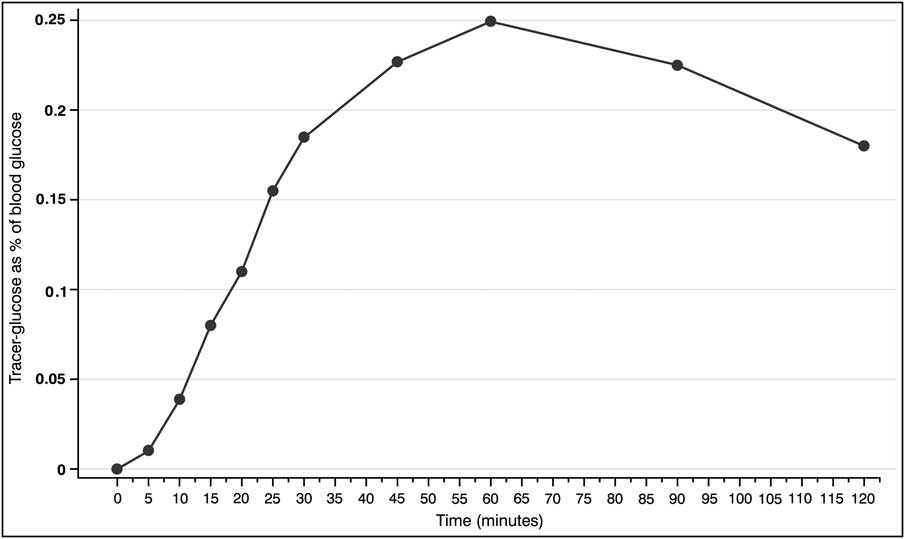
In all subjects, the tracer-glucose marker was detected at the time of the first phlebotomy (i.e., five minutes after EASI infusion commencement). Figure 1 is a graphic depiction of tracer-glucose absorption over time. The summary estimate for the area-under-curve (for 18 subjects) was a median of 16.3% (IQR = 14.2-22.3%). The interpretation of this number is that over the study period, 16.3% of the subjects’ blood glucose was tracer-labeled glucose. The figure also shows that the rise in tracer-glucose was rapid, approaching a peak within 30 minutes. An underestimated calculation (see previous discussion) for median absorption efficiency was 12.0% (IQR = 7.4-16.1%).
Tracer-Glucose Absorption Over Time (summation over n = 18 subjects)

Follow-Up
There were no serious side effects or complications at either the IV or EASI access sites. No physician reassessments were necessary for access site issues (or other reasons).
Follow-up identified three subjects reporting slight discomfort at the EASI access placement site. No subject reported pain at the EASI access placement site. A 48-hour telephone follow-up on the three subjects with slight EASI site discomfort identified no remaining symptoms. There were no major complications occurring either at the time of the study infusion or thereafter.
There were no cases in which pain or complications occurred (0%, 97.5% one-sided CI = 0-18.5%). For the three cases (16.7%) in which there was slight EASI-site discomfort, the 95% binomial exact CI for these minor complications was 3.6-41.4%.
Discussion
There are many situations in the prehospital setting in which there is a need for rapid access to the intravascular compartment, but there is no capability for IV placement. Because of the possibilities of such occurrences, which include MCI situations with limited ALS resources, this study focused on the potential for EMT-B providers to place access lines (EASI access) for hydration and glucose administration.
Although there is some controversy about prehospital fluids administration,Reference Alam and Rhee 15 clinical practice as well as standard texts emphasize the importance of early fluid resuscitation as a general therapy and for specific situations such as crush injuries.Reference Sever, Vanholder and Lameire 1 , 3 Literature addressing medical care in austere settings or MCI situations includes the importance of capability for use of alternative approaches (e.g., hypodermoclysis) for fluid administration.Reference Kramer, Hoskins, Copper, Chen, Hazel and Mitchell 16 - Reference Dalal and Bruera 18 In some cases, personnel who are qualified to start IVs may not be available during a disaster or may be deployed elsewhere. In other cases, during rescue efforts, customary sites for IV access may not be accessible to the provider. In both of these cases, EASI may be an appropriate and valuable alternative.
Hypodermoclysis has been well studied since the 1950s, and has been used extensively in children and in the elderly—both populations in which intravenous access may be difficult.Reference Sasson and Shvartzman 19 Hypodermoclysis offers advantages to IV routes with lower training requirements than by using IV line insertions, less likelihood of fluid overload, lower risks of infection and thrombophlebitis, and with less discomfort than often is associated with the insertion of an intravenous line.
There are few contraindications for hypodermoclysis in the injured patient, but the operator may be unable to infuse fluids as rapidly with hypodermoclysis than with the intravenous route. As noted earlier, a previous study showed excellent hypodermoclysis fluid absorption even in comparison with intravenous fluid administration.Reference Soremekun, Shear and Patel 4
Human recombinant hyaluronidase-facilitated EASI access allows for successful use of the subcutaneous compartment for hydration, since the hyaluronidase temporarily overcomes the major barrier to diffusion. Previous studies have demonstrated the utility of subcutaneous hydration facilitated by HRH, in a variety of volunteer and actual-patient settings.Reference Soremekun, Shear and Patel 4 , Reference Thomas, Yocum, Haller and von Gunten 10 , Reference Pirrello, Ting Chen and Thomas 11 , Reference Kozak, Kayikcioglu and Cheng 20 , Reference Allen, Etzwiler, Miller and Harb 21 The major purposes of the current study were to provide qualitative and quantitative information about tracer-glucose EASI infusate, and to assess the capabilities of EMT-B providers to institute EASI access. It also is noteworthy that the prehospital and MCI settings commonly include scenarios in which the EASI-administered hydration rate approaching 400 mL/hour can be very useful.
The results with respect to EASI access catheter placement confirm that, with minimal training (3-5 minutes), EMT-Bs had no problems learning to place the access lines. There is further reason for optimism given that EMT-Bs were able to place EASI access on the first attempt, in <15 seconds. Previous data of EASI access institution by prehospital EMT-P-level providers suggested that ALS-level training may not be necessary for placement of EASI access; the current study results appear to confirm this position.Reference Soremekun, Shear and Patel 4
Placement success was 100% in this study, as it was in the EASI Access I study (with EMT-P operators).Reference Soremekun, Shear and Patel 4 The overall numbers for prehospital provider EASI placement success from both studies are 38 first-attempt successes in 38 attempts. Post hoc calculation of a one-sided 97.5% CI around this point estimate of 100% yields a range of 91-100%. This range seems consistent with a high likelihood of prehospital success of EASI access, although actual clinical-setting studies are needed to confirm this probability.
This study identified no EASI-associated pain of either moderate or high severity, and there were no infusion-site complications of significance. No previous studies have identified side effects of concern associated with EASI infusion, but the virtual absence of any side effects in this study is important. It is possible that the absence of any pain or side effects was a result of some combination of the use of isotonic (rather than hypertonic) fluids, and/or employment of an upper-back infusion site (rather than a site on the arm). For logistic and ethical reasons, the investigators chose not to randomize subjects to other infusates or infusion sites. The resulting study limitation is acknowledged, and the results of EASI Access II should not be extrapolated to the use of different infusates or placement sites. This low number of complications is reflected in multiple prior studies of hypodermoclysis that also have few side effects.Reference Schen and Singer-Edelstein 22
There are other study limitations. All subjects were healthy volunteers of relatively young age. Other studies suggest the utility of EASI access in patients ranging from the very young to the elderly,Reference Soremekun, Shear and Patel 4 , Reference Thomas, Yocum, Haller and von Gunten 10 , Reference Pirrello, Ting Chen and Thomas 11 , Reference Kozak, Kayikcioglu and Cheng 20 , Reference Allen, Etzwiler, Miller and Harb 21 but EASI Access II's absorption results may need to be replicated in these other populations before definitive conclusions can be drawn about use of EASI and the timing and degree of infusate uptake.
Study limitations also include issues with the interpretation of the GC/MS results. Because of the staggered subject entry and related logistics of conducting a clinical trial with volunteers, subjects were not nil per os during the trial. As noted earlier, this results in significant under-estimation of the absorption efficiency; these data are presented as a “basement estimate,” for informational and hypothesis-generating purposes only. In fact, even requiring subjects to fast during the study would not have provided acceptable absorption efficiency results, since the optimal techniques for calculating efficiency require multiple tracer infusions, at least two IV sites, calculations of endogenous glucose production, and a longer study period.
The limitations on calculation of absorption efficiency are not to be ignored, but the study's main goal was to use the area-under-curve approach. These data proved consistent between subjects, and potentially relevant to the clinician. The figure renders clearly the point that peak absorption was neared in approximately 30 minutes, and that at this peak, nearly 20% of subjects’ blood glucose came from a small-volume infusate of a relatively low amount (12.5 g) of glucose. However, EASI-administered glucose is not intended to replace IV glucose for life-threatening hypoglycemia—assuming an IV is available—but future applications of EASI may include an ability to keep blood glucose at acceptable levels with an ongoing infusion (e.g., while awaiting transport or definitive care).
Finally, although the subjects were under constant observation, the impact of the Hawthorne effect was felt to be minimal due to the ease of the procedure (teaching time was only 3-5 minutes and only one needle stick was done). Skill retention was not judged in this study, so no comment could be made about skill erosion from this study. A future study should assess re-testing and re-evaluation of the skill, which will provide a sense of the frequency with which recurrent training may be required or if a pre-deployment briefing of the skill set is needed.
Conclusions
After 100% success with no concerning side effects or adverse reactions, it is believed that the next step for assessment of this FDA-approved HRH is judicious assessment of its use in the actual (prehospital) clinical setting. As part of an appropriately designed and monitored prehospital study, EASI may be assessed for its utility in administering fluids, electrolytes, and drugs such as analgesics.Reference Bookbinder, Hofer and Haller 6 , Reference Frost 8 , Reference Pirrello, Ting Chen and Thomas 11 Additional studies are planned to take place during training of a cadre of urban search and rescue medics for possible use during confined space rescue where starting intravenous lines may be very difficult. Further studies also should address the potential use of EASI in MCI situations, especially those in which there are large numbers of casualties requiring access to the intravascular compartment. It is not posited that EASI should replace IV access in all cases—IV hydration and glucose/medications administration will always have the capability of more rapid delivery of fluids. However, in cases in which the alternative to EASI is a prolonged delay for any access, the EASI route may prove useful.
Abbreviations
- ALS:
-
advanced life support
- BLS:
-
basic life support
- D5W:
-
solution of 5% dextrose in water
- EASI:
-
enzyme-assisted subcutaneous infusion
- EMT-B:
-
emergency medical technician-basic
- EMT-P:
-
emergency medical technician-paramedic
- GC/MS:
-
gas chromatography/mass spectrometry
- HRH:
-
human recombinant hyaluronidase
- IV:
-
intravenous
- MCI:
-
mass-casualty incident
- SC:
-
subcutaneous
Acknowledgments
The authors are grateful for Massachusetts General Hospital Research Pharmacy assistance from John Vetrano and Alexis Barth, and for technical advice and expertise from the Massachusetts General Hospital/Shriners Burn Center's Ronald Tompkins, MD, ScD, and Yong-Ming Yu, MD, PhD.