Introduction
Diaspore hetermorphism refers to the production by an individual plant of two or more kinds of seeds and/or fruits (sometime plus accessory parts), which differ in shape, size, colour and mass. Heteromorphic diaspores can also differ in dormancy/germination, dispersal ability and persistence in the soil seed bank (reviewed in Baskin and Baskin, Reference Baskin and Baskin2014). Production of heteromorphic diaspores is most common in Amaranthaceae (subfamily Chenopodioideae), Asteraceae and Brassicaceae. Altogether, more than 200 species have been reported to exhibit diaspore heteromorphism (Mandák, Reference Mandák1997; Imbert, Reference Imbert2002).
Germination is a crucial stage in the life of plant species. It determines the environment experienced by subsequent life-cycle stages of plants throughout their lives and influences phenotypic expression of life-history characters, mortality, reproduction, fitness and direction of natural selection (Donohue, Reference Donohue2002, Reference Donohue2009; Donohue et al., Reference Donohue, Dorn, Griffith, Kim, Aguilera, Polisetty and Schmitt2005; Pico, Reference Pico2012; Baskin and Baskin, Reference Baskin and Baskin2014). The differences in dormancy and germination between morphs of heteromorphic species have been studied in considerable detail (reviewed in Baskin et al., Reference Baskin, Lu, Baskin, Tan and Wang2014), and it has been shown that seed dimorphism is associated with diversification of degree of dormancy and in the spreading of offspring in time and space – a bet-hedging strategy (Venable, Reference Venable1985a, Reference Venableb; Venable and Levin, Reference Venable and Levin1985). The spread of germination in time is related to the ability of the more dormant morph to form a persistent seed bank. However, there is relatively little information on seed banks of heteromorphic species (reviewed in Baskin and Baskin, Reference Baskin and Baskin2014).
Atriplex centralasiatica Iljin (Amaranthaceae, subfamily Chenopodioideae) is a summer annual, salt-secreting halophyte that is widely distributed in China (Li et al., Reference Li, Liu, Huang and Qiao2005). It is very tolerant of salinity and high temperatures (Qiu and Lu, Reference Qiu and Lu2003; Qiu et al., Reference Qiu, Lu and Lu2003) and has been suggested as a potential species to use to reduce the soil salinity in saline areas and to increase soil organic matter (Zhao, Reference Zhao, Fan, Jiang and Song2002; Wang and Hou, Reference Wang and Hou2005). Li et al. (Reference Li, An, Liu, Khan, Tsuji and Tanaka2008, Reference Li, Liu, Hanada and Khan2011) reported that A. centralasiatica produces two distinct diaspores (flat and humped), with each type containing either a black or a brown single-seeded fruit. These authors studied the effect of temperature, light, hormones, etc. on germination of the black and brown fruits in considerable detail (see the Appendix) but did very little with the diaspores, which are the natural units of germination. Thus, information about dormancy and germination behaviour of the natural heteromorphic diaspores of A. centralasiatica is very limited (Li et al., Reference Li, An, Liu, Khan, Tsuji and Tanaka2008, Reference Li, Liu, Hanada and Khan2011) and, further, there is no information on seed-bank dynamics or seed persistence of this species in soil under field conditions.
As noted by Baskin et al. (Reference Baskin, Lu, Baskin, Tan and Wang2014), the dormancy-breaking and germination requirements of a species cannot be determined accurately unless the natural diaspore is the object of study. Thus, our aim was to compare the germination biology of the intact diaspores of A. centralasiatica, including their fates on the soil surface and during burial in soil in the field under natural environmental conditions. Our results on dormancy and germination of intact diaspores of A. centralasiatica are compared to those of Li et al. (Reference Li, An, Liu, Khan, Tsuji and Tanaka2008, Reference Li, Liu, Hanada and Khan2011) on fruits of this species, and it is shown that there are big differences between them.
Materials and methods
Study site and diaspore collection
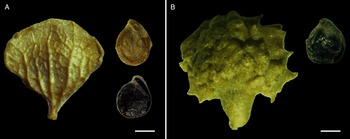
Diaspores (fruit enclosed by persistent ‘bracteoles’) of A. centralasiatica were collected from several individual plants at the Yuzhong Campus, Lanzhou University (35°57′N, 104°09′E, 1720 m above sea level), Gansu Province, China, in late September 2012. Mean annual precipitation at the collection site, 60% of which occurs from July to September, is 350 mm, and mean annual temperature is 6.7°C. Although most of the A. centralasiatica diaspores are either distinctly flat or humped, a few intermediate types are produced. However, in the present study we used only the two distinct diaspores (flat and humped). The ‘bracteoles’ of humped diaspores are heart-shaped from base to tip and vary in size, while ‘bracteoles’ of flat diaspores are flat. A fruit from flat diaspores in our study was either black or brown, while all fruits from humped diaspores were black (see Fig. 1). We did not study fruit colour morphs per se. Diaspores were dried under laboratory conditions (18–25°C, 30–45% relative humidity) for 1 week, separated into the two types according to shape (flat or humped) and stored dry at 4°C until used in experiments. Germination experiments were conducted within 3 weeks after harvest.
Diaspores and fruits of Atriplex centralasiatica: (A) flat diaspore and black and brown fruits; (B) humped diaspore and black fruit. Scale bar = 1 mm.

Morphology of diaspores
Length, width and area of each of the two types of diaspores were measured by WINSEEDLE 2011 Pro (Regent Instruments Inc., Quebec, Canada). Three replicates each of 30 humped and flat diaspores were used. We determined the 1000-diaspore mass and the fruit:diaspore mass ratio. In the latter case, fruits were excised carefully from diaspores with forceps and a surgical knife and categorized into two types based on colour (black and brown). Eight replicates of 100 diaspores of each of the two types were weighed to the nearest 0.1 mg using a Sartorius BSA2245 analytical balance (Shanghai, China).
Water absorption
Four replicates each of 50 flat and humped diaspores that had been stored for 1 week in the laboratory (18–25°C, 30–45% relative humidity) were weighed at time 0 and then at 2-h intervals for 24 h after they were placed on a wet substrate at 20°C. Percentage of water uptake (P w) was calculated using the equation:
 $$\% {P_w} = \left[ {\left( {{W_t}-{W_i}} \right)/{W_i}} \right] \times 100,$$
where W i is the mass of diaspores at time 0, and W t is mass of diaspores after each period of imbibition.
To determine whether the fruits had imbibed water, another test was conducted. The initial mass of 50 fruits each from humped and flat diaspores was determined by weighing after each fruit had been separated by hand from air-dry diaspores. Then, 50 flat and 50 humped diaspores were placed on a wet substrate at 20°C for 24 h and 72 h, respectively, after which each fruit was separated from each diaspore and weighed.
Effect of light and temperature on germination of fresh diaspores
Diaspores were placed in 12-cm-diameter Petri dishes on two layers of filter paper moistened with distilled water and then incubated at 15, 20, 25, 15/25 and 20/30°C in light (12-h photoperiod, hereafter light) or in continuous darkness. For continuous darkness, Petri dishes were wrapped with two layers of aluminium foil. For treatments in light, diaspores or fruits were exposed to light from white fluorescent tubes with a photon irradiance of c. 60 μmol m−2 s−1 (400–700 nm). Germination of diaspores incubated in light and in dark was monitored daily for 14 d. Diaspores incubated in dark were examined under a LED green safe light (520 ± 10 nm) (Sanpai, Shanghai, China). Fruits of diaspores that failed to germinate were examined for viability/non-viability. Those with white and firm embryos were considered to be viable and those with soft and tan embryos, non-viable. Very few seeds were non-viable.
Effects of GA3 and KNO3 on germination of fresh diaspores
Diaspores were treated with gibberellin (GA3, Sigma, China) and potassium nitrate (KNO3). GA3 was dissolved in 2 ml ethanol prior to dilution in water, and the final concentrations of GA3 were 200 μM and 400 μM. Preliminary experiments showed that the low concentration of ethanol did not affect germination of A. centralasiatica. Concentrations of KNO3 used were 10 mM and 50 mM. Diaspores incubated in distilled water served as the control. For each treatment, four replicates of 50 diaspores were placed in 12-cm-diameter Petri dishes on two sheets of filter paper moistened with 10 ml of solutions or distilled water, and then incubated at 15/25°C in light. Germination was monitored daily for 14 d.
Effect of dry storage on germination of diaspores and fruits
Fresh diaspores and fruits were tested for germination at 15/25°C in light. The two types of diaspores were stored dry in darkness at 4°C for 2 years. Four replicates each of 50 fresh and 2-year-old diaspores and fruits were tested for germination at 15/25°C in light, as described above.
Effects of burial depth on the fate of diaspores
An experiment was conducted to compare the effects of burial on the fate of the two kinds of diaspores (morphs). There were two types of fresh diaspores (flat and humped) and two burial depths (0 and 5 cm). Fifty diaspores of each type were put into each of 150 nylon bags (10 cm × 10 cm). For each type of diaspore, 75 nylon bags were placed on the soil surface (0 cm) and 75 buried at a depth of 5 cm (2 morphs × 75 bags × 2 depths = 300 bags) near the diaspore collection site on the Yuzhong Campus on 31 October 2012. For diaspores placed on the soil surface, the bags were fixed to the soil by iron nails, so that each one of them was in contact with the soil. For each type of diaspore, three bags were retrieved from the soil surface and from the 5 cm burial depth on 31 December 2012, and on 28 February, 30 April, 30 June and 31 October 2013 (2 morphs × 3 bags × 2 soil positions × 5 temperatures = 60 bags), after which the diaspores were cleaned and tested for germination over a range of temperatures in the laboratory. Germinated diaspores in each bag were counted and discarded before germination tests were performed. The remaining intact diaspores in each bag were poured into a separate 12-cm-diameter Petri dish with two layers of filter paper moistened with distilled water, and incubated at 15, 20, 25, 15/25 and 20/30°C in light {5 retrievals × [30 (flat) + 30 (humped)] = 300 bags}. The numbers of dead, germinated in situ, germinated in the lab (enforced dormancy) and non-germinated (dormant) diaspores were counted after 14 d. Following the germination test, non-germinated diaspores were tested for viability as described above.
Statistical analyses
Germination percentage data were arcsine transformed before analysis to meet the assumption of normality of variance. Independent-samples t-test was used to compare the mean differences in length, width, area, mass, fruit:diaspore mass ratio, water uptake and seed fate following burial in the field between the two morphs. Duncan's multiple range test was used to compare the germination percentage of flat diaspores at various temperature and light conditions. A two-way analysis of variance (ANOVA) (P < 0.05) was performed to test the effect of light and temperature on germination percentage of flat diaspores. A three-way ANOVA (P < 0.05) was performed to test the effect of diaspore type, burial duration, burial depth and their interaction on the percentage of dead, germinated in situ, enforced dormant and dormant diaspores. Data are expressed as means ± standard error. Statistical analyses were conducted using SPSS 17.0 (SPSS Inc., Chicago, Illinois, USA).
Results
Morphology of diaspores
Individual plants of A. centralasiatica produced two distinctly different diaspores (flat and humped) and a few intermediate types. A flat diaspore contained either a black or a brown fruit, while a humped diaspore contained only a black fruit (Fig. 1). Length, width, area and mass were greater for humped than for flat diaspores (P < 0.05) (Table 1). In contrast, the mass ratio of fruits to diaspores was higher for flat than for humped diaspores (P < 0.05).
Size and mass of flat and humped diaspores of Atriplex centralasiatica. Different letters in a column indicate significant differences (P < 0.05)

Water absorption
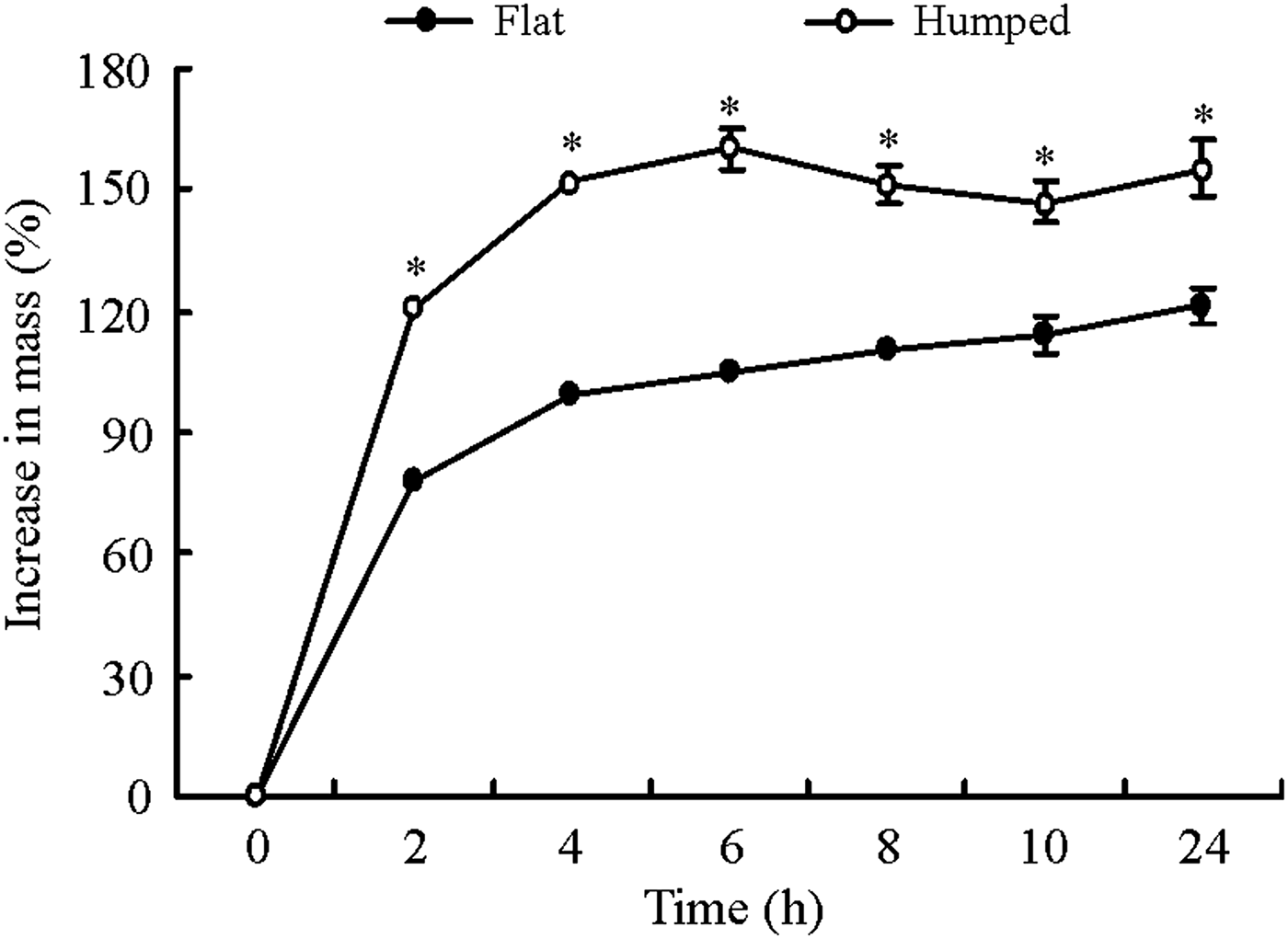
Both diaspore morphs absorbed water quickly and, after 24 h, the mass of flat and humped diaspores had increased by 120.8 ± 2.4% and 154.9 ± 4.3%, respectively (Fig. 2). After 24 h and 72 h of imbibition, the mass of fruits in flat and humped diaspores had increased by 35.3 ± 1.8% and 25.9 ± 5.0%, respectively; after 32 h some of the flat fruits had germinated.
Imbibition curves for humped and flat diaspores of Atriplex centralasiatica. Bars with an asterisk (*) indicate a significant difference between the two morphs at the same imbibition time.

Effect of light and temperature on germination of fresh diaspores
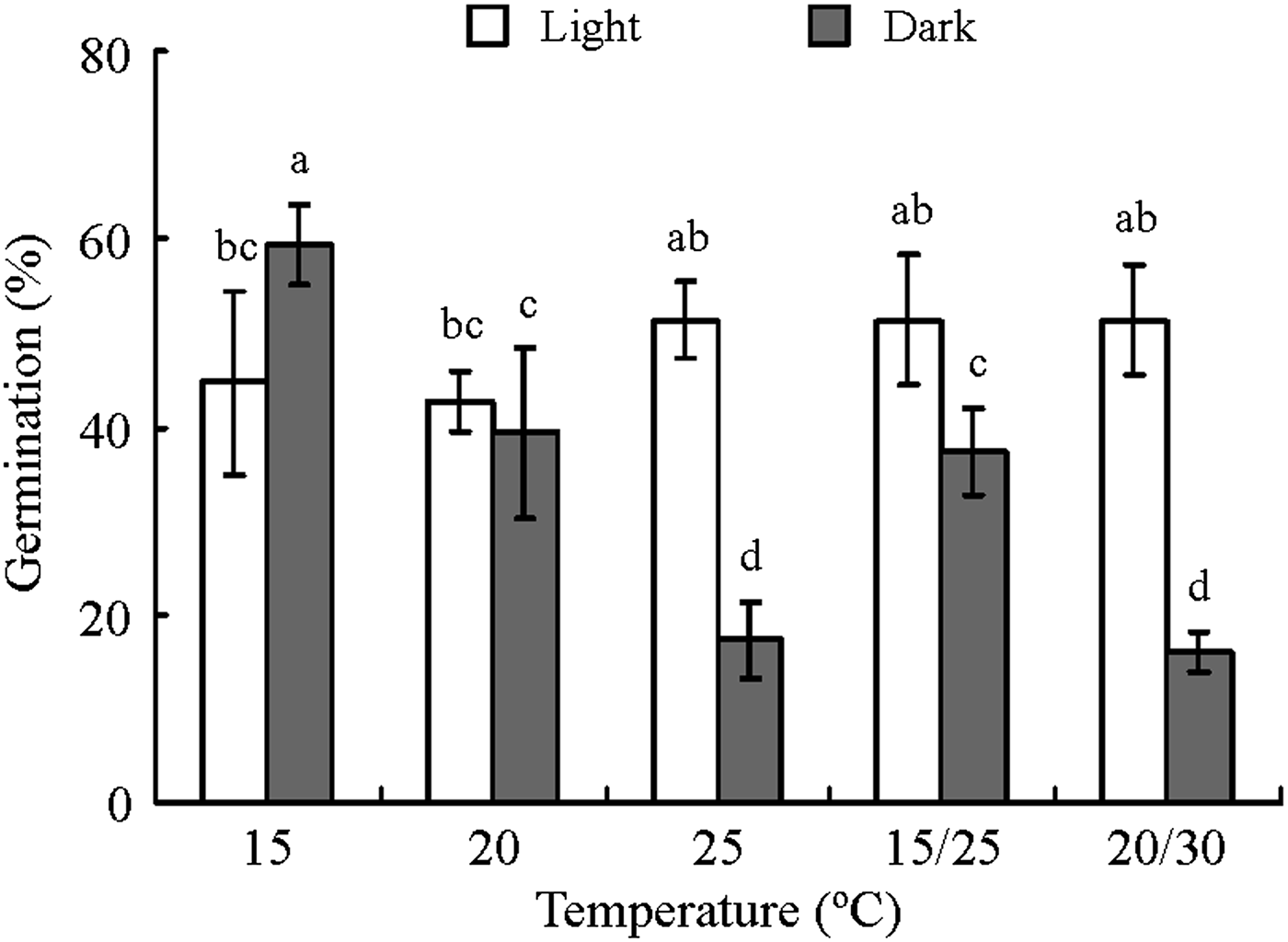
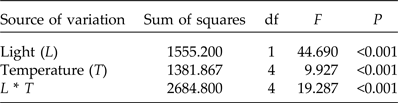
Diaspore type, light/dark, temperature and their interaction had significant effects on the germination of fresh flat diaspores (Table 2). Humped diaspores did not germinate at any combination of light and temperature. In contrast, flat diaspores germinated in all conditions, but the germination percentage varied with light/dark and temperature (Fig. 3). For example, the germination percentage significantly decreased with a temperature increase from 15°C to 25°C in the dark. Seeds germinated to significantly higher percentages in the light than in the dark, except at 15°C and 20°C.
The germination percentage (mean ± SE) of fresh flat diaspores of Atriplex centralasiatica incubated at five temperature regimes in the light (12-h photoperiod) or in continuous darkness for 14 d. For all test conditions, bars with different letters differ significantly (P < 0.05).

Two-way ANOVA of the effect of light, temperature and their interaction on germination percentage of fresh flat diaspores 1 of Atriplex centralasiatica

1 The analysis was performed only for the flat diaspores since no humped diaspores germinated.
Effect of GA3 and KNO3 on germination of fresh diaspores
Neither GA3 nor KNO3 had an effect on the germination percentage of fresh flat or humped diaspores. Germination percentages of fresh flat diaspores treated with GA3 at 200 μM and 400 μM were 40.5 ± 6.0% and 45.0 ± 3.8%, respectively, and for those treated with KNO3 at 10 mM and 50 mM the values were 41.5 ± 7.4% and 40.5 ± 7.7%, respectively, which had no significant difference (P > 0.05) from the germination percentage of those incubated in distilled water, i.e. 49.5 ± 5.3%.
Effect of dry storage on germination of diaspores and fruits
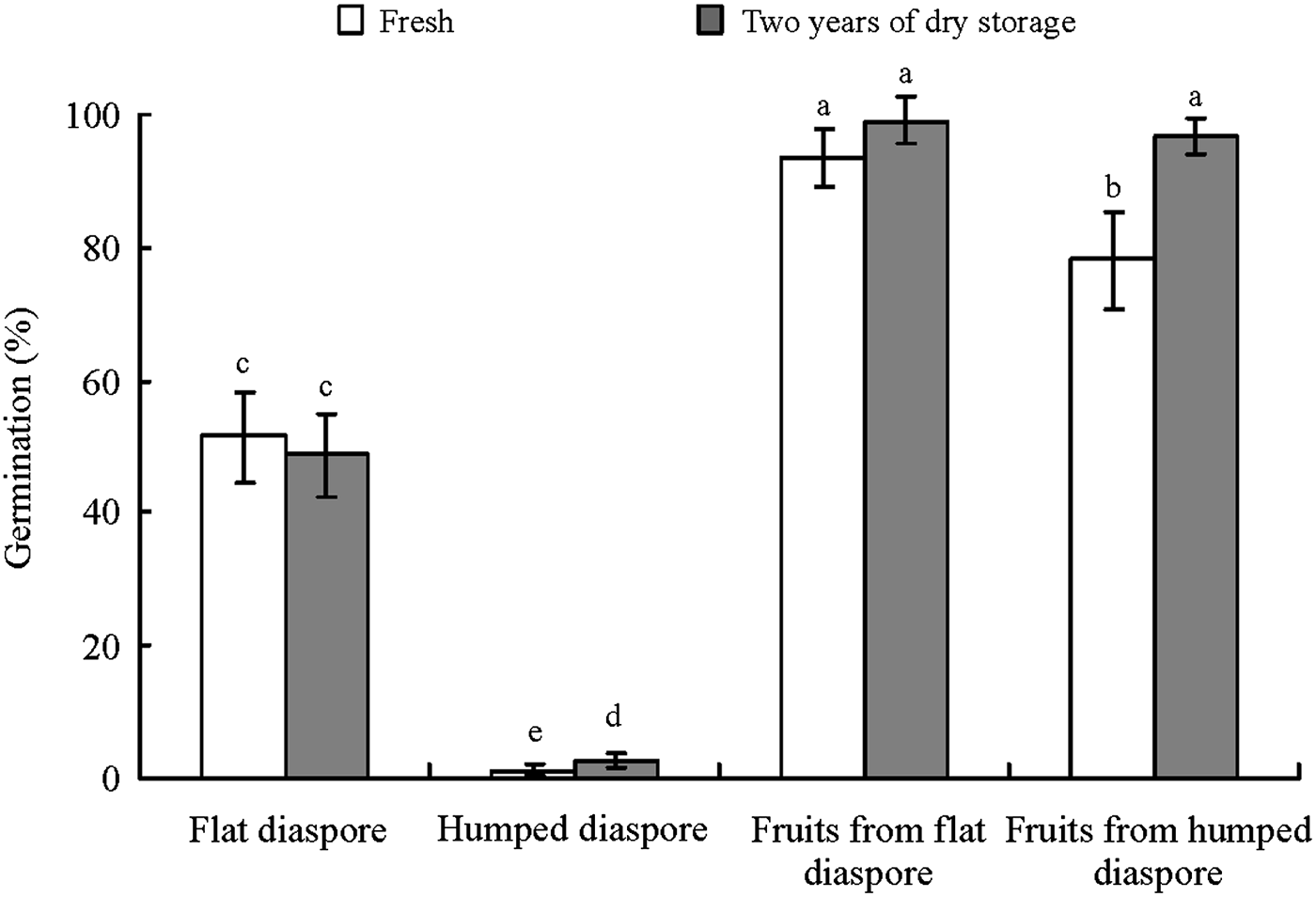
The germination percentages of fresh and afterripened flat diaspores did not differ (P > 0.05) but were higher (P < 0.05) than those of fresh and afterripened humped diaspores, which were very low (Fig. 4). The germination percentages of fresh and afterripened fruits of flat diaspores did not differ, whereas that of afterripened fruits from humped diaspores was significantly higher than that of fresh fruits.
The effect of dry storage on the germination percentage (mean ± SE) of diaspores and fruits of Atriplex centralasiatica incubated at 15/25°C in the light (12-h photoperiod) for 14 d. For all test conditions, bars with different letters differ significantly (P < 0.05).

Effects of burial on fate of the two types of diaspores
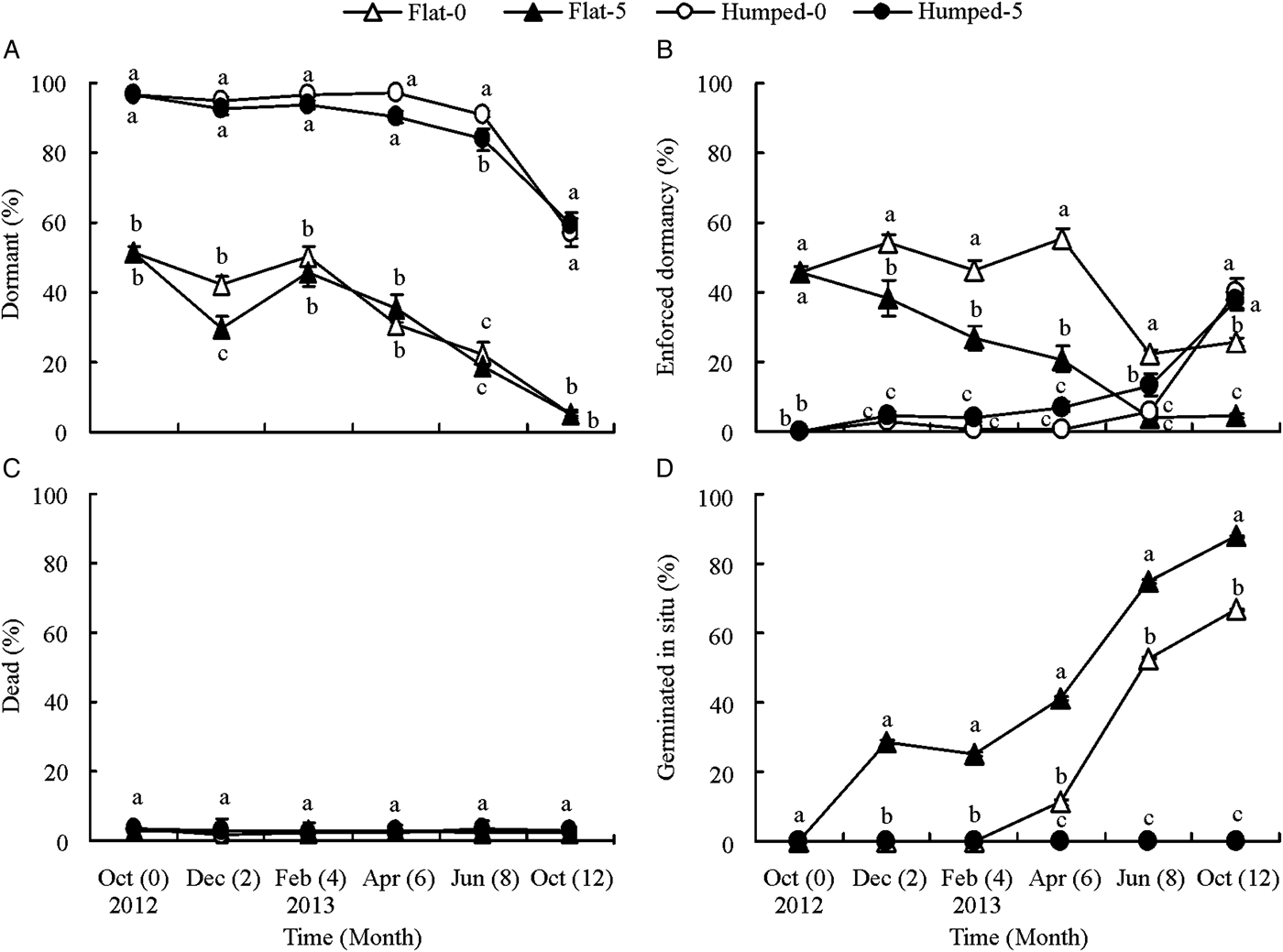
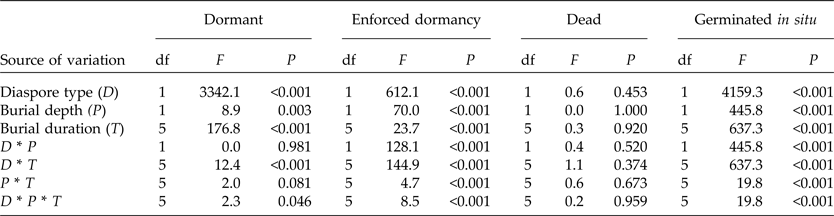
Diaspore type, burial depth, burial duration and their interaction had significant effects on germination percentage in the lab (enforced dormancy in situ and germination percentage in situ) but had no effect on percentage of dead diaspores of either type (Table 3). Flat diaspores began to germinate on the soil surface in April 2013, and >60% of them germinated before October 2013. Flat diaspores buried 5 cm germinated and then died in the field at any time, even in winter, during the burial period, and 87% of them germinated before October 2013. In contrast, no humped diaspores germinated in the field during the 1-year burial period, regardless of whether they were on the soil surface or buried 5 cm in the soil. The number of humped diaspores in enforced dormancy increased from April 2013 and reached nearly 40% by October 2013. Dead humped diaspores varied from 2 to 4% during the 12 months of burial, and there were no seasonal differences (Fig. 5).
Fates of flat and humped diaspores in the field on the soil surface (0) and buried at a depth of 5 cm: (A) dormant; (B) enforced dormancy; (C) dead; (D) germinated in situ. Bars with different letters differ significantly (P < 0.05) among the four treatments for the same month. Numbers within parentheses on the x axis indicate number of months of burial.

Three-way ANOVA of the effect of diaspore type, burial depth, burial duration and their interaction on the percentage of dormant, enforced dormancy, dead and germinated in situ diaspores of Atriplex centralasiatica

Discussion
Atriplex centralasiatica produces two distinct diaspores that differ in morphology, mass, dormancy/germination and persistence in the soil. Fresh flat diaspores are less dormant than fresh humped diaspores, which were fully dormant and thus germinated to <3% in all test conditions. Further, humped diaspores persisted for a longer period in the soil than the flat ones. For the most part, the ‘bracteoles’ [actually ‘… two opposite accrescent tepal lobes, parts of the perianth persistent on the fruit’ (Flores-Olvera et al., Reference Flores-Olvera, Vrijdaghs, Ochoterema and Smets2011)] are responsible for diaspore dormancy in A. centralasiatica (Li et al., Reference Li, An, Liu, Khan, Tsuji and Tanaka2008; this study). Diaspores of A. centralasiatica are water permeable, and the embryo is fully developed at seed maturity. Thus, the diaspores have physiological dormancy based on the seed dormancy classification system of Baskin and Baskin (Reference Baskin and Baskin2004).
Different degrees (intensities) of dormancy between morphs of heteromorphic species are usually related to variation in diaspore morphology (Baskin and Baskin, Reference Baskin and Baskin2014; Baskin et al., Reference Baskin, Lu, Baskin, Tan and Wang2014). The ‘bracteoles’ accounted for 44% of the mass of humped diaspores but only 26% of that of flat diaspores. Removal of the ‘bracteoles’ greatly increased the germination percentage of the fruits of A. centralasiatica, which shows that the ‘bracteoles’ are the main factor responsible for seed dormancy. The fruit-accessory parts of the diaspores of various other species of chenopods have been shown to inhibit seed germination (Beadle, Reference Beadle1952; Kadman-Zahavi, Reference Kadman-Zahavi1953; Koller, Reference Koller1957; Al-Charchafchi and Clor, Reference Al-Charchafchi and Clor1989; Takeno and Yamaguchi, Reference Takeno and Yamaguchi1991; Aiazzi and Arguello, Reference Aiazzi and Arguello1992; Osman and Ghassali, Reference Osman and Ghassali1997; Ungar and Kahn, Reference Ungar and Khan2001; Garvin and Meyer, Reference Garvin and Meyer2003; Wei et al., Reference Wei, Dong and Huang2007, Reference Wei, Dong, Huang and Tan2008; Li et al., Reference Li, An, Liu, Khan, Tsuji and Tanaka2008; Lu et al., Reference Lu, Tan, Baskin and Baskin2013).
Imbibition and germination tests showed that there is no barrier to water uptake in either diaspores or fruits of A. centralasiatica (Li et al., Reference Li, An, Liu, Khan, Tsuji and Tanaka2008; this study). Thus, lack of water uptake is not the reason for bracteole-imposed dormancy in this species. Li et al. (Reference Li, An, Liu, Khan, Tsuji and Tanaka2008) showed that the presence of ‘bracteoles’ and bracteole leachate significantly affected final germination percentage of fruits from humped diaspores, while there was little effect on fruits from the flat diaspores. In our study, the removal of ‘bracteoles’ significantly improved the germination of fruits from both types of diaspore. We suggest that dormancy of A. centralasiatica may be attributed to the bracteoles via mechanical restraint. The differences in dormancy of flat versus humped diaspores were related to the significant difference in the fruit:diaspore mass ratio, which was higher in flat (0.44) than in humped (0.26) diaspores. This suggests that that humped diaspores have thicker ‘bracteoles’, which would be expected to exert more mechanical restraint on the embryo.
In the study by Li et al. (Reference Li, An, Liu, Khan, Tsuji and Tanaka2008), both humped and flat diaspores of A. centralasiatica produced black and brown fruits. However, we found that although flat diaspores contained both black and brown fruits, humped diaspores contained only black fruits. This variation in fruit colour and in various other aspects of the two studies, such as mass and germination percentage of flat and humped diaspores (see Appendix), may be due to differences in genotype (G), environment (E) or a G × E interaction between the populations (Baskin and Baskin, Reference Baskin and Baskin2014). Li et al. (Reference Li, An, Liu, Khan, Tsuji and Tanaka2008, Reference Li, Liu, Hanada and Khan2011) collected diaspores from plants growing in coastal saline soils, Hebei Province, whereas diaspores for our study were collected from plants growing in non-saline soil on the Loess Plateau in Gansu Province. Previous studies on diaspore dimorphic species have shown that the environment of the mother plant can influence the proportion of different morphs that is produced. The proportion of brown seeds produced by plants of Chenopodium album grown from dimorphic brown or black seeds was significantly increased by high salinity (Yao et al., Reference Yao, Lan and Zhang2010). The brown:black seed ratio for Suaeda salsa was much higher for plants growing in the intertidal zone than it was for those growing inland on saline soil in the Yellow River Delta in Shandong in eastern China (Song et al., Reference Song, Fan, Zhao, Jia, Du and Wang2008).
Flat diaspores contained more brown fruits, and light had little effect on the germination of brown fruits at 23°C (Li et al., Reference Li, An, Liu, Khan, Tsuji and Tanaka2008), which is consistent with our results at 20°C (Fig. 3). In the present study, the germination response to light depended on the incubation temperature. Thus, fresh flat diaspores of A. centralasiatica germinated to a significantly higher percentage in dark than in light at 15°C and to significantly higher percentages in light than in dark at 25, 15/25 and 20/30°C, but at 20°C germination percentages in light and dark did not differ significantly. It is well known that a seed may require light to germinate at a given temperature but not at other temperatures (Pons, Reference Pons and Gallagher2013).
In our study, fresh and 2-year-old dry-stored flat diaspores of A. centralasiatica germinated to 51.3 and 48.7%, respectively, whereas the germination of fresh and 2-year-old dry-stored humped diaspores was <3%. However, the removal of ‘bracteoles’ from fresh and 2-year-old flat and humped diaspores greatly increased germination of their fruits (Fig. 4). These data indicate that ‘bracteoles’ alone are responsible for about 50% of the dormancy in fresh and 2-year-old flat diaspores and for about 80–100% of that in fresh and 2-year-old humped fruits. Li et al. (Reference Li, An, Liu, Khan, Tsuji and Tanaka2008) showed that humped diaspores germinated to c. 50%.
Humped diaspores did not germinate during 1 year of burial in the field, while flat ones began to germinate after 2 months of burial at 5 cm and after 6 months on the soil surface. The reason(s) for different behaviours of the two morphs in the soil under natural conditions is/are undoubtedly due to the inhibitory action of the ‘bracteoles’. For flat diaspores, germination occurred at 5-cm burial depth between October and December, but those on the soil surface did not germinate until the following April. Soil below the surface would be moist for a longer period of time than that on the surface, and thus the burial of seeds in the soil would favour germination. For humped diaspores, burial depth had little effect on germination in the field. Enforced-dormant humped diaspores at 5-cm burial depth and on the soil surface reached 39.7 and 38.0%, respectively. Compared to flat diaspores of A. centralasiatica, humped diaspores persist for a longer period in the soil and form at least a short-lived persistent seed bank, whereas the flat diaspores form only a transient seed bank.
Baskin et al. (Reference Baskin, Lu, Baskin, Tan and Wang2014) proposed the following high risk–low risk strategy formula for diaspore dispersal and dormancy in A. centralasiatica: H/H (hubr)–L/L (flbl). H/H (hubr) meant that the brown seed (br) of humped fruits (hu) had a high risk strategy for dispersal, i.e. good dispersal ability (first H of H/H), and for germination, i.e. low degree of dormancy (second H of H/H). The L/L (flbl) meant that the black seed (bl) of flat fruits (fl) had a low risk for dispersal, i.e. low dispersal ability (first L of L/L), and for germination, i.e. high degree of dormancy (second L of L/L). What we have learned from the present study, and from carefully re-reading the papers of Li et al. (Reference Li, An, Liu, Khan, Tsuji and Tanaka2008, Reference Li, Liu, Hanada and Khan2011), which are confusing about the diaspore unit(s) they used in various germination tests [i.e. seed, fruit, dispersal unit (diaspore)], has called our attention to the fact that the formula for A. centralasiatica needs to be revised. In short, Baskin et al. (Reference Baskin, Lu, Baskin, Tan and Wang2014) misinterpreted the fruit to be the seed and the fruit plus bracteole to be the fruit. The revised high risk–low risk strategy formula for seed dispersal and dormancy is as follows: H/H (fl)–L/L (hu). In which case, the flat diaspore is the high risk diaspore (fl) for both dispersal and germination (H/H), and the humped diaspore (hu) is the low risk diaspore for both dispersal and germination (L/L).
In conclusion, A. centralasiatica produces two distinct types of diaspores, each consisting of a one-seeded dry fruit with persistent ‘bracteoles’, which differ in morphology, mass, germination behaviour and persistence in the soil. A comparison of the results of our study on seed dormancy and germination of A. centralasiatica using the natural intact diaspores with those of Li et al. (Reference Li, An, Liu, Khan, Tsuji and Tanaka2008, Reference Li, Liu, Hanada and Khan2011), who used the fruit (i.e. ‘bracteoles’ removed from the diaspores) in almost all of their germination tests, is a good example of why the intact diaspore (whatever it is!) should be used in studies on the ecology of seed dormancy and germination (see ‘dictum’ number 1 of Baskin et al., Reference Baskin, Thompson and Baskin2006).
Financial support
This work was supported by the Programme of Introducing Talents of Discipline to Universities (B12002) and Special Fund for Agro-scientific Research in the Public Interest (201403048-3).
Conflicts of interest
None.
Comparison between previous research (Li et al., Reference Li, An, Liu, Khan, Tsuji and Tanaka2008, Reference Li, Liu, Hanada and Khan2011) and the present study on Atriplex centralasiatica