Introduction
Archaeological interest in the study of primitive war is relatively recent and should be considered in relation to the increase in anthropological studies of ethnic wars that occurred during the 1950s and 1960s (Otterbain Reference Otterbain1999). Works published on this subject from both archaeological and anthropological perspectives are divided into two opposing stances: those who propose a non-violent past, based on the study of present-day primitive societies (Sponsel & Gregor Reference Sponsel and Gregor1994; Bonta Reference Bonta1996); and those who reject this pacifist vision based on archaeological (Keeley Reference Keeley1996) and ethnological evidence (Turney-High Reference Turney-High1949; Ferguson Reference Ferguson, Randolph, Schneider and Diaz1988), even arguing for a biological basis behind the possible violent nature of societies (Wrangham & Peterson Reference Wrangham and Peterson1996).
In fact, this reconstruction of an unstable past fuels a broader debate, encompassing modes of expressing conflict, its time span and cultural implications, as well as the role of war in driving change in society, yet this debate is not without its limitations. One of the main problems in establishing the origin, nature and scope of violence in prehistory is the asynchronous emergence (Vencl Reference Vencl1984) and ambiguous interpretation (Guilaine & Zammit Reference Guilaine and Zammit2002; Thorpe Reference Thorpe2003; Vandkilde Reference Vandkilde2003; Lull et al. Reference Lull, Micó, Rihuete and Risch2006) of the limited material evidence left in the archaeological record by even the most lethal episodes of physical violence. For example, post-depositional processes can affect the conservation of evidence for violent trauma in skeletal remains or destroy all trace of weaponry made from perishable materials. This has led to such evidence being under-represented and has skewed its interpretation (Christensen Reference Christensen2004; Etxeberría et al. Reference Etxeberría, Herrasti and Bandrés2005). Pictorial evidence is also constrained by difficulties in decoding the meaning behind prehistoric imagery (Sauvet Reference Sauvet1993; Martí Reference Martí, Tortosa and Santos2003) and in proving its value in understanding prehistoric societies.
In this paper, I consider the potential and limitations of prehistoric art in identifying the existence of conflict in prehistoric societies. Scenes in Levantine rock art with violent content are analysed, and new variables for analysis are introduced that allow identification of the various changes that occur geographically and over time. I suggest an anthropological reading of these scenes to shed light on aspects of behaviour rooted in these societies. I then assess the value of the data provided by the pictorial record in the context of archaeological evidence for violent episodes in the prehistoric Iberian Peninsula.
Levantine rock art: analysis and contextualisation
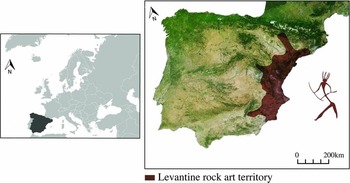
Levantine rock art is a unique form of pictorial expression in prehistoric Europe. Located in rockshelters in the inland regions of the Iberian Mediterranean basin (Figure 1), this rock art is of particular interest due to the narrative component of its scenes. The difficulty in obtaining radiocarbon dates for this rock art has increased debate between two opposing positions: those who see the images as depictions of hunter-gatherers and assign them to the last Mesolithic groups (Alonso & Grimal Reference Alonso and Grimal1996; Mateo Reference Mateo2005); and those who believe they were created by agricultural societies, based on pottery decoration parallels, Levantine motif superimposition on Early Schematic art and on the distribution of these paintings, which mainly corresponds to known Neolithic settlements (Martí & Juan-Cavanilles Reference Martí, Juan-Cavanilles, Hernández and Segura2002; García et al. Reference García, Molina and García2004).
Map of location and geographic extent of Levantine rock art.

The analysis of Levantine paintings is controversial; their study has been approached without taking into account either their evolution or marked regionality, which make Levantine paintings a dynamic form of expression. Reconstruction of the Levantine sequence in the northern regions (Villaverde et al. Reference Villaverde, López-Montalvo, Domingo, Martínez, Martínez and Villaverde2002; Domingo Reference Domingo2006; López-Montalvo Reference López-Montalvo2007, Reference López-Montalvo, López, Martínez and Matamoros2009) has confirmed that the themes portrayed—the socio-economic activities—undergo significant changes in frequency, geographic distribution and mode of expression (López-Montalvo Reference López-Montalvo and Martínez2005, Reference López-Montalvo2007, Reference López-Montalvo, Baray, Honegger and Dias-Meirinho2011; Villaverde et al. Reference Villaverde, Martínez, Guillem, López-Montalvo, Domingo, Garcia, Collado and Nash2012). These changes are especially revealing because, beyond the presumed symbolic meaning in prehistoric art, they can reflect significant variations in societies. The scope and characteristics of these thematic variations need to be defined, and they are key to understanding the historical dynamics of their creators. In this paper, I present the first analysis of scenes with violent content.
Expressions of violence: continuity and change
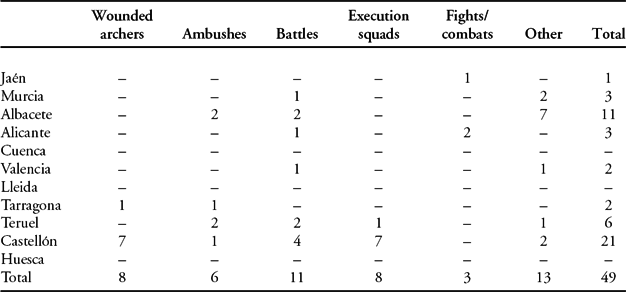
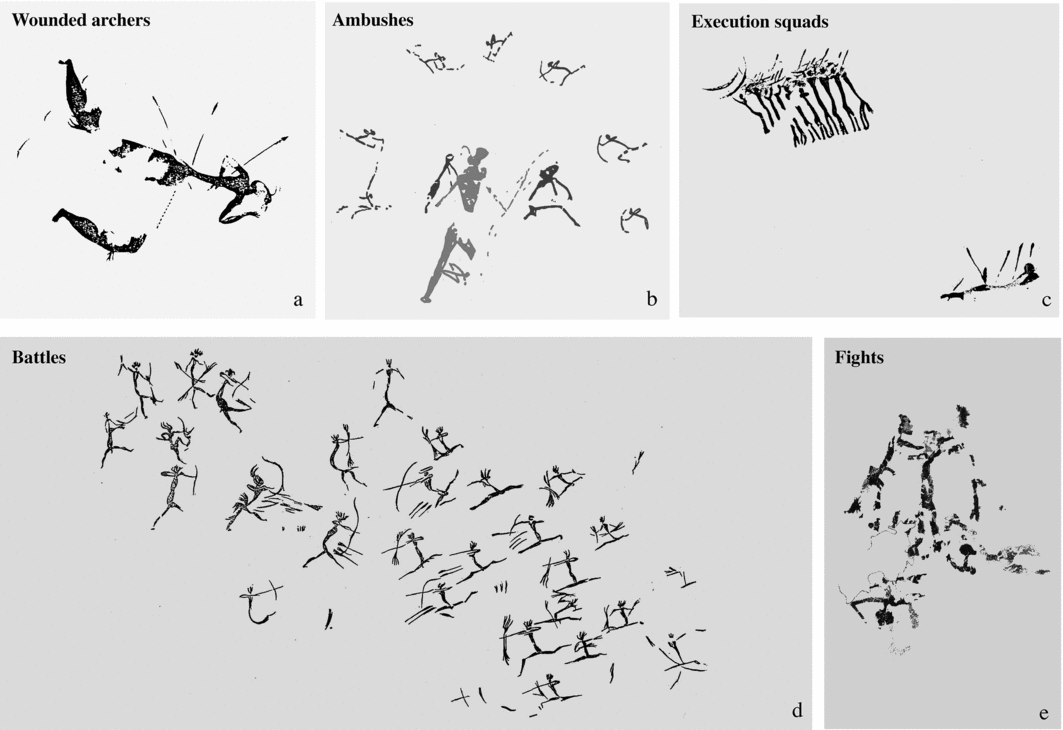
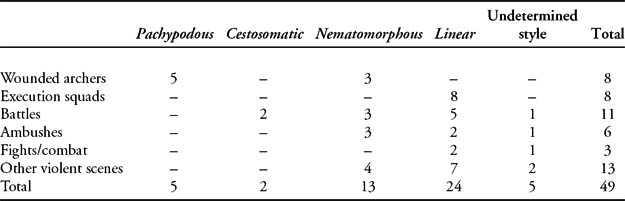
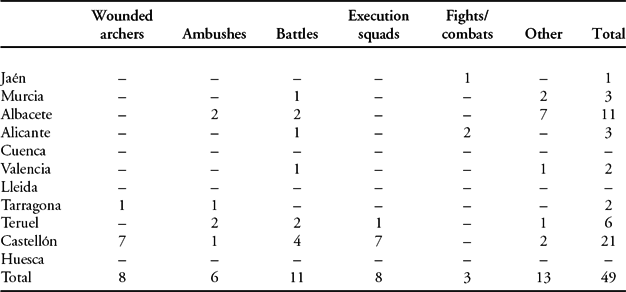
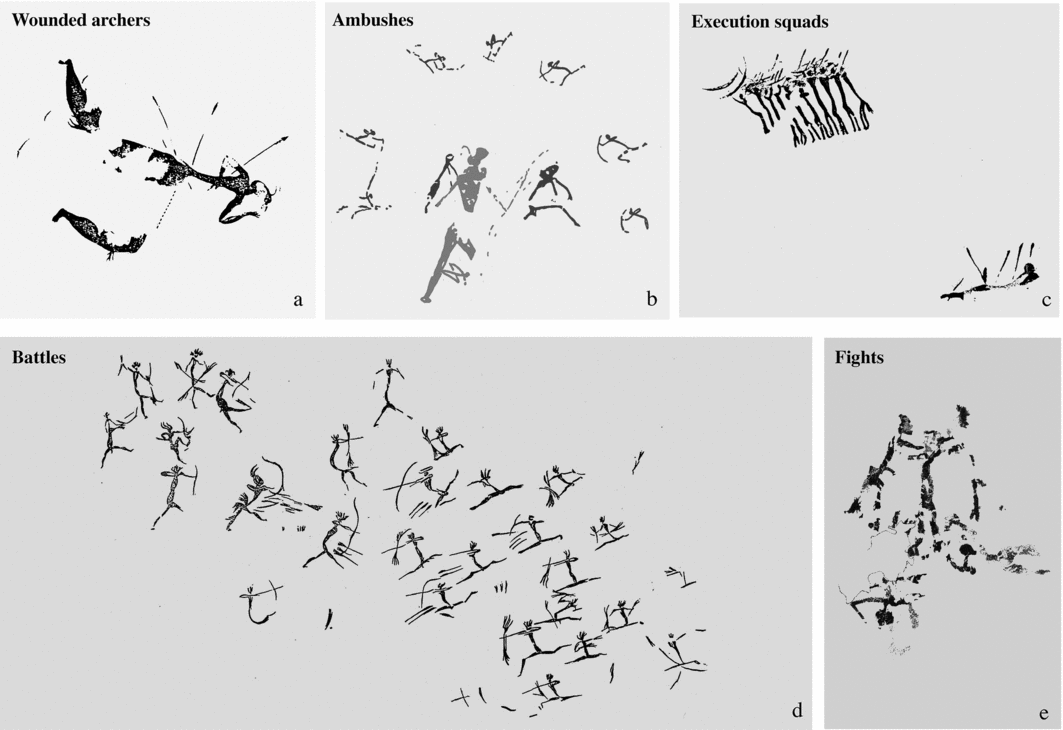
The portrayal of violence in Levantine paintings is restricted to just a few examples (Table 1) and types of violent acts: battles; ambushes; execution squads; fighting or combat; and wounded archers (López-Montalvo Reference López-Montalvo, Baray, Honegger and Dias-Meirinho2011) (Figure 2). There are also other representations of violence and death that may be considered exceptional by their uniqueness. These aspects are of interest and encourage us to analyse these representations, incorporating the chronologic-geographic axis as a new variable of analysis that will help us to identify the exact point in time at which violence appears in the panels. This analysis also considers the variations in the mode of depiction, frequency and distribution, and aspects that enable an anthropological reading of conflicts, such as the emergence of social status, gender attribution of weaponry and personal ornamentation linked to the warriors’ identity.
Scenes of violent content portrayed in Levantine territory.
Strategies portrayed in expressions of violence: a & c) Cova Remigia (Gasulla, Castellón) (Porcar Ripollés et al. Reference Porcar Ripollés, Obermaier and Breuil1935); b) El Cerrao (River Martín, Teruel) (Andreu et al. Reference Andreu, Ariño, Perlaes, Picazo and Sancho1982); d) Les Dogues (Porcar Reference Porcar1953); e) Cañada de la Cruz (River Segura, Jaén) (Soria et al. Reference Soria, López Payer, Zorrilla, Garcia, Collado and Nash2012).
Evolution of the mode and frequency of pictorial expressions of violence
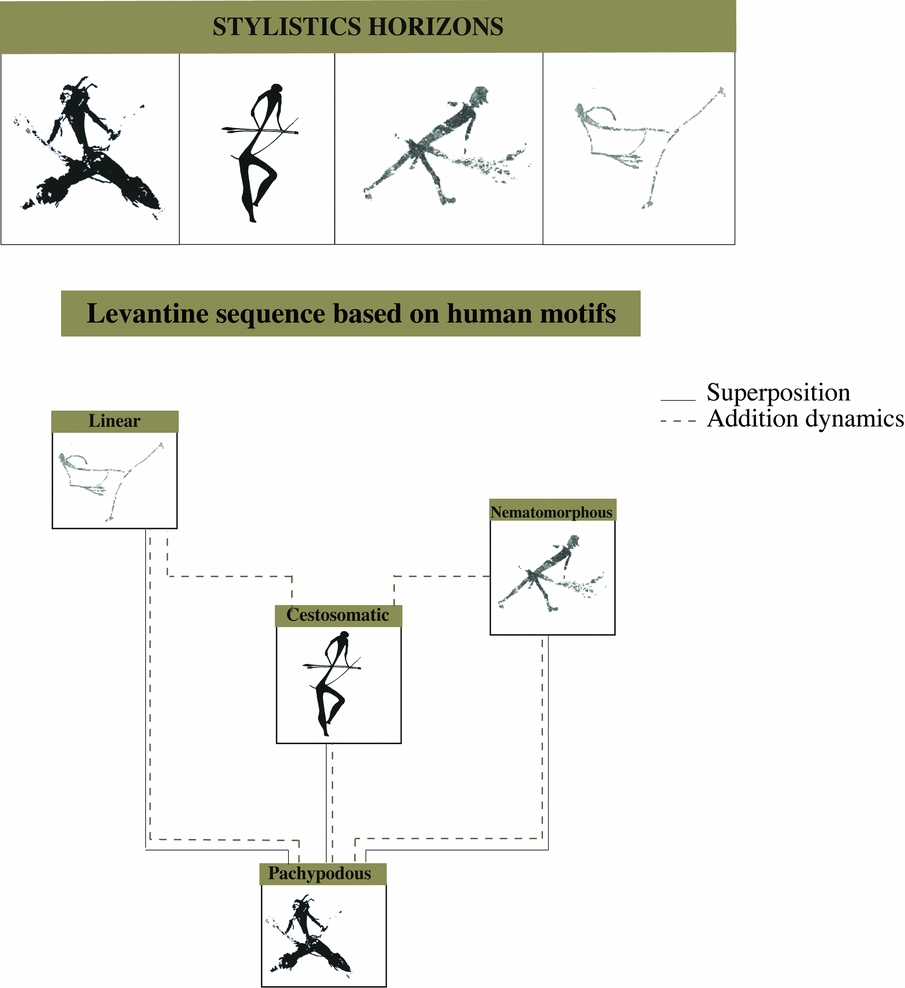
Establishing a diachronic evolution relies on the stylistic sequence recognised in the northern regions of the Iberian Peninsula, which is based on the depiction of the human figure. So far, four stylistic horizons have been characterised in the Valltorta-Gassulla region (Castellón), and they have been ordered chronologically based on the sequence of superposition of figures and the way they are incorporated into panels (Villaverde et al. Reference Villaverde, López-Montalvo, Domingo, Martínez, Martínez and Villaverde2002, Reference Villaverde, Guillem and Martínez2006; Domingo Reference Domingo2006; López-Montalvo Reference López-Montalvo2007, Reference López-Montalvo, López, Martínez and Matamoros2009) (Figure 3). This sequence shows strong links with the neighbouring regions of Bajo Aragón (Utrilla & Martínez Reference Utrilla and Martínez2007) and Catalonia. Its correlation with the central and southern regions is more complex, and, the further we travel from this centre of Levantine rock art, the more marked the regional peculiarities become. Not all regions have had their stylistic sequence reconstructed, however, and existing reconstructions have been established using disparate or undefined criteria (Alonso & Grimal Reference Alonso and Grimal1996; Mateo Reference Mateo2006). Most of these works also use specific terminology referencing particular sites, thereby reinforcing regional differences and impeding a global stylistic approach. Here, I follow the terminology proposed by Obermaier and Wernert (Reference Obermaier and Wernert1919) to compare different artistic regions; this terminology focuses on the formal typology of human figures and avoids reference to particular sites or regional features. Obermaier and Wernert (Reference Obermaier and Wernert1919) identified three stylistic phases:
Stylistic horizons in northern regions and sequence of levantine human motifs based on superpositions and addition dynamics.

-
• Pachypodous, naturalistic, medium- to large-sized, well-proportioned figures, with massive legs and a great variety of costumes;
-
• Cestosomatic, medium- to large-sized figures with disproportionate trunks, well-modelled legs and very few personal ornaments;
-
• Nematomorphous, small- to medium-sized and anatomically disproportionate figures, with short and linear legs; trunks show a wide range of shapes, from linear to inverted-triangle body shape, sometimes showing a well-marked abdomen.
To these three types I add Linear, which is characterised by small figures with a linear and simplified drawing style and a wide range of anatomical proportions (Villaverde et al. Reference Villaverde, López-Montalvo, Domingo, Martínez, Martínez and Villaverde2002; Domingo Reference Domingo2006; López-Montalvo Reference López-Montalvo2007).
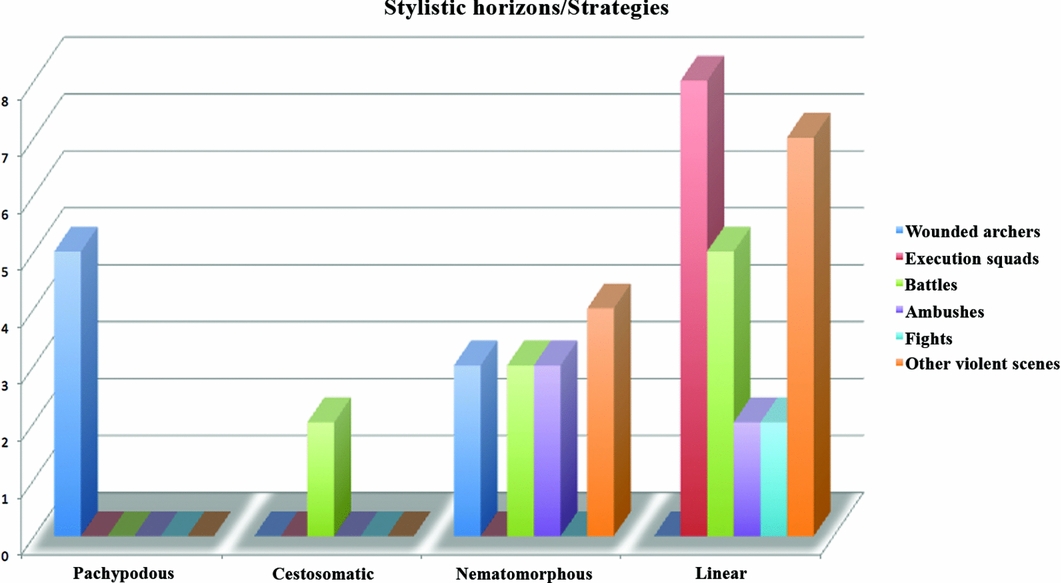
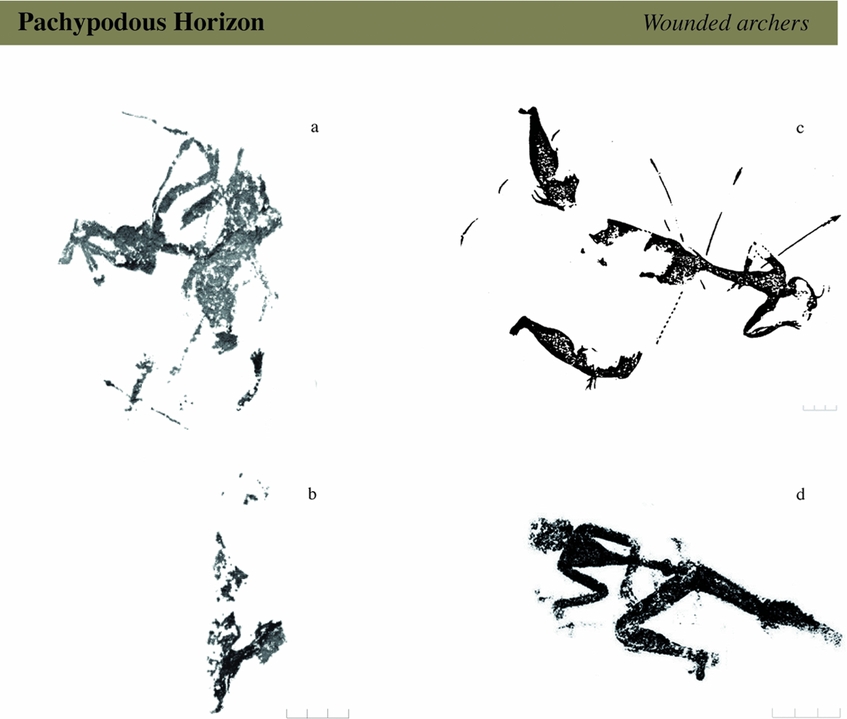
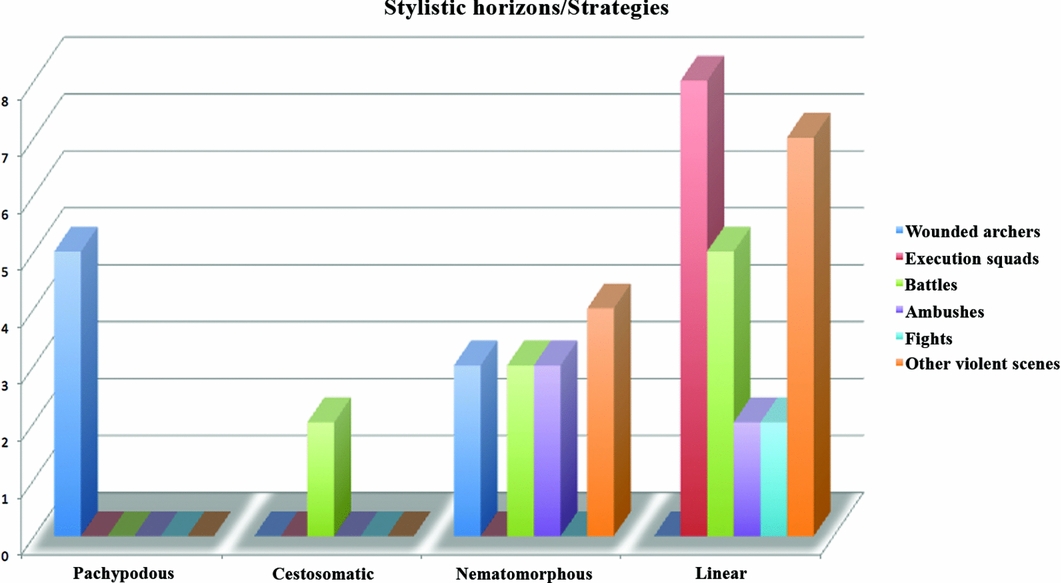
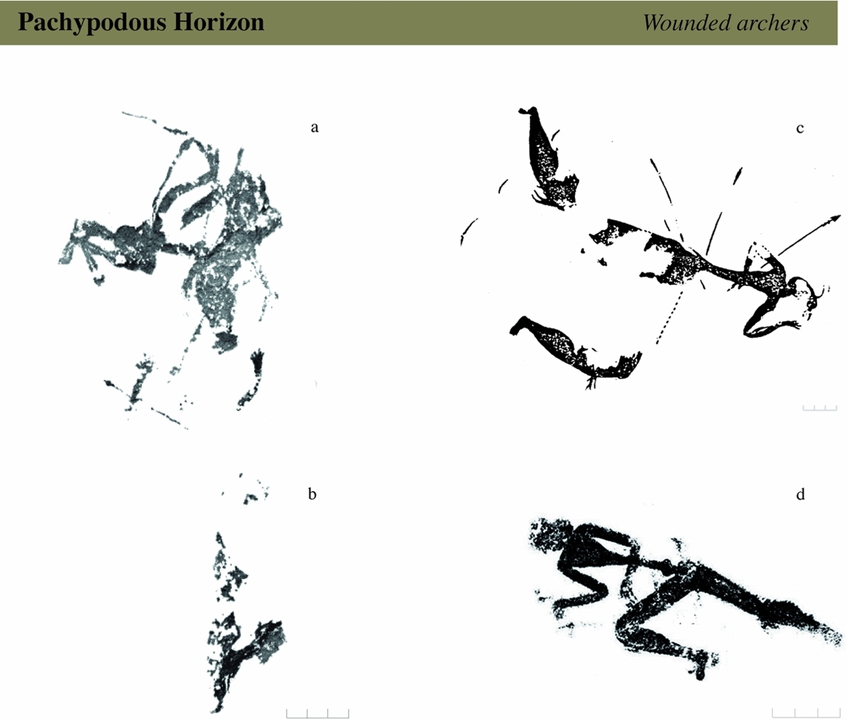
Notable differences can be observed chronologically between the different stylistic phases, with clear elements of continuity and change in terms of both the type of violence and the frequency with which it is portrayed (Figure 4 & Table 2). There appears to be a steady increase in the frequency of depictions of violence (Figure 4), culminating in a high percentage in the Nematomorphous and Linear horizons and in the incorporation of different acts of violence, which provide new understandings of conflict resolution and internal governance. It is the Nematomorphous horizon that shows the greatest innovation, incorporating previously uncommon scenes of violence and death. The modes of depicting violence also change; the earliest stylistic phase—the Pachypodous horizon—shows only individual archers killed by projectile weapons (Figure 5). This concept reappeared in the Nematomorphous horizon without apparent continuity. Furthermore, it is a concept virtually exclusive to the northern regions and with a distribution limited to a small number of rockshelters (Remigia, Saltadora VII, Polvorín, Llidoner and Llaberia).
Variation in strategies portrayed throughout the Levantine sequence.
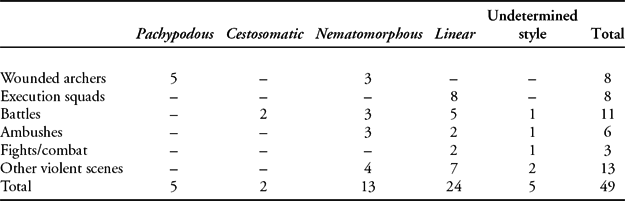
Evolution over time of the pictorial expression of violence.
Pachypodous horizon: a & b) Saltadora VII (Valltorta, Castellón) (Domingo et al. Reference Domingo, López-Montalvo, Villaverde and Martínez2007); c) Cova Remigia (Gassulla, Castellón) (Porcar Ripollés et al. Reference Porcar Ripollés, Obermaier and Breuil1935); Llaberia (Tarragona) (Martínez Abarca & Serrano Gomicia in press).
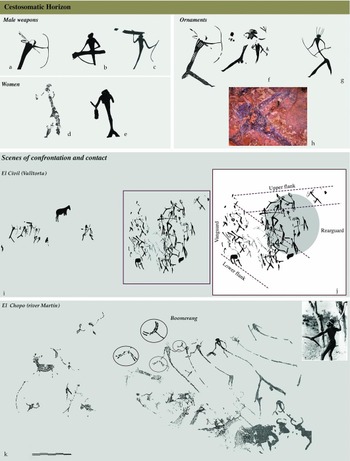
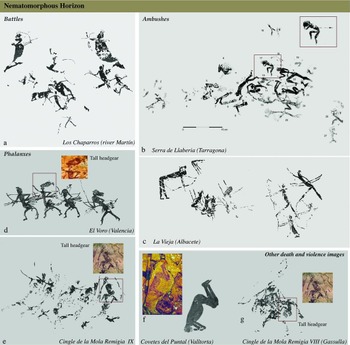
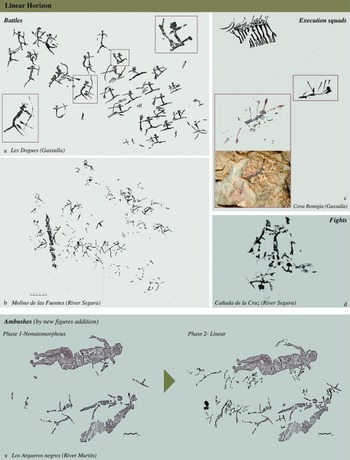
The next phase, the Cestosomatic, introduced collective involvement in conflict resolution in the form of scenes of confrontation between large groups. The most interesting aspects of these scenes are the tactical arrangement of the figures (El Civil, Valltorta) (Obermaier & Wernert Reference Obermaier and Wernert1919; López-Montalvo Reference López-Montalvo2007), the introduction of unconventional weaponry, such as the boomerang (El Chopo, River Martín) (Picazo et al. Reference Picazo, Loscos, Martínez and Perales2001–2002), and the participation of women (El Civil) (López-Montalvo Reference López-Montalvo2007) (Figure 6). This notion of a collective response is consolidated in the subsequent Nematomorphous (Figure 7) and Linear horizons (Figure 8); here, battle scenes are still depicted, but we also see new modes of violence appearing, including flanks of archers, execution squads, ambushes and other previously uncommon strategies that focus on violence and death (Figure 7f & g). Several new elements introduced in the later phases are notable; from a tactical viewpoint, the nematomorphic figures incorporate episodes of ambush depicting an indiscriminate attack on a large unarmed group (Figure 7b & c). The ambushes portrayed in the Llaberia (Tarragona) (Martínez Abarca & Serrano Gomicia in press) or La Vieja (Albacete) (Alonso & Grimal Reference Alonso and Grimal1999) rockshelters are exceptional in Levantine paintings, which, even in body-to-body confrontations, do not portray felled or wounded victims. There is also a sudden emergence of execution squads in the Linear horizon (Figure 8c), with particular concentration in Valltorta-Gassulla. Finally, the distinction of certain figures, perhaps of rank, through the use of variables such as size (Figure 7a), spatial positioning (Figure 7a & e) and personal ornaments (Figure 7a & e) is consolidated in the Nematomorphous horizon. Ornaments differentiate the opposing groups (Les Dogues) (Figure 8a) and highlight certain individuals (Cingle IX or Los Chaparros) (Figure 7a & e). Above all, however, they seem to play an important role as indicators of social identity (Sorensen Reference Sorensen1997). In the case of some of these ornaments, such as tall headgear (Figure 7e & g), not only do they distinguish certain individuals, but their use is associated exclusively with participation in violent conflicts.
Cestosomatic horizon: a–c & e) Cova del Civil (Valltorta, Castellón) (Obermaier & Wernert Reference Obermaier and Wernert1919); d) Cova del Civil (López-Montalvo Reference López-Montalvo2007); f & g) Cova del Civil (Cabré Reference Cabré1925); h) Cova del Civil; i & j) Cova del Civil (Obermaier & Wernert Reference Obermaier and Wernert1919; López-Montalvo Reference López-Montalvo2007); k) Cueva del Chopo (Obón, Teruel) (Picazo et al. Reference Picazo, Loscos, Martínez and Perales2001–2002).

Nematomorphous horizon: a) Los Chaparros (River Martín) (Beltrán & Royo Reference Beltrán and Royo1997); b) Serra de Llaberia (Tarragona) (Martínez Abarca & Serrano Gomicia in press); c) La Vieja (Albacete) (Alonso & Grimal Reference Alonso and Grimal1999); d) El Voro (Valencia) (Aparicio 1986–Reference Aparicio1987); e) Cingle de la Mola Remigia (Gassulla) (López-Montalvo Reference López-Montalvo2007); f) Covetes del Puntal (Valltorta) (Viñas Reference Viñas1982); g) Cingle de la Mola Remigia (Gassulla) (López-Montalvo Reference López-Montalvo, Baray, Honegger and Dias-Meirinho2011).

Linear horizon: a) Les Dogues (Gassulla) (Porcar Reference Porcar1953: digital tracings in frames from López-Montalvo Reference López-Montalvo, Baray, Honegger and Dias-Meirinho2011); b) Molino de las Fuentes (River Segura) (Alonso & Grimal Reference Alonso and Grimal1996); c) Cova Remigia (Gassulla) (Porcar et al. Reference Porcar Ripollés, Obermaier and Breuil1935: digital tracing in frames by López-Montalvo (unpublished)); d) Cañada de la Cruz (River Segura) (Soria et al. Reference Soria, López Payer, Zorrilla, Garcia, Collado and Nash2012); e) Los Argueros negros (River Martín) (modified from Herrero et al. 1993–Reference Herrero, Loscos and Martínez1995).

Depictions distinguishing figures within phalanxes on the battlefield (Figure 7e) suggest a kind of leadership, and the portrayal of execution squads (Figure 8c) points to the existence of an organisation necessarily governed by key individuals in accordance with agreed social conventions. The ordered arrangement of the groups involved in battle suggests knowledge of combat tactics (Molinos 1986–Reference Molinos1987) and perhaps battle training. On many occasions this spatial arrangement simply reflects conventions of composition, yet other elements point to coordinated attacks, if not actual military tactics. An example is the scene at the El Civil rockshelter, where archers are shown with bows raised, arranged in two ranks and protecting others in the rear-guard (López-Montalvo Reference López-Montalvo, Baray, Honegger and Dias-Meirinho2011) (Figure 6i & j).
Few variations in weaponry are observed over time, with the bow and arrow prevailing throughout. The most significant new weapon appeared during the Cestosomatic horizon, when a possible boomerang is depicted (El Chopo) (Figure 6k) (Picazo et al. Reference Picazo, Loscos, Martínez and Perales2001–2002); quivers for arrows appear at the same time (Figure 6b & c). Although an infrequent tool in the Levantine panels, the boomerang's use as a projectile weapon in confrontation, notably in long-distance attacks, is confirmed by ethnographic studies, but its effectiveness seems limited (Gat Reference Gat1999). The few scenes depicting close combat (Figure 8d) suggest that short-range, dagger-like weapons might have been used, as seen at La Sarga or Santa Maira (Alicante) (Hernández & Segura Reference Hernández and Segura2007), but their simplified depiction impedes any identification of weapon type.
Attitudes to gender and identity can also be explored through depictions of violence. Access to weapons appears to have been limited to the male sphere, as only men are depicted participating in scenes of violence or hunting. While the male figure is incontrovertibly identified by the bow and arrow and by his role as hunter and warrior, the female figure repeatedly appears with either a basket or short sticks, carrying out activities that are difficult to interpret. This gender-coding of objects, together with the narrative disassociation or absence of women from the Levantine panels, makes the scene at El Civil particularly significant; it is the only one in which women, although unarmed, are portrayed in an episode of a violent nature (Figure 6d & e). Ethnographic examples of female participation in battles are limited to times during which all human resources are necessary. Their participation usually involves assisting the injured, carrying provisions or recovering projectile weapons thrown by the enemy (Keeley Reference Keeley2002).
Regional variations
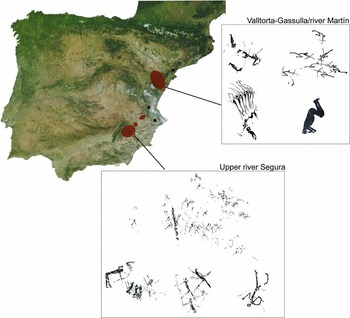
The regional distribution of violent scenes focuses on two main centres: the northern regions, with the artistic sites of Valltorta-Gassulla (Castellón) and the River Martín (Bajo Aragón-Teruel); and the southern inland regions connected by the River Segura, with Taibilla-Nerpio (Albacete-Murcia) as a site of particular interest (López-Montalvo Reference López-Montalvo, Baray, Honegger and Dias-Meirinho2011) (Figure 9). Beyond these two centres, the presence of violent scenes is patchy; the rockshelters of Cuenca, Huesca and Lleida have so far produced no clear example, while those of Jaén, Alicante and Valencia have yielded only a small number of cases. The interpretation of their content as violent is not always plausible, and their composition often departs from conventional rules. In Tarragona, there is a single ambush scene.
Geographical distribution of violent scenes, showing two main centres.

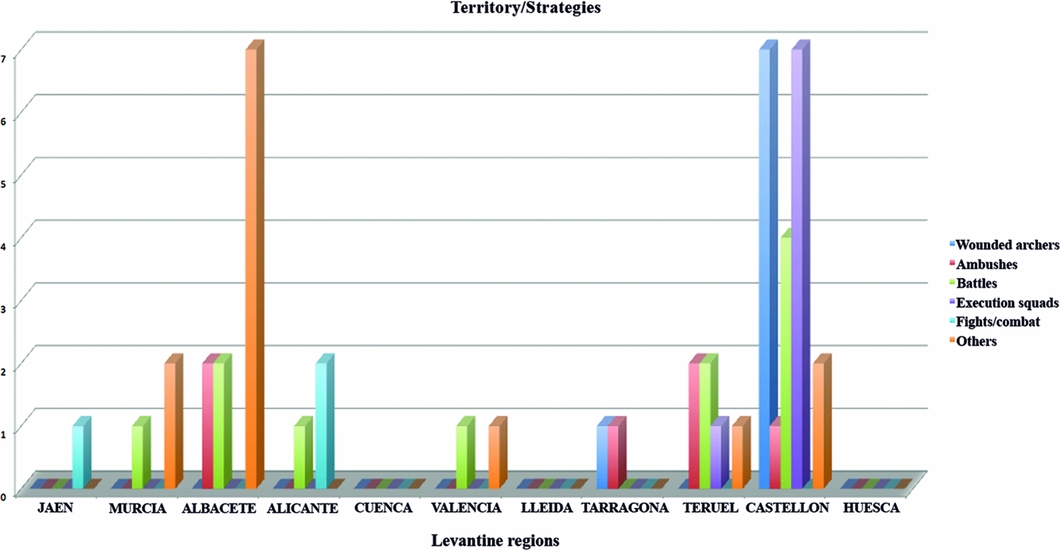
The variations between the Levantine regions in the depiction of violence can be quantified in terms of frequency, duration and type (Figure 10). Depictions of violence emerge in the early stylistic phases of the northern regions, while in the central-southern regions there are only isolated episodes (El Mansano, Minateda or La Risca). There is a sparse geographical distribution in the central-southern regions, in clear contrast with sites such as Valltorta-Gassulla, where there is a significant concentration of violent scenes in the older Pachypodous stylistic phase. The number of violent scenes increases in the later phases, not only at sites with early violent images, such as Valltorta-Gassulla and the upper River Segura, but also in new regions, such as Valencia and Alicante, where this type of depiction was either absent, rare or ambiguous in the earlier phases.
Geographic distribution of scenes with violent content, taking into account the different strategies portrayed.
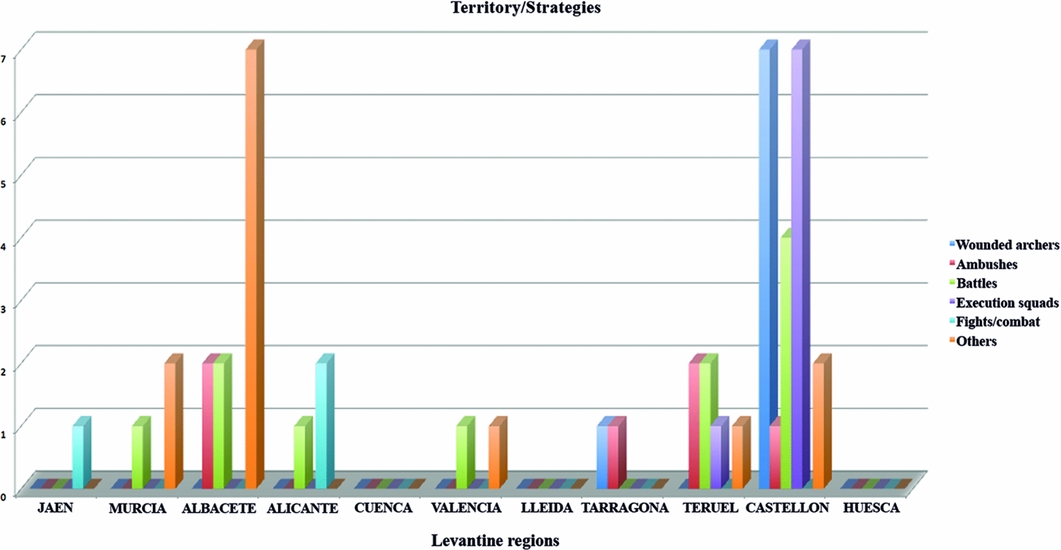
Valltorta-Gassulla (Castellón) boasts the greatest concentration of violent scenes (21 examples), the longest time span in terms of phases and the broadest range of violent acts. Another important site among the northern regions is on the River Martín (Teruel), which hosts every violent scene documented in the Aragón province. While a cultural link between these two sites is undeniable, interesting differences can be observed in the depictions of violence. The frequency of representation is significantly lower on the River Martín, as is the variety of violent acts. There appears to be particular representation here of violence requiring collective effort. Unlike Valltorta-Gassulla and Tarragona, there is no evidence of violent episodes in the older phases, also associated with the Pachypodous figures (Utrilla & Martínez Reference Utrilla and Martínez2007). One of the most distinctive aspects of the River Martín sites is the appropriation of older paintings of human figures to create ambush scenes by the addition of new motifs (El Cerrao and Arqueros Negros) (Figure 8e).
In the central-southern regions, the upper River Segura (Mateo Reference Mateo2004), running through the provinces of Jaén, Albacete and Murcia, has a sizeable network of ravines, such as the Taibilla-Nerpio or the Letur, and a significant concentration of Levantine rockshelters. The frequency of representations of violence is considerably lower in this region, with just 15 examples; the violence takes the form of fights, battles or ambushes that require group participation. With the exception of the ambush scenes in the Minateda and La Vieja shelters, the scenes belong to the Linear horizon, which places them in the final phase of Levantine paintings. Beyond the territory defined by the River Segura, the Alicante mountainside offers three examples: one possible battle (El Mansano) and two close-combat scenes (Santa Maira and La Sarga). The sites connected by the River Júcar (Valencia) yield one image of a phalanx (El Voro) (Figure 7d), the violent nature of which is debated, and a similarly controversial battle in the Trini rockshelter (Martínez-Rubio Reference Martínez-Rubio2010). Along with this patchy distribution at the macro-regional level, it is worth stressing the concentration of violent scenes in certain rock art sites or specific rockshelters. This suggests that certain spaces might have held particular appeal as places for pictorial expression, and might have become ‘favoured’ places for the repeated portrayal of a single theme. The province of Castellón is a prime example of this notion: the 21 violent images documented to date are distributed across just nine rockshelters, while at the Gassulla site more than half of the violent images are concentrated in just three rockshelters (Remigia, Cingle IX and Les Dogues). In the panels at Remigia, the portrayal of violent scenes is repeated throughout the sequence, or at least during its initial and final phases.
In the central-southern regions, however, the distribution of violent scenes does not indicate the existence of ‘favoured’ rockshelters, and it is only the Torcal de las Bojadillas rockshelter that yields multiple images with violent content—one battle and a possible phalanx—as well as the depiction of what have been dubbed ‘clouds of archers’, an unprecedented motif outside of Nerpio-Taibilla whose violent content is not evident. Finally, we should draw attention to the strategies that are exclusive to, or appear with greatest frequency in, specific regions; for example, the wounded archers or execution squads that are concentrated in Valltorta-Gassulla. The two-colour repainted phase detected recently in one of the squads documented in Remigia (López-Montalvo et al. Reference López-Montalvo, Villaverde, Roldán, Murcia and Badal2014), as well as the addition of new arrows in the victim, suggest the appropriation, persistence and reaffirmation of these themes in later phases (Figure 8c). It is precisely in those regions with fewer images of violence—Jaén or Alicante—that the violence shown is of a non-standard type, such as the close-combat scenes using short-range weapons (Figure 8d).
Pictorial evidence versus material evidence: a first assessment
Two clear trends have emerged through the analysis of violent scenes: first, a progressive increase in their number and complexity (Figure 4); and second, an uneven geographical distribution with two clear centres (Figure 10). My aim is to ascertain whether the variations identified in the pictorial plane translate into real changes in societies. Although it is not possible to fully decode these paintings, I believe that, as well as holding a symbolism, the representation of violence indicates more straightforwardly that situations of instability were a cause for concern among social groups. Certain aspects, such as the emergence of figures of higher status, the existence of organised squads or phalanxes, changes to strategies requiring cooperation and even the sporadic presence of women, reveal practices strongly rooted in the organisation of these societies and surely allow us to gain a deeper understanding of them.
However, interpretations based on pictorial evidence and evidence for violence in the archaeological record are constrained. The reasons for this are twofold: the chronological boundaries of Levantine rock art are still blurred, with the date it began, its period of production and the dates of the phases still unclear; and, situations of conflict, especially in non-state societies, do not always leave traces in the archaeological record. Interpreting the scale and impact of this kind of conflict in these societies is, therefore, a complex task.
In pre-state societies lacking defensive structures or weaponry designed exclusively for war, the evidence used to argue for the existence of conflict is the presence of skeletal remains with arrow wounds (Chapman Reference Chapman, Carman and Harding1999; Walker Reference Walker2001; Etxeberría et al. Reference Etxeberría, Herrasti and Bandrés2005; Lull et al. Reference Lull, Micó, Rihuete and Risch2006). The interpretation of fractures or contusion wounds is less conclusive, as they might have been accidental (Walker Reference Walker2001; Pérez Reference Pérez, Pérez and Soler2010). In the Iberian Peninsula, material traces of collective violent episodes emerge in the Final Neolithic (third millennium cal BC), coinciding with an increase in funerary evidence. These episodes are most prevalent in the regions to the north and north-east; that is, on the outskirts of the area with Levantine paintings. In these regions, there are as many as three collective burial sites, with individuals presenting arrow wounds or arrow heads embedded in bones (San Juan Ante Portam Latinam and Hipogeo de Longar) (Etxeberría & Vegas Reference Etxeberría and Vegas1992; Vegas et al. Reference Vegas, Armendariz, Etxeberría, Fernández, Herrasti, Schulting and Fibiger2012), as well as evidence of projectile weapons having been lodged in perishable soft tissues, as in Can Martorell (Barcelona) (Mercadal et al. Reference Mercadal, Palomo, Aliaga, Agustí, Gibaja, Barrios, Chimenos, Arias, Ontañon and García-Moncó2005). This evidence increases considerably from the Chalcolithic period onward, which is very much in line with what we see in other parts of Europe over the same periods (Beyneix Reference Beyneix, Schulting and Fibiger2012). Alongside these collective burial sites are individual burial sites, dating to the Middle Neolithic, which present the occasional example of individuals killed by arrows (Bòbila Madurell and Camí de Can Grau). The remaining evidence consists of cut-marks or sharp-force trauma, such as those at Cova d’En Pardo (Alicante), Sarsa (Valencia) and Boixadera dels Bancs (Barcelona), whose interpretation is controversial (Pérez Reference Pérez, Pérez and Soler2010). This type of wound is also documented in some skeletal remains at Neolithic settlements in Andalusia and may be the result of violent episodes (Jiménez-Brobeil et al. Reference Jiménez-Brobeil, Du Souich and Oumaoui2009). The lack of material evidence for violent episodes prior to this must be viewed in relation to the obscurity surrounding funerary practices during the Early Neolithic (sixth millennium cal BC). At around this time throughout the Iberian Mediterranean basin, such evidence is scarce and of dubious chronological origin (Bernabeu et al. Reference Bernabeu, Molina and García2001; Bernabeu Reference Bernabeu, Pérez and Soler2010). A possible explanation could be that burial rituals left no trace (Gibaja Reference Gibaja2005) or involved the deliberate destruction of the bodies (Guilaine & Manen Reference Guilaine, Manen, Guilaine, Manen and Vigne2007). Although cannibalism cannot be categorised unequivocally as violent behaviour, this interpretation may stand up to scrutiny in Neolithic Europe. Well-known cases from Fontbrégua (France) and Villa and Herxheim (Germany) (Boulestin et al. Reference Boulestin, Zeeb-Lanz, Jeunesse, Haak, Arbogast and Denaire2009) should be considered together with examples from the Iberian Peninsula, such as the Andalusian Neolithic sites of Malalmuerzo, Carigüela and Nerja (Botella et al. Reference Botella, Alemán, Jiménez, Du Souich, García, Malgosa, Nogués and Aluja2002).
It remains a complex task to piece together the archaeological and artistic evidence available to us for the nature and intensity of violent conflict throughout the Neolithic of the Iberian Peninsula. However, my analysis of the pictorial record has identified two key aspects: the involvement of entire groups in conflicts and the emergence of distinguished warriors, perhaps noted for their skill or bravery in combat. That there appears to be some degree of organisation, as suggested by the representation of phalanxes and execution squads, leads us to suspect the existence of an emerging (or already established) differentiation of roles in groups. Although the existence of social inequalities is offered as proof of complex hunter-gatherer societies (Hayden Reference Hayden, Douglas and Feinman1995), in which war is an important means of controlling the group, these inequalities are more clearly visible in the archaeological record of the Iberian Peninsula towards the end of the Neolithic, specifically in funerary archaeology. This coincides with a marked increase in projectile weapon and arrow-head finds in tombs, which some have attributed to the significant rise in conflict at this time (Gibaja Reference Gibaja2005). This level of conflict is also evident in the later phases of the Levantine pictorial cycle, through the increased representation of violent acts and their geographic distribution. In order to discern whether the changes observed in the pictorial plane correspond to a real rise in situations of instability within these groups, and to be able to situate the pictorial evidence in the archaeological sequence, we must advance in two directions: first, we must strive to understand the meaning of these images, which requires systematic analysis of the themes represented using the same criteria applied in the case of violent content. These criteria have demonstrable value for characterising the elements of continuity and change in pictorial traditions. Second, we must establish a chronology for each phase of these paintings. To achieve this aim requires more in-depth characterisation and sequencing of the horizons proposed to date, including details of their geographical distribution, time span and the formal variations observed over time. Cartographic reconstruction of stylistic phases of the Levantine pictorial tradition must ultimately be carried out in relation to the immediate archaeological context, with a view to correlating the phases of use with the presence or absence of stylistic phases.
Conclusion
In recent years, there has been an unprecedented surge of interest in characterising the origin and development of violence in prehistoric societies through the use of archaeological evidence. This has involved revisiting older models of a non-violent past and considering the limitations in characterising instability in prehistoric societies.
Although material evidence provides information regarding the presence or absence of conflicts, the pictorial evidence offers a different method of interpreting these societies, one with a cognitive, anthropological perspective on aspects that leave no material trace. For beyond their symbolic meaning, these paintings offer a window on characteristics deeply rooted in the behaviour and social organisation of their creators. This analysis of the pictorial expression of violence in the Levantine artistic tradition supports this concept. The introduction of chronological and geographic variables offers new perspectives, and it reveals the existence of tensions in a society, the nature, frequency, complexity and intensity of which varied over time and across different regions. Analysis of these scenes, however, cannot be carried out in isolation. The value of the rock art conclusions lies, unquestionably, in their being integrated and confirmed using archaeological data.
Acknowledgements
This paper was developed as part of project ANR-10-CREA-001 and project ‘NEOSOCWESTMED’ (no. 628428) of the Marie Curie Actions in the 7th Programme of the European Commission (FP7/2007–2013). The author is grateful to Bernat Martí, Georges Sauvet and Iñigo García for their useful comments.