Significant outcomes
-
∙ The cannabinoid agonist, WIN 55,212-2, attenuated serotonin-induced scratches.
-
∙ Unlike its antinociceptive effect, neurotoxic destruction did not influence the antipruritic action of WIN 55,212-2.
Limitations
-
∙ Monoamine levels may be measured to verify the degree of depletion of serotonin and noradrenaline in the spinal cord.
Introduction
Pruritus (itch), an unpleasant sensation that evokes the desire to scratch, is a significant clinical problem. It is a common symptom not only of skin diseases, such as atopic dermatitis, contact dermatitis, urticaria and psoriasis, but also of systemic disorders, such as uraemia and cholestasis. Therefore, treating pruritus will improve the quality of life for many patients. Itch and pain sensations have much in common. Similar to pain, itch sensation is transmitted via primary afferent C fibres from the skin to the superficial layer of the spinal cord dorsal horn and then to the thalamus by spinothalamic pathways (Reference Ikoma, Steinhoff, Stander, Yosipovitch and Schmelz1, Reference Schmelz2). Recently, descending inhibitory system has been shown to exert a tonic inhibition on the itch signalling (Reference Gotoh, Omori, Andoh and Kuraishi3), supporting the notion that the spinal cord is very important in modulation of pruritus (Reference Cevikbas, Steinhoff and Ikoma4–Reference Ross7). As a result, mediators and receptors involved in itch signal transmission in the spinal cord’s dorsal horn are gaining more attention for the development of new drugs for patients with pruritic disease (Reference Cevikbas, Steinhoff and Ikoma4,Reference Horvath, Joo and Kekesi6,Reference Kuraishi8).
The analgesic effects of cannabimimetic compounds have been known for centuries; however, they cannot be used effectively in clinical settings because of their abuse potential and unwanted central effects, including tolerance and physical dependence (Reference Gunduz, Oltulu and Ulugol9–Reference Grotenhermen and Muller-Vahl12). Cannabinoid drugs have only recently been approved for medicinal purposes, mainly for neuropathic pain, multiple sclerosis, etc. (Reference Kalliomaki, Annas and Huizar13–Reference Toth, Mawani and Brady15). Recent experimental research also indicates that cannabinoids elicit antipruritic effects (Reference Darmani and Pandya16–Reference Tosun, Gunduz and Ulugol18). Participation of descending serotonergic and noradrenergic systems in spinal modulation of pain has been known for a long time (Reference Millan19,Reference Yanarates, Dogrul and Yildirim20). Moreover, descending inhibitory pathways are indicated to modulate antinociceptive action of cannabinoids (Reference Dogrul, Seyrek, Yalcin and Ulugol10,Reference Millan19,Reference Gutierrez, Nackley, Neely, Freeman, Edwards and Hohmann21, Reference Seyrek, Kahraman, Deveci, Yesilyurt and Dogrul22).
Aims of the study
Taking into account the similarities between pain and itch, we aimed to observe attenuation of serotonin-induced itch responses with the cannabinoid agonist WIN 55,212-2 and determine whether neurotoxic destruction of descending serotonergic and noradrenergic pathways play a role in the antipruritic effect of WIN 55,212-2.
Materials and methods
Animals and ethics
Male Balb/c mice (Center of the Laboratory Animals, Trakya University), weighing 20–30 g, were used in the experiments. Mice were maintained under 12–12 h light-dark cycles at the temperature of 21±2°C with water and food available ad libitum. The local ‘Animal Care Ethics Committee’ approved all experimental protocols of this study.
Serotonin-induced scratching behaviour and rotarod assessment
Scratching behaviour was produced by intradermal injection of 50 µg/50 µl of serotonin into the pre-shaved rostral part of the back of the mice. Immediately after intradermal serotonin injection, the animals were put back into transparent acrylic cages individually and scratching of the injected site by the hind-paws was videotaped for 30 min. Typically, the mice produced several scratches per second and such response is counted as one bout of scratching. The videotape was played back to count the number of bouts of scratching.
Motor performance was tested using a rotarod apparatus (Commat, Ankara, Turkey). Latencies to fall of the mice were recorded. A cut-off time of 180 s and a speed of 16 rpm were adapted before assessments.
Experimental procedures and drugs
In order to determine the effect of cannabinoid treatment on serotonin-induced scratches, different doses of WIN 55,212-2 (1, 3, 10 mg/kg) were administered intraperitoneally (i.p.) 30 min before serotonin administrations. In different groups, the neurotoxins 5,7-dihydroxytryptamine (5,7-DHT, 50 μg/mouse) and 6-hydroxydopamine (6-OHDA, 20 μg/mouse) were given intrathecally to deplete serotonin and noradrenaline and to degenerate noradrenergic and serotonergic terminals in the spinal cord. Desipramine (25 mg/kg, i.p.) is given 30 min before 5,7-DHT in order to prevent the uptake of 5,7-DHT into noradrenergic terminals. In another set of experiments, to observe the effects of lesioning of descending noradrenergic and serotonergic pathways on cannabinoid-induced antipruritic action WIN 55,212-2 was administered 3 days after 5,7-DHT and 6-OHDA injections. The doses, treatment times of the drugs and experimental procedures were similar to our previous studies (Reference Tosun, Gunduz and Ulugol18,Reference Ulugol, Karadag, Ipci, Tamer and Dokmeci23,Reference Saglam, Gunduz and Ulugol24).
Serotonin hydrochloride, WIN 55,212-2, 5,7-DHT and 6-OHDA were purchased from Sigma, whereas desipramine hydrochloride from Tocris. WIN 55,212-2 was given in 20% DMSO, 5% Tween 80, 5% ethanol and 70% saline, while other drugs were dissolved in 0.9% sterile saline.
Statistical analysis
To determine statistical differences between groups, two-way analysis of variance, followed by Bonferroni’s t-test, were carried out. Values of p<0.05 were considered to be significant. All data was expressed as mean±SEM.
Results
Effects of the cannabinoid agonist WIN 55,212-2 on serotonin-induced scratches
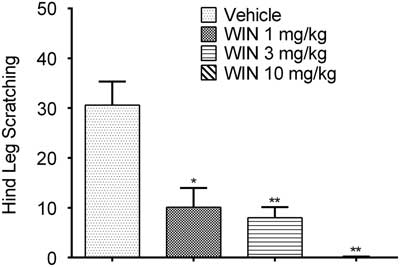
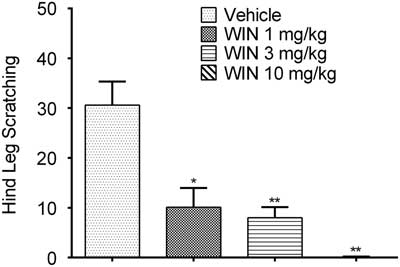
Intradermal serotonin injection (50 µg/50 µl) elicited marked scratching of the injection site (Fig. 1). Systemic administration of the cannabinoid agonist, WIN 55,212-2 (1, 3, 10 mg/kg, i.p.), significantly and dose-dependently attenuated serotonin-induced scratches. Its anti-scratching activity was stronger with its higher doses (3, 10 mg/kg), as compared with the lowest dose (1 mg/kg) (p<0.005 and <0.01, respectively, Fig. 1). No scratches were observed with 10 mg/kg dose of WIN 55,212-2 (Fig. 1).
Effects of systemic (1, 3, 10 mg/kg) injections of the cannabinoid agonist, WIN 55 212-2, on serotonin-induced scratches (two-way analysis of variance, followed by Bonferroni’s t-test, *p<0.005, **p<0.001, n=10 for each group).
The influence of spinal noradrenalin and serotonin depletion on the anti-scratching activity of WIN 55,212-2
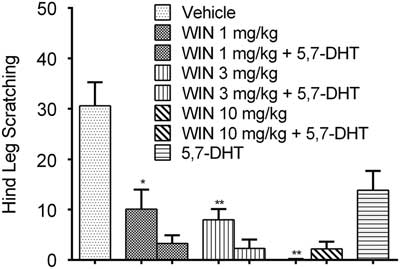
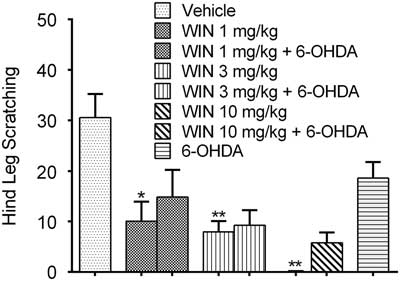
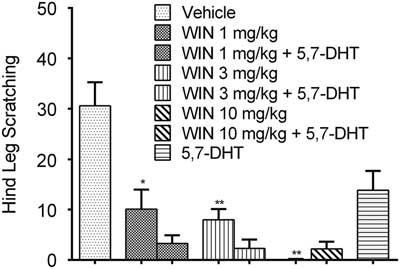
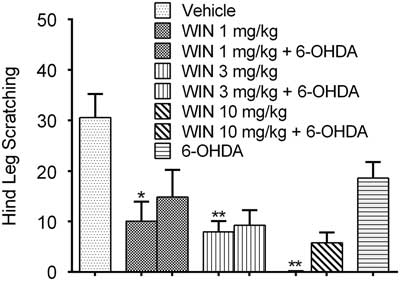
Spinal 5,7-DHT (50 μg/mouse) and 6-OHDA (20 μg/mouse) injections are known to deplete serotonin and noradrenaline in the spinal cord. Reduction of monoamine levels in the spinal tissues with administrations of these neurotoxins is mentioned to be 85% and 90–95% in two similar studies (Reference Hung, Wu, Mizoguchi, Leitermann and Tseng25,Reference Dogrul, Seyrek, Akgul, Cayci, Kahraman and Bolay26). Intrathecal pretreatment with neither 5,7-DHT nor 6-OHDA reduced anti-scratching activity of WIN 55,212-2 (Figs 2, 3).
Effects of intrathecal pretreatment with the neurotoxin 5,7-dihydroxytryptamine (5,7-DHT, 50 μg/mouse) on attenuation of serotonin-induced scratches by WIN 55,212-2 (two-way analysis of variance, followed by Bonferroni’s t-test, *p<0.005, **p<0.001, n=10 for each group). WIN versus WIN+5,7-DHT comparisons in the respective groups were not statistically significant.
Effects of intrathecal pretreatment with the neurotoxin 6-hydroxydopamine (6-OHDA, 20 μg/mouse) on attenuation of serotonin-induced scratches by WIN 55,212-2 (two-way analysis of variance, followed by Bonferroni’s t-test, *p<0.005, **p<0.001, n=10 for each group). WIN versus WIN+6-OHDA comparisons in the respective groups were not statistically significant.
Effects of WIN 55,212-2 on locomotor performance
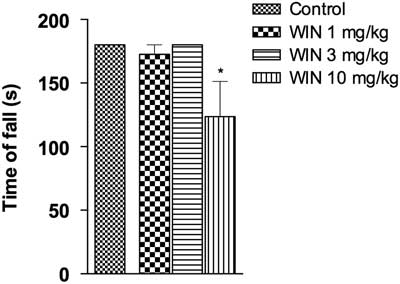
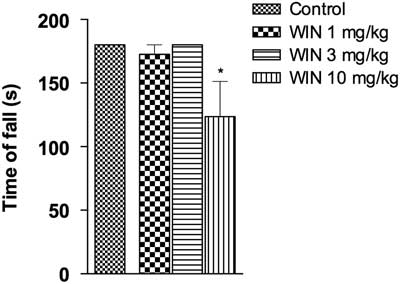
WIN 55,212-2 impaired locomotor performances only at the highest dose administered, 10 mg/kg (p<0.05, Fig. 4).
Effects of different doses of WIN 55,212-2 on spontaneous locomotor activity (one-way analysis of variance, followed by Bonferroni’s t-test, *p<0.05, n=10 for each group).
Discussion
As mentioned in the introduction, a large number of experimental and clinical researches have been done on the analgesic effects of cannabinoids. On the other hand, although pain is known to share many similarities with itch, cannabinoid effects on pruritus has not attracted much attention and there are very few studies in this area. Previously, Darmani and Pandya (Reference Darmani and Pandya16,Reference Darmani27) showed that cannabinoid receptor agonists attenuated scratching responses while cannabinoid antagonists induced scratching behaviours in mice. Similarly, the cannabinoid CB1 receptor antagonist rimonabant-induced pruritic responses, and reversal of this effect with mixed cannabinoid agonists have also been indicated (Reference Schlosburg, O’Neal, Conrad and Lichtman17,Reference Janoyan, Crim and Darmani28). Moreover, histamine-induced responses are diminished by the potent synthetic cannabinoid HU-210 in human skin (Reference Dvorak, Watkinson, McGlone and Rukwied29). Recent research also indicates that scratching behaviour is attenuated by inhibition of endocannabinoid degradative enzymes, fatty acid amide hydrolase and monoacylglycerol lipase, pointing to the importance of the endocannabinoid system in modulation of scratching response (Reference Tosun, Gunduz and Ulugol18,Reference Schlosburg, Boger, Cravatt and Lichtman30). Here, in line with these previous researches, we showed that the cannabinoid agonist WIN 55,212-2 decreased serotonin-induced scratches dose-dependently, no scratches are observed with the highest used dose of WIN 55,212-2. It should be taken into consideration that WIN 55,212-2 impaired motor function at the dose of 10 mg/kg and its anti-scratching activity at the highest dose may be due to impairment in motor control (Reference Gomes, Del Bel and Guimaraes31–Reference Gunduz, Topuz, Karadag and Ulugol33).
CB1 receptors are known to be the principal receptor in cannabinoid action for both pain and itch responses (Reference Schlosburg, O’Neal, Conrad and Lichtman17,Reference Kinsey, Nomura and O’Neal34). CB1 receptor antagonists induce scratching behaviour, and CB1 receptors are necessary to produce rimonabant-induced scratching (Reference Schlosburg, O’Neal, Conrad and Lichtman17,Reference Schlosburg, Boger, Cravatt and Lichtman30). On the other hand, recent research suggests that cannabinoid CB2 receptors also play role in the modulation of scratching behaviour. CB2, but not the CB1, receptor antagonist has recently been found to reverse the antipruritic effect of the FAAH inhibitor URB597 (Reference Tosun, Gunduz and Ulugol18). Spradley et al. (Reference Spradley, Davoodi, Gee, Carstens and Carstens35) indicated that both CB1 and CB2 receptors mediate endocannabinoid modulation of serotonin-induced scratching behaviour. Moreover, new CB2 selective agonists are considered to be promising orally active antipruritic agent candidates (Reference Kusakabe, Iso and Tada36,Reference Odan, Ishizuka and Hiramatsu37). Thus, both CB1 and CB2 receptors are now implicated to play active roles in reduction of scratching behaviour. Since WIN 55,212-2 is a mixed CB1/CB2 agonist, both CB1 and CB2 receptors may be involved in the measured anti-scratching effect of WIN 55,212-2. Observing the effects of specific CB1 and CB2 agonists and antagonists will improve understanding of the individual roles cannabinoid receptors play in scratching behaviour.
The involvement of the descending monoaminergic systems in the regulation of pain signalling in the spinal cord has been known for many years (Reference Millan19). Similarly, the descending noradrenergic, but not serotonergic, system has been shown to exert a tonic inhibition of itch signalling through α-adrenoceptors (Reference Gotoh, Omori, Andoh and Kuraishi3). Stimulation of both α1-and α2-adrenoceptors and inhibition of noradrenaline reuptake has been found to attenuate scratching behaviour (Reference Andoh, Gotoh and Kuraishi38–Reference Gotoh, Andoh and Kuraishi40). Gutierrez et al. (Reference Gutierrez, Nackley, Neely, Freeman, Edwards and Hohmann21) demonstrated that cannabinoid antinociception is diminished following neurotoxic destruction of descending noradrenergic pathways. Our findings, showing that neurotoxic destruction of neither serotonergic nor noradrenergic pathways influence the efficiency of cannabinoids to attenuate itch behaviour, are not consistent with these reports. However, we speculate that cannabinoid-induced antinociception and antipruritic activities may develop via different mechanisms.
Our results indicate that cannabinoid receptor agonists attenuate serotonin-induced scratching behaviour. Moreover, we suggest that, unlike their antinociceptive action, neurotoxic destruction of monoaminergic pathways does not affect the antipruritic action of cannabinoids. We conclude that, regardless of the mechanism of action in the spinal cord, cannabinoid receptor agonists might be effective for the treatment of pruritus in mice.
Acknowledgements
Authors Contributions: Zeynep Gizem Todurga, MSc, contributed acquisition and interpretation of data, drafting the article and final approval of the version to be published. Assoc. Prof. Ozgur Gunduz contributed to the acquisition, analysis and interpretation of data, drafting the article and final approval of the version to be published. Prof. Cetin Hakan Karadag contributed to the conception, design, analysis and interpretation of data, drafting and revising the article for important intellectual content and final approval of the version to be published. Prof. Ahmet Ulugol contributed to the conception, design, analysis and interpretation of data, drafting and revising the article for important intellectual content and final approval of the version to be published.
Financial Support
This work was supported by a grant from Trakya University Research Council (TUBAP-2013/44).
Conflicts of Interest
None.
Ethical Standards
The authors assert that all procedures contributing to this work comply with the ethical standards of the relevant national and institutional guides on the care and use of laboratory animals.