Kawasaki disease, also known as the mucocutaneous lymph node syndrome, is an acute vasculitis illness of childhood. It occurs world wide, and is a major cause of acquired cardiac disease in children. Myocarditis, which is one the main manifestations of the disease, presents with tachycardia, gallop rhythm, muffled heart sounds and decreased ventricular function, and occurs in more than half of afflicted patients.Reference Moran, Newburg, Sanders, Parness, Spevak, Burns and Colan1–Reference Crystal, Syan, Yeung, Dipchand and McCrindle5 Different invasive and non-invasive methods has been suggested for assessment of ventricular function in these patients with myocardial involvement. Non-invasive echocardiographic evaluation, with the use of M-mode and cross-sectional methods, is well recognized as a suitable tool for such assessment. Lately, an easily measured new Doppler-derived index of global myocardial performance, which combines systolic and diastolic time intervals, and is now known as the Tei-index, has been reported.Reference Tei6–Reference Eidem, Tei, O’Leary, Cetta and Seward8 This index, which measures combined systolic and diastolic function of either ventricle, has previously been correlated with severity and clinical outcome in children with congenital and acquired cardiac disease.Reference Eto, Ishii, Tei, Tsustumi, Akaqi and Kato9–Reference Tsutsumi, Ishii, Eto, Hota and Kato10 We have now assessed the accuracy of the index in comparison with conventional echocardiographic measurements for detecting ventricular dysfunction in patients with Kawasaki disease.
Materials and Methods
We studied 14 patients diagnosed with acute Kawasaki diseases according to the criterions established by the American Heart Association,11 all of whom were admitted at the paediatric wards of Nemazee and Dastgheib Hospitals of Shiraz University of Medical Sciences over a period of 1 year. The patients aged from 2 to 9 years old, with equal numbers of males and females. The duration of the disease from the time of the onset of symptoms to the time of treatment with immunoglobulin was 10 days or less. Approval for the study was obtained from institutional research board and ethical committee of Shiraz University. Written informed consent was obtained from parents of all the patients.
Recording of data
Echocardiographic studies were performed using M-mode, cross-sectional, colour and pulsed Doppler modalities using a Hewlett- Packard Sono CFM 100 machine coupled to a 3.5 megaherz transducer, first at the time of diagnosis of the disease, in its acute phase, before treatment with immunoglobulin, and then two weeks later, during the subacute phase of disease and after treatment. We measured the Tei index for both ventricles, the ejection and shortening fractions, and assessed for pericardial effusion and valvar regurgitation. We performed similar measurements in 22 normal and healthy children, matched for age and gender, and without any underlying cardiac disease.
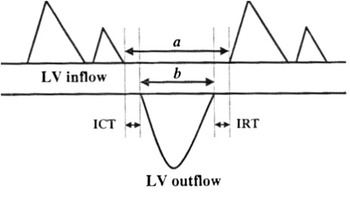
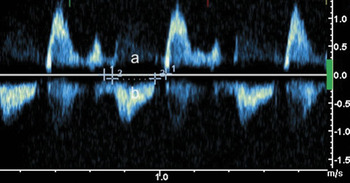
For Doppler interrogation, we measured 5 consecutive beats, averaging the values, and assessing the following Doppler time intervals (Figs 1 and 2):
Illustration of the calculations required to derive the Tei index.

Echocardiographic measurements from of one of our patients, showing the calculation of the Tei index.

• The interval from the cessation to onset of mitral or tricuspid inflow, equal to the sum of the isovolumetric contraction time, ejection time and isovolumetric relaxation time, designated as “a” in the equation shown below, and
• The duration of ventricular ejection from the onset to the end of aortic or pulmonary ejection, designated as “b” in the equation.
The Doppler derived Tei-index, combining systolic and diastolic function of either ventricle, was then calculated as 
Statistical analysis
Variables were expressed as mean values plus or minus standard deviations. The relation between the variables was analyzed by one way analysis of variance using Mini Tab (Stirling Tech. Inc.). A p value of less than 0.05 was considered statistically significant. SPSS version 13 statistical software was used for all statistical analyses.
Results
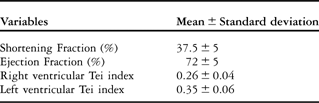
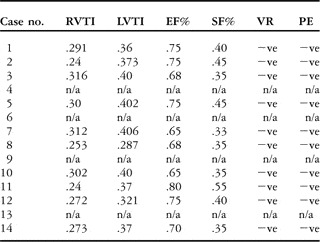
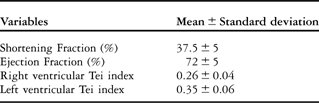
The results of conventional echocardiographic measurements and assessments of Tei-index for ventricular function for the control subjects, are summarized in Table 1. All values were within the normal range as previously reported.
Echocardiographic measurements of the control patients.
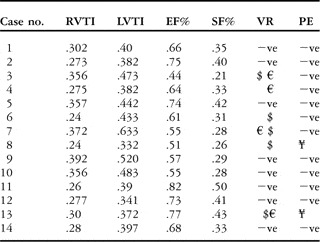
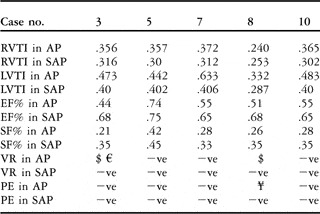
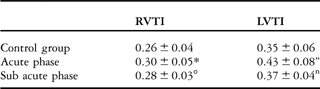
In Tables 2 and 3, we show the results of the echocardiographic studies of patients during the acute phase of the disease, and 2 weeks after treatment with intravenous immunoglobulin. In Table 4 we show the echocardiographic data of 5 patients revealed to have ventricular dysfunction. When we compared the values of the Tei index of the patients with abnormal measurements in the acute phase with those of control group, and also within the same group after treatment with immunoglobulin, as shown in Table 5, there were statistically significant differences between the index for the left ventricle, with values of 0.43 ± 0.08 as opposed to 0.35 ± 0.06 (p less than 0.003), and also within themselves in the subacute phase of the disease, with values of 0.43 ± 0.08 as opposed to 0.37 ± 0.04 (p less than 0.045).
Echocardiographic measurements taken during the acute phase of Kawasaki disease.

Abbreviations: Right ventricular Tei-index (RVTI), left ventricular Tei-index (LVTI), ejection fraction (EF%), shortening fraction (SF%), pericardial effusion (PE), valvular regurgitation (VR), negative (−ve): no valvular regurgitation or pericardial effusion.
$ Mild mitral regurgitation.
€ Mild tricuspid regurgitation.
¥ Minimal pericardial effusion.
Echocardiographic measurements taken during the subacute phase of Kawasaki disease.

Abbreviations: Right ventricular Tei-index (RVTI), left ventricular Tei-index (LVTI), ejection fraction (EF%), shortening fraction (SF%), pericardial effusion (PE), valvular regurgitation (VR), Negative (-ve): no valvular regurgitation or pericardial effusion.
n/a, data not available.
Comparison of echocardiographic measurements of patients with abnormal values during the acute phase of Kawasaki disease with the respective measurements in the subacute phase.

Abbreviations: Right ventricular Tei-index (RVTI), left ventricular Tei-index (LVTI), ejection fraction (EF%), shortening fraction (SF%), pericardial effusion (PE), valvular regurgitation (VR), acute phase (AP), sub acute phase (SAP), negative (-ve): no valvular regurgitation or pericardial effusion.
$ Mild mitral regurgitation.
€ Mild tricuspid regurgitation.
¥ Minimal pericardial effusion.
Comparison of Tei-indices of patients during different phases of KD and with control group.
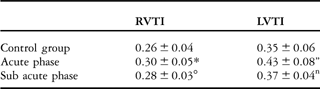
Abbreviations: Right ventricular Tei-index (RVTI), left ventricular Tei-index (LVTI).
* p value 0.009 compared to the control population.
” p value 0.003 compared to the control population.
° p value 0.164 compared to the patients in acute phase.
n p value 0.045 compared to the patients in acute phase.
We also found statistically significant differences for the right ventricular Tei index of these patients when compared with their controls, at 0.30 ± 0.05 versus 0.26 ± 0.04 (p less than 0.009), but the difference between the two stages of the disease for the index of the right ventricle was not statistically significant, the values being 0.30 ± 0.05 and 0.28 ± 0.03 (p equal to 0.164). We identified 5 patients with mild mitral regurgitation, two with minimal pericardial effusion and mitral regurgitation, and none with coronary arterial involvement.
Discussion
Cardiac involvement is the most important sequel of Kawasaki disease. Myocarditis, pericarditis, coronary arterial aneurysms, and valvar regurgitation are among the major cardiac manifestations of the disease. There is the possibility of disturbance of myocardial function during different stages of the disease, reflecting different underlying pathological processes.Reference Moran, Newburg, Sanders, Parness, Spevak, Burns and Colan1–Reference Matsuura, Ishikita, Yamamoto, Umezawa, Ito, Hashiguchi, Saji, Matsuo and Takano4
Endomyocardial biopsyReference Yaneska, Nakada, Sunagawa, Tomimoto, Naka, Takahashi, Matubara and Sekigami12, Reference Yutani, Go, Kamiya, Hirose, Misawa, Maeda, Kozuka and Onishi13 has provided histological evidence of myocarditis in the acute phase of the disease, during which the antibody titers to human cardiac myosin are significantly elevated.Reference Cunningham, Meissner, Heuser, Pietra, Kurahara and Leung14 In four-fifths of patients, myocarditis in the acute phase has also been demonstrated using Gallium-67 myocardial imaging with single photon emission computed tomography,Reference Matsuura, Ishikita, Yamamoto, Umezawa, Ito, Hashiguchi, Saji, Matsuo and Takano4 being seen in almost three-fifths when studied using tecnecium scans.Reference Kao, Hsieh, Wang, Chen, Liao, Wang and Yeh3 The severity of the myocardial dysfunction is correlated with the degree of myocardial inflammation.Reference Kao, Hsieh, Wang, Wang and Yeh15 Echocardiographic studies have shown ventricular end-diastolic and systolic dimensions to be significantly higher, and proportional fractional shortening and ejection fraction significantly lower, during the acute phase of the disease.Reference Newburger, Sanders, Burns, Parness, Beiser and Colan16 Non invasive tests, such as stress-shortening and stress-velocity analysis, have also shown abnormal contractility at the time of initial presentation of the patients.Reference Moran, Newburg, Sanders, Parness, Spevak, Burns and Colan1
The so-called Tei index is a Doppler derived index of myocardial performance, which correlates with invasive measurements of systolic and diastolic ventricular function, and has been shown to be a promising non-invasive tool for assessment of overall cardiac function.Reference Tei, Nisshimura, Seward and Tajik17–Reference Jiang, Levine and Weyman21 When using a combined isovolumic index in laboratory studies, defined as the isovolumic contraction plus isovolumic relaxation time divided by ventricular ejection time, an inverse correlation was shown with changes in fractional shortening.Reference Mancini, Friedman, Hramiee and DeBoe22 This experimental technique was then extended for use in patients with ischaemic heart disease or idiopathic dilated cardiomyopathy, invasive measurements of left ventricle systolic and diastolic function being shown to correlate well with the Doppler-derived index.Reference Tei, Nisshimura, Seward and Tajik17 A subsequent study showed significant, but not strong, correlation of the index with echocardiographically derived ejection fractions in adults with idiopathic dilated cardiomyopathy.Reference Dujardin, Tei, Yeo, Hodge, Rossi and Seward23 The index was then used in the evaluation of ventricular function in children after anthracycline therapy. These studies showed an increase in the index in spite of normal ejection fractions in patients whom left ventricular dysfunction developed on follow up, the investigators concluding that the index was a sensitive technique for detecting subclinical left ventricular dysfunction, being better than the currently available standard echocardiographic measurements.Reference Eidem, Sapp, Suarez and Cetta24, Reference Ishii, Tsutsumi, Himeno, Eto, Furui, Hashino and Suqahara25
These experiences suggest that, while there may be no exact inverse relationship between the Tei index, ejection fraction, and shortening fraction, such a relationship may be seen in the setting of overt left ventricular dysfunction, when both ejection fraction and shortening fraction are unequivocally impaired. We considered the measured values of less than 0.30 for the right ventricle, and less than 0.43 for the left ventricle, in the setting of ejection fractions of less than 55% and shortening fractions of less than 28%, to be abnormal. Others have previously considered comparable values to be abnormal.Reference Karatzis, Giannakopoulou, Papadakis, Karazachos and Nearchou26–Reference Borzoee and Kheirandish28 The presence of pericardial effusions and mitral regurgitation may also cause prolongation of the isovolumic relaxation time and shortening of the ejection times, respectively, so these features might also produce an increase of the Tei index. Other studies,Reference Javidi and Saffarian29, Reference Bruch, Schmermund, Dagres, Katz, Bartel and Erbel30 nonetheless, have shown that mild pericardial effusion and primary mitral regurgitation may not increase the index, a finding observed in our 8th patient, who had abnormal ejection and shortening fractions, but a normal Tei index.
The index has the advantage of being independent of heart rate and cardiac loading conditions, and is able to detect early global myocardial dysfunction in situations where the routine indexes of cardiac function are still within the normal range,Reference Mancini, Friedman, Hramiee and DeBoe22, Reference Jessup, Sutton, Weber and Janicki31–Reference Badke32 as can be the case in the acute phase of Kawasaki disease. Although we were unable to prove the superiority of the Tei index over conventional measurements of ejection fraction and shortening fraction in the early detection of myocardial dysfunction and during the acute phase of Kawasaki disease, we suggest a further study using a larger population of patients is justified further to evaluate this possibility. The improvement of the myocardial function, as measured by the index after treatment, also provided good evidence of the value of the index in assessing the reversibility of acute myocarditis in patients with Kawasaki disease.
In conclusion, we submit that our study shows the Tei index to be a simple, sensitive, and accurate tool, which is easy to use and reproducible in quantitatively estimating global myocardial function. Our results demonstrate that the index provided information over and above other indexes of myocardial performance when used for assessment of patients during the acute phase of Kawasaki disease. The index can also be used for follow-up and assessment of myocardial function during the recovery phase of the disease.
Acknowledgement
We thank Mrs M. Farahmandi for preparation and typing of the manuscript.
This work was financially supported by Vice Chancellor for Research of Shiraz University of Medical Sciences.