Introduction
Injection medialisation laryngoplasty for the management of voice disorders such as vocal fold palsy and atrophy is well described.Reference Vila, Bhatt and Paniello1–Reference Hamdan, Ziade, Jaffal and Skaff4 The procedure may be performed under either general or local anaesthetic, with implant material injected into the paraglottic space. A variety of injection materials have been described.Reference Lisi, Hawkshaw and Sataloff3
Case report
We describe the following technique of injection medialisation laryngoplasty in an 88-year-old man with a 2-year history of presbyphonia, on a background of Parkinson's disease. The patient was initially managed conservatively by speech therapy and referred to the voice clinic when results plateaued. Pre-procedure examination of the larynx with flexible nasendoscopy revealed atrophy of the vocal folds, worse on the left, with a resulting phonatory gap. The patient also has a significant multi-comorbid background of atrial fibrillation, hypertension and long-term catheter placement.
The patient was scheduled for injection medialisation laryngoplasty under general anaesthesia because of cervical kyphosis, which precluded conventional injection medialisation via suspension microlaryngoscopy.
The author's preference is to use transnasal humidified rapid-insufflation ventilatory exchange (‘THRIVE’) (Optiflow; Fisher & Paykel Healthcare, Maidenhead, UK) for oxygenation and ventilation, with target-controlled infusion anaesthesia. However, a variety of different anaesthetic and airway management options may be applied depending on patient factors, and the preferences and expertise of the anaesthesia and surgical team.
Once adequate depth of anaesthesia has been achieved, a ‘C-MAC’ intubating video-laryngoscope with a Macintosh blade (Karl Storz, Tuttlingen, Germany), using a ‘D-blade’ attachment, is used to visualise the vocal folds. Topical anaesthesia (2 ml, 2 per cent lignocaine) is administered to the glottis using a mucosal atomisation device (MADgic Laryngo-Tracheal Mucosal Atomization Device; Teleflex Medical Europe, Athlone, Ireland). The D-blade is then advanced beyond the epiglottis, optimising the view of the vocal folds.
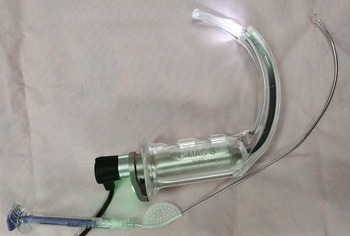
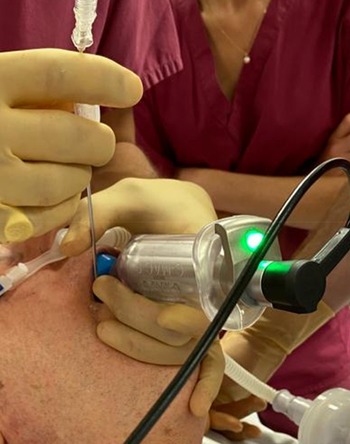
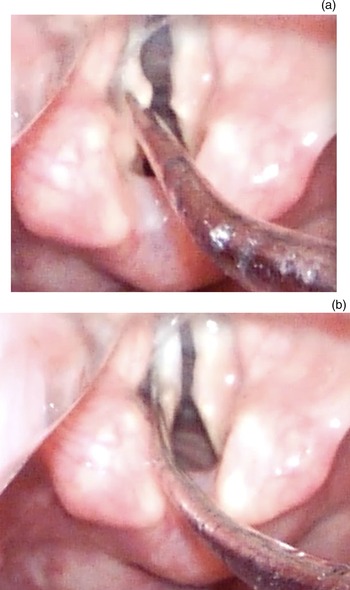
A transoral introducing needle (24-gauge needle tip, 16-gauge shaft, 25 cm total length) is then shaped by tactile manipulation to a curved angle of between 130 and 145 degrees, to approximately match the curvature of the D-blade (Figure 1). The needle is introduced along the curve of the D-blade, until the needle tip is visible on the C-MAC screen, above the glottis (Figure 2). The implant material (Renú® Voice injectable vocal fold implant) is then injected into the paraglottic space in the normal manner until satisfactory medialisation of the vocal fold has been achieved, following which the patient may be woken up (Figure 3). The entire surgical procedure is performed using visual feedback from the C-MAC video-scope screen.
Transoral introducing needle, shaped to an angle of between 130 and 145 degrees, matching the curvature of the D-blade.

Introducing the re-shaped transoral needle along the curve of the D-blade.

Injection of the implant material into the left vocal fold guided by ‘C-MAC’ intubating video-laryngoscope images: (a) pre-injection and (b) post-injection images.

In the case that we have used to illustrate the technique, both vocal folds were injected because of the bilateral nature of the vocal fold atrophy. When reviewed in the out-patient clinic four weeks later, the patient's post-operative Voice Handicap Index score was 6, comparing favourably with their pre-operative score of 21.
Discussion
Injection medialisation laryngoplasty for the management of voice disorders may be performed under either general or local anaesthesia, with the implant injected into the paraglottic space.
When performed under general anaesthesia, a transoral approach is employed.Reference Nawka and Hosemann5 In certain cases, patient-specific anatomical factors may compromise the view of the glottis on direct laryngoscopy (such as kyphosis, cervical fixation, prominent dentition, retrognathia or an anteriorly positioned larynx), precluding injection by direct laryngoscopy or microlaryngoscopy. Furthermore, co-morbid medical factors may contraindicate general anaesthesia in some patients.
Two approaches – transcricothyroid and transthyrohyoid – are typically described for performing the procedure under local anaesthesia.Reference Wilson, Kimball, Sayce, Luo, Khosla and Rousseau6 As with general anaesthesia, certain patient factors may compromise and preclude the ability to perform the procedure under local anaesthesia (such as intolerance to nasendoscopy, marked kyphosis, a low-lying larynx or cricoid, horizontal larynx, and a high body mass index).Reference Wang, Wu, Tu, Lin and Liu7
In certain cases, the abovementioned patient factors may combine, such that conventional techniques are not possible. Whilst transnasal injection thyroplasty using a flexible nasendoscope with a working side channel has been described,Reference Hamdan, Ziade, Jaffal and Skaff4 a suitable injection material with a sufficiently low viscosity for injection via a long, narrow side channel, and with sufficiently high viscosity for durable results, has yet to be developed.
There exist several other potential applications of the described technique, such as unilateral injection for vocal fold paralysis and the delivery of other injectable materials like botulinum toxin, for example in the management of adductor spasmodic dysphonia. Additionally, this technique may potentially be applied to biopsy collection (with appropriate biopsy forceps) in patients with similarly challenging anatomy.
We therefore describe the above technique for successful injection medialisation laryngoplasty in the management of voice disorders, performed under general anaesthesia, where conventional methods are precluded. This technique utilises commonly available equipment and anaesthesia support to recreate the views and access that conventional nasendoscopy and laryngoscopy would otherwise facilitate.
Conclusion
We describe a procedure that we have found to be effective for performing injection medialisation laryngoplasty in patients who are not suitable for a local anaesthetic procedure, and in whom anatomical variations preclude direct laryngoscopy. To our knowledge, this procedure has not previously been described, and provides a viable and proven alternative in these uncommon, but challenging, cases.
Acknowledgement
The authors would like to thank Mr Hugh Prater, Theatre Manager at ENT Theatres, University Hospitals Sussex.
Data availability statement
The data and images that support the findings of this study are available from the corresponding author upon reasonable request.
Competing interests
None declared