Introduction
The frequency of mass casualty incidents (MCIs) is steadily rising around the world as a result of human and nonhuman etiologies.Reference Sarpy, Warren, Kaplan, Bradley and Howe1 Natural disasters, novel biological threats, and an increasing number of armed conflicts or political unrest are fueling the number of complex disaster zones globally.Reference Murray2 In dealing with the medically complex patients of such events, care teams must be coordinated efficiently with a multidisciplinary leadership plan. While disaster medicine education is a component of most Emergency Medicine (EM) residency program curricula and is a core component required by the Residency Review Committee for EM (RRC-EM), there are no standardized guidelines for disaster medicine training. This results in significant variability in knowledge and skills.Reference Sarin, Cattamanchi, Alqahtani, Aljohani, Keim and Ciottone3, Reference Sandifer, Wexler and Flamm4 In the context of an increasing number of disaster events, it becomes prudent to ensure exposure to the fundamentals of disaster medicine while EM physicians are in their postgraduate training.
Various methods of instructing healthcare providers in this discipline exist.Reference Mahdi, Jafri and Allana5 Full-scale exercises (FSX) are realistic drills requiring full mobilization of personnel and resources, mimicking a true MCI. FSX generally require significant preparation, including enlisting multiple organizations, intensive use of resources or equipment, labor, and time.Reference Mahdi, Jafri and Allana5 FSX are valuable as they allow individuals to practice skills in high-fidelity settings. These skills include communication, organizing under incident command structures, prioritization, and stress management.Reference Pek, Quah, Valente, Ragazzoni and Della Corte6, Reference Weinstein, Bortolin and Lamine7 FSX also provides institutional benefit. A full-scale MCI requires cessation of daily operations, clearing and changing the physical space in preparation for an influx of patients, and minimizing consequences of ongoing disasters to the institution’s baseline functions, all of which can be practiced during FSX.Reference Djalali, Carenzo and Ragazzoni8 FSX are infrequently performed due to the intensive labor, cost, and time required to arrange them. These exercises come at a high financial cost to the organizing institution as they require closure of normal operations and a significant investment in personnel, experts, and equipment. While a massive undertaking, learners in FSX report increased self-efficacy, preparedness, and improved skills to manage disaster events. However, studies have demonstrated that these exercises fall lower on the Kirkpatrick levels of learner evaluation.Reference Pek, Quah, Valente, Ragazzoni and Della Corte6
Simulation education focuses on exposing learners to high acuity, low occurrence phenomena, making it an ideal avenue to educate providers in disaster medicine.Reference Bentley, Iavicoli and Boehm9 While simulation time is inherently compressed and may not reflect a realistic MCI time-line, simulation-based training enables participants to experience the same psychological stress and cognitive load as in a true MCI without risk of adverse patient outcomes.Reference Shrestha, Kanchan and Krishan10 Simulated MCI events (functional drills, smaller than FSX scale) have shown increased participant knowledge base, competency, and self-perceived effectiveness in response to disasters.Reference Mahdi, Jafri and Allana5, Reference Ingrassia, Pigozzi, Bono, Ragazzoni and Della Corte11, Reference Sánchez-Marco, Escribano, Rubio-Aparicio, Juliá-Sanchis and Cabañero-Martínez12 Various methods have been trialed in integrating simulation into disaster education. These methods include a lecture portion as part of a formalized curriculum, stand-alone simulation cases, small group discussions, and the use of gamification in education.Reference Bentley, Iavicoli and Boehm9, Reference Hailey, Lei and Lawrence13–Reference Alim, Kawabata and Nakazawa15 Tabletop exercises (TTX) are an additional method in training healthcare providers in disaster medicine. TTX are defined as discussion-based activities that are guided by a facilitator.Reference Frégeau, Cournoyer and Maheu-Cadotte16 These are generally low fidelity and include dioramas or figures. They require that participants identify, investigate, and resolve issues while prompting constructive discussion around emergency plans and policies in a psychologically safe environment.Reference Whitney, Burke, Lehman-Huskamp, Arora, Park and Cicero17, Reference Liu, Huang, Li, Gui and Zhou18 Benefits of TTX include the low cost and lack of disruption to everyday institutional operations.Reference Idrose, Adnan, Villa and Abdullah19, Reference Descatha, Loeb, Dolveck, Goddet, Poirier and Baer20 TTX are the most frequently used disaster preparation tool across the world and have demonstrated efficacy in increasing participant engagement.Reference Mahdi, Jafri and Allana5
Both low-fidelity and high-fidelity simulations have been shown to improve clinical skills and team performance.Reference Nicolaides, Theodorou and Emin21 Low-fidelity simulation provides a foundational grasp of essential skills, while high-fidelity simulation elevates the learning by allowing for the complexity of real-life clinical settings. Low-fidelity simulation, which includes TTX, is easier to plan and execute due to the need for fewer resources. They also allow for more frequent applications and spaced repetition. TTX can also allow for more learners to work through the topic and break the topic down into smaller, more manageable topics, allowing for lower cognitive load. High-fidelity immersive simulation, including full-scale MCIs, requires more planning and resources to enhance realism. In addition, high-fidelity immersive simulation is more stressful for the participants and can lead to overconfidence in learners.Reference Nicolaides, Theodorou and Emin21, Reference Massoth, Röder and Ohlenburg22 The authors sought to compare the effectiveness of TTX and high-fidelity in-person simulations (IPS) in improving knowledge, confidence, and perceived preparedness in disaster medicine among EM residents.
Methods
Ethical Approval
Institutional review board approval was obtained from the Albert Einstein College of Medicine (Reference# 116318, IRB# 2024-15826).
Study Objective
The study objective was to compare the effectiveness of TTX and high-fidelity IPS in improving disaster medicine preparedness among EM residents.
Study Design
Prospective randomized educational initiative
Study Participants and Setting
Sixty-three resident physicians were recruited across two urban EM residency programs. Residents were selected based on their availability and willingness to participate in the study. While all residents were eligible, participation was voluntary. Before enrollment, participants provided informed consent. Anonymity and confidentiality of study subjects were assured. Anonymity and confidentiality of study subjects were assured. Participants then participated in a needs assessment among the residencies to understand the knowledge and training gap as related to disaster medication education.
Study Intervention
Participants were randomized to the TTX or IPS groups using a computer-generated randomization. All participants completed pre- and postintervention objective multiple-choice questions (MCQs) designed to assess baseline knowledge on disaster medicine principles. Content was recommended by 2 subject matter experts, EM physicians who had completed a disaster medicine fellowship and had participated in prior MCIs. MCQs addressed various topics, including MCI triage, resource allocation, logistics, management of care teams, and incident command. The MCQs were designed using guidance from subject matter experts to meet specific educational goals related to these principles. Consensus was achieved among experts in regard to content included, with only iterative changes noted. Educational goals were derived from the Core Disaster Medicine Education published by Cambridge University Press, which includes expert consensus-driven prioritized ranking of disaster medicine topics that serve as the core curriculum for United States EM residency programs.Reference Sarin, Biddinger and Brown23 These core disaster medicine topics were derived from a modified Delphi methodology. The content was piloted on a group of simulation fellows with a 100% response rate and modification in questionnaire clarity and order.
Participant comfort level regarding participation in an MCI pre- and postintervention was also measured on a 5-point Likert Scale (Very Comfortable = 5, Comfortable = 4, Somewhat Comfortable = 3, Not Very Comfortable = 2, Uncomfortable = 1) through survey collection. The survey was created by the simulation department and was piloted on a sample of fellows and EM residents. Iterative changes were noted.
The intervention consisted of 2 disaster scenarios held in adjacent rooms. TTXs and IPSs were developed by disaster medicine and simulation-trained faculty. Participants either engaged in TTX or IPS, alternating groups after completion of the scenario. Each session lasted approximately 1 hour and was moderated by a supervising faculty member. Supervising faculty included those who were simulation and disaster medicine trained, with prior experience in MCIs and hospital policy. Simulation-trained faculty conducted the IPS with disaster medicine faculty as subject matter experts, while disaster medicine-trained faculty conducted the TTX with the simulation faculty assisting with debriefing. Following each simulation, participants participated in a debriefing discussion tailored to their completed exercise. Debriefing sessions aimed to facilitate reflection, discussion, and learning from the experience.
After completion of each scenario, participants completed a postintervention survey and MCQ test (see Table 1) to provide feedback on their experience and perceptions of the training sessions and assess knowledge acquisition. The survey aimed to gather qualitative data on participant satisfaction, perceived effectiveness of the interventions, and suggestions for improvement. Standard descriptive statistics were utilized to summarize baseline and demographic characteristics. A paired 2-tailed Student’s t-test was utilized to compare MCQs and survey results. Statistical significance was defined as P <0.01.
Comfort levels (average and percentage participants by Likert Scale) pre- and postintervention (IPS or TTX) with relative significance

Results
All (100%, N = 63) physicians completed the pre- and postintervention surveys and MCQs and were ultimately available for analysis. Following computer-generated randomization, 60.3% (N = 38) participated in the TTX group while 39.7% (N = 25) participated in the IPS group.
Self-reported comfort levels regarding participation in MCIs pre (2.33 SD 1.02) and postintervention (3.63 SD 0.72) demonstrated an overall increase in comfort levels for all trainees (P <0.001). When analyzed independently, pre- and postintervention comfort levels in the IPS (2.37 SD 1.09 versus 3.60 SD 0.73, P <0.001) and TTX (2.28 SD 1.03 versus 3.60 SD 0.72, P <0.001) groups independently demonstrated statistically significant improvement. See Table 1.
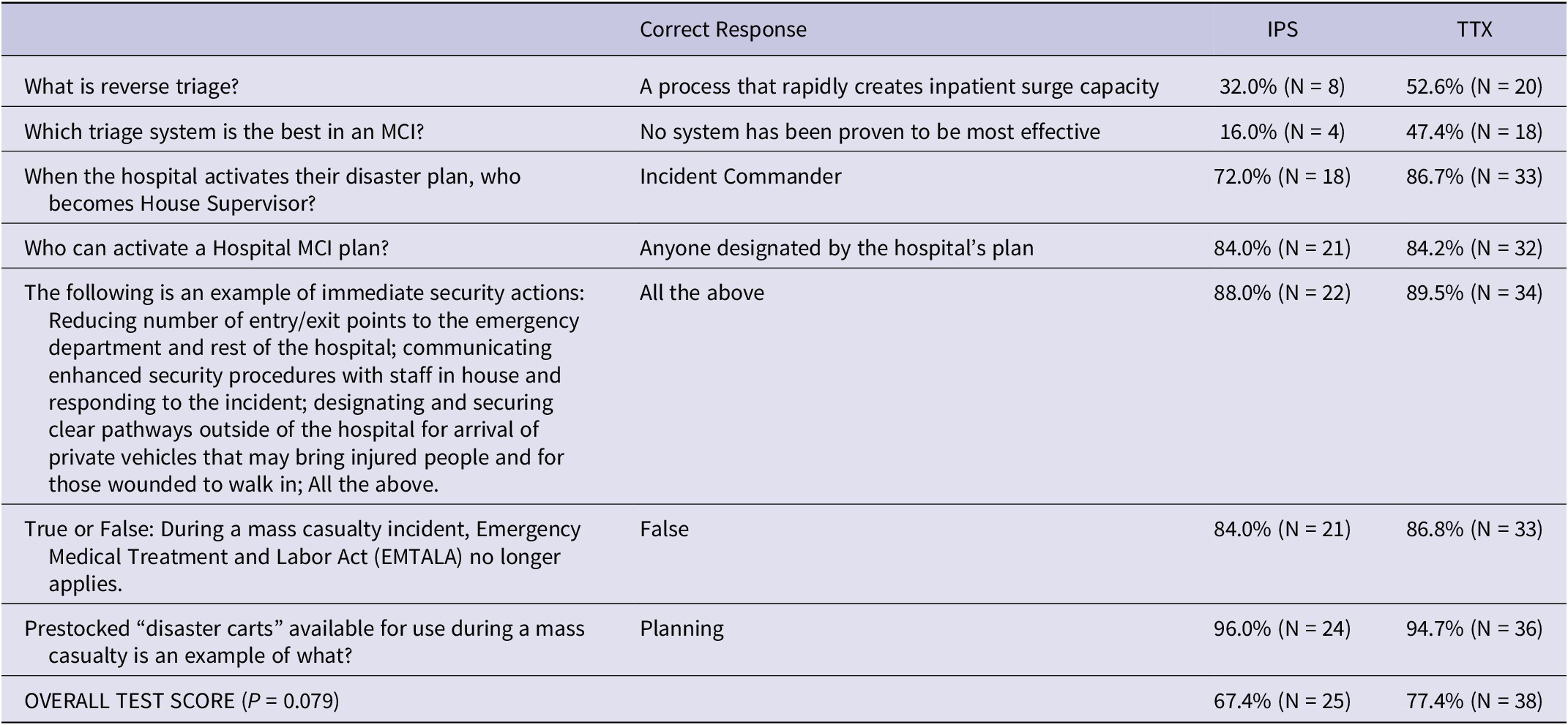
Regarding knowledge acquisition, IPS (67.4%, N = 25) and TTX (77.4%, N = 38) cohorts demonstrated comparable results on postintervention MCQ testing. See Table 2. While the TTX cohort demonstrated higher scores on each component of the MCQ testing, overall scores showed no significant difference (P = 0.079) between IPS and TTX.
Postintervention comparison of MCQ responses in IPS and TTX groups following MCI scenario

Discussion
TTX and IPS are widely utilized modalities for residency education, with limited data concerning disaster medicine education. This study utilized TTX and IPS to assess knowledge acquisition and confidence levels following a simulated MCI. All participants reported improved confidence and comfort in managing MCIs regardless of training modality. Higher overall scores were recorded in the TTX group. However, this may not necessarily indicate actual readiness for real-world MCI scenarios. The TTX is lower in difficulty, given the collaborative nature of the exercise, and prioritizes a low-stress, structured environment. In contrast, IPS, which immerses participants in high-intensity situations, provides a more tangible depiction of the challenges faced in disaster response. This exposure may lead to lower self-reported confidence postintervention, as participants recognize gaps in their preparedness through the debrief and identify the need for additional training. In addition, simulation content is harder to control as the learner begins to lead the scenario and faculty teams may differ in relation to inter-rater reliability.
Similarly, TTX participants showed higher median post-test scores (77.4%) compared to IPS participants (67.4%). While both modalities improved participant knowledge and skill acquisition, no statistically significant difference was observed between the two groups (P = 0.079). These results suggest that TTX is comparable to IPS in preparing responders for MCIs while offering a more cost-effective training alternative. With a larger sample size, the authors anticipate that TTX would be more effective in improving performance on MCQ assessments than IPS. This may be attributed to the lower-stress learning environment of TTX, which allows participants to engage in a structured format, process information thoroughly, and consolidate their knowledge in a format that aligns well with standardized testing. TTX facilitates orderly discussion, problem-solving in a group setting, and theoretical application, all of which contribute to improved knowledge retention.
In contrast, IPS is a dynamic approach that seeks to increase participant stress levels while focusing on the experience of real-time decision-making and action. This may not translate as effectively to MCQ performance. Rapid decision-making under actual psychological stress is a critical skill during real-world MCIs. The modality of MCQ testing itself is likely a less effective tool in assessing skills gained in IPS.
Limitations
Limitations of this study include its study design utilizing survey research, limited sample size, potential availability bias, and selection bias. An attempt to mitigate selection bias was made through a randomized educational initiative considering postgraduate training level. An additional limitation includes the study design as survey based, with utilization of self-made nonvalidated surveys. However, such surveys were based on the core curriculum of Disaster Medicine, as presented in the Core Disaster Medicine Education recommendations published by Cambridge Press.Reference Sarin, Biddinger and Brown23 An additional limitation includes its limited generalizability. The population performing the study consists of resident physicians from high-acuity and heavily populated urban emergency departments. Future multicenter, larger cohort studies would be beneficial in assessing the impact of TTX compared to IPS in disaster medicine education. Furthermore, this study relied on knowledge-based assessments and self-reported confidence levels. Psychomotor performance and real-time decision making are not assessed with our survey tools, which limits the ability to measure IPS applicability in teaching MCI management skills. Future larger cohort studies should focus on different modalities of assessing psychomotor skills in IPS, such as checklist-based assessment tools. This may yield a varying picture regarding the efficacy of IPS.
Conclusions
TTX is an accessible method for disaster medicine training, with outcomes comparable to high-fidelity simulation. While TTX may better align with knowledge-based assessments, IPS remains essential for practicing real-time decision-making under stress. The authors hesitate to utilize TTX as a direct substitute for hands-on simulation-based training. Instead, integrating TTX and IPS in a complementary manner may provide a more inclusive approach to MCI preparedness, balancing theoretical knowledge acquisition with practical skill development. A blended approach to MCI training may begin with a foundational TTX centered on exploring potential scenarios and planning for contingencies, with progressive introduction of IPS elements. The IPS would act as a real “event” to reveal unexpected challenges and latent safety threats that the hypothetical discussion would not. A blended approach would be tested against TTX and IPS individually, in terms of participants’ satisfaction, comfort, and objective knowledge acquisition. The authors anticipate that combining these modalities will provide the knowledge base and psychological duress required for robust disaster scenario training.
Acknowledgments
None.
Authorship
We certify that all listed authors meet the International Committee of Medical Journal Editors’ specific requirements regarding the duties and responsibilities of authorship. Each author contributed equally in terms of idea generation, methodology, data collection and analysis, subject recruitment, manuscript drafting/editing, and finalizing the final version for submission.
IRB approval
Einstein IRB Approval Received, Reference# 116318, IRB# 2024-15826
Prior or similar publications
None.
Funding statement
The authors did not receive support from any organization.
Competing interests
All authors certify that they have no affiliations with or involvement in any organization or entity with any financial interest or nonfinancial interest in the subject matter or materials discussed in this manuscript.