Introduction
Well before the current coronavirus pandemic, there was an awareness of the increased risk of transmission of infective pathogens to health care workers involved in performing aerosol generating procedures (AGPs).Reference Fowler, Guest and Lapinsky1 Tracheal intubation is recognized as a high-risk intervention for exposure to infective pathogens, such as the novel coronavirus disease 2019 (COVID-19) and influenza. A systematic review reported a more than six-fold increase of risk of transmission in health care workers performing AGPs such as intubation.Reference Tran, Cimon, Severn, Pessoa-Silva and Conly2 In the UK, in the initial stages of the coronavirus pandemic, Public Health England (PHE; London, UK) identified tracheal intubation as exposing clinicians to a potentially high viral load.3
The World Health Organization (WHO; Geneva, Switzerland) and the United States Centre for Disease Control and Prevention (CDC; Atlanta, Georgia USA) define prolonged close contact as within six feet for a total of 15 minutes over 24 hours.4 However, with close contact during the induction phase of anesthesia, there is evidence that even shorter exposure time has led to one-in-ten health care workers involved in intubation reporting COVID-19 infection.Reference El-Boghdadly, Wong and Owen5 This has significant implications for both the health of health care workers and workforce planning.Reference Chan-Yeung6
The prehospital critical care service is staffed by prehospital doctors and critical care practitioners and has a standard operating procedure (SOP) for the safe delivery of prehospital emergency anesthesia (PHEA).Reference O’Meara and Phipps7 This was designed to comply with UK guidance from the Association of AnesthetistsReference Lockey, Crewdson and Davies8 (London, UK) and the Difficult Airway Society (London, UK),Reference Frerk, Mitchell and McNarry9 applying the principles of simplicity and standardization for use in a system with comprehensive clinical governance.
In the early phase of the coronavirus pandemic, clear evidence regarding the risks of coronavirus transmission and required personal protective equipment (PPE) were not yet available. Recommendations resulted in the use of Level 3 PPE (long-sleeved fluid repellent disposable gown; respirator/FFP3; eye protection; and gloves)10 for treating patients who were at-risk of COVID-19 infection, particularly when treatment involved potential AGPs. While PPE delivered the benefit of reduced risk of viral transmission,Reference Cook11 but also potential difficulties, both physical and psychological (eg, impaired view, restricted movement, poor communication, heat stress, and mechanical trips).Reference Nicolle12 A modified prehospital anesthesia SOP was created on the assumption that any prehospital patient attended may have COVID-19 infection, and therefore, all AGPs required Level 3 PPE. This SOP was put in place on March 27, 2020.13
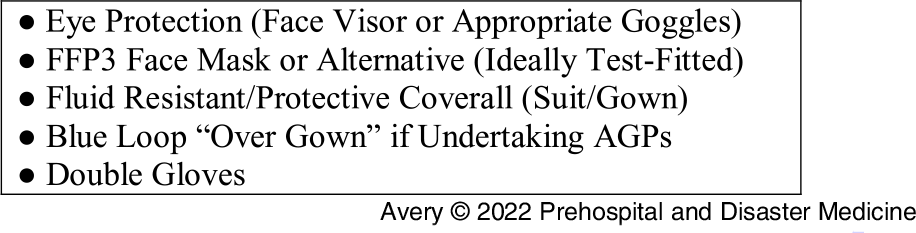
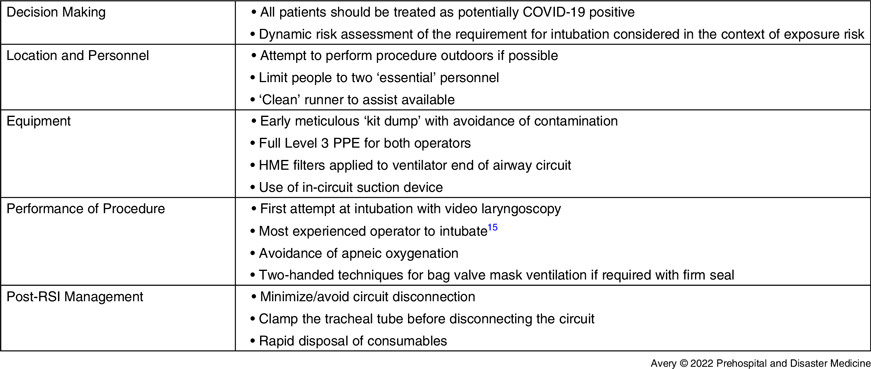
The understanding of the risk associated with tracheal intubation as an AGP has evolved in the in-hospital setting.Reference Brown, Gregson and Shrimpton14 However, at the time of guideline change in March 2020, the requirement to provide PHEA or tracheal intubation in an unscreened population was the main driver for SOP change to protect the service and continue providing effective care to the patient population. Standards for PPE were based on multi-agency guidance,3 and the service SOP mandated that Level 3 PPE (Figure 1) should be worn for all AGPs.4 One part of the modified SOP was PPE. Table 1 Reference Gill15 shows the additional recommendations to minimize exposure risk.
Level 3 (“Red”) Person Protective EquiptmentReference O’Meara and Phipps7
Abbreviation: AGP, aerosol generating procedures.

The introduction of changes to the SOP were multi-faceted, however, the introduction of PPE, the most experienced operator having first intubation attempt, and routine use of video laryngoscopy (VL) are likely to have had the main impact on intubation success rates. The service used the McGRATH MAC video laryngoscope (Medtronic; Minneapolis, Minnesota USA) device as the primary intubating laryngoscope. These changes were introduced in March 2020. This combination of changes to the SOP (most experienced operator, routine use of VL) attempted to maintain intubation success rate and mitigate the potential impact of “view with PPE” issues.
Introduction of Video Laryngoscopy
Most data on VL come from the elective operating theatre setting which suggests that whilst it reduces the number of failed intubations, it does not necessarily improve the first intubation pass rates nor mitigate against hypoxia or respiratory complications.Reference Lewis, Butler, Parker, Cook and Smith16 In other settings, however, there is evidence to suggest that VL is associated with a better first-pass intubation success rate in intensive care patients with less experienced clinicians.Reference Arulkumaran, Lowe, Ions, Mendoza, Bennett and Dunser17 Clinicians in China involved in the early phases of the pandemic advocated VL use as part of a series of interventions to minimize risk of transmission and increase success rate.Reference Meng, Qiu and Wan18 It is logical to assume that VL devices may also increase the distance between the intubating clinician and the patient.Reference Miller, Lukovic and Wagener19
Video laryngoscopy is not always seen as the panacea of airway management in the prehospital setting. Some services encourage the use of direct laryngoscopy (DL) with a MacIntosh standard blade for intubation in certain circumstances, such as in direct sunlight.Reference Nabecker, Greif, Kotarlic, Kleine-Brueggeney, Riggenbach and Theiler20 Illumination of the airway is vital, and marked variation between VL devices when compared to DL has also been reported.Reference Pieters and van Zundert21 The evidence for the use of VL in soiled airways is contradictory and significant difficulties have been reported.Reference Trimmel, Kreutziger and Fitzka22 However, there is evidence to suggest that VL is still more reliable that DL during intubation in these circumstances.Reference Sakles, Corn, Hollinger, Arcaris, Patanwala and Mosier23 The pre-COVID-19 emergency anesthesia SOP recommended VL for first intubation attempt, but allowed clinicians to use either a VL or DL device when airway soiling or direct sunlight was present. Routine first use of VL attempts to offset some of the challenges of “poor view with PPE” to maintain first-pass intubation success rate.
Impact of PPE and Who Should Intubate?
It is recognized that Level 3 PPE impairs both vision and movement which may reduce intubation success rates. Simulation studies have demonstrated that the use of PPE may reduce first-pass success ratesReference Koo, Walsh and Knutson24 and time to intubation,Reference Garner, Laurence and Lee25–Reference Caglar, Kacer, Hacimustafaoglu, Ozturk and Ozturk27 and that the success of DL is negatively impacted more than VL.Reference Caglar, Kacer, Hacimustafaoglu, Ozturk and Ozturk27,Reference Sanfilippo, Tigano, Palumbo, Astuto and Murabito28 There is, however, a paucity of high-quality evidence looking at use of PPE and VL in the prehospital environment.
Aim of the Study
This retrospective observational cohort study compares intubation success rates before and after the introduction of a modified COVID-19 PHEA SOP.
Methodology
The setting is collaborative service between the public and third sector, covering a base population of just under three million people. It is staffed by National Health Service (NHS; London, UK) prehospital doctors and critical care practitioners, attending approximately 3,500 incidents each year. Approximately 60% are responded to by air, and the rest by road in a rapid response vehicle. Indications for PHEA in the service include: Glasgow Coma Scale, airway compromise, ventilatory failure, neuroprotection, combative, anticipated course, and flight safety.
This retrospective observational cohort study included January 1, 2019 through August 30, 2021. Level 3 PPE and the modified PHEA SOP was introduced on March 27, 2020. The pre-COVID-19 group was January 1, 2019 through March 26, 2021 inclusive. The COVID-19 group was March 27, 2020 through August 30, 2021 inclusive. A retrospective analysis of prospectively collected data was carried out. Data were collected prospectively through an electronic patient record system (Version 2.0.3, Forms ePCR; Nugensis Ltd; Glasgow, UK). Anonymized data relating to intubation attempts were extracted from the structured query language (Version 2014; SQL Server Standard Edition & Reporting Services; Microsoft Corp.; Redmond, Washington USA) database into Microsoft Excel (Version 2003; Microsoft Corp.; Redmond, Washington USA) for analysis. A single entry is made per patient, and all data relating to their interventions are held in related tables. Fields relating to intubation lookups form reference tables. Data were extracted from the SQL database and flattened into a single table with one record per patient using a unique system identifier to enable anonymization prior to analysis.
Data were held in Excel and analyzed using IBM SPSS Statistics (Version 26; IBM Inc.; Armonk, New York USA). Descriptive statistics were performed in SPSS. Age is presented as median (IQR) as data were not normally distributed. Risk is presented as OR with 95% CI (P value).
The study protocol was reviewed at the local Health Board Joint Study Review Committee (JSRC) and was ratified as a service evaluation not requiring ethical approval. This study adhered to the Strengthening the Reporting of Observational Studies in Epidemiology (STROBE) checklist.Reference von Elm, Altman and Egger29 Inclusion criteria were patients of all ages who received a prehospital primary tracheal intubation attempt by prehospital critical care service staff. The management of tracheal intubation was standardized throughout the service using SOPs. During the study period, the service VL was the McGRATH MAC with a single-use blade, introduced into the service in 2016.
Results
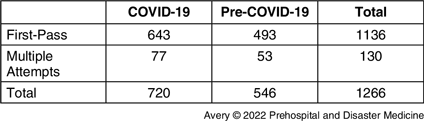
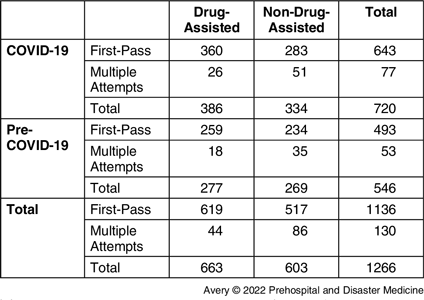
In the study period, 1,266 patients received prehospital intubation attempts by the service (Table 2). Patient age ranged from 0 to 96 years, with a median age of 55 years (IQR 38-67); (n = 1,233; unknown ages excluded). Of patients with gender recorded (n = 1,263), 70% were male (n = 855) and 30% were female (n = 378). Pediatric patients (defined ≤16 years old) accounted for 6.4% of patients. The most common initial diagnoses were cardiac arrest (n = 671), head injury (n = 199), multiple trauma (n = 66), and suspected intracranial hemorrhage (n = 65). Just over one-half of tracheal intubations were drug-assisted (52%; n = 663) with the remaining 48% conducted without the use of drugs (n = 603). Five-hundred forty-six patients received tracheal intubation in the pre-COVID-19 group (6.2% pediatric) and 720 patients receiving tracheal intubation in the COVID-19 group (6.5% pediatric).
Key Changes to Emergency Anesthesia SOP Introduced in Response to COVID-19

Abbreviation: PPE, personal protective equipment; SOP, standard operating procedure.
Number of Patients Receiving Tracheal Intubation by Group

There was a first-pass success rate of 90.3% in the pre-COVID-19 group and 89.3% in the COVID-19 group. There was no statistically significant difference in first-pass success rate between the two groups (Pearson chi-square 0.329; P = .566).
Overall Intubation Success Rate
The overall intubation success rate for all patients was 99.9% (n = 1,266; Table 3). In the pre-COVID-19 group, overall tracheal intubation success rate was 99.8% (n = 546). In the COVID-19 group, the overall success rate was 100.0% (n = 720). There was no statistical difference in overall intubation success rate between groups (Pearson chi-square 1.32; P = .251). The overall first-pass success rate was 89.7% (n = 1,266).
Intubation Success (Drug-Assisted and Non-Drug-Assisted)

There was a statistically significant difference in first-pass success rate between tracheal intubations which were drug-assisted and tracheal intubations that were non-drug-assisted. Non-drug-assisted intubations were more than twice as likely to require multiple attempts with OR = 2.34; 95% CI, 1.59-3.42; P <.001 (n = 1,266).
There was a statistically significant difference in first-pass success rate in both pre-COVID-19 and COVID-19 groups between tracheal intubations which were drug-assisted and tracheal intubations that were non-drug-assisted. In the pre-COVID-19 group, non-drug-assisted intubations were more than twice as likely to require multiple attempts compared to drug-assisted intubations with OR = 2.15; 95% CI, 1.19-3.90; P = .01 (n = 546). In the COVID-19 group, non-drug-assisted intubations were also more than twice as likely to require multiple attempts with OR = 2.5; 95% CI, 1.5-4.1; P ≤.001 (n = 720).
Discussion
The baseline characteristics of patients were 70% male with a median age of 55 years (IQR 38-67). This is similar to that of other prehospital observational studies of advanced airway management.Reference Sunde, Heltne and Lockey30,Reference Gellerfors, Fevang and Backman31 The overall intubation success rates and first-pass success rates (99.9% and 89.7%) reported in this study are high and similar to those reported in other recent prehospital studies.Reference Sunde, Heltne and Lockey30,Reference Gellerfors, Fevang and Backman31 Although the potential difficulties of prehospital intubation are well-documented, the intubation success rates and complications may, in services with good clinical governance and experienced teams, equal or better those in hospital emergency departments.Reference Lockey and Crewdson32 A large in-hospital prospective observational multi-center cohort study performed from March through October 2020 included 4,476 episodes of emergency intubation for patients with suspected or confirmed COVID-19 infection.Reference Wong, El-Boghdadly and Owen33 The reported in-hospital intubation success was remarkably similar to the prehospital success rates at 99.2% overall and 89.7% first pass. This study also reported that successful first-pass intubation was more likely during rapid sequence induction (RSI) versus non-RSI (adjusted OR 1.89; 95% CI, 1.49-2.39; P ≤.001) and when performed by operators with more COVID-19 intubation experience (adjusted OR 1.03 for each additional previous intubation; 95% CI, 1.01-1.06; P = .015).Reference Wong, El-Boghdadly and Owen33 This supports the finding that drug-assisted intubation is more likely to be successful than non-drug-assisted intubation in both cohort groups. In addition, the finding that a successful first attempt is more likely when performed by experienced operators supports modification of the SOP to have the first attempt performed by the most experienced intubator.
This study was primarily performed to establish whether simple alterations could be made to an existing emergency anesthesia SOP to maintain intubation success rates despite the use of Level 3 PPE. Success rates were maintained and the overall intubation success rate was the same in the pre-COVID-19 and COVID-19 intubation groups (99.8% and 100.0%, respectively). In addition, there was no statistical difference in first-pass success rate between the pre-COVID-19 group (90.3%) and the COVID-19 group (89.3%; P = .566).
The study “COVID-19” population (n = 720) received prehospital emergency intubation in accordance with a modified SOP with the first line use of VL. Although some centers frequently use VL for the emergency intubation of COVID-19 patients, practice is varied. Wong, et al in their large multi-center study of COVID-19 airway management reported that the use of VL during the first attempt at tracheal intubation was more frequent in high-income countries than in low- and middle-income countries (81.9% and 43.9%, respectively; P <.001).Reference Wong, El-Boghdadly and Owen33 This may reflect the higher costs associated with video laryngoscopes. The recommended use of VL in patients with suspected COVID-19 infection is in line with recent expert guidelines.Reference Trembley, Tobias and Schillo34–Reference Lockhart, Duggan, Wax, Saad and Grocott36 Expert consensus remains the basis for use of VL first line in patients with COVID-19 infection, as there is a paucity of high-quality evidence demonstrating superiority of VL in this prehospital and in-hospital patient group.Reference Foley, Urdaneta and Berkow37,Reference Hart, Tracy and Johnston38 Most of the guidance for use of VL in COVID-19 patients suggests that the main reason to use VL rather than DL is to reduce provider infections by increasing the distance between patient and operator rather than to maintain intubation performance. There is mixed evidence that VL maintains intubation performance.Reference Lewis, Butler, Parker, Cook and Smith16
Similar key changes in procedure (increased use of VL and more experienced laryngoscopist) resulted in similar intubation success rates in 406 patients who had in-hospital emergency intubation in a US single-center retrospective cohort study of patients from February through April 2020.Reference Hawkins, Stapleton, Rodriguez, Gonzalez and Baker39 There was no difference in intubation first-pass success rates between COVID-19 and non-COVID-19 patients (89.4% versus 89.0%; P = 1.0).
Limitations
The results of this study are subject to the limitations inherent in retrospective study design, in addition to both selection and reporting biases. The results from this study may be influenced by confounding factors inherent in the retrospective design, such as information bias arising from inaccurate record keeping. The service has an active quality assurance program – all electronic patient record entries are examined by an independent service consultant within 24 hours of entry. Database completion is also performed by the same operational clinicians who have carried out the procedure.
The population is a national patient group, however, the findings may not be generalizable to other clinical settings or other countries with different baseline populations.
Conclusion
This study demonstrates that prehospital intubation success rates can be maintained despite the use of full PPE to protect staff during the procedure. With the use of simple alterations to SOPs (eg, routine use of VL), good overall and first-pass intubation success rates can be achieved, which are equivalent to those without the use of PPE and also as good as reported in-hospital emergency intubation success rates.
Conflicts of interest/funding
The authors declare that they have no competing interests. No funding was received for this review.
Author Contributions
PA, SM, DR, SG, and DL drafted the initial manuscript. DL conceived the project and provided feedback and editing. All authors agreed on the final draft. Data sharing not applicable to this article, as no datasets were generated or analyzed during the current study.