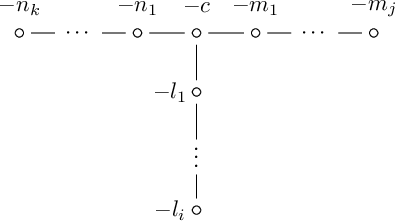
1 Introduction.
We say that X is a log del Pezzo surface if X is a normal projective surface with only klt singularities whose anti-canonical divisor is ample. When in addition X has at worst canonical singularities, we often call X a Du Val del Pezzo surface.
Over an algebraically closed field k of characteristic
 $p>0$
, it has been revealed that many pathological phenomena may occur on log del Pezzo surfaces. For example, Keel–McKernan [Reference Keel and McKernan10, end of Section 9] constructed log del Pezzo surfaces of Picard rank one with
 $(2n+1)$
singularities for each
 $n \geq 3$
in characteristic
 $p=2$
, even though the number of singularities on a log del Pezzo surface of rank one is at most four in characteristic zero [Reference Belousov4, Theorem 1.1]. When
 $n=3$
, their construction gives a Du Val del Pezzo surface
 $S_{7A_1}$
with seven Du Val
 $A_1$
-singularities. Cascini–Tanaka [Reference Cascini and Tanaka5, Proposition 6.4] shows that
 $S_{7A_1}$
is also constructed from the blow-up of the projective plane
 $\mathbb {P}^2_k$
at all the
 $\mathbb {F}_2$
-rational points by contracting the strict transform of all the lines defined over
 $\mathbb {F}_2$
. They [ibid. Proposition 4.3 (iii)] also shows that the anti-canonical members of
 $S_{7A_1}$
are all singular. In particular, they gave a counterexample of Bertini’s theorem in positive characteristic, since the complete linear system of the anti-canonical divisor of
 $S_{7A_1}$
is base point free. Cascini–Tanaka [Reference Cascini and Tanaka6, Theorem 4.2(6)] also showed the existence of an ample
 $\mathbb {Z}$
-Weil divisor A on
 $S_{7A_1}$
such that
 $H^1(S_{7A_1}, \mathcal {O}_{S_{7A_1}}(-A)) \neq 0$
, which is a counterexample of the Kodaira vanishing theorem for
 $\mathbb {Z}$
-divisors on klt singularities in positive characteristic. Furthermore, in [Reference Langer16, Proposition 4.1] and [Reference Langer17, Proposition 11.1], Langer showed that
 $S_{7A_1}$
is not log liftable to the ring
 $W(k)$
of Witt vectors of k (see Definition 3.1).
Kawakami and the author [Reference Kawakami and Nagaoka11] investigated the relationship of these three pathological phenomena and non-log liftability of Du Val del Pezzo surfaces over
 $W(k)$
. As a result, we revealed that the non-existence of smooth anti-canonical members is the weakest phenomena. In other words, a pathological phenomenon occurs on a Du Val del Pezzo surfaces if and only if there are plenty of cuspidal cubic curves in its smooth locus. Moreover, using this fact, we classified pathological Du Val del Pezzo surfaces up to isomorphisms.
Around the same time, following Keel and McKernan’s idea [Reference Keel and McKernan10], Lacini [Reference Lacini14] gave the classification of log del Pezzo surfaces of rank one over k of characteristic
 $p>3$
by means of hunt steps (see Section 2.2). As a result, he showed that every log del Pezzo surface of rank one over k is log liftable over
 $W(k)$
when we add the assumption that
 $p \neq 5$
.
On the other hand, he constructed an example of log del Pezzo surface of rank one in characteristic
 $p=5$
which is not log liftable over
 $W(k)$
. Arvidsson–Bernasconi–Lacini [Reference Arvidsson, Bernasconi and Lacini1, §5] showed that this example is also a counterexample of the Kodaira vanishing theorem for
 $\mathbb {Z}$
-divisors on klt surfaces. For the construction, they use the fact that the Du Val del Pezzo surface
 $S_{2A_4}$
with two Du Val
 $A_4$
-singularities contains a cuspidal cubic curve in its smooth locus if and only if the characteristic is five (see Section 2.3).
The aim of this paper is to investigate the relationship between pathological phenomena on log del Pezzo surfaces of Picard rank one, non-log liftability over
 $W(k)$
, and the above property of
 $S_{2A_4}$
in characteristic
 $p=5$
. To this end, we define the following notation. For the definition and terminology of Dynkin types, we refer to Section 2.1.
Definition 1.1 [Reference Kawakami and Nagaoka11, Definition 1.2].
For a log del Pezzo surface S of index r over an algebraically closed field k of characteristic
 $p>0$
, we say that S satisfies:
-
• (ND) if there exists no log del Pezzo surface
 $S_{\mathbb {C}}$
over the field of complex numbers
$\mathbb {C}$
with the same Dynkin type and the same Picard rank as S.
-
• (NB) if the members of
$|-rK_S|$
are all singular. -
• (NK) if
$H^1(S, \mathcal {O}_S(-A)) \neq 0$
for some ample
$\mathbb {Z}$
-Weil divisor A on S. -
• (NL) if S is not log liftable over
$W(k)$
.


In this notation, the first letter N indicates negation, and the second letters D, B, K, and L indicate the Dynkin type, the Bertini theorem, the Kodaira vanishing theorem, and log liftability, respectively. Note that
 $S_{\mathbb {C}}$
as in the condition (ND) must have the same anti-canonical volume as S since log del Pezzo surfaces are rational. Furthermore, compared to the case of Du Val del Pezzo surfaces [Reference Kawakami and Nagaoka11, Definition 1.2], the property (NB) does not express pathological features very often since, to the best of the author’s knowledge, it is unknown whether
 $|-rK_S|$
has a smooth member even in characteristic zero.
The list of
 $(\dagger )$
where
 $a, b, c \in \mathbb {Z}_{\geq 1}$

The main results of this paper consist of three theorems. One is Theorem 1.2, which determines log del Pezzo surfaces of rank one satisfying (NL) or (ND) when
 $p=5$
. As a corollary, we show that these surfaces have at most five singularities.
Theorem 1.2. Let S be a log del Pezzo surface of rank one over an algebraically closed field k of characteristic five. Then the following hold.
-
(1) S is not log liftable over the ring of Witt vectors
$W(k)$
if and only if
$\operatorname {Dyn} (S) =2[3,2]+[3]+[2]+[2^4]$
,
$[4,2]+[3,2^5]+[3,2]+[2]$
,
$[2,4]+[2,3,2^2]+[3]+[2^4]$
, or
$2[2^4]+(\dagger )$
, where
$(\dagger )$
is listed in Table 1. -
(2) The isomorphism class of S is uniquely determined by its Dynkin type except when
$\operatorname {Dyn} (S)=2[2^4]+ [2^n]+[2+n; [2], [3], [5]]$
for some
$n \geq 0$
. In these cases, the isomorphism classes of log del Pezzo surfaces correspond to the closed points of
$\mathbb {P}^1_k \setminus \{0, 1, \infty \}$
for each
$n \geq 0$
. -
(3) S is not log liftable over
$W(k)$
but there exists a log del Pezzo surface of rank one over
$\mathbb {C}$
with the same Dynkin type as S if and only if
$\operatorname {Dyn} (S) = 2[2^4]+[3]$
or
$2[2^4]+[2, 4]$
.


The second is Theorem 1.3, which shows that each log del Pezzo surface satisfying (NL) in
 $p=5$
is constructed from
 $S_{2A_4}$
.
Theorem 1.3. Let S be a log del Pezzo surface of rank one over an algebraically closed field k of characteristic five. Suppose that S is not log liftable over the ring of Witt vectors
 $W(k)$
. Then there is a partial resolution
 $T \to S$
and a
 $K_T$
-negative contraction
 $T \to S'$
such that
 $S'$
is the Du Val del Pezzo surface with Dynkin type
 $2[2^4]$
.
The other is Theorem 1.4, which shows that (NK)
 $\Rightarrow $
(ND)
 $\Rightarrow $
(NL) when the rank is one and
 $p=5$
. The latter implication also holds in any characteristic
 $p> 0$
. Combining the second and third main theorems, we conclude that each pathological log del Pezzo surface in
 $p=5$
is constructed from
 $S_{2A_4}$
.
Theorem 1.4. Let S be a log del Pezzo surface of rank one over an algebraically closed field k of characteristic
 $p>0$
. Then the following hold.
-
(1) If S is log liftable over
$W(k)$
, then there exists a log del Pezzo surface of rank one over
$\mathbb {C}$
with the same Dynkin type as S. -
(2) If
$p=5$
and there exists a log del Pezzo surface of rank one over
$\mathbb {C}$
with the same Dynkin type as S, then
$H^1(S, \mathcal {O}_S(-A))=0$
for every ample
$\mathbb {Z}$
-Weil divisor A.


Our proof of the assertion (2) is based on Theorem 1.2 and involves a careful analysis of log del Pezzo surfaces with Dynkin type
 $2[2^4]+[3]$
or
 $2[2^4]+[2,4]$
. Note that (NK)
 $\Rightarrow $
(ND) also holds for Du Val del Pezzo surfaces in any characteristic as a consequence of classifications [Reference Kawakami and Nagaoka11, Theorem 1.7]. What is still lacking is a proof of (NK)
 $\Rightarrow $
(ND) without using the classification of log del Pezzo surfaces satisfying (NL).
1.1 Structure of the paper.
This paper is structured as follows. In Section 2, we set up terminology of klt singularities, recall hunt steps, and compile facts on the Du Val del Pezzo surface with Dynkin type
 $2[2^4]$
. In Section 3, we give implications between pathological phenomena on log del Pezzo surfaces of rank one. In particular, we prove Theorem 1.4 (1). In Section 4, we construct non-log liftable log del Pezzo surfaces, which were omitted in the arXiv version of [Reference Lacini14, §6.1] when we submitted this paper. We note that they are described in the published version of [ibid., Definitions 6.5 and 6.6]. In Section 5, we prove a refinement of [ibid., Theorem 6.2](= Theorem 5.3) and an alternative of [ibid., Theorem 6.27](= Theorem 5.8), which make it easy to seek a necessary condition for log del Pezzo surfaces of rank one to satisfy (NL).
In Section 6, we prove Theorems 1.2, 1.3, and 1.4 (2) as follows. We can calculate easily the necessary condition of Dynkin types of non-log liftable log del Pezzo surfaces of rank one by Example 4.2 and Theorem 5.8. On the other hand, from the Bogomolov bound, we see that any Dynkin types in the list except
 $2[2^4]+[3], 2[2^4]+[2,4]$
and
 $2[2^4]+[2;[2], [3], [5]]$
are not feasible over
 $\mathbb {C}$
. Running hunt steps, we show that the last case is also not feasible over
 $\mathbb {C}$
. For the remaining two cases, which are feasible over
 $\mathbb {C}$
, we prove non-log liftability by contradiction. For a log lift of such a log del Pezzo surface, we contract a certain extremal ray to get a log lift of the Du Val del Pezzo surface with Dynkin type
 $2[2^4]$
. Since all the singular anti-canonical member of this Du Val del Pezzo surface are defined over the fractional field of
 $W(k)$
, we deduce that
 $\sqrt {5}$
must be contained in
 $W(k)$
, hence a contradiction. Thus we prove Theorem 1.2. By decreasing invariants used in Example 4.2, we are reduced to prove Theorem 1.3 for the case where log del Pezzo surfaces has tigers. Now the theorem follows from Lemma 6.2. To show Theorem 1.4 (2), we calculate the first cohomology of anti-ample
 $\mathbb {Z}$
-Weil divisors of small canonical degree explicitly.
Notation 1.5. We work over an algebraically closed field k of characteristic
 $p> 0$
unless otherwise stated. A variety means an integral separated scheme of finite type over k. A curve (resp. a surface) means a variety of dimension one (resp. two). A log pair
 $(S, \Delta )$
is the pair of a normal projective variety S and an effective
 $\mathbb {Q}$
-Weil divisor
 $\Delta $
such that
 $K_S+\Delta $
is
 $\mathbb {Q}$
-Cartier. We say that a
 $\mathbb {Q}$
-Weil divisor
 $\Delta $
is a boundary if the irreducible decomposition
 $\Delta = \sum _i c_i D_i$
satisfies
 $0 \leq c_i \leq 1$
. We say that a normal surface is Du Val if it has only canonical singularities. A log del Pezzo surface is a projective surface with only klt singularities whose anti-canonical divisor is ample. We often call the Picard rank of a log del Pezzo surface simply as the rank. Throughout this paper, we also use the following notation:
-
•
$W(k)$
: the ring of Witt vectors of k. -
•
$E_f$
: the reduced exceptional divisor of a birational morphism f. -
•
$S^\circ $
: the smooth locus of a surface S. -
•
$\Delta (\Gamma )$
: the absolute value of the determinant of the intersection matrix of the weighted graph
$\Gamma $
. -
•
$p_a(C)$
: the arithmetic genus of a projective curve C.


2 Preliminaries.
2.1 Dynkin types.
In this subsection, we set up notation and terminology of klt singularities of dimension two.
Definition 2.1. For integers
 $c, l_1, \ldots , l_i, m_1, \ldots , m_j, n_1, \ldots n_k \in \mathbb {Z}_{\geq 2}$
, the symbol
 $[n_1, \ldots , n_k]$
(resp.
 $[c; [l_1, \ldots , l_i], [m_1, \ldots , m_j], [n_1, \ldots , n_k]]$
) stands for the weighted dual graph as in Figure 1 (resp. Figure 2).
The weighted graph
 $[n_1, n_2, \ldots , n_k]$
.

The weighted graph
 $[c; [l_1, \ldots , l_i], [m_1, \ldots , m_j], [n_1, \ldots , n_k]]$
.

Definition 2.2. Let S be a surface with klt singularities and
 $\sigma \colon \widetilde S \to S$
the minimal resolution. The Dynkin type of S, denoted by
 $\operatorname {Dyn}(S)$
, is defined to be the weighted dual graph of the reduced
 $\sigma $
-exceptional divisor.
For example, we write
 $\operatorname {Dyn}(S)=2[2^4]+[2;[2],[3],[5]]$
if the weighted dual graph of the reduced
 $\sigma $
-exceptional divisor consists of two connected components isomorphic to
 $[2^4]$
and one connected component isomorphic to
 $[2;[2], [3], [5]]$
. Recall that we can express the Dynkin type of each klt singularity by
 $[n_1, \ldots , n_k]$
or
 $[c; [l_1, \ldots , l_i], [m_1, \ldots , m_j], [n_1, \ldots , n_k]]$
(see [Reference Kollár13, §3] for more details).
2.2 Hunt steps.
In this subsection, we recall certain Sarkisov links called hunt steps, which are used in [Reference Keel and McKernan10] and [Reference Lacini14].
Definition 2.3 [Reference Keel and McKernan10, 1.16 Definition].
Let
 $(X, \Delta )$
be a log pair. Let
 $f \colon Y \to X$
be a birational morphism with Y normal and
 $\Gamma =f^{-1}_*\Delta +G$
the log pullback of
 $\Delta $
via f, that is, the
 $\mathbb {Q}$
-Weil divisor with
 $G f$
-exceptional such that
 $K_Y+\Gamma =f^*(K_X+\Delta )$
. For a prime divisor E on Y, we define the coefficient
 $e(E; X, \Delta )$
of E with respect to the pair
 $(X, \Delta )$
to be the multiplicity of
 $\Gamma $
along E.
Definition 2.4 [Reference Keel and McKernan10, 8.0.2 Definition].
Let
 $(X, \Delta )$
be a log pair with
 $\Delta $
a boundary and
 $\Delta = \sum _{i=1}^n a_i D_i$
the irreducible decomposition. We say that
 $(X, \Delta )$
is flush if
 $e(E; X, \Delta ) < \min \{a_1, \ldots , a_n, 1\}$
for all exceptional divisors E over X.
Definition 2.5 [Reference Keel and McKernan10, 1.13 Definition] and [Reference Lacini14, Definitions 3.10 and 6.1].
Let
 $(X, \Delta )$
be a log pair and
 $f \colon Y \to X$
be a birational morphism with Y normal. We say that
 $(X, \Delta )$
has a tiger in Y if there exists an effective
 $\mathbb {Q}$
-Cartier divisor
 $\alpha $
on X such that
-
(1)
$K_X+\Delta +\alpha $
is numerically trivial and -
(2) there exists a prime divisor E on Y such that
$e(E; X, \Delta +\alpha ) \geq 1$
.


Any such divisor E is called a tiger for
 $(X, \Delta )$
. A tiger E for
 $(X, \Delta )$
is called exceptional if E does not lie in X. When
 $\Delta = \emptyset $
, we say that X has a tiger in Y for short.
Lemma 2.6 ([Reference Keel and McKernan10, 8.2.5 Definition-Lemma] and [Reference Lacini14, Lemma 3.12]).
Let
 $(S, \Delta )$
be a log pair such that S is a log del Pezzo surface of rank one. Let
 $f \colon T \to S$
be an extraction of relative Picard rank one of an irreducible divisor E of the minimal resolution of S. The Mori cone
 $\overline {\mathrm {NE}}(T)$
has two edges, one of which is generated by E. Let R be the other edge. Let
 $x=f(E)$
,
 $\Gamma $
the log pullback of
 $\Delta $
, and
 $\Gamma _\varepsilon = \Gamma + \varepsilon E$
, where
 $0 < \varepsilon \ll 1$
. Assume that
 $-(K_S+\Delta )$
is ample. Then the following hold.
-
(1) R is
$K_T$
-negative and contractible. Hence there is a rational curve
$\Sigma $
that generate R. Let
$\pi $
be the contraction morphism of R. -
(2)
$K_T+\Gamma _\varepsilon $
is anti-ample. -
(3)
$\Gamma _\varepsilon $
is E-negative. -
(4) There is a unique rational number
$\lambda $
such that with
$\Gamma ' = \lambda \Gamma _\varepsilon $
,
$K_T+\Gamma '$
is R-trivial. Moreover,
$\lambda>1$
. -
(5)
$K_T+\Gamma '$
is E-negative. -
(6)
$\pi $
is either a
$\mathbb {P}^1_k$
-fibration (called “net”) or birational. -
(7) If
$\pi \colon T \to S_1$
is birational, and
$\Delta _1 = \pi _*\Gamma '$
, then
$K_{S_1}+\Delta _1$
is anti-ample and
$S_1$
is a log del Pezzo surface of rank one.


Definition 2.7 [Reference Keel and McKernan10, 8.2.8 Definition-Remark] and [Reference Lacini14, Definition 3.13].
We call the transformation
 $(f, \pi )$
as in Lemma 2.6 a hunt step for
 $(S, \Delta )$
if
 $e(E; S, \Delta )$
is maximal among exceptional divisors of the minimal resolution of S. If x is a chain singularity (resp. a non-chain singularity) and
 $\Delta = \emptyset $
, we require E to not be a
 $(-2)$
-curve (resp. to be the central curve). This is always possible by [Reference Keel and McKernan10, 8.3.9 Lemma and 10.11 Lemma].
Hunt steps often preserve the flush condition. For example, we have:
Lemma 2.8 ([Reference Keel and McKernan10, 8.4.5 Lemma]).
We follow the notation of Lemma 2.6. In the hunt step with
 $\Delta = \emptyset $
,
 $K_T+\Gamma '$
is flush. If T is not a net in addition, then
 $K_{S_1}+\Delta _1$
is flush.
On the other hand, the flush condition controls the singularity of pairs as follows.
Lemma 2.9 ([Reference Keel and McKernan10, 8.0.4 Lemma]).
Let
 $(S, \Delta )$
be a flush log pair such that S is a surface. Let
 $A=\lceil \Delta \rceil $
. Then
 $(S, A)$
is plt at each singular point of S.
2.3
Du Val del Pezzo surface with Dynkin type
$2[2^4]$
.

In this subsection, we compile facts on Du Val del Pezzo surfaces with Dynkin type
 $2[2^4]$
in characteristic
 $p \neq 2, 3$
. Note that such a surface is unique up to isomorphism in each characteristic by [Reference Ye20] and [Reference Kawakami and Nagaoka12].
Example 2.10. Let k be an algebraically closed field of characteristic
 $p \neq 2, 3$
. Let us recall the construction of the Du Val del Pezzo surface with Dynkin type
 $2[2^4]$
as in [Reference Arvidsson, Bernasconi and Lacini1, §5.1] (see also [Reference Beauville3] and [Reference Lacini14, Examples B.11 and B.12]).
Consider the following four points in
 $\mathbb {P}^2_k$
 $$ \begin{align*} a =[-1:1:1], b=[-1:-1:1], c=[1:-1:1] ,\text{ and } d=[1:1:1]. \end{align*} $$
Let
 $L_{ab}$
,
 $L_{ac}$
,
 $L_{ad}$
,
 $L_{bc}$
,
 $L_{bd}$
, and
 $L_{cd}$
be the six lines passing through two of them. Consider the cubic curves
 $C_0=L_{ad}+L_{ac}+L_{bc}$
and
 $C_\infty = L_{ab}+L_{bd}+L_{cd}$
. Then the base locus of the pencil
 $C_t = C_0+tC_\infty $
consists of points
 $a, b, c, d$
with multiplicity two, and a point
 $[0:0:1]$
with multiplicity one. Take
 $U_1$
as the blow-up of
 $\mathbb {P}^2_k$
at
 $a, b, c,$
and d. Let
 $E_a, \ldots , E_d$
be the exceptional divisor over
 $a, \ldots , d$
, respectively. Next take
 $U_2$
as the blow-up of
 $U_1$
at
 $E_a \cap L_{ab}, E_b \cap L_{bc}, E_c \cap L_{cd}$
, and
 $E_d \cap L_{ad}$
. Let
 $F_a, \ldots , F_d$
be the exceptional divisor over
 $a, \ldots , d$
, respectively. Then there are two chains of four
 $(-2)$
-curves which consist of the strict transforms of
 $E_a$
,
 $L_{ad}$
,
 $L_{bc}$
,
 $E_c$
and
 $E_d$
,
 $L_{cd}$
,
 $L_{ab}$
,
 $E_b$
, respectively. Hence
 $U_2$
is the minimal resolution of the Du Val del Pezzo surface with Dynkin type
 $2[2^4]$
.
Fixing coordinates
 $[X:Y:Z]$
of
 $\mathbb {P}^2_k$
, we can write the equation of
 $C_t$
as
 $$ \begin{align*} (Y^2-Z^2)(X+Y)+t(X^2-Z^2)(Y-X)=0. \end{align*} $$
The singular member locus of the pencil
 $C_t$
in
 $\mathbb {P}^1_{k, [s:t]}$
is the same as that of
 $|-K_{U_2}|$
, and equals
 $\{st(t^2+11st-s^2)=0\}$
. The equation
 $t^2+11t-1=0$
has a double root if and only if
 $p=5$
. In
 $p \neq 5$
(resp.
 $p=5$
), for
 $\alpha \in k$
with
 $\alpha ^2+11\alpha -1=0$
, the member
 $C_\alpha $
is a nodal cubic (resp. cuspidal cubic).
In
 $p=5$
, by [Reference Lang15, Theorem 4.1], we can also construct the Du Val del Pezzo surface with Dynkin type
 $2[2^4]$
as the hypersurface
 $\{y^2-(x^3+2t^4x+4s^5t+2t^6)=0\}$
in
 $\mathbb {P}(1,1,2,3)$
, where s, t, x, and y are coordinates of weight
 $1$
,
 $1$
,
 $2$
, and
 $3$
, respectively.
3 Pathological phenomena.
In this section, we give implications between pathological phenomena in Definition 1.1. First let us recall the definition of log liftability.
Definition 3.1 [Reference Kawakami and Nagaoka11, Definition 2.2].
Let
 $\alpha \colon S \to T$
be a morphism between Noetherian irreducible schemes. Let Y be a smooth projective scheme over S and E a simple normal crossing divisor over S on Y with
 $E = \sum _{i=1}^r E_i$
the irreducible decomposition. We say that the pair
 $(Y,E)$
lifts to T via
 $\alpha $
if there exist
-
• a smooth and projective morphism
$\mathcal {Y} \to T$
and -
• effective divisors
$\mathcal {E}_1, \dots , \mathcal E_r$
on
$\mathcal {Y}$
such that
$\sum _{i=1}^r \mathcal {E}_i$
is simple normal crossing over T


such that the base change of the schemes
 $\mathcal {Y}, \mathcal {E}_1,\ldots ,\mathcal {E}_r$
by
 $\alpha \colon S \to T$
are isomorphic to
 $Y, E_1,\ldots , E_r$
, respectively. When T is the spectrum of a local ring
 $(R, m)$
and
 $\alpha $
is induced by
 $R/m \cong k$
, we also say that
 $(Y, E)$
lifts to R for short.
Definition 3.2 [Reference Kawakami and Nagaoka11, Definition 2.5].
Let X be a normal projective surface. Fix a Noetherian irreducible scheme T and a morphism
 $\alpha \colon \operatorname {Spec} k \to T$
. We say that X is log liftable over T via
 $\alpha $
(or log liftable over R via
 $\alpha $
when
 $T= \operatorname {Spec} R$
) if the pair
 $(Z, E_{f})$
lifts to T via
 $\alpha $
for some log resolution
 $f \colon Z \to X$
. When T is the spectrum of a local ring
 $(R, m)$
and
 $\alpha $
is induced by
 $R/m \cong k$
, we also say that X is log liftable over R for short.
By the following lemma, we only have to consider the minimal resolution to check the property (NL).
Lemma 3.3 [Reference Kawakami and Nagaoka11, Proposition 2.8(1)].
Let X be a normal projective surface with
 $-K_X$
ample
 $\mathbb {Q}$
-Cartier. Suppose that the minimal resolution of X is a log resolution and there exists a log resolution
 $f \colon Z \to X$
such that
 $(Z, E_f)$
lifts to
 $W_2(k)$
. Then, for everly log resolution
 $f' \colon Z' \to X$
, the pair
 $(Z', E_{f'})$
lifts to every Noetherian complete local ring with residue field k.
Next, we show Theorem 1.4 (1), that is, (ND)
 $\Rightarrow $
(NL) when the rank is one.
Lemma 3.4. Let S be a log del Pezzo surface of rank one. Let R be a Noetherian integral domain of characteristic zero with a morphism
 $\alpha \colon \operatorname {Spec}{k} \to \operatorname {Spec}{R}$
. If X is log liftable over R via
 $\alpha $
, then there exists a log del Pezzo surface of rank one over
 $\mathbb {C}$
which has the same Dynkin type as S.
Proof. Let
 $\sigma \colon \widetilde S \to S$
be the minimal resolution and
 $(\widetilde {\mathcal {S}}, \mathcal E)$
be an R-lifting of
 $(\widetilde S, E_\sigma )$
. Shrinking the field of definition of the generic fiber of
 $(\widetilde {\mathcal {S}}, \mathcal E)$
if necessary, we obtain the base change
 $(\widetilde {S}_{\mathbb {C}}, E_{\mathbb {C}})$
of the generic fiber to
 $\operatorname {Spec} \mathbb {C}$
. Since
 $E_{\mathbb {C}}$
have the same intersection matrix as
 $E_\sigma $
, we have a contraction
 $\sigma _{\mathbb {C}} \colon \widetilde {S}_{\mathbb {C}} \to S_{\mathbb {C}}$
of
 $E_{\mathbb {C}}$
by [Reference Bădescu2, Theorem 3.9]. Since
 $H^1(\widetilde {S}_{\mathbb {C}}, \mathcal {O}_{\widetilde {S}_{\mathbb {C}}}) \cong H^1(\widetilde {S}, \mathcal {O}_{\widetilde {S}}) \cong 0$
and
 $H^0(\widetilde {S}_{\mathbb {C}}, 2K_{\widetilde {S}_{\mathbb {C}}}) \cong H^0(\widetilde {S}, 2K_{\widetilde {S}}) \cong 0$
, the Castelnuovo’s criterion shows that
 $\widetilde {S}_{\mathbb {C}}$
is a rational surface. Since
 $K_{\widetilde {S}_{\mathbb {C}}}^2=K_{\widetilde {S}}^2$
, the Picard rank of
 $\widetilde {S}_{\mathbb {C}}$
coincides with that of
 $\widetilde {S}$
, and hence the Picard rank of
 $S_{\mathbb {C}}$
is one. On the other hand, take
 $\mathcal H$
as a Cartier divisor on
 $\widetilde {\mathcal {S}}$
relatively ample over R and write
 $H_k$
(resp.
 $H_{\mathbb {C}}$
) as the restriction of
 $\mathcal H$
to
 $\widetilde S$
(resp.
 $\widetilde {S}_{\mathbb {C}}$
). Then
 $$ \begin{align*} 0>(K_S \cdot \sigma_* H_k)=(\sigma^* K_{\widetilde S} \cdot H_k)=(\sigma^*_{\mathbb{C}} K_{\widetilde{S}_{\mathbb{C}}} \cdot H_{\mathbb{C}})=(K_{S_{\mathbb{C}}} \cdot (\sigma_{\mathbb{C}})_* H_{\mathbb{C}}), \end{align*} $$
which implies that
 $-K_{S_{\mathbb {C}}}$
is ample. Hence
 $S_{\mathbb {C}}$
is the desired surface.
Next, we show (NK)
 $\Rightarrow $
(NB) for log del Pezzo surfaces of rank one with sufficiently small anti-canonical volume. The proof is similar to that of [Reference Kawakami8, Theorem 4.8].
Lemma 3.5. Let S be a log del Pezzo surface of rank one with index r in characteristic
 $p>0$
and A an ample
 $\mathbb {Z}$
-Weil divisor on S. Suppose that a general member of
 $|-rK_S|$
is smooth. Then
 $H^1(S, \mathcal {O}_S (-A)) = 0$
unless
 $p(-K_S \cdot A) \leq (r-1) K_S^2$
. In particular, it holds that
 $H^1(S, \mathcal {O}_S (-A)) = 0$
if
 $p> r(r-1)K_S^2$
.
Proof. Suppose that
 $H^1(S, \mathcal {O}_S (-A)) \neq 0$
. Then
 $H^0(S, (\Omega _S^{[1]} \otimes \mathcal {O}_S(-p^e A))^{**}) \neq 0$
for some
 $e \in \mathbb {Z}_{>0}$
by [Reference Kawakami8, Lemma 2.5], where
 $\Omega _S^{[1]}$
is the reflexive hull of
 $\Omega _S^1$
. In other words, we have an injection
 $s \colon \mathcal {O}_S(p^e A) \hookrightarrow \Omega _S^{[1]}$
. Let
 $C \in |-rK_S|$
be a smooth member. Then C is connected and the exact sequence
 $0 \rightarrow \mathcal {O}_S \rightarrow \mathcal {O}_S(-rK_X) \rightarrow \mathcal {O}_C(-rK_X|_C) \to 0$
gives that
 $\dim |-rK_S| \geq \frac {r+1}{2} (-rK_S)^2 \geq 1$
. In particular,
 $|-rK_S|$
has no fixed component and, by replacing k as an infinite field if necessary, we may assume that C avoids the associated locus of
 $\mathrm {Coker(s)}$
. Then
 $s|_C \colon \mathcal {O}_C(p^e A) \rightarrow \Omega _S^{[1]}|_C$
is still injective and
 $\Omega _S^{[1]}|_C=\Omega _S^1|_C$
. If the composition
 $t \colon \mathcal {O}_C(p^e A) \to \omega _C$
of
 $s|_C$
and the canonical map
 $\Omega _S^1|_C \to \omega _C$
is zero, then the conormal bundle sequence with respect to
 $C \subset S$
gives an injection
 $\mathcal {O}_C(p^e A) \hookrightarrow \mathcal {O}_C(-C)$
, a contradiction since
 $(p^e A \cdot C)>0> -C^2$
. Hence t is nonzero, which implies that
 $\deg \mathcal {O}_C(p^e A) \leq \deg \omega _C$
. Hence
 $p^e(-rK_S \cdot A) \leq (r-1) rK_S^2$
, and the assertion holds.
Finally, let us see that
 $p=5$
is the largest positive characteristic in which log del Pezzo surfaces of rank one can satisfy (NL), (NK), or (ND).
Lemma 3.6. Suppose that
 $p>5$
. Then no log del Pezzo surfaces of rank one satisfy (NL), (NK), or (ND).
Proof. By [Reference Lacini14, Theorem 7.2], such surfaces lifts to characteristic zero over a smooth base. [Reference Arvidsson, Bernasconi and Lacini1, Proposition 2.5] now shows that they do not satisfy (NL). Hence the assertion follows from [Reference Kawakami and Nagaoka11, Proposition 3.4] and Lemma 3.4.
4 Log del Pezzo surfaces without tigers in characteristic five.
In this section, we construct three log del Pezzo surfaces in characteristic
 $p=5$
. Only those were omitted in the arXiv version of [Reference Lacini14, §6.1] among non-log liftable log del Pezzo surfaces in
 $p=5$
which may have no tigers when we submitted this paper. We note that they are described in the published version of [ibid., Definitions 6.5 and 6.6].
To construct them, let us consider a certain configuration of curves in
 $\mathbb {P}^2_k$
.
Lemma 4.1. In
 $\mathbb {P}^2_k$
, let C be a cuspidal curve and Q a smooth conic intersecting with C at a smooth point t of C with multiplicity at least five. Take a point s so that
 $C \cap Q=\{s, t\}$
. (We admit that
 $s=t$
.) Let u be the cusp of C. Take the line
 $M_u$
which intersects with C at u with multiplicity three and the line
 $L_{su}$
(resp.
 $L_{tu}$
) passing through s (resp. t) and u. Then the following hold:
-
(1) When
$p \neq 3$
, then there are coordinates
$[x:y:z]$
of
$\mathbb {P}^2$
such that
$C=\{x^3=y^2z\}$
,
$Q = \{-45x^2-5y^2+z^2+24xy+40yz-15zx=0\}$
,
$M_u=\{y=0\}$
, and
$t=[1:1:1]$
. -
(2) When
$p = 3$
, then there are coordinates
$[x:y:z]$
of
$\mathbb {P}^2$
such that
$C = \{x^3=y^2z+x^2y\}$
,
$Q = \{-x^2+z^2-yz-zx=0\}$
,
$M_u=\{y=0\}$
, and
$t=[0:1:0]$
. -
(3)
$Q \cap L_{tu}$
consists of exactly two points. -
(4)
$s=t$
if and only if
$p=2$
. -
(5)
$M_u$
is the tangent line of Q at some point if and only if
$p=5$
. -
(6)
$L_{su}$
is the tangent line of Q at s if and only if
$p=5$
.


Proof. (1): By [Reference Lee, Park and Schenzel18, Theorem 3.1], we can choose the coordinates
 $[x:y:z]$
of
 $\mathbb {P}^2_k$
such that
 $C = \{x^3=y^2z\}$
and
 $M_u=\{y=0\}$
. Since the automorphism
 $[x:y:z] \longmapsto [\alpha x:y:\alpha ^3 z]$
of
 $\mathbb {P}^2_k$
with
 $\alpha \in k^*$
fixes C, we may assume that
 $t=[0:1:0]$
or
 $[1:1:1]$
. Since Q does not pass through
 $u = [0:0:1]$
, we can write
 $Q = \{ax^2+by^2+z^2+dxy+eyz+fzx=0\}$
for some
 $a, b,d,e,f \in k$
. Since

either
 $0$
or
 $1$
is the root of multiplicity at least five of
 $x^6+fx^4+ex^3+ax^2+dx+b=0$
. If the former holds, then
 $a=b=d=e=f=0$
and hence
 $Q=\{z^2=0\}$
, a contradiction. Hence the latter holds. Since the coefficient of
 $x^5$
is zero, we obtain
 $x^6+fx^4+ex^3+ax^2+dx+b=(x-1)^5(x+5)$
. Comparing coefficients, we obtain the assertion.
(2): As in the proof of the assertion (1), if
 $C = \{x^3=y^2z\}$
, then
 $Q=\{-45x^2-5y^2+z^2+24xy+40yz-15zx=0\}=\{(y+z)^2=0\}$
, a contradiction. Hence we can choose the coordinates
 $[x:y:z]$
of
 $\mathbb {P}^2_k$
such that
 $C = \{x^3=y^2z+x^2y\}$
and
 $M_u=\{y=0\}$
by [Reference Lee, Park and Schenzel18, Theorem 3.1]. Since the automorphism
 $[x:y:z] \longmapsto [x+\alpha y:y:\alpha x+(\alpha ^3-\alpha ^2)y+z]$
of
 $\mathbb {P}^2_k$
with
 $\alpha \in k$
fixes C, we may assume that
 $t=[0:1:0]$
. Since Q does not pass through
 $u=[0:0:1]$
, we can write
 $Q = \{ax^2+by^2+z^2+dxy+eyz+fzx=0\}$
for some
 $a, b,d,e,f \in k$
. Since

 $0$
is the root of multiplicity five of
 $x^6+x^5+(1+f)x^4+(e-f)x^3+(a-e)x^2+dx+b=0$
. Comparing coefficients, we obtain the assertion.
(3): In
 $p \neq 3$
(resp.
 $p=3$
), we have
 $L_{tu}=\{x=y\}$
(resp.
 $\{x=0\}$
) and
 $L_{tu} \cap Q=\{[1:1:1], [1:1:-26]\}$
(resp.
 $\{[0:1:0], [0:1:1]\}$
). Hence the assertion holds.
(4): In
 $p \neq 3$
(resp.
 $p=3$
), we have
 $C \cap Q=\{[1:1:1], [-5:1:-125]\}$
(resp.
 $\{[0:1:0], [-1:1:1]\}$
). Hence the assertion holds.
(5): In
 $p \neq 3$
(resp.
 $p=3$
),
 $Q \cap M_u$
is isomorphic to
 (resp.
 ), whose discriminant equals
 $405=5 \cdot 3^4$
(resp.
 $5$
). Hence the assertion holds.
(6): Suppose that
 $L_{su}$
is the tangent line of B at s. Assume that
 $p = 3$
in addition. Then
 $s=[-1:1:1]$
and
 $L_{su}=\{x=-y\}$
. However,
 $Q \cap L_{su} \cong \{x=-y, (x-z)(x+z)=0\}$
consists of two points, a contradiction.
Hence
 $p \neq 3$
,
 $s=[-5:1:-125]$
, and
 $L_{su}=\{x=-5y\}$
. Since

consists of one point, it holds that
 $125+10 = 135=5 \cdot 3^3$
equals zero in k. Hence the assertion holds.
By Lemma 4.1 (5) and (6), we can construct pathological log del Pezzo surfaces in
 $p=5$
as follows.
Example 4.2 [Reference Lacini14, Definitions 6.5 and 6.6].
In
 $p = 5$
, we follow the notation as in Lemma 4.1. Set
 $(n_t, n_u)=(5,3)$
,
 $(6, 3)$
, or
 $(5, 4)$
. Next blow-up at s twice along
 $L_{su}$
. Next blow-up at
 $t n_t$
times along C. Finally blow-up at
 $u n_u$
times along C.
When
 $(n_t, n_u)=(5,3)$
,
 $(6, 3)$
, and
 $(5, 4)$
, we obtain the minimal resolution
 $\widetilde S$
of a log del Pezzo surface S of rank one with
 $\operatorname {Dyn}(S)=2[3,2]+[3]+[2]+[2^4]$
,
 $[4,2]+[3,2^5]+[3,2]+[2]$
, and
 $[2,4]+[2,3,2^2]+[3]+[2^4]$
, respectively. Indeed, the strict transform of the
 $(-1)$
-curve over u in S is of
 $(-K_S)$
-degree
 $\frac 15$
,
 $\frac {1}{35}$
, or
 $\frac {5}{77}$
, and hence
 $-K_S$
is ample. Since the Dynkin types violate the Bogomolov bound [Reference Keel and McKernan10, 9.2 Corollary], these surfaces satisfy (ND) and (NL) by Lemma 3.4.
5 Extractions of tigers.
In this section, we prove a refinement of [Reference Lacini14, Theorem 6.2] and an alternative of [ibid., Theorem 6.27]. To this end, we recall the definition of almost log canonical singularities.
Definition 5.1 [Reference Lacini14, Definition 3.6].
Let
 $s \in S$
be the germ of a klt surface singularity and D a reduced
 $\mathbb {Z}$
-Weil divisor on S. We say that a pair
 $(S, D)$
is almost log canonical if the coefficient of every exceptional divisor of the minimal resolution
 $\sigma \colon \widetilde S \to S$
with respect to
 $(S, D)$
is at most one. When
 $s \in S$
is singular,
 $(S, D)$
is almost log canonical if and only if either
 $(S, D)$
is log canonical at s or, by replacing S as a suitable étale neighborhood of s if necessary, the
 $\sigma $
-exceptional divisor
 $E_\sigma $
satisfies one of the following.
-
(a)
$E_\sigma $
is irreducible and the strict transform of D in
$\widetilde S$
is simply tangent to
$E_\sigma $
. -
(b)
$E_\sigma $
is irreducible and the strict transform of D in
$\widetilde S$
has two branch meeting transversally on
$E_\sigma $
, with each branch meeting
$E_\sigma $
transversally as well. -
(c)
$E_\sigma $
consists of two irreducible components
$E_1$
and
$E_2$
, and the strict transform of D in
$\widetilde S$
has one branch meeting each component transversally at
$E_1 \cap E_2$
.


Next, we prepare an auxiliary lemma.
Lemma 5.2. Let S be a projective surface with klt singularities and
 $\sigma \colon \widetilde S \to S$
be the minimal resolution. Take a reduced and irreducible curve
 $C \subset S$
such that
 $(K_S+C \cdot C) \leq 0$
. Then one of the following holds.
-
(1)
$C \subset S^\circ $
. -
(2) For each
$s \in S$
,
$\sigma $
is a log resolution of
$(S, C)$
at s or
$E_\sigma $
satisfies one of (a)–(c) in Definition 5.1 at s.


Moreover, if C has a singularity in
 $S^\circ $
in addition, then
 $C \subset S^\circ $
.
Proof. Let  be the irreducible decomposition and
 . Take non-negative rational vectors
 $\mathbf {a} = (a_i)_{i=1}^n, \mathbf {b} = (b_i)_{i=1}^n, \mathbf {d} = (d_i)_{i=1}^n, \mathbf {e} = (e_i)_{i=1}^n$
and a rational vector
 $\mathbf {f} = (f_i)_{i=1}^n$
so that
 $a_i= (\widetilde C \cdot E_i)$
,
 $\sigma ^* C = \widetilde C + \sum _{i=1}^n d_i E_i$
,
 $\sigma ^* K_S =K_{\widetilde S} +\sum _{i=1}^n e_i E_i$
,
 $\mathbf {b}=\mathbf {d}+\mathbf {e}$
, and
 $\mathbf {f}=\mathbf {1} - \mathbf {b}$
, where
 $\mathbf {1}=(1)_{i=1}^n$
. We will use the symbol
 $\langle $
-,-
 $\rangle $
to denote the inner product of vectors. Write
 $M =((E_i \cdot E_j))_{i=1, j=1}^{n, n}$
for the intersection matrix of
 $E_\sigma $
. By assumption, we have
 $$ \begin{align*} 0 &\geq (K_S +C \cdot C) = (K_{\widetilde S}+ \widetilde C \cdot \sigma^* C) = (K_{\widetilde S}+\widetilde C \cdot \widetilde C) + \sum_{i=1}^n d_i (K_{\widetilde S} \cdot E_i) + \langle \mathbf{d}, \mathbf{a} \rangle \\ &\geq (K_{\widetilde S}+\widetilde C \cdot \widetilde C) = 2 (p_a(\widetilde C)-1). \end{align*} $$
Suppose that
 $p_a(\widetilde C) \geq 1$
. Then we have
 $p_a(\widetilde C)=1$
. Moreover
 $d_i=0$
or
 $a_i=0$
for each
 $1 \leq i \leq n$
, and hence
 $C \subset S^\circ $
. In particular, the last assertion holds.
In what follows, we may assume that
 $p_a( \widetilde C)=0$
and
 $C \not \subset S^\circ $
. Taking a resolution of
 $S \setminus C$
if necessary, we may also assume that
 $\operatorname {Sing} S \subset C$
. Then
 $$ \begin{align*} (K_S +C \cdot C) &= (\sigma^*(K_S + C) \cdot \widetilde C) = (K_{\widetilde S}+\widetilde C \cdot \widetilde C) + \langle \mathbf{b}, \mathbf{a} \rangle \\ &= -2+ \langle \mathbf{b}, \mathbf{a} \rangle = -2+\sum_{i=1}^n a_i - \langle \mathbf{f}, \mathbf{a}\rangle \end{align*} $$
and hence
 $$ \begin{align*} 0 \geq (K_S+C \cdot C) \iff \langle \mathbf{a}, \mathbf{b} \rangle \leq 2 \iff \langle \mathbf{a}, \mathbf{f}\rangle \geq \sum_{i=1}^n a_i -2. \end{align*} $$
Set
 $\operatorname {Sing} S = \{x_1, \ldots , x_m\}$
and take the decomposition
 $\mathbf {a}=\sum _{j=1}^m \mathbf {a}_j$
and
 $\mathbf {b} = \sum _{j=1}^m \mathbf {b}_j$
with respect to
 $\{x_1, \ldots , x_m\}$
so that
 $\langle \mathbf {a}, \mathbf {b} \rangle = \sum _{j=1}^m \langle \mathbf {a}_j, \mathbf {b}_j \rangle $
. If
 $(K_S+C \cdot C) \leq 0$
, then
 $\langle \mathbf {a}_j, \mathbf {b}_j \rangle \leq 2$
for all
 $1 \leq j \leq m$
. Since the condition (2) is local, we may assume that
 $\operatorname {Sing} S$
consists of one point contained in C, and
 $$ \begin{align} \langle \mathbf{a}, \mathbf{f} \rangle \geq \sum_{i=1}^n a_i -2. \end{align} $$
On the other hand,
 $M^{-1}$
has only negative entries by [Reference Kollár13, 2.19.3 Lemma]. If
 $\mathbf {a}$
becomes smaller, then so does
 $\langle \mathbf {a}, \mathbf {b} \rangle $
since
 $\mathbf {d}=-M^{-1} \mathbf {a}$
and
 $\mathbf {b}=\mathbf {d}+\mathbf {e}$
. In particular, if (5.1) holds for some
 $\mathbf {a}$
, then it also holds for smaller
 $\mathbf {a}$
. Similarly, if the equality of (5.1) holds for some
 $\mathbf {a}$
, then (5.1) does not hold for larger
 $\mathbf {a}$
.
Now let us show the first assertion by induction on
 $\mathbf {a}$
. Set
 $\Gamma $
as the weighted dual graph of
 $E_\sigma $
with the vertex
 $v_i$
corresponding to
 $E_i$
. Without further reference, we will use [Reference Kollár13, (3.1.10)] to calculate the log discrepancies
 $\mathbf {f}$
with respect to
 $(S, C)$
.
Case 1: Suppose that
 $\Gamma $
is a chain.
Case 1a: Suppose further that
 $a_i \neq 0$
if and only if
 $i=1$
. The subgraph
 $\Gamma - v_1= \Gamma _1+\Gamma _2$
is the disjoint union of two chains (each
 $\Gamma _i$
could be empty). Then
 $$ \begin{align*} f_1 =\frac{\Delta(\Gamma_1)\Delta(\Gamma_2)}{\Delta(\Gamma)}(\frac1{\Delta(\Gamma_1)}+\frac1{\Delta(\Gamma_2)}-a_1). \end{align*} $$
If
 $a_1=1$
, then
 $\sigma $
is a log resolution of
 $(S, C)$
. Suppose further that
 $a_1 \geq 2$
. Then
 $f_1 \geq 0$
since
 $a_1 f_1 = \langle \mathbf {a}, \mathbf {f} \rangle \geq \sum _{i=1}^n a_i -2 \geq 0$
. Hence
 $\Delta (\Gamma _1)=\Delta (\Gamma _2)=1$
and
 $a_1=2$
. Hence
 $E_\sigma $
is irreducible. Moreover, either
 $\sigma $
is a log resolution of
 $(S, C)$
or
 $E_\sigma $
satisfies (a) or (b) of Definition 5.1. Note that when
 $a_1=2$
, we have
 $\langle \mathbf {a}, \mathbf {f} \rangle = \sum _{i=1}^n a_i -2$
and hence (5.1) does not hold for larger
 $\mathbf {a}$
.
Case 1b: Suppose further that
 $a_i \neq 0$
if and only if
 $i \leq 2$
. The subgraph
 $\Gamma - v_1-v_2= \Gamma _1+\Gamma _2+\Gamma _3$
is the disjoint union of three chains (each
 $\Gamma _i$
could be empty) such that
 and
 are connected. Since (5.1) also holds for
 $\mathbf {a}-(a_1, 0^{n-1})$
and
 $\mathbf {a}-(0, a_2, 0^{n-2})$
, the consequence of Case 1a shows that
 $a_1 =a_2=1$
. Hence (5.1) for
 $\mathbf {a}$
is equivalent to
 $f_1+f_2 \geq 0$
. Hence we may assume that
 $f_1 \geq 0$
. On the other hand, we have
 $$ \begin{align*} f_1 = \frac{\Delta (\Gamma_1) \Delta(\Gamma_{2,3})}{\Delta(\Gamma)}\left( \frac{1-\Delta(\Gamma_1)}{\Delta(\Gamma_1)}+\frac{1-\Delta(\Gamma_3)}{\Delta(\Gamma_{2,3})}\right) \geq 0. \end{align*} $$
Hence
 $\Delta (\Gamma _1)=\Delta (\Gamma _3)=1$
. In particular,
 $\Gamma _1=\Gamma _3=\emptyset $
. Hence either
 $\sigma $
is a log resolution of
 $(S, C)$
or
 $E_\sigma $
satisfies (c) of Definition 5.1. Since it holds that
 $\langle \mathbf {a}, \mathbf {f} \rangle = \sum _{i=1}^n a_i -2$
, (5.1) does not hold for larger
 $\mathbf {a}$
.
Case 1c: Suppose further that
 $a_{i} \neq 0$
if
 $i \leq 3$
. Then (5.1) also holds for
 $(a_1, a_2, 0^{n-2})$
, a contradiction with the consequence of Case 1b.
Case 2: Suppose that
 $\Gamma $
is not a chain. Let
 $v_n$
be the center of
 $\Gamma $
and set
 $\Gamma _1, \Gamma _2$
, and
 $\Gamma _3$
be the branches of
 $\Gamma $
.
Case 2a: Suppose further that
 $a_i \neq 0$
if and only if
 $i=n$
. Then
 $$ \begin{align*} f_n = \frac{\Delta(\Gamma_1) \Delta(\Gamma_2) \Delta(\Gamma_3)}{\Delta(\Gamma)} \left( \frac1{\Delta(\Gamma_1)} + \frac1{\Delta(\Gamma_2)} + \frac1{\Delta(\Gamma_3)} - (1+a_n)\right). \end{align*} $$
If
 $a_n \geq 2$
, then
 $f_n \geq 0$
since
 $a_n f_n = \langle \mathbf {a}, \mathbf {f} \rangle \geq \sum _{i=1}^n a_i -2 \geq 0$
. Hence (5.1) shows that
 $$ \begin{align*} \frac32 \geq \frac1{\Delta(\Gamma_1)} + \frac1{\Delta(\Gamma_2)} + \frac1{\Delta(\Gamma_3)} \geq 1+a_n \geq 3, \end{align*} $$
a contradiction. Hence
 $a_1=1$
and
 $\sigma $
is a log resolution of
 $(S, C)$
.
Case 2b: Suppose further that
 $v_1 \in \Gamma _1$
and
 $a_i \neq 0$
if and only if
 $i=1$
. The subgraph
 $\Gamma _1 - v_1=\Gamma _{1,1}+\Gamma _{1,2}$
is the disjoint union of two chains (each
 $\Gamma _{1,i}$
could be empty) such that
 $\Gamma _{1,2}$
is adjacent to
 $v_n$
. Let
 . Then
 $$ \begin{align*} f_1 = \frac{\Delta(\Gamma_{1,1}) \Delta(\Gamma')}{\Delta(\Gamma)} \left( \frac{1-(\Delta(\Gamma_3)-1)(\Delta(\Gamma_2)-1)}{\Delta(\Gamma')} + \frac{1}{\Delta(\Gamma_{1,1})} - a_1 \right). \end{align*} $$
If
 $a_1 \geq 2$
, then
 $f_1 \geq 0$
since
 $a_1 f_1 = \langle \mathbf {a}, \mathbf {f} \rangle \geq \sum _{i=1}^n a_i -2 \geq 0$
. Hence (5.1) shows that
 $$ \begin{align*} 1 \geq \frac{1-(\Delta(\Gamma_3)-1)(\Delta(\Gamma_2)-1)}{\Delta(\Gamma')} + \frac{1}{\Delta(\Gamma_{1,1})} \geq a_1 \geq 2, \end{align*} $$
a contradiction. Hence
 $a_1 = 1$
and
 $\sigma $
is a log resolution of
 $(S, C)$
.
Case 2c: Suppose further that
 $v_1 \in \Gamma _1$
,
 $v_2 \in \Gamma _2$
and
 $a_i \neq 0$
if and only if
 $i \leq 2$
. Then for
 $i=1, 2$
,
 $\Gamma _i - v_i=\Gamma _{i,1}+\Gamma _{i,2}$
is the disjoint union of two chains (each
 $\Gamma _{i,j}$
could be empty) such that
 $\Gamma _{i,2}$
is adjacent to
 $v_n$
. Set
 . Since (5.1) holds for
 $\mathbf {a}-(a_1, 0^{n-1})$
and
 $\mathbf {a}-(0, a_2, 0^{n-2})$
, the consequence of Case 2b show that
 $a_1 =a_2=1$
. Hence (5.1) for
 $\mathbf {a}$
is equivalent to
 $f_1+f_2 \geq 0$
. Hence we may assume that
 $f_1 \geq 0$
. However, we have
 $$ \begin{align*} f_1 &= \frac{\Delta(\Gamma') \Delta(\Gamma_{1,1})}{\Delta(\Gamma)} \left( \frac{1 - (\Delta(\Gamma_2) -1) (\Delta(\Gamma_3) - 1)}{\Delta(\Gamma')} + \frac{1-\Delta(\Gamma_{1,1})}{\Delta(\Gamma_{1,1})} - \frac{\Delta(\Gamma_{2,1}) \Delta(\Gamma_3)}{\Delta(\Gamma')}\right)\\ & < 0, \end{align*} $$
a contradiction.
Case 2d: Suppose further that
 $v_1, v_2 \in \Gamma _1$
and
 $a_i \neq 0$
if and only if
 $i \leq 2$
. Then
 $\Gamma _1 -v_1 - v_2 = \Gamma _{1,1}+\Gamma _{1,2} + \Gamma _{1,3}$
is the disjoint union of three chains (each
 $\Gamma _{1,i}$
could be empty). We may assume that
 $\Gamma _{1,3}$
is adjacent to both
 $v_2$
and
 $v_n$
, and
 $\Gamma _{1,2}$
is adjacent to both
 $v_1$
and
 $v_2$
. Set
 .
 , and
 . Since (5.1) holds for
 $\mathbf {a}-(a_1, 0^{n-1})$
and
 $\mathbf {a}-(0, a_2, 0^{n-2})$
, the consequence of Case 2b show that
 $a_1 =a_2=1$
. Hence (5.1) for
 $\mathbf {a}$
is equivalent to
 $f_1+f_2 \geq 0$
. However, we have
 $$ \begin{align*} f_1 &= \frac{\Delta (\Gamma_{1,1}) \Delta (\Gamma_a)}{\Delta (\Gamma)} \left( \frac{1 - (\Delta (\Gamma_2) - 1) (\Delta (\Gamma _3) -1)}{\Delta (\Gamma_a)} + \frac{1- \Delta(\Gamma_{1,1})}{\Delta (\Gamma_{1,1})} - \frac{\Delta (\Gamma_b)}{\Delta (\Gamma_a)} \right) <0,\\ f_2 &= \frac{\Delta (\Gamma_{b}) \Delta (\Gamma_c)}{\Delta (\Gamma)} \left( \frac{1 - (\Delta (\Gamma_2) - 1) (\Delta (\Gamma _3) -1)}{\Delta (\Gamma_b)} + \frac{1- \Delta(\Gamma_c)}{\Delta (\Gamma_{c})} - \frac{\Delta (\Gamma_{1,1})}{\Delta (\Gamma_c)} \right) <0, \end{align*} $$
a contradiction.
Case 2e: Suppose further that
 $v_1 \in \Gamma _1$
and
 $a_i \neq 0$
if and only if
 $i = 1$
or n. The subgraph
 $\Gamma _1 - v_1=\Gamma _{1,1}+\Gamma _{1,2}$
is the disjoint union of two chains (each
 $\Gamma _{1,i}$
could be empty) such that
 $\Gamma _{1,2}$
is adjacent to
 $v_n$
. Set
 . Since (5.1) holds for
 $\mathbf {a}-(a_1, 0^{n-1})$
and
 $\mathbf {a}-(0^{n-1}, a_n)$
, the consequences of Cases 2a and 2b show that
 $a_1 =a_n=1$
. Hence (5.1) for
 $\mathbf {a}$
is equivalent to
 $f_1+f_n \geq 0$
. However, we have
 $$ \begin{align*} f_1&=\frac{\Delta (\Gamma') \Delta (\Gamma_{1,1})}{\Delta (\Gamma)} \left( \frac{1 - (\Delta (\Gamma_2) - 1) (\Delta (\Gamma _3) -1)}{\Delta (\Gamma')} + \frac{1- \Delta(\Gamma_{1,1})}{\Delta (\Gamma_{1,1})} - \frac{\Delta (\Gamma_2) \Delta(\Gamma_3) }{\Delta (\Gamma')} \right)<0,\\ f_n&=\frac{\Delta(\Gamma_1)\Delta(\Gamma_2)\Delta(\Gamma_3)}{\Delta(\Gamma)} \left( \frac{1}{\Delta(\Gamma_1)} + \frac{1}{\Delta(\Gamma_2)} + \frac{1}{\Delta(\Gamma_3)} -2 - \frac{\Delta(\Gamma_{1,1})}{\Delta(\Gamma_1)}\right) <0, \end{align*} $$
a contradiction.
Case 2f: Suppose further that there is an integer
 $l \geq 3$
such that
 $a_{1}, a_{2}, a_{l} \neq 0$
. Then (5.1) holds for
 $(a_1, a_2, 0^{n-2})$
, a contradiction with the consequences of Cases 2c and 2d.
Combining these results, we obtain the assertion.
In Remark 6.7, we will see that the pair
 $(S, C)$
as in Lemma 5.2 can have an almost log canonical singularity and hence the minimal resolution of S is not necessarily a log resolution of
 $(S, C)$
. Using Lemma 5.2, we can show that an analog of a hunt step adopted in [Reference Lacini14, Theorem 6.2] outputs a plt pair or a Du Val del Pezzo surface of rank one as follows.
Theorem 5.3 (cf. [Reference Lacini14, Theorem 6.2]).
Let S be a rank one log del Pezzo surface with tigers in its minimal resolution
 $\widetilde S$
.
-
(1) Suppose that S has an exceptional tiger E in
$\widetilde S$
. Take f and
$\pi $
as in Lemma 2.6. Let C be the support of
$\Delta _1$
if
$\pi $
is birational. Then, by replacing E if necessary, one of the following holds.-
(a) T is a net, E is a section or a bisection, and
$K_T+E$
is plt. -
(b)
$\pi $
is birational,
$S_1$
is a Du Val del Pezzo surface of rank one, and C is an irreducible, reduced, and singular anti-canonical member of
$S_1$
contained in
$S_1^\circ $
. The image of the
$\pi $
-exceptional curve in
$S_1$
is the singularity of C. -
(c)
$\pi $
is birational and
$S_1$
is a log del Pezzo surface of rank one.
$K_{S_1}+C$
is plt and anti-nef. The image of the
$\pi $
-exceptional curve in
$S_1$
is contained in C.
-
-
(2) If S has tigers in
$\widetilde S$
none of which is exceptional, then S contains a reduced and irreducible curve C such that
$K_S+C$
is plt and anti-nef.


Proof. (1): We follow the notation of Lemma 2.6. By definition, there is an effective
 $\mathbb {Q}$
-divisor
 $\alpha $
such that
 $K_S+\alpha $
is anti-nef and
 $K_T+E+f^{-1}_*(\alpha ) = f^*(K_S+\alpha )$
. We may assume that E has maximal coefficient for
 $(S, \emptyset )$
among exceptional tigers in
 $\widetilde S$
.
Let us show that we can replace E so that
 $K_T+E$
is plt. For this, we may assume that
 $x = f(E)$
is a non-chain singularity and E is distinct from the central curve, say
 $E_0$
. Then there is a unique non-plt point of
 $K_T+E$
, say y. Let
 $\Gamma $
be the dual graph of the exceptional divisor in
 $\widetilde S$
over y and v (resp.
 $v_0$
) the vertex of
 $\Gamma $
corresponding to E (resp.
 $E_0$
). Then the subgraph
 $\Gamma - v_0 =\Gamma _1+\Gamma _2+\Gamma _3$
is the disjoint union of three chains (
 $\Gamma _1$
could be empty) such that
 $\Gamma _1$
is adjacent to v and
 $v_0$
. By [Reference Kollár13, (3,1,10)], the log discrepancy of
 $E_0$
with respect to
 $K_T+E$
is
 $$ \begin{align*} \frac{\Delta(\Gamma_1)\Delta(\Gamma_2)\Delta(\Gamma_3)}{\Delta(\Gamma)} \left( \frac{1}{\Delta(\Gamma_2)}+ \frac{1}{\Delta(\Gamma_3)} -1 \right) \leq 0. \end{align*} $$
Hence
 $e(E_0; S, \alpha ) = e(E_0; T, E+f^{-1}_*(\alpha )) \geq 1$
, and
 $E_0$
is an exceptional tiger. By [Reference Keel and McKernan10, 8.3.9 Lemma], we have
 $e(E_0; S, \emptyset ) \geq e(E; S, \emptyset )$
. Thus we can replace E as
 $E_0$
.
Suppose that T is a net. Let F be a general
 $\pi $
-fiber. Then
 $$ \begin{align*} 0 \geq (f^*(K_S+\alpha) \cdot F) = (K_T+E+f^{-1}_*(\alpha) \cdot F) \geq -2+(E \cdot F). \end{align*} $$
Hence we obtain the description (a).
Suppose that
 $\pi \colon T \to S_1$
is birational. Let
 $q_1 = \pi (\Sigma ) \in S_1$
and
 $e = e(E; S, \emptyset )$
. Since
 $E^2 <0$
in T and
 $0<C^2$
in
 $S_1$
, E intersects with
 $\Sigma $
. Hence
 $q_1 \in C$
. By Lemma 2.6 (4),
 $K_T+aE$
is
 $\pi $
-trivial for some
 $a>e$
. Since
 $K_T+E \sim -f^{-1}_*(\alpha ) +f^*(K_S+\alpha )$
is numerically equivalent to an anti-effective
 $\mathbb {Q}$
-Weil divisor, so is
 $f_*(K_T+E)=K_S+C$
. Hence
 $K_S+C$
is anti-nef.
If
 $a \geq 1$
, then
 $K_{S_1}+C$
is plt since so is
 $K_T+E$
, and we obtain the description (c). Hence we may also assume that
 $a<1$
. By the choice of E,
 $K_{S_1}+C$
is plt away from
 $q_1$
. Lemma 5.2 now shows that either
 $C \subset S^\circ $
,
 $K_{S_1}+C$
is almost log canonical of one of types (a)–(c) in Definition 5.1 at
 $q_1$
, or the minimal resolution of
 $S_1$
is a log resolution of
 $(S_1, C)$
.
Suppose further that the first case occurs. If C is smooth, then we obtain the description (c). If C is singular, then C has a singularity of genus one at
 $q_1$
since
 $2(p_a(C)-1) \leq (K_{S_1}+C \cdot C) \leq 0$
. Hence we obtain the description (b).
Suppose further that the second case occurs. Take
 $E_1$
as an exceptional divisor in
 $\widetilde S_1$
over
 $q_1$
. Set
 $f(t) = e(E_1; S_1, tC)$
. Then
 $f(0) \geq 0$
. Moreover,
 $f(1) =1$
because the singularity
 $q_1 \in (S_1, C)$
has the same numerical property as a log canonical pair with analytically reducible boundary. Since f is an affine function, we obtain
 $f(a) \geq a$
. Now consider
 . Then
 $g(0) \geq 0$
. We have just seen that
 $g(a)=f(a) \geq a$
. Hence
 $g(e) \geq e$
. On the other hand, define
 . Then
 $$ \begin{align*} f^*(K_S+\alpha) = K_T+E+f^{-1}_*(\alpha) = \pi^*(K_{S_1}+C + \pi_*f^{-1}_*(\alpha)) + d\Sigma. \end{align*} $$
Since
 $e(E_1; S, \alpha )=e(E_1; T, E+f^{-1}_*(\alpha )) \geq e(E_1; S_1, C)=1$
, the divisor
 $E_1$
is an exceptional tiger of S in
 $\widetilde S$
. Then
 $g(e) = e$
by the choice of E. Hence
 $g(t) \geq t$
for all
 $t \geq 0$
. However, we have
 $g(1) < 1$
since
 $(T, E)$
is plt, a contradiction.
Suppose further that the last case occurs. If
 $q_1 \in S_1^\circ $
, then
 $(S_1, C)$
is log smooth at
 $q_1$
by assumption and hence we have the description (c). Hence we may assume that
 $q_1 \not \in S_1^\circ $
. Let c be the log canonical threshold of
 $(S_1, C)$
at
 $q_1$
. Then
 $1 \geq c \geq a$
since
 $K_T+aE = \pi ^*(K_{S_1}+aC)$
. Assume that there is an exceptional divisor
 $E_1$
in
 $\widetilde S_1$
over
 $q_1$
such that
 $e(E_1; S_1, cC) =1$
. Set
 . Then
 $f(0) \geq 0$
and
 $f(c)=1 \geq c$
by assumption. Hence
 $f(a) \geq a$
. We now apply the same argument as in the second case to obtain a contradiction. Since
 $q_1 \not \in S_1^\circ $
, we conclude that
 $c=1$
and
 $(S, C)$
is plt at
 $q_1$
by [Reference Keel and McKernan10, 8.3.3 Lemma]. Hence we have the description (c).
Combining these results, we obtain the assertion.
(2): Let
 $C \subset S$
be a tiger. Then
 $K_S+C$
is anti-nef by definition. First suppose that
 $C \not \subset S^\circ $
. Then
 $(S, C)$
is log smooth around
 $S^\circ $
by Lemma 5.2. If there is an exceptional divisor E in
 $\widetilde S$
such that
 $e(E; S,C) \geq 1$
, then E is an exceptional tiger, a contradiction with the assumption. Now [Reference Keel and McKernan10, 8.3.3 Lemma] shows that
 $(S, C)$
is plt. Next suppose that
 $C \subset S^\circ $
. If
 $p_a(C)=0$
, then
 $K_S+C$
is plt. Hence we may assume that
 $p_a(C) \geq 1$
. Then
 $p_a(C) = 1$
,
 $C \sim -K_S$
, and S is a Du Val del Pezzo surface. If
 $K_S^2\geq 8$
, then
 $S \cong \mathbb {P}^2_k$
or a quadric cone in
 $\mathbb {P}^3_k$
and we can replace C as a conic so that
 $(S, C)$
is plt. Otherwise, we can replace C as a
 $(-1)$
-curve so that
 $C \not \subset S^\circ $
and hence
 $(S, C)$
is plt. Combining these results, we obtain the assertion.
In Remark 6.7, we will see that the case (b) of Theorem 5.3 (1) actually occurs. Based on Theorem 5.3, we define some classes of log del Pezzo surfaces of rank one.
Definition 5.4. A log del Pezzo surface S of rank one belongs to LDP (a) if S is constructed as follows: Let
 $\pi \colon T \to \mathbb {P}^1_k$
be a
 $\mathbb {P}^1_k$
-fibration of relative Picard rank one. Take a
 $K_T$
-non-negative smooth rational curve
 $E \subset T$
which is
 $\pi $
-section or
 $\pi $
-bisection such that
 $K_T+E$
is plt. Then S is the contraction of E.
Definition 5.5. A log del Pezzo surface S of rank one belongs to LDP (b) if S is constructed as follows: Let
 $S_1$
be a Du Val del Pezzo surface of rank one and C an irreducible, reduced, and singular member of
 $|-K_{S_1}|$
contained in
 $S_1^\circ $
. Let
 $q_1 \in C$
be the singularity of C. Take a
 $K_T$
-negative contraction
 $\pi \colon T \to S_1$
of relative Picard rank one such that the exceptional divisor lies over
 $q_1$
, and the strict transform E of C in T is
 $K_T$
-non-negative and contractible. Then S is the contraction of E.
Definition 5.6. A log del Pezzo surface S of rank one belongs to LDP (c) if S is constructed as follows: Let
 $(S_1, C)$
be one of the surface pairs in [Reference Lacini14, Propositions 5.1–5.3 or Lemma 5.4]. Choose a point
 $q_1 \in C$
. Take a
 $K_T$
-negative contraction
 $\pi \colon T \to S_1$
of relative Picard rank one such that the exceptional divisor lies over
 $q_1$
, the strict transform E of C in T is
 $K_T$
-non-negative and contractible. Then S is the contraction of E.
Definition 5.7. A log del Pezzo surface S of rank one belongs to LDP (d) if S contains a curve C such that
 $(S, C)$
is one of the pairs in [Reference Lacini14, Propositions 5.1–5.3 or Lemma 5.4].
Now we are ready to state an alternative of [Reference Lacini14, Theorem 6.27] assuming the existence of tigers.
Theorem 5.8 (cf. [Reference Lacini14, Theorem 6.27]).
Let S be a log del Pezzo surface of rank one over an algebraically closed field of characteristic
 $p \neq 2$
or
 $3$
. Suppose that S has a tiger. Then S belongs to one of classes LDP (a)–(d).
Proof. The assertion follows from Theorem 5.3 and [Reference Lacini14, §5.1]. We note that [ibid., Example 7.6] belongs to LDP (b) by construction.
6 Proof of the main theorems.
In this section, we prove Theorems 1.2, 1.3, and 1.4 (2). Throughout this section, we assume that
 $p=5$
otherwise stated. First let us mention the case where there is no tiger.
Lemma 6.1. Let S be a log del Pezzo surface of rank one with no tiger in the minimal resolution of S. Then the following are equivalent.
-
(1) S is constructed as in Example 4.2.
-
(2)
$\operatorname {Dyn}(S)=2[3,2]+[3]+[2]+[2^4]$
,
$[4,2]+[3,2^5]+[3,2]+[2]$
, or
$[2,4]+[2,3,2^2]+[3]+[2^4]$
. -
(3) There exists no log del Pezzo surface of rank one over
$\mathbb {C}$
with the same Dynkin type as S. -
(4) S is not log liftable over
$W(k)$
.


Proof. The assertion (1)
 $\Rightarrow $
(2) is obvious and (3)
 $\Rightarrow $
(4) follows from Lemma 3.4. Since each Dynkin type violates the Bogomolov bound [Reference Keel and McKernan10, 9.2 Corollary], the assertion (2)
 $\Rightarrow $
(3) holds. We can check that the arguments as in [Reference Lacini14, §4] hold in characteristic both zero and five except for [ibid., Proposition 4.4 (2) and (3)], that is, the existence of Example 4.2 in characteristic five. Hence the assertion (4)
 $\Rightarrow $
(1) holds.
Next, we consider the case where there is a tiger. Let us summary consequences of Theorem 5.8 for non-log liftable log del Pezzo surfaces of rank one.
Lemma 6.2. Let S be a log del Pezzo surface of rank one with a tiger in the minimal resolution of S. Suppose that S is not log liftable over
 $W(k)$
. Then S belongs to LDP (b) and we can choose
 $(S_1, C)$
as the pair of the Du Val del Pezzo surface with
 $\operatorname {Dyn} (S_1) =2 [2^4]$
and the cuspidal anti-canonical member.
Proof. The arguments as in [Reference Lacini14, §5.1] hold in characteristic both zero and five except for [ibid, Proposition 5.1 (2)], which shows the existence of [ibid, Example 7.6]. Since this example also belongs to LDP (b), we may assume that S belongs to LDP (a), (b), or (c) by Theorem 5.8 and the non-log liftability of S.
Suppose that S belongs to LDP (a). Let
 $\sigma \colon \widetilde S \to S$
be the minimal resolution. Then there is a
 $\mathbb {P}^1_k$
-fibration
 $\widetilde \pi \colon \widetilde S \to \mathbb {P}^1_k$
which factors through
 $\pi \colon T \to \mathbb {P}^1_k$
as in Definition 5.4. By [Reference Kawakami9, Remark 4.2 and Lemma 4.11], we obtain
 $H^2(\widetilde S, T_{\widetilde S}(-\operatorname {log} E_\sigma ))=0$
. Since
 $\widetilde S$
is rational, we have
 $H^2(\widetilde S, \mathcal {O}_{\widetilde S})=0$
. Thus
 $(\widetilde S, E_\sigma )$
lifts to
 $W(k)$
by [Reference Kawakami and Nagaoka11, Theorem 2.3], a contradiction.
Hence S belongs to LDP (b) or (c). By assumption, any log resolution of the pair
 $(S, \emptyset )$
does not lift to
 $W(k)$
. Then neither does any log resolution of the pair
 $(S_1, C)$
as in Definitions 5.5 and 5.6.
Suppose S belongs to LDP (c). Then, by [Reference Lacini14, §5.1],
 $(S_1, C)$
must be the surface pairs as in [ibid., Example 7.6]. By construction, the hunt step for
 $(S_1, C)$
gives the Du Val del Pezzo surface
 $S_2$
with Dynkin type
 $2[2^4]$
and its cuspidal anti-canonical divisor
 $C'$
contained in
 $S_2^\circ $
. Hence S also belongs to LDP (b).
Suppose S belongs to LDP (b). Repeated blow-ups at the intersection of C and a
 $(-1)$
-curve gives an extremal rational elliptic fibration Z with singular fiber F of type
 $II$
or
 $I_1$
. By [Reference Lang15, Theorem 4.1], the non-log liftability of
 $(S, \emptyset )$
shows that the singular fibers of Z are of type
 $II$
,
 $I_5$
,
 $I_5$
. Hence
 $\operatorname {Dyn} (S_1) =2 [2^4]$
and C is cuspidal, and the assertion holds.
Lemma 6.3. Let S be a log del Pezzo surface of rank one. Suppose that S belongs to LDP (b) and
 $(S_1, C)$
is the pair of the Du Val del Pezzo surface with
 $\operatorname {Dyn} (S_1) =2 [2^4]$
and the cuspidal anti-canonical member. Then the following hold.
-
(1)
$\operatorname {Dyn} (S) = 2[2^4] + (\dagger )$
, where
$(\dagger )$
is listed in Table 1. -
(2) The isomorphism class of S is uniquely determined by its Dynkin type except when
$(\dagger ) = [2^n]+[2+n; [2], [3], [5]]$
for some
$n \geq 0$
. In these cases, the isomorphism classes of del Pezzo surfaces correspond to the closed points of
$\mathbb {P}^1_k \setminus \{0, 1, \infty \}$
for each
$n \geq 0$
.


Proof. (1): Take
 $\pi \colon T \to S_1$
and
 $E \subset T$
as in Definition 5.5. Note that the contraction of E always gives a log del Pezzo surface of rank one by [Reference Keel and McKernan10, 23.3 Lemma]. Since each
 $[2^4]$
-singularity is disjoint from C, we can write
 $\operatorname {Dyn} (S) = 2[2^4] + (\dagger )$
for some symbol
 $(\dagger )$
. When
 $\pi $
is one of configuration I, II, and III of [Reference Keel and McKernan10, §11.2], we obtain
 $(\dagger ) = [3], [2,4]$
, and
 $[2]+[3]+[5]$
, respectively.
Now we may assume that
 $\pi $
is none of them. In what follows, we use the notation of Definition 5.6. Then S also belongs to LDP (c) with
 $(S_1, C)$
the same as [Reference Lacini14, Example 7.6]. We also follow the notation of [Reference Keel and McKernan10, §11.4] to indicate a series of blow-ups constructing
 $\pi \colon T \to S_1$
. Note that interior blow-ups cannot appear as a component
 $\pi $
, since otherwise S contains a non-klt non-cyclic singularity.
Suppose that
 $q_1 \in C \cap S_1^\circ $
. Then blow-ups at farthest points cannot appear as a component
 $\pi $
, since otherwise S contains a non-klt non-cyclic singularity. Hence
 $\pi $
is indicated by
 $(n)$
or
 $(n^{a+1})$
and we have
 $(\dagger ) = [2; [2], [3], [5]]$
or
 $[2^a]+[2+a; [2], [3], [5]]$
for some
 $a \in \mathbb {Z}_{\geq 1}$
.
Suppose that
 $q_1$
is the
 $[2]$
-singularity. Then blow-ups at farthest points can appear only as the last component, since otherwise S contains a non-klt non-cyclic singularity. Hence
 $\pi $
is indicated by
 $(n^{a+1})$
or
 $(n^{a+1};f)$
for some
 $a \in \mathbb {Z}_{\geq 0}$
. When
 $a=0$
(resp.
 $a>0$
), we have
 $(\dagger ) = [3]+[3, 2, 5]$
or
 $[4]+[2; [2], [3], [5]]$
(resp.
 $[2^a, 3]+[3, 2+a, 5]$
or
 $[3, 2^{a-1}, 3]+[2+a; [2], [3], [5]]$
).
Suppose that
 $q_1$
is the
 $[3]$
-singularity. By a similar argument,
 $\pi $
is indicated by
 $(n^{a+1})$
,
 $(n^{a+1};f^b)$
or
 $(n^{a+1};f;n)$
for some
 $a \in \mathbb {Z}_{\geq 0}$
and
 $b \in \{1, 2\}$
. When
 $a=0$
(resp.
 $a>0$
), we have
 $(\dagger )=[4]+[2, 2, 5]$
,
 $[4+b]+[2; [2], [2^b], [5]]$
, or
 $[2, 5]+[2;[2], [3], [5]]$
(resp.
 $[2^a, 4]+[2, 2+a, 5]$
,
 $[2+b, 2^{a-1}, 4]+[2+a; [2], [2^b], [5]]$
, or
 $[2, 3, 2^{a-1}, 4]+[2+a; [2], [3], [5]]$
).
Suppose that
 $q_1$
is the
 $[5]$
-singularity. By a similar argument,
 $\pi $
is indicated by
 $(n^{a+1})$
,
 $(n^{a+1};f^b)$
,
 $(n^{a+1};f;n^c)$
,
 $(n^{a+1};f;n;f)$
, or
 $(n^{a+1};f^2;n)$
for some
 $a \in \mathbb {Z}_{\geq 0}$
,
 $b \in \{1, 2, 3, 4\}$
, and
 $c \in \{1,2,3\}$
. When
 $a=0$
(resp.
 $a>0$
), we have
 $(\dagger )=[6]+[2, 2, 3]$
,
 $[6+b]+[2; [2], [3], [2^b]]$
,
 $[2^c, 7]+[2; [2], [3], [2+c]]$
,
 $[3, 7]+[2; [2], [3], [3, 2]]$
, or
 $[2, 8]+[2; [2], [3], [2, 3]]$
(resp.
 $[2^a, 6]+[2, 2+a, 3]$
,
 $[2+b, 2^{a-1}, 6]+[2+a;[2], [3], [2^b]$
,
 $[2^c, 3, 2^{a-1}, 6]+[2+a; [2], [3], [2+c]]$
,
 $[3, 3, 2^{a-1}, 6]+[2+a; [2], [3], [3, 2]]$
, or
 $[2, 4, 2^{a-1}, 6]+[2+a; [2], [3], [2, 3]]$
).
Combining these results, we obtain the first assertion.
(2): When
 $(\dagger ) \neq [2^n]+[2+n; [2], [3], [5]]$
for any
 $n \geq 0$
, we see at once that
 $\operatorname {Dyn}(S)$
determines
 $\pi $
uniquely. Now suppose that
 $(\dagger ) = [2^n]+[2+n; [2], [3], [5]]$
for some
 $n \geq 0$
. Then S also belongs to LDP (c), and we can replace
 $(S_1, C)$
as [Reference Lacini14, Example 7.6]. Then there is a point
 $q_1 \in C \cap S_1^\circ $
such that
 $\pi $
is induced by the blow-up of
 $S_1$
at
 $q_1 (n+1)$
times along C. By construction, the induced morphism
 $T \to S$
is the extraction of the central curve of the
 $[2+n; [2], [3], [5]]$
-singularity. Hence the automorphism group of S equals that of T, and the group of automorphisms of
 $S_1$
fixing
 $q_1$
. On the other hand, since every automorphism of
 $S_1$
fixes the
 $[2]$
,
 $[3]$
, and
 $[5]$
-singularities and C, they fix each point of
 $C \cap S_1^\circ $
. Therefore the isomorphism classes of del Pezzo surfaces with Dynkin type
 $[2^n]+[2+n; [2], [3], [5]]$
are parametrized by
 $C \cap S_1^\circ \cong \mathbb {P}^1_k \setminus \{0,1, \infty \}$
. Combining these results, we obtain the second assertion.
Next let us check when the Dynkin types determine the non-log liftability.
Lemma 6.4. Let S be a log del Pezzo surface of rank one. Suppose that
 $\operatorname {Dyn} (S) = 2[2^4] + (\dagger )$
, where
 $(\dagger )$
is listed in Table 1 but
 $(\dagger ) \neq [3]$
or
 $[2, 4]$
. Then there exists no log del Pezzo surface of rank one over
 $\mathbb {C}$
with the same Dynkin type as S.
Proof. If
 $(\dagger ) \neq [2; [2], [3], [5]]$
in addition, then
 $\operatorname {Dyn} (S)$
violates the Bogomolov bound [Reference Keel and McKernan10, 9.2 Corollary], and the assertion holds. Hence we may assume that
 $(\dagger ) = [2; [2], [3], [5]]$
.
Suppose by contradiction that there is a log del Pezzo surface
 $S_{\mathbb {C}}$
of rank one over
 $\mathbb {C}$
with
 $\operatorname {Dyn} (S_{\mathbb {C}})=2[2^4]+[2; [2], [3], [5]]$
. Run the hunt step for
 $(S_{\mathbb {C}}, \emptyset )$
, that is, take
 $f_0 \colon T_1 \to S_{\mathbb {C}}$
as the extraction of the central curve
 $E_1$
of
 $[2; [2], [3], [5]]$
and
 $\pi _1 \colon T_1 \to S_{1}$
be the
 $K_{T_1}$
-negative contraction. From now on, we follow the notation of [Reference Keel and McKernan10, 8.2.10]. An easy computation shows that
 $e_0=28/29<a_1$
.
Assume that
 $T_1$
is a net. Let F be a general
 $\pi _1$
-fiber. Since
 $0=(K_{T_1}+a_1 E_1 \cdot F)> -2+28/29(E_1 \cdot F)$
, we have
 $(E_1 \cdot F)=1$
or
 $2$
. If the former holds, then the
 $\pi _1$
-fiber intersecting with
 $E_1$
at the
 $[2]$
-singularity must contain another
 $[2]$
-singularity by [Reference Keel and McKernan10, 3.4 Lemma], a contradiction. Hence the latter holds. Since any
 $\pi _1$
-fibers cannot contain two of
 $[2]$
,
 $[3]$
and
 $[5]$
-singularities, there are three distinct
 $\pi _1$
-fibers
 $F_2$
,
 $F_3$
, and
 $F_5$
such that each
 $F_i$
passes through the
 $[i]$
-singularity. Since these fibers are multiple,
 $F_i \cap E_1$
supports on the
 $[i]$
-singularity for
 $i=2,3,5$
. It implies, however, that the double covering
 $\pi _1|_{E_1}$
ramifies at three points, a contradiction.
Hence
 $\pi _1$
must be birational. Next let us show that
 $(S_1, A_1)$
is plt. If
 $a_1 \geq 1$
, then
 $(S_1, A_1)$
is plt since so is
 $(T, E_1)$
. Hence, to this end, we may assume that
 $a_1<1$
. Then
 $(S_1, a_1 A_1)$
is flush by Lemma 2.8. If
 $q_1 \in S_1$
is singular, then
 $(S_1, A_1)$
is plt by Lemma 2.9. Suppose that
 $q_1 \in S_1$
is smooth. Then [Reference Keel and McKernan10, 8.3.7 Lemma (4)] shows that
 $A_1$
is normal crossing at
 $q_1$
since
 $a_1 \geq 4/5$
. Hence
 $A_1$
is either smooth or has a simple node at
 $q_1$
. Assume that the latter case holds. By [Reference Keel and McKernan10, 11.1.1 Lemma] and
 $a_1> 1/2$
,
 $E_1 \cap \Sigma _1$
consists of either one smooth point and the
 $[2]$
-singularity, or two singular points. In the former case, we obtain
 $a_1=2/3 < 28/29$
, a contradiction. In the latter case,
 $E_1 \cap \Sigma _1$
consists of the
 $[2]$
and
 $[3]$
-singularities since
 $S_1$
is smooth at
 $q_1$
. However,
 $(K_T+a_1 E_1 \cdot \Sigma _1)=0$
gives
 $a_1=4/5 < 28/29$
, a contradiction.
Hence
 $A_1$
is smooth at
 $q_1$
and
 $(S_1, A_1)$
is plt. If
 $\Sigma _1$
contains no
 $[2^4]$
-singularities, then
 $(S_1, A_1)$
violates the Bogomolov bound [Reference Keel and McKernan10, 9.2 Corollary]. From this fact,
 $\Sigma _1$
contains one
 $[2^4]$
-singularity. By the contractibility of
 $\Sigma _1$
, this point is the unique singularity of T which
 $\Sigma _1$
passes through. Hence
 $\operatorname {Dyn} (S_1)=[2^4]+[2]+[3]+[5]$
and
 $A_1$
passes through
 $[2]$
,
 $[3]$
, and
 $[5]$
-singularities. In particular,
 $K_{S_1}+A_1$
is anti-ample. However, this contradicts [Reference Keel and McKernan10, 23.5 Proposition] since
 $[2^4]$
is a cyclic singularity. Hence the assertion holds.
On the other hand,
 $2[2^4]+[3]$
and
 $2[2^4]+[2, 4]$
are feasible over
 $\mathbb {C}$
as follows.
Example 6.5. We follow the notation of Example 2.10 with
 $k=\mathbb {C}$
. Let
 $\alpha $
be a solution to
 $t^2+11t-1=0$
. By blowing up the node of
 $C_\alpha $
once (resp. twice along one of two branches of
 $C_\alpha $
), the strict transform of
 $C_\alpha $
becomes a
 $(-3)$
-curve (resp. a
 $(-4)$
-curve), and hence we get the minimal resolution of a log del Pezzo surface of rank one whose Dynkin type is
 $2[2^4]+[3]$
(resp.
 $2[2^4]+[2, 4]$
).
To prove Theorem 1.2, we have to treat the case where the Dynkin type is
 $2[2^4]+[3]$
or
 $2[2^4]+[2, 4]$
. The next lemma shows that such a log del Pezzo surface is always constructed as in Example 6.5.
Lemma 6.6. Let S be a log del Pezzo surface of rank one with
 $\operatorname {Dyn} (S) =2 [2^4] +[3]$
or
 $2[2^4] +[2, 4]$
. Let
 $(S_1, \Delta _1)$
be the outcome of the hunt step for
 $(S, \emptyset )$
and
 $A_1$
the support of
 $\Delta _1$
. Then
 $S_1$
is a Du Val del Pezzo with Dynkin type
 $2[2^4]$
and
 $A_1$
is a singular anti-canonical member of
 $S_1$
.
Proof. We follow the notation of [Reference Keel and McKernan10, 8.2.10]. Let
 $f_0 \colon T_1 \to S$
and
 $\pi _1 \colon T_1 \to S_1$
be the first hunt step. Since
 $T_1$
is a Du Val surface containing at least
 $2[2^4]$
singularities, [Reference Keel and McKernan10, 3.4 Lemma] shows that
 $T_1$
is not a net. Hence
 $\pi _1$
is birational.
By the contractibility of the
 $\pi _1$
-exceptional divisor
 $\Sigma _1$
, it contains at most one singularity and
 $K_{T_1}+\Sigma _1$
is plt. Then
 $\operatorname {Dyn} (S_1)$
is one of
 $[2]+2[2^4]$
,
 $2[2^4]$
,
 $[2]+[2^4]$
or
 $[2^4]$
. Comparing [Reference Lacini14, Theorem B.6], we have
 $\operatorname {Dyn} (S_1) \neq [2]+2[2^4]$
or
 $[2]+[2^4]$
. In particular,
 $q_1 \in A_1 \subset S_1^\circ $
. If
 $a_1 \geq 1$
, then
 $K_{S_1}+A_1$
is anti-ample and hence
 $A_1$
is a smooth rational curve in
 $S_1^\circ $
, a contradiction with [Reference Keel and McKernan10, 13.7 Lemma]. Hence
 $a_1 < 1$
and
 $(S_1, a_1 A_1)$
is flush by Lemma 2.8. Since
 $1/3 \leq e_0<a_1$
, [Reference Keel and McKernan10, 8.3.7 Lemma (1)] shows that the multiplicity of
 $A_1$
at
 $q_1$
is at most three. By [Reference Keel and McKernan10, 13.7 Lemma], the multiplicity cannot be one. Since
 $T_1$
is Du Val and
 $E_1 \cap \operatorname {Sing} T_1$
consists of at most one
 $[2]$
-singularity, [Reference Keel and McKernan10, §11.1–§11.3] shows that the multiplicity is two and
 $T_1$
has type I or II.
Assume that
 $\operatorname {Dyn} (S_1) =[2^4]$
. Then
 $\operatorname {Dyn} (S) =2[2^4]+[3]$
,
 $T_1$
has type I and
 $\Sigma _1$
contains one
 $[2^4]$
-singularity. In particular,
 $A_1$
has a double point of genus five at
 $q_1$
. On the other hand, write
 $A_1 \sim -nK_{S_1}$
for some
 $n \in \mathbb {Q}_{>0}$
. Then the genus formula yields
 $5 = p_a(A_1) = \frac 12 (A_1+K_{S_1} \cdot A_1)+1=\frac 52 n(n-1)+1$
. However, this has no rational solution, a contradiction.
Hence
 $\operatorname {Dyn} (S_1) =2[2^4]$
. If
 $\operatorname {Dyn} (S) =2[2^4]+[3]$
, then
 $T_1$
has type I and
 $\Sigma _1 \subset T_1^\circ $
. If
 $\operatorname {Dyn} (S) =2[2^4]+[2, 4]$
, then
 $T_1$
has type II and
 $\Sigma _1 \cap \operatorname {Sing} T_1$
contains the
 $[2]$
-singularity. In each case,
 $A_1$
has a double point of genus one at
 $q_1$
. Hence
 $A_1$
is a singular member of
 $|-K_{S_1}|$
, and the assertion holds.
Remark 6.7. We follow the notation of the proof of Lemma 6.6.
-
(1) Let
$E_1=E_{f_0}$
and
$\overline {\Sigma _1} = f_0(\Sigma _1) \subset S$
. Then we see at once that
$K_S+\overline {\Sigma _1}$
is numerically trivial and
$e(E_1; S, \overline {\Sigma _1})=1$
. Hence
$E_1$
is a tiger and S belongs to the case (b) of Theorem 5.3. Moreover,
$q_1 \in A_1$
is a cusp as we have seen in Example 2.10. Hence
$(S, \overline {\Sigma _1})$
is almost log canonical of type (a) or (c) in Definition 5.1 at the point
$f_0(E_1)$
. -
(2) The proof of Lemma 6.6 is characteristic-free. It also holds that the strict transform D of
$\Sigma _1$
in
$\widetilde S$
is characterized by the intersection numbers with
$-K_{\widetilde S}$
and the irreducible components of
$E_\sigma $
, where
$\sigma \colon \widetilde S \to S$
is the minimal resolution.


Proposition 6.8. Let S be a log del Pezzo surface of rank one with
 $\operatorname {Dyn} (S) =2 [2^4] +[3]$
or
 $2[2^4] +[2, 4]$
. Then S is not log liftable over
 $W(k)$
.
Proof. Let
 $\sigma \colon \widetilde S \to S$
be the minimal resolution. Suppose by contradiction that S is log liftable over
 $W(k)$
. Let
 $E_\sigma = \sum _{i=1}^n E_i$
be the irreducible decomposition and take
 as a
 $W(k)$
-lifting of
 $(\widetilde S, E_\sigma )$
. Let K be a subfield of the fractional field of
 $W(k)$
such that the generic fiber of
 $(\widetilde {\mathcal {S}}, \mathcal {E})$
is defined over K and
 $K \subset \mathbb {C}$
. For a field extension
 $K \subset L$
, write
 and
 for each i. Let
 $\sigma _{\mathbb {C}} \colon \widetilde S_{\mathbb {C}} \to S_{\mathbb {C}}$
be the contraction of
 $E_{\mathbb {C}}$
. Take
 $D \subset \widetilde S$
and
 $D_{\mathbb {C}} \subset \widetilde {S}_{\mathbb {C}}$
as in Remark 6.7. Since
 $(D_{\mathbb {C}} \cdot -K_{\widetilde {S}_{\mathbb {C}}}) = (D \cdot -K_{\widetilde S})$
and
 $(D_{\mathbb {C}} \cdot E_{i, \mathbb {C}}) = (D \cdot E_i)$
for each
 $1 \leq i \leq n$
,
 $D_{\mathbb {C}}$
descends to
 $\operatorname {Spec} K$
and the closure
 $\mathcal {D}$
of
 $D_K$
in
 $\widetilde {\mathcal {S}}$
is a lift of D.
On the other hand, D spans an extremal lay of the Mori cone
 $\overline {\mathrm {NE}}(\widetilde S)$
. Since every line bundle on
 $\widetilde S$
is liftable to
 $\widetilde {\mathcal {S}}$
by [Reference Fantechi, Göttsche, Illusie, Kleiman, Nitsure and Vistoli7, Corollary 8.5.6(a)], D also spans an extremal lay R of
 $\overline {\mathrm {NE}}(\widetilde {\mathcal {S}}/\operatorname {Spec} W(k))$
. By [Reference Takamatsu and Yoshikawa19, Proposition 5.6], there is a contraction
 $\Phi \colon \widetilde {\mathcal {S}} \to \widetilde {\mathcal {S}}_1$
of R. Since the special fiber of
 $\widetilde {\mathcal {S}}_1$
is the contraction of D, which is smooth,
 $\widetilde {\mathcal {S}}_1$
is also smooth over
 $\operatorname {Spec} W(k)$
. Since
 $\Phi $
contracts the special fiber of
 $\mathcal {D}$
to a point,
 $\Phi (\mathcal {D})$
is a section over
 $\operatorname {Spec} W(k)$
.
Now suppose that
 $\operatorname {Dyn} (S)=2[2^4]+[2, 4]$
. Then there are exactly two irreducible components of
 $\mathcal {E}$
, say
 $\mathcal {E}_1$
and
 $\mathcal {E}_2$
which intersects with
 $\mathcal {D}$
as we have seen in the proof of Lemma 6.6. We may assume that
 $\mathcal {E}_2$
is the lift of the
 $(-4)$
-curve. Then
 is a simple normal crossing divisor over
 $\operatorname {Spec} W(k)$
and
 $(\widetilde {\mathcal {S}}_1, \mathcal {F})$
is a log lift of a log del Pezzo surface with Dynkin type
 $2[2^4]+[3]$
.
Hence we may assume that
 $\operatorname {Dyn} (S)=2[2^4]+[3]$
to prove the assertion. Then there is a unique irreducible component of
 $\mathcal {E}$
, say
 $\mathcal {E}_1$
which intersects with
 $\mathcal {D}$
as we have seen in the proof of Lemma 6.6. Then
 is a log lift of the Du Val del Pezzo surface
 $S_1$
with
 $\operatorname {Dyn} (S_1) = 2[2^4]$
. Lemma 6.6 also shows that
 defines a singular anti-canonical member in both the special fiber and the generic fiber. As the generic fiber, we get a weak del Pezzo surface
 $S_{1,K}$
, the union of all
 $(-2)$
-curves
 $F_K = \mathcal {F} \otimes _{W(k)} K$
, and one of two nodal anti-canonical members
 $A_{1,K} = \mathcal {A}_1 \otimes _{W(k)} K$
. In particular, the other nodal anti-canonical member of
 $S_{1, K}$
, say B, is also defined over K. Let
 $Z_K$
be the blow-up of
 $S_{1, K}$
at the basepoint of
 $|-K_{S_{1, K}}|$
, which is a K-rational point. Then
 $|-K_{Z_K}|$
defines an elliptic fibration
 $g \colon Z_K \to \mathbb {P}^1_K$
. Let G be the strict transform
 $F_K \cup A_{1, K} \cup B$
in
 $Z_K$
. Then
 $g(G) \subset \mathbb {P}^1_K$
consists of four K-rational points and
 $g^{-1}(g(G))$
is a disjoint union of four singular g-fibers. We fix coordinates
 $s, t$
of
 $\mathbb {P}^1_K$
such that
 $g(G)=\{st(t-s)(t-\alpha s)=0\}$
for some
 $\alpha \in k \setminus \{0,1\}$
.
On the other hand,
 $g(G)$
is projectively equivalent to
 $\{st(t^2+11st-s^2)=0\}$
by Example 2.10. Hence there is an automorphism
 $\iota $
of
 $\mathbb {P}^1_K$
which sends
 $g(G)$
to
 $\{st(t^2+11st-s^2)=0\}$
. When
 $\iota $
sends
 $[1:0]$
,
 $[0:1]$
,
 $[1:1]$
, and
 $[1:\alpha ]$
to
 $[a_0:a_1]$
,
 $[b_0,b_1]$
,
 $[c_0:c_1]$
, and
 $[d_0:d_1]$
respectively, then an easy computation shows that
 $$ \begin{align*} \alpha=\frac{b_0c_1-b_1c_0}{a_1c_0-a_0c_1} \cdot \frac{d_0a_1-a_0d_1}{b_0d_1-b_1d_0}. \end{align*} $$
In particular,
 $\alpha $
is a solution of one of
 $x^2-123x+1=0$
,
 $121x^2-121x-1=0$
, or
 $x^2+121x-121=0$
. Since we can transform those equations as
 $$ \begin{align*} \left( \frac{1}{55} (2x-123)\right)^2=5, \left(\frac{11}{5} (2x-1) \right)^2=5, \text{ and } \left( \frac{1}{55} (2x+121) \right)^2=5 \end{align*} $$
respectively, there is a solution of the equation
 $y^2=5$
in K, a contradiction to the Eisenstein’s criterion. Hence the assertion holds.
Now we can prove Theorem 1.2.
Proof of Theorem 1.2
If S has no tiger, then the assertion holds from Lemma 6.1. Hence we may assume that S has a tiger. By Lemmas 6.2 and 6.3, to show the assertions (1) and (2), it suffices to show that S is not log liftable over
 $W(k)$
if
 $\operatorname {Dyn}(S)=2[2^4]+(\dagger )$
, where
 $(\dagger )$
is listed in Table 1. When
 $(\dagger ) \neq [3]$
or
 $[2,4]$
(resp.
 $(\dagger ) = [3]$
or
 $[2,4]$
), we get the assertions by Lemmas 3.4 and 6.4. (resp. Proposition 6.8). The assertion (3) follows from Lemma 6.4 and Example 6.5.
To prove Theorem 1.3, let us mention some properties of Example 4.2.
Corollary 6.9. Let S be a log del Pezzo surface of rank one as in Example 4.2. Then the following hold.
-
(1) S has no tigers.
-
(2) There is a partial resolution
$T \to S$
and a
$K_T$
-negative contraction
$T \to S'$
such that
$S'$
is the Du Val del Pezzo surface with Dynkin type
$2[2^4]$
.


Proof. (1): By Lemma 6.1, S is not log liftable over
 $W(k)$
. If S has a tiger, then Lemmas 6.2 and 6.3 shows that S contains
 $2[2^4]$
-singularities, a contradiction with Example 4.2.
(2): Let U be the blow-up of
 $\mathbb {P}^2_k$
as in Example 4.2 with
 $(n_t, n_u)=(5,2)$
. Then there is the induced birational morphism
 $\widetilde S \to U$
from the minimal resolution
 $\widetilde S$
of S and we can check that U is the minimal resolution of a log del Pezzo surface with Dynkin type
 $2[2^4]+[3]$
. Hence the assertion follows from Lemma 6.6.
Now we can prove Theorem 1.3.
Proof of Theorem 1.3
When S has a tiger (resp. no tiger), then Lemma 6.2 (resp. Lemma 6.1 and Corollary 6.9) gives the assertion.
To prove Theorem 1.4 (2), we need further investigations of log del Pezzo surfaces of rank one with Dynkin type
 $2 [2^4] +[3]$
or
 $2[2^4] +[2, 4]$
. Let us show such a surface does not satisfy (NB) or (NK).
Lemma 6.10. Let S be a log del Pezzo surface of rank one with
 $\operatorname {Dyn} (S) =2 [2^4] +[3]$
or
 $2[2^4] +[2, 4]$
. Let r be the index of S. Then a general member of
 $|-rK_S|$
is smooth.
Proof. We follow the notation of [Reference Keel and McKernan10, 8.2.10]. Since
 $-rK_S$
is Cartier, it suffices to find a smooth member of
 $|-rK_S|$
. When
 $\operatorname {Dyn} (S) =2 [2^4] +[3]$
, we have
 $f_0^*(-3K_S) \sim -3K_{T_1} -E_1 \sim 3(\pi _1^*(-K_{S_1})-\Sigma _1)-(\pi _1^*(A_1)-2\Sigma _1) \sim \pi _1^*(-2K_{S_1})-\Sigma _1$
. On the other hand, when
 $\operatorname {Dyn} (S) =2 [2^4] +[2, 4]$
, we have
 $f_0^*(-7K_S) \sim -7K_{T_1} -4E_1 \sim 7(\pi _1^*(-K_{S_1})-2\Sigma _1)-4(\pi _1^*(A_1)-3\Sigma _1) \sim \pi _1^*(-3K_{S_1})-2\Sigma _1$
. Hence, to show the assertion, it suffices to find a smooth member
 $D_i \in |-iK_{S_1}|$
such that
 $D_i \cap A_1$
supports on the cusp of
 $A_1$
for
 $i=2$
and
 $3$
.
By Lemma 6.6 and Example 2.10,
 $S_1$
is defined by
 $y^2-(x^3+2t^4x+4s^5t+2t^6)=0$
in
 $\mathbb {P}(1,1,2,3)$
, where s, t, x, and y are coordinates of weight
 $1$
,
 $1$
,
 $2$
, and
 $3$
, respectively. Moreover,
 $A_1$
is defined by
 $t=0$
and its cusp is
 $[1:0:0:0]$
. Then we can choose the desired
 $D_2$
(resp.
 $D_3$
) as the curve defined by
 $x-t(s+2t)=0$
(resp.
 $y-t(x+t^2+st+3s^2)=0$
), and the assertion holds.
Lemma 6.11. Let S be a log del Pezzo surface of rank one with
 $\operatorname {Dyn} (S) =2 [2^4] +[3]$
or
 $2[2^4] +[2, 4]$
. Then
 $H^1(S, \mathcal {O}_S(-A))=0$
for each ample
 $\mathbb {Z}$
-Weil divisor A.
Proof. Let A be an ample
 $\mathbb {Z}$
-Weil divisor on S. Suppose that
 $\operatorname {Dyn} (S) =2 [2^4] +[3]$
. Then S is of index
 $3$
and
 $K_S^2=1/3$
. Since
 $p=5> 3 \cdot (3-1) \cdot K_S^2=2$
, Lemmas 3.5 and 6.10 yield
 $H^1(S, \mathcal {O}_S(-A))=0$
.
Now suppose that
 $\operatorname {Dyn} (S) = 2[2^4] +[2, 4]$
. Then S is of index
 $7$
and
 $K_S^2=1/7$
. From now on, we follow the notation of Example 2.10 and Lemma 6.6. Then
 $U_2$
is the minimal resolution of
 $S_1$
and
 $C_2$
is the strict transform of
 $A_1$
in
 $\mathbb {P}^2_k$
. For abbreviation, we continue to write
 $C_2$
for its strict transform in
 $U_2$
Now take
 $\widetilde \pi _1 \colon \widetilde S \to U_2$
as the blow-up of
 $U_2$
at the cusp of
 $C_2$
two times along
 $C_2$
. Then Lemma 6.6 shows that
 $\widetilde S$
is the minimal resolution of S. There are two
 $\widetilde \pi _1$
-exceptional curves
 $G_1$
and
 $G_2$
such that
 $G_1^2=-2$
and
 $G_2^2=-1$
. To simplify notation, we continue to write
 $L_{ab}, \ldots , L_{cd}, E_{a}, \ldots , E_d, F_a, \ldots , F_d, C_2$
for the strict transform of these curves in
 $\widetilde S$
. Note that the minimal resolution
 $\sigma \colon \widetilde S \to S$
is the contraction of
 $L_{ab}$
,
 $L_{bc}$
,
 $L_{cd}$
,
 $L_{ad}$
,
 $E_a$
,
 $E_b$
,
 $E_c$
,
 $E_d$
,
 $G_1$
, and
 $C_2$
. We denote
 $L_{ac, V}, L_{bd, V}, F_{a, V}, \ldots F_{d, V}$
and
 $G_{2, V}$
the strict transform of
 $L_{ac}, L_{bd}, F_a, \ldots , F_d$
and
 $G_2$
in a birational model V of S respectively. By construction, the class divisor group of S is generated by
 $L_{ac, S}, L_{bd, S}, F_{a, S}, \ldots F_{d, S}$
and
 $G_{2, S}$
. Easy calculations gives that
 $$ \begin{align} (C_2 \cdot L_{ac})&=(C_2 \cdot L_{bd})=(C_2 \cdot F_{a}) = \ldots = (C_2 \cdot F_{d}) = 1, \nonumber\\ (G_1 \cdot L_{ac})&=(G_1 \cdot L_{bd})=(G_1 \cdot F_{a}) = \ldots = (G_1 \cdot F_{d}) = 0, \\ (-K_S \cdot L_{ac, S})&=(-K_S \cdot L_{bd, S})=(-K_S \cdot F_{a, S}) = \ldots = (-K_S \cdot F_{d, S}) = 3/7, \nonumber\\ (C_2 \cdot G_2)&=(G_1 \cdot G_2)=1, (-K_S \cdot G_{2, S}) = 1/7.\nonumber \end{align} $$
Now let us show the assertion. Since
 $(-K_S \cdot A) \in \frac 17 \mathbb {Z}$
, we may assume that
 $(-K_S \cdot A)=1/7$
by Lemmas 3.5 and 6.10. Then we can write
 $$ \begin{align*} A &= G_{2, S}+n_{ac}L_{ac, S}+n_{bd}L_{bd, S}+n_aL_{a, S}+ \ldots + n_d L_{d, S} \end{align*} $$
for some
 $n_{ac}, n_{bd}, n_a, \ldots , n_d \in \mathbb {Z}$
such that
 $n_{ac}+n_{bd}+n_a+ \ldots +n_d=0$
. By [Reference Kawakami and Nagaoka11, Lemma 3.3], we have
 $H^i(S, \mathcal {O}(-A))=H^i(\widetilde S, \mathcal {O}_{\widetilde S}(- \lceil \sigma ^* A \rceil ))$
for
 $i \geq 0$
. By (6.1), coefficients of
 $\sigma ^*(n_{ac}L_{ac, S}+n_{bd}L_{bd, S}+n_aL_{a, S}+ \ldots + n_d L_{d, S})$
along
 $C_2$
and
 $G_1$
equal zero. On the other hand, we have
 $\sigma ^*G_{2,S} = G_2+ 5/7 G_1 + 3/7 C_2$
. Hence
 $$ \begin{align*} \lceil \sigma^* A \rceil &= \lceil \sigma^* G_{2, S} \rceil + \lceil \sigma^*(n_{ac}L_{ac, S}+n_{bd}L_{bd, S}+n_aL_{a, S}+ \ldots + n_d L_{d, S}) \rceil \\ &= C_2 + G_1 + G_2 + \lceil \tau^*(n_{ac}L_{ac, S_1}+n_{bd}L_{bd, S_1}+n_aL_{a, S_1}+ \ldots + n_d L_{d, S_1}) \rceil \\ &= - G_1 - 2 G_2 + \lceil \tau^*(C_{2, S_1}+n_{ac}L_{ac, S_1}+n_{bd}L_{bd, S_1}+n_aL_{a, S_1}+ \ldots + n_d L_{d, S_1}) \rceil, \end{align*} $$
where
 $\tau \colon \widetilde S \to S_1$
is the induced morphism. Set
 $A' = C_{2, S_1}+ n_{ac}L_{ac, S_1}+n_{bd}L_{bd, S_1}+n_aL_{a, S_1}+ \ldots + n_d L_{d, S_1}$
. By the Riemann–Roch theorem, we have
 $$ \begin{align*} \chi (\widetilde S, - \lceil \sigma^* A \rceil) & = 1+ \frac12( G_1 + 2G_2 - \lceil \tau^* A' \rceil \cdot -K_{\widetilde S} + G_1 + 2G_2 - \lceil \tau^*A' \rceil)\\ & = 1 + \frac12( - \lceil \tau^* A' \rceil \cdot -K_{\widetilde S} - \lceil \tau^*A' \rceil)\\ & = \chi (\widetilde S, - \lceil \tau^* A' \rceil). \end{align*} $$
[Reference Kawakami and Nagaoka11, Lemma 3.3] now yields
 $\chi (S, -A)=\chi (S_1, -A')$
. By [Reference Kawakami and Nagaoka11, Theorem 1.7(3)], the right hand side equals
 $h^2(S_1, \mathcal {O}_{S_1}(-A'))$
. By the Serre duality for Cohen–Macaulay sheaves, we obtain
 $$ \begin{align*} -h^1(S, \mathcal{O}_S(-A))+h^0(S, \mathcal{O}_S(K_S+A)) = h^0 (S_1, \mathcal{O}_{S_1}(K_{S_1}+A')), \end{align*} $$
which implies that
 $h^1(S, \mathcal {O}_S(-A))=0$
unless
 $h^0(S, \mathcal {O}_S(K_S+A))>0$
.
Now suppose that
 $h^0(S, \mathcal {O}_S(K_S+A))>0$
. Then
 $A \sim -K_S \sim G_{2,S}$
since
 $(-K_S \cdot K_S+A)=0$
. In particular, we may assume that
 $n_{ac}=n_{bd}=n_a= \ldots =n_d=0$
. Then
 $A' \sim C_{2, S_1} \sim -K_{S_1}$
. In particular,
 $h^0(S, \mathcal {O}_S(K_S+A)) = h^0 (S_1, \mathcal {O}_{S_1}(K_{S_1}+A'))=1$
. Therefore
 $h^1(S, \mathcal {O}_S(-A))=0$
and the assertion holds.
Now we can prove Theorem 1.4.
The proof of Theorem 1.4
The assertion (1) follows from Lemma 3.4. To show the assertion (2), it suffices to consider log del Pezzo surfaces which are not log liftable over
 $W(k)$
by [Reference Kawakami and Nagaoka11, Proposition 3.4]. Theorem 1.2 now shows that the assumption holds only if these Dynkin types are either
 $2[2^4]+[3]$
or
 $2[2^4]+[2,4]$
. Hence the assertion (2) follows from Lemma 6.11.
Acknowledgements
The author is indebted to Tatsuro Kawakami for several helpful discussions and comments on log liftability. Discussions with Shou Yoshikawa and Makoto Enokizono on the minimal model program for log lifts have been insightful. The author would like to thank Justin Lacini and Hiromichi Takagi for useful comments on this paper. The author is supported by JSPS KAKENHI Grant Number JP21K13768.