Introduction
For much of the twentieth century corruption was a taboo subject. In the scramble to rebuild a war torn Europe post-World War II and the independence of most of the colonies from European colonial powers, many of them lacking sound infrastructure, much of the attention was focused solely on economic growth. Unethical practices on the part of private and public sectors while frowned upon were not openly criticised. Bribes and kickbacks were seen as a necessary part of engaging in international business and it was fairly common to build a margin of 5 to 10 per cent in the costings to cover such contingencies. Bribes were often passed off as expenses. The International Chamber of Commerce (ICC) tried to infuse ethics into commercial practices by drafting the ICC Rules of Conduct and Recommendations for Combating Extortion and Bribery in 1977.Footnote 1 Being a self-regulatory code it did not have any direct legal effect. It was largely dependent on how far businesses were willing to incorporate and abide by the codes of conduct. In an increasingly competitive world, corrupt practices provided an advantage in obtaining market entry. The practice of corruption continued to spread across boundaries and in many countries it became systemic.Footnote 2
In the 1970s the United States initiated the first legal step to combating corruption in international business as a result of investigations by the Securities and Exchange Commission (SEC). It found that more than 400 US-based companies had made illegal payments of well over US$300 million to foreign officials and political parties to facilitate trade. The United States passed the Foreign Corrupt Practices Act in 1977 which makes the bribing of foreign officials by US firms a criminal offence.Footnote 3 The United States had expected other developed countries to follow suit by enacting similar legislation but it took another two decades for the OECDFootnote 4 Convention on Combating Bribery of Public Officials in International Business TransactionsFootnote 5 to be adopted in 1997. Since the adoption of this convention and efforts on the part of organisations such as the World Bank world attentionFootnote 6 has been drawn to the problem of corruption and much has been said and written about the links between corruption and poverty. Footnote 7 As a result, regional and international institutions have been hyperactive in drafting and adopting legislation to combat corruption. We now have nine regional and international conventions. Not all are in force.Footnote 8 While it would be logical to expect that these conventions have adopted a harmonised approach to combating corruption, the scope of these legal instruments varies and conventions drafted more recently have adopted an increasing robustness in their comprehensiveness by creating offences (e.g. illicit enrichment) that may, arguably, be questioned for their disregard of due process (Carr, Reference Carr2007).
This article examines the current legal frameworks adopted by the conventions, regional and international, with the aim of showing that: (a) the lack of a unified approach is unlikely to further the fight against corruption in any meaningful way; (b) legal regulation is unlikely to be effective unless there are robust enforcement mechanisms in place; and (c) anti-corruption legislation provides only a partial answer and that we need to engage in what I call a process of re-socialisation. This article is divided into three sections. Section 1, entitled ‘Regulatory measures: the conventions’, examines the current frameworks adopted by existing conventions to tackle corruption. Section 2, on ‘Enforcement and informers’ highlights the difficulties associated in enforcing the conventions and explores whether the antiquated qui tam action might serve a useful purpose in addressing enforcement deficit. Section 3, ‘Fighting corruption through re-socialisation’, asks whether greater social awareness through education provides a possible solution. Guided by a humanistic philosophy of society, I put forward the view that part of the answer in tackling corruption lies in making people aware of its long-term effects.
Before proceeding with the task at hand, I wish to dispel some commonly held beliefs in respect of corruption. It must not be surmised from the close relationship between corruption and poverty that it is exclusively a developing country problem. It occurs in developed countries (Doig, Reference Doig1984), the recent scandals in Britain surrounding the Labour Party peerages for loans (Syal Reference Syal2006) and BAE and the Al Yamamah arms contract with Saudi Arabia (Leigh and Evans, Reference Leigh and Evans2006) being possible illustrations. Recently, Transparency International (TI) has also published a bribery index which shows that many of the commercial interests from developed countries are engaged in bribing public officials in developing countries.Footnote 9 These cases of bribery occur in the context of public procurement contracts, licensing and foreign direct investment,Footnote 10 thus reinforcing the opinion of policy-makers and think tanks from developing countries that developed countries are equally to blame for their contribution to grand corruption in their countries.Footnote 11 Evidence also indicates that affluent developed countries are equally prone to corruption at the petty level as recent scandals surrounding possible corruption amongst prison personnel suggest (Leech, 2006).
Neither is corruption a by-product of ruthless capitalism, which promotes self-interest and maximum economic growth as opposed to the interests of the community. While it is true that in a competitive global market, where countries such as China and India offer lucrative returns as a result of cheap labour and lax environmental and labour standards, bribes play a role in getting a foothold, it is by no means a product of capitalism. Corruption was found equally in the bureaucracies of non-capitalist countries such as the USSR.Footnote 12 It seems to be a universal disease found in all societies regardless of the political, social, religious or economic background.
In addressing corruption, the importance of the motivations and reasons for corrupt behaviour cannot be overstated. An understanding of the underlying reasons will help towards the creation and adoption of a suitable remedial strategy that might require a conscious, energetic and persistent effort in imparting information at the ground level about the detrimental effects of corruption thus empowering citizens to adopt suitable measures to curb corruption. Of course, this depends on how far people regard ‘citizenship’ as imparting rights and responsibilities. A noticeable aspect of many of the studies on corruption is that they fail to take into account human nature which perhaps has as much to contribute to corruption as socio-economic conditions.
Before moving on, it must be stated that TI has done much to publicise the incidence of corruption and is a robust player in the international arena in combating corruption.Footnote 13 Much is owed to them and institutions such as the World Bank, the African Development Bank and international development departments of industrialised countries such as DFIDFootnote 14 in the UK and USAIDFootnote 15 for drawing the attention of policy-makers to the debilitating effects of corruption thus imparting a sense of urgency in looking for solutions.
1. Regulatory measures: the conventions
Regulation,Footnote 16 using a variegated mix of cautions, fines, loss of freedom, and incentives, is a popular choice amongst policy-makers and politicians as a means of achieving the desired goal. Fear of loss of freedom and social stigma attached to criminal records, for instance, are all seen as sufficiently effective to deterFootnote 17 undesirable behaviour and mould the social condition of mankind to a preconceived standard. Given the human propensity towards a degree of unpredictability and an inclination towards ignoring rules, sanctions play an important role in guiding human choice. Their negative impact on a person’s identity and status both in the short and long term may ‘persuade’ the person to reconsider their motivations and desires. Sanctions, however, do not serve the moulding of human behaviour as well one would expect, as is made apparent by crime statistics. In these circumstances we have to ask whether there are alternatives to legal regulation that might work better, an issue that is explored in Section 3 below.
To tackle the global problem of corruption international institutions and regional groupings look to criminal law as a means of regulating human behaviour. Since 1996, nine conventions have been adopted for combating corruption. Of these, eightFootnote 18 see criminal law as the vehicle for combating corruption. Given the number of international and regional institutions involved in drafting corruption combating legislative frameworks for adoption by contracting states it would be reasonable to expect that there has been mutual co-operation between the various regional bodies and international institutions resulting in a largely harmonised and a comparatively uniform legislative approach to fighting corruption amongst the contracting states. Unfortunately, the conventions vary in terms of both substantive and procedural provisions, and comprehensiveness. Lack of conformity between the conventions means that the contracting states are likely to tackle the issue of corruption in different ways thus leaving the door wide open to uncertainties, the uncertainty involved in extradition in the context of transnational corruption being one of these.
It is not the intention here to examine the provisions of each convention in great detail. The aim here is to amplify the differences and points of departure by focusing on specific topics: corruption and corruption-related offences; preventive measures; mutual assistance and international co-operation, with the intention of highlighting the lack of coherence in the current international legal frameworks. The conventions that are considered for this purpose are chronologically:
(i) Organisation of American States Inter-American Convention Against Corruption 1996 (‘OAS Convention’);Footnote 19
(ii) Organisation for Economic Co-operation and Development Convention on Combating Bribery of Foreign Public Officials in International Business Transactions 1997 (‘OECD Convention’)Footnote 20
(iii) Convention drawn up on the basis of Article K.3 (2) (c) of the Treaty on European Union on the Fight Against Corruption involving Officials of the European Union Communities or Officials of Member States of the European Union 1999 (‘EU Convention’)Footnote 21
(iv) Council of Europe Criminal Law Convention on Corruption 1999 (‘COE Convention’)Footnote 22
(v) Southern African Development Protocol Against Corruption 2001 (‘SADC Protocol’)Footnote 23
(vi) African Union Convention of Preventing and Combating Corruption 2003 (‘AU Convention’);Footnote 24
(vii) United Nations Convention Against Corruption 2003 (‘UN Convention’);Footnote 25
(viii) Council of Europe Additional Protocol to the Criminal Law Convention on Corruption 2003 (‘COE Protocol’)Footnote 26
1.1. Corruption – the scope
The starting place for any convention is its scope. It would be normal to expect the conventions to define the word ‘corruption’. Its multi-dimensional character imparts complexity to the notion of corruption. The word is interpreted in a variety of senses from moral turpitude to economic or material benefit obtained by an individual in a position of power by virtue of that individual’s role within an organisation (Carr, Reference Carr2007, pp. 111–16). In practice, the conventions, other than the SADC Protocol,Footnote 27 refrain from providing a general definition of corruption but focus on specific types of corrupt behaviour. It is however possible on the basis of the offences created by these conventions to group them into two: ‘Group A’ and ‘Group B’. Corruption, as stated earlier, can occur in different contexts but much of the corruption reported is in the public sector context, be it at the petty or at the grand level. It is not uncommon to hear many anecdotes of petty corruption from those living in developing countries.Footnote 28 The classic form of corruption, bribery, is a regular phenomenon in seeking the provision of basic services such as an electric or telephone connection from government owned utilities. At the grand level, corruption rears its ugly head in a variety of situations ranging from public procurement contracts, the obtaining of licences and permits, foreign direct investment, construction contracts, through to tax incentives and arms deals. Group A targets corruption in the public sector and addresses the issue of abuse/misuse of power by those in public office for private gain.Footnote 29 Three of the conventions listed above – the OAS Convention, the OECD Convention, and the EU Convention – concentrate solely on corruption of public officials though they vary in terms of scoping corrupt behaviour and defining public officials.
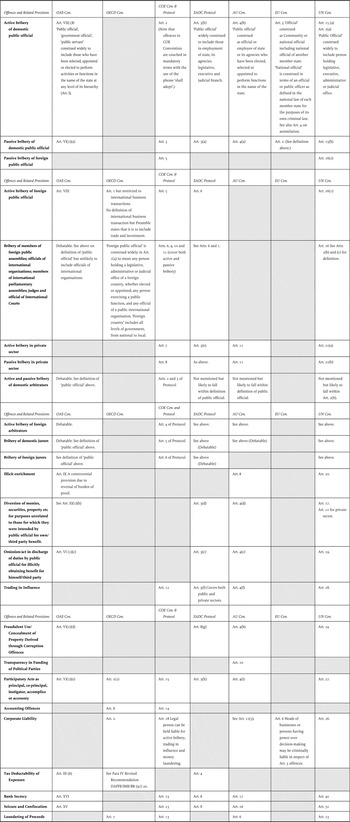
While corruption is much talked about in relation to government employees, it is found also in the private sector. Wherever an individual is in a position of power and has opportunities to exercise discretion, be it directly or indirectly, in the decision-making process opportunities for engaging in corrupt behaviour present themselves. Conventions falling within Group B focus on the abuse/misuse of power in the decision-making process for obtaining an undue advantage and are broader in scope than those within Group A that relate to the public sector. Of course the types of misuse, and the kinds of undue advantage outlawed, vary between the conventions as the following paragraphs and Table I show.
Offences created by the Anti-Corruption Conventions (OAS Convention, OECD Convention, COE Convention and Protocol, SADC Protocol, AU Convention and EU Convention, and UN Convention)
© Indira Carr, Reference Carr2007.

Group A
The OAS Convention is the earliest anti-corruption convention with the prime objective of eradicating corruption in the performance of public functions and has the following features:
• it creates corruption offences both in the context of mutual exchange between the offeror and the recipient and where there is no mutual exchange;
• it includes corrupt activities of both public officials and foreign public officials;
• it covers both passive bribery (solicitation and acceptance by a public official of a benefit in return for an act or omission) and active bribery (offering or granting of a benefit to a public official in return for the doing or not doing of an act); and
• it creates a controversial offence of illicit enrichment.
The first corruption offence created by this convention is that of bribery. The solicitation or acceptance, or the offering or granting, directly or indirectly of any article of monetary value or other benefit in exchange for any act or omission in the performance of his public functions by a governmental official or public official is made an offence.Footnote 30 The advantage gained by the public official can be for himself or another party and is not restricted to money but can include other advantages, a gift or a favour such as a holiday, a job, or a training contract for a third party. The term ‘public official’, construed to include government employees and those performing services in the name of the state, is sufficiently wide to include besides civil servants those working in public undertakings such as state trading corporations, various state agencies, and the judiciary. The OAS Convention has an extra-territorial dimension and makes active bribery of a foreign public official an offence (Art. VIII). Foreign public official is not defined as such but presumably the definition of a public official referred to above will be relevant.
The OAS Convention, as stated earlier, addresses corrupt acts that do not involve a mutual exchange. Article VI includes acts or omissions by a public official for the purpose of illicitly obtaining benefits for himself or for a third party. This will cover acts such as failure to record donations and their diversion for personal or third party use. Since gains derived from corrupt behaviour are likely to be concealed, the Convention also makes the use and concealment of property derived through corrupt acts as outlined in the Convention an offence (Art. VI (1)(d)).
An interesting but questionable offence included in the OAS Convention is the offence of illicit enrichment. This is also found in a number of other conventionsFootnote 31 and has been a source of some debate. According to Art. IX:
‘each State Party that has not yet done so shall take the necessary measures to establish under its laws as an offense a significant increase in the assets of a government official that he cannot reasonably explain in relation to his lawful earnings during the performance of his functions. Among those States that have established illicit enrichment as an offense, such offense shall be considered an act of corruption for the purposes of this Convention.’
This article has been the source of some contention since it seems to place the burden on the accused to show that he has obtained his assets in a lawful manner (Gantz, Reference Gantz1998). In some jurisdictions this may be seen as a necessary provision where there is total disregard of the law. Nevertheless, it goes against the grain of the expectation of a fair trial and right against self-incrimination enshrined in the various human rights treaties.
The next convention in chronological order which falls within Group A is the OECD Convention.Footnote 32 Unlike the OAS Convention, the OECD Convention deals only with transnational bribery and makes criminal active bribery of a foreign public official in the context of international business transactions. This restricted ambit is not surprising given its historical antecedents in the US Foreign Corrupt Practices Act 1977. The OECD Convention focuses on the bribe giver and makes active bribery an offence. A promise given directly or indirectly, a pecuniary or other advantage to a public official in order to obtain or retain business or other improper advantage in the context of an international business transaction is an offence. There is no clear definition of an international business transaction but its interpretation is likely to be guided by mercantile custom and international conventionsFootnote 33 and would presumably include transactions where parties to a business agreement are located in different jurisdictions.
The next instrument that restricts itself to the corrupt acts of public officials is the EU Convention. Footnote 34 This Convention addresses both active and passive corruption (namely, bribe offering and bribe soliciting) involving community and national officials in Arts. 2 and 3. The meaning of national official is to be determined by reference to the definition of ‘official’ or ‘public officer’ in the national lawFootnote 35 of the member state whereas the meaning of the ‘community official’ is to be established by reference to the staff regulation of the European Communities and includes those seconded to the European Communities by the European States (Art. 1(b)).
All of the above conventions are restrictive in scope in that they all focus on bribery with the exception of the OAS Convention which seems to reach farther into the recesses of human behaviour that could be classified as corrupt.
Group B
The public sector in developing countries is often seen as the breeding ground for corruption.Footnote 36 Since the public sector in these countries provides basic utilities with a huge consumer base many members of the public have experienced some level of bribery at the petty level. Some of the developing countries have therefore privatisedFootnote 37 or semi-privatised the utilities sector hoping that this would curb corruption. Since the private sector is profit seeking inevitably the charges of these utilities, once privatised, are raised and puts them out of the reach of the low income group. This, in its own way, breeds corruption at the petty level – for instance, on the part of those taking meter readings for the purposes of billing by entering a lower meter reading or tampering with the mechanical parts of the meter to show a lower consumption in return for a payment.
Private sector corruption however is not restricted to the petty level. It is commonplace for senior managers to engage in corrupt activities in various contexts, for instance, in procurement and compromising confidential and sensitive company information. To root out corruption it is essential that the private sector is also included in the regulatory framework.
The earliest convention to include both the public and private sector is the COE Convention, focusing on the abuse of power in return for an undue advantage regardless of the context in which it occurs. It also takes a comprehensive approach in construing the term ‘public official’.Footnote 38 The Convention dispels doubts about which services are or are not included in the public sector by including specific provisions relating to active and passive bribery of domestic public officials (Arts. 2 and 3), bribery of members of domestic public assemblies (Art. 4), foreign public assemblies (Art. 6), international parliamentary assemblies (Art. 20), officials of international organisations, and judges and officials of international courts (Arts. 2–6). The COE Protocol extends the list to include bribery of domestic and foreign arbitrators, and domestic and foreign jurors.Footnote 39 However, it fails in its comprehensiveness when it comes to the creation of offences. Corruption is construed within a narrow band that includes acts of active and passive bribery both at the domestic and international level (Arts. 2–11), and trade in influence over persons in the public sector such as domestic or foreign public officials, members of domestic and international parliamentary assemblies. The judiciary is separately addressed in Art. 12. An accounting offence is also created to address fraudulent practices such as the creation or use of an invoice or other accounting document containing false or incomplete information, and unlawfully omitting to make a record of payment (Art. 14).
A more comprehensive approach is adopted by the next three conventions in the chronological list: SADC Protocol, AU Convention and the UN Convention. The first two are regional conventions and likely, therefore, to have a limited impact unlike the UN Convention which is a truly international convention.
Turning our attention to the two African conventions, the SADC ProtocolFootnote 40 provides a definition in its Art. 1 and focuses on the abuse of power in return for undue advantage. The specific acts of corruption made illegal are listed in Art. 3 and include active and passive bribery be it by a public official or a person working in the private sector, act or omission by a public official for illicitly obtaining benefits for himself or a third party, diversion by a public official of property, monies or securities of the state, individual or independent agency received by virtue of his position for his own benefit or that of a third party, the fraudulent use or concealment of property described from corrupt acts as listed in Art. 3, and participation as principal, co-principal, agent, instigator, collaborator or accessory after the fact. The SADC Protocol also has a transnational aspect and includes the bribery of a foreign public official in its list of offences.
The AU Convention simply lists specific acts of corruption and related offences but in doing so is much wider in scope. It includes in its list passive and active bribery in the public and the private sector, the controversial provision on illicit enrichment, trading in influence, diversion of funds and concealment of funds resulting from acts of corruption. The classic example of corruption, bribery, is addressed in Art. 4 and includes both the direct or indirect solicitation or acceptance by a public officialFootnote 41 or a person in the private sector of an undue advantage in exchange for an act or omission in the performance of his public function, or in breach of his duties (Arts. 4(1)(a)–(e)). The AU Convention, like the OAS Convention, includes the controversial offence of illicit enrichment where a public official or any other person cannot reasonably explain the possession of his assets (Arts. 4(1)(g) and 8). The points made in respect of the offence of illicit enrichment in the OAS Convention apply equally here. Laundering or concealment of proceeds from corrupt activities is also made an offence (Arts. 4 and 6). The AU Convention includes an interesting provision on the funding of political parties. It expects the contracting states to proscribe the use of funds acquired through illegal and corrupt practices to finance political parties and incorporate the principle of transparency in such funding (Art. 10). This is a welcome provision, since it is common practice in many developing countries to channel the proceeds of crime through the funding of political parties.
The AU Convention does not include bribery of a foreign public official within its list of corruption offences which is a surprise omission since a number of African businesses do engage in international investment, South African business prominent among them.
The UN Convention is the latest corruption-related convention and it is expected to have a noticeable and successful international impact since it seems to have the support of international institutions such as the World Bank, the International Monetary Fund and policy-makers from developing and developed countries. Indeed countries have made known their adherence to the UN Convention when passing legislation to combat corruption.Footnote 42 It is much wider in scope than the previous two conventions in the group of three considered in this section. It criminalises bribery of national officials (Art. 15), foreign public officials and officials of public international organisations (Art. 16) bribery in the private sector (Art. 21), embezzlement of property both in the public and private sector (Arts. 17 and 22), trading in influence (Art. 18), illicit enrichment (Art. 20) abuse of function (Art. 19) and laundering and concealing the proceeds of corruption (Arts. 23 and 24). In taking a comprehensive approach, it also addresses aspects that may hinder enforcement and criminalises the use of physical force, threats or the offer of a bribe to induce false testimony or to interfere in the giving of testimony or production of evidence. Equally, intimidation of officials in order to interfere with the exercise of their official duties in respect of the offences created by the Convention is made an offence (Art. 25).
1.2 Sanctions
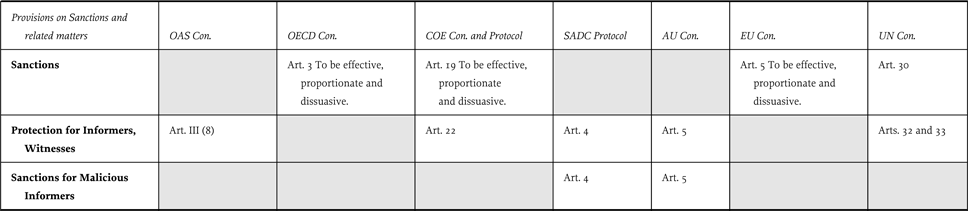
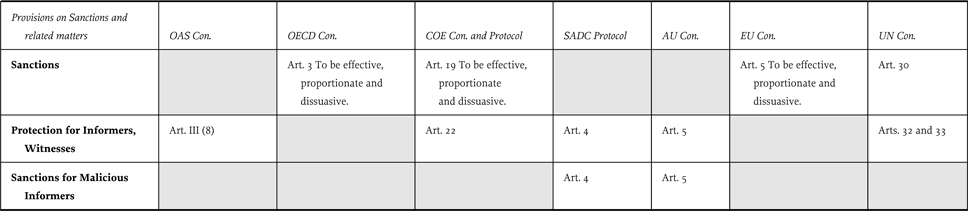
As with other international criminal conventions,Footnote 43 the approach towards sanctions is one of minimal interference or no interference in some cases. The SADC Protocol, the AU Convention and the OAS Convention subscribe to the latter approach in remaining silent in respect of penalties leaving it to the contracting state to decide how to deal with offenders. It is indeed difficult to understand why the regional agreements have remained silent on this issue since members of regional organisations have normally come together to pursue common aims and may be expected to achieve these aims through the same means. The reason for the silence may be to avoid the rather sensitive and emotive issue of sovereignty given that a number of countries in these continents have troubling issues ranging from boundary disputes to political and civil unrest. To intervene in criminal justice matters could be seen as an encroachment of matters that should be left to the contracting state to decide in keeping with its policy on criminal justice. The other conventions take a minimalist approach. The EU Convention, the OECD Convention, and the COE Convention in general terms expect the sanctions to be effective, proportionate and dissuasive and provide some indication of the range of sanctions that could be used for punishing corrupt conduct. This includes fines and loss of liberty.Footnote 44 The UN Convention appears to sit somewhere in the middle though it can be said that it is perhaps more willing to cover other aspects of criminal justice since, according to Art. 41, states may take ‘any previous conviction in another State for the purpose of using such information in criminal proceedings relating to an offence established in accordance with [the UN] Convention’. While including a provision on sanctions it does not go as far as the European driven conventions in giving any indication of the forms the sanctions can take. In Art. 30(1) it simply states that the gravity of the offence must be taken into account in determining the sanction but that loss of liberty is contemplated to be amongst the types of sanction is apparent from Art. 30(5), which mentions early release and parole. For a quick comparison see Table II.
Sanctions and Related Matters in Anti-Corruption Conventions (OAS Convention, OECD Convention, COE Convention and Protocol, SADC Protocol, AU Convention and EU Convention, and UN Convention)
© Indira Carr, Reference Carr2007.
1.3 Preventive measures
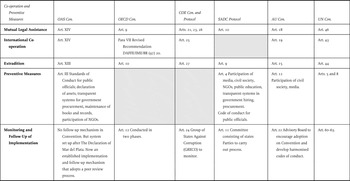
Prevention through the participation of citizens, those affected by corruption, and closing the current loopholes in existing law, such as banking law, that may be used to deposit the proceeds of corruption are important means of fighting corruption. The UN Convention once again is expansive in its approach to prevention of corruption and deals with bank secrecy (Art. 40), prevention and detection of transfers of proceeds of crime (Art. 52), the creation of financial intelligence units (Art. 58), participation of society (Art. 13), improving accounting procedures and introducing codes of conduct (Art. 12). The OAS Convention also specifically addresses the issue of preventive measures in Art. 5, ranging from codes of conduct, a system for registering assets of public official to participation of civil society. A similar approach is to be found in the AU Convention (Arts. 5, 12 and 17) and SADC Protocol (Art. 4). The OECD Convention is the least prescriptive and requires contracting states to adopt measures in terms of better accounting practices (Art. 8), while the EU Convention and the COE Convention do not contain any specific provisions on preventive mechanisms.
1.4 Mutual assistance and co-operation
All the conventions contain provisions on mutual assistance and international co-operation in the investigation and obtaining of evidence. The UN Convention covers this area in an extensive manner and includes various provisions detailing co-operation between national authorities (Art. 38), and between national authorities and the private sector (Art. 39), international co-operation (Art. 43), mutual legal assistance (Art. 46), law enforcement co-operation (Art. 48), and extradition (Art. 44). The OAS Convention (Arts. XII and XIV), the OECD Convention, the AU Convention (Arts. 18 and 19), the COE Convention and the SADC Protocol (Arts. 9 and 10) contain provisions on mutual legal assistance and co-operation except they vary greatly in terms of detail. For example, the OECD Convention provides for mutual legal assistance and extradition (Arts. 9 and 10), while the COE Convention goes into greater depth by providing for co-operation between national authorities (Art. 21), mutual assistance (Art. 26), extradition (Art. 27) and outlining the general principles and measures for international co-operation (Art. 25), and the EU Convention contemplates mutual assistance between EU member states (Arts. 8 and 9). For a comparison on preventive measures and other provisions see Table III.
Preventive Measures and Co-operation Provisions in the Anti-Corruption Conventions (OAS Convention, OECD Convention, COE Convention and Protocol, SADC Protocol, AU Convention and UN Convention)
© Indira Carr, Reference Carr2007.

1.5 The current state of affairs and some further remarks
The list of conventions and the number of ratifications received by these conventions is impressive. Should this be heralded as a sign of success on the part of the international legislative community? Far from it. It exhibits a lack of concerted effort on the part of regional and international institutions. The presence of this number of conventions is bound to leave states wondering which convention to ratify and implement or alternatively which model to base their own legislation on. It is interesting to see that a number of states have become serial ‘ratifiers’. This may be indicative of their seriousness to tackle corruption and perhaps a desire to ensure that all forms of corrupt behaviour are addressed in their jurisdiction. And where the serial ‘ratifier’ is a developing country, it may be motivated by socio-economic reasons – to attract foreign investors and to show to lending agencies such as the World Bank and the European Bank for Re-construction and Development that corruption is not tolerated. Or it could simply be a diplomatic exercise! In practice, ratification of a number of conventions creates ample room for uncertainties. To illustrate, if state S has ratified and implemented the OECD Convention, COE Convention and the UN Convention, when it comes to the interpretation of the term ‘foreign public official’ which of the travaux préparatoires is the judiciary going to turn to for guidance?Footnote 45
The existence of the many conventions on the same subject matter is perhaps a result of historical and political accident. The OECD Convention was the result of pressure from the US which had passed the Foreign Corrupt Practices Act in 1977 expecting that other industrialised countries would follow suit. Instead it found that it was alone in penalising the activities of their businesses abroad which affected the international competitiveness of US businesses abroad. Equally, the OAS Convention was very much a product of US policy in the Americas. The regional conventions in Africa emerged in response to the need to contribute to the socio-economic development of the region. And since there was no convention that applied in Europe the Council of Europe drafted the two conventions, one civil and the other criminal, for ratification by their member states.
The anti-corruption agenda has evolved slowly through initiatives from a number of institutions and it is now perceived on the international scene as an agenda worth pursuing vigorously.Footnote 46 Even developing countries are embracing regulation to curb corruption enthusiastically, judging from the number of ratifications for the various conventions. Therefore it is now time to ask whether any good is being done by still having so many conventions in force. All that it does is promote uncertainty, since they diverge in scope, substance and procedure. The time has come to have in place just one convention that is comprehensive, forward looking and includes extensive and meaningful extra-legal measures including corporate social responsibility for the prevention of corruption. This move might be opposed on the ground that countries will not wish to yet again engage in the drafting, adoption and ratification of a new convention. That need not be the case. There is a convention that possesses these qualities – the UN Convention on Corruption 2003. Perhaps it is time that countries simply ratify this Convention and denounce their ratifications of other conventions. Admittedly, the UN Convention may have some shortcomings – for instance, ambiguities in respect of sanctions. These can be refined where desired and needed since the Convention does make room for proposing amendments five years after its entry into force according to Art. 69.
What is striking about the OAS Convention, the SADC Protocol, the AU Convention and the UN Convention are the provisions that require states to put in place adequate measures that address accountability, integrity and transparency. This seems to be due to the influence of the theoretical model that has been widely adopted by the World Bank in introducing administrative and structural reforms in recipient countries and also informs much of economic analysis and empirical surveys on corruption. Known as the principal-agent-client model, it explains corruption in terms of the divergence between the principal’s or public’s interests and those of the agent or civil servant and where the agent betrays the principal’s interest in order to pursue his own (Klitgaard, Reference Klitgaard1988, Reference Klitgaard1997).Footnote 47 It arises where the following factors are present: state power, discretion and lack of accountability and transparency. So, according to this model, conditions for corruption present themselves when the principal (P) is in a powerful position and the agent (A) to whom P has entrusted to carry out the services has an element of discretion in administering the services and there is a lack or near lack of accountability or transparency in the process. To illustrate, where P is in a monopolistic position of providing telecommunications services in a country and A is responsible for allocating connections and numbers and the decision is left to A’s judgement with no transparent procedures in place in the decision-making process then the situation lends itself easily to corruption. Opacity and high discretion levels within an organisation that holds a powerful position create the right conditions for corruption provided A is also self-seeking (acting in his own interest) rather than acting in the interests of P, his employer. While much of the discourse relating to this model has taken place in the context of the public sector it can equally apply to the private sector even where the condition of a monopolistic status may not be entirely met. Corrupt practices within a company’s (P) purchasing department provides a good illustration where the high level of discretion accorded to the purchasing manager (A) coupled with lack of accountability can result in the purchase manager (A) coming to an arrangement (monetary or otherwise) with the supplier that promotes A’s rather than P’s interests.
2. Enforcement and informers
The adoption of a convention and its ratification by a state only goes part of the way in countering corruption. For any regulation to be hailed a success, it has to be adopted sufficiently seriously by the people so as to influence their behaviour when faced with choices as for instance where a person is influenced by the knowledge of the illegality of receiving a bribe in declining an offer of a bribe to speed up the process of obtaining a passport. However, given man’s proclivity towards exercising free will, it is not always the case that regulation of itself will achieve the aim of controlling his behaviour. Hence enforcement plays an important role in making sense of regulation. Regulation in the absence of enforcementFootnote 48 is meaningless and at best, is a political exercise that does not serve the citizens of a state well. In ratifying an international convention and implementing it through criminal legislation, a contracting state accepts responsibilities both to the international community and to its citizens – it is a public commitment to the legislation and to see that it is enforced. After all, the aim of criminalisation of certain types of behaviour through law is to protect society from their detrimental effects, and in the case of corruption, it is to promote economic prosperity and to protect the weaker sections of societies from the debilitating effects of poverty, and to ensure fairness and integrity.
Much of the corrupt activity is of a secretive nature and parties to a corrupt transaction are unlikely to conduct their affairs in the open for all to see. The enforcement of anti-corruption legislation is therefore dependant on sophisticated investigative techniques, both overtFootnote 49 and covert. Periodic surveillance of officials, undercover operations, use of banks to report unusually large transactions and their scrutiny may be ways of exposing corrupt behaviour. However, such proactive techniques, if adopted, need to be balanced against human rights obligations of the state, so that there is no infringement of the right to privacy, right against self-incrimination, and property related rights.Footnote 50 Investigative techniques such as surveillance and examination of bank accounts are of limited use and are dependent upon an investigative and enforcement service with ample financial and personnel provision. Police informersFootnote 51 are cultivated, nurtured and widely used by police authorities globally and are perceived as a vital tool in the detection, investigation and prosecution of criminal activities,Footnote 52 and more so in respect of hidden criminal activity such as corruption (Parker, Reference Parker1986).
While the use of informers (also known as ‘informants’ or ‘police sources’)Footnote 53 is widespread there is limited research on their background and their motivations in imparting information to the police. The available researchFootnote 54 in this largely ‘secretive’ policing activity suggests that most of the informers are in some way connected to the criminal fraternity directly or indirectly, although there are the few who are not. Their motivations vary. Some are tempted by the police reward, whilst others may divulge information in return for immunity or for a reduction in sentence or for the purposes of protecting loved ones from getting involved with the criminal fraternity. Revenge is also cited as a reason for providing police with information. And there are those who are driven by moral principles and act for the greater good. In most cases, there is some sort of exchange between the informer and the informed, be it of money, leniency in sentencing or some other favour (Billingsley, Nemitz and Bean, Reference Billingsley, Nemitz and Bean2001). It is indeed very difficult to gauge the success of this mechanism in the context of corruption. Regardless of various mechanisms that the police may have in place in accessing information from ‘good’ sources the reliability of such information is debatable and may result in miscarriages of justice (Westervelt and Humphreys, Reference Westervelt and Humphreys2001).
Neither covert surveillance techniques nor the use of informers are viable techniques in the enforcement of anti-corruption legislation due to their high financial costs and the high risk of unreliability of information obtained. Financial costs will cause concern to developing countries that do not have sufficient revenue to invest in basic infrastructure for a number of reasons ranging from civil war to border conflicts and defence expenditure.
A class of informant who may be able to provide better quality information in terms of reliability for enforcement purposes is the whistleblower – employees from within an organisation who expose malpractices within their organisations. Since whistleblowers are likely to face reprisals at their place of employment, some of the adopted anti-corruption conventions require that legislation protecting whistleblowers be passed in states ratifying the conventions.Footnote 55 Jurisdictions such as the United Kingdom,Footnote 56 South Africa,Footnote 57 AustraliaFootnote 58 and the United StatesFootnote 59 have whistleblower protection legislation. Since whistleblowers divulge malpractices within their organisations they have the potential to play an important role in curbing grand corruption – for instance, where their organisation is engaged in corrupt practices in tendering for overseas contracts.
While the legislation may guarantee legal protection to a whistleblower, it is debatable whether this of itself will be sufficient to enable an individual to come forward to report questionable activities within an organisation. There are no available comparative statistics relating to number of complaints about malpractices involving whistleblowers to assess the success of the legislation. However, what is overlooked are the likely psychological effects such as stress and the social aftermath of a disclosure on the individual who discloses (Bucy, Reference Bucy2002, p. 944; Westin, Kurtz and Robbins, Reference Westin, Kurtz and Robbins1981). Society at large, including his fellow employees and other employers in the sector, perceive such an act on the part of an individual as exhibiting disloyaltyFootnote 60 towards the employers and fellow employees, and the individual will have to bear the cross of disloyalty regardless of whatever legal protection that may be provided. There is plenty of evidence to suggest that whistleblowers are simply victimised by their employers.Footnote 61 This cross may prove to be too burdensome. The contribution that whistleblower legislation may make towards enforcement of anti-corruption legislation is likely to be minimal unless social attitudes towards whistleblowers change. This could happen over time through what I call re-socialisationFootnote 62 of the general populace by imparting the importance of good practice in the conduct of business practice – be it in the public sector or private – and promoting the need for striking a balance between acting for the greater good and self-seeking behaviour.
Given the financial costs of surveillance and the limited usefulness of police informers are there any other legal means through which anti-corruption legislation could be enforced by members of the public? The answer may lie in action qui tam Footnote 63 or the common informer action abolished in Britain in 1951 with the Common Informers Act. The origins of common informers action is traceable to the end of the thirteenth century. It enabled individuals to initiate actions in the royal courts on their behalf and that of the Crown.Footnote 64 By the sixteenth century, qui tam actions were explicitly or implicitly included in statutes to overcome the difficulties in enforcing penal laws and the common informer normally obtained a share of the fines that were to be received by the Crown. In an era where there was no police force, this seemed an ideal method for minimising the gap between legislation and enforcement. The offer of a bounty preying on human greed brings in its wake its own dangers. Predictably, many perceived informing as a lucrative career and there are records of individuals taking on this activity seriously.Footnote 65 It seems that in the sixteenth century common informers played an important role in enforcing economic regulation ranging from customs and foreign trade offences to marketing and manufacturing offences.Footnote 66 The usefulness of such informers, however, was short-lived, due to abuse of the system by common informers, for instance extracting money from the law breaker with threat of a court action thus attracting unflattering comments. Qui tam actions re-emerged in the twentieth century as a force to reckon with in the context of the Lord Day’s Observance Act 1781 and the Sunday Observance Act 1677. The abuse associated with such actions, however, continued and in 1951 the common informers action was abolished. The debates in the House of Commons exhibit the level of contempt towards common informers. According to Sir Gerald Hurst, the common informer is just a ‘complete sneak who engages in legalised blackmail’.Footnote 67
Independently of the attitudes towards common informers in Britain, the US in 1863 enacted the False Claims Act (FCA) to root out fraud such as false records, and false claims for payment on the part of contractors against the government. Since the aim of the FCA was to encourage informers to come forward with information in return for a share of the fine in respect of such fraud, it empowered citizensFootnote 68 to bring suit on behalf of the government for fraud against the government. Qui tam suits were fairly common until amendments to the Act in 1943 following a controversial decision in US ex rel. Marcus v. Hess,Footnote 69 a case that held that the relator could bring a suit based on information already possessed by the government. The 1943 amendments put an end to ‘parasitical suits’ by disallowing actions based on information already known to the government. However, in the 1980s there was renewed interest on the part of the US Congress in the FCA due to growing concerns about fraud against the Government,Footnote 70 especially relating to defence contracts. The FCA was amended in 1986, so as to allow a relator to bring a suit as long as he was the original source of the information and the financial rewards were also substantially increased. As a consequence of these amendments, there has been a marked increase in qui tam actions and, according to a report from the US Department of Justice in 2005, the Justice Department recovered $1.4 billion in fraud and false claims. Of this figure $1.1 billion was recovered in association with qui tam actions. The FCA, seen as a ‘primary weapon to fight government fraud’, has been heralded by the Assistant Attorney General of the Civil Division of the US Department of Justice as giving ‘ordinary citizens the courage and protection to blow the whistle on government fraud’.Footnote 71
It seems from the US experience that qui tam action has the potential to play an important role in fighting corruption. On the one hand we have the British distrust of common informers and strong doubts in respect of common informer actions in furthering justice and, on the other we have their enthusiastic reception of the US law enforcement institutions. The US success story in recovering huge amounts in fraud and false claims is sufficiently persuasive for arguing for the introduction of qui tam actions in exposing corruption. Of course, there is the danger of spurious actions and legalised blackmail in the form of threats of initiating action to elicit money from the law breaker, but it is possible to insert suitable safeguards to reduce the number of spurious claims as in the FCAFootnote 72 and to introduce stiff penalties for those abusing or misusing qui tam actions for malicious ends. No doubt it will add another layer of bureaucracy and extra pressures on the Attorney General and other relevant institutions within a country.
While there is a lot to be said for the views expressed by the British Members of Parliament, we have to be aware that circumstances are far different from those immediately post World War II. We now live in a global community where the defensiveness of borders have been eroded by free trade and notions of sovereignty and the idea of nation state has taken on new hues with the emergence of multinational corporations as powerful economic and political entities. In their quest for increasing their market share and market power corruption is simply a tool for furthering their ambitions and they remain oblivious to the ensuing poverty in developing countries and least developed countries. In these circumstances, it is important to explore what may be regarded as outdated actions to see whether these could provide useful tools to combat corruption. Allowing qui tam actions in the corruption context is not a revolution. It is simply resorting to private justice and this is not a novel idea. It can be traced back to thirteenth century Britain except that now this private justice will work in partnership with the judicial institutions of a state. The privatisation of justice is emerging in other areas too – for instance in the use of mediation in international commercial contracts (Carr, Reference Carr2003). Of course, this resort to private-public partnership in matters of pursuing justice might not suit countries where judicial institutions are still in the making or ineffective due to interference from the political structures.
3. Fighting corruption through re-socialisation
While anti-corruption regulationFootnote 73 in the form of an international convention is to be welcomed it provides only a partial answer. Its biggest drawback is enforcement deficit. As stated in the preceding part, use of police informers is not a reliable method of enforcing legislation since it carries with it a high element of risk. However sophisticated risk assessment and risk management methods may be as reflected by the codes of practice adopted by a law enforcement agency in their selection of informers, reliability will continue to be a problem. Qui tam action and the ensuing private-public partnership on the other hand may provide an effective method to enhance enforcement of anti-corruption legislation. However, it too has its pitfalls since it may attract bounty hunters who have lost sight of justice and the checks in place to stop spurious actions may not always be effective due to lack of personnel and other bureaucratic contingencies.
The difficulties associated with enforcement brings with it the spectre of hopelessness. There are, however, other means of making the populace realise the harmful effects of corruption on the general welfare of citizens, be it at a global or at a state level, and of the need to think of the greater good as opposed to engaging in self-seeking behaviour such as corruption. In re-socialisation, in making people aware of the long-term effects of corruption on the human condition, lies at least part of the answer. In a world riddled with illiteracy, prejudices and ignorance, the re-socialisation process will take time and effort. So how do we go about highlighting the short- and long-term ill effects of corrupt behaviour on the part of the few on the greater whole? And how do we build in mechanisms other than legislation to curb and prevent corruption?
Educating people as to the detrimental effects of corruption and of their central role in its prevention, I believe, offers a partial solution. In the absence of knowledge of the long-term impact of corruption on the economic well-being of a nation and its people there is the danger that corruption may be seen simply as a quick-fix solution for a problem and a commonplace nuisance that a person has to put up with in obtaining a licence, a contract, a job or a passport.
Immediately identifiable faces of victims of corruption are absent. Since it is not possible to point to X and Y as those who have suffered as a consequence of a corrupt act, it is difficult fully to appreciate the effects of corruption. The victim of corruption, however, is humanity, and humanity is the countless hungry and starving to be found across all continents. An appreciation of corruption’s debilitating economic impact and consequently its role as a breeding ground for local and global poverty must be made widely known to the general public. This, in turn, will enable citizens to foster a common goal and mobilise them to initiate steps necessary for eradicating a practice, a habit that runs counter to social justice and to promote the happiness and well-being of the greater number. It is not a matter that should be left to the rarefied atmosphere of academics and realm of the economists, policy-makers, and legislators. There is no doubt that the bribing of a public official, for instance, in a developing country to obtain a licence for installing a chemical factory with lax health and safety standards may satisfy the immediate needs of the multinational in meeting its financial and annual targets, the expectations of the shareholders and the living standards of the public official in the short term, and may also bring much-needed employment in a poverty stricken area. But longer-term consequences also need to be taken into account. How does the behaviour of the multinational affect other stakeholders: the employees, their families and others in the state? How does it impact on competitors, forcing them to lower standards and cut corners? How does it relate to the goal of happiness of the greater number? It does not require much thought to predict the long-term impact of this course of action, although it may not immediately be all that obvious. Lax health and safety standards is a tragedy waiting to happen. The case of Union Carbide in Bhopal, India provides a good illustration of the consequences of lax safety standards. It has caused long-term human suffering, spilling into future generations in the form of genetic disorders and poverty, since those affected are unable to provide for their families. The limited compensation agreed upon has been slow to reach the suffering (Morehouse, Reference Morehouse1994 and Schroyer, Reference Schroyer1997). Admittedly, the above illustration of the widespread agony for current and future generations is an extreme one. But, regardless of this, the detrimental effects of what may be considered innocuous and harmless forms of corruption equally over time contributes to poverty and affects humanity. For instance, the taking of bribes in order to tamper with electricity meters, beneficial to the consumer and the bribe-taking official, causes economic harm to the provider and other customers. This may lower the ability of the country to meet energy demands required for attracting industries necessary for economic growth and prosperity.
That education is an important aspect of preventing corruption is also recognised by the UN Convention in Art. 8 entitled ‘Participation of Society’, which requires states to undertake public education programmes, including school and university curricula that contribute to non-tolerance of corruption. The inclusion of corruption in the curricula will not of itself be sufficient to spread intolerance towards corrupt activities. Most developing countries have low literacy rates amongst adults and much of the younger population do not go to school because their families cannot afford to send them to school. In some countries children as young as five work in appalling conditions in the mining, carpet and construction industries. There is still a lot to be done in stopping the exploitation of child labour and education, but a discussion of this is beyond the scope of this article.Footnote 74 Against this general backdrop the education of the public has to take place through other means and this will vary from country to country. Non-governmental organisations, civil society organisations and activists have an important role to play in spreading the ill effects of corruption, its impact on the community and society and how the citizens themselves can play a vital role in refusing to pay bribes, to inform relevant authorities of the incidents of bribe, and to co-operate with the media in exposing corrupt activities. Of course, such methods will have to be tailored to suit existing local conditions and local freedoms and this is where local activists and NGOs have an important role to play. There are a number of successful activist movements in developing countries that have resulted in better forest management and irrigation management fuelled by social justice and environment concerns. The Chipko AndolanFootnote 75 (Hug a Tree Movement) and the Narmada Bachao AndolanFootnote 76 (Save Narmada Valley Movement) in India provide illustrations of how social movements can contribute to changes. For instance, the Chipko Andolan, which started in the 1970s resulted in a fifteen-year ban on green felling in the Himalayas.Footnote 77
The view put forward here is of the importance of instilling an awareness of the social impact and consequences of one’s behaviour not only in relation to oneself, the near and the dear but on whole communities, on humanity and on generations, current and future. Of course it could be said that this is simply an idealistic viewpoint underpinned by a utilitarian and humanistic philosophy of society and social relations. Such a criticism would be unfair. What is being propounded is not unrealistic, neither is it proposing an abstract and complex philosophical analysis of the moral and social dimensions of human behaviour for the philosophically initiated. Footnote 78 Instead, the approach here is a pragmatic one. What is being argued for is making citizens aware of the consequences of their behaviour over the long term and their taking suitable steps to ensure that the measures they take towards achieving the goal of individual happiness do not cast a gloomy shadow on the happiness of the greater number. Illiteracy and lack of formal education should by no means hinder an understanding of acting in a manner while keeping in sight of the greater good since man has the ability to exercise self-control.
Of course, the importance of social awareness needs to be communicated in some way. This is where civil society organisations have a central role to play. There is ample evidence that civil society organisations have been successful in spreading information and harnessing a suitable response to the social ills of the global community. TI provides a good illustration of this. It has played a central role in exposing the incidence of corruption and has contributed to harnessing the efforts of legislators and international institutions in combating corruption. More, however, needs to be done in enabling and involving citizens, especially in the developing countries, in playing a participatory role in not only moulding their own future but that of the global community.
Conclusion
Corruption is an endemic problem that affects the prosperity and well-being of nations. It is a major contributor to poverty. Lower corruption would see a lowering of poverty levels in the developing world since monies that would have normally found their way into the purses of officials would be available for building a sound social and economic infrastructure. International institutions and regional organisations have scrambled to introduce anti-corruption conventions, with the result that there are now nine conventions varying in detail creating disharmony. The adoption and quick ratification of the conventions by a great number of states are insufficient to curb the undesirable practice of corruption. Some countries have ratified more than one convention and this in itself is likely to prove cumbersome when it comes to interpreting the legislative instruments within those states. For instance, which of the travaux préparatoires should the judiciary refer to for purposes of clarification? What is needed urgently is a co-operative and concerted effort on the part of regional and international institutions to replace the existing regional conventions with a single comprehensive international instrument open for ratification by all states. Instead of trying to formulate yet another convention, it might be well worth considering the UN Convention as that instrument.
Regulation, however comprehensive and widely ratified and implemented, is unlikely to prove highly successful since it is prone to enforcement deficit. Corrupt behaviour by its very nature is secretive and is likely to prove difficult to investigate. I have suggested that we need to adopt an approach that involves members of the public in the fight against corruption, through their refusal to willingly participate in corrupt activities. This is achievable through instilling social awareness, through an awareness of the harm that corruption causes to the wider community and behaving in a suitably responsible and balanced manner with the happiness of the greater number and current and future generations in sight. It is measures like re-awakening the spirit of civic sense and a duty not to harm others that is likely to prove more successful in the long run than legal regulation of itself. We still have a long way to go to achieve our goal of a less corrupt world but it is a goal we can reach provided we remind ourselves constantly of the detrimental effects of corruption not only on this generation but on future generations.