Despite NGOs' campaigns connected with so-called ‘conflict diamonds’, the social reality of the artisanal production of precious gems continues to remain opaque. The cutting and polishing operations that turn rough stones into bright jewels seem to conceal the processes of mining work, and little or no information is available about the point of view of the extractor-producers. For instance, what do these workers think of the uses of diamonds made by Western consumers?
During fieldwork in the diamondiferous districts of Sierra Leone,Footnote 1 I noticed that miners, like their Malagasy colleagues engaged in the search for sapphires and described by Walsh (Reference Walsh2004), would maintain that they did not know what diamonds could possibly be used for. When I asked them to envisage the uses of these stones and questioned them about the reasons why so many people were willing to spend enormous amounts of money to possess them, their responses varied considerably. Some believed diamonds were mainly used to make lenses for glasses and windscreens for cars. Among the younger fans of action movies, a rumour circulated that diamonds could be used to build weapons of mass destruction. Others believed that these stones were used to construct technologically complex equipment (for instance, mobile phones or aeroplanes). More generally, many felt that they were used in the production of those goods that represent modernity in their eyes, ‘desirable and intensely desired’ (Masquelier Reference Masquelier2000: 85) and yet distant and unaffordable. Like miners and sapphire traders met by Walsh in Madagascar, miners in Sierra Leone thought it was improbable that the stones extracted through such hard labour were being used in the global jewellery industry (cf. Walsh Reference Walsh2004: 225).
Although most extractor-producers maintained that they did not know what diamonds were for, when solicited they would say that ‘diamonds are just money’, thereby recognizing that stones with no local use-value might become objects of value once in the hands of those who ‘know’ their inherent secrets. Suspicions and fantasies surrounding the diamond trade in Sierra Leone, unlike those in Madagascar, call for an analysis that extends beyond the visible aspects of the diamond commodity chain. According to several miners, diamonds belong to, or are under the control of, invisible beings known as dεbul dεn (plural; singular dεbul) or djinns. In the south-eastern diamondiferous areas of Sierra Leone, there are miners who turn to these invisible presences to increase their chances of finding the precious stones and accumulating extraordinary wealth in a short period of time. Through gifts and ritual offerings, these miners hope to minimize the threat posed by such entities and to be reciprocated with diamonds.
What is the relationship between diamonds, their alleged uses and their invisible owners, and how is it articulated in the life experience of miners? Several scholars have recently insisted on an approach centred on the so-called ‘occult economies’ (for instance, Comaroff and Comaroff Reference Comaroff and Comaroff1999; Reference Comaroff and Comaroff2000; Reference Comaroff and Comaroff2003). This is a peculiar ‘ethnology of suspicion’ (Robotham Reference Robotham and Carrier2005) that focuses on the growing ‘deployment, real or imagined, of magical means for material ends’ in post-colonial societies (Comaroff and Comaroff Reference Comaroff and Comaroff1999: 279). In addressing the question, this perspective promotes an analysis of the reactions and contradictory effects of modernity, global market expansion and neoliberal capitalism.
While this field of study has gained wide popularity among scholars and has had the advantage of pointing to the concealments and imaginaries of capitalistic accumulation of wealth in the context of broad economic conjunctures, it has paid little attention to the specificity of local historical experiences, the relevance of long-term cultural elaborations, or their impact on the lives of specific subjects in specific historical and political circumstances.
Terence Ranger (Reference Ranger2007) considers different ways of breaking the ‘occult economies’ consensus. He points to ‘the crucial importance of context; the crucial need to disaggregate; the significance of history’ (ibid.: 282). This article aims to rectify the ethnographic and theoretical omission of occult economies by considering the ecology of particular discursive practices surrounding diamond mining and its economy, the intertwining of visible and hidden forces and their action through objects, words, techniques and environmental elements (cf. Ferme Reference Ferme2001) – an intertwining that reveals, in turn, a system of relations between human and non-human agents (Ingold Reference Ingold2000).
The article consists of three parts structured around the overlapping and interlaced meanings of the words ‘economy’ and ‘ecology’.Footnote 2 The classic definition of economy as the science of managing uncertainty and scarcity and its etymological meaning of management (nomos) of the habitat or the household (oikos) orient the first part. Here, the focus is on how artisanal miners work, distribute profits and speculate about the uses of diamonds. As has been the case with diamond diggers on the border between Angola and Congo-Zaire analysed by De Boeck (Reference De Boeck1998; Reference De Boeck2000; Reference De Boeck2001), in Sierra Leone diamonds have triggered an imaginary that draws its symbols and its images from different sources. The second part examines how the miners' imaginary on diamond money and illicit wealth has been shaped through the prism of a particular regional history. The third part changes perspective, considering the ecological side of artisanal and small-scale mining. It interprets the mines as phantasmagorical places in which the spatial, cultural and imaginative dimensions of the local and the global are intertwined, producing new images and cultural practices that challenge the existing social order and create environmental spaces of potential power dispute.
THE ECO-NOMY OF DIAMONDS
In Sierra Leone, diamonds can be extracted on a large scale, small scale or artisanal scale. Each of these levels is monitored and regulated by the Ministry of Mineral Resources (MMR), which, since the end of the civil war (1991–2002), has collaborated with major development aid agencies and human rights NGOs to reform the mining sector and minimize the smuggling of precious stones.
Large-scale extraction usually operates on kimberlite deposits and therefore requires the use of complex and expensive technological equipment. In contrast, on the artisanal level miners work on alluvial deposits. In this type of deposit, diamonds are scattered almost randomly.Footnote 3 Technological investment here is minimal. Shovels, buckets and sieves are the essential tools used to open pits in the ground or to dig holes in river beds, and to collect and sift the gravel. Much of the work is done manually; the number of people involved varies according to the economic resources available to the supporters, the size of the mines, and the various working phases (stripping or removing vegetation and rocks, excavating and draining the water filtering into the pits, washing or sieving the gravel). The small-scale level is an intermediate level: the miners can use medium-sized machinery – such as excavators, dredges and automated washing plants – and there can be large numbers, even hundreds, of them. It should be noted that, unlike on the small- and large-scale extraction levels, the MMR grants artisanal licences only to Sierra Leonean citizens. Large-scale licences are held by foreign mining companies capable of large financial investments, while the small-scale companies can be wholly owned by Sierra Leoneans or they can be bodies corporate with a minimum level of Sierra Leonean shareholding.
At the artisanal and small-scale level, miners are organized in gangs. In the artisanal case, a gang comprises a minimum of two or three people, and usually no more than a dozen. The greater the number of people involved in a mine, the greater the structured hierarchy of tasks. At the top of this hierarchy are the financiers or supporters, who are often, but not always, also the owners of the mining licences (the ‘licence holders’) granted by the MMR after the miners have identified the most promising sites and have asked for permission from local chiefs and from the landowner or landholder. A supporter can have direct control over the work in the mine and be a miner himself (sometimes referred to as the ‘boss’ or ‘master’). Or, for example, he can be a diamond dealer employing expert miners in the roles of supervisors or managers. The supervisor mainly has the role of representing the supporter in the mines and coordinating the work of one or more gangs. The latter are made up of the labour force in charge of excavation activities (‘diggers’) and of sieving the gravel (‘washers’). Their work is coordinated by the gang leader who represents the gang and communicates with the boss or the supporter if necessary.Footnote 4
A decade after the end of the civil war in Sierra Leone, many people still try their luck in diamond mining. With very few options for employment (Peters Reference Peters2012: 140) and the similar ‘dire conditions that gave rise to the conflict’ – that is, ‘high level of youth unemployment, marginalization, and lacking hope for the future’ (UN 2007, cited in Fanthorpe and Maconachie Reference Fanthorpe and Maconachie2010: 255) – artisanal and small-scale mining attracts many people. The minimum daily guarantee of ‘food’ offered by the supporters and the messianic promise of a future reward on (and from) the earth – which includes money but also ‘social freedom’ (see Richards et al. Reference Richards, Bah and Vincent2004) – seem to be two of the main common reasons to work in the mines. Thus, despite gloomy predictions about the exhaustion of alluvial deposits, the rate of production has returned to prewar levels. In 2005, for example, it was estimated that more than 100,000 artisanal miners were working in Kono District alone.Footnote 5 This is surprising, considering that in Sierra Leone most of the population lives below the so-called ‘poverty line’ (UNDP 2011) and that the difficulties and uncertainty that characterize diamond mining do not even guarantee that the costs will be recouped. Yet, contrary to the claim of some development experts and analysts interested in the problem of mining in this country (i.e. Partnership Africa Canada and Global Witness 2004), the diamond economy has nothing to do with a ‘casino economy’ (cf. Walsh Reference Walsh2004). Miners ponder their choices and their strategies reflect their awareness of working and making complex decisions under conditions of radical uncertainty. This clearly emerges when we consider the agreements miners make for the allocation of earnings.
Secrets and deceptions
Among alluvial diamond miners there are various possibilities for agreements. They may, for example, decide to share out the extracted gravel (hoping to find the best gems in their heap or pile), or to share out the actual earnings from any ‘winning’Footnote 6 according to precise percentages, or to draw up an agreement of a wage-earning type.
The first case is common when a supporter or boss realizes or knows from the start that he or she does not have the necessary capital to complete the extractive operations. In this case, he or she may come to an agreement to share out the extracted gravel with other supporters or peopleFootnote 7 involved in the mining operations (pile and bucket systems), or with his or her own work force (kongoma system) (Fithen Reference Fithen1999; Levin Reference Levin2005; D'Angelo Reference D'Angelo2011).Footnote 8
It is interesting to note that, at the end of the gravel sharing operations, apparently unlikely events may take place. It may in fact happen that the miners who have received the smallest quantities of gravel are those who make the most gains (e.g. they find the most or the biggest diamonds). The luckiest miners may arouse the suspicion that they have actually stolen diamonds by using magical means prepared by ritual specialists (moriman or jujuman). One of the instruments most often suspected for this kind of theft is the fana, a sieve-shaped charm that the miner hides in a pocket and uses to magically transfer by night the diamonds from his fellow workers' heaps to his own.
To prevent problems of this type arising, but also to prevent simple quarrels and bad temper concerning the methods of sharing out the gravel, many miners I knew considered that the best agreement between supporters and labourers was the contract system. This system is the most widespread form of payment for small-scale mining. Here, the supporter gives the miner a fixed salary of 5,000 leone (Le) to Le10,000Footnote 9 per work day. Whoever accepts this agreement with the supporter gives up any other benefit and any percentage from the diamonds that might be discovered. From the point of view of the supporter, this system is more risky economically speaking because he can never be certain if, at the end of the mining operations, the diamonds' value will cover all of his expenses (i.e. salaries, rent and maintenance of machinery, compensation for the landowner, fees for licences, etc.).Footnote 10 On the other hand, the advantage for the supporter is obvious if the mine where he is working is full of gems. All of the profits will end up in his pocket, instead of being subdivided among the other workers, as happens in other systems of distributing earnings.
Most of the Sierra Leone miners, however, do not have sufficient capital to undertake small-scale digging, as stipulated by the licence concession criteria issued by the MMR (2005), but they may be able to afford to work on an artisanal scale. At this level, the most common form of economic agreement is called the ‘supporting’ (Levin Reference Levin2005; D'Angelo Reference D'Angelo2011) or ‘tributary’ system (Zack-Williams Reference Zack-Williams1995). Within this system, supporters and diggers agree on the percentages of money they will share from the sale of each diamond discovered. Typical ratios for subdividing earnings are 50:50, 60:40 or 70:30, where the highest percentage always goes to the supporter. Supporters offer each digger daily portions of rice,Footnote 11 often accompanied by small amounts of money (from Le500 to Le3,000) and, more sporadically, other benefits (such as medicines or alcohol). In exchange, supporters have the right to purchase any diamonds found in the pits by the gang, which has a prior collective ownership interest in them.Footnote 12
Under the supporting system, the stone belongs firstly to the gang that found it. This means that before a supporter can sell it to a diamond dealer, he or she must first agree on the price with the workers of the gang. Notwithstanding the pre-established agreements, which cannot be renegotiated during extracting operations, there is ample room for bargaining between the gang and the supporters; such negotiation is based mainly on two factors: the ‘effective’ value of the diamond and the costs incurred by the supporters, which are to be subtracted from the sale value of the diamond. Supporters dutifully note down their expenses, but they tend to overestimate them while bargaining with their workforce (Levin Reference Levin2005). As far as the value of diamonds is concerned, it is worth noting that most miners cannot easily evaluate the gems. This is a tricky task even for experts. Such reputedly valuable diamonds as the ‘white’ type, one of the most valuable ones along with the fancy coloured gems (e.g. ‘pink’, ‘white-blue’ or ‘gold’), may, when examined under a lens, show impurities or flaws invisible to the naked eye; consequently, their market value is considerably lower than expected. Each gem is unique (cf. Walsh Reference Walsh2004) – the problem is how to quantify its uniqueness in monetary value.
Precisely by taking advantage of this difficulty, supporters and diamond traders try to maximize their profits. In the ‘supporting system’, none of the buyers has any interest in revealing what he thinks the diamond is worth (Levin Reference Levin2005) – if anyone can really know its value. Even if the workers can use the knowledge they have gained through previous experience, or if they have the opportunity to consult friends, relatives or more experienced colleagues, in the end, they just have to trust the other parties. Trust and loyalty, however, are only two of the ingredients in a complex game of negotiation where what counts is, among other things, the ability to persuade, to deceive, or even to impose one's own decision with veiled threats.
There are those who are willing to cheat in order to maximize their profits. There are supporters who have no qualms about bribing those among the workers who are most influential, by secretly promising large tips in the event that bargaining will swing in a favourable direction and the gang will accept the supporters' offer. Others may even get a preliminary agreement with diamond dealers on a ‘shadow price’ and, at the moment of trading in the presence of gang members, underestimate the value of the stones (Zack-Williams Reference Zack-Williams1995: 150).
Conversely, the workers are not always passive victims, as the supporters know perfectly well. The risk of thieving is ever present, above all during the washing stages. Finding a local intermediary, a peddler or an illegal dealer (banabana or nikoniko) who is willing to buy the stolen gem is not an impossible undertaking, just as it is also not difficult (although risky) to smuggle it.Footnote 13 That is why building up and maintaining a bond of trust with workers remains a central concern for mining sponsors. Their interest is to get along well with their men so as to enhance the conditions required for the success of the mining operation as well as to dampen the temptation to purloin any ‘winnings’. This is an important aspect to bear in mind in order to understand some of the social dynamics at play in the mines.
Supporters invest money in each worker in the hope of recovering these expenses with the sale of the diamonds. A miner who is attracted by higher payment in another mine and leaves his work before the end of mining operations is considered ungrateful. But, if the miner leaves when the extracted gravel is being washed (that is, sieved to search for gems), he can be suspected of having found and stolen a stone of good quality. Since all miners involved are entitled to a predetermined quota, the other workers will largely share the suspicions and concerns of the supporter. An eye will be constantly kept on the suspected thief, and in general a change in patterns of consumption, for instance the purchase of a new phone or new shoes, will be regarded as suspect or evidence of guilt, and will be checked. Recovering a stolen diamond may be a hard and expensive task. Hence, the supporter must manage his relationship with his workers very carefully. As the miners say, the employee should always be ‘made happy’ and given small tokens of appreciation in the form of cash and food. In this way, the supporter dispels any temptation to steal the bigger stones and, at the same time, acquires a credit of gratitude that will be weighed during the bargaining for the purchase and sale of diamonds.
In these complex exchanges, the ability to conceal and lie and to hide intentions and knowledge is crucial in order for the miners to be successful and to avoid being deceived by colleagues. Indeed, secrets and concealment of ‘diamond business’ accompany the life of workers outside the mines as well. By hiding the discovery of a stone, miners forestall the pressing demands and the impossible expectations of cash and favours from friends and relatives – who will also claim a quota of the winnings.
In contrast, there is no way to hide a ‘big stone’, a group of workers I happened to meet on the street in Koidu-Sefadu told me. It is difficult to keep secret the discovery of a diamond of unusual sizeFootnote 14 (a ‘jack’). The news would quickly spread all over the country, they playfully maintained, becoming a ‘national issue’. During my research in Kono District in 2007 and 2008, I was told by several people that a few years before my arrival a young man had found a diamond ‘as big as an egg’. Stories of this kind are very common in mining areas in Sierra Leone. They often share common narrative plots. In this particular story, it was rumoured that the lucky finder had been taken by helicopter to Freetown to meet the president in person. Accompanying him were relatives and various local diamond dealers previously contacted, all hoping to take part in the negotiations with international dealers able to make offers to match the value of the stone. Once they reached the capital, the ‘diamond’ was examined and discovered to be only an ordinary stone. So the young finder was sent home with a small sum of money to compensate for his disappointment. But, ‘If it was only a stone …’, commented Sia, the young Kono woman who told me this detail of the story, ‘… why did they pay him? This is corruption!’ she exclaimed, convinced that the young man had been taken in or he might have told a lie. And she suggested I listened to a song by the Sierra Leonean rapper Daddy Saj (aka Diamond Saj) which, according to her, was partly inspired by this story. I thereby discovered that Sia's words echoed the text of ‘Corruption E Do So’ (2003), in which the themes of poverty and suffering, injustice and social inequality, local favouritism and international frauds – what the singer synthesized in the word ‘corruption’ – are also intertwined in the issue of diamonds. In his controversial debut album, he in fact polemically asks:
… How can diamonds turn to stones?
… We get diamonds, silver and copper,
tell me why we are still dying like poor persons?
Tell me! This is corruption! Footnote 15
Mineral oikonomikos
The miners' secrets and precautions contrast sharply with the emotions they feel when a good quality diamond is discovered, an experience that diggers often described as a shock. After such hard work, hopes and desires suddenly seem to materialize in a few glittering sparkles coming from the sieves. Such hopes and desires are shared not only with colleagues, but also with extended family and friends. Not surprisingly, the gang is often composed of members of both groups. The fact that workers are related to each other, however, does not prevent disputes or quarrels over the division of the quotas of earnings or the desire to steal.
Emanuel, the young son of the sister of a supporter working in Kono, confided to me that if he happened to find a ‘jack’, he would never give it to his uncle. Although he had held positions of trust in his maternal uncle's mine, and was satisfied with his pay, he told me that if he found a very large diamond, he would hide it and smuggle it abroad. With the money earned, he would leave Africa. He regretted having turned down an offer from an international NGO, which, at the end of the war, wanted him to work in a rehabilitation programme for ‘child soldiers’. He could have gone to Europe, but he refused. Emanuel, who said he had never used a weapon but admitted that he had known and lived for a long period with the Revolutionary United Front (RUF) rebels when he was still a child, now hoped that, by finding a large stone, he would be able to recreate on his own the opportunity to go away. So he imagined that with the money from the stolen diamond, he would be able to travel far away and call his uncle from Europe or America. In Emanuel's fantasy, his uncle would be very angry on the phone, but then would understand and forgive him. The young miner was in fact aware that with a theft like that he would accrue a debt of gratitude, a debt for which, sooner or later, his uncle would claim repayment, perhaps by receiving in his turn an invitation to some European country.
In this regard, Abduraman, a Kono miner in his thirties, also recounted a significant episode, which had actually happened. Just before the war, he was working with his brothers in a mine financed by their father. After several months of fruitless labour, Abduraman's brothers decided to abandon the site while he was sifting the last buckets of remaining gravel. As Abduraman told me:
The very last day, I was washing the gravel. My older brother, who is in London now, and others, left me and decided to go away … I was not expecting anything. But, when I did so [makes the gesture of bending with the sieve in his hands] I saw a big stone. I took it without letting them know. When they returned I told my older brother – who is now a lecturer at the university – ‘We have something.’ At that time my father was alive and supported us. I said that we would have to bring the diamond to our father. But he said: ‘No. I want to study in Russia. You have to give me the diamond now or I'll give you a good deal of beating.’ I told him: ‘Wait, the diamond is not here.’ I disappeared with the diamond and I gave it to my father. Our first money.
In this episode, Abduraman emphasizes his young age compared with his brothers'. Later on, he also told me that he never had the opportunity to finish his studies. Although he was less experienced and less educated than his brothers, he was still able to find a stone large enough to repay the entire investment made by the family. With his story, Abduraman shows a sense of personal vindication that is mediated by family solidarity ethics. This contrasts with the words uttered by his elder brother – educated and cosmopolitan, but unwilling to share the money with the other family members. His brother knew that once the stone had been delivered into the hands of their father-supporter, the latter would have had to balance different demands, not necessarily compatible with his personal dreams of studying abroad.
For Emanuel and for Abduraman's brother, diamonds represented the possibility of escaping from Kono and realizing their ambitions abroad. For Musa, an experienced Muslim miner of about fifty years of age who lived with his extended family in a mining village on the banks of the Sewa River, the question of the use of diamonds arose in other terms. When I asked him what he thought the uses of these minerals were, he explained to me how he managed his household. Indeed, not knowing what to say about the uses made of diamonds by Westerners, he explained what diamonds meant to him. He indicated the brick and concrete building where we were, a building surrounded by many other homes in the village that were instead made of mud and wood: ‘These are diamonds.’ Then, he nodded to one of his two wives, who sat on the sidelines pretending to be indifferent to our conversation, to suggest that he had afforded the cost of a dowry to marry her with the money obtained through the diamonds. Finally, he listed on his fingers of his hand the projects he had achieved with diamond money, like marrying off his older sons and sending his younger children to school.
Musa faced the uncertainties and hardships of the post-war economic plight through a coordinated strategy of diversifying the working activities of each member of his family. At the artisan level, diamonds did not guarantee the reproduction of its own conditions of existence. Therefore, during the rainy season, Musa and his family engaged in the cultivation of agricultural products required by the local market, such as rice, cassava, potatoes, onions and okra. With the profits from the sale of these vegetables, they funded the extraction of gold, which, in general, was entrusted to wives and daughters. They invested their earnings to support – especially during the dry season – the more expensive search for diamonds. When the extraction of diamonds did not render the profits expected and money was scarce, the strongest young family members were redirected by Musa into the difficult but economically safer extraction of sand from the river. Other family members, particularly women, were engaged in petty trade on a daily basis, which provides vital support to the domestic economy during periods of shortage. However, it was on the diamond money that Musa and all his family placed their greatest hopes to escape from the economic autarchy. Luckily, the extraction of diamonds allowed them to earn large and immediate sums of cash, but what these so profitable stones were for – what uses were made of them by foreign buyers willing to pay US dollars in order to win the best pieces – was not clear to Musa and, actually, it did not seem to matter to him at all.
FAST MONI, DεBUL MONI
Many miners claimed not to know what diamonds were really used for. But, unlike Musa, they showed curiosity about this issue. As in the case of the Malagasy miners, in general, the miners of Sierra Leone attributed their ignorance to the perception of a difference in knowledge and power between themselves and foreigners, ‘Europeans’ and ‘Americans’ in particular (cf. Walsh Reference Walsh2004: 226). In this central region of West Africa, secrets, knowledge and material wealth are frequently associated with foreigners (Bledsoe and Robey Reference Bledsoe and Robey1986; Shaw Reference Shaw, Jedrej and Shaw1992; Skinner Reference Skinner1978).
In the same district where Musa lived, I asked a Nigerian-born miner in his sixties and his younger Sierra Leonean colleague if they knew the use made of diamonds in Europe or in America. I was answered in this way:
R. We Sierra Leoneans, we do not know the value of diamonds. Perhaps, people who buy them know the uses of diamonds. How people process them.
O. Yes, we do not know how they work. We only know that we sell them, we have the money and they end up from the ‘hand to mouth’ [an to mot]! If you have a lot of money you buy a bike, you build a house, you buy a car. This is what we know about diamonds. We do not know what they do.
On other occasions, my interlocutors returned to the issue of the uses of diamonds, assuming that I knew the answer perfectly well. A group of miners in a Kono village affirmed that I – as a ‘white man’ – should know more than they did about the uses of diamonds. My answer was genuinely vague.
The words of a mine supervisor and his colleagues involved in the extraction of diamonds in Kono District synthesize the views of many other miners; they established a close connection between the possession of an object and knowledge associated to its use:
Diamonds are for those who know what diamonds are for … If you ask what are the uses, most people will say: ‘Diamonds are money’ … But if you ask me, I know that diamonds are minerals that are used for different purposes. You can use them for car windows, you can use them in airplanes, in cars, in many different things. There are many different uses. Ninety-five per cent of them do not know this.
Only a few miners said that diamonds are used in the jewellery industry. Like the sapphire seekers in Madagascar (Walsh Reference Walsh2004: 225), many people suspected that diamonds must have some hidden or unknown use; otherwise, they would not have been able to explain the many secrets and deceptions that surround their extraction and trade. Still now, rumours circulate about how the British, in colonial times, mocked the inhabitants of the mining areas and told them that they should not touch those strange stones unless they wanted to get a shock or burn their fingers.Footnote 16 That being said, if diamonds are ‘just money’, what kind of money do they promise? What makes them so attractive as to entice miners to invest more money to find them?
‘A diamond is a stone, but also money,’ miners would say, thereby emphasizing two aspects of diamonds: their economic significance for the economy of many miners and their families and their deceptive ontological duality – they are stones and, at the same time, money.Footnote 17 As ‘potential money’, they have the ‘alchemical power’ (Neary and Taylor Reference Neary and Taylor1998) to become the universal equivalent of desires and projects that require ‘actual money’. Miners, therefore, conceive their use-value in terms of exchange-value, albeit in disguise. Contrary to the Marxian perspective according to which what makes a commodity ‘an arcane mystery’ is its being an exchange-value, for the miners, the mysterious part is first of all the use-value of the diamonds.
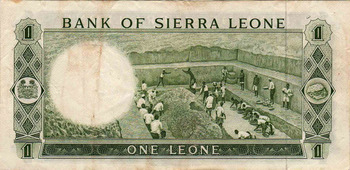
Back of a 1 Leone banknote, introduced by the Bank of Sierra Leone in 1964 Source: http://www.sierra-leone.org/artifacts-money.html (reproduced with permission of Peter C. Andersen)

Back of a 20 Leone banknote, issued in 1982 Source: http://www.banconotemondiali.it (reproduced with permission of Mr Gulden)

Unlike money circulating through other productive or commercial activities, money obtained from the sale of diamonds is called ‘fast money’ (fast moni), desired cash coming unexpectedly and, above all, in abundance. In the everyday life of Sierra Leone, fast moni is also the money of thieves or corrupt politicians, those who become rich through questionable and non-transparent means or by cheating people. By association, this money is connected with selfishness, greed and a lack of any sense of community. During and after the civil war, the same type of behaviour was associated with rebels. Furthermore, these associations are not new. In the 1950s, thousands of young people from every region of West Africa went to the mines of Sierra Leone, attracted by the prospect of easy earnings within short periods of time and far more lucrative job opportunities than those offered to common people (van der Laan Reference van der Laan1965). However, while the Sierra Leone Selection Trust (SLST) retained the monopoly on diamond extraction, whoever was searching for diamonds was breaking the law. Even later, when a licensing system was introduced that allowed wealthy or entrepreneurial Sierra Leoneans to engage in mining, the search for diamonds remained an illegal activity for most miners excluded from this system, and especially for foreigners.
Arguably, licensed miners realized immediately that the new opportunity was not without its ambiguities. Miners had to deal with the paradoxes and magic of the alchemic capitalism of the diamond industry. Stones without any local use-value could multiply their value while not undergoing any evident process of transformation but simply by passing from hand to hand; those very stones could be obtained, ideally, without necessarily having worked at all, something that was contrary to a widespread ‘hardship ideology’ based on an ethic of hard work and merit (cf. Bledsoe Reference Bledsoe1990). The mining mercantilist rationale (Zack-Williams Reference Zack-Williams1995) not only stimulated the economic expectations of gem seekers, but also strongly questioned the previous moral and social order – already accustomed to the social, economic and religious innovations resulting from trading operations with foreigners and quite used to the knowledge they brought and shared (Bledsoe and Robey Reference Bledsoe and Robey1986; Shaw Reference Shaw, Jedrej and Shaw1992) – and called for a new balance between different sets of values (Richards Reference Richards and Moore1996).
Affluence coming from the extractive economy of natural resources or human beings has long been associated with material wealth imported and traded by foreigners, especially from Europe (Shaw Reference Shaw2002; Reference Shaw and Drewal2009). These new forms of material wealth have been largely considered immoral and suspicious for two main reasons: first, they entail the enrichment of some individuals over others – as is evidently the case in the trade of human beings; second, the extraordinary wealth generated through contact with foreigners, and especially that obtained by using forced labour or selling human beings, sharpened the contradiction between personal wealth achievements and social responsibility (Brown Reference Brown2003: 47).
Nowadays, the fortune promised to diamond miners can be as dangerous and immoral as human trafficking and the exploitation of slave labour were in a not too distant past. Such prosperity becomes particularly dangerous and immoral when quick money is generated through interaction with the spiritual forces controlling diamonds, the dεbul dεn. Rumours circulated among miners about colleagues who had sacrificed body parts or the lives of relatives or colleagues in order to get diamonds and money more quickly.
THE OCCULT ECO-NOMY OF DIAMOND MINING
In Sierra Leone Krio, the word ‘dεbul’ is used to describe an incredible variety of religious and popular culture elements.Footnote 18 With the word ‘dεbul’, miners refer to a specific category of spirits, which many Muslims also identify with the Arabic term ‘djinn’. According to the Qur'an, the djinns are preternatural, non-human beings created by Allah. In Islam, these spirits belong to the ‘hidden world’ (‘alam al-ghayba), which can interact with the visible world inhabited by human beings (‘alam al-shahada). The djinns are described as intelligent and invisible beings that are able to manifest themselves as animals and humans. They possess extraordinary powers and their strength considerably surpasses that of humans. For all these reasons, Muslims sometimes ask for their help, using the intermediation of ritual specialists.
In Sierra Leone, the process of Islamization has covered a long period of time and has followed complex trajectories (Skinner Reference Skinner1978). The ideas and practices imported from the Islamic clerics have intertwined with existing ritual knowledge and religious forms (Shaw Reference Shaw, Jedrej and Shaw1992: 40). As Thayer notes in his study on the categories of nature and culture among the Susu of Sierra Leone (1983: 118), the Qur'anic cosmology has integrated various local spirits, reinterpreting them as djinns. Consequently, the dεbul dεn mentioned by my interlocutors show aspects of the djinns described in the Muslim holy book and features of other local spirits associated, for example, with unexpected wealth or unwanted changes.Footnote 19 The Qur'anic cosmology has therefore become a source of symbols and images for elaborated mineral cosmogonies.
Dεbul dεn as men
When I met Ibrahim, he was an expert Muslim diver in his fifties seeking precious stones in the depths of the Sewa River. According to Ibrahim's mineral cosmogony, before becoming the guardians of the diamonds, the djinns were slaves and, in particular, they were the slaves of King Solomon. In his own words:
At the beginning, the djinns and the men were together, God created them together. They lived together until there was a prophet, Mulk Sulaiman [King Solomon]. They all worked for him, every day. Goats, sheep, ants, fish: they all worked for him. But, the dεbul have more strength than us, the men. So they worked for him [Mulk Sulaiman] twenty-four hours a day, without resting … When they wanted to rest they were beaten. They were prisoners, slaves. They worked for him until he died. Sulaiman died and was buried. Then, the dεbul turned to God: ‘Please, we cannot stay with them; they make us work too hard. Put the darkness between us and them. Do that they do not see us and we do not see them.’ For this reason the bush was given to them. Wherever the bush is deep, there is a dεbul. Wherever there is a lot of water, or a large rock, there is a dεbul. They have all the wealth. They have gold and diamonds.
This tale is rich in symbols,Footnote 20 but a particular aspect of the relationship between human beings and djinns is worth attention. Notwithstanding the close proximity of miners and djinns, they are also separated or alienated from each other. This condition is well expressed by the metaphor of darknessFootnote 21 or invisibility. However, the dεbul dεn's invisibility does not mean that miners cannot know what they look like. There are people who have the power to see them because they have the ‘double vision’ (dɔbul yay). In addition, the dεbul dεn can decide to manifest themselves to those human beings for whom they feel sympathy or affection. In either case, these spirits are generally compared to human beings. Since the meaning of this comparison is crucial to my argument, the question that arises is the following: what do miners mean when they say that the dεbul dεn look like men?
According to miners and to the inhabitants of mining areas, dεbul dεn have a social, political and economic life that mirrors that of humans, and it includes the distinction between the rich and the poor, between farmers and miners, between Christians and Muslims. However, values and expectations are reversed: work is effortless, what is invisible and concealed becomes clearly visible, what is scarce is abundant. Djinns are able to carry out heavy work tasks very easily and they know exactly where diamonds are. As in a camera obscura,Footnote 22 their world speaks obliquely of the precarious and uncertain reality of the world of human beings, and as such they epitomize a form of protest against the misery of reality and its unpredictable aspects. ‘Diamonds are rascals’ – Ibrahim complained one day while he observed the men in his gang carrying heavy sacks of gravel on their shoulders to the river to sieve it – ‘Sometimes you work very hard, but you can't find them. Other times you work very little and you find them straightaway.’ That finding diamonds had become less and less easy was a recurrent thought for Ibrahim and other colleagues. This thought went hand in hand with the older miners' tales, when they recalled a past when things were different and Sierra Leone, like other African mining countries (cf. Ferguson Reference Ferguson1999), shared all the conveniences of Western modernity. In these memories, the facilities of Kono (paved streets, electricity, running water) were comparable with those in Western countries and more Mercedes-Benz cars were to be seen than in any other part of the world. Diamonds were easy to find and their finding could be publicly celebrated because sooner or later someone else would find some, and he would do the same.
After the war and decades of intensive mining, having a solid starting capital to explore the deepest deposits for a long period of time was considered by the miners as an increasingly necessary, but not sufficient, requisite if they were to have any chance of success with diamonds. And so, having to come to terms with the actual (scarce) resources available, the miners often compared, also ironically, their hard manual work – rich in technical artisan or ‘traditional’ expedients – with the rapid mechanical work of the foreign mining companies, which were enviably well equipped with such powerful, efficient machines that they seemed almost magic.Footnote 23
In this context, it is interesting to note that the tireless, hardworking dεbul dεn, non-human beings able to work unceasingly – just like the machinery of the foreign companies – have Caucasian body features: a pale complexion (instead of the dark skin colour of most Africans) and long, smooth hair (rather than the short, frizzy hair of Sierra Leoneans). In many cases, they are both seductive and familiar. Ibrahim, for example, told me that he found his first diamonds in the late 1970s after dreaming of a dεbul who had taken the form of a Lebanese woman named Mariama. The woman was the wife of a wealthy Lebanese businessman for whom Ibrahim had worked when he was just a boy. In his dream, the woman/dεbul guided the young and inexperienced miner to diamonds by pointing to a mass of stone from the mine where he was working with one of his brothers. There, they found many diamonds. ‘They know where there are lots of diamonds,’ Ibrahim commented after many years, ‘But we do not know. We try our luck.’ This episode persuaded Ibrahim to continue this work. After just a couple of seasons, Ibrahim had already earned enough money to buy new mining equipment, a motorcycle and a twelve-room house for his mother. This was a sum of money he could never have accumulated in his previous job (as a cross-border trader and guardian at the port of Freetown).
Not all dεbul dεn, however, are as generous as ‘Mariama’ was. A cobra snake seen around a mining site may indicate the presence of a malignant or angry dεbul who has assumed the appearance of the dangerous reptile. To prevent or to appease the wrath of a dεbul, or simply to seek their sympathy, miners make ritual offerings. These can range from sacrifices of particular animals to simple acts of generosity. Despite the mediation of ritual specialists, however, figuring out what the dεbul dεn want exactly can be a tricky issue. Moreover, even if the dεbul dεn's requests are satisfied, miners are not necessarily granted what they want.
Dεbul dεn and men
How can these presences be interpreted, invisible as they are and yet so close to miners? We have so far considered their appearance above all, but how do they actually behave? How do they relate to the miners and what relationship do they have with the populations living around the mines? The dεbul dεn or djinns often behave inexplicably, apparently at random, and sometimes even with malevolence (Thayer Reference Thayer1983: 121; Jackson Reference Jackson1998: 51). As we have mentioned, this is even more evident when they take on the form of dangerous, untameable animals.
A group of miners engaged in sieving the gravel on one of the many islands appearing in the Sewa River during the dry season explained to me that in a stretch of the river where they were looking for precious stones lived a dεbul in the guise of a large electric fish.Footnote 24 Whenever the divers attempted to approach his diamonds, he gave them an electric shock. One miner who had found himself face to face with the fish/dεbul underwater explained to me that:
When you go down he drives you off, he gives you the shock. When you get some gravel you always dig out some diamonds … but he doesn't want you to. You get two or three buckets and then he comes … He doesn't want people working there. When you go down, underwater, you can see him: he's a big fish … if he turns round he gives you the shock. When you see him, you have to run away (if you don't want to die)!
To ingratiate a dεbul, or to pacify him, the miners often prepared libations (fangadama) with different kinds of food (such as fruit, biscuits or rice) or – according to the instructions of the ritual specialists, the previous experience of the miners themselves, and the financial means of the supporter – they would sacrifice particular domesticated animals (chickens, sheep or cows, for example) (sarat).Footnote 25 These offerings – the miners I met were anxious to underline – were always preceded and accompanied by prayers to God, and the food prepared after the ritual slaughter was always shared out with as many people as possible in order to underline the social, sympathetic or relational nature of their actions (cf. Jackson Reference Jackson1998: 70–3). ‘God, Father, let me get a diamond. This is the only thing that I am thinking,’ Ibrahim begged when he went to the mosque on Fridays and was busy preparing a sarat together with his fellow workers. Similarly, Mohamed, a Kono miner aged about forty, supervising a few small gangs in Bo District for a Lebanese diamond dealer, chanted from memory verses from the Qur'an to summon God (dooawa; Arabic du'a), while in the heart of the forest he prepared a fangadama or a sarat with his labourers.
Apart from the controversies arising between miners concerning the morality and compatibility of these kinds of sacrifices with the precepts of the Qur'an or the Bible,Footnote 26 this ethnographic sketch shows that the dεbul dεn are apt to iconize the risks and contradictory possibilities of wealth obtained through the exploitation of the environment and human labour. However, I do not intend to interpret these presences as projections of social anxiety, or personifications of the features of the natural landscape that enact these same anxieties (for example, Amir-Moezzi Reference Amir-Moezzi2007; Nash Reference Nash1993). The environment and its non-human inhabitants play a key role, and they cannot be considered simply as ‘bearers of symbolic projection’ (Latour Reference Latour2005: 10). What is worth emphasizing on the basis of this example is, if anything, the non-human agency: the efforts of the miners to establish relationships with other non-human beings based on ‘trust’ rather than ‘domination’ (Ingold Reference Ingold2000). At an even greater depth of meaning, what is implied in these transactions is that relationships may be established with non-humans that are analogous or identical to those between human beings: the boundary between human and non-human, between animate and inanimate, is therefore blurred. It is in this epistemological ‘relational’ perspective (Bird-David Reference Bird-David1999) – in which even the diamonds seem at times to be animated by intentions and, like the gold extracted in Burkina Faso, they can move and ‘suddenly appear and disappear’ (Werthmann Reference Werthmann2003: 110) – that we may consider the transactions between humans and non-humans not in terms of categorical errors (Ingold Reference Ingold1999), but as forms of ‘interagentivity’ (Ingold Reference Ingold, Ellen and Fukui1996; Kirsch Reference Kirsch, Rumsey and Weiner2004).
Bearing all this in mind, we may outline this eco-nomic perspective on diamond mining more clearly, following Leach (Reference Leach, Croll and Parkin1992) and considering the different uses of environment. In this vein, the preparatory work at the mining sites and the subsequent phases of extraction and of gravel washing can be considered as forms of humanization or re-humanization of the landscape. Arguably, a symbolical parallel can be made between mining and farming. Working in the rice fields cleared from among the wild areas of the bush entails a constant dialectic between the uncertainty of unfamiliar places governed by unpredictable natural bush forces, and the relative safety of familiar and reassuring places governed by the human, regulating forces of the towns (Jackson Reference Jackson1989; Leach Reference Leach, Croll and Parkin1992). Likewise, diamond mining is based on continuous negotiations and compromises between the certain and the uncertain, order and disorder, or the familiar and the alien. In both cases, the mines and the cultivated fields are humanized spaces as long as human activity provides and maintains order (Leach Reference Leach, Croll and Parkin1992: 80). Thus, miners, like ‘neophytes’ and ‘strangers’, are symbolically located in the mutable and ambiguous space existing between these different dimensions of the construction and the continued reproduction of the social (Jackson Reference Jackson1998); like ‘heroes’, they are in between, ‘at once inside and outside’ (De Boeck Reference De Boeck2000), risking life ‘in the wilderness in order to gain the powerful things on which community life depends’ (Jackson Reference Jackson1998: 49).Footnote 27
On this premise, we must take a further step to complete this shift towards the occult eco-nomy of diamonds. When the miners intervene on a landscape to seek the most precious gems, they must reckon not only with the landowners – to whom, as we have mentioned, they owe an agreed percentage of their (possible) earnings – but they also have to deal with the demands of the populations (visible and invisible) dwelling in the mines or in their vicinity: they also claim gifts or a share of the earnings, often in the form of compensation or payment for the damage and inconvenience they suffer. The mining uses of the environment are in fact not always compatible with other kinds of use, although they do not necessarily exclude them (cf. Pijpers Reference Pijpers2010). The lands where the miners dig are mostly fertile land suitable for agriculture; the trees uprooted to make excavation easier may be used for food or agriculture; the river water used to wash the gravel is the same water used for domestic or agricultural purposes. The lands where the seekers find traces of the presence of diamonds may be sacred places and their access may be limited (Conteh Reference Conteh1979). Knowing the ‘chronicle of life and dwelling’ of the landscapes (Ingold Reference Ingold2000: 89), the inhabitants of the mining areas therefore also play a primary role – however unrecognized – in the mining operations, not only as a reserve of low-cost expert labour in the territory, but also as intermediary agents between gem seekers and the spirits' world.
When I followed the excavation work on Emanuel's uncle's small-scale mine in Kono District,Footnote 28 the inhabitants of the nearby village had warned the miners that a dεbul lived in that area. The miners had been engaged in draining a little lake, uprooting trees on the site and digging the cleared land for weeks when the dεbul appeared in the dreams of various people in the village asking for specific types of sacrifices to be consumed in the mines and in the village.
When some machinery hired by the uncle unexpectedly broke down, forcing the miners to interrupt their work, they realized that the dεbul was annoyed with them and the sacrifices made up until that moment had not satisfied all the inhabitants. While the unfortunate episode worried the uncle because of the high cost of hiring the equipment, it was put down by some miners and villagers to the vindictive action of the dεbul. Frightened by the idea that even more serious accidents might occur, some workers convinced Emanuel's uncle to perform a sacrifice of reparation. Although he was not convinced of the dεbul's existence, he was, however, set on the success of the mining operations and therefore sought to maintain good relations with all his workers – to whom he knew he had to offer both economic and spiritual protection – and also with the villagers, to whom he constantly gave small presents in exchange for their ongoing favours. ‘Diamond mining is a chain,’ the uncle-supporter claimed, to justify his decision to allow sacrifices in the mine, aware of his role as a bigman (Shaw Reference Shaw, Karp and Masolo2000) in a ‘social system in which everyone is “for” or “behind” someone else and no one can claim to be “for” her/himself’ (Richards Reference Richards and Moore1996: 145).
And, indeed, from this perspective diamond mining is a chain of being. If we consider how the protagonists of this mineral drama position themselves along the diamond commodity chain, we realize that at one end we find the spiritual owners of the diamonds, the dεbul den or djinns. With their invisible presence they signal the existence of a hidden world holding the order of things and regulating access to wealth – a world of contradictory possibilities, such as in the extraction of value from human labour and environment. On the opposite side we have the potential consumers of diamonds, visible yet absent. In this reversed logic the mines are places of mediation and (dis)connection between people and things that are not necessarily present or directly connected to each other (cf. Masquelier Reference Masquelier2000: 113; Reference Masquelier2002). These places are shaped by the influence of social persons distant in space and time, whose memory lives in practices, rituals, and images continually reactivated and reworked by the miners.
CONCLUSION
As I have tried to show, the two starting questions of this article are merely two sides of the same coin tossed ‘in the wake of things’ (Walsh Reference Walsh2004). To ask what diamonds are for is like putting the question of who needs or who uses the diamonds. For the miners of Sierra Leone, diamonds are nothing more than money. As such, they can be converted into homes, education, dowries or airline tickets to distant countries where the miners' lives could change. Only very few claim to know the uses of these stones for Westerners. In Marxian terms, diamonds have an exchange-value for miners but no use-value. More than that, they are exchange-value.
The miners know that with adequate knowledge and appropriate technology, these minerals become objects with particular uses for the benefit of foreign consumers. But they find it hard to believe that these stones can really be used in the jewellery industry to adorn the bodies of wealthy people with necklaces, rings or bracelets – they find it hard to believe that their utility is largely due to their futility. However, miners recognize that diamonds mean more than the hard physical work needed to extract them. Diamonds represent, above all, knowledge, or ‘immaterial capital’ (Gorz Reference Gorz2003). This knowledge entails the circular interdependence between the power and wealth of those who ‘know/own’ them.
Taking into account the point of view of these workers, we could then argue that diamonds stand as instances of the enigmatic paradoxes and upheavals of ‘millennial capitalism’, or what the Comaroffs define as the age of ‘futilitarianism’ (1999). However, in this article I have preferred to explore the specific socio-historical and ecological production of diamonds in Sierra Leone, and extend the analysis of commodity chains to their invisible aspects. As I have shown, the world of the dεbul dεn is in itself a dialectical image ‘good to think’ the randomness and uncertainty of events, the morality or immorality of human actions, the social relations of interdependence between individuals and society, and, in particular, the extractive relationships with predatory foreigners (Shaw Reference Shaw2002). Being so similar to nameless and faceless Europeans and Americans, the images of the dεbul dεn dramatize the relationship of distance with ‘absent persons’ (Giddens Reference Giddens1990), who, however distant and unknown they may be, are historically linked to this African region through an extended and centuries-old network of social and economic relations. Since the accounts about dεbul dεn are steeped in these historical (dis)connections, they have a paradoxical dis-alienating effect: the phantasmagorical images of the potential consumers of those stones that miners find hidden in the ground replace a web of interrupted relationships, thus closing the circle in the chain of commodities started by diamond miners themselves.
Furthermore, the invisible dεbul dεn world mirrors human societies. This enables the members of a particular society to reflect obliquely on the social relationship of dependency and ownership, like the one related to the land, and on contingencies and the ‘misery of reality’, as well as on their own moral responsibilities. The mining populations' criticism of those who have exploited the extraordinary natural wealth of this country, which still ranks at the bottom of the list of the ‘least developed’ and poorest countries in the world, is also a self-critique, sometimes merciless, and not without some ironic overtones of ‘Afro-pessimism’ (cf. Utas Reference Utas and Hart2008).
Bitterness accompanies the smiles when stories of how the British used to make fun of Kono in the 1930s are recalled. There is bitterness but no derision in these oral memories, because the inhabitants of the diamond areas of Sierra Leone know that things have not changed so much since the discovery of the first diamonds. Although the country has crossed the threshold of the Second Millennium, the streets of the diamondiferous districts continue to remain at the limits of practicality; electricity is a mirage of modernity reserved for the few rich people and water is still being fetched with buckets. But many politicians and local authorities, when they get the chance, send their children to study abroad; they travel in luxury cars and, in some cases, they brag of once being on the board (van der Laan Reference van der Laan1965; Reno Reference Reno1995: 90–4), or continue to be on the board, of large foreign mining companies (Fanthorpe and Maconachie Reference Fanthorpe and Maconachie2010: 268).
With the same irony that the Kono summoned up to comment on the injustices they have suffered since colonial times, we can read a passage from the Qur'an. In surah 34, 12–14, it is said that the djinns realized that Solomon was dead and thus that they were no longer subjugated to his will, but only much later, when the stick that supported his corpse was eaten by a woodworm (Amir-Moezzi Reference Amir-Moezzi2007). When will the miners' woodworm of doubts and suspicions end its work?
ACKNOWLEDGEMENTS
I am indebted to Philippe Gagnon, Laura Menin and Andrew Walsh for having read and commented on earlier versions of this article. I am also grateful to the anonymous reviewers and the editors for their insightful critical comments. None of those mentioned here is responsible for the views the article expresses or for whatever errors or inaccuracy it contains.