INTRODUCTION
Honeydew is a sugary excretion of phloem-feeding insects. It contains large amounts of carbohydrates and trace amounts of amino acids and can provide an important food source. Honeydew-producing insects tend to excrete copious honeydew, live in groups, and are typically sedentary or semi-sedentary (Williams & Williams Reference WILLIAMS and WILLIAMS1980). Scale insects (Coccoidea) are well known for their honeydew secretions and relationships with ants that feed on them (reviewed by Bach Reference BACH1991, Buckley Reference BUCKLEY1987, Way Reference WAY1963). To a lesser extent, the use of scale insect honeydew by birds has also been documented (Beggs Reference BEGGS2001, Gaze & Clout Reference GAZE and CLOUT1983, Greenberg et al. Reference GREENBERG, CABALLERO and BICHIER1993, Jirón & Salas Reference JIRÓN and SALAS1975, Koster & Stoewesand Reference KOSTER and STOEWESAND1973, Latta et al. Reference LATTA, GAMPER and TIETZ2001, Murphy & Kelly Reference MURPHY and KELLY2003, Paton Reference PATON1980, Reichholf & Reichholf Reference REICHHOLF and REICHHOLF1973, Woinarski Reference WOINARSKI1984). However, the dynamics of the interaction between scale insects and birds remains poorly understood.
Honeydew may provide an important resource for nectarivorous and frugivorous birds, especially during times when flowers and fruit are not abundant. Such a resource may be worth defending, just as large displays of nectar-producing flowers (Feinsinger Reference FEINSINGER1976, Mac Nally & Timewell Reference MAC NALLY and TIMEWELL2005) and fruit (Male & Roberts Reference MALE and ROBERTS2002, Pratt Reference PRATT1984) have been shown to promote territorial defence in birds. Migratory birds do not commonly engage in interspecific aggression in wintering habitat (Greenberg et al. Reference GREENBERG, REITSMA and CRUZ ANGON1996), but Greenberg et al. (Reference GREENBERG, CABALLERO and BICHIER1993) found that where such aggression occurs, it is most common when birds are using resource-rich patches such as fruit or nectar. Several studies have documented bird defence of honeydew (Greenberg et al. Reference GREENBERG, CABALLERO and BICHIER1993, Latta & Faaborg Reference LATTA and FAABORG2002, Latta et al. Reference LATTA, GAMPER and TIETZ2001, Paton Reference PATON1980, Woinarski Reference WOINARSKI1984).
Along with the type and richness of the food involved, habitat structure may play an important role in the defensibility of a resource. Single trees in open pasture may be more defensible than a structurally diverse forest with a greater abundance of birds (Orians & Willson Reference ORIANS and WILLSON1964). Greenberg et al. (Reference GREENBERG, REITSMA and CRUZ ANGON1996) discovered that the yellow warbler (Dendroica petechia) invests large amounts of energy in displacing birds entering the small number of trees located within pasture territories.
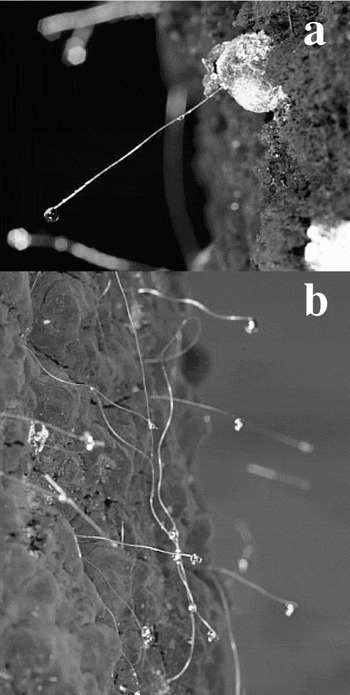
A honeydew-producing scale insect, Stigmacoccus garmilleri Hempel, is associated with oak trees (Quercus spp.) in highland forests of Chiapas, Mexico (Greenberg et al. Reference GREENBERG, CABALLERO and BICHIER1993). Quercus spp. in forests of Veracruz, Mexico, the focal area of this study, harbour the same species (Hodgson et al. Reference HODGSON, GAMPER, BOGO and WATSON2007) (Figure 1). Ants, the usual consumers of scale insect honeydew, were only occasionally observed foraging on honeydew, while migrant and resident birds were commonly found foraging on honeydew (Hodgson et al. Reference HODGSON, GAMPER, BOGO and WATSON2007). We occasionally observed other Hymenoptera (bees and wasps), in addition to Diptera (flies) and Acaridae (mites).
In the study area, the Quercus spp. with dense colonies of scale insects are found both in forest habitat and as isolated trees in cattle pastures. The bird community is diverse; 55 bird species were observed visiting oak trees in the vicinity of the observational trees (Gamper pers. obs.). From September to June the area is home to many neotropical migrant birds. In addition, many species endemic to Mexico are found in oak-dominated forests (Watson Reference WATSON2003).
This study aimed to describe bird use of honeydew in the study area and uncover potential patterns and influential factors to honeydew foraging. This study also compares bird defence of the honeydew resource in forest and pasture areas. We hypothesized that aggressive interactions among birds would be more frequent in honeydew trees isolated in the pasture areas than in those within forest.
METHODS
Study area
The study reported here was conducted near the town of Chiconquiaco, in the state of Veracruz, Mexico. The area has three seasons: moderately dry and cool from October to March, dry and warm from April to May, and wet and warm from June to September (mean annual temperature is 15.2 °C; total mean annual precipitation is 1532 mm) (Williams-Linera et al. Reference WILLIAMS-LINERA, DEVALL and ALVAREZ-AQUINO2000). The area is covered by heavy fog on most days and humidity levels remain high even during the relatively dry months. The elevation is approximately 2000 m, and the habitat is a mosaic of mature forest patches, cattle pastures and small cornfields. The observational trees were located in two forest patches (each c. 25 ha) and two pasture areas (each c. 35 ha), all on west-facing slopes. Forest areas had closed canopies dominated by Quercus spp., and pasture areas were open and included a few, large, scattered Quercus spp. individuals. Several species of oak have been identified from the study area (Q. laurina Bonpl., Q. germana Schltdl. & Cham., Q. salicifolia Née, Q. corrugata Hook., Q. affinis Schweid. and Q. xalapensis Bonpl.), and all are capable of hosting the scale insects.
Observations of birds foraging in oak trees
Forty observational trees (ten at each of two forest sites and two pasture sites) were chosen for study. Though it is difficult to determine specific identity accurately with vegetative characters and complications of hybridization, all individual observation trees were presumed to be Quercus laurina. All sites were separated by at least 1 km. Observation trees in pasture sites and forest sites were of similar size. The average diameter at breast height (dbh) of observation trees was 52.1 cm. All observation trees harboured colonies of scale insects producing honeydew, although not all trees at each site had such colonies. Almost all scattered oak trees in pasture habitat contain scale insects, whereas in forest patches most oaks (> 70%) bordering pasture and most oak trees in the forest interior (>50%) contain scale insects (Gamper unpubl. data). Trees with scale insects producing honeydew were easily discovered through the abundant liquid drops falling from the numerous scale insect anal filaments (Figure 1).
The number and species of birds visiting the tree, the total time spent in the tree by each individual bird, and food items taken were recorded during 1-h observation periods at observation trees. Nomenclature for bird species follows Clements (Reference CLEMENTS2000). Birds were easily determined to be feeding on scale insect honeydew. The large honeydew droplets can be viewed without difficulty using binoculars to view upper branches, and without the aid of binoculars on lower branches. Scale insects colonize only the trunk and branches, therefore birds feeding upon the foliage, and using more active feeding behaviours (such as sallying) where honeydew was not present, were assumed to be feeding on insects. Since all birds could not be individually identified, repeat visits to the tree by the same individual were counted separately. Interspecific and intraspecific interactions (such as physical contact and/or chasing behaviour) were also recorded. Each individual tree was observed on four occasions (divided evenly among morning and afternoon periods) between March and May 2002, for a total of 160 h of bird observation. Observation times for each tree were randomized. Before each hour of bird observation, 10 scale insects producing honeydew on the lower trunk of the observation tree were randomly chosen, and sugar concentration and volume of the exposed honeydew drop were recorded (n = 1600). Honeydew drop volume was measured with 15-μl microcapillary tubes (Drummond Scientific Co.). A hand-held refractometer (Bellingham & Stanley Co., UK) was used to measure sugar concentration (and utilized in subsequent studies). Overall scale insect density at each observation tree was measured using 40-cm2 quadrat counts. Quadrat measurements (taken at 1-m and 3-m heights along the trunk of the tree and on one branch) were averaged for observation trees.
Morphology of scale insects producing honeydew on oak trees in tropical montane cloud forest of Chiconquiaco, Veracruz, Mexico. Anal filaments of these insects are visible excreting the sugary, honeydew waste. (a) Individual scale insect (Stigmacoccus garmilleri) found on oak (Quercus spp.) in late feeding instar stage. Excrement of this insect (honeydew) is visible at the end of the anal filament (b). Colony of scale insects (Stigmacoccus garmilleri) on the trunk of oak (Quercus spp.).

Statistical analysis
Mann–Whitney U-tests were used to compare the mean rank of honeydew visits for migratory birds in comparison to resident species. Number of visits to observation trees and visits for honeydew consumption were compared using bivariate correlations. To specify whether forests and pastures did not differ in the number of honeydew visits, the total time spent foraging on honeydew, or defensive chases independent-sample t-tests (equal variances were not assumed) were conducted. Pearson's correlation coefficients were used to determine covariance between number of bird chases observed (pooled for each observation tree) and the scale insect density measures. All analyses were performed in SPSS version 11.0 (SPSS Inc., Chicago, Illinois, USA).
RESULTS
Bird foraging
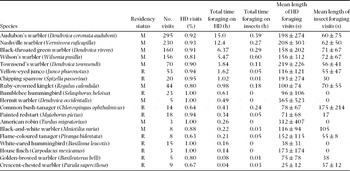
Fifteen resident bird species and 18 migrant species were observed visiting observation trees during the 1-h observation periods (Table 1). Approximately 72% of the resident bird species and 83% of the migrant bird species observed were recorded to forage on scale-insect honeydew. The mean rank of honeydew visits was higher for migratory birds than for residents (Z = −1.97, df = 42, P = 0.029).
Bird visits to scale insect honeydew on oak trees in tropical montane forest and pasture areas of Chiconquiaco, Veracruz, Mexico (March–May 2002). Bird species nomenclature follows Clements (Reference CLEMENTS2000). The residency status (M = migrant, R = resident), number of visits to observation trees, percentage of visits during which honeydew was consumed, total time observed feeding on honeydew (HD), total time birds were observed foraging on insects, mean length (± SD) of honeydew foraging bouts for bird species that visited observation trees at least three times, and mean length (± SD) of foraging bouts for birds that were observed consuming insects. Data were accumulated from a total of 160 1-h observations of 40 observation trees.

The 21 species of birds observed to feed on honeydew at least three times made a total of 1027 honeydew foraging visits (Table 1). The most frequent visitor to the honeydew was Audubon's warbler (Dendroica coronata auduboni; n = 272 visits), followed by the Nashville warbler (Vermivora ruficapilla; n = 214), black-throated green warbler (Dendroica virens; n = 160) and Wilson's warbler (Wilsonia pusilla; n = 156). Of these the Nashville warbler made the highest proportion of visits during which honeydew was consumed (Table 1), but each of the four species fed on honeydew during more than 80% of their visits. Number of visits to observation trees and number of visits to consume honeydew were highly correlated (r 2 = 0.998, P < 0.001). The proportions of such visits were similar for all species; that is, birds visiting trees were consuming honeydew, and no individual species visited often for any other purpose.
Interspecific interactions and resource defence
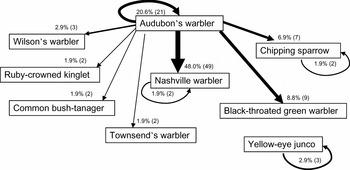
Honeydew was most actively defended by Audubon's warbler, but the Nashville warbler, Wilson's warbler and yellow-eyed junco (Junco phaeonotus) were all observed attempting to exclude conspecific birds from Quercus spp. harbouring scale insects. The bird species most commonly chased by Audubon's warbler was the Nashville warbler (Figure 2). A linear regression analysis supported the prediction of number of bird chases from scale insect density at each observation tree. As the overall scale insect density increased, the number of aggressive chases by birds increased (F1,38 = 9.28, P = 0.004). The regression equation for predicting the overall number of chases is y = 3.48x − 3.47, where y = predicted chases and x = scale insect density.
Diagrammatic representation of interactions among birds utilizing honeydew on trees harbouring scale insects during 80 1-h observations of pasture trees in Chiconquiaco, Veracruz, Mexico. Species observed only once have been omitted from the figure. (Figure design adapted from Greenberg et al., Reference GREENBERG, CABALLERO and BICHIER1993.) Arrows indicate aggressive interactions by the source species against the species to which the arrows point (interspecific chasing); curved arrows indicate intraspecific competition. Percentage of total chases and number of actual chases are provided. Trees were dominated by Audubon's warbler, with the Nashville warbler being the most frequent object of defensive chases.

The correlation (r) between the index of chases and scale insect density was 0.443. Approximately 19.6% of the variation in number of aggressive chases could be accounted for by its linear relationship with scale insect density (r2).
Comparison of forest and pasture
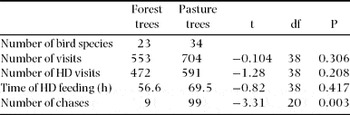
Twenty-three species of bird were observed to visit the observation trees located in the forest (n = 472 honeydew visits), and 34 species were observed in observation trees in the pasture areas (n = 591 honeydew visits; Table 2). Forest honeydew visits were dominated by Nashville warbler (28.6%), black-throated green warbler (22.5%) and Wilson's warbler (21.2%). Pasture-habitat honeydew visits were predominantly by Audubon's warbler (45.3%) and Nashville warbler (13.5%) (other species not listed comprised less than 9% of honeydew visits). Of 118 aggressive chases observed, only 9.65% occurred in forest observation trees, and 90.3% in pasture trees (Table 2). Audubon's warblers were the dominant chasing bird in pasture habitats (Figure 2), whereas in forest habitat no bird species was as proportionately dominant in the number of total chases. Independent-samples t-tests revealed that number of bird visits for honeydew at each observation tree did not depend on habitat type. That is, forest and pasture did not differ in number of honeydew visits (t38 = −1.28, P = 0.208; Table 2) or in total time spent foraging on honeydew (t38 = −0.820, P = 0.417; Table 2). They did differ significantly in number of defensive chases (t20 = −3.31, P = 0.003; equal variances were not assumed; Table 2).
Summary of birds and their feeding behaviour on oak trees in tropical montane forest and pasture areas of Chiconquiaco, Veracruz, Mexico (March–May 2002). The numbers of species, visits, honeydew (HD) visits (total number of visits to observation trees during which honeydew was consumed), time of honeydew feeding (cumulative time spent feeding on honeydew), and number of aggressive chases observed during a total of 160 1-h observation periods at 20 observation trees (equal variances not assumed) located in forest habitat and 20 trees located in pasture habitat.

DISCUSSION
Measures of honeydew consumption and aggressive defence of the honeydew resource demonstrate the importance of scale insect honeydew as a food resource for birds. These results illustrate how aggressive defence of honeydew was much greater in pasture trees and may have been habitat driven. Greater incidence of chases observed in pasture trees was not due to facility of observation in these isolated trees. Individual oaks in sunny pasture tended to have a very dense, bushy structure while forest trees contained many open lower branches and only thick foliage in the upper branches.
In Chiapas, Mexico, the white-eared hummingbird (Hylocharis leucotis) is the only resident species commonly feeding on honeydew (Greenberg et al. Reference GREENBERG, CABALLERO and BICHIER1993). The greater number of species found to do so in the present study (Table 1) could be a result of observing both pasture and forest habitat and including a larger assemblage of bird species. Some species (bumblebee hummingbird, painted redstart) were almost exclusively observed in forest–pasture edge habitat, one (yellow-eyed junco) in both forest–pasture edge and pasture areas, and several (Nashville warbler, Wilson's warbler, black-throated green warbler) were mostly observed in forest habitat.
The higher rate of defensive chases observed in the present study (0.712 h−1) than in a study in dry forests of the Dominican Republic (0.476 h−1; Latta et al. Reference LATTA, GAMPER and TIETZ2001) may result from the greater number and density of scale insects at this site than in the Dominican Republic site (Gamper pers. obs.) or other factors such as seasonality, location and bird assemblages; it is most likely due to habitat characteristics. Pasture trees alone experienced a chase rate of 1.24 h−1, in comparison with 0.11 h−1 for forest trees, making the forest rate for this study lower than in the dry forests of the Dominican Republic (Latta et al. Reference LATTA, GAMPER and TIETZ2001). Rates of defensive chases at this Veracruz site did not approach those at Chiapas, Mexico, where 12.2 chases h−1 have been recorded (Greenberg et al. Reference GREENBERG, CABALLERO and BICHIER1993) and where, in addition, individuals of the yellow-rumped warbler (Dendroica coronata) frequently flew from tree to tree, a behaviour recognized as territorial patrolling (Greenberg et al. Reference GREENBERG, CABALLERO and BICHIER1993). We observed this common behaviour in this study, but only in pasture trees. Forest trees were much less frequently defended or patrolled. This result may be associated with the greater defensibility of isolated trees. The preferential defence of scale-insect honeydew by Audubon's warbler in isolated pasture trees supports the hypothesis of Orians & Willson (Reference ORIANS and WILLSON1964) that, when forests with various structural characters are converted to more open agricultural habitats, the defensibility of resources increases.
Aggressive defence may increase energy requirements and risk of injury for the individual bird. Woinarski (Reference WOINARSKI1984) speculated that gregarious behaviour during the non-breeding season could reduce the risk of injury for those individuals that are displaced from defended resources. In this system, the aggressive defence of pasture trees by Audubon's warbler may have forced other species, such as the Nashville warbler, to forage on honeydew predominantly in flocks in forested areas (Gamper, pers. obs.). In addition to increasing the chance of honeydew foraging, this flocking behaviour by the Nashville warbler may reduce energy consumption and individual risk of injury. The possible resource-driven changes to bird assemblages in a range of habitats compels further observation or experimentation.
Mexico's highland cloud-forest habitat now frequently exists only in landscapes dominated by pasture (Cayuela et al. Reference CAYUELA, GOLICHER, BENAYAS, GONZALEZ-ESPINOSA and RAMIREZ-MARCIAL2006). Although some species depend on native forest habitat, tropical pasture areas may offer great support for maintenance of biodiversity, especially if they are managed well (Hughes et al. Reference HUGHES, DAILY and EHRLICH2002). Scattered trees in managed landscapes have been noted as keystone structures because their contribution to ecosystem functioning is disproportionately large when recognizing the small area occupied and low biomass of individual trees (Manning et al. Reference MANNING, FISCHER and LINDENMAYER2006). These trees are declining in managed agricultural landscapes globally (Gibbons et al. Reference GIBBONS, LINDENMAYER, FISCHER, MANNING, WEINBERG, SEDDON, RYAN and BARRETT2008). Since scattered trees fulfil distinctive functional roles in a broad range of scattered tree ecosystems, their loss may result in unfavourable ecological regime shifts (Manning et al. Reference MANNING, FISCHER and LINDENMAYER2006).
We found that Audubon's Warbler excludes many other species from this resource in a pasture environment, but different dynamics occur among birds in the forest environment. Most importantly, our work demonstrates that leaving isolated oak trees in an agricultural setting can still provide an important resource for at least some species (including some neotropical migrants).
ACKNOWLEDGEMENTS
R. Greenberg, G. Williams-Linera and J. Garcia Franco provided invaluable logistical support. P. Gullan (scale) and M. Peralta Méndez (oak) determined the species. V. Ruiz Mandoval, M. Ferrer, M. Cuautle, and A. Plata Stapper provided field assistance; C. Brown (photographs); and an EPA Fellowship (U916078) and the Tropical Biology Program at Florida International University provided funding. We are indebted to the caretakers and landowners of Chiconquiaco, Mexico who granted permission to perform observations on their land. This is publication number 177 to the Florida International University Program in Tropical Biology.